Overview
• Defining photosynthesis
•History of photosynthesis
• Equation of photosynthesis
• Structure of the chloroplast
• Light phase
• Dark phase
• Factors affecting the rate of photosynthesis (internal and external factors)
• Biological importance of photosynthesis
3.
Definition
• Photosynthesis isa biochemical process carried out by green plants
in which light energy from the sun is absorbed by chlorophyll and
converted into chemical energy stored in organic molecules , mainly
glucose.
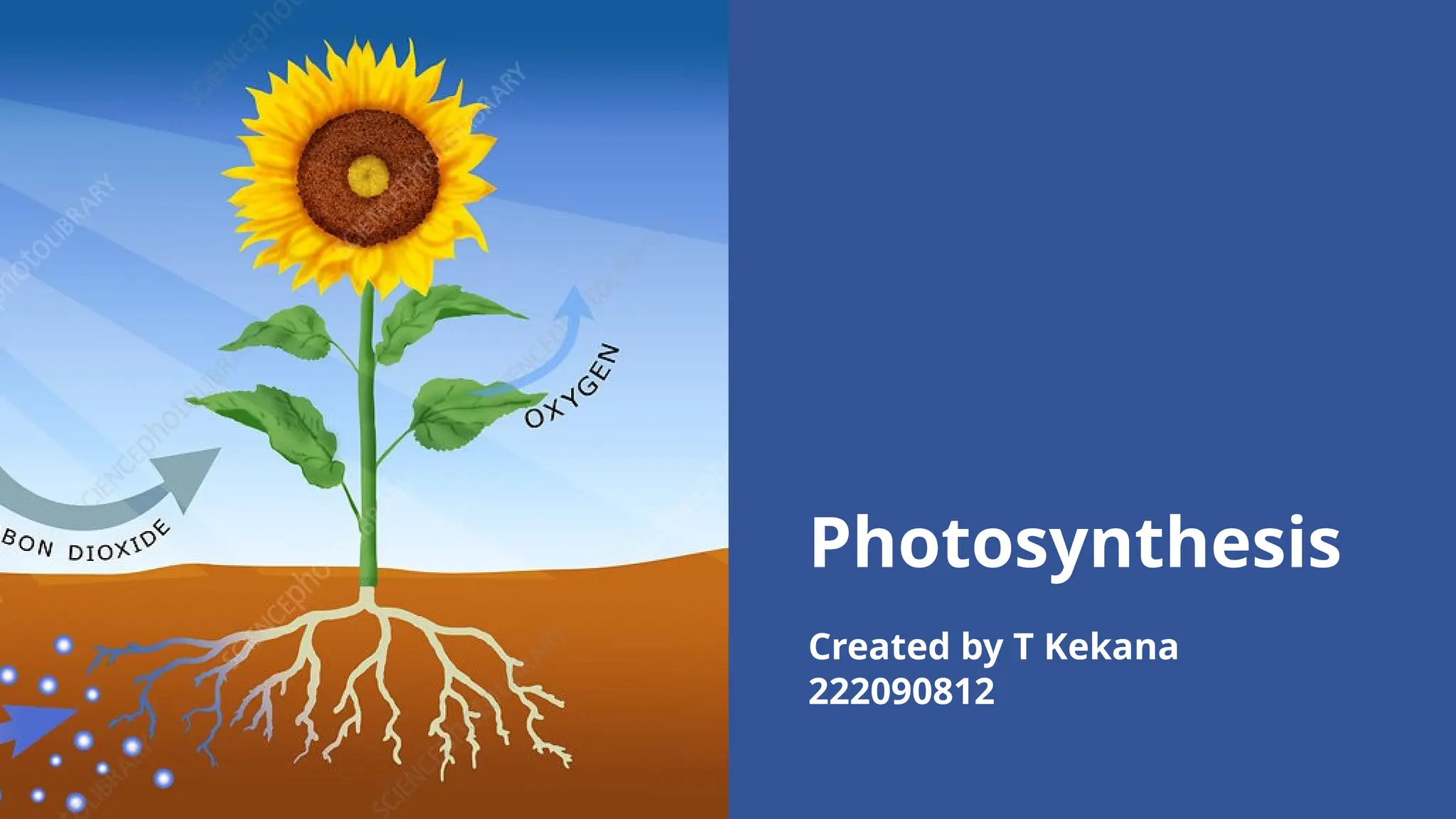
• During this process, organisms use carbon dioxide from the
atmosphere and water from the soil to produces and release oxygen
as a by product.
• This process occurs in the chloroplasts of plant cells where the light
dependent reactions generates ATP and NADPH and the light
independent reactions use these products to fix carbon into
glucose.
4.
History of
Photosynthesis
• Ancienttimes: Thought plants ate
soil
• 1600s- 1800s: Scientists discovered
pants use water, sunlight and CO2.
• 1900s: Discovered chlorophyll and
the steps of photosynthesis.
• Today: We know photosysntheis is
how plants convert light into
chemical energy and release oxygen.
5.
Equation of
photosynthesis
• Theprocess of photosynthesis can be summarized by the
following equation.
• CO2 + H2O + light chlorophyll - C6H12O6 + O2
• enzymes
• The same equation can be written out in words as follows:
• Carbon dioxide + water + light chlorophyll glucose +
oxygen enzymes
•
Light phase
• Thereactions of the light phase take place in
the grana of the chloroplast which contain
chlorophyll.
• The chlorophyll molecules absorb light energy.
• This energy is used in two ways, namely:
• It is used to from the energy carrier ATP
• It is used to split water molecules to release
high energy hydrogen atoms and oxygen.
• The hydrogen atoms combine with coenzymes
which take them into the dark phase.
• The oxygen is released into the atmosphere as
a by product.
8.
Dark Phase
• Thereactions of the dark phase
take place in the stroma of the
chloroplast .
• Carbon dioxide provides carbon
and oxygen which combines with
the high energy hydrogen atoms
of the light phase to from energy
rich carbohydrates such as
glucose and starch.
• The high energy hydrogen atoms
and the ATP from the light phase
provide the required energy for
this process.
• All the reactions of the dark
phase are controlled by enzymes.
9.
Factors affecting therate of
photosynthesis (Internal
factors)
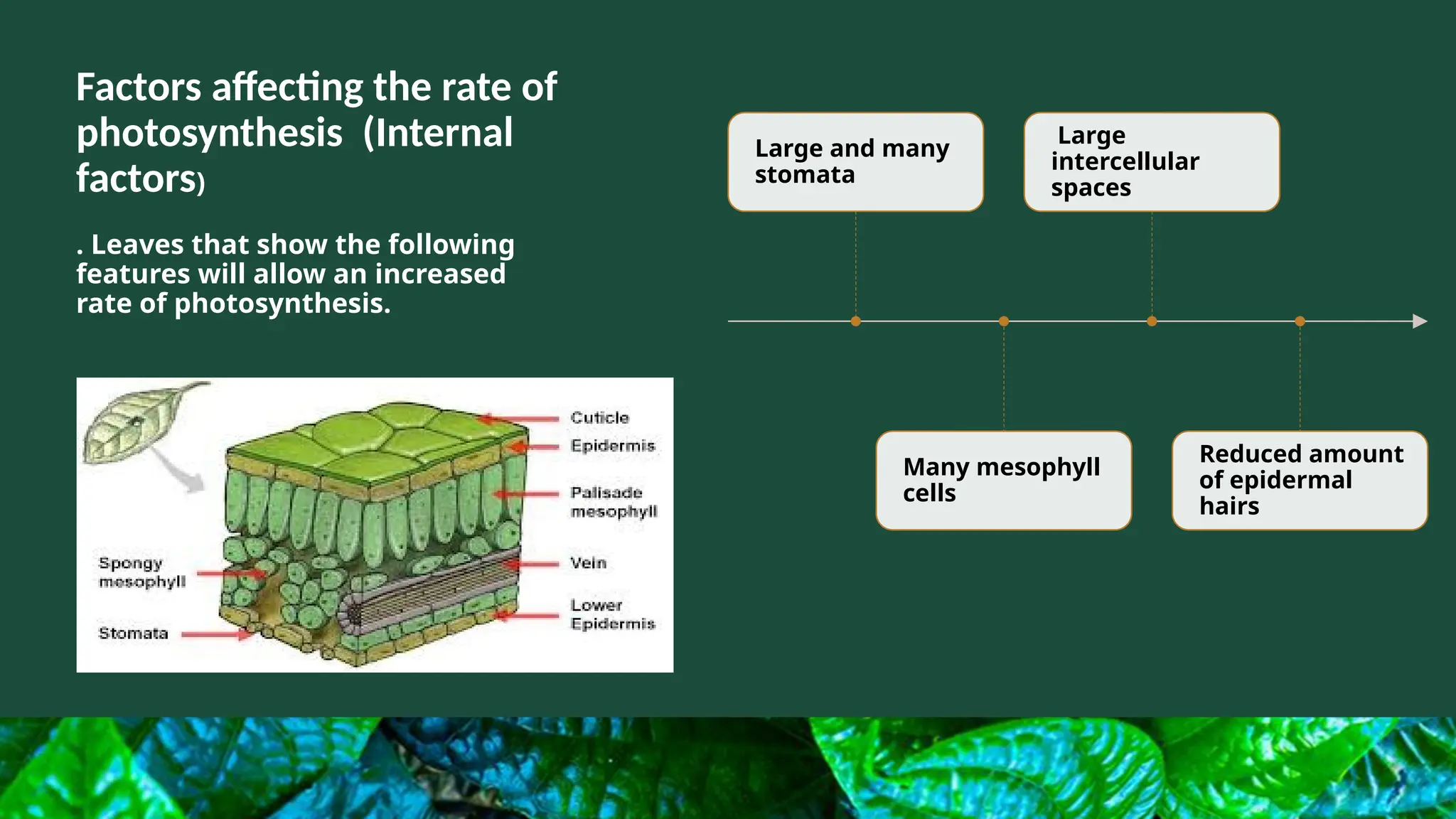
. Leaves that show the following
features will allow an increased
rate of photosynthesis.
Large and many
stomata
Many mesophyll
cells
Large
intercellular
spaces
Reduced amount
of epidermal
hairs
10.
External factors
1. Thecarbon dioxide concentration
• At low CO2 levels, photosynthesis is slow because there isn’t
enough raw material for glucose for glucose production.
• As CO2 concentration increases the rate of photosynthesis
increases proportionally
• At a certain point, the rate of photosynthesis reaches a
plateau, beyond this point, even if CO2 increases the rate
does not rise because another factor like light intensity or
temperature becomes limiting.
11.
2. Light intensity
•The rate of photosynthesis
increases as the light
intensity increases.
• When a certain light
intensity is reached, the
rate of photosynthesis
levels off as a result of
other limiting factors such
as insufficient water or
carbon dioxide.
12.
3. Temperature
• Theoptimum temperature for
photosynthesis in mesophytic
plants is 25 degrees Celsius.
• Therefore, as the temperature
rises to 25 the rate of
photosynthesis increases.
• Any further increase in
temperature past 25 will result in
a decrease in the rate of
photosynthesis because the
enzymes of photosynthesis
become denatured.
13.
Importance of
photosynthesis
1. Provisionof food
• Green plants trap light energy and
manufacture organic compounds during
photosynthesis.
• Most animals cannot make use of energy
directly from the sun because they do not
have chlorophyll to trap the radiant
energy.
• They obtain their energy by eating plants
or other animals which in turn may have
eaten plants.
• In this way light energy from the sun is
transferred to all living organisms.
14.
2. Control ofcarbon
dioxide/oxygen levels
in the atmosphere
• Plant and animal respiration, burning of fuels and
decay processes all release carbon dioxide into
the atmosphere.
• If allowed to accumulate this carbon dioxide will
be harmful to living organisms.
• The process of photosynthesis ensures that this
does not occur by using up large amounts of
carbon dioxide.
• In addition, photosynthesis releases oxygen,
which is used by plants and animals to release
energy to maintain life during the process of
cellular respiration.
• Photosynthesis thus maintains the carbon
dioxide/oxygen ratio at a constant level.
15.
References
• Cecile, C(2015) Photosynthesis from slide share at Christabelle Cécile presentations
• Kashyap, V (2016) Photosynthesis from slide share at Vikas Kashyap presentations
• Beck, S (2011) Photosynthesis introduction for Advanced Biology from slide share at
Photosynthesis introduction for Advanced Biology 9th grade | PPT
• Noori, HZ (2015) Photosynthesis from slide share at Photosynthesis | PPTX | Chemistry | Science
• Tidke, S (2020) Photosynthesis (Light and Dark reaction of photosynthesis) from slide share at
Photosynthesis (Light and Dark reaction of photosynthesis) | PPTX | Chemistry | Science
• Majid, A (2016) Light reaction of photosynthesis from slide share at
Light reaction of photosynthesis | PPTX | Chemistry | Science
• Shaw, A (2019) Dark reaction from slide share at Dark reaction | PDF






![Photosyntehsis PPT [Autosaved] Version two](https://cdn.slidesharecdn.com/ss_thumbnails/photosyntehsispptautosaved-241013005258-1d7c6b45-thumbnail.jpg?width=640&height=640&fit=bounds)


