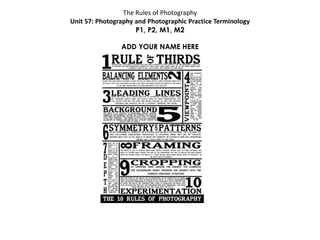
The Rules of Photography
Unit 57: Photography and Photographic Practice Terminology
P1, P2, M1, M2
ADD YOUR NAME HERE
Rule of thirds
•

•

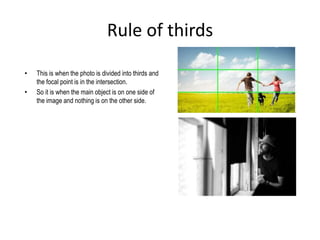
This is when the photo is divided into thirds and
the focal point is in the intersection.
So it is when the main object is on one side of
the image and nothing is on the other side.
Framing
•

•
•

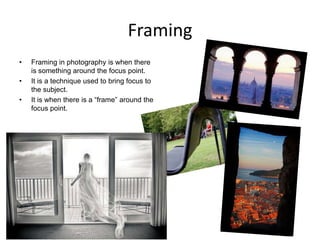
Framing in photography is when there
is something around the focus point.
It is a technique used to bring focus to
the subject.
It is when there is a “frame” around the
focus point.
Leading Lines
•

•

This is for taking you eye from the
foreground to the background.
For example roads and paths.
Balancing Elements
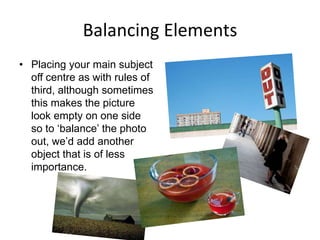
• Placing your main subject
off centre as with rules of
third, although sometimes
this makes the picture
look empty on one side
so to „balance‟ the photo
out, we‟d add another
object that is of less
importance.
Symmetry & Patterns
•

•
•
•

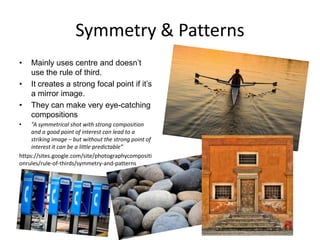
Mainly uses centre and doesn‟t
use the rule of third.
It creates a strong focal point if it‟s
a mirror image.
They can make very eye-catching
compositions

“A symmetrical shot with strong composition
and a good point of interest can lead to a
striking image – but without the strong point of
interest it can be a little predictable”
https://sites.google.com/site/photographycompositi
onrules/rule-of-thirds/symmetry-and-patterns
Depth of Field
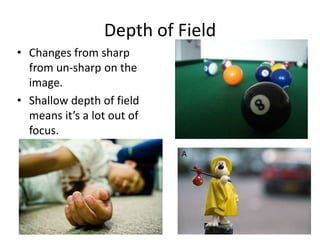
• Changes from sharp
from un-sharp on the
image.
• Shallow depth of field
means it’s a lot out of
focus.

Photography rules powerpoint

  • 1.
    The Rules ofPhotography Unit 57: Photography and Photographic Practice Terminology P1, P2, M1, M2 ADD YOUR NAME HERE
  • 2.
    Rule of thirds • • Thisis when the photo is divided into thirds and the focal point is in the intersection. So it is when the main object is on one side of the image and nothing is on the other side.
  • 3.
    Framing • • • Framing in photographyis when there is something around the focus point. It is a technique used to bring focus to the subject. It is when there is a “frame” around the focus point.
  • 4.
    Leading Lines • • This isfor taking you eye from the foreground to the background. For example roads and paths.
  • 5.
    Balancing Elements • Placingyour main subject off centre as with rules of third, although sometimes this makes the picture look empty on one side so to „balance‟ the photo out, we‟d add another object that is of less importance.
  • 6.
    Symmetry & Patterns • • • • Mainlyuses centre and doesn‟t use the rule of third. It creates a strong focal point if it‟s a mirror image. They can make very eye-catching compositions “A symmetrical shot with strong composition and a good point of interest can lead to a striking image – but without the strong point of interest it can be a little predictable” https://sites.google.com/site/photographycompositi onrules/rule-of-thirds/symmetry-and-patterns
  • 7.
    Depth of Field •Changes from sharp from un-sharp on the image. • Shallow depth of field means it’s a lot out of focus.