Perspective Close-up Frame Movement Photography is the process of recording pictures by means of capturing light on a light-sensitive medium, such as a film or electronic sensor. STYLE What can you see? How was it achieved? Colour Composition Camera Position Light
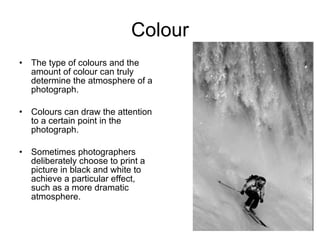
Colour The type of  colours and the amount of colour can truly determine the atmosphere of a photograph.  Colours can draw the  attention to a certain point in the photograph. Sometimes photographers deliberately choose to print a picture in black and white to achieve a particular effect, such as a more dramatic atmosphere.
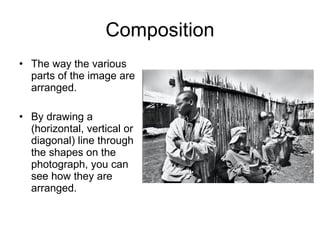
Composition The way the various parts of the image are arranged.  By drawing a (horizontal, vertical or diagonal) line through the shapes on the photograph, you can see how they are arranged.
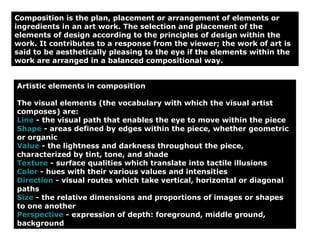
Artistic elements in composition The visual elements (the vocabulary with which the visual artist composes) are: Line  - the visual path that enables the eye to move within the piece  Shape  - areas defined by edges within the piece, whether geometric or organic  Value  - the lightness and darkness throughout the piece, characterized by tint, tone, and shade  Texture  - surface qualities which translate into tactile illusions  Color  - hues with their various values and intensities  Direction  - visual routes which take vertical, horizontal or diagonal paths  Size  - the relative dimensions and proportions of images or shapes to one another  Perspective  - expression of depth: foreground, middle ground, background  Composition is the plan, placement or arrangement of elements or ingredients in an art work. The selection and placement of the elements of design according to the principles of design within the work. It contributes to a response from the viewer; the work of art is said to be aesthetically pleasing to the eye if the elements within the work are arranged in a balanced compositional way.
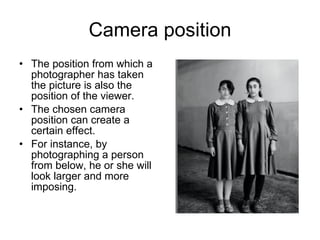
Camera position The position from which a photographer has taken the picture is also the position of the viewer.  The chosen camera position can create a certain effect.  For instance, by photographing a person from below, he or she will look larger and more imposing.
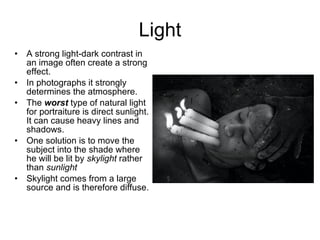
Light A strong light-dark contrast in an image often create a strong effect.  In photographs it strongly determines the atmosphere. The  worst  type of natural light for portraiture is direct sunlight. It can cause heavy lines and shadows. One solution is to move the subject into the shade where he will be lit by  skylight  rather than  sunlight Skylight comes from a large source and is therefore diffuse.
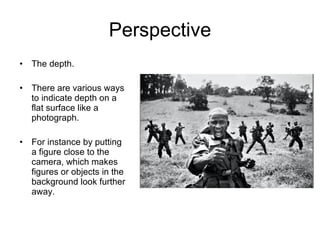
Perspective The depth. There are various ways to indicate depth on a flat surface like a photograph. For instance by putting a figure close to the camera, which makes figures or objects in the background look further away.
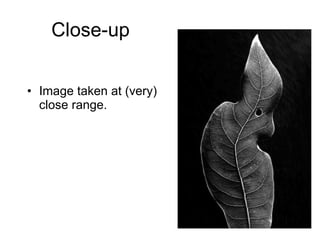
Close-up Image taken at (very) close range.
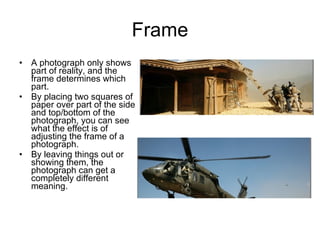
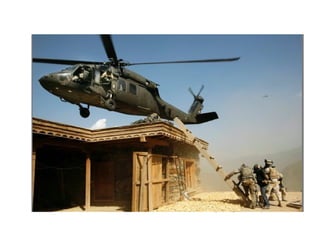
Frame A photograph only shows part of reality, and the frame determines which part. By placing two squares of paper over part of the side and top/bottom of the photograph, you can see what the effect is of adjusting the frame of a photograph. By leaving things out or showing them, the photograph can get a completely different meaning.
 
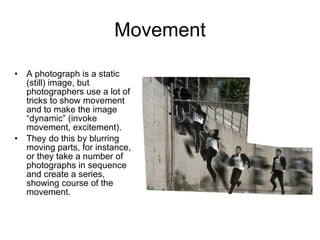
Movement A photograph is a static (still) image, but photographers use a lot of tricks to show movement and to make the image “dynamic” (invoke movement, excitement). They do this by blurring moving parts, for instance, or they take a number of photographs in sequence and create a series, showing course of the movement.

Photography

  • 1.
    Perspective Close-up FrameMovement Photography is the process of recording pictures by means of capturing light on a light-sensitive medium, such as a film or electronic sensor. STYLE What can you see? How was it achieved? Colour Composition Camera Position Light
  • 2.
    Colour The typeof colours and the amount of colour can truly determine the atmosphere of a photograph. Colours can draw the attention to a certain point in the photograph. Sometimes photographers deliberately choose to print a picture in black and white to achieve a particular effect, such as a more dramatic atmosphere.
  • 3.
    Composition The waythe various parts of the image are arranged. By drawing a (horizontal, vertical or diagonal) line through the shapes on the photograph, you can see how they are arranged.
  • 4.
    Artistic elements incomposition The visual elements (the vocabulary with which the visual artist composes) are: Line - the visual path that enables the eye to move within the piece Shape - areas defined by edges within the piece, whether geometric or organic Value - the lightness and darkness throughout the piece, characterized by tint, tone, and shade Texture - surface qualities which translate into tactile illusions Color - hues with their various values and intensities Direction - visual routes which take vertical, horizontal or diagonal paths Size - the relative dimensions and proportions of images or shapes to one another Perspective - expression of depth: foreground, middle ground, background Composition is the plan, placement or arrangement of elements or ingredients in an art work. The selection and placement of the elements of design according to the principles of design within the work. It contributes to a response from the viewer; the work of art is said to be aesthetically pleasing to the eye if the elements within the work are arranged in a balanced compositional way.
  • 5.
    Camera position Theposition from which a photographer has taken the picture is also the position of the viewer. The chosen camera position can create a certain effect. For instance, by photographing a person from below, he or she will look larger and more imposing.
  • 6.
    Light A stronglight-dark contrast in an image often create a strong effect. In photographs it strongly determines the atmosphere. The worst type of natural light for portraiture is direct sunlight. It can cause heavy lines and shadows. One solution is to move the subject into the shade where he will be lit by skylight rather than sunlight Skylight comes from a large source and is therefore diffuse.
  • 7.
    Perspective The depth.There are various ways to indicate depth on a flat surface like a photograph. For instance by putting a figure close to the camera, which makes figures or objects in the background look further away.
  • 8.
    Close-up Image takenat (very) close range.
  • 9.
    Frame A photographonly shows part of reality, and the frame determines which part. By placing two squares of paper over part of the side and top/bottom of the photograph, you can see what the effect is of adjusting the frame of a photograph. By leaving things out or showing them, the photograph can get a completely different meaning.
  • 10.
  • 11.
    Movement A photographis a static (still) image, but photographers use a lot of tricks to show movement and to make the image “dynamic” (invoke movement, excitement). They do this by blurring moving parts, for instance, or they take a number of photographs in sequence and create a series, showing course of the movement.