KETONE
S
GENERAL INTRODUCTION OF KETONES
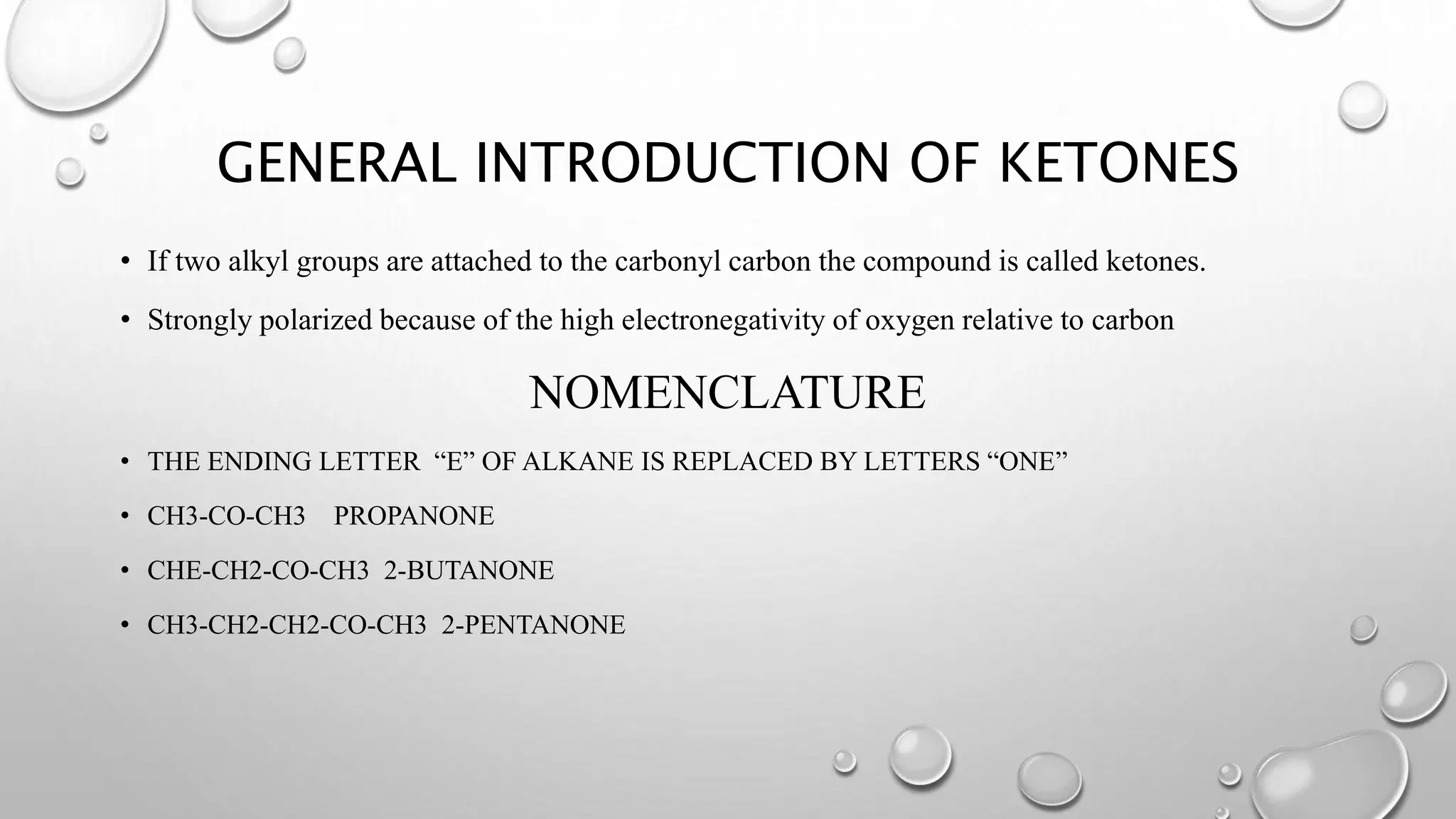
• If two alkyl groups are attached to the carbonyl carbon the compound is called ketones.
• Strongly polarized because of the high electronegativity of oxygen relative to carbon
NOMENCLATURE
• THE ENDING LETTER “E” OF ALKANE IS REPLACED BY LETTERS “ONE”
• CH3-CO-CH3 PROPANONE
• CHE-CH2-CO-CH3 2-BUTANONE
• CH3-CH2-CH2-CO-CH3 2-PENTANONE
GENERAL FORMULA OF KETONES
Here, R and R’ can
be an alkyl group
or aryl group.
aryl
group.
METHODS OF PREPARATION OF KETONES
1. OXIDATION OF SECONDARY ALCOHOLS
2. CATALYTIC DEHYDROGENATION OF SECONDARY ALCOHOLS:
3. HYDRATION OF ALKYNES:
4. HYDROLYSIS OF DIHALIDES
5. WACKER PROCESS (CATALYST CUCI2)
PHYSICAL PROPERTIES
1. Acetone is colourless
2. Volatile in nature (acetone)
3. Highly flammable liquid higher members are solids
4. Boiling point increases with increase in molecular
weight
5. Soluble in water , ethanol, and ether in all proportions
6. Have pleasant smell
CHEMICAL PROPERTIES
1. ADDITION OF HCN
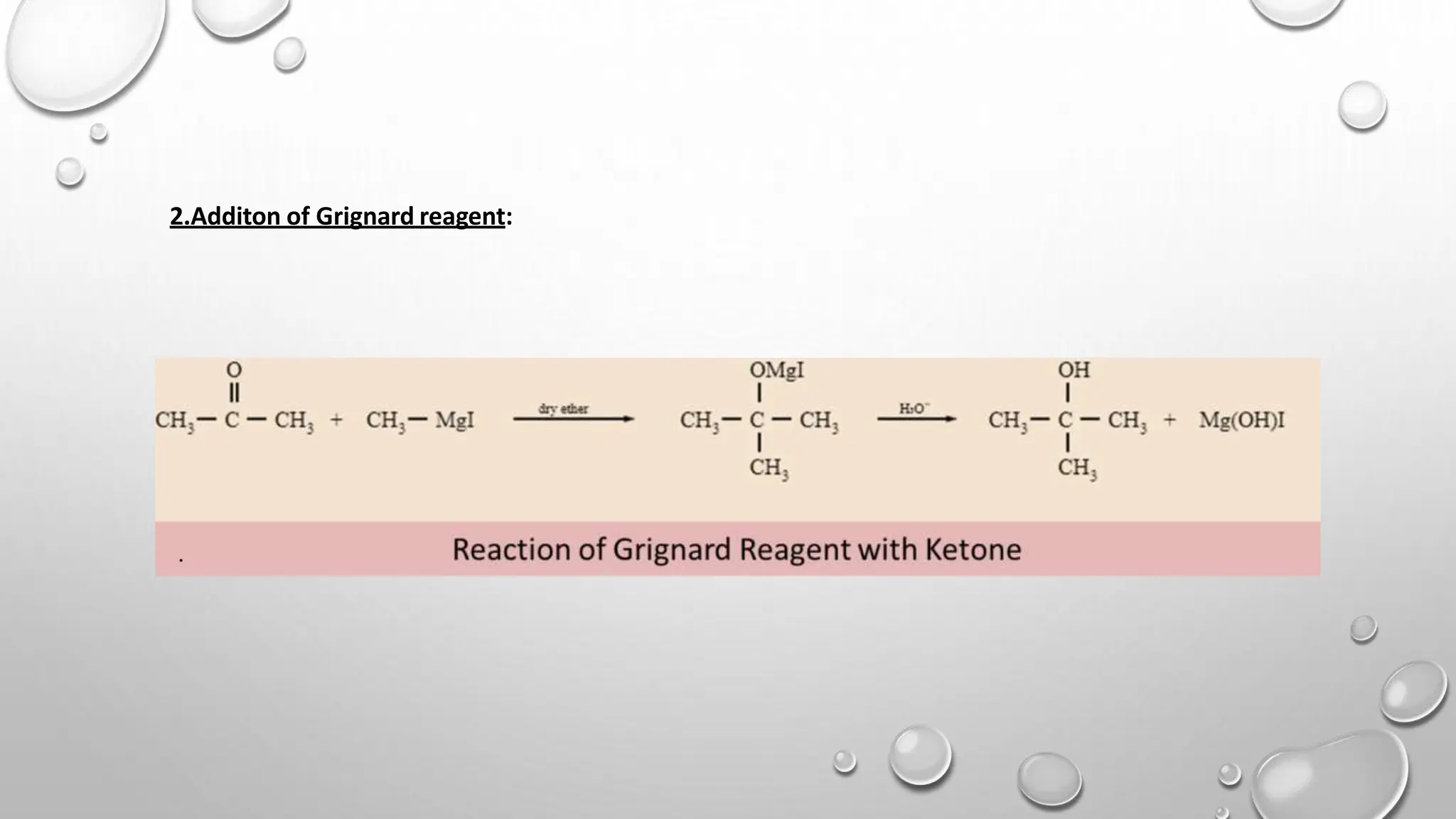
2.Additon of Grignard reagent:
.
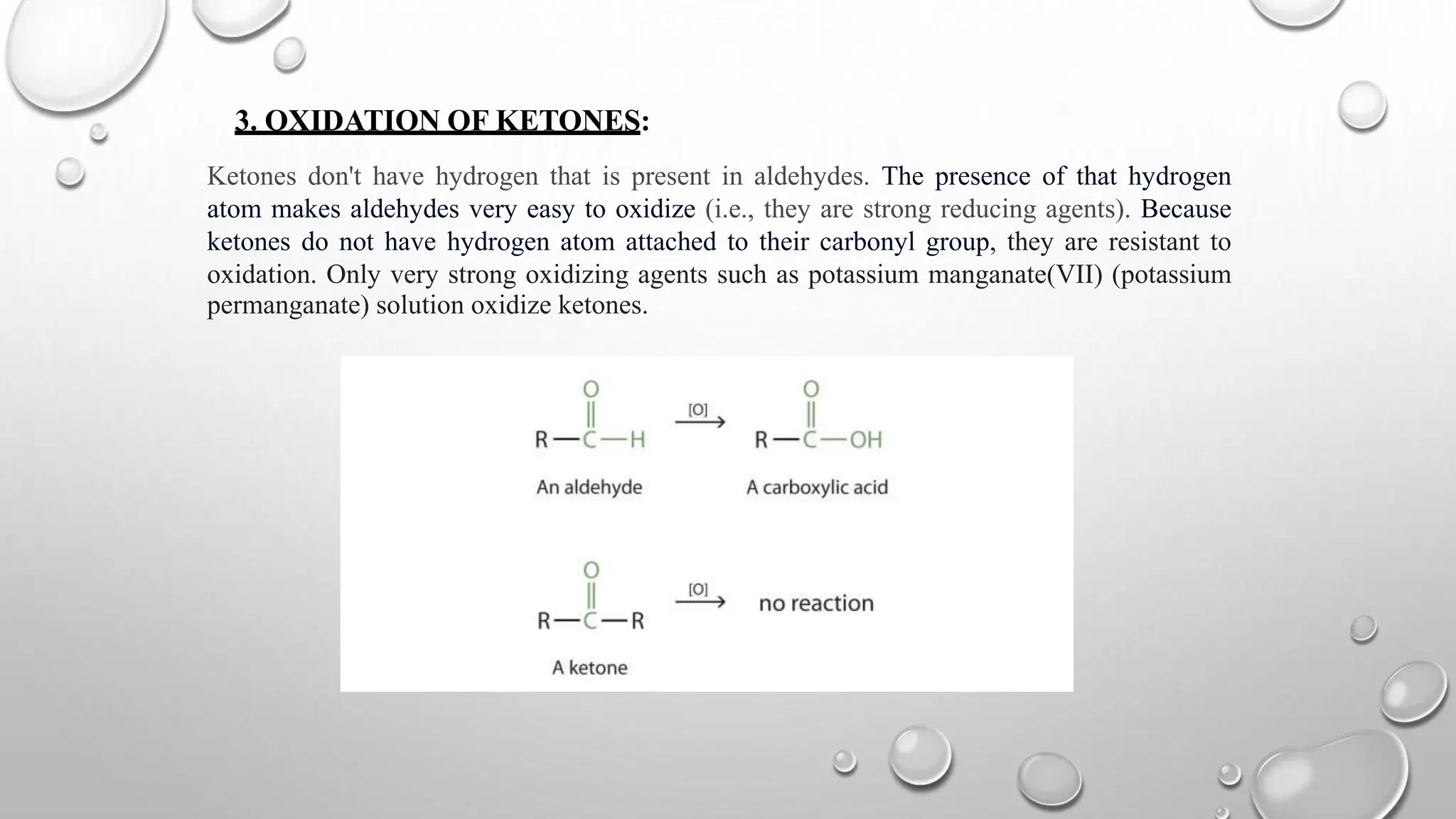
3. OXIDATION OF KETONES:
Ketones don't have hydrogen that is present in aldehydes. The presence of that hydrogen
atom makes aldehydes very easy to oxidize (i.e., they are strong reducing agents). Because
ketones do not have hydrogen atom attached to their carbonyl group, they are resistant to
oxidation. Only very strong oxidizing agents such as potassium manganate(VII) (potassium
permanganate) solution oxidize ketones.
4. HALOGINATION
5. REDUCTION
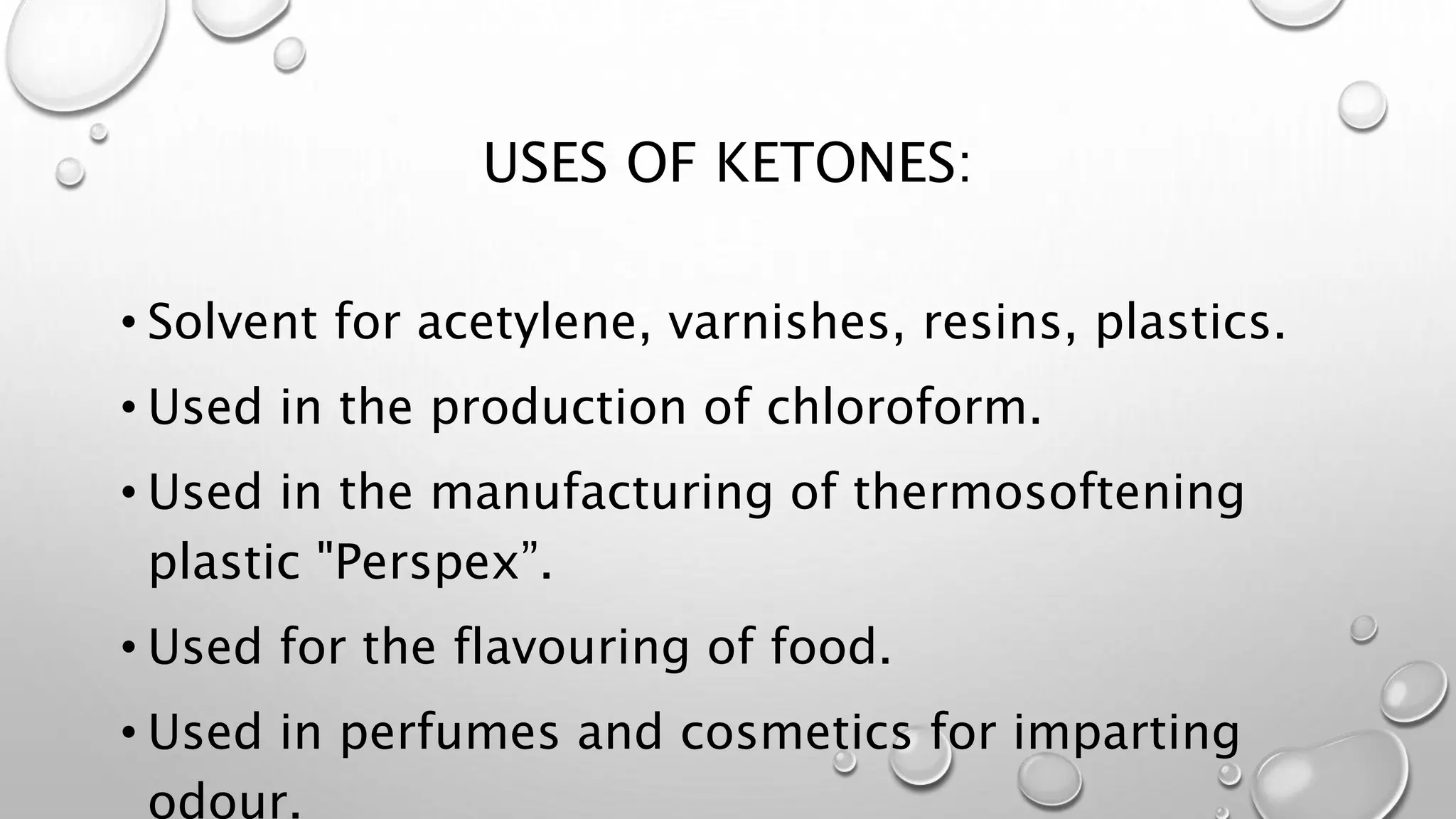
USES OF KETONES:
• Solvent for acetylene, varnishes, resins, plastics.
• Used in the production of chloroform.
• Used in the manufacturing of thermosoftening
plastic "Perspex”.
• Used for the flavouring of food.
• Used in perfumes and cosmetics for imparting
odour.
PHARMACEUTICAL USES OF KETONES
• Chlorthalidone:
 Its a diuretic used for hypertension treatment
• Bromfenac:
 Used to treat postoperative pain and eye inflamation
• Droperidol:
 It is dopamine antagonist used to prevent and treat
postoperative nausea and vomiting.

PHMD102-Ketones presentation_149915.pptx

  • 1.
  • 2.
    GENERAL INTRODUCTION OFKETONES • If two alkyl groups are attached to the carbonyl carbon the compound is called ketones. • Strongly polarized because of the high electronegativity of oxygen relative to carbon NOMENCLATURE • THE ENDING LETTER “E” OF ALKANE IS REPLACED BY LETTERS “ONE” • CH3-CO-CH3 PROPANONE • CHE-CH2-CO-CH3 2-BUTANONE • CH3-CH2-CH2-CO-CH3 2-PENTANONE
  • 3.
    GENERAL FORMULA OFKETONES Here, R and R’ can be an alkyl group or aryl group. aryl group.
  • 4.
    METHODS OF PREPARATIONOF KETONES 1. OXIDATION OF SECONDARY ALCOHOLS
  • 5.
    2. CATALYTIC DEHYDROGENATIONOF SECONDARY ALCOHOLS: 3. HYDRATION OF ALKYNES:
  • 6.
    4. HYDROLYSIS OFDIHALIDES 5. WACKER PROCESS (CATALYST CUCI2)
  • 7.
    PHYSICAL PROPERTIES 1. Acetoneis colourless 2. Volatile in nature (acetone) 3. Highly flammable liquid higher members are solids 4. Boiling point increases with increase in molecular weight 5. Soluble in water , ethanol, and ether in all proportions 6. Have pleasant smell
  • 8.
  • 9.
  • 10.
    3. OXIDATION OFKETONES: Ketones don't have hydrogen that is present in aldehydes. The presence of that hydrogen atom makes aldehydes very easy to oxidize (i.e., they are strong reducing agents). Because ketones do not have hydrogen atom attached to their carbonyl group, they are resistant to oxidation. Only very strong oxidizing agents such as potassium manganate(VII) (potassium permanganate) solution oxidize ketones.
  • 11.
  • 12.
    USES OF KETONES: •Solvent for acetylene, varnishes, resins, plastics. • Used in the production of chloroform. • Used in the manufacturing of thermosoftening plastic "Perspex”. • Used for the flavouring of food. • Used in perfumes and cosmetics for imparting odour.
  • 13.
    PHARMACEUTICAL USES OFKETONES • Chlorthalidone:  Its a diuretic used for hypertension treatment • Bromfenac:  Used to treat postoperative pain and eye inflamation • Droperidol:  It is dopamine antagonist used to prevent and treat postoperative nausea and vomiting.