ALDEHYDES, KETONES
AND
CARBOXYLIC ACIDS
Nomenclature
• Common names
IUPAC Name
Structure of the Carbonyl Group
• Hybridisation: sp2
• Shape: trigonal planar
• Bond angle: 120
• The carbon-oxygen double bond is polarised due to higher
electronegativity of oxygen relative to carbon.
• Hence, the carbonyl carbon is an electrophilic (Lewis acid), and
carbonyl oxygen, a nucleophilic (Lewis base) centre.
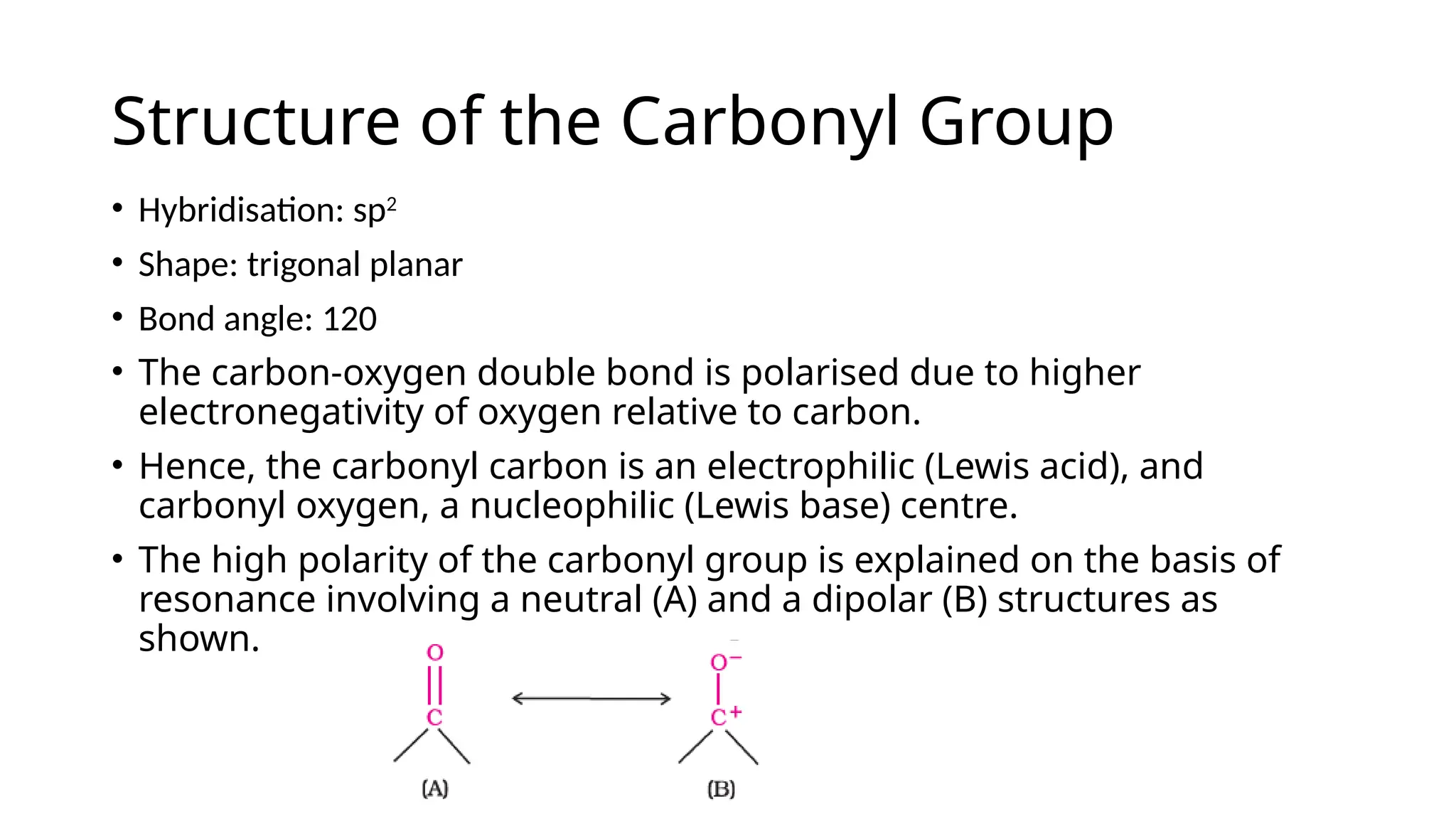
• The high polarity of the carbonyl group is explained on the basis of
resonance involving a neutral (A) and a dipolar (B) structures as
shown.
Preparation of Aldehydes and Ketones
1. By oxidation of alcohols
2. By dehydrogenation of alcohols
3. From hydrocarbons
(i) By ozonolysis of alkenes:
(ii) By hydration of alkynes:
Preparation of Aldehydes
• 1. From acyl chloride (Rosenmund reduction)
• 2. From nitriles and esters
: Stephen
reaction
3. From hydrocarbons
(i) By oxidation of methylbenzene
(ii) (a) Use of chromyl chloride (CrO2Cl2):
This reaction is called Etard reaction.
(b) Use of chromic oxide (CrO3):
benzylidene diacetate
(ii) By side chain chlorination followed by hydrolysis
(iii) By Gatterman – Koch reaction
Preparation of Ketones
• Treatment of acyl chlorides with dialkylcadmium, prepared by the reaction of
cadmium chloride with Grignard reagent, gives ketones.
2. From nitriles
3. From benzene or substituted benzenes (Friedel-Crafts acylation
reaction)
Physical Properties
• The boiling points of aldehydes and ketones are higher than hydrocarbons and ethers
of comparable molecular masses. It is due to weak molecular association in
aldehydes and ketones arising out of the dipole-dipole interactions.
• Their boiling points are lower than those of alcohols of similar molecular masses due
to absence of intermolecular hydrogen bonding.
• The solubility of aldehydes and ketones decreases rapidly on increasing the length of
alkyl chain.
• All aldehydes and ketones are fairly soluble in organic solvents like benzene, ether,
methanol, chloroform, etc.
• Higher aldehydes and ketones are used in the blending of perfumes and flavouring
agents due to their fragrance.
ALDEHYDES, KETONES AND CARBOXYLIC ACIDS. Online class notes.pptx

ALDEHYDES, KETONES AND CARBOXYLIC ACIDS. Online class notes.pptx

  • 1.
  • 2.
  • 3.
  • 5.
    Structure of theCarbonyl Group • Hybridisation: sp2 • Shape: trigonal planar • Bond angle: 120 • The carbon-oxygen double bond is polarised due to higher electronegativity of oxygen relative to carbon. • Hence, the carbonyl carbon is an electrophilic (Lewis acid), and carbonyl oxygen, a nucleophilic (Lewis base) centre. • The high polarity of the carbonyl group is explained on the basis of resonance involving a neutral (A) and a dipolar (B) structures as shown.
  • 6.
    Preparation of Aldehydesand Ketones 1. By oxidation of alcohols 2. By dehydrogenation of alcohols
  • 7.
    3. From hydrocarbons (i)By ozonolysis of alkenes: (ii) By hydration of alkynes:
  • 8.
    Preparation of Aldehydes •1. From acyl chloride (Rosenmund reduction) • 2. From nitriles and esters : Stephen reaction
  • 9.
    3. From hydrocarbons (i)By oxidation of methylbenzene (ii) (a) Use of chromyl chloride (CrO2Cl2): This reaction is called Etard reaction. (b) Use of chromic oxide (CrO3): benzylidene diacetate
  • 10.
    (ii) By sidechain chlorination followed by hydrolysis (iii) By Gatterman – Koch reaction
  • 11.
    Preparation of Ketones •Treatment of acyl chlorides with dialkylcadmium, prepared by the reaction of cadmium chloride with Grignard reagent, gives ketones.
  • 12.
    2. From nitriles 3.From benzene or substituted benzenes (Friedel-Crafts acylation reaction)
  • 14.
    Physical Properties • Theboiling points of aldehydes and ketones are higher than hydrocarbons and ethers of comparable molecular masses. It is due to weak molecular association in aldehydes and ketones arising out of the dipole-dipole interactions. • Their boiling points are lower than those of alcohols of similar molecular masses due to absence of intermolecular hydrogen bonding. • The solubility of aldehydes and ketones decreases rapidly on increasing the length of alkyl chain. • All aldehydes and ketones are fairly soluble in organic solvents like benzene, ether, methanol, chloroform, etc. • Higher aldehydes and ketones are used in the blending of perfumes and flavouring agents due to their fragrance.