Philippines: World War II
By: Patrick Blanco
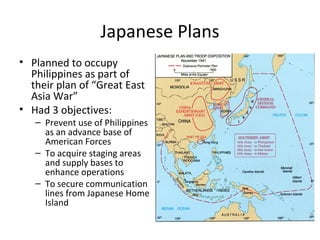
Japanese Plans
• Planned to occupy
Philippines as part of
their plan of “Great East
Asia War”
• Had 3 objectives:
– Prevent use of Philippines
as an advance base of
American Forces
– To acquire staging areas
and supply bases to
enhance operations
– To secure communication
lines from Japanese Home
Island
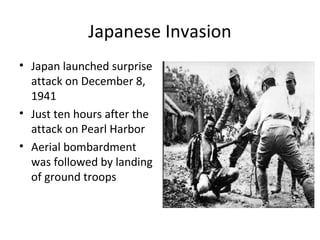
Japanese Invasion
• Japan launched surprise
attack on December 8,
1941
• Just ten hours after the
attack on Pearl Harbor
• Aerial bombardment
was followed by landing
of ground troops
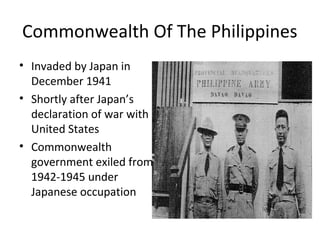
Commonwealth Of The Philippines
• Invaded by Japan in
December 1941
• Shortly after Japan’s
declaration of war with
United States
• Commonwealth
government exiled from
1942-1945 under
Japanese occupation
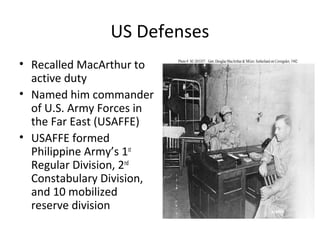
US Defenses
• Recalled MacArthur to
active duty
• Named him commander
of U.S. Army Forces in
the Far East (USAFFE)
• USAFFE formed
Philippine Army’s 1st
Regular Division, 2nd
Constabulary Division,
and 10 mobilized
reserve division
USAFFE
• Or U.S. Army Forces in the
Far East
• On July 31, 1941, the
Philippine Department had
22,532 assigned
• Half of whom were Filipino
• MacArthur recommended
the reassignment of the
department commander,
Maj. Gen. George Grunert
in October 1941
• MacArthur organized
USAFFE into 4 commands:
– The North Luzon Force
• Activated in Dec 3, 1941
• Under Major Gen. Jonathan
Wainwright
– The South Luzon Force
• Activated in Dec 13, 1941
• Under Brig. Gen. George M.
Parker Jr
– The Visayan-Mindanao Force
• Under Brig. Gen. William
Sharp
– USAFFE’s Reserve Force
• Under MacArthur’s direct
control
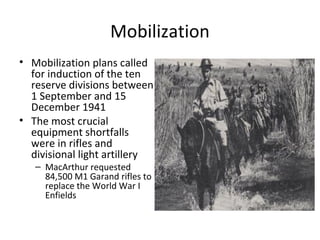
Mobilization
• Mobilization plans called
for induction of the ten
reserve divisions between
1 September and 15
December 1941
• The most crucial
equipment shortfalls
were in rifles and
divisional light artillery
– MacArthur requested
84,500 M1 Garand rifles to
replace the World War I
Enfields
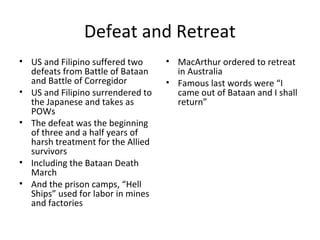
Defeat and Retreat
• US and Filipino suffered two
defeats from Battle of Bataan
and Battle of Corregidor
• US and Filipino surrendered to
the Japanese and takes as
POWs
• The defeat was the beginning
of three and a half years of
harsh treatment for the Allied
survivors
• Including the Bataan Death
March
• And the prison camps, “Hell
Ships” used for labor in mines
and factories
• MacArthur ordered to retreat
in Australia
• Famous last words were “I
came out of Bataan and I shall
return”
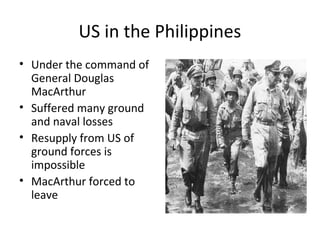
US in the Philippines
• Under the command of
General Douglas
MacArthur
• Suffered many ground
and naval losses
• Resupply from US of
ground forces is
impossible
• MacArthur forced to
leave
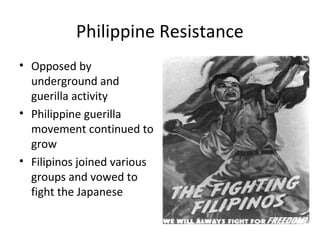
Philippine Resistance
• Opposed by
underground and
guerilla activity
• Philippine guerilla
movement continued to
grow
• Filipinos joined various
groups and vowed to
fight the Japanese
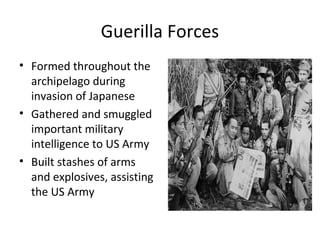
Guerilla Forces
• Formed throughout the
archipelago during
invasion of Japanese
• Gathered and smuggled
important military
intelligence to US Army
• Built stashes of arms
and explosives, assisting
the US Army
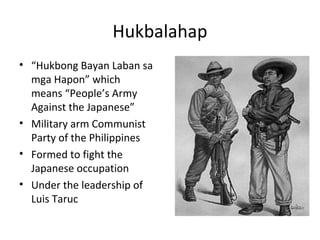
Hukbalahap
• “Hukbong Bayan Laban sa
mga Hapon” which
means “People’s Army
Against the Japanese”
• Military arm Communist
Party of the Philippines
• Formed to fight the
Japanese occupation
• Under the leadership of
Luis Taruc
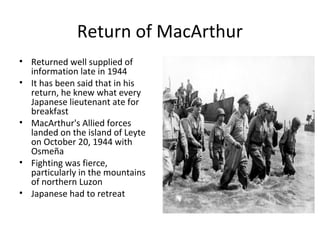
Return of MacArthur
• Returned well supplied of
information late in 1944
• It has been said that in his
return, he knew what every
Japanese lieutenant ate for
breakfast
• MacArthur's Allied forces
landed on the island of Leyte
on October 20, 1944 with
Osmeña
• Fighting was fierce,
particularly in the mountains
of northern Luzon
• Japanese had to retreat
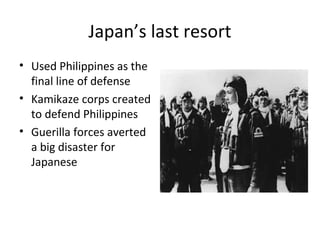
Japan’s last resort
• Used Philippines as the
final line of defense
• Kamikaze corps created
to defend Philippines
• Guerilla forces averted
a big disaster for
Japanese
Philippine’s Aftermath
• Filipino-American
resistance lasted for 3
months
• An estimated 1 million
Filipinos had been killed
• A large proportion
during the final months
of the war, and Manila
was extensively
damaged
• The valor of the Filipino
and American soldiers is
celebrated
• April 9th
in the
Philippines, Valor Day
or “Araw ng Kagitingan”
Bibliography
• http://countrystudies.us/philippines/21.htm
• http://philippinesfreepress.wordpress.com/20
06/04/09/world-war-ii-in-the-
philippines/#comments
• http://en.wikipedia.org/wiki/Japanese_occup
ation_of_the_Philippines
• http://en.wikipedia.org/wiki/Military_history_
of_the_Philippines_during_World_War_II

Philippineswwii 110516221426-phpapp01

  • 1.
    Philippines: World WarII By: Patrick Blanco
  • 2.
    Japanese Plans • Plannedto occupy Philippines as part of their plan of “Great East Asia War” • Had 3 objectives: – Prevent use of Philippines as an advance base of American Forces – To acquire staging areas and supply bases to enhance operations – To secure communication lines from Japanese Home Island
  • 3.
    Japanese Invasion • Japanlaunched surprise attack on December 8, 1941 • Just ten hours after the attack on Pearl Harbor • Aerial bombardment was followed by landing of ground troops
  • 4.
    Commonwealth Of ThePhilippines • Invaded by Japan in December 1941 • Shortly after Japan’s declaration of war with United States • Commonwealth government exiled from 1942-1945 under Japanese occupation
  • 5.
    US Defenses • RecalledMacArthur to active duty • Named him commander of U.S. Army Forces in the Far East (USAFFE) • USAFFE formed Philippine Army’s 1st Regular Division, 2nd Constabulary Division, and 10 mobilized reserve division
  • 6.
    USAFFE • Or U.S.Army Forces in the Far East • On July 31, 1941, the Philippine Department had 22,532 assigned • Half of whom were Filipino • MacArthur recommended the reassignment of the department commander, Maj. Gen. George Grunert in October 1941 • MacArthur organized USAFFE into 4 commands: – The North Luzon Force • Activated in Dec 3, 1941 • Under Major Gen. Jonathan Wainwright – The South Luzon Force • Activated in Dec 13, 1941 • Under Brig. Gen. George M. Parker Jr – The Visayan-Mindanao Force • Under Brig. Gen. William Sharp – USAFFE’s Reserve Force • Under MacArthur’s direct control
  • 7.
    Mobilization • Mobilization planscalled for induction of the ten reserve divisions between 1 September and 15 December 1941 • The most crucial equipment shortfalls were in rifles and divisional light artillery – MacArthur requested 84,500 M1 Garand rifles to replace the World War I Enfields
  • 8.
    Defeat and Retreat •US and Filipino suffered two defeats from Battle of Bataan and Battle of Corregidor • US and Filipino surrendered to the Japanese and takes as POWs • The defeat was the beginning of three and a half years of harsh treatment for the Allied survivors • Including the Bataan Death March • And the prison camps, “Hell Ships” used for labor in mines and factories • MacArthur ordered to retreat in Australia • Famous last words were “I came out of Bataan and I shall return”
  • 9.
    US in thePhilippines • Under the command of General Douglas MacArthur • Suffered many ground and naval losses • Resupply from US of ground forces is impossible • MacArthur forced to leave
  • 10.
    Philippine Resistance • Opposedby underground and guerilla activity • Philippine guerilla movement continued to grow • Filipinos joined various groups and vowed to fight the Japanese
  • 11.
    Guerilla Forces • Formedthroughout the archipelago during invasion of Japanese • Gathered and smuggled important military intelligence to US Army • Built stashes of arms and explosives, assisting the US Army
  • 12.
    Hukbalahap • “Hukbong BayanLaban sa mga Hapon” which means “People’s Army Against the Japanese” • Military arm Communist Party of the Philippines • Formed to fight the Japanese occupation • Under the leadership of Luis Taruc
  • 13.
    Return of MacArthur •Returned well supplied of information late in 1944 • It has been said that in his return, he knew what every Japanese lieutenant ate for breakfast • MacArthur's Allied forces landed on the island of Leyte on October 20, 1944 with Osmeña • Fighting was fierce, particularly in the mountains of northern Luzon • Japanese had to retreat
  • 14.
    Japan’s last resort •Used Philippines as the final line of defense • Kamikaze corps created to defend Philippines • Guerilla forces averted a big disaster for Japanese
  • 15.
    Philippine’s Aftermath • Filipino-American resistancelasted for 3 months • An estimated 1 million Filipinos had been killed • A large proportion during the final months of the war, and Manila was extensively damaged • The valor of the Filipino and American soldiers is celebrated • April 9th in the Philippines, Valor Day or “Araw ng Kagitingan”
  • 16.
    Bibliography • http://countrystudies.us/philippines/21.htm • http://philippinesfreepress.wordpress.com/20 06/04/09/world-war-ii-in-the- philippines/#comments •http://en.wikipedia.org/wiki/Japanese_occup ation_of_the_Philippines • http://en.wikipedia.org/wiki/Military_history_ of_the_Philippines_during_World_War_II