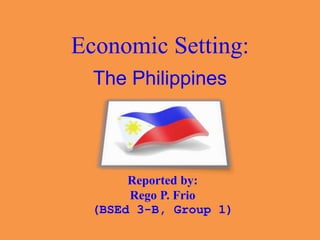
Economic Setting:
The Philippines
Reported by:
Rego P. Frio
(BSEd 3-B, Group 1)
Economic Setting:
The Philippines
• Before World War II (1939-1945)
the economy of the Philippines
was based on the production
and export of a narrow range of
primary commodities, mainly
agricultural and forest products.
The Supreme Court of the
Economic Setting:
The Philippines
United States ruled in the early
20th century that Philippine
goods could enter the American
market without tariff restraints.
In the trade that followed, the
United States imported
Philippine agricultural goods and
Economic Setting:
The Philippines
provided the Philippines with
most manufactured items. The
Philippines had virtually no
manufacturing other than the
processing of food products,
primarily for the United States
market.
Economic Setting:
The Philippines
After independence in 1946, the
Philippines initially remained
dependent on free-trade access
to United States markets for its
agricultural commodities,
especially sugar. Government
restrictions on import spending
Economic Setting:
The Philippines
spurred an increase in
manufacturing for the domestic
market. During the 1950s the
Philippines tried to become an
industrialized nation. In the long
term, however, protectionist
economic policies provided little
Economic Setting:
The Philippines
incentive for the development of
labor-intensive export
manufacturing. In the 1970s the
government implemented a
policy to encourage export
manufactures and foreign
investment, and the rate of
Economic Setting:
The Philippines
economic growth accelerated.
The country’s foreign debt rose
dramatically, however, and by
the mid-1970s the country faced
problems meeting payments on
its international loans. This
problem was compounded by a
Economic Setting:
The Philippines
worldwide recession in the early
1980s. The recession resulted in
less demand for Philippine
manufactures, and the economy
moved into a deep recession in
the mid-1980s.
Economic Setting:
The Philippines
At this time the Philippine
economy also suffered from
more than a decade of economic
mismanagement under
President Ferdinand Marcos,
who ruled by decree after
declaring martial law in 1972.
Economic Setting:
The Philippines
Under Marcos the government
greatly expanded the number of
public-sector enterprises.
Government-mandated
monopolies were set up in
various sectors, while subsidies
and special privileges were
Economic Setting:
The Philippines
awarded to close associates of
Marcos. This concentration of
ownership and control among
the president’s closest business
associates, friends, and relatives
became known as crony
capitalism. The system allowed
Economic Setting:
The Philippines
for rampant corruption. During
the economic recession of the
1980s, many of the crony
enterprises experienced severe
financial difficulties. This in turn
undermined the viability of the
big government-owned banks
and led to an economic crisis.
Economic Setting:
The Philippines
Major structural reforms
implemented during succeeding
government administrations
dismantled the monopolies and
promoted privatization.
Measures to stabilize the
economy involved compliance
Economic Setting:
The Philippines
with a severe austerity program
of the International Monetary
Fund (IMF). Economic reforms
reduced government
intervention in the economy and
stimulated the private sector. By
the mid-1990s the Philippine
Economic Setting:
The Philippines
economy had largely recovered
and was experiencing steady
growth. It contracted much less
dramatically than other Asian
countries from the regional
financial crisis of 1997. It
contracted much less
Economic Setting:
The Philippines
dramatically than other Asian
countries from the regional
financial crisis of 1997. It was
also slower to rebound,
however, due to drought
conditions that caused a sharp
fall in agricultural output in
Economic Setting:
The Philippines
1998. The modest pace of
economic recovery was
adversely affected by corruption
in government and a global
economic downturn in the early
2000s that reduced demand for
Philippine manufactures by the
Economic Setting:
The Philippines
country’s two largest trading
partners, the United States and
Japan.
Economic Setting:
The Philippines
In the early 2000s the
government was pursuing
economic reforms to help the
Philippines match the pace of
development in the so-called
newly industrialized economies
of East Asia. The strategy
Economic Setting:
The Philippines
includes improving
infrastructure, revamping the tax
system to increase government
revenues, promoting further
deregulation and privatization of
the economy, and expanding
trade ties in the region.
Economic Setting:
The Philippines
The estimated governmental
budget in 2006 included
revenues of $19 billion and
expenditures of $20.5 billion.
Gross domestic product (GDP) in
2006 was $117.6 billion, or
$1,362.80 per person.
Economic Setting:
The Philippines
Source:
Microsoft ® Encarta ® 2009. ©
1993-2008 Microsoft
Corporation. All rights reserved.
Economic Setting:
The Philippines
Salamat!!!
Economic Setting
as we
Understanding
Economic Community
for
establish an
Republic of the Philippines
CAPIZ STATE UNIVERSITY
Dumarao Satellite College, Dumarao, Capiz
Theme: “Understanding Better the Political, Economic &
Socio-Cultural
Settings of Southeast Asian Nations for
Peace, Prosperity & People”
May 25, 2015 (8:00-11:30 am)
Campus Library

Philippines: Economic Setting

  • 1.
    Economic Setting: The Philippines Reportedby: Rego P. Frio (BSEd 3-B, Group 1)
  • 2.
    Economic Setting: The Philippines •Before World War II (1939-1945) the economy of the Philippines was based on the production and export of a narrow range of primary commodities, mainly agricultural and forest products. The Supreme Court of the
  • 3.
    Economic Setting: The Philippines UnitedStates ruled in the early 20th century that Philippine goods could enter the American market without tariff restraints. In the trade that followed, the United States imported Philippine agricultural goods and
  • 4.
    Economic Setting: The Philippines providedthe Philippines with most manufactured items. The Philippines had virtually no manufacturing other than the processing of food products, primarily for the United States market.
  • 5.
    Economic Setting: The Philippines Afterindependence in 1946, the Philippines initially remained dependent on free-trade access to United States markets for its agricultural commodities, especially sugar. Government restrictions on import spending
  • 6.
    Economic Setting: The Philippines spurredan increase in manufacturing for the domestic market. During the 1950s the Philippines tried to become an industrialized nation. In the long term, however, protectionist economic policies provided little
  • 7.
    Economic Setting: The Philippines incentivefor the development of labor-intensive export manufacturing. In the 1970s the government implemented a policy to encourage export manufactures and foreign investment, and the rate of
  • 8.
    Economic Setting: The Philippines economicgrowth accelerated. The country’s foreign debt rose dramatically, however, and by the mid-1970s the country faced problems meeting payments on its international loans. This problem was compounded by a
  • 9.
    Economic Setting: The Philippines worldwiderecession in the early 1980s. The recession resulted in less demand for Philippine manufactures, and the economy moved into a deep recession in the mid-1980s.
  • 10.
    Economic Setting: The Philippines Atthis time the Philippine economy also suffered from more than a decade of economic mismanagement under President Ferdinand Marcos, who ruled by decree after declaring martial law in 1972.
  • 11.
    Economic Setting: The Philippines UnderMarcos the government greatly expanded the number of public-sector enterprises. Government-mandated monopolies were set up in various sectors, while subsidies and special privileges were
  • 12.
    Economic Setting: The Philippines awardedto close associates of Marcos. This concentration of ownership and control among the president’s closest business associates, friends, and relatives became known as crony capitalism. The system allowed
  • 13.
    Economic Setting: The Philippines forrampant corruption. During the economic recession of the 1980s, many of the crony enterprises experienced severe financial difficulties. This in turn undermined the viability of the big government-owned banks and led to an economic crisis.
  • 14.
    Economic Setting: The Philippines Majorstructural reforms implemented during succeeding government administrations dismantled the monopolies and promoted privatization. Measures to stabilize the economy involved compliance
  • 15.
    Economic Setting: The Philippines witha severe austerity program of the International Monetary Fund (IMF). Economic reforms reduced government intervention in the economy and stimulated the private sector. By the mid-1990s the Philippine
  • 16.
    Economic Setting: The Philippines economyhad largely recovered and was experiencing steady growth. It contracted much less dramatically than other Asian countries from the regional financial crisis of 1997. It contracted much less
  • 17.
    Economic Setting: The Philippines dramaticallythan other Asian countries from the regional financial crisis of 1997. It was also slower to rebound, however, due to drought conditions that caused a sharp fall in agricultural output in
  • 18.
    Economic Setting: The Philippines 1998.The modest pace of economic recovery was adversely affected by corruption in government and a global economic downturn in the early 2000s that reduced demand for Philippine manufactures by the
  • 19.
    Economic Setting: The Philippines country’stwo largest trading partners, the United States and Japan.
  • 20.
    Economic Setting: The Philippines Inthe early 2000s the government was pursuing economic reforms to help the Philippines match the pace of development in the so-called newly industrialized economies of East Asia. The strategy
  • 21.
    Economic Setting: The Philippines includesimproving infrastructure, revamping the tax system to increase government revenues, promoting further deregulation and privatization of the economy, and expanding trade ties in the region.
  • 22.
    Economic Setting: The Philippines Theestimated governmental budget in 2006 included revenues of $19 billion and expenditures of $20.5 billion. Gross domestic product (GDP) in 2006 was $117.6 billion, or $1,362.80 per person.
  • 23.
    Economic Setting: The Philippines Source: Microsoft® Encarta ® 2009. © 1993-2008 Microsoft Corporation. All rights reserved.
  • 24.
  • 25.
  • 26.
  • 29.
    Republic of thePhilippines CAPIZ STATE UNIVERSITY Dumarao Satellite College, Dumarao, Capiz Theme: “Understanding Better the Political, Economic & Socio-Cultural Settings of Southeast Asian Nations for Peace, Prosperity & People” May 25, 2015 (8:00-11:30 am) Campus Library