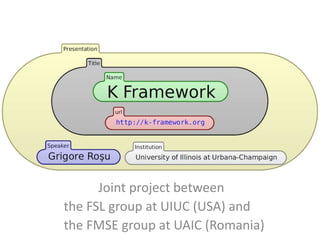
K Framework
Joint project between
the FSL group at UIUC (USA) and
the FMSE group at UAIC (Romania)
k-framework.org
K Team
• UIUC, USA
– Grigore Rosu (started K in 2003)
– Cansu Erdogan
– Dwight Guth
– David Lazar
– Patrick Meredith
– Andrei Stefanescu
Former members
– Kyle Blocher
– Peter Dinges
– Chucky Ellison
– Mike Ilseman
– Traian Serbanuta
• UAIC, Iasi, Romania
– Dorel Lucanu
– Traian Serbanuta
– Andrei Arusoae
– Denis Bogdanas
– Stefan Ciobaca
– Gheorghe Grigoras
– Radu Mereuta
– Raluca Necula
– Emilian Necula
Former Members
– Irina Asavoae
– Mihai Asavoae
Current State-of-the-Art in PL Design,
Implementation and Analysis
Consider some programming language, L
• Formal semantics of L?
– Typically skipped: considered expensive and useless
• Implementations for L
– Based on some adhoc understanding of what L is
• Model checkers for L
– Based on some adhoc encodings/models of L
• Program verifiers for L
– Based on some other adhoc encodings/models of L
• …
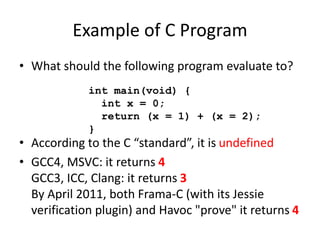
Example of C Program
• What should the following program evaluate to?
• According to the C “standard”, it is undefined
• GCC4, MSVC: it returns 4
GCC3, ICC, Clang: it returns 3
By April 2011, both Frama-C (with its Jessie
verification plugin) and Havoc "prove" it returns 4
int main(void) {
int x = 0;
return (x = 1) + (x = 2);
}
A Formal Semantics Manifesto
• Programming languages must have formal
semantics! (period)
– And analysis/verification tools should build on them
• Otherwise they are adhoc and likely wrong
• Informal manuals are not sufficient
– Manuals typically have a formal syntax of the
language (in an appendix)
– Why not a formal semantics appendix as well?
Motivation and Goal
We want a semantic framework
which makes it easy and fun to define
programming languages, no matter
how complex or large they are!
The K Framework
k-framework.org
A tool-supported rewrite-based
framework for defining programming
language design and semantics.
Complete K Definition of KernelC
Syntax declared using annotated BNF
…
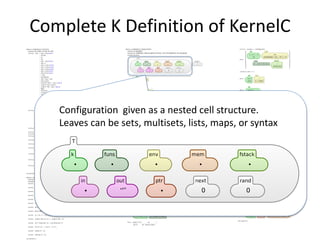
Complete K Definition of KernelC
Configuration given as a nested cell structure.
Leaves can be sets, multisets, lists, maps, or syntax
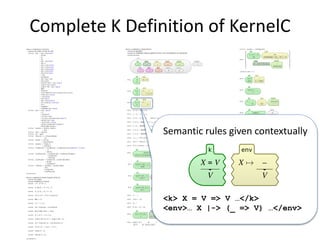
Complete K Definition of KernelC
Semantic rules given contextually
<k> X = V => V …</k>
<env>… X |-> (_ => V) …</env>
State-space exploration (search and model-checking)
Efficient and interactive execution (interpreters)
…
cfg[pgm]
What does the K Tool Offer?
…
…
Deductive program verification (in progress)
K Scales
Besides smaller and paradigmatic teaching
languages, several larger languages were defined
• Java 1.4 : by Chen [CAV’06]
• Verilog : by Meredith&Katelman [MEMOCODE’10]
• C : by Chucky Ellison [POPL’12]
etc.
The K Configuration of C
75 Cells!
Heap
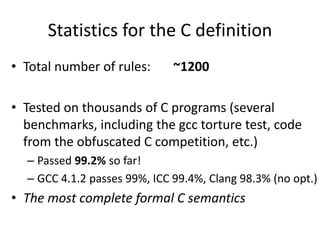
Statistics for the C definition
• Total number of rules: ~1200
• Tested on thousands of C programs (several
benchmarks, including the gcc torture test, code
from the obfuscated C competition, etc.)
– Passed 99.2% so far!
– GCC 4.1.2 passes 99%, ICC 99.4%, Clang 98.3% (no opt.)
• The most complete formal C semantics
Next Steps
• Watch the five-minute video demo
• Download the K tool
• Do the K Tutorial
• Define your own language!
• Watch the interview on rewrite-based semantics
if you’d like to better understand our viewpoint
• Read select publications for a deeper
understanding of K’s foundations

K overview

  • 1.
    K Framework Joint projectbetween the FSL group at UIUC (USA) and the FMSE group at UAIC (Romania) k-framework.org
  • 2.
    K Team • UIUC,USA – Grigore Rosu (started K in 2003) – Cansu Erdogan – Dwight Guth – David Lazar – Patrick Meredith – Andrei Stefanescu Former members – Kyle Blocher – Peter Dinges – Chucky Ellison – Mike Ilseman – Traian Serbanuta • UAIC, Iasi, Romania – Dorel Lucanu – Traian Serbanuta – Andrei Arusoae – Denis Bogdanas – Stefan Ciobaca – Gheorghe Grigoras – Radu Mereuta – Raluca Necula – Emilian Necula Former Members – Irina Asavoae – Mihai Asavoae
  • 3.
    Current State-of-the-Art inPL Design, Implementation and Analysis Consider some programming language, L • Formal semantics of L? – Typically skipped: considered expensive and useless • Implementations for L – Based on some adhoc understanding of what L is • Model checkers for L – Based on some adhoc encodings/models of L • Program verifiers for L – Based on some other adhoc encodings/models of L • …
  • 4.
    Example of CProgram • What should the following program evaluate to? • According to the C “standard”, it is undefined • GCC4, MSVC: it returns 4 GCC3, ICC, Clang: it returns 3 By April 2011, both Frama-C (with its Jessie verification plugin) and Havoc "prove" it returns 4 int main(void) { int x = 0; return (x = 1) + (x = 2); }
  • 5.
    A Formal SemanticsManifesto • Programming languages must have formal semantics! (period) – And analysis/verification tools should build on them • Otherwise they are adhoc and likely wrong • Informal manuals are not sufficient – Manuals typically have a formal syntax of the language (in an appendix) – Why not a formal semantics appendix as well?
  • 6.
    Motivation and Goal Wewant a semantic framework which makes it easy and fun to define programming languages, no matter how complex or large they are!
  • 7.
    The K Framework k-framework.org Atool-supported rewrite-based framework for defining programming language design and semantics.
  • 8.
  • 9.
    Complete K Definitionof KernelC Syntax declared using annotated BNF …
  • 10.
    Complete K Definitionof KernelC Configuration given as a nested cell structure. Leaves can be sets, multisets, lists, maps, or syntax
  • 11.
    Complete K Definitionof KernelC Semantic rules given contextually <k> X = V => V …</k> <env>… X |-> (_ => V) …</env>
  • 12.
    State-space exploration (searchand model-checking) Efficient and interactive execution (interpreters) … cfg[pgm] What does the K Tool Offer? … … Deductive program verification (in progress)
  • 13.
    K Scales Besides smallerand paradigmatic teaching languages, several larger languages were defined • Java 1.4 : by Chen [CAV’06] • Verilog : by Meredith&Katelman [MEMOCODE’10] • C : by Chucky Ellison [POPL’12] etc.
  • 14.
    The K Configurationof C 75 Cells! Heap
  • 15.
    Statistics for theC definition • Total number of rules: ~1200 • Tested on thousands of C programs (several benchmarks, including the gcc torture test, code from the obfuscated C competition, etc.) – Passed 99.2% so far! – GCC 4.1.2 passes 99%, ICC 99.4%, Clang 98.3% (no opt.) • The most complete formal C semantics
  • 16.
    Next Steps • Watchthe five-minute video demo • Download the K tool • Do the K Tutorial • Define your own language! • Watch the interview on rewrite-based semantics if you’d like to better understand our viewpoint • Read select publications for a deeper understanding of K’s foundations