Philippine Development Plan 2011-2016
RESULTS MATRICES


                The 2011-2016 Philippine Development Plan Results Matrices   1
2   The 2011-2016 Philippine Development Plan Results Matrices
Philippine Development Plan 2011-2016
RESULTS MATRICES


                     The 2011-2016 Philippine Development Plan Results Matrices   3
SA KABU
                       AAN        HA
                     IW             YA
                  AS                  N
             NG


                                                     AT
           PA


                                                        PA
   BANSANG


                                                          GPA UNLAD
                                                             PA
PAM


             RE
                   PU                               AS
                        B LIK              P   IN
                                A N G PILI


© 2011 by National Economic and Development Authority

All rights reserved. Any part of this book may be used and reproduced,
provided proper acknowledgement is made.

Philippine Development Plan 2011-2016 Results Matrices

Published by:

National Economic and Development Authority
12 Escriva Drive, Ortigas Center, Pasig City
Tel: (+632) 631 0945 to 56
Email: info@neda.gov.ph
www.neda.gov.ph


ISSN: 2243-7576

Printed in the Philippines

4                                     The 2011-2016 Philippine Development Plan Results Matrices
Table of Contents
Message of the Director-General                                                                                     1

The 2011-2016 PDP Results Matrices                                                                                  2

Results Matrices with Government’s Five Major Guideposts                                                            6

List of Acronyms                                                                                                    8

Critical Indicators                                                                                                13

Chapter 2: Macroeconomy                                                                                            29

Chapter 3. Competitive Industry and Services Sectors                                                               35

Chapter 4: Competitive and Sustainable Agriculture and Fisheries Sectors                                           38

Chapter 5: Accelerating Infrastructure Development                                                                 43

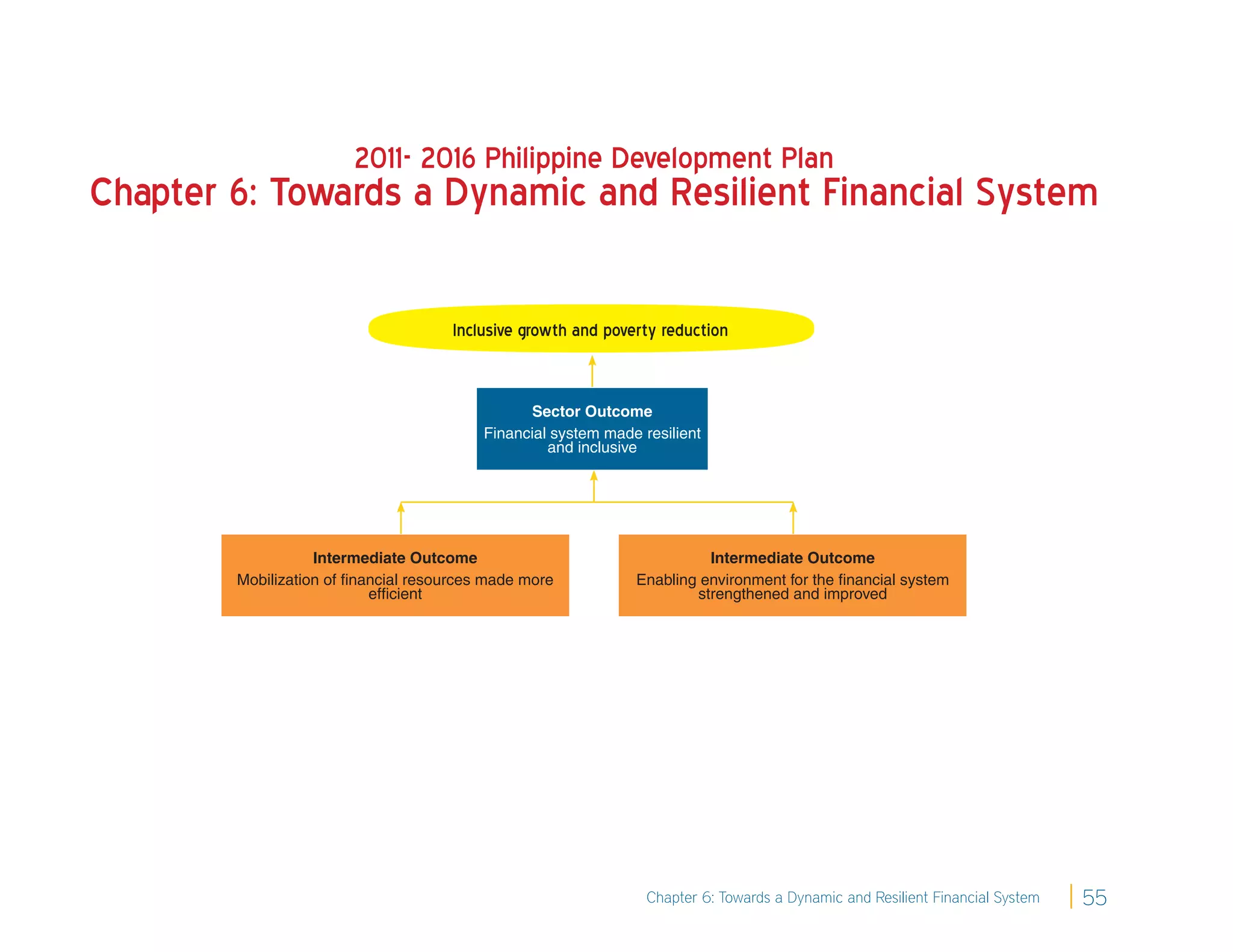
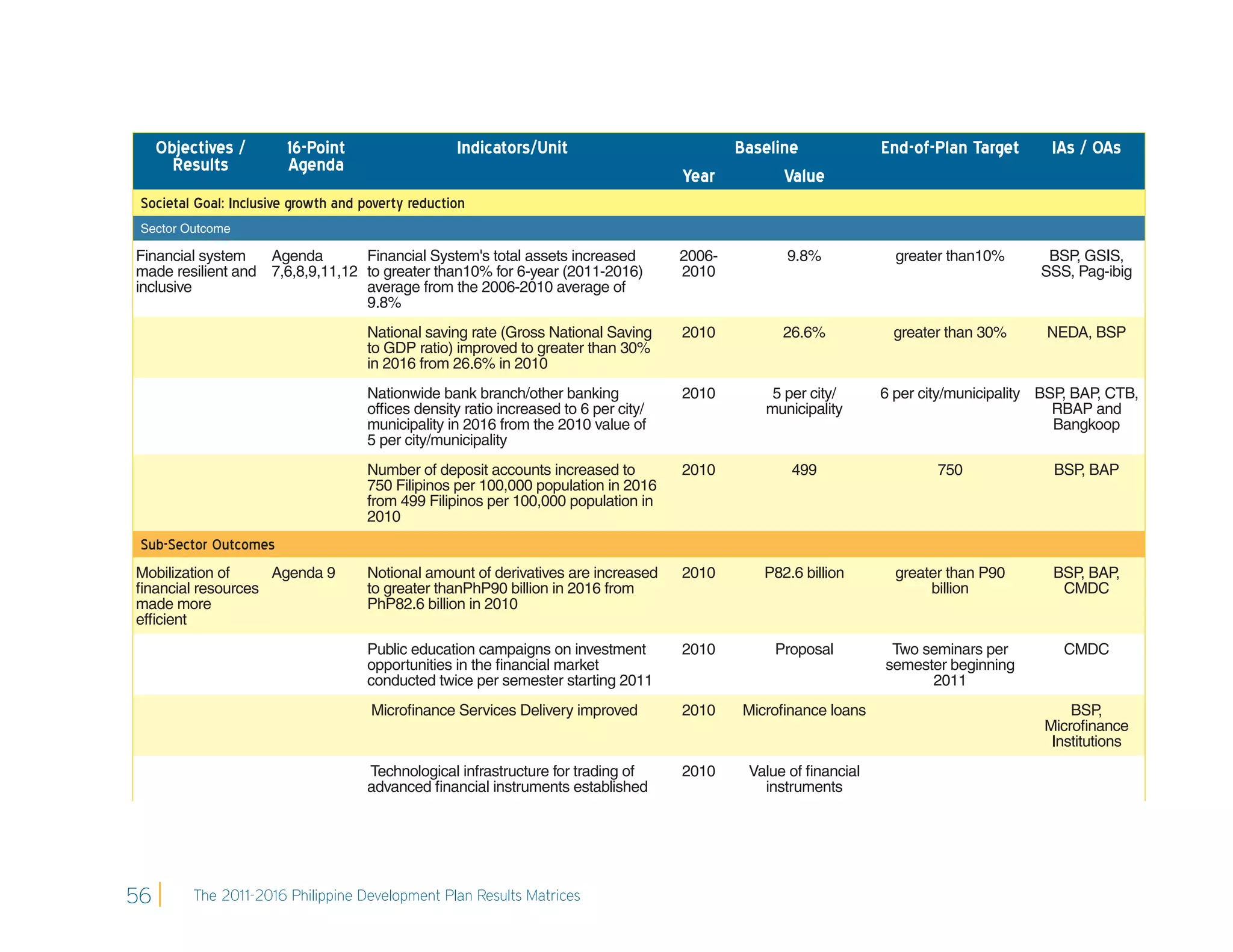
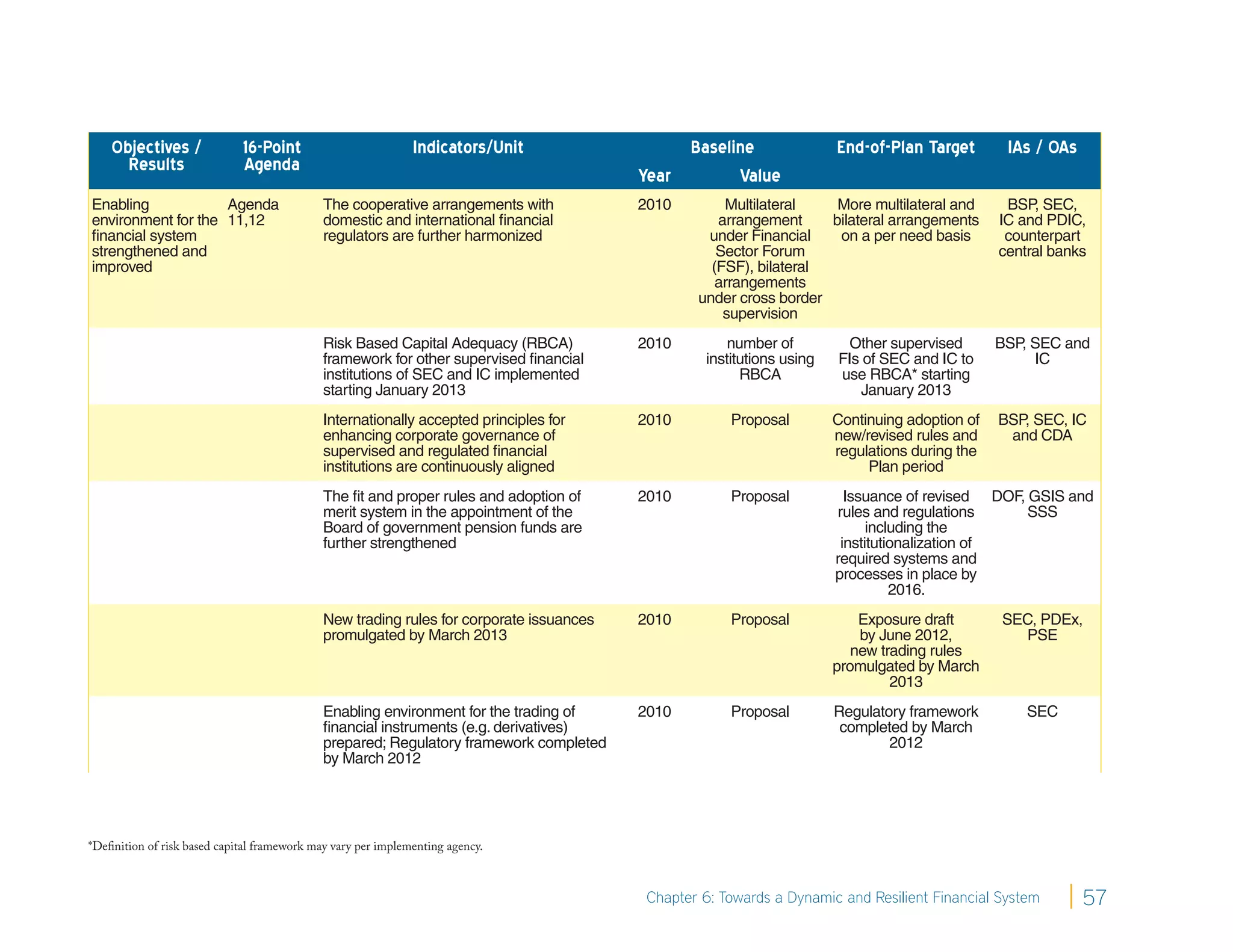
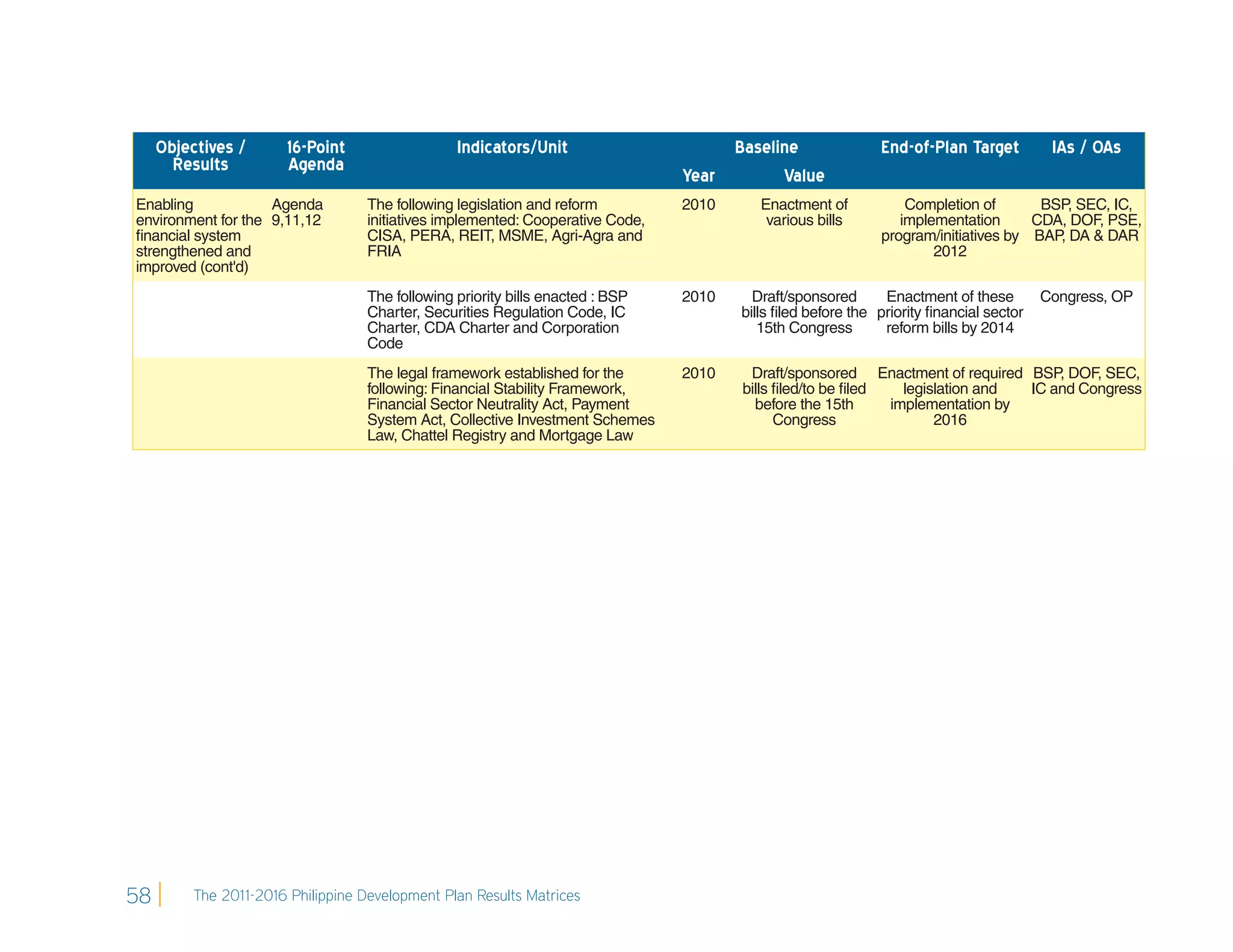
Chapter 6: Towards A Dynamic and Resilient Financial System                                                        55

Chapter 7: Good Governance and The Rule Of Law                                                                     59

Chapter 8: Social Development                                                                                      66

Chapter 9: Peace and Security                                                                                      73

Chapter 10: Conservation, Protection, and Rehabilitation Of Environment and Natural Resources                      84

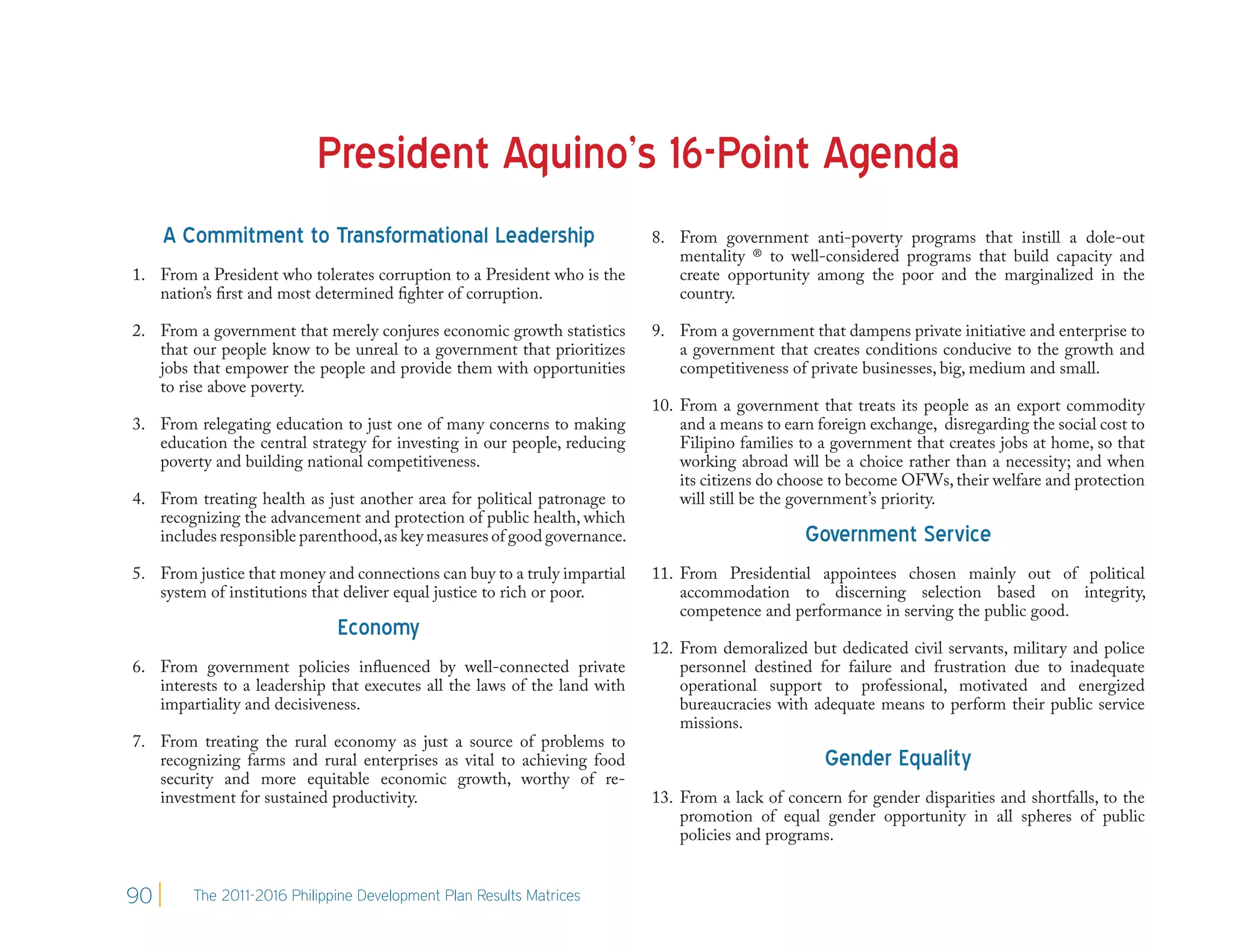
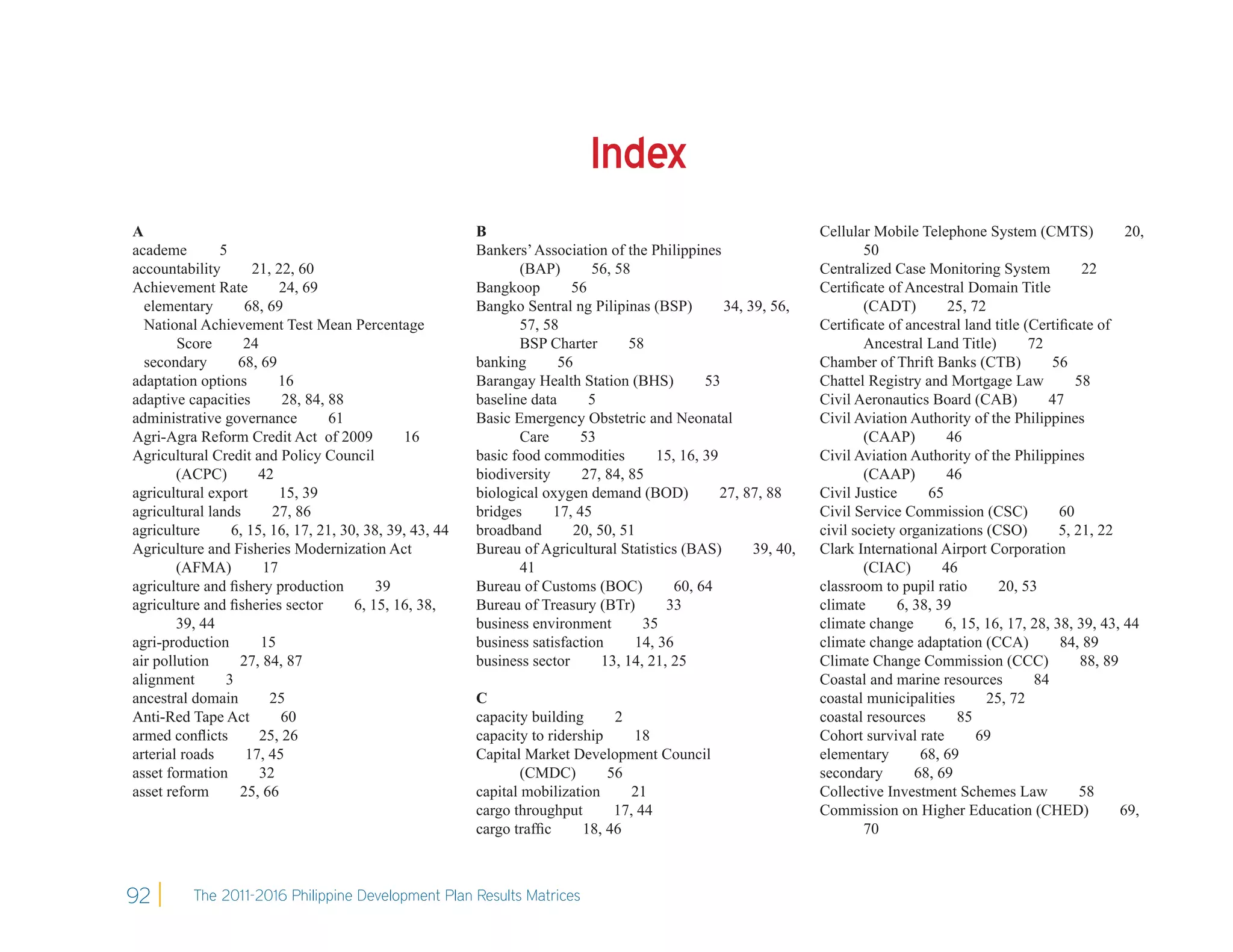
President Aquino’s 16-Point Agenda                                                                                 90

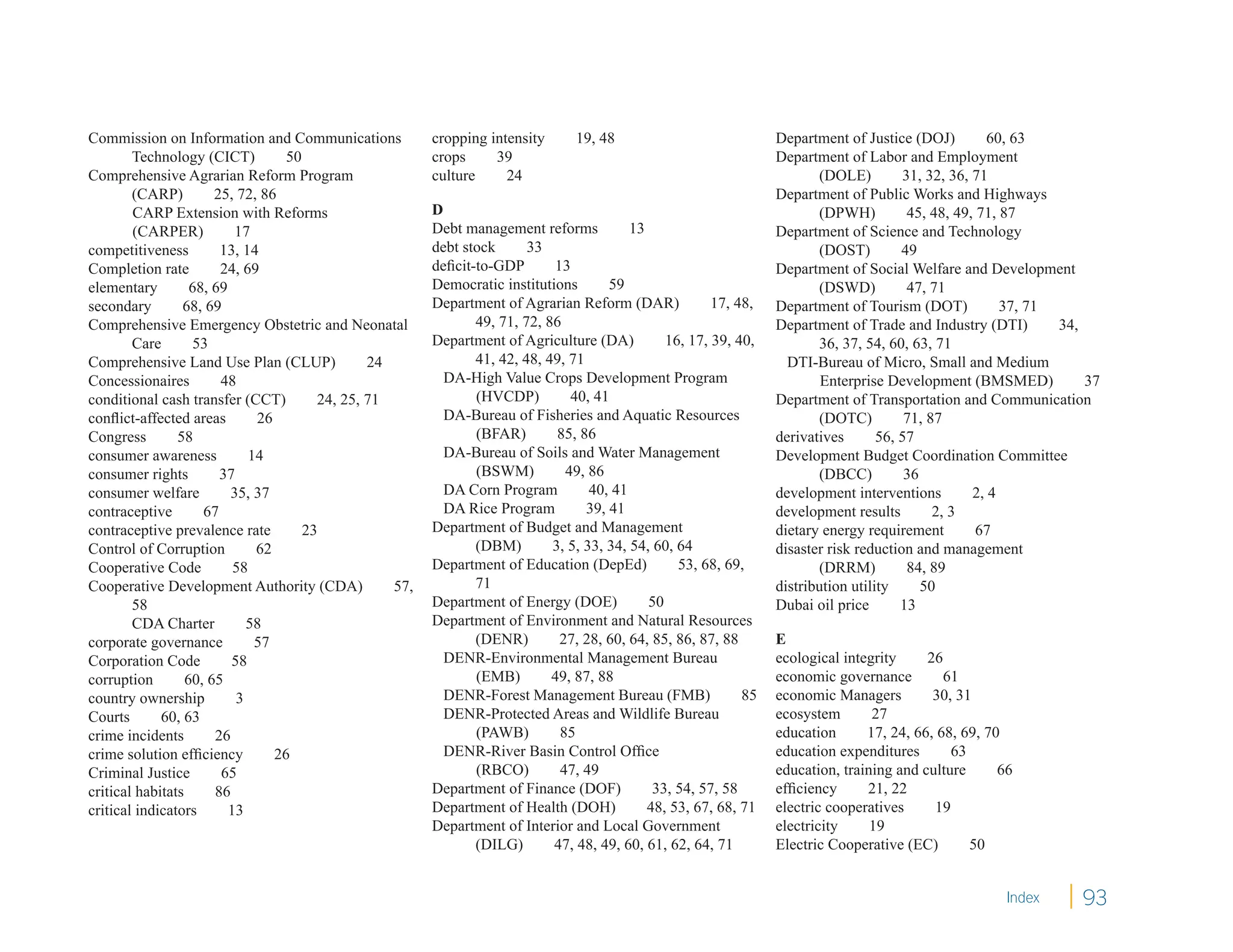
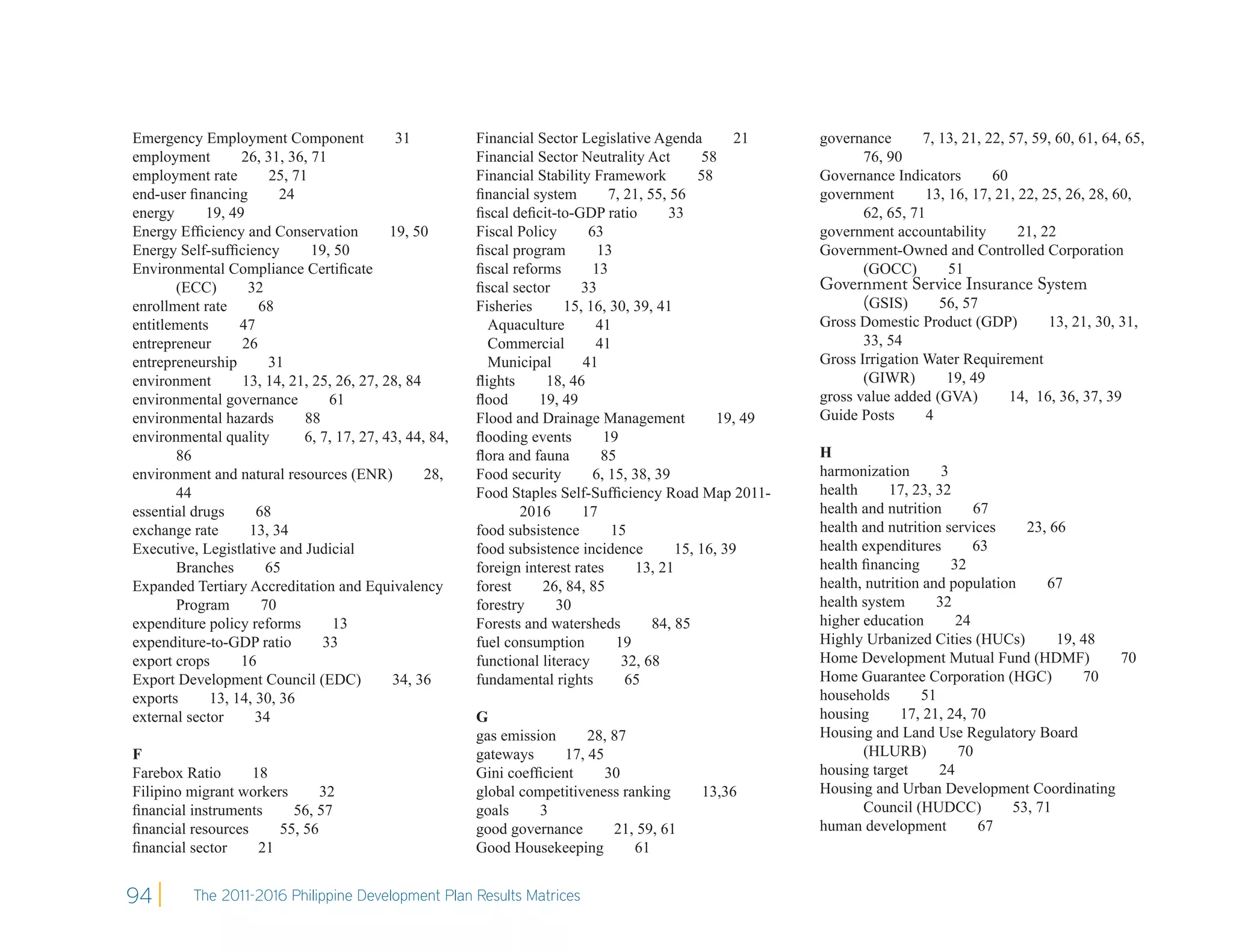
Index                                                                                                              92

                                                                              The 2011-2016 Philippine Development Plan Results Matrices   5
6   The 2011-2016 Philippine Development Plan Results Matrices
Message of the Director-General

                                   The Philippine Government,                The RMs will be enhanced and updated annually through an inclusive
                                   in the last several years, has            and iterative process. We expect the various development stakeholders
                                   been pursuing the “whole of               who have participated and collaborated intensively in the formulation of
                                   government”         management            the PDP to exhibit the same passion and commitment to such process.
                                   approach     for    results,    a         These include the national and regional sector agencies, local government
                                   mechanism      that    highlights         units (LGUs), statistical agencies and research institutions, the academe,
                                   shared    responsibilities   and          private business sector and civil society organizations.
collaborative practices among the country’s various sectors. This
approach aims to incorporate results-orientation in the planning,            This document is a product of mutual trust among the development
budgeting, implementation and monitoring and evaluation processes of         stakeholders in our society to come up with a Plan whose results shall
development.                                                                 be monitored and evaluated and whose focus shall shift from inputs-
                                                                             outputs to outcomes and sustainable impacts.
In the crafting of the Philippine Development Plan 2011-2016,
the National Economic and Development Authority (NEDA) has                   We envision the RMs as instrument to continually refine the overall
coordinated the formulation of the Results Matrices (RMs) which              accountability framework for results, by the government for the Filipino
integrate results-orientation vis-a-vis the various strategies, programs     people.
and projects outlined in the Plan. The RMs will facilitate the tracking of
gains achieved and serve as a tool to monitor and evaluate the progress
of the Plan.

The RMs consist of an indicator framework for evaluating results
corresponding to the strategies, programs and projects identified in the                           Cayetano W. Paderanga, Jr.
chapters of the Plan as well as Objective Trees that illustrate the means-                            Director-General and
ends relationships between the strategic framework of the Plan with its                      Secretary for Socio-Economic Planning
development objectives.


                                                                                                                                  Introduction        1
The 2011-2016 PDP Results Matrices
A. What are development results?                                                                B. Why results and why does measuring it matter?
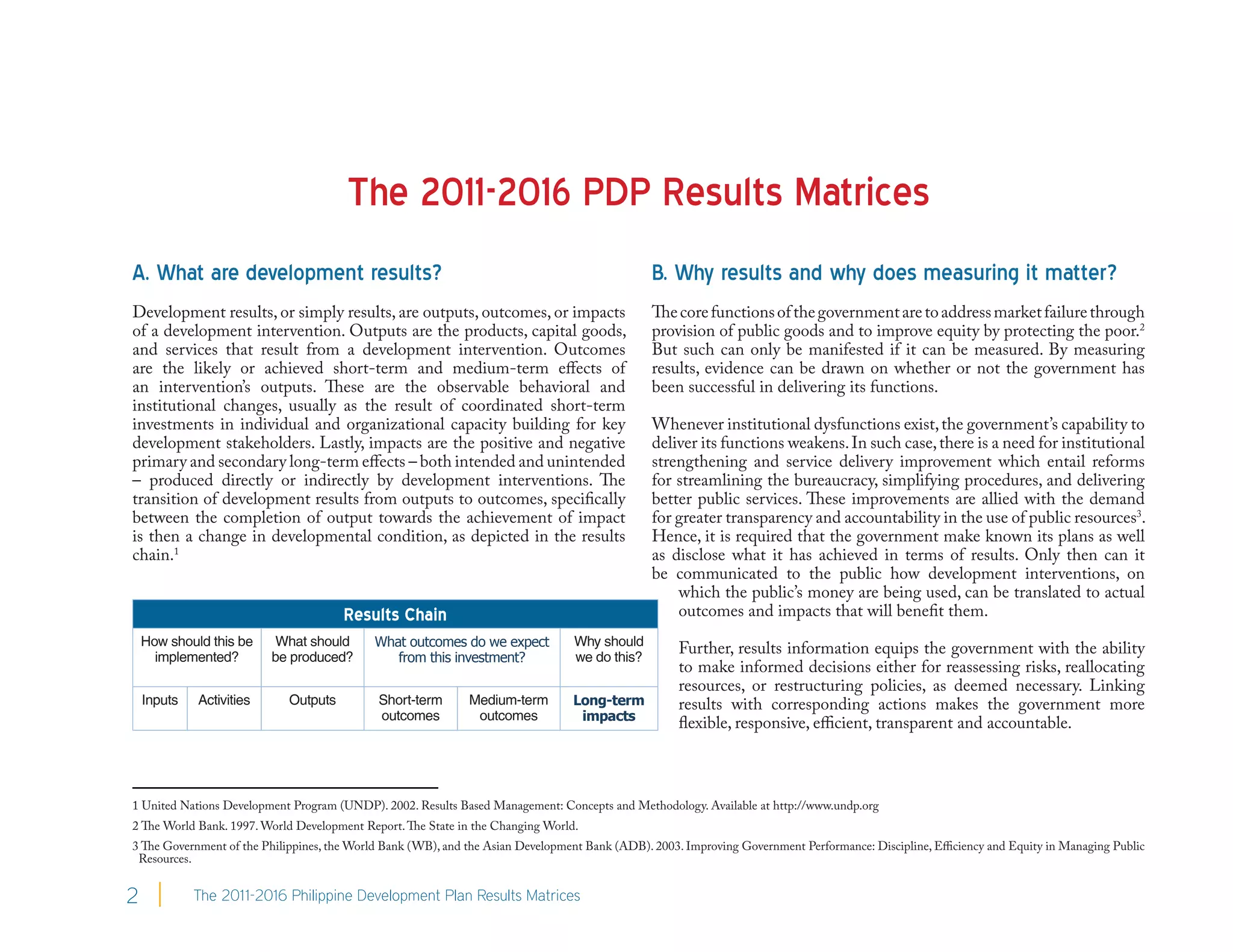
Development results, or simply results, are outputs, outcomes, or impacts                       The core functions of the government are to address market failure through
of a development intervention. Outputs are the products, capital goods,                         provision of public goods and to improve equity by protecting the poor.2
and services that result from a development intervention. Outcomes                              But such can only be manifested if it can be measured. By measuring
are the likely or achieved short-term and medium-term effects of                                results, evidence can be drawn on whether or not the government has
an intervention’s outputs. These are the observable behavioral and                              been successful in delivering its functions.
institutional changes, usually as the result of coordinated short-term
investments in individual and organizational capacity building for key                          Whenever institutional dysfunctions exist, the government’s capability to
development stakeholders. Lastly, impacts are the positive and negative                         deliver its functions weakens. In such case, there is a need for institutional
primary and secondary long-term effects – both intended and unintended                          strengthening and service delivery improvement which entail reforms
– produced directly or indirectly by development interventions. The                             for streamlining the bureaucracy, simplifying procedures, and delivering
transition of development results from outputs to outcomes, specifically                        better public services. These improvements are allied with the demand
between the completion of output towards the achievement of impact                              for greater transparency and accountability in the use of public resources3.
is then a change in developmental condition, as depicted in the results                         Hence, it is required that the government make known its plans as well
chain.1                                                                                         as disclose what it has achieved in terms of results. Only then can it
                                                                                                be communicated to the public how development interventions, on
                                                                                                    which the public’s money are being used, can be translated to actual
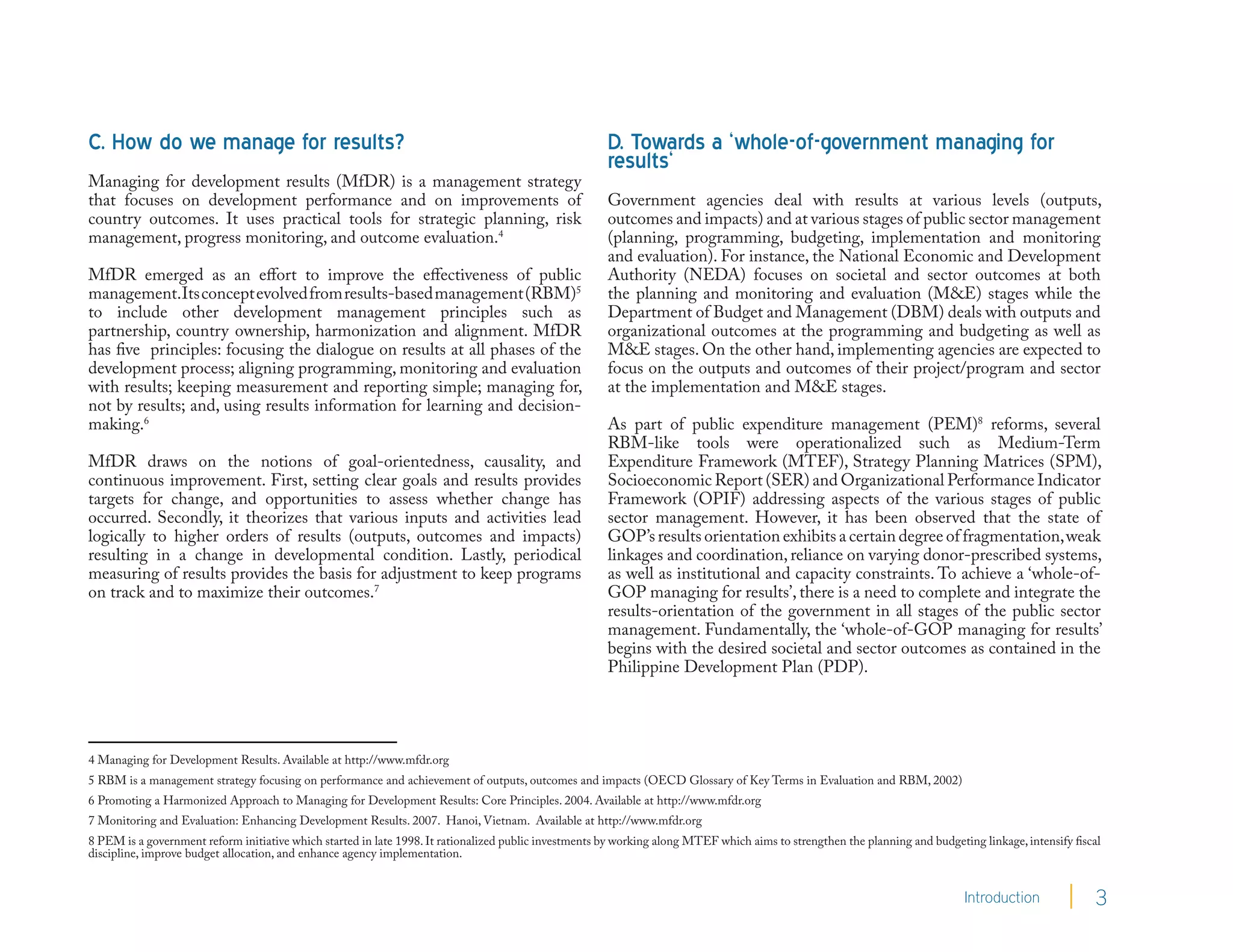
                                       Results Chain                                                outcomes and impacts that will benefit them.
    How should this be     What should       What outcomes do we expect           Why should
                                                                                                     Further, results information equips the government with the ability
      implemented?        be produced?          from this investment?             we do this?
                                                                                                     to make informed decisions either for reassessing risks, reallocating
                                                                                                     resources, or restructuring policies, as deemed necessary. Linking
    Inputs   Activities      Outputs         Short-term       Medium-term        Long-term           results with corresponding actions makes the government more
                                             outcomes          outcomes           impacts
                                                                                                     flexible, responsive, efficient, transparent and accountable.


1 United Nations Development Program (UNDP). 2002. Results Based Management: Concepts and Methodology. Available at http://www.undp.org
2 The World Bank. 1997. World Development Report. The State in the Changing World.
3 The Government of the Philippines, the World Bank (WB), and the Asian Development Bank (ADB). 2003. Improving Government Performance: Discipline, Efficiency and Equity in Managing Public
 Resources.


2            The 2011-2016 Philippine Development Plan Results Matrices
C. How do we manage for results?                                                                       D. Towards a ‘whole-of-government managing for
                                                                                                       results‘
Managing for development results (MfDR) is a management strategy
that focuses on development performance and on improvements of                                         Government agencies deal with results at various levels (outputs,
country outcomes. It uses practical tools for strategic planning, risk                                 outcomes and impacts) and at various stages of public sector management
management, progress monitoring, and outcome evaluation.4                                              (planning, programming, budgeting, implementation and monitoring
                                                                                                       and evaluation). For instance, the National Economic and Development
MfDR emerged as an effort to improve the effectiveness of public                                       Authority (NEDA) focuses on societal and sector outcomes at both
management.Its concept evolved from results-based management (RBM)5                                    the planning and monitoring and evaluation (M&E) stages while the
to include other development management principles such as                                             Department of Budget and Management (DBM) deals with outputs and
partnership, country ownership, harmonization and alignment. MfDR                                      organizational outcomes at the programming and budgeting as well as
has five principles: focusing the dialogue on results at all phases of the                             M&E stages. On the other hand, implementing agencies are expected to
development process; aligning programming, monitoring and evaluation                                   focus on the outputs and outcomes of their project/program and sector
with results; keeping measurement and reporting simple; managing for,                                  at the implementation and M&E stages.
not by results; and, using results information for learning and decision-
making.6                                                                                               As part of public expenditure management (PEM)8 reforms, several
                                                                                                       RBM-like tools were operationalized such as Medium-Term
MfDR draws on the notions of goal-orientedness, causality, and                                         Expenditure Framework (MTEF), Strategy Planning Matrices (SPM),
continuous improvement. First, setting clear goals and results provides                                Socioeconomic Report (SER) and Organizational Performance Indicator
targets for change, and opportunities to assess whether change has                                     Framework (OPIF) addressing aspects of the various stages of public
occurred. Secondly, it theorizes that various inputs and activities lead                               sector management. However, it has been observed that the state of
logically to higher orders of results (outputs, outcomes and impacts)                                  GOP’s results orientation exhibits a certain degree of fragmentation, weak
resulting in a change in developmental condition. Lastly, periodical                                   linkages and coordination, reliance on varying donor-prescribed systems,
measuring of results provides the basis for adjustment to keep programs                                as well as institutional and capacity constraints. To achieve a ‘whole-of-
on track and to maximize their outcomes.7                                                              GOP managing for results’, there is a need to complete and integrate the
                                                                                                       results-orientation of the government in all stages of the public sector
                                                                                                       management. Fundamentally, the ‘whole-of-GOP managing for results’
                                                                                                       begins with the desired societal and sector outcomes as contained in the
                                                                                                       Philippine Development Plan (PDP).


4 Managing for Development Results. Available at http://www.mfdr.org
5 RBM is a management strategy focusing on performance and achievement of outputs, outcomes and impacts (OECD Glossary of Key Terms in Evaluation and RBM, 2002)
6 Promoting a Harmonized Approach to Managing for Development Results: Core Principles. 2004. Available at http://www.mfdr.org
7 Monitoring and Evaluation: Enhancing Development Results. 2007. Hanoi, Vietnam. Available at http://www.mfdr.org
8 PEM is a government reform initiative which started in late 1998. It rationalized public investments by working along MTEF which aims to strengthen the planning and budgeting linkage, intensify fiscal
discipline, improve budget allocation, and enhance agency implementation.


                                                                                                                                                                              Introduction              3
Results orientation in the PDP is strengthened through the incorporation       RMs are intended to facilitate the operationalization of MfDR. It should
of the Results Matrix (RM) in each of the Plan Chapters. Similar to            be used as a primary tool for all stages of public sector management.
a project logical framework, the RM structures the planning process            The results statements at the Plan level (sector and sub-sector) will be
and presents information in an easy-to-understand format. As the               linked to the OPIF of various government agencies, which provides the
main instrument in shifting the focus from only inputs and outputs to          results statements at the organizational and output levels. The intent is
outcomes and impacts, the RM provides an indicator framework to both           to establish and make sufficient the results chain in each chapter RM,
the sector and subsector results statements of the Plan.                       so that RM sector outcomes are clearly supported by the corresponding
                                                                               OPIF organizational outcomes and outputs. As the basic document
                                                                               for the Plan’s M&E, information gathered will then be used to further
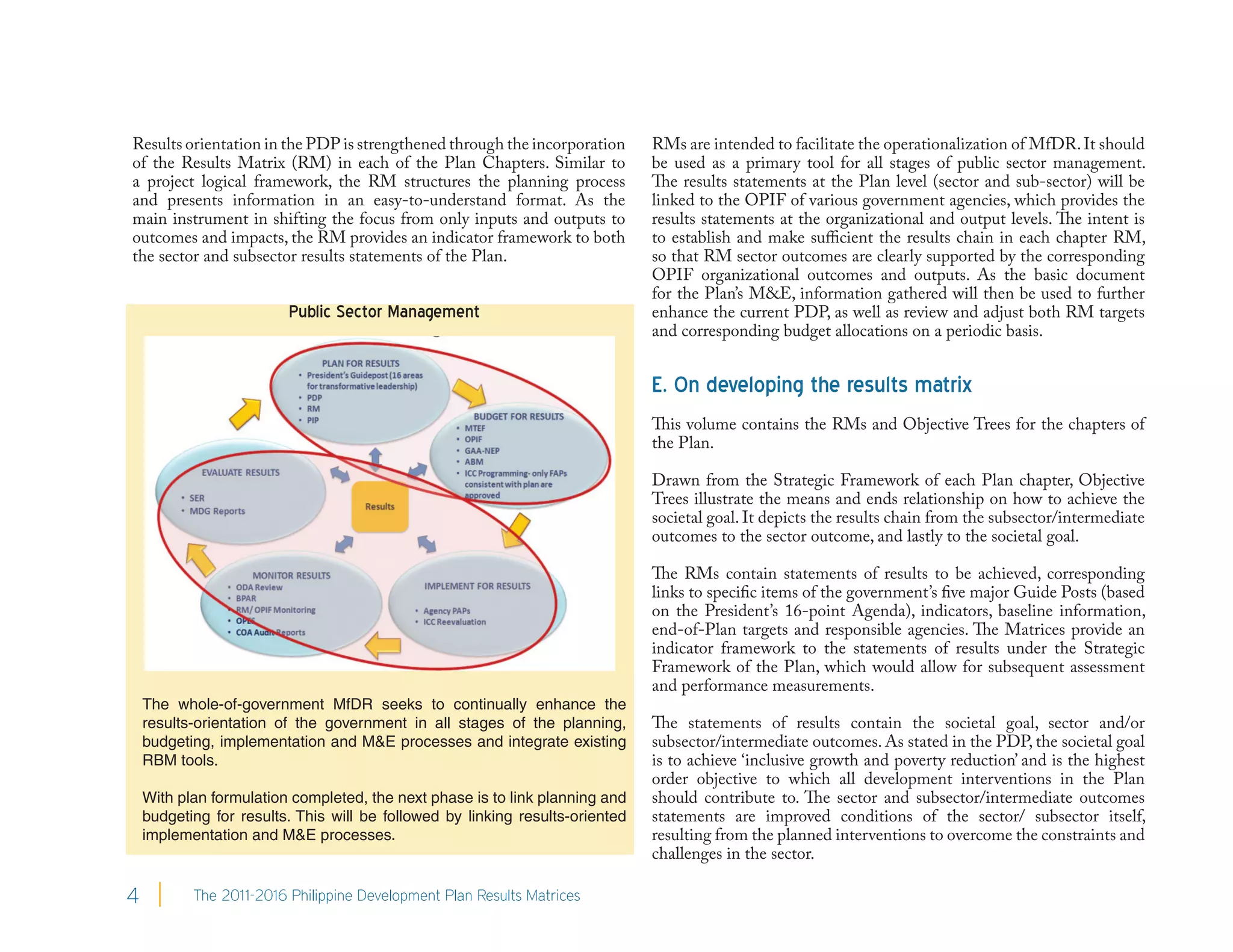
                         Public Sector Management                              enhance the current PDP, as well as review and adjust both RM targets
                                                                               and corresponding budget allocations on a periodic basis.


                                                                               E. On developing the results matrix
                                                                               This volume contains the RMs and Objective Trees for the chapters of
                                                                               the Plan.

                                                                               Drawn from the Strategic Framework of each Plan chapter, Objective
                                                                               Trees illustrate the means and ends relationship on how to achieve the
                                                                               societal goal. It depicts the results chain from the subsector/intermediate
                                                                               outcomes to the sector outcome, and lastly to the societal goal.

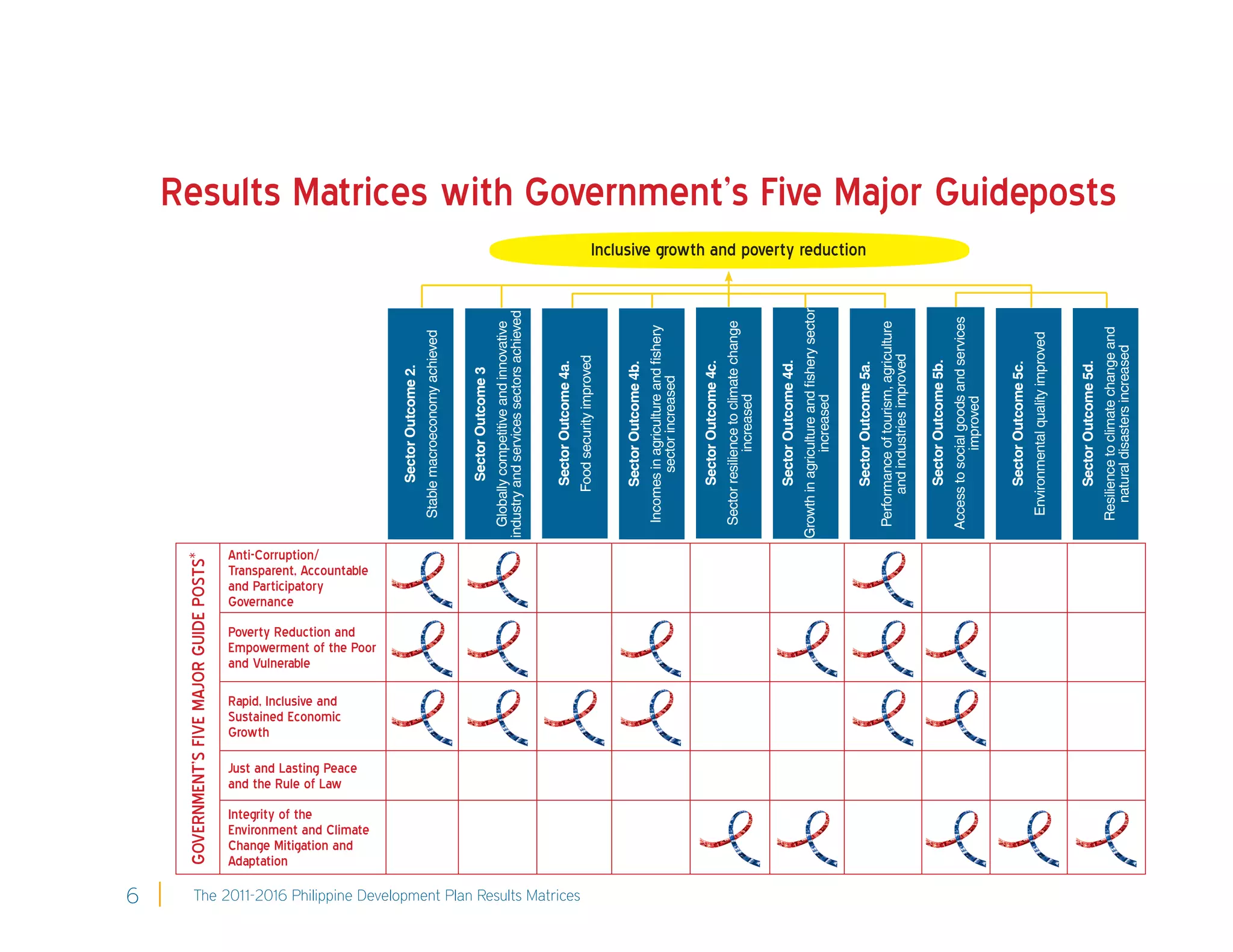
                                                                               The RMs contain statements of results to be achieved, corresponding
                                                                               links to specific items of the government’s five major Guide Posts (based
                                                                               on the President’s 16-point Agenda), indicators, baseline information,
                                                                               end-of-Plan targets and responsible agencies. The Matrices provide an
                                                                               indicator framework to the statements of results under the Strategic
                                                                               Framework of the Plan, which would allow for subsequent assessment
                                                                               and performance measurements.
    The whole-of-government MfDR seeks to continually enhance the
    results-orientation of the government in all stages of the planning,       The statements of results contain the societal goal, sector and/or
    budgeting, implementation and M&E processes and integrate existing         subsector/intermediate outcomes. As stated in the PDP, the societal goal
    RBM tools.                                                                 is to achieve ‘inclusive growth and poverty reduction’ and is the highest
                                                                               order objective to which all development interventions in the Plan
    With plan formulation completed, the next phase is to link planning and    should contribute to. The sector and subsector/intermediate outcomes
    budgeting for results. This will be followed by linking results-oriented   statements are improved conditions of the sector/ subsector itself,
    implementation and M&E processes.                                          resulting from the planned interventions to overcome the constraints and
                                                                               challenges in the sector.

4          The 2011-2016 Philippine Development Plan Results Matrices
The Plan indicators serve as a guide in all the stages of the public sector
management (from planning to M&E of Plan). Indicators may be
modified for clarity, added if deemed necessary/appropriate, deleted if
found irrelevant, or replaced by proxy indicators if difficult and costly to
monitor. Further, indicators should have characteristics of SMART and
dimensions of QQTAB9. The number of indicators should be manageable
and monitorable, that is, must not exceed seven per objective/result
statement.

The baseline data, indicated by year and values, are either drawn from the
PDP chapters or supplied. In case of multiple indicators with available
baseline data, outcome indicators that are most appropriate and currently
being gathered by the national statistical agencies and/or pertinent IAs
are used.

At the societal goal level, targets are set for measurement at the middle
and end of the Plan period. The same applies at the sector outcome level,
except in CY 2015 when the achievement of MDGs is scheduled for
final measurement. From the subsector outcome level to the MFOs level,
the annual targets (expressed in percentages, absolute values, ratios and
other measures that indicate directional change) are set as appropriate
and available. The end of plan target of the outcome indicators are either
drawn from the PDP chapters or supplied.

Lastly, the responsible agency or agencies for each of the outcome and
output indicators are indicated. Said agency or agencies are responsible
for delivering the indicator, hence accountable for subsequent reporting
on progress.

The RM is not a static document and will continue to be enhanced and
updated annually through an iterative process, involving collaboration
and integration of knowledge and skills of personnel from NEDA
(Officials, Central Office and Regional Offices), DBM, sector agencies
(national and regional), statistical agencies, research institutions, the
academe, and civil society organizations.


9
  SMART (Specific, Measurable, Appropriate, Realistic, and Timebound) and QQTAB (Quality, Quantity, Time, Area and Beneficiaries) are mnemonics used for objective setting, usually for project
management.

                                                                                                                                                                     Introduction            5
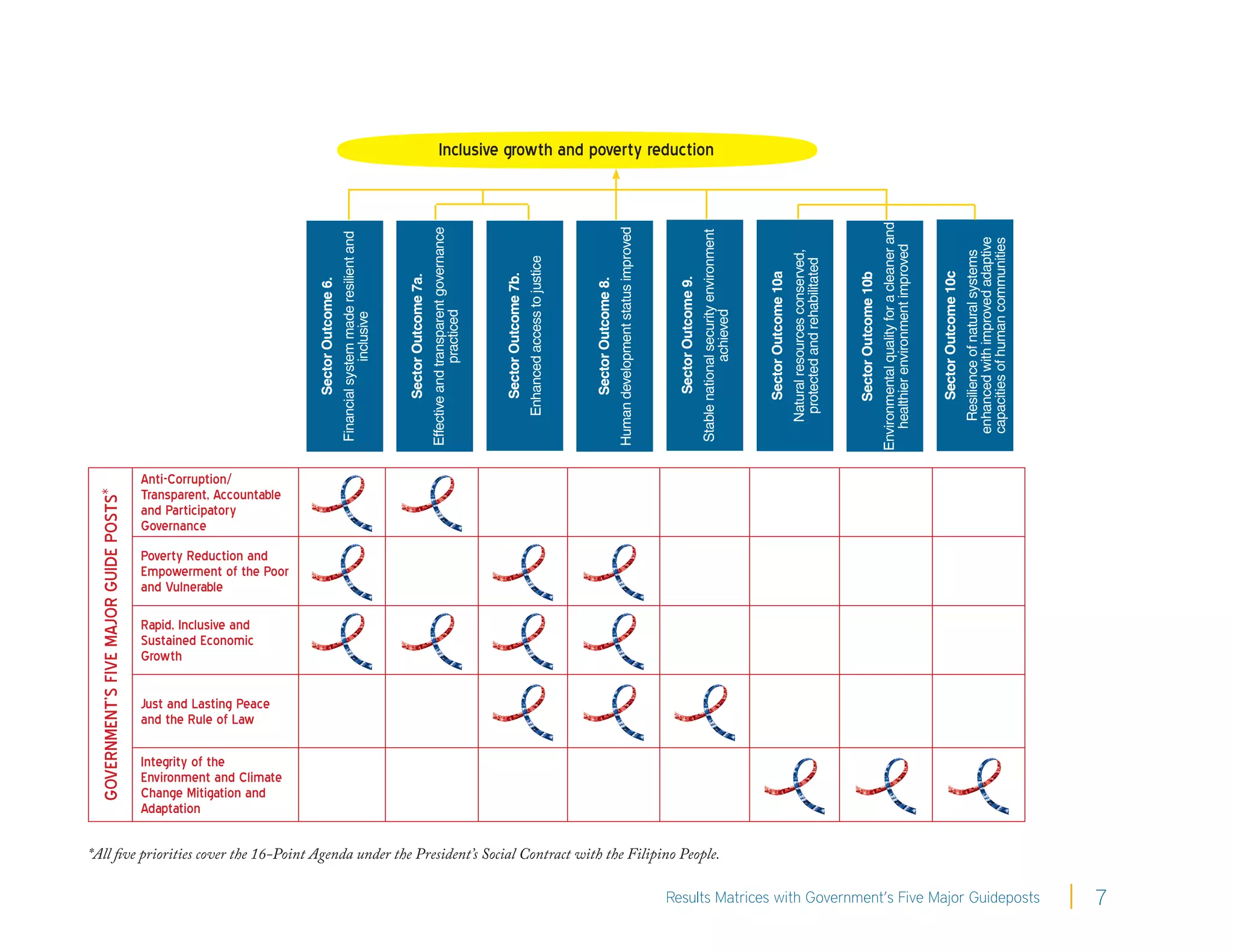
6
                                                              GOVERNMENT’S FIVE MAJOR GUIDE POSTS*


                                                                                                                Growth


                                                             Adaptation
                                                                                                                                                                 Governance


                                                                                                                                       and Vulnerable


                                                             Integrity of the
                                                                                                                                                                 Anti-Corruption/
                                                                                                                                                                 and Participatory


                                                                                                                Rapid, Inclusive and
                                                                                                                Sustained Economic


                                                                                       and the Rule of Law


                                                             Change Mitigation and
                                                                                                                                       Poverty Reduction and


                                                                                       Just and Lasting Peace
                                                                                                                                                                 Transparent, Accountable


                                                             Environment and Climate
                                                                                                                                       Empowerment of the Poor
                                                                                                                                                                                                     Sector Outcome 2.
                                                                                                                                                                                               Stable macroeconomy achieved


                                                                                                                                                                                                     Sector Outcome 3
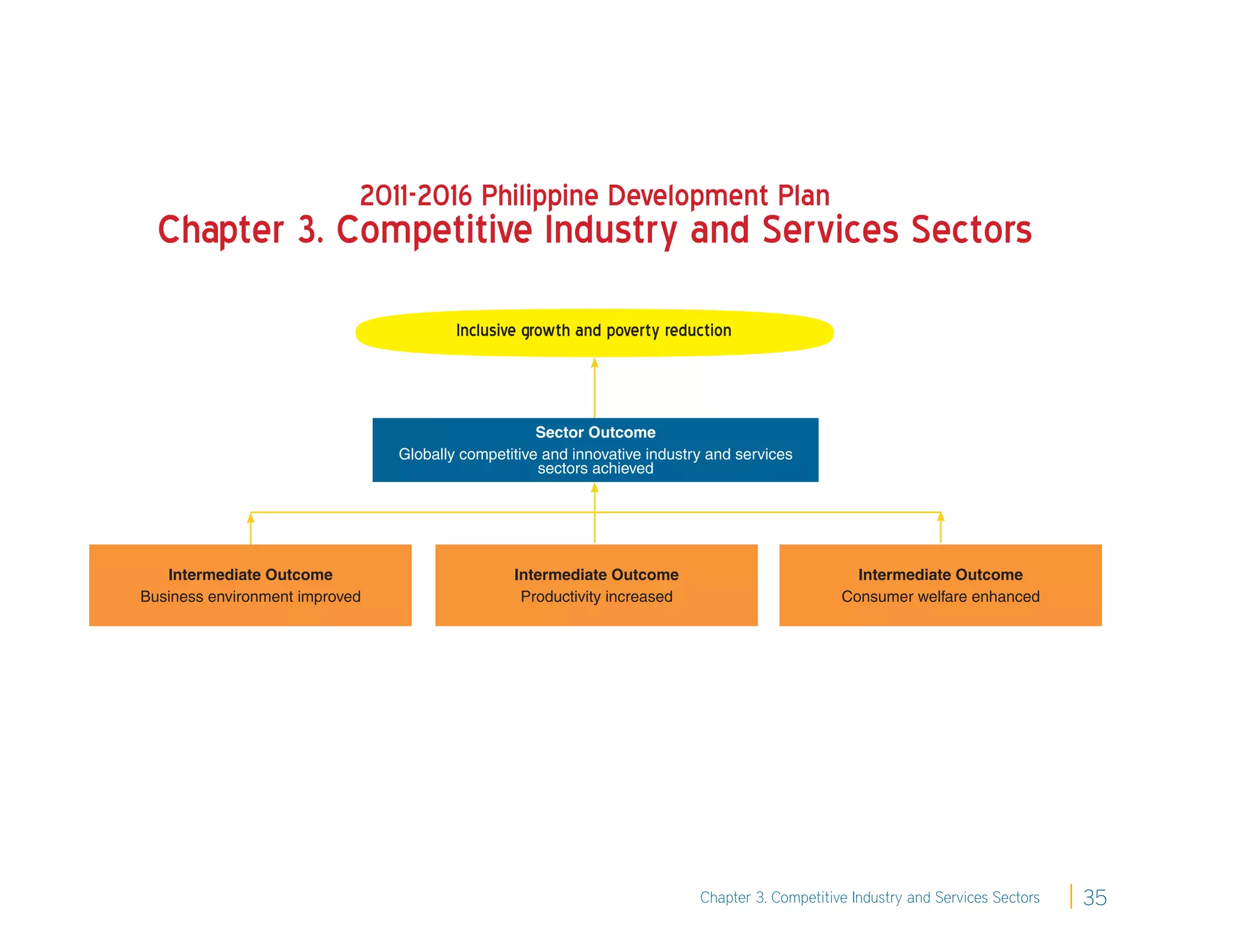
                                                                                                                                                                                              Globally competitive and innovative
                                                                                                                                                                                            industry and services sectors achieved


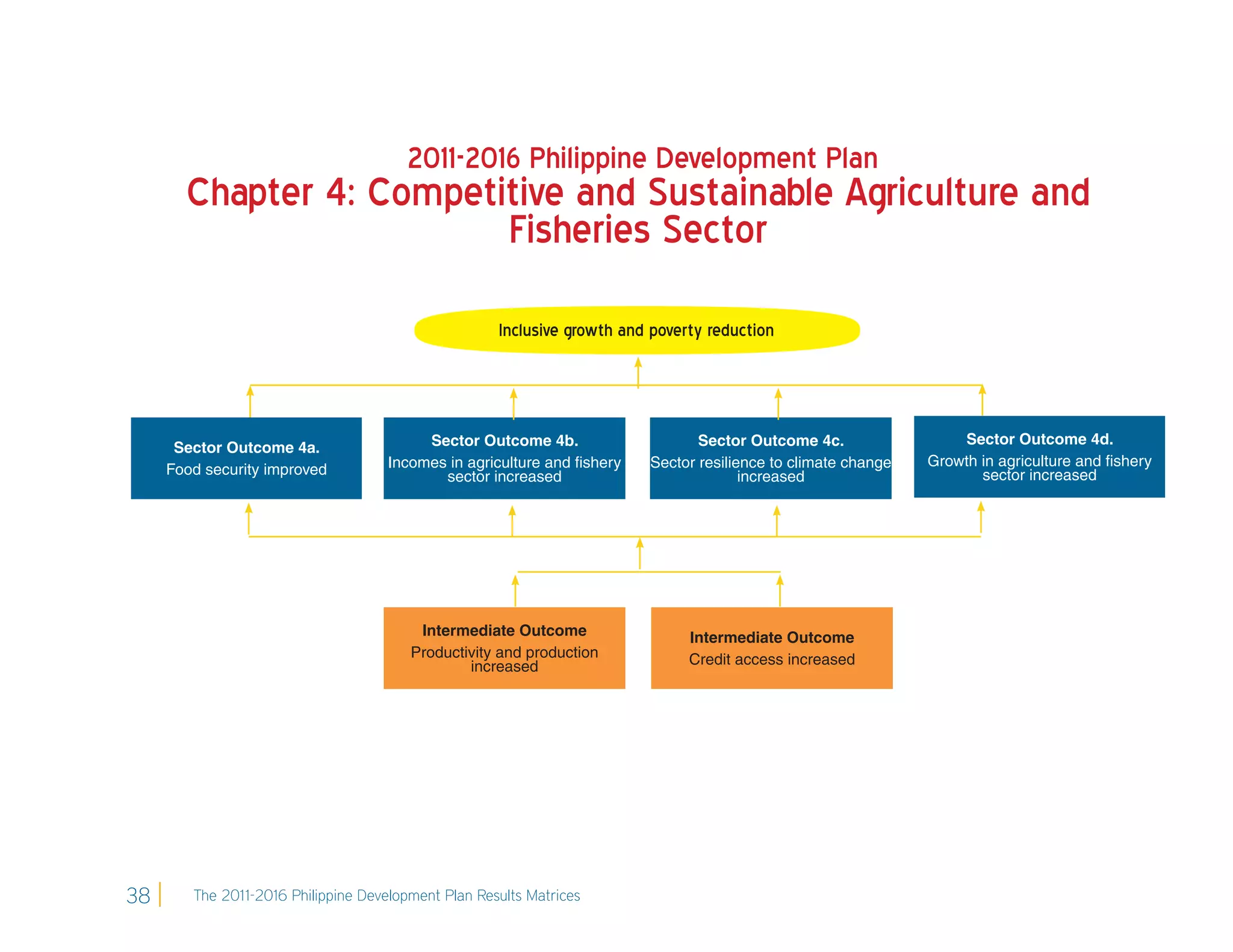
                                                                                                                                                                                                    Sector Outcome 4a.


The 2011-2016 Philippine Development Plan Results Matrices
                                                                                                                                                                                                   Food security improved


                                                                                                                                                                                                    Sector Outcome 4b.
                                                                                                                                                                                              Incomes in agriculture and fishery
                                                                                                                                                                                                     sector increased

                                                                                                                                                                                                    Sector Outcome 4c.
                                                                                                                                                                                              Sector resilience to climate change
                                                                                                                                                                                                            increased

                                                                                                                                                                                                    Sector Outcome 4d.
                                                                                                                                                                                            Growth in agriculture and fishery sector
                                                                                                                                                                                                           increased
                                                                                                                                                                                                                                      Inclusive growth and poverty reduction


                                                                                                                                                                                                    Sector Outcome 5a.
                                                                                                                                                                                             Performance of tourism, agriculture
                                                                                                                                                                                                  and industries improved

                                                                                                                                                                                                    Sector Outcome 5b.
                                                                                                                                                                                             Access to social goods and services
                                                                                                                                                                                                          improved


                                                                                                                                                                                                    Sector Outcome 5c.
                                                                                                                                                                                               Environmental quality improved


                                                                                                                                                                                                    Sector Outcome 5d.
                                                                                                                                                                                                                                                                               Results Matrices with Government’s Five Major Guideposts


                                                                                                                                                                                              Resilience to climate change and
                                                                                                                                                                                                natural disasters increased
GOVERNMENT’S FIVE MAJOR GUIDE POSTS*


                                                                                                                                                                                                                               Growth


                                                                                                                                                                            Adaptation
                                                                                                                                                                                                                                                                                Governance


                                                                                                                                                                                                                                                      and Vulnerable


                                                                                                                                                                            Integrity of the
                                                                                                                                                                                                                                                                                Anti-Corruption/
                                                                                                                                                                                                                                                                                and Participatory


                                                                                                                                                                                                                               Rapid, Inclusive and
                                                                                                                                                                                                                               Sustained Economic


                                                                                                                                                                                                      and the Rule of Law


                                                                                                                                                                            Change Mitigation and
                                                                                                                                                                                                                                                      Poverty Reduction and


                                                                                                                                                                                                      Just and Lasting Peace
                                                                                                                                                                                                                                                                                Transparent, Accountable


                                                                                                                                                                            Environment and Climate
                                                                                                                                                                                                                                                      Empowerment of the Poor
                                                                                                                                                                                                                                                                                                                    Sector Outcome 6.
                                                                                                                                                                                                                                                                                                            Financial system made resilient and
                                                                                                                                                                                                                                                                                                                          inclusive


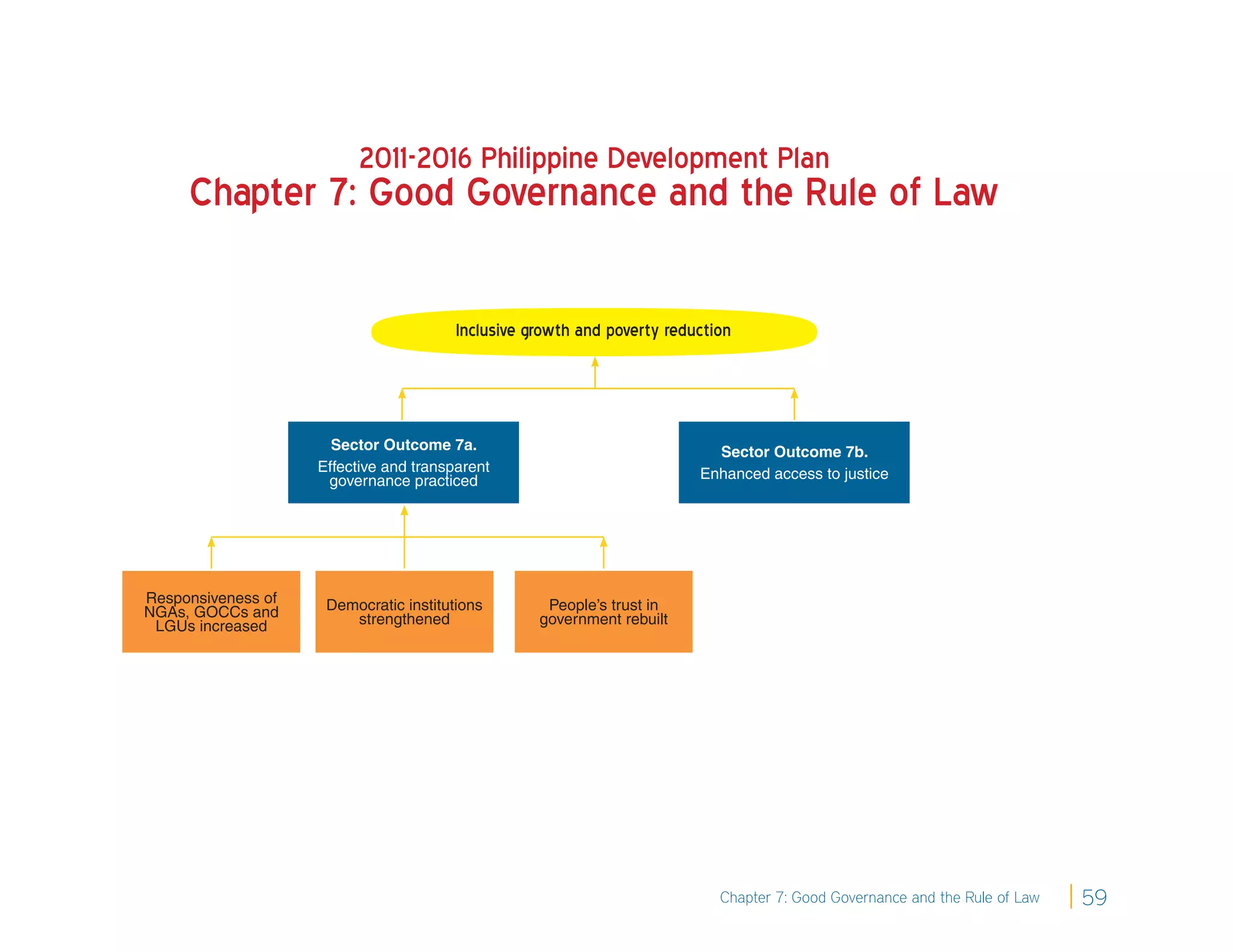
                                                                                                                                                                                                                                                                                                                   Sector Outcome 7a.
                                                                                                                                                                                                                                                                                                           Effective and transparent governance
                                                                                                                                                                                                                                                                                                                          practiced


                                                                                                                                                                                                                                                                                                                   Sector Outcome 7b.
                                                                                                                                                                                                                                                                                                                Enhanced access to justice


                                                                                                                                                                                                                                                                                                                    Sector Outcome 8.
                                                                                                                                                                                                                                                                                                           Human development status improved


                                                                                                                                                                                                                                                                                                                    Sector Outcome 9.
                                                                                                                                                                                                                                                                                                                                                     Inclusive growth and poverty reduction


                                                                                                                                                                                                                                                                                                            Stable national security environment


                                                           *All five priorities cover the 16-Point Agenda under the President’s Social Contract with the Filipino People.
                                                                                                                                                                                                                                                                                                                         achieved


                                                                                                                                                                                                                                                                                                                   Sector Outcome 10a
                                                                                                                                                                                                                                                                                                               Natural resources conserved,
                                                                                                                                                                                                                                                                                                                protected and rehabilitated


                                                                                                                                                                                                                                                                                                                   Sector Outcome 10b
                                                                                                                                                                                                                                                                                                           Environmental quality for a cleaner and
                                                                                                                                                                                                                                                                                                              healthier environment improved


                                                                                                                                                                                                                                                                                                                   Sector Outcome 10c
                                                                                                                                                                                                                                                                                                               Resilience of natural systems
                                                                                                                                                                                                                                                                                                             enhanced with improved adaptive
                                                                                                                                                                                                                                                                                                             capacities of human communities
Results Matrices with Government’s Five Major Guideposts
7
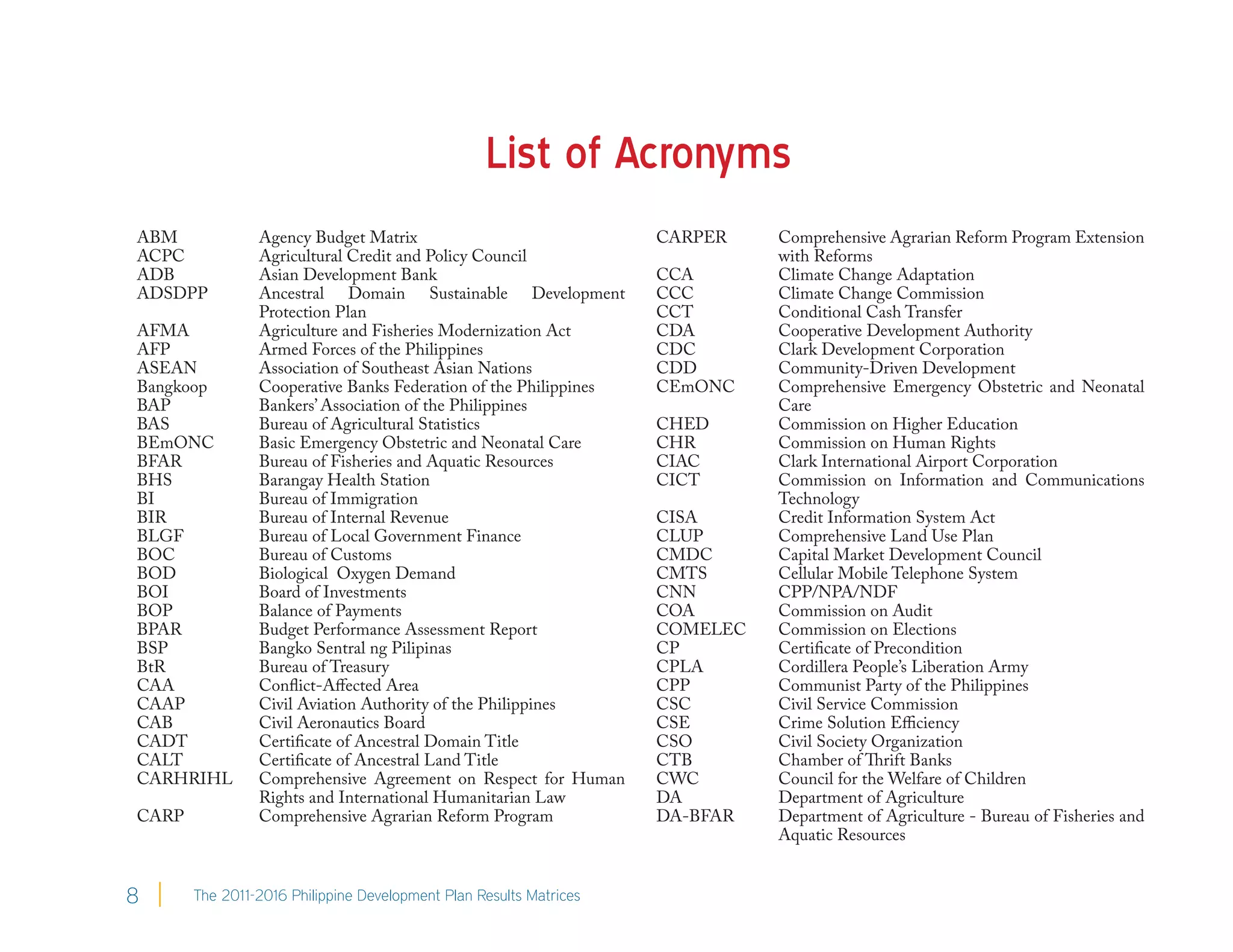
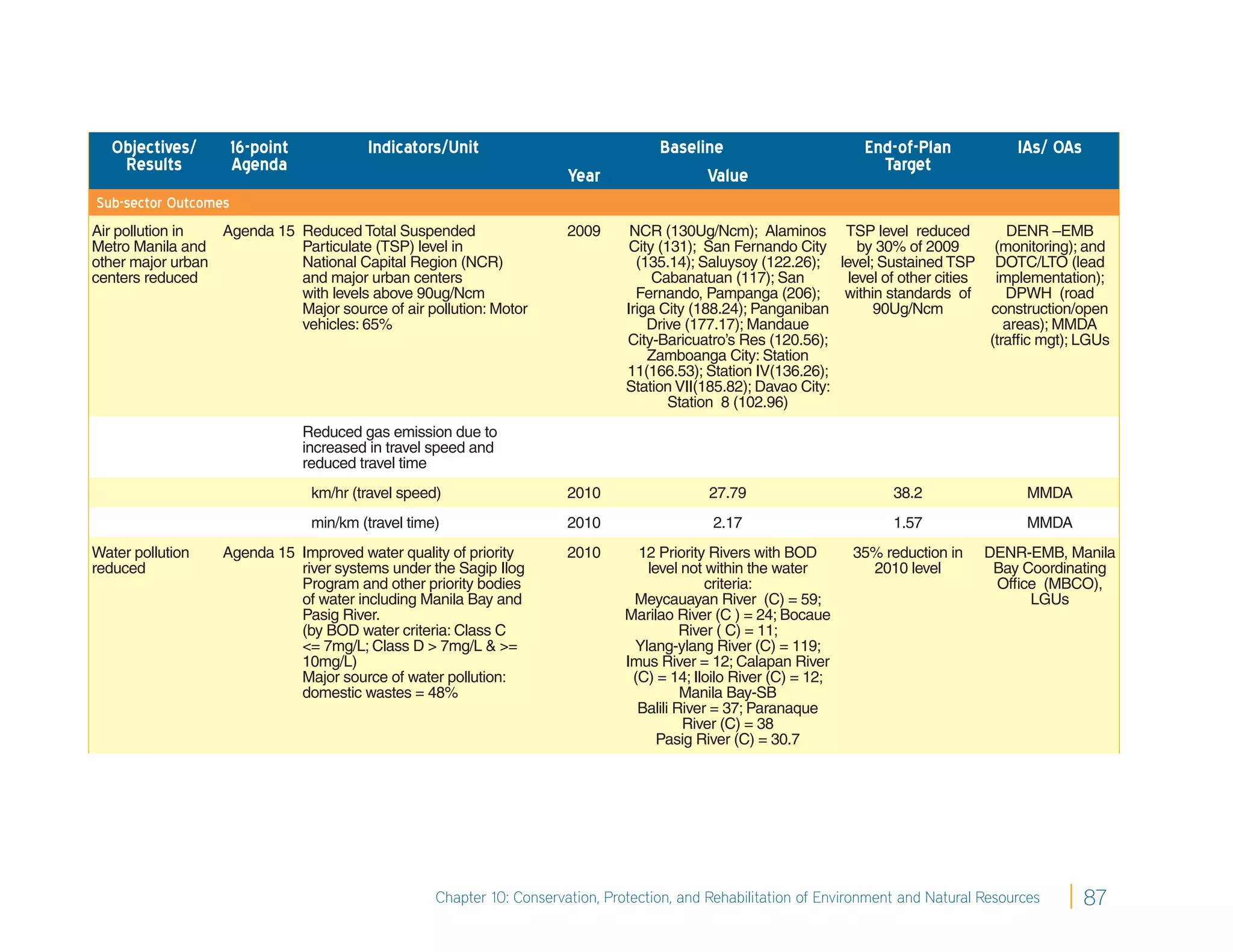
List of Acronyms
ABM             Agency Budget Matrix                                CARPER    Comprehensive Agrarian Reform Program Extension
ACPC            Agricultural Credit and Policy Council                        with Reforms
ADB             Asian Development Bank                              CCA       Climate Change Adaptation
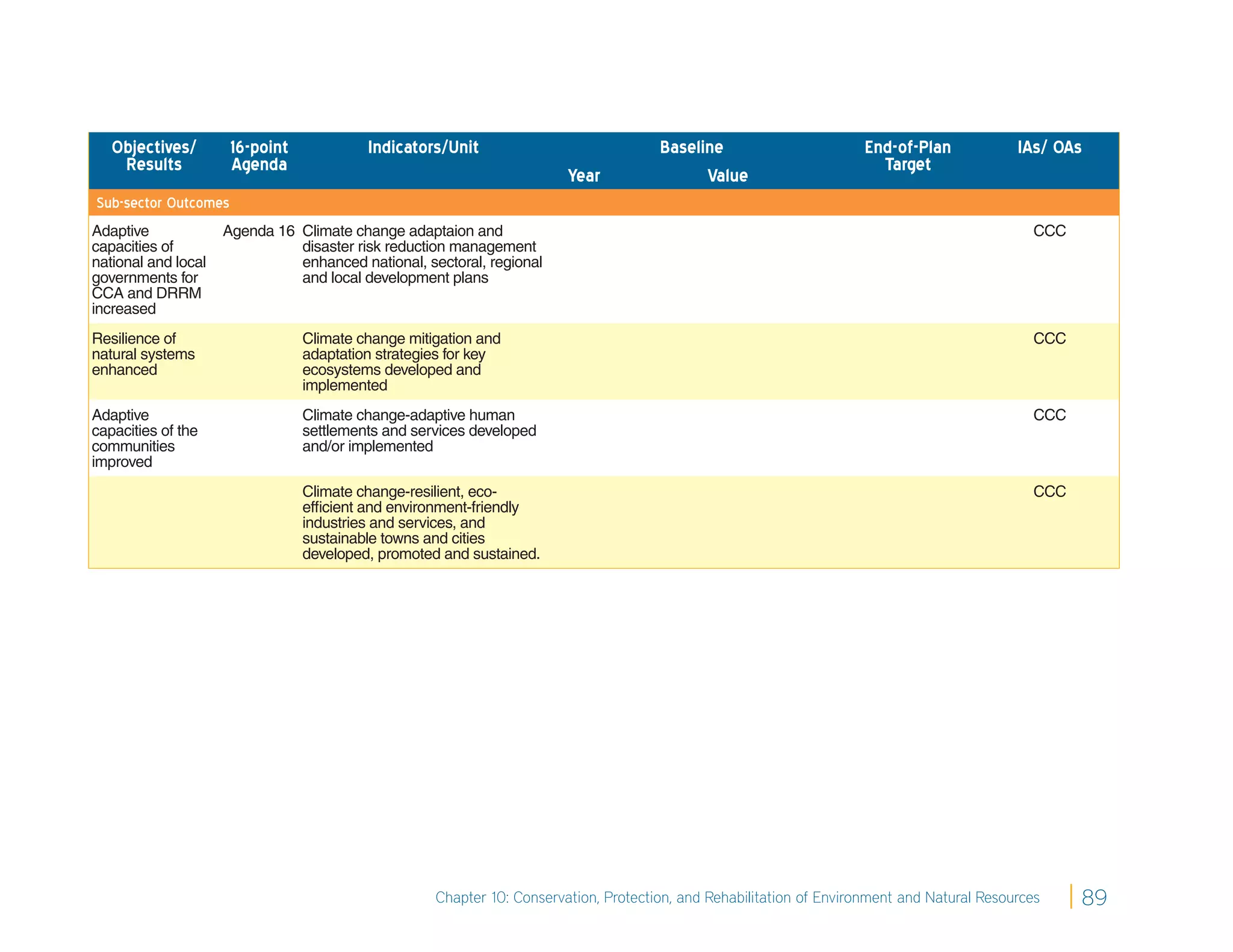
ADSDPP          Ancestral Domain Sustainable Development            CCC       Climate Change Commission
                Protection Plan                                     CCT       Conditional Cash Transfer
AFMA            Agriculture and Fisheries Modernization Act         CDA       Cooperative Development Authority
AFP             Armed Forces of the Philippines                     CDC       Clark Development Corporation 
ASEAN           Association of Southeast Asian Nations              CDD       Community-Driven Development
Bangkoop        Cooperative Banks Federation of the Philippines     CEmONC    Comprehensive Emergency Obstetric and Neonatal
BAP             Bankers’ Association of the Philippines                       Care
BAS             Bureau of Agricultural Statistics                   CHED      Commission on Higher Education
BEmONC          Basic Emergency Obstetric and Neonatal Care         CHR       Commission on Human Rights
BFAR            Bureau of Fisheries and Aquatic Resources           CIAC      Clark International Airport Corporation
BHS             Barangay Health Station                             CICT      Commission on Information and Communications
BI              Bureau of Immigration                                         Technology
BIR             Bureau of Internal Revenue                          CISA      Credit Information System Act
BLGF            Bureau of Local Government Finance                  CLUP      Comprehensive Land Use Plan
BOC             Bureau of Customs                                   CMDC      Capital Market Development Council
BOD             Biological Oxygen Demand                            CMTS      Cellular Mobile Telephone System
BOI             Board of Investments                                CNN       CPP/NPA/NDF
BOP             Balance of Payments                                 COA       Commission on Audit
BPAR            Budget Performance Assessment Report                COMELEC   Commission on Elections
BSP             Bangko Sentral ng Pilipinas                         CP        Certificate of Precondition
BtR             Bureau of Treasury                                  CPLA      Cordillera People’s Liberation Army 
CAA             Conflict-Affected Area                              CPP       Communist Party of the Philippines
CAAP            Civil Aviation Authority of the Philippines         CSC       Civil Service Commission
CAB             Civil Aeronautics Board                             CSE       Crime Solution Efficiency
CADT            Certificate of Ancestral Domain Title               CSO       Civil Society Organization
CALT            Certificate of Ancestral Land Title                 CTB       Chamber of Thrift Banks
CARHRIHL        Comprehensive Agreement on Respect for Human        CWC       Council for the Welfare of Children
                Rights and International Humanitarian Law           DA        Department of Agriculture
CARP            Comprehensive Agrarian Reform Program               DA-BFAR   Department of Agriculture - Bureau of Fisheries and
                                                                              Aquatic Resources


8      The 2011-2016 Philippine Development Plan Results Matrices
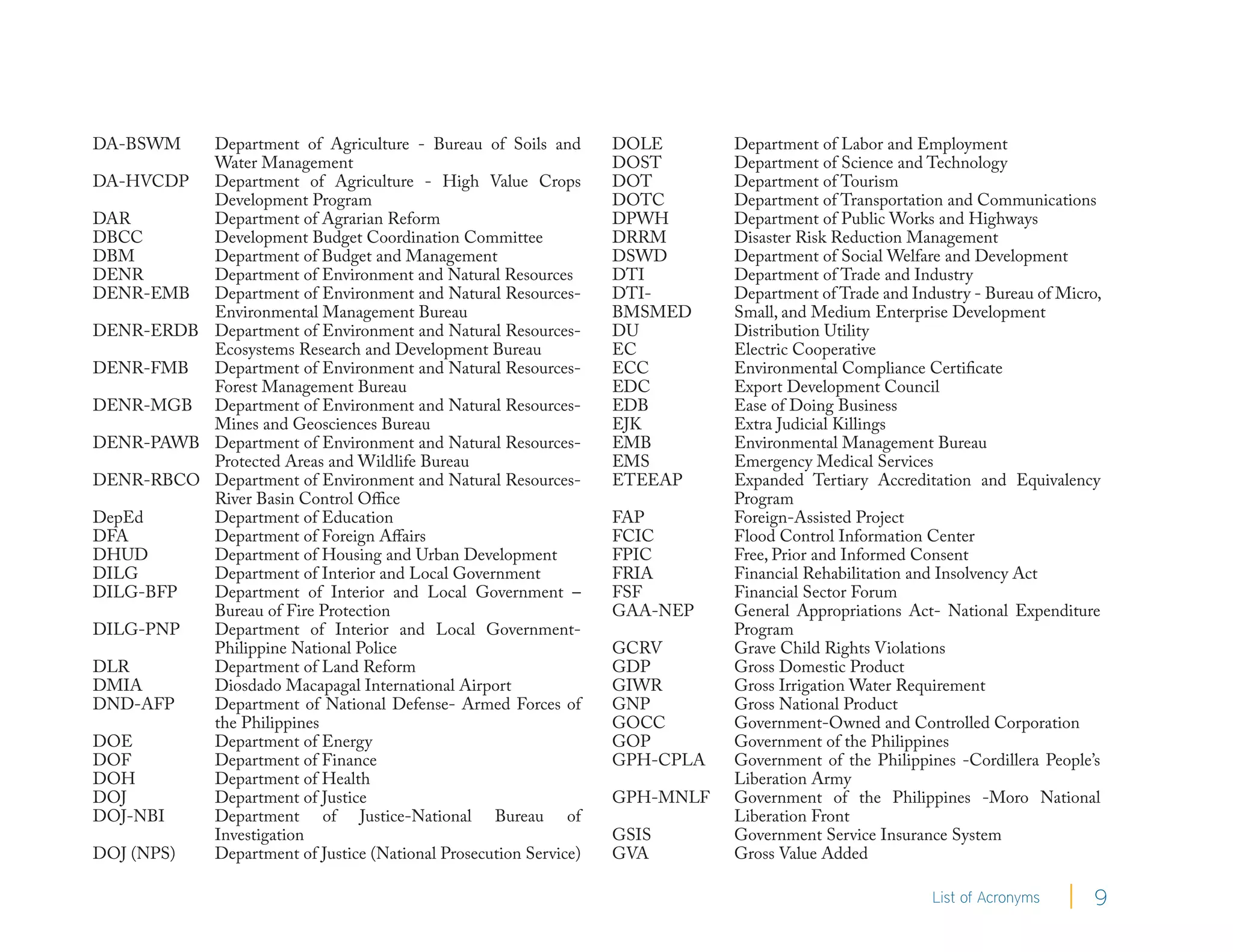
DA-BSWM   Department of Agriculture - Bureau of Soils and        DOLE       Department of Labor and Employment
          Water Management                                       DOST       Department of Science and Technology
DA-HVCDP  Department of Agriculture - High Value Crops           DOT        Department of Tourism
          Development Program                                    DOTC       Department of Transportation and Communications
DAR       Department of Agrarian Reform                          DPWH       Department of Public Works and Highways
DBCC      Development Budget Coordination Committee              DRRM       Disaster Risk Reduction Management
DBM       Department of Budget and Management                    DSWD       Department of Social Welfare and Development
DENR      Department of Environment and Natural Resources        DTI        Department of Trade and Industry
DENR-EMB Department of Environment and Natural Resources-        DTI-       Department of Trade and Industry - Bureau of Micro,
          Environmental Management Bureau                        BMSMED     Small, and Medium Enterprise Development
DENR-ERDB Department of Environment and Natural Resources-       DU         Distribution Utility
          Ecosystems Research and Development Bureau             EC         Electric Cooperative
DENR-FMB  Department of Environment and Natural Resources-       ECC        Environmental Compliance Certificate
          Forest Management Bureau                               EDC        Export Development Council
DENR-MGB Department of Environment and Natural Resources-        EDB        Ease of Doing Business
          Mines and Geosciences Bureau                           EJK        Extra Judicial Killings
DENR-PAWB Department of Environment and Natural Resources-       EMB        Environmental Management Bureau
          Protected Areas and Wildlife Bureau                    EMS        Emergency Medical Services
DENR-RBCO Department of Environment and Natural Resources-       ETEEAP     Expanded Tertiary Accreditation and Equivalency
          River Basin Control Office                                        Program
DepEd     Department of Education                                FAP        Foreign-Assisted Project
DFA       Department of Foreign Affairs                          FCIC       Flood Control Information Center
DHUD      Department of Housing and Urban Development            FPIC       Free, Prior and Informed Consent
DILG      Department of Interior and Local Government            FRIA       Financial Rehabilitation and Insolvency Act
DILG-BFP  Department of Interior and Local Government –          FSF        Financial Sector Forum
          Bureau of Fire Protection                              GAA-NEP    General Appropriations Act- National Expenditure
DILG-PNP  Department of Interior and Local Government-                      Program
          Philippine National Police                             GCRV       Grave Child Rights Violations
DLR       Department of Land Reform                              GDP        Gross Domestic Product
DMIA      Diosdado Macapagal International Airport               GIWR       Gross Irrigation Water Requirement
DND-AFP   Department of National Defense- Armed Forces of        GNP        Gross National Product
          the Philippines                                        GOCC       Government-Owned and Controlled Corporation
DOE       Department of Energy                                   GOP        Government of the Philippines
DOF       Department of Finance                                  GPH-CPLA   Government of the Philippines -Cordillera People’s
DOH       Department of Health                                              Liberation Army 
DOJ       Department of Justice                                  GPH-MNLF   Government of the Philippines -Moro National
DOJ-NBI   Department of Justice-National Bureau of                          Liberation Front
          Investigation                                          GSIS       Government Service Insurance System
DOJ (NPS) Department of Justice (National Prosecution Service)   GVA        Gross Value Added

                                                                                                       List of Acronyms      9
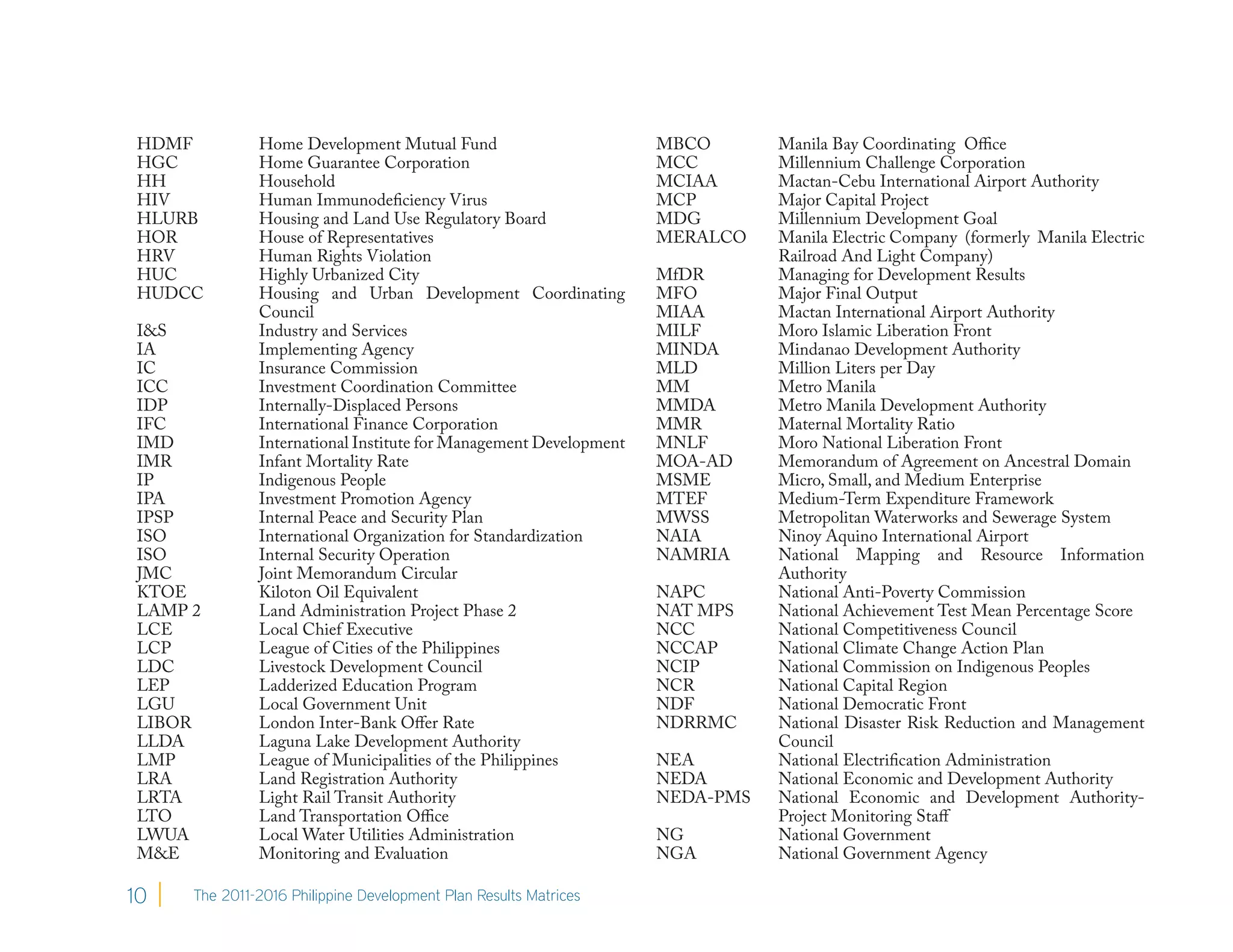
HDMF          Home Development Mutual Fund                         MBCO       Manila Bay Coordinating Office
 HGC           Home Guarantee Corporation                           MCC        Millennium Challenge Corporation
 HH            Household                                            MCIAA      Mactan-Cebu International Airport Authority
 HIV           Human Immunodeficiency Virus                         MCP        Major Capital Project
 HLURB         Housing and Land Use Regulatory Board                MDG        Millennium Development Goal
 HOR           House of Representatives                             MERALCO    Manila Electric Company (formerly  Manila Electric
 HRV           Human Rights Violation                                          Railroad And Light Company)
 HUC           Highly Urbanized City                                MfDR       Managing for Development Results
 HUDCC         Housing and Urban Development Coordinating           MFO        Major Final Output
               Council                                              MIAA       Mactan International Airport Authority
 I&S           Industry and Services                                MILF       Moro Islamic Liberation Front
 IA            Implementing Agency                                  MINDA      Mindanao Development Authority
 IC            Insurance Commission                                 MLD        Million Liters per Day
 ICC           Investment Coordination Committee                    MM         Metro Manila
 IDP           Internally-Displaced Persons                         MMDA       Metro Manila Development Authority
 IFC           International Finance Corporation                    MMR        Maternal Mortality Ratio
 IMD           International Institute for Management Development   MNLF       Moro National Liberation Front
 IMR           Infant Mortality Rate                                MOA-AD     Memorandum of Agreement on Ancestral Domain
 IP            Indigenous People                                    MSME       Micro, Small, and Medium Enterprise
 IPA           Investment Promotion Agency                          MTEF       Medium-Term Expenditure Framework
 IPSP          Internal Peace and Security Plan                     MWSS       Metropolitan Waterworks and Sewerage System
 ISO           International Organization for Standardization       NAIA       Ninoy Aquino International Airport
 ISO           Internal Security Operation                          NAMRIA     National Mapping and Resource Information
 JMC           Joint Memorandum Circular                                       Authority
 KTOE          Kiloton Oil Equivalent                               NAPC       National Anti-Poverty Commission
 LAMP 2        Land Administration Project Phase 2                  NAT MPS    National Achievement Test Mean Percentage Score
 LCE           Local Chief Executive                                NCC        National Competitiveness Council
 LCP           League of Cities of the Philippines                  NCCAP      National Climate Change Action Plan
 LDC           Livestock Development Council                        NCIP       National Commission on Indigenous Peoples
 LEP           Ladderized Education Program                         NCR        National Capital Region
 LGU           Local Government Unit                                NDF        National Democratic Front
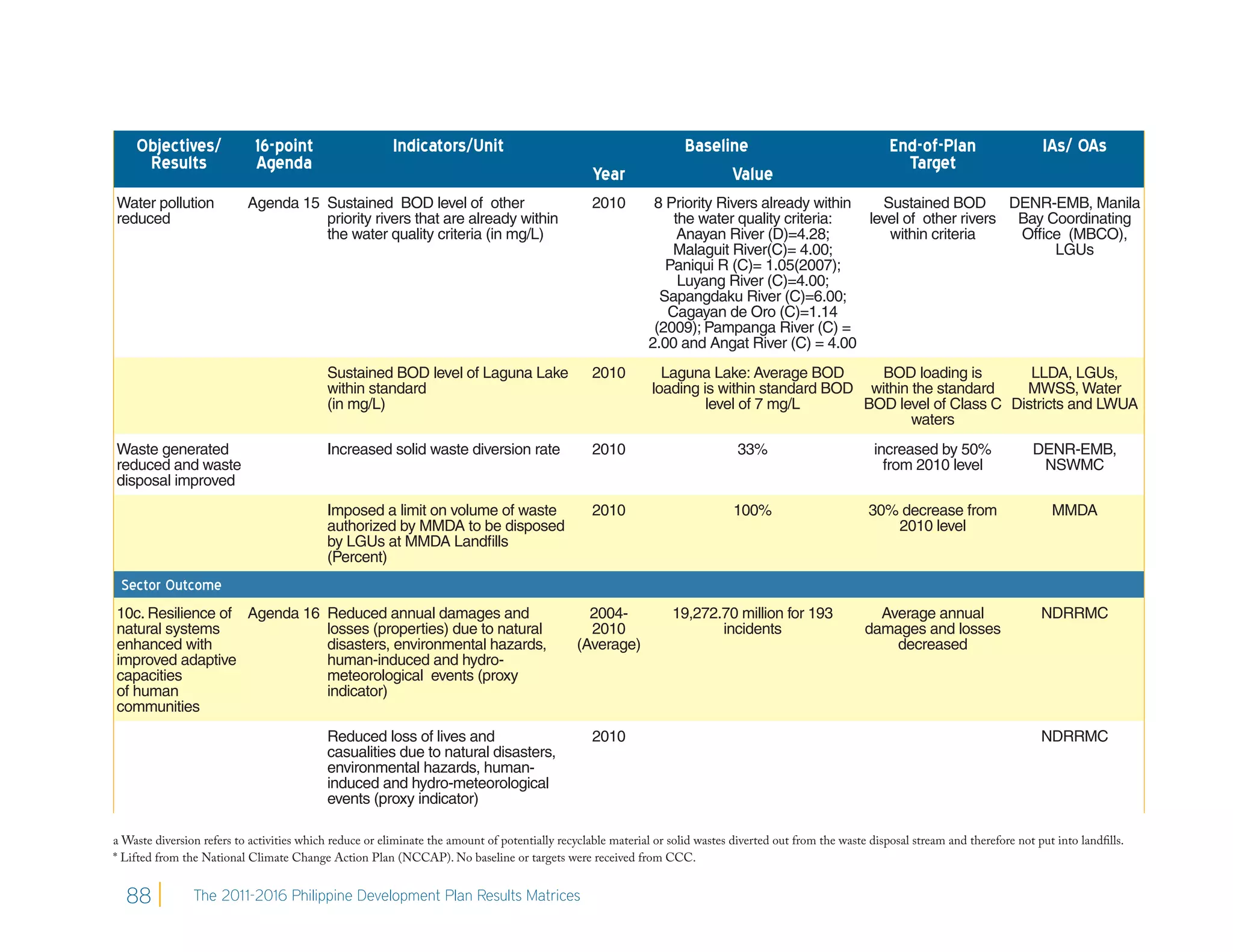
 LIBOR         London Inter-Bank Offer Rate                         NDRRMC     National Disaster Risk Reduction and Management
 LLDA          Laguna Lake Development Authority                               Council
 LMP           League of Municipalities of the Philippines          NEA        National Electrification Administration
 LRA           Land Registration Authority                          NEDA       National Economic and Development Authority
 LRTA          Light Rail Transit Authority                         NEDA-PMS   National Economic and Development Authority-
 LTO           Land Transportation Office                                      Project Monitoring Staff
 LWUA          Local Water Utilities Administration                 NG         National Government
 M&E           Monitoring and Evaluation                            NGA        National Government Agency

10    The 2011-2016 Philippine Development Plan Results Matrices
NGCP       National Grid Corporation of the Philippines              PCGG         Presidential Commission on Good Governance
NGO        Non-Governmental Organization                             PCW          Philippine Commission on Women
NHA        National Housing Authority                                PDEx         Philippine Dealing and Exchange Corporation
NHIP       National Health Insurance Program                         PDIC         Philippine Deposit Insurance Corporation
NHMFC      National Home Mortgage Finance Corporation                PDP          Philippine Development Plan
NHTS-PR    National Household Targeting System for Poverty           PEM          Public Expenditure Management
           Reduction                                                 PERA         Personal Equity Retirement Account
NIA        National Irrigation Administration                        PESFA        Private Education Students Financial Assistance
NIPAS      National Integrated Protected Areas System                             Program
NNC        National Nutrition Council                                PEZA         Philippine Economic Zone Authority
NPA        New People’s Army                                         PHIC/        Philippine Health Insurance Corporation
NRW        Non-revenue Water                                         PhilHealth
NSCB       National Statistical Coordination Board                   PhilMech     Philippine Center for Postharvest Development and
NSO        National Statistics Office                                             Mechanization
NSWMC      National Solid Waste Management Commission                PHRC         Presidential Human Rights Committee
NTC        National Telecommunications Commission                    PIOU         Private Investor-Owned Utilities
NWRB       National Water Resources Board                            PIP          Public Investment Plan
O&M        Operation and Maintenance                                 PNP          Philippine National Police
OA         Oversight Agency                                          PNP-MG       Philippine National Police- Maritime Group
OCD        Office of Civil Defense                                   POPCOM       Population Commission
ODA        Official Development Assistance                           PP           Palay Production
OECD       Organisation for Economic Co-operation and                PPA          Philippine Ports Authority
           Development                                               PPP          Public-Private Partnership
OFW        Overseas Filipino Worker                                  PR           Palay equivalent of Rice requirement
OMB        Optical Media Board                                       PS           Private Sector
OP         Office of the President                                   PSE          Philippine Stock Exchange
OPAPP      Office of the Presidential Adviser on the Peace Process   QQTAB        Quality, Quantity, Time, Area and Beneficiaries
OPES       Office Performance Evaluation System                      RBAP         Rural Bankers Association of the Philippines
OPIF       Organizational Performance Indicator Framework            RBCA         Risk Based Capital Adequacy
OWWA       Overseas Workers Welfare Administration                   RBM          Results-Based Management
PAG        Private Armed Group                                       RBO          River Basin Organization
PAGC       Presidential Anti-Graft Commission                        REIT         Real Estate Investment Trust
PAG-IBIG   Pagtutulungan sa Kinabukasan: Ikaw, Bangko,               RH           Reproductive Health
           Industriya at Gobyerno                                    RHU          Rural Health Unit
PAMANA     Payapa at Masaganang Pamayanan Program                    RM           Results Matrix
PAP        Program and Project                                       ROD          Registry of Deeds
PBR        Philippine Business Registry                              RPMP/RPA-    Rebolusyonaryong Partido ng Manggagawa-Pilipinas
PCA        Philippine Coconut Authority                              ABB          /Revolutionary Proletariat Army-Alex Boncayao
PCG        Philippine Coast Guard                                                 Brigade

                                                                                                            List of Acronyms     11
RRA           RPMP/RPA-ABB
 SBMA          Subic Bay Metropolitan Authority
 SEC           Securities and Exchange Commission
 SER           Socioeconomic Report
 SHFC          Social Housing Finance Corporation
 SLM           Sustainable Land Management
 SMART         Specifi c, Measurable, Appropriate, Realistic, and
               Time-bound
 SPM           Strategy Planning Matrices
 SRA           Sugar Regulatory Administration
 SSR           Security Sector Reform
 SSS           Social Security System
 STUFAP        Student Financial Assistance Programs
 SUC           State Universities and Colleges
 TESDA         Technical Education and Skills Development
               Authority
 TSP           Total Suspended Particulate
 TVET          Technical And Vocational Education And Training
 UHC           Universal Health Care
 UNDP          United Nations Development Program
 WATSAN        Water and Sanitation
 WB            World Bank
 WD            Water District
 WEF           World Economic Forum
 WGI           Worldwide Governance Indicators
 WTO           World Trade Organization
 WSP           Water Service Provider


12    The 2011-2016 Philippine Development Plan Results Matrices
2011- 2016 Philippine Development Plan
                                              Critical Indicators
                                                                                   Tax administration (priority on measures that improve
MACROECONOMY                                                                        governance; substantially reduce tax evasion, smuggling,
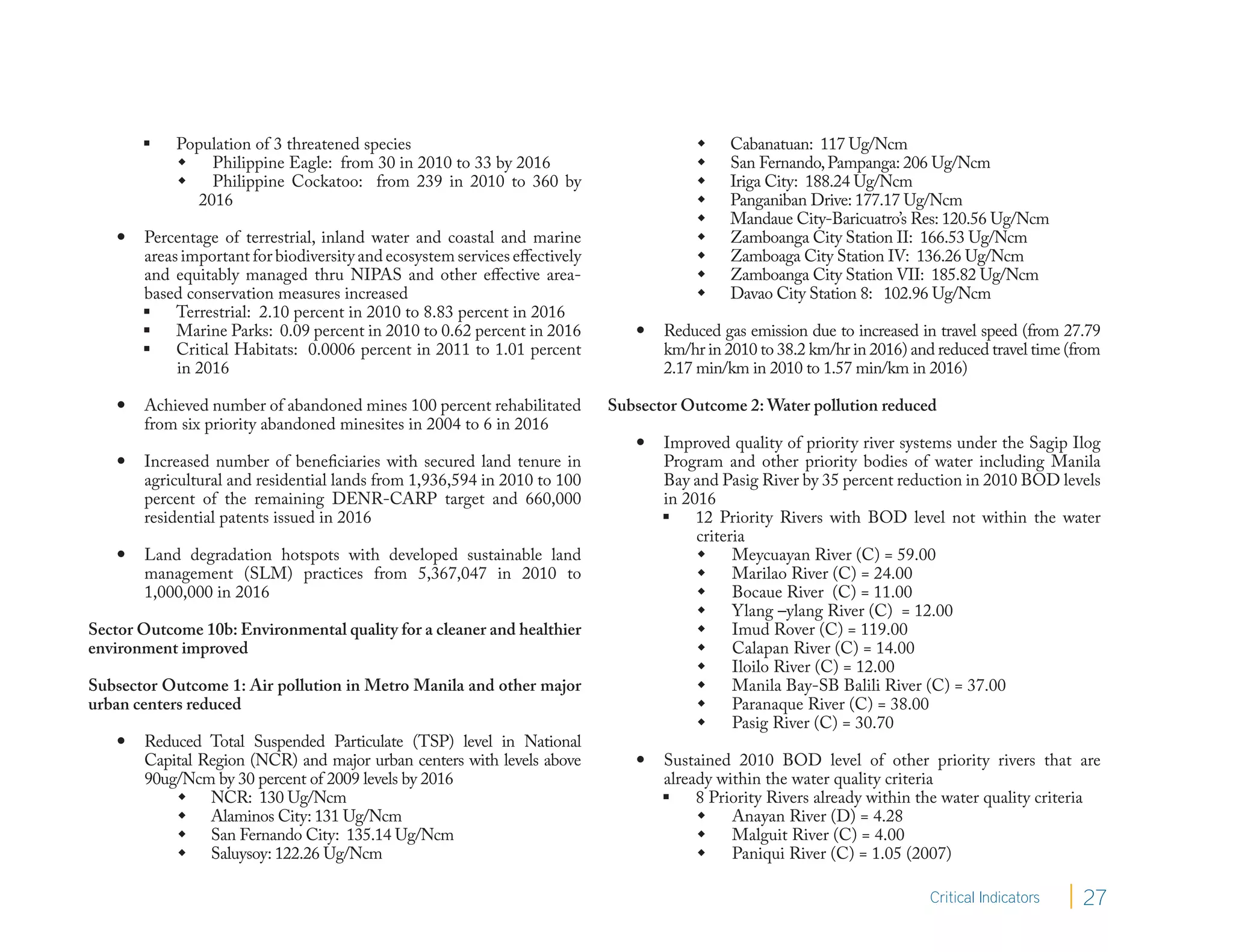
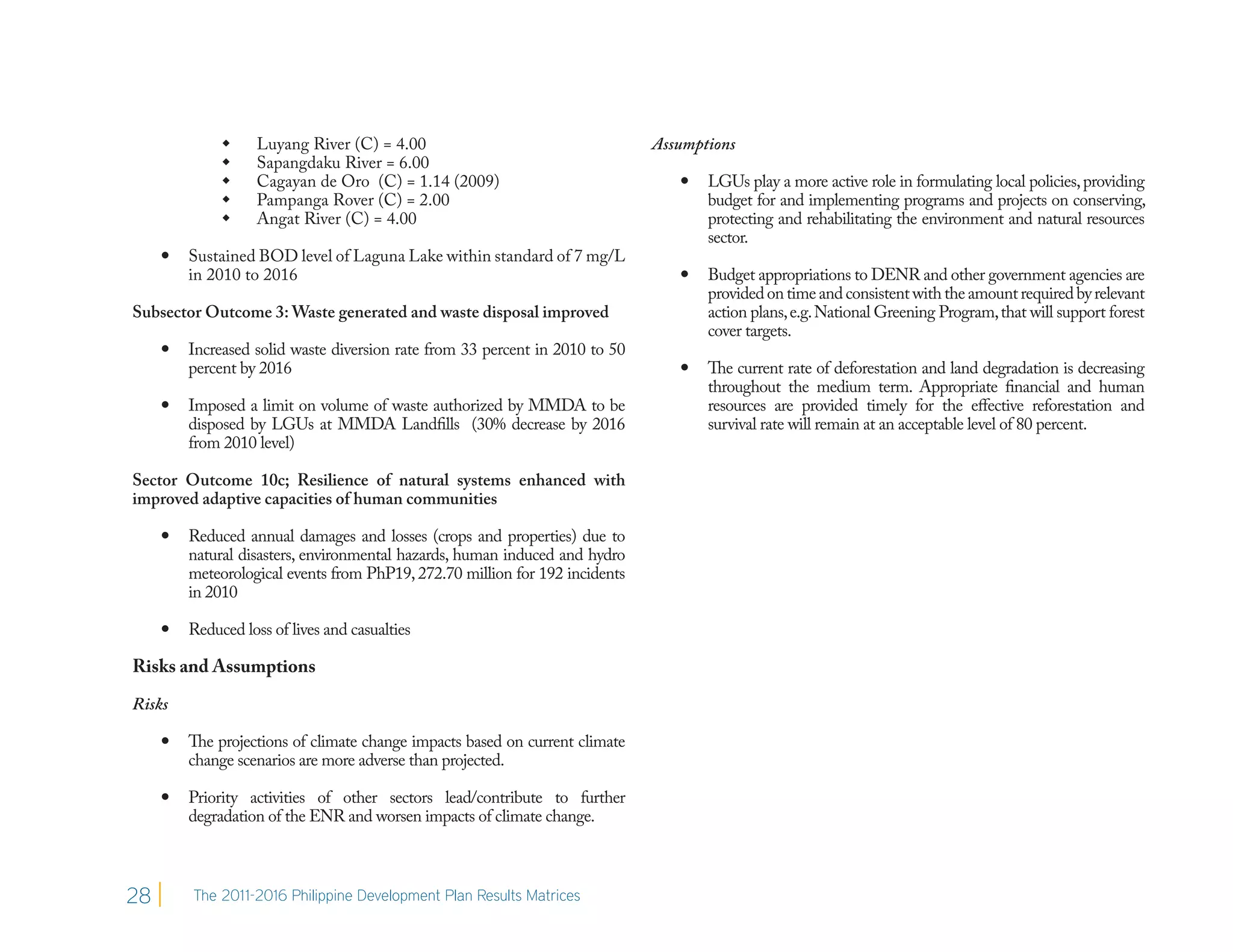
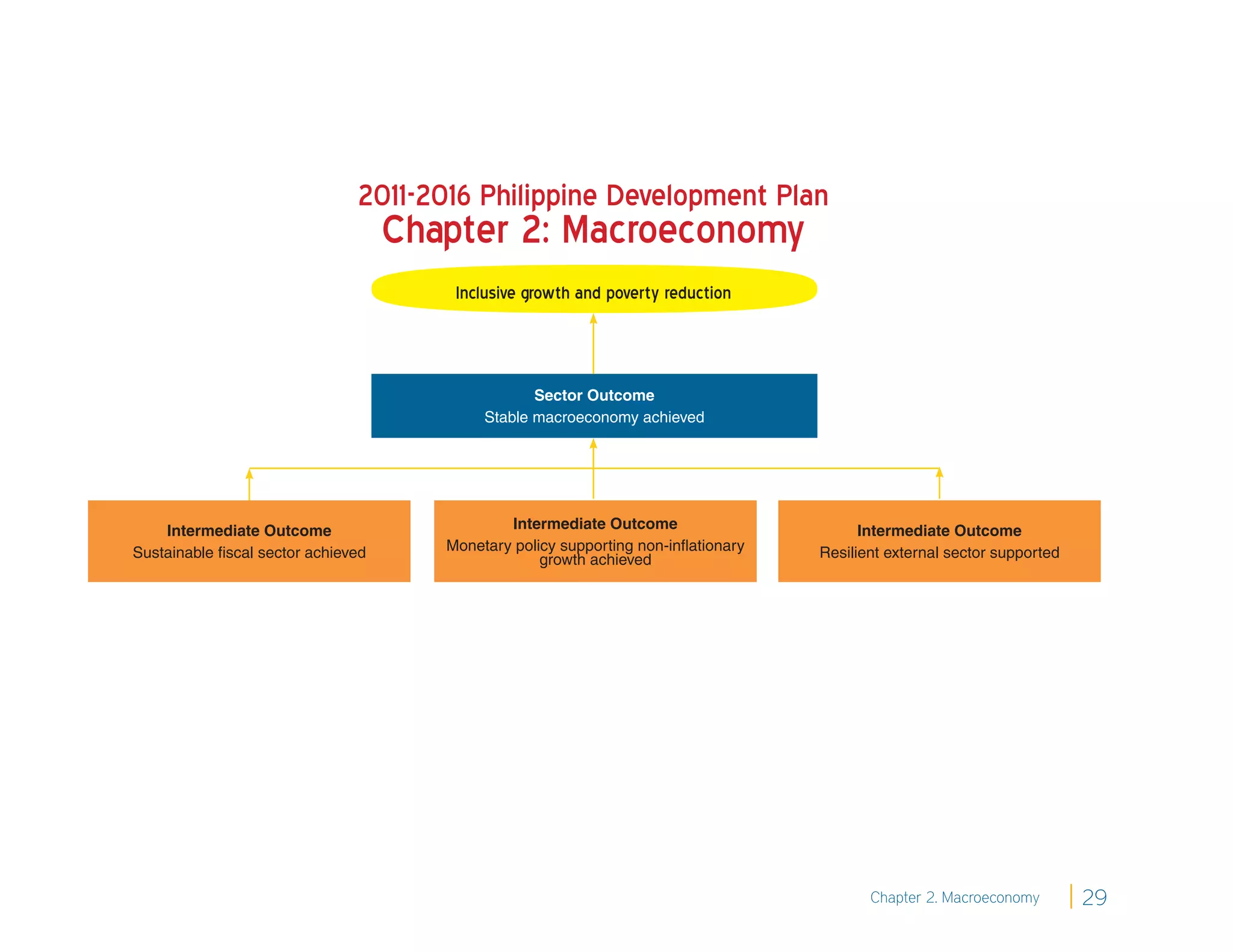
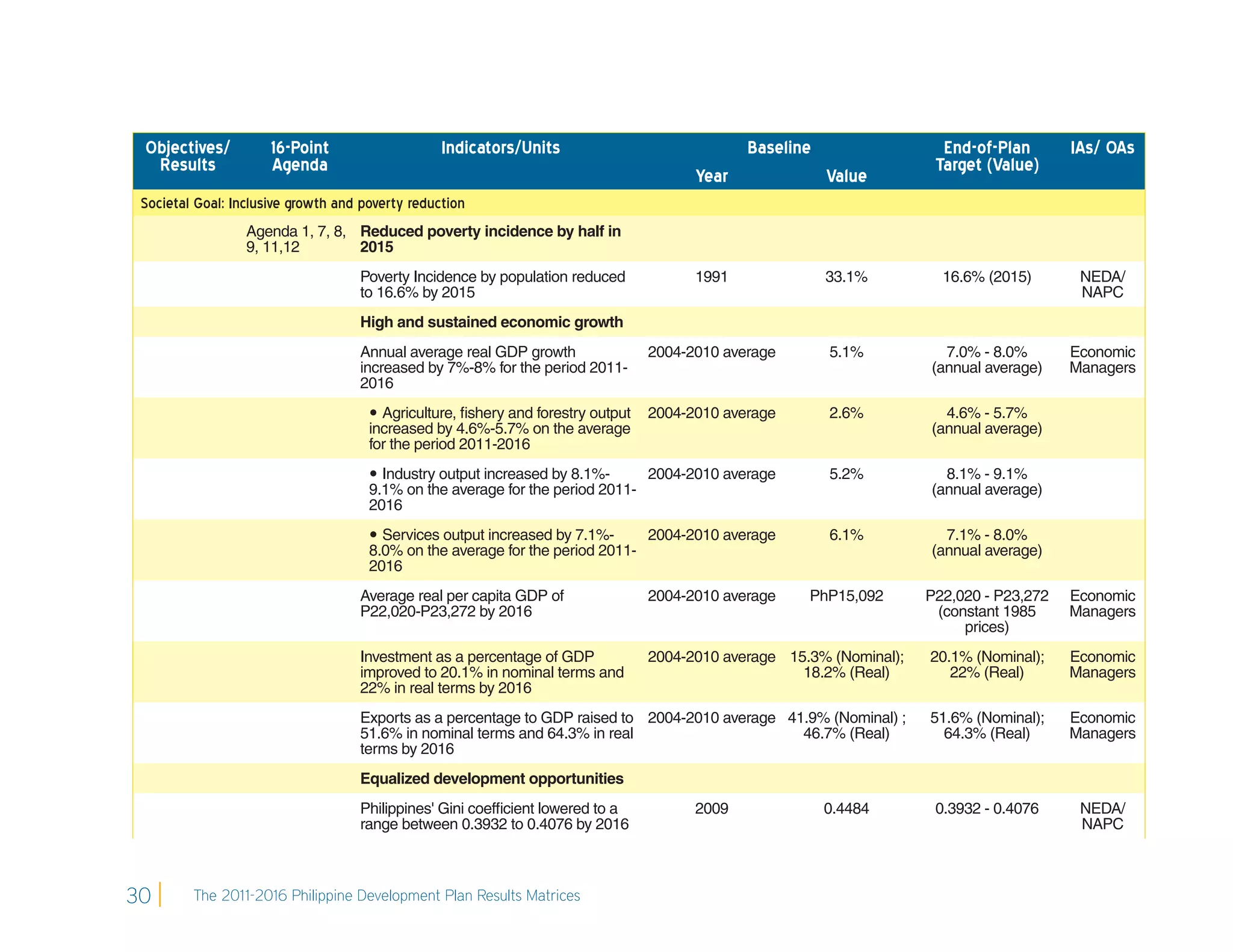
                                                                                    and corruption; and increase efficiency);
Sector Outcome: Stable macroeconomy achieved                                       Tax policy (focus on raising tax and revenue efforts of the
                                                                                    government);
      Reduced fiscal deficit-to-GDP ratio from 3.7 percent to 2.0                 Expenditure policy reforms (substantially increase
       percent by 2016                                                              productive expenditures such as spending on infrastructure
                                                                                    and social services; more efficient utilization of the budget)
      Achieved low and stable inflation of 3 percent to 5 percent                 Debt management reforms (effectively maintained a
       annual average for the period 2011-2013                                      manageable debt level; effectively reduced government
                                                                                    exposure to contingent liabilities)
Risks and Assumptions
                                                                               Effective implementation of reforms in government corporations
Assumptions                                                                     and other public sector entities

      Attainment/realization of the medium term fiscal program and            Stable political environment
       macroeconomic assumptions (e.g. GDP, inflation rate, foreign
       interest rates (LIBOR), exports, imports, exchange rate, Dubai
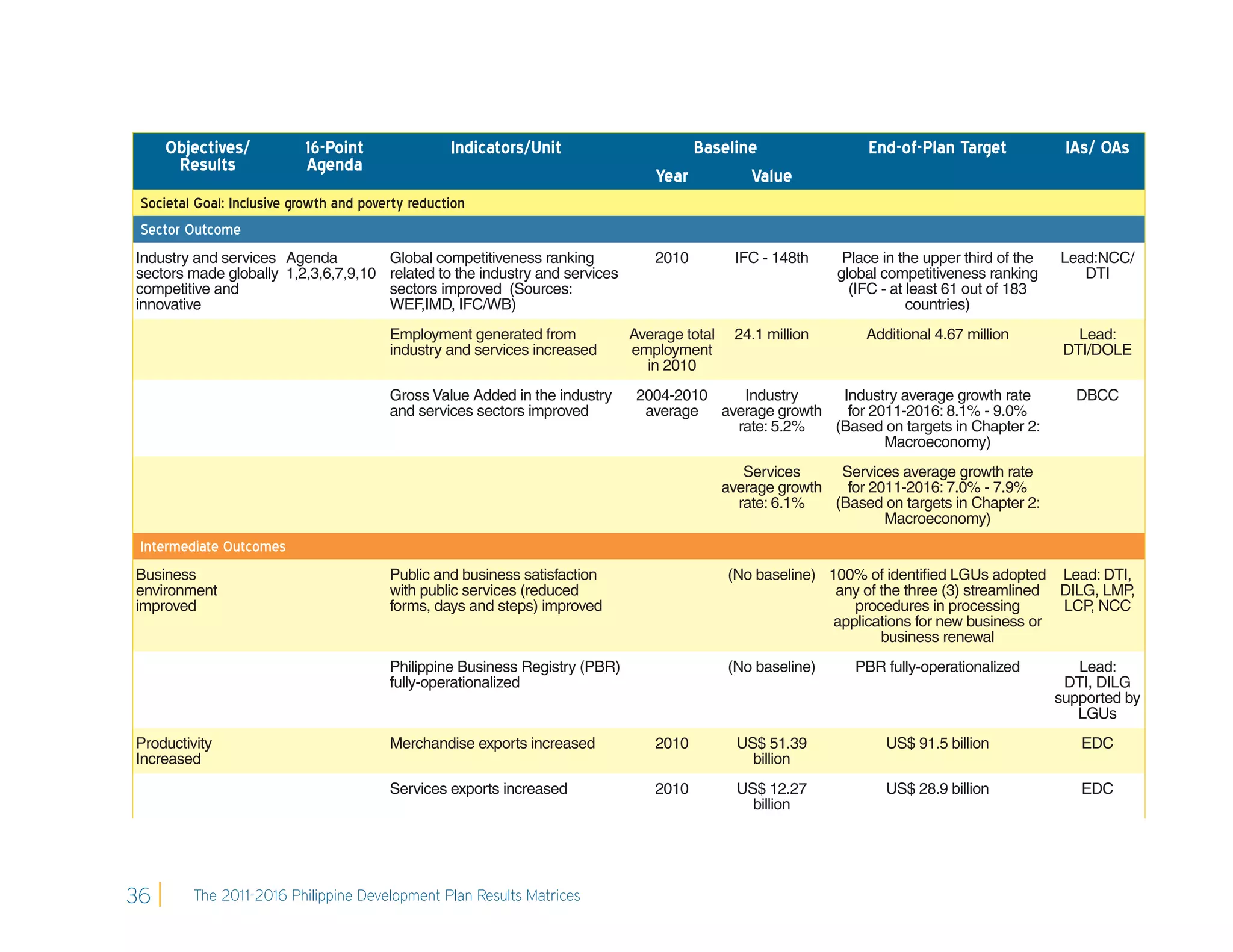
       oil price, etc.)                                                  COMPETITIVE INDUSTRY AND SERVICES SECTORS
      Realization of the population growth assumption                   Sector Outcome: Industry and services sectors made globally
                                                                         competitive and innovative
      Stable external and domestic environment (no economic,
       financial, and current account shocks)                                  Improved global competitiveness ranking related to the I&S
                                                                                sectors (Sources: WEF,IMD, IFC/WB) - Land top 30 percent
      Continued high level of business and consumer confidence                 in global universe (IFC - at least 54)

      Timely passage and efficient implementation of budget                   Generated employment from industry and services increased by
                                                                                additional 4.67 million from 2011-2016
      Timely and effective implementation of necessary fiscal reforms
       in the areas of:


                                                                                                                       Critical Indicators     13
   Improved Gross Value Added arising from innovation in the           Risks and Assumptions
         industry and services sectors
          Industry: 5.2 percent (2004-2010 average) to 8.1 percent-         Risks
             9.0 percent (2011-2016 average)
          Services: 6.1 percent (2004-2010 average) to 7.0 percent -               Political instability, economic crisis
             7.9 percent (2011-2016 average)
                                                                                    Projects/programs are not implemented, or not implemented on
Intermediate Outcome 1: Business environment improved                                time

        Improved public and business satisfaction with public services             Delay in the operationalization of PBR due to connectivity
         (reduced forms, delays and steps)                                           concerns

        Fully operationalized Philippine Business Registry (PBR)

Intermediate Outcome 2: Productivity increased                               COMPETITIVE AND SUSTAINABLE AGRICULTURE AND
                                                                             FISHERIES SECTORS
        Increased merchandise exports from US$51.39 billion (2010) to
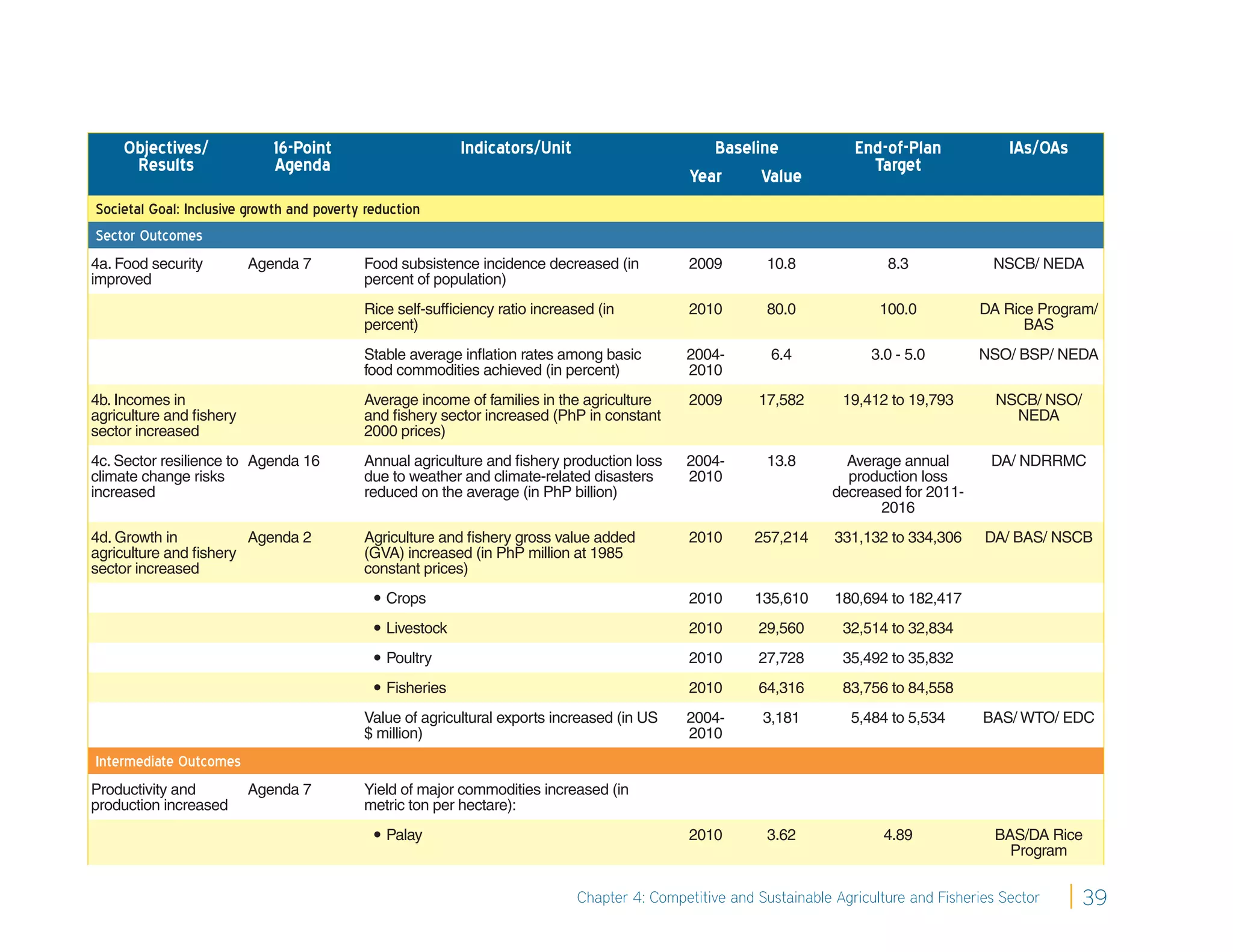
         US$ 91.5 billion (2016).                                            Sector Outcome (Goal 4a): Food security improved
        Increased services exports from US$12.27 billion (2010) to                 Decreased food subsistence incidence (in percent of population)
         US$28.9 billion (2016).                                                     from 10.8 percent in 2009 to 8.3 percent in 2015

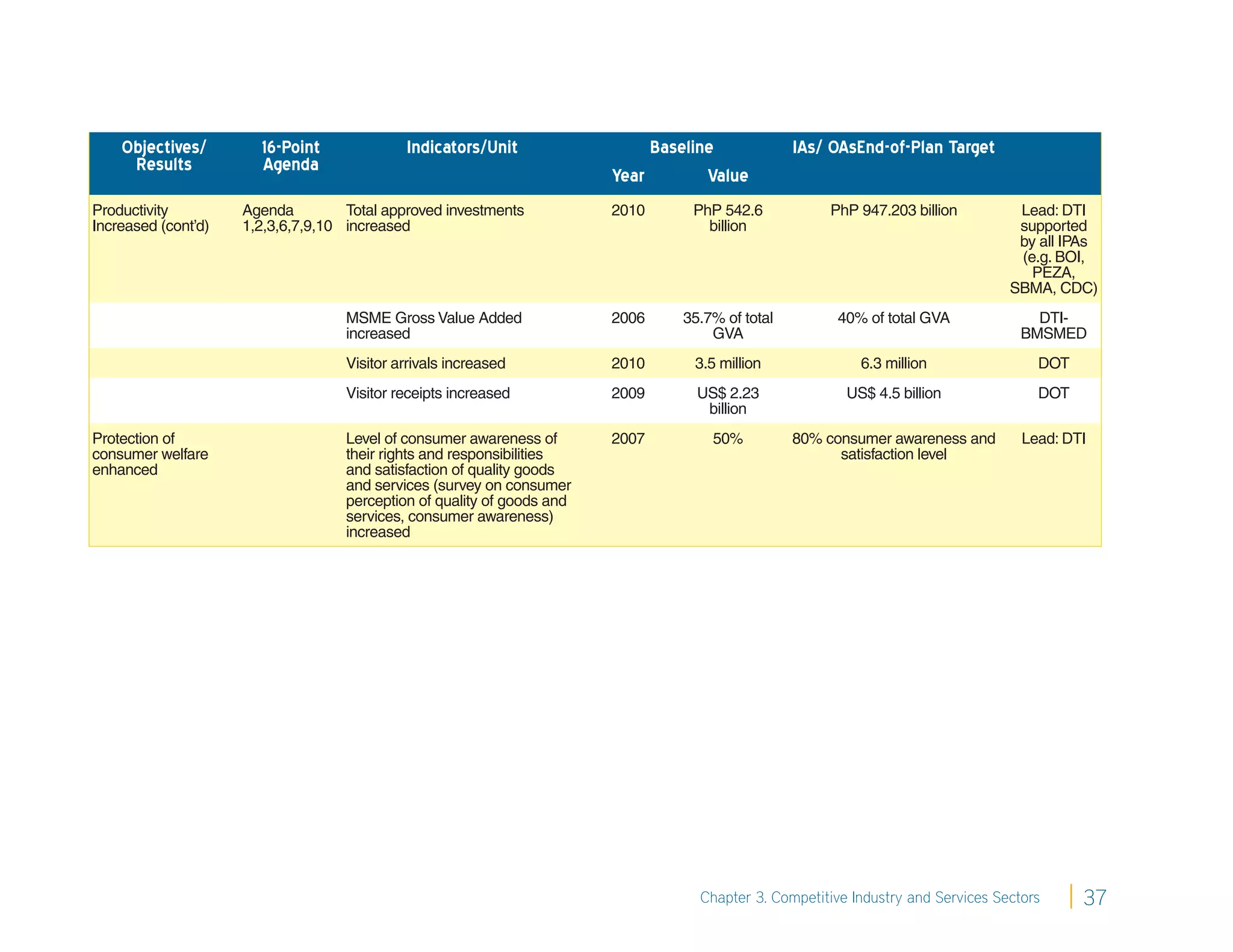
        Increased total approved investments from PhP542.6 billion                 Increased rice self-sufficiency ratio (in percent) from 80 percent
         (2010) to PhP947.203 billion (2016).                                        in 2010 to 100 percent in 2013

        Increased MSME Gross Value Added from 35.7 percent (2006)                  Stable average inflation rates among basic food commodities
         of total GVA to 40 percent of total GVA (2016)                              (in percent) from 6.4 percent (2004-2010) to 3.0 to 5.0 percent
                                                                                     (2011 to 2016)
        Increased visitor arrivals from 3.5 million (2010) to 6.3 million
         (2016)                                                              Sector Outcome (Goal 4b): Incomes in agriculture and fishery
                                                                             sector increased
        Increased visitor receipts from US$2.23 billion (2009) to US$4.5
         billion (2016)                                                             Increased annual average income of families in the agriculture
                                                                                     and fishery sector (in pesos, real terms) from PhP17,582 in 2009
Intermediate Outcome 3: Protection of Consumer Welfare                               to PhP19,412 to PhP19,793 in 2015
Enhanced

        Increased level of consumer awareness and satisfaction of quality
         goods and services

14        The 2011-2016 Philippine Development Plan Results Matrices
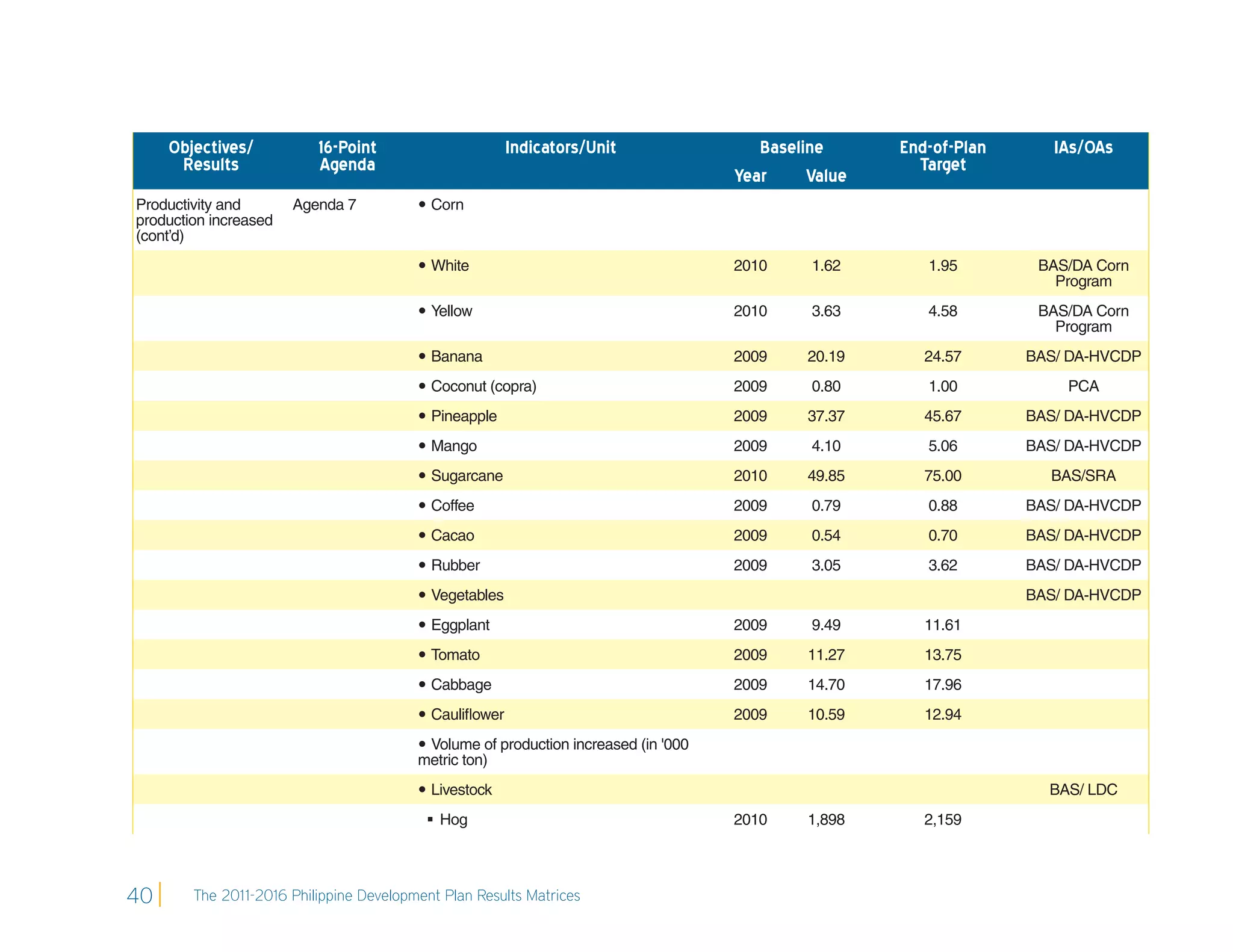
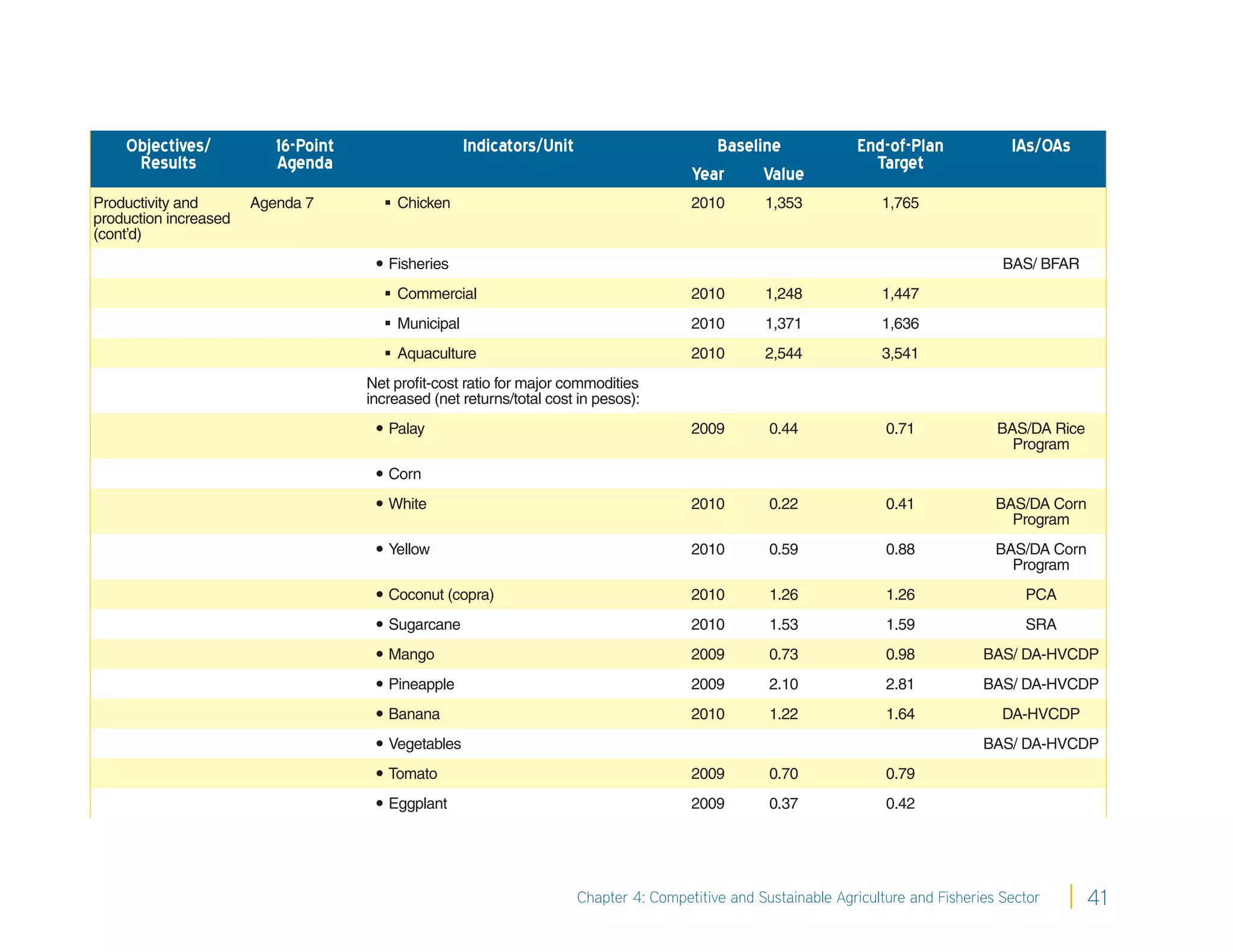
Sector Outcome (Goal 4c): Sector resilience to climate change               Increased volume of production (in ‘000 metric ton)
risks increased                                                               Livestock
                                                                                   Hog - 1,898 in 2010 to 2,159 in 2016
      Reduced average annual agri-production loss due to weather and              Chicken - 1,353 in 2010 to 1,765 in 2016
       climate-related disasters (in PhP billion) from PhP13.8 billion        Fisheries
       (2004-2010) and at a decreasing rate per year                               Commercial - 1,248 in 2010 to 1,447 in 2016
                                                                                   Municipal - 1,371 in 2010 to 1,636 in 2016
Sector Outcome (Goal 4d): Growth in agriculture and fishery                        Aquaculture - 2,544 in 2010 to 3,541 in 2016
sector increased
                                                                            Increased net profit-cost ratio for major commodities (net
      Increased annual agriculture and fishery gross value added (in        returns/total cost in pesos):
       PhP million at constant prices) from PhP257,214 million in                Palay - from 0.44 in 2009 to 0.71 in 2016
       2010 to PhP331,132 to PhP334,306 million by 2016                          Corn
                                                                                   White - from 0.22 in 2010 to 0.41 in 2016
      Increased annual value of agricultural export (in US$ million)              Yellow - from 0.59 in 2010 to 0.88 in 2016
       from US$3,181 million (2004-2010) to US$5,484 million to               Coconut (copra) - from 1.26 in 2010 to 1.26 in 2016
       US$5,534 million (2011-2016)                                           Sugarcane - from 1.53 in 2010 to 1.59 in 2016
                                                                              Mango - from 0.73 in 2009 to 0.98 in 2016
Intermediate Outcome: Productivity and production increased                   Pineapple - from 2.10 in 2009 to 2.81 in 2016
                                                                              Banana - from 1.22 in 2010 to 1.64 in 2016
      Increased yield of major commodities (in metric ton/ha):               Eggplant - from 0.37 in 2009 to 0.42 in 2016
        Palay – from 3.62 in 2010 to 4.89 in 2016                            Tomato - from 0.70 in 2009 to 0.79 in 2016
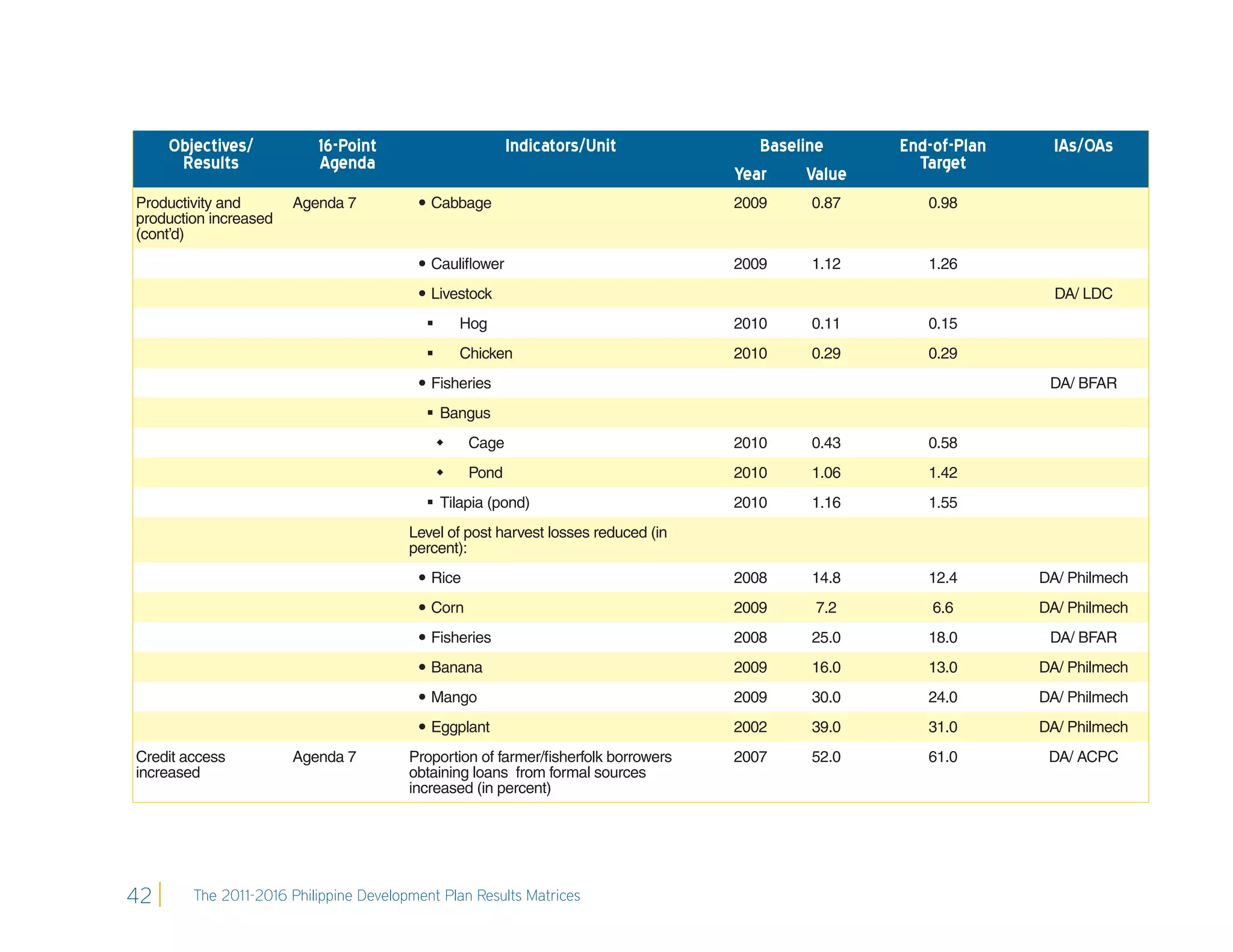
        Corn                                                                 Cabbage - from 0.87 in 2009 to 0.98 in 2016
             White – from 1.62 in 2010 to 1.95 in 2016                       Cauliflower - from 1.12 in 2009 to 1.26 in 2016
             Yellow – from 3.63 in 2010 to 4.58 in 2016                      Livestock
        Banana - from 20.19 in 2009 to 24.57 in 2016                              Hog - from 0.11 in 2010 to 0.15 in 2016
        Coconut (copra) - from 0.80 in 2009 to 1.00 in 2016                       Chicken - from 0.29 in 2010 to 0.29 in 2016
        Pineapple - from 37.37 in 2009 to 45.67 in 2016                         Fisheries
        Mango - from 4.10 in 2009 to 5.06 in 2016                                 Bangus
        Sugarcane - from 49.85 in 2010 to 75.00 in 2016                              Cage - from 0.43 in 2010 to 0.58 in 2016
        Coffee - from 0.79 in 2009 to 0.88 in 2016                                   Pond - from 1.06 in 2010 to 1.42 in 2016
        Rubber - from 3.05 in 2009 to 3.62 in 2016                                Tilapia (pond) - from 1.16 in 2010 to 1.55 in 2016
        Eggplant - from 9.49 in 2009 to 11.61 in 2016
        Tomato - from 11.27 in 2009 to 13.75 in 2016                       Reduced level of post harvest losses (in percent):
        Cabbage - from 14.70 in 2009 to 17.96 in 2016                        Rice – from 14.8 in 2008 to 12.4 by 2016
                                                                              Corn – from 7.2 in 2009 to 6.6 in 2016
                                                                              Fisheries – from 25.0 in 2008 to 18 in 2016


                                                                                                                     Critical Indicators   15
    Banana – from 16 in 2009 to 13 in 2016                           On agricultural export targets
             Mango – from 30 in 2009 to 24 in 2016
             Eggplant – from 39 in 2002 to 31 in 2016                                International prices of export crops (e.g. coconut, pineapple, etc.)
                                                                                       should remain at least stable to encourage producers.
        Increased borrowing incidence from formal sources among small
         farmers and fisherfolk from 52 percent in 2007 to 61 percent in       Assumptions
         2016
                                                                                      Natural or man-made disasters/calamities, diseases
Risks and Assumptions
                                                                                      Global economic crisis
Risks
                                                                                      Major political problems that may affect international supply
On the achievement of growth in agriculture and fishery sector, rice                   and demand of goods/services
self-sufficiency and productivity targets
                                                                                      Projects/programs are not implemented or not implemented on
        Destructive typhoons and other climate-related events such as                 time
         the El Nino Phenomenon pose a risk to the achievement of
         sector outcome targets on gross value added (GVA) and 100                    Competitiveness used in assessing a country’s performance may
         percent rice self-sufficiency. High population growth will further            have its limitation. Parameters used to measure competitiveness
         put pressure on the demand for food especially for rice.                      ranking may not reflect the level of development of the country.
                                                                                       It should be used with other indicators in order to make a more
On stable prices of basic food commodities                                             meaningful comparison.

        Volatility in the world price of crude oil has a negative impact on          The increase of countries enjoined to the competitiveness survey
         the affordability of basic food commodities since                             will further increase the country’s efforts to attain target of the
          it increases the prices of farm inputs (e.g. fertilizer); and               top third in ranking.
          fuel is used for farm equipment such as tractors and
             fishing boats, and for transporting food commodities from         On the indicator on climate change
             production areas to the market.
                                                                                      The national government especially the DA and other rural
On food subsistence incidence and increased incomes                                    agencies should remain committed in the implementation of
                                                                                       adaptation options (e.g. drought resistant varieties, early warning
        High and unstable inflation rate (headline) reduces the                       systems, etc.) to reduce the impact of climate change and
         purchasing power of the poor especially the small farmers and                 extreme weather events.
         fishers which may increase hunger incidence and decrease real
         incomes.                                                              On the indicator on increased credit access

                                                                                      The banking system is committed to support the Agri-Agra
                                                                                       Reform Credit Act of 2009 (RA 10000).

16       The 2011-2016 Philippine Development Plan Results Matrices
On the availability of budgetary support for government agencies and            TRANSPORT
commodity plans
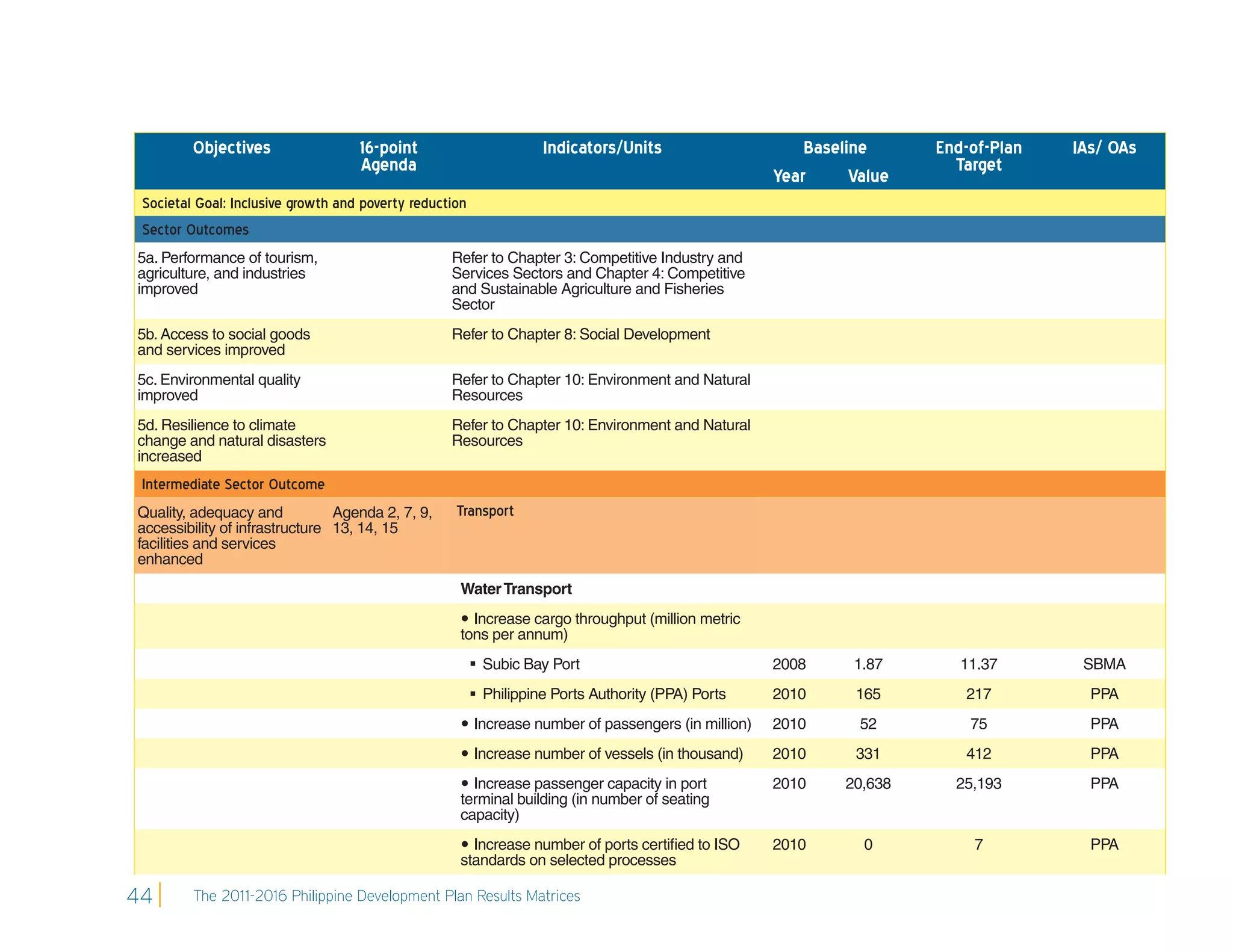
                                                                                Water
       Appropriations to the DA, DAR and other government
        agencies should be provided in time and consistent with the                    Increased cargo throughput (million metric tons per annum)
        amount required by law such as the AFMA and CARPER. The                          Subic Bay Port
        budgetary requirement of the DA’s Food Staples Self-Sufficiency                  PPA Ports
        Road Map 2011-2016 should also be provided to achieve the
        target of 100 percent rice self-sufficiency.                                   Increased number of passengers from 52 million in 2010 to 75
                                                                                        million in 2016
On the role of LGUs on devolved activities
                                                                                       Increased number of vessels from 331,000 in 2010 to 412,000
       Majority of LGUs should remain committed in supporting                          in 2016
        agricultural and fisheries programs and projects since the sector
        is already devolved to LGUs. The DA has personnel only up to                   Increased passenger capacity in port terminal building from
        the regional level.                                                             20,638 in 2010 to 25,913 in 2016

                                                                                       Increased number of ports certified to ISO standards on selected
                                                                                        processes from 0 in 2010 to 7 in 2016
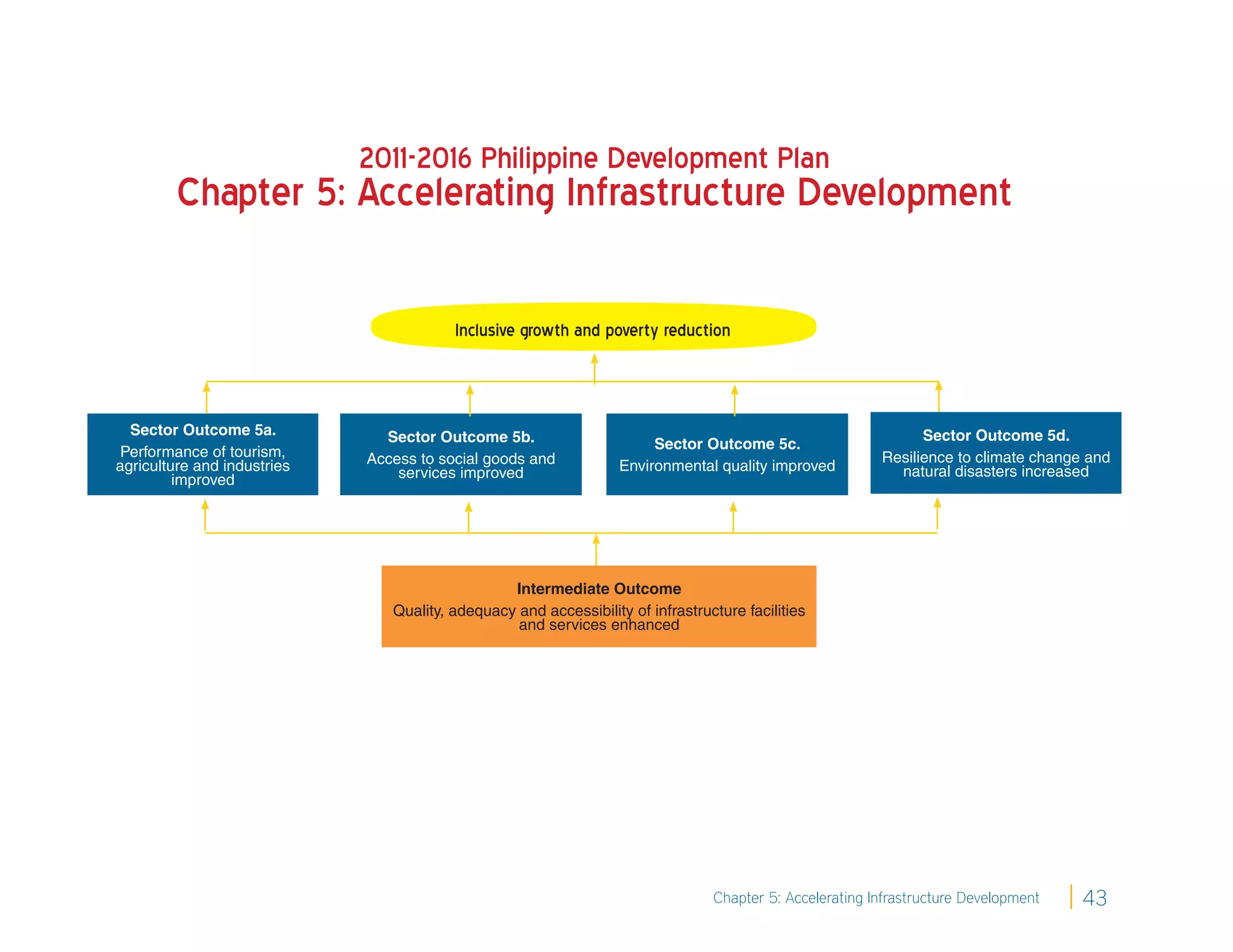
ACCELERATING INFRASTRUCTURE DEVELOPMENT
                                                                                       Increased percentage of 22 major gateways receiving foreign
Sector Outcomes:                                                                        vessels (dredged to minimum of -11 m) from 44 percent of total
                                                                                        in 2010 to 100 percent in 2016
5a. Performance of Tourism, Agriculture, and Industries Improved
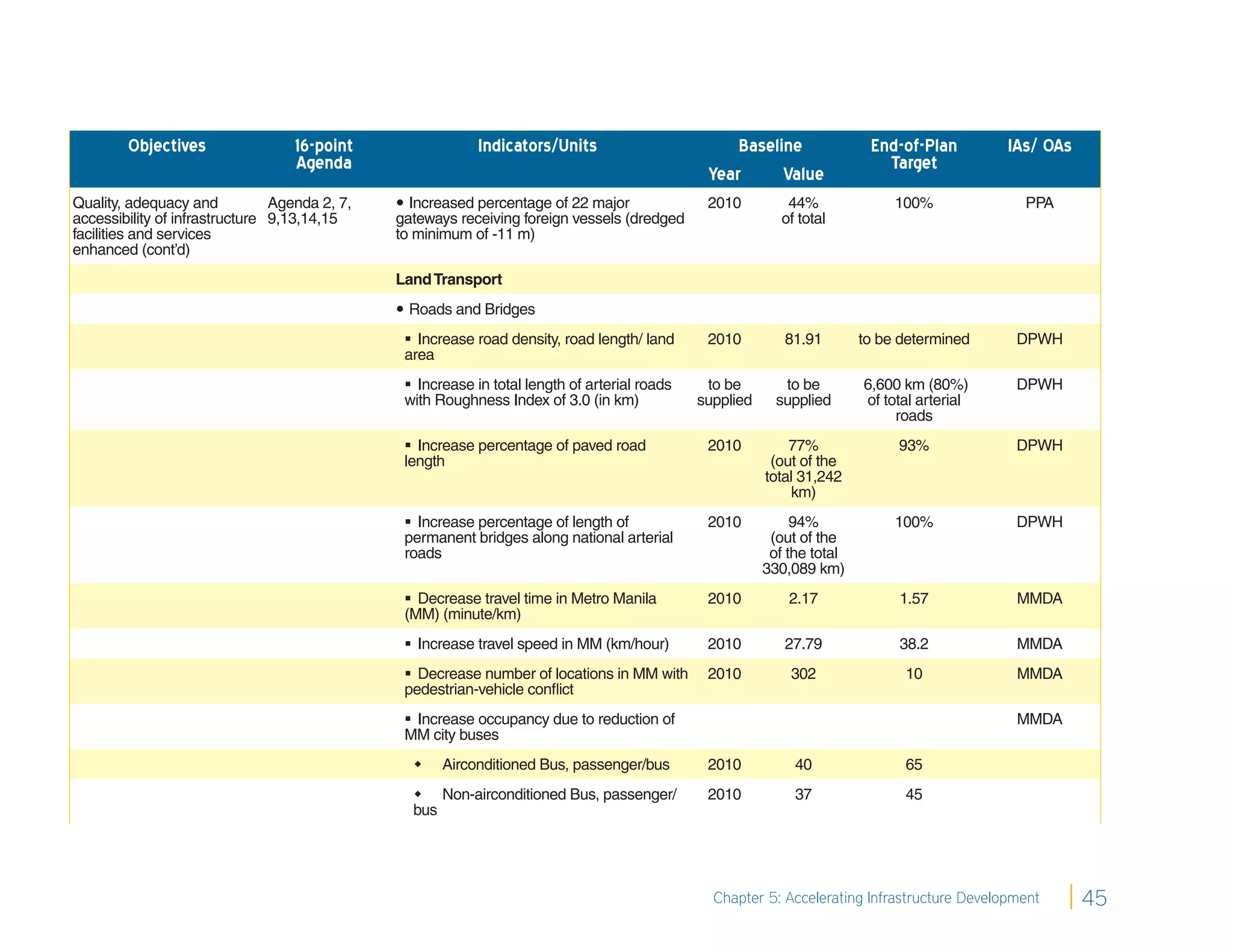
                                                                                Land
5b. Access to goods and services improved (e.g. education, health, housing
and other social infrastructure attained)                                       Roads and Bridges

5c. Environmental quality improved                                                     Increased road density, road length/land area

5d. Resilience to climate change and natural disasters increased                       Increased total length of arterial roads with Roughness Index of
                                                                                        3.0 (in km)
Intermediate Sector Outcome
                                                                                       Increased percentage of paved road length from 77 percent (of
Quality, adequacy and accessibility of infrastructure facilities and services           the total 31,242 km) in 2010 to 93 percent in 2016
enhanced
                                                                                       Increased percentage of length of permanent bridges along
                                                                                        national arterial roads from 94 percent (of the total 330,089 km)
                                                                                        to 100 percent in 2016

                                                                                                                               Critical Indicators     17
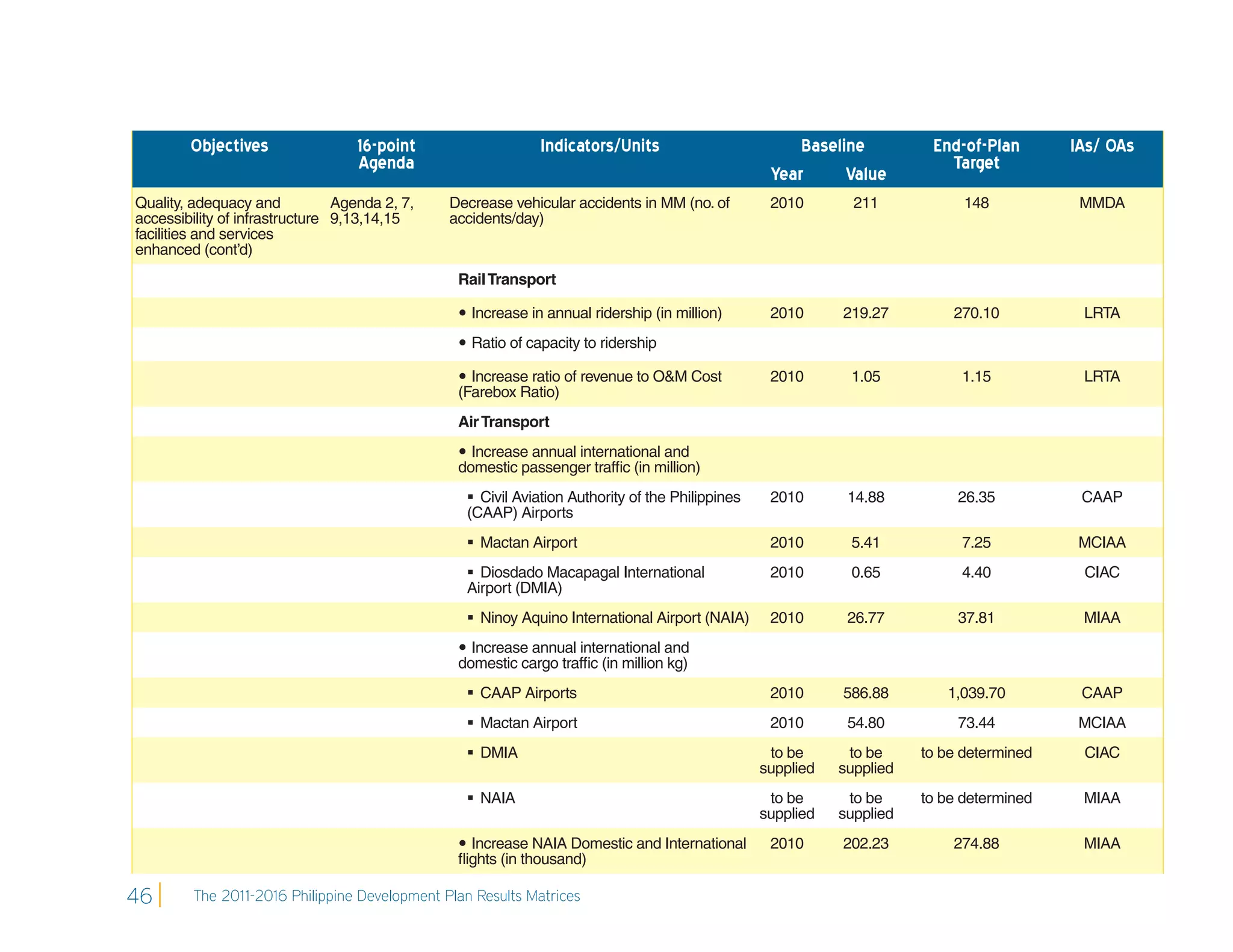
   Decreased travel time in Metro Manila (MM) from 2.17 minute/              Increased annual international and domestic cargo traffic (in
         km in 2010 to 1.57 minute/km in 2016.                                      million kg)
                                                                                     CAAP Airports, from 586.88 in 2010 to 1039.70 in 2016
        Increased travel speed in MM from 27.79 km/hour to 38.2 km/                 Mactan Airport, from 54.80 in 2010 to 73.44 in 2016.
         hour                                                                        DMIA
                                                                                     NAIA
        Decreased number of locations in MM with pedestrian-vehicle
         conflict from 302 in 2010 to 10 in 2016.                                  Increased NAIA domestic and international flights (in thousand)
                                                                                    from 202.23 in 2010 to 274.88 in 2016.
        Increased occupancy due to reduction of city (MM) buses
         (passenger/bus)                                                           Increased Philippine Air Traffic Rights/Entitlements (excluding
          Airconditioned Bus, from 40 in 2010 to 65 in 2016                        unlimited entitlements and assuming unlimited entitlements in
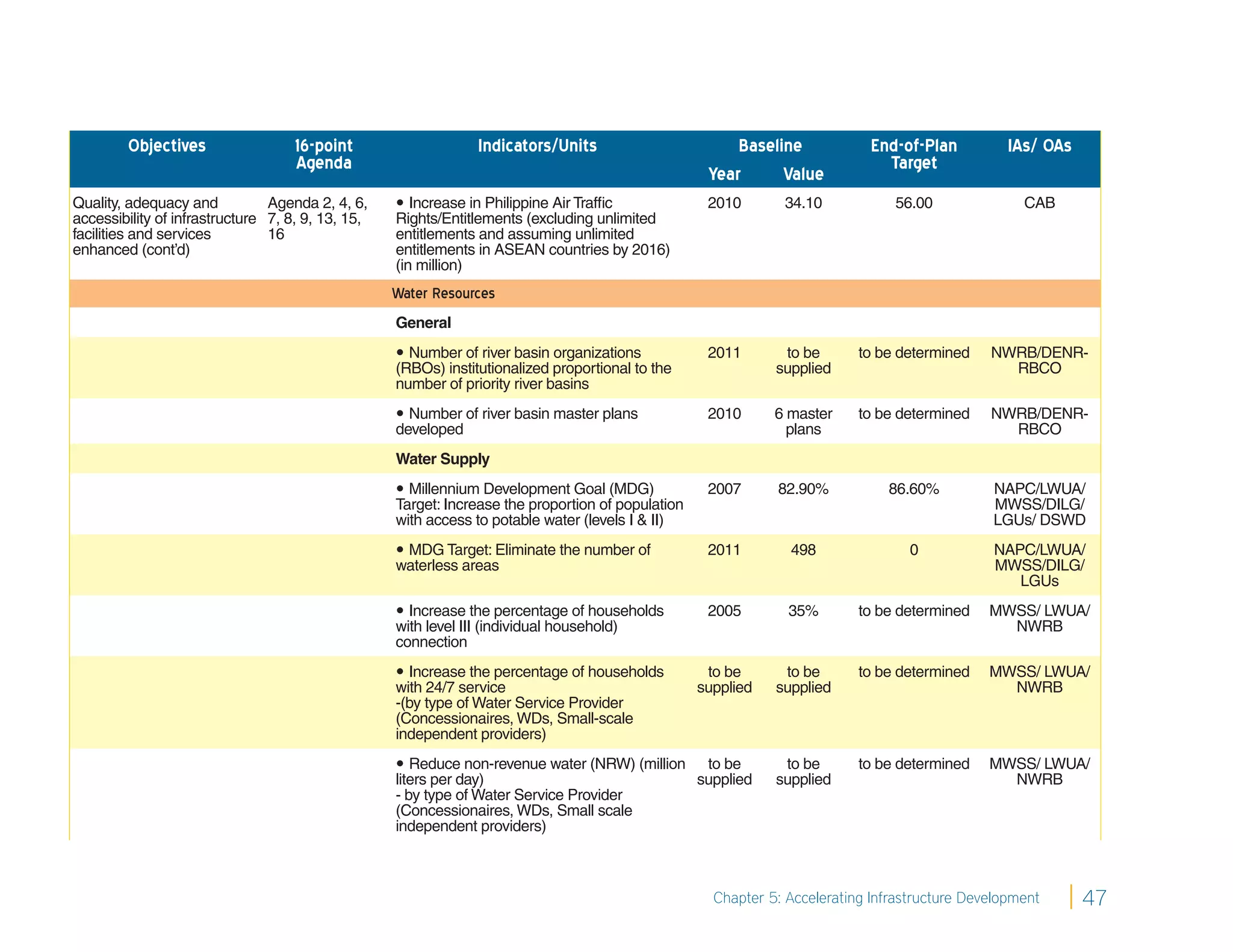
          Non-airconditioned Bus, from 37 in 2010 to 45 in 2016.                   ASEAN countries by 2016) from 34.10 million in 2010 to 56
                                                                                    million in 2016
        Decreased vehicular accidents in MM from 211 accidents per
         day in 2010 to 148 accidents per day in 2016                        WATER

Rail Transport                                                               Water Supply

        Increased annual ridership from 219.27 million in 2010 to                 Millennium Development Goal (MDG) Target: Increase the
         270.10 million in 2016.                                                    proportion of population with access to potable water (level
                                                                                    I&II) from 82.9 percent in 2007 to 86.6 percent in 2016
        Increased ratio of capacity to ridership
                                                                                   MDG Target: Eliminate the number of waterless areas from 498
        Increased ratio of revenue to O&M Cost (Farebox Ratio) from                in 2011 to 0 in 2016
         1.05 in 2010 to 1.15 in 2016.
                                                                                   Increased percentage of households with level III (individual
Air Transport                                                                       household) connection

        Increased annual international and domestic passenger traffic (in         Increased percentage of households with 24/7 service
         million)
          CAAP Airports, from 14.88 in 2010 to 26.35 in 2016                      Reduced nonrevenue water (NRW) (million liters per day or
          Mactan Airport, from 5.41 in 2010 to 7.25 in 2016                        MLD)
          Diosdado Macapagal International Airport (DMIA) from                      average
              0.65 in 2010 to 4.40 in 2016
          Ninoy Aquino International Airport (NAIA) from 26.77 in                 Lessened gap between demand and supply (both in MLD)
              2010 to 37.81 in 2016                                                  to be illustrated by national, regional and critical urban
                                                                                        center levels


18        The 2011-2016 Philippine Development Plan Results Matrices
   Increased percentage of regulated water service providers              Flood and Drainage Management
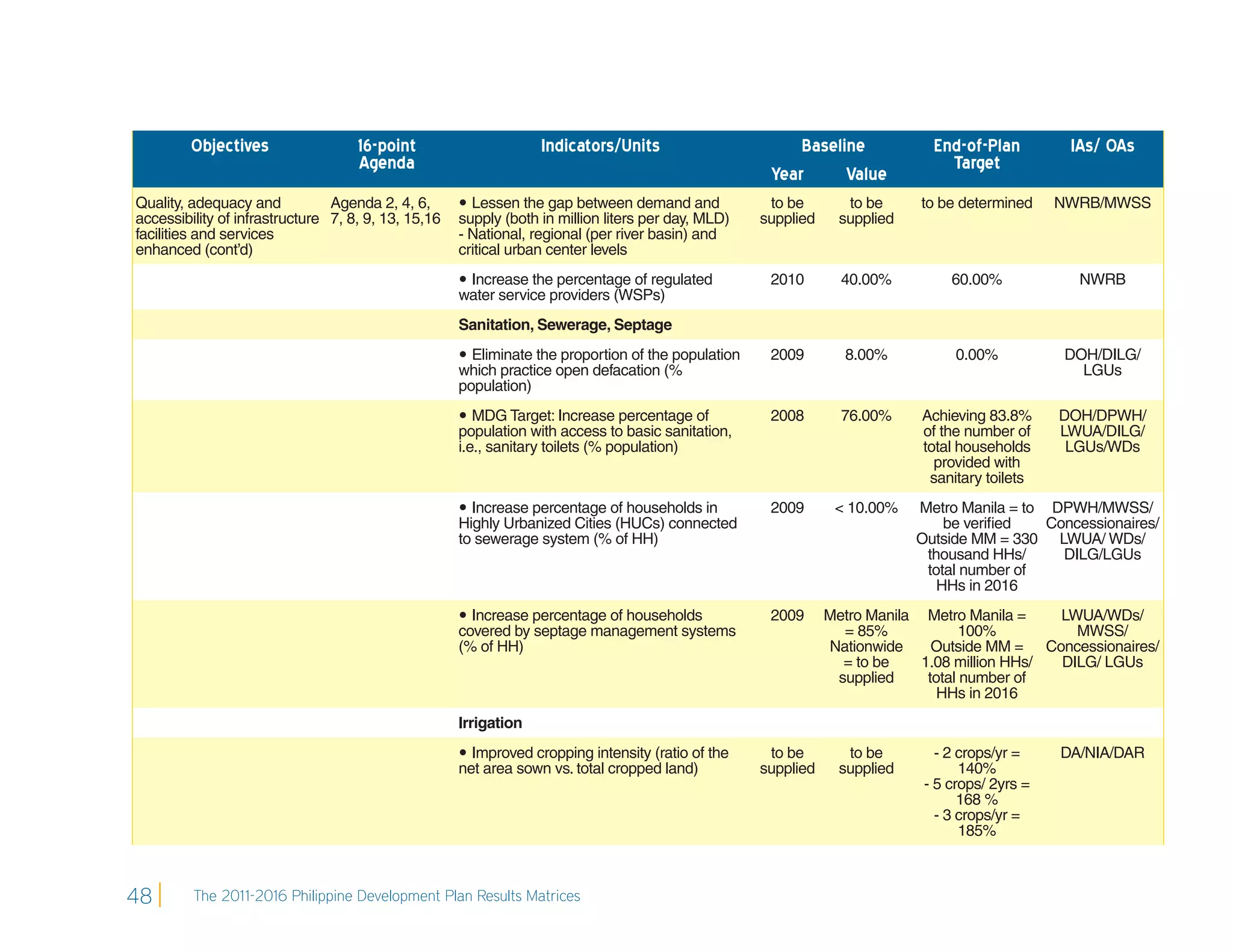
        ( WSPs) from 40 percent in 2010 to 60 percent in 2016
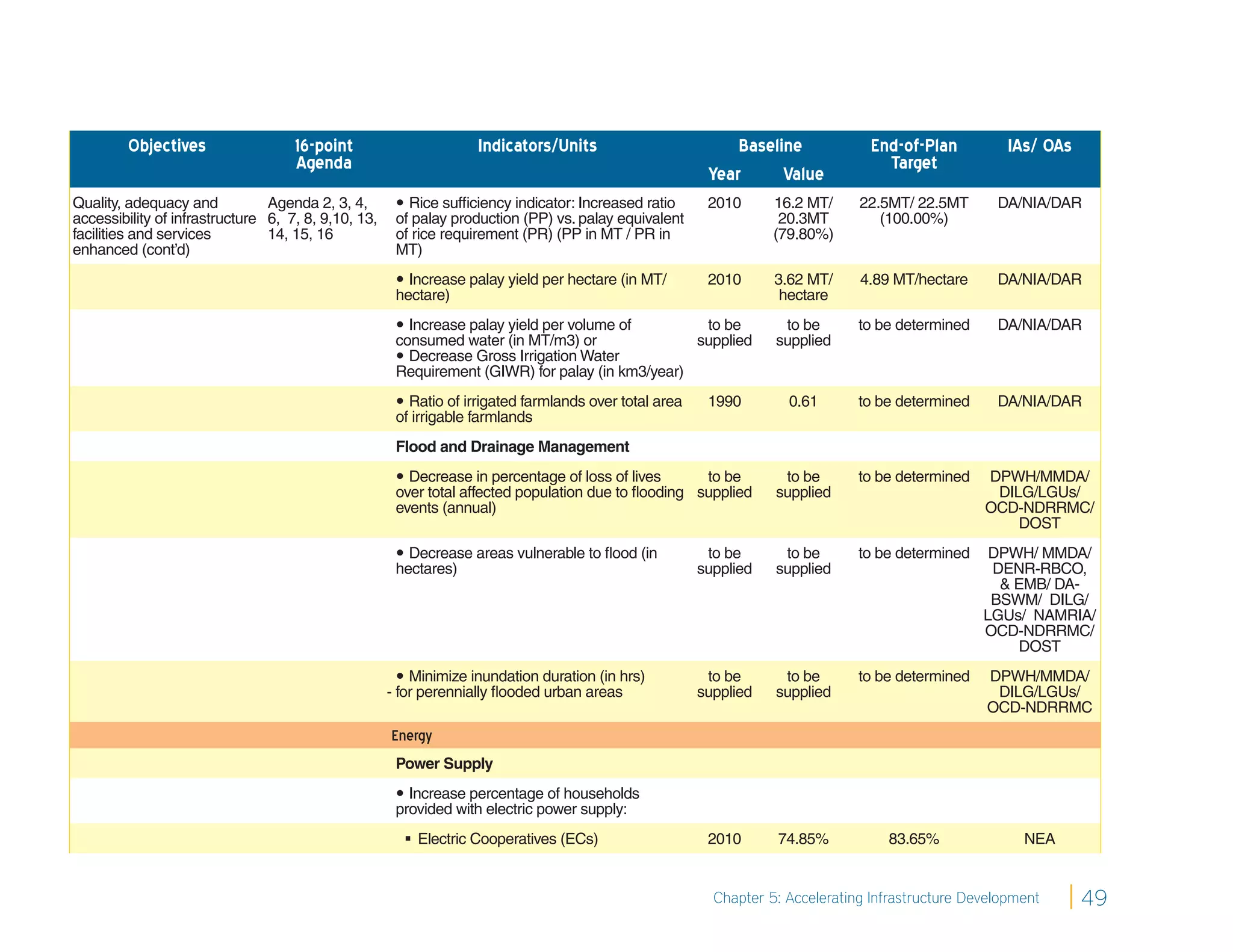
                                                                                     Decreased Percentage of loss of lives over total affected
Sanitation, Sewerage, Septage                                                         population due to flooding events (annual)

       Eliminated proportion of the population which practice open                  Decreased areas vulnerable to flood (in hectares)
        defacation from 8 percent in 2009 to 0 percent in 2016
                                                                                     Minimized inundation duration (in hrs)
       MDG Target: Increased percentage of population with access to                  for perennially flooded urban areas
        basic sanitation (i.e., sanitary toilets) from 76 percent in 2008 to
        83.8 percent in 2016
                                                                               ENERGY
       Increased percentage of households in Highly Urbanized Cities
        (HUCs) connected to sewerage system (% of HH)                          Power Supply

       Increased percentage of households covered by septage                        Increased percentage of households provided with electric power
        management systems (% of HH)                                                  supply
                                                                                       Electric Cooperatives (ECs) from 74.85 percent in 2010 to
Irrigation                                                                                 83.65 percent in 2016
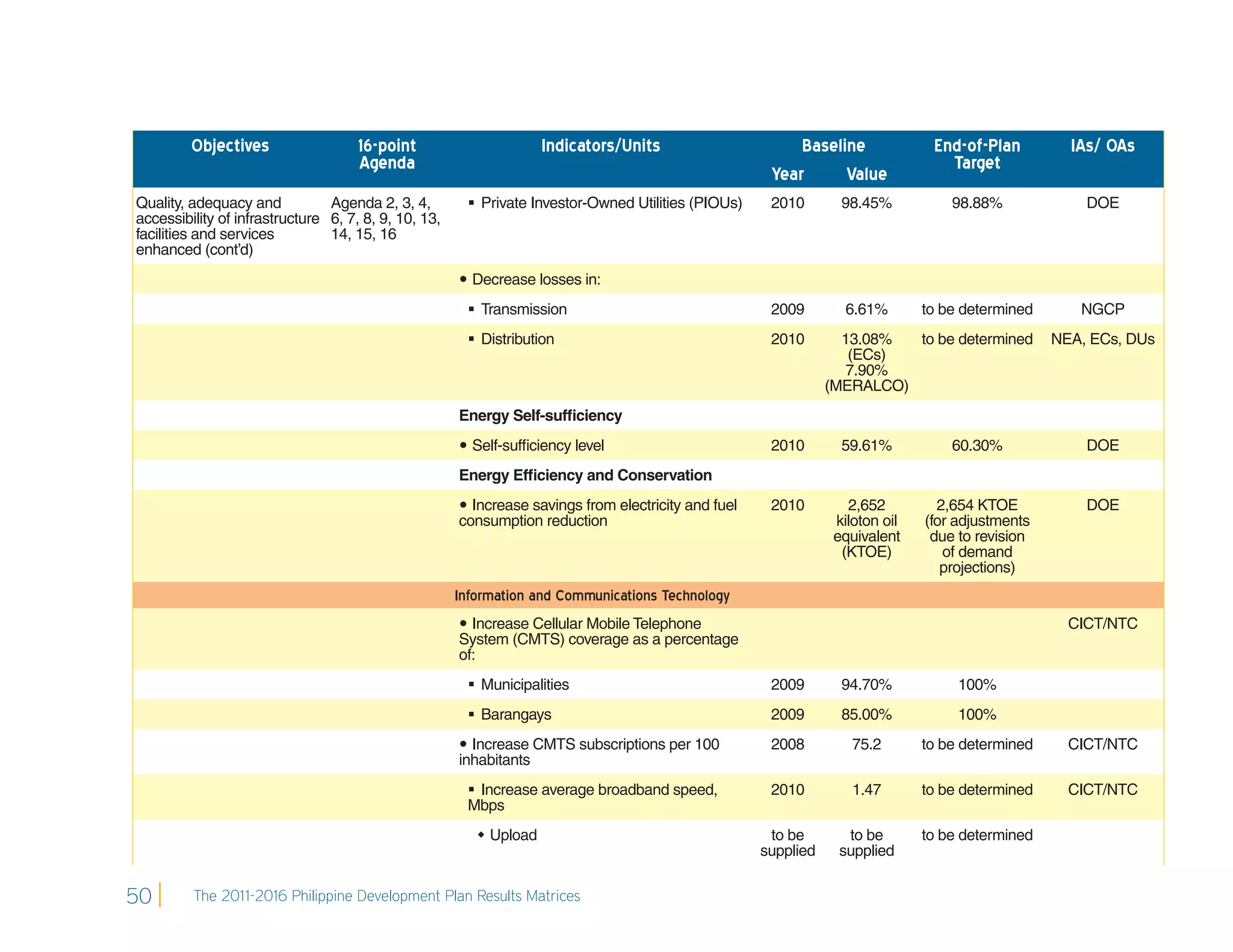
                                                                                       Private Investor-Owned Utilities (PIOUs) from 98.45
       Improved cropping intensity (ratio of the net area sown vs. total                  percent in 2010 to 98.88 percent in 2016
        cropped land)
                                                                                     Decreased losses in:
       Rice sufficiency indicator: Increased ratio of palay production                transmission
        (PP) vs. palay equivalent of rice requirement (PR) (PP in MT /                 distribution
        PR in MT) from 16.2 MT/20.3 MT in 2010 to 22.5 MT/22.5
        MT in 2016                                                             Energy Self-Sufficiency

       Increased Palay yield per volume of consumed water (in MT/                   Increased self-sufficiency level from 59.61 percent in 2010 to
        ha.), or                                                                      60.30 percent in 2016

       Decreased Gross Irrigation Water Requirement (GIWR) for                Energy Efficiency and Conservation
        palay (in km3/year)
                                                                                     Increased savings from electricity and fuel consumption
       Increased Ratio of irrigated farmlands over total area of irrigable           reduction from 2,652 KTOE in 2010 to 2,654 KTOE in 2016
        farmlands


                                                                                                                             Critical Indicators   19
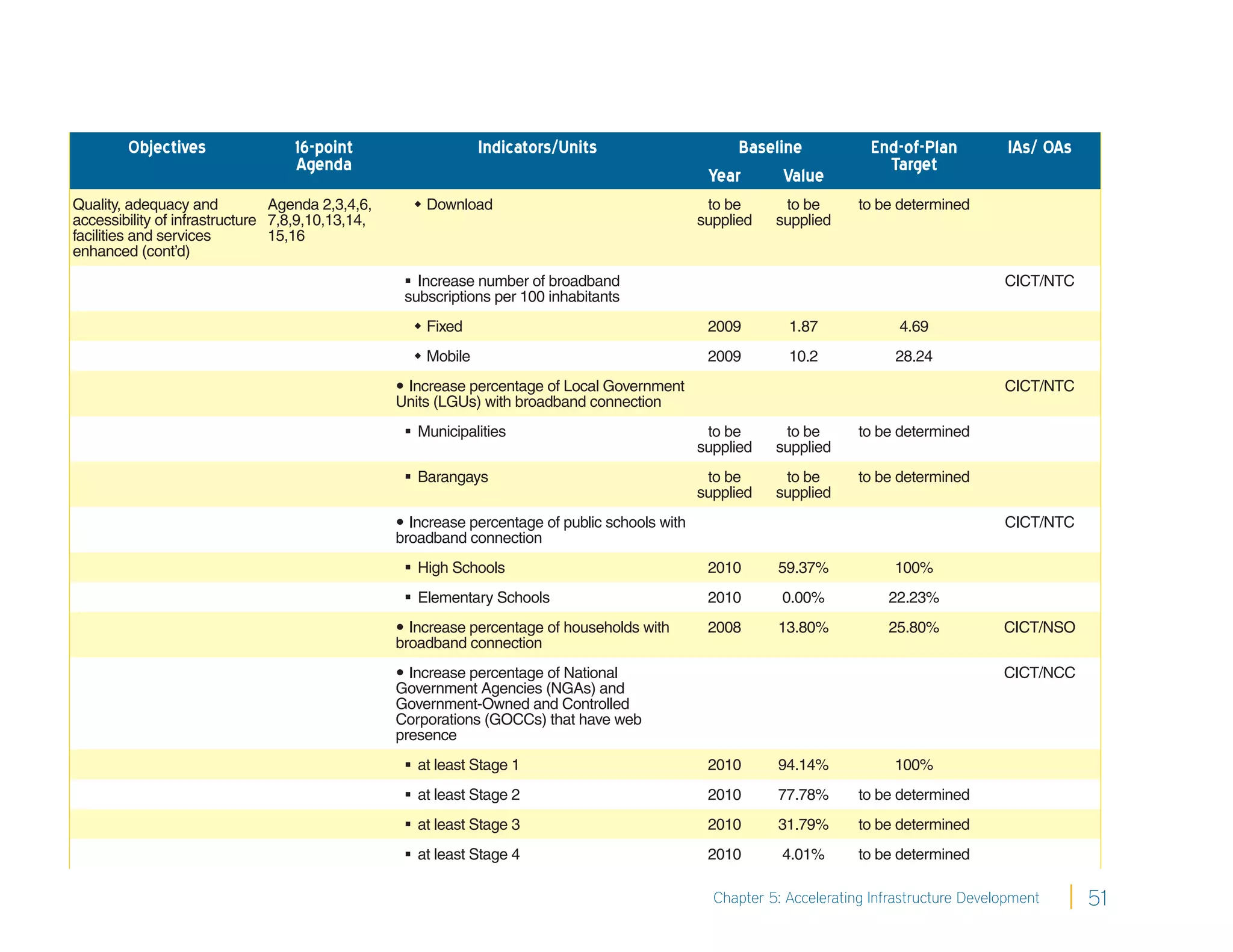
INFORMATION AND COMMUNICATIONS TECHNOLOGY                                        at least Stage 3
                                                                                 at least Stage 4
        Increased Cellular Mobile Telephone System (CMTS) coverage
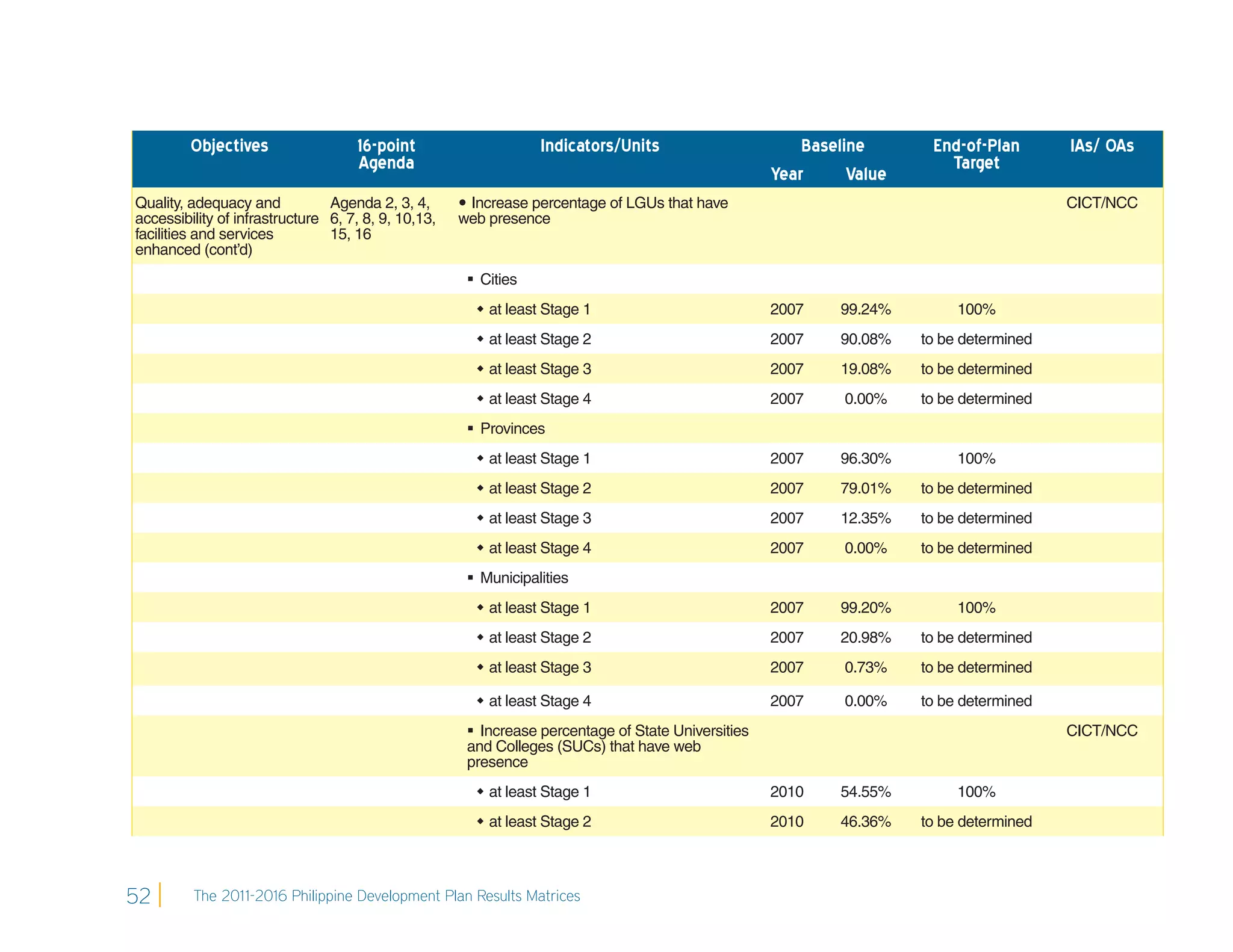
         as a percentage of:                                                 Increased percentage of LGUs that have web presence
          Municipalities, from 94.7 percent in 2009 to 100 percent
              in 2016                                                        Increased percentage of cities that have web presence
          Barangays, from 85 percent in 2009 to 100 percent in 2016           at least Stage 1
                                                                               at least Stage 2
        Increased CMTS subscriptions per 100 inhabitants                      at least Stage 3
                                                                               at least Stage 4
        Increased average broadband speed, Mbps
          Upload                                                            Increased percentage of provinces that have web presence
          Download                                                            at least Stage 1
                                                                               at least Stage 2
        Increased number of broadband subscriptions per 100                   at least Stage 3
         participants                                                          at least Stage 4
          Fixed, from 1.87 in 2009 to 4.69 in 2016
          Mobile, from 10.2 in 2009 to 28.24 in 2016                        Increased percentage of municipalities that have web presence
                                                                               at least Stage 1
        Increased percentage of Local Government Units (LGUs) with            at least Stage 2
         broadband connection                                                  at least Stage 3
          Municipalities                                                      at least Stage 4
          Barangays
                                                                             Increased percentage of State Universities and Colleges (SUCs)
        Increased percentage of public schools with broadband                that have web presence
         connection                                                            at least Stage 1
          High Schools from 59.37 percent in 2010 to 100 percent              at least Stage 2
              in 2016                                                          at least Stage 3
          Elementary Schools from 0 percent in 2010 to 22.23 percent          at least Stage 4
              in 2016.
                                                                        SOCIAL INFRASTRUCTURE
        Increased percentage of households with broadband connection
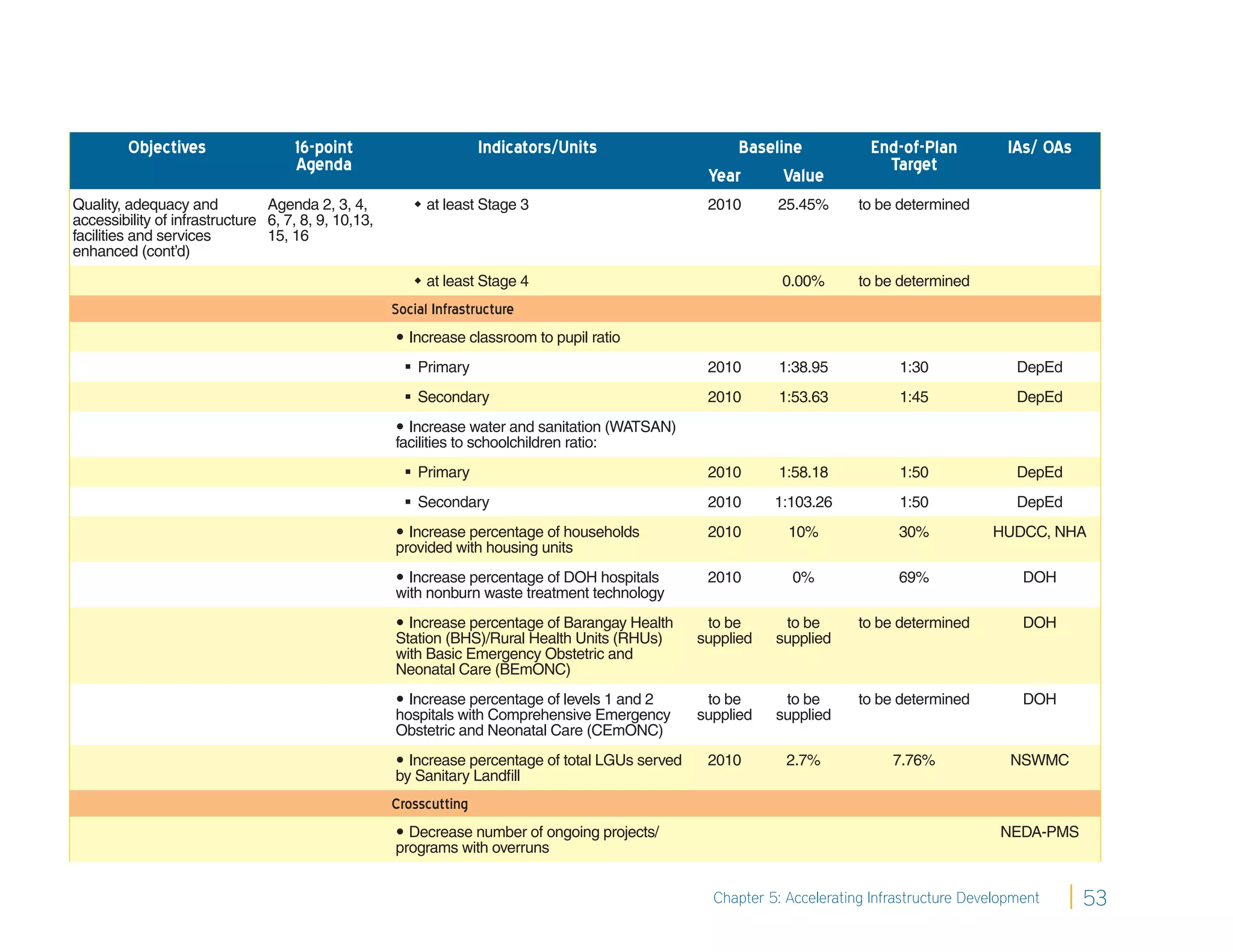
         from 13.8 percent in 2008 to 25.8 percent in 2016                   Increased classroom to pupil ratio
                                                                               Primary, from 1:38.95 in 2010 to 1:30 in 2016
        Increased percentage of National Government Agencies                  Secondary, from 1:53.63 in 2010 to 1:45 in 2016
         (NGAs) and Government-Owned and Controlled Corporations
         (GOCCs) that have web presence                                      Increased water and sanitation ( WATSAN) facilities to
          at least Stage 1                                                   schoolchildren ratio
          at least Stage 2                                                    Primary, from 1:58.18 in 2010 to 1:50 in 2016

20        The 2011-2016 Philippine Development Plan Results Matrices
     Secondary, from 1:103.26 in 2010 to 1:50 in 2016              Risks and Assumptions
      Increased percentage of households provided with housing units      Assumptions
       from 10 percent in 2010 to 30 percent in 2016
                                                                                 Passage of majority of the bills under the Financial Sector
      Increased percentage of total LGUs served by sanitary landfill             Legislative Agenda within the medium term
       from 2.7 percent in 2010 to 7.76 percent in 2016
                                                                                 Proper and immediate implementation of the enacted Financial
CROSS-CUTTING INDICATORS                                                          Sector legislative measures

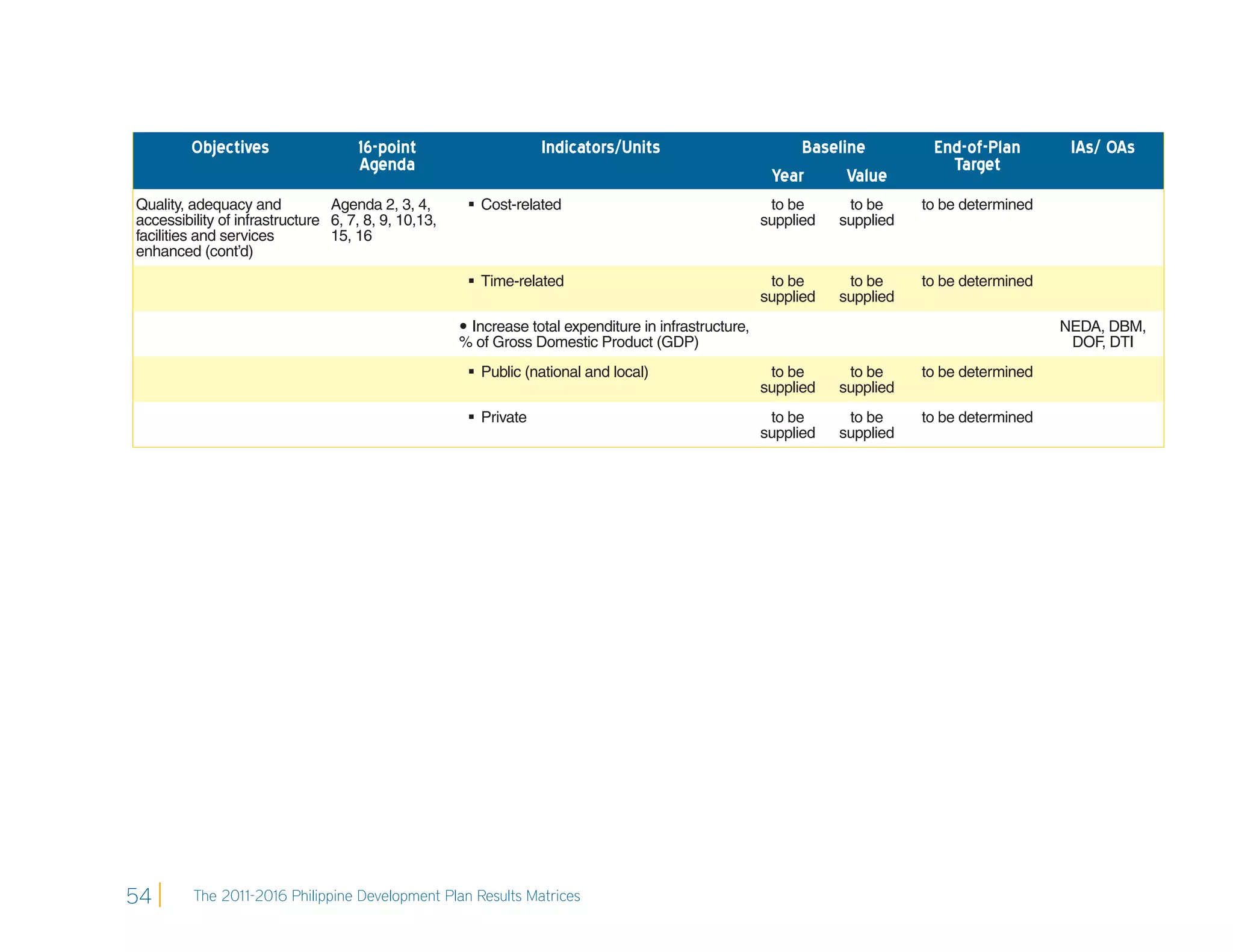
      Decreased number of ongoing projects/programs with overruns               Attainment/realization of macroeconomic assumptions (e.g.
        Cost-related                                                             GDP, inflation rate, foreign interest rates (LIBOR)) and labor
        Time-related                                                             sector targets

      Increased total expenditure in infrastructure, as a percentage of         Stable external and domestic environment (no financial, fiscal,
       Gross Domestic Product (GDP)                                               current account crises)
        Public (national and local)
        Private                                                                 Continued high level of business and consumer confidence

Risks and Assumptions
                                                                           GOOD GOVERNANCE AND THE RULE OF LAW
Assumption
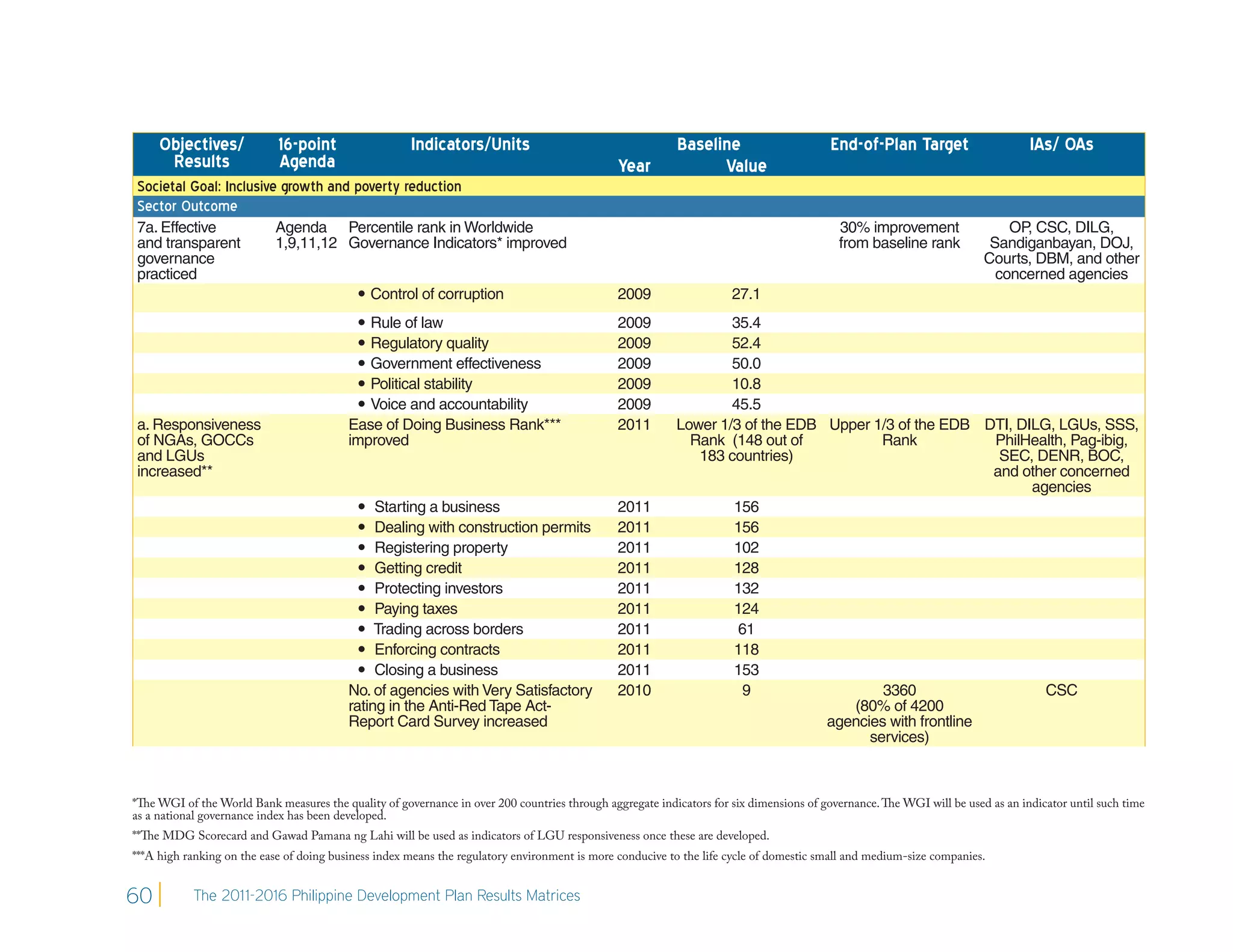
                                                                           Sector Outcome 7a: Effective and transparent governance practiced
      Policies/programs/projects for social, environment, tourism,
       agriculture and other industries provided                                 Improved scores on the indices (primarily those relating to
                                                                                  conrtol of corruption and ruling justly) and percentile ranks
                                                                                  in the WGI, MCC and EDB Indices/Ranks to make the
TOWARDS A DYNAMIC AND RESILIENT FINANCIAL                                         Philippines at par with neighboring countries
SYSTEM
                                                                           Sector Outcome 7b: Enhanced access to justice
FINANCIAL SECTOR
                                                                                 Established and operationalized Integrity Infrastructure
Sector Outcome: Resilient and Inclusive Financial System                          Development and Centralized Case Monitoring System

      Increased Financial Systems total assets from 9.8 percent (2006-          Improved government accountability, transparency and efficiency
       2010 average) to more than 10 percent (2011-2016 average)                  in allocating public funds for development

      Increased national saving rate from 26.6 percent in 2010 to more          Increased constructive engagement between CSOs/other
       than 30 percent in 2016.                                                   private groups and government thru mechanisms that promote

                                                                                                                        Critical Indicators    21
transparency, accountability and public participation in the        Assumptions
         national government development processess
                                                                                    Improved scores on the indices (primarily those relating to
Risks and Assumptions                                                                conrtol of corruption and ruling justly) and percentile ranks
                                                                                     in the WGI, MCC and EDB Indices/Ranks to make the
Risks                                                                                Philippines at par with neighboring countries
                                                                                      Reforms that address weaknesses in controlling corruption
        Improved scores on the indices (primarily those relating to                      and ruling justly are implemented and sustained.
         conrtol of corruption and ruling justly) and percentile ranks                The survey respondents experience first hand the
         in the WGI, MCC and EDB Indices/Ranks to make the                                improvements in governance brought about by these
         Philippines at par with neighboring countries                                    reforms.
          Reforms are not implemented, or do not achieve the desired
              impact.                                                        Established and Operationalized Centralized Case Monitoring System
          The survey respondents do not have first hand experience,
              and answer based on perception only.                                  Concerned government agencies are willing to harmonize their
                                                                                     case monitoring systems.
        Established and operationalized Centralized Case Monitoring
         System                                                                     There are sufficient funds to establish the centralized system,
          Concerned government agencies do not support the                          and competent staff to operate it.
              centralized system.
          There is a lack of funds and staff to establish and operate the   Improved government accountability, transparency and efficiency in allocating
              centralized system.                                            public funds for development

        Improved government accountability, transparency and efficiency            Necessary reforms in the budget allocation process are
         in allocating public funds for development                                  implemented and sustained.
          Reforms are not implemented, or do not achieve the desired
               impact.                                                       Increased constructive engagement between CSOs/other private groups and
                                                                             government thru mechanisms that promote transparency, accountability and
        Increased constructive engagement between CSOs/other private        public participation in the national government development processes
         groups and government through mechanisms that promote
         transparency, accountability and public participation in the               The government, CSOs and the private sector are willing to
         national government development processes                                   work together to achieve development goals.
          The government, CSOs and the private sector opt to work
              separately.


22        The 2011-2016 Philippine Development Plan Results Matrices
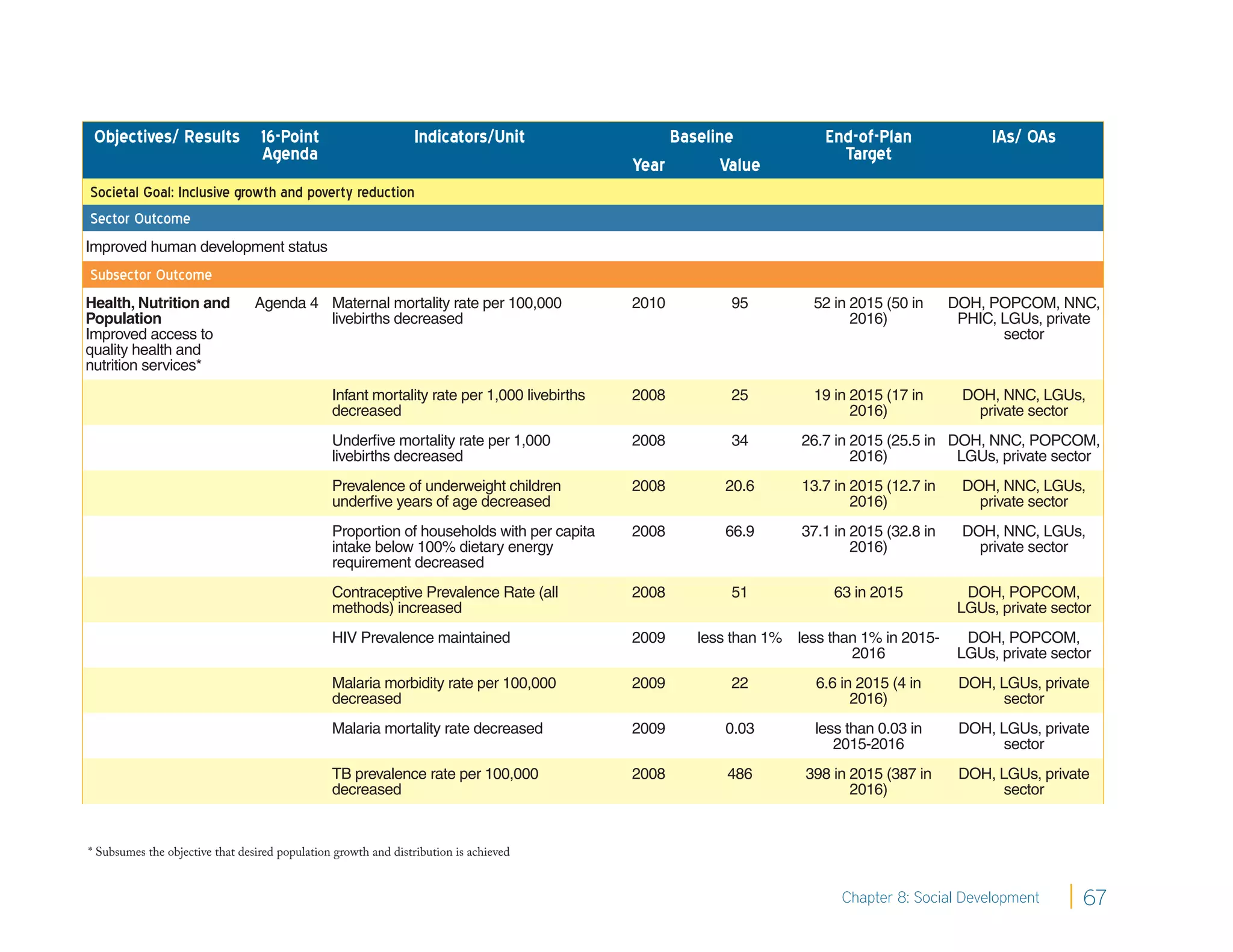
SOCIAL DEVELOPMENT                                                        Risks and Assumptions

HEALTH, NUTRITION AND POPULATION MANAGEMENT                               Risks

Subsector Outcome: Improved access to quality health and nutrition               Unsettled disputes with church and NGOs particularly on
services                                                                          reproductive health (RH)

      Decreased maternal mortality rate per 100,000 livebirths from             Lack of unified stand in the community to participate in
       95 in 2010 to 52 in 2015 (50 in 2016)                                      Resposible Parenthood activities

      Decreased infant mortality rate per 1,000 livebirths from 25 in           Emergence of new diseases/new strain
       2008 to 19 in 2015 (17 in 2016)
                                                                                 Changes in political leadership
      Decreased underfive mortality rate per 1,000 livebirths from 34
       in 2008 to 26.7 in 2015 (25.5 in 2016)                                    Resistance by concerned groups regarding the use of Sin taxes
                                                                                  for UHC programs
      Decreased prevalence of underweight children under five from
       20.6 in 2008 to 13.7 in 2015 (12.7 in 2016)                        Assumptions

      Decreased proportion of households with per capita intake                 Cooperation of families/households in the implementation of
       below 100 percent dietary energy requirement from 66.9 in 2008             health programs is ensured
       to 37.1 in 2015 (32.8 in 2016)
                                                                                 Commitments and capacities of the LGUs to deliver basic
      Increased contraceptive prevalence rate (all methods) from 51 in           services and provide the supply requirements are strengthened/
       2008 to 63 in 2015 (no target identified for 2016)                         funded

      Increased National Health Insurance Program coverage from 53              MDG Monitoring System for LGUs is revisited and enhanced
       percent in 2008 to 100 percent in 2013                                     (ensuring that indicators at the local level are consisitent with
        (100% in 2014-2016)                                                      the national level)

      Increased National Health Insurance Program enrolment rate                Funding for the MDGs from various international donors is
       from 74 percent in 2010 to 100 percent in 2013                             secured
        (100% in 2014-2016)
                                                                                 Sin tax is restructured (incremental revenues to fund UHC
                                                                                  activities to include premiums of indigents); ammendment to
                                                                                  the Sin Tax law

                                                                                 RH Bill is passed


                                                                                                                         Critical Indicators    23
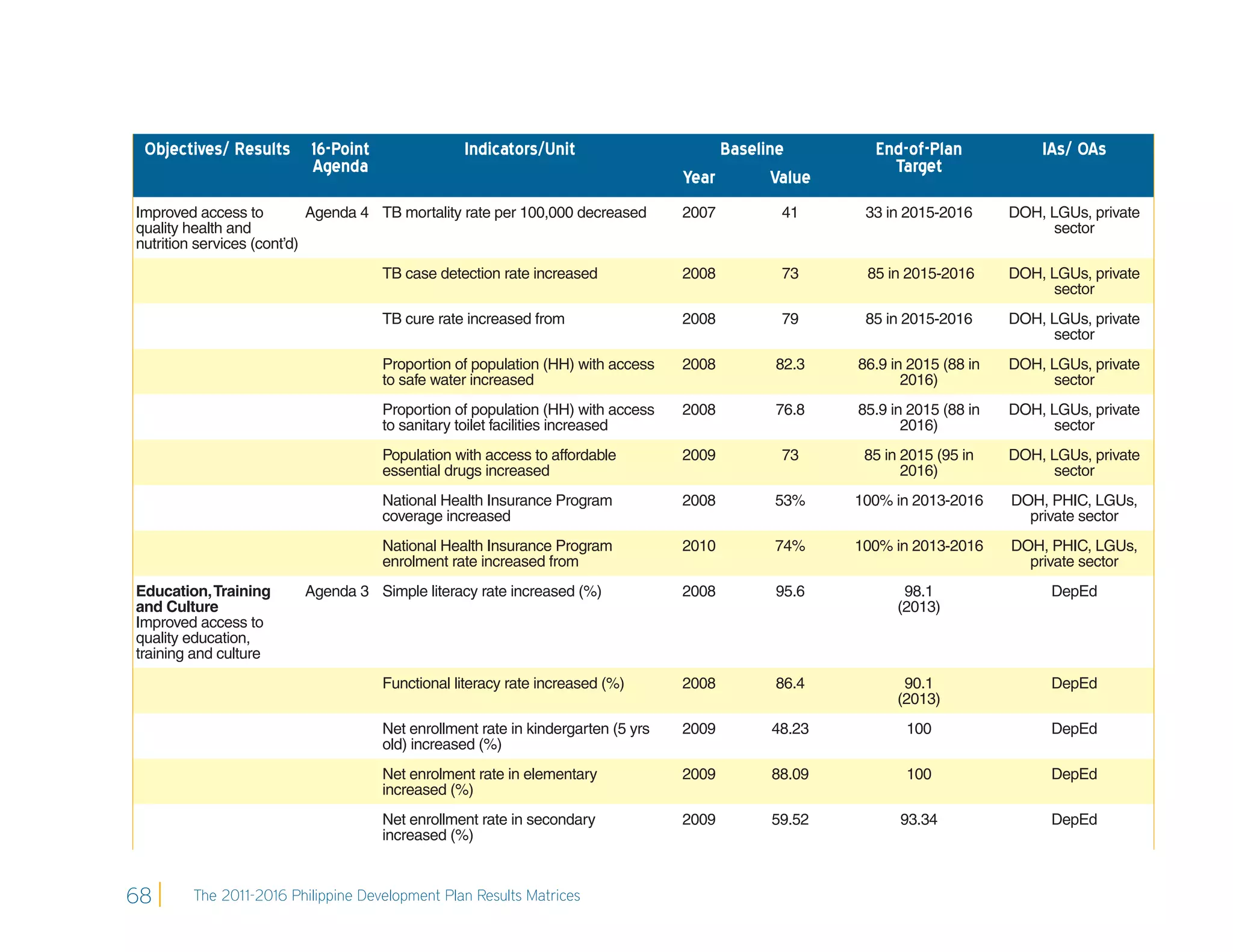
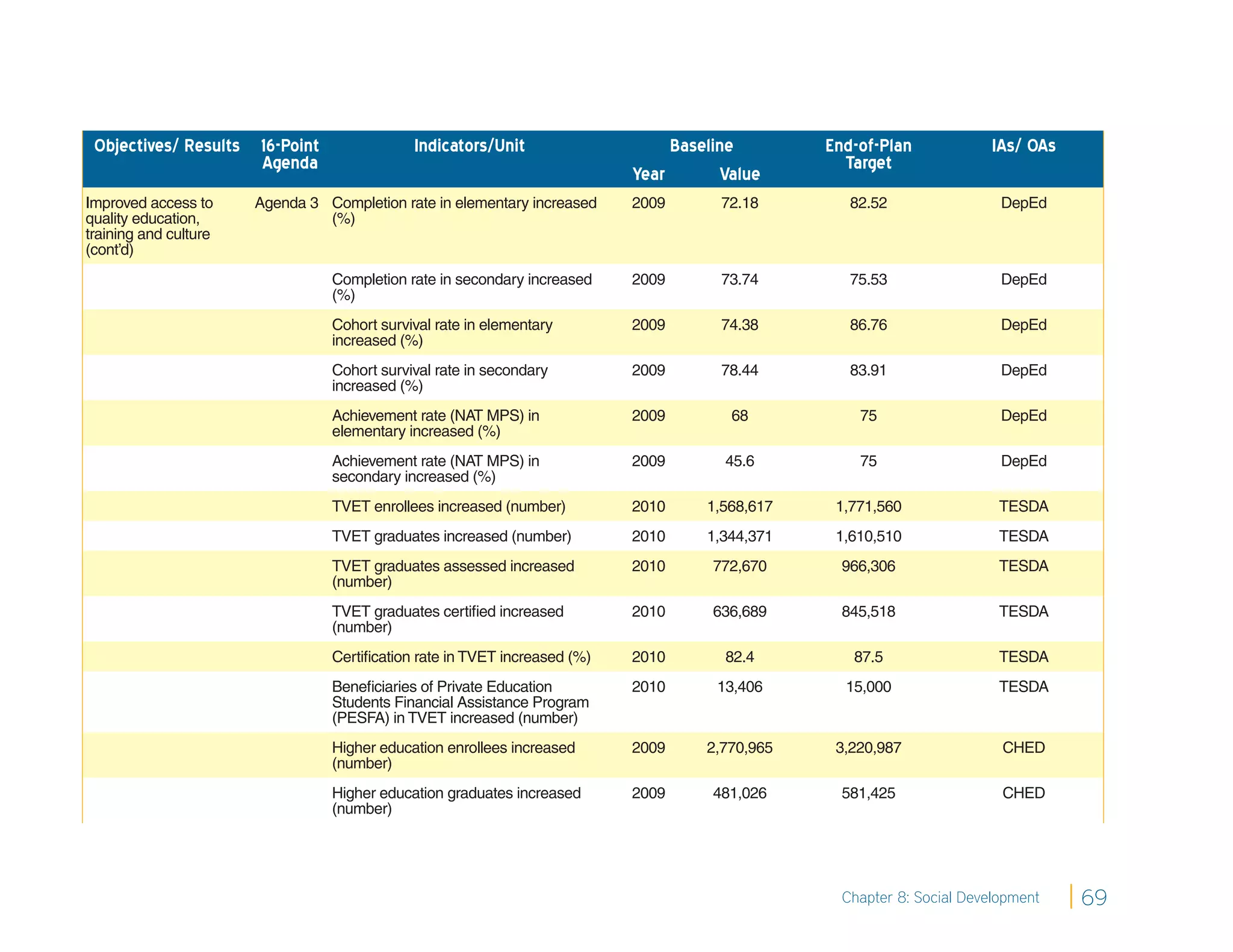
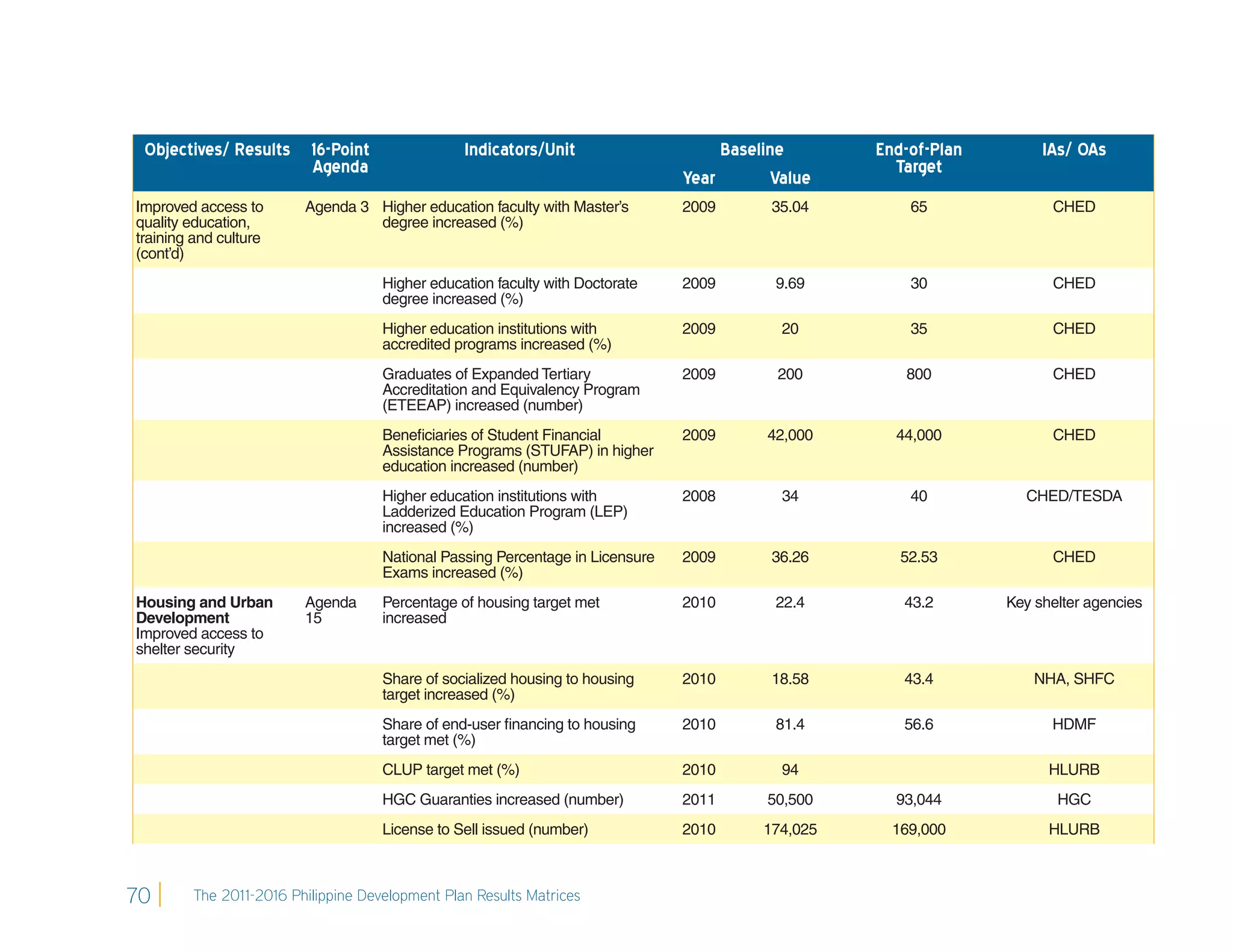
EDUCATION, TRAINING AND CULTURE                                             HOUSING AND DEVELOPMENT

Subsector Outcome: Improved access to quality education, training and       Subsector Outcome: Improved access to shelter security
culture.
                                                                                   Increased percentage of housing target met from 22.4 percent in
        Increased Net Enrolment Rate – elementary (from 88.09% in                  2010 to 43.2 percent in 2006
         2009 to 100% in 2016) and secondary (from 59.52% in 2009 to
         93.34% in 2016)                                                           Increased percentage share of socialized housing to housing
                                                                                    target from 18.58 percent in 2010 to 43.4 percent in 2016
        Increased Completion Rate – elementary (from 72.18% in 2009
         to 82.52% in 2016) and secondary (from 73.74% in 2009 to                  Increased percentage share of end-user financing to housing
         75.53% in 2016)                                                            target from 81.4 percent in 2010 to 56.6 percent in 2016

        Increased Achievement Rate (NAT MPS) – elementary (from                   Achieved percentage of CLUP target
         68.01% in 2009 to 75.00% in 2016) and secondary (from 45.56%
         in 2009 to 75.00% in 2016)                                         Risks and Assumptions
        Increased number of TVET graduates (from 1,344,371 in 2010         Risks
         to 1,610,510 in 2016)
                                                                                   Budgetary constraints
        Increased number of higher education graduates (from 481,026
         in 2009 to 581,425 in 2016)                                               Natural and man-made disasters that may affect housing
                                                                                    construction
Risks and Assumptions
                                                                                   Policy on resettlement, i.e., if a moratorium on evictions and
Risk                                                                                demolitions is imposed

        Inability of households to send pupils/students to school due to   Assumption
         poverty, peace and order concerns, natural calamity and other
         factors                                                                   Passage of the Department of Housing and Urban Development
                                                                                    (DHUD) Bill
Assumptions
                                                                            SOCIAL PROTECTION
        Appropriate budget allocation provided to the concerned
         agencies                                                           Subsector Outcome (Social Protection): Improved access to quality
                                                                            social protection services
        Improved participation of stakeholders such as LGUs, private
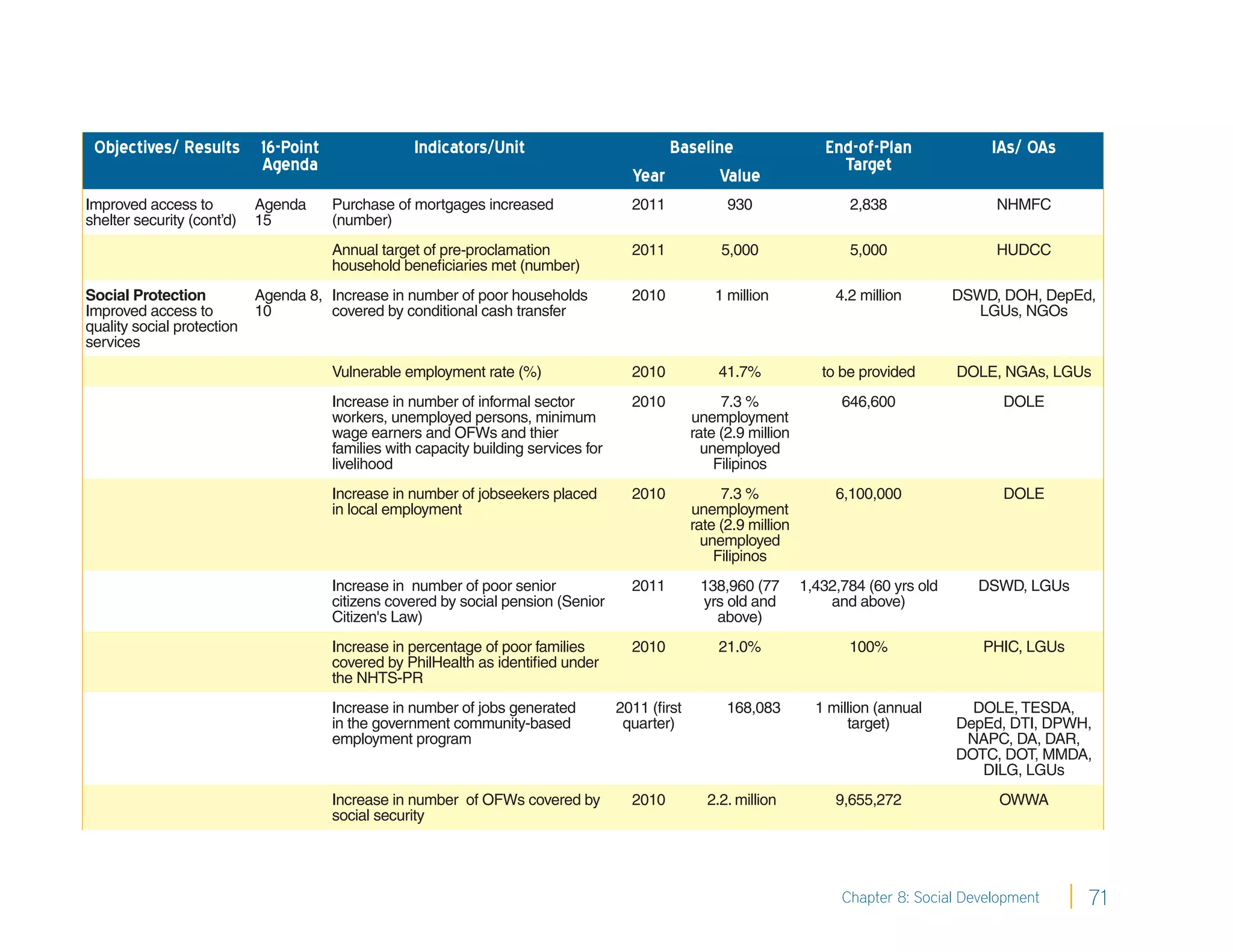
         sector and the community in meeting the targets                           Increased number of poor households covered by conditional
                                                                                    cash transfer from 1 million in 2010 to 4.2 million in 2016

24       The 2011-2016 Philippine Development Plan Results Matrices
   Decreased vulnerable employment rate                             Asset Reform

       Increased percentage of poor families covered by PhilHealth as          Unsettled land disputes
        identified under the NHTS-PR from 21 percent in 2010 to 100
        percent in 2016                                                         Political interference in the delineation of municipal waters

       Increased number of poor senior citizens covered by social       Assumptions
        pension (Senior Citizen’s Law) from 138,960 (77 yrs and above)
        in 2011 to 1,432,789 (60 yrs. and above) in 2016                 Social Protection

       Increased number of OFWs covered by social security from 2.2            Sustained funding for CCT, NHIP, social pension for senior
        million in 2010 to 9.7 million in 2016                                   citizens and NHTS-PR

ACCESS TO ASSET REFORM                                                          Government can facilitate and entice the business/private
                                                                                 sector for the creation of 1 million jobs annually, through the
Subsector Outcome: Improved Access to Asset Reform                               provision of good infrastructure and good business/investment
                                                                                 environment
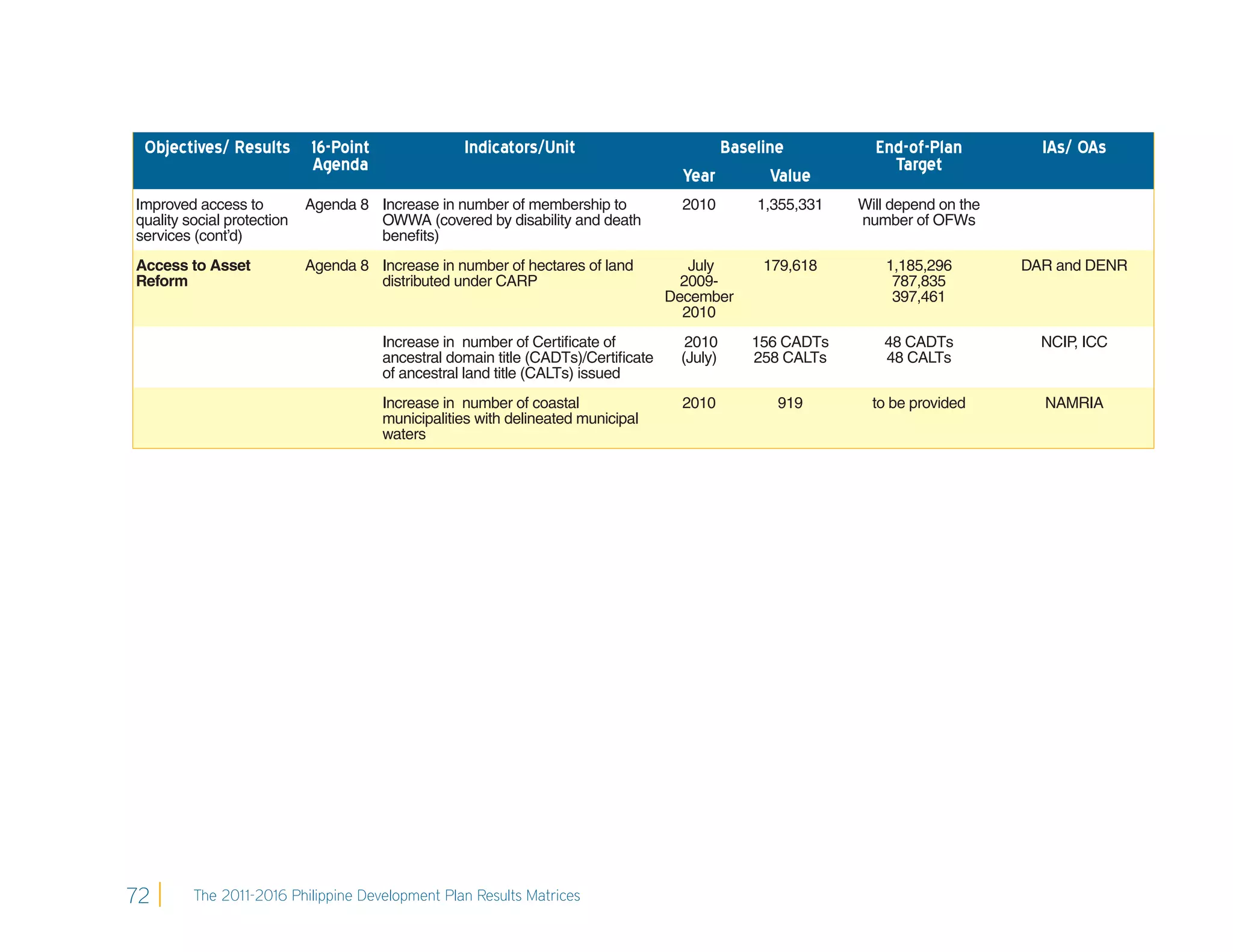
       Increased number of hectares of land distributed under CARP
                                                                                The poor and vulnerable groups are provided with jobs
       Increased number of issued Certificate of Ancestral Domain
        Title (CADTs)/Certificate of ancestral land title (CALTs)               Needed law or executive order issued for compulsory enrolment
                                                                                 of OFWs on all social security schemes of the government Asset
       Increased number of coastal municipalities with    delineated            Reform
        municipal waters
                                                                                Available funding/manpower for the processing/issuance of
Risks and Assumptions                                                            CADTs and CALTs

Risks
                                                                         PEACE AND SECURITY
Social Protection
                                                                         Subsector Outcome 1: All armed conflicts brught to a permanent and
       Noncoverage/enrolment of OFWs in social security schemes         peaceful closure
        e.g. SSS, Philhealth
                                                                         Intermediate Outcome 1: Negotiated political settlement of all armed
       Nonparticipation of LGUs in converging social protection         conflicts completed
        programs and projects
                                                                                Signed and implemented peace agreements completed


                                                                                                                         Critical Indicators     25
Intermediate Outcome 2: Causes of armed conflict and other issues that                 Spoilers are kept at bay (e.g. incidents of grave abuse of
affect the peace process effectively addressed                                          human rights, land mines)
                                                                                       Sustainability of good faith negotiations should also be
        Improved health condition of population in conflict-affected                   dovetailed on the viability of security sector reform
         (PAMANA) areas (IMR, MMR, etc.)
                                                                                  A final negotiated political settlement with the MILF is
        Improved education status of children in conflict-affected areas          not mutually exclusive to a convergence of government’s
         (net enrolment, cohort survival, completion rates for both                commitment to both MNLF and MILF.  The MNLF and
         elementary & secondary levels)                                            the MILF’s commitment, both representing the Bangsamoro
                                                                                   peoples, should be harmonized.
        Improved livelihood, entrepreneur and employment status of
         adult population in conflict-affected areas                              PAMANA, as the government’s flagship program in conflict-
                                                                                   affected areas, can address causes of armed conflicts and other
Subsector Outcome 2: Safer and more secured environment conducive                  issues that affect the peace process through its macro-micro-
to national development created and sustained                                      meso levels, provided that:
                                                                                    Effective convergence mechanisms are in place
Intermediate Outcome 1: Internal stability promoted and sustained                   Peace talks are continuing; there is no impasse
                                                                                    Budget is released
        Reduced crime incidents from 296,059 in 2010 to 30 percent in              Transparent, accountable and conflict-sensitive LGUs are
         2016                                                                           ensured
                                                                                    Processes and mechanisms for social cohesion are in place
        Improved crime solution efficiency (CSE) from 21.26 percent in             Greater participation of CSOs are encouraged
         2010 to 28.49 percent in 2016

        Private Armed Groups (PAGs) and other Threat Groups
         Eradicated                                                         CONSERVATION, PROTECTION, AND REHABILITATION
                                                                            OF THE ENVIRONMENT AND NATURAL RESOURCES
Risks and Assumptions
                                                                            Sector Outcome 10a: Natural resources conserved, protected and
Assumptions                                                                 rehabilitated

        The workability of any final peace agreement hinges on many              Increase proportion of land area covered by forest from 23.8
         things, some of which are as follows:                                     percent in 2003 to 30 percent in 2016
          Agreed timetable for the peace talks are observed
          Factions and splinter groups from the ranks of rebel groups            Extinction of threatened species of wild flora and fauna prevented
              are addressed from the outset                                        and population of at least three threatened species improved.
          Convincing the respective publics of the two parties i.e.                Threatened Species:
              congressional support                                                     Fauna: from 221 in 2004 to 221 by 2016
          All sectors are consulted                                                    Flora: from 526 in 2007 to 526 by 2116

26       The 2011-2016 Philippine Development Plan Results Matrices
    Population of 3 threatened species                                               Cabanatuan: 117 Ug/Ncm
             Philippine Eagle: from 30 in 2010 to 33 by 2016                                San Fernando, Pampanga: 206 Ug/Ncm
             Philippine Cockatoo: from 239 in 2010 to 360 by                                Iriga City: 188.24 Ug/Ncm
              2016                                                                           Panganiban Drive: 177.17 Ug/Ncm
                                                                                             Mandaue City-Baricuatro’s Res: 120.56 Ug/Ncm
      Percentage of terrestrial, inland water and coastal and marine                        Zamboanga City Station II: 166.53 Ug/Ncm
       areas important for biodiversity and ecosystem services effectively                   Zamboaga City Station IV: 136.26 Ug/Ncm
       and equitably managed thru NIPAS and other effective area-                            Zamboanga City Station VII: 185.82 Ug/Ncm
       based conservation measures increased                                                 Davao City Station 8: 102.96 Ug/Ncm
        Terrestrial: 2.10 percent in 2010 to 8.83 percent in 2016
        Marine Parks: 0.09 percent in 2010 to 0.62 percent in 2016                Reduced gas emission due to increased in travel speed (from 27.79
        Critical Habitats: 0.0006 percent in 2011 to 1.01 percent                  km/hr in 2010 to 38.2 km/hr in 2016) and reduced travel time (from
            in 2016                                                                 2.17 min/km in 2010 to 1.57 min/km in 2016)

      Achieved number of abandoned mines 100 percent rehabilitated          Subsector Outcome 2: Water pollution reduced
       from six priority abandoned minesites in 2004 to 6 in 2016
                                                                                   Improved quality of priority river systems under the Sagip Ilog
      Increased number of beneficiaries with secured land tenure in                Program and other priority bodies of water including Manila
       agricultural and residential lands from 1,936,594 in 2010 to 100             Bay and Pasig River by 35 percent reduction in 2010 BOD levels
       percent of the remaining DENR-CARP target and 660,000                        in 2016
       residential patents issued in 2016                                            12 Priority Rivers with BOD level not within the water
                                                                                         criteria
      Land degradation hotspots with developed sustainable land                          Meycuayan River (C) = 59.00
       management (SLM) practices from 5,367,047 in 2010 to                               Marilao River (C) = 24.00
       1,000,000 in 2016                                                                  Bocaue River (C) = 11.00
                                                                                          Ylang –ylang River (C) = 12.00
Sector Outcome 10b: Environmental quality for a cleaner and healthier                     Imud Rover (C) = 119.00
environment improved                                                                      Calapan River (C) = 14.00
                                                                                          Iloilo River (C) = 12.00
Subsector Outcome 1: Air pollution in Metro Manila and other major                        Manila Bay-SB Balili River (C) = 37.00
urban centers reduced                                                                     Paranaque River (C) = 38.00
                                                                                          Pasig River (C) = 30.70
      Reduced Total Suspended Particulate (TSP) level in National
       Capital Region (NCR) and major urban centers with levels above              Sustained 2010 BOD level of other priority rivers that are
       90ug/Ncm by 30 percent of 2009 levels by 2016                                already within the water quality criteria
            NCR: 130 Ug/Ncm                                                         8 Priority Rivers already within the water quality criteria
            Alaminos City: 131 Ug/Ncm                                                    Anayan River (D) = 4.28
            San Fernando City: 135.14 Ug/Ncm                                             Malguit River (C) = 4.00
            Saluysoy: 122.26 Ug/Ncm                                                      Paniqui River (C) = 1.05 (2007)

                                                                                                                            Critical Indicators    27
     Luyang River (C) = 4.00                                   Assumptions
                   Sapangdaku River = 6.00
                   Cagayan de Oro (C) = 1.14 (2009)                                LGUs play a more active role in formulating local policies, providing
                   Pampanga Rover (C) = 2.00                                        budget for and implementing programs and projects on conserving,
                   Angat River (C) = 4.00                                           protecting and rehabilitating the environment and natural resources
                                                                                     sector.
        Sustained BOD level of Laguna Lake within standard of 7 mg/L
         in 2010 to 2016                                                            Budget appropriations to DENR and other government agencies are
                                                                                     provided on time and consistent with the amount required by relevant
Subsector Outcome 3: Waste generated and waste disposal improved                     action plans, e.g. National Greening Program, that will support forest
                                                                                     cover targets.
        Increased solid waste diversion rate from 33 percent in 2010 to 50
         percent by 2016                                                            The current rate of deforestation and land degradation is decreasing
                                                                                     throughout the medium term. Appropriate financial and human
        Imposed a limit on volume of waste authorized by MMDA to be                 resources are provided timely for the effective reforestation and
         disposed by LGUs at MMDA Landfills (30% decrease by 2016                    survival rate will remain at an acceptable level of 80 percent.
         from 2010 level)

Sector Outcome 10c; Resilience of natural systems enhanced with
improved adaptive capacities of human communities

        Reduced annual damages and losses (crops and properties) due to
         natural disasters, environmental hazards, human induced and hydro
         meteorological events from PhP19, 272.70 million for 192 incidents
         in 2010

        Reduced loss of lives and casualties

Risks and Assumptions

Risks

        The projections of climate change impacts based on current climate
         change scenarios are more adverse than projected.

        Priority activities of other sectors lead/contribute to further
         degradation of the ENR and worsen impacts of climate change.


28       The 2011-2016 Philippine Development Plan Results Matrices
2011-2016 Philippine Development Plan
                                    Chapter 2: Macroeconomy
                                        Inclusive growth and poverty reduction


                                                   Sector Outcome
                                            Stable macroeconomy achieved


    Intermediate Outcome                       Intermediate Outcome                       Intermediate Outcome
Sustainable fiscal sector achieved      Monetary policy supporting non-inflationary   Resilient external sector supported
                                                    growth achieved


                                                                                           Chapter 2. Macroeconomy        29
Objectives/          16-Point                    Indicators/Units                             Baseline                  End-of-Plan       IAs/ OAs
  Results             Agenda                                                                                            Target (Value)
                                                                                        Year              Value
 Societal Goal: Inclusive growth and poverty reduction
                  Agenda 1, 7, 8, Reduced poverty incidence by half in
                  9, 11,12        2015
                                    Poverty Incidence by population reduced             1991              33.1%          16.6% (2015)       NEDA/
                                    to 16.6% by 2015                                                                                        NAPC
                                    High and sustained economic growth
                                    Annual average real GDP growth                2004-2010 average       5.1%           7.0% - 8.0%       Economic
                                    increased by 7%-8% for the period 2011-                                            (annual average)    Managers
                                    2016
                                       Agriculture, fishery and forestry output   2004-2010 average       2.6%           4.6% - 5.7%
                                      increased by 4.6%-5.7% on the average                                            (annual average)
                                      for the period 2011-2016
                                       Industry output increased by 8.1%-     2004-2010 average          5.2%           8.1% - 9.1%
                                      9.1% on the average for the period 2011-                                         (annual average)
                                      2016
                                       Services output increased by 7.1%-     2004-2010 average          6.1%           7.1% - 8.0%
                                      8.0% on the average for the period 2011-                                         (annual average)
                                      2016
                                    Average real per capita GDP of                2004-2010 average    PhP15,092       P22,020 - P23,272   Economic
                                    P22,020-P23,272 by 2016                                                             (constant 1985     Managers
                                                                                                                            prices)
                                    Investment as a percentage of GDP             2004-2010 average 15.3% (Nominal);   20.1% (Nominal);    Economic
                                    improved to 20.1% in nominal terms and                            18.2% (Real)        22% (Real)       Managers
                                    22% in real terms by 2016
                                    Exports as a percentage to GDP raised to 2004-2010 average 41.9% (Nominal) ;       51.6% (Nominal);    Economic
                                    51.6% in nominal terms and 64.3% in real                     46.7% (Real)            64.3% (Real)      Managers
                                    terms by 2016
                                    Equalized development opportunities
                                    Philippines' Gini coefficient lowered to a           2009              0.4484        0.3932 - 0.4076     NEDA/
                                    range between 0.3932 to 0.4076 by 2016                                                                  NAPC


30       The 2011-2016 Philippine Development Plan Results Matrices
Objectives/      16-Point                 Indicators/Units                               Baseline                   End-of-Plan          IAs/ OAs
  Results         Agenda                                                                                            Target (Value)
                                                                                   Year               Value
Inclusive      Agenda 1, 7, 8, Enhanced labor market conditions                                                                            DOLE
growth and     9, 11,12        conducive to growth
poverty
reduction
(cont’d)
                                 Accelerated employment generation of             2010              983,000      1 Million average per
                                1 million per year                                                                         year
                                 Reduced the unemployment rate to as              2010                 7.3             6.8 - 7.2
                                low as 6.8% by 2016
                               Regional disparity reduced by lowering the          2009                0.7609            0.6673           Economic
                               variance of GDP within and among regions                              (variance)        (variance)         Managers
                               Effective social protection
                               Labor market programs providing
                               employment opportunities and protection
                               of the rights and welfare of workers
                               enhanced
                               Community-based Employment Program              RM of Chapter     RM of Chapter    RM of Chapter 8,         DOLE
                               particularly the Emergency Employment            8, subsector      8, subsector   subsector outcome
                               Component enhanced                            outcome on Social outcome on Social on Social Protection
                                                                                 Protection        Protection
                               Sustainable livelihood & entrepreneurship       RM of Chapter     RM of Chapter    RM of Chapter 8,         DOLE
                               opportunities for vulnerable workers (i.e.;      8, subsector      8, subsector   subsector outcome
                               informal workers, displaced OFWs, youth,      outcome on Social outcome on Social on Social Protection
                               & women) developed                                Protection        Protection
                               Employability of vulnerable workers             RM of Chapter     RM of Chapter    RM of Chapter 8,         DOLE
                               enhanced to facilitate labor market (re)         8, subsector      8, subsector   subsector outcome
                               intgeration                                   outcome on Social outcome on Social on Social Protection
                                                                                 Protection        Protection
                               Social insurance that seek to mitigate
                               income risks to vunerable households
                               expanded


                                                                                                                  Chapter 2. Macroeconomy         31
Objectives/      16-Point                   Indicators/Units                                Baseline                      End-of-Plan          IAs/ OAs
  Results         Agenda                                                                                                  Target (Value)
                                                                                     Year                Value
Inclusive      Agenda 1, 7, 8,     Enhanced social security programs,            Chapter 4,         Chapter 4,      Chapter 4, Section SSS/ ECC/
growth and     9, 11,12           workmen's compensation, health               Section 3 of the   Section 3 of the    3 of the Philippine PAG-IBIG
poverty                           insurance, and housing for vulnerable       Philippine Labor & Philippine Labor & Labor & Employment
reduction                         groups developed                            Employment Plan Employment Plan          Plan 2011-2016
(cont’d)                                                                          2011-2016          2011-2016          (Targets to be
                                                                                                                     provided by DOLE)
                                   Social protection for Filipino migrant                                                                      DOLE/
                                  workers expanded                                                                                              OWWA/
                                                                                                                                                 POEA
                                 Effective social protection particulalrly
                                 preventive and developmental
                                 interventions to support the minimum basic
                                 requirements of the poor provided
                                   "Better health outcomes, fair health       RM of Chapter        RM of Chapter        RM of Chapter 8,
                                  financing and responsive health system         8, subsector         8, subsector       subsector outcome
                                  through universal health care achieved"       outcome on           outcome on         on Health, Nutrition,
                                                                              Health, Nutrition, & Health, Nutrition, &    & Population
                                                                                 Population           Population
                                   "Functional literacy achieved for all"     RM of Chapter 8, RM of Chapter 8,   RM of Chapter 8,
                                                                              subsector outcome subsector outcome subsector outcome
                                                                                on Education &    on Education &    on Education &
                                                                                   Training          Training          Training
                                    Improved asset formation through:
                                     Land reform programs implemented         RM of Chapter 8, RM of Chapter 8,   RM of Chapter 8,
                                                                              subsector outcome subsector outcome subsector outcome
                                                                                on Access on      on Access on    on Access on Asset
                                                                                Asset Reform      Asset Reform         Reform
                                     Shelter security provided & slum         RM of Chapter        RM of Chapter         RM of Chapter 8,
                                    dwellers' lives improved                    8, subsector         8, subsector        subsector outcome
                                                                                outcome on           outcome on         on Housing & Urban
                                                                              Housing & Urban      Housing & Urban         Development
                                                                               Development          Development


32     The 2011-2016 Philippine Development Plan Results Matrices
Objectives/             16-Point                         Indicators/Units                                            Baseline                             End-of-Plan          IAs/ OAs
   Results                Agenda                                                                                                                           Target (Value)
                                                                                                             Year                     Value
Inclusive             Agenda 1, 7, 8, Strengthened social safety nets provided
growth and            9, 11,12        to vulnerable groups specially in times of
poverty                               socioeconomic shocks (i.e., man-made
reduction                             and natural calamities)
(cont’d)
                                              "Poor, vulnerable and disadvantaged                 RM of Chapter                RM of Chapter    RM of Chapter 8,
                                             individuals, families and communities                 8, subsector                  8, subsector   subsector outcome
                                             empowered and protected from risks,                   outcome on Social          outcome on Social on Social Protection
                                             e.g., life cycle, economic, environmental,            Protection                     Protection
                                             and social risks"
                                              "Resilience of natural systems                       RM of Chapter 10, RM of Chapter 10, RM of Chapter 10,
                                             enhanced with improved adaptive                        Sector Outcome #3 Sector Outcome #3 Sector Outcome #3
                                             capacities of human communities"
 Sector Outcome
Stable       Agenda 9                       Sustainable fiscal sector achieved
macroeconomy
achieved
                                            Reduced fiscal deficit-to-GDP ratio to 2.0%                        2010                      3.7%                       2.0%           DOF/DBM
                                            by 2016
                                            Improved primary balance-to-GDP ratio to                         2010                     -0.2%                       0.4%           DOF/DBM
                                            0.4% by 2016 1/
                                            Achieved higher government revenue-to-                           2010                     14.2%                      16.6%            DOF
                                            GDP ratio of 16.6% by 20101/
                                              Tax revenue-to-GDP ratio improved to                          2010                     12.8%                      15.6%            DOF
                                             15.6% by 2016 1/
                                              Non-tax revenue-to-GDP ratio of 1.0%                          2010                      1.3%                        1%             DOF
                                             by 2016 achieved1/
                                            Improved primary expenditure-to-GDP                              2010                     14.4%                      16.2%            DBM
                                            ratio to 16.2%1/


1/ 2011-2016 annual targets are based on fiscal program discussed during July 9, 2010 DBCC. GDP levels used are NEDA preliminary estimates for the budget as of July 28, 2010.


                                                                                                                                                       Chapter 2. Macroeconomy          33
Agenda 9        Total NG debt stock as a share of GDP         2010              55.4%                42.8%         DOF/BTr
                               reduced to 42.8% by 2016.
 Objectives/      16-Point                  Indicators/Units                        Baseline                     End-of-Plan      IAs/ OAs
  Results         Agenda                                                                                        Target (Value)
                                                                             Year              Value
Stable       Agenda 9          Percentage share of interest payments in      2010              19.3%                13.1%           DBM
macroeconomy                   the total budget declined to 13.1% in 2016.
achieved
                               Monetary policy supporting non-
                               inflationary growth achieved
                               Achieved a low and stable inflation of 3%-     2010              3.8%            3.0%-5.0% (2011-     BSP
                               5% annual average for the period 2011-                                               2014)
                               2013.
                               Resilient external sector supported
                               Increased merchandise exports (BOP)           2010         US$50.7 billion      US$109.4 billion   BSP/ DTI/
                               value to US$109.4 billion by 2016.                                                                   EDC
                               Increased merchandise imports (BOP)           2010         US$61.1 billion      US$167.8 billion   BSP/ DTI/
                               value to US$167.8 billion by 2016.                                                                   EDC
                               A market-determined exchange rate             2010       PhP45.1(per US$);                           BSP
                               maintained                                                1.1125 (volatility)


34     The 2011-2016 Philippine Development Plan Results Matrices
2011-2016 Philippine Development Plan
  Chapter 3. Competitive Industry and Services Sectors
                                        Inclusive growth and poverty reduction


                                                    Sector Outcome
                                Globally competitive and innovative industry and services
                                                    sectors achieved


   Intermediate Outcome                         Intermediate Outcome                              Intermediate Outcome
Business environment improved                    Productivity increased                         Consumer welfare enhanced


                                                                           Chapter 3. Competitive Industry and Services Sectors   35
Objectives/           16-Point                Indicators/Unit                      Baseline                     End-of-Plan Target             IAs/ OAs
      Results              Agenda
                                                                                   Year        Value
 Societal Goal: Inclusive growth and poverty reduction
 Sector Outcome
Industry and services Agenda             Global competitiveness ranking            2010          IFC - 148th     Place in the upper third of the   Lead:NCC/
sectors made globally 1,2,3,6,7,9,10     related to the industry and services                                   global competitiveness ranking        DTI
competitive and                          sectors improved (Sources:                                               (IFC - at least 61 out of 183
innovative                               WEF,IMD, IFC/WB)                                                                   countries)
                                         Employment generated from              Average total    24.1 million       Additional 4.67 million           Lead:
                                         industry and services increased        employment                                                          DTI/DOLE
                                                                                  in 2010
                                         Gross Value Added in the industry       2004-2010   Industry     Industry average growth rate                DBCC
                                         and services sectors improved            average average growth   for 2011-2016: 8.1% - 9.0%
                                                                                            rate: 5.2%   (Based on targets in Chapter 2:
                                                                                                                 Macroeconomy)
                                                                                                   Services     Services average growth rate
                                                                                                average growth   for 2011-2016: 7.0% - 7.9%
                                                                                                  rate: 6.1%   (Based on targets in Chapter 2:
                                                                                                                       Macroeconomy)
 Intermediate Outcomes
Business                                 Public and business satisfaction                       (No baseline) 100% of identified LGUs adopted Lead: DTI,
environment                              with public services (reduced                                         any of the three (3) streamlined DILG, LMP,
improved                                 forms, days and steps) improved                                          procedures in processing      LCP NCC
                                                                                                                                                    ,
                                                                                                               applications for new business or
                                                                                                                      business renewal
                                         Philippine Business Registry (PBR)                     (No baseline)      PBR fully-operationalized          Lead:
                                         fully-operationalized                                                                                      DTI, DILG
                                                                                                                                                   supported by
                                                                                                                                                      LGUs
Productivity                             Merchandise exports increased             2010           US$ 51.39            US$ 91.5 billion               EDC
Increased                                                                                           billion
                                         Services exports increased                2010           US$ 12.27            US$ 28.9 billion               EDC
                                                                                                    billion


36       The 2011-2016 Philippine Development Plan Results Matrices
Objectives/        16-Point              Indicators/Unit                  Baseline            IAs/ OAsEnd-of-Plan Target
     Results           Agenda
                                                                         Year        Value
Productivity         Agenda         Total approved investments           2010      PhP 542.6          PhP 947.203 billion          Lead: DTI
Increased (cont’d)   1,2,3,6,7,9,10 increased                                        billion                                       supported
                                                                                                                                   by all IPAs
                                                                                                                                   (e.g. BOI,
                                                                                                                                     PEZA,
                                                                                                                                  SBMA, CDC)
                                    MSME Gross Value Added               2006    35.7% of total         40% of total GVA              DTI-
                                    increased                                        GVA                                            BMSMED
                                    Visitor arrivals increased           2010      3.5 million             6.3 million                DOT
                                    Visitor receipts increased           2009      US$ 2.23              US$ 4.5 billion              DOT
                                                                                    billion
Protection of                       Level of consumer awareness of       2007        50%          80% consumer awareness and        Lead: DTI
consumer welfare                    their rights and responsibilities                                   satisfaction level
enhanced                            and satisfaction of quality goods
                                    and services (survey on consumer
                                    perception of quality of goods and
                                    services, consumer awareness)
                                    increased


                                                                                   Chapter 3. Competitive Industry and Services Sectors     37
2011-2016 Philippine Development Plan
       Chapter 4: Competitive and Sustainable Agriculture and
                         Fisheries Sector
                                                     Inclusive growth and poverty reduction


                                          Sector Outcome 4b.                    Sector Outcome 4c.                 Sector Outcome 4d.
      Sector Outcome 4a.
                                     Incomes in agriculture and fishery   Sector resilience to climate change   Growth in agriculture and fishery
     Food security improved                 sector increased                           increased                      sector increased


                                         Intermediate Outcome                  Intermediate Outcome
                                        Productivity and production            Credit access increased
                                                increased


38      The 2011-2016 Philippine Development Plan Results Matrices
Objectives/              16-Point                      Indicators/Unit                       Baseline              End-of-Plan             IAs/OAs
     Results                 Agenda                                                                                      Target
                                                                                              Year     Value
Societal Goal: Inclusive growth and poverty reduction
Sector Outcomes
4a. Food security        Agenda 7          Food subsistence incidence decreased (in           2009        10.8              8.3             NSCB/ NEDA
improved                                   percent of population)
                                           Rice self-sufficiency ratio increased (in           2010        80.0             100.0          DA Rice Program/
                                           percent)                                                                                             BAS
                                           Stable average inflation rates among basic         2004-        6.4             3.0 - 5.0       NSO/ BSP/ NEDA
                                           food commodities achieved (in percent)            2010
4b. Incomes in                             Average income of families in the agriculture      2009      17,582       19,412 to 19,793        NSCB/ NSO/
agriculture and fishery                     and fishery sector increased (PhP in constant                                                        NEDA
sector increased                           2000 prices)
4c. Sector resilience to Agenda 16         Annual agriculture and fishery production loss     2004-        13.8        Average annual        DA/ NDRRMC
climate change risks                       due to weather and climate-related disasters      2010                     production loss
increased                                  reduced on the average (in PhP billion)                                  decreased for 2011-
                                                                                                                           2016
4d. Growth in          Agenda 2            Agriculture and fishery gross value added           2010      257,214     331,132 to 334,306     DA/ BAS/ NSCB
agriculture and fishery                     (GVA) increased (in PhP million at 1985
sector increased                           constant prices)
                                              Crops                                          2010      135,610     180,694 to 182,417
                                              Livestock                                      2010      29,560       32,514 to 32,834
                                              Poultry                                        2010      27,728       35,492 to 35,832
                                              Fisheries                                      2010      64,316       83,756 to 84,558
                                           Value of agricultural exports increased (in US    2004-       3,181         5,484 to 5,534      BAS/ WTO/ EDC
                                           $ million)                                        2010
Intermediate Outcomes
Productivity and         Agenda 7          Yield of major commodities increased (in
production increased                       metric ton per hectare):
                                              Palay                                          2010        3.62              4.89             BAS/DA Rice
                                                                                                                                               Program


                                                                             Chapter 4: Competitive and Sustainable Agriculture and Fisheries Sector      39
Objectives/          16-Point                      Indicators/Unit                 Baseline      End-of-Plan      IAs/OAs
      Results             Agenda                                                                        Target
                                                                                     Year     Value
Productivity and       Agenda 7           Corn
production increased
(cont’d)
                                          White                                     2010     1.62       1.95        BAS/DA Corn
                                                                                                                       Program
                                          Yellow                                    2010     3.63       4.58        BAS/DA Corn
                                                                                                                       Program
                                          Banana                                    2009     20.19      24.57      BAS/ DA-HVCDP
                                          Coconut (copra)                           2009     0.80       1.00           PCA
                                          Pineapple                                 2009     37.37      45.67      BAS/ DA-HVCDP
                                          Mango                                     2009     4.10       5.06       BAS/ DA-HVCDP
                                          Sugarcane                                 2010     49.85      75.00        BAS/SRA
                                          Coffee                                    2009     0.79       0.88       BAS/ DA-HVCDP
                                          Cacao                                     2009     0.54       0.70       BAS/ DA-HVCDP
                                          Rubber                                    2009     3.05       3.62       BAS/ DA-HVCDP
                                          Vegetables                                                               BAS/ DA-HVCDP
                                          Eggplant                                  2009     9.49       11.61
                                          Tomato                                    2009     11.27      13.75
                                          Cabbage                                   2009     14.70      17.96
                                          Cauliflower                                2009     10.59      12.94
                                          Volume of production increased (in '000
                                         metric ton)
                                          Livestock                                                                  BAS/ LDC
                                           Hog                                      2010     1,898      2,159


40      The 2011-2016 Philippine Development Plan Results Matrices
Objectives/           16-Point                   Indicators/Unit                       Baseline              End-of-Plan             IAs/OAs
     Results              Agenda                                                                                   Target
                                                                                        Year     Value
Productivity and       Agenda 7         Chicken                                        2010       1,353             1,765
production increased
(cont’d)
                                       Fisheries                                                                                       BAS/ BFAR
                                        Commercial                                     2010       1,248             1,447
                                        Municipal                                      2010       1,371             1,636
                                        Aquaculture                                    2010       2,544             3,541
                                     Net profit-cost ratio for major commodities
                                     increased (net returns/total cost in pesos):
                                       Palay                                           2009        0.44              0.71             BAS/DA Rice
                                                                                                                                         Program
                                       Corn
                                       White                                           2010        0.22              0.41             BAS/DA Corn
                                                                                                                                         Program
                                       Yellow                                          2010        0.59              0.88             BAS/DA Corn
                                                                                                                                         Program
                                       Coconut (copra)                                 2010        1.26              1.26                 PCA
                                       Sugarcane                                       2010        1.53              1.59                 SRA
                                       Mango                                           2009        0.73              0.98           BAS/ DA-HVCDP
                                       Pineapple                                       2009        2.10              2.81           BAS/ DA-HVCDP
                                       Banana                                          2010        1.22              1.64              DA-HVCDP
                                       Vegetables                                                                                   BAS/ DA-HVCDP
                                       Tomato                                          2009        0.70              0.79
                                       Eggplant                                        2009        0.37              0.42


                                                                       Chapter 4: Competitive and Sustainable Agriculture and Fisheries Sector       41
Objectives/          16-Point                        Indicators/Unit             Baseline      End-of-Plan     IAs/OAs
      Results             Agenda                                                                      Target
                                                                                   Year     Value
Productivity and       Agenda 7           Cabbage                                 2009     0.87       0.98
production increased
(cont’d)
                                          Cauliflower                              2009     1.12       1.26
                                          Livestock                                                                DA/ LDC
                                                 Hog                              2010     0.11       0.15
                                                 Chicken                          2010     0.29       0.29
                                          Fisheries                                                               DA/ BFAR
                                           Bangus
                                                  Cage                            2010     0.43       0.58
                                                  Pond                            2010     1.06       1.42
                                           Tilapia (pond)                         2010     1.16       1.55
                                        Level of post harvest losses reduced (in
                                        percent):
                                          Rice                                    2008     14.8       12.4       DA/ Philmech
                                          Corn                                    2009      7.2        6.6       DA/ Philmech
                                          Fisheries                               2008     25.0       18.0        DA/ BFAR
                                          Banana                                  2009     16.0       13.0       DA/ Philmech
                                          Mango                                   2009     30.0       24.0       DA/ Philmech
                                          Eggplant                                2002     39.0       31.0       DA/ Philmech
Credit access          Agenda 7         Proportion of farmer/fisherfolk borrowers   2007     52.0       61.0        DA/ ACPC
increased                               obtaining loans from formal sources
                                        increased (in percent)


42      The 2011-2016 Philippine Development Plan Results Matrices
2011-2016 Philippine Development Plan
         Chapter 5: Accelerating Infrastructure Development

                                         Inclusive growth and poverty reduction


  Sector Outcome 5a.           Sector Outcome 5b.                                                               Sector Outcome 5d.
                                                                        Sector Outcome 5c.
 Performance of tourism,     Access to social goods and                                                   Resilience to climate change and
agriculture and industries       services improved                 Environmental quality improved           natural disasters increased
         improved


                                                 Intermediate Outcome
                                Quality, adequacy and accessibility of infrastructure facilities
                                                  and services enhanced


                                                                                 Chapter 5: Accelerating Infrastructure Development   43
Objectives                 16-point                        Indicators/Units                    Baseline      End-of-Plan   IAs/ OAs
                                    Agenda                                                                              Target
                                                                                                    Year      Value
 Societal Goal: Inclusive growth and poverty reduction
 Sector Outcomes
5a. Performance of tourism,                        Refer to Chapter 3: Competitive Industry and
agriculture, and industries                        Services Sectors and Chapter 4: Competitive
improved                                           and Sustainable Agriculture and Fisheries
                                                   Sector
5b. Access to social goods                         Refer to Chapter 8: Social Development
and services improved
5c. Environmental quality                          Refer to Chapter 10: Environment and Natural
improved                                           Resources
5d. Resilience to climate                          Refer to Chapter 10: Environment and Natural
change and natural disasters                       Resources
increased
 Intermediate Sector Outcome
Quality, adequacy and           Agenda 2, 7, 9,     Transport
accessibility of infrastructure 13, 14, 15
facilities and services
enhanced
                                                     Water Transport
                                                      Increase cargo throughput (million metric
                                                     tons per annum)
                                                          Subic Bay Port                           2008      1.87       11.37       SBMA
                                                          Philippine Ports Authority (PPA) Ports   2010      165        217          PPA
                                                      Increase number of passengers (in million)   2010       52         75          PPA
                                                      Increase number of vessels (in thousand)     2010      331        412          PPA
                                                      Increase passenger capacity in port          2010     20,638     25,193        PPA
                                                     terminal building (in number of seating
                                                     capacity)
                                                      Increase number of ports certified to ISO     2010       0          7           PPA
                                                     standards on selected processes

44       The 2011-2016 Philippine Development Plan Results Matrices
Objectives                 16-point                 Indicators/Units                        Baseline               End-of-Plan        IAs/ OAs
                                   Agenda                                                                                    Target
                                                                                                Year      Value
Quality, adequacy and           Agenda 2, 7,    Increased percentage of 22 major               2010          44%              100%             PPA
accessibility of infrastructure 9,13,14,15     gateways receiving foreign vessels (dredged                   of total
facilities and services                        to minimum of -11 m)
enhanced (cont’d)
                                               Land Transport
                                                Roads and Bridges
                                                 Increase road density, road length/ land      2010         81.91        to be determined     DPWH
                                                area
                                                 Increase in total length of arterial roads    to be        to be        6,600 km (80%)       DPWH
                                                with Roughness Index of 3.0 (in km)            supplied     supplied      of total arterial
                                                                                                                               roads
                                                 Increase percentage of paved road             2010          77%              93%             DPWH
                                                length                                                     (out of the
                                                                                                          total 31,242
                                                                                                              km)
                                                 Increase percentage of length of              2010           94%             100%            DPWH
                                                permanent bridges along national arterial                  (out of the
                                                roads                                                      of the total
                                                                                                          330,089 km)
                                                 Decrease travel time in Metro Manila          2010          2.17             1.57            MMDA
                                                (MM) (minute/km)
                                                 Increase travel speed in MM (km/hour)         2010         27.79             38.2            MMDA
                                                 Decrease number of locations in MM with       2010          302               10             MMDA
                                                pedestrian-vehicle conflict
                                                 Increase occupancy due to reduction of                                                       MMDA
                                                MM city buses
                                                     Airconditioned Bus, passenger/bus         2010           40               65
                                                  Non-airconditioned Bus, passenger/           2010           37               45
                                                 bus


                                                                                                 Chapter 5: Accelerating Infrastructure Development      45
Objectives                 16-point                   Indicators/Units                         Baseline          End-of-Plan       IAs/ OAs
                                   Agenda                                                                                  Target
                                                                                                   Year      Value
Quality, adequacy and           Agenda 2, 7,   Decrease vehicular accidents in MM (no. of          2010        211            148           MMDA
accessibility of infrastructure 9,13,14,15     accidents/day)
facilities and services
enhanced (cont’d)
                                                Rail Transport

                                                 Increase in annual ridership (in million)        2010      219.27         270.10          LRTA
                                                 Ratio of capacity to ridership

                                                 Increase ratio of revenue to O&M Cost            2010       1.05           1.15           LRTA
                                                (Farebox Ratio)
                                                Air Transport
                                                 Increase annual international and
                                                domestic passenger traffic (in million)
                                                   Civil Aviation Authority of the Philippines    2010       14.88          26.35          CAAP
                                                  (CAAP) Airports
                                                   Mactan Airport                                 2010       5.41           7.25           MCIAA
                                                   Diosdado Macapagal International               2010       0.65           4.40           CIAC
                                                  Airport (DMIA)
                                                   Ninoy Aquino International Airport (NAIA)      2010       26.77          37.81          MIAA
                                                 Increase annual international and
                                                domestic cargo traffic (in million kg)
                                                   CAAP Airports                                  2010      586.88        1,039.70         CAAP
                                                   Mactan Airport                                 2010       54.80          73.44          MCIAA
                                                   DMIA                                           to be      to be     to be determined    CIAC
                                                                                                  supplied   supplied
                                                   NAIA                                           to be      to be     to be determined    MIAA
                                                                                                  supplied   supplied
                                                 Increase NAIA Domestic and International         2010      202.23         274.88          MIAA
                                                flights (in thousand)

46       The 2011-2016 Philippine Development Plan Results Matrices
Objectives                 16-point                    Indicators/Units                        Baseline             End-of-Plan          IAs/ OAs
                                    Agenda                                                                                     Target
                                                                                                    Year      Value
Quality, adequacy and           Agenda 2, 4, 6,     Increase in Philippine Air Traffic              2010       34.10            56.00               CAB
accessibility of infrastructure 7, 8, 9, 13, 15,   Rights/Entitlements (excluding unlimited
facilities and services         16                 entitlements and assuming unlimited
enhanced (cont’d)                                  entitlements in ASEAN countries by 2016)
                                                   (in million)
                                                   Water Resources
                                                   General
                                                    Number of river basin organizations            2011       to be       to be determined    NWRB/DENR-
                                                   (RBOs) institutionalized proportional to the               supplied                           RBCO
                                                   number of priority river basins
                                                    Number of river basin master plans             2010      6 master     to be determined    NWRB/DENR-
                                                   developed                                                    plans                            RBCO
                                                   Water Supply
                                                    Millennium Development Goal (MDG)              2007      82.90%           86.60%          NAPC/LWUA/
                                                   Target: Increase the proportion of population                                               MWSS/DILG/
                                                   with access to potable water (levels I & II)                                                LGUs/ DSWD
                                                    MDG Target: Eliminate the number of            2011        498                0           NAPC/LWUA/
                                                   waterless areas                                                                             MWSS/DILG/
                                                                                                                                                  LGUs
                                                    Increase the percentage of households          2005        35%        to be determined    MWSS/ LWUA/
                                                   with level III (individual household)                                                         NWRB
                                                   connection
                                                    Increase the percentage of households          to be      to be       to be determined    MWSS/ LWUA/
                                                   with 24/7 service                               supplied   supplied                           NWRB
                                                   -(by type of Water Service Provider
                                                   (Concessionaires, WDs, Small-scale
                                                   independent providers)
                                                    Reduce non-revenue water (NRW) (million to be             to be       to be determined    MWSS/ LWUA/
                                                   liters per day)                           supplied         supplied                           NWRB
                                                   - by type of Water Service Provider
                                                   (Concessionaires, WDs, Small scale
                                                   independent providers)


                                                                                                     Chapter 5: Accelerating Infrastructure Development      47
Objectives                 16-point                      Indicators/Units                       Baseline            End-of-Plan         IAs/ OAs
                                    Agenda                                                                                     Target
                                                                                                     Year      Value
Quality, adequacy and           Agenda 2, 4, 6,       Lessen the gap between demand and             to be       to be     to be determined     NWRB/MWSS
accessibility of infrastructure 7, 8, 9, 13, 15,16   supply (both in million liters per day, MLD)   supplied    supplied
facilities and services                              - National, regional (per river basin) and
enhanced (cont’d)                                    critical urban center levels
                                                      Increase the percentage of regulated          2010        40.00%         60.00%            NWRB
                                                     water service providers (WSPs)
                                                     Sanitation, Sewerage, Septage
                                                      Eliminate the proportion of the population    2009        8.00%           0.00%          DOH/DILG/
                                                     which practice open defacation (%                                                            LGUs
                                                     population)
                                                      MDG Target: Increase percentage of            2008        76.00%    Achieving 83.8%      DOH/DPWH/
                                                     population with access to basic sanitation,                           of the number of     LWUA/DILG/
                                                     i.e., sanitary toilets (% population)                                 total households      LGUs/WDs
                                                                                                                             provided with
                                                                                                                            sanitary toilets
                                                      Increase percentage of households in          2009       < 10.00%   Metro Manila = to DPWH/MWSS/
                                                     Highly Urbanized Cities (HUCs) connected                                  be verified    Concessionaires/
                                                     to sewerage system (% of HH)                                          Outside MM = 330 LWUA/ WDs/
                                                                                                                            thousand HHs/      DILG/LGUs
                                                                                                                            total number of
                                                                                                                              HHs in 2016
                                                      Increase percentage of households             2009      Metro Manila Metro Manila =    LWUA/WDs/
                                                     covered by septage management systems                       = 85%             100%         MWSS/
                                                     (% of HH)                                                 Nationwide     Outside MM = Concessionaires/
                                                                                                                 = to be    1.08 million HHs/ DILG/ LGUs
                                                                                                                supplied     total number of
                                                                                                                               HHs in 2016
                                                     Irrigation
                                                      Improved cropping intensity (ratio of the     to be       to be        - 2 crops/yr =    DA/NIA/DAR
                                                     net area sown vs. total cropped land)          supplied    supplied          140%
                                                                                                                            - 5 crops/ 2yrs =
                                                                                                                                  168 %
                                                                                                                              - 3 crops/yr =
                                                                                                                                  185%


48       The 2011-2016 Philippine Development Plan Results Matrices
Objectives                 16-point                       Indicators/Units                         Baseline             End-of-Plan          IAs/ OAs
                                    Agenda                                                                                         Target
                                                                                                        Year      Value
Quality, adequacy and           Agenda 2, 3, 4,        Rice sufficiency indicator: Increased ratio      2010      16.2 MT/     22.5MT/ 22.5MT       DA/NIA/DAR
accessibility of infrastructure 6, 7, 8, 9,10, 13,    of palay production (PP) vs. palay equivalent                20.3MT         (100.00%)
facilities and services         14, 15, 16            of rice requirement (PR) (PP in MT / PR in                  (79.80%)
enhanced (cont’d)                                     MT)
                                                       Increase palay yield per hectare (in MT/        2010      3.62 MT/     4.89 MT/hectare      DA/NIA/DAR
                                                      hectare)                                                     hectare
                                                       Increase palay yield per volume of        to be            to be       to be determined     DA/NIA/DAR
                                                      consumed water (in MT/m3) or               supplied         supplied
                                                       Decrease Gross Irrigation Water
                                                      Requirement (GIWR) for palay (in km3/year)
                                                       Ratio of irrigated farmlands over total area    1990        0.61       to be determined     DA/NIA/DAR
                                                      of irrigable farmlands
                                                      Flood and Drainage Management
                                                       Decrease in percentage of loss of lives      to be         to be       to be determined   DPWH/MMDA/
                                                      over total affected population due to flooding supplied      supplied                         DILG/LGUs/
                                                      events (annual)                                                                             OCD-NDRRMC/
                                                                                                                                                      DOST
                                                       Decrease areas vulnerable to flood (in           to be      to be       to be determined    DPWH/ MMDA/
                                                      hectares)                                        supplied   supplied                         DENR-RBCO,
                                                                                                                                                    & EMB/ DA-
                                                                                                                                                   BSWM/ DILG/
                                                                                                                                                  LGUs/ NAMRIA/
                                                                                                                                                  OCD-NDRRMC/
                                                                                                                                                      DOST
                                                        Minimize inundation duration (in hrs)          to be      to be       to be determined   DPWH/MMDA/
                                                     - for perennially flooded urban areas              supplied   supplied                         DILG/LGUs/
                                                                                                                                                  OCD-NDRRMC
                                                     Energy
                                                      Power Supply
                                                       Increase percentage of households
                                                      provided with electric power supply:
                                                        Electric Cooperatives (ECs)                    2010      74.85%           83.65%               NEA


                                                                                                         Chapter 5: Accelerating Infrastructure Development      49
Objectives                  16-point                       Indicators/Units                      Baseline              End-of-Plan         IAs/ OAs
                                     Agenda                                                                                       Target
                                                                                                      Year      Value
Quality, adequacy and           Agenda 2, 3, 4,         Private Investor-Owned Utilities (PIOUs)     2010        98.45%           98.88%             DOE
accessibility of infrastructure 6, 7, 8, 9, 10, 13,
facilities and services         14, 15, 16
enhanced (cont’d)
                                                       Decrease losses in:
                                                        Transmission                                 2009         6.61%       to be determined      NGCP
                                                        Distribution                                 2010        13.08%  to be determined        NEA, ECs, DUs
                                                                                                                   (ECs)
                                                                                                                  7.90%
                                                                                                                (MERALCO)
                                                      Energy Self-sufficiency
                                                       Self-sufficiency level                         2010        59.61%           60.30%             DOE
                                                      Energy Efficiency and Conservation
                                                       Increase savings from electricity and fuel    2010         2,652         2,654 KTOE           DOE
                                                      consumption reduction                                      kiloton oil   (for adjustments
                                                                                                                 equivalent     due to revision
                                                                                                                  (KTOE)          of demand
                                                                                                                                  projections)
                                                      Information and Communications Technology
                                                       Increase Cellular Mobile Telephone                                                          CICT/NTC
                                                      System (CMTS) coverage as a percentage
                                                      of:
                                                        Municipalities                               2009        94.70%            100%
                                                        Barangays                                    2009        85.00%            100%
                                                       Increase CMTS subscriptions per 100           2008          75.2       to be determined     CICT/NTC
                                                      inhabitants
                                                        Increase average broadband speed,            2010          1.47       to be determined     CICT/NTC
                                                       Mbps
                                                          Upload                                     to be       to be        to be determined
                                                                                                     supplied    supplied


50       The 2011-2016 Philippine Development Plan Results Matrices
Objectives                16-point                     Indicators/Units                       Baseline             End-of-Plan          IAs/ OAs
                                  Agenda                                                                                     Target
                                                                                                  Year      Value
Quality, adequacy and           Agenda 2,3,4,6,      Download                                    to be      to be       to be determined
accessibility of infrastructure 7,8,9,10,13,14,                                                  supplied   supplied
facilities and services         15,16
enhanced (cont’d)
                                                    Increase number of broadband                                                              CICT/NTC
                                                   subscriptions per 100 inhabitants
                                                     Fixed                                       2009        1.87             4.69
                                                     Mobile                                      2009        10.2            28.24
                                                   Increase percentage of Local Government                                                    CICT/NTC
                                                  Units (LGUs) with broadband connection
                                                    Municipalities                               to be      to be       to be determined
                                                                                                 supplied   supplied
                                                    Barangays                                    to be      to be       to be determined
                                                                                                 supplied   supplied
                                                   Increase percentage of public schools with                                                 CICT/NTC
                                                  broadband connection
                                                    High Schools                                 2010      59.37%            100%
                                                    Elementary Schools                           2010       0.00%           22.23%
                                                   Increase percentage of households with        2008      13.80%           25.80%            CICT/NSO
                                                  broadband connection
                                                   Increase percentage of National                                                            CICT/NCC
                                                  Government Agencies (NGAs) and
                                                  Government-Owned and Controlled
                                                  Corporations (GOCCs) that have web
                                                  presence
                                                    at least Stage 1                             2010      94.14%            100%
                                                    at least Stage 2                             2010      77.78%       to be determined
                                                    at least Stage 3                             2010      31.79%       to be determined
                                                    at least Stage 4                             2010       4.01%       to be determined

                                                                                                   Chapter 5: Accelerating Infrastructure Development      51
Objectives                 16-point                     Indicators/Units                       Baseline       End-of-Plan       IAs/ OAs
                                    Agenda                                                                               Target
                                                                                                    Year      Value
Quality, adequacy and           Agenda 2, 3, 4,       Increase percentage of LGUs that have                                             CICT/NCC
accessibility of infrastructure 6, 7, 8, 9, 10,13,   web presence
facilities and services         15, 16
enhanced (cont’d)
                                                       Cities
                                                        at least Stage 1                           2007     99.24%        100%
                                                        at least Stage 2                           2007     90.08%   to be determined
                                                        at least Stage 3                           2007     19.08%   to be determined
                                                        at least Stage 4                           2007     0.00%    to be determined
                                                       Provinces
                                                        at least Stage 1                           2007     96.30%        100%
                                                        at least Stage 2                           2007     79.01%   to be determined
                                                        at least Stage 3                           2007     12.35%   to be determined
                                                        at least Stage 4                           2007     0.00%    to be determined
                                                       Municipalities
                                                        at least Stage 1                           2007     99.20%        100%
                                                        at least Stage 2                           2007     20.98%   to be determined
                                                        at least Stage 3                           2007     0.73%    to be determined

                                                        at least Stage 4                           2007     0.00%    to be determined
                                                       Increase percentage of State Universities                                        CICT/NCC
                                                      and Colleges (SUCs) that have web
                                                      presence
                                                        at least Stage 1                           2010     54.55%        100%
                                                        at least Stage 2                           2010     46.36%   to be determined


52       The 2011-2016 Philippine Development Plan Results Matrices
Objectives                 16-point                        Indicators/Units                   Baseline             End-of-Plan          IAs/ OAs
                                    Agenda                                                                                    Target
                                                                                                   Year      Value
Quality, adequacy and           Agenda 2, 3, 4,          at least Stage 3                         2010      25.45%       to be determined
accessibility of infrastructure 6, 7, 8, 9, 10,13,
facilities and services         15, 16
enhanced (cont’d)
                                                         at least Stage 4                                    0.00%       to be determined
                                                     Social Infrastructure
                                                      Increase classroom to pupil ratio
                                                        Primary                                   2010       1:38.95           1:30              DepEd
                                                        Secondary                                 2010       1:53.63           1:45              DepEd
                                                      Increase water and sanitation (WATSAN)
                                                     facilities to schoolchildren ratio:
                                                        Primary                                   2010       1:58.18           1:50              DepEd
                                                        Secondary                                 2010      1:103.26           1:50              DepEd
                                                      Increase percentage of households           2010        10%              30%           HUDCC, NHA
                                                     provided with housing units
                                                      Increase percentage of DOH hospitals        2010         0%              69%                DOH
                                                     with nonburn waste treatment technology
                                                      Increase percentage of Barangay Health      to be      to be       to be determined         DOH
                                                     Station (BHS)/Rural Health Units (RHUs)      supplied   supplied
                                                     with Basic Emergency Obstetric and
                                                     Neonatal Care (BEmONC)
                                                      Increase percentage of levels 1 and 2       to be      to be       to be determined         DOH
                                                     hospitals with Comprehensive Emergency       supplied   supplied
                                                     Obstetric and Neonatal Care (CEmONC)
                                                      Increase percentage of total LGUs served    2010        2.7%            7.76%             NSWMC
                                                     by Sanitary Landfill
                                                     Crosscutting
                                                      Decrease number of ongoing projects/                                                    NEDA-PMS
                                                     programs with overruns


                                                                                                    Chapter 5: Accelerating Infrastructure Development      53
Objectives                 16-point                      Indicators/Units                          Baseline          End-of-Plan        IAs/ OAs
                                    Agenda                                                                                      Target
                                                                                                        Year      Value
Quality, adequacy and           Agenda 2, 3, 4,        Cost-related                                    to be      to be     to be determined
accessibility of infrastructure 6, 7, 8, 9, 10,13,                                                     supplied   supplied
facilities and services         15, 16
enhanced (cont’d)
                                                       Time-related                                    to be      to be     to be determined
                                                                                                       supplied   supplied
                                                      Increase total expenditure in infrastructure,                                            NEDA, DBM,
                                                     % of Gross Domestic Product (GDP)                                                           DOF, DTI
                                                       Public (national and local)                     to be      to be     to be determined
                                                                                                       supplied   supplied
                                                       Private                                         to be      to be     to be determined
                                                                                                       supplied   supplied


54       The 2011-2016 Philippine Development Plan Results Matrices
2011- 2016 Philippine Development Plan
Chapter 6: Towards a Dynamic and Resilient Financial System

                                     Inclusive growth and poverty reduction


                                                Sector Outcome
                                          Financial system made resilient
                                                   and inclusive


                   Intermediate Outcome                                  Intermediate Outcome
        Mobilization of financial resources made more           Enabling environment for the financial system
                           efficient                                    strengthened and improved


                                                                 Chapter 6: Towards a Dynamic and Resilient Financial System   55
Objectives /       16-Point                    Indicators/Unit                        Baseline               End-of-Plan Target     IAs / OAs
       Results          Agenda
                                                                                      Year       Value
 Societal Goal: Inclusive growth and poverty reduction
 Sector Outcome

Financial system   Agenda        Financial System's total assets increased            2006-         9.8%            greater than10%      BSP GSIS,
                                                                                                                                            ,
made resilient and 7,6,8,9,11,12 to greater than10% for 6-year (2011-2016)            2010                                              SSS, Pag-ibig
inclusive                        average from the 2006-2010 average of
                                 9.8%
                                      National saving rate (Gross National Saving     2010         26.6%           greater than 30%      NEDA, BSP
                                      to GDP ratio) improved to greater than 30%
                                      in 2016 from 26.6% in 2010
                                      Nationwide bank branch/other banking            2010        5 per city/     6 per city/municipality BSP BAP CTB,
                                                                                                                                             ,   ,
                                      offices density ratio increased to 6 per city/              municipality                               RBAP and
                                      municipality in 2016 from the 2010 value of                                                           Bangkoop
                                      5 per city/municipality
                                      Number of deposit accounts increased to         2010           499                  750             BSP BAP
                                                                                                                                             ,
                                      750 Filipinos per 100,000 population in 2016
                                      from 499 Filipinos per 100,000 population in
                                      2010
 Sub-Sector Outcomes
Mobilization of    Agenda 9           Notional amount of derivatives are increased    2010      P82.6 billion       greater than P90      BSP BAP
                                                                                                                                             ,   ,
financial resources                    to greater thanPhP90 billion in 2016 from                                          billion           CMDC
made more                             PhP82.6 billion in 2010
efficient
                                      Public education campaigns on investment        2010        Proposal         Two seminars per        CMDC
                                      opportunities in the financial market                                        semester beginning
                                      conducted twice per semester starting 2011                                        2011
                                      Microfinance Services Delivery improved          2010    Microfinance loans                             BSP   ,
                                                                                                                                        Microfinance
                                                                                                                                         Institutions
                                      Technological infrastructure for trading of     2010    Value of financial
                                      advanced financial instruments established                 instruments


56        The 2011-2016 Philippine Development Plan Results Matrices
Objectives /              16-Point                         Indicators/Unit                Baseline                 End-of-Plan Target        IAs / OAs
      Results                 Agenda
                                                                                         Year       Value
Enabling            Agenda                   The cooperative arrangements with           2010        Multilateral    More multilateral and       BSP SEC,
                                                                                                                                                     ,
environment for the 11,12                    domestic and international financial                    arrangement     bilateral arrangements      IC and PDIC,
financial system                              regulators are further harmonized                    under Financial    on a per need basis         counterpart
strengthened and                                                                                    Sector Forum                                central banks
improved                                                                                           (FSF), bilateral
                                                                                                    arrangements
                                                                                                 under cross border
                                                                                                     supervision
                                             Risk Based Capital Adequacy (RBCA)          2010         number of          Other supervised       BSP SEC and
                                                                                                                                                   ,
                                             framework for other supervised financial              institutions using   FIs of SEC and IC to          IC
                                             institutions of SEC and IC implemented                     RBCA           use RBCA* starting
                                             starting January 2013                                                         January 2013
                                             Internationally accepted principles for     2010         Proposal         Continuing adoption of   BSP SEC, IC
                                                                                                                                                   ,
                                             enhancing corporate governance of                                         new/revised rules and     and CDA
                                             supervised and regulated financial                                         regulations during the
                                             institutions are continuously aligned                                          Plan period
                                             The fit and proper rules and adoption of     2010         Proposal           Issuance of revised DOF, GSIS and
                                             merit system in the appointment of the                                    rules and regulations      SSS
                                             Board of government pension funds are                                           including the
                                             further strengthened                                                       institutionalization of
                                                                                                                       required systems and
                                                                                                                       processes in place by
                                                                                                                                 2016.
                                             New trading rules for corporate issuances   2010         Proposal             Exposure draft       SEC, PDEx,
                                             promulgated by March 2013                                                     by June 2012,           PSE
                                                                                                                          new trading rules
                                                                                                                       promulgated by March
                                                                                                                                2013
                                             Enabling environment for the trading of     2010         Proposal         Regulatory framework         SEC
                                             financial instruments (e.g. derivatives)                                    completed by March
                                             prepared; Regulatory framework completed                                          2012
                                             by March 2012


*Definition of risk based capital framework may vary per implementing agency.


                                                                                          Chapter 6: Towards a Dynamic and Resilient Financial System        57
Objectives /       16-Point                  Indicators/Unit                     Baseline                End-of-Plan Target          IAs / OAs
       Results          Agenda
                                                                                 Year       Value
Enabling            Agenda          The following legislation and reform         2010      Enactment of           Completion of       BSP SEC, IC,
                                                                                                                                          ,
environment for the 9,11,12         initiatives implemented: Cooperative Code,              various bills        implementation      CDA, DOF, PSE,
financial system                     CISA, PERA, REIT, MSME, Agri-Agra and                                     program/initiatives by BAP DA & DAR
                                                                                                                                        ,
strengthened and                    FRIA                                                                              2012
improved (cont'd)
                                    The following priority bills enacted : BSP   2010     Draft/sponsored      Enactment of these        Congress, OP
                                    Charter, Securities Regulation Code, IC             bills filed before the priority financial sector
                                    Charter, CDA Charter and Corporation                   15th Congress       reform bills by 2014
                                    Code
                                    The legal framework established for the      2010    Draft/sponsored Enactment of required BSP DOF, SEC,
                                                                                                                                    ,
                                    following: Financial Stability Framework,           bills filed/to be filed   legislation and IC and Congress
                                    Financial Sector Neutrality Act, Payment              before the 15th     implementation by
                                    System Act, Collective Investment Schemes                 Congress               2016
                                    Law, Chattel Registry and Mortgage Law


58        The 2011-2016 Philippine Development Plan Results Matrices
2011-2016 Philippine Development Plan
     Chapter 7: Good Governance and the Rule of Law

                                        Inclusive growth and poverty reduction


                      Sector Outcome 7a.                                   Sector Outcome 7b.
                    Effective and transparent                            Enhanced access to justice
                     governance practiced


Responsiveness of    Democratic institutions        People’s trust in
NGAs, GOCCs and         strengthened               government rebuilt
 LGUs increased


                                                                            Chapter 7: Good Governance and the Rule of Law   59
Objectives/            16-point                  Indicators/Units                                     Baseline                      End-of-Plan Target                     IAs/ OAs
      Results               Agenda                                                             Year              Value
Societal Goal: Inclusive growth and poverty reduction
Sector Outcome
7a. Effective               Agenda Percentile rank in Worldwide                                                                           30% improvement                  OP CSC, DILG,
                                                                                                                                                                             ,
and transparent             1,9,11,12 Governance Indicators* improved                                                                     from baseline rank            Sandiganbayan, DOJ,
governance                                                                                                                                                             Courts, DBM, and other
practiced                                                                                                                                                                concerned agencies
                                             Control of corruption                            2009                  27.1
                                            Rule of law                                       2009               35.4
                                            Regulatory quality                                2009               52.4
                                            Government effectiveness                          2009               50.0
                                            Political stability                               2009               10.8
                                            Voice and accountability                          2009               45.5
a. Responsiveness                         Ease of Doing Business Rank***                       2011       Lower 1/3 of the EDB Upper 1/3 of the EDB DTI, DILG, LGUs, SSS,
of NGAs, GOCCs                            improved                                                          Rank (148 out of           Rank            PhilHealth, Pag-ibig,
and LGUs                                                                                                     183 countries)                             SEC, DENR, BOC,
increased**                                                                                                                                            and other concerned
                                                                                                                                                            agencies
                                             Starting a business                              2011               156
                                             Dealing with construction permits                2011               156
                                             Registering property                             2011               102
                                             Getting credit                                   2011               128
                                             Protecting investors                             2011               132
                                             Paying taxes                                     2011               124
                                             Trading across borders                           2011                61
                                             Enforcing contracts                              2011               118
                                             Closing a business                               2011               153
                                          No. of agencies with Very Satisfactory               2010                 9                  3360                   CSC
                                          rating in the Anti-Red Tape Act-                                                        (80% of 4200
                                          Report Card Survey increased                                                         agencies with frontline
                                                                                                                                     services)


*The WGI of the World Bank measures the quality of governance in over 200 countries through aggregate indicators for six dimensions of governance. The WGI will be used as an indicator until such time
as a national governance index has been developed.
**The MDG Scorecard and Gawad Pamana ng Lahi will be used as indicators of LGU responsiveness once these are developed.
***A high ranking on the ease of doing business index means the regulatory environment is more conducive to the life cycle of domestic small and medium-size companies.


60          The 2011-2016 Philippine Development Plan Results Matrices
Objectives/       16-point            Indicators/Units                    Baseline               End-of-Plan Target           IAs/ OAs
   Results          Agenda                                           Year         Value
Responsiveness of              No. of LGUs reaching the benchmark                                      10% increase               DILG
NGAs, GOCCs and                rating of 4 (High) on the State of                                        annually
LGUs increased                 Local Governance increased per
(cont’d)                       performance area
                                  Administrative governance
                                   Provinces                        2009           54
                                   Cities                           2009           91
                                   Municipalities                   2009           581
                                  Social governance
                                   Provinces                        2009           59
                                   Cities                           2009           91
                                   Municipalities                   2009           577
                                  Economic governance
                                   Provinces                        2009           73
                                   Cities                           2009           57
                                   Municipalities                   2009           648
                                  Environmental governance
                                   Provinces                        2009           66
                                   Cities                           2009           85
                                   Municipalities                   2009           307
                                  Valuing the fundamentals of
                                 good governance
                                   Provinces                        2009           70
                                   Cities                           2009           93
                                   Municipalities                   2009           341
                               No. of provnces reaching the                                          5% increase from             DILG
                               benchmark rating of 3 (Fair) on the                                       baseline
                               State of Development increased
                                  Economic Development              2009            4
                                  Social Development                2009           73
                                  Environmental Development         2009           56
                               No. of LGUs passing the Seal of                                                                    DILG
                               Good Housekeeping increased
                                  Provinces                         2011    to be generated in             80
                                                                                    2011


                                                                                          Chapter 7: Good Governance and the Rule of Law   61
Objectives/       16-point            Indicators/Units                      Baseline                End-of-Plan Target          IAs/ OAs
      Results          Agenda                                             Year         Value
Responsiveness of                   Cities                               2011    to be generated in             122
NGAs, GOCCs and                                                                          2011
LGUs increased
(cont’d)
                                    Municipalities                       2010     30 (4th-6th class            1,512
                                                                                         mun)
                                  No. of LGUs conferred with awards                                                                    DILG
                                    Performance Challenge Fund           2010    30 (4th to 6th class   10% increase annually
                                                                                         mun)
                                    Galing Pook Award                    2010    10 LGU Awardees        10 Awardees annually

                                    Lupon Tagapamayapa Incentives        2010      4 LGU National         4 LGU National
                                   and Award                                     Awardees (HUC, CC, Awardees annually;
                                                                                 1st to 3rd class mun Increase in the no. of
                                                                                  and 4th to 6th class Hall of Famers every
                                                                                         mun)                  3 years
                                  No. of LGUs with adverse/disclaimer     2011   data to be generated Continuing decrease              DILG
                                  COA findings decreased                                 in 2011
b. People's trust in              Millennium Challenge Corporation                                           Continuing          NGAs, GOCCs, LGUs
government rebuilt                (MCC) eligibility maintained with                                      improvement in the
                                  above the median performance                                          score and percentile
                                  scorecard in the 3 policy categories:                                rank in each indicator
                                  Ruling Justly
                                    Political Rights (M=17)              2010         21(58%)
                                    Civil Liberties (M=29)               2010         36 (74%)
                                    Control of Corruption (M=0.00)       2010        0.06 (60%)           Above the median
                                                                                                                score
                                   Government Effectiveness              2010        0.76 (97%)
                                  (M=0.00)
                                   Rule of Law (M=0.00)                  2010        0.39 (74%)
                                   Voice and Accountability              2010        0.58 (81%)
                                  (M=0.00)
                                  Economic Freedom
                                    Regulatory Quality (M=0.00)          2010        0.71 (98%)
                                    Land Rights and Access               2010       0.723 (86%)
                                   (M=0.597)


62       The 2011-2016 Philippine Development Plan Results Matrices
Objectives/             16-point                   Indicators/Units                                     Baseline                       End-of-Plan Target                      IAs/ OAs
      Results                Agenda                                                              Year              Value
People’s trust in                             Business Start –Up (M=0.944)                      2010              0.953 (63%)
government rebuilt
(cont’d)
                                              Trade Policy (M=68.6)                             2010               77.8 (83%)
                                              Inflation (M=15)                                   2010                3.2 (73%)
                                              Fiscal Policy (M-2.3)                             2010               -2.2 (52%)                Above the median
                                                                                                                                                   score
                                           Investing in People
                                              Immunization Rates (M=81)                         2010               87.5 (66%)
                                              Health Expenditures (M=2.54)                      2010               1.27 (18%)                Above the median
                                                                                                                                                   score
                                             Primary Education Expenditures                     2010               1.36 (32%)                Above the median
                                            (M=1.71)                                                                                               score
                                             Girls’ Primary Education                           2010               96.6 (92%)
                                            Completion (M=70.8)
                                           SWS Ratings of Net Sincerity in                                                                     Positive trend in            Executive, Legislative
                                           Fighting Corruption improved*                                                                     the Net Sincerity in           and Judicial Branches
                                                                                                                                             Fighting Corruption
                                                                                                                                             ratings of agencies
                                              Supreme Court                                     2009                    +40
                                              SSS                                               2009                    +40
                                              DTI                                               2009                    +38
                                              DOH                                               2009                    +37
                                              City/Municipal Goverment                          2009                    +35
                                              Trial Courts                                      2009                    +11
                                              AFP                                               2009                    +10
                                              Sandiganbayan                                     2009                    +8
                                              COA                                               2009                    +8
                                              DepEd                                             2009                     0
                                              Senate                                            2009                     -1
                                              DOF                                               2009                     -4
                                              DOJ                                               2009                     -5
                                              GSIS                                              2009                     -5


* Net Sincerity rating of +50 and above is Very Good; +30 to +49 is Good; +10 to +29 is Moderate; -9 to +9 is Neutral; -10 to -29 is Poor; -30 to -49 is Bad; and -50 and below is Very Bad. The SWS Ratings
of Sincerity in Fighting Corruption will be used as indicator until such time as a national client satisfaction survey has been developed.


                                                                                                                               Chapter 7: Good Governance and the Rule of Law                           63
Objectives/           16-point                  Indicators/Units                                   Baseline                     End-of-Plan Target                    IAs/ OAs
      Results              Agenda                                                            Year             Value
People’s trust in                           COMELEC                                         2009                   -8
government rebuilt
(cont’d)
                                           OMB                                              2009                   -8
                                           DBM                                              2009                  -17
                                           PNP                                              2009                  -17
                                           DA                                               2009                  -19
                                           DILG                                             2009                  -25
                                           PCGG                                             2009                  -28
                                           DOTC                                             2009                  -30
                                           PAGC                                             2009                  -33
                                           DENR                                             2009                  -34
                                           HOR                                              2009                  -34
                                           OP                                               2009                  -37
                                           LTO                                              2009                  -39
                                           BIR                                              2009                  -57
                                           DPWH                                             2009                  -65
                                           BOC                                              2009                  -69
c. Democratic                            Open Budget Index score improved *                  2010                   55                        61 - 80                         DBM
institutions
strengthened
                                         No. of departments/agencies                                                                                                          DBM
                                         conducting continuing budget
                                         consultations with CSOs, PS and
                                         other stakeholders increased
                                            NGAs                                            2011                 6                            22
                                            GOCCs                                           2011                  3                           84
                                         No. of LGUs engaged with CSOs                       2011         to be generated in         Continuing increase in                   DILG
                                         increased                                                               2011                 the number of LGUs
                                                                                                                                        with active CSOs
                                                                                                                                        engaged in local
                                                                                                                                           governance


*Countries receiving an OBI score between 81 and 100 are categorized as providing extensive information on their budgets;those scoring between 61 and 80 are categorized as providing significant
information; those scoring between 41 and 60, some information; those scoring between 21 and 40, minimal information ; and those scoring between 0 and 20 are categorized as providing scant or no
information on their budgets. The OBI scores are based on the Open Budget Survey conducted by the International Budget Partnership every two years.


64         The 2011-2016 Philippine Development Plan Results Matrices
Objectives/             16-point                   Indicators/Units                                     Baseline                       End-of-Plan Target                      IAs/ OAs
      Results                Agenda                                                              Year              Value
7b. Enhanced                Agenda         Regional ranking in the World                         2010           Lower 50% in the              Upper 50% in the              Executive, Legistlative
access to justice*          5,6            Justice Project Rule of Law Index**                                   regional ranking              regional ranking             and Judicial Branches
                                           improved
                                           Factor 1: Limited Government                          2010         6 out of 7 countries
                                           Powers
                                           Factor 2: Absence of Corruption                       2010                    6/7
                                           Factor 3: Clear, Publicized, and                      2010                    6/7
                                           Stable Laws
                                           Factor 4: Order and Security                          2010                    7/7
                                           Factor 5: Fundamental Rights                          2010                    7/7
                                           Factor 6: Open Government                             2010                   5/7
                                           Factor 7: Regulatory Enforcement                      2010                   6/7
                                           Factor 8: Access to Civil Justice                     2010                    6/7
                                           Factor 9: Effective Criminal Justice                  2010                    7/7
                                           Percentile rank in 'Rule of Law'                      2009                   35.4                  30% improvement               Executive, Legistlative
                                           dimension of the Worldwide                                                                         from baseline rank            and Judicial Branches
                                           Governance Index improved


*Enhanced access to justice covers the efficiency, effectiveness, transparency, integrity and independence of the justice system.
**The Rule of Law Index is a quantitative assessment tool to measure the extent to which countries adhere to the rule of law in practice. It was developed and is administered by the World
Justice Project, an independent and non-profit organization. This will be used until such time as an internally generated index has been developed.


                                                                                                                               Chapter 7: Good Governance and the Rule of Law                    65
2011-2016 Philippine Development Plan
                                    Chapter 8: Social Development

                                                     Inclusive growth and poverty reduction


                                                               Sector Outcome
                                                            Human development status
                                                                   improved


      Subsector Outcome           Subsector Outcome             Subsector Outcome           Subsector Outcome         Subsector Outcome
     Access to quality health       Access to quality         Access to shelter security   Access to quality social   Access to asset reform
      and nutrition services     education, training and             improved                protection improved            improved
           improved                 culture improved


66     The 2011-2016 Philippine Development Plan Results Matrices
Objectives/ Results 16-Point                                   Indicators/Unit                   Baseline            End-of-Plan                IAs/ OAs
                     Agenda                                                                                             Target
                                                                                             Year       Value
Societal Goal: Inclusive growth and poverty reduction
Sector Outcome
Improved human development status
Subsector Outcome
Health, Nutrition and            Agenda 4 Maternal mortality rate per 100,000                2010        95          52 in 2015 (50 in     DOH, POPCOM, NNC,
Population                                livebirths decreased                                                             2016)            PHIC, LGUs, private
Improved access to                                                                                                                                sector
quality health and
nutrition services*
                                                Infant mortality rate per 1,000 livebirths   2008        25          19 in 2015 (17 in      DOH, NNC, LGUs,
                                                decreased                                                                  2016)              private sector
                                                Underfive mortality rate per 1,000            2008        34        26.7 in 2015 (25.5 in DOH, NNC, POPCOM,
                                                livebirths decreased                                                       2016)          LGUs, private sector
                                                Prevalence of underweight children           2008       20.6       13.7 in 2015 (12.7 in    DOH, NNC, LGUs,
                                                underfive years of age decreased                                            2016)              private sector
                                                Proportion of households with per capita     2008       66.9       37.1 in 2015 (32.8 in    DOH, NNC, LGUs,
                                                intake below 100% dietary energy                                           2016)              private sector
                                                requirement decreased
                                                Contraceptive Prevalence Rate (all           2008        51             63 in 2015           DOH, POPCOM,
                                                methods) increased                                                                          LGUs, private sector
                                                HIV Prevalence maintained                    2009    less than 1% less than 1% in 2015-      DOH, POPCOM,
                                                                                                                          2016              LGUs, private sector
                                                Malaria morbidity rate per 100,000           2009        22          6.6 in 2015 (4 in      DOH, LGUs, private
                                                decreased                                                                  2016)                  sector
                                                Malaria mortality rate decreased             2009       0.03         less than 0.03 in      DOH, LGUs, private
                                                                                                                        2015-2016                 sector
                                                TB prevalence rate per 100,000               2008        486        398 in 2015 (387 in     DOH, LGUs, private
                                                decreased                                                                  2016)                  sector


* Subsumes the objective that desired population growth and distribution is achieved


                                                                                                                         Chapter 8: Social Development        67
Objectives/ Results 16-Point                   Indicators/Unit                       Baseline        End-of-Plan             IAs/ OAs
                     Agenda                                                                             Target
                                                                                 Year       Value
Improved access to          Agenda 4 TB mortality rate per 100,000 decreased     2007        41      33 in 2015-2016      DOH, LGUs, private
quality health and                                                                                                              sector
nutrition services (cont’d)
                                    TB case detection rate increased             2008        73      85 in 2015-2016      DOH, LGUs, private
                                                                                                                                sector
                                    TB cure rate increased from                  2008        79      85 in 2015-2016      DOH, LGUs, private
                                                                                                                                sector
                                    Proportion of population (HH) with access    2008       82.3    86.9 in 2015 (88 in   DOH, LGUs, private
                                    to safe water increased                                                2016)                sector
                                    Proportion of population (HH) with access    2008       76.8    85.9 in 2015 (88 in   DOH, LGUs, private
                                    to sanitary toilet facilities increased                                2016)                sector
                                    Population with access to affordable         2009        73      85 in 2015 (95 in    DOH, LGUs, private
                                    essential drugs increased                                              2016)                sector
                                    National Health Insurance Program            2008       53%     100% in 2013-2016     DOH, PHIC, LGUs,
                                    coverage increased                                                                      private sector
                                    National Health Insurance Program            2010       74%     100% in 2013-2016     DOH, PHIC, LGUs,
                                    enrolment rate increased from                                                           private sector
Education, Training      Agenda 3 Simple literacy rate increased (%)             2008       95.6           98.1                DepEd
and Culture                                                                                               (2013)
Improved access to
quality education,
training and culture
                                    Functional literacy rate increased (%)       2008       86.4           90.1                DepEd
                                                                                                          (2013)
                                    Net enrollment rate in kindergarten (5 yrs   2009       48.23          100                 DepEd
                                    old) increased (%)
                                    Net enrolment rate in elementary             2009       88.09          100                 DepEd
                                    increased (%)
                                    Net enrollment rate in secondary             2009       59.52         93.34                DepEd
                                    increased (%)


68      The 2011-2016 Philippine Development Plan Results Matrices
Objectives/ Results 16-Point                Indicators/Unit                    Baseline        End-of-Plan             IAs/ OAs
                     Agenda                                                                       Target
                                                                           Year       Value
Improved access to     Agenda 3 Completion rate in elementary increased    2009       72.18        82.52                 DepEd
quality education,              (%)
training and culture
(cont’d)
                                 Completion rate in secondary increased    2009       73.74        75.53                 DepEd
                                 (%)
                                 Cohort survival rate in elementary        2009       74.38        86.76                 DepEd
                                 increased (%)
                                 Cohort survival rate in secondary         2009       78.44        83.91                 DepEd
                                 increased (%)
                                 Achievement rate (NAT MPS) in             2009        68           75                   DepEd
                                 elementary increased (%)
                                 Achievement rate (NAT MPS) in             2009       45.6          75                   DepEd
                                 secondary increased (%)
                                 TVET enrollees increased (number)         2010     1,568,617    1,771,560               TESDA
                                 TVET graduates increased (number)         2010     1,344,371    1,610,510               TESDA
                                 TVET graduates assessed increased         2010      772,670      966,306                TESDA
                                 (number)
                                 TVET graduates certified increased         2010      636,689      845,518                TESDA
                                 (number)
                                 Certification rate in TVET increased (%)   2010       82.4         87.5                  TESDA
                                 Beneficiaries of Private Education         2010      13,406       15,000                 TESDA
                                 Students Financial Assistance Program
                                 (PESFA) in TVET increased (number)
                                 Higher education enrollees increased      2009     2,770,965    3,220,987               CHED
                                 (number)
                                 Higher education graduates increased      2009      481,026      581,425                CHED
                                 (number)


                                                                                                  Chapter 8: Social Development    69
Objectives/ Results 16-Point                    Indicators/Unit                     Baseline       End-of-Plan        IAs/ OAs
                     Agenda                                                                           Target
                                                                                Year       Value
Improved access to       Agenda 3 Higher education faculty with Master’s        2009       35.04        65              CHED
quality education,                degree increased (%)
training and culture
(cont’d)
                                     Higher education faculty with Doctorate    2009       9.69         30              CHED
                                     degree increased (%)
                                     Higher education institutions with         2009        20          35              CHED
                                     accredited programs increased (%)
                                     Graduates of Expanded Tertiary             2009       200         800              CHED
                                     Accreditation and Equivalency Program
                                     (ETEEAP) increased (number)
                                     Beneficiaries of Student Financial          2009      42,000      44,000            CHED
                                     Assistance Programs (STUFAP) in higher
                                     education increased (number)
                                     Higher education institutions with         2008        34          40          CHED/TESDA
                                     Ladderized Education Program (LEP)
                                     increased (%)
                                     National Passing Percentage in Licensure   2009       36.26       52.53            CHED
                                     Exams increased (%)
Housing and Urban        Agenda      Percentage of housing target met           2010       22.4        43.2       Key shelter agencies
Development              15          increased
Improved access to
shelter security
                                     Share of socialized housing to housing     2010       18.58       43.4           NHA, SHFC
                                     target increased (%)
                                     Share of end-user financing to housing      2010       81.4        56.6             HDMF
                                     target met (%)
                                     CLUP target met (%)                        2010        94                          HLURB
                                     HGC Guaranties increased (number)          2011      50,500      93,044             HGC
                                     License to Sell issued (number)            2010      174,025     169,000           HLURB


70       The 2011-2016 Philippine Development Plan Results Matrices
Objectives/ Results 16-Point                      Indicators/Unit                          Baseline                     End-of-Plan              IAs/ OAs
                     Agenda                                                                                                Target
                                                                                       Year       Value
Improved access to          Agenda    Purchase of mortgages increased                  2011             930                  2,838                 NHMFC
shelter security (cont’d)   15        (number)
                                      Annual target of pre-proclamation                2011            5,000                 5,000                 HUDCC
                                      household beneficiaries met (number)
Social Protection           Agenda 8, Increase in number of poor households            2010           1 million            4.2 million        DSWD, DOH, DepEd,
Improved access to          10        covered by conditional cash transfer                                                                       LGUs, NGOs
quality social protection
services
                                      Vulnerable employment rate (%)                   2010           41.7%              to be provided       DOLE, NGAs, LGUs
                                      Increase in number of informal sector            2010            7.3 %                646,600                 DOLE
                                      workers, unemployed persons, minimum                        unemployment
                                      wage earners and OFWs and thier                             rate (2.9 million
                                      families with capacity building services for                  unemployed
                                      livelihood                                                      Filipinos
                                      Increase in number of jobseekers placed          2010            7.3 %               6,100,000                DOLE
                                      in local employment                                         unemployment
                                                                                                  rate (2.9 million
                                                                                                    unemployed
                                                                                                      Filipinos
                                      Increase in number of poor senior                2011        138,960 (77        1,432,784 (60 yrs old      DSWD, LGUs
                                      citizens covered by social pension (Senior                   yrs old and            and above)
                                      Citizen's Law)                                                 above)
                                      Increase in percentage of poor families          2010           21.0%                  100%                PHIC, LGUs
                                      covered by PhilHealth as identified under
                                      the NHTS-PR
                                      Increase in number of jobs generated           2011 (first         168,083         1 million (annual       DOLE, TESDA,
                                      in the government community-based               quarter)                               target)          DepEd, DTI, DPWH,
                                      employment program                                                                                       NAPC, DA, DAR,
                                                                                                                                              DOTC, DOT, MMDA,
                                                                                                                                                 DILG, LGUs
                                      Increase in number of OFWs covered by            2010         2.2. million           9,655,272               OWWA
                                      social security


                                                                                                                            Chapter 8: Social Development     71
Objectives/ Results 16-Point                      Indicators/Unit                        Baseline          End-of-Plan          IAs/ OAs
                     Agenda                                                                                   Target
                                                                                     Year       Value
Improved access to          Agenda 8 Increase in number of membership to             2010     1,355,331   Will depend on the
quality social protection            OWWA (covered by disability and death                                number of OFWs
services (cont’d)                    benefits)
Access to Asset             Agenda 8 Increase in number of hectares of land           July     179,618        1,185,296        DAR and DENR
Reform                               distributed under CARP                          2009-                     787,835
                                                                                   December                    397,461
                                                                                     2010
                                       Increase in number of Certificate of           2010     156 CADTs      48 CADTs            NCIP ICC
                                                                                                                                     ,
                                       ancestral domain title (CADTs)/Certificate    (July)    258 CALTs      48 CALTs
                                       of ancestral land title (CALTs) issued
                                       Increase in number of coastal                 2010        919        to be provided       NAMRIA
                                       municipalities with delineated municipal
                                       waters


72       The 2011-2016 Philippine Development Plan Results Matrices
2011-2016 Philippine Development Plan
                                   Chapter 9: Peace and Security
                                                  Inclusive growth and poverty reduction


                                                             Sector Outcome
                                                          Stable national security
                                                          environment achieved


           Subsector outcome                                                                Subsector outcome
 Permanent and peaceful closure of all armed                                   Safer and more secured environment conducive
             conflicts reached                                                  to national development created and sustained


                              Intermediate                                       Intermediate               Intermediate
     Intermediate               Outcome                 Intermediate                                           Outcome              Intermediate
       Outcome                                            Outcome                  Outcome                                            Outcome
                          Causes of all armed                                  Full capability to          Highest standard
  Negotiated political      conflict and other          Internal stability                                  of capability and       Security sector
settlement of all armed                                 promoted and        uphold the sovereignty      preparedness against        reformed and
  conflicts (OPAPP)          issues that affect                              and territorial integrity
                           the peace process              sustained          of the state assured       natural calamities and       modernized
       completed          effectively addressed                                                          disasters addressed


                                                                                                           Chapter 9: Peace and Security     73
Objectives/             16-Point               Indicators/Unit                  Baseline                    End-of-Plan Target       IAs/OAs
      Results                Agenda
                                                                           Year            Value
 Societal Goal: Inclusive growth and poverty reduction
 Sector Outcome

Stable national
security environment
achieved
 Sub-sector Outcome 1
All armed conflicts        Agenda 14
brought to a
permanent and
peaceful closure
 Intermediate Outcomes
Negotiated political                        Peace agreements and closure   2011     Peace negotiations with   Final peace agreements      OPAPP
settlement of all armed                     instruments signed with                CNN and MILF resumed.      with CNN and MILF, as
conflicts (OPAPP)                            various groups. Mechanisms               Closure programs for    well as closure agreements
completed                                   for implementation and                CPLA and RRA developed.        with CPLA nd RRA,
                                            monitoring in place                    Peace accord with MNLF     implemented. Common
                                                                                        being reviewed         proposals with MNLF
                                                                                                            implemented. Former rebels
                                                                                                            mainstreamed as productive
                                                                                                                 members of society
                                            • Peace Accord with the MILF   2011      Negotiations with the      Comprehensive compact     OPAPP
                                            signed                                  MILF formally resumed          with MILF signed
                                                                                      in February 2011.
                                                                                     Public consultations
                                                                                  conducted. Interim security
                                                                                  arrangements operational
                                            • Final Peace agreement        2011     Negotiation with the        Final peace agreement     OPAPP
                                            signed with CPP/NPA/NDF               CNN formally resumed in          signed with CNN
                                            (CNN)                                 February 2011 . JMC for
                                                                                  CARHRIHL reconvened
                                            • Implementation of Final      2011        GPH-CPLA Joint         CPLA transformed into a     OPAPP
                                            Peace Agreements with CPLA            Declaration of Commitment socio-economic organization
                                            (1986)                                 for Peace signed in May
                                                                                    2011. Closure program
                                                                                        being finalized


74       The 2011-2016 Philippine Development Plan Results Matrices
Objectives/          16-Point          Indicators/Unit                       Baseline                    End-of-Plan Target            IAs/OAs
      Results             Agenda
                                                                        Year            Value
Negotiated political                 • Implementation of Final          2011     Separate MOAs signed       MOAs fully implemented.          OPAPP
settlement of all armed              Peace Agreement with RPMP/                 with Nilo dela Cruz Group      RPMP-RPA-ABB
conflicts (OPAPP)                     RPA/ABB (2000) completed                  and Tabara Paduano group     transformed into a legal
completed (con’td)                                                                                                   entity
                                     • Final Peace Agreement with       2011   Tripartite implementation     GPH-MNLF 1996 Final             OPAPP
                                     the Moro National Liberation              review of the GPH-MNLF       Peace Accord satisfactorily
                                     Front (MNLF) (1996) fully                 1996 Final Peace Accord             completed
                                     implemented                                   ongoing. Common
                                                                                proposals and common
                                                                                    grounds reached
                                     • Level of armed hostilities and   2011   Ceasefire ongoing in MILF Armed encounters with rebel DND-AFP ,
                                     other forms of violence arising            and RRA areas. Armed    groups significantly reduced DILG-PNP,
                                     from insurgencies reduced                  encounters reported in                              DOJ, CHR
                                                                                 various CNN-affected
                                                                                         areas
Causes of armed
conflict and other
issues rthat affect
the peace process
effectively addressed
Land Disputes                        Number of policy instruments       2010    Ongoing implementation      Governance, transparency         DENR,
                                     crafted and mechanisms                      of Land Administration       and efficiencies in basic        DAR,
                                     established to resolve/settle             Project Phase 2 (LAMP 2)       land administration and        NCIP ,
                                     land disputes                                                             management service           DLR, BIR,
                                                                                                               delivery, specifically in     DA, LRA,
                                                                                                             land tenure security, land      BLGF,
                                                                                                             valuations, land titling and     ROD,
                                                                                                            land records management          LGUs
                                                                                                                      improved
                                                                        2011    National Land Use Act           Land use policies
                                                                               submitted to Congress as           rationalized
                                                                                      priority bill


                                                                                                             Chapter 9: Peace and Security         75
Objectives/          16-Point             Indicators/Unit                       Baseline                        End-of-Plan Target             IAs/OAs
      Results             Agenda
                                                                           Year            Value
Human Rights                            Cases of Extra Judicial Killings   2010    DOJ Special Task Force All cases of EJKs and HRVs        DOJ,
Violations                              (EJKs) and Human Rights                        created to address        are decisely acted upon.   CHR,
                                        Violations (HRVs) are resolved               Extralegal Killings and      Families of victims are  PHRC,
                                                                                  Enforced Disappearances.            compensated         DND-AFP,
                                                                                  A total of 25 EJKs incidents                            DILG-PNP
                                                                                   since June 2010. Ten(10)
                                                                                    of these are confirmed
                                                                                  EJKs, while the rest are still
                                                                                   under police investigation
                                                                           2010       Of the ten confirmed
                                                                                  cases, suspects have been
                                                                                  identified in eight (8) of the
                                                                                    cases, and five (5) have
                                                                                      already gone to trial
Good Governance                         Policy instruments on good         2011     DILG's Performance             Local Government Units           DILG,
                                        and transparent governance                 Challenge Fund in place.       (LGUs) in Conflict-Affected         LGU,
                                        implemented                                COA-DILG convergence            Areas (CAAs) attain Seal         OPAPP
                                                                                           initiated              of Good Housekeeping as
                                                                                                                   mark of good governance
                                        Transparency and                   2011       Transparency and            Full disclosure policy in local   DILG,
                                        Accountability mechanisms in               Accountability framework       government operationalized         LGU,
                                        CAAs implemented                                   drafted                                                  OPAPP
                                        Incidence of absentee Local        2011                                    Functioning local leaders.       DILG,
                                        Chief Executives (LCEs)                                                   LCEs are available and able        LGU,
                                        decreased                                                                   to respond to the needs         OPAPP
                                                                                                                   of communities expecially
                                                                                                                     during times of conflict
                                        Number of former rebels            2010                                         Former rebels               OPAPP
                                        mainstreamed                                                               mainstreamed and made
                                                                                                                    productive members of
                                                                                                                            society
                                                                           2010                                   Final disposition of arms and
                                                                                                                        forces completed


76      The 2011-2016 Philippine Development Plan Results Matrices
Objectives/         16-Point          Indicators/Unit                     Baseline                     End-of-Plan Target          IAs/OAs
     Results            Agenda
                                                                     Year           Value
Internal Displacement              Closure Program for Internally-   2010     17,860 IDPs present in  Phenomenon of internal           DSWD,
                                   Displaced Persons (IDPs)                  29 evacuation centers in displacement prevented;          OPAPP
                                   established                               Maguindanao and North early warning system set up
                                                                               Cotabato. IDP Shelter
                                                                                Assistance Program
                                                                              under PAMANA Pillar 1
                                                                            is implemented in Central
                                                                            Mindanao where massive
                                                                              displacement occurred
                                                                               because of hostilities
                                                                            arising from the MOA-AD
                                                                                       issue
                                                                     2010                                IDPs have returned to their   DSWD,
                                                                                                        respective communities and     OPAPP
                                                                                                        experience normalcy in their
                                                                                                                    lives
PAMANA Pillar 2                    More households and               2010    Delivery of basic social          The presence of         DSWD,
                                   communities in CAAs are                  services are targetted in         Government is felt       DepEd,
                                   benefitted by conditional cash             CAAs under PAMANA.              by households and          DOH,
                                   transfers, Community-Driven                MOAs with agencies            communities in CAAs.        LGUs
                                   Development (CDD) projects                        signed             General welfare is improved
                                   and community livelihood                                              whereby incidence of drop
                                                                                                          outs in primary schools is
                                                                                                          decreased, rate of infant
                                                                                                          and maternal deaths are
                                                                                                        decreased, and participation
                                                                                                           of communities in CDD
                                                                                                        projects are increased. MDG
                                                                                                           performance is likewise
                                                                                                                   improved


                                                                                                          Chapter 9: Peace and Security      77
Objectives/          16-Point              Indicators/Unit                      Baseline                    End-of-Plan Target          IAs/OAs
      Results             Agenda
                                                                           Year            Value
PAMANA Pillar 3                         Sub-regional projects              2010   PAMANA Pillar 3 projects       Economic integration          DTI,
                                        established                                   determined                of poor areas with more      DOLE,
                                                                                                              prosperous areas achieved      MINDA,
                                                                                                                  through physical and         DA,
                                                                                                                 economic connectivity       DPWH,
                                                                                                                   improvements such          LGUs
                                                                                                                   as production areas
                                                                                                                expansion, post-harvest
                                                                                                               support, infrastructure for
                                                                                                                agri-development, eco-
                                                                                                              tourism, and halal industry
                                                                                                                      development
Peace and Social                        (1) Peace-building structures      2010     Framework for Peace        Peace and social cohesion     DSWD,
Cohesion                                and healing and reconciliation              and Social Cohesion         and conflict sensitivity of   OPAPP
                                        processes established or                        formulated             communities in CAAs are
                                        strengthened in conflict-                                                     strengthened
                                        affected areas
                                        (2) Capacity building provided     2010
                                        to LGUs and other local
                                        partners on conflict sensitivity
                                        and peace building
                                        (3) Community-driven projects      2010
                                        completed in CAAs
Security Sector                         (1) AFP IPSP implemented           2010     AFP IPSP formulated.        A transformed and coherent DND-AFP   ,
Reform                                                                             Peace and human rights        Security Sector is in place DILG-PNP,
                                                                                     training/education for      setting the foundations for  OPAPP
                                                                                  security personnel initiated. just and long-lasting peace
                                                                                   Human Rights Offices in         and the full protection of
                                                                                    AFP and PNP in place.               human rights
                                                                                    SSR-related projects of
                                                                                        CSOs pipelined.
                                        (2) Human rights upheld            2010
                                        especially for civilians in CAAs
                                        (3) Civil society initiatives      2010
                                        leading to SSR pursued


78      The 2011-2016 Philippine Development Plan Results Matrices
Objectives/     16-Point          Indicators/Unit                     Baseline                       End-of-Plan Target           IAs/OAs
     Results        Agenda
                                                                 Year           Value
Security Sector                (4) More policy instruments       2010
Reform (cont’d)                leading to security sector
                               reform crafted
Women                          Processes and structures          2011     National Action Plan         Monitoring and Evaluation        PCW
                               that increase participation                      drafted                  system established to
                               of women in peace building                                               evaluate and report the
                               promoted and protection                                                   implementation of the
                               of women against all forms                                                 national action plan
                               of gender-based violence
                               ensured
                                                                 2011   Gender and Development
                                                                        mainstreaming in CAAs is
                                                                                ongoing
Children in Armed              Grave child rights violations     2010        GCRVs, notably            Monitoring and Response          CWC
Conflict                        (GCRVs) significantly lessened            recruitment of children by    Mechanism established and
                                                                         armed groups in CAAs                 operational
                                                                                reported
Ancestral Domain               CADTs issued to IPs               2010    Convergence of NCIP-          CADTs are issued to IPs         NCIP ,
                               increased                                  DAR-DENR initiated                                            DAR,
                                                                                                                                       DENR,
                                                                                                                                      DA, DILG
                               LGUs are prevented from           2010       NCIP leadership             The fruits and benefits of
                               interfering insofar as issuance               reconstituted               ancestral lands are justly
                               of mining and logging permits                                           accorded to the indigenous
                               in IP areas is concerned                                                  peoples. IPs are likewise
                                                                                                      capacitated and empowered
                                                                                                        to manage their ancestral
                                                                                                                domains.
                               Irregularities in the conduct     2010   Mechanism for Alternative
                               of the FPIC process                      dispute resolution in place
                               in connection with CP
                               applications are prevented


                                                                                                        Chapter 9: Peace and Security         79
Objectives/           16-Point             Indicators/Unit                    Baseline                        End-of-Plan Target      IAs/OAs
      Results              Agenda
                                                                         Year            Value
Ancestral Domain                         Number of community             2010    (Area of ancestral domain
(cont’d)                                 formulated Ancestral Domain            not yet officially recognized:
                                         Sustainable Development                   3.441 million hectares)
                                         Protection Plan (ADSDPP) are
                                         increased
                                         Increased number of             2010   (Number of CADTs issued:
                                         ADSDPP incorporated in the             156 CADTs with an area of
                                         Development Plans of LGUs                4.259 million hectares)
                                         Number of policy instruments    2010
                                         crafted and mechanisms
                                         established to resolve/settle
                                         conflict within the ancestral
                                         domain of indigenous peoples
 Subsector Outcome 2
Safer and more
secured environment
conducive to national
development created
and sustained
 Intermediate Outcomes
Internal stability                       Crime incidents reduced         2010             296,059                     30% reduction        DILG-PNP
promoted and                             (number)
sustained
                                         Crime solution efficiency        2010             21.26%                28.49% (improved by 7.23% DILG-PNP
                                         (CSE) improved (%)                                                     compared to previous CSE)

                                         Private Armed Groups (PAGs)     2010                86                    50% reduction i.e. 43   DILG-PNP,
                                         and other threat groups                                                                           DND-AFP
                                         eradicated
                                         Crime detection and             2010              62%                             99%             DOJ-NBI
                                         investigation resolution rate
                                         increased (%)
                                         Technical investigation         2010              96%                             99%             DOJ-NBI
                                         resolution rate increased (%)


80       The 2011-2016 Philippine Development Plan Results Matrices
Objectives/            16-Point          Indicators/Unit                        Baseline                     End-of-Plan Target         IAs/OAs
      Results               Agenda
                                                                           Year            Value
Internal stability                     Resolution rate for                 2010              75%                          85%                  DOJ
promoted and                           determination of probable                                                                              Proper
sustained (cont’d)                     cause increased (%)                                                                                    (NPS)
                                       Armed groups no longer threat       2011   Implementation of Internal Attained the goals of Internal DND-AFP
                                       to internal security of the state           Peace and Security Plan Security Operation (ISO) by
                                                                                     "Oplan Bayanihan"         2014, and handover lead
                                                                                                              role to appropriate civilian
                                                                                                                agencies (2015-2016)
Full capability to                     Enhanced security relations         2010     Existing bilateral and       International defense and   DND-AFP,
uphold the sovereignty                 with allies and neighbors                   multilateral International      security relations and      DFA
and territorial integrity                                                           Defense and Security        cooperations strengthened
of the state assured                                                              Engagements participation            and expanded
                                                                                       and partnership
                                       Developed surveillance,             2011     Coast Watch System          100% active monitoring of    DND-AFP,
                                       communication and interdiction             surveillance and detection       maritime territory        PNP-MG,
                                       capabilities                                capability enhancement                                     PCG,
                                                                                            ongoing
                                       Increased resolution rate of        2010              83%                          95%                 DOJ-BI
                                       immigration fraud cases (%)
                                       Increased resolution rate of        2010              59%                          100%                DOJ-BI
                                       deportation cases (%)
Highest standard                       Increase in number of               2010      85.20% 0r 413,795          87.5% 0r 445,834        DILG-BFP
of capability and                      buildings and establishments                  establishments are    establishment out of 509,581
preparedness against                   that are compliant with fire                  compliant and issued
natural calamities and                 code vs. Total number of                       with FCICs out of
disasters achieved                     inspection conducted                       establishmnets inspected
                                       Percentage of calls for             2010    84% of all fire incidents      93% of all fire incidents    DILG-BFP
                                       emergency/rescue due to fire                  responded within the          responded within the
                                       incidence responded within the             prescribed period of 5 - 7    prescribed period of 5 - 7
                                       prescribed period increased                      mins. in NCR                  mins. in NCR


                                                                                                                 Chapter 9: Peace and Security         81
Objectives/          16-Point             Indicators/Unit                     Baseline                    End-of-Plan Target       IAs/OAs
      Results             Agenda
                                                                         Year            Value
Highest standard                        Increase in the number of        2010    80.86% or 8,711 cases       85% or 9,387 out of 11,043 DILG-BFP
of capability and                       investigations with cause                out of the 10,773 actrual    projected number of fire
preparedness against                    and origin of fire determined             number of fire incidents       incidents investigated
natural calamities and                  with prescribed time vs. total                  investigated
disasters achieved                      number of investigations
(cont’d)                                conducted
                                        Increase in the number of        2010     85% or 6,788 turnouts/      88% or 7,293 turn-outs/   DILG-BFP
                                        emergency medical rescue                responses out of the 7,962    responses out of 8,287
                                        and other nonfire emergency              actual number of EMS calls   projected number of EMS
                                        calls responded within                                                          calls
                                        presecribe response time of 10
                                        minutes
                                        Enhanced disaster response       2011   Implementation of Disaster     Responded timely and     DND-AFP,
                                        capabilities and operations                Risk Reduction and          quickly to natural and    OCD/
                                                                                  Management programs           manmade calamities      NDRRMC
                                                                                      and projects
Security sector                         Transparency and                 2010       Implementation of          Highest standards of     DND-AFP
reformed and                            accountability in the security             Philippine Defense           personnel integrity,
modernized                              sector adhered to and carried            Reform Program nearing      professional competence
                                        out                                            completion             among officers, enlisted
                                                                                                               personnel and civilian
                                                                                                             employees are achieved
                                                                         2010      Implementation of the
                                                                                     Philippine Defense
                                                                                  Transformation Program
                                                                                implemented to commence
                                                                                           in 2012
                                                                         2010   Implementation of the PNP                               DILG-PNP
                                                                                 Integrated Transformation
                                                                                  Program - Performance
                                                                                    Governance System
                                                                                          ongoing


82      The 2011-2016 Philippine Development Plan Results Matrices
Objectives/       16-Point         Indicators/Unit             Baseline                    End-of-Plan Target        IAs/OAs
     Results          Agenda
                                                         Year            Value
Security sector                  Capability upgraded     2010   Implementation of the PNP    Capability index improved   DILG-PNP
reformed and                                                     Integrated Transformation       to 47% (mobility,
modernized (cont’d)                                               Program - Performance       firepower, investigation,
                                                                    Governance System            communication)
                                                                          ongoing
                                                         2010      Implementation of the      Materiel capability and    DND-AFP
                                                                     Philippine Defense        capacity upgraded
                                                                  Transformation Program
                                                                implemented to commence
                                                                           in 2012


                                                                                             Chapter 9: Peace and Security     83
2011-2016 Philippine Development Plan
              Chapter 10: Conservation, Protection, and Rehabilitation of
                         Environment and Natural Resources
                                                                  Inclusive growth and poverty reduction


                                                                              Sector Outcome 10b                      Sector Outcome 10c
                          Sector Outcome 10a                                                                       Resilience of natural systems
                                                                             Environmental quality for               enhanced with improved
                       Natural resources conserved,                           a cleaner and healthier
                        protected and rehabilitated                           environment improved                 adaptive capacities of human
                                                                                                                           communities


                                                                                                            Subsector
Subsector       Subsector        Subsector        Subsector         Subsector                                Outcome       Subsector        Subsector
 Outcome         Outcome         Outcome           Outcome          Outcome                                                Outcome          Outcome
                                                                                                             Adaptive
Forests and     Biodiversity      Coastal            Land            Equitable                              capacities     Resilience        Adaptive
watersheds    protection and    and marine       administration      utilization                            of national     of natural      capacities
sustainably    conservation      resources            and           of mineral                               and local      systemts           of the
 managed         improved       management       management         resources                              governments     enhanced        communities
                                 enhanced          improved          managed                               for CCA and                       improved
                                                                                                              DRRM


                                                               Subsector                     Subsector
                                                                Outcome        Subsector      Outcome
                                                              Air pollution in Outcome          Waste
                                                              Metro Manila Water pollution   generated
                                                             and other major    reduced     reduced and
                                                              urban centers                waste disposal
                                                                 reduced                      improved


       84       The 2011-2016 Philippine Development Plan Results Matrices
Objectives/         16-point              Indicators/Unit                               Baseline                        End-of-Plan            IAs/ OAs
   Results            Agenda                                                                                                Target
                                                                            Year                Value
Societal Goal: Inclusive growth and poverty reduction
Sector Outcome

10a. Natural
resources
conserved,
protected and
rehabilitated
Sub-sector Outcomes
Forests and         Agenda 16 Proportion of land area covered by            2003                 23.8%                  30% of total land       DENR-FMB
watersheds                    forest increased (%)                                                                      area are covered
sustainably                                                                                                                with forest
managed
Biodiversity                     Extinction of threatened species of        2004               Fauna: 221             100% of the number DENR-PAWB/ DA-
protection and                   wild flora and fauna prevented and                                                        of threatened      BFAR
conservation                     population of at least 3 threatened                                                      species from
improved                         species improved                                                                      baseline prevented
                                                                                                                         from extinction
                                 number of threatened species               2007               Flora: 526
                                 observed population of 3 threatened        2010           Philippine Eagle: 30                33
                                 species
                                 population of 3 threatened                 2011             Tamaraw: 274                     330
                                                                            2010        Philippine Cockatoo: 239              360
Coastal and                      Increased percentage of terrestrial,       2010            Terrestrial: 2.10%          8.85% terrrestial     DENR, DA-BFAR
marine resources                 inland water and coastal and marine                                                  areas effectively and     and LGUs
management                       areas important for biodiversity and                                                  equitably managed
enhanced                         ecosystem services effectively and                                                        thru NIPAS
                                 equitably managed thru NIPAS
                                 and other effective area-based
                                 conservation measures
                                                                            2010           Marine Pas: 0.09%          0.62% marine areas      DENR, DA-BFAR
                                                                                                                       are effectively and      and LGUs
                                                                                                                      equitably managed
                                                                                                                          thru NIPAS


                                                        Chapter 10: Conservation, Protection, and Rehabilitation of Environment and Natural Resources       85
Objectives/        16-point             Indicators/Unit                          Baseline                      End-of-Plan             IAs/ OAs
   Results           Agenda                                                                                        Target
                                                                        Year             Value
Coastal and       Agenda 16                                             2011     Critical Habitats: 0.0006%      1.01% critical       DENR, DA-BFAR
marine resources                                                                                               habitats effectively     and LGUs
management                                                                                                       and equitably
enhanced (cont’d)                                                                                              managed pursuant
                                                                                                              to RA 9147 (Wildlife
                                                                                                                      Act)
Land                            Increased number of beneficiaries        2010            1,936,594                100% of the            DENR-LMB
administration                  with secured land tenure in                                                   remaining DENR-
and management                  agricultural and residential lands                                             CARP target and
improved                                                                                                      660,000 residential
                                                                                                                patents issued
                                Land degradation hotspots with          2010   5,367,047 (Land Degradation     1 Million hectares       DA-BSWM in
                                developed sustainable land                            Hotspot areas)          of land degradation     collaboration with
                                management (SLM) practices (in                                                hotspots with SLM       DENR and DAR
                                hectares)                                                                           practices
Equitable                       Number of abandoned mines               2004   6 priority abandoned minesites 6 abandoned mines    DENR (MGB,
utilization of                  rehabilitated                                                                 100% rehabilitated ERDB, PAWB) and
mineral resources                                                                                                                    LGUs
managed
Sector Outcome
10b. Environmental
quality for a
cleaner and
healthier
environment
improved


 86        The 2011-2016 Philippine Development Plan Results Matrices
Objectives/        16-point             Indicators/Unit                              Baseline                        End-of-Plan            IAs/ OAs
    Results           Agenda                                                                                              Target
                                                                          Year                Value
Sub-sector Outcomes
Air pollution in  Agenda 15      Reduced Total Suspended                  2009      NCR (130Ug/Ncm); Alaminos TSP level reduced              DENR –EMB
Metro Manila and                 Particulate (TSP) level in                         City (131); San Fernando City     by 30% of 2009       (monitoring); and
other major urban                National Capital Region (NCR)                       (135.14); Saluysoy (122.26); level; Sustained TSP DOTC/LTO (lead
centers reduced                  and major urban centers                                Cabanatuan (117); San       level of other cities  implementation);
                                 with levels above 90ug/Ncm                          Fernando, Pampanga (206);      within standards of      DPWH (road
                                 Major source of air pollution: Motor              Iriga City (188.24); Panganiban       90Ug/Ncm         construction/open
                                 vehicles: 65%                                         Drive (177.17); Mandaue                               areas); MMDA
                                                                                   City-Baricuatro’s Res (120.56);                        (traffic mgt); LGUs
                                                                                       Zamboanga City: Station
                                                                                   11(166.53); Station IV(136.26);
                                                                                   Station VII(185.82); Davao City:
                                                                                           Station 8 (102.96)
                                 Reduced gas emission due to
                                 increased in travel speed and
                                 reduced travel time
                                  km/hr (travel speed)                    2010                  27.79                       38.2                 MMDA
                                  min/km (travel time)                    2010                   2.17                       1.57                 MMDA
Water pollution   Agenda 15 Improved water quality of priority            2010       12 Priority Rivers with BOD       35% reduction in   DENR-EMB, Manila
reduced                     river systems under the Sagip Ilog                        level not within the water         2010 level        Bay Coordinating
                            Program and other priority bodies                                    criteria:                                 Office (MBCO),
                            of water including Manila Bay and                       Meycauayan River (C) = 59;                                  LGUs
                            Pasig River.                                           Marilao River (C ) = 24; Bocaue
                            (by BOD water criteria: Class C                                  River ( C) = 11;
                            <= 7mg/L; Class D > 7mg/L & >=                          Ylang-ylang River (C) = 119;
                            10mg/L)                                                Imus River = 12; Calapan River
                            Major source of water pollution:                        (C) = 14; Iloilo River (C) = 12;
                            domestic wastes = 48%                                            Manila Bay-SB
                                                                                     Balili River = 37; Paranaque
                                                                                             River (C) = 38
                                                                                        Pasig River (C) = 30.7


                                                      Chapter 10: Conservation, Protection, and Rehabilitation of Environment and Natural Resources       87
Objectives/              16-point                    Indicators/Unit                                             Baseline                                  End-of-Plan                     IAs/ OAs
     Results                 Agenda                                                                                                                              Target
                                                                                                  Year                     Value
Water pollution            Agenda 15 Sustained BOD level of other                                 2010         8 Priority Rivers already within   Sustained BOD DENR-EMB, Manila
reduced                              priority rivers that are already within                                      the water quality criteria:   level of other rivers Bay Coordinating
                                     the water quality criteria (in mg/L)                                          Anayan River (D)=4.28;          within criteria    Office (MBCO),
                                                                                                                  Malaguit River(C)= 4.00;                                 LGUs
                                                                                                                 Paniqui R (C)= 1.05(2007);
                                                                                                                   Luyang River (C)=4.00;
                                                                                                                Sapangdaku River (C)=6.00;
                                                                                                                 Cagayan de Oro (C)=1.14
                                                                                                               (2009); Pampanga River (C) =
                                                                                                              2.00 and Angat River (C) = 4.00
                                            Sustained BOD level of Laguna Lake                    2010          Laguna Lake: Average BOD       BOD loading is        LLDA, LGUs,
                                            within standard                                                   loading is within standard BOD within the standard    MWSS, Water
                                            (in mg/L)                                                                  level of 7 mg/L       BOD level of Class C Districts and LWUA
                                                                                                                                                    waters
Waste generated                             Increased solid waste diversion rate                  2010                          33%                         increased by 50%                 DENR-EMB,
reduced and waste                                                                                                                                             from 2010 level                 NSWMC
disposal improved
                                            Imposed a limit on volume of waste                    2010                         100%                        30% decrease from                     MMDA
                                            authorized by MMDA to be disposed                                                                                 2010 level
                                            by LGUs at MMDA Landfills
                                            (Percent)
 Sector Outcome
10c. Resilience of Agenda 16                Reduced annual damages and                           2004-             19,272.70 million for 193                Average annual                    NDRRMC
natural systems                             losses (properties) due to natural                   2010                     incidents                       damages and losses
enhanced with                               disasters, environmental hazards,                  (Average)                                                      decreased
improved adaptive                           human-induced and hydro-
capacities                                  meteorological events (proxy
of human                                    indicator)
communities
                                            Reduced loss of lives and                             2010                                                                                        NDRRMC
                                            casualities due to natural disasters,
                                            environmental hazards, human-
                                            induced and hydro-meteorological
                                            events (proxy indicator)

a Waste diversion refers to activities which reduce or eliminate the amount of potentially recyclable material or solid wastes diverted out from the waste disposal stream and therefore not put into landfills.
* Lifted from the National Climate Change Action Plan (NCCAP). No baseline or targets were received from CCC.


  88            The 2011-2016 Philippine Development Plan Results Matrices
Objectives/        16-point            Indicators/Unit                             Baseline                        End-of-Plan            IAs/ OAs
    Results           Agenda                                                                                            Target
                                                                        Year                Value
Sub-sector Outcomes
Adaptive             Agenda 16 Climate change adaptaion and                                                                                     CCC
capacities of                  disaster risk reduction management
national and local             enhanced national, sectoral, regional
governments for                and local development plans
CCA and DRRM
increased
Resilience of                    Climate change mitigation and                                                                                  CCC
natural systems                  adaptation strategies for key
enhanced                         ecosystems developed and
                                 implemented
Adaptive                         Climate change-adaptive human                                                                                  CCC
capacities of the                settlements and services developed
communities                      and/or implemented
improved
                                 Climate change-resilient, eco-                                                                                 CCC
                                 efficient and environment-friendly
                                 industries and services, and
                                 sustainable towns and cities
                                 developed, promoted and sustained.


                                                    Chapter 10: Conservation, Protection, and Rehabilitation of Environment and Natural Resources     89
President Aquino’s 16-Point Agenda
     A Commitment to Transformational Leadership                           8. From government anti-poverty programs that instill a dole-out
                                                                              mentality ® to well-considered programs that build capacity and
1. From a President who tolerates corruption to a President who is the        create opportunity among the poor and the marginalized in the
   nation’s first and most determined fighter of corruption.                  country.

2. From a government that merely conjures economic growth statistics       9. From a government that dampens private initiative and enterprise to
   that our people know to be unreal to a government that prioritizes         a government that creates conditions conducive to the growth and
   jobs that empower the people and provide them with opportunities           competitiveness of private businesses, big, medium and small.
   to rise above poverty.
                                                                           10. From a government that treats its people as an export commodity
3. From relegating education to just one of many concerns to making            and a means to earn foreign exchange,  disregarding the social cost to
   education the central strategy for investing in our people, reducing        Filipino families to a government that creates jobs at home, so that
   poverty and building national competitiveness.                              working abroad will be a choice rather than a necessity; and when
                                                                               its citizens do choose to become OFWs, their welfare and protection
4. From treating health as just another area for political patronage to        will still be the government’s priority.
   recognizing the advancement and protection of public health, which
   includes responsible parenthood, as key measures of good governance.                           Government Service
5. From justice that money and connections can buy to a truly impartial    11. From Presidential appointees chosen mainly out of political
   system of institutions that deliver equal justice to rich or poor.          accommodation to discerning selection based on integrity,
                                                                               competence and performance in serving the public good.
                             Economy
                                                                           12. From demoralized but dedicated civil servants, military and police
6. From government policies influenced by well-connected private               personnel destined for failure and frustration due to inadequate
   interests to a leadership that executes all the laws of the land with       operational support to professional, motivated and energized
   impartiality and decisiveness.                                              bureaucracies with adequate means to perform their public service
                                                                               missions.
7. From treating the rural economy as just a source of problems to
   recognizing farms and rural enterprises as vital to achieving food                               Gender Equality
   security and more equitable economic growth, worthy of re-
   investment for sustained productivity.                                  13. From a lack of concern for gender disparities and shortfalls, to the
                                                                               promotion of equal gender opportunity in all spheres of public
                                                                               policies and programs.


90      The 2011-2016 Philippine Development Plan Results Matrices
Peace & Order
14. From a disjointed, short-sighted Mindanao policy that merely reacts
    to events and incidents to one that seeks a broadlysupported just
    peace and will redress decades of neglect of the Moro and other
    peoples of Mindanao.

                            Environment
15. From allowing environmental blight to spoil our cities, where both
    the rich and the poor bear with congestion and urban decay to
    planning alternative, inclusive urban developments where people of
    varying income levels are integrated in productive, healthy and safe
    communities.

16. From a government obsessed with exploiting the country for
    immediate gains to the detriment of its environment to a government
    that will encourage sustainable use of resources to benefit the present
    and future generations.

This platform is a commitment to change that Filipinos can depend on.

With trust in their leaders, everyone can work and build a greater future
together.


                                                                              President Aquino’s 16-Point Agenda   91
Index
A                                                        B                                                        Cellular Mobile Telephone System (CMTS)              20,
academe        5                                         Bankers’ Association of the Philippines                          50
accountability       21, 22, 60                                 (BAP)       56, 58                                Centralized Case Monitoring System           22
Achievement Rate          24, 69                         Bangkoop        56                                       Certificate of Ancestral Domain Title
  elementary       68, 69                                Bangko Sentral ng Pilipinas (BSP)         34, 39, 56,            (CADT)        25, 72
  National Achievement Test Mean Percentage                     57, 58                                            Certificate of ancestral land title (Certificate of
        Score      24                                           BSP Charter        58                                     Ancestral Land Title)       72
  secondary       68, 69                                 banking       56                                         Chamber of Thrift Banks (CTB)           56
adaptation options        16                             Barangay Health Station (BHS)          53                Chattel Registry and Mortgage Law           58
adaptive capacities       28, 84, 88                     baseline data      5                                     Civil Aeronautics Board (CAB)          47
administrative governance         61                     Basic Emergency Obstetric and Neonatal                   Civil Aviation Authority of the Philippines
Agri-Agra Reform Credit Act of 2009           16                Care      53                                              (CAAP)        46
Agricultural Credit and Policy Council                   basic food commodities        15, 16, 39                 Civil Aviation Authority of the Philippines
        (ACPC)        42                                 biodiversity      27, 84, 85                                     (CAAP)        46
agricultural export       15, 39                         biological oxygen demand (BOD)           27, 87, 88      Civil Justice     65
agricultural lands      27, 86                           bridges      17, 45                                      Civil Service Commission (CSC)           60
agriculture      6, 15, 16, 17, 21, 30, 38, 39, 43, 44   broadband       20, 50, 51                               civil society organizations (CSO)        5, 21, 22
Agriculture and Fisheries Modernization Act              Bureau of Agricultural Statistics (BAS)        39, 40,   Clark International Airport Corporation
        (AFMA)         17                                       41                                                        (CIAC)       46
agriculture and fishery production         39             Bureau of Customs (BOC)           60, 64                 classroom to pupil ratio       20, 53
agriculture and fisheries sector       6, 15, 16, 38,     Bureau of Treasury (BTr)        33                       climate      6, 38, 39
        39, 44                                           business environment        35                           climate change       6, 15, 16, 17, 28, 38, 39, 43, 44
agri-production       15                                 business satisfaction      14, 36                        climate change adaptation (CCA)          84, 89
air pollution     27, 84, 87                             business sector      13, 14, 21, 25                      Climate Change Commission (CCC)              88, 89
alignment       3                                                                                                 Coastal and marine resources         84
ancestral domain        25                               C                                                        coastal municipalities       25, 72
Anti-Red Tape Act         60                             capacity building      2                                 coastal resources      85
armed conflicts        25, 26                             capacity to ridership     18                             Cohort survival rate       69
arterial roads      17, 45                               Capital Market Development Council                       elementary       68, 69
asset formation       32                                         (CMDC)        56                                 secondary       68, 69
asset reform      25, 66                                 capital mobilization      21                             Collective Investment Schemes Law            58
                                                         cargo throughput       17, 44                            Commission on Higher Education (CHED)               69,
                                                         cargo traffic      18, 46                                         70


92        The 2011-2016 Philippine Development Plan Results Matrices
Commission on Information and Communications             cropping intensity      19, 48                            Department of Justice (DOJ)          60, 63
        Technology (CICT)          50                    crops     39                                              Department of Labor and Employment
Comprehensive Agrarian Reform Program                    culture     24                                                   (DOLE)         31, 32, 36, 71
        (CARP)         25, 72, 86                                                                                  Department of Public Works and Highways
        CARP Extension with Reforms                      D                                                                (DPWH)          45, 48, 49, 71, 87
        (CARPER)           17                            Debt management reforms           13                      Department of Science and Technology
competitiveness         13, 14                           debt stock      33                                               (DOST)         49
Completion rate         24, 69                           deficit-to-GDP       13                                    Department of Social Welfare and Development
elementary         68, 69                                Democratic institutions       59                                 (DSWD)          47, 71
secondary        68, 69                                  Department of Agrarian Reform (DAR)             17, 48,   Department of Tourism (DOT)            37, 71
Comprehensive Emergency Obstetric and Neonatal                  49, 71, 72, 86                                     Department of Trade and Industry (DTI)        34,
        Care       53                                    Department of Agriculture (DA)          16, 17, 39, 40,          36, 37, 54, 60, 63, 71
Comprehensive Land Use Plan (CLUP)              24              41, 42, 48, 49, 71                                   DTI-Bureau of Micro, Small and Medium
Concessionaires         48                                 DA-High Value Crops Development Program                         Enterprise Development (BMSMED)           37
conditional cash transfer (CCT)         24, 25, 71              (HVCDP)         40, 41                             Department of Transportation and Communication
conflict-affected areas        26                           DA-Bureau of Fisheries and Aquatic Resources                   (DOTC)          71, 87
Congress        58                                              (BFAR)        85, 86                               derivatives       56, 57
consumer awareness           14                            DA-Bureau of Soils and Water Management                 Development Budget Coordination Committee
consumer rights         37                                      (BSWM)         49, 86                                     (DBCC)          36
consumer welfare          35, 37                           DA Corn Program          40, 41                         development interventions         2, 4
contraceptive        67                                    DA Rice Program         39, 41                          development results         2, 3
contraceptive prevalence rate         23                 Department of Budget and Management                       dietary energy requirement         67
Control of Corruption         62                                (DBM)        3, 5, 33, 34, 54, 60, 64              disaster risk reduction and management
Cooperative Code           58                            Department of Education (DepEd)           53, 68, 69,            (DRRM)          84, 89
Cooperative Development Authority (CDA)            57,          71                                                 distribution utility      50
        58                                               Department of Energy (DOE)           50                   Dubai oil price       13
        CDA Charter          58                          Department of Environment and Natural Resources
corporate governance          57                                (DENR)        27, 28, 60, 64, 85, 86, 87, 88       E
Corporation Code          58                               DENR-Environmental Management Bureau                    ecological integrity     26
corruption        60, 65                                        (EMB)        49, 87, 88                            economic governance         61
country ownership          3                               DENR-Forest Management Bureau (FMB)                85   economic Managers         30, 31
Courts       60, 63                                        DENR-Protected Areas and Wildlife Bureau                ecosystem       27
crime incidents        26                                       (PAWB)        85                                   education      17, 24, 66, 68, 69, 70
crime solution efficiency         26                        DENR-River Basin Control Office                          education expenditures       63
Criminal Justice        65                                      (RBCO)        47, 49                               education, training and culture      66
critical habitats      86                                Department of Finance (DOF)           33, 54, 57, 58      efficiency      21, 22
critical indicators       13                             Department of Health (DOH)           48, 53, 67, 68, 71   electric cooperatives     19
                                                         Department of Interior and Local Government               electricity     19
                                                                (DILG)       47, 48, 49, 60, 61, 62, 64, 71        Electric Cooperative (EC)       50


                                                                                                                                                         Index      93
Emergency Employment Component               31          Financial Sector Legislative Agenda          21    governance      7, 13, 21, 22, 57, 59, 60, 61, 64, 65,
employment        26, 31, 36, 71                         Financial Sector Neutrality Act         58               76, 90
employment rate        25, 71                            Financial Stability Framework          58          Governance Indicators       60
end-user financing        24                              financial system        7, 21, 55, 56               government      13, 16, 17, 21, 22, 25, 26, 28, 60,
energy      19, 49                                       fiscal deficit-to-GDP ratio         33                     62, 65, 71
Energy Efficiency and Conservation           19, 50       Fiscal Policy      63                              government accountability       21, 22
Energy Self-sufficiency        19, 50                     fiscal program        13                            Government-Owned and Controlled Corporation
Environmental Compliance Certificate                      fiscal reforms       13                                   (GOCC)        51
       (ECC)       32                                    fiscal sector      33                               Government Service Insurance System
enrollment rate      68                                  Fisheries      15, 16, 30, 39, 41                       (GSIS)   56, 57
entitlements      47                                       Aquaculture        41                            Gross Domestic Product (GDP)        13, 21, 30, 31,
entrepreneur      26                                       Commercial         41                                   33, 54
entrepreneurship       31                                  Municipal       41                               Gross Irrigation Water Requirement
environment       13, 14, 21, 25, 26, 27, 28, 84         flights      18, 46                                        (GIWR)       19, 49
environmental governance         61                      flood       19, 49                                  gross value added (GVA)       14, 16, 36, 37, 39
environmental hazards        88                          Flood and Drainage Management             19, 49   Guide Posts      4
environmental quality        6, 7, 17, 27, 43, 44, 84,   flooding events        19
       86                                                flora and fauna        85                           H
environment and natural resources (ENR)           28,    Food security       6, 15, 38, 39                  harmonization        3
       44                                                Food Staples Self-Sufficiency Road Map 2011-        health      17, 23, 32
essential drugs      68                                         2016       17                               health and nutrition       67
exchange rate      13, 34                                food subsistence       15                          health and nutrition services     23, 66
Executive, Legistlative and Judicial                     food subsistence incidence         15, 16, 39      health expenditures        63
       Branches        65                                foreign interest rates     13, 21                  health financing        32
Expanded Tertiary Accreditation and Equivalency          forest     26, 84, 85                              health, nutrition and population     67
       Program        70                                 forestry      30                                   health system       32
expenditure policy reforms        13                     Forests and watersheds         84, 85              higher education        24
expenditure-to-GDP ratio        33                       fuel consumption        19                         Highly Urbanized Cities (HUCs)         19, 48
export crops      16                                     functional literacy      32, 68                    Home Development Mutual Fund (HDMF)           70
Export Development Council (EDC)            34, 36       fundamental rights        65                       Home Guarantee Corporation (HGC)           70
exports      13, 14, 30, 36                                                                                 households       51
external sector      34                                  G                                                  housing       17, 21, 24, 70
                                                         gas emission      28, 87                           Housing and Land Use Regulatory Board
F                                                        gateways      17, 45                                      (HLURB)          70
Farebox Ratio      18                                    Gini coefficient      30                            housing target      24
Filipino migrant workers      32                         global competitiveness ranking      13,36          Housing and Urban Development Coordinating
financial instruments     56, 57                          goals     3                                               Council (HUDCC)          53, 71
financial resources     55, 56                            good governance       21, 59, 61                   human development           67
financial sector     21                                   Good Housekeeping        61


94        The 2011-2016 Philippine Development Plan Results Matrices
Human development   7, 66                                  K                                                        Malaria mortality       67
Human Immunodeficiency Virus (HIV)               67         Key shelter agencies      70                             Managing for development results (MfDR)            3, 4
                                                                                                                    Manila Bay Coordinating Office (MBCO)              87,
I                                                          L                                                               88
Immunization Rates          63                             labor market       31                                    marine      84, 85
impacts       2, 3, 4                                      labor sector targets      21                             marine areas      85
imports       13                                           Ladderized Education Program          70                 marine resources       84, 85
inclusive growth        4, 6, 7, 29, 30, 31, 32, 35, 36,   Laguna Lake Development Authority                        maternal mortality       23, 67
        38, 39, 43, 44, 55, 56, 59, 60, 66, 73, 84                (LLDA)         88                                 maternal mortality rate      23
income       6, 15, 31                                     Land administration        84, 86                        Medium-Term Expenditure Framework
indicator framework         4                              land area      17, 26, 45                                       (MTEF)        3
indicators      4, 5                                       Land degradation hotspots         86                     merchandise exports        14, 34
industries      6, 17, 21, 30 , 43, 44, 89                 land disputes       25                                   merchandise imports        34
industry and services sectors         6, 13, 14, 35, 36,   land reform       32                                     Metro Manila       18, 45, 46, 48
        44                                                 land rights      62                                      Metro Manila Development Authority
infant mortality rate       23, 67                         land tenure      27                                             (MMDA)          28, 45, 46, 49, 71, 87, 88
inflation       13, 15, 16, 21, 34, 63                      League of Cities of the Philippines (LCP)        36      Metropolitan Waterworks and Sewerage System
inflation rate       13, 16, 21, 39                         League of Municipalities of the Philippines                     (MWSS)         47, 88
informal sector       71                                          (LMP)         36                                  Microfinance        56
Information and Communications                             Light Rail Transport Authority (LRTA)         46         Microfinance Institutions        56
        Technology        50                               livelihood      26                                       micro, small and medium-scale enterprises
infrastructure       13, 17, 20, 21, 25, 54, 56            Livestock       15, 16, 39, 40                                  (MSME)         37
infrastructure facilities      43                          Livestock Development Council (LDC)            40         MSME Gross Value Added             14
infrastructure facilities and services        44, 46       Local Governance         61                              Millennium Challenge Corporation           62
inland water       85                                      Local Government Units (LGU)           17, 20, 21, 23,   Millennium Development Goal (MDG)              18, 19,
inputs      2                                                     24, 26, 28, 51, 60, 62 67, 85, 86, 87, 88                23, 47, 48
Insurance Commission (IC)            57, 58                Land Transportation Office (LTO)          87              mineral resources       84, 86
  IC Charter       58                                      Local Water Utilities Administration                     mines      27
Integrity Infrastructure Development and                          (LWUA)          47                                minimum wage         71
        Centralized Case Monitoring System            21                                                            Monetary policy        34
interest payments        34                                M                                                        monitoring and evaluation (M&E)          3, 4, 5
inundation       19, 49                                    macroeconomic assumptions        13, 21                  Moro Islamic Liberation Front (MILF)          26
investment        14, 30, 37                               macroeconomy       6, 13, 36                             Moro National Liberation Front (MNLF)            26
Irrigation      19, 48                                     Mactan-Cebu International Airport Authority              mortgages       71
                                                                 (MCIAA)        46                                  municipalities      20, 25
J                                                          Mactan International Airport Authority
jobs      25                                                     (MIAA)       46                                    N
justice     7, 21, 59, 65, 90                              major commodities      15, 39, 41                        National Anti-Poverty Commission
                                                           Malaria morbidity     67                                       (NAPC)       30, 47, 71


                                                                                                                                                           Index        95
National Competitiveness Council (NCC)             36,     natural resources     7, 26, 84, 85              Payapa at Masaganang Pamayanan Program
       51, 52                                              natural systems      7, 28, 33, 84, 88, 89               (PAMANA)             26
National Disaster Risk Reduction and Management            net enrolment rate      24                       Payment System Act             58
       Council (NDRRMC)            39, 49, 88                elementary      68, 69                         peace agreement          25, 26
National Economic and Development Authority                  kindergarten     68                            peace and security          23, 25
       (NEDA)         30, 33, 39, 53, 54, 56                 secondary      68, 69                          pedestrian-vehicle conflict           45
National Electrification Administration                     non-burn waste treatment technology        53    people’s trust in government           59
       (NEA)        49, 50                                 non-inflationary growth        34                 Performance Challenge Fund              62
National Government Agencies (NGA)              20, 51     non-revenue water (NRW)          18, 47          Philippine Air Traffic Rights           18
National Greening Program          28                      Non-tax revenue-to-GDP ratio         33          Philippine Business Registry (PBR)             14, 36
National Grid Corporation of the Philippines               number of seating capacity       44              Philippine Center for Postharvest Development and
       (NGCP)        50                                    nutrition     23                                         Mechanization (Philmech)             42
National Health Insurance Program (NHIP)             23,                                                    Philippine Coconut Authority (PCA)              40, 41
       25, 68                                              O                                                Philippine Dealing and Exchange Corporation
National Home Mortgage Finance Corporation                 Objective Trees       4                                  (PDEx)         57
       (NHMFC)          71                                 occupancy       45                               Philippine Deposit Insurance Corporation
National Household Targeting System for Poverty            Office of the President (OP)    58, 60, 64                (PDIC)         57
       Reduction (NHTS-PR)            25                   Organizational Performance Indicator Framework   Philippine Health Insurance Corporation
National Housing Authority (NHA)            53, 70                (OPIF)       3, 4                                 (PhilHealth)         25, 60, 67, 68, 71
National Integrated Protected Areas System                 outcome indicators       5                       Philippine Overseas Employment Administration
       (NIPAS)        27, 85                               outcomes       2, 3, 4                                   (POEA)          32
National Irrigation Administration (NIA)         48,       outputs     2, 3, 4                              Philippine Ports Authority (PPA)            44, 45
       49                                                  overruns     21, 53                              Philippine Stock Exchange (PSE)              57, 58
National Mapping and Resource Information                  Overseas Filipino Worker (OFW)       71          planning        3, 4, 5
       Authority (NAMRIA)            49, 72                Overseas Workers Welfare Administration          political settlement         25, 26
National Nutrition Council (NNC)           67                     (OWWA)          32, 72                    Political Stability       60
national saving rate       21                                                                               population        68, 85
National saving rate       56                              P                                                Population Commission (POPCOM)                  67
national security      7, 73, 74                           Pagtutulungan sa Kinabukasan: Ikaw, Bangko,      population management             23
National Solid Waste Management Commission                        Industriya at Gobyerno (PAG-IBIG) 32,     ports      44
       (NSWMC)           53, 88                                   56, 60                                    port terminal building          17, 44
National Statistical Coordination Board                    palay equivalent of rice requirement  49         post harvest losses         16
       (NSCB)        39                                    palay production       49                        potable water         18, 47
National Statistics Office (NSO)         39, 51             palay yield     49                               poultry       39
National Telecommunications Commission                     partnership     3                                poverty incidence          30
       (NTC)        50                                     passenger capacity       17, 44                  poverty reduction          4, 6, 7, 29, 30, 31, 32, 35, 36,
National Water Resources Board (NWRB)               47,    passengers      44                                       38, 39, 43, 44, 55, 56, 59, 60, 66, 73, 84
       48                                                  passenger traffic      18, 46                     power supply          19, 49
natural disasters      6, 17, 28, 43, 44, 88                                                                primary balance-to-GDP ratio             33


96        The 2011-2016 Philippine Development Plan Results Matrices
priority rivers     27                                     rice self-sufficiency ratio      15, 39          social goods and services         6, 43, 44
Private Armed Groups         26                            Rice sufficiency        19, 49                   Social governance        61
Private Education Students Financial Assistance            ridership      18, 46                           social infrastructure       17, 20, 53
        Program       69                                   rights      47, 62                              social insurance       31
Private Investor-Owned Utilities (PIOU)      19            Risk Based Capital Adequacy (RBCA)         57   socialized housing        24, 70
private sector      22, 24, 25, 67, 68                     river basin master plans       47               Social Housing Finance Corporation
production       15, 39, 40                                river basin organizations       47                      (SHFC)        70
Productivity       15, 35, 36, 37, 39                      river systems       27                          social pension       25, 71
productivity targets      16                               road density       17, 45                       social protection       24, 25, 31, 32, 66, 71, 72
profit-cost ratio      41                                   road length      17, 45                         social safety nets      33
provinces       20                                         roads and bridges       17, 45                  social security      32
public expenditure management (PEM)         3              Roughness Index         17, 45                  Social Security System (SSS)          25, 32, 56, 57,
public participation      22                               Rule of Law        21, 59, 60, 62, 65                   60, 63
public schools       20, 51                                Rural Bankers Association of the Philippines    societal goal      4, 5
public sector management         3, 4, 5                           (RBAP)        56                        Socioeconomic Report (SER)             3
public services      36                                    Rural Health Units        53                    socioeconomic shocks           33
                                                                                                           solid waste       28, 88
Q                                                          S                                               stability      26
quality social protection      66                          Sagip Ilog Program         27, 87               State Universities and Colleges (SUCs)          20
                                                           Sandiganbayan         60, 63                    statistical agencies      5
R                                                          sanitary landfill      21, 53                    Strategic Framework          4
RA 9147 (Wildlife Act)          86                         sanitary toilet     68                          Strategy Planning Matrices (SPM)            3
Rail Transport        18, 46                               sanitation      19, 20                          Student Financial Assistance Programs           70
reforestation       28                                     Sanitation, Sewerage, Septage         48        Subic Bay Metropolitan Authority (SBMA)             44
Reforms        22                                          sector agencies       5                         Supreme Court         63
reproductive health (RH)         23                        Securities and Exchange Commission              survival rate      28
research institutions       5                                      (SEC)       57, 58, 60                  sustainable land management           27, 86
residential lands        86                                Securities Regulation Code         58           sustainable livelihood        31
resilience      6, 7, 15, 17, 28, 33, 38, 39 43, 44, 84,   senior citizens      71
        88, 89                                             Senior Citizen’s Law        25                  T
responsiveness         59                                  septage       19                                targets     3, 4, 5
resposible parenthood         23                           septage management systems           19         tax administration     13
results      2, 3, 4                                       services      30, 36                            taxes      60
results-based management (RBM)             3, 4            services exports       14                       tax policy      13
results chain       2, 4                                   sewerage        19                              tax revenue-to-GDP ratio     33
Results Matrices         2                                 shelter security      24, 32, 66, 70            Technical And Vocational Education And Training
results statements        4                                Simple literacy       68                                (TVET)      24, 69
revenue-to-GDP ratio          33                           social      13, 17, 21, 25, 26                  Technical Education and Skills Development
rice self-sufficiency        15, 16, 17                     social development        44                            Authority (TESDA)      69, 70, 71


                                                                                                                                                  Index        97
terrrestial areas      85                           Water Districts     88
threatened species        26, 85                    waterless areas     18, 47
threat groups       26                              water pollution     84, 87
Total Suspended Particulate        27, 87           water quality     87, 88
tourism       6, 17, 21, 43, 44, 78                 water resources      47
Trade Policy        63                              water service provider (WSP)  19, 47
training       24                                   watersheds      84
transparency        21, 22                          water supply      18, 47
transport       17, 44                              water district (WD)        48
  air transport      18                             web presence       20, 51, 52
  land Transport        45                          Whole-of-Government Managing for Results   3
  water Transport        44                         wild flora and fauna      26
travel speed       18, 45
travel time       18, 28, 45
tuberculosis (TB)        67, 68

U
underfive mortality rate     23, 67
underweight children      67
unemployment        31
unemployment rate       71
universal health care    32

V
valuing the fundamentals of good
        governance      61
vehicular accidents      18, 46
vessels      44, 45
visitor arrivals    14, 37
visitor receipts    14, 37
vulnerable groups       25
vulnerable workers       31
vunerable households        31

W
waste     28
waste disposal      84, 88
water     18, 19, 27
water and sanitation (WATSAN)          20, 53


98        The 2011-2016 Philippine Development Plan Results Matrices
Index   99
100   The 2011-2016 Philippine Development Plan Results Matrices
Index   101
Philippine Development Plan 2011-2016 Results Matrices
Published by:
National Economic and Development Authority
12 Escriva Drive, Ortigas Center, Pasig City
Tel: +632 631 0945 to 56
info@neda.gov.ph
www.neda.gov.ph

ISSN: 2243-7576


102   The 2011-2016 Philippine Development Plan Results Matrices

Philippine Development Plan 2011-2016

  • 1.
    Philippine Development Plan2011-2016 RESULTS MATRICES The 2011-2016 Philippine Development Plan Results Matrices 1
  • 2.
    2 The 2011-2016 Philippine Development Plan Results Matrices
  • 3.
    Philippine Development Plan2011-2016 RESULTS MATRICES The 2011-2016 Philippine Development Plan Results Matrices 3
  • 4.
    SA KABU AAN HA IW YA AS N NG AT PA PA BANSANG GPA UNLAD PA PAM RE PU AS B LIK P IN A N G PILI © 2011 by National Economic and Development Authority All rights reserved. Any part of this book may be used and reproduced, provided proper acknowledgement is made. Philippine Development Plan 2011-2016 Results Matrices Published by: National Economic and Development Authority 12 Escriva Drive, Ortigas Center, Pasig City Tel: (+632) 631 0945 to 56 Email: info@neda.gov.ph www.neda.gov.ph ISSN: 2243-7576 Printed in the Philippines 4 The 2011-2016 Philippine Development Plan Results Matrices
  • 5.
    Table of Contents Messageof the Director-General 1 The 2011-2016 PDP Results Matrices 2 Results Matrices with Government’s Five Major Guideposts 6 List of Acronyms 8 Critical Indicators 13 Chapter 2: Macroeconomy 29 Chapter 3. Competitive Industry and Services Sectors 35 Chapter 4: Competitive and Sustainable Agriculture and Fisheries Sectors 38 Chapter 5: Accelerating Infrastructure Development 43 Chapter 6: Towards A Dynamic and Resilient Financial System 55 Chapter 7: Good Governance and The Rule Of Law 59 Chapter 8: Social Development 66 Chapter 9: Peace and Security 73 Chapter 10: Conservation, Protection, and Rehabilitation Of Environment and Natural Resources 84 President Aquino’s 16-Point Agenda 90 Index 92 The 2011-2016 Philippine Development Plan Results Matrices 5
  • 6.
    6 The 2011-2016 Philippine Development Plan Results Matrices
  • 7.
    Message of theDirector-General The Philippine Government, The RMs will be enhanced and updated annually through an inclusive in the last several years, has and iterative process. We expect the various development stakeholders been pursuing the “whole of who have participated and collaborated intensively in the formulation of government” management the PDP to exhibit the same passion and commitment to such process. approach for results, a These include the national and regional sector agencies, local government mechanism that highlights units (LGUs), statistical agencies and research institutions, the academe, shared responsibilities and private business sector and civil society organizations. collaborative practices among the country’s various sectors. This approach aims to incorporate results-orientation in the planning, This document is a product of mutual trust among the development budgeting, implementation and monitoring and evaluation processes of stakeholders in our society to come up with a Plan whose results shall development. be monitored and evaluated and whose focus shall shift from inputs- outputs to outcomes and sustainable impacts. In the crafting of the Philippine Development Plan 2011-2016, the National Economic and Development Authority (NEDA) has We envision the RMs as instrument to continually refine the overall coordinated the formulation of the Results Matrices (RMs) which accountability framework for results, by the government for the Filipino integrate results-orientation vis-a-vis the various strategies, programs people. and projects outlined in the Plan. The RMs will facilitate the tracking of gains achieved and serve as a tool to monitor and evaluate the progress of the Plan. The RMs consist of an indicator framework for evaluating results corresponding to the strategies, programs and projects identified in the Cayetano W. Paderanga, Jr. chapters of the Plan as well as Objective Trees that illustrate the means- Director-General and ends relationships between the strategic framework of the Plan with its Secretary for Socio-Economic Planning development objectives. Introduction 1
  • 8.
    The 2011-2016 PDPResults Matrices A. What are development results? B. Why results and why does measuring it matter? Development results, or simply results, are outputs, outcomes, or impacts The core functions of the government are to address market failure through of a development intervention. Outputs are the products, capital goods, provision of public goods and to improve equity by protecting the poor.2 and services that result from a development intervention. Outcomes But such can only be manifested if it can be measured. By measuring are the likely or achieved short-term and medium-term effects of results, evidence can be drawn on whether or not the government has an intervention’s outputs. These are the observable behavioral and been successful in delivering its functions. institutional changes, usually as the result of coordinated short-term investments in individual and organizational capacity building for key Whenever institutional dysfunctions exist, the government’s capability to development stakeholders. Lastly, impacts are the positive and negative deliver its functions weakens. In such case, there is a need for institutional primary and secondary long-term effects – both intended and unintended strengthening and service delivery improvement which entail reforms – produced directly or indirectly by development interventions. The for streamlining the bureaucracy, simplifying procedures, and delivering transition of development results from outputs to outcomes, specifically better public services. These improvements are allied with the demand between the completion of output towards the achievement of impact for greater transparency and accountability in the use of public resources3. is then a change in developmental condition, as depicted in the results Hence, it is required that the government make known its plans as well chain.1 as disclose what it has achieved in terms of results. Only then can it be communicated to the public how development interventions, on which the public’s money are being used, can be translated to actual Results Chain outcomes and impacts that will benefit them. How should this be What should What outcomes do we expect Why should Further, results information equips the government with the ability implemented? be produced? from this investment? we do this? to make informed decisions either for reassessing risks, reallocating resources, or restructuring policies, as deemed necessary. Linking Inputs Activities Outputs Short-term Medium-term Long-term results with corresponding actions makes the government more outcomes outcomes impacts flexible, responsive, efficient, transparent and accountable. 1 United Nations Development Program (UNDP). 2002. Results Based Management: Concepts and Methodology. Available at http://www.undp.org 2 The World Bank. 1997. World Development Report. The State in the Changing World. 3 The Government of the Philippines, the World Bank (WB), and the Asian Development Bank (ADB). 2003. Improving Government Performance: Discipline, Efficiency and Equity in Managing Public Resources. 2 The 2011-2016 Philippine Development Plan Results Matrices
  • 9.
    C. How dowe manage for results? D. Towards a ‘whole-of-government managing for results‘ Managing for development results (MfDR) is a management strategy that focuses on development performance and on improvements of Government agencies deal with results at various levels (outputs, country outcomes. It uses practical tools for strategic planning, risk outcomes and impacts) and at various stages of public sector management management, progress monitoring, and outcome evaluation.4 (planning, programming, budgeting, implementation and monitoring and evaluation). For instance, the National Economic and Development MfDR emerged as an effort to improve the effectiveness of public Authority (NEDA) focuses on societal and sector outcomes at both management.Its concept evolved from results-based management (RBM)5 the planning and monitoring and evaluation (M&E) stages while the to include other development management principles such as Department of Budget and Management (DBM) deals with outputs and partnership, country ownership, harmonization and alignment. MfDR organizational outcomes at the programming and budgeting as well as has five principles: focusing the dialogue on results at all phases of the M&E stages. On the other hand, implementing agencies are expected to development process; aligning programming, monitoring and evaluation focus on the outputs and outcomes of their project/program and sector with results; keeping measurement and reporting simple; managing for, at the implementation and M&E stages. not by results; and, using results information for learning and decision- making.6 As part of public expenditure management (PEM)8 reforms, several RBM-like tools were operationalized such as Medium-Term MfDR draws on the notions of goal-orientedness, causality, and Expenditure Framework (MTEF), Strategy Planning Matrices (SPM), continuous improvement. First, setting clear goals and results provides Socioeconomic Report (SER) and Organizational Performance Indicator targets for change, and opportunities to assess whether change has Framework (OPIF) addressing aspects of the various stages of public occurred. Secondly, it theorizes that various inputs and activities lead sector management. However, it has been observed that the state of logically to higher orders of results (outputs, outcomes and impacts) GOP’s results orientation exhibits a certain degree of fragmentation, weak resulting in a change in developmental condition. Lastly, periodical linkages and coordination, reliance on varying donor-prescribed systems, measuring of results provides the basis for adjustment to keep programs as well as institutional and capacity constraints. To achieve a ‘whole-of- on track and to maximize their outcomes.7 GOP managing for results’, there is a need to complete and integrate the results-orientation of the government in all stages of the public sector management. Fundamentally, the ‘whole-of-GOP managing for results’ begins with the desired societal and sector outcomes as contained in the Philippine Development Plan (PDP). 4 Managing for Development Results. Available at http://www.mfdr.org 5 RBM is a management strategy focusing on performance and achievement of outputs, outcomes and impacts (OECD Glossary of Key Terms in Evaluation and RBM, 2002) 6 Promoting a Harmonized Approach to Managing for Development Results: Core Principles. 2004. Available at http://www.mfdr.org 7 Monitoring and Evaluation: Enhancing Development Results. 2007. Hanoi, Vietnam. Available at http://www.mfdr.org 8 PEM is a government reform initiative which started in late 1998. It rationalized public investments by working along MTEF which aims to strengthen the planning and budgeting linkage, intensify fiscal discipline, improve budget allocation, and enhance agency implementation. Introduction 3
  • 10.
    Results orientation inthe PDP is strengthened through the incorporation RMs are intended to facilitate the operationalization of MfDR. It should of the Results Matrix (RM) in each of the Plan Chapters. Similar to be used as a primary tool for all stages of public sector management. a project logical framework, the RM structures the planning process The results statements at the Plan level (sector and sub-sector) will be and presents information in an easy-to-understand format. As the linked to the OPIF of various government agencies, which provides the main instrument in shifting the focus from only inputs and outputs to results statements at the organizational and output levels. The intent is outcomes and impacts, the RM provides an indicator framework to both to establish and make sufficient the results chain in each chapter RM, the sector and subsector results statements of the Plan. so that RM sector outcomes are clearly supported by the corresponding OPIF organizational outcomes and outputs. As the basic document for the Plan’s M&E, information gathered will then be used to further Public Sector Management enhance the current PDP, as well as review and adjust both RM targets and corresponding budget allocations on a periodic basis. E. On developing the results matrix This volume contains the RMs and Objective Trees for the chapters of the Plan. Drawn from the Strategic Framework of each Plan chapter, Objective Trees illustrate the means and ends relationship on how to achieve the societal goal. It depicts the results chain from the subsector/intermediate outcomes to the sector outcome, and lastly to the societal goal. The RMs contain statements of results to be achieved, corresponding links to specific items of the government’s five major Guide Posts (based on the President’s 16-point Agenda), indicators, baseline information, end-of-Plan targets and responsible agencies. The Matrices provide an indicator framework to the statements of results under the Strategic Framework of the Plan, which would allow for subsequent assessment and performance measurements. The whole-of-government MfDR seeks to continually enhance the results-orientation of the government in all stages of the planning, The statements of results contain the societal goal, sector and/or budgeting, implementation and M&E processes and integrate existing subsector/intermediate outcomes. As stated in the PDP, the societal goal RBM tools. is to achieve ‘inclusive growth and poverty reduction’ and is the highest order objective to which all development interventions in the Plan With plan formulation completed, the next phase is to link planning and should contribute to. The sector and subsector/intermediate outcomes budgeting for results. This will be followed by linking results-oriented statements are improved conditions of the sector/ subsector itself, implementation and M&E processes. resulting from the planned interventions to overcome the constraints and challenges in the sector. 4 The 2011-2016 Philippine Development Plan Results Matrices
  • 11.
    The Plan indicatorsserve as a guide in all the stages of the public sector management (from planning to M&E of Plan). Indicators may be modified for clarity, added if deemed necessary/appropriate, deleted if found irrelevant, or replaced by proxy indicators if difficult and costly to monitor. Further, indicators should have characteristics of SMART and dimensions of QQTAB9. The number of indicators should be manageable and monitorable, that is, must not exceed seven per objective/result statement. The baseline data, indicated by year and values, are either drawn from the PDP chapters or supplied. In case of multiple indicators with available baseline data, outcome indicators that are most appropriate and currently being gathered by the national statistical agencies and/or pertinent IAs are used. At the societal goal level, targets are set for measurement at the middle and end of the Plan period. The same applies at the sector outcome level, except in CY 2015 when the achievement of MDGs is scheduled for final measurement. From the subsector outcome level to the MFOs level, the annual targets (expressed in percentages, absolute values, ratios and other measures that indicate directional change) are set as appropriate and available. The end of plan target of the outcome indicators are either drawn from the PDP chapters or supplied. Lastly, the responsible agency or agencies for each of the outcome and output indicators are indicated. Said agency or agencies are responsible for delivering the indicator, hence accountable for subsequent reporting on progress. The RM is not a static document and will continue to be enhanced and updated annually through an iterative process, involving collaboration and integration of knowledge and skills of personnel from NEDA (Officials, Central Office and Regional Offices), DBM, sector agencies (national and regional), statistical agencies, research institutions, the academe, and civil society organizations. 9 SMART (Specific, Measurable, Appropriate, Realistic, and Timebound) and QQTAB (Quality, Quantity, Time, Area and Beneficiaries) are mnemonics used for objective setting, usually for project management. Introduction 5
  • 12.
    6 GOVERNMENT’S FIVE MAJOR GUIDE POSTS* Growth Adaptation Governance and Vulnerable Integrity of the Anti-Corruption/ and Participatory Rapid, Inclusive and Sustained Economic and the Rule of Law Change Mitigation and Poverty Reduction and Just and Lasting Peace Transparent, Accountable Environment and Climate Empowerment of the Poor Sector Outcome 2. Stable macroeconomy achieved Sector Outcome 3 Globally competitive and innovative industry and services sectors achieved Sector Outcome 4a. The 2011-2016 Philippine Development Plan Results Matrices Food security improved Sector Outcome 4b. Incomes in agriculture and fishery sector increased Sector Outcome 4c. Sector resilience to climate change increased Sector Outcome 4d. Growth in agriculture and fishery sector increased Inclusive growth and poverty reduction Sector Outcome 5a. Performance of tourism, agriculture and industries improved Sector Outcome 5b. Access to social goods and services improved Sector Outcome 5c. Environmental quality improved Sector Outcome 5d. Results Matrices with Government’s Five Major Guideposts Resilience to climate change and natural disasters increased
  • 13.
    GOVERNMENT’S FIVE MAJORGUIDE POSTS* Growth Adaptation Governance and Vulnerable Integrity of the Anti-Corruption/ and Participatory Rapid, Inclusive and Sustained Economic and the Rule of Law Change Mitigation and Poverty Reduction and Just and Lasting Peace Transparent, Accountable Environment and Climate Empowerment of the Poor Sector Outcome 6. Financial system made resilient and inclusive Sector Outcome 7a. Effective and transparent governance practiced Sector Outcome 7b. Enhanced access to justice Sector Outcome 8. Human development status improved Sector Outcome 9. Inclusive growth and poverty reduction Stable national security environment *All five priorities cover the 16-Point Agenda under the President’s Social Contract with the Filipino People. achieved Sector Outcome 10a Natural resources conserved, protected and rehabilitated Sector Outcome 10b Environmental quality for a cleaner and healthier environment improved Sector Outcome 10c Resilience of natural systems enhanced with improved adaptive capacities of human communities Results Matrices with Government’s Five Major Guideposts 7
  • 14.
    List of Acronyms ABM Agency Budget Matrix CARPER Comprehensive Agrarian Reform Program Extension ACPC Agricultural Credit and Policy Council with Reforms ADB Asian Development Bank CCA Climate Change Adaptation ADSDPP Ancestral Domain Sustainable Development CCC Climate Change Commission Protection Plan CCT Conditional Cash Transfer AFMA Agriculture and Fisheries Modernization Act CDA Cooperative Development Authority AFP Armed Forces of the Philippines CDC Clark Development Corporation  ASEAN Association of Southeast Asian Nations CDD Community-Driven Development Bangkoop Cooperative Banks Federation of the Philippines CEmONC Comprehensive Emergency Obstetric and Neonatal BAP Bankers’ Association of the Philippines Care BAS Bureau of Agricultural Statistics CHED Commission on Higher Education BEmONC Basic Emergency Obstetric and Neonatal Care CHR Commission on Human Rights BFAR Bureau of Fisheries and Aquatic Resources CIAC Clark International Airport Corporation BHS Barangay Health Station CICT Commission on Information and Communications BI Bureau of Immigration Technology BIR Bureau of Internal Revenue CISA Credit Information System Act BLGF Bureau of Local Government Finance CLUP Comprehensive Land Use Plan BOC Bureau of Customs CMDC Capital Market Development Council BOD Biological Oxygen Demand CMTS Cellular Mobile Telephone System BOI Board of Investments CNN CPP/NPA/NDF BOP Balance of Payments COA Commission on Audit BPAR Budget Performance Assessment Report COMELEC Commission on Elections BSP Bangko Sentral ng Pilipinas CP Certificate of Precondition BtR Bureau of Treasury CPLA Cordillera People’s Liberation Army  CAA Conflict-Affected Area CPP Communist Party of the Philippines CAAP Civil Aviation Authority of the Philippines CSC Civil Service Commission CAB Civil Aeronautics Board CSE Crime Solution Efficiency CADT Certificate of Ancestral Domain Title CSO Civil Society Organization CALT Certificate of Ancestral Land Title CTB Chamber of Thrift Banks CARHRIHL Comprehensive Agreement on Respect for Human CWC Council for the Welfare of Children Rights and International Humanitarian Law  DA Department of Agriculture CARP Comprehensive Agrarian Reform Program DA-BFAR Department of Agriculture - Bureau of Fisheries and Aquatic Resources 8 The 2011-2016 Philippine Development Plan Results Matrices
  • 15.
    DA-BSWM Department of Agriculture - Bureau of Soils and DOLE Department of Labor and Employment Water Management DOST Department of Science and Technology DA-HVCDP Department of Agriculture - High Value Crops DOT Department of Tourism Development Program DOTC Department of Transportation and Communications DAR Department of Agrarian Reform DPWH Department of Public Works and Highways DBCC Development Budget Coordination Committee DRRM Disaster Risk Reduction Management DBM Department of Budget and Management DSWD Department of Social Welfare and Development DENR Department of Environment and Natural Resources DTI Department of Trade and Industry DENR-EMB Department of Environment and Natural Resources- DTI- Department of Trade and Industry - Bureau of Micro, Environmental Management Bureau BMSMED Small, and Medium Enterprise Development DENR-ERDB Department of Environment and Natural Resources- DU Distribution Utility Ecosystems Research and Development Bureau EC Electric Cooperative DENR-FMB Department of Environment and Natural Resources- ECC Environmental Compliance Certificate Forest Management Bureau EDC Export Development Council DENR-MGB Department of Environment and Natural Resources- EDB Ease of Doing Business Mines and Geosciences Bureau EJK Extra Judicial Killings DENR-PAWB Department of Environment and Natural Resources- EMB Environmental Management Bureau Protected Areas and Wildlife Bureau EMS Emergency Medical Services DENR-RBCO Department of Environment and Natural Resources- ETEEAP Expanded Tertiary Accreditation and Equivalency River Basin Control Office Program DepEd Department of Education FAP Foreign-Assisted Project DFA Department of Foreign Affairs FCIC Flood Control Information Center DHUD Department of Housing and Urban Development FPIC Free, Prior and Informed Consent DILG Department of Interior and Local Government FRIA Financial Rehabilitation and Insolvency Act DILG-BFP Department of Interior and Local Government – FSF Financial Sector Forum Bureau of Fire Protection GAA-NEP General Appropriations Act- National Expenditure DILG-PNP Department of Interior and Local Government- Program Philippine National Police GCRV Grave Child Rights Violations DLR Department of Land Reform GDP Gross Domestic Product DMIA Diosdado Macapagal International Airport GIWR Gross Irrigation Water Requirement DND-AFP Department of National Defense- Armed Forces of GNP Gross National Product the Philippines GOCC Government-Owned and Controlled Corporation DOE Department of Energy GOP Government of the Philippines DOF Department of Finance GPH-CPLA Government of the Philippines -Cordillera People’s DOH Department of Health Liberation Army  DOJ Department of Justice GPH-MNLF Government of the Philippines -Moro National DOJ-NBI Department of Justice-National Bureau of Liberation Front Investigation GSIS Government Service Insurance System DOJ (NPS) Department of Justice (National Prosecution Service) GVA Gross Value Added List of Acronyms 9
  • 16.
    HDMF Home Development Mutual Fund MBCO Manila Bay Coordinating Office HGC Home Guarantee Corporation MCC Millennium Challenge Corporation HH Household MCIAA Mactan-Cebu International Airport Authority HIV Human Immunodeficiency Virus  MCP Major Capital Project HLURB Housing and Land Use Regulatory Board MDG Millennium Development Goal HOR House of Representatives MERALCO Manila Electric Company (formerly  Manila Electric HRV Human Rights Violation Railroad And Light Company) HUC Highly Urbanized City MfDR Managing for Development Results HUDCC Housing and Urban Development Coordinating MFO Major Final Output Council MIAA Mactan International Airport Authority I&S Industry and Services MILF Moro Islamic Liberation Front IA Implementing Agency MINDA Mindanao Development Authority IC Insurance Commission MLD Million Liters per Day ICC Investment Coordination Committee MM Metro Manila IDP Internally-Displaced Persons MMDA Metro Manila Development Authority IFC International Finance Corporation MMR Maternal Mortality Ratio IMD International Institute for Management Development MNLF Moro National Liberation Front IMR Infant Mortality Rate MOA-AD Memorandum of Agreement on Ancestral Domain IP Indigenous People MSME Micro, Small, and Medium Enterprise IPA Investment Promotion Agency MTEF Medium-Term Expenditure Framework IPSP Internal Peace and Security Plan MWSS Metropolitan Waterworks and Sewerage System ISO International Organization for Standardization NAIA Ninoy Aquino International Airport ISO Internal Security Operation NAMRIA National Mapping and Resource Information JMC Joint Memorandum Circular Authority KTOE Kiloton Oil Equivalent NAPC National Anti-Poverty Commission LAMP 2 Land Administration Project Phase 2 NAT MPS National Achievement Test Mean Percentage Score LCE Local Chief Executive NCC National Competitiveness Council LCP League of Cities of the Philippines NCCAP National Climate Change Action Plan LDC Livestock Development Council NCIP National Commission on Indigenous Peoples LEP Ladderized Education Program NCR National Capital Region LGU Local Government Unit NDF National Democratic Front LIBOR London Inter-Bank Offer Rate NDRRMC National Disaster Risk Reduction and Management LLDA Laguna Lake Development Authority Council LMP League of Municipalities of the Philippines NEA National Electrification Administration LRA Land Registration Authority NEDA National Economic and Development Authority LRTA Light Rail Transit Authority NEDA-PMS National Economic and Development Authority- LTO Land Transportation Office Project Monitoring Staff LWUA Local Water Utilities Administration NG National Government M&E Monitoring and Evaluation NGA National Government Agency 10 The 2011-2016 Philippine Development Plan Results Matrices
  • 17.
    NGCP National Grid Corporation of the Philippines PCGG Presidential Commission on Good Governance NGO Non-Governmental Organization PCW Philippine Commission on Women NHA National Housing Authority PDEx Philippine Dealing and Exchange Corporation NHIP National Health Insurance Program PDIC Philippine Deposit Insurance Corporation NHMFC National Home Mortgage Finance Corporation PDP Philippine Development Plan NHTS-PR National Household Targeting System for Poverty PEM Public Expenditure Management Reduction PERA Personal Equity Retirement Account NIA National Irrigation Administration PESFA Private Education Students Financial Assistance NIPAS National Integrated Protected Areas System Program NNC National Nutrition Council PEZA Philippine Economic Zone Authority NPA New People’s Army PHIC/ Philippine Health Insurance Corporation NRW Non-revenue Water PhilHealth NSCB National Statistical Coordination Board PhilMech Philippine Center for Postharvest Development and NSO National Statistics Office Mechanization NSWMC National Solid Waste Management Commission PHRC Presidential Human Rights Committee NTC National Telecommunications Commission PIOU Private Investor-Owned Utilities NWRB National Water Resources Board PIP Public Investment Plan O&M Operation and Maintenance PNP Philippine National Police OA Oversight Agency PNP-MG Philippine National Police- Maritime Group OCD Office of Civil Defense POPCOM Population Commission ODA Official Development Assistance PP Palay Production OECD Organisation for Economic Co-operation and PPA Philippine Ports Authority Development  PPP Public-Private Partnership OFW Overseas Filipino Worker PR Palay equivalent of Rice requirement OMB Optical Media Board PS Private Sector OP Office of the President PSE Philippine Stock Exchange OPAPP Office of the Presidential Adviser on the Peace Process QQTAB Quality, Quantity, Time, Area and Beneficiaries OPES Office Performance Evaluation System RBAP Rural Bankers Association of the Philippines OPIF Organizational Performance Indicator Framework RBCA Risk Based Capital Adequacy OWWA Overseas Workers Welfare Administration RBM Results-Based Management PAG Private Armed Group RBO River Basin Organization PAGC Presidential Anti-Graft Commission REIT Real Estate Investment Trust PAG-IBIG Pagtutulungan sa Kinabukasan: Ikaw, Bangko, RH Reproductive Health Industriya at Gobyerno RHU Rural Health Unit PAMANA Payapa at Masaganang Pamayanan Program RM Results Matrix PAP Program and Project ROD Registry of Deeds PBR Philippine Business Registry RPMP/RPA- Rebolusyonaryong Partido ng Manggagawa-Pilipinas PCA Philippine Coconut Authority ABB /Revolutionary Proletariat Army-Alex Boncayao PCG Philippine Coast Guard Brigade List of Acronyms 11
  • 18.
    RRA RPMP/RPA-ABB SBMA Subic Bay Metropolitan Authority SEC Securities and Exchange Commission SER Socioeconomic Report SHFC Social Housing Finance Corporation SLM Sustainable Land Management SMART Specifi c, Measurable, Appropriate, Realistic, and Time-bound SPM Strategy Planning Matrices SRA Sugar Regulatory Administration SSR Security Sector Reform SSS Social Security System STUFAP Student Financial Assistance Programs SUC State Universities and Colleges TESDA Technical Education and Skills Development Authority TSP Total Suspended Particulate TVET Technical And Vocational Education And Training UHC Universal Health Care UNDP United Nations Development Program WATSAN Water and Sanitation WB World Bank WD Water District WEF World Economic Forum WGI Worldwide Governance Indicators WTO World Trade Organization WSP Water Service Provider 12 The 2011-2016 Philippine Development Plan Results Matrices
  • 19.
    2011- 2016 PhilippineDevelopment Plan Critical Indicators  Tax administration (priority on measures that improve MACROECONOMY governance; substantially reduce tax evasion, smuggling, and corruption; and increase efficiency); Sector Outcome: Stable macroeconomy achieved  Tax policy (focus on raising tax and revenue efforts of the government);  Reduced fiscal deficit-to-GDP ratio from 3.7 percent to 2.0  Expenditure policy reforms (substantially increase percent by 2016 productive expenditures such as spending on infrastructure and social services; more efficient utilization of the budget)  Achieved low and stable inflation of 3 percent to 5 percent  Debt management reforms (effectively maintained a annual average for the period 2011-2013 manageable debt level; effectively reduced government exposure to contingent liabilities) Risks and Assumptions  Effective implementation of reforms in government corporations Assumptions and other public sector entities  Attainment/realization of the medium term fiscal program and  Stable political environment macroeconomic assumptions (e.g. GDP, inflation rate, foreign interest rates (LIBOR), exports, imports, exchange rate, Dubai oil price, etc.) COMPETITIVE INDUSTRY AND SERVICES SECTORS  Realization of the population growth assumption Sector Outcome: Industry and services sectors made globally competitive and innovative  Stable external and domestic environment (no economic, financial, and current account shocks)  Improved global competitiveness ranking related to the I&S sectors (Sources: WEF,IMD, IFC/WB) - Land top 30 percent  Continued high level of business and consumer confidence in global universe (IFC - at least 54)  Timely passage and efficient implementation of budget  Generated employment from industry and services increased by additional 4.67 million from 2011-2016  Timely and effective implementation of necessary fiscal reforms in the areas of: Critical Indicators 13
  • 20.
    Improved Gross Value Added arising from innovation in the Risks and Assumptions industry and services sectors  Industry: 5.2 percent (2004-2010 average) to 8.1 percent- Risks 9.0 percent (2011-2016 average)  Services: 6.1 percent (2004-2010 average) to 7.0 percent -  Political instability, economic crisis 7.9 percent (2011-2016 average)  Projects/programs are not implemented, or not implemented on Intermediate Outcome 1: Business environment improved time  Improved public and business satisfaction with public services  Delay in the operationalization of PBR due to connectivity (reduced forms, delays and steps) concerns  Fully operationalized Philippine Business Registry (PBR) Intermediate Outcome 2: Productivity increased COMPETITIVE AND SUSTAINABLE AGRICULTURE AND FISHERIES SECTORS  Increased merchandise exports from US$51.39 billion (2010) to US$ 91.5 billion (2016). Sector Outcome (Goal 4a): Food security improved  Increased services exports from US$12.27 billion (2010) to  Decreased food subsistence incidence (in percent of population) US$28.9 billion (2016). from 10.8 percent in 2009 to 8.3 percent in 2015  Increased total approved investments from PhP542.6 billion  Increased rice self-sufficiency ratio (in percent) from 80 percent (2010) to PhP947.203 billion (2016). in 2010 to 100 percent in 2013  Increased MSME Gross Value Added from 35.7 percent (2006)  Stable average inflation rates among basic food commodities of total GVA to 40 percent of total GVA (2016) (in percent) from 6.4 percent (2004-2010) to 3.0 to 5.0 percent (2011 to 2016)  Increased visitor arrivals from 3.5 million (2010) to 6.3 million (2016) Sector Outcome (Goal 4b): Incomes in agriculture and fishery sector increased  Increased visitor receipts from US$2.23 billion (2009) to US$4.5 billion (2016)  Increased annual average income of families in the agriculture and fishery sector (in pesos, real terms) from PhP17,582 in 2009 Intermediate Outcome 3: Protection of Consumer Welfare to PhP19,412 to PhP19,793 in 2015 Enhanced  Increased level of consumer awareness and satisfaction of quality goods and services 14 The 2011-2016 Philippine Development Plan Results Matrices
  • 21.
    Sector Outcome (Goal4c): Sector resilience to climate change  Increased volume of production (in ‘000 metric ton) risks increased  Livestock  Hog - 1,898 in 2010 to 2,159 in 2016  Reduced average annual agri-production loss due to weather and  Chicken - 1,353 in 2010 to 1,765 in 2016 climate-related disasters (in PhP billion) from PhP13.8 billion  Fisheries (2004-2010) and at a decreasing rate per year  Commercial - 1,248 in 2010 to 1,447 in 2016  Municipal - 1,371 in 2010 to 1,636 in 2016 Sector Outcome (Goal 4d): Growth in agriculture and fishery  Aquaculture - 2,544 in 2010 to 3,541 in 2016 sector increased  Increased net profit-cost ratio for major commodities (net  Increased annual agriculture and fishery gross value added (in returns/total cost in pesos): PhP million at constant prices) from PhP257,214 million in  Palay - from 0.44 in 2009 to 0.71 in 2016 2010 to PhP331,132 to PhP334,306 million by 2016  Corn  White - from 0.22 in 2010 to 0.41 in 2016  Increased annual value of agricultural export (in US$ million)  Yellow - from 0.59 in 2010 to 0.88 in 2016 from US$3,181 million (2004-2010) to US$5,484 million to  Coconut (copra) - from 1.26 in 2010 to 1.26 in 2016 US$5,534 million (2011-2016)  Sugarcane - from 1.53 in 2010 to 1.59 in 2016  Mango - from 0.73 in 2009 to 0.98 in 2016 Intermediate Outcome: Productivity and production increased  Pineapple - from 2.10 in 2009 to 2.81 in 2016  Banana - from 1.22 in 2010 to 1.64 in 2016  Increased yield of major commodities (in metric ton/ha):  Eggplant - from 0.37 in 2009 to 0.42 in 2016  Palay – from 3.62 in 2010 to 4.89 in 2016  Tomato - from 0.70 in 2009 to 0.79 in 2016  Corn  Cabbage - from 0.87 in 2009 to 0.98 in 2016  White – from 1.62 in 2010 to 1.95 in 2016  Cauliflower - from 1.12 in 2009 to 1.26 in 2016  Yellow – from 3.63 in 2010 to 4.58 in 2016  Livestock  Banana - from 20.19 in 2009 to 24.57 in 2016  Hog - from 0.11 in 2010 to 0.15 in 2016  Coconut (copra) - from 0.80 in 2009 to 1.00 in 2016  Chicken - from 0.29 in 2010 to 0.29 in 2016  Pineapple - from 37.37 in 2009 to 45.67 in 2016  Fisheries  Mango - from 4.10 in 2009 to 5.06 in 2016  Bangus  Sugarcane - from 49.85 in 2010 to 75.00 in 2016  Cage - from 0.43 in 2010 to 0.58 in 2016  Coffee - from 0.79 in 2009 to 0.88 in 2016  Pond - from 1.06 in 2010 to 1.42 in 2016  Rubber - from 3.05 in 2009 to 3.62 in 2016  Tilapia (pond) - from 1.16 in 2010 to 1.55 in 2016  Eggplant - from 9.49 in 2009 to 11.61 in 2016  Tomato - from 11.27 in 2009 to 13.75 in 2016  Reduced level of post harvest losses (in percent):  Cabbage - from 14.70 in 2009 to 17.96 in 2016  Rice – from 14.8 in 2008 to 12.4 by 2016  Corn – from 7.2 in 2009 to 6.6 in 2016  Fisheries – from 25.0 in 2008 to 18 in 2016 Critical Indicators 15
  • 22.
    Banana – from 16 in 2009 to 13 in 2016 On agricultural export targets  Mango – from 30 in 2009 to 24 in 2016  Eggplant – from 39 in 2002 to 31 in 2016  International prices of export crops (e.g. coconut, pineapple, etc.) should remain at least stable to encourage producers.  Increased borrowing incidence from formal sources among small farmers and fisherfolk from 52 percent in 2007 to 61 percent in Assumptions 2016  Natural or man-made disasters/calamities, diseases Risks and Assumptions  Global economic crisis Risks  Major political problems that may affect international supply On the achievement of growth in agriculture and fishery sector, rice and demand of goods/services self-sufficiency and productivity targets  Projects/programs are not implemented or not implemented on  Destructive typhoons and other climate-related events such as time the El Nino Phenomenon pose a risk to the achievement of sector outcome targets on gross value added (GVA) and 100  Competitiveness used in assessing a country’s performance may percent rice self-sufficiency. High population growth will further have its limitation. Parameters used to measure competitiveness put pressure on the demand for food especially for rice. ranking may not reflect the level of development of the country. It should be used with other indicators in order to make a more On stable prices of basic food commodities meaningful comparison.  Volatility in the world price of crude oil has a negative impact on  The increase of countries enjoined to the competitiveness survey the affordability of basic food commodities since will further increase the country’s efforts to attain target of the  it increases the prices of farm inputs (e.g. fertilizer); and top third in ranking.  fuel is used for farm equipment such as tractors and fishing boats, and for transporting food commodities from On the indicator on climate change production areas to the market.  The national government especially the DA and other rural On food subsistence incidence and increased incomes agencies should remain committed in the implementation of adaptation options (e.g. drought resistant varieties, early warning  High and unstable inflation rate (headline) reduces the systems, etc.) to reduce the impact of climate change and purchasing power of the poor especially the small farmers and extreme weather events. fishers which may increase hunger incidence and decrease real incomes. On the indicator on increased credit access  The banking system is committed to support the Agri-Agra Reform Credit Act of 2009 (RA 10000). 16 The 2011-2016 Philippine Development Plan Results Matrices
  • 23.
    On the availabilityof budgetary support for government agencies and TRANSPORT commodity plans Water  Appropriations to the DA, DAR and other government agencies should be provided in time and consistent with the  Increased cargo throughput (million metric tons per annum) amount required by law such as the AFMA and CARPER. The  Subic Bay Port budgetary requirement of the DA’s Food Staples Self-Sufficiency  PPA Ports Road Map 2011-2016 should also be provided to achieve the target of 100 percent rice self-sufficiency.  Increased number of passengers from 52 million in 2010 to 75 million in 2016 On the role of LGUs on devolved activities  Increased number of vessels from 331,000 in 2010 to 412,000  Majority of LGUs should remain committed in supporting in 2016 agricultural and fisheries programs and projects since the sector is already devolved to LGUs. The DA has personnel only up to  Increased passenger capacity in port terminal building from the regional level. 20,638 in 2010 to 25,913 in 2016  Increased number of ports certified to ISO standards on selected processes from 0 in 2010 to 7 in 2016 ACCELERATING INFRASTRUCTURE DEVELOPMENT  Increased percentage of 22 major gateways receiving foreign Sector Outcomes: vessels (dredged to minimum of -11 m) from 44 percent of total in 2010 to 100 percent in 2016 5a. Performance of Tourism, Agriculture, and Industries Improved Land 5b. Access to goods and services improved (e.g. education, health, housing and other social infrastructure attained) Roads and Bridges 5c. Environmental quality improved  Increased road density, road length/land area 5d. Resilience to climate change and natural disasters increased  Increased total length of arterial roads with Roughness Index of 3.0 (in km) Intermediate Sector Outcome  Increased percentage of paved road length from 77 percent (of Quality, adequacy and accessibility of infrastructure facilities and services the total 31,242 km) in 2010 to 93 percent in 2016 enhanced  Increased percentage of length of permanent bridges along national arterial roads from 94 percent (of the total 330,089 km) to 100 percent in 2016 Critical Indicators 17
  • 24.
    Decreased travel time in Metro Manila (MM) from 2.17 minute/  Increased annual international and domestic cargo traffic (in km in 2010 to 1.57 minute/km in 2016. million kg)  CAAP Airports, from 586.88 in 2010 to 1039.70 in 2016  Increased travel speed in MM from 27.79 km/hour to 38.2 km/  Mactan Airport, from 54.80 in 2010 to 73.44 in 2016. hour  DMIA  NAIA  Decreased number of locations in MM with pedestrian-vehicle conflict from 302 in 2010 to 10 in 2016.  Increased NAIA domestic and international flights (in thousand) from 202.23 in 2010 to 274.88 in 2016.  Increased occupancy due to reduction of city (MM) buses (passenger/bus)  Increased Philippine Air Traffic Rights/Entitlements (excluding  Airconditioned Bus, from 40 in 2010 to 65 in 2016 unlimited entitlements and assuming unlimited entitlements in  Non-airconditioned Bus, from 37 in 2010 to 45 in 2016. ASEAN countries by 2016) from 34.10 million in 2010 to 56 million in 2016  Decreased vehicular accidents in MM from 211 accidents per day in 2010 to 148 accidents per day in 2016 WATER Rail Transport Water Supply  Increased annual ridership from 219.27 million in 2010 to  Millennium Development Goal (MDG) Target: Increase the 270.10 million in 2016. proportion of population with access to potable water (level I&II) from 82.9 percent in 2007 to 86.6 percent in 2016  Increased ratio of capacity to ridership  MDG Target: Eliminate the number of waterless areas from 498  Increased ratio of revenue to O&M Cost (Farebox Ratio) from in 2011 to 0 in 2016 1.05 in 2010 to 1.15 in 2016.  Increased percentage of households with level III (individual Air Transport household) connection  Increased annual international and domestic passenger traffic (in  Increased percentage of households with 24/7 service million)  CAAP Airports, from 14.88 in 2010 to 26.35 in 2016  Reduced nonrevenue water (NRW) (million liters per day or  Mactan Airport, from 5.41 in 2010 to 7.25 in 2016 MLD)  Diosdado Macapagal International Airport (DMIA) from  average 0.65 in 2010 to 4.40 in 2016  Ninoy Aquino International Airport (NAIA) from 26.77 in  Lessened gap between demand and supply (both in MLD) 2010 to 37.81 in 2016  to be illustrated by national, regional and critical urban center levels 18 The 2011-2016 Philippine Development Plan Results Matrices
  • 25.
    Increased percentage of regulated water service providers Flood and Drainage Management ( WSPs) from 40 percent in 2010 to 60 percent in 2016  Decreased Percentage of loss of lives over total affected Sanitation, Sewerage, Septage population due to flooding events (annual)  Eliminated proportion of the population which practice open  Decreased areas vulnerable to flood (in hectares) defacation from 8 percent in 2009 to 0 percent in 2016  Minimized inundation duration (in hrs)  MDG Target: Increased percentage of population with access to  for perennially flooded urban areas basic sanitation (i.e., sanitary toilets) from 76 percent in 2008 to 83.8 percent in 2016 ENERGY  Increased percentage of households in Highly Urbanized Cities (HUCs) connected to sewerage system (% of HH) Power Supply  Increased percentage of households covered by septage  Increased percentage of households provided with electric power management systems (% of HH) supply  Electric Cooperatives (ECs) from 74.85 percent in 2010 to Irrigation 83.65 percent in 2016  Private Investor-Owned Utilities (PIOUs) from 98.45  Improved cropping intensity (ratio of the net area sown vs. total percent in 2010 to 98.88 percent in 2016 cropped land)  Decreased losses in:  Rice sufficiency indicator: Increased ratio of palay production  transmission (PP) vs. palay equivalent of rice requirement (PR) (PP in MT /  distribution PR in MT) from 16.2 MT/20.3 MT in 2010 to 22.5 MT/22.5 MT in 2016 Energy Self-Sufficiency  Increased Palay yield per volume of consumed water (in MT/  Increased self-sufficiency level from 59.61 percent in 2010 to ha.), or 60.30 percent in 2016  Decreased Gross Irrigation Water Requirement (GIWR) for Energy Efficiency and Conservation palay (in km3/year)  Increased savings from electricity and fuel consumption  Increased Ratio of irrigated farmlands over total area of irrigable reduction from 2,652 KTOE in 2010 to 2,654 KTOE in 2016 farmlands Critical Indicators 19
  • 26.
    INFORMATION AND COMMUNICATIONSTECHNOLOGY  at least Stage 3  at least Stage 4  Increased Cellular Mobile Telephone System (CMTS) coverage as a percentage of:  Increased percentage of LGUs that have web presence  Municipalities, from 94.7 percent in 2009 to 100 percent in 2016  Increased percentage of cities that have web presence  Barangays, from 85 percent in 2009 to 100 percent in 2016  at least Stage 1  at least Stage 2  Increased CMTS subscriptions per 100 inhabitants  at least Stage 3  at least Stage 4  Increased average broadband speed, Mbps  Upload  Increased percentage of provinces that have web presence  Download  at least Stage 1  at least Stage 2  Increased number of broadband subscriptions per 100  at least Stage 3 participants  at least Stage 4  Fixed, from 1.87 in 2009 to 4.69 in 2016  Mobile, from 10.2 in 2009 to 28.24 in 2016  Increased percentage of municipalities that have web presence  at least Stage 1  Increased percentage of Local Government Units (LGUs) with  at least Stage 2 broadband connection  at least Stage 3  Municipalities  at least Stage 4  Barangays  Increased percentage of State Universities and Colleges (SUCs)  Increased percentage of public schools with broadband that have web presence connection  at least Stage 1  High Schools from 59.37 percent in 2010 to 100 percent  at least Stage 2 in 2016  at least Stage 3  Elementary Schools from 0 percent in 2010 to 22.23 percent  at least Stage 4 in 2016. SOCIAL INFRASTRUCTURE  Increased percentage of households with broadband connection from 13.8 percent in 2008 to 25.8 percent in 2016  Increased classroom to pupil ratio  Primary, from 1:38.95 in 2010 to 1:30 in 2016  Increased percentage of National Government Agencies  Secondary, from 1:53.63 in 2010 to 1:45 in 2016 (NGAs) and Government-Owned and Controlled Corporations (GOCCs) that have web presence  Increased water and sanitation ( WATSAN) facilities to  at least Stage 1 schoolchildren ratio  at least Stage 2  Primary, from 1:58.18 in 2010 to 1:50 in 2016 20 The 2011-2016 Philippine Development Plan Results Matrices
  • 27.
    Secondary, from 1:103.26 in 2010 to 1:50 in 2016 Risks and Assumptions  Increased percentage of households provided with housing units Assumptions from 10 percent in 2010 to 30 percent in 2016  Passage of majority of the bills under the Financial Sector  Increased percentage of total LGUs served by sanitary landfill Legislative Agenda within the medium term from 2.7 percent in 2010 to 7.76 percent in 2016  Proper and immediate implementation of the enacted Financial CROSS-CUTTING INDICATORS Sector legislative measures  Decreased number of ongoing projects/programs with overruns  Attainment/realization of macroeconomic assumptions (e.g.  Cost-related GDP, inflation rate, foreign interest rates (LIBOR)) and labor  Time-related sector targets  Increased total expenditure in infrastructure, as a percentage of  Stable external and domestic environment (no financial, fiscal, Gross Domestic Product (GDP) current account crises)  Public (national and local)  Private  Continued high level of business and consumer confidence Risks and Assumptions GOOD GOVERNANCE AND THE RULE OF LAW Assumption Sector Outcome 7a: Effective and transparent governance practiced  Policies/programs/projects for social, environment, tourism, agriculture and other industries provided  Improved scores on the indices (primarily those relating to conrtol of corruption and ruling justly) and percentile ranks in the WGI, MCC and EDB Indices/Ranks to make the TOWARDS A DYNAMIC AND RESILIENT FINANCIAL Philippines at par with neighboring countries SYSTEM Sector Outcome 7b: Enhanced access to justice FINANCIAL SECTOR  Established and operationalized Integrity Infrastructure Sector Outcome: Resilient and Inclusive Financial System Development and Centralized Case Monitoring System  Increased Financial Systems total assets from 9.8 percent (2006-  Improved government accountability, transparency and efficiency 2010 average) to more than 10 percent (2011-2016 average) in allocating public funds for development  Increased national saving rate from 26.6 percent in 2010 to more  Increased constructive engagement between CSOs/other than 30 percent in 2016. private groups and government thru mechanisms that promote Critical Indicators 21
  • 28.
    transparency, accountability andpublic participation in the Assumptions national government development processess  Improved scores on the indices (primarily those relating to Risks and Assumptions conrtol of corruption and ruling justly) and percentile ranks in the WGI, MCC and EDB Indices/Ranks to make the Risks Philippines at par with neighboring countries  Reforms that address weaknesses in controlling corruption  Improved scores on the indices (primarily those relating to and ruling justly are implemented and sustained. conrtol of corruption and ruling justly) and percentile ranks  The survey respondents experience first hand the in the WGI, MCC and EDB Indices/Ranks to make the improvements in governance brought about by these Philippines at par with neighboring countries reforms.  Reforms are not implemented, or do not achieve the desired impact. Established and Operationalized Centralized Case Monitoring System  The survey respondents do not have first hand experience, and answer based on perception only.  Concerned government agencies are willing to harmonize their case monitoring systems.  Established and operationalized Centralized Case Monitoring System  There are sufficient funds to establish the centralized system,  Concerned government agencies do not support the and competent staff to operate it. centralized system.  There is a lack of funds and staff to establish and operate the Improved government accountability, transparency and efficiency in allocating centralized system. public funds for development  Improved government accountability, transparency and efficiency  Necessary reforms in the budget allocation process are in allocating public funds for development implemented and sustained.  Reforms are not implemented, or do not achieve the desired impact. Increased constructive engagement between CSOs/other private groups and government thru mechanisms that promote transparency, accountability and  Increased constructive engagement between CSOs/other private public participation in the national government development processes groups and government through mechanisms that promote transparency, accountability and public participation in the  The government, CSOs and the private sector are willing to national government development processes work together to achieve development goals.  The government, CSOs and the private sector opt to work separately. 22 The 2011-2016 Philippine Development Plan Results Matrices
  • 29.
    SOCIAL DEVELOPMENT Risks and Assumptions HEALTH, NUTRITION AND POPULATION MANAGEMENT Risks Subsector Outcome: Improved access to quality health and nutrition  Unsettled disputes with church and NGOs particularly on services reproductive health (RH)  Decreased maternal mortality rate per 100,000 livebirths from  Lack of unified stand in the community to participate in 95 in 2010 to 52 in 2015 (50 in 2016) Resposible Parenthood activities  Decreased infant mortality rate per 1,000 livebirths from 25 in  Emergence of new diseases/new strain 2008 to 19 in 2015 (17 in 2016)  Changes in political leadership  Decreased underfive mortality rate per 1,000 livebirths from 34 in 2008 to 26.7 in 2015 (25.5 in 2016)  Resistance by concerned groups regarding the use of Sin taxes for UHC programs  Decreased prevalence of underweight children under five from 20.6 in 2008 to 13.7 in 2015 (12.7 in 2016) Assumptions  Decreased proportion of households with per capita intake  Cooperation of families/households in the implementation of below 100 percent dietary energy requirement from 66.9 in 2008 health programs is ensured to 37.1 in 2015 (32.8 in 2016)  Commitments and capacities of the LGUs to deliver basic  Increased contraceptive prevalence rate (all methods) from 51 in services and provide the supply requirements are strengthened/ 2008 to 63 in 2015 (no target identified for 2016) funded  Increased National Health Insurance Program coverage from 53  MDG Monitoring System for LGUs is revisited and enhanced percent in 2008 to 100 percent in 2013 (ensuring that indicators at the local level are consisitent with  (100% in 2014-2016) the national level)  Increased National Health Insurance Program enrolment rate  Funding for the MDGs from various international donors is from 74 percent in 2010 to 100 percent in 2013 secured  (100% in 2014-2016)  Sin tax is restructured (incremental revenues to fund UHC activities to include premiums of indigents); ammendment to the Sin Tax law  RH Bill is passed Critical Indicators 23
  • 30.
    EDUCATION, TRAINING ANDCULTURE HOUSING AND DEVELOPMENT Subsector Outcome: Improved access to quality education, training and Subsector Outcome: Improved access to shelter security culture.  Increased percentage of housing target met from 22.4 percent in  Increased Net Enrolment Rate – elementary (from 88.09% in 2010 to 43.2 percent in 2006 2009 to 100% in 2016) and secondary (from 59.52% in 2009 to 93.34% in 2016)  Increased percentage share of socialized housing to housing target from 18.58 percent in 2010 to 43.4 percent in 2016  Increased Completion Rate – elementary (from 72.18% in 2009 to 82.52% in 2016) and secondary (from 73.74% in 2009 to  Increased percentage share of end-user financing to housing 75.53% in 2016) target from 81.4 percent in 2010 to 56.6 percent in 2016  Increased Achievement Rate (NAT MPS) – elementary (from  Achieved percentage of CLUP target 68.01% in 2009 to 75.00% in 2016) and secondary (from 45.56% in 2009 to 75.00% in 2016) Risks and Assumptions  Increased number of TVET graduates (from 1,344,371 in 2010 Risks to 1,610,510 in 2016)  Budgetary constraints  Increased number of higher education graduates (from 481,026 in 2009 to 581,425 in 2016)  Natural and man-made disasters that may affect housing construction Risks and Assumptions  Policy on resettlement, i.e., if a moratorium on evictions and Risk demolitions is imposed  Inability of households to send pupils/students to school due to Assumption poverty, peace and order concerns, natural calamity and other factors  Passage of the Department of Housing and Urban Development (DHUD) Bill Assumptions SOCIAL PROTECTION  Appropriate budget allocation provided to the concerned agencies Subsector Outcome (Social Protection): Improved access to quality social protection services  Improved participation of stakeholders such as LGUs, private sector and the community in meeting the targets  Increased number of poor households covered by conditional cash transfer from 1 million in 2010 to 4.2 million in 2016 24 The 2011-2016 Philippine Development Plan Results Matrices
  • 31.
    Decreased vulnerable employment rate Asset Reform  Increased percentage of poor families covered by PhilHealth as  Unsettled land disputes identified under the NHTS-PR from 21 percent in 2010 to 100 percent in 2016  Political interference in the delineation of municipal waters  Increased number of poor senior citizens covered by social Assumptions pension (Senior Citizen’s Law) from 138,960 (77 yrs and above) in 2011 to 1,432,789 (60 yrs. and above) in 2016 Social Protection  Increased number of OFWs covered by social security from 2.2  Sustained funding for CCT, NHIP, social pension for senior million in 2010 to 9.7 million in 2016 citizens and NHTS-PR ACCESS TO ASSET REFORM  Government can facilitate and entice the business/private sector for the creation of 1 million jobs annually, through the Subsector Outcome: Improved Access to Asset Reform provision of good infrastructure and good business/investment environment  Increased number of hectares of land distributed under CARP  The poor and vulnerable groups are provided with jobs  Increased number of issued Certificate of Ancestral Domain Title (CADTs)/Certificate of ancestral land title (CALTs)  Needed law or executive order issued for compulsory enrolment of OFWs on all social security schemes of the government Asset  Increased number of coastal municipalities with delineated Reform municipal waters  Available funding/manpower for the processing/issuance of Risks and Assumptions CADTs and CALTs Risks PEACE AND SECURITY Social Protection Subsector Outcome 1: All armed conflicts brught to a permanent and  Noncoverage/enrolment of OFWs in social security schemes peaceful closure e.g. SSS, Philhealth Intermediate Outcome 1: Negotiated political settlement of all armed  Nonparticipation of LGUs in converging social protection conflicts completed programs and projects  Signed and implemented peace agreements completed Critical Indicators 25
  • 32.
    Intermediate Outcome 2:Causes of armed conflict and other issues that  Spoilers are kept at bay (e.g. incidents of grave abuse of affect the peace process effectively addressed human rights, land mines)  Sustainability of good faith negotiations should also be  Improved health condition of population in conflict-affected dovetailed on the viability of security sector reform (PAMANA) areas (IMR, MMR, etc.)  A final negotiated political settlement with the MILF is  Improved education status of children in conflict-affected areas not mutually exclusive to a convergence of government’s (net enrolment, cohort survival, completion rates for both commitment to both MNLF and MILF.  The MNLF and elementary & secondary levels) the MILF’s commitment, both representing the Bangsamoro peoples, should be harmonized.  Improved livelihood, entrepreneur and employment status of adult population in conflict-affected areas  PAMANA, as the government’s flagship program in conflict- affected areas, can address causes of armed conflicts and other Subsector Outcome 2: Safer and more secured environment conducive issues that affect the peace process through its macro-micro- to national development created and sustained meso levels, provided that:  Effective convergence mechanisms are in place Intermediate Outcome 1: Internal stability promoted and sustained  Peace talks are continuing; there is no impasse  Budget is released  Reduced crime incidents from 296,059 in 2010 to 30 percent in  Transparent, accountable and conflict-sensitive LGUs are 2016 ensured  Processes and mechanisms for social cohesion are in place  Improved crime solution efficiency (CSE) from 21.26 percent in  Greater participation of CSOs are encouraged 2010 to 28.49 percent in 2016  Private Armed Groups (PAGs) and other Threat Groups Eradicated CONSERVATION, PROTECTION, AND REHABILITATION OF THE ENVIRONMENT AND NATURAL RESOURCES Risks and Assumptions Sector Outcome 10a: Natural resources conserved, protected and Assumptions rehabilitated  The workability of any final peace agreement hinges on many  Increase proportion of land area covered by forest from 23.8 things, some of which are as follows: percent in 2003 to 30 percent in 2016  Agreed timetable for the peace talks are observed  Factions and splinter groups from the ranks of rebel groups  Extinction of threatened species of wild flora and fauna prevented are addressed from the outset and population of at least three threatened species improved.  Convincing the respective publics of the two parties i.e.  Threatened Species: congressional support  Fauna: from 221 in 2004 to 221 by 2016  All sectors are consulted  Flora: from 526 in 2007 to 526 by 2116 26 The 2011-2016 Philippine Development Plan Results Matrices
  • 33.
    Population of 3 threatened species  Cabanatuan: 117 Ug/Ncm  Philippine Eagle: from 30 in 2010 to 33 by 2016  San Fernando, Pampanga: 206 Ug/Ncm  Philippine Cockatoo: from 239 in 2010 to 360 by  Iriga City: 188.24 Ug/Ncm 2016  Panganiban Drive: 177.17 Ug/Ncm  Mandaue City-Baricuatro’s Res: 120.56 Ug/Ncm  Percentage of terrestrial, inland water and coastal and marine  Zamboanga City Station II: 166.53 Ug/Ncm areas important for biodiversity and ecosystem services effectively  Zamboaga City Station IV: 136.26 Ug/Ncm and equitably managed thru NIPAS and other effective area-  Zamboanga City Station VII: 185.82 Ug/Ncm based conservation measures increased  Davao City Station 8: 102.96 Ug/Ncm  Terrestrial: 2.10 percent in 2010 to 8.83 percent in 2016  Marine Parks: 0.09 percent in 2010 to 0.62 percent in 2016  Reduced gas emission due to increased in travel speed (from 27.79  Critical Habitats: 0.0006 percent in 2011 to 1.01 percent km/hr in 2010 to 38.2 km/hr in 2016) and reduced travel time (from in 2016 2.17 min/km in 2010 to 1.57 min/km in 2016)  Achieved number of abandoned mines 100 percent rehabilitated Subsector Outcome 2: Water pollution reduced from six priority abandoned minesites in 2004 to 6 in 2016  Improved quality of priority river systems under the Sagip Ilog  Increased number of beneficiaries with secured land tenure in Program and other priority bodies of water including Manila agricultural and residential lands from 1,936,594 in 2010 to 100 Bay and Pasig River by 35 percent reduction in 2010 BOD levels percent of the remaining DENR-CARP target and 660,000 in 2016 residential patents issued in 2016  12 Priority Rivers with BOD level not within the water criteria  Land degradation hotspots with developed sustainable land  Meycuayan River (C) = 59.00 management (SLM) practices from 5,367,047 in 2010 to  Marilao River (C) = 24.00 1,000,000 in 2016  Bocaue River (C) = 11.00  Ylang –ylang River (C) = 12.00 Sector Outcome 10b: Environmental quality for a cleaner and healthier  Imud Rover (C) = 119.00 environment improved  Calapan River (C) = 14.00  Iloilo River (C) = 12.00 Subsector Outcome 1: Air pollution in Metro Manila and other major  Manila Bay-SB Balili River (C) = 37.00 urban centers reduced  Paranaque River (C) = 38.00  Pasig River (C) = 30.70  Reduced Total Suspended Particulate (TSP) level in National Capital Region (NCR) and major urban centers with levels above  Sustained 2010 BOD level of other priority rivers that are 90ug/Ncm by 30 percent of 2009 levels by 2016 already within the water quality criteria  NCR: 130 Ug/Ncm  8 Priority Rivers already within the water quality criteria  Alaminos City: 131 Ug/Ncm  Anayan River (D) = 4.28  San Fernando City: 135.14 Ug/Ncm  Malguit River (C) = 4.00  Saluysoy: 122.26 Ug/Ncm  Paniqui River (C) = 1.05 (2007) Critical Indicators 27
  • 34.
    Luyang River (C) = 4.00 Assumptions  Sapangdaku River = 6.00  Cagayan de Oro (C) = 1.14 (2009)  LGUs play a more active role in formulating local policies, providing  Pampanga Rover (C) = 2.00 budget for and implementing programs and projects on conserving,  Angat River (C) = 4.00 protecting and rehabilitating the environment and natural resources sector.  Sustained BOD level of Laguna Lake within standard of 7 mg/L in 2010 to 2016  Budget appropriations to DENR and other government agencies are provided on time and consistent with the amount required by relevant Subsector Outcome 3: Waste generated and waste disposal improved action plans, e.g. National Greening Program, that will support forest cover targets.  Increased solid waste diversion rate from 33 percent in 2010 to 50 percent by 2016  The current rate of deforestation and land degradation is decreasing throughout the medium term. Appropriate financial and human  Imposed a limit on volume of waste authorized by MMDA to be resources are provided timely for the effective reforestation and disposed by LGUs at MMDA Landfills (30% decrease by 2016 survival rate will remain at an acceptable level of 80 percent. from 2010 level) Sector Outcome 10c; Resilience of natural systems enhanced with improved adaptive capacities of human communities  Reduced annual damages and losses (crops and properties) due to natural disasters, environmental hazards, human induced and hydro meteorological events from PhP19, 272.70 million for 192 incidents in 2010  Reduced loss of lives and casualties Risks and Assumptions Risks  The projections of climate change impacts based on current climate change scenarios are more adverse than projected.  Priority activities of other sectors lead/contribute to further degradation of the ENR and worsen impacts of climate change. 28 The 2011-2016 Philippine Development Plan Results Matrices
  • 35.
    2011-2016 Philippine DevelopmentPlan Chapter 2: Macroeconomy Inclusive growth and poverty reduction Sector Outcome Stable macroeconomy achieved Intermediate Outcome Intermediate Outcome Intermediate Outcome Sustainable fiscal sector achieved Monetary policy supporting non-inflationary Resilient external sector supported growth achieved Chapter 2. Macroeconomy 29
  • 36.
    Objectives/ 16-Point Indicators/Units Baseline End-of-Plan IAs/ OAs Results Agenda Target (Value) Year Value Societal Goal: Inclusive growth and poverty reduction Agenda 1, 7, 8, Reduced poverty incidence by half in 9, 11,12 2015 Poverty Incidence by population reduced 1991 33.1% 16.6% (2015) NEDA/ to 16.6% by 2015 NAPC High and sustained economic growth Annual average real GDP growth 2004-2010 average 5.1% 7.0% - 8.0% Economic increased by 7%-8% for the period 2011- (annual average) Managers 2016  Agriculture, fishery and forestry output 2004-2010 average 2.6% 4.6% - 5.7% increased by 4.6%-5.7% on the average (annual average) for the period 2011-2016  Industry output increased by 8.1%- 2004-2010 average 5.2% 8.1% - 9.1% 9.1% on the average for the period 2011- (annual average) 2016  Services output increased by 7.1%- 2004-2010 average 6.1% 7.1% - 8.0% 8.0% on the average for the period 2011- (annual average) 2016 Average real per capita GDP of 2004-2010 average PhP15,092 P22,020 - P23,272 Economic P22,020-P23,272 by 2016 (constant 1985 Managers prices) Investment as a percentage of GDP 2004-2010 average 15.3% (Nominal); 20.1% (Nominal); Economic improved to 20.1% in nominal terms and 18.2% (Real) 22% (Real) Managers 22% in real terms by 2016 Exports as a percentage to GDP raised to 2004-2010 average 41.9% (Nominal) ; 51.6% (Nominal); Economic 51.6% in nominal terms and 64.3% in real 46.7% (Real) 64.3% (Real) Managers terms by 2016 Equalized development opportunities Philippines' Gini coefficient lowered to a 2009 0.4484 0.3932 - 0.4076 NEDA/ range between 0.3932 to 0.4076 by 2016 NAPC 30 The 2011-2016 Philippine Development Plan Results Matrices
  • 37.
    Objectives/ 16-Point Indicators/Units Baseline End-of-Plan IAs/ OAs Results Agenda Target (Value) Year Value Inclusive Agenda 1, 7, 8, Enhanced labor market conditions DOLE growth and 9, 11,12 conducive to growth poverty reduction (cont’d)  Accelerated employment generation of 2010 983,000 1 Million average per 1 million per year year  Reduced the unemployment rate to as 2010 7.3 6.8 - 7.2 low as 6.8% by 2016 Regional disparity reduced by lowering the 2009 0.7609 0.6673 Economic variance of GDP within and among regions (variance) (variance) Managers Effective social protection Labor market programs providing employment opportunities and protection of the rights and welfare of workers enhanced Community-based Employment Program RM of Chapter RM of Chapter RM of Chapter 8, DOLE particularly the Emergency Employment 8, subsector 8, subsector subsector outcome Component enhanced outcome on Social outcome on Social on Social Protection Protection Protection Sustainable livelihood & entrepreneurship RM of Chapter RM of Chapter RM of Chapter 8, DOLE opportunities for vulnerable workers (i.e.; 8, subsector 8, subsector subsector outcome informal workers, displaced OFWs, youth, outcome on Social outcome on Social on Social Protection & women) developed Protection Protection Employability of vulnerable workers RM of Chapter RM of Chapter RM of Chapter 8, DOLE enhanced to facilitate labor market (re) 8, subsector 8, subsector subsector outcome intgeration outcome on Social outcome on Social on Social Protection Protection Protection Social insurance that seek to mitigate income risks to vunerable households expanded Chapter 2. Macroeconomy 31
  • 38.
    Objectives/ 16-Point Indicators/Units Baseline End-of-Plan IAs/ OAs Results Agenda Target (Value) Year Value Inclusive Agenda 1, 7, 8,  Enhanced social security programs, Chapter 4, Chapter 4, Chapter 4, Section SSS/ ECC/ growth and 9, 11,12 workmen's compensation, health Section 3 of the Section 3 of the 3 of the Philippine PAG-IBIG poverty insurance, and housing for vulnerable Philippine Labor & Philippine Labor & Labor & Employment reduction groups developed Employment Plan Employment Plan Plan 2011-2016 (cont’d) 2011-2016 2011-2016 (Targets to be provided by DOLE)  Social protection for Filipino migrant DOLE/ workers expanded OWWA/ POEA Effective social protection particulalrly preventive and developmental interventions to support the minimum basic requirements of the poor provided  "Better health outcomes, fair health RM of Chapter RM of Chapter RM of Chapter 8, financing and responsive health system 8, subsector 8, subsector subsector outcome through universal health care achieved" outcome on outcome on on Health, Nutrition, Health, Nutrition, & Health, Nutrition, & & Population Population Population  "Functional literacy achieved for all" RM of Chapter 8, RM of Chapter 8, RM of Chapter 8, subsector outcome subsector outcome subsector outcome on Education & on Education & on Education & Training Training Training  Improved asset formation through:  Land reform programs implemented RM of Chapter 8, RM of Chapter 8, RM of Chapter 8, subsector outcome subsector outcome subsector outcome on Access on on Access on on Access on Asset Asset Reform Asset Reform Reform  Shelter security provided & slum RM of Chapter RM of Chapter RM of Chapter 8, dwellers' lives improved 8, subsector 8, subsector subsector outcome outcome on outcome on on Housing & Urban Housing & Urban Housing & Urban Development Development Development 32 The 2011-2016 Philippine Development Plan Results Matrices
  • 39.
    Objectives/ 16-Point Indicators/Units Baseline End-of-Plan IAs/ OAs Results Agenda Target (Value) Year Value Inclusive Agenda 1, 7, 8, Strengthened social safety nets provided growth and 9, 11,12 to vulnerable groups specially in times of poverty socioeconomic shocks (i.e., man-made reduction and natural calamities) (cont’d)  "Poor, vulnerable and disadvantaged RM of Chapter RM of Chapter RM of Chapter 8, individuals, families and communities 8, subsector 8, subsector subsector outcome empowered and protected from risks, outcome on Social outcome on Social on Social Protection e.g., life cycle, economic, environmental, Protection Protection and social risks"  "Resilience of natural systems RM of Chapter 10, RM of Chapter 10, RM of Chapter 10, enhanced with improved adaptive Sector Outcome #3 Sector Outcome #3 Sector Outcome #3 capacities of human communities" Sector Outcome Stable Agenda 9 Sustainable fiscal sector achieved macroeconomy achieved Reduced fiscal deficit-to-GDP ratio to 2.0% 2010 3.7% 2.0% DOF/DBM by 2016 Improved primary balance-to-GDP ratio to 2010 -0.2% 0.4% DOF/DBM 0.4% by 2016 1/ Achieved higher government revenue-to- 2010 14.2% 16.6% DOF GDP ratio of 16.6% by 20101/  Tax revenue-to-GDP ratio improved to 2010 12.8% 15.6% DOF 15.6% by 2016 1/  Non-tax revenue-to-GDP ratio of 1.0% 2010 1.3% 1% DOF by 2016 achieved1/ Improved primary expenditure-to-GDP 2010 14.4% 16.2% DBM ratio to 16.2%1/ 1/ 2011-2016 annual targets are based on fiscal program discussed during July 9, 2010 DBCC. GDP levels used are NEDA preliminary estimates for the budget as of July 28, 2010. Chapter 2. Macroeconomy 33
  • 40.
    Agenda 9 Total NG debt stock as a share of GDP 2010 55.4% 42.8% DOF/BTr reduced to 42.8% by 2016. Objectives/ 16-Point Indicators/Units Baseline End-of-Plan IAs/ OAs Results Agenda Target (Value) Year Value Stable Agenda 9 Percentage share of interest payments in 2010 19.3% 13.1% DBM macroeconomy the total budget declined to 13.1% in 2016. achieved Monetary policy supporting non- inflationary growth achieved Achieved a low and stable inflation of 3%- 2010 3.8% 3.0%-5.0% (2011- BSP 5% annual average for the period 2011- 2014) 2013. Resilient external sector supported Increased merchandise exports (BOP) 2010 US$50.7 billion US$109.4 billion BSP/ DTI/ value to US$109.4 billion by 2016. EDC Increased merchandise imports (BOP) 2010 US$61.1 billion US$167.8 billion BSP/ DTI/ value to US$167.8 billion by 2016. EDC A market-determined exchange rate 2010 PhP45.1(per US$); BSP maintained 1.1125 (volatility) 34 The 2011-2016 Philippine Development Plan Results Matrices
  • 41.
    2011-2016 Philippine DevelopmentPlan Chapter 3. Competitive Industry and Services Sectors Inclusive growth and poverty reduction Sector Outcome Globally competitive and innovative industry and services sectors achieved Intermediate Outcome Intermediate Outcome Intermediate Outcome Business environment improved Productivity increased Consumer welfare enhanced Chapter 3. Competitive Industry and Services Sectors 35
  • 42.
    Objectives/ 16-Point Indicators/Unit Baseline End-of-Plan Target IAs/ OAs Results Agenda Year Value Societal Goal: Inclusive growth and poverty reduction Sector Outcome Industry and services Agenda Global competitiveness ranking 2010 IFC - 148th Place in the upper third of the Lead:NCC/ sectors made globally 1,2,3,6,7,9,10 related to the industry and services global competitiveness ranking DTI competitive and sectors improved (Sources: (IFC - at least 61 out of 183 innovative WEF,IMD, IFC/WB) countries) Employment generated from Average total 24.1 million Additional 4.67 million Lead: industry and services increased employment DTI/DOLE in 2010 Gross Value Added in the industry 2004-2010 Industry Industry average growth rate DBCC and services sectors improved average average growth for 2011-2016: 8.1% - 9.0% rate: 5.2% (Based on targets in Chapter 2: Macroeconomy) Services Services average growth rate average growth for 2011-2016: 7.0% - 7.9% rate: 6.1% (Based on targets in Chapter 2: Macroeconomy) Intermediate Outcomes Business Public and business satisfaction (No baseline) 100% of identified LGUs adopted Lead: DTI, environment with public services (reduced any of the three (3) streamlined DILG, LMP, improved forms, days and steps) improved procedures in processing LCP NCC , applications for new business or business renewal Philippine Business Registry (PBR) (No baseline) PBR fully-operationalized Lead: fully-operationalized DTI, DILG supported by LGUs Productivity Merchandise exports increased 2010 US$ 51.39 US$ 91.5 billion EDC Increased billion Services exports increased 2010 US$ 12.27 US$ 28.9 billion EDC billion 36 The 2011-2016 Philippine Development Plan Results Matrices
  • 43.
    Objectives/ 16-Point Indicators/Unit Baseline IAs/ OAsEnd-of-Plan Target Results Agenda Year Value Productivity Agenda Total approved investments 2010 PhP 542.6 PhP 947.203 billion Lead: DTI Increased (cont’d) 1,2,3,6,7,9,10 increased billion supported by all IPAs (e.g. BOI, PEZA, SBMA, CDC) MSME Gross Value Added 2006 35.7% of total 40% of total GVA DTI- increased GVA BMSMED Visitor arrivals increased 2010 3.5 million 6.3 million DOT Visitor receipts increased 2009 US$ 2.23 US$ 4.5 billion DOT billion Protection of Level of consumer awareness of 2007 50% 80% consumer awareness and Lead: DTI consumer welfare their rights and responsibilities satisfaction level enhanced and satisfaction of quality goods and services (survey on consumer perception of quality of goods and services, consumer awareness) increased Chapter 3. Competitive Industry and Services Sectors 37
  • 44.
    2011-2016 Philippine DevelopmentPlan Chapter 4: Competitive and Sustainable Agriculture and Fisheries Sector Inclusive growth and poverty reduction Sector Outcome 4b. Sector Outcome 4c. Sector Outcome 4d. Sector Outcome 4a. Incomes in agriculture and fishery Sector resilience to climate change Growth in agriculture and fishery Food security improved sector increased increased sector increased Intermediate Outcome Intermediate Outcome Productivity and production Credit access increased increased 38 The 2011-2016 Philippine Development Plan Results Matrices
  • 45.
    Objectives/ 16-Point Indicators/Unit Baseline End-of-Plan IAs/OAs Results Agenda Target Year Value Societal Goal: Inclusive growth and poverty reduction Sector Outcomes 4a. Food security Agenda 7 Food subsistence incidence decreased (in 2009 10.8 8.3 NSCB/ NEDA improved percent of population) Rice self-sufficiency ratio increased (in 2010 80.0 100.0 DA Rice Program/ percent) BAS Stable average inflation rates among basic 2004- 6.4 3.0 - 5.0 NSO/ BSP/ NEDA food commodities achieved (in percent) 2010 4b. Incomes in Average income of families in the agriculture 2009 17,582 19,412 to 19,793 NSCB/ NSO/ agriculture and fishery and fishery sector increased (PhP in constant NEDA sector increased 2000 prices) 4c. Sector resilience to Agenda 16 Annual agriculture and fishery production loss 2004- 13.8 Average annual DA/ NDRRMC climate change risks due to weather and climate-related disasters 2010 production loss increased reduced on the average (in PhP billion) decreased for 2011- 2016 4d. Growth in Agenda 2 Agriculture and fishery gross value added 2010 257,214 331,132 to 334,306 DA/ BAS/ NSCB agriculture and fishery (GVA) increased (in PhP million at 1985 sector increased constant prices)  Crops 2010 135,610 180,694 to 182,417  Livestock 2010 29,560 32,514 to 32,834  Poultry 2010 27,728 35,492 to 35,832  Fisheries 2010 64,316 83,756 to 84,558 Value of agricultural exports increased (in US 2004- 3,181 5,484 to 5,534 BAS/ WTO/ EDC $ million) 2010 Intermediate Outcomes Productivity and Agenda 7 Yield of major commodities increased (in production increased metric ton per hectare):  Palay 2010 3.62 4.89 BAS/DA Rice Program Chapter 4: Competitive and Sustainable Agriculture and Fisheries Sector 39
  • 46.
    Objectives/ 16-Point Indicators/Unit Baseline End-of-Plan IAs/OAs Results Agenda Target Year Value Productivity and Agenda 7  Corn production increased (cont’d)  White 2010 1.62 1.95 BAS/DA Corn Program  Yellow 2010 3.63 4.58 BAS/DA Corn Program  Banana 2009 20.19 24.57 BAS/ DA-HVCDP  Coconut (copra) 2009 0.80 1.00 PCA  Pineapple 2009 37.37 45.67 BAS/ DA-HVCDP  Mango 2009 4.10 5.06 BAS/ DA-HVCDP  Sugarcane 2010 49.85 75.00 BAS/SRA  Coffee 2009 0.79 0.88 BAS/ DA-HVCDP  Cacao 2009 0.54 0.70 BAS/ DA-HVCDP  Rubber 2009 3.05 3.62 BAS/ DA-HVCDP  Vegetables BAS/ DA-HVCDP  Eggplant 2009 9.49 11.61  Tomato 2009 11.27 13.75  Cabbage 2009 14.70 17.96  Cauliflower 2009 10.59 12.94  Volume of production increased (in '000 metric ton)  Livestock BAS/ LDC  Hog 2010 1,898 2,159 40 The 2011-2016 Philippine Development Plan Results Matrices
  • 47.
    Objectives/ 16-Point Indicators/Unit Baseline End-of-Plan IAs/OAs Results Agenda Target Year Value Productivity and Agenda 7  Chicken 2010 1,353 1,765 production increased (cont’d)  Fisheries BAS/ BFAR  Commercial 2010 1,248 1,447  Municipal 2010 1,371 1,636  Aquaculture 2010 2,544 3,541 Net profit-cost ratio for major commodities increased (net returns/total cost in pesos):  Palay 2009 0.44 0.71 BAS/DA Rice Program  Corn  White 2010 0.22 0.41 BAS/DA Corn Program  Yellow 2010 0.59 0.88 BAS/DA Corn Program  Coconut (copra) 2010 1.26 1.26 PCA  Sugarcane 2010 1.53 1.59 SRA  Mango 2009 0.73 0.98 BAS/ DA-HVCDP  Pineapple 2009 2.10 2.81 BAS/ DA-HVCDP  Banana 2010 1.22 1.64 DA-HVCDP  Vegetables BAS/ DA-HVCDP  Tomato 2009 0.70 0.79  Eggplant 2009 0.37 0.42 Chapter 4: Competitive and Sustainable Agriculture and Fisheries Sector 41
  • 48.
    Objectives/ 16-Point Indicators/Unit Baseline End-of-Plan IAs/OAs Results Agenda Target Year Value Productivity and Agenda 7  Cabbage 2009 0.87 0.98 production increased (cont’d)  Cauliflower 2009 1.12 1.26  Livestock DA/ LDC  Hog 2010 0.11 0.15  Chicken 2010 0.29 0.29  Fisheries DA/ BFAR  Bangus  Cage 2010 0.43 0.58  Pond 2010 1.06 1.42  Tilapia (pond) 2010 1.16 1.55 Level of post harvest losses reduced (in percent):  Rice 2008 14.8 12.4 DA/ Philmech  Corn 2009 7.2 6.6 DA/ Philmech  Fisheries 2008 25.0 18.0 DA/ BFAR  Banana 2009 16.0 13.0 DA/ Philmech  Mango 2009 30.0 24.0 DA/ Philmech  Eggplant 2002 39.0 31.0 DA/ Philmech Credit access Agenda 7 Proportion of farmer/fisherfolk borrowers 2007 52.0 61.0 DA/ ACPC increased obtaining loans from formal sources increased (in percent) 42 The 2011-2016 Philippine Development Plan Results Matrices
  • 49.
    2011-2016 Philippine DevelopmentPlan Chapter 5: Accelerating Infrastructure Development Inclusive growth and poverty reduction Sector Outcome 5a. Sector Outcome 5b. Sector Outcome 5d. Sector Outcome 5c. Performance of tourism, Access to social goods and Resilience to climate change and agriculture and industries services improved Environmental quality improved natural disasters increased improved Intermediate Outcome Quality, adequacy and accessibility of infrastructure facilities and services enhanced Chapter 5: Accelerating Infrastructure Development 43
  • 50.
    Objectives 16-point Indicators/Units Baseline End-of-Plan IAs/ OAs Agenda Target Year Value Societal Goal: Inclusive growth and poverty reduction Sector Outcomes 5a. Performance of tourism, Refer to Chapter 3: Competitive Industry and agriculture, and industries Services Sectors and Chapter 4: Competitive improved and Sustainable Agriculture and Fisheries Sector 5b. Access to social goods Refer to Chapter 8: Social Development and services improved 5c. Environmental quality Refer to Chapter 10: Environment and Natural improved Resources 5d. Resilience to climate Refer to Chapter 10: Environment and Natural change and natural disasters Resources increased Intermediate Sector Outcome Quality, adequacy and Agenda 2, 7, 9, Transport accessibility of infrastructure 13, 14, 15 facilities and services enhanced Water Transport  Increase cargo throughput (million metric tons per annum)  Subic Bay Port 2008 1.87 11.37 SBMA  Philippine Ports Authority (PPA) Ports 2010 165 217 PPA  Increase number of passengers (in million) 2010 52 75 PPA  Increase number of vessels (in thousand) 2010 331 412 PPA  Increase passenger capacity in port 2010 20,638 25,193 PPA terminal building (in number of seating capacity)  Increase number of ports certified to ISO 2010 0 7 PPA standards on selected processes 44 The 2011-2016 Philippine Development Plan Results Matrices
  • 51.
    Objectives 16-point Indicators/Units Baseline End-of-Plan IAs/ OAs Agenda Target Year Value Quality, adequacy and Agenda 2, 7,  Increased percentage of 22 major 2010 44% 100% PPA accessibility of infrastructure 9,13,14,15 gateways receiving foreign vessels (dredged of total facilities and services to minimum of -11 m) enhanced (cont’d) Land Transport  Roads and Bridges  Increase road density, road length/ land 2010 81.91 to be determined DPWH area  Increase in total length of arterial roads to be to be 6,600 km (80%) DPWH with Roughness Index of 3.0 (in km) supplied supplied of total arterial roads  Increase percentage of paved road 2010 77% 93% DPWH length (out of the total 31,242 km)  Increase percentage of length of 2010 94% 100% DPWH permanent bridges along national arterial (out of the roads of the total 330,089 km)  Decrease travel time in Metro Manila 2010 2.17 1.57 MMDA (MM) (minute/km)  Increase travel speed in MM (km/hour) 2010 27.79 38.2 MMDA  Decrease number of locations in MM with 2010 302 10 MMDA pedestrian-vehicle conflict  Increase occupancy due to reduction of MMDA MM city buses  Airconditioned Bus, passenger/bus 2010 40 65  Non-airconditioned Bus, passenger/ 2010 37 45 bus Chapter 5: Accelerating Infrastructure Development 45
  • 52.
    Objectives 16-point Indicators/Units Baseline End-of-Plan IAs/ OAs Agenda Target Year Value Quality, adequacy and Agenda 2, 7, Decrease vehicular accidents in MM (no. of 2010 211 148 MMDA accessibility of infrastructure 9,13,14,15 accidents/day) facilities and services enhanced (cont’d) Rail Transport  Increase in annual ridership (in million) 2010 219.27 270.10 LRTA  Ratio of capacity to ridership  Increase ratio of revenue to O&M Cost 2010 1.05 1.15 LRTA (Farebox Ratio) Air Transport  Increase annual international and domestic passenger traffic (in million)  Civil Aviation Authority of the Philippines 2010 14.88 26.35 CAAP (CAAP) Airports  Mactan Airport 2010 5.41 7.25 MCIAA  Diosdado Macapagal International 2010 0.65 4.40 CIAC Airport (DMIA)  Ninoy Aquino International Airport (NAIA) 2010 26.77 37.81 MIAA  Increase annual international and domestic cargo traffic (in million kg)  CAAP Airports 2010 586.88 1,039.70 CAAP  Mactan Airport 2010 54.80 73.44 MCIAA  DMIA to be to be to be determined CIAC supplied supplied  NAIA to be to be to be determined MIAA supplied supplied  Increase NAIA Domestic and International 2010 202.23 274.88 MIAA flights (in thousand) 46 The 2011-2016 Philippine Development Plan Results Matrices
  • 53.
    Objectives 16-point Indicators/Units Baseline End-of-Plan IAs/ OAs Agenda Target Year Value Quality, adequacy and Agenda 2, 4, 6,  Increase in Philippine Air Traffic 2010 34.10 56.00 CAB accessibility of infrastructure 7, 8, 9, 13, 15, Rights/Entitlements (excluding unlimited facilities and services 16 entitlements and assuming unlimited enhanced (cont’d) entitlements in ASEAN countries by 2016) (in million) Water Resources General  Number of river basin organizations 2011 to be to be determined NWRB/DENR- (RBOs) institutionalized proportional to the supplied RBCO number of priority river basins  Number of river basin master plans 2010 6 master to be determined NWRB/DENR- developed plans RBCO Water Supply  Millennium Development Goal (MDG) 2007 82.90% 86.60% NAPC/LWUA/ Target: Increase the proportion of population MWSS/DILG/ with access to potable water (levels I & II) LGUs/ DSWD  MDG Target: Eliminate the number of 2011 498 0 NAPC/LWUA/ waterless areas MWSS/DILG/ LGUs  Increase the percentage of households 2005 35% to be determined MWSS/ LWUA/ with level III (individual household) NWRB connection  Increase the percentage of households to be to be to be determined MWSS/ LWUA/ with 24/7 service supplied supplied NWRB -(by type of Water Service Provider (Concessionaires, WDs, Small-scale independent providers)  Reduce non-revenue water (NRW) (million to be to be to be determined MWSS/ LWUA/ liters per day) supplied supplied NWRB - by type of Water Service Provider (Concessionaires, WDs, Small scale independent providers) Chapter 5: Accelerating Infrastructure Development 47
  • 54.
    Objectives 16-point Indicators/Units Baseline End-of-Plan IAs/ OAs Agenda Target Year Value Quality, adequacy and Agenda 2, 4, 6,  Lessen the gap between demand and to be to be to be determined NWRB/MWSS accessibility of infrastructure 7, 8, 9, 13, 15,16 supply (both in million liters per day, MLD) supplied supplied facilities and services - National, regional (per river basin) and enhanced (cont’d) critical urban center levels  Increase the percentage of regulated 2010 40.00% 60.00% NWRB water service providers (WSPs) Sanitation, Sewerage, Septage  Eliminate the proportion of the population 2009 8.00% 0.00% DOH/DILG/ which practice open defacation (% LGUs population)  MDG Target: Increase percentage of 2008 76.00% Achieving 83.8% DOH/DPWH/ population with access to basic sanitation, of the number of LWUA/DILG/ i.e., sanitary toilets (% population) total households LGUs/WDs provided with sanitary toilets  Increase percentage of households in 2009 < 10.00% Metro Manila = to DPWH/MWSS/ Highly Urbanized Cities (HUCs) connected be verified Concessionaires/ to sewerage system (% of HH) Outside MM = 330 LWUA/ WDs/ thousand HHs/ DILG/LGUs total number of HHs in 2016  Increase percentage of households 2009 Metro Manila Metro Manila = LWUA/WDs/ covered by septage management systems = 85% 100% MWSS/ (% of HH) Nationwide Outside MM = Concessionaires/ = to be 1.08 million HHs/ DILG/ LGUs supplied total number of HHs in 2016 Irrigation  Improved cropping intensity (ratio of the to be to be - 2 crops/yr = DA/NIA/DAR net area sown vs. total cropped land) supplied supplied 140% - 5 crops/ 2yrs = 168 % - 3 crops/yr = 185% 48 The 2011-2016 Philippine Development Plan Results Matrices
  • 55.
    Objectives 16-point Indicators/Units Baseline End-of-Plan IAs/ OAs Agenda Target Year Value Quality, adequacy and Agenda 2, 3, 4,  Rice sufficiency indicator: Increased ratio 2010 16.2 MT/ 22.5MT/ 22.5MT DA/NIA/DAR accessibility of infrastructure 6, 7, 8, 9,10, 13, of palay production (PP) vs. palay equivalent 20.3MT (100.00%) facilities and services 14, 15, 16 of rice requirement (PR) (PP in MT / PR in (79.80%) enhanced (cont’d) MT)  Increase palay yield per hectare (in MT/ 2010 3.62 MT/ 4.89 MT/hectare DA/NIA/DAR hectare) hectare  Increase palay yield per volume of to be to be to be determined DA/NIA/DAR consumed water (in MT/m3) or supplied supplied  Decrease Gross Irrigation Water Requirement (GIWR) for palay (in km3/year)  Ratio of irrigated farmlands over total area 1990 0.61 to be determined DA/NIA/DAR of irrigable farmlands Flood and Drainage Management  Decrease in percentage of loss of lives to be to be to be determined DPWH/MMDA/ over total affected population due to flooding supplied supplied DILG/LGUs/ events (annual) OCD-NDRRMC/ DOST  Decrease areas vulnerable to flood (in to be to be to be determined DPWH/ MMDA/ hectares) supplied supplied DENR-RBCO, & EMB/ DA- BSWM/ DILG/ LGUs/ NAMRIA/ OCD-NDRRMC/ DOST  Minimize inundation duration (in hrs) to be to be to be determined DPWH/MMDA/ - for perennially flooded urban areas supplied supplied DILG/LGUs/ OCD-NDRRMC Energy Power Supply  Increase percentage of households provided with electric power supply:  Electric Cooperatives (ECs) 2010 74.85% 83.65% NEA Chapter 5: Accelerating Infrastructure Development 49
  • 56.
    Objectives 16-point Indicators/Units Baseline End-of-Plan IAs/ OAs Agenda Target Year Value Quality, adequacy and Agenda 2, 3, 4,  Private Investor-Owned Utilities (PIOUs) 2010 98.45% 98.88% DOE accessibility of infrastructure 6, 7, 8, 9, 10, 13, facilities and services 14, 15, 16 enhanced (cont’d)  Decrease losses in:  Transmission 2009 6.61% to be determined NGCP  Distribution 2010 13.08% to be determined NEA, ECs, DUs (ECs) 7.90% (MERALCO) Energy Self-sufficiency  Self-sufficiency level 2010 59.61% 60.30% DOE Energy Efficiency and Conservation  Increase savings from electricity and fuel 2010 2,652 2,654 KTOE DOE consumption reduction kiloton oil (for adjustments equivalent due to revision (KTOE) of demand projections) Information and Communications Technology  Increase Cellular Mobile Telephone CICT/NTC System (CMTS) coverage as a percentage of:  Municipalities 2009 94.70% 100%  Barangays 2009 85.00% 100%  Increase CMTS subscriptions per 100 2008 75.2 to be determined CICT/NTC inhabitants  Increase average broadband speed, 2010 1.47 to be determined CICT/NTC Mbps  Upload to be to be to be determined supplied supplied 50 The 2011-2016 Philippine Development Plan Results Matrices
  • 57.
    Objectives 16-point Indicators/Units Baseline End-of-Plan IAs/ OAs Agenda Target Year Value Quality, adequacy and Agenda 2,3,4,6,  Download to be to be to be determined accessibility of infrastructure 7,8,9,10,13,14, supplied supplied facilities and services 15,16 enhanced (cont’d)  Increase number of broadband CICT/NTC subscriptions per 100 inhabitants  Fixed 2009 1.87 4.69  Mobile 2009 10.2 28.24  Increase percentage of Local Government CICT/NTC Units (LGUs) with broadband connection  Municipalities to be to be to be determined supplied supplied  Barangays to be to be to be determined supplied supplied  Increase percentage of public schools with CICT/NTC broadband connection  High Schools 2010 59.37% 100%  Elementary Schools 2010 0.00% 22.23%  Increase percentage of households with 2008 13.80% 25.80% CICT/NSO broadband connection  Increase percentage of National CICT/NCC Government Agencies (NGAs) and Government-Owned and Controlled Corporations (GOCCs) that have web presence  at least Stage 1 2010 94.14% 100%  at least Stage 2 2010 77.78% to be determined  at least Stage 3 2010 31.79% to be determined  at least Stage 4 2010 4.01% to be determined Chapter 5: Accelerating Infrastructure Development 51
  • 58.
    Objectives 16-point Indicators/Units Baseline End-of-Plan IAs/ OAs Agenda Target Year Value Quality, adequacy and Agenda 2, 3, 4,  Increase percentage of LGUs that have CICT/NCC accessibility of infrastructure 6, 7, 8, 9, 10,13, web presence facilities and services 15, 16 enhanced (cont’d)  Cities  at least Stage 1 2007 99.24% 100%  at least Stage 2 2007 90.08% to be determined  at least Stage 3 2007 19.08% to be determined  at least Stage 4 2007 0.00% to be determined  Provinces  at least Stage 1 2007 96.30% 100%  at least Stage 2 2007 79.01% to be determined  at least Stage 3 2007 12.35% to be determined  at least Stage 4 2007 0.00% to be determined  Municipalities  at least Stage 1 2007 99.20% 100%  at least Stage 2 2007 20.98% to be determined  at least Stage 3 2007 0.73% to be determined  at least Stage 4 2007 0.00% to be determined  Increase percentage of State Universities CICT/NCC and Colleges (SUCs) that have web presence  at least Stage 1 2010 54.55% 100%  at least Stage 2 2010 46.36% to be determined 52 The 2011-2016 Philippine Development Plan Results Matrices
  • 59.
    Objectives 16-point Indicators/Units Baseline End-of-Plan IAs/ OAs Agenda Target Year Value Quality, adequacy and Agenda 2, 3, 4,  at least Stage 3 2010 25.45% to be determined accessibility of infrastructure 6, 7, 8, 9, 10,13, facilities and services 15, 16 enhanced (cont’d)  at least Stage 4 0.00% to be determined Social Infrastructure  Increase classroom to pupil ratio  Primary 2010 1:38.95 1:30 DepEd  Secondary 2010 1:53.63 1:45 DepEd  Increase water and sanitation (WATSAN) facilities to schoolchildren ratio:  Primary 2010 1:58.18 1:50 DepEd  Secondary 2010 1:103.26 1:50 DepEd  Increase percentage of households 2010 10% 30% HUDCC, NHA provided with housing units  Increase percentage of DOH hospitals 2010 0% 69% DOH with nonburn waste treatment technology  Increase percentage of Barangay Health to be to be to be determined DOH Station (BHS)/Rural Health Units (RHUs) supplied supplied with Basic Emergency Obstetric and Neonatal Care (BEmONC)  Increase percentage of levels 1 and 2 to be to be to be determined DOH hospitals with Comprehensive Emergency supplied supplied Obstetric and Neonatal Care (CEmONC)  Increase percentage of total LGUs served 2010 2.7% 7.76% NSWMC by Sanitary Landfill Crosscutting  Decrease number of ongoing projects/ NEDA-PMS programs with overruns Chapter 5: Accelerating Infrastructure Development 53
  • 60.
    Objectives 16-point Indicators/Units Baseline End-of-Plan IAs/ OAs Agenda Target Year Value Quality, adequacy and Agenda 2, 3, 4,  Cost-related to be to be to be determined accessibility of infrastructure 6, 7, 8, 9, 10,13, supplied supplied facilities and services 15, 16 enhanced (cont’d)  Time-related to be to be to be determined supplied supplied  Increase total expenditure in infrastructure, NEDA, DBM, % of Gross Domestic Product (GDP) DOF, DTI  Public (national and local) to be to be to be determined supplied supplied  Private to be to be to be determined supplied supplied 54 The 2011-2016 Philippine Development Plan Results Matrices
  • 61.
    2011- 2016 PhilippineDevelopment Plan Chapter 6: Towards a Dynamic and Resilient Financial System Inclusive growth and poverty reduction Sector Outcome Financial system made resilient and inclusive Intermediate Outcome Intermediate Outcome Mobilization of financial resources made more Enabling environment for the financial system efficient strengthened and improved Chapter 6: Towards a Dynamic and Resilient Financial System 55
  • 62.
    Objectives / 16-Point Indicators/Unit Baseline End-of-Plan Target IAs / OAs Results Agenda Year Value Societal Goal: Inclusive growth and poverty reduction Sector Outcome Financial system Agenda Financial System's total assets increased 2006- 9.8% greater than10% BSP GSIS, , made resilient and 7,6,8,9,11,12 to greater than10% for 6-year (2011-2016) 2010 SSS, Pag-ibig inclusive average from the 2006-2010 average of 9.8% National saving rate (Gross National Saving 2010 26.6% greater than 30% NEDA, BSP to GDP ratio) improved to greater than 30% in 2016 from 26.6% in 2010 Nationwide bank branch/other banking 2010 5 per city/ 6 per city/municipality BSP BAP CTB, , , offices density ratio increased to 6 per city/ municipality RBAP and municipality in 2016 from the 2010 value of Bangkoop 5 per city/municipality Number of deposit accounts increased to 2010 499 750 BSP BAP , 750 Filipinos per 100,000 population in 2016 from 499 Filipinos per 100,000 population in 2010 Sub-Sector Outcomes Mobilization of Agenda 9 Notional amount of derivatives are increased 2010 P82.6 billion greater than P90 BSP BAP , , financial resources to greater thanPhP90 billion in 2016 from billion CMDC made more PhP82.6 billion in 2010 efficient Public education campaigns on investment 2010 Proposal Two seminars per CMDC opportunities in the financial market semester beginning conducted twice per semester starting 2011 2011 Microfinance Services Delivery improved 2010 Microfinance loans BSP , Microfinance Institutions Technological infrastructure for trading of 2010 Value of financial advanced financial instruments established instruments 56 The 2011-2016 Philippine Development Plan Results Matrices
  • 63.
    Objectives / 16-Point Indicators/Unit Baseline End-of-Plan Target IAs / OAs Results Agenda Year Value Enabling Agenda The cooperative arrangements with 2010 Multilateral More multilateral and BSP SEC, , environment for the 11,12 domestic and international financial arrangement bilateral arrangements IC and PDIC, financial system regulators are further harmonized under Financial on a per need basis counterpart strengthened and Sector Forum central banks improved (FSF), bilateral arrangements under cross border supervision Risk Based Capital Adequacy (RBCA) 2010 number of Other supervised BSP SEC and , framework for other supervised financial institutions using FIs of SEC and IC to IC institutions of SEC and IC implemented RBCA use RBCA* starting starting January 2013 January 2013 Internationally accepted principles for 2010 Proposal Continuing adoption of BSP SEC, IC , enhancing corporate governance of new/revised rules and and CDA supervised and regulated financial regulations during the institutions are continuously aligned Plan period The fit and proper rules and adoption of 2010 Proposal Issuance of revised DOF, GSIS and merit system in the appointment of the rules and regulations SSS Board of government pension funds are including the further strengthened institutionalization of required systems and processes in place by 2016. New trading rules for corporate issuances 2010 Proposal Exposure draft SEC, PDEx, promulgated by March 2013 by June 2012, PSE new trading rules promulgated by March 2013 Enabling environment for the trading of 2010 Proposal Regulatory framework SEC financial instruments (e.g. derivatives) completed by March prepared; Regulatory framework completed 2012 by March 2012 *Definition of risk based capital framework may vary per implementing agency. Chapter 6: Towards a Dynamic and Resilient Financial System 57
  • 64.
    Objectives / 16-Point Indicators/Unit Baseline End-of-Plan Target IAs / OAs Results Agenda Year Value Enabling Agenda The following legislation and reform 2010 Enactment of Completion of BSP SEC, IC, , environment for the 9,11,12 initiatives implemented: Cooperative Code, various bills implementation CDA, DOF, PSE, financial system CISA, PERA, REIT, MSME, Agri-Agra and program/initiatives by BAP DA & DAR , strengthened and FRIA 2012 improved (cont'd) The following priority bills enacted : BSP 2010 Draft/sponsored Enactment of these Congress, OP Charter, Securities Regulation Code, IC bills filed before the priority financial sector Charter, CDA Charter and Corporation 15th Congress reform bills by 2014 Code The legal framework established for the 2010 Draft/sponsored Enactment of required BSP DOF, SEC, , following: Financial Stability Framework, bills filed/to be filed legislation and IC and Congress Financial Sector Neutrality Act, Payment before the 15th implementation by System Act, Collective Investment Schemes Congress 2016 Law, Chattel Registry and Mortgage Law 58 The 2011-2016 Philippine Development Plan Results Matrices
  • 65.
    2011-2016 Philippine DevelopmentPlan Chapter 7: Good Governance and the Rule of Law Inclusive growth and poverty reduction Sector Outcome 7a. Sector Outcome 7b. Effective and transparent Enhanced access to justice governance practiced Responsiveness of Democratic institutions People’s trust in NGAs, GOCCs and strengthened government rebuilt LGUs increased Chapter 7: Good Governance and the Rule of Law 59
  • 66.
    Objectives/ 16-point Indicators/Units Baseline End-of-Plan Target IAs/ OAs Results Agenda Year Value Societal Goal: Inclusive growth and poverty reduction Sector Outcome 7a. Effective Agenda Percentile rank in Worldwide 30% improvement OP CSC, DILG, , and transparent 1,9,11,12 Governance Indicators* improved from baseline rank Sandiganbayan, DOJ, governance Courts, DBM, and other practiced concerned agencies  Control of corruption 2009 27.1  Rule of law 2009 35.4  Regulatory quality 2009 52.4  Government effectiveness 2009 50.0  Political stability 2009 10.8  Voice and accountability 2009 45.5 a. Responsiveness Ease of Doing Business Rank*** 2011 Lower 1/3 of the EDB Upper 1/3 of the EDB DTI, DILG, LGUs, SSS, of NGAs, GOCCs improved Rank (148 out of Rank PhilHealth, Pag-ibig, and LGUs 183 countries) SEC, DENR, BOC, increased** and other concerned agencies  Starting a business 2011 156  Dealing with construction permits 2011 156  Registering property 2011 102  Getting credit 2011 128  Protecting investors 2011 132  Paying taxes 2011 124  Trading across borders 2011 61  Enforcing contracts 2011 118  Closing a business 2011 153 No. of agencies with Very Satisfactory 2010 9 3360 CSC rating in the Anti-Red Tape Act- (80% of 4200 Report Card Survey increased agencies with frontline services) *The WGI of the World Bank measures the quality of governance in over 200 countries through aggregate indicators for six dimensions of governance. The WGI will be used as an indicator until such time as a national governance index has been developed. **The MDG Scorecard and Gawad Pamana ng Lahi will be used as indicators of LGU responsiveness once these are developed. ***A high ranking on the ease of doing business index means the regulatory environment is more conducive to the life cycle of domestic small and medium-size companies. 60 The 2011-2016 Philippine Development Plan Results Matrices
  • 67.
    Objectives/ 16-point Indicators/Units Baseline End-of-Plan Target IAs/ OAs Results Agenda Year Value Responsiveness of No. of LGUs reaching the benchmark 10% increase DILG NGAs, GOCCs and rating of 4 (High) on the State of annually LGUs increased Local Governance increased per (cont’d) performance area  Administrative governance  Provinces 2009 54  Cities 2009 91  Municipalities 2009 581  Social governance  Provinces 2009 59  Cities 2009 91  Municipalities 2009 577  Economic governance  Provinces 2009 73  Cities 2009 57  Municipalities 2009 648  Environmental governance  Provinces 2009 66  Cities 2009 85  Municipalities 2009 307  Valuing the fundamentals of good governance  Provinces 2009 70  Cities 2009 93  Municipalities 2009 341 No. of provnces reaching the 5% increase from DILG benchmark rating of 3 (Fair) on the baseline State of Development increased  Economic Development 2009 4  Social Development 2009 73  Environmental Development 2009 56 No. of LGUs passing the Seal of DILG Good Housekeeping increased  Provinces 2011 to be generated in 80 2011 Chapter 7: Good Governance and the Rule of Law 61
  • 68.
    Objectives/ 16-point Indicators/Units Baseline End-of-Plan Target IAs/ OAs Results Agenda Year Value Responsiveness of  Cities 2011 to be generated in 122 NGAs, GOCCs and 2011 LGUs increased (cont’d)  Municipalities 2010 30 (4th-6th class 1,512 mun) No. of LGUs conferred with awards DILG  Performance Challenge Fund 2010 30 (4th to 6th class 10% increase annually mun)  Galing Pook Award 2010 10 LGU Awardees 10 Awardees annually  Lupon Tagapamayapa Incentives 2010 4 LGU National 4 LGU National and Award Awardees (HUC, CC, Awardees annually; 1st to 3rd class mun Increase in the no. of and 4th to 6th class Hall of Famers every mun) 3 years No. of LGUs with adverse/disclaimer 2011 data to be generated Continuing decrease DILG COA findings decreased in 2011 b. People's trust in Millennium Challenge Corporation Continuing NGAs, GOCCs, LGUs government rebuilt (MCC) eligibility maintained with improvement in the above the median performance score and percentile scorecard in the 3 policy categories: rank in each indicator Ruling Justly  Political Rights (M=17) 2010 21(58%)  Civil Liberties (M=29) 2010 36 (74%)  Control of Corruption (M=0.00) 2010 0.06 (60%) Above the median score  Government Effectiveness 2010 0.76 (97%) (M=0.00)  Rule of Law (M=0.00) 2010 0.39 (74%)  Voice and Accountability 2010 0.58 (81%) (M=0.00) Economic Freedom  Regulatory Quality (M=0.00) 2010 0.71 (98%)  Land Rights and Access 2010 0.723 (86%) (M=0.597) 62 The 2011-2016 Philippine Development Plan Results Matrices
  • 69.
    Objectives/ 16-point Indicators/Units Baseline End-of-Plan Target IAs/ OAs Results Agenda Year Value People’s trust in  Business Start –Up (M=0.944) 2010 0.953 (63%) government rebuilt (cont’d)  Trade Policy (M=68.6) 2010 77.8 (83%)  Inflation (M=15) 2010 3.2 (73%)  Fiscal Policy (M-2.3) 2010 -2.2 (52%) Above the median score Investing in People  Immunization Rates (M=81) 2010 87.5 (66%)  Health Expenditures (M=2.54) 2010 1.27 (18%) Above the median score  Primary Education Expenditures 2010 1.36 (32%) Above the median (M=1.71) score  Girls’ Primary Education 2010 96.6 (92%) Completion (M=70.8) SWS Ratings of Net Sincerity in Positive trend in Executive, Legislative Fighting Corruption improved* the Net Sincerity in and Judicial Branches Fighting Corruption ratings of agencies  Supreme Court 2009 +40  SSS 2009 +40  DTI 2009 +38  DOH 2009 +37  City/Municipal Goverment 2009 +35  Trial Courts 2009 +11  AFP 2009 +10  Sandiganbayan 2009 +8  COA 2009 +8  DepEd 2009 0  Senate 2009 -1  DOF 2009 -4  DOJ 2009 -5  GSIS 2009 -5 * Net Sincerity rating of +50 and above is Very Good; +30 to +49 is Good; +10 to +29 is Moderate; -9 to +9 is Neutral; -10 to -29 is Poor; -30 to -49 is Bad; and -50 and below is Very Bad. The SWS Ratings of Sincerity in Fighting Corruption will be used as indicator until such time as a national client satisfaction survey has been developed. Chapter 7: Good Governance and the Rule of Law 63
  • 70.
    Objectives/ 16-point Indicators/Units Baseline End-of-Plan Target IAs/ OAs Results Agenda Year Value People’s trust in  COMELEC 2009 -8 government rebuilt (cont’d)  OMB 2009 -8  DBM 2009 -17  PNP 2009 -17  DA 2009 -19  DILG 2009 -25  PCGG 2009 -28  DOTC 2009 -30  PAGC 2009 -33  DENR 2009 -34  HOR 2009 -34  OP 2009 -37  LTO 2009 -39  BIR 2009 -57  DPWH 2009 -65  BOC 2009 -69 c. Democratic Open Budget Index score improved * 2010 55 61 - 80 DBM institutions strengthened No. of departments/agencies DBM conducting continuing budget consultations with CSOs, PS and other stakeholders increased  NGAs 2011 6 22  GOCCs 2011 3 84 No. of LGUs engaged with CSOs 2011 to be generated in Continuing increase in DILG increased 2011 the number of LGUs with active CSOs engaged in local governance *Countries receiving an OBI score between 81 and 100 are categorized as providing extensive information on their budgets;those scoring between 61 and 80 are categorized as providing significant information; those scoring between 41 and 60, some information; those scoring between 21 and 40, minimal information ; and those scoring between 0 and 20 are categorized as providing scant or no information on their budgets. The OBI scores are based on the Open Budget Survey conducted by the International Budget Partnership every two years. 64 The 2011-2016 Philippine Development Plan Results Matrices
  • 71.
    Objectives/ 16-point Indicators/Units Baseline End-of-Plan Target IAs/ OAs Results Agenda Year Value 7b. Enhanced Agenda Regional ranking in the World 2010 Lower 50% in the Upper 50% in the Executive, Legistlative access to justice* 5,6 Justice Project Rule of Law Index** regional ranking regional ranking and Judicial Branches improved Factor 1: Limited Government 2010 6 out of 7 countries Powers Factor 2: Absence of Corruption 2010 6/7 Factor 3: Clear, Publicized, and 2010 6/7 Stable Laws Factor 4: Order and Security 2010 7/7 Factor 5: Fundamental Rights 2010 7/7 Factor 6: Open Government 2010 5/7 Factor 7: Regulatory Enforcement 2010 6/7 Factor 8: Access to Civil Justice 2010 6/7 Factor 9: Effective Criminal Justice 2010 7/7 Percentile rank in 'Rule of Law' 2009 35.4 30% improvement Executive, Legistlative dimension of the Worldwide from baseline rank and Judicial Branches Governance Index improved *Enhanced access to justice covers the efficiency, effectiveness, transparency, integrity and independence of the justice system. **The Rule of Law Index is a quantitative assessment tool to measure the extent to which countries adhere to the rule of law in practice. It was developed and is administered by the World Justice Project, an independent and non-profit organization. This will be used until such time as an internally generated index has been developed. Chapter 7: Good Governance and the Rule of Law 65
  • 72.
    2011-2016 Philippine DevelopmentPlan Chapter 8: Social Development Inclusive growth and poverty reduction Sector Outcome Human development status improved Subsector Outcome Subsector Outcome Subsector Outcome Subsector Outcome Subsector Outcome Access to quality health Access to quality Access to shelter security Access to quality social Access to asset reform and nutrition services education, training and improved protection improved improved improved culture improved 66 The 2011-2016 Philippine Development Plan Results Matrices
  • 73.
    Objectives/ Results 16-Point Indicators/Unit Baseline End-of-Plan IAs/ OAs Agenda Target Year Value Societal Goal: Inclusive growth and poverty reduction Sector Outcome Improved human development status Subsector Outcome Health, Nutrition and Agenda 4 Maternal mortality rate per 100,000 2010 95 52 in 2015 (50 in DOH, POPCOM, NNC, Population livebirths decreased 2016) PHIC, LGUs, private Improved access to sector quality health and nutrition services* Infant mortality rate per 1,000 livebirths 2008 25 19 in 2015 (17 in DOH, NNC, LGUs, decreased 2016) private sector Underfive mortality rate per 1,000 2008 34 26.7 in 2015 (25.5 in DOH, NNC, POPCOM, livebirths decreased 2016) LGUs, private sector Prevalence of underweight children 2008 20.6 13.7 in 2015 (12.7 in DOH, NNC, LGUs, underfive years of age decreased 2016) private sector Proportion of households with per capita 2008 66.9 37.1 in 2015 (32.8 in DOH, NNC, LGUs, intake below 100% dietary energy 2016) private sector requirement decreased Contraceptive Prevalence Rate (all 2008 51 63 in 2015 DOH, POPCOM, methods) increased LGUs, private sector HIV Prevalence maintained 2009 less than 1% less than 1% in 2015- DOH, POPCOM, 2016 LGUs, private sector Malaria morbidity rate per 100,000 2009 22 6.6 in 2015 (4 in DOH, LGUs, private decreased 2016) sector Malaria mortality rate decreased 2009 0.03 less than 0.03 in DOH, LGUs, private 2015-2016 sector TB prevalence rate per 100,000 2008 486 398 in 2015 (387 in DOH, LGUs, private decreased 2016) sector * Subsumes the objective that desired population growth and distribution is achieved Chapter 8: Social Development 67
  • 74.
    Objectives/ Results 16-Point Indicators/Unit Baseline End-of-Plan IAs/ OAs Agenda Target Year Value Improved access to Agenda 4 TB mortality rate per 100,000 decreased 2007 41 33 in 2015-2016 DOH, LGUs, private quality health and sector nutrition services (cont’d) TB case detection rate increased 2008 73 85 in 2015-2016 DOH, LGUs, private sector TB cure rate increased from 2008 79 85 in 2015-2016 DOH, LGUs, private sector Proportion of population (HH) with access 2008 82.3 86.9 in 2015 (88 in DOH, LGUs, private to safe water increased 2016) sector Proportion of population (HH) with access 2008 76.8 85.9 in 2015 (88 in DOH, LGUs, private to sanitary toilet facilities increased 2016) sector Population with access to affordable 2009 73 85 in 2015 (95 in DOH, LGUs, private essential drugs increased 2016) sector National Health Insurance Program 2008 53% 100% in 2013-2016 DOH, PHIC, LGUs, coverage increased private sector National Health Insurance Program 2010 74% 100% in 2013-2016 DOH, PHIC, LGUs, enrolment rate increased from private sector Education, Training Agenda 3 Simple literacy rate increased (%) 2008 95.6 98.1 DepEd and Culture (2013) Improved access to quality education, training and culture Functional literacy rate increased (%) 2008 86.4 90.1 DepEd (2013) Net enrollment rate in kindergarten (5 yrs 2009 48.23 100 DepEd old) increased (%) Net enrolment rate in elementary 2009 88.09 100 DepEd increased (%) Net enrollment rate in secondary 2009 59.52 93.34 DepEd increased (%) 68 The 2011-2016 Philippine Development Plan Results Matrices
  • 75.
    Objectives/ Results 16-Point Indicators/Unit Baseline End-of-Plan IAs/ OAs Agenda Target Year Value Improved access to Agenda 3 Completion rate in elementary increased 2009 72.18 82.52 DepEd quality education, (%) training and culture (cont’d) Completion rate in secondary increased 2009 73.74 75.53 DepEd (%) Cohort survival rate in elementary 2009 74.38 86.76 DepEd increased (%) Cohort survival rate in secondary 2009 78.44 83.91 DepEd increased (%) Achievement rate (NAT MPS) in 2009 68 75 DepEd elementary increased (%) Achievement rate (NAT MPS) in 2009 45.6 75 DepEd secondary increased (%) TVET enrollees increased (number) 2010 1,568,617 1,771,560 TESDA TVET graduates increased (number) 2010 1,344,371 1,610,510 TESDA TVET graduates assessed increased 2010 772,670 966,306 TESDA (number) TVET graduates certified increased 2010 636,689 845,518 TESDA (number) Certification rate in TVET increased (%) 2010 82.4 87.5 TESDA Beneficiaries of Private Education 2010 13,406 15,000 TESDA Students Financial Assistance Program (PESFA) in TVET increased (number) Higher education enrollees increased 2009 2,770,965 3,220,987 CHED (number) Higher education graduates increased 2009 481,026 581,425 CHED (number) Chapter 8: Social Development 69
  • 76.
    Objectives/ Results 16-Point Indicators/Unit Baseline End-of-Plan IAs/ OAs Agenda Target Year Value Improved access to Agenda 3 Higher education faculty with Master’s 2009 35.04 65 CHED quality education, degree increased (%) training and culture (cont’d) Higher education faculty with Doctorate 2009 9.69 30 CHED degree increased (%) Higher education institutions with 2009 20 35 CHED accredited programs increased (%) Graduates of Expanded Tertiary 2009 200 800 CHED Accreditation and Equivalency Program (ETEEAP) increased (number) Beneficiaries of Student Financial 2009 42,000 44,000 CHED Assistance Programs (STUFAP) in higher education increased (number) Higher education institutions with 2008 34 40 CHED/TESDA Ladderized Education Program (LEP) increased (%) National Passing Percentage in Licensure 2009 36.26 52.53 CHED Exams increased (%) Housing and Urban Agenda Percentage of housing target met 2010 22.4 43.2 Key shelter agencies Development 15 increased Improved access to shelter security Share of socialized housing to housing 2010 18.58 43.4 NHA, SHFC target increased (%) Share of end-user financing to housing 2010 81.4 56.6 HDMF target met (%) CLUP target met (%) 2010 94 HLURB HGC Guaranties increased (number) 2011 50,500 93,044 HGC License to Sell issued (number) 2010 174,025 169,000 HLURB 70 The 2011-2016 Philippine Development Plan Results Matrices
  • 77.
    Objectives/ Results 16-Point Indicators/Unit Baseline End-of-Plan IAs/ OAs Agenda Target Year Value Improved access to Agenda Purchase of mortgages increased 2011 930 2,838 NHMFC shelter security (cont’d) 15 (number) Annual target of pre-proclamation 2011 5,000 5,000 HUDCC household beneficiaries met (number) Social Protection Agenda 8, Increase in number of poor households 2010 1 million 4.2 million DSWD, DOH, DepEd, Improved access to 10 covered by conditional cash transfer LGUs, NGOs quality social protection services Vulnerable employment rate (%) 2010 41.7% to be provided DOLE, NGAs, LGUs Increase in number of informal sector 2010 7.3 % 646,600 DOLE workers, unemployed persons, minimum unemployment wage earners and OFWs and thier rate (2.9 million families with capacity building services for unemployed livelihood Filipinos Increase in number of jobseekers placed 2010 7.3 % 6,100,000 DOLE in local employment unemployment rate (2.9 million unemployed Filipinos Increase in number of poor senior 2011 138,960 (77 1,432,784 (60 yrs old DSWD, LGUs citizens covered by social pension (Senior yrs old and and above) Citizen's Law) above) Increase in percentage of poor families 2010 21.0% 100% PHIC, LGUs covered by PhilHealth as identified under the NHTS-PR Increase in number of jobs generated 2011 (first 168,083 1 million (annual DOLE, TESDA, in the government community-based quarter) target) DepEd, DTI, DPWH, employment program NAPC, DA, DAR, DOTC, DOT, MMDA, DILG, LGUs Increase in number of OFWs covered by 2010 2.2. million 9,655,272 OWWA social security Chapter 8: Social Development 71
  • 78.
    Objectives/ Results 16-Point Indicators/Unit Baseline End-of-Plan IAs/ OAs Agenda Target Year Value Improved access to Agenda 8 Increase in number of membership to 2010 1,355,331 Will depend on the quality social protection OWWA (covered by disability and death number of OFWs services (cont’d) benefits) Access to Asset Agenda 8 Increase in number of hectares of land July 179,618 1,185,296 DAR and DENR Reform distributed under CARP 2009- 787,835 December 397,461 2010 Increase in number of Certificate of 2010 156 CADTs 48 CADTs NCIP ICC , ancestral domain title (CADTs)/Certificate (July) 258 CALTs 48 CALTs of ancestral land title (CALTs) issued Increase in number of coastal 2010 919 to be provided NAMRIA municipalities with delineated municipal waters 72 The 2011-2016 Philippine Development Plan Results Matrices
  • 79.
    2011-2016 Philippine DevelopmentPlan Chapter 9: Peace and Security Inclusive growth and poverty reduction Sector Outcome Stable national security environment achieved Subsector outcome Subsector outcome Permanent and peaceful closure of all armed Safer and more secured environment conducive conflicts reached to national development created and sustained Intermediate Intermediate Intermediate Intermediate Outcome Intermediate Outcome Intermediate Outcome Outcome Outcome Outcome Causes of all armed Full capability to Highest standard Negotiated political conflict and other Internal stability of capability and Security sector settlement of all armed promoted and uphold the sovereignty preparedness against reformed and conflicts (OPAPP) issues that affect and territorial integrity the peace process sustained of the state assured natural calamities and modernized completed effectively addressed disasters addressed Chapter 9: Peace and Security 73
  • 80.
    Objectives/ 16-Point Indicators/Unit Baseline End-of-Plan Target IAs/OAs Results Agenda Year Value Societal Goal: Inclusive growth and poverty reduction Sector Outcome Stable national security environment achieved Sub-sector Outcome 1 All armed conflicts Agenda 14 brought to a permanent and peaceful closure Intermediate Outcomes Negotiated political Peace agreements and closure 2011 Peace negotiations with Final peace agreements OPAPP settlement of all armed instruments signed with CNN and MILF resumed. with CNN and MILF, as conflicts (OPAPP) various groups. Mechanisms Closure programs for well as closure agreements completed for implementation and CPLA and RRA developed. with CPLA nd RRA, monitoring in place Peace accord with MNLF implemented. Common being reviewed proposals with MNLF implemented. Former rebels mainstreamed as productive members of society • Peace Accord with the MILF 2011 Negotiations with the Comprehensive compact OPAPP signed MILF formally resumed with MILF signed in February 2011. Public consultations conducted. Interim security arrangements operational • Final Peace agreement 2011 Negotiation with the Final peace agreement OPAPP signed with CPP/NPA/NDF CNN formally resumed in signed with CNN (CNN) February 2011 . JMC for CARHRIHL reconvened • Implementation of Final 2011 GPH-CPLA Joint CPLA transformed into a OPAPP Peace Agreements with CPLA Declaration of Commitment socio-economic organization (1986) for Peace signed in May 2011. Closure program being finalized 74 The 2011-2016 Philippine Development Plan Results Matrices
  • 81.
    Objectives/ 16-Point Indicators/Unit Baseline End-of-Plan Target IAs/OAs Results Agenda Year Value Negotiated political • Implementation of Final 2011 Separate MOAs signed MOAs fully implemented. OPAPP settlement of all armed Peace Agreement with RPMP/ with Nilo dela Cruz Group RPMP-RPA-ABB conflicts (OPAPP) RPA/ABB (2000) completed and Tabara Paduano group transformed into a legal completed (con’td) entity • Final Peace Agreement with 2011 Tripartite implementation GPH-MNLF 1996 Final OPAPP the Moro National Liberation review of the GPH-MNLF Peace Accord satisfactorily Front (MNLF) (1996) fully 1996 Final Peace Accord completed implemented ongoing. Common proposals and common grounds reached • Level of armed hostilities and 2011 Ceasefire ongoing in MILF Armed encounters with rebel DND-AFP , other forms of violence arising and RRA areas. Armed groups significantly reduced DILG-PNP, from insurgencies reduced encounters reported in DOJ, CHR various CNN-affected areas Causes of armed conflict and other issues rthat affect the peace process effectively addressed Land Disputes Number of policy instruments 2010 Ongoing implementation Governance, transparency DENR, crafted and mechanisms of Land Administration and efficiencies in basic DAR, established to resolve/settle Project Phase 2 (LAMP 2) land administration and NCIP , land disputes management service DLR, BIR, delivery, specifically in DA, LRA, land tenure security, land BLGF, valuations, land titling and ROD, land records management LGUs improved 2011 National Land Use Act Land use policies submitted to Congress as rationalized priority bill Chapter 9: Peace and Security 75
  • 82.
    Objectives/ 16-Point Indicators/Unit Baseline End-of-Plan Target IAs/OAs Results Agenda Year Value Human Rights Cases of Extra Judicial Killings 2010 DOJ Special Task Force All cases of EJKs and HRVs DOJ, Violations (EJKs) and Human Rights created to address are decisely acted upon. CHR, Violations (HRVs) are resolved Extralegal Killings and Families of victims are PHRC, Enforced Disappearances. compensated DND-AFP, A total of 25 EJKs incidents DILG-PNP since June 2010. Ten(10) of these are confirmed EJKs, while the rest are still under police investigation 2010 Of the ten confirmed cases, suspects have been identified in eight (8) of the cases, and five (5) have already gone to trial Good Governance Policy instruments on good 2011 DILG's Performance Local Government Units DILG, and transparent governance Challenge Fund in place. (LGUs) in Conflict-Affected LGU, implemented COA-DILG convergence Areas (CAAs) attain Seal OPAPP initiated of Good Housekeeping as mark of good governance Transparency and 2011 Transparency and Full disclosure policy in local DILG, Accountability mechanisms in Accountability framework government operationalized LGU, CAAs implemented drafted OPAPP Incidence of absentee Local 2011 Functioning local leaders. DILG, Chief Executives (LCEs) LCEs are available and able LGU, decreased to respond to the needs OPAPP of communities expecially during times of conflict Number of former rebels 2010 Former rebels OPAPP mainstreamed mainstreamed and made productive members of society 2010 Final disposition of arms and forces completed 76 The 2011-2016 Philippine Development Plan Results Matrices
  • 83.
    Objectives/ 16-Point Indicators/Unit Baseline End-of-Plan Target IAs/OAs Results Agenda Year Value Internal Displacement Closure Program for Internally- 2010 17,860 IDPs present in Phenomenon of internal DSWD, Displaced Persons (IDPs) 29 evacuation centers in displacement prevented; OPAPP established Maguindanao and North early warning system set up Cotabato. IDP Shelter Assistance Program under PAMANA Pillar 1 is implemented in Central Mindanao where massive displacement occurred because of hostilities arising from the MOA-AD issue 2010 IDPs have returned to their DSWD, respective communities and OPAPP experience normalcy in their lives PAMANA Pillar 2 More households and 2010 Delivery of basic social The presence of DSWD, communities in CAAs are services are targetted in Government is felt DepEd, benefitted by conditional cash CAAs under PAMANA. by households and DOH, transfers, Community-Driven MOAs with agencies communities in CAAs. LGUs Development (CDD) projects signed General welfare is improved and community livelihood whereby incidence of drop outs in primary schools is decreased, rate of infant and maternal deaths are decreased, and participation of communities in CDD projects are increased. MDG performance is likewise improved Chapter 9: Peace and Security 77
  • 84.
    Objectives/ 16-Point Indicators/Unit Baseline End-of-Plan Target IAs/OAs Results Agenda Year Value PAMANA Pillar 3 Sub-regional projects 2010 PAMANA Pillar 3 projects Economic integration DTI, established determined of poor areas with more DOLE, prosperous areas achieved MINDA, through physical and DA, economic connectivity DPWH, improvements such LGUs as production areas expansion, post-harvest support, infrastructure for agri-development, eco- tourism, and halal industry development Peace and Social (1) Peace-building structures 2010 Framework for Peace Peace and social cohesion DSWD, Cohesion and healing and reconciliation and Social Cohesion and conflict sensitivity of OPAPP processes established or formulated communities in CAAs are strengthened in conflict- strengthened affected areas (2) Capacity building provided 2010 to LGUs and other local partners on conflict sensitivity and peace building (3) Community-driven projects 2010 completed in CAAs Security Sector (1) AFP IPSP implemented 2010 AFP IPSP formulated. A transformed and coherent DND-AFP , Reform Peace and human rights Security Sector is in place DILG-PNP, training/education for setting the foundations for OPAPP security personnel initiated. just and long-lasting peace Human Rights Offices in and the full protection of AFP and PNP in place. human rights SSR-related projects of CSOs pipelined. (2) Human rights upheld 2010 especially for civilians in CAAs (3) Civil society initiatives 2010 leading to SSR pursued 78 The 2011-2016 Philippine Development Plan Results Matrices
  • 85.
    Objectives/ 16-Point Indicators/Unit Baseline End-of-Plan Target IAs/OAs Results Agenda Year Value Security Sector (4) More policy instruments 2010 Reform (cont’d) leading to security sector reform crafted Women Processes and structures 2011 National Action Plan Monitoring and Evaluation PCW that increase participation drafted system established to of women in peace building evaluate and report the promoted and protection implementation of the of women against all forms national action plan of gender-based violence ensured 2011 Gender and Development mainstreaming in CAAs is ongoing Children in Armed Grave child rights violations 2010 GCRVs, notably Monitoring and Response CWC Conflict (GCRVs) significantly lessened recruitment of children by Mechanism established and armed groups in CAAs operational reported Ancestral Domain CADTs issued to IPs 2010 Convergence of NCIP- CADTs are issued to IPs NCIP , increased DAR-DENR initiated DAR, DENR, DA, DILG LGUs are prevented from 2010 NCIP leadership The fruits and benefits of interfering insofar as issuance reconstituted ancestral lands are justly of mining and logging permits accorded to the indigenous in IP areas is concerned peoples. IPs are likewise capacitated and empowered to manage their ancestral domains. Irregularities in the conduct 2010 Mechanism for Alternative of the FPIC process dispute resolution in place in connection with CP applications are prevented Chapter 9: Peace and Security 79
  • 86.
    Objectives/ 16-Point Indicators/Unit Baseline End-of-Plan Target IAs/OAs Results Agenda Year Value Ancestral Domain Number of community 2010 (Area of ancestral domain (cont’d) formulated Ancestral Domain not yet officially recognized: Sustainable Development 3.441 million hectares) Protection Plan (ADSDPP) are increased Increased number of 2010 (Number of CADTs issued: ADSDPP incorporated in the 156 CADTs with an area of Development Plans of LGUs 4.259 million hectares) Number of policy instruments 2010 crafted and mechanisms established to resolve/settle conflict within the ancestral domain of indigenous peoples Subsector Outcome 2 Safer and more secured environment conducive to national development created and sustained Intermediate Outcomes Internal stability Crime incidents reduced 2010 296,059 30% reduction DILG-PNP promoted and (number) sustained Crime solution efficiency 2010 21.26% 28.49% (improved by 7.23% DILG-PNP (CSE) improved (%) compared to previous CSE) Private Armed Groups (PAGs) 2010 86 50% reduction i.e. 43 DILG-PNP, and other threat groups DND-AFP eradicated Crime detection and 2010 62% 99% DOJ-NBI investigation resolution rate increased (%) Technical investigation 2010 96% 99% DOJ-NBI resolution rate increased (%) 80 The 2011-2016 Philippine Development Plan Results Matrices
  • 87.
    Objectives/ 16-Point Indicators/Unit Baseline End-of-Plan Target IAs/OAs Results Agenda Year Value Internal stability Resolution rate for 2010 75% 85% DOJ promoted and determination of probable Proper sustained (cont’d) cause increased (%) (NPS) Armed groups no longer threat 2011 Implementation of Internal Attained the goals of Internal DND-AFP to internal security of the state Peace and Security Plan Security Operation (ISO) by "Oplan Bayanihan" 2014, and handover lead role to appropriate civilian agencies (2015-2016) Full capability to Enhanced security relations 2010 Existing bilateral and International defense and DND-AFP, uphold the sovereignty with allies and neighbors multilateral International security relations and DFA and territorial integrity Defense and Security cooperations strengthened of the state assured Engagements participation and expanded and partnership Developed surveillance, 2011 Coast Watch System 100% active monitoring of DND-AFP, communication and interdiction surveillance and detection maritime territory PNP-MG, capabilities capability enhancement PCG, ongoing Increased resolution rate of 2010 83% 95% DOJ-BI immigration fraud cases (%) Increased resolution rate of 2010 59% 100% DOJ-BI deportation cases (%) Highest standard Increase in number of 2010 85.20% 0r 413,795 87.5% 0r 445,834 DILG-BFP of capability and buildings and establishments establishments are establishment out of 509,581 preparedness against that are compliant with fire compliant and issued natural calamities and code vs. Total number of with FCICs out of disasters achieved inspection conducted establishmnets inspected Percentage of calls for 2010 84% of all fire incidents 93% of all fire incidents DILG-BFP emergency/rescue due to fire responded within the responded within the incidence responded within the prescribed period of 5 - 7 prescribed period of 5 - 7 prescribed period increased mins. in NCR mins. in NCR Chapter 9: Peace and Security 81
  • 88.
    Objectives/ 16-Point Indicators/Unit Baseline End-of-Plan Target IAs/OAs Results Agenda Year Value Highest standard Increase in the number of 2010 80.86% or 8,711 cases 85% or 9,387 out of 11,043 DILG-BFP of capability and investigations with cause out of the 10,773 actrual projected number of fire preparedness against and origin of fire determined number of fire incidents incidents investigated natural calamities and with prescribed time vs. total investigated disasters achieved number of investigations (cont’d) conducted Increase in the number of 2010 85% or 6,788 turnouts/ 88% or 7,293 turn-outs/ DILG-BFP emergency medical rescue responses out of the 7,962 responses out of 8,287 and other nonfire emergency actual number of EMS calls projected number of EMS calls responded within calls presecribe response time of 10 minutes Enhanced disaster response 2011 Implementation of Disaster Responded timely and DND-AFP, capabilities and operations Risk Reduction and quickly to natural and OCD/ Management programs manmade calamities NDRRMC and projects Security sector Transparency and 2010 Implementation of Highest standards of DND-AFP reformed and accountability in the security Philippine Defense personnel integrity, modernized sector adhered to and carried Reform Program nearing professional competence out completion among officers, enlisted personnel and civilian employees are achieved 2010 Implementation of the Philippine Defense Transformation Program implemented to commence in 2012 2010 Implementation of the PNP DILG-PNP Integrated Transformation Program - Performance Governance System ongoing 82 The 2011-2016 Philippine Development Plan Results Matrices
  • 89.
    Objectives/ 16-Point Indicators/Unit Baseline End-of-Plan Target IAs/OAs Results Agenda Year Value Security sector Capability upgraded 2010 Implementation of the PNP Capability index improved DILG-PNP reformed and Integrated Transformation to 47% (mobility, modernized (cont’d) Program - Performance firepower, investigation, Governance System communication) ongoing 2010 Implementation of the Materiel capability and DND-AFP Philippine Defense capacity upgraded Transformation Program implemented to commence in 2012 Chapter 9: Peace and Security 83
  • 90.
    2011-2016 Philippine DevelopmentPlan Chapter 10: Conservation, Protection, and Rehabilitation of Environment and Natural Resources Inclusive growth and poverty reduction Sector Outcome 10b Sector Outcome 10c Sector Outcome 10a Resilience of natural systems Environmental quality for enhanced with improved Natural resources conserved, a cleaner and healthier protected and rehabilitated environment improved adaptive capacities of human communities Subsector Subsector Subsector Subsector Subsector Subsector Outcome Subsector Subsector Outcome Outcome Outcome Outcome Outcome Outcome Outcome Adaptive Forests and Biodiversity Coastal Land Equitable capacities Resilience Adaptive watersheds protection and and marine administration utilization of national of natural capacities sustainably conservation resources and of mineral and local systemts of the managed improved management management resources governments enhanced communities enhanced improved managed for CCA and improved DRRM Subsector Subsector Outcome Subsector Outcome Air pollution in Outcome Waste Metro Manila Water pollution generated and other major reduced reduced and urban centers waste disposal reduced improved 84 The 2011-2016 Philippine Development Plan Results Matrices
  • 91.
    Objectives/ 16-point Indicators/Unit Baseline End-of-Plan IAs/ OAs Results Agenda Target Year Value Societal Goal: Inclusive growth and poverty reduction Sector Outcome 10a. Natural resources conserved, protected and rehabilitated Sub-sector Outcomes Forests and Agenda 16 Proportion of land area covered by 2003 23.8% 30% of total land DENR-FMB watersheds forest increased (%) area are covered sustainably with forest managed Biodiversity Extinction of threatened species of 2004 Fauna: 221 100% of the number DENR-PAWB/ DA- protection and wild flora and fauna prevented and of threatened BFAR conservation population of at least 3 threatened species from improved species improved baseline prevented from extinction number of threatened species 2007 Flora: 526 observed population of 3 threatened 2010 Philippine Eagle: 30 33 species population of 3 threatened 2011 Tamaraw: 274 330 2010 Philippine Cockatoo: 239 360 Coastal and Increased percentage of terrestrial, 2010 Terrestrial: 2.10% 8.85% terrrestial DENR, DA-BFAR marine resources inland water and coastal and marine areas effectively and and LGUs management areas important for biodiversity and equitably managed enhanced ecosystem services effectively and thru NIPAS equitably managed thru NIPAS and other effective area-based conservation measures 2010 Marine Pas: 0.09% 0.62% marine areas DENR, DA-BFAR are effectively and and LGUs equitably managed thru NIPAS Chapter 10: Conservation, Protection, and Rehabilitation of Environment and Natural Resources 85
  • 92.
    Objectives/ 16-point Indicators/Unit Baseline End-of-Plan IAs/ OAs Results Agenda Target Year Value Coastal and Agenda 16 2011 Critical Habitats: 0.0006% 1.01% critical DENR, DA-BFAR marine resources habitats effectively and LGUs management and equitably enhanced (cont’d) managed pursuant to RA 9147 (Wildlife Act) Land Increased number of beneficiaries 2010 1,936,594 100% of the DENR-LMB administration with secured land tenure in remaining DENR- and management agricultural and residential lands CARP target and improved 660,000 residential patents issued Land degradation hotspots with 2010 5,367,047 (Land Degradation 1 Million hectares DA-BSWM in developed sustainable land Hotspot areas) of land degradation collaboration with management (SLM) practices (in hotspots with SLM DENR and DAR hectares) practices Equitable Number of abandoned mines 2004 6 priority abandoned minesites 6 abandoned mines DENR (MGB, utilization of rehabilitated 100% rehabilitated ERDB, PAWB) and mineral resources LGUs managed Sector Outcome 10b. Environmental quality for a cleaner and healthier environment improved 86 The 2011-2016 Philippine Development Plan Results Matrices
  • 93.
    Objectives/ 16-point Indicators/Unit Baseline End-of-Plan IAs/ OAs Results Agenda Target Year Value Sub-sector Outcomes Air pollution in Agenda 15 Reduced Total Suspended 2009 NCR (130Ug/Ncm); Alaminos TSP level reduced DENR –EMB Metro Manila and Particulate (TSP) level in City (131); San Fernando City by 30% of 2009 (monitoring); and other major urban National Capital Region (NCR) (135.14); Saluysoy (122.26); level; Sustained TSP DOTC/LTO (lead centers reduced and major urban centers Cabanatuan (117); San level of other cities implementation); with levels above 90ug/Ncm Fernando, Pampanga (206); within standards of DPWH (road Major source of air pollution: Motor Iriga City (188.24); Panganiban 90Ug/Ncm construction/open vehicles: 65% Drive (177.17); Mandaue areas); MMDA City-Baricuatro’s Res (120.56); (traffic mgt); LGUs Zamboanga City: Station 11(166.53); Station IV(136.26); Station VII(185.82); Davao City: Station 8 (102.96) Reduced gas emission due to increased in travel speed and reduced travel time km/hr (travel speed) 2010 27.79 38.2 MMDA min/km (travel time) 2010 2.17 1.57 MMDA Water pollution Agenda 15 Improved water quality of priority 2010 12 Priority Rivers with BOD 35% reduction in DENR-EMB, Manila reduced river systems under the Sagip Ilog level not within the water 2010 level Bay Coordinating Program and other priority bodies criteria: Office (MBCO), of water including Manila Bay and Meycauayan River (C) = 59; LGUs Pasig River. Marilao River (C ) = 24; Bocaue (by BOD water criteria: Class C River ( C) = 11; <= 7mg/L; Class D > 7mg/L & >= Ylang-ylang River (C) = 119; 10mg/L) Imus River = 12; Calapan River Major source of water pollution: (C) = 14; Iloilo River (C) = 12; domestic wastes = 48% Manila Bay-SB Balili River = 37; Paranaque River (C) = 38 Pasig River (C) = 30.7 Chapter 10: Conservation, Protection, and Rehabilitation of Environment and Natural Resources 87
  • 94.
    Objectives/ 16-point Indicators/Unit Baseline End-of-Plan IAs/ OAs Results Agenda Target Year Value Water pollution Agenda 15 Sustained BOD level of other 2010 8 Priority Rivers already within Sustained BOD DENR-EMB, Manila reduced priority rivers that are already within the water quality criteria: level of other rivers Bay Coordinating the water quality criteria (in mg/L) Anayan River (D)=4.28; within criteria Office (MBCO), Malaguit River(C)= 4.00; LGUs Paniqui R (C)= 1.05(2007); Luyang River (C)=4.00; Sapangdaku River (C)=6.00; Cagayan de Oro (C)=1.14 (2009); Pampanga River (C) = 2.00 and Angat River (C) = 4.00 Sustained BOD level of Laguna Lake 2010 Laguna Lake: Average BOD BOD loading is LLDA, LGUs, within standard loading is within standard BOD within the standard MWSS, Water (in mg/L) level of 7 mg/L BOD level of Class C Districts and LWUA waters Waste generated Increased solid waste diversion rate 2010 33% increased by 50% DENR-EMB, reduced and waste from 2010 level NSWMC disposal improved Imposed a limit on volume of waste 2010 100% 30% decrease from MMDA authorized by MMDA to be disposed 2010 level by LGUs at MMDA Landfills (Percent) Sector Outcome 10c. Resilience of Agenda 16 Reduced annual damages and 2004- 19,272.70 million for 193 Average annual NDRRMC natural systems losses (properties) due to natural 2010 incidents damages and losses enhanced with disasters, environmental hazards, (Average) decreased improved adaptive human-induced and hydro- capacities meteorological events (proxy of human indicator) communities Reduced loss of lives and 2010 NDRRMC casualities due to natural disasters, environmental hazards, human- induced and hydro-meteorological events (proxy indicator) a Waste diversion refers to activities which reduce or eliminate the amount of potentially recyclable material or solid wastes diverted out from the waste disposal stream and therefore not put into landfills. * Lifted from the National Climate Change Action Plan (NCCAP). No baseline or targets were received from CCC. 88 The 2011-2016 Philippine Development Plan Results Matrices
  • 95.
    Objectives/ 16-point Indicators/Unit Baseline End-of-Plan IAs/ OAs Results Agenda Target Year Value Sub-sector Outcomes Adaptive Agenda 16 Climate change adaptaion and CCC capacities of disaster risk reduction management national and local enhanced national, sectoral, regional governments for and local development plans CCA and DRRM increased Resilience of Climate change mitigation and CCC natural systems adaptation strategies for key enhanced ecosystems developed and implemented Adaptive Climate change-adaptive human CCC capacities of the settlements and services developed communities and/or implemented improved Climate change-resilient, eco- CCC efficient and environment-friendly industries and services, and sustainable towns and cities developed, promoted and sustained. Chapter 10: Conservation, Protection, and Rehabilitation of Environment and Natural Resources 89
  • 96.
    President Aquino’s 16-PointAgenda A Commitment to Transformational Leadership 8. From government anti-poverty programs that instill a dole-out mentality ® to well-considered programs that build capacity and 1. From a President who tolerates corruption to a President who is the create opportunity among the poor and the marginalized in the nation’s first and most determined fighter of corruption. country. 2. From a government that merely conjures economic growth statistics 9. From a government that dampens private initiative and enterprise to that our people know to be unreal to a government that prioritizes a government that creates conditions conducive to the growth and jobs that empower the people and provide them with opportunities competitiveness of private businesses, big, medium and small. to rise above poverty. 10. From a government that treats its people as an export commodity 3. From relegating education to just one of many concerns to making and a means to earn foreign exchange,  disregarding the social cost to education the central strategy for investing in our people, reducing Filipino families to a government that creates jobs at home, so that poverty and building national competitiveness. working abroad will be a choice rather than a necessity; and when its citizens do choose to become OFWs, their welfare and protection 4. From treating health as just another area for political patronage to will still be the government’s priority. recognizing the advancement and protection of public health, which includes responsible parenthood, as key measures of good governance. Government Service 5. From justice that money and connections can buy to a truly impartial 11. From Presidential appointees chosen mainly out of political system of institutions that deliver equal justice to rich or poor. accommodation to discerning selection based on integrity, competence and performance in serving the public good. Economy 12. From demoralized but dedicated civil servants, military and police 6. From government policies influenced by well-connected private personnel destined for failure and frustration due to inadequate interests to a leadership that executes all the laws of the land with operational support to professional, motivated and energized impartiality and decisiveness. bureaucracies with adequate means to perform their public service missions. 7. From treating the rural economy as just a source of problems to recognizing farms and rural enterprises as vital to achieving food Gender Equality security and more equitable economic growth, worthy of re- investment for sustained productivity. 13. From a lack of concern for gender disparities and shortfalls, to the promotion of equal gender opportunity in all spheres of public policies and programs. 90 The 2011-2016 Philippine Development Plan Results Matrices
  • 97.
    Peace & Order 14.From a disjointed, short-sighted Mindanao policy that merely reacts to events and incidents to one that seeks a broadlysupported just peace and will redress decades of neglect of the Moro and other peoples of Mindanao. Environment 15. From allowing environmental blight to spoil our cities, where both the rich and the poor bear with congestion and urban decay to planning alternative, inclusive urban developments where people of varying income levels are integrated in productive, healthy and safe communities. 16. From a government obsessed with exploiting the country for immediate gains to the detriment of its environment to a government that will encourage sustainable use of resources to benefit the present and future generations. This platform is a commitment to change that Filipinos can depend on. With trust in their leaders, everyone can work and build a greater future together. President Aquino’s 16-Point Agenda 91
  • 98.
    Index A B Cellular Mobile Telephone System (CMTS) 20, academe 5 Bankers’ Association of the Philippines 50 accountability 21, 22, 60 (BAP) 56, 58 Centralized Case Monitoring System 22 Achievement Rate 24, 69 Bangkoop 56 Certificate of Ancestral Domain Title elementary 68, 69 Bangko Sentral ng Pilipinas (BSP) 34, 39, 56, (CADT) 25, 72 National Achievement Test Mean Percentage 57, 58 Certificate of ancestral land title (Certificate of Score 24 BSP Charter 58 Ancestral Land Title) 72 secondary 68, 69 banking 56 Chamber of Thrift Banks (CTB) 56 adaptation options 16 Barangay Health Station (BHS) 53 Chattel Registry and Mortgage Law 58 adaptive capacities 28, 84, 88 baseline data 5 Civil Aeronautics Board (CAB) 47 administrative governance 61 Basic Emergency Obstetric and Neonatal Civil Aviation Authority of the Philippines Agri-Agra Reform Credit Act of 2009 16 Care 53 (CAAP) 46 Agricultural Credit and Policy Council basic food commodities 15, 16, 39 Civil Aviation Authority of the Philippines (ACPC) 42 biodiversity 27, 84, 85 (CAAP) 46 agricultural export 15, 39 biological oxygen demand (BOD) 27, 87, 88 Civil Justice 65 agricultural lands 27, 86 bridges 17, 45 Civil Service Commission (CSC) 60 agriculture 6, 15, 16, 17, 21, 30, 38, 39, 43, 44 broadband 20, 50, 51 civil society organizations (CSO) 5, 21, 22 Agriculture and Fisheries Modernization Act Bureau of Agricultural Statistics (BAS) 39, 40, Clark International Airport Corporation (AFMA) 17 41 (CIAC) 46 agriculture and fishery production 39 Bureau of Customs (BOC) 60, 64 classroom to pupil ratio 20, 53 agriculture and fisheries sector 6, 15, 16, 38, Bureau of Treasury (BTr) 33 climate 6, 38, 39 39, 44 business environment 35 climate change 6, 15, 16, 17, 28, 38, 39, 43, 44 agri-production 15 business satisfaction 14, 36 climate change adaptation (CCA) 84, 89 air pollution 27, 84, 87 business sector 13, 14, 21, 25 Climate Change Commission (CCC) 88, 89 alignment 3 Coastal and marine resources 84 ancestral domain 25 C coastal municipalities 25, 72 Anti-Red Tape Act 60 capacity building 2 coastal resources 85 armed conflicts 25, 26 capacity to ridership 18 Cohort survival rate 69 arterial roads 17, 45 Capital Market Development Council elementary 68, 69 asset formation 32 (CMDC) 56 secondary 68, 69 asset reform 25, 66 capital mobilization 21 Collective Investment Schemes Law 58 cargo throughput 17, 44 Commission on Higher Education (CHED) 69, cargo traffic 18, 46 70 92 The 2011-2016 Philippine Development Plan Results Matrices
  • 99.
    Commission on Informationand Communications cropping intensity 19, 48 Department of Justice (DOJ) 60, 63 Technology (CICT) 50 crops 39 Department of Labor and Employment Comprehensive Agrarian Reform Program culture 24 (DOLE) 31, 32, 36, 71 (CARP) 25, 72, 86 Department of Public Works and Highways CARP Extension with Reforms D (DPWH) 45, 48, 49, 71, 87 (CARPER) 17 Debt management reforms 13 Department of Science and Technology competitiveness 13, 14 debt stock 33 (DOST) 49 Completion rate 24, 69 deficit-to-GDP 13 Department of Social Welfare and Development elementary 68, 69 Democratic institutions 59 (DSWD) 47, 71 secondary 68, 69 Department of Agrarian Reform (DAR) 17, 48, Department of Tourism (DOT) 37, 71 Comprehensive Emergency Obstetric and Neonatal 49, 71, 72, 86 Department of Trade and Industry (DTI) 34, Care 53 Department of Agriculture (DA) 16, 17, 39, 40, 36, 37, 54, 60, 63, 71 Comprehensive Land Use Plan (CLUP) 24 41, 42, 48, 49, 71 DTI-Bureau of Micro, Small and Medium Concessionaires 48 DA-High Value Crops Development Program Enterprise Development (BMSMED) 37 conditional cash transfer (CCT) 24, 25, 71 (HVCDP) 40, 41 Department of Transportation and Communication conflict-affected areas 26 DA-Bureau of Fisheries and Aquatic Resources (DOTC) 71, 87 Congress 58 (BFAR) 85, 86 derivatives 56, 57 consumer awareness 14 DA-Bureau of Soils and Water Management Development Budget Coordination Committee consumer rights 37 (BSWM) 49, 86 (DBCC) 36 consumer welfare 35, 37 DA Corn Program 40, 41 development interventions 2, 4 contraceptive 67 DA Rice Program 39, 41 development results 2, 3 contraceptive prevalence rate 23 Department of Budget and Management dietary energy requirement 67 Control of Corruption 62 (DBM) 3, 5, 33, 34, 54, 60, 64 disaster risk reduction and management Cooperative Code 58 Department of Education (DepEd) 53, 68, 69, (DRRM) 84, 89 Cooperative Development Authority (CDA) 57, 71 distribution utility 50 58 Department of Energy (DOE) 50 Dubai oil price 13 CDA Charter 58 Department of Environment and Natural Resources corporate governance 57 (DENR) 27, 28, 60, 64, 85, 86, 87, 88 E Corporation Code 58 DENR-Environmental Management Bureau ecological integrity 26 corruption 60, 65 (EMB) 49, 87, 88 economic governance 61 country ownership 3 DENR-Forest Management Bureau (FMB) 85 economic Managers 30, 31 Courts 60, 63 DENR-Protected Areas and Wildlife Bureau ecosystem 27 crime incidents 26 (PAWB) 85 education 17, 24, 66, 68, 69, 70 crime solution efficiency 26 DENR-River Basin Control Office education expenditures 63 Criminal Justice 65 (RBCO) 47, 49 education, training and culture 66 critical habitats 86 Department of Finance (DOF) 33, 54, 57, 58 efficiency 21, 22 critical indicators 13 Department of Health (DOH) 48, 53, 67, 68, 71 electric cooperatives 19 Department of Interior and Local Government electricity 19 (DILG) 47, 48, 49, 60, 61, 62, 64, 71 Electric Cooperative (EC) 50 Index 93
  • 100.
    Emergency Employment Component 31 Financial Sector Legislative Agenda 21 governance 7, 13, 21, 22, 57, 59, 60, 61, 64, 65, employment 26, 31, 36, 71 Financial Sector Neutrality Act 58 76, 90 employment rate 25, 71 Financial Stability Framework 58 Governance Indicators 60 end-user financing 24 financial system 7, 21, 55, 56 government 13, 16, 17, 21, 22, 25, 26, 28, 60, energy 19, 49 fiscal deficit-to-GDP ratio 33 62, 65, 71 Energy Efficiency and Conservation 19, 50 Fiscal Policy 63 government accountability 21, 22 Energy Self-sufficiency 19, 50 fiscal program 13 Government-Owned and Controlled Corporation Environmental Compliance Certificate fiscal reforms 13 (GOCC) 51 (ECC) 32 fiscal sector 33 Government Service Insurance System enrollment rate 68 Fisheries 15, 16, 30, 39, 41 (GSIS) 56, 57 entitlements 47 Aquaculture 41 Gross Domestic Product (GDP) 13, 21, 30, 31, entrepreneur 26 Commercial 41 33, 54 entrepreneurship 31 Municipal 41 Gross Irrigation Water Requirement environment 13, 14, 21, 25, 26, 27, 28, 84 flights 18, 46 (GIWR) 19, 49 environmental governance 61 flood 19, 49 gross value added (GVA) 14, 16, 36, 37, 39 environmental hazards 88 Flood and Drainage Management 19, 49 Guide Posts 4 environmental quality 6, 7, 17, 27, 43, 44, 84, flooding events 19 86 flora and fauna 85 H environment and natural resources (ENR) 28, Food security 6, 15, 38, 39 harmonization 3 44 Food Staples Self-Sufficiency Road Map 2011- health 17, 23, 32 essential drugs 68 2016 17 health and nutrition 67 exchange rate 13, 34 food subsistence 15 health and nutrition services 23, 66 Executive, Legistlative and Judicial food subsistence incidence 15, 16, 39 health expenditures 63 Branches 65 foreign interest rates 13, 21 health financing 32 Expanded Tertiary Accreditation and Equivalency forest 26, 84, 85 health, nutrition and population 67 Program 70 forestry 30 health system 32 expenditure policy reforms 13 Forests and watersheds 84, 85 higher education 24 expenditure-to-GDP ratio 33 fuel consumption 19 Highly Urbanized Cities (HUCs) 19, 48 export crops 16 functional literacy 32, 68 Home Development Mutual Fund (HDMF) 70 Export Development Council (EDC) 34, 36 fundamental rights 65 Home Guarantee Corporation (HGC) 70 exports 13, 14, 30, 36 households 51 external sector 34 G housing 17, 21, 24, 70 gas emission 28, 87 Housing and Land Use Regulatory Board F gateways 17, 45 (HLURB) 70 Farebox Ratio 18 Gini coefficient 30 housing target 24 Filipino migrant workers 32 global competitiveness ranking 13,36 Housing and Urban Development Coordinating financial instruments 56, 57 goals 3 Council (HUDCC) 53, 71 financial resources 55, 56 good governance 21, 59, 61 human development 67 financial sector 21 Good Housekeeping 61 94 The 2011-2016 Philippine Development Plan Results Matrices
  • 101.
    Human development 7, 66 K Malaria mortality 67 Human Immunodeficiency Virus (HIV) 67 Key shelter agencies 70 Managing for development results (MfDR) 3, 4 Manila Bay Coordinating Office (MBCO) 87, I L 88 Immunization Rates 63 labor market 31 marine 84, 85 impacts 2, 3, 4 labor sector targets 21 marine areas 85 imports 13 Ladderized Education Program 70 marine resources 84, 85 inclusive growth 4, 6, 7, 29, 30, 31, 32, 35, 36, Laguna Lake Development Authority maternal mortality 23, 67 38, 39, 43, 44, 55, 56, 59, 60, 66, 73, 84 (LLDA) 88 maternal mortality rate 23 income 6, 15, 31 Land administration 84, 86 Medium-Term Expenditure Framework indicator framework 4 land area 17, 26, 45 (MTEF) 3 indicators 4, 5 Land degradation hotspots 86 merchandise exports 14, 34 industries 6, 17, 21, 30 , 43, 44, 89 land disputes 25 merchandise imports 34 industry and services sectors 6, 13, 14, 35, 36, land reform 32 Metro Manila 18, 45, 46, 48 44 land rights 62 Metro Manila Development Authority infant mortality rate 23, 67 land tenure 27 (MMDA) 28, 45, 46, 49, 71, 87, 88 inflation 13, 15, 16, 21, 34, 63 League of Cities of the Philippines (LCP) 36 Metropolitan Waterworks and Sewerage System inflation rate 13, 16, 21, 39 League of Municipalities of the Philippines (MWSS) 47, 88 informal sector 71 (LMP) 36 Microfinance 56 Information and Communications Light Rail Transport Authority (LRTA) 46 Microfinance Institutions 56 Technology 50 livelihood 26 micro, small and medium-scale enterprises infrastructure 13, 17, 20, 21, 25, 54, 56 Livestock 15, 16, 39, 40 (MSME) 37 infrastructure facilities 43 Livestock Development Council (LDC) 40 MSME Gross Value Added 14 infrastructure facilities and services 44, 46 Local Governance 61 Millennium Challenge Corporation 62 inland water 85 Local Government Units (LGU) 17, 20, 21, 23, Millennium Development Goal (MDG) 18, 19, inputs 2 24, 26, 28, 51, 60, 62 67, 85, 86, 87, 88 23, 47, 48 Insurance Commission (IC) 57, 58 Land Transportation Office (LTO) 87 mineral resources 84, 86 IC Charter 58 Local Water Utilities Administration mines 27 Integrity Infrastructure Development and (LWUA) 47 minimum wage 71 Centralized Case Monitoring System 21 Monetary policy 34 interest payments 34 M monitoring and evaluation (M&E) 3, 4, 5 inundation 19, 49 macroeconomic assumptions 13, 21 Moro Islamic Liberation Front (MILF) 26 investment 14, 30, 37 macroeconomy 6, 13, 36 Moro National Liberation Front (MNLF) 26 Irrigation 19, 48 Mactan-Cebu International Airport Authority mortgages 71 (MCIAA) 46 municipalities 20, 25 J Mactan International Airport Authority jobs 25 (MIAA) 46 N justice 7, 21, 59, 65, 90 major commodities 15, 39, 41 National Anti-Poverty Commission Malaria morbidity 67 (NAPC) 30, 47, 71 Index 95
  • 102.
    National Competitiveness Council(NCC) 36, natural resources 7, 26, 84, 85 Payapa at Masaganang Pamayanan Program 51, 52 natural systems 7, 28, 33, 84, 88, 89 (PAMANA) 26 National Disaster Risk Reduction and Management net enrolment rate 24 Payment System Act 58 Council (NDRRMC) 39, 49, 88 elementary 68, 69 peace agreement 25, 26 National Economic and Development Authority kindergarten 68 peace and security 23, 25 (NEDA) 30, 33, 39, 53, 54, 56 secondary 68, 69 pedestrian-vehicle conflict 45 National Electrification Administration non-burn waste treatment technology 53 people’s trust in government 59 (NEA) 49, 50 non-inflationary growth 34 Performance Challenge Fund 62 National Government Agencies (NGA) 20, 51 non-revenue water (NRW) 18, 47 Philippine Air Traffic Rights 18 National Greening Program 28 Non-tax revenue-to-GDP ratio 33 Philippine Business Registry (PBR) 14, 36 National Grid Corporation of the Philippines number of seating capacity 44 Philippine Center for Postharvest Development and (NGCP) 50 nutrition 23 Mechanization (Philmech) 42 National Health Insurance Program (NHIP) 23, Philippine Coconut Authority (PCA) 40, 41 25, 68 O Philippine Dealing and Exchange Corporation National Home Mortgage Finance Corporation Objective Trees 4 (PDEx) 57 (NHMFC) 71 occupancy 45 Philippine Deposit Insurance Corporation National Household Targeting System for Poverty Office of the President (OP) 58, 60, 64 (PDIC) 57 Reduction (NHTS-PR) 25 Organizational Performance Indicator Framework Philippine Health Insurance Corporation National Housing Authority (NHA) 53, 70 (OPIF) 3, 4 (PhilHealth) 25, 60, 67, 68, 71 National Integrated Protected Areas System outcome indicators 5 Philippine Overseas Employment Administration (NIPAS) 27, 85 outcomes 2, 3, 4 (POEA) 32 National Irrigation Administration (NIA) 48, outputs 2, 3, 4 Philippine Ports Authority (PPA) 44, 45 49 overruns 21, 53 Philippine Stock Exchange (PSE) 57, 58 National Mapping and Resource Information Overseas Filipino Worker (OFW) 71 planning 3, 4, 5 Authority (NAMRIA) 49, 72 Overseas Workers Welfare Administration political settlement 25, 26 National Nutrition Council (NNC) 67 (OWWA) 32, 72 Political Stability 60 national saving rate 21 population 68, 85 National saving rate 56 P Population Commission (POPCOM) 67 national security 7, 73, 74 Pagtutulungan sa Kinabukasan: Ikaw, Bangko, population management 23 National Solid Waste Management Commission Industriya at Gobyerno (PAG-IBIG) 32, ports 44 (NSWMC) 53, 88 56, 60 port terminal building 17, 44 National Statistical Coordination Board palay equivalent of rice requirement 49 post harvest losses 16 (NSCB) 39 palay production 49 potable water 18, 47 National Statistics Office (NSO) 39, 51 palay yield 49 poultry 39 National Telecommunications Commission partnership 3 poverty incidence 30 (NTC) 50 passenger capacity 17, 44 poverty reduction 4, 6, 7, 29, 30, 31, 32, 35, 36, National Water Resources Board (NWRB) 47, passengers 44 38, 39, 43, 44, 55, 56, 59, 60, 66, 73, 84 48 passenger traffic 18, 46 power supply 19, 49 natural disasters 6, 17, 28, 43, 44, 88 primary balance-to-GDP ratio 33 96 The 2011-2016 Philippine Development Plan Results Matrices
  • 103.
    priority rivers 27 rice self-sufficiency ratio 15, 39 social goods and services 6, 43, 44 Private Armed Groups 26 Rice sufficiency 19, 49 Social governance 61 Private Education Students Financial Assistance ridership 18, 46 social infrastructure 17, 20, 53 Program 69 rights 47, 62 social insurance 31 Private Investor-Owned Utilities (PIOU) 19 Risk Based Capital Adequacy (RBCA) 57 socialized housing 24, 70 private sector 22, 24, 25, 67, 68 river basin master plans 47 Social Housing Finance Corporation production 15, 39, 40 river basin organizations 47 (SHFC) 70 Productivity 15, 35, 36, 37, 39 river systems 27 social pension 25, 71 productivity targets 16 road density 17, 45 social protection 24, 25, 31, 32, 66, 71, 72 profit-cost ratio 41 road length 17, 45 social safety nets 33 provinces 20 roads and bridges 17, 45 social security 32 public expenditure management (PEM) 3 Roughness Index 17, 45 Social Security System (SSS) 25, 32, 56, 57, public participation 22 Rule of Law 21, 59, 60, 62, 65 60, 63 public schools 20, 51 Rural Bankers Association of the Philippines societal goal 4, 5 public sector management 3, 4, 5 (RBAP) 56 Socioeconomic Report (SER) 3 public services 36 Rural Health Units 53 socioeconomic shocks 33 solid waste 28, 88 Q S stability 26 quality social protection 66 Sagip Ilog Program 27, 87 State Universities and Colleges (SUCs) 20 Sandiganbayan 60, 63 statistical agencies 5 R sanitary landfill 21, 53 Strategic Framework 4 RA 9147 (Wildlife Act) 86 sanitary toilet 68 Strategy Planning Matrices (SPM) 3 Rail Transport 18, 46 sanitation 19, 20 Student Financial Assistance Programs 70 reforestation 28 Sanitation, Sewerage, Septage 48 Subic Bay Metropolitan Authority (SBMA) 44 Reforms 22 sector agencies 5 Supreme Court 63 reproductive health (RH) 23 Securities and Exchange Commission survival rate 28 research institutions 5 (SEC) 57, 58, 60 sustainable land management 27, 86 residential lands 86 Securities Regulation Code 58 sustainable livelihood 31 resilience 6, 7, 15, 17, 28, 33, 38, 39 43, 44, 84, senior citizens 71 88, 89 Senior Citizen’s Law 25 T responsiveness 59 septage 19 targets 3, 4, 5 resposible parenthood 23 septage management systems 19 tax administration 13 results 2, 3, 4 services 30, 36 taxes 60 results-based management (RBM) 3, 4 services exports 14 tax policy 13 results chain 2, 4 sewerage 19 tax revenue-to-GDP ratio 33 Results Matrices 2 shelter security 24, 32, 66, 70 Technical And Vocational Education And Training results statements 4 Simple literacy 68 (TVET) 24, 69 revenue-to-GDP ratio 33 social 13, 17, 21, 25, 26 Technical Education and Skills Development rice self-sufficiency 15, 16, 17 social development 44 Authority (TESDA) 69, 70, 71 Index 97
  • 104.
    terrrestial areas 85 Water Districts 88 threatened species 26, 85 waterless areas 18, 47 threat groups 26 water pollution 84, 87 Total Suspended Particulate 27, 87 water quality 87, 88 tourism 6, 17, 21, 43, 44, 78 water resources 47 Trade Policy 63 water service provider (WSP) 19, 47 training 24 watersheds 84 transparency 21, 22 water supply 18, 47 transport 17, 44 water district (WD) 48 air transport 18 web presence 20, 51, 52 land Transport 45 Whole-of-Government Managing for Results 3 water Transport 44 wild flora and fauna 26 travel speed 18, 45 travel time 18, 28, 45 tuberculosis (TB) 67, 68 U underfive mortality rate 23, 67 underweight children 67 unemployment 31 unemployment rate 71 universal health care 32 V valuing the fundamentals of good governance 61 vehicular accidents 18, 46 vessels 44, 45 visitor arrivals 14, 37 visitor receipts 14, 37 vulnerable groups 25 vulnerable workers 31 vunerable households 31 W waste 28 waste disposal 84, 88 water 18, 19, 27 water and sanitation (WATSAN) 20, 53 98 The 2011-2016 Philippine Development Plan Results Matrices
  • 105.
  • 106.
    100 The 2011-2016 Philippine Development Plan Results Matrices
  • 107.
    Index 101
  • 108.
    Philippine Development Plan2011-2016 Results Matrices Published by: National Economic and Development Authority 12 Escriva Drive, Ortigas Center, Pasig City Tel: +632 631 0945 to 56 info@neda.gov.ph www.neda.gov.ph ISSN: 2243-7576 102 The 2011-2016 Philippine Development Plan Results Matrices