The document summarizes the key components of the Philippine Administrative System (PAS). It defines the PAS as a network of public organizations with specific goals, policies, structures, resources and programs. It identifies five main components: 1) public organizations created by law to undertake defined functions, 2) internal processes and interactions between organizations, 3) implementing, helping formulate and assessing public policies, 4) individuals, groups and communities as clients, and 5) the greater socio-political and economic environment. The power of the PAS stems from being an arm of the government, enforcing public policy, providing services, participating in policy formulation, technical expertise, and nationwide presence.
In this document
Powered by AI
Introduction and definition of the Philippine Administrative System, highlighting public organizations and their interactions.
Exploration of five components: public organizations, internal processes, policy implementation, clientele, and socio-political context.
Factors contributing to the power of the PAS, including its enforcement role, service delivery, and nationwide presence.
Focus on just enforcement, participatory governance, accessibility, decentralization, efficiency, and accountability.
Introduction of facilitator Ms. Ethel-Veda S. Gadiano.
The Philippine Administrative
System:A Definition
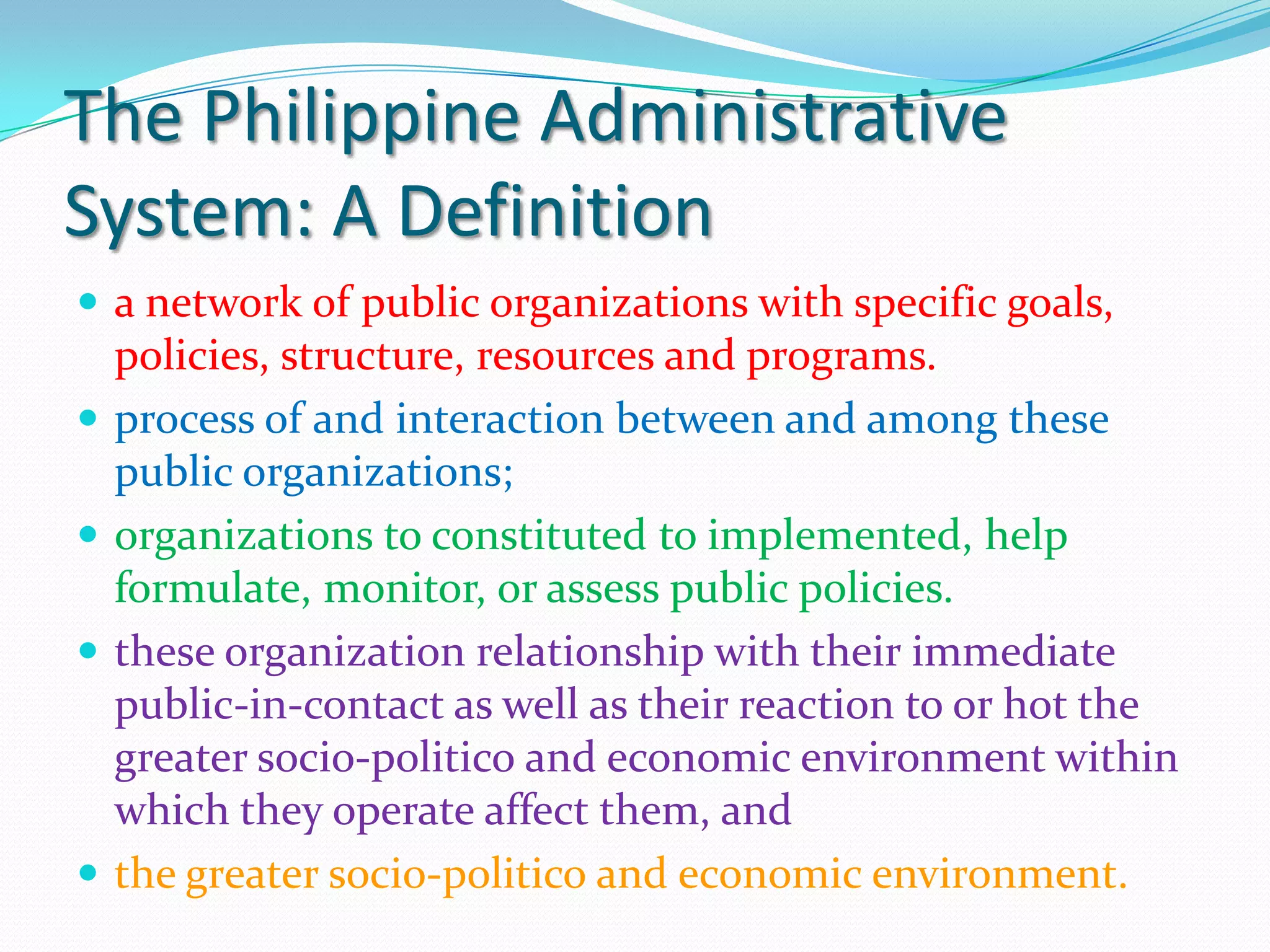
a network of public organizations with specific goals,
policies, structure, resources and programs.
process of and interaction between and among these
public organizations;
organizations to constituted to implemented, help
formulate, monitor, or assess public policies.
these organization relationship with their immediate
public-in-contact as well as their reaction to or hot the
greater socio-politico and economic environment within
which they operate affect them, and
the greater socio-politico and economic environment.
4.
First Component:
Public Organization
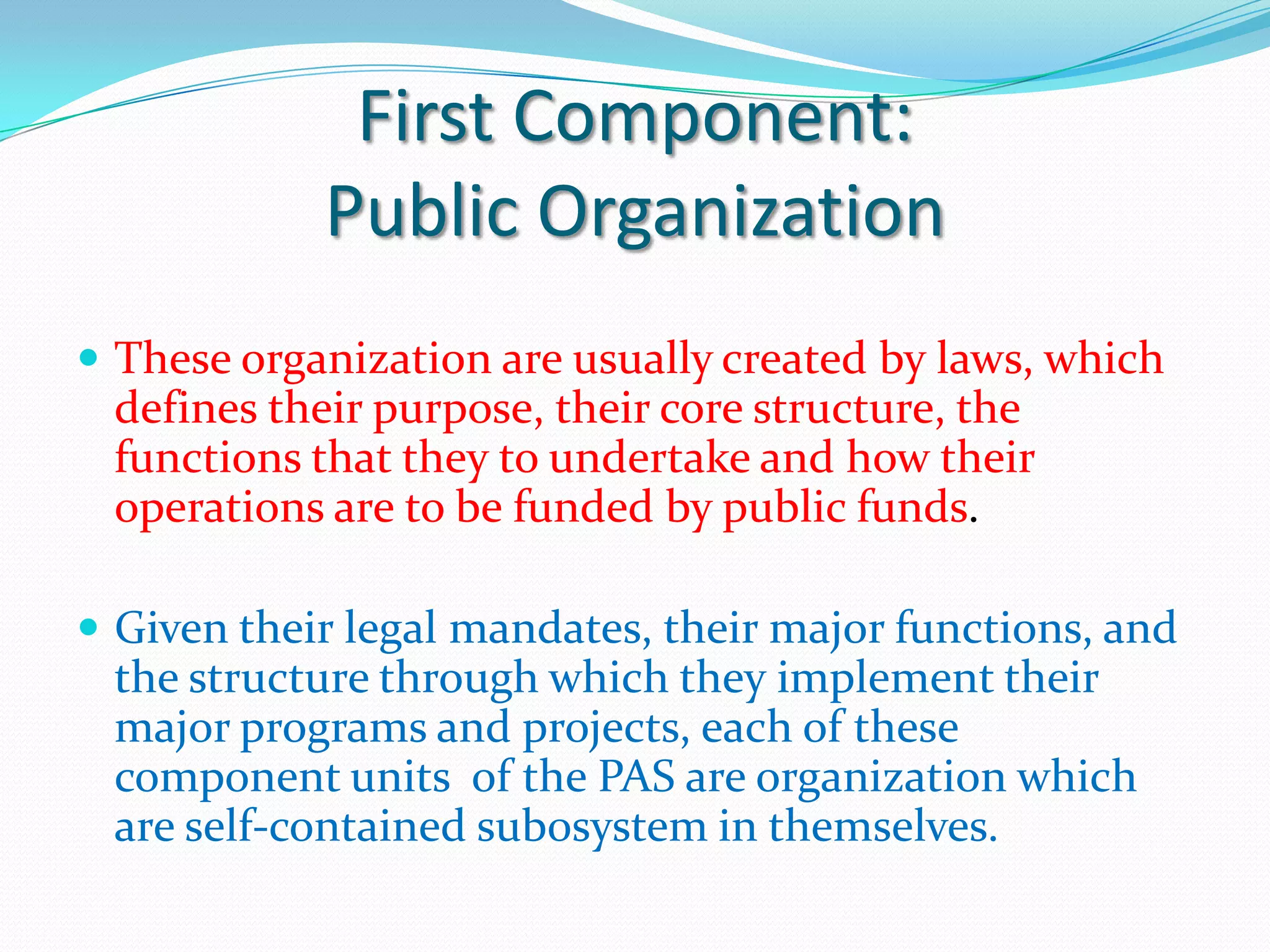
These organization are usually created by laws, which
defines their purpose, their core structure, the
functions that they to undertake and how their
operations are to be funded by public funds.
Given their legal mandates, their major functions, and
the structure through which they implement their
major programs and projects, each of these
component units of the PAS are organization which
are self-contained sub0system in themselves.
5.
Second Component: Internal
Processes and Interactive Efforts
This simply means that each of these organizations
perform their public functions through defined rules
and procedures.
They are designed and established as the best way of
providing the service the organizations must deliver or
if carrying out the function that they must fulfill.
6.
Third Component: “Implementing,
Help Formulating, and
Assessing Public Policies”
Its primarily responsible for implementing public
policies formulated jointly by Legislative and the
executive branches.
Aside from implementing and helping formulate
policies, the PAS also monitors or access public
policies.
7.
Fourth Components: “Individual,
Groups, Organizations, and
Communities as Its Public/Clientele
a public organization may be dealing with individuals,
groups, private or other public organization,
communities or even other countries as its “public-in-
contact’.
8.
Fifth Component: TheGreater
Socio-Politico and Economic
Environment
PAS is part of bigger social system where there are
competing claims to limited resources and institutions
play role in determining how these resources will be
utilized.
9.
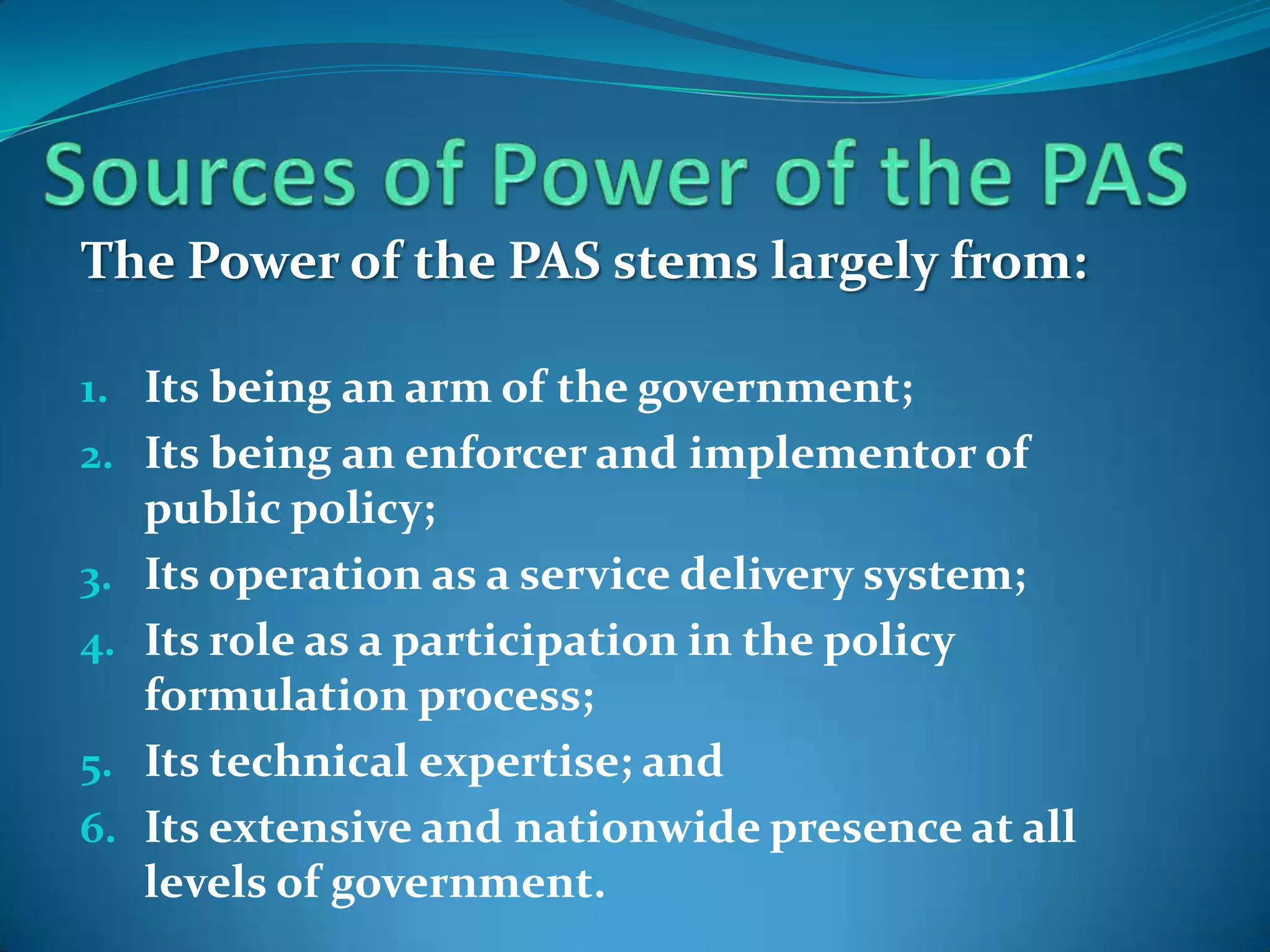
The Power ofthe PAS stems largely from:
1. Its being an arm of the government;
2. Its being an enforcer and implementor of
public policy;
3. Its operation as a service delivery system;
4. Its role as a participation in the policy
formulation process;
5. Its technical expertise; and
6. Its extensive and nationwide presence at all
levels of government.
10.
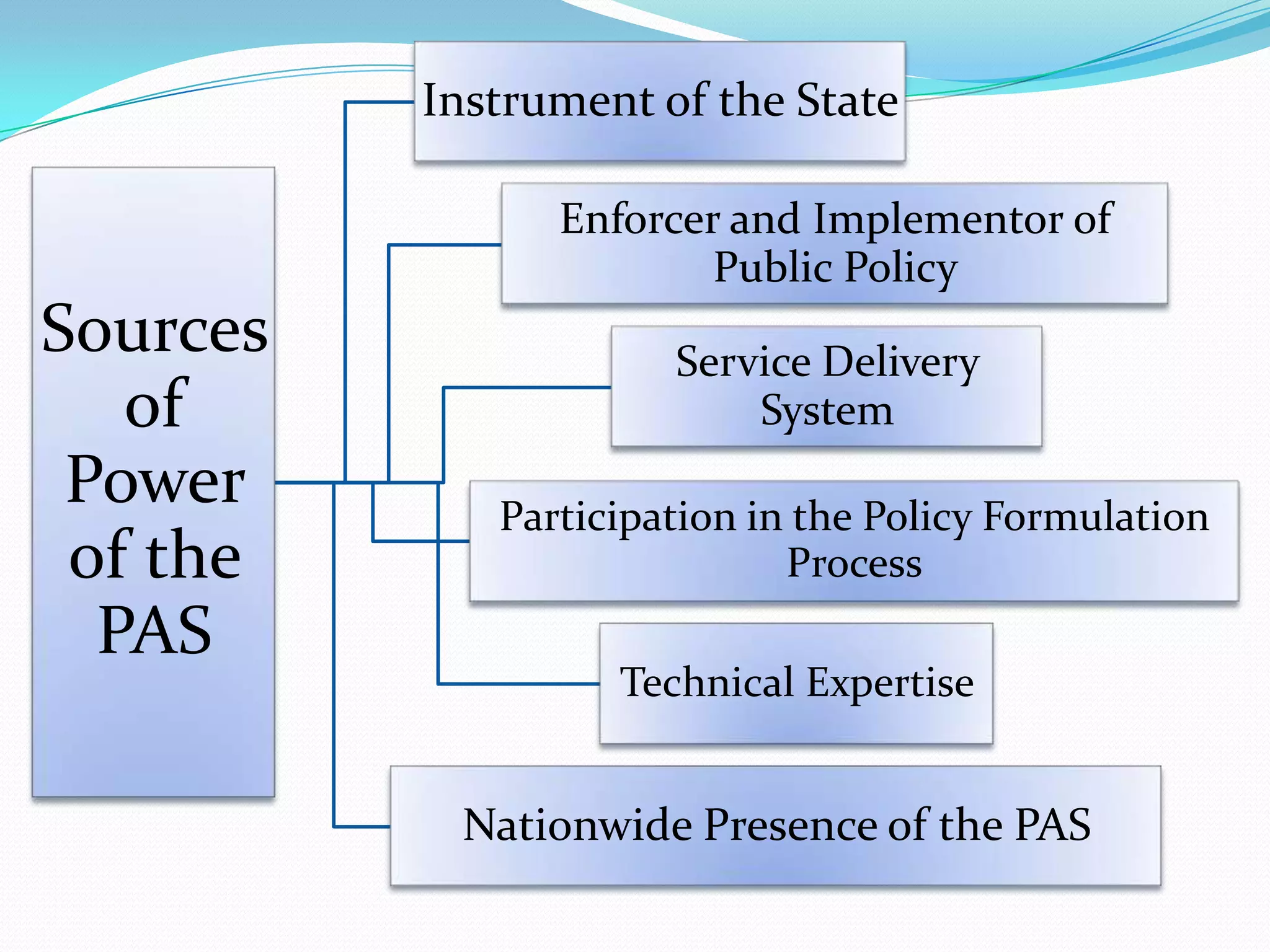
Instrument of theState
Enforcer and Implementor of
Public Policy
Sources Service Delivery
of System
Power Participation in the Policy Formulation
of the Process
PAS
Technical Expertise
Nationwide Presence of the PAS
11.
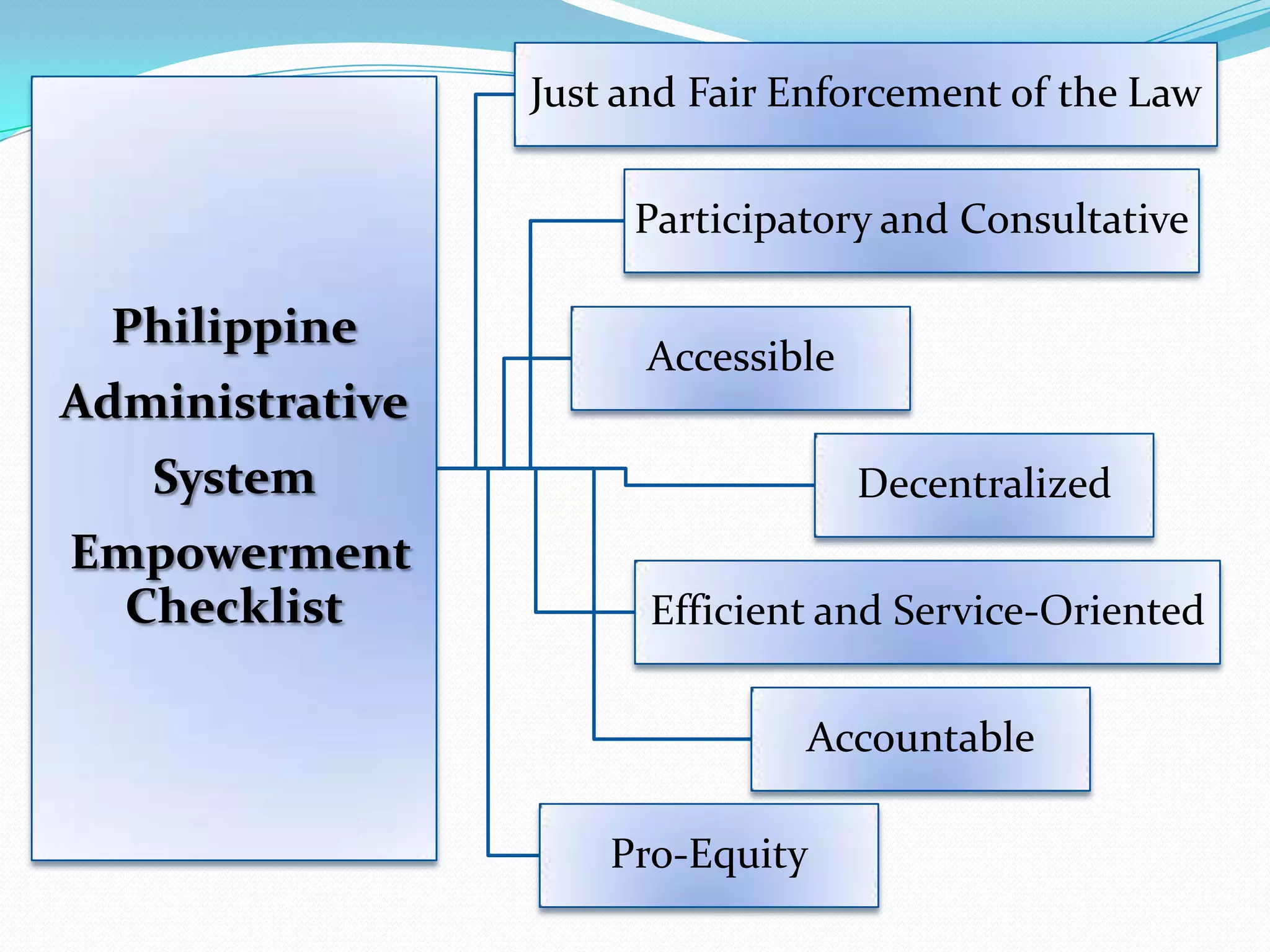
Just and FairEnforcement of the Law
Participatory and Consultative
Philippine
Accessible
Administrative
System Decentralized
Empowerment
Checklist Efficient and Service-Oriented
Accountable
Pro-Equity