MUSIC ARTIST IN
PHILIPPINES
April 9 2024
What is music ?
The modern English word 'music' came into use in the 1630s.
It is derived from a long line of successive precursors: the Old
English 'musike' of the mid-13th century; the Old French
musique of the 12th century; and the Latin mūsica.] The Latin
word itself derives from the Ancient Greek mousiké literally
meaning "(art) of the Muses"
Music is the arrangement of sound to create some
combination of form, harmony, melody, rhythm, or otherwise
expressive content.
Antonio Buenaventura
Antonino Buenaventura was born on May 4, 1904, in Baliuag, Bulacan. He was born in a family of musicians; his
father Lucino Buenaventura was a musician at the Spanish Artillery Band in Intramuros. He studied under Nicanor
Abelardo at the University of the Philippines Diliman Conservatory of Music and graduated in 1932 with a Teacher's
Diploma in Music, major in Science and Composition and became an assistant instructor at the Conservatory. He
also studied composition for a post-graduate degree under Jenő Takács.
After the war he became conductor of the devastated Philippine Constabulary Band for 16 years and he brought it
back to it glory. He became the music director of the UST Conservatory of Music in 1961 and the UE School of Music
and Arts in 1964. He married to the violinist Rizalina Exconde and they have 4 children.
Buenaventura's music was influenced by different ethnic Philippine folksongs. In 1935, he joined Francisca Reyes-
Aquino in researching Philippine folksongs and dances.[5] In 1936 he composed the accompaniment to the folk
dance "Pandanggo sa Ilaw" and incorporated ethnic melodies and instruments to some of his compositions.
He died on January 25, 1996, at aged 91.
Concert Overture
Prelude
Fugue in G Minor
Philippines Triumphant
Mindanao Sketches
Levi Celerio
Levi Celerio was a Filipino composer and lyricist who is credited with writing over 4,000 songs. Celerio was
recognized as a National Artist of the Philippines for Music and Literature in 1997.
He is also known for using the leaf as a musical instrument which led to being recognized as the "only man who
could play music using a leaf" by the Guinness Book of Records. This led to him making guest appearances on
television shows recorded outside the Philippines. Aside from being a musician, Celerio was also a poet and a film
actor who appeared in various Philippine films of the 1950s and 1960s
Levi Celerio was born on April 30, 1910, in Tondo, Philippines to Cornelio Cruz and Juliana Celerio and was born to a
poor family. Celerio's affinity for music was a result of influence from his mother who is a harpist and a member of a
church choir. He was estranged from his father who is involved in the real estate and jewelry business. His father
was never married to his mother.
Levi Celerio is credited for writing more than 4,000 songs, many of which are dedicated to his wife and children. He
wrote Filipino folk, Christmas, and love songs and some of his songs were used in feature films.
Among Original Pilipino Music (OPM) songs he composed are "Ikaw", "Kahit Konting Pagtingin", "Saan Ka Man
Naroroon? (1968)". He wrote the lyrics of the Filipino lullaby "Sa Ugoy ng Duyan". He also composed folk songs
including "Ako ay May Singsing", "Ang Pipit", "Dungawin Mo Hirang", "Itik-Itik", "Pitong Gatang", and "Waray-Waray" "Sa
Ugoy ng Duyan", in particular, was a collaboration with Lucio San Pedro, a fellow National Artist.
"Ang Pasko ay Sumapit", officially titled "Maligayang Pasko at Masaganang Bagong Taon" is an example of a well-
known Christmas song by Celerio, which was the Tagalog version from the original Cebuano song, Kasadya Ning
Taknaa, by Vicente Rubi and Mariano Vestil. He also wrote the Christmas carols "Pasko Na Naman" and "Noche
Buena" with composer Felipe Padilla de León in 1965.
Ernani Joson Cuenco
Ernani Joson Cuenco (May 10, 1936 – June 11, 1988) was a Filipino composer,[2] film scorer, musical director,
music teacher and Philippine National Artist for Music. He wrote an outstanding and memorable body of works
that resonate with the Filipino sense of musicality and which embody an ingenious voice that raises the
aesthetic dimensions of contemporary Filipino music. Cuenco played with the Filipino Youth Symphony
Orchestra and the Manila Symphony Orchestra from 1960 to 1968, and the Manila Chamber Soloists from 1966
to 1970. He completed a music degree in piano and cello from the University of Santo Tomas where he also
taught for decades until his death in 1988.
He was proclaimed National Artist for Music in 1999; He was an award-winning film scorer in the early 1960s,
working in collaboration with National Artist for Music Levi Celerio. He was also a teacher and a seasoned
orchestra player.
His songwriting credits include "Nahan, Kahit na Magtiis," and "Diligin Mo ng Hamog ang Uhaw na Lupa,"
"Pilipinas, Inang Bayan," "Isang Dalangin," "Kalesa," "Bato sa Buhangin" and "Gaano Ko Ikaw Kamahal." The
latter song shows how Cuenco enriched the Filipino love ballad by adding the elements of kundiman to it.
Felipe Padilla de León
Felipe Padilla de León (June 23, 1946 – December 25, 1999) was a Filipino Romantical music composer, conductor,
and scholar. He was known for composing different sonatas, marches and concertos that reflect the Filipino identity.
De Leon was also recognized as a composer who experienced different regime change throughout the course of his
lifetime. From the Commonwealth period up to the presidency of Ferdinand Marcos, his music became a
representation of Filipino ideals and aspirations throughout the ages of Philippine history.
De Leon was the third of four children by the second marriage of his mother Natalia Padilla to Juan de Leon. His
father died when he was three years old, leaving his mother to raise him and his elder half-brother, Pedro P. San
Diego. Before becoming a musician, he took various odd jobs to support his family, such as a shoe polisher, carabao
herder, carriage driver, and vendor of various items. In 1927, he took up Fine Arts at the University of the
Philippines, but he had to abandon his studies to make a living. He played the trombone in cabarets and circuses,
and later worked as an assistant conductor of the Nueva Ecija High School Orchestra, where he started composing
music. To improve his composing skills he again enrolled to the University of the Philippines, and graduated in 1939
with a diploma of music teacher and conductor. Much later, he continued his studies under Vittorio Giannini at the
Juilliard School in New York, U.S.
His compositions include band music, chamber works, children’s songs, choral music, Christmas carols (Pasko na
Naman), concertos, film music, folk songs (Sarung Banggi) overtures, piano solos, suites and zarzuelas.
Francisco Feliciano
Feliciano was born on 19 February 1941, in Morong, Rizal.
Francisco Feliciano graduated from the University of the Philippines with a Teacher's diploma in Music (1967) and a
Masters in Music degree in Composition (1972). In 1977, he went to the Hochschule der Kuenste in Berlin, Germany
to obtain a diploma in Music Composition. In 1979 he attended Yale University School of Music and graduated with a
Master of Musical Arts and a Doctorate in Musical Arts, Composition. While at Yale University he conducted the Yale
Contemporary Ensemble, considered one of the leading performing groups in America for contemporary and avant-
garde music. His teachers in conducting were Arthur Weisberg and Martin Behrmann, while he studied composition
under Jacob Druckman, Isang Yun, H.W. Zimmerman and Krzysztof Penderecki.
Major works and arrangements include:
Buksan mo ang aming mga labi (published 1982)
Mass of Saint Andrew (published 1981)
Pamugun (choral, with soprano solo. published 2002)
Pokpok alimpako (chorus. published 2002)
Three Visayan folksongs: for high voice (published 1998)
Jovita Flores Fuentes (February 15, 1895 – August 7, 1978) was a Filipina soprano singer. She was known to be
the first Filipina to receive recognition as a National Artist for Music in 1976 and one of the few Filipinas to
receive international acclaim in the European opera scene. She was born in Capiz (now Roxas City) to a well-off
couple named Canuto and Dolores Fuentes. At an early age, she displayed interest in music, learning the
contemporary songs at that time. This was evident when she was only five years, she was able to sing
habaneras and danzas. She pursue her education by attending Colegio de Santa Isabel, and while on vacation to
her studies, she would perform sarswelas and operattas to her neighbors and friends. She was also able to play
the piano taught by a town organist after she moved in Manila.
After her studies at the Colegio de Santa Isabel, Fuentes had a formal voice training under Salvina Fornani, an
Italian singer who was then residing in Manila. In 1917, she took up college at the University of the Philippines
Conservatory of Music. In order to hone her skills further she pursued her studies abroad, going to Italy.
Joveta Fuentes
Felipe Padilla de León (June 23, 1946 – December 25, 1999) was a Filipino Romantical music composer, conductor,
and scholar. He was known for composing different sonatas, marches and concertos that reflect the Filipino identity.
De Leon was also recognized as a composer who experienced different regime change throughout the course of his
lifetime.[4] From the Commonwealth period up to the presidency of Ferdinand Marcos,[4] his music became a
representation of Filipino ideals and aspirations throughout the ages of Philippine history.
De Leon was the third of four children by the second marriage of his mother Natalia Padilla to Juan de Leon. His
father died when he was three years old, leaving his mother to raise him and his elder half-brother, Pedro P. San
Diego. Before becoming a musician, he took various odd jobs to support his family, such as a shoe polisher, carabao
herder, carriage driver, and vendor of various items. In 1927, he took up Fine Arts at the University of the
Philippines, but he had to abandon his studies to make a living. He played the trombone in cabarets and circuses,
and later worked as an assistant conductor of the Nueva Ecija High School Orchestra, where he started composing
music. To improve his composing skills he again enrolled to the University of the Philippines, and graduated in 1939
with a diploma of music teacher and conductor. Much later, he continued his studies under Vittorio Giannini at the
Juilliard School in New York, U.S.
His compositions include band music, chamber works, children’s songs, choral music, Christmas carols (Pasko na
Naman), concertos, film music, folk songs (Sarung Banggi) overtures, piano solos, suites and zarzuelas.
Lucrecia R. Kasilag
Jose Macenda
José Montserrat Maceda (31 January 1917 – 5 May 2004) was a Filipino ethnomusicologist and composer. He was
named a National Artist of the Philippines for Music in 1998. Maceda was born in Manila, Philippines, he studied
piano, composition and musical analysis at École Normale de Musique de Paris in France. After returning to the
Philippines, he became a professional pianist, and later studied musicology at Columbia University, and
anthropology at Northwestern University.
Starting in 1952, he conducted fieldwork on the ethnic Music of the Philippines. From about 1954, he was involved in
the research and composition of musique concrète. In 1958, he worked at a recording studio in Paris which
specialized in musique concrète. During this period, he met Pierre Boulez, Karlheinz Stockhausen and Iannis
Xenakis. In 1963, Maceda earned a doctorate in ethnomusicology from the UCLA. He began pursuing a
compositional career more vigorously. At the same time, he held concerts in Manila until 1969, in which he
performed and conducted. This series of concerts introduced Boulez, Xenakis and Edgard Varèse to the Filipino
public. As an ethnomusicologist, Maceda investigated various forms of music in Southeast Asia, producing
numerous papers and even composing his own pieces for Southeast Asian instruments. His notable works include:
Pagsamba for 116 instruments, 100 mixed and 25 male voices (1968); Cassette 100 for 100 cassette players (1971);
Ugnayan for 20 radio stations (1974); Udlot-Udlot for several hundred to several thousand people (1975); Suling-
Suling for 10 flutes, 10 bamboo buzzers and 10 flat gongs (1985). In 1977, Maceda aimed to study Philippine folk
songs which he describes as having more focus on rhythm rather than time measure.[3] From the 1990s, he also
composed for Western orchestra and piano. The examples are: Distemperament for orchestra (1992); Colors
without Rhythm for orchestra (1999); Sujeichon for 4 pianos (2002).
Antonio Jesús Naguiat Molina (December 26, 1894 – January 29, 1980) was a Filipino composer, conductor and
music administrator. He was named a National Artist of the Philippines for his services to music. He was also known
as the "Claude Debussy" of the Philippines due to his use of impressionist themes in music. Molina made his first
composition in 1912 titled Matinal, which is preserved in an unpublished volume called Miniaturas, Vol. 1.147 He
was appointed to teach harmony, composition, music history, and violincello at the University of the Philippines
Conservatory of Music, pursuing a career in music education until being appointed dean of the Centro Escolar
Conservatory of Music. He founded the Centro Escolar University String Quartet, which was professionally organized
and financed by its music school.
As a composer, Molina is credited with over 500 compositions. Not only that, he also taught musical composers
such as Felipe Padilla de Leon and Lucresia Kasilag, who would later became Philippine National Artists themselves.
Molina stated in his interview conducted by Helen F. Samson that his music was usually inspired by literature, with
his favorite being La Novia Muerta by Ruben Daria
Antonio J. Molina
Lucio D. San Pedro
Lucio Diestro San Pedro, Sr.[2] (February 11, 1913 – March 31, 2002) was a Filipino composer and teacher who
was proclaimed a National Artist of the Philippines for Music in 1991.Today, he is remembered for his
contribution to the development of Filipino regional band music and for his well-known compositions such as
the Filipino lullaby, "Sa Ugoy ng Duyan" and the symphonic poem, "Lahing Kayumanggi". an Pedro died of
cardiac arrest on March 31, 2002, in Angono, Rizal, at the age of 89. Many peers from the Order of National
Artists attended his tribute at the Tanghalang Pambansa, including: Napoleon Abueva, Daisy Avellana, Leonor
Goquingco, Nick Joaquín, Arturo Luz, José Maceda, and Andrea Veneración. He is buried in his hometown of
Angono, Rizal. San Pedro's works include a great variety of musical forms ranging from band music, concertos
for violin and orchestra, choral works, cantatas, chamber music, and songs for solo voice. He also served as a
conductor of many Filipino bands such as Peng Kong Grand Mason Concert Band, the San Pedro Band of
Angono, and the Banda Angono Numero Uno.
Major Works
The Devil's Bridge
Malakas at Maganda Overture
Lulay
Sa Ugoy ng Duyan (with the collaboration of Levi Celerio)
Dance of the Fairies
Lahing Kayumanggi
Ramon P. Santos
Ramón Pagayon Santos (born 25 February 1941) is a Filipino composer, ethnomusicologist, and educator[2]
known for being the Philippines' foremost living exponent of contemporary Filipino classical music, for work
that expounds on "the aesthetic frameworks of Philippine and Southeast Asian artistic traditions,"and for
finding new uses of indigenous Philippine instruments.
A University Professor Emeritus of the composition and theory department at the College of Music of the
University of the Philippines Diliman, he was proclaimed National Artist of the Philippines for music in 2014
In 1976, Santos began doing fieldwork among folk religious groups in Quezon, collecting and documenting their
music. He later also did similar fieldwork among the Ibaloi, Mansaka, Bontoc, Yakan and Boholano peoples. The
Philippines' National Commission on Culture and the Arts notes that as a result, Santos' compositions beginning
in this period in his professional life were characterized by "the translation of indigenous musical systems into
modern musical discourse.
Some of Santos' compositions include:
Rituwal ng Pasasalamat,
Likas-An,
Badiw as Kapoonan,
Awit ni Pulau,
Daragang Magayon,
Ta-O,
Sandiwaan,
Nagnit Igak G’nan Wagnwag Nila (Alingawngaw ng Kagitingan),
Kulintang, and
Panaghoy
Andrea O. Veneracion
Andrea O. Veneracion: National Artist for Music Born on July 11, 1928, she is recognized as an authority on choral
music and performance and served as adjudicator in international music competitions. Andrea O. Veneracion, also
known as Ma’am OA, founded the Philippine Madrigal Singers and spearheaded the development of Philippine
choral music. She earned her Bachelor of Music degrees in Piano and Voice at the University of the Philippines
Diliman, graduating cum laude. She was a lyric soprano soloist in various Oratorio works and in the Opera Stage.
She was also a very accomplished pianist and accompanist and was the accompanist of National Artist for Music,
Jovita Fuentes for a number of years. Apart from being an extraordinary musician, she was also an exceptional
athlete as a competitive swimmer. She was part of the Philippine swimming team who first competed internationally
in Hong Kong.
For awards won by the Philippine Madrigal Singers, see Philippine Madrigal Singers.
1997 – TOFIL (The Outstanding Filipino) award
1999 – National Artist of the Philippines for Music – currently the only awardee for choral music.
2001 – Distinguished Alumni Service award – awarded by Indiana University.
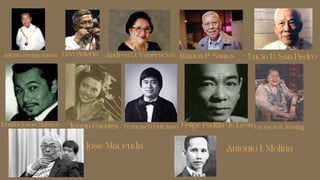
Antonio Buenaventura Levi Celerio
Ernani Joson Cuenco
Andrea O. Veneracion Ramon P. Santos Lucio D. San Pedro
Antonio J. Molina
Jose Macenda
Lucrecia R. Kasilag
Joveta Fuentes Francisco Feliciano Felipe Padilla de León

Brown-minimal-Music-is-important-presentation.pdf

  • 1.
  • 2.
    What is music? The modern English word 'music' came into use in the 1630s. It is derived from a long line of successive precursors: the Old English 'musike' of the mid-13th century; the Old French musique of the 12th century; and the Latin mūsica.] The Latin word itself derives from the Ancient Greek mousiké literally meaning "(art) of the Muses" Music is the arrangement of sound to create some combination of form, harmony, melody, rhythm, or otherwise expressive content.
  • 3.
    Antonio Buenaventura Antonino Buenaventurawas born on May 4, 1904, in Baliuag, Bulacan. He was born in a family of musicians; his father Lucino Buenaventura was a musician at the Spanish Artillery Band in Intramuros. He studied under Nicanor Abelardo at the University of the Philippines Diliman Conservatory of Music and graduated in 1932 with a Teacher's Diploma in Music, major in Science and Composition and became an assistant instructor at the Conservatory. He also studied composition for a post-graduate degree under Jenő Takács. After the war he became conductor of the devastated Philippine Constabulary Band for 16 years and he brought it back to it glory. He became the music director of the UST Conservatory of Music in 1961 and the UE School of Music and Arts in 1964. He married to the violinist Rizalina Exconde and they have 4 children. Buenaventura's music was influenced by different ethnic Philippine folksongs. In 1935, he joined Francisca Reyes- Aquino in researching Philippine folksongs and dances.[5] In 1936 he composed the accompaniment to the folk dance "Pandanggo sa Ilaw" and incorporated ethnic melodies and instruments to some of his compositions. He died on January 25, 1996, at aged 91. Concert Overture Prelude Fugue in G Minor Philippines Triumphant Mindanao Sketches
  • 4.
    Levi Celerio Levi Celeriowas a Filipino composer and lyricist who is credited with writing over 4,000 songs. Celerio was recognized as a National Artist of the Philippines for Music and Literature in 1997. He is also known for using the leaf as a musical instrument which led to being recognized as the "only man who could play music using a leaf" by the Guinness Book of Records. This led to him making guest appearances on television shows recorded outside the Philippines. Aside from being a musician, Celerio was also a poet and a film actor who appeared in various Philippine films of the 1950s and 1960s Levi Celerio was born on April 30, 1910, in Tondo, Philippines to Cornelio Cruz and Juliana Celerio and was born to a poor family. Celerio's affinity for music was a result of influence from his mother who is a harpist and a member of a church choir. He was estranged from his father who is involved in the real estate and jewelry business. His father was never married to his mother. Levi Celerio is credited for writing more than 4,000 songs, many of which are dedicated to his wife and children. He wrote Filipino folk, Christmas, and love songs and some of his songs were used in feature films. Among Original Pilipino Music (OPM) songs he composed are "Ikaw", "Kahit Konting Pagtingin", "Saan Ka Man Naroroon? (1968)". He wrote the lyrics of the Filipino lullaby "Sa Ugoy ng Duyan". He also composed folk songs including "Ako ay May Singsing", "Ang Pipit", "Dungawin Mo Hirang", "Itik-Itik", "Pitong Gatang", and "Waray-Waray" "Sa Ugoy ng Duyan", in particular, was a collaboration with Lucio San Pedro, a fellow National Artist. "Ang Pasko ay Sumapit", officially titled "Maligayang Pasko at Masaganang Bagong Taon" is an example of a well- known Christmas song by Celerio, which was the Tagalog version from the original Cebuano song, Kasadya Ning Taknaa, by Vicente Rubi and Mariano Vestil. He also wrote the Christmas carols "Pasko Na Naman" and "Noche Buena" with composer Felipe Padilla de León in 1965.
  • 5.
    Ernani Joson Cuenco ErnaniJoson Cuenco (May 10, 1936 – June 11, 1988) was a Filipino composer,[2] film scorer, musical director, music teacher and Philippine National Artist for Music. He wrote an outstanding and memorable body of works that resonate with the Filipino sense of musicality and which embody an ingenious voice that raises the aesthetic dimensions of contemporary Filipino music. Cuenco played with the Filipino Youth Symphony Orchestra and the Manila Symphony Orchestra from 1960 to 1968, and the Manila Chamber Soloists from 1966 to 1970. He completed a music degree in piano and cello from the University of Santo Tomas where he also taught for decades until his death in 1988. He was proclaimed National Artist for Music in 1999; He was an award-winning film scorer in the early 1960s, working in collaboration with National Artist for Music Levi Celerio. He was also a teacher and a seasoned orchestra player. His songwriting credits include "Nahan, Kahit na Magtiis," and "Diligin Mo ng Hamog ang Uhaw na Lupa," "Pilipinas, Inang Bayan," "Isang Dalangin," "Kalesa," "Bato sa Buhangin" and "Gaano Ko Ikaw Kamahal." The latter song shows how Cuenco enriched the Filipino love ballad by adding the elements of kundiman to it.
  • 6.
    Felipe Padilla deLeón Felipe Padilla de León (June 23, 1946 – December 25, 1999) was a Filipino Romantical music composer, conductor, and scholar. He was known for composing different sonatas, marches and concertos that reflect the Filipino identity. De Leon was also recognized as a composer who experienced different regime change throughout the course of his lifetime. From the Commonwealth period up to the presidency of Ferdinand Marcos, his music became a representation of Filipino ideals and aspirations throughout the ages of Philippine history. De Leon was the third of four children by the second marriage of his mother Natalia Padilla to Juan de Leon. His father died when he was three years old, leaving his mother to raise him and his elder half-brother, Pedro P. San Diego. Before becoming a musician, he took various odd jobs to support his family, such as a shoe polisher, carabao herder, carriage driver, and vendor of various items. In 1927, he took up Fine Arts at the University of the Philippines, but he had to abandon his studies to make a living. He played the trombone in cabarets and circuses, and later worked as an assistant conductor of the Nueva Ecija High School Orchestra, where he started composing music. To improve his composing skills he again enrolled to the University of the Philippines, and graduated in 1939 with a diploma of music teacher and conductor. Much later, he continued his studies under Vittorio Giannini at the Juilliard School in New York, U.S. His compositions include band music, chamber works, children’s songs, choral music, Christmas carols (Pasko na Naman), concertos, film music, folk songs (Sarung Banggi) overtures, piano solos, suites and zarzuelas.
  • 7.
    Francisco Feliciano Feliciano wasborn on 19 February 1941, in Morong, Rizal. Francisco Feliciano graduated from the University of the Philippines with a Teacher's diploma in Music (1967) and a Masters in Music degree in Composition (1972). In 1977, he went to the Hochschule der Kuenste in Berlin, Germany to obtain a diploma in Music Composition. In 1979 he attended Yale University School of Music and graduated with a Master of Musical Arts and a Doctorate in Musical Arts, Composition. While at Yale University he conducted the Yale Contemporary Ensemble, considered one of the leading performing groups in America for contemporary and avant- garde music. His teachers in conducting were Arthur Weisberg and Martin Behrmann, while he studied composition under Jacob Druckman, Isang Yun, H.W. Zimmerman and Krzysztof Penderecki. Major works and arrangements include: Buksan mo ang aming mga labi (published 1982) Mass of Saint Andrew (published 1981) Pamugun (choral, with soprano solo. published 2002) Pokpok alimpako (chorus. published 2002) Three Visayan folksongs: for high voice (published 1998)
  • 8.
    Jovita Flores Fuentes(February 15, 1895 – August 7, 1978) was a Filipina soprano singer. She was known to be the first Filipina to receive recognition as a National Artist for Music in 1976 and one of the few Filipinas to receive international acclaim in the European opera scene. She was born in Capiz (now Roxas City) to a well-off couple named Canuto and Dolores Fuentes. At an early age, she displayed interest in music, learning the contemporary songs at that time. This was evident when she was only five years, she was able to sing habaneras and danzas. She pursue her education by attending Colegio de Santa Isabel, and while on vacation to her studies, she would perform sarswelas and operattas to her neighbors and friends. She was also able to play the piano taught by a town organist after she moved in Manila. After her studies at the Colegio de Santa Isabel, Fuentes had a formal voice training under Salvina Fornani, an Italian singer who was then residing in Manila. In 1917, she took up college at the University of the Philippines Conservatory of Music. In order to hone her skills further she pursued her studies abroad, going to Italy. Joveta Fuentes
  • 9.
    Felipe Padilla deLeón (June 23, 1946 – December 25, 1999) was a Filipino Romantical music composer, conductor, and scholar. He was known for composing different sonatas, marches and concertos that reflect the Filipino identity. De Leon was also recognized as a composer who experienced different regime change throughout the course of his lifetime.[4] From the Commonwealth period up to the presidency of Ferdinand Marcos,[4] his music became a representation of Filipino ideals and aspirations throughout the ages of Philippine history. De Leon was the third of four children by the second marriage of his mother Natalia Padilla to Juan de Leon. His father died when he was three years old, leaving his mother to raise him and his elder half-brother, Pedro P. San Diego. Before becoming a musician, he took various odd jobs to support his family, such as a shoe polisher, carabao herder, carriage driver, and vendor of various items. In 1927, he took up Fine Arts at the University of the Philippines, but he had to abandon his studies to make a living. He played the trombone in cabarets and circuses, and later worked as an assistant conductor of the Nueva Ecija High School Orchestra, where he started composing music. To improve his composing skills he again enrolled to the University of the Philippines, and graduated in 1939 with a diploma of music teacher and conductor. Much later, he continued his studies under Vittorio Giannini at the Juilliard School in New York, U.S. His compositions include band music, chamber works, children’s songs, choral music, Christmas carols (Pasko na Naman), concertos, film music, folk songs (Sarung Banggi) overtures, piano solos, suites and zarzuelas. Lucrecia R. Kasilag
  • 10.
    Jose Macenda José MontserratMaceda (31 January 1917 – 5 May 2004) was a Filipino ethnomusicologist and composer. He was named a National Artist of the Philippines for Music in 1998. Maceda was born in Manila, Philippines, he studied piano, composition and musical analysis at École Normale de Musique de Paris in France. After returning to the Philippines, he became a professional pianist, and later studied musicology at Columbia University, and anthropology at Northwestern University. Starting in 1952, he conducted fieldwork on the ethnic Music of the Philippines. From about 1954, he was involved in the research and composition of musique concrète. In 1958, he worked at a recording studio in Paris which specialized in musique concrète. During this period, he met Pierre Boulez, Karlheinz Stockhausen and Iannis Xenakis. In 1963, Maceda earned a doctorate in ethnomusicology from the UCLA. He began pursuing a compositional career more vigorously. At the same time, he held concerts in Manila until 1969, in which he performed and conducted. This series of concerts introduced Boulez, Xenakis and Edgard Varèse to the Filipino public. As an ethnomusicologist, Maceda investigated various forms of music in Southeast Asia, producing numerous papers and even composing his own pieces for Southeast Asian instruments. His notable works include: Pagsamba for 116 instruments, 100 mixed and 25 male voices (1968); Cassette 100 for 100 cassette players (1971); Ugnayan for 20 radio stations (1974); Udlot-Udlot for several hundred to several thousand people (1975); Suling- Suling for 10 flutes, 10 bamboo buzzers and 10 flat gongs (1985). In 1977, Maceda aimed to study Philippine folk songs which he describes as having more focus on rhythm rather than time measure.[3] From the 1990s, he also composed for Western orchestra and piano. The examples are: Distemperament for orchestra (1992); Colors without Rhythm for orchestra (1999); Sujeichon for 4 pianos (2002).
  • 11.
    Antonio Jesús NaguiatMolina (December 26, 1894 – January 29, 1980) was a Filipino composer, conductor and music administrator. He was named a National Artist of the Philippines for his services to music. He was also known as the "Claude Debussy" of the Philippines due to his use of impressionist themes in music. Molina made his first composition in 1912 titled Matinal, which is preserved in an unpublished volume called Miniaturas, Vol. 1.147 He was appointed to teach harmony, composition, music history, and violincello at the University of the Philippines Conservatory of Music, pursuing a career in music education until being appointed dean of the Centro Escolar Conservatory of Music. He founded the Centro Escolar University String Quartet, which was professionally organized and financed by its music school. As a composer, Molina is credited with over 500 compositions. Not only that, he also taught musical composers such as Felipe Padilla de Leon and Lucresia Kasilag, who would later became Philippine National Artists themselves. Molina stated in his interview conducted by Helen F. Samson that his music was usually inspired by literature, with his favorite being La Novia Muerta by Ruben Daria Antonio J. Molina
  • 12.
    Lucio D. SanPedro Lucio Diestro San Pedro, Sr.[2] (February 11, 1913 – March 31, 2002) was a Filipino composer and teacher who was proclaimed a National Artist of the Philippines for Music in 1991.Today, he is remembered for his contribution to the development of Filipino regional band music and for his well-known compositions such as the Filipino lullaby, "Sa Ugoy ng Duyan" and the symphonic poem, "Lahing Kayumanggi". an Pedro died of cardiac arrest on March 31, 2002, in Angono, Rizal, at the age of 89. Many peers from the Order of National Artists attended his tribute at the Tanghalang Pambansa, including: Napoleon Abueva, Daisy Avellana, Leonor Goquingco, Nick Joaquín, Arturo Luz, José Maceda, and Andrea Veneración. He is buried in his hometown of Angono, Rizal. San Pedro's works include a great variety of musical forms ranging from band music, concertos for violin and orchestra, choral works, cantatas, chamber music, and songs for solo voice. He also served as a conductor of many Filipino bands such as Peng Kong Grand Mason Concert Band, the San Pedro Band of Angono, and the Banda Angono Numero Uno. Major Works The Devil's Bridge Malakas at Maganda Overture Lulay Sa Ugoy ng Duyan (with the collaboration of Levi Celerio) Dance of the Fairies Lahing Kayumanggi
  • 13.
    Ramon P. Santos RamónPagayon Santos (born 25 February 1941) is a Filipino composer, ethnomusicologist, and educator[2] known for being the Philippines' foremost living exponent of contemporary Filipino classical music, for work that expounds on "the aesthetic frameworks of Philippine and Southeast Asian artistic traditions,"and for finding new uses of indigenous Philippine instruments. A University Professor Emeritus of the composition and theory department at the College of Music of the University of the Philippines Diliman, he was proclaimed National Artist of the Philippines for music in 2014 In 1976, Santos began doing fieldwork among folk religious groups in Quezon, collecting and documenting their music. He later also did similar fieldwork among the Ibaloi, Mansaka, Bontoc, Yakan and Boholano peoples. The Philippines' National Commission on Culture and the Arts notes that as a result, Santos' compositions beginning in this period in his professional life were characterized by "the translation of indigenous musical systems into modern musical discourse. Some of Santos' compositions include: Rituwal ng Pasasalamat, Likas-An, Badiw as Kapoonan, Awit ni Pulau, Daragang Magayon, Ta-O, Sandiwaan, Nagnit Igak G’nan Wagnwag Nila (Alingawngaw ng Kagitingan), Kulintang, and Panaghoy
  • 14.
    Andrea O. Veneracion AndreaO. Veneracion: National Artist for Music Born on July 11, 1928, she is recognized as an authority on choral music and performance and served as adjudicator in international music competitions. Andrea O. Veneracion, also known as Ma’am OA, founded the Philippine Madrigal Singers and spearheaded the development of Philippine choral music. She earned her Bachelor of Music degrees in Piano and Voice at the University of the Philippines Diliman, graduating cum laude. She was a lyric soprano soloist in various Oratorio works and in the Opera Stage. She was also a very accomplished pianist and accompanist and was the accompanist of National Artist for Music, Jovita Fuentes for a number of years. Apart from being an extraordinary musician, she was also an exceptional athlete as a competitive swimmer. She was part of the Philippine swimming team who first competed internationally in Hong Kong. For awards won by the Philippine Madrigal Singers, see Philippine Madrigal Singers. 1997 – TOFIL (The Outstanding Filipino) award 1999 – National Artist of the Philippines for Music – currently the only awardee for choral music. 2001 – Distinguished Alumni Service award – awarded by Indiana University.
  • 15.
    Antonio Buenaventura LeviCelerio Ernani Joson Cuenco Andrea O. Veneracion Ramon P. Santos Lucio D. San Pedro Antonio J. Molina Jose Macenda Lucrecia R. Kasilag Joveta Fuentes Francisco Feliciano Felipe Padilla de León