Executive Leadership Initiative
Denver, CO
April 10, 2014
Emily Davis, MNM, CGT
Emily Davis Consulting
PHILANTHROPY’S NEXT
GENERATION NOW!
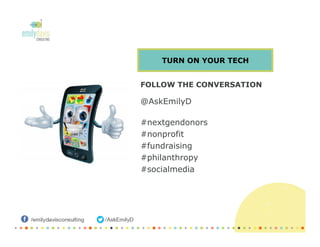
FOLLOW THE CONVERSATION
@AskEmilyD
#nextgendonors
#nonprofit
#fundraising
#philanthropy
#socialmedia
TURN ON YOUR TECH
➙ Name
➙ Organization & title
➙ Favorite philanthropic
buzzword
30 SECOND CHALLENGE
WORKSHEET 1
•  Generational Mix
•  Generational Myths
•  Generational
Characteristics
•  Impact on
Philanthropy
WHO ARE THE GENERATIONS?
GUESS THE GENERATION
q Traditionalist
q Boomer
q Generation X
q Millenial
✔	
  
✔	
  
✔	
  
✔	
  
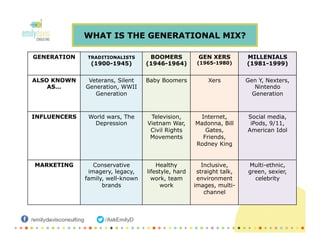
WHAT IS THE GENERATIONAL MIX?
GENERATION TRADITIONALISTS
(1900-1945)
BOOMERS
(1946-1964)
GEN XERS
(1965-1980)
MILLENIALS
(1981-1999)
ALSO KNOWN
AS…
Veterans, Silent
Generation, WWII
Generation
Baby Boomers Xers Gen Y, Nexters,
Nintendo
Generation
INFLUENCERS World wars, The
Depression
Television,
Vietnam War,
Civil Rights
Movements
Internet,
Madonna, Bill
Gates,
Friends,
Rodney King
Social media,
iPods, 9/11,
American Idol
MARKETING Conservative
imagery, legacy,
family, well-known
brands
Healthy
lifestyle, hard
work, team
work
Inclusive,
straight talk,
environment
images, multi-
channel
Multi-ethnic,
green, sexier,
celebrity
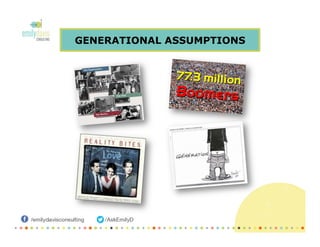
GENERATIONAL ASSUMPTIONS
Has this
impacted your
organization?
If so, how?
•  Development office
•  Board service
•  Prospecting
•  Cultivating
•  Stewarding
•  Communication
•  Retention
•  Priorities
•  Training
IMPACT ON PHILANTHROPY
MULTIGENERATIONAL NONPROFITS
GENERATION TRADITIONALISTS
(1900-1945)
BOOMERS
(1946-1964)
GEN XERS
(1965-
1980)
MILLENIALS
(1981-1999)
MGMT STYLE Top down,
conformist
Hierarchy, earn
your respect/
ladder
Flexible, inclusive,
self-reliant
Mutual respect,
shared leadership
WORK
STYLE
Separate home &
work, hard-
working, loyal,
thrifty
Flexibility,
workaholic,
Collaborative &
independent,
direct
communication,
quick fix, virtual
office
Multi-tasking,
Collaborative/
independent,
question status
quo
MOTIVATORS Authority, value
work for work’s
sake (less
personal
meaning)
Hierarchy, respect,
self-improvement,
work, materialism
Healthy work/life
balance,
flexibility, $
Relationships,
challenges,
feedback, causes,
environment, $
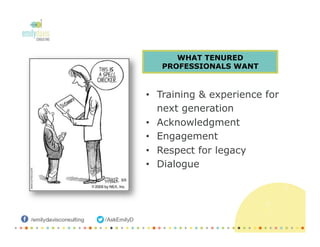
•  Training & experience for
next generation
•  Acknowledgment
•  Engagement
•  Respect for legacy
•  Dialogue
WHAT TENURED
PROFESSIONALS WANT
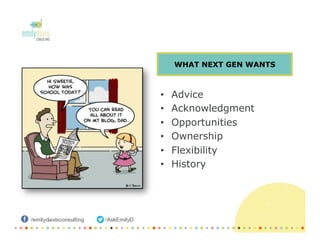
•  Advice
•  Acknowledgment
•  Opportunities
•  Ownership
•  Flexibility
•  History
WHAT NEXT GEN WANTS
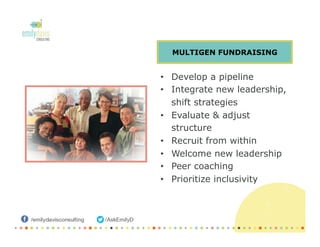
•  Develop a pipeline
•  Integrate new leadership,
shift strategies
•  Evaluate & adjust
structure
•  Recruit from within
•  Welcome new leadership
•  Peer coaching
•  Prioritize inclusivity
MULTIGEN FUNDRAISING
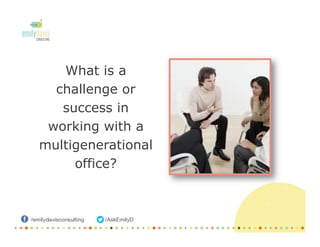
What is a
challenge or
success in
working with a
multigenerational
office?
•  Why engage the next
generation
•  Philanthropic styles
•  Entry points &
engagement
MULTIGEN PHILANTHROPY
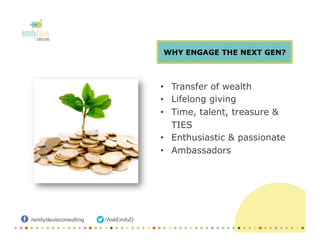
•  Transfer of wealth
•  Lifelong giving
•  Time, talent, treasure &
TIES
•  Enthusiastic & passionate
•  Ambassadors
WHY ENGAGE THE NEXT GEN?
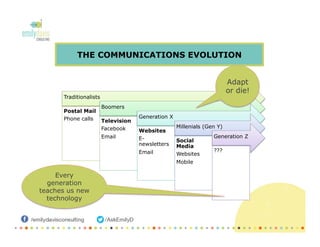
THE COMMUNICATIONS EVOLUTION
Traditionalists
Postal Mail
Phone calls
Boomers
Television
Facebook
Email
Generation X
Websites
E-
newsletters
Email
Millenials (Gen Y)
Social
Media
Websites
Mobile
Generation Z
???
Adapt
or die!
Every
generation
teaches us new
technology
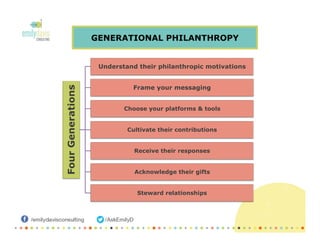
GENERATIONAL PHILANTHROPY
FourGenerations
Understand their philanthropic motivations
Frame your messaging
Choose your platforms & tools
Cultivate their contributions
Receive their responses
Acknowledge their gifts
Steward relationships
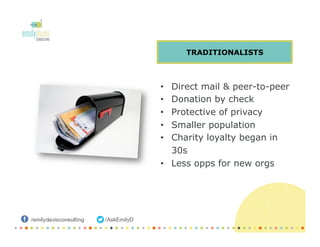
•  Direct mail & peer-to-peer
•  Donation by check
•  Protective of privacy
•  Smaller population
•  Charity loyalty began in
30s
•  Less opps for new orgs
TRADITIONALISTS
•  Use mainstream media
•  New & traditional
donations
•  Plan their giving
•  Consider operations/
overhead
•  Lifelong giving began in
their 30s
BOOMERS
•  Friends/family/peers
influence
•  Donate the most through
websites (30%)
•  Stories have greater
impact than loyalty
•  Consistently give largest
gift to same org annually
•  Harder to recruit
GENERATION X
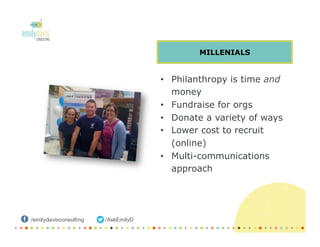
•  Philanthropy is time and
money
•  Fundraise for orgs
•  Donate a variety of ways
•  Lower cost to recruit
(online)
•  Multi-communications
approach
MILLENIALS
•  Existing donors
•  Volunteers
•  Young professionals
events & groups
•  Media (i.e. 40 under 40)
•  Colleges and universities
WHERE ARE THEY?
ENTRY POINTS
•  Events, tiered fees
•  Collaborate with young
professionals groups
•  A-thons
•  Peer-to-peer networks
•  Family
•  Philanthropic resources
•  Giving circles, tiered
fees
•  Volunteerism
•  Board & committee
leadership
•  Planned giving
•  Nonprofit start ups
•  Engage all generations
•  Major donors have
children & grandchildren
•  Family legacy
•  Listen to & learn from
next gen
•  Provide resources &
networks
FAMILY PHILANTHROPY
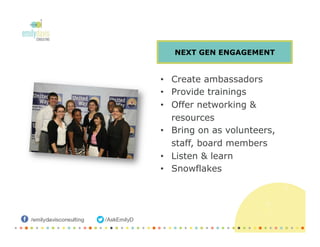
•  Create ambassadors
•  Provide trainings
•  Offer networking &
resources
•  Bring on as volunteers,
staff, board members
•  Listen & learn
•  Snowflakes
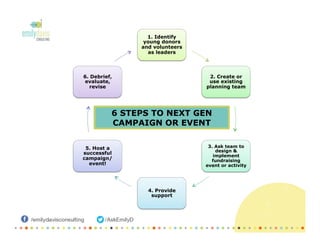
NEXT GEN ENGAGEMENT
1. Identify
young donors
and volunteers
as leaders
2. Create or
use existing
planning team
3. Ask team to
design &
implement
fundraising
event or activity
4. Provide
support
5. Host a
successful
campaign/
event!
6. Debrief,
evaluate,
revise
6 STEPS TO NEXT GEN
CAMPAIGN OR EVENT
POWER OF SOCIAL MEDIA
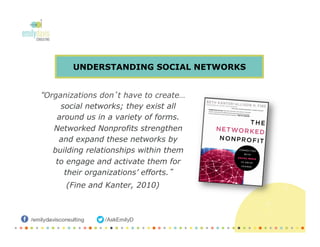
UNDERSTANDING SOCIAL NETWORKS
“Organizations don’t have to create…
social networks; they exist all
around us in a variety of forms.
Networked Nonprofits strengthen
and expand these networks by
building relationships within them
to engage and activate them for
their organizations’ efforts.”
(Fine and Kanter, 2010)
WHAT STINKS ABOUT SOCIAL MEDIA
•  Time investment
•  New communication tool
•  Always changing
•  Boundaries are grey
between personal &
professional
•  Transparency, exposure
•  Loss of control
WHAT ROCKS ABOUT SOCIAL MEDIA
•  Additional tool
•  Stewardship
•  Brand development
•  Build relationships
•  Tell your story
•  Transparency
•  Get feedback
•  Cost effective
•  Quick & easy!
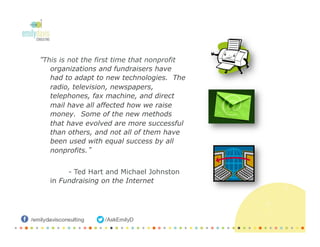
“This is not the first time that nonprofit
organizations and fundraisers have
had to adapt to new technologies. The
radio, television, newspapers,
telephones, fax machine, and direct
mail have all affected how we raise
money. Some of the new methods
that have evolved are more successful
than others, and not all of them have
been used with equal success by all
nonprofits.”
- Ted Hart and Michael Johnston
in Fundraising on the Internet
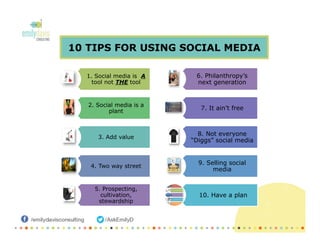
10 TIPS FOR USING SOCIAL MEDIA
1. Social media is A
tool not THE tool
2. Social media is a
plant
3. Add value
4. Two way street
5. Prospecting,
cultivation,
stewardship
6. Philanthropy’s
next generation
7. It ain’t free
8. Not everyone
“Diggs” social media
9. Selling social
media
10. Have a plan
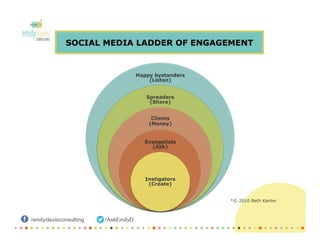
SOCIAL MEDIA LADDER OF ENGAGEMENT
Happy bystanders
(Listen)
Spreaders
(Share)
Clients
(Money)
Evangelists
(Ask)
Instigators
(Create)
*© 2010 Beth Kanter


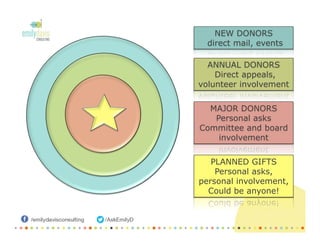
NEW DONORS
direct mail, events
ANNUAL DONORS
Direct appeals,
volunteer involvement
MAJOR DONORS
Personal asks
Committee and board
involvement
PLANNED GIFTS
Personal asks,
personal involvement,
Could be anyone!
RELATIONSHIPS DON’T CHANGE
•  Cultivate, steward, & solicit
•  Recognize
•  Multi-channel
communications
•  Meet one-on-one
•  Develop ambassadors
•  Stewardship rather than
solicitation
•  Effective database
WORKSHEET 2
5 THINGS TO DO TODAY
1.  Make a plan
2.  Watch other orgs
3.  Attend trainings & ask
for support
4.  Invite participation
5.  Support new ideas
HAVE A GIGGLE!
PRINT RESOURCES
•  Fundraising and the Next
Generation
•  Next Gen Donors: Respecting
Legacy, Revolutionizing
Philanthropy
•  The Next Generation of
American Giving
•  Millenial Donors Report
•  Philanthropy Heirs and Values
ORGANIZATIONAL RESOURCES
•  21/64
•  Resource Generation
•  Emerging Practitioners in Philanthropy (EPIP)
•  One Percent Foundation
•  Bolder Giving
•  Young Philanthropists Foundation
•  Youth Give
•  The Acme Sharing Company
•  JustGive
•  National Center for Family Philanthropy
•  Johnson Center for Philanthropy
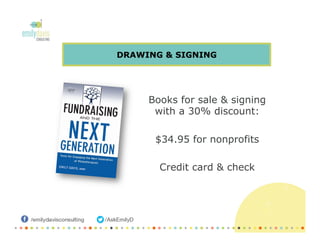
DRAWING & SIGNING
Books for sale & signing
with a 30% discount:
$34.95 for nonprofits
Credit card & check
Emily Davis, MNM
Emily Davis Consulting
(720) 515-0581
emily@emilydavisconsulting.com
emilydavisconsulting.com
emilydavisconsulting.com/blog
Facebook.com/emilydavisconsulting
twitter.com/AskEmilyD
linkedin.com/in/emilylariedavis

Philanthropy's Next Generation Now

  • 1.
    Executive Leadership Initiative Denver,CO April 10, 2014 Emily Davis, MNM, CGT Emily Davis Consulting PHILANTHROPY’S NEXT GENERATION NOW!
  • 2.
  • 3.
    ➙ Name ➙ Organization & title ➙ Favoritephilanthropic buzzword 30 SECOND CHALLENGE
  • 5.
  • 6.
    •  Generational Mix • Generational Myths •  Generational Characteristics •  Impact on Philanthropy WHO ARE THE GENERATIONS?
  • 7.
  • 8.
    WHAT IS THEGENERATIONAL MIX? GENERATION TRADITIONALISTS (1900-1945) BOOMERS (1946-1964) GEN XERS (1965-1980) MILLENIALS (1981-1999) ALSO KNOWN AS… Veterans, Silent Generation, WWII Generation Baby Boomers Xers Gen Y, Nexters, Nintendo Generation INFLUENCERS World wars, The Depression Television, Vietnam War, Civil Rights Movements Internet, Madonna, Bill Gates, Friends, Rodney King Social media, iPods, 9/11, American Idol MARKETING Conservative imagery, legacy, family, well-known brands Healthy lifestyle, hard work, team work Inclusive, straight talk, environment images, multi- channel Multi-ethnic, green, sexier, celebrity
  • 9.
  • 10.
  • 11.
    •  Development office • Board service •  Prospecting •  Cultivating •  Stewarding •  Communication •  Retention •  Priorities •  Training IMPACT ON PHILANTHROPY
  • 12.
    MULTIGENERATIONAL NONPROFITS GENERATION TRADITIONALISTS (1900-1945) BOOMERS (1946-1964) GENXERS (1965- 1980) MILLENIALS (1981-1999) MGMT STYLE Top down, conformist Hierarchy, earn your respect/ ladder Flexible, inclusive, self-reliant Mutual respect, shared leadership WORK STYLE Separate home & work, hard- working, loyal, thrifty Flexibility, workaholic, Collaborative & independent, direct communication, quick fix, virtual office Multi-tasking, Collaborative/ independent, question status quo MOTIVATORS Authority, value work for work’s sake (less personal meaning) Hierarchy, respect, self-improvement, work, materialism Healthy work/life balance, flexibility, $ Relationships, challenges, feedback, causes, environment, $
  • 13.
    •  Training &experience for next generation •  Acknowledgment •  Engagement •  Respect for legacy •  Dialogue WHAT TENURED PROFESSIONALS WANT
  • 14.
    •  Advice •  Acknowledgment • Opportunities •  Ownership •  Flexibility •  History WHAT NEXT GEN WANTS
  • 15.
    •  Develop apipeline •  Integrate new leadership, shift strategies •  Evaluate & adjust structure •  Recruit from within •  Welcome new leadership •  Peer coaching •  Prioritize inclusivity MULTIGEN FUNDRAISING
  • 16.
    What is a challengeor success in working with a multigenerational office?
  • 17.
    •  Why engagethe next generation •  Philanthropic styles •  Entry points & engagement MULTIGEN PHILANTHROPY
  • 18.
    •  Transfer ofwealth •  Lifelong giving •  Time, talent, treasure & TIES •  Enthusiastic & passionate •  Ambassadors WHY ENGAGE THE NEXT GEN?
  • 19.
    THE COMMUNICATIONS EVOLUTION Traditionalists PostalMail Phone calls Boomers Television Facebook Email Generation X Websites E- newsletters Email Millenials (Gen Y) Social Media Websites Mobile Generation Z ??? Adapt or die! Every generation teaches us new technology
  • 20.
    GENERATIONAL PHILANTHROPY FourGenerations Understand theirphilanthropic motivations Frame your messaging Choose your platforms & tools Cultivate their contributions Receive their responses Acknowledge their gifts Steward relationships
  • 21.
    •  Direct mail& peer-to-peer •  Donation by check •  Protective of privacy •  Smaller population •  Charity loyalty began in 30s •  Less opps for new orgs TRADITIONALISTS
  • 22.
    •  Use mainstreammedia •  New & traditional donations •  Plan their giving •  Consider operations/ overhead •  Lifelong giving began in their 30s BOOMERS
  • 23.
    •  Friends/family/peers influence •  Donatethe most through websites (30%) •  Stories have greater impact than loyalty •  Consistently give largest gift to same org annually •  Harder to recruit GENERATION X
  • 24.
    •  Philanthropy istime and money •  Fundraise for orgs •  Donate a variety of ways •  Lower cost to recruit (online) •  Multi-communications approach MILLENIALS
  • 25.
    •  Existing donors • Volunteers •  Young professionals events & groups •  Media (i.e. 40 under 40) •  Colleges and universities WHERE ARE THEY?
  • 26.
    ENTRY POINTS •  Events,tiered fees •  Collaborate with young professionals groups •  A-thons •  Peer-to-peer networks •  Family •  Philanthropic resources •  Giving circles, tiered fees •  Volunteerism •  Board & committee leadership •  Planned giving •  Nonprofit start ups
  • 27.
    •  Engage allgenerations •  Major donors have children & grandchildren •  Family legacy •  Listen to & learn from next gen •  Provide resources & networks FAMILY PHILANTHROPY
  • 28.
    •  Create ambassadors • Provide trainings •  Offer networking & resources •  Bring on as volunteers, staff, board members •  Listen & learn •  Snowflakes NEXT GEN ENGAGEMENT
  • 29.
    1. Identify young donors andvolunteers as leaders 2. Create or use existing planning team 3. Ask team to design & implement fundraising event or activity 4. Provide support 5. Host a successful campaign/ event! 6. Debrief, evaluate, revise 6 STEPS TO NEXT GEN CAMPAIGN OR EVENT
  • 30.
  • 31.
    UNDERSTANDING SOCIAL NETWORKS “Organizationsdon’t have to create… social networks; they exist all around us in a variety of forms. Networked Nonprofits strengthen and expand these networks by building relationships within them to engage and activate them for their organizations’ efforts.” (Fine and Kanter, 2010)
  • 33.
    WHAT STINKS ABOUTSOCIAL MEDIA •  Time investment •  New communication tool •  Always changing •  Boundaries are grey between personal & professional •  Transparency, exposure •  Loss of control
  • 34.
    WHAT ROCKS ABOUTSOCIAL MEDIA •  Additional tool •  Stewardship •  Brand development •  Build relationships •  Tell your story •  Transparency •  Get feedback •  Cost effective •  Quick & easy!
  • 35.
    “This is notthe first time that nonprofit organizations and fundraisers have had to adapt to new technologies. The radio, television, newspapers, telephones, fax machine, and direct mail have all affected how we raise money. Some of the new methods that have evolved are more successful than others, and not all of them have been used with equal success by all nonprofits.” - Ted Hart and Michael Johnston in Fundraising on the Internet
  • 36.
    10 TIPS FORUSING SOCIAL MEDIA 1. Social media is A tool not THE tool 2. Social media is a plant 3. Add value 4. Two way street 5. Prospecting, cultivation, stewardship 6. Philanthropy’s next generation 7. It ain’t free 8. Not everyone “Diggs” social media 9. Selling social media 10. Have a plan
  • 37.
    SOCIAL MEDIA LADDEROF ENGAGEMENT Happy bystanders (Listen) Spreaders (Share) Clients (Money) Evangelists (Ask) Instigators (Create) *© 2010 Beth Kanter
  • 38.
                              NEW DONORS direct mail, events ANNUAL DONORS Direct appeals, volunteer involvement MAJOR DONORS Personal asks Committee and board involvement PLANNED GIFTS Personal asks, personal involvement, Could be anyone!
  • 39.
    RELATIONSHIPS DON’T CHANGE • Cultivate, steward, & solicit •  Recognize •  Multi-channel communications •  Meet one-on-one •  Develop ambassadors •  Stewardship rather than solicitation •  Effective database
  • 40.
  • 41.
    5 THINGS TODO TODAY 1.  Make a plan 2.  Watch other orgs 3.  Attend trainings & ask for support 4.  Invite participation 5.  Support new ideas
  • 42.
  • 43.
    PRINT RESOURCES •  Fundraisingand the Next Generation •  Next Gen Donors: Respecting Legacy, Revolutionizing Philanthropy •  The Next Generation of American Giving •  Millenial Donors Report •  Philanthropy Heirs and Values
  • 44.
    ORGANIZATIONAL RESOURCES •  21/64 • Resource Generation •  Emerging Practitioners in Philanthropy (EPIP) •  One Percent Foundation •  Bolder Giving •  Young Philanthropists Foundation •  Youth Give •  The Acme Sharing Company •  JustGive •  National Center for Family Philanthropy •  Johnson Center for Philanthropy
  • 46.
    DRAWING & SIGNING Booksfor sale & signing with a 30% discount: $34.95 for nonprofits Credit card & check
  • 47.
    Emily Davis, MNM EmilyDavis Consulting (720) 515-0581 emily@emilydavisconsulting.com emilydavisconsulting.com emilydavisconsulting.com/blog Facebook.com/emilydavisconsulting twitter.com/AskEmilyD linkedin.com/in/emilylariedavis