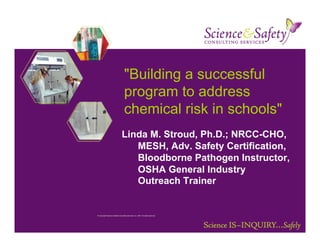
"Building a successful
                                     program to address
                                     chemical risk in schools"
                                 Linda M. Stroud, Ph.D.; NRCC-CHO,
                                    MESH, Adv. Safety Certification,
                                    Bloodborne Pathogen Instructor,
                                    OSHA General Industry
                                    Outreach Trainer


© Copyright Science & Safety Consulting Services, Inc. 2007. All rights reserved.
What Does It Take?


            Raise awareness of chemical
            issues in schools and promote
            sustainable solutions


© Copyright Science & Safety Consulting Services, Inc. 2007. All rights reserved
Safe Schools

                                  School Administrators
                                     Never Understand
                                     School Safety
                                            Is More Than:

                                                    Guns
                                                   Knives
                                                  Intruders
                                                    Drugs
                                                   Bullies


  S&SCS pg. 1


© Copyright Science & Safety Consulting Services, Inc. 2007. All rights reserved
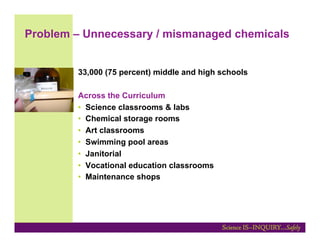
Problem – Unnecessary / mismanaged chemicals


        33,000 (75 percent) middle and high schools

        Across the Curriculum
        •  Science classrooms & labs
        •  Chemical storage rooms
        •  Art classrooms
        •  Swimming pool areas
        •  Janitorial
        •  Vocational education classrooms
        •  Maintenance shops
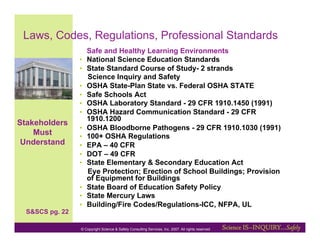
Laws, Codes, Regulations, Professional Standards
                      Safe and Healthy Learning Environments
                 •    National Science Education Standards
                 •    State Standard Course of Study- 2 strands
                      Science Inquiry and Safety
                 •    OSHA State-Plan State vs. Federal OSHA STATE
                 •    Safe Schools Act
                 •    OSHA Laboratory Standard - 29 CFR 1910.1450 (1991)
                 •    OSHA Hazard Communication Standard - 29 CFR
                      1910.1200
Stakeholders
                 •    OSHA Bloodborne Pathogens - 29 CFR 1910.1030 (1991)
    Must         •    100+ OSHA Regulations
 Understand      •    EPA – 40 CFR
                 •    DOT – 49 CFR
                 •    State Elementary & Secondary Education Act
                      Eye Protection; Erection of School Buildings; Provision
                      of Equipment for Buildings
                 •    State Board of Education Safety Policy
                 •    State Mercury Laws
                 •    Building/Fire Codes/Regulations-ICC, NFPA, UL
  S&SCS pg. 22

                 © Copyright Science & Safety Consulting Services, Inc. 2007. All rights reserved
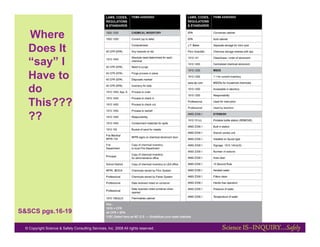
Where
   Does It
   “say” I
   Have to
   do
   This???
   ??


S&SCS pgs.16-19

  © Copyright Science & Safety Consulting Services, Inc. 2008 All rights reserved.
Chemical Management
                  System


S&SCS pgs. 93-195


            © Copyright Science & Safety Consulting Services, Inc. 2007. All rights reserved
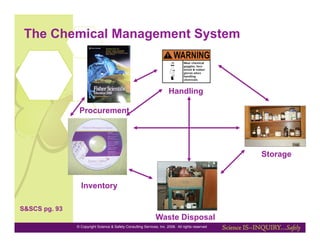
The Chemical Management System


                                                                       Handling

                Procurement


                                                                                                  Storage


                 Inventory

S&SCS pg. 93
                                                               Waste Disposal
               © Copyright Science & Safety Consulting Services, Inc. 2008. All rights reserved
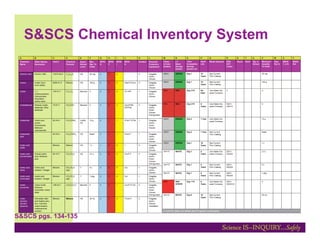
S&SCS Chemical Inventory System


S&SCS pgs. 134-135
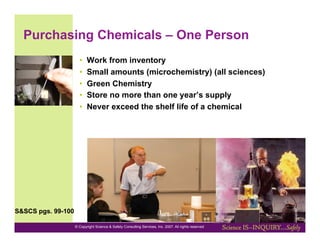
Purchasing Chemicals – One Person
                      •    Work from inventory
                      •    Small amounts (microchemistry) (all sciences)
                      •    Green Chemistry
                      •    Store no more than one year’s supply
                      •    Never exceed the shelf life of a chemical


S&SCS pgs. 99-100

                    © Copyright Science & Safety Consulting Services, Inc. 2007. All rights reserved
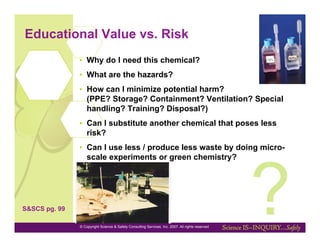
Educational Value vs. Risk
               •  Why do I need this chemical?
               •  What are the hazards?
               •  How can I minimize potential harm?
                  (PPE? Storage? Containment? Ventilation? Special
                  handling? Training? Disposal?)
               •  Can I substitute another chemical that poses less
                  risk?
               •  Can I use less / produce less waste by doing micro-


                                                                                                  ?
                  scale experiments or green chemistry?


S&SCS pg. 99

               © Copyright Science & Safety Consulting Services, Inc. 2007. All rights reserved
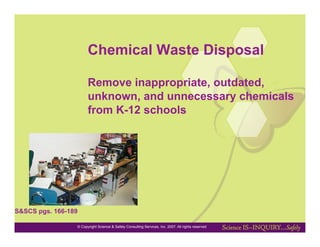
Chemical Waste Disposal

                       Remove inappropriate, outdated,
                       unknown, and unnecessary chemicals
                       from K-12 schools


S&SCS pgs. 166-189

                 © Copyright Science & Safety Consulting Services, Inc. 2007. All rights reserved
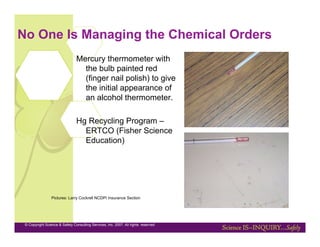
No One Is Managing the Chemical Orders
                                Mercury thermometer with
                                  the bulb painted red
                                  (finger nail polish) to give
                                  the initial appearance of
                                  an alcohol thermometer.

                                Hg Recycling Program –
                                  ERTCO (Fisher Science
                                  Education)


                 Pictures: Larry Cockrell NCDPI Insurance Section


 © Copyright Science & Safety Consulting Services, Inc. 2007. All rights reserved
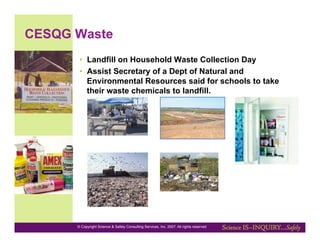
CESQG Waste
       •  Landfill on Household Waste Collection Day
       •  Assist Secretary of a Dept of Natural and
          Environmental Resources said for schools to take
          their waste chemicals to landfill.


      © Copyright Science & Safety Consulting Services, Inc. 2007. All rights reserved
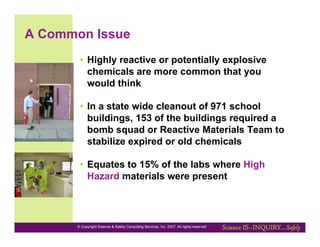
A Common Issue
       •  Highly reactive or potentially explosive
          chemicals are more common that you
          would think

       •  In a state wide cleanout of 971 school
          buildings, 153 of the buildings required a
          bomb squad or Reactive Materials Team to
          stabilize expired or old chemicals

       •  Equates to 15% of the labs where High
          Hazard materials were present


      © Copyright Science & Safety Consulting Services, Inc. 2007. All rights reserved
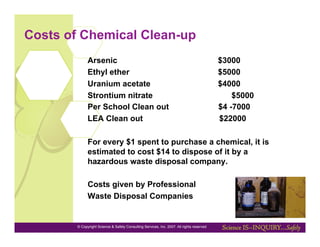
Costs of Chemical Clean-up
              Arsenic                                                                      $3000
              Ethyl ether                                                                  $5000
              Uranium acetate                                                              $4000
              Strontium nitrate                                                                $5000
              Per School Clean out                                                         $4 -7000
              LEA Clean out                                                                $22000

              For every $1 spent to purchase a chemical, it is
              estimated to cost $14 to dispose of it by a
              hazardous waste disposal company.

              Costs given by Professional
              Waste Disposal Companies


        © Copyright Science & Safety Consulting Services, Inc. 2007. All rights reserved
SC3 and Exemplary Chemical
  Management Programs
Cooperative Project in Removal of Chemicals as
in SC3
         •  US EPA
         •  State Departments of Environmental
            Resources
         •  State Departments of Public Instruction
         •  Hospitals
         •  Businesses
         •  Parent – Teacher Organizations
         •  Science Education Organizations
            NCSTA, NCSLA, Local Chapter ACS, Sigma Xi
SC3 Collaboration –Most Exemplary (the Model)

         •  Tennessee Dept of Environment and Conservation
             programs
            -Office of Environmental Assistance
             Green Schools Program
            -Division of Solid Waste Management
             Household Hazardous Waste Mobile Collection Service
         Collaborating to provide schools with:
           -A safe and financially feasible way of removing school lab
             chemicals & mercury thermometers
           -On-site chemical management assistance
           -Chemical segregation
           -Disposal cost assistance (School cost calculated on sliding
             scale based on economic index of their respective county

         Disposes of its waste in El Dorado, Arkansas
         Cynthia Rohrbach
Example 1


       Tennessee - 2005

       •  School employees disposed of lab
          chemicals in the trash the
          resulting fire

       •  Cleanup and lab cleanout costs
          were $80,000
Example 2

       Tennessee

       •  Old chemicals were removed from a
          school lab and taken in the back of a
          truck to a warehouse

       •  Leaking chemicals began to burn and
          then exploded. Cleanup costs were
          $190,000
Alabama
      Own waste disposal facility – Emelie, AL
      Program - ADEM

      2007-2008, collected 8,640 lbs waste in 36
        schools

      2009 budget - $1300 / school for 13 schools
Summary
Prevent future chemical mismanagement through:

Training
Curriculum change in all sciences
Long term management solutions


S&SCS pgs. 166-189   © Copyright Science & Safety Consulting Services, Inc. 2007. All rights reserved
Chemical Management System - Policy
         •  Chemical Inventory
         •  Compatible Chemical Storage
            - Centralized secure store room
            - Supervision by one person
         •  Lab Curriculum review and modifications
             –  Standard experiments using non toxic chemicals
                are available
             –  Microchemistry and Green Chemistry experiments
         •  Chemical Purchasing Plan
             –  Just in time ordering and delivery of small amounts
             –  Purchase only premixed solutions & reagents
             –  Scrutinize all chemical orders
         •  Budget for Annual Chemical Disposal
         •  Audit labs, Repair & Replace Safety Equipment
         •  Review & Update CHP Annually
        © Copyright Science & Safety Consulting Services, Inc. 2007. All rights reserved
Science Safety Training
        •  Science methods course for all science education
           majors at the college/university

        •  Novice science teacher certification process

        •  All administrators certification

        •  In-service training for veteran teachers (OSHA)


        © Copyright Science & Safety Consulting Services, Inc. 2007. All rights reserved
Can Change Occur?
                                    Ventilation in chemical storage area

                                        Changes:

                                        NCDPI School Planning Section

                                       Wake County Assist. Supt. of Facilities


S&SCS pgs. 5-8
                 © Copyright Science & Safety Consulting Services, Inc. 2007. All rights reserved
2808 Rue Sans Famille
                               Raleigh, NC 27607
                               919.881.0282 ph
                               919.789.4477 fax
                               LMSTROUD@sciencesafetyconsulting.com
                               www.sciencesafetyconsulting.com


© Copyright Science & Safety Consulting Services, Inc. 2007. All rights reserved

Stroud Chems Schools

  • 1.
    "Building a successful program to address chemical risk in schools" Linda M. Stroud, Ph.D.; NRCC-CHO, MESH, Adv. Safety Certification, Bloodborne Pathogen Instructor, OSHA General Industry Outreach Trainer © Copyright Science & Safety Consulting Services, Inc. 2007. All rights reserved.
  • 2.
    What Does ItTake? Raise awareness of chemical issues in schools and promote sustainable solutions © Copyright Science & Safety Consulting Services, Inc. 2007. All rights reserved
  • 3.
    Safe Schools School Administrators Never Understand School Safety Is More Than: Guns Knives Intruders Drugs Bullies S&SCS pg. 1 © Copyright Science & Safety Consulting Services, Inc. 2007. All rights reserved
  • 4.
    Problem – Unnecessary/ mismanaged chemicals 33,000 (75 percent) middle and high schools Across the Curriculum •  Science classrooms & labs •  Chemical storage rooms •  Art classrooms •  Swimming pool areas •  Janitorial •  Vocational education classrooms •  Maintenance shops
  • 5.
    Laws, Codes, Regulations,Professional Standards Safe and Healthy Learning Environments •  National Science Education Standards •  State Standard Course of Study- 2 strands Science Inquiry and Safety •  OSHA State-Plan State vs. Federal OSHA STATE •  Safe Schools Act •  OSHA Laboratory Standard - 29 CFR 1910.1450 (1991) •  OSHA Hazard Communication Standard - 29 CFR 1910.1200 Stakeholders •  OSHA Bloodborne Pathogens - 29 CFR 1910.1030 (1991) Must •  100+ OSHA Regulations Understand •  EPA – 40 CFR •  DOT – 49 CFR •  State Elementary & Secondary Education Act Eye Protection; Erection of School Buildings; Provision of Equipment for Buildings •  State Board of Education Safety Policy •  State Mercury Laws •  Building/Fire Codes/Regulations-ICC, NFPA, UL S&SCS pg. 22 © Copyright Science & Safety Consulting Services, Inc. 2007. All rights reserved
  • 6.
    Where Does It “say” I Have to do This??? ?? S&SCS pgs.16-19 © Copyright Science & Safety Consulting Services, Inc. 2008 All rights reserved.
  • 7.
    Chemical Management System S&SCS pgs. 93-195 © Copyright Science & Safety Consulting Services, Inc. 2007. All rights reserved
  • 8.
    The Chemical ManagementSystem Handling Procurement Storage Inventory S&SCS pg. 93 Waste Disposal © Copyright Science & Safety Consulting Services, Inc. 2008. All rights reserved
  • 9.
    S&SCS Chemical InventorySystem S&SCS pgs. 134-135
  • 10.
    Purchasing Chemicals –One Person •  Work from inventory •  Small amounts (microchemistry) (all sciences) •  Green Chemistry •  Store no more than one year’s supply •  Never exceed the shelf life of a chemical S&SCS pgs. 99-100 © Copyright Science & Safety Consulting Services, Inc. 2007. All rights reserved
  • 11.
    Educational Value vs.Risk •  Why do I need this chemical? •  What are the hazards? •  How can I minimize potential harm? (PPE? Storage? Containment? Ventilation? Special handling? Training? Disposal?) •  Can I substitute another chemical that poses less risk? •  Can I use less / produce less waste by doing micro- ? scale experiments or green chemistry? S&SCS pg. 99 © Copyright Science & Safety Consulting Services, Inc. 2007. All rights reserved
  • 12.
    Chemical Waste Disposal Remove inappropriate, outdated, unknown, and unnecessary chemicals from K-12 schools S&SCS pgs. 166-189 © Copyright Science & Safety Consulting Services, Inc. 2007. All rights reserved
  • 13.
    No One IsManaging the Chemical Orders Mercury thermometer with the bulb painted red (finger nail polish) to give the initial appearance of an alcohol thermometer. Hg Recycling Program – ERTCO (Fisher Science Education) Pictures: Larry Cockrell NCDPI Insurance Section © Copyright Science & Safety Consulting Services, Inc. 2007. All rights reserved
  • 14.
    CESQG Waste •  Landfill on Household Waste Collection Day •  Assist Secretary of a Dept of Natural and Environmental Resources said for schools to take their waste chemicals to landfill. © Copyright Science & Safety Consulting Services, Inc. 2007. All rights reserved
  • 15.
    A Common Issue •  Highly reactive or potentially explosive chemicals are more common that you would think •  In a state wide cleanout of 971 school buildings, 153 of the buildings required a bomb squad or Reactive Materials Team to stabilize expired or old chemicals •  Equates to 15% of the labs where High Hazard materials were present © Copyright Science & Safety Consulting Services, Inc. 2007. All rights reserved
  • 16.
    Costs of ChemicalClean-up Arsenic $3000 Ethyl ether $5000 Uranium acetate $4000 Strontium nitrate $5000 Per School Clean out $4 -7000 LEA Clean out $22000 For every $1 spent to purchase a chemical, it is estimated to cost $14 to dispose of it by a hazardous waste disposal company. Costs given by Professional Waste Disposal Companies © Copyright Science & Safety Consulting Services, Inc. 2007. All rights reserved
  • 17.
    SC3 and ExemplaryChemical Management Programs
  • 18.
    Cooperative Project inRemoval of Chemicals as in SC3 •  US EPA •  State Departments of Environmental Resources •  State Departments of Public Instruction •  Hospitals •  Businesses •  Parent – Teacher Organizations •  Science Education Organizations NCSTA, NCSLA, Local Chapter ACS, Sigma Xi
  • 19.
    SC3 Collaboration –MostExemplary (the Model) •  Tennessee Dept of Environment and Conservation programs -Office of Environmental Assistance Green Schools Program -Division of Solid Waste Management Household Hazardous Waste Mobile Collection Service Collaborating to provide schools with: -A safe and financially feasible way of removing school lab chemicals & mercury thermometers -On-site chemical management assistance -Chemical segregation -Disposal cost assistance (School cost calculated on sliding scale based on economic index of their respective county Disposes of its waste in El Dorado, Arkansas Cynthia Rohrbach
  • 20.
    Example 1 Tennessee - 2005 •  School employees disposed of lab chemicals in the trash the resulting fire •  Cleanup and lab cleanout costs were $80,000
  • 21.
    Example 2 Tennessee •  Old chemicals were removed from a school lab and taken in the back of a truck to a warehouse •  Leaking chemicals began to burn and then exploded. Cleanup costs were $190,000
  • 22.
    Alabama Own waste disposal facility – Emelie, AL Program - ADEM 2007-2008, collected 8,640 lbs waste in 36 schools 2009 budget - $1300 / school for 13 schools
  • 23.
    Summary Prevent future chemicalmismanagement through: Training Curriculum change in all sciences Long term management solutions S&SCS pgs. 166-189 © Copyright Science & Safety Consulting Services, Inc. 2007. All rights reserved
  • 24.
    Chemical Management System- Policy •  Chemical Inventory •  Compatible Chemical Storage - Centralized secure store room - Supervision by one person •  Lab Curriculum review and modifications –  Standard experiments using non toxic chemicals are available –  Microchemistry and Green Chemistry experiments •  Chemical Purchasing Plan –  Just in time ordering and delivery of small amounts –  Purchase only premixed solutions & reagents –  Scrutinize all chemical orders •  Budget for Annual Chemical Disposal •  Audit labs, Repair & Replace Safety Equipment •  Review & Update CHP Annually © Copyright Science & Safety Consulting Services, Inc. 2007. All rights reserved
  • 25.
    Science Safety Training •  Science methods course for all science education majors at the college/university •  Novice science teacher certification process •  All administrators certification •  In-service training for veteran teachers (OSHA) © Copyright Science & Safety Consulting Services, Inc. 2007. All rights reserved
  • 26.
    Can Change Occur? Ventilation in chemical storage area Changes: NCDPI School Planning Section Wake County Assist. Supt. of Facilities S&SCS pgs. 5-8 © Copyright Science & Safety Consulting Services, Inc. 2007. All rights reserved
  • 27.
    2808 Rue SansFamille Raleigh, NC 27607 919.881.0282 ph 919.789.4477 fax LMSTROUD@sciencesafetyconsulting.com www.sciencesafetyconsulting.com © Copyright Science & Safety Consulting Services, Inc. 2007. All rights reserved