Chapter 9

                 Organizational Strategy


©2004 by Nelson, a division of Thomson Canada Limited
                                                        1
What Would You Do?
      Sobeys is a national player in the grocery
       industry
      Faced integration, cash flow, and IT
       problems
      Has 12% of the market
      Increasing competition and tough
       market outlook
      How do you respond to these
       challenges?

©2004 by Nelson, a division of Thomson Canada Limited
                                                        2
Learning Objectives:
     Basics of Organizational Strategy

     After reading the next two sections,
     you should be able to:

     1. explain the components of sustainable
        competitive advantage and why it is
     important
     2. describe the steps involved in the
     strategy-making process
©2004 by Nelson, a division of Thomson Canada Limited
                                                        3
Sustainable
     Competitive Advantage
          Resources
                 assets, capabilities, process, information, and
                  knowledge
          Competitive advantage
                 providing greater value for customers than
                  competitors can
          Sustainable competitive advantage
                 when other companies have tried unsuccessfully
                  to duplicate, and have, for the moment, stopped
                  trying to duplicate

©2004 by Nelson, a division of Thomson Canada Limited
                                                                    4
Achieving a Sustainable
     Competitive Advantage
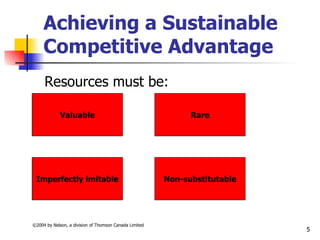
     Resources must be:

             Valuable                                         Rare


 Imperfectly imitable                                   Non-substitutable


©2004 by Nelson, a division of Thomson Canada Limited
                                                                            5
Strategy-Making Process
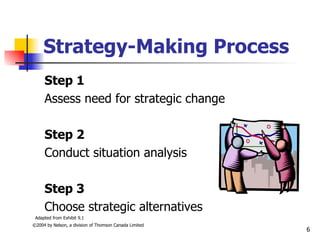
     Step 1
     Assess need for strategic change

     Step 2
     Conduct situation analysis

     Step 3
     Choose strategic alternatives
 Adapted from Exhibit 9.1
©2004 by Nelson, a division of Thomson Canada Limited
                                                        6
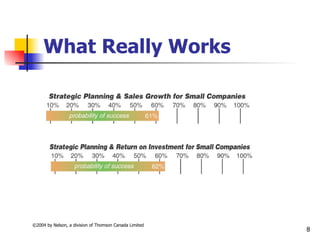
What Really Works
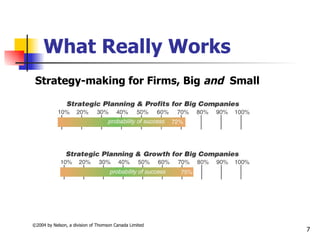
 Strategy-making for Firms, Big and Small


©2004 by Nelson, a division of Thomson Canada Limited
                                                        7
What Really Works


©2004 by Nelson, a division of Thomson Canada Limited
                                                        8
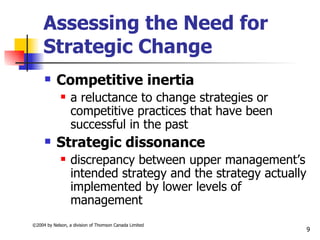
Assessing the Need for
     Strategic Change
          Competitive inertia
                 a reluctance to change strategies or
                  competitive practices that have been
                  successful in the past
          Strategic dissonance
                 discrepancy between upper management’s
                  intended strategy and the strategy actually
                  implemented by lower levels of
                  management
©2004 by Nelson, a division of Thomson Canada Limited
                                                                9
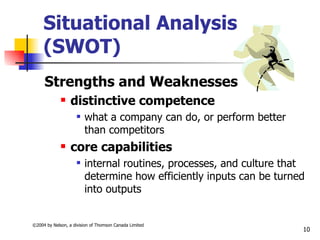
Situational Analysis
     (SWOT)
     Strengths and Weaknesses
                 distinctive competence
                       what a company can do, or perform better
                        than competitors
                 core capabilities
                       internal routines, processes, and culture that
                        determine how efficiently inputs can be turned
                        into outputs


©2004 by Nelson, a division of Thomson Canada Limited
                                                                     10
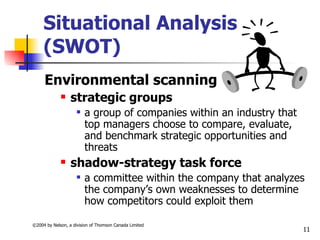
Situational Analysis
     (SWOT)
     Environmental scanning
                 strategic groups
                       a group of companies within an industry that
                        top managers choose to compare, evaluate,
                        and benchmark strategic opportunities and
                        threats
                 shadow-strategy task force
                       a committee within the company that analyzes
                        the company’s own weaknesses to determine
                        how competitors could exploit them

©2004 by Nelson, a division of Thomson Canada Limited
                                                                       11
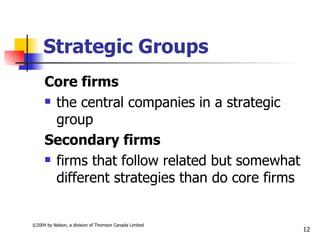
Strategic Groups
     Core firms
      the central companies in a strategic

       group
     Secondary firms
      firms that follow related but somewhat

       different strategies than do core firms


©2004 by Nelson, a division of Thomson Canada Limited
                                                        12
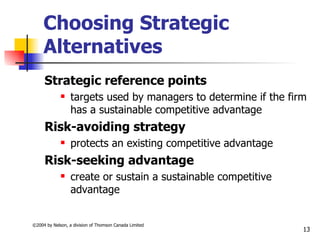
Choosing Strategic
     Alternatives
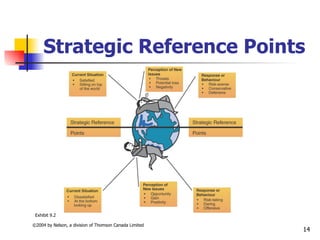
     Strategic reference points
                 targets used by managers to determine if the firm
                  has a sustainable competitive advantage
     Risk-avoiding strategy
                 protects an existing competitive advantage
     Risk-seeking advantage
                 create or sustain a sustainable competitive
                  advantage


©2004 by Nelson, a division of Thomson Canada Limited
                                                                  13
Strategic Reference Points


 Exhibit 9.2

©2004 by Nelson, a division of Thomson Canada Limited
                                                        14
Learning Objectives:
     Corporate-, Industry-, &
     Firm-Level Strategies

     After reading the next three sections, you
     should be able to:

     3. explain the different kinds of corporate-level
        strategies
     4. describe the different kinds of industry-
     level strategies
     5. explain the components and kinds of firm-
     level strategies
©2004 by Nelson, a division of Thomson Canada Limited
                                                        15
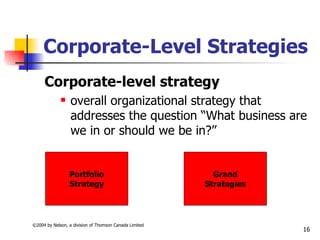
Corporate-Level Strategies
     Corporate-level strategy
                 overall organizational strategy that
                  addresses the question “What business are
                  we in or should we be in?”


                 Portfolio                                Grand
                 Strategy                               Strategies


©2004 by Nelson, a division of Thomson Canada Limited
                                                                     16
Portfolio Strategy
          Minimize risk by diversification
          Acquisition
                 purchase of a company by another company
          Unrelated diversification
                 creating or acquiring companies in completely
                  unrelated businesses
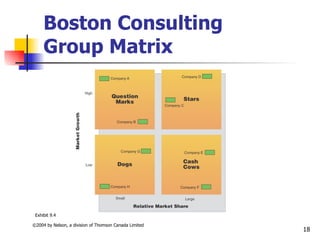
          BCG matrix
          Related diversification

©2004 by Nelson, a division of Thomson Canada Limited
                                                                  17
Boston Consulting
     Group Matrix


 Exhibit 9.4

©2004 by Nelson, a division of Thomson Canada Limited
                                                        18
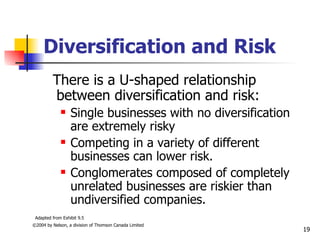
Diversification and Risk
         There is a U-shaped relationship
         between diversification and risk:
                 Single businesses with no diversification
                  are extremely risky
                 Competing in a variety of different
                  businesses can lower risk.
                 Conglomerates composed of completely
                  unrelated businesses are riskier than
                  undiversified companies.
 Adapted from Exhibit 9.5
©2004 by Nelson, a division of Thomson Canada Limited
                                                              19
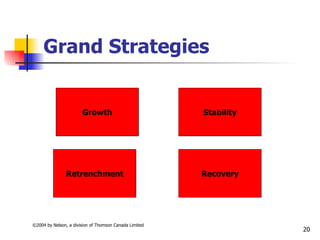
Grand Strategies


                       Growth                           Stability


               Retrenchment                             Recovery


©2004 by Nelson, a division of Thomson Canada Limited
                                                                    20
Industry-Level Strategies
          Industry-level strategy
                 overall organizational strategy that
                  addresses the question “How should we
                  compete in this industry?”
          Five industry forces
          Positioning strategies
          Adaptive strategies

©2004 by Nelson, a division of Thomson Canada Limited
                                                          21
Porter’s
     Five Industry Forces
          Character of the rivalry
          Threat of new entrants
          Threat of substitute products or
           services
          Bargaining power of suppliers
          Bargaining power of buyers

©2004 by Nelson, a division of Thomson Canada Limited
                                                        22
Positioning Strategies
     Cost leadership
                 producing a quality product or service at a price
                  lower than competitors
     Differentiation
                 accentuating difference between a product or
                  service and those of competitors
     Focus
                 Using cost leadership or differentiation for a
                  specific target market
©2004 by Nelson, a division of Thomson Canada Limited
                                                                      23
Adaptive Strategies
     Defenders                                          Analyzers
                 seek growth                                minimize risk and
                 retain customers                            maximize profit
     Prospectors
                                                             imitate proven
                                                              successes of
                 seek fast growth                            prospectors
                 encourage risk-
                  taking and
                                                        Reactors
                  innovation                                 Inconsistent strategy
                                                             React to changes

©2004 by Nelson, a division of Thomson Canada Limited
                                                                                  24
Firm-Level Strategies
          Direct competition
          Strategic moves of direct competition
          Entrepreneurship: A firm-level strategy


©2004 by Nelson, a division of Thomson Canada Limited
                                                        25
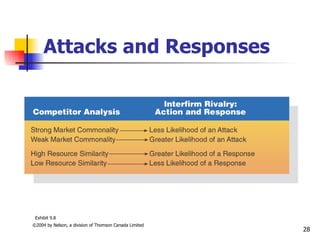
Direct Competition
     Direct competition
                 rivalry between two firms that offer similar
                  products and services that acknowledge each
                  other as rivals and take offensive and defensive
                  positions in response to each other
     Two factors determine extent of
      competition:
                 market commonality
                 resource similarity

©2004 by Nelson, a division of Thomson Canada Limited
                                                                     26
Strategic Moves of
     Direct Competition
     Attack
                 a competitive move
                 designed to reduce a rival’s market share
                  or profits
     Response
                 a counter move
                 to defend or improve a company’s market
                  share or profit
©2004 by Nelson, a division of Thomson Canada Limited
                                                              27
Attacks and Responses


 Exhibit 9.8
©2004 by Nelson, a division of Thomson Canada Limited
                                                        28
Entrepreneurship:
     A Firm-Level Strategy
     Entrepreneurship
                 process of entering new or established
                  markets with new goods or services
     Entrepreneurial orientation
                 set of processes, practices and decision-
                  making activities that lead to new entry
                 characterized by autonomy,
                  innovativeness, risk-taking, proactiveness,
                  and competitive aggressiveness
©2004 by Nelson, a division of Thomson Canada Limited
                                                                29
What Really Happened?
          Focused product lines
          Improved store network
          Removed costs from its structure
          Revenues, share price, and operating
           earnings all increased


©2004 by Nelson, a division of Thomson Canada Limited
                                                        30

Chapter 09.ppd

  • 1.
    Chapter 9 Organizational Strategy ©2004 by Nelson, a division of Thomson Canada Limited 1
  • 2.
    What Would YouDo?  Sobeys is a national player in the grocery industry  Faced integration, cash flow, and IT problems  Has 12% of the market  Increasing competition and tough market outlook  How do you respond to these challenges? ©2004 by Nelson, a division of Thomson Canada Limited 2
  • 3.
    Learning Objectives: Basics of Organizational Strategy After reading the next two sections, you should be able to: 1. explain the components of sustainable competitive advantage and why it is important 2. describe the steps involved in the strategy-making process ©2004 by Nelson, a division of Thomson Canada Limited 3
  • 4.
    Sustainable Competitive Advantage  Resources  assets, capabilities, process, information, and knowledge  Competitive advantage  providing greater value for customers than competitors can  Sustainable competitive advantage  when other companies have tried unsuccessfully to duplicate, and have, for the moment, stopped trying to duplicate ©2004 by Nelson, a division of Thomson Canada Limited 4
  • 5.
    Achieving a Sustainable Competitive Advantage Resources must be: Valuable Rare Imperfectly imitable Non-substitutable ©2004 by Nelson, a division of Thomson Canada Limited 5
  • 6.
    Strategy-Making Process Step 1 Assess need for strategic change Step 2 Conduct situation analysis Step 3 Choose strategic alternatives Adapted from Exhibit 9.1 ©2004 by Nelson, a division of Thomson Canada Limited 6
  • 7.
    What Really Works Strategy-making for Firms, Big and Small ©2004 by Nelson, a division of Thomson Canada Limited 7
  • 8.
    What Really Works ©2004by Nelson, a division of Thomson Canada Limited 8
  • 9.
    Assessing the Needfor Strategic Change  Competitive inertia  a reluctance to change strategies or competitive practices that have been successful in the past  Strategic dissonance  discrepancy between upper management’s intended strategy and the strategy actually implemented by lower levels of management ©2004 by Nelson, a division of Thomson Canada Limited 9
  • 10.
    Situational Analysis (SWOT) Strengths and Weaknesses  distinctive competence  what a company can do, or perform better than competitors  core capabilities  internal routines, processes, and culture that determine how efficiently inputs can be turned into outputs ©2004 by Nelson, a division of Thomson Canada Limited 10
  • 11.
    Situational Analysis (SWOT) Environmental scanning  strategic groups  a group of companies within an industry that top managers choose to compare, evaluate, and benchmark strategic opportunities and threats  shadow-strategy task force  a committee within the company that analyzes the company’s own weaknesses to determine how competitors could exploit them ©2004 by Nelson, a division of Thomson Canada Limited 11
  • 12.
    Strategic Groups Core firms  the central companies in a strategic group Secondary firms  firms that follow related but somewhat different strategies than do core firms ©2004 by Nelson, a division of Thomson Canada Limited 12
  • 13.
    Choosing Strategic Alternatives Strategic reference points  targets used by managers to determine if the firm has a sustainable competitive advantage Risk-avoiding strategy  protects an existing competitive advantage Risk-seeking advantage  create or sustain a sustainable competitive advantage ©2004 by Nelson, a division of Thomson Canada Limited 13
  • 14.
    Strategic Reference Points Exhibit 9.2 ©2004 by Nelson, a division of Thomson Canada Limited 14
  • 15.
    Learning Objectives: Corporate-, Industry-, & Firm-Level Strategies After reading the next three sections, you should be able to: 3. explain the different kinds of corporate-level strategies 4. describe the different kinds of industry- level strategies 5. explain the components and kinds of firm- level strategies ©2004 by Nelson, a division of Thomson Canada Limited 15
  • 16.
    Corporate-Level Strategies Corporate-level strategy  overall organizational strategy that addresses the question “What business are we in or should we be in?” Portfolio Grand Strategy Strategies ©2004 by Nelson, a division of Thomson Canada Limited 16
  • 17.
    Portfolio Strategy  Minimize risk by diversification  Acquisition  purchase of a company by another company  Unrelated diversification  creating or acquiring companies in completely unrelated businesses  BCG matrix  Related diversification ©2004 by Nelson, a division of Thomson Canada Limited 17
  • 18.
    Boston Consulting Group Matrix Exhibit 9.4 ©2004 by Nelson, a division of Thomson Canada Limited 18
  • 19.
    Diversification and Risk There is a U-shaped relationship between diversification and risk:  Single businesses with no diversification are extremely risky  Competing in a variety of different businesses can lower risk.  Conglomerates composed of completely unrelated businesses are riskier than undiversified companies. Adapted from Exhibit 9.5 ©2004 by Nelson, a division of Thomson Canada Limited 19
  • 20.
    Grand Strategies Growth Stability Retrenchment Recovery ©2004 by Nelson, a division of Thomson Canada Limited 20
  • 21.
    Industry-Level Strategies  Industry-level strategy  overall organizational strategy that addresses the question “How should we compete in this industry?”  Five industry forces  Positioning strategies  Adaptive strategies ©2004 by Nelson, a division of Thomson Canada Limited 21
  • 22.
    Porter’s Five Industry Forces  Character of the rivalry  Threat of new entrants  Threat of substitute products or services  Bargaining power of suppliers  Bargaining power of buyers ©2004 by Nelson, a division of Thomson Canada Limited 22
  • 23.
    Positioning Strategies Cost leadership  producing a quality product or service at a price lower than competitors Differentiation  accentuating difference between a product or service and those of competitors Focus  Using cost leadership or differentiation for a specific target market ©2004 by Nelson, a division of Thomson Canada Limited 23
  • 24.
    Adaptive Strategies Defenders Analyzers  seek growth  minimize risk and  retain customers maximize profit Prospectors  imitate proven successes of  seek fast growth prospectors  encourage risk- taking and Reactors innovation  Inconsistent strategy  React to changes ©2004 by Nelson, a division of Thomson Canada Limited 24
  • 25.
    Firm-Level Strategies  Direct competition  Strategic moves of direct competition  Entrepreneurship: A firm-level strategy ©2004 by Nelson, a division of Thomson Canada Limited 25
  • 26.
    Direct Competition Direct competition  rivalry between two firms that offer similar products and services that acknowledge each other as rivals and take offensive and defensive positions in response to each other Two factors determine extent of competition:  market commonality  resource similarity ©2004 by Nelson, a division of Thomson Canada Limited 26
  • 27.
    Strategic Moves of Direct Competition Attack  a competitive move  designed to reduce a rival’s market share or profits Response  a counter move  to defend or improve a company’s market share or profit ©2004 by Nelson, a division of Thomson Canada Limited 27
  • 28.
    Attacks and Responses Exhibit 9.8 ©2004 by Nelson, a division of Thomson Canada Limited 28
  • 29.
    Entrepreneurship: A Firm-Level Strategy Entrepreneurship  process of entering new or established markets with new goods or services Entrepreneurial orientation  set of processes, practices and decision- making activities that lead to new entry  characterized by autonomy, innovativeness, risk-taking, proactiveness, and competitive aggressiveness ©2004 by Nelson, a division of Thomson Canada Limited 29
  • 30.
    What Really Happened?  Focused product lines  Improved store network  Removed costs from its structure  Revenues, share price, and operating earnings all increased ©2004 by Nelson, a division of Thomson Canada Limited 30