GRADUATE SCHOOL IN MATHEMATICAL SCIENCES
DEPARTMENT OF MATHEMATICS ”FEDERIGO ENRIQUES”
PHD COURSE
IN MATHEMATICS AND STATISTICS FOR COMPUTATIONAL SCIENCES
XXV CYCLE
Doctoral Thesis
SPARSE RECOVERY BY NONCONVEX
LIPSHITZIAN MAPPINGS
settore scientifico-disciplinare: INF/01
Author: ALESSANDRO ADAMO
Supervisor: Prof. Alberto BERTONI
Co-Supervisor: PhD. Giuliano GROSSI
PhD Programme Coordinator: Prof. Giovanni NALDI
Acknowledgements
This dissertation would not have been possible without the guidance and the help
of several individuals who, in one way or another contributed and extended their
valuable assistance in the preparation and completion of this study.
Would like to express my heartfelt gratitude to my advisor Prof. Alberto Bertoni
for supporting me and guiding my research with mathematical tips. A special thanks
to Ph.D. Giuliano Grossi whereby I have worked hard on common topics and
whereby I had the pleasure to work. I want to thank Ph.D. Raffaella Lanzarotti for
introducing me to some interesting image processing problems, and to her valuable
support to my English.
I have to thank Prof.ssa Paola Campadelli for her availability to listen students’
problems and her will to resolve it. I have to thank all the guys of the LAIV lab-
oratory, for relaxation moments and for interesting discussions carried out. I thank
Prof. Federico Pedersini to give me precious suggestions related to electronics and
signal processing and for funny chats. I have to thank the Department of Computer
Science of the University of Milan, for having accommodate me in a comfortable
environment, giving me the opportunity to work with stimulating colleagues.
I would also like to thank Prof. Giovanni Naldi and Prof. Massimo Emiliano
Tarallo for their availability and for their valuable advice analysis of the developed
methods. I would to thank all the Department of Mathematics of the University of
Milan to give me the chance to follow interesting courses that have stimulated me
and which gave me new ideas for my research.
I would not have contemplated this road if not for my parents, Alonzo and Lorella
that believing in me and supporting my choices, gave me the strength to overcome
the difficulties.
I have to give a special thanks to my grandmother Lucia, that has always loved and
raised me as a son.
v
vi Acknowledgements
I have to thank Salvatore, Fortuna and Vito, for welcoming me into their family
and for treating me like a son.
Finally I have to thank my girlfriend Sabrina for having believed in my ability
and for having brought with me a path of growth, letting me know to be the woman
of my life and soon my wife.
Contents
List of Figures . . . . . . . . . . . . . . . . . . . . . . . . . . . . . . . . . . . . . . . . . . . . . . . . . . . . . xi
List of Tables . . . . . . . . . . . . . . . . . . . . . . . . . . . . . . . . . . . . . . . . . . . . . . . . . . . . . . xiii
Introduction . . . . . . . . . . . . . . . . . . . . . . . . . . . . . . . . . . . . . . . . . . . . . . . . . . . . . . . xv
Part I Theoretical Foundations
1 Sparse Recovery and Compressive Sensing . . . . . . . . . . . . . . . . . . . . . . . . 5
1.1 Introduction . . . . . . . . . . . . . . . . . . . . . . . . . . . . . . . . . . . . . . . . . . . . . . . 5
1.2 Preliminary Notations on Linear Algebra . . . . . . . . . . . . . . . . . . . . . . . 6
1.2.1 Singular Value Decomposition theorem. . . . . . . . . . . . . . . . . . 8
1.2.2 Moore-Penrose pseudoinverse . . . . . . . . . . . . . . . . . . . . . . . . . 9
1.2.3 Norm, Pseudo-Norm and Quasi-Norm in Rn . . . . . . . . . . . . . 11
1.2.4 Metric Space and Normed Vector Space . . . . . . . . . . . . . . . . . 12
1.2.5 Convex, Smooth and Lipschitzian Functions . . . . . . . . . . . . . 13
1.3 Basis and Frames. . . . . . . . . . . . . . . . . . . . . . . . . . . . . . . . . . . . . . . . . . . 15
1.4 Sparse and Compressible Signals . . . . . . . . . . . . . . . . . . . . . . . . . . . . . 16
1.5 Underdetermined Linear System and Sparsest Solution . . . . . . . . . . . 16
1.5.1 Null Space Property and Spark . . . . . . . . . . . . . . . . . . . . . . . . . 18
1.5.2 Restricted Isometry Property. . . . . . . . . . . . . . . . . . . . . . . . . . . 19
1.5.3 Coherence . . . . . . . . . . . . . . . . . . . . . . . . . . . . . . . . . . . . . . . . . . 21
1.6 Algorithms for Sparse Recovery . . . . . . . . . . . . . . . . . . . . . . . . . . . . . . 22
1.6.1 Basis Pursuit . . . . . . . . . . . . . . . . . . . . . . . . . . . . . . . . . . . . . . . . 22
1.6.2 Greedy Algorithms . . . . . . . . . . . . . . . . . . . . . . . . . . . . . . . . . . . 24
1.6.3 Relaxation Algorithms . . . . . . . . . . . . . . . . . . . . . . . . . . . . . . . . 25
2 Lipschitzian Mappings for Sparse Representation . . . . . . . . . . . . . . . . . 29
2.1 General Considerations. . . . . . . . . . . . . . . . . . . . . . . . . . . . . . . . . . . . . . 30
2.2 Problem Formulation and Summary of Results . . . . . . . . . . . . . . . . . . 31
2.3 A Source of Inspiration. . . . . . . . . . . . . . . . . . . . . . . . . . . . . . . . . . . . . . 31
2.4 Sparsity Promotion Mappings . . . . . . . . . . . . . . . . . . . . . . . . . . . . . . . . 33
vii
viii Contents
2.4.1 Uniformly Lipschitzian Shrinking Mappings . . . . . . . . . . . . . 33
2.5 Iterative scheme and Fixed Point Characterization . . . . . . . . . . . . . . . 37
2.5.1 Convergence for increasing sequences of λ . . . . . . . . . . . . . . 37
2.5.2 Fixed points of Gλ in the bidimensional case . . . . . . . . . . . . . 39
2.5.3 Sparsity Minimization . . . . . . . . . . . . . . . . . . . . . . . . . . . . . . . . 43
2.5.4 The LIMAPS Algorithm . . . . . . . . . . . . . . . . . . . . . . . . . . . . . . 50
2.6 Sparsity Approximation with Best k-Basis Coefficients . . . . . . . . . . . 52
2.6.1 Empirical Convergence for k-LIMAPS . . . . . . . . . . . . . . . . . . 54
2.7 Simulation of LIMAPS Algorithm . . . . . . . . . . . . . . . . . . . . . . . . . . . . 54
2.8 Simulation of k-LIMAPS Algorithm. . . . . . . . . . . . . . . . . . . . . . . . . . . 57
2.8.1 Empirical Phase Transition . . . . . . . . . . . . . . . . . . . . . . . . . . . . 61
2.9 Conclusions . . . . . . . . . . . . . . . . . . . . . . . . . . . . . . . . . . . . . . . . . . . . . . . 68
Part II Applications
3 Face Recognition . . . . . . . . . . . . . . . . . . . . . . . . . . . . . . . . . . . . . . . . . . . . . . . 71
3.1 Introduction . . . . . . . . . . . . . . . . . . . . . . . . . . . . . . . . . . . . . . . . . . . . . . . 71
3.2 Holistic Face Recognition by k-LIMAPS Algorithm . . . . . . . . . . . . . 73
3.2.1 Eigenfaces and Fisherfaces . . . . . . . . . . . . . . . . . . . . . . . . . . . . 73
3.2.2 Classification Based on Linear Sparse Representation . . . . . . 77
3.2.3 Classification by k-LIMAPS . . . . . . . . . . . . . . . . . . . . . . . . . . 78
3.2.4 Databases . . . . . . . . . . . . . . . . . . . . . . . . . . . . . . . . . . . . . . . . . . 79
3.2.5 Experimental results. . . . . . . . . . . . . . . . . . . . . . . . . . . . . . . . . . 80
3.3 Face Recognition with Occlusions by k-LIMAPS . . . . . . . . . . . . . . . 84
3.3.1 Combining Classifiers . . . . . . . . . . . . . . . . . . . . . . . . . . . . . . . . 85
3.3.2 Local Features. . . . . . . . . . . . . . . . . . . . . . . . . . . . . . . . . . . . . . . 86
3.3.3 Occlusion and Expression Database . . . . . . . . . . . . . . . . . . . . . 89
3.3.4 Experimental results. . . . . . . . . . . . . . . . . . . . . . . . . . . . . . . . . . 90
3.4 Conclusion . . . . . . . . . . . . . . . . . . . . . . . . . . . . . . . . . . . . . . . . . . . . . . . . 92
4 ECG Signal Compression . . . . . . . . . . . . . . . . . . . . . . . . . . . . . . . . . . . . . . . 93
4.1 Introduction . . . . . . . . . . . . . . . . . . . . . . . . . . . . . . . . . . . . . . . . . . . . . . . 93
4.2 The Electrocardiogram . . . . . . . . . . . . . . . . . . . . . . . . . . . . . . . . . . . . . . 94
4.3 ECG Preprocessing . . . . . . . . . . . . . . . . . . . . . . . . . . . . . . . . . . . . . . . . . 96
4.3.1 Baseline Wander . . . . . . . . . . . . . . . . . . . . . . . . . . . . . . . . . . . . . 96
4.3.2 Powerline Interference . . . . . . . . . . . . . . . . . . . . . . . . . . . . . . . . 97
4.4 R - Peak Detection . . . . . . . . . . . . . . . . . . . . . . . . . . . . . . . . . . . . . . . . . 97
4.5 Compression Method . . . . . . . . . . . . . . . . . . . . . . . . . . . . . . . . . . . . . . . 98
4.5.1 Dictionary Creation and Signal Normalization . . . . . . . . . . . . 99
4.5.2 Sparse Representation . . . . . . . . . . . . . . . . . . . . . . . . . . . . . . . . 101
4.5.3 Quantization and Compression . . . . . . . . . . . . . . . . . . . . . . . . . 102
4.6 Performance Evaluation . . . . . . . . . . . . . . . . . . . . . . . . . . . . . . . . . . . . . 103
4.7 PhysioNet MIT-BIH Arrhythmia Database . . . . . . . . . . . . . . . . . . . . . 104
4.8 Experimental Results . . . . . . . . . . . . . . . . . . . . . . . . . . . . . . . . . . . . . . . 105
4.9 Garanteed-Percentage Root Mean Square Difference Error . . . . . . . . 107
Contents ix
4.9.1 Dictionary Creation . . . . . . . . . . . . . . . . . . . . . . . . . . . . . . . . . . 108
4.9.2 Experimental Results . . . . . . . . . . . . . . . . . . . . . . . . . . . . . . . . . 111
4.10 Conclusion . . . . . . . . . . . . . . . . . . . . . . . . . . . . . . . . . . . . . . . . . . . . . . . . 112
A MATLAB Code . . . . . . . . . . . . . . . . . . . . . . . . . . . . . . . . . . . . . . . . . . . . . . . . 115
A.1 LIMAPS . . . . . . . . . . . . . . . . . . . . . . . . . . . . . . . . . . . . . . . . . . . . . . . . . 115
A.2 k-LIMAPS . . . . . . . . . . . . . . . . . . . . . . . . . . . . . . . . . . . . . . . . . . . . . . . 118
B Phase Transition . . . . . . . . . . . . . . . . . . . . . . . . . . . . . . . . . . . . . . . . . . . . . . . 123
References . . . . . . . . . . . . . . . . . . . . . . . . . . . . . . . . . . . . . . . . . . . . . . . . . . . . . 131
Index . . . . . . . . . . . . . . . . . . . . . . . . . . . . . . . . . . . . . . . . . . . . . . . . . . . . . . . . . . . . . 137
x Contents
List of Figures
Chapter 1: Sparse Recovery and Compressive Sensing . . . . . . . . . . . . . . . . . 5
1.1 Unit spheres . . . . . . . . . . . . . . . . . . . . . . . . . . . . . . . . . . . . . . . . . . . . . . . . 12
Chapter 2: Lipschitzian Mappings for Sparse Representation . . . . . . . . . . . 29
2.1 Sparsity promotion mappings (pt.1) . . . . . . . . . . . . . . . . . . . . . . . . . . . . 35
2.2 Sparsity promotion mappings (pt.2) . . . . . . . . . . . . . . . . . . . . . . . . . . . . 35
2.3 Shrinking function and Soft Threshold . . . . . . . . . . . . . . . . . . . . . . . . . . 36
2.4 2D Iterative system . . . . . . . . . . . . . . . . . . . . . . . . . . . . . . . . . . . . . . . . . . 40
2.5 Parametric function gλ . . . . . . . . . . . . . . . . . . . . . . . . . . . . . . . . . . . . . . . 44
2.6 Graph of 1
λ2 g′′
λ (z) . . . . . . . . . . . . . . . . . . . . . . . . . . . . . . . . . . . . . . . . . . . 48
2.7 LIMAPS iteration scheme . . . . . . . . . . . . . . . . . . . . . . . . . . . . . . . . . . . . 51
2.8 Sorted Coefficients . . . . . . . . . . . . . . . . . . . . . . . . . . . . . . . . . . . . . . . . . . 53
2.9 Convergence of the Norm. . . . . . . . . . . . . . . . . . . . . . . . . . . . . . . . . . . . . 55
2.10 Averages SNR vs. sparsity.. . . . . . . . . . . . . . . . . . . . . . . . . . . . . . . . . . . . 56
2.11 Averages computational times vs. sparsity. . . . . . . . . . . . . . . . . . . . . . . 57
2.12 Percentage of correctly recovered atoms. . . . . . . . . . . . . . . . . . . . . . . . . 58
2.13 MSE between the original and reconstructed signals . . . . . . . . . . . . . . 60
2.14 Dictionary learning training error. . . . . . . . . . . . . . . . . . . . . . . . . . . . . . . 61
2.15 Phase Transition . . . . . . . . . . . . . . . . . . . . . . . . . . . . . . . . . . . . . . . . . . . . 62
2.16 1D Phase Transition . . . . . . . . . . . . . . . . . . . . . . . . . . . . . . . . . . . . . . . . . 64
2.17 OMP SNR Phase Transition. . . . . . . . . . . . . . . . . . . . . . . . . . . . . . . . . . . 65
2.18 LASSO SNR Phase Transition . . . . . . . . . . . . . . . . . . . . . . . . . . . . . . . . 65
2.19 SL0 SNR Phase Transition . . . . . . . . . . . . . . . . . . . . . . . . . . . . . . . . . . . . 66
2.20 LIMAPS SNR Phase Transition . . . . . . . . . . . . . . . . . . . . . . . . . . . . . . . 66
Chapter 3: Face Recognition . . . . . . . . . . . . . . . . . . . . . . . . . . . . . . . . . . . . . . . . 71
3.1 Examples of Eigenfaces . . . . . . . . . . . . . . . . . . . . . . . . . . . . . . . . . . . . . . 75
3.2 Examples of Fisherfaces . . . . . . . . . . . . . . . . . . . . . . . . . . . . . . . . . . . . . . 76
3.3 Classification process by using k-LIMAPS . . . . . . . . . . . . . . . . . . . . . . 78
3.4 FRGC v.2 and BANCA adverse automatic cropping. . . . . . . . . . . . . . . 80
3.5 Classification of Occlusions . . . . . . . . . . . . . . . . . . . . . . . . . . . . . . . . . . . 85
xi
xii List of Figures
3.6 Random Pieces . . . . . . . . . . . . . . . . . . . . . . . . . . . . . . . . . . . . . . . . . . . . . 87
3.7 Gabor Filter . . . . . . . . . . . . . . . . . . . . . . . . . . . . . . . . . . . . . . . . . . . . . . . . 87
3.8 Gabor Features . . . . . . . . . . . . . . . . . . . . . . . . . . . . . . . . . . . . . . . . . . . . . 89
Chapter 4: ECG Signal Compression . . . . . . . . . . . . . . . . . . . . . . . . . . . . . . . . 93
4.1 Einthoven’s triangle . . . . . . . . . . . . . . . . . . . . . . . . . . . . . . . . . . . . . . . . . 95
4.2 Wave Definition of the Cardiac Cycle . . . . . . . . . . . . . . . . . . . . . . . . . . . 96
4.3 Baseline Wander . . . . . . . . . . . . . . . . . . . . . . . . . . . . . . . . . . . . . . . . . . . . 97
4.4 Encoding Phase . . . . . . . . . . . . . . . . . . . . . . . . . . . . . . . . . . . . . . . . . . . . . 98
4.5 Example of Dictionary Atoms . . . . . . . . . . . . . . . . . . . . . . . . . . . . . . . . . 101
4.6 Decoding Phase . . . . . . . . . . . . . . . . . . . . . . . . . . . . . . . . . . . . . . . . . . . . . 103
4.7 Example of Compressed Signal . . . . . . . . . . . . . . . . . . . . . . . . . . . . . . . . 107
4.8 Example of Dictionary Atoms . . . . . . . . . . . . . . . . . . . . . . . . . . . . . . . . . 109
4.9 ECG Dictionary with Gaussian atoms . . . . . . . . . . . . . . . . . . . . . . . . . . 110
B.1 Phase transition for Guassian matrices . . . . . . . . . . . . . . . . . . . . . . . . . . 123
B.2 Phase transition for Circulant matrices . . . . . . . . . . . . . . . . . . . . . . . . . . 124
B.3 Phase transition for Toeplitz matrices . . . . . . . . . . . . . . . . . . . . . . . . . . . 125
B.4 Phase transition for Ternary matrices . . . . . . . . . . . . . . . . . . . . . . . . . . . 126
B.5 Phase transition for Bernoulli matrices . . . . . . . . . . . . . . . . . . . . . . . . . . 127
B.6 Phase transition for Fourier matrices. . . . . . . . . . . . . . . . . . . . . . . . . . . . 128
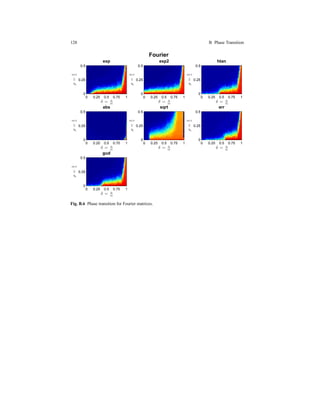
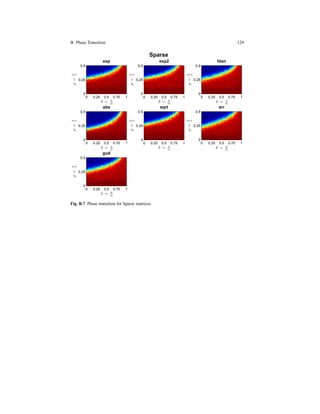
B.7 Phase transition for Sparse matrices . . . . . . . . . . . . . . . . . . . . . . . . . . . . 129
List of Tables
2.1 Sparsity promotion mappings . . . . . . . . . . . . . . . . . . . . . . . . . . . . . . . . . 34
2.2 Means results for low sparse instance . . . . . . . . . . . . . . . . . . . . . . . . . . . 58
2.3 PRD over 5000 test signals. . . . . . . . . . . . . . . . . . . . . . . . . . . . . . . . . . . . 61
2.4 PRDN over 5000 test signals. . . . . . . . . . . . . . . . . . . . . . . . . . . . . . . . . . 61
3.1 Database description . . . . . . . . . . . . . . . . . . . . . . . . . . . . . . . . . . . . . . . . . 80
3.2 The face recognition rate (%) on the FRGC 2.0 controlled . . . . . . . . . 81
3.3 Recognition rate (%) on 239 subjects of the FRGC 2.0 controlled . . . 81
3.4 The face recognition rate (%) on some databases. . . . . . . . . . . . . . . . . . 82
3.5 Parameters of Gabor filters . . . . . . . . . . . . . . . . . . . . . . . . . . . . . . . . . . . . 88
3.6 Results for AR registered . . . . . . . . . . . . . . . . . . . . . . . . . . . . . . . . . . . . . 90
3.7 Results for AR unregistered . . . . . . . . . . . . . . . . . . . . . . . . . . . . . . . . . . . 91
4.1 k-LIMAPS Compression Results for 6 bits of Quantization. . . . . . . . . 106
4.2 k-LIMAPS Compression Results for 7 bits of Quantization. . . . . . . . . 106
4.3 ECG Performance Comparison . . . . . . . . . . . . . . . . . . . . . . . . . . . . . . . . 108
4.4 k-LIMAPS Compression Results for the Garanteed-PRD Error . . . . . 112
xiii
xiv List of Tables
Introduction
In recent years, the sparsity concept has attracted considerable attention in areas
of applied mathematics and computer science, especially in signal and image pro-
cessing fields [41, 29, 55]. The general framework of sparse representation is now
a mature concept with solid basis in relevant mathematical fields, such as prob-
ability, geometry of Banach spaces, harmonic analysis, theory of computability,
and information-based complexity. Together with theoretical and practical advance-
ments, also several numeric methods and algorithmic techniques have been devel-
oped in order to capture the complexity and the wide scope that the theory suggests.
All these discoveries explain why sparsity paradigm has progressively interested a
broad spectrum of natural science and engineering applications.
Sparse recovery relays over the fact that many signals can be represented in a
sparse way, using only few nonzero coefficients in a suitable basis or overcomplete
dictionary. The problem can be described as follows. Given a fixed vector s ∈ Rn
and a matrix Φ ∈ Rn×m with m > n, determine the sparsest solution α∗, i.e.
α∗
= argmin
α
||α||0, s.t. Φα = s (BP0)
where || · ||0 is the ℓ0 quasinorm, that represents the number of non-zero entries of
the vector α.
Unfortunately, this problem, also called ℓ0-norm minimization, is not only NP-hard
[85], but but also hard to approximate within an exponential factor of the optimal
solution [87]. Nevertheless, many heuristics for the problem has been obtained and
proposed for many applications. Among them we recall a greedy pursuit technique
that approximates a sparse solutions to an underdetermined linear system of equa-
tions. Successively, several greedy-based extended heuristics that directly attempt
to solve the ℓ0-norm minimization have been proposed, for instance, Matching Pur-
suit (MP) [77], Orthogonal Matching Pursuit (OMP) [91] and Stagewise Orthogonal
Matching Pursuit (StOMP) [45].
xv
xvi List of Tables
A second key contribution [31] relaxes the problem by using the ℓ1-norm for
evaluating sparsity and solving the relaxed problem by linear programming. Typical
algorithm in this class of algorithms is Basis Pursuit (BP) [29]
This thesis provides new regularization methods for the sparse representation
problem with application to face recognition and ECG signal compression. The
proposed methods are based on fixed-point iteration scheme which combines non-
convex Lipschitzian-type mappings with canonical orthogonal projectors. The first
are aimed at uniformly enhancing the sparseness level by shrinking effects, the lat-
ter to project back into the feasible space of solutions. In particular the algorithm
LIMAPS (Lipshitzian Mappings for Sparse recovery) is proposed as heuristics for
(BP0). This algorithm is based on a parametric class Gλ of nonlinear mappings
Gλ : {α | s = Φα} → {α | s = Φα}.
First of all, the problem (BP0) is relaxed to the problem
α∗
= argmin
α
||α||<λ>, s.t. Φα = s (REL)
where, for all λ > 0, ||·||<λ> is a suitable pseudonorm such that ||α||0 ≈ ||α||<λ>
for large λ.
The main result we obtain in this part states under reasonable conditions, the
minima of (REL) are asymptotically stable fixed points of Gλ with respect to the
iterative system
αt+1 = Gλ (αt )
Then, the LIMAPS algorithm requires a suitable sequence {λt} with limt→∞ λt = ∞
Roughly speaking, this implies that || · ||<λ> ≈ || · ||0 for large t. LIMAPS imple-
ments the system
αt+1 = Gλ (αt )
for obtaining a sparse solution as t → ∞.
In many applications, it is often required to solve the variant of (BP0) in which
the sparsity level is a given as a constant:
α∗
= argmin
α
||Φα − s||2
2, s.t. ||α||0 ≤ 0 (LS0)
In this thesis we propose a heuristic for (LS0) the algorithm k-LIMAPS . An empir-
ical evidence of convergence of k-LIMAPS to good solutions is discussed.
In the second part of this thesis we study two applications in which sparseness
has been successfully applied in recent areas of the signal and image processing: the
face recognition problem and the ECG signal compression problem.
In the last decades, the face recognition (FR) problem has received increasing
attention. Despite excellent results have been achieved, the existing methods suf-
fer when applied in uncontrolled conditions. Such bottleneck represents a serious
limit for their real applicability. In this work we propose two different algorithms
List of Tables xvii
able to work on crucial topics in the context of uncontrolled conditions: variation in
illumination conditions, continuous occlusions and large expression variations. Ex-
perimental results based on k-LIMAPS show that the algorithm has high recognition
rate, showing good stability performances both in case of manually and automati-
cally registered images.
In the last few years, the need of ECG signal recordings has been enormously
augmented due to the increasing interest in health care. Portable ECG recording
systems (e.g., Holters) record ECG signals continuously for long time periods rang-
ing between several hours and few days. We present two novel and efficient signal
compression algorithms aimed at finding the sparsest representation of the ECG
signals based on k-LIMAPS . The idea behind these algorithms is to use to sparse
represent the ECG signal to compress a dictionary created from signal itself. The
saved coefficients are then discretized and rescaled in a convenient range and com-
pressed by a lossless entropy-based algorithm. Experimentally we have shown the
effectiveness of our methods which reaches high compression rate maintaining an
acceptable percent root-mean square difference level.
List of Tables 1
0 0
Part I
Theoretical Foundations
Chapter 1
Sparse Recovery and Compressive Sensing
Abstract Shannon-Nyquist sampling theorem is one of the central principle in
signal processing. To reconstruct without error a signal s(t) with no frequencies
higher than B Hertz by the sampled signal sc(t), it is sufficient a sampling frequency
A > 2B.
In the last few years a further development called compressive sensing has emerged,
showing that a signal can be reconstructed from far fewer measurements than what
is usually considered necessary, provided that it admits a sparse representation.
In this chapter we provide a brief introduction of the basic theory underlying com-
pressive sensing and discuss some methods to recovery a sparse vector in efficient
way.
1.1 Introduction
Compressive sensing (CS) has emerged as a new framework for signal acquisition
and sensor design [47, 28]. It provides an alternative to Shannon / Nyquist sampling
when signal under acquisition is known to be sparse or compressible. Instead of
taking periodic signal samples of length n, we measure inner products with p ≪ n
measurement vectors and then recover the signal via sparsity seeking optimization
algorithm. In matrix notation, the measurement vector y can be expressed as
y = Ψs = ΨΦα
where the rows of p × n matrix Ψ contain the measurement vectors, Φ is an n × n
compression matrix, α is the sparse compressed signal and s is the sampled signal.
While the matrix ΨΦ is rank deficient, and hence loses information in general, it
can be shown to preserve the information in sparse and compressible signals if it
satisfies the Restricted Isometry Property (RIP) [15]. The standard CS theory states
that robust signal recovery is possible from p = O(plog n
p ) measurements.
5
6 1 Sparse Recovery and Compressive Sensing
Many fundamental works are proposed by C`andes, Chen, Sauders, Tao and
Romberg [31, 21, 26, 27, 23] in which are shown that a finite dimensional signal
having a sparse or compressible representation can be recovered exactly from a
small set of linear non adaptive measurements.
This chapter starts with preliminary notations on linear algebra and continue with
an introduction to the compressive sensing problem and recall some of the most
important results in literature that summarize under which conditions compressive
sensing algorithms are able to recover the sparsest representation of a signal into a
given basis.
1.2 Preliminary Notations on Linear Algebra
The set of all n × 1 column vectors with complex number entries is denoted by Cn,
the i-th entry of a columns vector x = (x1,...,xn)T ∈ Rn is denoted by xi.
The set of all n×m rectangular matrices with complex number entries is denoted by
Cn×m. The elements in the i-th row and j-th column of a matrix A is denoted by Ai,j.
Let A ∈ Cn×m a rectangular matrix, the left multiplication of a matrix A with a
scalar λ gives another matrix λA of the same size as A. The entries of λA are given
by λ(A)i,j = (λA)i,j = λAi,j. Similarly, the right multiplication of a matrix A with
a scalar λ is defined to be (Aλ)i,j = Ai,jλ. If A is an n×m matrix and B is an m× p
matrix, the result AB of their multiplication is an n × p matrix defined only if the
number of columns m in A is equal to the number of rows m in B. The entries of
the product matrix smatrix AB are defined as (AB)i,j = ∑m
k=1 Ai,kBk,j. The matrix
addition is defined for two matrices of the same dimensions. The sum of two m× n
matrices A and B,s denoted by A+ B, is again an m× n matrix computed by adding
corresponding elements (A+ B)i,j = Ai,j + Bi,j.
The dot product, or scalar product, is an algebraic operation that takes two
equal-length vectors and returns a single number. Let a = (a1,...,an) ∈ Cn and
b = (b1,...bn) ∈ Cn, the dot product can be obtained by multiplying the transpose
of the vector a with the vector b and extracting the unique coefficient of the resulting
1 × 1 matrix is defined as
aT
b =
n
∑
i=1
aibi
Let A ∈ Cn×m, the adjoint matrix is a matrix A∗ ∈ Cm×n obtained from A by
taking the transpose and then taking the complex conjugate of each entry. Formally
the adjoint matrix is defined as
A∗
= (A)T
= AT
1.2 Preliminary Notations on Linear Algebra 7
where AT denotes the transpose and A denotes the matrix with complex conjugated
entries. If the matrix is A ∈ Rn×m, the adjoint matrix is given by
A∗
= AT
A square matrix A ∈ Cn×n is called invertible if there exists a matrix B ∈ Cn×n
such that
AB = BA = I
where I denotes the n × n identity matrix and the multiplication used is ordinary
matrix multiplication. If the matrix B exist, is uniquely determined by A and is
called the inverse of A, denoted as A−1. An orthogonal matrix is a square matrix with
complex entries whose columns and rows are orthogonal unit vectors. Equivalently,
a matrix A is orthogonal if its adjoint matrix is equal to its inverse:
A∗
= A−1
which entails
A∗
A = AA∗
= I
A symmetric n × n complex matrix A is said to be positive definite if
z∗
Az > 0, ∀z ∈ Cn
Similarly a symmetric n×n complex matrix A is said to be positive semi-definite if
z∗
Az ≥ 0, ∀z ∈ Cn
Let A ∈ Cn×m, the column rank of a matrix A, denoted as rank(A), is the max-
imum number of linearly independent column vectors of A. It is known that the
maximum number of linearly independent rows of a matrix is always equal to the
maximum number of linearly independent columns.
For a rectangular matrix A ∈ Cn×m, by definition rank(A) ≤ min{n,m}. When
rank(A) = min{n,m} A is said full rank, otherwise the matrix is said deficient rank.
A diagonal matrix is a matrix D = (di,j) ∈ Cn×n such that
di,j = 0 iff i = j
Denote with D = diag(d1,...,dn) ∈ Rn×n the diagonal matrix with diagonal vec-
tor (d1,...,dn). It holds that
diag(a1,...,an)+ diag(b1,...,bn) = diag(a1 + b1,...,an + bn) (1.1)
diag(a1,...,an)diag(b1,...,bn) = diag(a1b1,...,anbn) (1.2)
The diagonal matrix D = diag(d1,...,dn) is invertible if and only if all the entries
of (d1,...,dn) are all non-zero. In this case, we have
8 1 Sparse Recovery and Compressive Sensing
diag(d1,...,dn)−1
= diag(
1
d1
,...,
1
dn
)
The Hadamard product is a binary operation that takes two matrices of the same
dimensions, and produces another matrix where each element i, j is the product of
elements i, j of the original two matrices. Let A,B ∈ Cn×m two rectangular matri-
ces of the same dimensions, the Hadamard product A ⊙ B is a matrix, of the same
dimension as the operands, with elements given by
(A⊙ B)i,j = Ai,jBi,j
The Hadamard product is commutative, associative and distributive over addition.
That is,
A⊙ B =B⊙ A (1.3)
A⊙ (B⊙C) =(A⊙ B)⊙C (1.4)
A⊙ (B+C) =A⊙ B+ A⊙C (1.5)
(1.6)
The identity matrix under Hadamard multiplication of two n × m matrices is n × m
matrix where all elements are equal to 1.
Given x ∈ Rn
, the Euclidean norm of x is defined as
||x||2 = (xT
x)
1
2
The Euclidean norm measures the distance from the point x to the origin. It is almost
immediate from the definition that the following properties hold:
• ||x||2 ≥ 0 for all x ∈ Rn
• ||x||2 = 0 iff x = 0
• For any γ ∈ R, γ > 0, ||γx||2 = |γ|||x||2
1.2.1 Singular Value Decomposition theorem
Let A be an n×m matrix of rank r, with n < m. Then there exist unitary orthogonal
matrices U, V respectively of order n and m such that
A = UDV∗
where D has the form
D =
D1 0
0 0
and D1 = diag(σ1,...,σr) with σ1 ≥ σ2 ≥ ··· ≥ σr is a non singular diagonal matrix.
The diagonal elements of D = diag(σ1,...,σr,0,...,0) are called singular values
1.2 Preliminary Notations on Linear Algebra 9
of A and the number of non-zeros σi’s is equal to the rank of A. The ratio σ1
σr
, with
σr = 0 can be regarded as a condition number of A.
1.2.2 Moore-Penrose pseudoinverse
Let A = U
D1 0
0 0
V∗
be the singular value decomposition of A. Then the Moore-
Penrose pseudoinverse of A is defined as
A†
= V
D−1
1 0
0 0
U∗
(1.7)
It is possible to prove that the Moore-Penrose pseudoinverse A† is the unique
matrix X satisfying:
AXA = A (1.8)
XAX = X (1.9)
(XA)∗
= XA (1.10)
(AX)∗
= AX (1.11)
(1.12)
Let us consider the linear system
Ax = b
and let x0 = A†b. Then for x = x0 we have either
||Ax− b||2 > ||Ax0 − b||2 (1.13)
or
||Ax− b||2 = ||Ax0 − b||2 and ||x||2 > ||x0||2 (1.14)
In other words, A†b is either the unique least square solution, or it is the least
square solution of minimum norm.
An important case is when the rows of A are linearly independent; in this case A†b
is the unique least square solution and A† can be obtained by
A†
= (AT
A)−1
AT
(1.15)
The product of the matrix A and the n-dimensional vector x can be written in
terms of dot product of vectors as follow:
10 1 Sparse Recovery and Compressive Sensing
Ax =





aT
1 x
aT
2 x
...
aT
n x





where a1,a2,...,an denote the rows of the matrix A. Let NA be the null space of A,
i.e. NA = {x|Ax = 0}; x ∈ NA is orthogonal to each row vectors of A. The row space
of the matrix A is the span of the row vectors of A; it follows that a vector x ∈ NA iff
it is perpendicular to every vector in the row space of A. The dimension of the null
space of A is called nullity. It holds that rank(A)+ nullity(A) = m.
Let x ∈ Rn = V ⊕W. Then x can be uniquely decomposed into
x = x1 + x2 with x1 ∈ V and x2 ∈ W
The transformation that maps x into x1 is called projector matrix onto V along W
and is denoted by P. The vector x1 = Px transformed by the projector P is called the
projection of x onto V along W. The necessary and sufficient condition for a square
matrix P of order n to be the projection matrix is given by
P2
= P
Let Q denote the projector that transforms x in x2. Then
Px+ Qx = (P+ Q)x
Because the equation above has to hold for any x ∈ Rn
, it must hold that
I = P+ Q
Let P a square matrix be the projector matrix onto V along W. Then Q = I − P
satisfies Q2 = I − 2P + P2 = Q indicating that Q is the projection matrix onto W
along V. We have that
PQ = P(I − P) = P− P2
= 0
implying that the span(Q) constitutes the null space of P, similarly QP = 0 imply
that the span(P) constitutes the null space of Q.
By coming back to the general case, let Q = A†A
Q2
= A†
(AA†
A) = A†
A = Q
Q is the projection on the null space of A and P = I − Q is the projection on the
orthogonal complement of the null space of A, denoted by N ⊥
A .
The null space also plays a role in the solution to a nonhomogeneous linear sys-
tem of linear equations
Ax = b (1.16)
1.2 Preliminary Notations on Linear Algebra 11
If u and v are two possible solutions of the equations to the linear system (1.16),
then
A(u − v) = Au − Av = b − b = 0
Thus the difference of any two solutions of the equation (1.16) lies in NA. It follows
that any solution to the equation (1.16) can be expressed as the sum of a fixed solu-
tion v and an arbitrary element of NA. That is, the solution set of (1.16) is defined
as
{v+ x|x ∈ NA}
where v is any fixed vector satisfying Av = b. The solution set of (1.16), also called
affine space and denoted by AA,b, is the translation of the null space of A by the
vector v.
1.2.3 Norm, Pseudo-Norm and Quasi-Norm in Rn
For every p with p ∈ (0 < p < ∞), let us consider the functional ||.||p : Rn → R+
defined by:
||x||p = (∑|xi|p
)
1
p (1.17)
This functional is extended to p = 0 and p = ∞ as follows:
||x||0 = lim
p→0
||x||p
p = |supp(x)| (1.18)
||x||∞ = lim
p→∞
||x||p = max
i
|xi| (1.19)
with supp(x) = {i|xi = 0} is the support of the vector x.
It is known that ||.||p, with 1 ≤ p ≤ ∞, is a norm , i.e. it holds:
||x||p = 0 iff x = 0 (1.20)
||αx||p = |α|||x||p (1.21)
||x+ y||p ≤ ||x||p + ||y||p (1.22)
In particular, Rn equipped by ||.||p is a Banach space [9].
If 0 < p < 1, ||.||p is a quasinorm [108], i.e. it satisfies the norm axioms, except that
the triangular inequality which is replaced by
||x+ y||p = γ (||x||p + ||y||p) (1.23)
for some γ > 1. A vector space with an associated quasinorm is called a quasi-
normed vector space .
12 1 Sparse Recovery and Compressive Sensing
If p = 0, the triangular inequality (1.22) holds but does not hold the scaling ax-
iom (1.21). In this case ||.||0 is called pseudonorm .
−1 −0.5 0 0.5 1
−1
−0.8
−0.6
−0.4
−0.2
0
0.2
0.4
0.6
0.8
1
p=1
p=1.5
p=2
p=∞
p=0.5
p=0
Fig. 1.1 Unit spheres in R2 for the lp norms with p = 1,2,∞, for the lp quasinorm with p = 0.5
and for the pseudonorm l0.
In figure 1.1 are depicted on the plane the unit sphere and some quasinorms
{x | ||x||p = 1} for different values of p.
1.2.4 Metric Space and Normed Vector Space
A vector space over a field F is a set V equipped with operation sum + : V ×V → V
and scalar multiplication . : F ×V → V, such that the following conditions hold:
1.2 Preliminary Notations on Linear Algebra 13
x+ y = y+ x (commutativity) (1.24)
(x+ y)+ z = x+ (y+ z) (associativity of vector addition) (1.25)
α(βx) = (αβ)x (associativity of scalar multiplication) (1.26)
x+ 0 = 0 + x = x (additive identity) (1.27)
1x = x (scalar multiplication identity) (1.28)
x+ (−x) = 0 (existence of inverse) (1.29)
α(x+ y) = αx+ αy (distributivity of vector sums) (1.30)
We define a metric space an ordered pair (M,d) where M is a set and d is a metric
function
d : M × M → R+
such that for any x,y,z ∈ M the following properties holds:
d(x,0) = 0 iff x = y (identity) (1.31)
d(x,y) ≥ 0 (non negativity) (1.32)
d(x,y) = d(y,x) (simmetry) (1.33)
d(x,z) ≤ d(x,y)+ d(y,z) (triangular inequality) (1.34)
The function d is also called distance function .
A normed vector space is a pair (V,||.||) where V is a vector space and ||.|| is a
norm function on V. Observe that ||x− y|| is a distance function.
We call x the limit of the sequence (xn) if for each real number ε > 0, there exists
a natural number N such that, for every n > N, |xn − x| < ε where |.| denote the
absolute value. The sequence (xn) is said to converge to or tend to the limit x, and
we denote it as xn → x. A sequence {xn}n of real numbers is said to have the Cauchy
property, if for every positive real number ε, there is a positive integer N such that
for all natural numbers m,n < N
|xm − xn| < ε
A metric space M is called complete, if every Cauchy sequence of points in M has
a limit that is also in M or, alternatively, if every Cauchy sequence in M converges
in M.
1.2.5 Convex, Smooth and Lipschitzian Functions
A set V is convex if the line segment between any two points in V lies in V, i.e., if
for any x1,x2 ∈ C and and any θ with 0 ≤ θ ≤ 1, we have
θx1 + (1 − θ)x2 ∈ V
14 1 Sparse Recovery and Compressive Sensing
A real valued function f : V → R defined on a convex set V ⊆ Rn in a vector
space is said to be convex if for any points x,y ∈ V and any α ∈ [0,1] it holds
f(αx+ (1 − α)) ≤ α f(x)+ (1 − α)f(y) (1.35)
A function f : V → R is said to be strictly convex if for any α ∈ (0,1)
f(αx+ (1 − α)) < α f(x)+ (1 − α)f(y) (1.36)
If f is twice differentiable on its open domain and the Hessian ∇2 f(x)
∇2
f(x)i,j =
∂2 f(x)
∂xi∂xj
with i, j = 1,...,n
exists for each x ∈ domf, then it is convex if and only if the Hessian matrix is
positive semidefinite
∇2
f(x) 0 ∀x ∈ domf
If the Hessian matrix is positive definite, i.e., ∇2 f(x) ≻ 0, ∀x ∈ domf, f is strictly
convex.
Let f be a function defined on a open set on the real line and let k a non negative
integer. If the derivatives f
′
, f
′′
,..., f(k) exist and are continuous the function f is
said to be of class Ck . If the function f has derivatives of all orders is said to be of
class C∞ or smooth . The class C0 is the class of all continuous functions, the class
C1 is the class of all differentiable functions whose derivative is continuous.
Let (M,dM) and (N,dN) two metric spaces and let f : M → N a function. The
function f is said to be Lipschitz continuous if there exist a constant γ, called Lips-
chitz constant such that ∀x,y ∈ M
dN(f(x), f(y)) ≤ γdN(x,y) (1.37)
The smallest constant γ is called the best Lipschitz constant. If γ = 1 the function
is called a short map and if the Lipschitz constant is 0 ≤ γ < 1 the function is called
a contraction . A function is called locally Lipschitz continuous if for every x ∈ M
if there exists a neighborhood U such that f restricted to U is Lipschitz continuous.
A function f defined over M is said to be H¨older continuous or uniform Lipschitz
condition of order α on M if if there exists a constant λ such that
dN(f(x), f(y)) ≤ λdN(x,y)α
∀x,y ∈ M (1.38)
1.3 Basis and Frames 15
1.3 Basis and Frames
A set of column vectors Φ = {φi}n
i=1 is called basis for Rn if the vectors {φ1,...,φn}
are linearly independent. Each vector in Rn is then uniquely represented as a linear
combination of basis vectors, i.e. for any vector s ∈ Rn there exist a unique set of
coefficients α = {αi}n
i=1 such that
s = Φα (1.39)
The set of coefficients α can be univocally reconstructed as follows:
α = Φ−1
s (1.40)
The reconstruction is particularly simple when the set of vectors {φ1,...,φn}n
i=1 are
orthonormal, i.e.
φ∗
i φj =
1 if i = j
0 if i = j
(1.41)
In this case Φ−1 = Φ∗.
A generalization of the basis concept, that allow to represent a signal by a set of
linearly dependent vectors is the frame [76].
Definition 1.1. A frame in Rn
is a set of vectors {φi}m
i=1 ⊂ Rn
, with n < m, corre-
sponding to a matrix Φ such that there are 0 < A ≤ B and
A||α||2
2 ≤ ||ΦT
α||2
2 ≤ B||α||2
2 ∀α ∈ Rn
(1.42)
Since A > 0, condition (1.42), is equivalent to require that rows of Φ are linearly
independent, i.e. rank(Φ) = n.
If A = B then the frame Φ is called A-tight frame , while if A = B = 1, then Φ is
called Parseval frame.
By remembering the results presented in section (1.2.2), given a frame Φ in Rn, the
linear system
s = Φα (1.43)
admits an unique least square solution αLS, that can be obtained by
αLS = (ΦT
Φ)−1
ΦT
s = Φ†
s (1.44)
Is simple to show that the solution in (1.44) is the smallest l2 norm vector
||αLS||2
2 ≤ ||α||2
2 (1.45)
for each coefficient vector α such that x = Φα, and it is also called least square
solution.
16 1 Sparse Recovery and Compressive Sensing
1.4 Sparse and Compressible Signals
We say that a vector x ∈ Rn is k-sparse when |supp(x)| ≤ k, i.e ||x||0 ≤ k. Let
Σk = {α : ||α||0 ≤ k} the set of all k-sparse vectors.
A signal admits a sparse representation in some frame Φ, if s = Φα with ||α||0 ≤ k.
In real world only few signals are true sparse, rather they can be considered
compressible , in the sense that they can be well approximated by a sparse signal.
We can quantify the compressibility of a signal s by calculating the error between
the original signal and the best approximation ˆs ∈ Σk
σk(s)p = min
ˆs∈Σk
||s− ˆs||p (1.46)
If s ∈ Σk then σk(s)p = 0 for any p. Another way to think about compressible
signals is to consider the rate of decay of their coefficients. For many important
class of signals there exist bases such that the coefficients obey a power law decay,
in which case the signal are highly compressible. Specifically, if s = Φα and we sort
the coefficients αi such that |α1| ≥ |α2| ≥ ··· ≥ |αm|, then we say that the coefficients
obey a power law decay if there exist constants C1, q > 0 such that
|αi| ≤ C1i−q
The larger q is, the faster the magnitudes decay, and the more compressible a sig-
nal is. Because the magnitude of their coefficients decay so rapidly, compressible
signals can be represented accurately by k ≪ m coefficients. Specifically, for such
signal there exist constants C2, r > 0 depending only on C1 and q such that
σk(s)2 ≤ C2k−r
In fact, one can show that σk(s)2 will decay as k−r
if and only if the sorted coeffi-
cients αi decay as ir+ 1
2 [39].
1.5 Underdetermined Linear System and Sparsest Solution
Let consider a matrix Φ ∈ Rn×m with n < m and a vector s, the system Φα = s has
more unknowns than equations, and thus it has no solutions if s is not in the span of
the columns of the matrix Φ, or infinitely many if s is in the span of the dictionary Φ.
We consider the sparse recovery problem, where the goal is to recover a high-
dimensional sparse vector α from an observation s:
s = Φα (1.47)
1.5 Underdetermined Linear System and Sparsest Solution 17
A well-posed problem stems from a definition given by Jacques Hadamard. He
believed that mathematical models of physical phenomena should have three prop-
erties:
• a solution must exists
• the solution is unique
• the solution’s behavior hardly changes when there’s a slight change in the initial
condition
Problems that are not well-posed in the sense of Hadamard are termed ill-posed.
Inverse problems are often ill-posed .
In ill-posed problems we desire to find a single solution of system s = Φα, and
in order to select one well defined solution additional criteria are needed.
A way to do this is the regularization technique, where a function J(α) that eval-
uates the desirability of a would-be solution α is introduced, with smaller values
being preferred.
Defining the general optimization problem
arg min
α∈Rm
J(α) subject to Φα = s (PJ)
where α ∈ Rm is the vector we wish to reconstruct, s ∈ Rn are available measure-
ments, Φ is a known n × m matrix is also called sensing matrix or dictionary.
It is now in the hands of J(α) to govern the kind of solution we may obtain. We
are interested in the underdetermined case with fewer equations than unknowns, i.e.
n < m, and ask whether it is possible to reconstruct α with a good accuracy.
By fixing J(α) = ||α||0, we can constrain the solution of (1.47) to be sparsest as
possible.
The problem can be formulated as
arg min
α∈Rm
||α||0 s.t. Φα = s (P0)
where ||α||0 = |supp{α}|.
Problem (P0) requires searches over all subsets of columns of Φ, a procedure
which clearly is combinatorial in nature and has high computational complexity. It
is proved that (P0) is NP-hard [85].
In fact, under the so called Restricted Isometry Conditions[15] over the sensing ma-
trix Φ, described with more details in the next session, the sparse recovery problem
P0 [20, 24] can be relaxed to the convex l1 problem
arg min
α∈Rm
||α||1 s.t. Φα = s (P1)
where ||α||1 = ∑m
i=1 |αi| denotes the l1 norm of vector α.
Problem (P1) can be reformulated as a linear programming (LP) [99] problem
18 1 Sparse Recovery and Compressive Sensing
mint∈Rm ∑m
i=1 ti
s.t. −ti ≤ αi ≤ ti
Φα = s ti ≥ 0 (1.48)
This problem can be solved exactly with for instance interior point methods or with
the classical simplex algorithm.
The linear programming formulation (1.48) results inefficient in most cases, for
this reason many algorithms able to solve (P1) have been proposed in literature: for
example greedies Basis Pursuit (BP) [29], Stagewise Orthogonal Matching Pursuit
(StOMP) [45] and the Orthogonal Matching Pursuit (OMP) [91, 35] or other op-
timization methods like Least Angle Regression (LARS) [48] or the Smoothed ℓ0
(SL0) [82, 81] that are able to find the approximated solution to the problem (P1)
and (P0) respectively.
In the next session are recalled the conditions for the matrix Φ under which the
sparsest solution of the problem (P0) can be recovered uniquely.
1.5.1 Null Space Property and Spark
In this section we introduce a necessary and sufficient condition for to ensure that
the unique solution of (P1) is also the solution of (P0). At this regard, given η ∈ Rm
and Λ ⊂ {1,2,...,m}, we denote ηΛ the vector
(η)i =
ηi i ∈ Λ
0 i ∈ Λ
Definition 1.2. A sensing matrix Φ ∈ Rn×m has the Null Space property (NSP) of
order k, if there is 0 < γ < 1 such that for η ∈ NΦ and Λ ⊂ {1,2,...,m}, |Λ| ≤ k,
it holds
||ηΛ ||1 ≤ γ||ηΛc ||1 (1.49)
Notice that to verify the Null Space Property of a sensing matrix is not an easy task,
because we have to check each point in the null space with a support less than k.
A general necessary and sufficient condition [42] for solving problem (P0) is that
the sensing matrix Φ has the Null Space Property [43, 62]. Moreover, in [98] it is
shown that if a sensing matrix Φ has the Null Space Property it is guaranteed that
the unique solution of (P1) is also the solution of (P0).
Moreover, it is proved that if Φ has the Null Space Property, the unique minimizer
of the (P1) problem is recovered by basis pursuit (BP).
The column rank of a matrix Φ is the maximum number of linearly independent
column vectors of Φ. Equivalently, the column rank of Φ is the dimension of the
1.5 Underdetermined Linear System and Sparsest Solution 19
column space of Φ.
Another criteria to assert to existence of a unique sparsest solution to a linear
system is based on the concept of spark of a matrix the notion called spark[43]
defined as:
Definition 1.3. Given a matrix Φ, spark(Φ) is the smallest number s such that there
exists a set of s columns in Φ which are linearly-dependent.
spark(Φ) = min
z=0
||z||0 s.t. Φz = 0
While computing the rank of a matrix is an easy goal, from a computational point
of view, the problem of computing the spark is difficult. In fact, it has been proved to
be an NP-hard problem [111]. The spark gives a simple criterion for uniqueness of
sparse solutions. By definition, each vector z in the null space of the matrix Φz = 0
must satisfy ||z||0 ≥ spark(Φ), since these vectors combine linearly columns from
Φ to give the zero vector.
Theorem 1.1. [43] Given a linear system Φα = s, if α is a solution verifying
||α||0 < spark(Φ)
2 , then α is the unique sparsest solution.
Proof. Let β an alternative solution such that Φβ = s, and ||β||0 ≤ ||α||0. This
implies that Φ(α − β) = 0. By definition of spark
||α||0 + ||β||0 ≥ ||α − β||0 ≥ spark(Φ) (1.50)
Since ||α||0 <
spark(Φ)
2 , it follows that ||β||0 ≤ ||α||0 <
spark(Φ)
2 . By (1.50)
spark(Φ) ≤ ||α||0 + ||β||0 <
spark(Φ)
2
+
spark(Φ)
2
= spark(Φ)
that is impossible. ⊓⊔
1.5.2 Restricted Isometry Property
Compressive sensing allows to reconstruct sparse or compressible signals accurately
from a very limited number of measurements, possibly contaminated with noise.
Compressive sensing relies on properties of the sensing matrix such as the restricted
isometry property.
The Null Space Property is necessary and sufficient condition to ensure that any
k-sparse vector α is recovered as the unique minimizer of the problem (P1). When
the signal s is contamined by noise it will be useful to consider strongly condition
like the Restricted Isometry Property condition [22] on matrix Φ, introduced by
Candes and Tao and defined as
20 1 Sparse Recovery and Compressive Sensing
Definition 1.4. A matrix Φ satisfies the Restricted Isometry Property (RIP) of order
k if there exists a δk ∈ (0,1) such that
(1 − δk)||α||2
2 ≤ ||Φα||2
2 ≤ (1 + δk)||α||2
2 (1.51)
holds for all α ∈ Σk
If a matrix Φ satisfies the RIP of order 2k, then we can interpret (1.51) as saying
that Φ approximately preserves the distance between any pair of k-sparse vectors.
If the matrix Φ satisfies the RIP of order k with constant δk, then for any k′ < k we
automatically have that Φ satisfies the RIP of order k′ with constant δk′ ≤ δk.
In Compressive Sensing [68] , random matrices are usually used as random pro-
jections of a high-dimensionalbut sparse or compressible signal vector onto a lower-
dimensional space that with high probability contain enough information to enable
signal reconstruction with small or zero error. Random matrices drawn according
to any distribution that satisfies the Johnson-Lindenstrauss contraction inequality,
in [12] was shown that with high probability the random sensing matrix Φ has the
Restricted Isometry Property.
Proposition 1.1. Let Φ, be a random matrix of size n × m drawn according to any
distribution that satisfies the contraction inequality
P ||Φα||2 − ||α||2 ≤ ε||α||2 ≤ 2e−nc0(ε)
,with 0 < ε < 1
where c0(ε) > 0 is a function of ε. If Φ ∼ N(0, 1
n I), c0 = ε2
4 − ε3
6 is a monotonically
increasing function.
For a given Gaussian matrix Φ, for any α ∈ Rm
, Λ such that |Λ| = k < n and any
0 < δ < 1, we have that
(1 − δ)||α||2
2 ≤ ||Φα||2
2 ≤ (1 + δ)||α||2
2
with a probability
P (1 − δ) ≤
||Φα||2
2
||α||2
2
≤ (1 + δ) > 1 − 2(
12
δ
)k
e−nc0(δ/2)
For large m (number of columns of Φ), estimating and testing the Restricted
Isometry Constant is computational impractical. A computationally efficient, yet
conservative bounds on Restricted Isometry Property can be obtained through the
mutual coherence.
In the next session we introduce some bounds for of the mutual coherence of a
dictionary Φ.
1.5 Underdetermined Linear System and Sparsest Solution 21
1.5.3 Coherence
Mutual coherence is a condition that implies the uniqueness and recoverability of
the sparsest solution. While computing Restricted Isometry Property, Null Space
Property and spark are NP-hard problems, the coherence og a matrix can be easily
computed.
Definition 1.5. Let φ1,...,φm the columns of the matrix Φ. The mutual coherence
of Φ is then defined as
µ(Φ) = max
i< j
|φT
i φj|
||φi||2||φj||2
By Schwartz inequality, 0 ≤ µ(Φ) ≤ 1. We say that a matrix Φ is incoherent if
µ(Φ) = 0.
For n×n unitary matrices, columns are pairwise orthogonal, so the mutual coher-
ence is obviously zero. For full rank n × m matrices Φ with m > n, µ(Φ) is strictly
positive, and it is possible to show [109] that
µ(Φ) ≥
m− n
n(m− 1)
with equality being obtained only for a family of matrices named Grassmanian
frames. Moreover, if Φ is a Grassmanian frame, the spark(Φ) = n + 1, the high-
est value possible.
Mutual coherence is easy to compute and give a lower bound to the spark. In
order to outline this result, we briefly recall the Gershgorin’s theorem for localizing
eigenvalues of a matrix. Given a n×n matrix A = {ai,j}, let be Rk = ∑j=k |ak,j|. The
complex disk z = {z||z − ak,k| ≤ Rk} is said Gershgorin’s disk with (1 ≤ k ≤ n). It
holds that for Gershgorin’s theorem [57], every eigenvalues of A belongs to (at least
one) Gershgorin’s disk.
Theorem 1.2. [43] For any matrix Φ ∈ Rn×m the spark of the matrix is bounded by
a function of coherence as follows:
spark(Φ) ≥ 1 +
1
µ(Φ)
Proof. Since normalizing the columns does not change the coherence of a matrix,
without loss of generality we consider each column of the matrix Φ normalized to
the unit l2-norm. Let G = ΦT Φ the Gram matrix of Φ.
Consider an arbitrary minor from G of size p × p, built by choosing a subset of
p columns from the matrix Φ and computing their sub Gram matrix M. We have
|φT
i φj| = 1 if k = j and |φT
i φj| ≤ µ(Φ) if k = j, as consequence Rk ≤ (p−1)µ(Φ).
It follows that Gershgorin’s disks are contained in {z||1 − z| ≤ (p − 1)µ(Φ)}. If
(p − 1)µ(Φ) < 1, by Gershgorin’s theorem, 0 can not be eigenvalues of M, hence
every p-subset of columns of Φ is composed by linearly independent vectors. We
22 1 Sparse Recovery and Compressive Sensing
conclude that a subset of columns of Φ linearly dependent should contain p ≥ 1 +
1
µ(Φ) elements, hence spark(Φ) ≥ 1 + 1
µ(Φ) . ⊓⊔
Previous result, together with theorem (1.1) gives the following condition imply-
ing the uniqueness of the sparsest solution of a linear system Φα = s.
Theorem 1.3. [43] If a linear system Φα = s has a solution α such that ||α||0 <
1
2 (1 + 1
µ(Φ)
), than α is the sparsest solution.
1.6 Algorithms for Sparse Recovery
The problem we analyze in this section is to approximate a signal s using a lin-
ear combination of k columns of the dictionary Φ ∈ Rn×m. In particular we seek a
solution of the minimization problem
argΛ⊂{1,...,m} |Λ|=k min
|Λ|=k
min
αλ
|| ∑
λ∈Λ
φλ αλ − s||2
2 (1.52)
fixed k with (1 ≤ k ≤ m).
The real difficulties for solving problem (1.52) lies in the optimal selection of the
index set Λ, since the ”brute force” algorithm for the optimization requires to test
all m
k ≥ m
k
k
subsets of k columns of Φ; this seems prohibitive for real instances.
The algorithms for sparse recovery can be divided in three classes:
• Basis Pursuit methods where is desired the sparsest solution in the ℓ1 sense
and there is an underdetermined system of linear equations Φα = s that must
be satisfied exactly. The sparsest solution can be easily solved by classical linear
programming algorithms.
• Greedy methods where an approximation of the optimal solution is found by a
sequence of locally optimal choices.
• Convex or Non-convex methods that relax the combinatorial sparse problem to
a related convex/non-convex programming and solve it with iterative methods.
1.6.1 Basis Pursuit
Basis Pursuit (BP) finds the best representation of a signal s by minimizing the ℓ1
norm of the coefficients α of the representation. Ideally, we would like that some
components of α to be zero or as close to zero as possible.
In [99] is shown how (P1), can be recasted into a linear programming problem
(LP)of the form
min
α∈Rm
cT
α s.t. Φα = s,α ≥ 0 (1.53)
1.6 Algorithms for Sparse Recovery 23
where cT x is the objective function, Φα = s is a collection of equality constraints
and α ≥ 0 is a set of bounds.
The objective function of (P1) is not linear, however we can transfer the nonlineari-
ties to the set of constraints by adding new variables t1,...,tn. This gives:
min
t∈Rm
m
∑
i=1
ti
s.t. |αi| ≤ ti i = 1,...,m
Φα = s
Observing that |αi| ≤ ti if and only if −ti ≤ αi ≤ ti we can transform the original
problem (P1) into the following linear programming problem subject to m inequali-
ties constraints.
min
m
∑
i=1
ti ( Pℓ1
)
s.t. αi ≤ ti
αi ≥ −ti i = 1,...,m
Φα = s
Note that αi ≤ ti implies that Iα − It ≤ 0 and αi ≥ ti implies that IαI + t ≥ 0,
thus we have the problem in LP form
mincT
t (LP)
s.t. Iα − It ≤ 0
Iα + It ≥ 0
Φα = s
where c = [1,1,...,1]T .
In order to reduce the size of (LP) problem is that of using the dual problem .
From duality theory, starting with a linear program in standard form (1.53), we can
rewrite the problem as the following dual linear program:
max bT
s s.t. ΦT
s+ z = c,α ≥ 0 (1.54)
Using this equivalence we can rewrite the problem (1.54) in terms of dual variables
y and v which correspond to the constraints from the primal problem without re-
strictions
minbT
y (DLP)
s.t. ΦT
y− 2v = −e, 0 ≤ v ≤ e
Once the size of the original problem ( Pℓ1
) was reduced, the dual problem (DLP)
can be solved efficiently by a linear solver.
24 1 Sparse Recovery and Compressive Sensing
1.6.2 Greedy Algorithms
In literature many greedy algorithms was proposed to perform sparse recovery.
Many signal analysis methods look for a linear expansion of the unknown signal
s in terms of functions φi.
s =
m
∑
i=1
αiφi (1.55)
We may say that in such a way the unknown signal s is explained using atoms
(functions φi) from the dictionary Φ, used for decomposition. MP algorithm finds
a sub-optimal solution to the problem of an adaptive approximation of a signal in
a redundant set (dictionary) of atoms. If the dictionary Φi is an orthonormal basis,
then the coefficients an are given simply by the inner products of the dictionary’s
atoms φi with the signal αi =< s,φi >. We would like to use a dictionary Φ =
{φi}i=1,...,m that would properly reveal the intrinsic properties of an unknown signal,
or, almost equivalently, would give low entropy of the αi and possibilities of good
lossy compression.
We may relax the requirement of exact signal representation (1.55), and try to
automatically choose the atoms φλt
, optimal for the representation of a given signal
s, from a redundant dictionary Φ. The expansion becomes an approximation, and
uses only the functions φλt
chosen from the redundant dictionary Φ. In practice,
the dictionary contains orders of magnitude more candidate functions φλt
than the
number k of functions chosen for the representation:
s ≈
k
∑
t=1
αtφλt
(1.56)
A criterion of optimality of a given solution for a fixed dictionary Φ, signal s, and
number of used functions k can be formulated as minimization of the reconstruction
error of representation
ε = ||s−
k
∑
t=1
αtφλt
||2
2
Finding the minimum requires checking all the possible combinations (subsets)
of k functions from the dictionary, which leads to a combinatorial explosion. There-
fore, the problem is intractable even for moderate dictionary sizes. Matching pursuit
algorithm, proposed in [77], finds a sub-optimal solution by means of an iterative
procedure.
In the first step, the atom φλ1
which gives the largest product with the signal s is
chosen from the dictionary Φ, composed of normalized atoms (||φλt
||2
2 = 1). In each
of the consecutive steps, the atom φi is matched to the signal rt which is the residual
left after subtracting results of previous iterations:
1.6 Algorithms for Sparse Recovery 25
r0 = s
rt =< rt,φt > φt + rt−1
φλi
= arg max
φλi
∈D
| < rt,φλi
> |
For a complete dictionary the procedure converges to s with k → ∞ [77].
Algorithm 1 Orthogonal Matching Pursuit (OMP)
Require: - a dictionary Φ ∈ Rn×m
- a signal s ∈ Rn
- a stopping criteria
1: r0 = s,α0 = 0,Λ0 = /0,t = 0
2: while [ cond ] do
3: λt ∈ argmaxj=1,...m | < rt−1,φj > | < match >
4: Λt+1 = Λt ∪{λt} < identify: if multiple maxima exist, choose only one>
5: αt+1 = argminβ:supp(β)⊆Λt+1
||Φβ −s||2
2 < update >
6: rt+1 = s−Φαt+1
7: t = t +1
8: end while
Ensure: ˆα = αt = argminβ:supp(β)⊆Λt+1
||Φβ −s||2
2
Another greedy algorithm extensively used to find the sparsest solution of the
problem (P0) is the so called Orthogonal Matching Pursuit (OMP) algorithm pro-
posed in [35, 91] and analized by Tropp and Gilbert [113]. OMP adds a least square
minimization to each step of the Matching Pursuit. The t-th approximant of s is
ˆst = argmin
α
||s−
k
∑
t=1
αt φλt
||2
2
s.t. ˆs ∈ {φλ : λ ∈ Λt} (1.57)
that can be performed by standard least squares techniques. A detailed pseudo-code
of the OMP algorithm can be viewed in 1.
1.6.3 Relaxation Algorithms
An alternative way to solve the (P0) problem is to relax it to the highly discon-
tinuous ℓ0-norm, continuous or even smooth approximations. Examples of such
relaxation is to replace the ℓ0 norm with convex norm as the ℓ1, with nonconvex
norms like the ℓp for some p ∈ (0,1) or with smooth functions like ∑m
i=1(1−e−λα2
i ),
26 1 Sparse Recovery and Compressive Sensing
∑m
i=1 log(1 + λα2
i ) or ∑m
i=1
α2
i
λ+α2
i
.
The problem of using ℓ0 norm, needed for a combinatorial search of its mini-
mization, are both due to the fact that the ℓ0 norm of a vector is a discontinuous
function of that vector.
The main idea of the Smoothed l0 (SL0) algorithm, proposed and analyzed in
[82, 81], is to approximate this discontinuous function by a suitable continuous one,
and minimize it by means of minimization algorithms function i.e. with steepest de-
scent gradient method.
The continuous functions which approximation ||α||0, should have a parameter
which determines the quality of the approximation.
Consider the single variable family of functions
fσ (α) = e
−α2
2σ2
and note that
lim
σ→0
fσ (α) =
1, if α = 0
0, if α = 0
Defining Fσ (α) = ∑m
i=1 fσ (αi) it is clear that ||α||0 ≈ m−Fσ(α) for small values
of σ.
Algorithm 2 Smoothed ℓ0 (SL0)
Require: - a dictionary Φ ∈ Rn×m and the Moore-Penrose pseudo inverse Φ†
- a signal s ∈ Rn
- a suitable decreasing sequence for σ = {σ1,...σT }
- a stopping criteria
1: α0 = Φ†s
2: while [ cond ] do
3: σ = σt < match >
4: Maximize the function Fσ on the feasible set S using L iterations of the steepest ascent
algorithm (followed by projection onto the feasible set):
5: for j = 1,...,L do
6: ∆α = [α1e
−|α1|2
2σ2 ,...,αme
−|αm|2
2σ2 ]
7: α ← α − µ∆α < where µ is a small positive constant >
8: α ← α −Φ†(Φα −s) <orthogonal projection>
9: end for
10: t = t +1
11: end while
Ensure: ˆα = αt
1.6 Algorithms for Sparse Recovery 27
We can find the minimum ℓ0 norm solution by maximizing the Fσ (α) subject to
Φα = s for a very small value of σ. The σ parameter determines how smooth the
function Fσ is, the smaller value of σ, closer behavior of Fσ to ℓ0 norm.
The idea is than to use a decreasing sequence for σ, for maximizing Fσ for each
value of σ, the initial value of the maximization algorithm is the maximizer of Fσ
for the previous larger value of σ. If we gradually decrease the value of σ, for
each value of σ the maximization algorithm starts with an initial solution near the
actual maximizer of Fσ and hence we hope to escape from getting trapped into local
maxima and reach to the actual maximum for a small values of σ, which gives the
ℓ0 norm solution.
Chapter 2
Lipschitzian Mappings for Sparse
Representation
Abstract In this chapter we present two new algorithms (LIMAPS and k-LIMAPS
respectively) for the following Sparse Recovery Problem
min
α
||α||0 s.t. s = Φα (2.1)
After a general introduction in sec. 2.1, in sec. 2.2 we describe the problem of Sparse
Recovery faced in this work, of which the two proposed algorithms are heuristics.
In sec. 2.4 we introduce a parametric class {Gλ |λ ≥ 0} of nonlinear mappings and
in sec. 2.5 we discuss some properties of iterative scheme based on these operators.
In sec. 2.5.1, for a given sequence of λt, the iterative scheme
αt+1 = Gλt
(αt) (2.2)
is discussed, proving the convergence when ∑ 1
λt
< ∞.
In sec. 2.5.2 the iterative scheme αt+1 = Gλt
(αt) is studied in the simple bidimen-
sional case. It is proved that, for sufficiently large λ, the sparsest solution is ”near”
to a fixed point of Gλ .
In sec. 2.5.3, we find a connection between the fixed point of Gλ and a relax-
ation of the problem (2.1). First of all, we introduce a family {|| · || λ | λ > 0}
of pseudonorms (see lemma 8). Then we study the relaxed problem
min
α
||α|| λ s.t. s = Φα (2.3)
The main result (2.3) asserts that, under reasonable assumptions, the minima of (2.3)
are asymptotically stable fixed points of Gλ .
In sec. 2.5.4 and sec. 2.6 the algorithms LIMAPS and k-LIMAPS are introduced,
together a brief discussion on empirical evidence of convergence of k-LIMAPS in
sec. 2.6.1.
29
30 2 Lipschitzian Mappings for Sparse Representation
2.1 General Considerations
Consider the underdetermined system of linear equations
s = Φα∗
+ η (2.4)
where η represents an additive noise with mean and variance
E[η] = 0 (2.5)
E[η2
] = σ2
I (2.6)
and s the vector of observations. The matrix Φ is a n×m sensing matrix with n < m.
The matrix Φ can be considered as the modeling operator that links α∗(the model)
to the s − η (the noise free data). We assume that the vector α has few entries
significantly different from 0, i.e. α∗ is approximately sparse. In this case, we can
promote the sparsity via ℓ1 regularization to overcome the singular nature of Φ. It
is reasonable to recover α∗, under suitable conditions on the matrix Φ, minimizing
the objective function:
E[
1
2
||s− η − Φα||2
2]+ λ||α||1
=
1
2
||s− Φα||2
2 +
1
2
E[(s− Φα)η]+
1
2
E[η2
]+ λ||α||1
=
1
2
||s− Φα||2
2 + λ||α||1 + σ2
(2.7)
The minimizer is independentfrom σ2, and can be obtained solving the optimization
problem
min
α
1
2
||s− Φα||2
2 + λ||α||1 (QP)
that is closely related to quadratic programming. The parameter λ represents the
trade off between the ℓ2-norm of the reconstruction error and the ℓ1-norm of the
solution vector.
When an estimate of the noise level σ2 in the signal is available, a different
formulation is often useful:
min
{α |||s−Φα||2
2≤σ2}
||α||1 (BP)
This formulation, called Basis Pursuit (BP) denoise problem[29], minimizes the ℓ1
norm giving a maximum misfit.
When the ℓ1 norm estimator τ of a ”good” solution is available, a third formula-
tion is given by the Lasso [110]
2.3 A Source of Inspiration 31
min
{α|||α||1≤τ}
1
2
||s− Φα||2
2 (LS)
2.2 Problem Formulation and Summary of Results
In this chapter we present two new algorithms for sparse recovery problem called
LIMAPS and k-LIMAPS respectively. The LIMAPS algorithm tries to find the
sparsest solution of the reformulation of the basis pursuit denoise problem in ℓ0
norm
min
α
||α||0 s.t. ||s− Φα||2
2 ≤ σ (BP0 Noisy)
In this work we consider only the model without noise (σ = 0). The problem can be
rewritten as:
min
α
||α||0 s.t. s = Φα (BP0)
In sec. 2.5.3 we introduce a family {||·|| λ | λ > 0} of pseudonorm 2.5.3 that
approximate ||·||0 for large values of λ, and we consider the relaxation of BP0:
min
α
||α|| λ s.t. s = Φα (REL)
In sec. 2.4 we consider a family of mappings {Gλ | λ > 0}, sec. 2.4 and we
prove that, under reasonable conditions, a solution of (REL) is an asymptotically
stable fixed point of Gλ 2.3.
This fact suggests, given a suitable sequence {λt} with limt→∞ = ∞. to consider the
iterative scheme called LIMAPS
αt+1 = Gλt
(αt)
as heuristics for solving (BP0). This iterative schema in the base of the algorithm
LIMAPS presented in 2.5.4.
The second proposed algorithm, called k-LIMAPS , is an heuristics for the fol-
lowing problem:
min
α
1
2
||s− Φα||2
2 s.t. ||α||0 ≤ k (LS0)
2.3 A Source of Inspiration
In recent years, a new family of numerical algorithms has been gradually built. This
family, addressing the optimization problem (QP), is the Iterative Shrinkage algo-
rithms [17, 86, 13].
Roughly speaking, in these iterative methods, each iteration comprises a multipli-
32 2 Lipschitzian Mappings for Sparse Representation
cation by Φ and its adjoint, along with a scalar shrinkage step on the obtained result.
If Φ is unitary, the minimization of (QP) can be founded easily, with a closed
form solution that leads to shrinkage. Using the identity ΦΦT = I, and exploiting
the fact that ℓ2 norm is unitary invariant, we have:
f(x) =
1
2
||s− Φα||2
2 + λρ(α)
=
1
2
||Φ(ΦT
s− α)||2
2 + λρ(α)
=
1
2
||ΦT
s− α||2
2 + λρ(α)
and denoting α0 = ΦT s, we get:
f(x) =
1
2
||α0
− α||2
2 + λρ(α)
=
m
∑
k=1
1
2
(α0
k − αk)2
+ λρ(αk)
=
m
∑
k=1
g(α0
k ,αk)
The minimization of the scalar function of the form g(x,a) = 1
2 (x−a)2
+λρ(x) with
respect to x requires that we either zero the gradient in the case of smooth function
ρ(·), or show that the sub-gradient of g contains the zero, for non differentiable ρ(·).
The problem can be solved, by finding ˆxopt = Sρ,λ (a) that is the global minimizer
of the scalar objective function g(x,a).
Let us now consider the convex function ρ(x) = |x|p with 1 ≤ p < 2. The scalar
objective function g(x,a) then can be rewritten as
g(x,a) =
1
2
(x− a)2
+ λ|x|p
The condition of minimum is thean expressed by
g′
(x,a) =x− a + pλ|x|p−1
sgn(x) = 0
from which we can derive
a =x+ λ p|x|p−1
sgn(x) (2.8)
Inverting the equation (2.8) we obtain
ˆxopt =Sλ (a) (2.9)
that maps the input a in the global minimizer ˆxopt. Notice that:
2.4 Sparsity Promotion Mappings 33
(a) if a is near the origin, then Sλ (a) ≈ 0. This implies that if |Sλ (a)| ≤ ε then
|α| ≈ pλ|x|p−1 and then |Sλ (a)| ≈ (p 1
λ a)2.
(b) if a is large (tending to infinity), Sλ (a) ≈ a − pλ|a|p−1sgn(a), implying |a| >
|Sλ (a)|.
The function Sλ (a) results to be a shrinkage function.
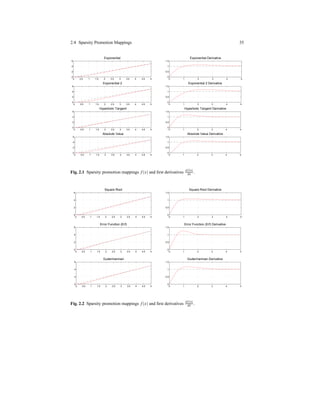
2.4 Sparsity Promotion Mappings
The aim of this section is to establish asymptotic fixed point approaches for a
thresholding-based iterative process for model selection relying on a family of
shrinkage function represented by the uniformly Lipschitzian nonlinear mappings
F = { fλ | λ ∈ R+}, where the choice of λ is important in controlling the shrink-
ing effects, i.e., to drive the search towards the sparsest solutions. It provides then a
fusion with the classical orthogonal projectors built on the Moore-Penrose pseudo-
inverse, in order to restore the feasibility at each iteration step.
2.4.1 Uniformly Lipschitzian Shrinking Mappings
The key feature of shrinking functions is to attenuate coefficients adaptively with
respect to scale and time, taking into proper account the general strength constraints
of the signal. This task is committed to classes of smooth sigmoidal based shrinkage
maps that may be used to promote the sparsity. These classes of shrinkage functions
introduce a little variability among coefficients with small amplitude, performing
low attenuation of coefficients with high amplitude and stronger attenuation on co-
efficients with small amplitudes. These functions depend on a parameter λ that make
possible the control of the attenuation degree imposed to coefficients. Moreover they
have the following features:
smoothness: the shrinkage function induces small variability among data with
close values.
shrinkage: a strong attenuation is imposed for small values, conversely weak
attenuation is imposed for large values.
vanishing attenuation: attenuation decreases to zero when the amplitude of the
coefficient tends to infinity.
Lipschitzianity: given a class of functions
{ fλ | fλ : R → R, λ ∈ Λ}
the class is called Lipschitzian continuous with Lipschitz constant K ≥ 0 if for
all λ ∈ Λ, it holds
34 2 Lipschitzian Mappings for Sparse Representation
|fλ (x)− fλ (y)|
|x− y|
≤ K (2.10)
for all x and y in R, with x = y.
Name f (x) df(x)
dx
Exponential x(1−e−λ|x|) e−λ|x|(λ|x|−1)+1
Exponential 2 x( 2
1+e−λ|x| −1) 2λ|x|eλ|x|+e2λ|x|−1
(eλ|x|+1)2
Hyperbolic Tangent xtanh(λ|x|) tanh(λ|x|)+λ|x|sech2(λ|x|)
Absolute Value x( λ|x|2
1+λ|x|2 ) λx2(λx2+3)
(λx2+1)2
Square Root x λ|x|
√
1+λ|x|2
λ|x|(λx2+2)
(λx2+1)
3
2
Error Function xer f (λ|x|) er f (λ|x|)+λ|x| d
dλ|x| er f (λ|x|)
Gudermannian x 2
π atan(sinh(π
2 λ|x|)) λ|x|sech(π
2 λ|x|)+ 2
π atan(sinh(π
2 λ|x|))
Table 2.1 Sparsity promotion mappings f (x) and first derivatives d f(x)
dx .
In table 2.1 we list some Lipschitzian smooth sigmoidal based shrinkage maps
and their derivatives that have the properties required above.
Let us introduce some property for a uniformly Lipschitzian mapping based on a
family of nonlinear maps
F = { fλ | λ ∈ R+
}, (2.11)
where the choice of λ is important in controlling the sparsity effects. In particular,
we restrict all our analysis on the exponential family, for its well-known character-
istics.
For λ > 0, let fλ : R → R be the shrinkage map
fλ (x) = x(1 − e−λ|x|
). (2.12)
Let be F = { fλ |λ > 0}. The function fλ is an odd function with continuous deriva-
tive f′
λ (x) = (λ|x|−1)e−λ|x| +1. Since supx∈R |f′
λ (x)| = 1+e−2, as a direct conse-
quence of the intermediate value theorem |fλ (x)− fλ (y)| ≤ (1+e−2)|x−y|, for each
λ > 0 and x,y ∈ R. Thus, mapping (2.12) is uniformly Lipschitzian with respect to
λ with Lipschitz constant 1 + e−2. Moreover, given that |f′
λ (x)| < 1 on the interval
(−1/λ,1/λ), the mapping (2.12) is contractive within that interval with fixed point
2.4 Sparsity Promotion Mappings 35
0 0.5 1 1.5 2 2.5 3 3.5 4 4.5 5
0
2
4
6
Exponential
0 1 2 3 4 5
0
0.5
1
1.5
Exponential Derivative
0 0.5 1 1.5 2 2.5 3 3.5 4 4.5 5
0
2
4
6
Exponential 2
0 1 2 3 4 5
0
0.5
1
1.5
Exponential 2 Derivative
0 0.5 1 1.5 2 2.5 3 3.5 4 4.5 5
0
2
4
6
Hyperbolic Tangent
0 1 2 3 4 5
0
0.5
1
1.5
Hyperbolic Tangent Derivative
0 0.5 1 1.5 2 2.5 3 3.5 4 4.5 5
0
2
4
6
Absolute Value
0 1 2 3 4 5
0
0.5
1
1.5
Absolute Value Derivative
Fig. 2.1 Sparsity promotion mappings f (x) and first derivatives d f(x)
dx .
0 0.5 1 1.5 2 2.5 3 3.5 4 4.5 5
0
2
4
6
Square Root
0 1 2 3 4 5
0
0.5
1
1.5
Square Root Derivative
0 0.5 1 1.5 2 2.5 3 3.5 4 4.5 5
0
2
4
6
Error Function (Erf)
0 1 2 3 4 5
0
0.5
1
1.5
Error Function (Erf) Derivative
0 0.5 1 1.5 2 2.5 3 3.5 4 4.5 5
0
2
4
6
Gudermannian
0 1 2 3 4 5
0
0.5
1
1.5
Gudermannian Derivative
Fig. 2.2 Sparsity promotion mappings f (x) and first derivatives d f(x)
dx .
36 2 Lipschitzian Mappings for Sparse Representation
at the origin [10]. It obeys to the shrinkage rule since |fλ (x)| ≤ |x| for all x ∈ R and
it is nondecreasing, as shown by its plotting in Figure 2.3. Just for comparison, in
figure is displayed also the soft threshold function Sτ(x) = max(|x| − τ,0)sgn(x)
which arises frequently in sparse signal processing and compressed sensing. The
latter, differently from (2.12), is discontinuous and Sτ(x) = 0 iff |x| ≤ τ.
x x
x
1−
e−
λ
|x|
x
x
m
ax(|x|−
τ
,0)sgn(x)
Fig. 2.3 The graphs of shrinking function (2.12) and the well known soft threshold function.
To deal with high dimensional data, we extend mapping (2.12) to many dimen-
sions , obtaining the one-parameter family of nonlinear mappings Fm = {Fλ : Rm →
Rm | λ ∈ R+}, where the k-th component (Fλ (x))k of Fλ
(Fλ (x))k = fλ (x), (1 ≤ k ≤ m) (2.13)
Analogously to the scalar case, the function [fλ (x1)/x1,..., fλ (xm)/xm] repre-
sents a symmetric sigmoid function in m dimensions, where larger values of λ give
sharper sigmoids, in the limit becoming a Heaviside multi-dimensional step func-
tion.
Now we come back to the problem
Φα = s
where Φ is an n×m sensing matrix of full rank, and s is the vector of observations.
The set of possible solutions AΦ,s = {x|Φx = s} is the affine space ν +NΦ, where
NΦ = {y|Φy = 0} is the null space of Φ and ν is the solution with minimum ℓ2
norm. We recall that ν = Φ†s, where Φ† = (ΦT Φ)−1ΦT is the Moore-Penrose
pseudo inverse of Φ.
Let P be the projector onto NΦ. For each x in Rm is projected in a point y ∈
AΦ,s = ν + NΦ as follow:
y = Px+ ν (2.14)
These early assumptions suggest to define a new mapping by composing the
shrinking (2.13) and the feasibility (2.14). As a consequence, we get the self-
mapping family Gλ : AΦ,s → AΦ,s, which has the form
2.5 Iterative scheme and Fixed Point Characterization 37
Gλ (α) = PFλ (α)+ ν, (2.15)
Since α ∈ AΦ,s, it holds α = x+ ν for a suitable x ∈ NΦ; as a consequence:
Gλ (α) = P(x+ ν)+ ν − P(α ⊙ e−λ|α|
) (2.16)
= x+ ν − P(α ⊙ e−λ|α|
)
= α − P(α ⊙ e−λ|α|
)
2.5 Iterative scheme and Fixed Point Characterization
The aim of this section is to show that a fixed point iterative scheme involving
mapping (2.15) becomes an effective procedure to find good approximation of the
sparsest solution to the linear system (2.4), providing that a suitable sequence of λt
would be supplied.
By denoting with Tλ : Rm → NΦ the mapping defined by Tλ (α) = Pα ⊙ e−λ|α|,
a fixed point α∗ of mapping (2.15) satisfies:
α∗
= Gλ (α∗
) ⇐⇒ Tλ (α∗
) = 0. (2.17)
Thus, each α∗ in the set FixGλ ≡ KTλ
⊆ AΦ,s uniquely corresponds to the point
α∗ ⊙ e−λ|α∗| ∈ NΦ, being KTλ
and NΦ the kernel of Tλ and the null space of
projector P respectively.
For mapping (2.15) we study the convergence of sequences of successive ap-
proximations (Picard process) with a given initial value. In particular, we take into
exam two cases: the first with fixed parameter λ and the latter providing a sequence
{λt}t≥0, tending to become arbitrarily large as t → ∞. Both the analysis will be
useful in the study of minimizers for sparsity promotion functionals.
2.5.1 Convergence for increasing sequences of λ
In this case, for a given incresing sequence of real numbers {λt}t≥0, we define the
iterates as
α0 = α ∈ AΦ,s
αt = Gλt−1
(αt−1), t ≥ 1
(2.18)
and we study the convergence of the sequence {αt}t≥0.
The first lemma provides an inductive form of the general term αt .
Lemma 1 Let {αt} be the sequence generated by (2.18), then it holds:
αt = Pα − P
t−1
∑
k=0
αk ⊙ e−λk|αk|
+ ν , t ≥ 1. (2.19)
38 2 Lipschitzian Mappings for Sparse Representation
Proof. To prove the lemma we proceed by induction on n. The case t = 1 is trivial.
For t > 1, by definition we have
αt = Gλt−1
(αt−1) = Pαt−1 − P αt−1 ⊙ e−λt−1|αt−1|
+ ν .
Assume inductively that the equality (2.19) is true for every positive integer less
than t. Thus, the induction hypothesis and the idempotency of P imply that
Pαt−1 = P2
α − P2
t−2
∑
k=0
αk ⊙ e−λk|αk|
+ Pν
= Pα − P
t−2
∑
k=0
αk ⊙ e−λk|αk|
,
because
Pν = (I − Φ†
Φ)Φ†
s = Φ†
s− Φ†
ΦΦ†
s = 0.
Hence, the proposition holds for t, and this completes the proof. ⊓⊔
By limiting the sum of reciprocals of {λt}, the sequence {αt} results to be con-
vergent, as stated in the following lemma.
Lemma 2 Let {λt} be a real positive sequence. Then, if ∑∞
t=0 1/λt < +∞, the se-
quence {αt} converges as t → +∞.
Proof. First of all observe that the univariate mapping
x → |x|e−λ|x|
≤
1
eλ
is bounded, which implies
αk ⊙ e−λk|αk|
≤
√
m
e
1
λk
.
For any n > n′ and since ||P|| < 1 we have:
||αn − αn′|| =||P(
n−1
∑
k=n′
αk ⊙ e−λk|αk|
)|| (2.20)
≤||
n−1
∑
k=n′
αk ⊙ e−λk|αk|
||
≤
n−1
∑
k=n′
||αk ⊙ e−λk|αk|
||
≤
√
m
e
n−1
∑
k=n′
1
λk
2.5 Iterative scheme and Fixed Point Characterization 39
For all ε > 0 therefore, there always exists a index γ such that, for n,n′ > γ it holds
that
|
n
∑
k=n′
1
λk
| ≤
e
√
m
ε
It follows that if ∑n
k=n′
1
λk
converges also {αk} is convergent.
Given the previous bound, we show now that the sequence (2.18) is a Cauchy
sequence.
We conclude that the hypothesis done on the sequence {λt} is sufficient to get
the convergence in norm of ∑+∞
k=0 αk ⊙ e−λk|αk|. ⊓⊔
2.5.2 Fixed points of Gλ in the bidimensional case
In this section we discuss the fixed points of Gλ in the simple bidimensional case.
Consider the family of Lipshitzian functions with parameter λ > 0
Gλ : AΦ,s → AΦ,s
given by
Gλ (α) = α − P(α ⊙ e−λ|α|
)
where P is the projector on NΦ. We can assume without loss of generality that
||ν|| = 1 because
Gλ
α
||ν||
=
1
||ν||
G λ
||ν||
(α)
The linear system in the bidimensional case, is then:
(φ1,φ2)
α1
α2
= s
where s ∈ R is fixed. Without loss of generality, we can consider ||(φ1,φ2)|| = 1,
which can be written in terms of a unique parameter θ, as for instance (φ1,φ2) =
(−sinθ,cosθ) and NΦ = {(z,w)|φ1z + φ2w = 0} = {x(cosθ,sinθ)|x ∈ R}. The
solutions
α1
α2
are in the affine space ν + NΦ, with ν =
−sinθ
cosθ
s. Without loss
of generality, we can consider the case s = 1, then ν =
−sinθ
cosθ
.
The problem is transformed into the study of the fixed points of Gλ (α), with
fixed λ. Consider the bijection ψ : R → AΦ,s given by:
x → x(cosθ,sinθ)+ (−sinθ,cosθ)
With respect to the bijection, the operator Gλ : AΦ,s → AΦ,s becomes the operator
Sλ : R → R. The picture in figure 2.4 shows the above bijection in which the point
40 2 Lipschitzian Mappings for Sparse Representation
xu = x(cosθ,sinθ) is mapped on α = (xcosθ,sinθ)+ (−sinθ,cosθ) and Gλ (α)
is mapped on Sλ (x)(cosθ,sinθ).
x
y
xu
α
Sλ (x)
Gλ α
x
Fig. 2.4 Representation of the bijection in which the point xu = x(cosθ,sinθ) is mapped on α =
(cosθ,sinθ)+(−sinθ,cosθ) and the map Gλ (α) is mapped on Sλ (x).
An explicit write for Sλ is given by:
x → xu + ν − (xu + ν)⊙ e−λ|xu+ν|
),u
where ·,· denotes the usual dot product in R2. Thus, in this setting, we characterize
the fixed points of the transformation
Sλ (x) = x− cosθ(xcosθ − sinθ)e−λ|xcosθ−sinθ|
−
sinθ(xsinθ + cosθ)e−λ|xsinθ+cosθ|
(2.21)
varying the parameters λ and θ.
The equation for the determination of the fixed points is:
e−λ|xcosθ−sinθ|
e−λ|xsinθ+cosθ|
=
1 + xtanθ
1 − xcotθ
(2.22)
2.5 Iterative scheme and Fixed Point Characterization 41
For sake of simplicity, we suppose that sinθ,cosθ > 0. In order to identify the
interval where fixed points lie, we obtain:
Lemma 3 If x ≥ tanθ then 0 < Sλ (x) < x
Proof. Since x ≥ sinθ
cosθ , then xcosθ − sinθ ≥ 0, and xcosθ + sinθ > 0, then
Sλ (x)−x = −cosθ(xcosθ −sinθ)e−λ(xcosθ−sinθ)
−sinθ(xsinθ +cosθ)e−λ(xsinθ+cosθ)
< 0
which concludes the proof. ⊓⊔
Under the same hypothesis it holds, with similar proof:
Lemma 4 If x ≤ −cotθ then 0 > Sλ (x) > x
By lemma 3 and 4, the presence of fixed points out of the interval (−cotθ,tanθ)
can be excluded.
In this case we can therefore conclude that the fixed points of the transformation
Sλ (x) must be in the interval (−cotθ,tanθ). We can drop the absolute values, ob-
taining:
Sλ (x) = x−cosθ(xcosθ −sinθ)e−λ(xcosθ−sinθ)
−sinθ(xsinθ +cosθ)e−λ(xsinθ+cosθ)
The equation for the fixed points is then:
e−λ(sinθ−cosθ)
eλx(cosθ+sinθ)
=
1 + xtanθ
1 − xcotθ
The function
y1(x) =
1 + xtanθ
1 − xcotθ
(2.23)
is a rectangular hyperbola that cuts the x-axis in x = −cotθ. The hyperbola has the
vertical asymptote x = tanθ and intersects the y-axis in the point y = 1. The function
y2(x) = e−λ(sinθ−cosθ)
e+λ(sinθ+cosθ)x
(2.24)
is a growing exponential function.
We can remark:
• If sinθ > cosθ, the function (2.24) intersects the ordinate axis in a point with
coordinate ˆy < 1. This guarantees the existence of a fixed point ˆx < 0; if λ ≫ 1
it holds that ˆx ≈ −cotθ. We conclude observing that, for λ sufficiently large, ˆx
is a sparse solution.
• If sinθ < cosθ, the function (2.24) intersects the ordinate axis in a point of co-
ordinate ˆy > 1. This guarantees the existence of a fixed point ˆx > 0; if λ ≫ 1 it
holds that ˆx ≈ tanθ.
The point ˆx is asymptotically stable if |S′(ˆx)| < 1. If λ ≫ 1 it holds that ˆx ≈ tanθ
and
S′
(ˆx) ≈ 1 − cos2
θ − sin2
θ(1 − λ tanθ)e−λ tanθ
(2.25)
42 2 Lipschitzian Mappings for Sparse Representation
It follows that, if λ ≫ 1, |S′(ˆx)| < 1, hence the point ˆx is asymptotically stable.
Similarly, if sinθ > cosθ, the fixed point ˆx = −cotθ is asymptotically stable for
λ ≫ 1.
We now analyze in details, for illustrative purposes, the case θ = π
4 . The function
Sλ can be rewritten as
Sλ (x) =x−
1
2
(x− 1)e
− λ√
2
|1−x|
−
1
2
e
− λ√
2
|1+x|
(2.26)
Posing for simplicity t = λ√
2
, we have
Sλ (x) =x−
1
2
(x− 1)e−t|1−x|
−
1
2
e−t|1+x|
. (2.27)
The fixed points are in the interval (−1,1) and they are solutions of the equation
e2tx
=
1 + x
1 − x
(2.28)
We observe that
• for each t, x1 = 0 is fixed point
• if d
dx e2tx|x=0 > d
dx
1+x
1−x |x=0 iff t > 1. In this case there are two other fixed points
x2 and x3 such that −1 < x2 < 0 < x3 < 1.
• if 0 < t ≤ 1 it exists only the fixed point x1 = 0.
To study the fixed point stability, we calculate:
S′
(x) = 1 −
1
2
e−t(1−x)(1+t(x−1))
−
1
2
e−t(1+x)(1−t(x+1))
(2.29)
Let S′(x1) = S′(0) = 1 − e−t(1 − t). If t > 1 the fixed point x1 is instable and if
0 < t < 1 the point x1 is asymptotically stable. Since for t sufficiently high, x2 ≈ −1
and x3 ≈ 1, then:
S′
(x2) ≈ S′
(1) =
1
2
(1 − e−2t
(1 − 2t)) (2.30)
If t > 1 is −e−2t(1−2t) < e−2, S′(1) ≤ 1
2 (1 + e−2) < 1. The point x3, that exists for
t > 1, is asymptotically stable. Similarly for the fixed point x2.
Now we return to the original transformation in the affine space AΦ,s
Gλ (α) = α − P(α ⊙ e−λ|α|
) (2.31)
In the bijection between AΦ,s and R, given by α = xu + ν, with u = (cosθ,sinθ)
and ν = (−sinθ,cosθ), for sufficiently large λ, the point ˆα = xu+ν is the asymp-
totically stable fixed point of the iterative system generated by Gλ . We observe that:
2.5 Iterative scheme and Fixed Point Characterization 43
• if ˆx ≈ tanθ, then
ˆα ≈ tanθ(cosθ,sinθ)+ (−sinθ,cosθ) = (0,
1
cosθ
)
• if ˆx ≈ cotθ, then
ˆα ≈ −cotθ(cosθ,sinθ)+ (−sinθ,cosθ) = (−
1
sinθ
,0)
The fixed points ˆα, are then very close to the minimizers of the problem (BP0), as
λ → +∞ they satisfy:
ˆα = min
α∈AΦ,s
||α||0 (2.32)
2.5.3 Sparsity Minimization
In this subsection, our objective is to study the sparsity minimization property of
the fixed points of the iterative system. To do this, let us now consider the family of
functions
gλ (z) = 1 − e−λ|z|
(1 + λ|z|) (2.33)
with parameter λ > 0. We can easily verify that the first derivative of the function
(2.33) is given by
Lemma 5
g′
λ (z) = λ2
ze−λ|z|
A graphical representation of the function gλ (z) can be obtained observing that
gλ (z) is even, is increasing for z ≥ 0, it holds that 0 ≤ gλ (z) < 1, if |z| ≪ 1
λ is
gλ (z) ≈ λ2z2 while |z| ≫ 1
λ is gλ (z) ≈ 1. In particular, g′
λ (z) and g′′
λ (z) are contin-
uous functions.
Respect to the parameter λ, if holds that:
Lemma 6
lim
λ→∞
gλ (z) =
0 z = 0
1 z = 0
(2.34)
A further property of (2.33) is the following:
Lemma 7 ∀x,y ∈ R it holds:
gλ (x+ y) ≤ gλ (x)+ gλ (y) (2.35)
Proof. Since gλ (z) = g1(λz), we can limit ourselves to the study in the case of
λ = 1. Considering the function
G(x,y) = e−x−y
(1 + x+ y)− e−x
(1 + x)− e−y
(1 + y)+ 1
44 2 Lipschitzian Mappings for Sparse Representation
1−e−λ|z| (1+λ|z|)
1
λ
− 1
λ x
Fig. 2.5 Parametric function gλ .
∀x,y ≥ 0. We observe that the point (0,0) is the minimum of G(x,y), then:
G(x,y) ≥ G(0,0) = 0
i.e.
e−x−y
(1 + x+ y)− e−x
(1 + x)− e−y
(1 + y)+ 1 ≥ 0
This is equivalent to
1 − e−x−y
(1 + x+ y) ≤ 1 − e−x
(1 + x)+ 1 − e−y
(1 + y) (2.36)
We conclude that
g1(x+ y) = 1 − e−|x+y|
(1 + |x+ y|)
= 1 − e−|x|−|y|
(1 + |x|+ |y|)
= 1 − e−|x|
(1 + |x|)+ 1 − e−|y|
(1 + |y|)
= g1(x)+ g1(y)
⊓⊔
Let us now study the functional with parameter λ > 0:
||·||<λ> : Rm
→ R+
(2.37)
where ||(α1,...,αm)||<λ> = ∑k=1,...,m gλ (αk).
The principal properties of ||·||<λ> are summarized in the following points:
Lemma 8 ∀λ > 0, ||·||<λ> is a pseudonorm
Proof. • For all α,β ∈ Rm it holds that
||α||<λ> = 0 ⇐⇒ ∑
k=1,...,m
gλ (αk) = 0
⇐⇒ gλ (αk)(1 ≤ k ≤ m)
⇐⇒ α = 0
(2.38)
2.5 Iterative scheme and Fixed Point Characterization 45
• For all α,β ∈ Rm it holds that
||α + β||<λ> ≤ ||α||<λ> + ||β||<λ>
Infact:
||α + β||<λ> = ∑
k=1,...,m
gλ (αk + βk)
≤ ∑
k=1,...,m
gλ (αk)+ gλ(βk)
= ∑
k=1,...,m
gλ (αk)+ ∑
k=1,...,m
gλ (βk)
= ||α||<λ> + ||β||<λ>
(2.39)
Lemma 9 ∀α ∈ Rm, limλ→∞ ||α||<λ> = ||α||0
Proof.
lim
λ→∞
||α||<λ> =
= ∑
k=1,...,m
lim
λ→∞
gλ (αk)
= |{k | αk = 0}| = ||α||0
(2.40)
Returning to the original problem:
min||α||0 s.t. α ∈ ν + NΦ (2.41)
it can be relaxed as
min||α||<λ> s.t. α ∈ ν + NΦ (2.42)
The justification of such relaxation is given by (9): limλ→∞ ||α||<λ> = ||α||0.
Let a1,...,ar with r ≤ m − n, an orthogonal basis of the null space NΦ, where
ak = (ak,1,...,ak,m) with 1 ≤ k ≤ r. Recalling that the vector ν is orthogonal to
a1,...,ar, the null space NΦ can be rewritten as:
NΦ = α ∈ | α = ∑
k=1,...,r
xkak, (x1,...,xr) ∈ Rr
Given the orthogonal basis a1,...,ar, the projector P : Rm → NΦ is defined by:
P(y) = ∑
k=1,r
y,ak ak. (2.43)
46 2 Lipschitzian Mappings for Sparse Representation
Given the vector α = ∑k=1,...,r xkak +ν, the problem (2.42) can be recasted in the
problem:
min
x∈Rr ∑
j=1,...,m
gλ (αj) with αj = ∑
k=1,...,r
xkak,j + νj (2.44)
Note that, fixed an orthogonal basis, the problem (2.44), turns out to be an uncon-
strained problem on the entire space Rr. The aim of the following results is to show
that the fixed point of the operator Lλ (α) are local minima of the problem (2.44). A
necessary condition of minimum is to nullify the gradient:
∂
∂xs
∑
j=1,...,n
gλ (αj) = 0, ∀(s = 1,...,r).
It holds that
0 =
∂
∂xs
∑
j=1,...,n
gλ (αj) = ∑
j=1,...,n
g′
λ (αj)
∂
∂xs
= ∑
j=1,...,n
g′
λ (αj)as,j = (g′
,as),
where g′ = (g′
λ (α1),...,g′
λ (αn)). Since Pα ⊙ e−λ|α| = 0 is the fixed point condi-
tion of the operator Gλ (α), and since g′ = λ2α ⊙ e−λ|α|, we can conclude that the
necessary condition of minimum becomes
P(g′
) = ∑
s=1,...,r
g′
,as as = 0. (2.45)
Previous result can be stated in following theorem:
Theorem 2.1. Let α∗
a solution of local minimum of
min||α||<λ> s.t. α ∈ ν + NΦ
then, it holds that
P(α∗
⊙ e−λ|α∗|
) = 0
It follow that the point α∗ is a fixed point of Gλ (α) = α − P(α ⊙ e−λ|α|) ⊓⊔
2.5.3.1 Fixed Point Stability
Aiming to show both the local minimum property and the stability property of the
fixed point, we use the second partial derivative test. Necessary condition of relative
minimum of the problem (2.42) is that
∂
∂xk
∑
j=1,...,m
gλ (αj) = 0, ∀k = 1,...,r (2.46)
or equivalently
2.5 Iterative scheme and Fixed Point Characterization 47
∑
j=1,...,m
g′
λ (αj)ak,j = 0, ∀k = 1,...,r (2.47)
Let P the projector in NΦ, i.e. Pα = ∑k=1,...,m α,ak ak; the condition 2.47 can be
rewritten as
Pg′
λ (α) = 0.
A sufficient condition since α is a relative minimum, is that the Hessian matrix
H(α) =
∂2
∂xs∂xu
∑
k=1,...,m
gλ (αk)
must be positive defined. With a direct calculus
H(α) = ∑
k=1,...,m
g′′
λ (αk)as,kau,k (2.48)
Let us consider the transformation Gλ : AΦ,s → AΦ,s defined as
Gλ (α) = α − P(α ⊙ e−λ|α|
).
We are interested in the study of the iterative system
αt+1 = Gλ (αt ) (2.49)
Suppose that α∗
is a relative minimum of (2.42) such that the Hessian H(α∗
) is
positive definite, i.e. has all the eigenvalues greater than zero.
We now show that a fixed point α∗ is a asymptotically stable fixed point of the
iterative system (2.49).
In this regard, consider the bijection φ : η + NΦ → Rm given by
xk = α,ak , α = η + ∑
k
xkak.
Let Lλ : Rm → Rm, given by Lλ = φGλ φ−1, it is convenient to study instead of
(2.49) the isomorphic iterative system
x(t + 1) = Lλ (x(t)) (2.50)
In terms of components
xk(t + 1) = xk(t)−
1
λ2 ∑
j=1,...,r
g′
λ (αj)ak,j
with αj = ηj + ∑l=1 xlal,j.
Let x∗ the fixed point of Lλ , corresponding to α∗, i.e. x∗ = α∗,ak . The lin-
earization x∗ + ∆(t) ≈ x(t) of the system (2.50) in the neighborhood of x∗ is given
by
48 2 Lipschitzian Mappings for Sparse Representation
∆k(t + 1) = ∆k(t)− ∑
s=1,...,r
∂
∂xs
1
λ2 ∑
j=1,...,m
g′
λ (αj)ak,j
α=α∗
∆s(t)
Since
∂
∂xs
( ∑
j=1,...,m
g′
λ (αj)) = ∑
j=1,...,m
g′′
λ (αj)ak,jas,j = Hk,s(α)
results that
∆(t + 1) = ∆(t)−
1
λ2
∑
s=1,...,r
Hk,s(α∗
)∆s(t)
or in vector notation
∆(t + 1) = (I −
1
λ2
H(α∗
))∆(t) (2.51)
We can conclude that
Lemma 10 If the eigenvalues ε of I − 1
λ2 H(α∗), satisfy that |ε| < 1, than α∗ is
asymptotic stable fixed point of the system (2.49).
Since the eigenvalues ε of I − 1
λ2 H(α∗) are related to the eigenvalues of γ of H(α∗)
by ε = 1 − η
λ2 , then we can study the eigenvalues of H(α∗).
Recall that g′
λ (z) = λ2ze−λ|z|, results that
g′′
λ (x) = λ2
(1 − λ|z|)e−λ|z|
. (2.52)
λ2(1 −λ|z|)e−λ|z|
1
0 2
λ
−e−2 z
Fig. 2.6 Graph of 1
λ2 g′′
λ (z).
The function 1
λ2 g′′
λ (z), illustrated in Fig. 2.6, is an even function, with the max-
imum value in 0, end minimum value in ± 2
λ , in particular results that −e−2 ≤
1
λ2 g′′
λ (z) ≤ 1.
Theorem 2.2. For all α ∈ ν + NΦ, let ε be the maximum eigenvalue ε of 1
λ2 H(α);
then ε ≤ 1.
Proof. Recall that 1
λ2 Hs,k(α) = ∑j=1,...,m ρjas,jak,j, with ρj = 1
λ2 g′′
λ (αj) ≤ 1. We
know that:
ε = max
||(v1,...,vr)||=1
∑
i,s
vi
1
λ2
Hi,s(α)vs
2.5 Iterative scheme and Fixed Point Characterization 49
It result that
∑
i,s
vi
1
λ2
Hi,s(α)vs = ∑
i,s
vi ∑
j=1,...,m
ρjas,jai,j vs
= ∑
j
ρj ∑
i=1
viai,j
2
≤ ∑
j=1,...,m
∑
i=1,...,r
viai,j
2
(2.53)
Cansidering an orthonormal basis a1,...,ar,ar+1,...,am of Rm, the matrix A =
(ai,j) is orthogonal and then
∑
j=1,...,m
∑
i=1,...,r
viai,j
2
= ||(v1,...,vr,0,...,0)A||2
= ||(v1,...,vr,0,...,0)||2
for orthogonality of A
= ||v||2
= 1
(2.54)
We conclude with
ε = max
(v1,...,vr0)||2=1
∑
i,s
vi
1
λ2
Hi,s(α)vs ≤ 1 (2.55)
⊓⊔
We are able to prove the main result of this section:
Theorem 2.3. Let α∗
a relative minimum of (2.42), with H(α∗
) positive defined,
then α∗ is the asymptotically stable fixed point of the iterative system (2.49).
Proof. Each eigenvalue ε of I − 1
λ2 H(α∗) is equal to ε = 1 − γ, where γ is an
eigevalue of 1
λ2 H(α∗). By theorem 2.2, we know that γ ≤ 1; furthermore, since
H(α∗) is positive defined, it holds that:
0 < γ ≤ 1
Since ε = 1 − γ, we conclude that 0 ≤ ε < 1. Since, each eigenvalue ε of I −
1
λ2 H(α∗) verifies that |ε| < 1, α∗ is asymptotically stable fixed point.
50 2 Lipschitzian Mappings for Sparse Representation
2.5.4 The LIMAPS Algorithm
Stating the role of the parameter λ in the family of Lipschitzian-type mappings F,
we call it sparsity ratio because it determines how strong the overall increment of
the sparsity level should be within each step of the iterative process. In fact, when
applied iteratively, for small λ this kind of mappings should promote sparsity by
forcing the magnitude of all components αi to become more and more close to zero
(recall that the map is contractive within (−1/λ,1/λ)). On the other hand, for high
values of λ, the chance to reduce the magnitudes of the αi diminishes, fixing its
value over the time. Hence, for gaining sparsity, the scheduling of sparsity ratio λ
should start from small values and then increase according to the iteration step n.
This behavior is exhibited by the algorithm LIMAPS (which stands for LIPS-
CHITZIAN MAPPINGS FOR SPARSITY) introduced in [2], whose pseudo-code is
sketched in Algorithm 3.
Algorithm 3 LIMAPS
Require: - a dictionary Φ ∈ Rn×m
- its pseudo-inverse Φ†
- a signal s ∈ Rn
- a sequence {λt}t≥0
1: t ← 0
2: α ← ν
3: while [ cond ] do
4: λ ← λt <sparsity ratio update>
5: β ← fλ (α) <increase sparsity>
6: α ← β −Φ†(Φβ −s) <orthogonal projection>
7: t ← t +1 <step update>
8: end while
Ensure: a fixed-point α = Pα +ν
Remark 1 As said informally above, its ability to find desired solutions is
given by wise choices which will be adopted for the sequence {λt}t≥0, together with
choosing a good dictionary. Among many candidates respecting the constraints im-
posed by (2), one of the most promising sequence, at least on empirical grounds, is
the geometric progression whose t-th term has the form
λt = γλt−1 = θγt
for t ≥ 1,
where λ0 = θ and γ > 1 are positive and fixed constants.
Remark 2 In order to have faster computations, the projection operation P
must be split into the two matrix products of steps 5 and 6 in pseudocode LIMAPS .
2.5 Iterative scheme and Fixed Point Characterization 51
x
y
sparse solutions
AΦ,s
NΦ
αt
fλ (αt)
P fλ (αt)
ν
αt+1 = P fλ (αt)+ν
affine space of Φ
null space of Φ
Fig. 2.7 2D example of the LIMAPS iteration scheme. Starting from a point αt in the affine space
AΦ,s, the point is shrinked applying the fλ function. After that, the shrinked point is projected into
the null space of Φ. As last step, the point is shifted into the affine space by adding the least square
solution ν
.
Remark 3 The stop condition of the while loop (line 3: of Algorithm 3) may
capture different events leading to a correct termination of the iterative system to a
solution having minimum error and, hopefully low sparsity.
In realistic computations we found solutions with very small error when the algo-
rithm reaches values near machine precision. Possible choices may include to bound
the difference between two successive iterates, that is, until ||αn −αn−1|| ≥ ε, or the
discrepancy between the value ||P ∑∞
k=0 αk ⊙ e−λk|αk|
|| and zero.
Remark 4 LIMAPS algorithm has a very simple iteration scheme given by step
5 and 6 of the pseudocode. Each iteration consists of two vector additions and two
matrix multiplications.
52 2 Lipschitzian Mappings for Sparse Representation
2.6 Sparsity Approximation with Best k-Basis Coefficients
The main drawback of LIMAPS is represented by the need of providing a right se-
quence for the parameter λ indexing the function family in (2.11) so as to achieve a
convergent sequence {αt}t≥0. Moreover, even if it has good performances on sparse
recovery,in general there is no way to upper bound the sparsity level which LIMAPS
carries out, unless to accomplish an unnatural thresholding on the final coefficient
vector.
In this section we suggest a new fixed point iterative method inspired by the
same nonlinear operator on which LIMAPS is based on. In particular, it is shown
that the method is able to adaptively find a suitable sequence {λt} for approximately
solving the problem (LS0). This choice should also be made in the light of relevant
constraints imposed on the objective function of such a problem, that is to choose k
coefficients not null and discard the remaining m− k.
Fixed 1 ≤ k ≤ n, a possible strategy for finding k-sparse solutions using LIMAPS
consists on choosing λt = σ−1
t at time t ≥ 0 satisfying
σt = ˆαk+1 (2.56)
being ˆα the absolute values of α rearranged in descending order and ˆαk+1 its k-th
element. The goal of this choice is double:
1. to speed up the process aimed at dropping the smallest coefficients, i.e., those
corresponding to elements ˆαj ≤ σt, which have indices in the set Λ(t) = { j :
|αj| ≤ σt};
2. to minimize the solution error induced by α “adjusting” the not null coeffi-
cients, i.e., those corresponding to elements ˆαj > σt which have indices in the
set Λc(t) = { j : |αj| > σt}.
Based upon this strategy, the method should ideally force the σt values in such a
way to have
lim
t→+∞
gσt (|αj|) = 1 − e−|αj|/σt
=
1, if j ∈ Λ(t)
0, if j ∈ Λc(t)
.
Clearly, this requires that ∀ j ∈ Λ(t) the ratio between the absolute value of the
coefficient |αj| and the parameter σt tends to infinite, while ∀ j ∈ Λc(t), |αj| have to
be an infinitesimal of order greater than that of σt, leading to
lim
t→+∞
fσt (αj) = αjgσt (|αj|) =
αj, if j ∈ Λ(t)
0, if j ∈ Λc(t)
.
The overall algorithm, called k-LIMAPS (which stands for k-COEFFICIENTS
LIPSCHITZIAN MAPPINGS FOR SPARSITY), is sketched in Algorithm 4.
It should be noted that the last step of the algorithm accomplishes a threshold-
ing of the final point carried out by the while loop because in some cases it can
2.6 Sparsity Approximation with Best k-Basis Coefficients 53
Algorithm 4 k-LIMAPS
Require: - dictionary Φ ∈ Rn×m
- signal x ∈ Rn
- least square solution ν = Φ†x
- sparsity level k
1: α ← ν
2: while [ cond ] do
3: σ ← sort (|α|)
4: λ ← 1/σk+1
5: α ← α −P α ⊙e−λ| ˆα|
6: end while
7: ˆα ← PCk
(α)
Ensure: An approximate solution ˆα ∈ Ck.
have some noise among the null coefficients, that is those with indices in the set Λc.
However, experimentally we found that such coefficients reach arbitrary close to
zero values as the number of loops increases, making the threshold step not strictly
necessary. In Fig. 2.8 we plot the α coefficients showing thus annealing-like behav-
ior which hits the not required coefficients exhibited by k-LIMAPS already at the
beginning of the first iterations.
1 15 10 15 20 25 30 1 15 10 15 20 25 30
1 15 10 15 20 25 30 1 15 10 15 20 25 30
σ15
= 0.0103 σ30
= 7.72e−04
σ15
= 0.0191 σ30
= 0.0039
Sparsity k = 10
Sparsity k = 20
Fig. 2.8 Sorted absolute values of the α coefficients. The red stencils represent the absolute values
of σt at varius times. They separate the null coefficients (black stencils) from the absolute values
of those not null (blue stencils).
The k-LIMAPS algorithm relies on the nonlinear self-mapping
54 2 Lipschitzian Mappings for Sparse Representation
α → α − P α ⊙ e−λ|α|
(2.57)
over the affine convex set (affine space) AΦ,s = {α ∈ Rm : Φα = x}, where λ > 0
is a parameter.
Starting with an initial guess α ∈ Rm and applying the mapping (2.57), the se-
quences {αt}t>0 obtained by the iterative step
αt+1 = αt − P αt ⊙ e−λt|αt|
, (2.58)
where {λt}t>0 given by (2.56). Points that at the same time minimize the problem
(LS0) and are fixed points of (2.57) are those we are looking for. To this end, after a
fixed number of iterations, k-LIMAPS uses the nonlinear orthogonal projection PCk
onto the set Ck = {β ∈ Rm : β 0 ≤ k} expressed by
PCk
(α) = arg min
β∈Ck
α − β 2
. (2.59)
Note that, due to the nonconvexity of Ck, the solution of problem (2.59) is not
unique.
2.6.1 Empirical Convergence for k-LIMAPS
To provide empirical evidence on the convergence ratio, in Fig. 2.9 we plot the
curves given by the norm
||Pαe−λ|α|
|| (2.60)
during the first simulation steps of system (2.58). They are chosen as examples
for highlighting how it behaves and how is in general the slope of the curves which
result to be decaying in all simulations. Here in particular, k-sparse random instances
s ∈ Rn and random matrix dictionaries Φ ∈ Rn×m with fixed size n = 100 and various
m = 200,...,1000. The different slopes are mainly due to the ratio m/n rather than
the values imposed to the algorithm by means of the sparsity parameter k. In fact,
the curves do not significantly change when we use values for k > k∗, where k∗ is
the optimum sparsity of the given signal s.
2.7 Simulation of LIMAPS Algorithm
To show the effectiveness of LIMAPS algorithm we directly compared it with some
algorithms for sparsity recovery well-known in literature, as Matching Pursuit (MP)
[77], Orthogonal Matching Pursuit (OMP) [91, 113], Stagewise Orthogonal Match-
ing Pursuit (StOMP) [45], LASSO [48], LARS [48], Smoothed L0 (SL0) [82], It-
erative Soft Thresholding [49], Accelerated iterative hard thresholding (AIHT) [17]
2.7 Simulation of LIMAPS Algorithm 55
0 10 20 30 40 50 60 70 80 90
0
0.02
0.04
0.06
0.08
0.1
0.12
0.14
0.16
m = 200
m = 400
m = 800
m= 1000
Fig. 2.9 Plotting of the norm in (2.60) with sparsity k = 10, size n = 100 and m =
200,400,800,1000.
and Improved SL0 (ISL0)[66]. In order to make the ISL0 algorithm behavior more
stable, in our implementation we used the explicit pseudo inverse calculation instead
of the conjugate gradient method, so penalizing its time performances in case of big
size instances.
In all tests, the frames Φ and the optimum coefficients α∗ are randomly generated
using the noiseless Gaussian-Bernoulli stochastic model, i.e., for all i, j ∈ [1,...,m]:
Φij ∼ N (0,n−1
) and α∗
i ∼ xi ·N (0,σ),
where xi ∼ Bern(p). In this way each coefficient α∗
i has probability p to be active
and probability 1 − p to be inactive. When the coefficient α∗
i is active, its value
is randomly drawn with a Gaussian distribution having zero mean and standard
deviation σ. Conversely, if the coefficient is not active the value is set to zero. As far
as the parameters are concerned, we fix λ0 = 10−3 and γ = 1.01 because they have
given good results in all considered instances, coming out essentially independent
from the size n × m of the frames and size m of the coefficient vectors.
We evaluate the performances of the algorithms measuring relative error and
computation time:
1. as errors we consider the Signal-to-Noise-Ratio (SNR) and the Sum of Squares
Error (SSE) of found approximate solution α with respect the optimum α∗.
Precisely:
SNR = 20log10
α
α − α∗
, SSE = s− Φ ˆα 2
;
56 2 Lipschitzian Mappings for Sparse Representation
2. as computation time we take the CPU time spent in the execution of the algo-
rithm cores, without including the computation of instances generation or the
pseudo-inverse matrix of the dictionary in our and SL0 algorithms.
The simulations were performed on AMD Athlon II X4 630 Processor 64
bit, 2.8 GHz processor with 4 GB of memory, using MATLAB with Sparse-
Lab (http://sparselab.stanford.edu) and Toolbox Sparse Optimiza-
tion (http://www.ceremade.dauphine.fr/˜peyre/matlab/) for al-
gorithm implementation. The algorithm LIMAPS is available online at the URL
http://dalab.dsi.unimi.it/limaps.
Among the many experiments done, in Figure 2.10, Figure 2.11 and Figure 2.12
we report the average SNR, times and the relative number (in %) of correctly recov-
ered atoms values respectively, obtained from executions on instances of n = 200
equations and m ranging from 300 to 1400 variables, moving the percentage of spar-
sity k from 10% to 50% over n. For each n,m and k 100 instances of dictionary and
coefficients were randomly generated.
As can be noted, our algorithm outperforms all the others with regard to the
reconstruction quality, reaching arbitrary precision and keeping a CPU execution
time comparable with the others. The most interesting results are obtained with the
sparsity levels between the 30% and the 50% over n, where our algorithm keeps a
good accuracy in terms of SNR.
10 15 20 25 30
0
50
100
150
200
250
300
350
Sparsity (% of n)
SignalNoiseRatio(SNR)
LiMapS
SL0
LARS
LASSO
MP
OMP
StOMP
ISL0
AIHT
IST
Fig. 2.10 Averages SNR of the algorithms vs. sparsity, expressed in percentage of the number of
equations n.
2.8 Simulation of k-LIMAPS Algorithm 57
10 15 20 25 30
0
0.5
1
1.5
2
2.5
3
3.5
4
4.5
5
Sparsity (% of n)
Time(sec.)
LiMapS
SL0
LARS
LASSO
MP
OMP
StOMP
ISL0
AIHT
IST
Fig. 2.11 Averages computational times of the algorithms vs. sparsity, expressed in percentage of
the number of equations n.
A second kind of experiment was aimed at studing the algorithm behavior when
the sparsity level k is low (e.g., 50% over n), that is when algorithms find more
difficulties to converge toward the sparsest solution in general. To this end, we have
generated random instances of dimensions n = 400 and m = 800 with a sparsity
level k = 200, doing also in this case 100 trials. The results are outlined in Table
2.2, listed by error averages µSSE,µSNR and mean times µtime together with their
relative standard deviations σ. Again LIMAPS gives the best results in terms of
SNR and of SSE with lower standard deviations while the times remain comparable
with other algorithms. Finally, it must be noted that the SSE of solutions found by
LIMAPS vanishes at each iteration of while cycle (statement 1: in Algorithm 1)
since they are remapped every time onto the feasible space of (BP0).
2.8 Simulation of k-LIMAPS Algorithm
In order to empirically study how the k-LIMAPS algorithm performs, we have car-
ried out two kinds of experiments on synthetic and real data respectively. The first
was conducted on random instances assumed to have the sparsity property, while
the second was aimed to learn a dictionary for a class of electrocardiogram (ECG)
signals taken from standard benchmark. Other applications that can benefit from
58 2 Lipschitzian Mappings for Sparse Representation
10 15 20 25 30
0
20
40
60
80
100
0
20
40
60
Sparsity (% of n)
ReconstructionErr.(%ofm)
LiMapS
SL0
LARS
LASSO
MP
OMP
StOMP
ISL0
AIHT
IST
Fig. 2.12 Relative number (in %) of correctly recovered atoms not equal to zero. An atom is
considered correctly reconstructed if the deviation from the true value of the estimated value is less
than 5%.
Table 2.2 Averages and standard deviations of the results obtained by the algorithms from 1000
trials with instances of dimensions m = 800, n = 400 and k = 200.
µSSE σSSE µSNR σSNR µtime σtime
LIMAPS 1.5e-24 1.3e-24 249.8 114.9 0.79 0.23
SL0 4.8e-24 7.6e-25 24.7 38.3 0.15 0.01
ISL0 4.3e-16 3.7e-15 82.7 89.5 9.10 12.70
IST 6.2e+04 2.2e+05 -0.1 5.0 0.33 0.07
AIHT 5.8e+03 1.6e+03 5.4 1.28 0.06 0.02
LASSO 1.3e+02 1.1e+03 8.3 2.0 1.79 0.20
LARS 2.3e-10 2.3e-09 6.3 2.2 0.79 0.07
MP 2.4e+04 4.3e+03 1.9 0.7 0.18 0.01
OMP 2.4e+00 2.8e-01 1.6 5.5 11.4 0.79
StOMP 3.8e+05 1.4e+05 2.4 0.7 0.02 0.01
the sparsity and overcompleteness concepts include compression, regularization in
inverse problems and feature extraction.
By synthetic instances we mean a collection of instances of problem BP0 satis-
fying sparsity requirements and defined by an ensemble of matrices Φ of size n×m
2.8 Simulation of k-LIMAPS Algorithm 59
and an ensemble of k-sparse vectors s ∈ Rn. All matrices have been sampled from
the uniform spherical ensemble, while each vector s was a single realization of a
random variable having k nonzeros sampled from a standard iid N (0,1) distribu-
tion.
The OMP and k-LIMAPS algorithms are compared measuring their perfor-
mances on each realization according to the quantitative criterion given by the mean
square error:
MSE =
Φα − s 2
n
A diagram of the integral of the error depicts the performances of the two algo-
rithms for a wide variety of instances. The average value of such cumulative error
measure is displayed as a function of ρ = k/n and δ = n/m. Fig. 2.13 displays a grid
of δ − ρ values, with δ ranging through 50 equispaced points in the interval [.01,
.5] and ρ ranging through 100 equispaced points in [.01, 1]; here the signal length
is fixed to n = 100. Each point on the grid shows the cumulated mean square error
between the original and reconstructed, averaged over 100 independent realizations
at a given k,m.
It can be noticed that MSE of OMP increases particularly when δ tends to .5
and ρ tends to 1, while k-LIMAPS is less sensitive with respect to these saturation
values.
To show the effectiveness of our algorithm on real data, we focus on the dic-
tionary learning task for sparse representation applied to ECG signals. Instances are
taken from the Physionet bank [59], specifically in the class of normal sinus rhythm,
collecting many patient records with normal cardiac activity. We took a long ECG
registration relative to a single patient and we split the signal into segments of length
n = 128, each one corresponding to a second of the signal registration and sampled
with frequency fs = n, then we divide the blocks so obtained into two groups: train-
ing set and test set.
To perform the dictionary learning task we use KSVD[5] and MOD[50] tech-
niques working in conjunction with both the pursuit algorithm OMP and our non-
linear method k-LIMAPS as sparsity recovery algorithms. In the training phase, the
algorithms perform 50 iteration steps with a fixed sparsity level of 64 coefficients
(50% of the signal length), over a dataset collecting 512 samples randomly picked
from training set. At the end of the learning phase, the dictionaries carried out by
the learning algorithms were tested on 5000 signals picked from the test set using
the same sparse recovery algorithms (OMP or k-LIMAPS ) previously applied in
the training phase.
To evaluate the accuracy of the signal reconstruction, one of the most used perfor-
mance measure in the ECG signal processing field is the root mean square difference
or PRD, together with its normalized version PRDN (which does not depend on the
signal mean), defined respectively as:
PRD = 100 ∗
s− ˆs 2
s 2
and PRDN = 100 ∗
s− ˆs 2
s− ¯s 2
,
60 2 Lipschitzian Mappings for Sparse Representation
Fig. 2.13 Each point on the grid shows the cumulative MSE between the original s and recon-
structed Φα signals, averaged over 100 independent realizations. The grid of δ −ρ values is done
with δ ranging through 50 equispaced points in the interval [.01, 5] and ρ ranging through 100
equispaced points in [.01, 1].
where s and ˆs are the original and the reconstructed signals respectively, while ¯s is
the original signal mean.
As it can be observed in Tables 2.3 and 2.4 our sparse recovery algorithm, ap-
plied to the dictionary learning, obtains the best results on average for both training
algorithms MOD and KSVD, with standard deviations comparable to that of OMP.
The convergence error is a parameter in evaluating such a kind of algorithms.
In figure 2.14 we report all MSEs ensured by the algorithms: also in this case k-
LIMAPS outperforms OMP with both MOD and KSVD algorithms.
Qualitatively speacking, the signals recovered using dictionaries trained with
OMP suffer from a significant error in the more “flat” regions, which are mainly
localized nearby the most prominent features of a normal electrocardiogram, given
by the three graphical deflections seen on a typical ECG signal and called QRS
complex.
2.8 Simulation of k-LIMAPS Algorithm 61
Table 2.3 PRD over 5000 test signals.
PRD mean (%) PRD std. dev.
KSVD-LiMapS 15.86 5.26
MOD-LiMapS 16.16 5.05
KSVD-OMP 17.92 5.13
MOD-OMP 17.41 4.93
Table 2.4 PRDN over 5000 test signals.
PRDN mean (%) PRDN std. dev.
KSVD-LiMapS 16.17 5.26
MOD-LiMapS 15.86 5.05
KSVD-OMP 17.92 5.13
MOD-OMP 17.42 4.92
0 200 400 600 800 1000
0
1
2
3
4
5
6
7
# Iterations
Error
KSVD−LiMapS
MOD−LiMapS
KSVD−OMP
MOD−OMP
Fig. 2.14 Mean square error over the training set during each iteration of the learning process.
2.8.1 Empirical Phase Transition
Following [16], one of the main aspects of the CS systems is its ability to recover
k-sparse signals when the n ∼ k, as the problem size grows, i.e. n → ∞. Each sparse
recovery algorithm exhibits a phase transition property, such that, when no noise is
present, it exists a k∗
n such that for any ε > 0, as k∗
n, n → ∞, the algorithm successfully
62 2 Lipschitzian Mappings for Sparse Representation
recovers all k-sparse vectors, provided that k < (1 − ε)k∗
n and does not recover all
k-sparse vectors if k > (1 − ε)k∗
n.
We assume Φ is a n×m matrix with n < m, drawn from i.i.d. N (0,n−1
), the nor-
mal distribution with mean 0 and variance n−1 and let α ∈ Rm a real m dimensional
vector with k < n non zero entries.
For the problem (s,Φ) we seek the sparsest vector α such that s = Φα. When
the solution of (P1) is the same as the solution of the problem (BP0), α is called a
point of ℓ1/ℓ0 equivalence.
Following the convention used by Donoho [44], we denote ρ = k
n and δ = n
m a nor-
malized measure of problem indeterminacy and a normalized measure of the spar-
sity respectively, and we define regions (δ,ρ) ∈ [0,1]2
that describe the difficulty
of a problem instance, in which there is a high probability on the draw of Gaussian
matrix Φ that for large problem sizes (k,n,m) → ∞, all α ∈ Σk are points of ℓ1/ℓ0
equivalence.
A problem can be considered difficult to recover if the sparsity measure and the
problem indeterminacy measure are high.
The region where ℓ1/ℓ0 equivalences occur for all α ∈ Σk is given by (δ,ρ) for
ρ ≤ (1 − ε)ρS(δ) (2.61)
for any ε > 0, where the function ρS(δ) defines a curve below which there is expo-
nentially high probability on the draw of a matrix Φ with Gaussian i.i.d. entries that
every k-sparse vector is a point of ℓ1/ℓ0 equivalence .
0 1 2
0
1
n / m
k/n
Underdetermined Overderdetermined
ℓ1/ℓ0
Equivalence
Combinatorial
Search
Fig. 2.15 Donoho-Tanner [44] Phase Transition.
2.8 Simulation of k-LIMAPS Algorithm 63
Any problem instance with parameters (k,n,m), ∀ε > 0, if k
n = ρ < (1−ε)ρS(δ),
then with high probability in the draw of a matrix Φ with entries drawn i.i.d. from
N (0,n−1
) every α ∈ Σk is a point of ℓ1/ℓ0 equivalence.
Rudelson and Vershynin in [100] provided a sufficient condition under which
Gaussian matrices will recover all α ∈ Σk.
The next theorem shows the main result in terms of lower bound on the phase tran-
sition ρRV
S (δ) for Gaussian matrices.
Theorem 2.4. For any ε > 0 as (k,n,m) → ∞, there is an exponentially high prob-
ability on the draw of Φ with Gaussian i.i.d. entries that every α ∈ Σk is a point of
ℓ1/ℓ0 equivalence if ρ < (1 − ε)ρRV
S (δ), where ρRV
S (δ) is the solution of
ρ =
1
12 + 8log( 1
ρδ )β2(ρδ)
with
β(ρδ) = exp
log(1 + 2log( e
ρδ ))
4log( e
ρδ )
The curve (δ,ρRV
S (δ)) is the theoretical curve that separates the successful re-
coverability area positioned below from unrecoverable instances described by the
portion of phase space above. In Fig. 2.15, the Donoho-Tanner [44] phase transition
is illustrated. The area under the red curve represents the ℓ1/ℓ0 equivalence area.
For a given algorithm, we estimate the phase transition measuring the capability
of sparse recovery through extensive experiments. We fix the number of equations
of the undetermined system to n = 100 and we move the number of variables m and
the sparsity level k through a grid of 900 δ and 100 ρ, with δ varying from 0.01 to
1.0 and with ρ varying from 0.01 to 1.0. At each (δ,ρ) combination, we perform
100 problem instances.
Each problem instance is randomly generated using the Gaussian-Bernoulli
stochastic model, with each frame entry Φi,j ∼ N (0,n−1). Each entry belonging
to the optimal solution α∗ is modeled as
α∗
∼ xi.N (0,σ)
with xi ∼ Bern(p) distributed as a Bernoulli random variable with parameter p,
probability of coefficient’s activity. Finally the vector of known terms s of the linear
system is calculated by Φα∗ = s.
A problem instance generated as described above is thus a triplet (Φ,s,α∗) con-
sisting of a frame Φ ∈ Rn×m
and a k sparse coefficients vector α∗
.
To better highlight the reconstruction performances obtained by each algorithm,
we chose to plot the phase transition plane in terms of Signal-to-Noise-Ratio (SNR),
that compares the level of the desired k sparse vector α∗ to the level of noise of the
estimated vector α.
64 2 Lipschitzian Mappings for Sparse Representation
In our experiments we estimated the phase transition of four algorithms: OMP,
LASSO (LARS), SL0 and our LIMAPS algorithm. For each one of them we per-
formed 9 ∗ 106
sparse reconstructions using a dedicated workstation to reduce the
computational time required for the simulations.
In Figures 2.16,2.17,2.18, 2.19, 2.20 we depict empirical phase transitions es-
timated through instances extracted from the Gaussian-Bernoulli stochastic model
described above. The transitions obtained in terms of probability of reconstruction
obey the following ordering:
LIMAPS > SL0 > LASSO > OMP
Otherwise, if we consider the obtained reconstruction quality in terms of Signal-
to-Noise-Ration, the SL0 algorithm obtains the worst results, especially in the area
between 0.01 ≤ δ ≤ 0.8.
0.01 0.11 0.22 0.33 44 0.55 0.66 0.77 0.88 1
0
0.1
0.2
0.3
0.4
0.5
0.6
0.7
0.8
0.9
1.0
δ = n
m
ρ=k
n
Phase Transition Comparison
LiMapS
OMP
SL0
LASSO
Fig. 2.16 1D Phase Transition of the OMP, LIMAPS , LASSO and SL0 algorithm. In this graph, a
signal is considered reconstructed if the SNR of the estimated signal is greater or equal to 100dB.
To show the behavior of the LIMAPS algorithm with different nonlinear sparse
promoting mappings, extensive experiments are conducted varying dictionaries. The
chosen dictionaries are matrices commonly used or having features easily found in
real cases. The dictionaries used in these experiments are described below:
• Gaussian Dictionary: A Gaussian random dictionary Φ ∈ Rn×m has each entry
Φi,j drawn from i.i.d. N (0,n−1) normal distribution with mean 0 and variance
n−1.
2.8 Simulation of k-LIMAPS Algorithm 65
Fig. 2.17 Signal to Noise phase transition of the OMP algorithm.
Fig. 2.18 Signal to Noise phase transition of the LASSO (LARS) algorithm.
66 2 Lipschitzian Mappings for Sparse Representation
Fig. 2.19 Signal to Noise phase transition of the SL0 algorithm.
Fig. 2.20 Signal to Noise phase transition of the LIMAPS algorithm.
2.8 Simulation of k-LIMAPS Algorithm 67
• Partial Circulant Dictionary: Given a vector φ = (φ1,...,φm), the partial cir-
culant matrix C ∈ n × m is defined as
C =





φ1 φm ... φ2
φ2 φ1 ... φ3
...
...
...
φn φn−1 ... φm−n





where each entry φi is drawn from i.i.d. N (0,n−1)normal distribution with mean
0 and variance n−1.
• Partial Toeplitz Dictionary: Given a vector φ = (φ1,...,φm+n), the partial
Toeplitz matrix T ∈ n × m is defined as
T =





φ1 φ2 ... φm
φ2 φ3 ... φm+1
...
...
...
φn φn+1 ... φm+n





whit each entry φi randomly extracted from the i.i.d. φi ∼ N (0,n−1) random
variable.
• Ternary Dictionary: Each entry of the Ternary dictionary Φ has a probability p
to have value equal to zero. If the entry Φi,j is not equal to zero, has probability
0.5 to take value 1 and probability 0.5 to take value −1.
• Bernoulli Dictionary: Each entry Φi,j of the Bernoulli dictionary Φ has proba-
bility p = 0.5 to take value 1 and probability p = 0.5 to take value −1.
• Fourier Dictionary: the entries of the Fourier dictionary Φ ∈ Cn×m
are given by
Φj,k =
1
√
m
exp
2πijk
m
• Sparse dictionary: Sparse dictionay Φ ∈ Rn×m is a matrix populated primar-
ily with zeros. The entries of the dictionary that differ from zero are randomly
choosen from a Gaussian random variable. Formally, each entry φi,j has prob-
ability p to be active and probability 1 − p to be inactive. When φi,j is active,
its value is randomly drawn with a Gaussian distribution having zero mean and
standard deviation 1
n . Conversely, if the coefficient is not active, the value is set
to zero. In our experiments, p is set to 0.5.
For each dictionary and for each sparsity promoting mapping listed in table
(2.4.1) we estimate the phase transition measuring the capability of sparse recov-
ery in terms of Signal to Noise (SNR) of the LIMAPS algorithm. We fix the number
of equations of the undetermined system to n = 100 and we move the number of
variables m and the sparsity level k through a grid of 50 δ and 90 ρ, with δ varying
from 0.01 to 1.0 and with ρ varying from 0.01 to 1.0. At each (δ,ρ) combination,
we performed 100 problem instances. The results are shown in Appendix B of this
68 2 Lipschitzian Mappings for Sparse Representation
thesis. As we can see the LIMAPS algorithm reaches a high reconstruction area in
almost all couples sparsity promoting mapping - dictionary.
2.9 Conclusions
We developed new heuristics to solve efficiently the sparse recovery of signals de-
scribed by underdetermined linear systems. They consist in alternating two lips-
chitzian maps: one promotes the sparsity of each near-feasible solution (or point)
falling outside the affine space associated with the linear transformation and the
other remaps such a solution in the nearest point of the feasible space.
The so derived heuristics one based on a iteration schemes which converge to
good solution coinciding, in many cases, with the sparsest one solution admitted.
With the experimental results conduced in section 2.7, we highlight the high
solution quality and a good average time complexity in practice, comparable with
the fastest well-known reconstruction algorithms; in particular, such technique is
promising because it exhibits very good performances (high SNR) also in case of
very high sparsity (near n/2), values for which many others fail.
In particular, we have considered both the case of random generated instances
and the case of real data picked to ECG signal database with application to the dic-
tionary learning. We directly compare all accomplished tests with the well-known
greedy method called Orthogonal Matching Pursuit and we show that the proposed
method outperforms the latter one obtaining less noisy solutions in both kinds of
experiment.
We point out that the theoretical analysis of the algorithms is particularly difficult
and it deserves further studies. The main open problems are related to the clarity
into details the properties of the iterative systems generated by the mappings Gλ . In
particular, we proved that the local minima of the ||α||<λ> over the set {α | s =
Φα} are asymptotically stable fixed points of Gλ . An open problem is to show that
the sequence
αt+1 = Gλ (αt )
converges for any initial point α0.
Part II
Applications
Chapter 3
Face Recognition
Abstract In the first part of this chapter, we present a new holistic approach for
face recognition [3] that even with few training samples is robust against both
poorly defined and poorly aligned training and testing data. Working in the con-
ventional feature space yielded by the Fisher’s Linear Discriminant analysis, it uses
the sparse representation algorithm, namely k-LIMAPS introduced in chapter 2, as
general classification criterion. Thanks to its particular search strategy, it is very fast
and able to discriminate among separated classes lying in the low-dimension Fish-
erspace. In the second part of this chapter, we introduce a local-based FRS namely
k-LIMAPS LFR, proposing two possible local features: either raw sub-images or
Gabor features. Both these variants combine weak classifiers based on random local
information, creating a new robust classifier able to recognize faces in presence of
occlusions.
3.1 Introduction
In the last decades the face recognition problem has been widely studied involving
biological researchers, psychologists, and computer scientists. This interest is moti-
vated by the numerous applications it involves, such as human-computer interaction
(HCI), content-based image retrieval (CBIR), security systems and access control
systems [125]. Unfortunately there is still a big disparity between the performances
achieved by existing automatic face recognition systems (FRSs) [125, 97] and hu-
man ability in solving this task. In particular, the existing methods behave very well
under controlled conditions, but their performances drop down significantly when
dealing with uncontrolled conditions [125, 112, 97]. The term uncontrolled con-
ditions refers to several problems affecting the images, including variations in the
environmental conditions (lighting, clutter background), variations in the acquired
face (expressions, poses, occlusions), and even the quality of the acquisition (fo-
cus/blurred). All these problems have high probability to happen in real applica-
tions, thus they need to be faced to have a robust face recognition system (FRS).
71
72 3 Face Recognition
Many solutions have been proposed to face each single problem: several illumi-
nation invariant FRSs have been presented (e.g. [107, 46, 60, 83]), and also systems
dealing with variations of the expression and occlusions (e.g. [84, 7]). However,
such systems are specialized on one problem, while in real applications, it is neces-
sary a system able to deal with any possible imperfection, even added together. In
this perspective a big effort has been done: the FRSs proposed in [122, 38, 104, 95]
deal with uncontrolled images in general, achieving high performances. But again
when trying to adopt them in real applications other problems arise. The first con-
cerns the number of images per subjects required for training: many FRSs [122, 38]
behaves well only if a sufficiently representative training set is available which,
however, is not possible in many applications. On the contrary in literature we find
works where the training phase requires only one image per subject (facing the so
called Small Sample Size problem) [70, 96], but then the performances are too poor.
Another question concerns the step of face cropping: most approaches [104, 95]
present results on face images cropped using manual annotated landmarks, but this
is not indicative of the performances we would have applying the methods on au-
tomatic detected faces. In fact it has been amply demonstrated that the system per-
formances decrease drastically in presence of misalignment [18]. This problem has
been tackled in [124, 118] showing extensive results. Other factors to take into ac-
count evaluating a FRS are its scalability, namely, ”does the system perform well
even with big galleries?”, and the computational cost of the algorithm: real-time is
often required in applicative contexts.
Existing FRSs can be classified in holistic (H) and local-based (L). The holistic
approaches are suitable in case of low quality images considering they do not re-
quire to design and extract explicit features. The most popular are Eigenface [115],
Fisherface [14] and Laplacianface [64]. More recently a new approach [123] based
on the sparse representation theory [41, 25] has been proposed, proving its effec-
tiveness. This method aims at recognizing a test image as a sparse representation
of the training set, assuming that each subject can be represented as a linear com-
bination of the corresponding images in the training set. The main disadvantage of
this method, and of all the holistic approaches in general, is that it requires a very
precise (quasi-perfect) alignment of all the images both in the training and in the test
sets: even small errors affect heavily the performances [37]. Besides, they require to
have numerous images per subject for training. All these characteristics are not con-
ceivable for real world applications. The local-based methods extract local features
either on the whole face [92] or in correspondence to peculiar fiducial points [120].
By construction, such methods are more robust to variations caused by either illu-
mination or pose changes. Moreover they are more suitable to deal with face partial
occlusions [90, 79] that may occur in real world applications. Their main disad-
vantages are the computational cost and the fact that they require a certain image
resolution and quality, which cannot be guaranteed in real world applications.
In this chapter we propose both a holistic method and a local approach, high-
lighting their strengths and weaknesses.
The holistic approach follows [123], while being fast, robust and completely au-
tomatic. The crucial peculiarity consists in the adopted sparse approximation algo-
3.2 Holistic Face Recognition by k-LIMAPS Algorithm 73
rithm, solving an underdeterminend linear system using the k-LIMAPS algorithm
[2] presented in chapter 2. Such method is based on suitable Lipschitzian type map-
pings providing an easy and fast iterative scheme which leads to capture sparsity in
the face subspace spanned by the training set. With this change the method achieves
higher performances both in presence of unregistered and uncontrolled images.
The local-based approach we propose is also based on the k-LIMAPS algorithm,
while it extracts local and multiscale information (either raw sub-images or Gabor
features) in correspondence to the visible parts of faces. Such setting makes the
approach suitable to deal with partial occlusions caused by either accessories (e.g.
sunglasses, scarves or hats), or hands or hair on the faces, or even external sources
that partially occlude the camera view. The main novelty of our algorithm is that it
attempts to solve the face recognition problem with a set of weak classifiers com-
bined by the majority vote rule to create a strong FRS that classifies among multiple
linear regression models, being robust to partial occlusions and misalignments.
3.2 Holistic Face Recognition by k-LIMAPS Algorithm
In this section we propose a completely automatic and fast FRS based on the sparse
representation (SR) method. Both the training and the test sets are preprocessed
with the off-the-shelf face detector presented in [116] plus the eyes and mouth lo-
cator presented in [19]. The obtained face sub-images are projected in the Fisher
space and then sparsity is accomplished applying the recently proposed algorithm
k-LIMAPS [2]. Such method is based on suitable Lipschitzian type mappings pro-
viding an easy and fast iterative scheme which leads to capture sparsity in the face
subspace spanned by the training set.
We tested out method on the Yale, Yale B Extended [56], ORL [88], BANCA [11]
and FRGC version 2.0 database [93], and compared it with the SRC method. These
experiments prove that, despite the system is completely automatic, it is robust with
respect to misalignments and variations in expression or illumination.
3.2.1 Eigenfaces and Fisherfaces
Holistic Face Recognition algorithms deal with face images trying to extract global
features describing the face in its wholeness. In this section we outline two fun-
damental techniques used to extract interesting features useful for solving the face
recognition problem. These techniques are low sensitive to large variations in light-
ing intensity, direction and number of light sources and to different facial expres-
sions.
The first is the principal component analysis (PCA) that extracts a set of features
called Eigenfaces which maximize the total scatter over the whole training set. The
second method exploits the information given by the labels of the training set to
74 3 Face Recognition
extract features called Fisherfaces which are the most discriminative as possible
among the different classes.
3.2.1.1 Eigenfaces
The Eigenface method [114, 69], is based on the principal component analysis
(PCA) also called Karhunen–Lo´eve transformation for dimensionality reduction .
It applies a linear projection from the image space to a lower dimensional feature
space so that the chosen directions maximize the total scatter across all classes, i.e.
across all images of all faces. Choosing the projection which maximizes total scatter,
the principal component analysis retains unwanted variations such as for example
facial expressions and illuminations.
Let {x1,...,xN} with xi ∈ Rn be a set of N images taking values in an n-
dimensional image space, and assume that each image xi belongs to one of the C
classes {1,...,C}. Let us consider a linear transformation mapping the original n-
dimensional image space into an l-dimensional feature space , with l < n. The new
feature vectors yi ∈ Rl are defined by:
yi = WT
xi with i = 1,...,N (3.1)
where W ∈ Rn×l is an orthonormal column matrix.
Let ST the total scatter matrix defined as
ST =
N
∑
i=1
(xi − µ)(xi − µ)T
where µ ∈ Rn is the mean image of all samples, then after applying the linear trans-
formation WT , the scatter of the transformed feature vector {y1,...,yN} is WT STW.
Principal component analysis choose the projection Wopt such that the determinant
of the total scatter matrix of the projected samples is maximized
Wopt = argmax WT
STW
with Wopt = [w1,...,wl] is the set of n-dimensional eigenvectors of ST corre-
sponding to the l largest eigenvalues . Considering these eigenvectors have the same
dimension of the original images, they are also called Eigenfaces.
If the principal component analysis is presented with images of faces under
varying illumination , the projection matrix Wopt will contain principal components
which retain, in the projected feature space, the variation due to lighting. For this
reason, the points in the projected space will not be well clustered according to the
subject identity.
The eigenvectors that catch the variance of lighting are the first eigenvectors,
thus, discarding them permits a reduction of the variation due to lighting, and con-
sequently a better clustering of the projected samples.
3.2 Holistic Face Recognition by k-LIMAPS Algorithm 75
Fig. 3.1 Examples of Eigenfaces of some subjects of the YaleB database.
3.2.1.2 Fisherfaces
The principal component analysis projections are optimal for reconstruction from
a low dimensional basis but they may not be optimal from a discrimination stand-
point.
Since the learning set is labeled, it makes sense to use this information to build a
more reliable method for reducing the dimensionality of the feature space .
Fisher Linear Discriminant analysis (FLD) [54, 14] is a class specific method,
in the sense that it tries to reshape the scatter in order to make it more reliable for
classification. This method selects the projection matrix W of (3.1) such that the
ratio of the between class scatter and the within class scatter is maximized. We
define the between class scatter matrix as:
SB =
C
∑
i=1
Ni(µi − µ)(µi − µ)T
and let the within class scatter matrix be
SW =
C
∑
i=1
∑
xj∈Xi
(xj − µi)(xj − µi)T
where µi is the mean image of the class Xi and Ni the number of samples in the
class Xi. If SW is non singular, the optimal projection Wopt is chosen as the matrix
with orthonormal columns which maximizes the ratio between the determinants of
the between and the within class scatter matrix of the projected samples respectively
Wopt = argmax
W
WT SBW
|WT SWW|
(3.2)
The matrix Wopt = [w1,...,wl] is the matrix that contains the generalized eigen-
vectors of SB and SW corresponding to the l generalized eigenvalues
76 3 Face Recognition
SBwi = λiSW wi with i = 1,...,l
Fig. 3.2 Examples of Fisherfaces of some subjects of the YaleB database.
The maximum number of nonzero generalized eigenvalues is C − 1, so an upper
bound on l is C − 1, where C is the number of classes.
In the face recognition problem, a possible difficulty that can be appear is that the
within class scatter matrix SW ∈ Rn×n can be singular. This stems from the fact that
the rank of the matrix SW is at most N −C, and in general the number of images N in
the learning set is much smaller then the number n of pixels in each image, making
possible to choose the matrix W such that the within class scatter of the projected
samples can be made exactly zero.
To avoid this problem in [14] it was proposed an alternative to the criterion (3.2)
called Fisherfaces , that projects the image set to a lower dimensional space such
that the within class scatter matrix SW is nonsingular . This can be achieved by using
the principal component analysis to reduce the dimensions of the feature space to
N −C and then applying the standard Fisher linear discriminant (3.2) to reduce the
dimension to C − 1. The projection matrix Wopt can be rewritten as
WT
opt = WT
fldWT
pca (3.3)
where
Wpca = argmax
W
WT
STW
Wfld = argmax
W
WTWT
pcaSBWpcaW
WTWT
pcaSWWpcaW
where Wpca is the projection matrix of the principal component analysis and Wfld
is the projection matrix of the Fisher linear discriminant.
3.2 Holistic Face Recognition by k-LIMAPS Algorithm 77
3.2.2 Classification Based on Linear Sparse Representation
The classification process aiming at identifying a subject within a fixed group of
individuals can be successfully carried out using techniques based on sparse repre-
sentation [123].
This process can be recasted into the problem of finding the sparsest represen-
tation of a test image, usually represented by a vector in a suitable feature space
x ∈ X ⊆ Rn, into a frame (called dictionary in this context) Φ = [φ1,...,φm] as-
sumed to be a wide collection (m > n) of vectors (or atoms ) in X , each one coding
a subject belonging to a fixed training set. In this setting, a sparse representation for
x means to linearly combine the fewest possible training images, i.e., the smallest
number of atoms such that x = ∑i αiφi, or equivalently in matricial form
Φα = x. (3.4)
Ideally, under condition of underdetermination of the system (3.4) the sparsest
solution can be found as a unique solution of the NP-hard optimization problem
BP0
In order to make effective the general techniques based on sparsity promotion
two main issues must be taken into account:
1. projection – it helps both in extracting holistic features to discriminate among
subjects and in projecting high-dimensional face images to low-dimensional
feature spaces, so making computations faster.
2. approximation – the recovery by the exact superposition of few atoms is some-
times unlikely for holistic feature spaces, therefore it is better for the sparse rep-
resentation to focus on constructing the best approximation of an image with a
linear combination of k, or fewer, atoms from the dictionary, as stated by the
sparse approximation problem:
min
α∈Rm
Φα − x subject to α 0 ≤ k, (LS0)
where · represents the standard Euclidean norm.
Following [123], the previous defined sparsity framework can be used to deter-
mine, given c distinct classes or subjects, at which one a given test image belongs.
To this end data are arranged such that the training samples from the i-th class are
represented as column vectors of the matrix Ai = [x1,...,xni ] ∈ Rn×ni. The training
set collecting all subjects is then obtained by stacking all matrices Ai into matrix
A = [A1,...,Ac].
As a usual practice, a dimensional reduction is carried out by linearly project-
ing high-dimensional face images to low-dimensional feature spaces by means of a
suitable matrix W. Thus the dictionary Φ for the sparse recovery is determined as
Φ =W A. Successively, in the classification stage, given a test image x, the projected
sample y = W x is used to find a sparse vector α such that Φα ≈ y, i.e., to solve one
out the many sparsity problems as, for instance, the problem referred by (LS0).
78 3 Face Recognition
In the purpose of solving the membership i of the test image x, one looks for
the linear span of the training samples associated to the subject i that better ap-
proximates the feature vector y. In other words, by denoting with ˆαi the coefficient
vector whose only nonzero entries are the ones in α associated to class i (zeroing
all others entries), the identity of y is found minimizing the residual with the linear
combination Φ ˆαi, i.e., by applying the discrepancy rule:
identity(y) = argmini∈[1,..,c] y− Φ ˆαi . (3.5)
3.2.3 Classification by k-LIMAPS
The holistic FRS we propose here, namely k-LIMAPS HFR, follows the setting
of the general framework introduced in the previous section, while adopting the
k-LIMAPS algorithm to solve the sparsity promotion.
The entire process for face recognition using k-LIMAPS is summarized in the
flow diagram of Figure 3.3 and consists in the following steps.
Fig. 3.3 The k-LIMAPS FR system.
1. Projection – which embed training and test n-dimensional images in the LDA
space ((c − 1)-dimensional vectors) in order to extracts holistic facial features
using the matrix WLDA as projector.
2. Sparsity – which finds a sparse representation of a test image x by building the
dictionary Φ =WLDA A ∈ R(c−1)×n (with c−1 < n) and applying k-LIMAPS to
3.2 Holistic Face Recognition by k-LIMAPS Algorithm 79
the projected test image y =WLDA x using dictionary Φ, an initial guess α0 = Py,
and the sparsity parameter s.
Classify – which finds the identity of x by applying rule (3.5).
3.2.4 Databases
As claimed before, our goal is to define a FRS that works independently of the ac-
quisition conditions. In order to verify this independence, we test our FRS on several
databases that differ significantly one from the others with respect to several aspects:
the illumination conditions, the photo sharpness, the face pose and expression, the
context, and the subject cardinality. In particular in table (3.1) we report the results
obtained on the following databases:
1. Yale db: contains 165 grayscale images of 15 individuals with homogeneous
background. There are 11 images per subject, where the expression (neutral,
happy, sad, sleepy, and wink) and the illumination conditions (central/right/left-
light) are varied. The subjects are also acquired both with or without glasses.
2. YaleB + Extended YaleB db [56]: contains 21888 grayscale images of 38 in-
dividuals acquired in 9 poses and 64 different illuminations, all with homoge-
neous background. For our experiments we considered the images with frontal
faces under any illumination conditions (2432 images).
3. ORL db [88]: contains 400 grayscale images of 40 distinct subjects in frontal
position and with homogeneous background.The images were taken at different
times, varying the lighting, facial expressions (open / closed eyes, smiling / not
smiling) and facial details (glasses / no glasses).
4. BANCA db [11]: it is a large, realistic and challenging multi-modal database.
For our experiments we refer to the sections Controlled and Adverse. Con-
trolled: it consists of 2080 images of of 52 people placed in front of the camera
and looking down as if reading. The images were acquired in 4 different ses-
sions. The images have homogeneous background while the illumination condi-
tions vary from daylight to underexposed. Adverse: like the Controlled section
it consists of 2080 images. The main difference is that the background is non-
uniform and the image quality and illumination are poorer.
5. FRGC version 2.0 db [93]: this dataset reports images of 466 people acquired
in several sessions (from 1 to 22, varying from person to person), over two pe-
riods (Fall 2003 and Spring 2004). A session consists of six images: four con-
trolled and two uncontrolled, both acquired with either neutral or smiling face
expression. Controlled images are acquired in frontal pose, with homogeneous
illumination, while the uncontrolled ones represent smaller faces, often blurred
and acquired in several illumination conditions. For our experiments we con-
sidered only the subjects with at least three sessions per period. This brought us
to 384 subjects, in the case of the uncontrolled section, and 394 subjects for the
controlled one.
80 3 Face Recognition
Table 3.1 Database description. From the left to the right the columns are the database name,
number of subjects, number of images, background, illumination, expression, timing and the image
quality.
Database N. sbj N. Imgs. Back. Illum. Expr. Timing Qual.
Yale 15 165 hom. varies varies n good
ORL 40 400 hom. varies varies y good
BANCA Controlled 52 2080 hom. good reading y good
BANCA Adverse 52 2080 clutter poor reading y bad
Extended Yale B (frontal) 38 2432 hom. varies neutral n good
FRGC v.2 Controlled 394 5726 hom. good varies y good
FRGC v.2 Uncontrolled 384 5248 clutter poor varies y bad
3.2.5 Experimental results
In this section we present the experimental results obtained running our system
on several public databases.
All the experiments have been carried out on images automatically localized
with the face detector proposed in [117] followed by the eyes and mouth locator
presented in [19]. No human intervention is required. The misalignment we deal
with is exemplified in Fig. 3.4.
Fig. 3.4 Examples of automatic cropping on uncontrolled images (first line from the FRGC v.2
db; second line from the BANCA Adverse db).
The number of images in the training set has been deliberately kept low (k vary-
ing between 3 and 5) in order to emulate real world settings. The results we
report have been obtained mediating over 100 trials; at each iteration, k images
are randomly selected for training and the remaining are used to construct the
test set. Comparisons have been carried out with the state-of-the-art SRC [123],
with a feature space dimension equal to 100, which is a good compromise be-
tween the performances and the computational costs.
We first set up several experiments referring to a subset of the FRGC 2.0 dataset.
The choice of this database is due to its high subject cardinality and to its rich-
3.2 Holistic Face Recognition by k-LIMAPS Algorithm 81
Table 3.2 The face recognition rate (%) on the FRGC 2.0 controlled, varying the cardinality. In
brackets we report the number of features which brought to such percentage.
# Subj 50 100 150 200 239
k = 3 97.6 (100) 96.4 (180) 95.6 (200) 94.9 (340) 93.9 (360)
k = 4 98.4 (100) 98.3 (200) 97.0 (250) 96.9 (390) 95.4 (490)
k = 5 98.8 (160) 98.2 (230) 98.2 (280) 97.2 (340) 97.2 (390)
ness in the acquisition conditions (both controlled and uncontrolled), allowing
to analyze our FRS under several critical aspects. In particular, we first explored
the system scalability : considering only the controlled images of people with
neutral expressions, we tested the system performances incrementing the sub-
jects cardinality. As shown in Table 3.2, the decrease of performances is more
important for small values of k.
Second, we investigated how the expression variation influences the perfor-
mances. In the first two columns of Table 3.3 we report the results obtained
by both our algorithm and the SRC, varying k and the pool of images: either
neutral or neutral and smiling of the FRGC 2.0 database. As we can see, the
expression variation causes a loss of less than one percentage point for both our
method and the SRC, showing a desirable invariance to the expressions.
We explored the system behavior on uncontrolled images reporting the results
in the last column of Table 3.3. This is the more realistic and challenging sce-
nario, where the subjects are non-collaborative and the acquisition conditions
non-optimal. In this case the performances are poorer, reflecting the challenge
of the task. The low quality of these images affects the recognition percentage
in two ways: first the face locator is less precise, resulting in more misaligned
faces (see Fig. 3.4). Second, the feature extractor itself has to deal with less
discriminative information deleted by blurring, and even misleading informa-
tion caused by shadows or glasses. What we highlight however is the large gap
between the performance we achieve and the SRC ones. Confirming that our
method is more robust in presence of misalignment and unfavorable conditions.
Table 3.3 The face recognition rate (%) on 239 subjects of the FRGC 2.0 controlled, neutral versus
neutral and smiling and FRGC 2.0 uncontrolled.
NEUTRAL NEUTRAL AND SMILING UNCONTROLLED
k-LiMapS SRC k-LiMapS SRC k-LiMapS SRC
k = 3 93.9 (360) 92.8 93.2 (380) 91.8 77.1 (390) 68.4
k = 4 95.4 (490) 95.3 94.6 (500) 94.7 82.8 (360) 74.7
k = 5 97.2 (390) 96.6 96.3 (460) 96.2 87.2 (380) 79.1
Secondly we investigate the behavior of our algorithm on different databases
described in 3.2.4, like Yale, Extended Yale B, Banca Controlled and Adverse,
82 3 Face Recognition
ORL and the FRGC v.2 Controlled and Uncontrolled. With this experiment
we wanted to demonstrate the robustness of our method independently of the
database in analysis.
Table 3.4 The face recognition rate (%) on some databases.
Database k = 3 k = 4 k = 5
k-LIMAPS HFR SRC k-LIMAPS HFR SRC k-LIMAPS HFR SRC
Yale 95.7 (26) 36.7 97.4 (46) 39.9 98.0 (44) 41.0
ORL 89.6 (52) 65.5 93.0 (66) 83.0 95.3 (54) 89.4
BANCA Co. 90.8 (148) 81.1 94.3 (154) 89.9 96.5 (190) 93.8
BANCA Ad. 86.3 (148) 77.4 90.7 (154) 87.5 93.9 (198) 91.9
Ext. Yale B 89.3 (109) 45.7 94.2 (114) 69.9 96.3 (146) 79.7
FRGC v.2 Co. 90.1 (565) 87.8 94.0 (625) 92.4 96.0 (685) 94.4
FRGC v.2 Un. 72.5 (530) 65.6 79.7 (530) 72.1 84.6 (634) 75.1
The experiments have been carried out keeping low the number of images per
subjects in the training set and repeating 100 times each single setting. In table
3.4 we report the average results; regarding the standard deviations, we remark
they are always very low (varying between 0.013 and 0.019), indicating a good
stability of the system. Results are presented for each database, reporting for
each k: the best results obtained varying the number of features n (in brackets
we indicate the corresponding value of n) and the results obtained on the same
data running the SRC algorithm.
In the following we highlight some aspects crucial for the applicability of the
system in real applications: the robustness to possible misalignment produced
by the localization step (sec. 3.2.5.1); the low criticality of the parameter set-
ting (sec. 3.2.5.2); the robustness in a wide range of acquisition conditions
(sec. 3.2.4); the low computational cost in testing phase (sec. 3.2.5.3).
3.2.5.1 Face localization
In all the experiments the images have been cropped automatically: we applied
the face detector proposed in [116], followed by the eyes and mouth locator
(EML) presented in [19]. The faces missed by the Viola-Jones face detector are
not considered for the subsequent steps, while the misalignments caused by the
EML is managed by the FRS.
In order to give a quantitative estimate of the misalignment error, we computed
the relative error measure introduced by Jesorsky [67] defined as
deye =
max(||Cl − ˜Cl||,||Cr − ˜Cr||)
||Cl −Cr||
3.2 Holistic Face Recognition by k-LIMAPS Algorithm 83
where the values ˜Cr/l stand for the eye positions output by the localization mod-
ule, while the values Cr/l are the ground truth of the right and left eye centers re-
spectively. This measure, which normalizes the localization error over the inter-
ocular distance, is scale independent. We analogously define the dmouth measure
as the mouth detection error normalized over the inter-ocular distance. Accord-
ing to these measures, we can say that on all the datasets the method achieves
both deye and dmouth ≤ 0.25 in about 99 − 100% of the processed images, ex-
cept for the uncontrolled sections of the BANCA and FRGC databases where
it achieves the 95%. A more precise localization (deye and dmouth ≤ 0.10) is
attained in the 85% of controlled images and 60% of the uncontrolled sections.
Figure 3.4 shows qualitatively the level of misalignment we deal with.
3.2.5.2 Parameters setting
The algorithm requires to fix three parameters: k, that is the number of images
per subject in the training set, n: the feature space dimensionality, and s: the
number of atoms selected by k-LIMAPS .
a. Regarding k, it is obvious that the bigger it is the better the performances
are. However, in order to emulate real world settings, we keep k low (vary-
ing it between 3 and 5). This choice frames our FRS as a solution to the
small sample size (SSS) problem.
b. The feature space dimensionality n depends on both the database and the
value of K. This is the reason why, whenever possible, it is advisable to
tune n for each experiment. Results reported in table 3.4 are based on tuned
values of n.
We remark, however that good performances can be achieved setting n
equal to any value between the number of subjects in the training set and the
number, ω, of eigenvalues greater than a fixed value (e.g., 10−6): the per-
formance trend in this range changes slowly, while overcoming the superior
limit ω they drop down drastically.
c. The k-LIMAPS algorithm requires to set the number s of atoms to select
from the dictionary. This is not a critical parameter (varying it between 2
and 10 no significant differences are encountered). In the experiments we
set s = k: so doing in the best case k-LIMAPS will select all and only the
k atoms in the dictionary corresponding to the current target subject.
3.2.5.3 Computational costs
A last but not least aspect to take in consideration when designing and imple-
menting a FRS is its computational cost: traditional approaches in the field of
the compressive sensing require to solve linear systems, adopting the expen-
sive simplex method. If on one hand this allows to achieve high performances,
84 3 Face Recognition
on the other hand, it is computational very expensive preventing by itself the
applicability in real applications.
The k-LIMAPS HFR is very fast being based on an iterative search strategy,
that in the case of face recognition arrives to convergence after few iterations
(namely 5-10).
In particular, the MATLAB implementation of our algorithm runs each image
in 0.01 seconds when referring to the most populous dictionary (FRGC con-
trolled), resulting in a real-time solution for the FR problem.
3.3 Face Recognition with Occlusions by k-LIMAPS
Occlusions and variation of expressions are the most common difficulties in
applications involving automatic FRSs. Sources of occlusions can be apparel
like sunglasses, eyeglasses, scarves and hats as well as hands or hair covering
part of a face or even other objects placed between the camera and the face.
Other kind of occlusions can be considered extreme variation of illumination
like dark shadows or excessive lighting.
Robustness to occlusions is essential for real world FRSs. If faces are partially
occluded, holistic methods based on Eigenfaces of Fisherfaces [14] cannot be
applied, since all the features extracted from the training set would be corrupted.
In this work we propose a local-based FRS namely k-LIMAPS LFR, com-
bining a set of weak local classifiers obtaining a strong and robust classifier,
suitable to solve the face recognition problem under occlusions. This algorithm
exploits two possible local features: the first, described in 3.3.2, called Multi-
scale Random Tessellations (MRT), consist of natural patches extracted from
face images; the second, are Gabor features (Gf) that well describe contours
and local variations in spatial domain.
The k-LIMAPS LFR system consists of two phases: the dictionary construction
and the test phase. Regarding the first one, we proceed selecting k unoccluded
images per subject and extracting from each of them a high number Z, of local
features (the same pool of features for all the images). Z dictionaries are then
constructed, one for each feature z, linearizing the corresponding information
extracted from each training images and placing them side by side in the matrix
Φz.
The testing phase is articulated in the following steps. At first the test image
is classified according to the possible occlusion (unoccluded / glasses / scarf)
performed through the use of the EML locator. In the case the EML locator cor-
rectly localize eyes, the subject must be checked by the scarf detector described
in [80] in order to determine the scarf possible presence. Otherwise, if the EML
fails to locate eyes, the face are classified as occluded by sunglasses. On the
basis of this information, we inhibit the occluded regions referring to off-line
defined masks. In particular two binary masks, one corresponding to sunglasses
and the other to scarves. The masks are mathematically described as M(x,y):
3.3 Face Recognition with Occlusions by k-LIMAPS 85
M(x,y) =
0, if the pixel (x,y) is not occluded
1, otherwise
Fig. 3.5 Classification of occlusions and feature points extraction.
M is used to define a feature property. Let z be a feature in Z and let (xz,yz) be
the center of the feature support, h and w be its height and width respectively.
Then, given 0 < σ < 1, we say that z is σ-unoccluded if
∑
⌈xp+ w
2 ⌉
i=⌊xp− w
2 ⌋ ∑
⌈yp+ h
2 ⌉
i=⌊yp− h
2 ⌋
M(i, j)
wh
≤ σ
Applying this inspection, a subset S of dictionaries is selected for classification
so that
Φz ∈ S if z is σ-unoccluded.
Each Φz ∈ S is a weak classifier behaving as the one presented in section 3.2.2.
The final decision is determined applying the majority vote rule as described
in the next subsection. Finally, at the end of this section we detail two possible
features to be casted in the k-LIMAPS LFR system.
3.3.1 Combining Classifiers
Let D = {D1,...,DL} be a set of classifiers, called also pool or ensemble, such
that Di : Rn → Ω, where Ω = {ω1,...,ωc}, assigns to each x ∈ Rn a class label
ωj ∈ Ω. The majority vote method for combining classifiers decisions, is one
86 3 Face Recognition
of many methods that assign to x the class label ωj that is supported by the
majority of the classifiers Di.
In general given the votes of L classifiers D1,...,DL, we define a majority vote
classifier as follows
C(x) = argmax
i
L
∑
j=1
wjI(Dj(x) = i) (3.6)
where w1,...,wL are weights such that ∑j wj = 1, and I(.) is an indicator func-
tion. If weights are wj = 1
L , (3.6) can be rewritten as
C(x) = mode{D1(x),...,DL(x)} (3.7)
where mode(.) is the value that appears most often in the set of classifiers.
Finding independent classifiers is one aim of classifier fusion methods for the
following reason. Let L be odd, Ω = {ω1,ω2}, and all classifiers have the same
classification accuracy p ∈ [0,1]. The majority vote method with independent
classifiers decisions gives an overall correct classification accuracy calculated
by the binomial formula
pma j =
⌊L/2⌋
∑
i=0
L
i
pL−i
(1 − p)i
where ⌊x⌋ denotes the largest integer less than or equal to x. The majority vote
method with independent classifiers is guaranteed to give a higher accuracy than
individual classifiers when p > 0.5 [72, 71].
3.3.2 Local Features
The first pool of features we are interested in investigating consists of patches
extracted varying randomly the position, the height and the width. These raw
data capture local details, varying the scale and thus the retailed details.
In figure 3.6 we can see examples of random patches maintained in presence
of different kind of occlusions. We observe that both the screaming and neutral
expression images are unoccluded, thus their occlusion masks are set to 0 for
all pixels.
The second pool of features we investigate is obtained applying a bank of Gabor
filters in correspondence to a certain number of points randomly extracted from
the non occluded face portion.
A Gabor filter is a linear band pass filter, widely used for edge detection, ob-
tained by modulating an harmonic sinusoidal function with a Gaussian function.
The filter has a real and an imaginary component representing orthogonal di-
rections.
3.3 Face Recognition with Occlusions by k-LIMAPS 87
Fig. 3.6 Example of Random Pieces for different occlusions.
The impulse response of a Gabor filter is defined as
greal(x,y;λ,θ,φ,σ,γ) = e
− x′2
+y′2
γ2
2σ2 cos(2π
x′
λ
+ φ)
gimag(x,y;λ,θ,φ,σ,γ) = e
− x′2
+y′2
γ2
2σ2 sin(2π
x′
λ
+ φ)
Fig. 3.7 Real (cosine-type) and imaginary (sine-type) part of the impulse response of a Gabor
filter.
where x′ = xcos(θ)+ ysin(θ) and y′ = −xsin(θ)+ ycos(θ).
The parameter λ is the wavelength of the sinusoidal function, θ is the orienta-
tion of the Gabor function , σ represents the sigma of the Gaussian envelope, γ
88 3 Face Recognition
specifies the ellipticity of the support of the Gabor function and φ is the phase
offset.
The real and the imaginary components of the Gabor filter may be used individ-
ually or combined to form a complex number as defined below:
g(x,y;λ,θ,φ,σ,γ) = e
− x′2
+y′2
γ2
2σ2 ei(2π x′
λ +φ)
The response of a Gabor filter to an image is obtained by a 2D convolution
operation. Let I(x,y) denotes the image and let G(x,y;λ,θ,φ,σ,γ) be the re-
sponse of a Gabor filter g(x,y;λ,θ,φ,σ,γ) at point (x,y) on the image plane.
The response G(.) of the Gabor filter is obtained as
G(x,y;λ,θ,φ,σ,γ) = I(u,v)∗ g(x,y;λ,θ,φ,σ,γ)
=
+∞
−∞
I(u,v)g(x− u,y− v;λ,θ,φ,σ,γ)dudv
In figure 3.8 we show the amplitude of response of Gabor filters with different
orientations and scales applied to a face image.
Wiskott at al. in [121] suggest a set of Gabor filters with 5 spatial frequencies
and 8 distinct orientations to create an efficient filter bank.
Parameters are resumed in table 3.5
Table 3.5 Parameters of Gabor filters.
Parameter Symbol Values
Orientation θ {0, π
8 , 2π
8 , 3π
8 , 4π
8 , 5π
8 , 6π
8 , 7π
8 }
Wavelength λ {4,4
√
2],8,8
√
2,16}
Phase φ {0, π
2 }
Gaussian Radius σ {4,4
√
2],8,8
√
2,16}
Aspect Radius γ 1
Gabor filters are among the most popular tools for facial feature extraction.
Their use in automatic face recognition system is motivated by two major fac-
tors: their computational properties and their biological relevance.
When exploited for feature extraction, a filter bank with several filters is usually
created and used to extract multiorientational and multi-scale features from the
given face image.
By convolving face images with the Gabor kernels of the filter bank previously
defined, we would have a total of 40 Gabor filter response images. These im-
ages could be used as features, but their high dimensionality would make this
approach impractical.
To reduce the feature space, our approach consists in generating random points
spatially located in non occluded area of the image, and in calculating local
features through the application of the Gabor filter bank.
3.3 Face Recognition with Occlusions by k-LIMAPS 89
5 10 15 20 25 30 35 40 45 50
10
20
30
40
50
60
5 10 15 20 25 30 35 40 45 50
10
20
30
40
50
60
5 10 15 20 25 30 35 40 45 50
10
20
30
40
50
60
5 10 15 20 25 30 35 40 45 50
10
20
30
40
50
60
5 10 15 20 25 30 35 40 45 50
10
20
30
40
50
60
5 10 15 20 25 30 35 40 45 50
10
20
30
40
50
60
Fig. 3.8 Example of features extracted convolving a subject with Gabor filters with different ori-
entations and scales.
3.3.3 Occlusion and Expression Database
Our goal is to test the k-LIMAPS LFRS system in case of partial occlusions
or expression variations. To this end we adopted the AR [78] database that con-
tains images of faces acquired with different occlusions and with different ex-
pressions.
This face database was created by Aleix Martinez and Robert Benavente in
the Computer Vision Center (CVC) at the U.A.B. It contains over 4,000 color
images corresponding to 126 people’s faces (70 men and 56 women). Images
show frontal view faces with different facial expressions, illumination condi-
tions, and occlusions (sun-glasses and scarves). The pictures were taken at the
CVC under strictly controlled conditions. No restriction on clothing, make-up,
hair style, etc. were imposed to participants. Each person participated in two
sessions, separated by two weeks (14 days) time.
The same pictures were taken in both sessions.
All images are stored in raw file format of the form G-xx-yy.raw. The letter ’G’
represents the gender of the subject and can assume the value ”M” for males
and ”F” for females, ’xx’ is a unique person identifier (from ”00” to ”70” for
males and from ”00” to ”56” for females) and ’yy’ specifies the features of each
image; its meanings are described in the following table:
1 Neutral expression
2 Smile
3 Anger
4 Scream
5 left light on
6 right light on
7 all side lights on
8 wearing sun glasses
9 wearing sun glasses and left light on
10 wearing sun glasses and right light on
11 wearing scarf
12 wearing scarf and left light on
13 wearing scarf and right light on
14 to 26 second session (same conditions as 1 to 13)
90 3 Face Recognition
3.3.4 Experimental results
In this section we present the experimental results obtained on the AR database run-
ning our local-FRS using both Multiscale Random Tessellation and Gabor features
.
Table 3.6 Face recognition rate (%) for AR registered with 100 subjects, 100 trials.
k-LIMAPS LFR k-LIMAPS LFR SRC PFI
Type Train Test MRT Gf
200 pieces 300 points
1 Glasses [1 : 4,14 : 17] [8,21] 98.15 94.50 97.50 97.50
2 Scarf [1 : 4,14 : 17] [11,24] 98.27 97.30 93.00 93.50
3 Glasses [1,5 : 7,14,18 : 20] [8 : 10,21 : 23] 95.01 95.00 96.00 97.70
4 Scarf [1,5 : 7,14,18 : 20] [11 : 13,24 : 26] 96.45 97.17 91.50 82.50
5 Glasses [1,2,5 : 7] [8 : 10,21 : 23] 87.80 91.30 79.30 84.50
6 Scarf [1,2,5 : 7] [11 : 13,24 : 26] 92.05 95.53 82.30 73.20
7 Neutral [1,2,5 : 7] [14,15,18 : 20] 98.94 99.76 96.20 98.80
8 Expression [1 : 4,7] [15 : 17] 95.77 96.47 91.00 97.00
In all the experiments the images are automatically located with the face detector
proposed in [117] and automatically registered by the eyes and mouth locator (EML)
presented in [19]. In case of sunglasses, the EML reports the eyes absence, thus
we refer to the face localized by the face detector. In case of scarves, the eyes are
generally correctly localized, allowing a partial registration.
The results we report have been obtained mediating over 100 experiments, vary-
ing randomly the patches for the Multiscale Random Tessellation (MRT) and the
point locations for the Gabor features (Gf).
We setup two sessions of experiments. In the first we adopt 8 images per subject
for the training set (k = 8), according to the experiments reported in literature [123].
In the second we reduce k to 5 in order to test the system behavior in more realistic
conditions. In all cases the training images are non occluded. Comparisons have
been carried out with the state-of-the-art SRC [123] and with the algorithm proposed
in [103, 105] that use a large features sets extracted locally in each image.
In the first session, the training sets are constructed as proposed in [123]. In
particular the authors propose two scenarios: in the first (adopted for the experiments
1 and 2 in the table (3.6)) the training sets represents each subject under different
expressions, while the illumination condition is constant. In the second (adopted for
the experiments 3 and 4 in the table (3.6)), the expression is always neutral while
the illumination conditions vary over the training images. In the second session all
illumination and neutral and smiling expressions are used for training. Only in the
3.3 Face Recognition with Occlusions by k-LIMAPS 91
case of test over the expressions, we enrich the training with all the expressions,
reducing the illumination variability.
Experiments are run both on manually registered images and on automatic regis-
tered images. Results are respectively summarized in in table (3.6) and in table (3.7).
We observe that in all the experiments we obtained a very low standard deviation,
varying between 0.022 and 0.037 indicating good stability results.
Table 3.7 Face recognition rate (%) for AR unregistered with 72 subjects, 100 trials.
k-LIMAPS k-LIMAPS SRC PFI
Type Train Test MRT GC
200 pieces 300 points
1 Glasses [1 : 4,14 : 17] [8,21] 84.40 82.74 52.56 83.80
2 Scarf [1 : 4,14 : 17] [11,24] 95.51 96.50 88.46 70.90
3 Glasses [1,5 : 7,14,18 : 20] [8 : 10,21 : 23] 78.21 81.60 56.55 74.50
4 Scarf [1,5 : 7,14,18 : 20] [11 : 13,24 : 26] 92.86 95.95 84.33 71.40
5 Glasses [1,2,5 : 7] [8 : 10,21 : 23] 65.60 66.84 44.02 62.80
6 Scarf [1,2,5 : 7] [11 : 13,24 : 26] 87.18 91.42 75.50 64.20
7 Neutral [1,2,5 : 7] [14,15,18 : 20] 91.64 94.02 83.59 92.50
8 Expression [1 : 4,7] [15 : 17] 80.80 85.76 74.64 91.20
As we can see in table 3.6, our local-FRS using 300 Gabor features results the
best classifier in almost all cases, except for the first experiment that use training
images with controlled frontal illumination but with variations in expressions. In
this case the best results are obtained adopting the MRT features. This behavior of
the Gabor features could be explained by the fact that the Gabor filter bank is very
sensitive to edges caused by expression variations, corrupting the training informa-
tion.
In the second most realistic scenario, where the images are automatically reg-
istered, the worst performances are obtained in the case of glasses occlusion. This
result confirms the difficulty already shown in table 3.6 of recognizing a person
viewing only the lower half of the face. Here the performance drop down even more
because of the higher misalignment: in case of occlusion only the face detector is
adopted to locate the face.
As general consideration we can remark that the local-based FRS does not re-
quire specific tuning, except the number of features to generate randomly. Obvi-
ously, a small feature cardinality Z would compromise the system performances, but
at a certain level we observed that further increasing of Z would be useless for the
performance improvement, while augmenting significantly the computational costs.
Experimentally we set Z = 300 as a trade-off between performances and compu-
tational costs. In any case, considering the weak classifiers are independent, it may
92 3 Face Recognition
always be possible to evaluate in parallel the classification stage and merging results
by majority vote rule.
3.4 Conclusion
In the first part of this chapter we have proposed a new approach for face recognition
in the framework of sparse recovery.Experimentally,we have shown its capability in
producing well separated classes in uncontrolled contexts, proving its applicability
in real contexts.
We remark that the system has been applied on automatically localized faces,
showing its ability in dealing with misalignment. Its applicability in real contexts is
reinforced by both the good performances achieved having few examples per sub-
ject for training, and its low computational costs.
In the second part we have illustrated a new local-FRS that combines weak clas-
sifiers to obtain a robust one able to work in difficult conditions such as partial occlu-
sions, with different kind of environmental luminosity conditions and with different
facial expressions.
Experimental results show that the algorithm has high recognition rate, showing
good stability performances both in case of manually registered images and in case
of automatic registration.
The promising results encourage us to research methods to reduce the number of
classifier necessary to obtain a stable FRSs, investigating new ensemble techniques
and different kind of features to improve the classification capacity under occlusions
and under variation of expressions.
Chapter 4
ECG Signal Compression
Abstract In this chapter we present a novel and efficient signal compression al-
gorithm aimed at finding the sparsest representation of electrocardiogram (ECG)
signals. In order to achieve high compression rate (CR), the method generates, for
each signal, its own base using the first seconds of the signal itself. The algorithm
requires the user to fix a desired percent root square difference (PRD). After a pre-
processing phase, where some kind of noise is suppressed, the ECG signal is win-
dowed and sparse represented by the k-LIMAPS algorithm with a number of coeffi-
cients adaptively estimated from the data. The found coefficients are then discretized
and rescaled in a convenient range and compressed with a lossless entropy-based
compression algorithm. To evaluate the proposed method, the technique is tested
over a large number of both normal and abnormal ECG signals extracted from the
MIT-BIH Arrhythmia database. The performances are measured in terms of percent
root-mean square difference (PRD), normalized percent root mean square difference
(PRDN), compression ratio (CR) and signal to noise ratio (SNR). Our algorithm
shows best results if compared with other methods proposed in literature, reaching
comparable compression ratios with lower root mean square difference error.
4.1 Introduction
In the last few years, the need of ECG signal recordings has been enormously aug-
mented due to the increasing interest in health care. Portable ECG recording sys-
tems (e.g. holters) record ECG signals continuously for long time periods ranging
between several hours and a few days. One of the most important problem of holter
systems is the huge space required to store long time records; for example a one
channel ECG signal sampled at a frequency of 512Hz with 11 bits of quantization
resolution, recorded for a day (24 hours) require an amount of 58MB of storage size.
In recent years, many ECG compression algorithms have been developed to en-
code digital ECG signals. They can be classified into two major categories: lossless
and lossy algorithms.
93
94 4 ECG Signal Compression
The lossless algorithms such as the Run-Length Encoding [74], Huffman [65]
and Lempel-Ziv-Welch [119] do not show reconstruction error while the compres-
sion ratio (CR) is generally small, conversely the lossy algorithms like Foveation-
SPIHT[32] and DCeq-MMP [51] pay a quantization error to obtain higher compres-
sion level.
The most classical compression algorithms apply some data transformations to
extract the most informative characteristics exploiting the redundancy of data. The
most informative coefficients are then encoded using different lossless compression
algorithms.
Within this group many methods based on the Discrete Wavelet Transform
(DWT) [4], like the Set Partitioning in Hierarchical Tree (SPIHT) algorithm [73]
show good results in ECG signal coding.
In recent years, compressive sensing and sparse recovery theory has generated
significant interest in the signal processing community because of its potential to
enable signal reconstruction from significantly fewer data samples than suggested
by conventional sampling theory. Compared to conventional ECG compression al-
gorithms, sparse recovery has some important advantages:
(a) It transfers the computational burden from the encoder to the decoder, and thus
offers simpler hardware implementations for the encoder.
(b) The location of the largest coefficients in the wavelet domain does not need to
be encoded.
Based on the fact that electrocardiogram (ECG) signals can be approximated by a
linear combination of a few coefficients taken from a Wavelet basis, in [94] com-
pressed sensing-based approach for ECG signal compression. For solving ECG de-
noising and compression problem, in [58] was proposed an algorithm based on a
sparse separable 2-dimensional transform for both complete and overcomplete dic-
tionaries.
In this chapter we propose a new compression algorithm that seeks, for each
block of a signal, the sparsest solution of an underdetermined linear system, in a
frame generated on the basis of the first second of the signal itself.
Conversely to the algorithms in the literature, we do not compress the signal
using random projection in a lower space, but we use the sparsest representation of
the signal in a natural basis.
4.2 The Electrocardiogram
A great variety of electrical signals are produced by the human body due to the
chemical activities both in the nerves and in the muscles. Among the others, the
heart leads to a characteristic pattern of voltage variations.
The registration and analysis of these bioelectrical activities are very important
processes in fields such as the clinical research.
4.2 The Electrocardiogram 95
The heart’s electrical activity is measured by electrodes that are placed on the
skin. The amplitudes, polarities and also times and duration of the different com-
ponents of the ECG mainly depend on the location of the electrodes on the body.
When electrodes are placed with medical purposes (4.1), the standard locations are
on both the arms near the wrists, the left leg near the ankle, and several points of the
chest called precordial positions. Moreover, a reference electrode is usually placed
on the right leg near the ankle.
Fig. 4.1 The standard leads (top) and the augmented leads (bottom) reflect the limb electrodes (left
arm, right arm, left leg) used to record the heart’s electrical axis in the frontal plane.
ECG can be viewed as pseudo periodical signals, characterized by elementary
beats in the specific waveform PQRST. The cardiac cycle begins with the P wave
which corresponds to the period of atrial depolarization in the heart. It follows the
QRS complex, which is the most recognizable feature of an ECG waveform and
corresponds to the period of ventricular repolarization. The T wave succeeds the
QRS complex ending the cardiac cycle. Occasionally a small U wave can be present
at the end of the signal, although not containing significant diagnostic information.
Another characteristic of the ECG is the interval, that is the timing between pairs
of ECG features (i.e. RR or ST intervals). Such feature is of great interest since it
96 4 ECG Signal Compression
Fig. 4.2 Wave definitions of the cardiac cycle. In figure are noted the P wave, the QRS complex,
the T wave and the R-R interval.
provides a measure of the state of the heart and can indicate the presence of certain
cardiological conditions [34] or diseases.
4.3 ECG Preprocessing
The aim of the preprocessing phase is to improve the quality of the electrocardio-
gram signals. The kinds of noise that can disturb the ECG signal are both low fre-
quency baseline wander (BW) and high frequency (50-60 Hz) noise. The first is
caused by the respiratory activity while the latter by either electrical power line,
poor electrode contacts, body movements or muscular activities.
In the next subsections we describe the preprocessing phase used to suppress
noise in our experiments.
4.3.1 Baseline Wander
Some considerations should be taken into account in designing a linear time invari-
ant highpass filter aimed at removing the baseline wander:
• The cut-off frequency should be chosen so that the clinical information in the
ECG signal remains undistorted while the baseline wander is removed. Indeed, if
we chose a too high cut-off frequency, the filtered signal would contain unwanted
artifacts with oscillatory component highly correlated to the beat rate. To this end
a reasonable cut-off can be fixed at 0.5 Hz: if the patient is retired, the frequency
content of the baseline wander is usually below 0.5 Hz and the lowest frequency
components of the ECG spectra are approximately 0.67 Hz.
• Linear phase is highly desirable in order to prevent phase distortions which would
alter wave properties of the cardiac cycle such as the duration of the QRS, the
ST-T segment level and the duration of the T wave.
4.3 ECG Preprocessing 97
The Finite Impulse Response (FIR) filters would satisfy the two requests, but
they have the disadvantage to have high order. On the contrary, the Infinite Impulse
Response (IIR) filters have a lower order, but they have a nonlinear phase response.
To overcame this problem we adopt a forward-backward IIR filter, rectifying the
nonlinear phase.
0 5 10 15 20 25 30
−0.5
0
0.5
1
1.5
2.0
2.5
3.0
time (sec)
amplitude(mV)
Original ECG
Filtered ECG
Fig. 4.3 Initial ECG sample (top) and after the IIR filter for baseline wander (bottom).
4.3.2 Powerline Interference
Another common source of noise in ECG signals is the electromagnet field caused
by powerline. This kind of noise is characterized by 50 or 60 Hz (depending on the
country power line frequency), possibly accompanied by several armonics.
Various precautions can be attempted to reduce the effects of this kind of in-
terference. For example we could either surround electrical devices that can cause
line noise or ground and shield the location of the devices. Unfortunately, these
shrewdnesses are often not sufficient to remove the power line noise, thus requir-
ing to perform signal processing. To this end linear time band stop notch filters are
generally applied.
98 4 ECG Signal Compression
4.4 R - Peak Detection
A basic task necessary for our electrocardiogram (ECG) compression algorithm is
the R wave peak detector. This task is necessary both for building the dictionary
used in the sparse representation phase and for the compression stage that they re-
quire RR signal bloks. To detect the peaks in ECG signals one can encounter some
difficulties, i.e. irregular peak form, irregular distance between peaks and presence
of low-frequency component due to patient breathing etc.
In literature many algorithms for QRS and R peak detection were presented. The
principal techniques are based on the filtering and thresholding of the signal [63, 89],
wavelets [36, 1] and template matching [30]. In our algorithm we use a simple and
inexpensive method to detect R peaks, that does not preserve information about the
Q and S waves, that are not useful for our purpose.
Let assume to have a digital ECG signal s = (s1,...,sn) ∈ Rn. The first step
in the ECG peak detection algorithm is to remove the low-frequency components.
We apply a direct Fast Fourier Transform (FFT), remove the low frequencies by
thresholding and reconstruct the ECG signal by applying the Inverse Fast Fourier
Transform (IFFT).
The second step is to find local maxima using a windowed nonlinear filter. This pro-
cess puts to zero all the values in the window except the local maximum.
The last step is to remove the small values that called false positives, i.e. high volt-
age T waves. To do this, we threshold the local maxima found in the previous step
with appropriate value that can be easily set equal to a percentage of the absolute
maximum of the signal s.
4.5 Compression Method
The algorithm for ECG signal compression and reconstruction is summarized in
Fig. 4.4. It consists of a block-wise sparse coding preceded by standard preprocess-
ing and dictionary creation, and followed by a final lossless compression of sparse
coefficients, as detailed in the following.
4.5.1 Dictionary Creation and Signal Normalization
The ECG signal s = (s1,...,sn) ∈ Rn
can be modeled as a mixture of two cardiac
activities:
s = sVA + sAA (4.1)
4.5 Compression Method 99
Preprocessing
Create the ECG
Sparse Encoding
s.t.
Coefficients
Normalization
Lossless
Compression
Dictionary Φ
minα||α||0
||Φα − s||2
2 ≤ ǫ
Fig. 4.4 Block diagram of the signal encoding phase.
where sAA ∈ Rn denotes the atrial activity signal and sVA ∈ Rn represent the ventric-
ular activity signal.
The generation of good sparse models for the atrial sAA and the ventricular sVA
signals requires the use of dictionaries capable to fit the signal structure.
The approach proposed in [40] is based on the decomposition of the ECG signal s
in a redundant dictionary Φ ∈ Rn×m that is a composition of two sub dictionaries:
ΦAA ∈ Rn×k1 suited for the representation of the atrial activity and ΦVA ∈ Rn×k2 able
to represent the ventricular activity (with m = k1 + k2).
In this way the ECG signal can be represented as
s = ΦVAαVA + ΦAAαAA (4.2)
The subdictionary ΦVA in [40] was proposed to be generated by all possible trans-
lations of the Generalized Gaussian function
gVA(t) = cexp(−
|t − a|d
b
) (4.3)
where c is a normalization constant, a represents the position, b is the scale and d
is the peakiness, conversely the subdictionary ΦAA was proposed to be generated by
all translations of the real Gabor function
gAA(t) = cexp −
t − a
b
2
cos
2πk(t − a)
n
− ∆θ (4.4)
where n is the signal length, a the peak position, c the normalization constant, b the
scale and ∆θ the phase.
In [75] was proposed to learn the subdictionaries from training samples by alter-
nating dictionary learning phases for ΦAA and ΦVA.
100 4 ECG Signal Compression
In [53, 30] ECG signals, were represented using a nlog2 n waveforms analytically
represented by wavelets functions (like the Haar, Coiflet4, Deaubuchies18, Battle3
and Symmlet8) as atoms of the dictionary Φ.
Alternative dictionaries are proposed in [61]. The first kind of dictionary, called
Resampled Cardiac Pattern, uses as atoms cardiac pattern taken between the middles
of successive RR intervals of the ECG signal. Each segment contains the P wave,
the QRS complex and the T wave. The second kind of overcomplete dictionary is
called Resampled R-centered Cardiac Patterns and is built taking beats patterns from
an ECG signal each of which is elastically shrinked and stretched with respect to the
peak of the R wave, until it is moved in the middle of the waveform.
Algorithm 5 Dictionary Creation
Require: - the ECG signal s
- the number m of atoms
- the length n of atoms
- the vector of peak positions RR
for i = 1,...,m do
2: µ =
RRi+1−RRi
2 < calculate the mean of the current RR interval >
sl = sRRi:(RRi+µ−1) < set the left half part of the current RR interval into sl >
4: sr = s(RRi+µ):(RRi+1−1) < set the right half part of the current RR interval into sr >
z = (0,...,0) ∈ Rn−(RRi+1−RRi) < create the zero padding vector >
6: φi = [sT
l ,zT ,sT
r ]T < stretch the atom to the fixed size >
end for
8: return Φ = {φ1,...,φm} < the dictionary Φ >
Following the idea in [61] to use natural patterns as representation basis of the
ECG signal, in our algorithm we propose a dictionary constructed from pieces of
RR interval sampled from the ECG signal that we want to compress. Given an ECG
signal, an overcomplete dictionary is built using the cardiac patterns of the signal
extracted from an initial transitory of few seconds’ duration. To do this, the signal
is segmented by taking patterns between successive RR intervals. Each segment s
contains two halves of the QRS complex with the T-wave on the left and the P-wave
on the right. s is then normalized extending its length to the size of the sample rate
by adding the right number of zeros in the middle.
The normalization meaning is obviously that of concentrating the distribution or
RR-peaks at the extrema of each segment in order to facilitate the sparse represen-
tation stage. In fact, the more the signal is regular and closer to be a cyclostationary
process, the higher the sparse representation will be. Thus, the light overhead given
by the normalization phase is widely compensated by the high level of sparsity
that could be potentially reached. This stage should then imply a first significant
4.5 Compression Method 101
numerosity reduction of coefficients involved in the sparse representation and con-
sequently a first decisive step toward high compression ratio.
100 200 300 400 500
−500
0
500
100 200 300 400 500
−500
0
500
100 200 300 400 500
−500
0
500
Fig. 4.5 Example of atoms from the original signal s. In red the zero padding for atom length
normalization.
After normalization, taken a set of m heart-beat segments φi (i = 1...,m) of size
n, with n < m, the dictionary Φ is obtained stacking all basis vectors (or atoms)
so that Φ = [φ1,...,φm], represents a linear mapping into a suitable feature space
S ⊆ Rn. This algorithm is summarized in Algorithm (5). Each atom of the dic-
tionary Φ so builted, ensures to represent the clinical information such as the PR
interval, the P wave configuration, the RR duration etc.
4.5.2 Sparse Representation
The main purpose of the sparsity promotion phase is to adaptively choose the spar-
sity level k in order to guarantee an upper bound on the discrepancy between the
i-th ECG segment si and its sparse representation ˆsi. To this end we introduce the
main criterion involved in such approximation in order to respect the bounded error
requirement, namely the Percent Root-Mean Square Difference (PRD) defined as:
102 4 ECG Signal Compression
PRD(si, ˆsi) = 100
si − ˆsi
si
.
In this setting, the early stage compression can be recasted into the problem of
finding the sparsest representation of the i-th segment si ∈ S into the dictionary Φ.
A sparse representation for si is a linear combination of as less as possible basis el-
ements, i.e., the smallest number of atoms such that si = ∑m
j=1 αjφj, or equivalently,
in matricial notation
Φα = si.
According to P0 and fixed a bound PRDmax on the PRD, for each segment si the
algorithm based on k-LIMAPS (called k-LIMAPS ECG) aims at approximately
solving the previous system with the regularization problem
min
α∈Rm
α 0 subject to PRD(si,Φα) ≤ PRDmax, (4.5)
whose k-LIMAPS -based solver pseudo-code is listed in Algorithm 6.
Algorithm 6 k-LIMAPS ECG - Sparse representation
Require: - dictionary pair Φ,Φ†
- signal si
- guessed initial sparsity level k0
- upper bound PRDmax
αi ← k-LIMAPS (si,Φ,Φ†,k0)
2: if PRD(si,Φαi) > PRDmax then
while PRD(si,Φαi) > PRDmax do
4: ki ← ki +1
αi ← k-LIMAPS (si,Φ,Φ†,ki)
6: end while
else
8: if PRD(si,Φαi) < PRDmax then
while PRD(si,Φαi) < PRDmax do
10: ki ← ki −1
αi ← k-LIMAPS (si,Φ,Φ†,ki)
12: end while
end if
14: end if
Ensure: a ki-sparse vector αi s.t. si ≈ ˆsi = Φαi
The algorithm takes as input the dictionary Φ ∈ Rn×m, the pseudoinverse matrix
Φ†, the set of RR intervals S, the initial sparsity level k0 and the maximum percent-
age root mean square difference (PRDmax) (4.6) allowed.
It starts finding the k0-sparsest representation for each si ∈ S RR interval, then it
evaluates the PRD and dichotomously searches the minimum kj such that ˆsi = Φα,
with α kj-sparse vector and PRD(si, ˆsi) < PRDmax
4.5 Compression Method 103
4.5.3 Quantization and Compression
For long term signal of N heart-beats the data we have to compress are of three
kinds:
1. the set of coefficients (amended by zeros elements) contained in the vectors
α1,...,αN whose number amount to K = ∑N
i=1 ki. Fixed q bits for 2q quanti-
zation levels we simply rescale and quantize each coefficient c into the integer
number
cq = round
c− αmin
αmax − αmin
(2q
− 1) (4.6)
where αmin and αmax are the minimum and maximum value coefficients.
2. Once processed coefficients, we have to compress the positions of coefficients
different from zero, i.e., the characteristic vectors {χα1,...,χαN }, one for each
n-tuple αi, identifying the positions of coefficients not null. The concatenation
of the binary vectors χαi forms a sparse bit-vector with K ones over nN bits,
with K ≪ nN. An effective way to compress them is to use of Huffman coding
[65] for bit-vectors. It is partitioned into blocks of fixed size l and statistics are
collected on the frequency of occurrence of the 2l bit patterns. Based on these
statistics the set of blocks is Huffman encoded and the bitmap itself is encoded
as a sequence of such codewords For sparse vectors the l-bit block consisting
of zeros only and blocks with only a single 1-bit have much higher probabilities
than the other blocks so the average codeword length of the Huffman code will
be smaller than l.
3. The last set of numbers ρ1,...,ρN to be compressed are those involved in the
zero-padding normalization task, accomplished for each heart-beat. An effec-
tive way to encode such a list is with the delta encoding, which stores the dif-
ferences between pairs of successive values in the list. Such encoding is par-
ticularly useful in our case where most of the differences are small. The final
sequence of differences can be thus compressed much more efficiently by most
of the compression algorithms.
Restore
Coefficients
DecodingSparse
Decompression
Lossless
ˆs = Φα
Fig. 4.6 Block diagram of the signal reconstruction phase.
104 4 ECG Signal Compression
4.6 Performance Evaluation
The compression performances for a cardiac signal x of fixed duration is computed,
as usual, in terms of Compression Ratio (CR) [102]:
CR =
# bits of x
# bits of ˆx
.
In our setting the signal to be compressed is a sequence of N cardiac segments x =
[s1,...,sN] picked sequentially by a sliding window without overlapping. As already
mentioned in the previous section, to accomplish this task we have to compress three
kinds of data: not null coefficients in each vectors αi, characteristic bit-vectors χi
and padding numbers ρi. Putting all tighter, the CR thus becomes
CR =
N × fs × 11
Bα + Bχ + Bρ
,
where fs the sampling frequency and Bα, Bχ, Bρ the number of bits coding coeffi-
cients, characteristic vectors and padding numbers respectively.
However, in the case of lossy data compression, the data compression ratio does
not provide sufficient detail on the performances because it does not reflect distinc-
tion between the original signal and the reconstructed signal.
Regarding the error, since PRD [6] measure heavily depends on the mean value
¯s of the ECG signal s, it is sometime more suitable to use the normalized PRD
measure given by
PRDN = 100
s− ˆs
s− ¯s
.
where ¯s is the mean value of the signal s.
Another measure typically used to evaluate the reconstruction error is the root
mean square error (RMS) defined as
RMS =
1
n
||s− ˆs||2
2 (4.7)
where n is the length of the window over which the RMS is evaluated [126].
The RMS quantifies the amount of the original signal discarded by the compression
method, as measured by the difference between the signal s and ˆs.
An important aspect of performanceevaluation is the choice of the ECG database.
As the performance of a method depends on the noise level, the evaluation should
be based on data representative of the application of interest.
In the next session we describe the PhysioNet MIT-BIH Arrhythmia database [59],
used to evaluate the performances of our algorithm.
4.8 Experimental Results 105
4.7 PhysioNet MIT-BIH Arrhythmia Database
PhysioNet offers free web access to large collections of recorded physiologic sig-
nals (PhysioBank) and related open-source software (PhysioToolkit) [59].
Since 1975 the Massachusetts Institute of Technology (MIT) together with the Beth
Israel Deaconess Medical Center have carried out research concerning medical ex-
aminations analysis and related points.
One of the first major product of that effort was the MIT-BIH Arrythmia database
(downloadable from the PhysioNet web site [59]) which was completed in 1980.
This database contains standard test material for evaluation of arrythmia detectors.
The MIT-BIH Arrhythmia Database contains 48 half-hour excerpts of two-
channel ambulatory ECG recordings, obtained from 47 subjects studied by the BIH
Arrhythmia Laboratory between 1975 and 1979. Twenty-three recordings were cho-
sen random from a set of 4000 24-hour ambulatory ECG recordings collected from a
mixed population of inpatients (about 60%) and outpatients (about 40%) at Boston’s
Beth Israel Hospital; the remaining 25 recordings were selected from the same set to
include less common but clinically significant arrhythmias that would not be well-
represented in a small random sample.
The recordings were digitized at 360 samples per second per channel with 11-bit
resolution over a 10 mV range and each signal was independently annotated from
two or more cardiologists.
4.8 Experimental Results
In order to evaluate the compression performances of the k-LIMAPS based com-
pression algorithm, we have performed extended computer simulations. Tests were
conducted using the records 100, 101, 102, 109, 111, 112, 113, 115, 117, 119 and
121 extracted from the MIT-BIH Arrythmia database [63]. These signals are 30
minutes registrations sampled at 11 bits with a sampling rate of 360 Hz.
Each recording was splitted in two parts: the first one of about 10 minutes, used
for the dictionary creation phase, the second one for the sparse representation and
signal compression.
Our experiments were performed on an AMD Athlon II X4 630 Processor 64 bit,
2.8 GHz processor with 4 GB of memory, implementing our algorithm in MATLAB
v.2011b.
In table (4.1) we can see results for the compression of the selected records. Each
one is quantized with two different quantization rate: 6 and 7 bits. With the 6 bits
106 4 ECG Signal Compression
Table 4.1 Examples of original and compressed ECG waveforms, along with the reconstruction
error with 6 bits of quantization. The signal duration for dictionary grabbing is about 10 min, while
the block of compressed ECG is about 20 min.
Sig.Num. CR PRD PRDN SNR Time Tot. Time Dict. Time Comp.
100 78.20 0.72 18.03 34.27 30.09 9.47 20.62
101 80.24 0.68 14.66 38.40 30.08 11.23 18.84
102 50.54 0.69 18.45 33.81 30.08 9.86 20.22
103 46.32 0.75 12.57 41.47 30.08 10.22 19.87
109 24.86 1.43 13.70 39.76 30.08 8.36 21.73
111 31.05 0.98 26.20 26.79 30.07 10.29 19.78
112 34.06 0.71 16.58 35.94 30.08 8.42 21.67
113 37.42 1.08 14.08 39.20 30.08 12.33 17.75
115 38.26 0.65 9.76 46.53 30.08 11.27 18.82
117 38.94 0.61 14.42 38.73 30.08 14.12 15.96
119 16.26 3.74 32.19 22.67 30.09 10.36 19.73
121 26.67 0.67 17.36 35.02 30.08 11.88 18.20
Table 4.2 Examples of original and compressed ECG waveforms, along with the reconstruction
error with 7 bits of quantization. The signal duration for dictionary grabbing is about 10 min, while
the block of compressed ECG is about 20 min.
Sig.Num. CR PRD PRDN SNR Time Tot. Time Dict. Time Comp.
100 75.12 0.68 17.22 35.19 30.09 9.47 20.62
101 76.46 0.60 12.91 40.95 30.08 11.23 18.84
102 48.47 0.68 18.16 34.11 30.08 9.86 20.22
103 44.33 0.69 11.57 43.14 30.08 10.22 19.87
109 23.57 1.04 9.97 46.12 30.08 8.36 21.73
111 29.44 0.73 19.51 32.69 30.07 10.29 19.78
112 32.55 0.68 15.99 36.66 30.08 8.42 21.67
113 35.49 0.75 9.82 46.42 30.08 12.33 17.75
115 36.57 0.61 9.18 47.75 30.08 11.27 18.82
117 37.13 0.56 13.38 40.23 30.08 14.12 15.96
119 15.24 1.90 16.36 36.20 30.09 10.36 19.73
121 25.29 0.60 15.63 37.12 30.08 11.88 18.20
quantization we can see that the compression rate increases respect to the 7 bits
quantization. The only signal that drastically decrease the quality passing from a
quantization of 7 bits to 6 bits is the record 119. This fact is due to the irregularity
of the RR interval.
In figure (4.7) we can see an example of compressed signal extracted from the
record 100 of the MIT-BIH Arrythmia database. From the top we illustrate the orig-
inal signal without baseline, the reconstructed signal and the error vector. We note
that the errors are equally distributed over all the signal.
4.8 Experimental Results 107
0 1 2 3 4 5
900
1000
1100
1200
(b)
0 1 2 3 4 5
−150
−100
−50
0
50
100
150
(c)
0 1 2 3 4 5
900
1000
1100
1200
(a)
Fig. 4.7 Compression of the record 100 with CR = 75.12 and PRD = 0.68. (a) Original signal. (b)
Reconstructed signal. (c) Error signal.
In table (4.3) we summarize comparative results with the algorithms DCeq-MMP
[52] (Multididimensional Multiscale Parser) and with Foveation [33] + SPIHT algo-
rithm (Set Partitioning in Hierarchical Trees [101, 106]) for records 100, 102, 115,
117 and 119.
In all the experiments conducted, the PRD of each signal was calculated with
respect to the original non-processed signal mean. This turns out to be necessary
because different preprocessing filtering can change significantly the average signal
magnitude, making the results incomparable.
As we can see for almost all the records, the compression rate obtained by our
algorithm is the highest, maintaining a PRD less or comparable to other algorithms.
An exception is found for the record 119: in this case this the irregularities of the
RR interval and the presence of large muscular noise, the atoms of the dictionary do
not represent properly the signal when only few coefficients are adopted.
108 4 ECG Signal Compression
Table 4.3 Performance comparison of different ECG compression schemes
Method Record CR PRD
DCeq - MMP [52] 100 24 3.30
Foveation + SPIHT [33] 100 20 0.52
k-LIMAPS (7 bit) 100 74.12 0.68
k-LIMAPS (6 bit) 100 78.20 0.72
DCeq - MMP [52] 102 10 2.03
k-LIMAPS (7 bit) 102 48.47 0.68
k-LIMAPS (6 bit) 102 50.54 0.69
DCeq - MMP [52] 115 30.6 2.92
k-LIMAPS (7 bit) 115 36.57 0.61
k-LIMAPS (6 bit) 115 38.26 0.65
DCeq - MMP [52] 117 13 0.91
Foveation + SPIHT [33] 117 32 0.51
k-LIMAPS (7 bit) 117 37.13 0.56
k-LIMAPS (6 bit) 117 38.19 0.61
DCeq - MMP [52] 119 20 1.83
DCeq - MMP [52] 119 10 1.07
DCeq - MMP [52] 119 8 0.91
Foveation + SPIHT [33] 119 20 0.49
k-LIMAPS (7 bit) 119 15.24 1.90
k-LIMAPS (6 bit) 119 16.26 3.74
4.9 Garanteed-Percentage Root Mean Square Difference Error
In this section we present a variant of the ECG compression algorithm explained in
4.5. The main difference concerns the dictionary construction: in this variant it is a
concatenation of two dictionaries, one extracted directly from a portion of the signal
to be compressed, the second is a random generated matrix used with the purpose of
improving the ability of sparse recovery of k-LIMAPS into a natural base. Moreover
no zero padding is added to the natural signals, thus no noise in the superposition
of atoms are added and propagated to the compressed coefficients. The algorithm
proposed in this section ensures that the recovered signal has a guaranteed PRD
error.
4.9 Garanteed-Percentage Root Mean Square Difference Error 109
4.9.1 Dictionary Creation
The dictionary is created by slicing a natural ECG signal with a fixed window size.
Atoms are selected as non overlapped pieces of signal that contain (in average) only
one beat. To do this, in the case the ECG signal used, belongs to subjects at rest, we
can simply choose a window size of dimension approximately equal to the sampling
rate. This assumption is justified by the fact that in normal conditions, the average
heart beat rate is in the interval of 60-80 bpm (beat per minute). If an estimate of
the average beats per minutes is available, another possible choice for the temporal
resolution is given by the formula
tr = ⌈
abpm
60
∗ fs⌉
where abpm is the average beat per minutes and fs is the sampling rate frequency.
0 50 100 150 200 250
−100
−50
0
50
100
150
200
250
300
ECG Dictionary Atoms
Fig. 4.8 Example of Dictioanry Atoms.
In figure 4.8 we can see examples of dictionary atoms extracted by slicing the
ECG signal with a temporal resolution equal to the sampling rate.
A generalization of the notion is presented in [8], where two fundamental mea-
sures of coherence are introduced: worst-case coherence and the average coherence
, among the columns of a matrix.
Let Φ be an n × m matrix with unitary norm columns φi ∈ Rn, [8] defines
110 4 ECG Signal Compression
µ(Φ) = max
i,j:i= j
| < φi,φj > | (4.8)
ν(Φ) =
1
m− 1
max
i
| ∑
j:j=i
< φi,φj > | (4.9)
respectively the worst-case coherence and the average coherence of Φ. The smaller
the worst-case coherence, the less similar the columns. On the other hand, the av-
erage coherence is a measure of the spread of the columns of a dictionary matrix
within the n-dimensional unit ball. TNote that, in addition to having zero worst-case
coherence, orthonormal bases also have zero average coherence.
The uniqueness of the sparsest solution of an underdetermined linear system de-
pends on the worst-case coherence of the dictionary Φ. Recalling the theorem 1.3:
i f a linear system Φα = s has a solution α such that ||α||0 < 1
2 (1 + 1
µ(Φ) ), than
α is the sparsest solution. Futhermore, the worst case analysis tells us that we can
recover superposition of k atoms as long as
k
1
µ(Φ)
≈
√
m (4.10)
The resulting worst case bounds for recoverable sparsity levels turn out to be overly
pessimistic and quite in contrast to the much better performancearchived in practice.
The natural bases extracted from the ECG signal, does not guarantee a low worst
case coherence, making difficult to recover the sparsest solution of the underdeter-
mined system.
It was established in [8] that when the average coherence ν(Φ) is sufficiently
smaller than µ(Φ), a number of guarantees can be provided for sparse signal pro-
cessing.
To decrease the average coherence of our dictionary, we concatenate the dictio-
nary containing atoms extracted from natural ECG signal with a dictionary random
sampled from a Gaussian distribution.
Formally let Φ be the dictionary created by segmenting the natural ECG signal,
and let Ψ be the dictionary sampled from a Gaussian distribution N (0, 1
n ), we can
recast the regularization problem 4.5 as
min
αi∈Rm
αi 0 subject to PRD(si,Σαi) ≤ PRDmax, (4.11)
with Σ defined as
Σ = [Φ|Ψ]
that is the concatenation of the two dictionaries.
As proved in [8], we note that the average coherence of Gaussian matrix Ψ ∈
Rn×p
with i.i.d. N (0, 1
n ) entries, is
ν(Ψ) ≤
√
15log p
n
4.9 Garanteed-Percentage Root Mean Square Difference Error 111
200 400 600 800 1000 1200 1400 1600 1800
50
100
150
200
250
300
350
ECG Atoms
Random Atoms
Fig. 4.9 ECG Dictionary with Gaussian atoms. The left part of the dictionary contains atoms
sampled from ECG signal, right part are atoms random sampled from Gaussian distribution.
with probability exceeding 1 − 2p−2 as long as p > n ≥ 60log p.
Conversely, the dictionary Φ extracted by natural ECG signal has a high average
coherence, hence concatenating the two dictionaries we can establish the following
relation
ν(Ψ) ≤ ν(Σ) ≤ ν(Φ)
4.9.2 Experimental Results
To analyze the compression performances of the method described in this session,
we have performed a wide range of experiments using the records taken from the
MIT-BIH Arrythmia database [63], as we have done to evaluate the k-LIMAPS
ECG in section 4.5.
Each record signal was divided in two partitions: one of about 12 minutes for the
creation of the subdictionary, and the other to be used to measure the compression
capability of the method.
In table (4.4) we resume the results of compression performances reached by the
Garanteed-Percentage Root Mean Square Difference Error algorithm, obtained over
a selection of ECG records taken from the MIT-BIH Arrythmia database.
112 4 ECG Signal Compression
Table 4.4 k-LIMAPS Compression Results for the Garanteed-Percentage Root Mean Square Dif-
fenrence Error algorithm.
Record CR PRD PRDN SNR Time dic. Time sign.
100 41.87 0.49 12.42 41.72 7.57 22.51
101 37.85 0.52 11.14 43.90 11.21 18.87
102 23.04 0.49 14.23 39.00 8.17 21.92
103 30.35 0.57 9.41 47.27 9.01 21.07
109 18.02 0.59 6.09 55.96 6.12 23.97
111 26.61 0.55 15.24 37.63 8.67 21.42
112 20.32 0.50 13.50 40.05 6.07 24.02
113 22.18 0.66 9.88 46.29 12.20 17.88
115 23.56 0.59 8.82 48.57 10.27 19.81
117 32.11 0.55 15.89 36.79 16.57 13.51
119 13.04 0.71 7.11 52.87 11.41 18.67
121 33.94 0.48 14.41 38.75 11.28 18.81
201 23.14 0.49 15.50 37.29 10.33 19.76
After the sparse representation, each obtained coefficient is quantized in 7 bits.
We can observe a decreasing of compression performances if compared with the
method that uses the dictionary obtained by signal length normalization with zero
padding. Conversely, the PRD obtained in the compression phase, in each signal
respects the imposed limit of 0.5.
The records with lowest compression rate are 119 and 109. The irregularity of the
RR intervals and the low quality recording, compromise the performances obtained
by the compression algorithm in these two examples.
4.10 Conclusion
This chapter proposes a new algorithm to perform electrocardiographic signal com-
pression. It rest on the recent but strengthen paradigm of sparsity representation on
overdetermined dictionary. It is developed on the basis of a recent optimization al-
gorithm which iterates suitable nonconvex mappings onto the solution affine space
after a brief trajectory accomplished inside the space. The novelty is mainly rep-
resented by the idea of extracting base waveforms from the cardiac signal in order
to provide succinct representation via linear combination for the long term part of
4.10 Conclusion 113
the signal. Therefore the compression task is recasted into the problem of finding a
sparse representation of signal blocks and successive encoding of the information
held by few coefficients saved along with their positions.
Experimentally we have shown the effectiveness of our method which reaches
high compression rate maintaining an acceptable percent root-mean square differ-
ence level. The proposed method has been experimentally compared with the state
of the art algorithms in our knowledge.
Subsequently has been proposed a variant of the k-LIMAPS ECG compression
algorithm, that has as main difference from the previous a different representation
dictionary. The dictionary is a composition of two different subdictionaries: the first
one extracted directly from a portion of the signal to be compressed, the second
one is a random generated Gaussian matrix used with the purpose of improving the
ability of sparse recovery of k-LIMAPS into a natural base.
With this compression algorithm, experiments have shown lower compression
rate if compared with previous method but capable of guaranteeing a percent root-
mean square difference level in reconstruction phase.
These techniques appears to be applicable in real contexts, especially in offline
outpatient applications. Future work suggests the necessity to make it computation-
ally tractable in embedded mobile devices, like Holter, to meet the medical needs
of the last few years and enabling the application of our algorithm in environments
like personal area networks (PAN).
Appendix A
MATLAB Code
A.1 LIMAPS
function [ alpha ] = LiMapS(s, D, DINV, gamma, maxIter, ftype)
%
% [ alpha ] = LIMAPS(s, D, DINV, gamma, maxIter, ftype)
%
% Returns the sparsest vector alpha which satisfies underdetermined
% system of equations D*alpha=s, using Lipschitzian Mapping for Sparsity
% Recovery algorithm.
% The dictionary matrix D should have more columns than rows. The
% number of rows of dictionary D must be equal to the length of the
% column observation vector(or matrix) s.
%
% The observations signal(s) s and the dictionary D necessarily, must
% be provided by the user. The other parameters have defult values, or
% may be provided by the user.
%
% This algorithm work fine with matrix too, returning the sparsest matrix
% alpha that satisfy the underdetermined system of equations D*alpha=s.
% Then the dictionary D is of size [n x m], s must be of size [ s x T ] and
% as consiquence the coefficients matirx alpha is of size [ m x T]
%
% s:
% The observation vector (matrix)
%
% D:
% The dictionary
%
% DINV (optional):
% The pseudo-inverse of the dictionary matrix D
%
% gamma (optional):
% The increase factor (default 1.01)
%
115
116 A MATLAB Code
% maxIter (optional):
% Maximum number of iterations (default 1000)
%
% ftype (optional):
% String that represent the shrinking function
% - 'exp' (default) exponential
% - 'exp2' exponential function
% - 'htan' hyperbolic function
% - 'abs' absolute value function
% - 'sqrt' square root function
% - 'err' error function
% - 'gud' Gudermannian function
%
% Authors: Alessandro Adamo and Giuliano Grossi
%
% WEB PAGE:
% ------------------
% http://dalab.dsi.unimi.it/limaps
%
% HISTORY:
%--------------
% Version 2.0: 9 Feb. 2013
% official version.
%
if(nargin<2||nargin>6)
error('Wrong parameters number');
end
if(nargin==2)
DINV=pinv(D);
gamma=1.01;
maxIter=1000;
ftype='exp';
end
if(nargin==3)
gamma=1.01;
maxIter=1000;
ftype='exp';
end
if(nargin==4)
maxIter=1000;
ftype='exp';
end
if(nargin==5)
ftype='exp';
end
%% -- INITIALIZATION --
alpha = DINV*s;
lambda = 1/max(abs(alpha(:)));
epsilon=1e-5; % stopping criteria
alpha_min=1e-2;
A.1 LIMAPS 117
% choose the shrinking function
f=shrinkage_function (ftype);
%% -- CORE --
for i=1:maxIter
alphaold=alpha;
% apply sparsity constraction mapping: increase sparsity
beta = f(alpha,lambda);
beta(abs(beta)<alpha_min)=0;
% apply the orthogonal projection
alpha = beta-DINV*(D*beta-s);
% update the lambda coefficient
lambda = lambda*gamma;
% check the stopping criteria
if (norm(alpha(:)-alphaold(:))<epsilon)
break;
end
if (mod(i,100))
if(sum(abs(f(alpha,lambda)./alpha)>1/lambda)>size(D,1))
break;
end
end
end
%% -- REFINEMENT --
% threshold the coefficients
alpha(abs(alpha)<alpha_min) = 0;
% final refinements of the solution
for i=1:size(alpha,2);
alpha_ind = alpha(:,i)=0;
D1 = D(:,alpha_ind);
alpha(alpha_ind,i) = alpha(alpha_ind,i) - pinv(D1)*(D1*alpha(alpha_ind,i)-s(:,i));
end
end
function [ f ] = shrinkage_function ( type )
f = @exponential_func;
switch(type)
case 'exp'
f = @exponential_func;
case 'exp2'
f = @exponential2_func;
118 A MATLAB Code
case 'htan'
f = @hyperbolic_tangent_func;
case 'abs'
f = @absolute_value_func;
case 'sqrt'
f = @square_root_func;
case 'err'
f = @error_func;
case 'gud'
f = @gudermannian_func;
end
end
function [ y ] = exponential_func(x,lambda)
y=x.*(1-exp(-lambda*abs(x)));
end
function [ y ] = exponential2_func(x,lambda)
y=x.*(2./(1+exp(-lambda*abs(x)))-1);
end
function [ y ] = hyperbolic_tangent_func(x,lambda)
y=x.*tanh(lambda*abs(x));
end
function [ y ] = absolute_value_func(x,lambda)
y=x.*(lambda*x.ˆ2./(1+lambda*x.ˆ2));
end
function [ y ] = square_root_func(x,lambda)
y=x.*(lambda*abs(x))./sqrt(1+(lambda*x).ˆ2);
end
function [ y ] = error_func(x,lambda)
y=x.*erf(lambda*abs(x));
end
function [ y ] = gudermannian_func(x,lambda)
y=x.*(2/pi*atan(sinh(pi/2*lambda*abs(x))));
end
A.2 k-LIMAPS
function [ alpha ] = KLiMapS(s, D, k, DINV, maxIter, ftype)
%
% [ alpha ] = KLIMAPS(s, D, k, DINV, maxIter, ftype)
%
% Returns the k-sparse vector alpha which satisfies underdetermined
% system of equations D*alpha=s, using Lipschitzian Mapping for Sparsity
% Recovery algorithm.
% The dictionary matrix D should have more columns than rows. The
A.2 k-LIMAPS 119
% number of rows of dictionary D must be equal to the length of the
% column observation vector(or matrix) s.
%
% The observations signal(s) s and the dictionary D necessarily, must
% be provided by the user. The other parameters have defult values, or
% may be provided by the user.
%
% This algorithm work fine with matrix too, returning the sparsest matrix
% alpha that satisfy the underdetermined system of equations D*alpha=s.
% Then the dictionary D is of size [n x m], s must be of size [ s x T ] and
% as consiquence the coefficients matirx alpha is of size [ m x T]
%
% s:
% The observation vector (matrix)
%
% D:
% The dictionary
%
% k:
% Number of coefficients to select
%
% DINV (optional):
% The pseudo-inverse of the dictionary matrix D
%
% gamma (optional):
% The increase factor (default 1.01)
%
% maxIter (optional):
% Maximum number of iterations (default 1000)
%
% ftype (optional):
% String that represent the shrinking function
% - 'exp' (default) exponential
% - 'exp2' exponential function
% - 'htan' hyperbolic function
% - 'abs' absolute value function
% - 'sqrt' square root function
% - 'err' error function
% - 'gud' Gudermannian function
%
% Authors: Alessandro Adamo and Giuliano Grossi
% Version: 1.0
% Last modified: 1 Aug. 2011.
%
% WEB PAGE:
% ------------------
% http://dalab.dsi.unimi.it/klimaps
%
% HISTORY:
%--------------
% Version 2.0: 9 Feb. 2013
% official version.
%
if(nargin<3||nargin>6)
120 A MATLAB Code
error('Wrong parameters number');
end
if(nargin==3)
DINV=pinv(D);
maxIter=1000;
ftype='exp';
end
if(nargin==4)
maxIter=1000;
ftype='exp';
end
if(nargin==5)
ftype='exp';
end
%% -- INITIALIZATION --
alpha = DINV*s;
a=sort(abs(alpha));
lambda = 1/a(end-k);
epsilon=1e-4; % stopping criteria
% choose the shrinking function
f=shrinkage_function (ftype);
%% -- CORE --
for i=1:maxIter
alphaold=alpha;
% apply sparsity constraction mapping: increase sparsity
beta = f(alpha,lambda);
% apply the orthogonal projection
alpha = beta-DINV*(D*beta-s);
% update the lambda coefficient
a=sort(abs(alpha));
lambda = 1/a(end-k);
% check the stopping criteria
if (norm(alpha-alphaold)/norm(alphaold)<epsilon || isnan(lambda))
break;
end
end
%% -- REFINEMENT --
% final refinements of the solution
alpha(abs(alpha)≤1/lambda)=0;
idx = alpha=0;
D1 = D(:,idx);
alpha(idx) = alpha(idx) - pinv(D1)*(D1*alpha(idx)-s);
A.2 k-LIMAPS 121
end
function [ f ] = shrinkage_function ( type )
f = @exponential_func;
switch(type)
case 'exp'
f = @exponential_func;
case 'exp2'
f = @exponential2_func;
case 'htan'
f = @hyperbolic_tangent_func;
case 'abs'
f = @absolute_value_func;
case 'sqrt'
f = @square_root_func;
case 'err'
f = @error_func;
case 'gud'
f = @gudermannian_func;
end
end
function [ y ] = exponential_func(x,lambda)
y=x.*(1-exp(-lambda*abs(x)));
end
function [ y ] = exponential2_func(x,lambda)
y=x.*(2./(1+exp(-lambda*abs(x)))-1);
end
function [ y ] = hyperbolic_tangent_func(x,lambda)
y=x.*tanh(lambda*abs(x));
end
function [ y ] = absolute_value_func(x,lambda)
y=x.*(lambda*x.ˆ2./(1+lambda*x.ˆ2));
end
function [ y ] = square_root_func(x,lambda)
y=x.*(lambda*abs(x))./sqrt(1+(lambda*x).ˆ2);
end
function [ y ] = error_func(x,lambda)
y=x.*erf(lambda*abs(x));
end
function [ y ] = gudermannian_func(x,lambda)
y=x.*(2/pi*atan(sinh(pi/2*lambda*abs(x))));
end
Appendix B
Phase Transition
Gaussian
exp
δ = n
m
ρ=k
n
0 0.25 0.5 0.75 1
0.5
0.25
0
exp2
δ = n
m
ρ=k
n
0 0.25 0.5 0.75 1
0.5
0.25
0
htan
δ = n
m
ρ=k
n
0 0.25 0.5 0.75 1
0.5
0.25
0
abs
δ = n
m
ρ=k
n
0 0.25 0.5 0.75 1
0.5
0.25
0
sqrt
δ = n
m
ρ=k
n
0 0.25 0.5 0.75 1
0.5
0.25
0
err
δ = n
m
ρ=k
n
0 0.25 0.5 0.75 1
0.5
0.25
0
gud
δ = n
m
ρ=k
n
0 0.25 0.5 0.75 1
0.5
0.25
0
Fig. B.1 Phase transition for Guassian matrices.
123
124 B Phase Transition
Circulant
exp
δ = n
m
ρ=k
n
0 0.25 0.5 0.75 1
0.5
0.25
0
exp2
δ = n
m
ρ=k
n
0 0.25 0.5 0.75 1
0.5
0.25
0
htan
δ = n
m
ρ=k
n
0 0.25 0.5 0.75 1
0.5
0.25
0
abs
δ = n
m
ρ=k
n
0 0.25 0.5 0.75 1
0.5
0.25
0
sqrt
δ = n
m
ρ=k
n
0 0.25 0.5 0.75 1
0.5
0.25
0
err
δ = n
m
ρ=k
n
0 0.25 0.5 0.75 1
0.5
0.25
0
gud
δ = n
m
ρ=k
n
0 0.25 0.5 0.75 1
0.5
0.25
0
Fig. B.2 Phase transition for Circulant matrices.
B Phase Transition 125
Toeplitz
exp
δ = n
m
ρ=k
n
0 0.25 0.5 0.75 1
0.5
0.25
0
exp2
δ = n
m
ρ=k
n
0 0.25 0.5 0.75 1
0.5
0.25
0
htan
δ = n
m
ρ=k
n
0 0.25 0.5 0.75 1
0.5
0.25
0
abs
δ = n
m
ρ=k
n
0 0.25 0.5 0.75 1
0.5
0.25
0
sqrt
δ = n
m
ρ=k
n
0 0.25 0.5 0.75 1
0.5
0.25
0
err
δ = n
m
ρ=k
n
0 0.25 0.5 0.75 1
0.5
0.25
0
gud
δ = n
m
ρ=k
n
0 0.25 0.5 0.75 1
0.5
0.25
0
Fig. B.3 Phase transition for Toeplitz matrices.
126 B Phase Transition
Ternary
exp
δ = n
m
ρ=k
n
0 0.25 0.5 0.75 1
0.5
0.25
0
exp2
δ = n
m
ρ=k
n
0 0.25 0.5 0.75 1
0.5
0.25
0
htan
δ = n
m
ρ=k
n
0 0.25 0.5 0.75 1
0.5
0.25
0
abs
δ = n
m
ρ=k
n
0 0.25 0.5 0.75 1
0.5
0.25
0
sqrt
δ = n
m
ρ=k
n
0 0.25 0.5 0.75 1
0.5
0.25
0
err
δ = n
m
ρ=k
n
0 0.25 0.5 0.75 1
0.5
0.25
0
gud
δ = n
m
ρ=k
n
0 0.25 0.5 0.75 1
0.5
0.25
0
Fig. B.4 Phase transition for Ternary matrices.
B Phase Transition 127
Bernoulli
exp
δ = n
m
ρ=k
n
0 0.25 0.5 0.75 1
0.5
0.25
0
exp2
δ = n
m
ρ=k
n
0 0.25 0.5 0.75 1
0.5
0.25
0
htan
δ = n
m
ρ=k
n
0 0.25 0.5 0.75 1
0.5
0.25
0
abs
δ = n
m
ρ=k
n
0 0.25 0.5 0.75 1
0.5
0.25
0
sqrt
δ = n
m
ρ=k
n
0 0.25 0.5 0.75 1
0.5
0.25
0
err
δ = n
m
ρ=k
n
0 0.25 0.5 0.75 1
0.5
0.25
0
gud
δ = n
m
ρ=k
n
0 0.25 0.5 0.75 1
0.5
0.25
0
Fig. B.5 Phase transition for Bernoulli matrices.
128 B Phase Transition
Fourier
exp
δ = n
m
ρ=k
n
0 0.25 0.5 0.75 1
0.5
0.25
0
exp2
δ = n
m
ρ=k
n
0 0.25 0.5 0.75 1
0.5
0.25
0
htan
δ = n
m
ρ=k
n
0 0.25 0.5 0.75 1
0.5
0.25
0
abs
δ = n
m
ρ=k
n
0 0.25 0.5 0.75 1
0.5
0.25
0
sqrt
δ = n
m
ρ=k
n
0 0.25 0.5 0.75 1
0.5
0.25
0
err
δ = n
m
ρ=k
n
0 0.25 0.5 0.75 1
0.5
0.25
0
gud
δ = n
m
ρ=k
n
0 0.25 0.5 0.75 1
0.5
0.25
0
Fig. B.6 Phase transition for Fourier matrices.
B Phase Transition 129
Sparse
exp
δ = n
m
ρ=k
n
0 0.25 0.5 0.75 1
0.5
0.25
0
exp2
δ = n
m
ρ=k
n
0 0.25 0.5 0.75 1
0.5
0.25
0
htan
δ = n
m
ρ=k
n
0 0.25 0.5 0.75 1
0.5
0.25
0
abs
δ = n
m
ρ=k
n
0 0.25 0.5 0.75 1
0.5
0.25
0
sqrt
δ = n
m
ρ=k
n
0 0.25 0.5 0.75 1
0.5
0.25
0
err
δ = n
m
ρ=k
n
0 0.25 0.5 0.75 1
0.5
0.25
0
gud
δ = n
m
ρ=k
n
0 0.25 0.5 0.75 1
0.5
0.25
0
Fig. B.7 Phase transition for Sparse matrices.
References 131
References
1. Wavelets for QRS detection, volume 2, November 2002.
2. Alessandro Adamo and Giuliano Grossi. A fixed-point iterative schema for error minimiza-
tion in k-sparse decomposition. pages 167–172, 2011.
3. Alessandro Adamo, Giuliano Grossi, and Raffaella Lanzarotti. Sparse representation based
classification for face recognition by k-limaps algorithm. In ICISP, pages 245–252, 2012.
4. P. S. Addison. Wavelet transforms and the ECG: a review. Physiol Meas, 26(5), October
2005.
5. M. Aharon, M. Elad, and A. Bruckstein. K-SVD: An Algorithm for Designing Overcom-
plete Dictionaries for Sparse Representation. Signal Processing, IEEE Transactions on,
54(11):4311–4322, November 2006.
6. Sabah M. Ahmed, Anwer Al-Shrouf, and Mohammed Abo-Zahhad. ECG data compression
using optimal non-orthogonal wavelet transform. Medical engineering & physics, 22(1):39–
46, 2000.
7. K. Ayarpadi, E. Kannan, R. R. Nair, T. Anitha, R. Srinivasan, and P.G. Scholar. Face Recogni-
tion under Expressions and Lighting Variations using Masking and Synthesizing. 2(1):758–
763, 2012.
8. Waheed U. Bajwa, A. Robert Calderbank, and Sina Jafarpour. Why gabor frames? two fun-
damental measures of coherence and their role in model selection. CoRR, abs/1006.0719,
2010.
9. S. Banach. Th´eorie des op´erations lin´eaires. Varsovie, 1932.
10. Stefan Banach. Sur les op´erations dans les ensembles abstraits et leur application aux
´equations int´egrales. Fundamenta Mathematicae III, pages 133–181, 1922.
11. BANCA DB. Address:
http://www.ee.surrey.ac.uk/Research/VSSP/banca/. web.
12. Richard Baraniuk, Mark Davenport, Ronald DeVore, and Michael Wakin. A Simple Proof
of the Restricted Isometry Property for Random Matrices. Constructive Approximation,
28(3):253–263, 2008.
13. Amir Beck and Marc Teboulle. A fast iterative shrinkage-thresholding algorithm for linear
inverse problems. SIAM J. Img. Sci., 2(1):183–202, March 2009.
14. P.N. Belhumeur, J.P. Hespanha, and D.J. Kriegman. Eigenfaces vs. Fisherfaces: Recognition
using class specific linear projection. IEEE Trans. Pattern Analysis and Machine Intelligence,
19(7):711–720, 1997.
15. Jeffrey D. Blanchard, Coralia Cartis, and Jared Tanner. Compressed sensing: How sharp is
the restricted isometry property? SIAM Review, 53(1):105–125, 2011.
16. Jeffrey D. Blanchard, Coralia Cartis, Jared Tanner, and Andrew Thompson. Phase transitions
for greedy sparse approximation algorithms. CoRR, abs/1004.1821, 2010.
17. Thomas Blumensath. Accelerated iterative hard thresholding. Signal Processing, 92(3):752–
756, 2012.
18. P. Campadelli, R. Lanzarotti, and G. Lipori. Automatic facial feature extraction for face
recognition. In Delac and Grgic [37], pages 31–58.
19. P. Campadelli, R. Lanzarotti, and G. Lipori. Precise eye and mouth localization. International
Journal of Pattern Recognition and Artificial Intelligence, 23(3), 2009.
20. E. J. Cand`es. The restricted isometry property and its implications for compressed sensing.
Comptes Rendus Mathematique, 346(9-10):589–592, may 2008.
21. E. J. Candes, J. Romberg, and T. Tao. Robust uncertainty principles: exact signal reconstruc-
tion from highly incomplete frequency information. Information Theory, IEEE Transactions
on, 52(2):489–509, February 2006.
22. E. J. Candes and T. Tao. Decoding by Linear Programming. IEEE Transactions on Informa-
tion Theory, 51(12):4203–4215, December 2005.
23. E. J. Candes and T. Tao. Near-Optimal Signal Recovery From Random Projections: Uni-
versal Encoding Strategies? Information Theory, IEEE Transactions on, 52(12):5406–5425,
December 2006.
132 B Phase Transition
24. E.J. Cand`es and Y. Plan. Near-ideal model selection by l1 minimization. The Annals of
Statistics, 37(5A):2145–2177, 2008.
25. Emmanuel Candes, Justin Romberg, and Terence Tao. Stable signal recovery from incom-
plete and inaccurate measurements. Comm. Pure Appl. Math, 59(8):1207–1223, 2005.
26. Emmanuel J. Candes and Justin Romberg. Quantitative Robust Uncertainty Principles and
Optimally Sparse Decompositions. Found. Comput. Math., 6(2):227–254, April 2006.
27. Emmanuel J. Cand`es, Justin K. Romberg, and Terence Tao. Stable signal recovery from in-
complete and inaccurate measurements. Communications on Pure and Applied Mathematics,
59(8):1207–1223, August 2006.
28. Rick Chartrand. Exact reconstructions of sparse signals via nonconvex minimization. IEEE
Signal Process. Lett., 14:707–710, 2007.
29. Chen, Scott Shaobing, Donoho, David L., Saunders, and Michael A. Atomic Decomposition
by Basis Pursuit. SIAM Rev., 43(1):129–159, jan 2001.
30. S. Chen, H. Chen, and H. Chan. A real-time QRS detection method based on moving-
averaging incorporating with wavelet denoising. Computer Methods and Programs in
Biomedicine, 82(3):187–195, June 2006.
31. Scott Shaobing Chen, David L. Donoho, and Michael A. Saunders. Atomic Decomposition
by Basis Pursuit. SIAM Rev., 43(1):129–159, January 2001.
32. Iulian B. Ciocoiu. ECG signal compression using 2D wavelet foveation. In Proceedings
of the 2009 International Conference on Hybrid Information Technology, ICHIT ’09, pages
576–580, New York, NY, USA, 2009. ACM.
33. Iulian B. Ciocoiu. Ecg signal compression using 2d wavelet foveation. In Geuk Lee, Daniel
Howard, Jeong Jin Kang, Dominik Slezak, Tae Nam Ahn, and Chung-Huang Yang, editors,
ICHIT, volume 321 of ACM International Conference Proceeding Series, pages 576–580.
ACM, 2009.
34. Gari D. Clifford, Francisco Azuaje, and Patrick McSharry. Advanced Methods And Tools for
ECG Data Analysis. Artech House, Inc., Norwood, MA, USA, 2006.
35. Geoffrey Davis, St´ephane Mallat, and Zhifeng Zhang. Adaptive Time-Frequency Decompo-
sitions with Matching Pursuits. Optical Engineering, 33, 1994.
36. Gael de Lannoy, Arnaud de Decker, and Michel Verleysen. A supervised wavelet transform
algorithm for r spike detection in noisy ecgs. In BIOSTEC (Selected Papers), pages 256–264,
2008.
37. Kresimir Delac and Mislav Grgic, editors. Face Recognition. I-Tech Education and Publish-
ing, 2007.
38. W. Deng, J. Hu, J. Guo, W. Cai, and D. Feng. Emulating biological strategies for uncontrolled
face recognition. Pattern Recognition, 43(6):2210–2223, 2010.
39. Ronald A. DeVore. Nonlinear approximation. ACTA NUMERICA, 7:51–150, 1998.
40. O. Divorra Escoda, L. Granai, M. Lemay, J. Molinero Hernandez, P. Vandergheynst, and
J. Vesin. Ventricular and Atrial Activity Estimation Through Sparse ECG Signal Decompo-
sitions. In Proc. of IEEE ICASSP’06, 2006.
41. David L. Donoho. For most large underdetermined systems of linear equations the minimal
ℓ1-norm solution is also the sparsest solution. Comm. Pure Appl. Math, 59:797–829, 2004.
42. David L. Donoho. High-dimensional centrally-symmetric polytopes with neighborliness pro-
portional to dimension. Technical report, Comput. Geometry, (online) Dec, 2005.
43. David L. Donoho and Michael Elad. Optimally sparse representation in general (nonorthog-
onal) dictionaries via l1 minimization. Proceedings of the National Academy of Sciences,
100(5):2197–2202, March 2003.
44. David L. Donoho and Jared Tanner. Observed universality of phase transitions in high-
dimensional geometry, with implications for modern data analysis and signal processing.
CoRR, abs/0906.2530, 2009.
45. David L. Donoho, Yaakov Tsaig, Iddo Drori, and Jean-Luc Starck. Sparse Solution of Under-
determined Systems of Linear Equations by Stagewise Orthogonal Matching Pursuit. IEEE
Transactions on Information Theory, 58(2):1094–1121, 2006.
References 133
46. S. Du and R.K. Ward. Adaptive Region-Based Image Enhancement Method for Robust Face
Recognition Under Variable Illumination Conditions. IEEE Transactions on Circuits and
Systems for video technology, 20(9):1165–1175, 2010.
47. Marco F. Duarte, Mark A. Davenport, Dharmpal Takhar, Jason N. Laska, Ting Sun, Kevin F.
Kelly, and Richard G. Baraniuk. Single-pixel imaging via compressive sampling. IEEE
Signal Processing Magazine, 25(2):83–91, Mar. 2008.
48. Bradley Efron, Trevor Hastie, Lain Johnstone, and Robert Tibshirani. Least angle regression.
Annals of Statistics, 32:407–499, 2004.
49. M. Elad. Sparse and Redundant Representations: From Theory to Applications in Signal and
Image Processing. Springer Science+Business Media, LLC, 2010.
50. K. Engan, S. O. Aase, and J. Hakon Husoy. Method of optimal directions for frame design.
In Proceedings of the Acoustics, Speech, and Signal Processing, 1999. on 1999 IEEE Inter-
national Conference - Volume 05, ICASSP ’99, pages 2443–2446, Washington, DC, USA,
1999. IEEE Computer Society.
51. Eddie B. L. Filho, Eduardo A. B. da Silva, Waldir S. S. Junior, and Murilo B. de Carvalho.
ECG compression using multiscale recurrent patterns with period normalization. In ISCAS,
2006.
52. Eddie B. L. Filho, Nuno M. M. Rodrigues, Eduardo A. B. da Silva, Murilo B. de Carvalho,
S´ergio M. M. de Faria, and V´ıtor Manuel Mendes da Silva. On ecg signal compression with
1-d multiscale recurrent patterns allied to preprocessing techniques. IEEE Trans. Biomed.
Engineering, 56(3):896–900, 2009.
53. Monica Fira and Liviu Goras. Biomedical signal compression based on basis pursuit. ICHIT,
541-545 (2009)., 2009.
54. R. A. Fisher. The use of multiple measurements in taxonomic problems. Annals of Eugenics,
7(7):179–188, 1936.
55. M. Fornasier. Theoretical Foundations and Numerical Methods for Sparse Recovery. Radon
Series on Computational and Applied Mathematics Series. De Gruyter, 2010.
56. A.S. Georghiades, P.N. Belhumeur, and D.J. Kriegman. From few to many: Illumination
cone models for face recognition under variable lighting and pose. IEEE Trans. Pattern
Anal. Mach. Intelligence, 23(6):643–660, 2001.
57. S. Gershgorin. Ueber die Abgrenzung der Eigenwerte einer Matrix. Izv. Akad. Nauk. SSSR
Ser. Mat., 1:749–754, 1931.
58. A. Ghafari, H. Palangi, Massoud Babaie-Zadeh, and Christian Jutten. ECG denoising and
compression by sparse 2D separable transform with overcomplete mixed dictionaries. In
Proceedings of the 19-th international IEEE workshop on Machine Learning for Signal Pro-
cessing (MLSP 2009), page 6 pages, Grenoble, France, September 2009.
59. A. L. Goldberger, L. A. N. Amaral, L. Glass, J. M. Hausdorff, P. Ch. Ivanov, R. G.
Mark, J. E. Mietus, G. B. Moody, C.-K. Peng, and H. E. Stanley. PhysioBank, Phys-
ioToolkit, and PhysioNet: Components of a new research resource for complex phys-
iologic signals. Circulation, 101(23):e215–e220, 2000 (June 13). Circulation Elec-
tronic Pages: http://circ.ahajournals.org/cgi/content/full/101/23/e215 PMID:1085218; doi:
10.1161/01.CIR.101.23.e215.
60. R. Gopalan and D. Jacobs. Comparing and combining lighting insensitive approaches for
face recognition. Computer Vision and Image Understanding, 114(1):135–145, 2010.
61. L. Goras and M. Fira. Preprocessing method for improving ECG signal classification and
compression validation., pages 20–25. Hackensack, NJ: World Scientific, 2010.
62. R. Gribonval and M. Nielsen. Sparse representations in unions of bases. IEEE Transactions
on Information Theory, 49(12):3320–3325, December 2003.
63. P. S. Hamilton and W. J. Tompkins. Quantitative investigation of QRS detection rules using
the MIT/BIH arrhythmia database. IEEE Trans Biomed Eng, 33(12):1157–1165, December
1986.
64. X. He, S.Yan, Y. Hu, P. Niyogi, and H. Zhang. Face recognition using laplacianfaces. IEEE
Trans. Pattern Analysis and Machine Intelligence, 27:328–340, 2005.
65. D.A. Huffman. A Method for the Construction of Minimum Redundancy Codes. Proceed-
ings IRE 40, 40(10):1098–1101, 1952.
134 B Phase Transition
66. Mashud Hyder and Kaushik Mahata. An improved smoothed ℓ0 approximation algorithm
for sparse representation. IEEE Transactions on Signal Processing, 58(4):2194–2205, 2010.
67. O. Jesorsky, K.J. Kirchberg, and R.W. Frischholz. Robust face detection using the Hausdorff
distance. Lecture Notes in Computer Science, 2091:212–227, 2001.
68. William Johnson and Joram Lindenstrauss. Extensions of Lipschitz mappings into a Hilbert
space. In Conference in modern analysis and probability (New Haven, Conn., 1982), vol-
ume 26 of Contemporary Mathematics, pages 189–206. American Mathematical Society,
1984.
69. M. Kirby and L. Sirovich. Application of the Karhunen-Loeve Procedure for the Charac-
terization of Human Faces. IEEE Trans. Pattern Anal. Mach. Intell., 12(1):103–108, jan
1990.
70. M. Koc¸ and A. Barkana. A new solution to one sample problem in face recognition using
FLDA. Applied Mathematics and Computation, 217(24):10368–10376, 2011.
71. L. Lam and S. Y. Suen. Application of majority voting to pattern recognition: an analysis
of its behavior and performance. Trans. Sys. Man Cyber. Part A, 27(5):553–568, September
1997.
72. Louisa Lam and Ching Y. Suen. Optimal combinations of pattern classifiers. Pattern Recogn.
Lett., 16(9):945–954, September 1995.
73. Z Lu, D Y Kim, and W A Pearlman. Wavelet compression of ECG signals by the set par-
titioning in hierarchical trees algorithm. IEEE Transactions on Biomedical Engineering,
47(7):849–856, 2000.
74. T.J. Lynch. Data compression techniques and applications. Lifetime Learning Publications,
1985.
75. Boris Mailh´e, R´emi Gribonval, Fr´ed´eric Bimbot, Mathieu Lemay, Pierre Vandergheynst, and
Jean-Marc Vesin. Dictionary learning for the sparse modelling of atrial fibrillation in ecg
signals. In ICASSP, pages 465–468. IEEE, 2009.
76. Stephane Mallat. A Wavelet Tour of Signal Processing, Second Edition (Wavelet Analysis &
Its Applications). Academic Press, 2 edition, sep 1999.
77. St´ephane Mallat and Zhifeng Zhang. Matching pursuit with time-frequency dictionaries.
IEEE Transactions on Signal Processing, 41:3397–3415, 1993.
78. Aleix Mart´ınez and Robert Benavente. The ar face database. Technical Report 24, Computer
Vision Center, Bellatera, Jun 1998.
79. Aleix M. Martinez. Recognizing imprecisely localized, partially occluded, and expression
variant faces from a single sample per class. IEEE Transactions on Pattern Analysis and
Machine Intelligence, 24(6):748–763, 2002.
80. Rui Min, Angela D’angelo, and Jean-Luc Dugelay. Efficient scarf detection prior to face
recognition. In EUSIPCO 2010, 18th European Signal Processing Conference, August 23-
27, 2010, Aalborg, Denmark, Aalborg, DANEMARK, 08 2010.
81. G. Hosein Mohimani, Massoud Babaie-Zadeh, Irina Gorodnitsky, and Christian Jutten.
Sparse Recovery using Smoothed ℓ0 (SL0): Convergence Analysis. CoRR, abs/1001.5073,
2010.
82. G. Hosein Mohimani, Massoud Babaie-Zadeh, and Christian Jutten. Fast Sparse Represen-
tation Based on Smoothed ℓ0 Norm. In ICA, pages 389–396, 2007.
83. A. Nabatchian, E. Abdel-Raheem, and M. Ahmadi. Illumination invariant feature extrac-
tion and mutual-information-based local matching for face recognition under illumination
variation and occlusion. Pattern Recognition, 44(10-11):2576–2587, 2011.
84. P. Nagesh and B. Li. A compressive sensing approach for expression-invariant face recog-
nition. Proc. Int’l Conf. on Computer Vision and Pattern Recognition, pages 1518–1525,
2009.
85. B. K. Natarajan. Sparse Approximate Solutions to Linear Systems. SIAM J. Comput.,
24(2):227–234, 1995.
86. D. Needell and J. A. Tropp. CoSaMP: Iterative signal recovery from incomplete and inaccu-
rate samples. Technical report, California Institute of Technology, Pasadena, 2008.
87. Tyler Neylon. Sparse solutions for linear prediction problems. PhD thesis, New York, NY,
USA, 2006. AAI3221982.
References 135
88. ORL DB. AT & T laboratories cambridge. web.
89. J. Pan and W. J. Tompkins. A real-time QRS detection algorithm. IEEE Trans Biomed Eng,
32(3):230–236, March 1985.
90. Bo-Gun Park, Kyoung-Mu Lee, and Sang-Uk Lee. Face recognition using face-arg matching.
IEEE Transactions on Pattern Analysis and Machine Intelligence, 27(12):1982–1988, 2005.
91. Y. C. Pati, R. Rezaiifar, Y. C. Pati R. Rezaiifar, and P. S. Krishnaprasad. Orthogonal Matching
Pursuit: Recursive Function Approximation with Applications to Wavelet Decomposition. In
Proceedings of the 27 th Annual Asilomar Conference on Signals, Systems, and Computers,
pages 40–44, 1993.
92. C. Perez, L. Cament, and L. E. Castillo. Methodological improvement on local Gabor face
recognition based on feature selection and enhanced Borda count. Pattern Recognition,
44(4):951–963, 2011.
93. P.J. Phillips, P.J. Flynn, T. Scruggs, and K.W. Bowyer. Overview of the face recognition
grand challenge. Proc. IEEE Conf. Computer Vision and Pattern Recognition, 2005.
94. Luisa F. Polania, Rafael E. Carrillo, Manuel Blanco-Velasco, and Kenneth E. Barner. Com-
pressed sensing based method for ecg compression. In ICASSP, pages 761–764. IEEE, 2011.
95. V.K. Pothos, C. Theoharatos, and G. Economou. A local spectral distribution approach to
face recognition. Computer Vision and Image Understanding, 116(6):663–675, 2012.
96. L. Qiao, S. Chen, and X. Tan. Sparsity preserving discriminant analysis for single training
image face recognition. Pattern Recognition Letters, 31(5):422–429, 2010.
97. J. Rabia and R.A. Hamid. A survey of face recognition techniques. Journal of Information
Processing Systems, 5, 2009.
98. H. Rauhut. Compressive sensing and structured random matrices. In M. Fornasier, editor,
Theoretical Foundations and Numerical Methods for Sparse Recovery, volume 9 of Radon
Series Comp. Appl. Math., pages 1–92. deGruyter, 2010.
99. M. Rudelson and R. Vershynin. Sparse reconstruction by convex relaxation: Fourier and
Gaussian measurements. In Annual Conference on Information Sciences and Systems, pages
207–212, 2006.
100. M. Rudelson and R. Vershynin. On sparse reconstruction from fourier and gaussian mea-
surements. Communications on Pure and Applied Mathematics, 61(8):1025–1045, 2008.
101. Amir Said, William A. Pearlman, and Senior Member. A new fast and efficient image codec
based on set partitioning in hierarchical trees. IEEE Transactions on Circuits and Systems
for Video Technology, 6:243–250, 1996.
102. David Salomon. A Concise Introduction to Data Compression. Undergraduate topics in
computer science. pub-SV, 2008.
103. William Robson Schwartz, Huimin Guo, and Larry S. Davis. A robust and scalable approach
to face identification. In Proceedings of the 11th European conference on Computer vision:
Part VI, ECCV’10, pages 476–489, Berlin, Heidelberg, 2010. Springer-Verlag.
104. W.R. Schwartz, H. Guo, J. Choi, and L.S. Davis. Face identification using large feature sets.
IEEE transactions on image processing, 21(4):2245–2255, 2012.
105. W.R. Schwartz, Huimin Guo, Jonghyun Choi, and Larry S. Davis. Face identification using
large feature sets. Image Processing, IEEE Transactions on, 21:2245 – 2255, 2012/04// 2012.
106. J. M. Shapiro. Embedded image coding using zerotrees of wavelet coefficients. IEEE Trans-
actions on Signal Processing, 41(12):3445–3462, December 1993.
107. A. Shashua and T. Riklin-Raviv. The quotient image: Class-based re- rendering and recogni-
tion with varying illuminations. IEEE Trans. Pattern Anal. Mach. Intell., 23:129–139, 2001.
108. Michael Starbird. R. H. Bing’s human and mathematical vitality. In Charles E. Aull and
Robert Lowen, editors, Handbook of the history of general topology, volume 2 of History of
Topology, pages 453–466. Kluwer Academic, Dordrecht, 1998. (San Antonio, TX, 1993).
MR 1795160. Zbl 0932.01042.
109. Thomas Strohmer and Robert W. Heath. Grassmannian frames with applications to coding
and communication. Applied and Computational Harmonic Analysis, 14(3):257–275, may
2003.
110. Robert Tibshirani. Regression shrinkage and selection via the lasso. Journal of the Royal
Statistical Society, Series B, 58:267–288, 1994.
136 B Phase Transition
111. Andreas M. Tillmann and Marc E. Pfetsch. The Computational Complexity of RIP, NSP, and
Related Concepts in Compressed Sensing. arXiv, 2012.
112. A. Tolba, A. El-Baz, and A. El-Harby. Face recognition: A literature review. Int. J. Signal
Process., 2:88–103, 2006.
113. Joel A. Tropp, Anna, and C. Gilbert. Signal recovery from random measurements via or-
thogonal matching pursuit. IEEE Trans. Inform. Theory, 53:4655–4666, 2007.
114. Matthew Turk and Alex Pentland. Eigenfaces for recognition. J. Cognitive Neuroscience,
3(1):71–86, jan 1991.
115. M. Turker and A. Pentland. Face recognition using Eigenfaces. Journal of Cognitive Neuro-
science, 3(1):71–86, 1991.
116. P. Viola and M. Jones. Rapid object detection using a boosted cascade of simple features.
Proc. IEEE Conf. Computer Vision and Pattern Recognition, 1:511–518, 2001.
117. P. Viola and M. Jones. Rapid object detection using a boosted cascade of simple features.
Proc. IEEE Conf. Computer Vision and Pattern Recognition, 1:511–518, 2001.
118. A. Wagner and J. Wright. Toward a Practical Face Recognition System: Robust Alignment
and Illumination by Sparse Representation. IEEE Trans. Pattern Analysis and Machine In-
telligence, 34(2):372–386, 2012.
119. T.A. Welch. A Technique for High-Performance Data Compression. Computer, 17:8–19,
1984.
120. Laurenz Wiskott, Jean-Marc Fellous, Norbert Kruger, and Christoph von der Malsburg. Face
recognition by elastic bunch graph matching. IEEE Trans. on Pattern Analysis and Machine
Intelligence, 19(7):775–779, 1997.
121. Laurenz Wiskott, Jean-Marc Fellous, Norbert Kr¨uger, and Christoph Von Der Malsburg. Face
recognition by elastic bunch graph matching. IEEE TRANSACTIONS ON PATTERN ANAL-
YSIS AND MACHINE INTELLIGENCE, 19:775–779, 1997.
122. J. Wright, A. Y. Yang, A. Ganesh, S. S. Sastry, and Yi Ma. Robust Face Recognition via
Sparse Representation. Pattern Analysis and Machine Intelligence, IEEE Transactions on,
31(2):210–227, feb 2009.
123. John Wright, Allen Y. Yang, Arvind Ganesh, Shankar S. Sastry, and Yi Ma. Robust face
recognition via sparse representation. IEEE Trans. Pattern Anal. Mach. Intell., 31(2):210–
227, 2009.
124. S. Yan, H. Wang, J. Liu, X. Tang, and T.S. Huang. Misalignment-robust face recognition.
IEEE transactions on image processing, 19(4):1087–96, 2010.
125. W. Zhao, R. Chellappa, P.J. Phillips, and A. Rosenfeld. Face recognition: A literature survey.
ACM, Computing Surveys, 35(4):399–458, 2003.
126. Hehong Zou and Ahmed H. Tewfik. Parametrization of compactly supported orthonormal
wavelets. IEEE Transactions on Signal Processing, 41(3):1428–1431, 1993.
Index
ℓ1/ℓ0 equivalence, 62
curve, 62
access control systems, 71
affine space, 11
atoms, 77
atrial activity, 99
Banach space, 11
baseline, 96
wander, 96
basis, 15
Basis Pursuit, 22
basis pursuit, 30
bioelectrical activity, 94
cardiac activities, 99
Cauchy property, 13
coherence
average, 109
mutual, 21
worst-case, 109
compressible signal, 16
compression
algorithm, 93
Huffman, 94
Lempel-Ziv-Welch, 94
lossless, 93
lossy, 93
run-length encoding, 94
compression rate, 93
compressive sensing, 5, 20
condition number, 9
content-based image retrieval, 71
cropping, 72
data compression ratio, 103
detector
face, 80, 90
QRS complex, 98
R peak, 97
dictionary, 16, 77
dimensionality reduction, 74, 77
discrete wavelet transform, 94
dual problem, 23
Eigenface, 73, 74
eigenvalues, 74
generalized, 75
eigenvectors, 74
electrode, 95
expression variation, 81
eyes and mouth locator, 90
face detector, 73
face recognition, 71
algorithm
holistic, 73
system, 71
feature space, 74, 75
holistic, 77
features
holistic, 78
fiducial points, 72
filter
highpass, 96
finite impulse response, 96
Fisher discriminant analysis, 75
Fisherface, 76
Fourier transform
fast, 98
inverse, 98
frame, 15, 94
Grassmanian, 21
137
138 Index
Parseval, 15
tight, 15
function
class, 14
contractive, 14
convex, 14
strictly, 14
distance, 13
Lipschitzian continuous, 33
metric, 13
norm, 13
smooth, 14
Gabor
filter, 86
function, 87
Gabor Classifier, 90
Gabor filter, 91
Gabor function, 99
Generalized Gaussian function, 99
Gershgorin
theorem, 21
H¨older continuous, 14
human-computer interaction, 71
illumination, 74
impulse response, 87
incoherence, 109
infinite impulse response, 96
Iterative Shrinkage, 31
Karhunen–Lo´eve transformation, 74
Lasso, 30
linear discriminant analysis, 75
Fisher, 75
linear programming, 18
linear system, 9, 15
underdetermined, 94
Lipschitz constant, 14
Lipschitz continuous, 14
locally, 14
uniform, 14
locator
eyes, 73
mouth, 73
majority vote, 73, 85
matrix
adjoint, 6
diagonal, 7
Gram, 21
Hessian, 47
identity, 7
inverse, 7
Moore-Penrose pseudoinverse, 9
nonsingular, 76
nullity, 10
orthogonal, 7
positive definite, 7
positive semi-definite, 7
positive semidefinite, 14
projection, 74
projector, 10
pseudoinverse, 102
random, 20
Gaussian, 62, 64, 67
rectangular, 6
metric space, 13
misalignment, 82
MIT-BIH Arrythmia database, 104
Multiscale Random Tessellation Classifier, 86,
90
norm, 11
Euclidean, 8
Null Space
property, 18
P wave, 99
phase
linear, 96
nonlinear, 97
transition, 61
precordial position, 95
principal component analysis, 73–75
problem
well-posed, 17
projection
matrix, 76
optimal, 75
pseudonorm, 12
QRS complex, 99
quadratic programming, 30
quasinorm, 11
quasinormed vector space, 11
range, 10
rank
column, 7, 18
deficient, 7
full, 7
regularization problem, 17
repolarization, 95
resampled cardiac patterns, 99
resampled R-centered cardiac patterns, 100
Index 139
Restricted Isometry
condition, 17
property, 19
root mean square difference, 93, 102
percent, 93
root mean square error, 104
scatter matrix
between class, 75
nonsingular, 76
total, 74
within class, 75
security systems, 71
sHadamard product, 8
Shannon-Nyquist sampling theorem, 5
short map, 14
shrinkage function, 33
shrinkage maps, 33
singular values, 9
small sample size, 83
spark, 19
sparse recovery algorithm
greedy, 22, 24
Basis Pursuit, 18
Orthogonal Matching Pursuit, 18
Stagewise Orthogonal Matching Pursuit,
18
relaxation, 25
Least Angle Regression, 18
Smoothed ℓ0, 18
sparse signal, 16
SPIHT, 106
system scalability, 81
T wave, 99
test
set, 73
training
phase, 72
set, 72
uncontrolled images, 81
vector space, 12
normed, 13
ventricular activity, 99
wave
U, 95

phd_unimi_R08725

  • 1.
    GRADUATE SCHOOL INMATHEMATICAL SCIENCES DEPARTMENT OF MATHEMATICS ”FEDERIGO ENRIQUES” PHD COURSE IN MATHEMATICS AND STATISTICS FOR COMPUTATIONAL SCIENCES XXV CYCLE Doctoral Thesis SPARSE RECOVERY BY NONCONVEX LIPSHITZIAN MAPPINGS settore scientifico-disciplinare: INF/01 Author: ALESSANDRO ADAMO Supervisor: Prof. Alberto BERTONI Co-Supervisor: PhD. Giuliano GROSSI PhD Programme Coordinator: Prof. Giovanni NALDI
  • 3.
    Acknowledgements This dissertation wouldnot have been possible without the guidance and the help of several individuals who, in one way or another contributed and extended their valuable assistance in the preparation and completion of this study. Would like to express my heartfelt gratitude to my advisor Prof. Alberto Bertoni for supporting me and guiding my research with mathematical tips. A special thanks to Ph.D. Giuliano Grossi whereby I have worked hard on common topics and whereby I had the pleasure to work. I want to thank Ph.D. Raffaella Lanzarotti for introducing me to some interesting image processing problems, and to her valuable support to my English. I have to thank Prof.ssa Paola Campadelli for her availability to listen students’ problems and her will to resolve it. I have to thank all the guys of the LAIV lab- oratory, for relaxation moments and for interesting discussions carried out. I thank Prof. Federico Pedersini to give me precious suggestions related to electronics and signal processing and for funny chats. I have to thank the Department of Computer Science of the University of Milan, for having accommodate me in a comfortable environment, giving me the opportunity to work with stimulating colleagues. I would also like to thank Prof. Giovanni Naldi and Prof. Massimo Emiliano Tarallo for their availability and for their valuable advice analysis of the developed methods. I would to thank all the Department of Mathematics of the University of Milan to give me the chance to follow interesting courses that have stimulated me and which gave me new ideas for my research. I would not have contemplated this road if not for my parents, Alonzo and Lorella that believing in me and supporting my choices, gave me the strength to overcome the difficulties. I have to give a special thanks to my grandmother Lucia, that has always loved and raised me as a son. v
  • 4.
    vi Acknowledgements I haveto thank Salvatore, Fortuna and Vito, for welcoming me into their family and for treating me like a son. Finally I have to thank my girlfriend Sabrina for having believed in my ability and for having brought with me a path of growth, letting me know to be the woman of my life and soon my wife.
  • 5.
    Contents List of Figures. . . . . . . . . . . . . . . . . . . . . . . . . . . . . . . . . . . . . . . . . . . . . . . . . . . . . xi List of Tables . . . . . . . . . . . . . . . . . . . . . . . . . . . . . . . . . . . . . . . . . . . . . . . . . . . . . . xiii Introduction . . . . . . . . . . . . . . . . . . . . . . . . . . . . . . . . . . . . . . . . . . . . . . . . . . . . . . . xv Part I Theoretical Foundations 1 Sparse Recovery and Compressive Sensing . . . . . . . . . . . . . . . . . . . . . . . . 5 1.1 Introduction . . . . . . . . . . . . . . . . . . . . . . . . . . . . . . . . . . . . . . . . . . . . . . . 5 1.2 Preliminary Notations on Linear Algebra . . . . . . . . . . . . . . . . . . . . . . . 6 1.2.1 Singular Value Decomposition theorem. . . . . . . . . . . . . . . . . . 8 1.2.2 Moore-Penrose pseudoinverse . . . . . . . . . . . . . . . . . . . . . . . . . 9 1.2.3 Norm, Pseudo-Norm and Quasi-Norm in Rn . . . . . . . . . . . . . 11 1.2.4 Metric Space and Normed Vector Space . . . . . . . . . . . . . . . . . 12 1.2.5 Convex, Smooth and Lipschitzian Functions . . . . . . . . . . . . . 13 1.3 Basis and Frames. . . . . . . . . . . . . . . . . . . . . . . . . . . . . . . . . . . . . . . . . . . 15 1.4 Sparse and Compressible Signals . . . . . . . . . . . . . . . . . . . . . . . . . . . . . 16 1.5 Underdetermined Linear System and Sparsest Solution . . . . . . . . . . . 16 1.5.1 Null Space Property and Spark . . . . . . . . . . . . . . . . . . . . . . . . . 18 1.5.2 Restricted Isometry Property. . . . . . . . . . . . . . . . . . . . . . . . . . . 19 1.5.3 Coherence . . . . . . . . . . . . . . . . . . . . . . . . . . . . . . . . . . . . . . . . . . 21 1.6 Algorithms for Sparse Recovery . . . . . . . . . . . . . . . . . . . . . . . . . . . . . . 22 1.6.1 Basis Pursuit . . . . . . . . . . . . . . . . . . . . . . . . . . . . . . . . . . . . . . . . 22 1.6.2 Greedy Algorithms . . . . . . . . . . . . . . . . . . . . . . . . . . . . . . . . . . . 24 1.6.3 Relaxation Algorithms . . . . . . . . . . . . . . . . . . . . . . . . . . . . . . . . 25 2 Lipschitzian Mappings for Sparse Representation . . . . . . . . . . . . . . . . . 29 2.1 General Considerations. . . . . . . . . . . . . . . . . . . . . . . . . . . . . . . . . . . . . . 30 2.2 Problem Formulation and Summary of Results . . . . . . . . . . . . . . . . . . 31 2.3 A Source of Inspiration. . . . . . . . . . . . . . . . . . . . . . . . . . . . . . . . . . . . . . 31 2.4 Sparsity Promotion Mappings . . . . . . . . . . . . . . . . . . . . . . . . . . . . . . . . 33 vii
  • 6.
    viii Contents 2.4.1 UniformlyLipschitzian Shrinking Mappings . . . . . . . . . . . . . 33 2.5 Iterative scheme and Fixed Point Characterization . . . . . . . . . . . . . . . 37 2.5.1 Convergence for increasing sequences of λ . . . . . . . . . . . . . . 37 2.5.2 Fixed points of Gλ in the bidimensional case . . . . . . . . . . . . . 39 2.5.3 Sparsity Minimization . . . . . . . . . . . . . . . . . . . . . . . . . . . . . . . . 43 2.5.4 The LIMAPS Algorithm . . . . . . . . . . . . . . . . . . . . . . . . . . . . . . 50 2.6 Sparsity Approximation with Best k-Basis Coefficients . . . . . . . . . . . 52 2.6.1 Empirical Convergence for k-LIMAPS . . . . . . . . . . . . . . . . . . 54 2.7 Simulation of LIMAPS Algorithm . . . . . . . . . . . . . . . . . . . . . . . . . . . . 54 2.8 Simulation of k-LIMAPS Algorithm. . . . . . . . . . . . . . . . . . . . . . . . . . . 57 2.8.1 Empirical Phase Transition . . . . . . . . . . . . . . . . . . . . . . . . . . . . 61 2.9 Conclusions . . . . . . . . . . . . . . . . . . . . . . . . . . . . . . . . . . . . . . . . . . . . . . . 68 Part II Applications 3 Face Recognition . . . . . . . . . . . . . . . . . . . . . . . . . . . . . . . . . . . . . . . . . . . . . . . 71 3.1 Introduction . . . . . . . . . . . . . . . . . . . . . . . . . . . . . . . . . . . . . . . . . . . . . . . 71 3.2 Holistic Face Recognition by k-LIMAPS Algorithm . . . . . . . . . . . . . 73 3.2.1 Eigenfaces and Fisherfaces . . . . . . . . . . . . . . . . . . . . . . . . . . . . 73 3.2.2 Classification Based on Linear Sparse Representation . . . . . . 77 3.2.3 Classification by k-LIMAPS . . . . . . . . . . . . . . . . . . . . . . . . . . 78 3.2.4 Databases . . . . . . . . . . . . . . . . . . . . . . . . . . . . . . . . . . . . . . . . . . 79 3.2.5 Experimental results. . . . . . . . . . . . . . . . . . . . . . . . . . . . . . . . . . 80 3.3 Face Recognition with Occlusions by k-LIMAPS . . . . . . . . . . . . . . . 84 3.3.1 Combining Classifiers . . . . . . . . . . . . . . . . . . . . . . . . . . . . . . . . 85 3.3.2 Local Features. . . . . . . . . . . . . . . . . . . . . . . . . . . . . . . . . . . . . . . 86 3.3.3 Occlusion and Expression Database . . . . . . . . . . . . . . . . . . . . . 89 3.3.4 Experimental results. . . . . . . . . . . . . . . . . . . . . . . . . . . . . . . . . . 90 3.4 Conclusion . . . . . . . . . . . . . . . . . . . . . . . . . . . . . . . . . . . . . . . . . . . . . . . . 92 4 ECG Signal Compression . . . . . . . . . . . . . . . . . . . . . . . . . . . . . . . . . . . . . . . 93 4.1 Introduction . . . . . . . . . . . . . . . . . . . . . . . . . . . . . . . . . . . . . . . . . . . . . . . 93 4.2 The Electrocardiogram . . . . . . . . . . . . . . . . . . . . . . . . . . . . . . . . . . . . . . 94 4.3 ECG Preprocessing . . . . . . . . . . . . . . . . . . . . . . . . . . . . . . . . . . . . . . . . . 96 4.3.1 Baseline Wander . . . . . . . . . . . . . . . . . . . . . . . . . . . . . . . . . . . . . 96 4.3.2 Powerline Interference . . . . . . . . . . . . . . . . . . . . . . . . . . . . . . . . 97 4.4 R - Peak Detection . . . . . . . . . . . . . . . . . . . . . . . . . . . . . . . . . . . . . . . . . 97 4.5 Compression Method . . . . . . . . . . . . . . . . . . . . . . . . . . . . . . . . . . . . . . . 98 4.5.1 Dictionary Creation and Signal Normalization . . . . . . . . . . . . 99 4.5.2 Sparse Representation . . . . . . . . . . . . . . . . . . . . . . . . . . . . . . . . 101 4.5.3 Quantization and Compression . . . . . . . . . . . . . . . . . . . . . . . . . 102 4.6 Performance Evaluation . . . . . . . . . . . . . . . . . . . . . . . . . . . . . . . . . . . . . 103 4.7 PhysioNet MIT-BIH Arrhythmia Database . . . . . . . . . . . . . . . . . . . . . 104 4.8 Experimental Results . . . . . . . . . . . . . . . . . . . . . . . . . . . . . . . . . . . . . . . 105 4.9 Garanteed-Percentage Root Mean Square Difference Error . . . . . . . . 107
  • 7.
    Contents ix 4.9.1 DictionaryCreation . . . . . . . . . . . . . . . . . . . . . . . . . . . . . . . . . . 108 4.9.2 Experimental Results . . . . . . . . . . . . . . . . . . . . . . . . . . . . . . . . . 111 4.10 Conclusion . . . . . . . . . . . . . . . . . . . . . . . . . . . . . . . . . . . . . . . . . . . . . . . . 112 A MATLAB Code . . . . . . . . . . . . . . . . . . . . . . . . . . . . . . . . . . . . . . . . . . . . . . . . 115 A.1 LIMAPS . . . . . . . . . . . . . . . . . . . . . . . . . . . . . . . . . . . . . . . . . . . . . . . . . 115 A.2 k-LIMAPS . . . . . . . . . . . . . . . . . . . . . . . . . . . . . . . . . . . . . . . . . . . . . . . 118 B Phase Transition . . . . . . . . . . . . . . . . . . . . . . . . . . . . . . . . . . . . . . . . . . . . . . . 123 References . . . . . . . . . . . . . . . . . . . . . . . . . . . . . . . . . . . . . . . . . . . . . . . . . . . . . 131 Index . . . . . . . . . . . . . . . . . . . . . . . . . . . . . . . . . . . . . . . . . . . . . . . . . . . . . . . . . . . . . 137
  • 8.
  • 9.
    List of Figures Chapter1: Sparse Recovery and Compressive Sensing . . . . . . . . . . . . . . . . . 5 1.1 Unit spheres . . . . . . . . . . . . . . . . . . . . . . . . . . . . . . . . . . . . . . . . . . . . . . . . 12 Chapter 2: Lipschitzian Mappings for Sparse Representation . . . . . . . . . . . 29 2.1 Sparsity promotion mappings (pt.1) . . . . . . . . . . . . . . . . . . . . . . . . . . . . 35 2.2 Sparsity promotion mappings (pt.2) . . . . . . . . . . . . . . . . . . . . . . . . . . . . 35 2.3 Shrinking function and Soft Threshold . . . . . . . . . . . . . . . . . . . . . . . . . . 36 2.4 2D Iterative system . . . . . . . . . . . . . . . . . . . . . . . . . . . . . . . . . . . . . . . . . . 40 2.5 Parametric function gλ . . . . . . . . . . . . . . . . . . . . . . . . . . . . . . . . . . . . . . . 44 2.6 Graph of 1 λ2 g′′ λ (z) . . . . . . . . . . . . . . . . . . . . . . . . . . . . . . . . . . . . . . . . . . . 48 2.7 LIMAPS iteration scheme . . . . . . . . . . . . . . . . . . . . . . . . . . . . . . . . . . . . 51 2.8 Sorted Coefficients . . . . . . . . . . . . . . . . . . . . . . . . . . . . . . . . . . . . . . . . . . 53 2.9 Convergence of the Norm. . . . . . . . . . . . . . . . . . . . . . . . . . . . . . . . . . . . . 55 2.10 Averages SNR vs. sparsity.. . . . . . . . . . . . . . . . . . . . . . . . . . . . . . . . . . . . 56 2.11 Averages computational times vs. sparsity. . . . . . . . . . . . . . . . . . . . . . . 57 2.12 Percentage of correctly recovered atoms. . . . . . . . . . . . . . . . . . . . . . . . . 58 2.13 MSE between the original and reconstructed signals . . . . . . . . . . . . . . 60 2.14 Dictionary learning training error. . . . . . . . . . . . . . . . . . . . . . . . . . . . . . . 61 2.15 Phase Transition . . . . . . . . . . . . . . . . . . . . . . . . . . . . . . . . . . . . . . . . . . . . 62 2.16 1D Phase Transition . . . . . . . . . . . . . . . . . . . . . . . . . . . . . . . . . . . . . . . . . 64 2.17 OMP SNR Phase Transition. . . . . . . . . . . . . . . . . . . . . . . . . . . . . . . . . . . 65 2.18 LASSO SNR Phase Transition . . . . . . . . . . . . . . . . . . . . . . . . . . . . . . . . 65 2.19 SL0 SNR Phase Transition . . . . . . . . . . . . . . . . . . . . . . . . . . . . . . . . . . . . 66 2.20 LIMAPS SNR Phase Transition . . . . . . . . . . . . . . . . . . . . . . . . . . . . . . . 66 Chapter 3: Face Recognition . . . . . . . . . . . . . . . . . . . . . . . . . . . . . . . . . . . . . . . . 71 3.1 Examples of Eigenfaces . . . . . . . . . . . . . . . . . . . . . . . . . . . . . . . . . . . . . . 75 3.2 Examples of Fisherfaces . . . . . . . . . . . . . . . . . . . . . . . . . . . . . . . . . . . . . . 76 3.3 Classification process by using k-LIMAPS . . . . . . . . . . . . . . . . . . . . . . 78 3.4 FRGC v.2 and BANCA adverse automatic cropping. . . . . . . . . . . . . . . 80 3.5 Classification of Occlusions . . . . . . . . . . . . . . . . . . . . . . . . . . . . . . . . . . . 85 xi
  • 10.
    xii List ofFigures 3.6 Random Pieces . . . . . . . . . . . . . . . . . . . . . . . . . . . . . . . . . . . . . . . . . . . . . 87 3.7 Gabor Filter . . . . . . . . . . . . . . . . . . . . . . . . . . . . . . . . . . . . . . . . . . . . . . . . 87 3.8 Gabor Features . . . . . . . . . . . . . . . . . . . . . . . . . . . . . . . . . . . . . . . . . . . . . 89 Chapter 4: ECG Signal Compression . . . . . . . . . . . . . . . . . . . . . . . . . . . . . . . . 93 4.1 Einthoven’s triangle . . . . . . . . . . . . . . . . . . . . . . . . . . . . . . . . . . . . . . . . . 95 4.2 Wave Definition of the Cardiac Cycle . . . . . . . . . . . . . . . . . . . . . . . . . . . 96 4.3 Baseline Wander . . . . . . . . . . . . . . . . . . . . . . . . . . . . . . . . . . . . . . . . . . . . 97 4.4 Encoding Phase . . . . . . . . . . . . . . . . . . . . . . . . . . . . . . . . . . . . . . . . . . . . . 98 4.5 Example of Dictionary Atoms . . . . . . . . . . . . . . . . . . . . . . . . . . . . . . . . . 101 4.6 Decoding Phase . . . . . . . . . . . . . . . . . . . . . . . . . . . . . . . . . . . . . . . . . . . . . 103 4.7 Example of Compressed Signal . . . . . . . . . . . . . . . . . . . . . . . . . . . . . . . . 107 4.8 Example of Dictionary Atoms . . . . . . . . . . . . . . . . . . . . . . . . . . . . . . . . . 109 4.9 ECG Dictionary with Gaussian atoms . . . . . . . . . . . . . . . . . . . . . . . . . . 110 B.1 Phase transition for Guassian matrices . . . . . . . . . . . . . . . . . . . . . . . . . . 123 B.2 Phase transition for Circulant matrices . . . . . . . . . . . . . . . . . . . . . . . . . . 124 B.3 Phase transition for Toeplitz matrices . . . . . . . . . . . . . . . . . . . . . . . . . . . 125 B.4 Phase transition for Ternary matrices . . . . . . . . . . . . . . . . . . . . . . . . . . . 126 B.5 Phase transition for Bernoulli matrices . . . . . . . . . . . . . . . . . . . . . . . . . . 127 B.6 Phase transition for Fourier matrices. . . . . . . . . . . . . . . . . . . . . . . . . . . . 128 B.7 Phase transition for Sparse matrices . . . . . . . . . . . . . . . . . . . . . . . . . . . . 129
  • 11.
    List of Tables 2.1Sparsity promotion mappings . . . . . . . . . . . . . . . . . . . . . . . . . . . . . . . . . 34 2.2 Means results for low sparse instance . . . . . . . . . . . . . . . . . . . . . . . . . . . 58 2.3 PRD over 5000 test signals. . . . . . . . . . . . . . . . . . . . . . . . . . . . . . . . . . . . 61 2.4 PRDN over 5000 test signals. . . . . . . . . . . . . . . . . . . . . . . . . . . . . . . . . . 61 3.1 Database description . . . . . . . . . . . . . . . . . . . . . . . . . . . . . . . . . . . . . . . . . 80 3.2 The face recognition rate (%) on the FRGC 2.0 controlled . . . . . . . . . 81 3.3 Recognition rate (%) on 239 subjects of the FRGC 2.0 controlled . . . 81 3.4 The face recognition rate (%) on some databases. . . . . . . . . . . . . . . . . . 82 3.5 Parameters of Gabor filters . . . . . . . . . . . . . . . . . . . . . . . . . . . . . . . . . . . . 88 3.6 Results for AR registered . . . . . . . . . . . . . . . . . . . . . . . . . . . . . . . . . . . . . 90 3.7 Results for AR unregistered . . . . . . . . . . . . . . . . . . . . . . . . . . . . . . . . . . . 91 4.1 k-LIMAPS Compression Results for 6 bits of Quantization. . . . . . . . . 106 4.2 k-LIMAPS Compression Results for 7 bits of Quantization. . . . . . . . . 106 4.3 ECG Performance Comparison . . . . . . . . . . . . . . . . . . . . . . . . . . . . . . . . 108 4.4 k-LIMAPS Compression Results for the Garanteed-PRD Error . . . . . 112 xiii
  • 12.
  • 13.
    Introduction In recent years,the sparsity concept has attracted considerable attention in areas of applied mathematics and computer science, especially in signal and image pro- cessing fields [41, 29, 55]. The general framework of sparse representation is now a mature concept with solid basis in relevant mathematical fields, such as prob- ability, geometry of Banach spaces, harmonic analysis, theory of computability, and information-based complexity. Together with theoretical and practical advance- ments, also several numeric methods and algorithmic techniques have been devel- oped in order to capture the complexity and the wide scope that the theory suggests. All these discoveries explain why sparsity paradigm has progressively interested a broad spectrum of natural science and engineering applications. Sparse recovery relays over the fact that many signals can be represented in a sparse way, using only few nonzero coefficients in a suitable basis or overcomplete dictionary. The problem can be described as follows. Given a fixed vector s ∈ Rn and a matrix Φ ∈ Rn×m with m > n, determine the sparsest solution α∗, i.e. α∗ = argmin α ||α||0, s.t. Φα = s (BP0) where || · ||0 is the ℓ0 quasinorm, that represents the number of non-zero entries of the vector α. Unfortunately, this problem, also called ℓ0-norm minimization, is not only NP-hard [85], but but also hard to approximate within an exponential factor of the optimal solution [87]. Nevertheless, many heuristics for the problem has been obtained and proposed for many applications. Among them we recall a greedy pursuit technique that approximates a sparse solutions to an underdetermined linear system of equa- tions. Successively, several greedy-based extended heuristics that directly attempt to solve the ℓ0-norm minimization have been proposed, for instance, Matching Pur- suit (MP) [77], Orthogonal Matching Pursuit (OMP) [91] and Stagewise Orthogonal Matching Pursuit (StOMP) [45]. xv
  • 14.
    xvi List ofTables A second key contribution [31] relaxes the problem by using the ℓ1-norm for evaluating sparsity and solving the relaxed problem by linear programming. Typical algorithm in this class of algorithms is Basis Pursuit (BP) [29] This thesis provides new regularization methods for the sparse representation problem with application to face recognition and ECG signal compression. The proposed methods are based on fixed-point iteration scheme which combines non- convex Lipschitzian-type mappings with canonical orthogonal projectors. The first are aimed at uniformly enhancing the sparseness level by shrinking effects, the lat- ter to project back into the feasible space of solutions. In particular the algorithm LIMAPS (Lipshitzian Mappings for Sparse recovery) is proposed as heuristics for (BP0). This algorithm is based on a parametric class Gλ of nonlinear mappings Gλ : {α | s = Φα} → {α | s = Φα}. First of all, the problem (BP0) is relaxed to the problem α∗ = argmin α ||α||<λ>, s.t. Φα = s (REL) where, for all λ > 0, ||·||<λ> is a suitable pseudonorm such that ||α||0 ≈ ||α||<λ> for large λ. The main result we obtain in this part states under reasonable conditions, the minima of (REL) are asymptotically stable fixed points of Gλ with respect to the iterative system αt+1 = Gλ (αt ) Then, the LIMAPS algorithm requires a suitable sequence {λt} with limt→∞ λt = ∞ Roughly speaking, this implies that || · ||<λ> ≈ || · ||0 for large t. LIMAPS imple- ments the system αt+1 = Gλ (αt ) for obtaining a sparse solution as t → ∞. In many applications, it is often required to solve the variant of (BP0) in which the sparsity level is a given as a constant: α∗ = argmin α ||Φα − s||2 2, s.t. ||α||0 ≤ 0 (LS0) In this thesis we propose a heuristic for (LS0) the algorithm k-LIMAPS . An empir- ical evidence of convergence of k-LIMAPS to good solutions is discussed. In the second part of this thesis we study two applications in which sparseness has been successfully applied in recent areas of the signal and image processing: the face recognition problem and the ECG signal compression problem. In the last decades, the face recognition (FR) problem has received increasing attention. Despite excellent results have been achieved, the existing methods suf- fer when applied in uncontrolled conditions. Such bottleneck represents a serious limit for their real applicability. In this work we propose two different algorithms
  • 15.
    List of Tablesxvii able to work on crucial topics in the context of uncontrolled conditions: variation in illumination conditions, continuous occlusions and large expression variations. Ex- perimental results based on k-LIMAPS show that the algorithm has high recognition rate, showing good stability performances both in case of manually and automati- cally registered images. In the last few years, the need of ECG signal recordings has been enormously augmented due to the increasing interest in health care. Portable ECG recording systems (e.g., Holters) record ECG signals continuously for long time periods rang- ing between several hours and few days. We present two novel and efficient signal compression algorithms aimed at finding the sparsest representation of the ECG signals based on k-LIMAPS . The idea behind these algorithms is to use to sparse represent the ECG signal to compress a dictionary created from signal itself. The saved coefficients are then discretized and rescaled in a convenient range and com- pressed by a lossless entropy-based algorithm. Experimentally we have shown the effectiveness of our methods which reaches high compression rate maintaining an acceptable percent root-mean square difference level.
  • 17.
  • 19.
  • 21.
    Chapter 1 Sparse Recoveryand Compressive Sensing Abstract Shannon-Nyquist sampling theorem is one of the central principle in signal processing. To reconstruct without error a signal s(t) with no frequencies higher than B Hertz by the sampled signal sc(t), it is sufficient a sampling frequency A > 2B. In the last few years a further development called compressive sensing has emerged, showing that a signal can be reconstructed from far fewer measurements than what is usually considered necessary, provided that it admits a sparse representation. In this chapter we provide a brief introduction of the basic theory underlying com- pressive sensing and discuss some methods to recovery a sparse vector in efficient way. 1.1 Introduction Compressive sensing (CS) has emerged as a new framework for signal acquisition and sensor design [47, 28]. It provides an alternative to Shannon / Nyquist sampling when signal under acquisition is known to be sparse or compressible. Instead of taking periodic signal samples of length n, we measure inner products with p ≪ n measurement vectors and then recover the signal via sparsity seeking optimization algorithm. In matrix notation, the measurement vector y can be expressed as y = Ψs = ΨΦα where the rows of p × n matrix Ψ contain the measurement vectors, Φ is an n × n compression matrix, α is the sparse compressed signal and s is the sampled signal. While the matrix ΨΦ is rank deficient, and hence loses information in general, it can be shown to preserve the information in sparse and compressible signals if it satisfies the Restricted Isometry Property (RIP) [15]. The standard CS theory states that robust signal recovery is possible from p = O(plog n p ) measurements. 5
  • 22.
    6 1 SparseRecovery and Compressive Sensing Many fundamental works are proposed by C`andes, Chen, Sauders, Tao and Romberg [31, 21, 26, 27, 23] in which are shown that a finite dimensional signal having a sparse or compressible representation can be recovered exactly from a small set of linear non adaptive measurements. This chapter starts with preliminary notations on linear algebra and continue with an introduction to the compressive sensing problem and recall some of the most important results in literature that summarize under which conditions compressive sensing algorithms are able to recover the sparsest representation of a signal into a given basis. 1.2 Preliminary Notations on Linear Algebra The set of all n × 1 column vectors with complex number entries is denoted by Cn, the i-th entry of a columns vector x = (x1,...,xn)T ∈ Rn is denoted by xi. The set of all n×m rectangular matrices with complex number entries is denoted by Cn×m. The elements in the i-th row and j-th column of a matrix A is denoted by Ai,j. Let A ∈ Cn×m a rectangular matrix, the left multiplication of a matrix A with a scalar λ gives another matrix λA of the same size as A. The entries of λA are given by λ(A)i,j = (λA)i,j = λAi,j. Similarly, the right multiplication of a matrix A with a scalar λ is defined to be (Aλ)i,j = Ai,jλ. If A is an n×m matrix and B is an m× p matrix, the result AB of their multiplication is an n × p matrix defined only if the number of columns m in A is equal to the number of rows m in B. The entries of the product matrix smatrix AB are defined as (AB)i,j = ∑m k=1 Ai,kBk,j. The matrix addition is defined for two matrices of the same dimensions. The sum of two m× n matrices A and B,s denoted by A+ B, is again an m× n matrix computed by adding corresponding elements (A+ B)i,j = Ai,j + Bi,j. The dot product, or scalar product, is an algebraic operation that takes two equal-length vectors and returns a single number. Let a = (a1,...,an) ∈ Cn and b = (b1,...bn) ∈ Cn, the dot product can be obtained by multiplying the transpose of the vector a with the vector b and extracting the unique coefficient of the resulting 1 × 1 matrix is defined as aT b = n ∑ i=1 aibi Let A ∈ Cn×m, the adjoint matrix is a matrix A∗ ∈ Cm×n obtained from A by taking the transpose and then taking the complex conjugate of each entry. Formally the adjoint matrix is defined as A∗ = (A)T = AT
  • 23.
    1.2 Preliminary Notationson Linear Algebra 7 where AT denotes the transpose and A denotes the matrix with complex conjugated entries. If the matrix is A ∈ Rn×m, the adjoint matrix is given by A∗ = AT A square matrix A ∈ Cn×n is called invertible if there exists a matrix B ∈ Cn×n such that AB = BA = I where I denotes the n × n identity matrix and the multiplication used is ordinary matrix multiplication. If the matrix B exist, is uniquely determined by A and is called the inverse of A, denoted as A−1. An orthogonal matrix is a square matrix with complex entries whose columns and rows are orthogonal unit vectors. Equivalently, a matrix A is orthogonal if its adjoint matrix is equal to its inverse: A∗ = A−1 which entails A∗ A = AA∗ = I A symmetric n × n complex matrix A is said to be positive definite if z∗ Az > 0, ∀z ∈ Cn Similarly a symmetric n×n complex matrix A is said to be positive semi-definite if z∗ Az ≥ 0, ∀z ∈ Cn Let A ∈ Cn×m, the column rank of a matrix A, denoted as rank(A), is the max- imum number of linearly independent column vectors of A. It is known that the maximum number of linearly independent rows of a matrix is always equal to the maximum number of linearly independent columns. For a rectangular matrix A ∈ Cn×m, by definition rank(A) ≤ min{n,m}. When rank(A) = min{n,m} A is said full rank, otherwise the matrix is said deficient rank. A diagonal matrix is a matrix D = (di,j) ∈ Cn×n such that di,j = 0 iff i = j Denote with D = diag(d1,...,dn) ∈ Rn×n the diagonal matrix with diagonal vec- tor (d1,...,dn). It holds that diag(a1,...,an)+ diag(b1,...,bn) = diag(a1 + b1,...,an + bn) (1.1) diag(a1,...,an)diag(b1,...,bn) = diag(a1b1,...,anbn) (1.2) The diagonal matrix D = diag(d1,...,dn) is invertible if and only if all the entries of (d1,...,dn) are all non-zero. In this case, we have
  • 24.
    8 1 SparseRecovery and Compressive Sensing diag(d1,...,dn)−1 = diag( 1 d1 ,..., 1 dn ) The Hadamard product is a binary operation that takes two matrices of the same dimensions, and produces another matrix where each element i, j is the product of elements i, j of the original two matrices. Let A,B ∈ Cn×m two rectangular matri- ces of the same dimensions, the Hadamard product A ⊙ B is a matrix, of the same dimension as the operands, with elements given by (A⊙ B)i,j = Ai,jBi,j The Hadamard product is commutative, associative and distributive over addition. That is, A⊙ B =B⊙ A (1.3) A⊙ (B⊙C) =(A⊙ B)⊙C (1.4) A⊙ (B+C) =A⊙ B+ A⊙C (1.5) (1.6) The identity matrix under Hadamard multiplication of two n × m matrices is n × m matrix where all elements are equal to 1. Given x ∈ Rn , the Euclidean norm of x is defined as ||x||2 = (xT x) 1 2 The Euclidean norm measures the distance from the point x to the origin. It is almost immediate from the definition that the following properties hold: • ||x||2 ≥ 0 for all x ∈ Rn • ||x||2 = 0 iff x = 0 • For any γ ∈ R, γ > 0, ||γx||2 = |γ|||x||2 1.2.1 Singular Value Decomposition theorem Let A be an n×m matrix of rank r, with n < m. Then there exist unitary orthogonal matrices U, V respectively of order n and m such that A = UDV∗ where D has the form D = D1 0 0 0 and D1 = diag(σ1,...,σr) with σ1 ≥ σ2 ≥ ··· ≥ σr is a non singular diagonal matrix. The diagonal elements of D = diag(σ1,...,σr,0,...,0) are called singular values
  • 25.
    1.2 Preliminary Notationson Linear Algebra 9 of A and the number of non-zeros σi’s is equal to the rank of A. The ratio σ1 σr , with σr = 0 can be regarded as a condition number of A. 1.2.2 Moore-Penrose pseudoinverse Let A = U D1 0 0 0 V∗ be the singular value decomposition of A. Then the Moore- Penrose pseudoinverse of A is defined as A† = V D−1 1 0 0 0 U∗ (1.7) It is possible to prove that the Moore-Penrose pseudoinverse A† is the unique matrix X satisfying: AXA = A (1.8) XAX = X (1.9) (XA)∗ = XA (1.10) (AX)∗ = AX (1.11) (1.12) Let us consider the linear system Ax = b and let x0 = A†b. Then for x = x0 we have either ||Ax− b||2 > ||Ax0 − b||2 (1.13) or ||Ax− b||2 = ||Ax0 − b||2 and ||x||2 > ||x0||2 (1.14) In other words, A†b is either the unique least square solution, or it is the least square solution of minimum norm. An important case is when the rows of A are linearly independent; in this case A†b is the unique least square solution and A† can be obtained by A† = (AT A)−1 AT (1.15) The product of the matrix A and the n-dimensional vector x can be written in terms of dot product of vectors as follow:
  • 26.
    10 1 SparseRecovery and Compressive Sensing Ax =      aT 1 x aT 2 x ... aT n x      where a1,a2,...,an denote the rows of the matrix A. Let NA be the null space of A, i.e. NA = {x|Ax = 0}; x ∈ NA is orthogonal to each row vectors of A. The row space of the matrix A is the span of the row vectors of A; it follows that a vector x ∈ NA iff it is perpendicular to every vector in the row space of A. The dimension of the null space of A is called nullity. It holds that rank(A)+ nullity(A) = m. Let x ∈ Rn = V ⊕W. Then x can be uniquely decomposed into x = x1 + x2 with x1 ∈ V and x2 ∈ W The transformation that maps x into x1 is called projector matrix onto V along W and is denoted by P. The vector x1 = Px transformed by the projector P is called the projection of x onto V along W. The necessary and sufficient condition for a square matrix P of order n to be the projection matrix is given by P2 = P Let Q denote the projector that transforms x in x2. Then Px+ Qx = (P+ Q)x Because the equation above has to hold for any x ∈ Rn , it must hold that I = P+ Q Let P a square matrix be the projector matrix onto V along W. Then Q = I − P satisfies Q2 = I − 2P + P2 = Q indicating that Q is the projection matrix onto W along V. We have that PQ = P(I − P) = P− P2 = 0 implying that the span(Q) constitutes the null space of P, similarly QP = 0 imply that the span(P) constitutes the null space of Q. By coming back to the general case, let Q = A†A Q2 = A† (AA† A) = A† A = Q Q is the projection on the null space of A and P = I − Q is the projection on the orthogonal complement of the null space of A, denoted by N ⊥ A . The null space also plays a role in the solution to a nonhomogeneous linear sys- tem of linear equations Ax = b (1.16)
  • 27.
    1.2 Preliminary Notationson Linear Algebra 11 If u and v are two possible solutions of the equations to the linear system (1.16), then A(u − v) = Au − Av = b − b = 0 Thus the difference of any two solutions of the equation (1.16) lies in NA. It follows that any solution to the equation (1.16) can be expressed as the sum of a fixed solu- tion v and an arbitrary element of NA. That is, the solution set of (1.16) is defined as {v+ x|x ∈ NA} where v is any fixed vector satisfying Av = b. The solution set of (1.16), also called affine space and denoted by AA,b, is the translation of the null space of A by the vector v. 1.2.3 Norm, Pseudo-Norm and Quasi-Norm in Rn For every p with p ∈ (0 < p < ∞), let us consider the functional ||.||p : Rn → R+ defined by: ||x||p = (∑|xi|p ) 1 p (1.17) This functional is extended to p = 0 and p = ∞ as follows: ||x||0 = lim p→0 ||x||p p = |supp(x)| (1.18) ||x||∞ = lim p→∞ ||x||p = max i |xi| (1.19) with supp(x) = {i|xi = 0} is the support of the vector x. It is known that ||.||p, with 1 ≤ p ≤ ∞, is a norm , i.e. it holds: ||x||p = 0 iff x = 0 (1.20) ||αx||p = |α|||x||p (1.21) ||x+ y||p ≤ ||x||p + ||y||p (1.22) In particular, Rn equipped by ||.||p is a Banach space [9]. If 0 < p < 1, ||.||p is a quasinorm [108], i.e. it satisfies the norm axioms, except that the triangular inequality which is replaced by ||x+ y||p = γ (||x||p + ||y||p) (1.23) for some γ > 1. A vector space with an associated quasinorm is called a quasi- normed vector space .
  • 28.
    12 1 SparseRecovery and Compressive Sensing If p = 0, the triangular inequality (1.22) holds but does not hold the scaling ax- iom (1.21). In this case ||.||0 is called pseudonorm . −1 −0.5 0 0.5 1 −1 −0.8 −0.6 −0.4 −0.2 0 0.2 0.4 0.6 0.8 1 p=1 p=1.5 p=2 p=∞ p=0.5 p=0 Fig. 1.1 Unit spheres in R2 for the lp norms with p = 1,2,∞, for the lp quasinorm with p = 0.5 and for the pseudonorm l0. In figure 1.1 are depicted on the plane the unit sphere and some quasinorms {x | ||x||p = 1} for different values of p. 1.2.4 Metric Space and Normed Vector Space A vector space over a field F is a set V equipped with operation sum + : V ×V → V and scalar multiplication . : F ×V → V, such that the following conditions hold:
  • 29.
    1.2 Preliminary Notationson Linear Algebra 13 x+ y = y+ x (commutativity) (1.24) (x+ y)+ z = x+ (y+ z) (associativity of vector addition) (1.25) α(βx) = (αβ)x (associativity of scalar multiplication) (1.26) x+ 0 = 0 + x = x (additive identity) (1.27) 1x = x (scalar multiplication identity) (1.28) x+ (−x) = 0 (existence of inverse) (1.29) α(x+ y) = αx+ αy (distributivity of vector sums) (1.30) We define a metric space an ordered pair (M,d) where M is a set and d is a metric function d : M × M → R+ such that for any x,y,z ∈ M the following properties holds: d(x,0) = 0 iff x = y (identity) (1.31) d(x,y) ≥ 0 (non negativity) (1.32) d(x,y) = d(y,x) (simmetry) (1.33) d(x,z) ≤ d(x,y)+ d(y,z) (triangular inequality) (1.34) The function d is also called distance function . A normed vector space is a pair (V,||.||) where V is a vector space and ||.|| is a norm function on V. Observe that ||x− y|| is a distance function. We call x the limit of the sequence (xn) if for each real number ε > 0, there exists a natural number N such that, for every n > N, |xn − x| < ε where |.| denote the absolute value. The sequence (xn) is said to converge to or tend to the limit x, and we denote it as xn → x. A sequence {xn}n of real numbers is said to have the Cauchy property, if for every positive real number ε, there is a positive integer N such that for all natural numbers m,n < N |xm − xn| < ε A metric space M is called complete, if every Cauchy sequence of points in M has a limit that is also in M or, alternatively, if every Cauchy sequence in M converges in M. 1.2.5 Convex, Smooth and Lipschitzian Functions A set V is convex if the line segment between any two points in V lies in V, i.e., if for any x1,x2 ∈ C and and any θ with 0 ≤ θ ≤ 1, we have θx1 + (1 − θ)x2 ∈ V
  • 30.
    14 1 SparseRecovery and Compressive Sensing A real valued function f : V → R defined on a convex set V ⊆ Rn in a vector space is said to be convex if for any points x,y ∈ V and any α ∈ [0,1] it holds f(αx+ (1 − α)) ≤ α f(x)+ (1 − α)f(y) (1.35) A function f : V → R is said to be strictly convex if for any α ∈ (0,1) f(αx+ (1 − α)) < α f(x)+ (1 − α)f(y) (1.36) If f is twice differentiable on its open domain and the Hessian ∇2 f(x) ∇2 f(x)i,j = ∂2 f(x) ∂xi∂xj with i, j = 1,...,n exists for each x ∈ domf, then it is convex if and only if the Hessian matrix is positive semidefinite ∇2 f(x) 0 ∀x ∈ domf If the Hessian matrix is positive definite, i.e., ∇2 f(x) ≻ 0, ∀x ∈ domf, f is strictly convex. Let f be a function defined on a open set on the real line and let k a non negative integer. If the derivatives f ′ , f ′′ ,..., f(k) exist and are continuous the function f is said to be of class Ck . If the function f has derivatives of all orders is said to be of class C∞ or smooth . The class C0 is the class of all continuous functions, the class C1 is the class of all differentiable functions whose derivative is continuous. Let (M,dM) and (N,dN) two metric spaces and let f : M → N a function. The function f is said to be Lipschitz continuous if there exist a constant γ, called Lips- chitz constant such that ∀x,y ∈ M dN(f(x), f(y)) ≤ γdN(x,y) (1.37) The smallest constant γ is called the best Lipschitz constant. If γ = 1 the function is called a short map and if the Lipschitz constant is 0 ≤ γ < 1 the function is called a contraction . A function is called locally Lipschitz continuous if for every x ∈ M if there exists a neighborhood U such that f restricted to U is Lipschitz continuous. A function f defined over M is said to be H¨older continuous or uniform Lipschitz condition of order α on M if if there exists a constant λ such that dN(f(x), f(y)) ≤ λdN(x,y)α ∀x,y ∈ M (1.38)
  • 31.
    1.3 Basis andFrames 15 1.3 Basis and Frames A set of column vectors Φ = {φi}n i=1 is called basis for Rn if the vectors {φ1,...,φn} are linearly independent. Each vector in Rn is then uniquely represented as a linear combination of basis vectors, i.e. for any vector s ∈ Rn there exist a unique set of coefficients α = {αi}n i=1 such that s = Φα (1.39) The set of coefficients α can be univocally reconstructed as follows: α = Φ−1 s (1.40) The reconstruction is particularly simple when the set of vectors {φ1,...,φn}n i=1 are orthonormal, i.e. φ∗ i φj = 1 if i = j 0 if i = j (1.41) In this case Φ−1 = Φ∗. A generalization of the basis concept, that allow to represent a signal by a set of linearly dependent vectors is the frame [76]. Definition 1.1. A frame in Rn is a set of vectors {φi}m i=1 ⊂ Rn , with n < m, corre- sponding to a matrix Φ such that there are 0 < A ≤ B and A||α||2 2 ≤ ||ΦT α||2 2 ≤ B||α||2 2 ∀α ∈ Rn (1.42) Since A > 0, condition (1.42), is equivalent to require that rows of Φ are linearly independent, i.e. rank(Φ) = n. If A = B then the frame Φ is called A-tight frame , while if A = B = 1, then Φ is called Parseval frame. By remembering the results presented in section (1.2.2), given a frame Φ in Rn, the linear system s = Φα (1.43) admits an unique least square solution αLS, that can be obtained by αLS = (ΦT Φ)−1 ΦT s = Φ† s (1.44) Is simple to show that the solution in (1.44) is the smallest l2 norm vector ||αLS||2 2 ≤ ||α||2 2 (1.45) for each coefficient vector α such that x = Φα, and it is also called least square solution.
  • 32.
    16 1 SparseRecovery and Compressive Sensing 1.4 Sparse and Compressible Signals We say that a vector x ∈ Rn is k-sparse when |supp(x)| ≤ k, i.e ||x||0 ≤ k. Let Σk = {α : ||α||0 ≤ k} the set of all k-sparse vectors. A signal admits a sparse representation in some frame Φ, if s = Φα with ||α||0 ≤ k. In real world only few signals are true sparse, rather they can be considered compressible , in the sense that they can be well approximated by a sparse signal. We can quantify the compressibility of a signal s by calculating the error between the original signal and the best approximation ˆs ∈ Σk σk(s)p = min ˆs∈Σk ||s− ˆs||p (1.46) If s ∈ Σk then σk(s)p = 0 for any p. Another way to think about compressible signals is to consider the rate of decay of their coefficients. For many important class of signals there exist bases such that the coefficients obey a power law decay, in which case the signal are highly compressible. Specifically, if s = Φα and we sort the coefficients αi such that |α1| ≥ |α2| ≥ ··· ≥ |αm|, then we say that the coefficients obey a power law decay if there exist constants C1, q > 0 such that |αi| ≤ C1i−q The larger q is, the faster the magnitudes decay, and the more compressible a sig- nal is. Because the magnitude of their coefficients decay so rapidly, compressible signals can be represented accurately by k ≪ m coefficients. Specifically, for such signal there exist constants C2, r > 0 depending only on C1 and q such that σk(s)2 ≤ C2k−r In fact, one can show that σk(s)2 will decay as k−r if and only if the sorted coeffi- cients αi decay as ir+ 1 2 [39]. 1.5 Underdetermined Linear System and Sparsest Solution Let consider a matrix Φ ∈ Rn×m with n < m and a vector s, the system Φα = s has more unknowns than equations, and thus it has no solutions if s is not in the span of the columns of the matrix Φ, or infinitely many if s is in the span of the dictionary Φ. We consider the sparse recovery problem, where the goal is to recover a high- dimensional sparse vector α from an observation s: s = Φα (1.47)
  • 33.
    1.5 Underdetermined LinearSystem and Sparsest Solution 17 A well-posed problem stems from a definition given by Jacques Hadamard. He believed that mathematical models of physical phenomena should have three prop- erties: • a solution must exists • the solution is unique • the solution’s behavior hardly changes when there’s a slight change in the initial condition Problems that are not well-posed in the sense of Hadamard are termed ill-posed. Inverse problems are often ill-posed . In ill-posed problems we desire to find a single solution of system s = Φα, and in order to select one well defined solution additional criteria are needed. A way to do this is the regularization technique, where a function J(α) that eval- uates the desirability of a would-be solution α is introduced, with smaller values being preferred. Defining the general optimization problem arg min α∈Rm J(α) subject to Φα = s (PJ) where α ∈ Rm is the vector we wish to reconstruct, s ∈ Rn are available measure- ments, Φ is a known n × m matrix is also called sensing matrix or dictionary. It is now in the hands of J(α) to govern the kind of solution we may obtain. We are interested in the underdetermined case with fewer equations than unknowns, i.e. n < m, and ask whether it is possible to reconstruct α with a good accuracy. By fixing J(α) = ||α||0, we can constrain the solution of (1.47) to be sparsest as possible. The problem can be formulated as arg min α∈Rm ||α||0 s.t. Φα = s (P0) where ||α||0 = |supp{α}|. Problem (P0) requires searches over all subsets of columns of Φ, a procedure which clearly is combinatorial in nature and has high computational complexity. It is proved that (P0) is NP-hard [85]. In fact, under the so called Restricted Isometry Conditions[15] over the sensing ma- trix Φ, described with more details in the next session, the sparse recovery problem P0 [20, 24] can be relaxed to the convex l1 problem arg min α∈Rm ||α||1 s.t. Φα = s (P1) where ||α||1 = ∑m i=1 |αi| denotes the l1 norm of vector α. Problem (P1) can be reformulated as a linear programming (LP) [99] problem
  • 34.
    18 1 SparseRecovery and Compressive Sensing mint∈Rm ∑m i=1 ti s.t. −ti ≤ αi ≤ ti Φα = s ti ≥ 0 (1.48) This problem can be solved exactly with for instance interior point methods or with the classical simplex algorithm. The linear programming formulation (1.48) results inefficient in most cases, for this reason many algorithms able to solve (P1) have been proposed in literature: for example greedies Basis Pursuit (BP) [29], Stagewise Orthogonal Matching Pursuit (StOMP) [45] and the Orthogonal Matching Pursuit (OMP) [91, 35] or other op- timization methods like Least Angle Regression (LARS) [48] or the Smoothed ℓ0 (SL0) [82, 81] that are able to find the approximated solution to the problem (P1) and (P0) respectively. In the next session are recalled the conditions for the matrix Φ under which the sparsest solution of the problem (P0) can be recovered uniquely. 1.5.1 Null Space Property and Spark In this section we introduce a necessary and sufficient condition for to ensure that the unique solution of (P1) is also the solution of (P0). At this regard, given η ∈ Rm and Λ ⊂ {1,2,...,m}, we denote ηΛ the vector (η)i = ηi i ∈ Λ 0 i ∈ Λ Definition 1.2. A sensing matrix Φ ∈ Rn×m has the Null Space property (NSP) of order k, if there is 0 < γ < 1 such that for η ∈ NΦ and Λ ⊂ {1,2,...,m}, |Λ| ≤ k, it holds ||ηΛ ||1 ≤ γ||ηΛc ||1 (1.49) Notice that to verify the Null Space Property of a sensing matrix is not an easy task, because we have to check each point in the null space with a support less than k. A general necessary and sufficient condition [42] for solving problem (P0) is that the sensing matrix Φ has the Null Space Property [43, 62]. Moreover, in [98] it is shown that if a sensing matrix Φ has the Null Space Property it is guaranteed that the unique solution of (P1) is also the solution of (P0). Moreover, it is proved that if Φ has the Null Space Property, the unique minimizer of the (P1) problem is recovered by basis pursuit (BP). The column rank of a matrix Φ is the maximum number of linearly independent column vectors of Φ. Equivalently, the column rank of Φ is the dimension of the
  • 35.
    1.5 Underdetermined LinearSystem and Sparsest Solution 19 column space of Φ. Another criteria to assert to existence of a unique sparsest solution to a linear system is based on the concept of spark of a matrix the notion called spark[43] defined as: Definition 1.3. Given a matrix Φ, spark(Φ) is the smallest number s such that there exists a set of s columns in Φ which are linearly-dependent. spark(Φ) = min z=0 ||z||0 s.t. Φz = 0 While computing the rank of a matrix is an easy goal, from a computational point of view, the problem of computing the spark is difficult. In fact, it has been proved to be an NP-hard problem [111]. The spark gives a simple criterion for uniqueness of sparse solutions. By definition, each vector z in the null space of the matrix Φz = 0 must satisfy ||z||0 ≥ spark(Φ), since these vectors combine linearly columns from Φ to give the zero vector. Theorem 1.1. [43] Given a linear system Φα = s, if α is a solution verifying ||α||0 < spark(Φ) 2 , then α is the unique sparsest solution. Proof. Let β an alternative solution such that Φβ = s, and ||β||0 ≤ ||α||0. This implies that Φ(α − β) = 0. By definition of spark ||α||0 + ||β||0 ≥ ||α − β||0 ≥ spark(Φ) (1.50) Since ||α||0 < spark(Φ) 2 , it follows that ||β||0 ≤ ||α||0 < spark(Φ) 2 . By (1.50) spark(Φ) ≤ ||α||0 + ||β||0 < spark(Φ) 2 + spark(Φ) 2 = spark(Φ) that is impossible. ⊓⊔ 1.5.2 Restricted Isometry Property Compressive sensing allows to reconstruct sparse or compressible signals accurately from a very limited number of measurements, possibly contaminated with noise. Compressive sensing relies on properties of the sensing matrix such as the restricted isometry property. The Null Space Property is necessary and sufficient condition to ensure that any k-sparse vector α is recovered as the unique minimizer of the problem (P1). When the signal s is contamined by noise it will be useful to consider strongly condition like the Restricted Isometry Property condition [22] on matrix Φ, introduced by Candes and Tao and defined as
  • 36.
    20 1 SparseRecovery and Compressive Sensing Definition 1.4. A matrix Φ satisfies the Restricted Isometry Property (RIP) of order k if there exists a δk ∈ (0,1) such that (1 − δk)||α||2 2 ≤ ||Φα||2 2 ≤ (1 + δk)||α||2 2 (1.51) holds for all α ∈ Σk If a matrix Φ satisfies the RIP of order 2k, then we can interpret (1.51) as saying that Φ approximately preserves the distance between any pair of k-sparse vectors. If the matrix Φ satisfies the RIP of order k with constant δk, then for any k′ < k we automatically have that Φ satisfies the RIP of order k′ with constant δk′ ≤ δk. In Compressive Sensing [68] , random matrices are usually used as random pro- jections of a high-dimensionalbut sparse or compressible signal vector onto a lower- dimensional space that with high probability contain enough information to enable signal reconstruction with small or zero error. Random matrices drawn according to any distribution that satisfies the Johnson-Lindenstrauss contraction inequality, in [12] was shown that with high probability the random sensing matrix Φ has the Restricted Isometry Property. Proposition 1.1. Let Φ, be a random matrix of size n × m drawn according to any distribution that satisfies the contraction inequality P ||Φα||2 − ||α||2 ≤ ε||α||2 ≤ 2e−nc0(ε) ,with 0 < ε < 1 where c0(ε) > 0 is a function of ε. If Φ ∼ N(0, 1 n I), c0 = ε2 4 − ε3 6 is a monotonically increasing function. For a given Gaussian matrix Φ, for any α ∈ Rm , Λ such that |Λ| = k < n and any 0 < δ < 1, we have that (1 − δ)||α||2 2 ≤ ||Φα||2 2 ≤ (1 + δ)||α||2 2 with a probability P (1 − δ) ≤ ||Φα||2 2 ||α||2 2 ≤ (1 + δ) > 1 − 2( 12 δ )k e−nc0(δ/2) For large m (number of columns of Φ), estimating and testing the Restricted Isometry Constant is computational impractical. A computationally efficient, yet conservative bounds on Restricted Isometry Property can be obtained through the mutual coherence. In the next session we introduce some bounds for of the mutual coherence of a dictionary Φ.
  • 37.
    1.5 Underdetermined LinearSystem and Sparsest Solution 21 1.5.3 Coherence Mutual coherence is a condition that implies the uniqueness and recoverability of the sparsest solution. While computing Restricted Isometry Property, Null Space Property and spark are NP-hard problems, the coherence og a matrix can be easily computed. Definition 1.5. Let φ1,...,φm the columns of the matrix Φ. The mutual coherence of Φ is then defined as µ(Φ) = max i< j |φT i φj| ||φi||2||φj||2 By Schwartz inequality, 0 ≤ µ(Φ) ≤ 1. We say that a matrix Φ is incoherent if µ(Φ) = 0. For n×n unitary matrices, columns are pairwise orthogonal, so the mutual coher- ence is obviously zero. For full rank n × m matrices Φ with m > n, µ(Φ) is strictly positive, and it is possible to show [109] that µ(Φ) ≥ m− n n(m− 1) with equality being obtained only for a family of matrices named Grassmanian frames. Moreover, if Φ is a Grassmanian frame, the spark(Φ) = n + 1, the high- est value possible. Mutual coherence is easy to compute and give a lower bound to the spark. In order to outline this result, we briefly recall the Gershgorin’s theorem for localizing eigenvalues of a matrix. Given a n×n matrix A = {ai,j}, let be Rk = ∑j=k |ak,j|. The complex disk z = {z||z − ak,k| ≤ Rk} is said Gershgorin’s disk with (1 ≤ k ≤ n). It holds that for Gershgorin’s theorem [57], every eigenvalues of A belongs to (at least one) Gershgorin’s disk. Theorem 1.2. [43] For any matrix Φ ∈ Rn×m the spark of the matrix is bounded by a function of coherence as follows: spark(Φ) ≥ 1 + 1 µ(Φ) Proof. Since normalizing the columns does not change the coherence of a matrix, without loss of generality we consider each column of the matrix Φ normalized to the unit l2-norm. Let G = ΦT Φ the Gram matrix of Φ. Consider an arbitrary minor from G of size p × p, built by choosing a subset of p columns from the matrix Φ and computing their sub Gram matrix M. We have |φT i φj| = 1 if k = j and |φT i φj| ≤ µ(Φ) if k = j, as consequence Rk ≤ (p−1)µ(Φ). It follows that Gershgorin’s disks are contained in {z||1 − z| ≤ (p − 1)µ(Φ)}. If (p − 1)µ(Φ) < 1, by Gershgorin’s theorem, 0 can not be eigenvalues of M, hence every p-subset of columns of Φ is composed by linearly independent vectors. We
  • 38.
    22 1 SparseRecovery and Compressive Sensing conclude that a subset of columns of Φ linearly dependent should contain p ≥ 1 + 1 µ(Φ) elements, hence spark(Φ) ≥ 1 + 1 µ(Φ) . ⊓⊔ Previous result, together with theorem (1.1) gives the following condition imply- ing the uniqueness of the sparsest solution of a linear system Φα = s. Theorem 1.3. [43] If a linear system Φα = s has a solution α such that ||α||0 < 1 2 (1 + 1 µ(Φ) ), than α is the sparsest solution. 1.6 Algorithms for Sparse Recovery The problem we analyze in this section is to approximate a signal s using a lin- ear combination of k columns of the dictionary Φ ∈ Rn×m. In particular we seek a solution of the minimization problem argΛ⊂{1,...,m} |Λ|=k min |Λ|=k min αλ || ∑ λ∈Λ φλ αλ − s||2 2 (1.52) fixed k with (1 ≤ k ≤ m). The real difficulties for solving problem (1.52) lies in the optimal selection of the index set Λ, since the ”brute force” algorithm for the optimization requires to test all m k ≥ m k k subsets of k columns of Φ; this seems prohibitive for real instances. The algorithms for sparse recovery can be divided in three classes: • Basis Pursuit methods where is desired the sparsest solution in the ℓ1 sense and there is an underdetermined system of linear equations Φα = s that must be satisfied exactly. The sparsest solution can be easily solved by classical linear programming algorithms. • Greedy methods where an approximation of the optimal solution is found by a sequence of locally optimal choices. • Convex or Non-convex methods that relax the combinatorial sparse problem to a related convex/non-convex programming and solve it with iterative methods. 1.6.1 Basis Pursuit Basis Pursuit (BP) finds the best representation of a signal s by minimizing the ℓ1 norm of the coefficients α of the representation. Ideally, we would like that some components of α to be zero or as close to zero as possible. In [99] is shown how (P1), can be recasted into a linear programming problem (LP)of the form min α∈Rm cT α s.t. Φα = s,α ≥ 0 (1.53)
  • 39.
    1.6 Algorithms forSparse Recovery 23 where cT x is the objective function, Φα = s is a collection of equality constraints and α ≥ 0 is a set of bounds. The objective function of (P1) is not linear, however we can transfer the nonlineari- ties to the set of constraints by adding new variables t1,...,tn. This gives: min t∈Rm m ∑ i=1 ti s.t. |αi| ≤ ti i = 1,...,m Φα = s Observing that |αi| ≤ ti if and only if −ti ≤ αi ≤ ti we can transform the original problem (P1) into the following linear programming problem subject to m inequali- ties constraints. min m ∑ i=1 ti ( Pℓ1 ) s.t. αi ≤ ti αi ≥ −ti i = 1,...,m Φα = s Note that αi ≤ ti implies that Iα − It ≤ 0 and αi ≥ ti implies that IαI + t ≥ 0, thus we have the problem in LP form mincT t (LP) s.t. Iα − It ≤ 0 Iα + It ≥ 0 Φα = s where c = [1,1,...,1]T . In order to reduce the size of (LP) problem is that of using the dual problem . From duality theory, starting with a linear program in standard form (1.53), we can rewrite the problem as the following dual linear program: max bT s s.t. ΦT s+ z = c,α ≥ 0 (1.54) Using this equivalence we can rewrite the problem (1.54) in terms of dual variables y and v which correspond to the constraints from the primal problem without re- strictions minbT y (DLP) s.t. ΦT y− 2v = −e, 0 ≤ v ≤ e Once the size of the original problem ( Pℓ1 ) was reduced, the dual problem (DLP) can be solved efficiently by a linear solver.
  • 40.
    24 1 SparseRecovery and Compressive Sensing 1.6.2 Greedy Algorithms In literature many greedy algorithms was proposed to perform sparse recovery. Many signal analysis methods look for a linear expansion of the unknown signal s in terms of functions φi. s = m ∑ i=1 αiφi (1.55) We may say that in such a way the unknown signal s is explained using atoms (functions φi) from the dictionary Φ, used for decomposition. MP algorithm finds a sub-optimal solution to the problem of an adaptive approximation of a signal in a redundant set (dictionary) of atoms. If the dictionary Φi is an orthonormal basis, then the coefficients an are given simply by the inner products of the dictionary’s atoms φi with the signal αi =< s,φi >. We would like to use a dictionary Φ = {φi}i=1,...,m that would properly reveal the intrinsic properties of an unknown signal, or, almost equivalently, would give low entropy of the αi and possibilities of good lossy compression. We may relax the requirement of exact signal representation (1.55), and try to automatically choose the atoms φλt , optimal for the representation of a given signal s, from a redundant dictionary Φ. The expansion becomes an approximation, and uses only the functions φλt chosen from the redundant dictionary Φ. In practice, the dictionary contains orders of magnitude more candidate functions φλt than the number k of functions chosen for the representation: s ≈ k ∑ t=1 αtφλt (1.56) A criterion of optimality of a given solution for a fixed dictionary Φ, signal s, and number of used functions k can be formulated as minimization of the reconstruction error of representation ε = ||s− k ∑ t=1 αtφλt ||2 2 Finding the minimum requires checking all the possible combinations (subsets) of k functions from the dictionary, which leads to a combinatorial explosion. There- fore, the problem is intractable even for moderate dictionary sizes. Matching pursuit algorithm, proposed in [77], finds a sub-optimal solution by means of an iterative procedure. In the first step, the atom φλ1 which gives the largest product with the signal s is chosen from the dictionary Φ, composed of normalized atoms (||φλt ||2 2 = 1). In each of the consecutive steps, the atom φi is matched to the signal rt which is the residual left after subtracting results of previous iterations:
  • 41.
    1.6 Algorithms forSparse Recovery 25 r0 = s rt =< rt,φt > φt + rt−1 φλi = arg max φλi ∈D | < rt,φλi > | For a complete dictionary the procedure converges to s with k → ∞ [77]. Algorithm 1 Orthogonal Matching Pursuit (OMP) Require: - a dictionary Φ ∈ Rn×m - a signal s ∈ Rn - a stopping criteria 1: r0 = s,α0 = 0,Λ0 = /0,t = 0 2: while [ cond ] do 3: λt ∈ argmaxj=1,...m | < rt−1,φj > | < match > 4: Λt+1 = Λt ∪{λt} < identify: if multiple maxima exist, choose only one> 5: αt+1 = argminβ:supp(β)⊆Λt+1 ||Φβ −s||2 2 < update > 6: rt+1 = s−Φαt+1 7: t = t +1 8: end while Ensure: ˆα = αt = argminβ:supp(β)⊆Λt+1 ||Φβ −s||2 2 Another greedy algorithm extensively used to find the sparsest solution of the problem (P0) is the so called Orthogonal Matching Pursuit (OMP) algorithm pro- posed in [35, 91] and analized by Tropp and Gilbert [113]. OMP adds a least square minimization to each step of the Matching Pursuit. The t-th approximant of s is ˆst = argmin α ||s− k ∑ t=1 αt φλt ||2 2 s.t. ˆs ∈ {φλ : λ ∈ Λt} (1.57) that can be performed by standard least squares techniques. A detailed pseudo-code of the OMP algorithm can be viewed in 1. 1.6.3 Relaxation Algorithms An alternative way to solve the (P0) problem is to relax it to the highly discon- tinuous ℓ0-norm, continuous or even smooth approximations. Examples of such relaxation is to replace the ℓ0 norm with convex norm as the ℓ1, with nonconvex norms like the ℓp for some p ∈ (0,1) or with smooth functions like ∑m i=1(1−e−λα2 i ),
  • 42.
    26 1 SparseRecovery and Compressive Sensing ∑m i=1 log(1 + λα2 i ) or ∑m i=1 α2 i λ+α2 i . The problem of using ℓ0 norm, needed for a combinatorial search of its mini- mization, are both due to the fact that the ℓ0 norm of a vector is a discontinuous function of that vector. The main idea of the Smoothed l0 (SL0) algorithm, proposed and analyzed in [82, 81], is to approximate this discontinuous function by a suitable continuous one, and minimize it by means of minimization algorithms function i.e. with steepest de- scent gradient method. The continuous functions which approximation ||α||0, should have a parameter which determines the quality of the approximation. Consider the single variable family of functions fσ (α) = e −α2 2σ2 and note that lim σ→0 fσ (α) = 1, if α = 0 0, if α = 0 Defining Fσ (α) = ∑m i=1 fσ (αi) it is clear that ||α||0 ≈ m−Fσ(α) for small values of σ. Algorithm 2 Smoothed ℓ0 (SL0) Require: - a dictionary Φ ∈ Rn×m and the Moore-Penrose pseudo inverse Φ† - a signal s ∈ Rn - a suitable decreasing sequence for σ = {σ1,...σT } - a stopping criteria 1: α0 = Φ†s 2: while [ cond ] do 3: σ = σt < match > 4: Maximize the function Fσ on the feasible set S using L iterations of the steepest ascent algorithm (followed by projection onto the feasible set): 5: for j = 1,...,L do 6: ∆α = [α1e −|α1|2 2σ2 ,...,αme −|αm|2 2σ2 ] 7: α ← α − µ∆α < where µ is a small positive constant > 8: α ← α −Φ†(Φα −s) <orthogonal projection> 9: end for 10: t = t +1 11: end while Ensure: ˆα = αt
  • 43.
    1.6 Algorithms forSparse Recovery 27 We can find the minimum ℓ0 norm solution by maximizing the Fσ (α) subject to Φα = s for a very small value of σ. The σ parameter determines how smooth the function Fσ is, the smaller value of σ, closer behavior of Fσ to ℓ0 norm. The idea is than to use a decreasing sequence for σ, for maximizing Fσ for each value of σ, the initial value of the maximization algorithm is the maximizer of Fσ for the previous larger value of σ. If we gradually decrease the value of σ, for each value of σ the maximization algorithm starts with an initial solution near the actual maximizer of Fσ and hence we hope to escape from getting trapped into local maxima and reach to the actual maximum for a small values of σ, which gives the ℓ0 norm solution.
  • 45.
    Chapter 2 Lipschitzian Mappingsfor Sparse Representation Abstract In this chapter we present two new algorithms (LIMAPS and k-LIMAPS respectively) for the following Sparse Recovery Problem min α ||α||0 s.t. s = Φα (2.1) After a general introduction in sec. 2.1, in sec. 2.2 we describe the problem of Sparse Recovery faced in this work, of which the two proposed algorithms are heuristics. In sec. 2.4 we introduce a parametric class {Gλ |λ ≥ 0} of nonlinear mappings and in sec. 2.5 we discuss some properties of iterative scheme based on these operators. In sec. 2.5.1, for a given sequence of λt, the iterative scheme αt+1 = Gλt (αt) (2.2) is discussed, proving the convergence when ∑ 1 λt < ∞. In sec. 2.5.2 the iterative scheme αt+1 = Gλt (αt) is studied in the simple bidimen- sional case. It is proved that, for sufficiently large λ, the sparsest solution is ”near” to a fixed point of Gλ . In sec. 2.5.3, we find a connection between the fixed point of Gλ and a relax- ation of the problem (2.1). First of all, we introduce a family {|| · || λ | λ > 0} of pseudonorms (see lemma 8). Then we study the relaxed problem min α ||α|| λ s.t. s = Φα (2.3) The main result (2.3) asserts that, under reasonable assumptions, the minima of (2.3) are asymptotically stable fixed points of Gλ . In sec. 2.5.4 and sec. 2.6 the algorithms LIMAPS and k-LIMAPS are introduced, together a brief discussion on empirical evidence of convergence of k-LIMAPS in sec. 2.6.1. 29
  • 46.
    30 2 LipschitzianMappings for Sparse Representation 2.1 General Considerations Consider the underdetermined system of linear equations s = Φα∗ + η (2.4) where η represents an additive noise with mean and variance E[η] = 0 (2.5) E[η2 ] = σ2 I (2.6) and s the vector of observations. The matrix Φ is a n×m sensing matrix with n < m. The matrix Φ can be considered as the modeling operator that links α∗(the model) to the s − η (the noise free data). We assume that the vector α has few entries significantly different from 0, i.e. α∗ is approximately sparse. In this case, we can promote the sparsity via ℓ1 regularization to overcome the singular nature of Φ. It is reasonable to recover α∗, under suitable conditions on the matrix Φ, minimizing the objective function: E[ 1 2 ||s− η − Φα||2 2]+ λ||α||1 = 1 2 ||s− Φα||2 2 + 1 2 E[(s− Φα)η]+ 1 2 E[η2 ]+ λ||α||1 = 1 2 ||s− Φα||2 2 + λ||α||1 + σ2 (2.7) The minimizer is independentfrom σ2, and can be obtained solving the optimization problem min α 1 2 ||s− Φα||2 2 + λ||α||1 (QP) that is closely related to quadratic programming. The parameter λ represents the trade off between the ℓ2-norm of the reconstruction error and the ℓ1-norm of the solution vector. When an estimate of the noise level σ2 in the signal is available, a different formulation is often useful: min {α |||s−Φα||2 2≤σ2} ||α||1 (BP) This formulation, called Basis Pursuit (BP) denoise problem[29], minimizes the ℓ1 norm giving a maximum misfit. When the ℓ1 norm estimator τ of a ”good” solution is available, a third formula- tion is given by the Lasso [110]
  • 47.
    2.3 A Sourceof Inspiration 31 min {α|||α||1≤τ} 1 2 ||s− Φα||2 2 (LS) 2.2 Problem Formulation and Summary of Results In this chapter we present two new algorithms for sparse recovery problem called LIMAPS and k-LIMAPS respectively. The LIMAPS algorithm tries to find the sparsest solution of the reformulation of the basis pursuit denoise problem in ℓ0 norm min α ||α||0 s.t. ||s− Φα||2 2 ≤ σ (BP0 Noisy) In this work we consider only the model without noise (σ = 0). The problem can be rewritten as: min α ||α||0 s.t. s = Φα (BP0) In sec. 2.5.3 we introduce a family {||·|| λ | λ > 0} of pseudonorm 2.5.3 that approximate ||·||0 for large values of λ, and we consider the relaxation of BP0: min α ||α|| λ s.t. s = Φα (REL) In sec. 2.4 we consider a family of mappings {Gλ | λ > 0}, sec. 2.4 and we prove that, under reasonable conditions, a solution of (REL) is an asymptotically stable fixed point of Gλ 2.3. This fact suggests, given a suitable sequence {λt} with limt→∞ = ∞. to consider the iterative scheme called LIMAPS αt+1 = Gλt (αt) as heuristics for solving (BP0). This iterative schema in the base of the algorithm LIMAPS presented in 2.5.4. The second proposed algorithm, called k-LIMAPS , is an heuristics for the fol- lowing problem: min α 1 2 ||s− Φα||2 2 s.t. ||α||0 ≤ k (LS0) 2.3 A Source of Inspiration In recent years, a new family of numerical algorithms has been gradually built. This family, addressing the optimization problem (QP), is the Iterative Shrinkage algo- rithms [17, 86, 13]. Roughly speaking, in these iterative methods, each iteration comprises a multipli-
  • 48.
    32 2 LipschitzianMappings for Sparse Representation cation by Φ and its adjoint, along with a scalar shrinkage step on the obtained result. If Φ is unitary, the minimization of (QP) can be founded easily, with a closed form solution that leads to shrinkage. Using the identity ΦΦT = I, and exploiting the fact that ℓ2 norm is unitary invariant, we have: f(x) = 1 2 ||s− Φα||2 2 + λρ(α) = 1 2 ||Φ(ΦT s− α)||2 2 + λρ(α) = 1 2 ||ΦT s− α||2 2 + λρ(α) and denoting α0 = ΦT s, we get: f(x) = 1 2 ||α0 − α||2 2 + λρ(α) = m ∑ k=1 1 2 (α0 k − αk)2 + λρ(αk) = m ∑ k=1 g(α0 k ,αk) The minimization of the scalar function of the form g(x,a) = 1 2 (x−a)2 +λρ(x) with respect to x requires that we either zero the gradient in the case of smooth function ρ(·), or show that the sub-gradient of g contains the zero, for non differentiable ρ(·). The problem can be solved, by finding ˆxopt = Sρ,λ (a) that is the global minimizer of the scalar objective function g(x,a). Let us now consider the convex function ρ(x) = |x|p with 1 ≤ p < 2. The scalar objective function g(x,a) then can be rewritten as g(x,a) = 1 2 (x− a)2 + λ|x|p The condition of minimum is thean expressed by g′ (x,a) =x− a + pλ|x|p−1 sgn(x) = 0 from which we can derive a =x+ λ p|x|p−1 sgn(x) (2.8) Inverting the equation (2.8) we obtain ˆxopt =Sλ (a) (2.9) that maps the input a in the global minimizer ˆxopt. Notice that:
  • 49.
    2.4 Sparsity PromotionMappings 33 (a) if a is near the origin, then Sλ (a) ≈ 0. This implies that if |Sλ (a)| ≤ ε then |α| ≈ pλ|x|p−1 and then |Sλ (a)| ≈ (p 1 λ a)2. (b) if a is large (tending to infinity), Sλ (a) ≈ a − pλ|a|p−1sgn(a), implying |a| > |Sλ (a)|. The function Sλ (a) results to be a shrinkage function. 2.4 Sparsity Promotion Mappings The aim of this section is to establish asymptotic fixed point approaches for a thresholding-based iterative process for model selection relying on a family of shrinkage function represented by the uniformly Lipschitzian nonlinear mappings F = { fλ | λ ∈ R+}, where the choice of λ is important in controlling the shrink- ing effects, i.e., to drive the search towards the sparsest solutions. It provides then a fusion with the classical orthogonal projectors built on the Moore-Penrose pseudo- inverse, in order to restore the feasibility at each iteration step. 2.4.1 Uniformly Lipschitzian Shrinking Mappings The key feature of shrinking functions is to attenuate coefficients adaptively with respect to scale and time, taking into proper account the general strength constraints of the signal. This task is committed to classes of smooth sigmoidal based shrinkage maps that may be used to promote the sparsity. These classes of shrinkage functions introduce a little variability among coefficients with small amplitude, performing low attenuation of coefficients with high amplitude and stronger attenuation on co- efficients with small amplitudes. These functions depend on a parameter λ that make possible the control of the attenuation degree imposed to coefficients. Moreover they have the following features: smoothness: the shrinkage function induces small variability among data with close values. shrinkage: a strong attenuation is imposed for small values, conversely weak attenuation is imposed for large values. vanishing attenuation: attenuation decreases to zero when the amplitude of the coefficient tends to infinity. Lipschitzianity: given a class of functions { fλ | fλ : R → R, λ ∈ Λ} the class is called Lipschitzian continuous with Lipschitz constant K ≥ 0 if for all λ ∈ Λ, it holds
  • 50.
    34 2 LipschitzianMappings for Sparse Representation |fλ (x)− fλ (y)| |x− y| ≤ K (2.10) for all x and y in R, with x = y. Name f (x) df(x) dx Exponential x(1−e−λ|x|) e−λ|x|(λ|x|−1)+1 Exponential 2 x( 2 1+e−λ|x| −1) 2λ|x|eλ|x|+e2λ|x|−1 (eλ|x|+1)2 Hyperbolic Tangent xtanh(λ|x|) tanh(λ|x|)+λ|x|sech2(λ|x|) Absolute Value x( λ|x|2 1+λ|x|2 ) λx2(λx2+3) (λx2+1)2 Square Root x λ|x| √ 1+λ|x|2 λ|x|(λx2+2) (λx2+1) 3 2 Error Function xer f (λ|x|) er f (λ|x|)+λ|x| d dλ|x| er f (λ|x|) Gudermannian x 2 π atan(sinh(π 2 λ|x|)) λ|x|sech(π 2 λ|x|)+ 2 π atan(sinh(π 2 λ|x|)) Table 2.1 Sparsity promotion mappings f (x) and first derivatives d f(x) dx . In table 2.1 we list some Lipschitzian smooth sigmoidal based shrinkage maps and their derivatives that have the properties required above. Let us introduce some property for a uniformly Lipschitzian mapping based on a family of nonlinear maps F = { fλ | λ ∈ R+ }, (2.11) where the choice of λ is important in controlling the sparsity effects. In particular, we restrict all our analysis on the exponential family, for its well-known character- istics. For λ > 0, let fλ : R → R be the shrinkage map fλ (x) = x(1 − e−λ|x| ). (2.12) Let be F = { fλ |λ > 0}. The function fλ is an odd function with continuous deriva- tive f′ λ (x) = (λ|x|−1)e−λ|x| +1. Since supx∈R |f′ λ (x)| = 1+e−2, as a direct conse- quence of the intermediate value theorem |fλ (x)− fλ (y)| ≤ (1+e−2)|x−y|, for each λ > 0 and x,y ∈ R. Thus, mapping (2.12) is uniformly Lipschitzian with respect to λ with Lipschitz constant 1 + e−2. Moreover, given that |f′ λ (x)| < 1 on the interval (−1/λ,1/λ), the mapping (2.12) is contractive within that interval with fixed point
  • 51.
    2.4 Sparsity PromotionMappings 35 0 0.5 1 1.5 2 2.5 3 3.5 4 4.5 5 0 2 4 6 Exponential 0 1 2 3 4 5 0 0.5 1 1.5 Exponential Derivative 0 0.5 1 1.5 2 2.5 3 3.5 4 4.5 5 0 2 4 6 Exponential 2 0 1 2 3 4 5 0 0.5 1 1.5 Exponential 2 Derivative 0 0.5 1 1.5 2 2.5 3 3.5 4 4.5 5 0 2 4 6 Hyperbolic Tangent 0 1 2 3 4 5 0 0.5 1 1.5 Hyperbolic Tangent Derivative 0 0.5 1 1.5 2 2.5 3 3.5 4 4.5 5 0 2 4 6 Absolute Value 0 1 2 3 4 5 0 0.5 1 1.5 Absolute Value Derivative Fig. 2.1 Sparsity promotion mappings f (x) and first derivatives d f(x) dx . 0 0.5 1 1.5 2 2.5 3 3.5 4 4.5 5 0 2 4 6 Square Root 0 1 2 3 4 5 0 0.5 1 1.5 Square Root Derivative 0 0.5 1 1.5 2 2.5 3 3.5 4 4.5 5 0 2 4 6 Error Function (Erf) 0 1 2 3 4 5 0 0.5 1 1.5 Error Function (Erf) Derivative 0 0.5 1 1.5 2 2.5 3 3.5 4 4.5 5 0 2 4 6 Gudermannian 0 1 2 3 4 5 0 0.5 1 1.5 Gudermannian Derivative Fig. 2.2 Sparsity promotion mappings f (x) and first derivatives d f(x) dx .
  • 52.
    36 2 LipschitzianMappings for Sparse Representation at the origin [10]. It obeys to the shrinkage rule since |fλ (x)| ≤ |x| for all x ∈ R and it is nondecreasing, as shown by its plotting in Figure 2.3. Just for comparison, in figure is displayed also the soft threshold function Sτ(x) = max(|x| − τ,0)sgn(x) which arises frequently in sparse signal processing and compressed sensing. The latter, differently from (2.12), is discontinuous and Sτ(x) = 0 iff |x| ≤ τ. x x x 1− e− λ |x| x x m ax(|x|− τ ,0)sgn(x) Fig. 2.3 The graphs of shrinking function (2.12) and the well known soft threshold function. To deal with high dimensional data, we extend mapping (2.12) to many dimen- sions , obtaining the one-parameter family of nonlinear mappings Fm = {Fλ : Rm → Rm | λ ∈ R+}, where the k-th component (Fλ (x))k of Fλ (Fλ (x))k = fλ (x), (1 ≤ k ≤ m) (2.13) Analogously to the scalar case, the function [fλ (x1)/x1,..., fλ (xm)/xm] repre- sents a symmetric sigmoid function in m dimensions, where larger values of λ give sharper sigmoids, in the limit becoming a Heaviside multi-dimensional step func- tion. Now we come back to the problem Φα = s where Φ is an n×m sensing matrix of full rank, and s is the vector of observations. The set of possible solutions AΦ,s = {x|Φx = s} is the affine space ν +NΦ, where NΦ = {y|Φy = 0} is the null space of Φ and ν is the solution with minimum ℓ2 norm. We recall that ν = Φ†s, where Φ† = (ΦT Φ)−1ΦT is the Moore-Penrose pseudo inverse of Φ. Let P be the projector onto NΦ. For each x in Rm is projected in a point y ∈ AΦ,s = ν + NΦ as follow: y = Px+ ν (2.14) These early assumptions suggest to define a new mapping by composing the shrinking (2.13) and the feasibility (2.14). As a consequence, we get the self- mapping family Gλ : AΦ,s → AΦ,s, which has the form
  • 53.
    2.5 Iterative schemeand Fixed Point Characterization 37 Gλ (α) = PFλ (α)+ ν, (2.15) Since α ∈ AΦ,s, it holds α = x+ ν for a suitable x ∈ NΦ; as a consequence: Gλ (α) = P(x+ ν)+ ν − P(α ⊙ e−λ|α| ) (2.16) = x+ ν − P(α ⊙ e−λ|α| ) = α − P(α ⊙ e−λ|α| ) 2.5 Iterative scheme and Fixed Point Characterization The aim of this section is to show that a fixed point iterative scheme involving mapping (2.15) becomes an effective procedure to find good approximation of the sparsest solution to the linear system (2.4), providing that a suitable sequence of λt would be supplied. By denoting with Tλ : Rm → NΦ the mapping defined by Tλ (α) = Pα ⊙ e−λ|α|, a fixed point α∗ of mapping (2.15) satisfies: α∗ = Gλ (α∗ ) ⇐⇒ Tλ (α∗ ) = 0. (2.17) Thus, each α∗ in the set FixGλ ≡ KTλ ⊆ AΦ,s uniquely corresponds to the point α∗ ⊙ e−λ|α∗| ∈ NΦ, being KTλ and NΦ the kernel of Tλ and the null space of projector P respectively. For mapping (2.15) we study the convergence of sequences of successive ap- proximations (Picard process) with a given initial value. In particular, we take into exam two cases: the first with fixed parameter λ and the latter providing a sequence {λt}t≥0, tending to become arbitrarily large as t → ∞. Both the analysis will be useful in the study of minimizers for sparsity promotion functionals. 2.5.1 Convergence for increasing sequences of λ In this case, for a given incresing sequence of real numbers {λt}t≥0, we define the iterates as α0 = α ∈ AΦ,s αt = Gλt−1 (αt−1), t ≥ 1 (2.18) and we study the convergence of the sequence {αt}t≥0. The first lemma provides an inductive form of the general term αt . Lemma 1 Let {αt} be the sequence generated by (2.18), then it holds: αt = Pα − P t−1 ∑ k=0 αk ⊙ e−λk|αk| + ν , t ≥ 1. (2.19)
  • 54.
    38 2 LipschitzianMappings for Sparse Representation Proof. To prove the lemma we proceed by induction on n. The case t = 1 is trivial. For t > 1, by definition we have αt = Gλt−1 (αt−1) = Pαt−1 − P αt−1 ⊙ e−λt−1|αt−1| + ν . Assume inductively that the equality (2.19) is true for every positive integer less than t. Thus, the induction hypothesis and the idempotency of P imply that Pαt−1 = P2 α − P2 t−2 ∑ k=0 αk ⊙ e−λk|αk| + Pν = Pα − P t−2 ∑ k=0 αk ⊙ e−λk|αk| , because Pν = (I − Φ† Φ)Φ† s = Φ† s− Φ† ΦΦ† s = 0. Hence, the proposition holds for t, and this completes the proof. ⊓⊔ By limiting the sum of reciprocals of {λt}, the sequence {αt} results to be con- vergent, as stated in the following lemma. Lemma 2 Let {λt} be a real positive sequence. Then, if ∑∞ t=0 1/λt < +∞, the se- quence {αt} converges as t → +∞. Proof. First of all observe that the univariate mapping x → |x|e−λ|x| ≤ 1 eλ is bounded, which implies αk ⊙ e−λk|αk| ≤ √ m e 1 λk . For any n > n′ and since ||P|| < 1 we have: ||αn − αn′|| =||P( n−1 ∑ k=n′ αk ⊙ e−λk|αk| )|| (2.20) ≤|| n−1 ∑ k=n′ αk ⊙ e−λk|αk| || ≤ n−1 ∑ k=n′ ||αk ⊙ e−λk|αk| || ≤ √ m e n−1 ∑ k=n′ 1 λk
  • 55.
    2.5 Iterative schemeand Fixed Point Characterization 39 For all ε > 0 therefore, there always exists a index γ such that, for n,n′ > γ it holds that | n ∑ k=n′ 1 λk | ≤ e √ m ε It follows that if ∑n k=n′ 1 λk converges also {αk} is convergent. Given the previous bound, we show now that the sequence (2.18) is a Cauchy sequence. We conclude that the hypothesis done on the sequence {λt} is sufficient to get the convergence in norm of ∑+∞ k=0 αk ⊙ e−λk|αk|. ⊓⊔ 2.5.2 Fixed points of Gλ in the bidimensional case In this section we discuss the fixed points of Gλ in the simple bidimensional case. Consider the family of Lipshitzian functions with parameter λ > 0 Gλ : AΦ,s → AΦ,s given by Gλ (α) = α − P(α ⊙ e−λ|α| ) where P is the projector on NΦ. We can assume without loss of generality that ||ν|| = 1 because Gλ α ||ν|| = 1 ||ν|| G λ ||ν|| (α) The linear system in the bidimensional case, is then: (φ1,φ2) α1 α2 = s where s ∈ R is fixed. Without loss of generality, we can consider ||(φ1,φ2)|| = 1, which can be written in terms of a unique parameter θ, as for instance (φ1,φ2) = (−sinθ,cosθ) and NΦ = {(z,w)|φ1z + φ2w = 0} = {x(cosθ,sinθ)|x ∈ R}. The solutions α1 α2 are in the affine space ν + NΦ, with ν = −sinθ cosθ s. Without loss of generality, we can consider the case s = 1, then ν = −sinθ cosθ . The problem is transformed into the study of the fixed points of Gλ (α), with fixed λ. Consider the bijection ψ : R → AΦ,s given by: x → x(cosθ,sinθ)+ (−sinθ,cosθ) With respect to the bijection, the operator Gλ : AΦ,s → AΦ,s becomes the operator Sλ : R → R. The picture in figure 2.4 shows the above bijection in which the point
  • 56.
    40 2 LipschitzianMappings for Sparse Representation xu = x(cosθ,sinθ) is mapped on α = (xcosθ,sinθ)+ (−sinθ,cosθ) and Gλ (α) is mapped on Sλ (x)(cosθ,sinθ). x y xu α Sλ (x) Gλ α x Fig. 2.4 Representation of the bijection in which the point xu = x(cosθ,sinθ) is mapped on α = (cosθ,sinθ)+(−sinθ,cosθ) and the map Gλ (α) is mapped on Sλ (x). An explicit write for Sλ is given by: x → xu + ν − (xu + ν)⊙ e−λ|xu+ν| ),u where ·,· denotes the usual dot product in R2. Thus, in this setting, we characterize the fixed points of the transformation Sλ (x) = x− cosθ(xcosθ − sinθ)e−λ|xcosθ−sinθ| − sinθ(xsinθ + cosθ)e−λ|xsinθ+cosθ| (2.21) varying the parameters λ and θ. The equation for the determination of the fixed points is: e−λ|xcosθ−sinθ| e−λ|xsinθ+cosθ| = 1 + xtanθ 1 − xcotθ (2.22)
  • 57.
    2.5 Iterative schemeand Fixed Point Characterization 41 For sake of simplicity, we suppose that sinθ,cosθ > 0. In order to identify the interval where fixed points lie, we obtain: Lemma 3 If x ≥ tanθ then 0 < Sλ (x) < x Proof. Since x ≥ sinθ cosθ , then xcosθ − sinθ ≥ 0, and xcosθ + sinθ > 0, then Sλ (x)−x = −cosθ(xcosθ −sinθ)e−λ(xcosθ−sinθ) −sinθ(xsinθ +cosθ)e−λ(xsinθ+cosθ) < 0 which concludes the proof. ⊓⊔ Under the same hypothesis it holds, with similar proof: Lemma 4 If x ≤ −cotθ then 0 > Sλ (x) > x By lemma 3 and 4, the presence of fixed points out of the interval (−cotθ,tanθ) can be excluded. In this case we can therefore conclude that the fixed points of the transformation Sλ (x) must be in the interval (−cotθ,tanθ). We can drop the absolute values, ob- taining: Sλ (x) = x−cosθ(xcosθ −sinθ)e−λ(xcosθ−sinθ) −sinθ(xsinθ +cosθ)e−λ(xsinθ+cosθ) The equation for the fixed points is then: e−λ(sinθ−cosθ) eλx(cosθ+sinθ) = 1 + xtanθ 1 − xcotθ The function y1(x) = 1 + xtanθ 1 − xcotθ (2.23) is a rectangular hyperbola that cuts the x-axis in x = −cotθ. The hyperbola has the vertical asymptote x = tanθ and intersects the y-axis in the point y = 1. The function y2(x) = e−λ(sinθ−cosθ) e+λ(sinθ+cosθ)x (2.24) is a growing exponential function. We can remark: • If sinθ > cosθ, the function (2.24) intersects the ordinate axis in a point with coordinate ˆy < 1. This guarantees the existence of a fixed point ˆx < 0; if λ ≫ 1 it holds that ˆx ≈ −cotθ. We conclude observing that, for λ sufficiently large, ˆx is a sparse solution. • If sinθ < cosθ, the function (2.24) intersects the ordinate axis in a point of co- ordinate ˆy > 1. This guarantees the existence of a fixed point ˆx > 0; if λ ≫ 1 it holds that ˆx ≈ tanθ. The point ˆx is asymptotically stable if |S′(ˆx)| < 1. If λ ≫ 1 it holds that ˆx ≈ tanθ and S′ (ˆx) ≈ 1 − cos2 θ − sin2 θ(1 − λ tanθ)e−λ tanθ (2.25)
  • 58.
    42 2 LipschitzianMappings for Sparse Representation It follows that, if λ ≫ 1, |S′(ˆx)| < 1, hence the point ˆx is asymptotically stable. Similarly, if sinθ > cosθ, the fixed point ˆx = −cotθ is asymptotically stable for λ ≫ 1. We now analyze in details, for illustrative purposes, the case θ = π 4 . The function Sλ can be rewritten as Sλ (x) =x− 1 2 (x− 1)e − λ√ 2 |1−x| − 1 2 e − λ√ 2 |1+x| (2.26) Posing for simplicity t = λ√ 2 , we have Sλ (x) =x− 1 2 (x− 1)e−t|1−x| − 1 2 e−t|1+x| . (2.27) The fixed points are in the interval (−1,1) and they are solutions of the equation e2tx = 1 + x 1 − x (2.28) We observe that • for each t, x1 = 0 is fixed point • if d dx e2tx|x=0 > d dx 1+x 1−x |x=0 iff t > 1. In this case there are two other fixed points x2 and x3 such that −1 < x2 < 0 < x3 < 1. • if 0 < t ≤ 1 it exists only the fixed point x1 = 0. To study the fixed point stability, we calculate: S′ (x) = 1 − 1 2 e−t(1−x)(1+t(x−1)) − 1 2 e−t(1+x)(1−t(x+1)) (2.29) Let S′(x1) = S′(0) = 1 − e−t(1 − t). If t > 1 the fixed point x1 is instable and if 0 < t < 1 the point x1 is asymptotically stable. Since for t sufficiently high, x2 ≈ −1 and x3 ≈ 1, then: S′ (x2) ≈ S′ (1) = 1 2 (1 − e−2t (1 − 2t)) (2.30) If t > 1 is −e−2t(1−2t) < e−2, S′(1) ≤ 1 2 (1 + e−2) < 1. The point x3, that exists for t > 1, is asymptotically stable. Similarly for the fixed point x2. Now we return to the original transformation in the affine space AΦ,s Gλ (α) = α − P(α ⊙ e−λ|α| ) (2.31) In the bijection between AΦ,s and R, given by α = xu + ν, with u = (cosθ,sinθ) and ν = (−sinθ,cosθ), for sufficiently large λ, the point ˆα = xu+ν is the asymp- totically stable fixed point of the iterative system generated by Gλ . We observe that:
  • 59.
    2.5 Iterative schemeand Fixed Point Characterization 43 • if ˆx ≈ tanθ, then ˆα ≈ tanθ(cosθ,sinθ)+ (−sinθ,cosθ) = (0, 1 cosθ ) • if ˆx ≈ cotθ, then ˆα ≈ −cotθ(cosθ,sinθ)+ (−sinθ,cosθ) = (− 1 sinθ ,0) The fixed points ˆα, are then very close to the minimizers of the problem (BP0), as λ → +∞ they satisfy: ˆα = min α∈AΦ,s ||α||0 (2.32) 2.5.3 Sparsity Minimization In this subsection, our objective is to study the sparsity minimization property of the fixed points of the iterative system. To do this, let us now consider the family of functions gλ (z) = 1 − e−λ|z| (1 + λ|z|) (2.33) with parameter λ > 0. We can easily verify that the first derivative of the function (2.33) is given by Lemma 5 g′ λ (z) = λ2 ze−λ|z| A graphical representation of the function gλ (z) can be obtained observing that gλ (z) is even, is increasing for z ≥ 0, it holds that 0 ≤ gλ (z) < 1, if |z| ≪ 1 λ is gλ (z) ≈ λ2z2 while |z| ≫ 1 λ is gλ (z) ≈ 1. In particular, g′ λ (z) and g′′ λ (z) are contin- uous functions. Respect to the parameter λ, if holds that: Lemma 6 lim λ→∞ gλ (z) = 0 z = 0 1 z = 0 (2.34) A further property of (2.33) is the following: Lemma 7 ∀x,y ∈ R it holds: gλ (x+ y) ≤ gλ (x)+ gλ (y) (2.35) Proof. Since gλ (z) = g1(λz), we can limit ourselves to the study in the case of λ = 1. Considering the function G(x,y) = e−x−y (1 + x+ y)− e−x (1 + x)− e−y (1 + y)+ 1
  • 60.
    44 2 LipschitzianMappings for Sparse Representation 1−e−λ|z| (1+λ|z|) 1 λ − 1 λ x Fig. 2.5 Parametric function gλ . ∀x,y ≥ 0. We observe that the point (0,0) is the minimum of G(x,y), then: G(x,y) ≥ G(0,0) = 0 i.e. e−x−y (1 + x+ y)− e−x (1 + x)− e−y (1 + y)+ 1 ≥ 0 This is equivalent to 1 − e−x−y (1 + x+ y) ≤ 1 − e−x (1 + x)+ 1 − e−y (1 + y) (2.36) We conclude that g1(x+ y) = 1 − e−|x+y| (1 + |x+ y|) = 1 − e−|x|−|y| (1 + |x|+ |y|) = 1 − e−|x| (1 + |x|)+ 1 − e−|y| (1 + |y|) = g1(x)+ g1(y) ⊓⊔ Let us now study the functional with parameter λ > 0: ||·||<λ> : Rm → R+ (2.37) where ||(α1,...,αm)||<λ> = ∑k=1,...,m gλ (αk). The principal properties of ||·||<λ> are summarized in the following points: Lemma 8 ∀λ > 0, ||·||<λ> is a pseudonorm Proof. • For all α,β ∈ Rm it holds that ||α||<λ> = 0 ⇐⇒ ∑ k=1,...,m gλ (αk) = 0 ⇐⇒ gλ (αk)(1 ≤ k ≤ m) ⇐⇒ α = 0 (2.38)
  • 61.
    2.5 Iterative schemeand Fixed Point Characterization 45 • For all α,β ∈ Rm it holds that ||α + β||<λ> ≤ ||α||<λ> + ||β||<λ> Infact: ||α + β||<λ> = ∑ k=1,...,m gλ (αk + βk) ≤ ∑ k=1,...,m gλ (αk)+ gλ(βk) = ∑ k=1,...,m gλ (αk)+ ∑ k=1,...,m gλ (βk) = ||α||<λ> + ||β||<λ> (2.39) Lemma 9 ∀α ∈ Rm, limλ→∞ ||α||<λ> = ||α||0 Proof. lim λ→∞ ||α||<λ> = = ∑ k=1,...,m lim λ→∞ gλ (αk) = |{k | αk = 0}| = ||α||0 (2.40) Returning to the original problem: min||α||0 s.t. α ∈ ν + NΦ (2.41) it can be relaxed as min||α||<λ> s.t. α ∈ ν + NΦ (2.42) The justification of such relaxation is given by (9): limλ→∞ ||α||<λ> = ||α||0. Let a1,...,ar with r ≤ m − n, an orthogonal basis of the null space NΦ, where ak = (ak,1,...,ak,m) with 1 ≤ k ≤ r. Recalling that the vector ν is orthogonal to a1,...,ar, the null space NΦ can be rewritten as: NΦ = α ∈ | α = ∑ k=1,...,r xkak, (x1,...,xr) ∈ Rr Given the orthogonal basis a1,...,ar, the projector P : Rm → NΦ is defined by: P(y) = ∑ k=1,r y,ak ak. (2.43)
  • 62.
    46 2 LipschitzianMappings for Sparse Representation Given the vector α = ∑k=1,...,r xkak +ν, the problem (2.42) can be recasted in the problem: min x∈Rr ∑ j=1,...,m gλ (αj) with αj = ∑ k=1,...,r xkak,j + νj (2.44) Note that, fixed an orthogonal basis, the problem (2.44), turns out to be an uncon- strained problem on the entire space Rr. The aim of the following results is to show that the fixed point of the operator Lλ (α) are local minima of the problem (2.44). A necessary condition of minimum is to nullify the gradient: ∂ ∂xs ∑ j=1,...,n gλ (αj) = 0, ∀(s = 1,...,r). It holds that 0 = ∂ ∂xs ∑ j=1,...,n gλ (αj) = ∑ j=1,...,n g′ λ (αj) ∂ ∂xs = ∑ j=1,...,n g′ λ (αj)as,j = (g′ ,as), where g′ = (g′ λ (α1),...,g′ λ (αn)). Since Pα ⊙ e−λ|α| = 0 is the fixed point condi- tion of the operator Gλ (α), and since g′ = λ2α ⊙ e−λ|α|, we can conclude that the necessary condition of minimum becomes P(g′ ) = ∑ s=1,...,r g′ ,as as = 0. (2.45) Previous result can be stated in following theorem: Theorem 2.1. Let α∗ a solution of local minimum of min||α||<λ> s.t. α ∈ ν + NΦ then, it holds that P(α∗ ⊙ e−λ|α∗| ) = 0 It follow that the point α∗ is a fixed point of Gλ (α) = α − P(α ⊙ e−λ|α|) ⊓⊔ 2.5.3.1 Fixed Point Stability Aiming to show both the local minimum property and the stability property of the fixed point, we use the second partial derivative test. Necessary condition of relative minimum of the problem (2.42) is that ∂ ∂xk ∑ j=1,...,m gλ (αj) = 0, ∀k = 1,...,r (2.46) or equivalently
  • 63.
    2.5 Iterative schemeand Fixed Point Characterization 47 ∑ j=1,...,m g′ λ (αj)ak,j = 0, ∀k = 1,...,r (2.47) Let P the projector in NΦ, i.e. Pα = ∑k=1,...,m α,ak ak; the condition 2.47 can be rewritten as Pg′ λ (α) = 0. A sufficient condition since α is a relative minimum, is that the Hessian matrix H(α) = ∂2 ∂xs∂xu ∑ k=1,...,m gλ (αk) must be positive defined. With a direct calculus H(α) = ∑ k=1,...,m g′′ λ (αk)as,kau,k (2.48) Let us consider the transformation Gλ : AΦ,s → AΦ,s defined as Gλ (α) = α − P(α ⊙ e−λ|α| ). We are interested in the study of the iterative system αt+1 = Gλ (αt ) (2.49) Suppose that α∗ is a relative minimum of (2.42) such that the Hessian H(α∗ ) is positive definite, i.e. has all the eigenvalues greater than zero. We now show that a fixed point α∗ is a asymptotically stable fixed point of the iterative system (2.49). In this regard, consider the bijection φ : η + NΦ → Rm given by xk = α,ak , α = η + ∑ k xkak. Let Lλ : Rm → Rm, given by Lλ = φGλ φ−1, it is convenient to study instead of (2.49) the isomorphic iterative system x(t + 1) = Lλ (x(t)) (2.50) In terms of components xk(t + 1) = xk(t)− 1 λ2 ∑ j=1,...,r g′ λ (αj)ak,j with αj = ηj + ∑l=1 xlal,j. Let x∗ the fixed point of Lλ , corresponding to α∗, i.e. x∗ = α∗,ak . The lin- earization x∗ + ∆(t) ≈ x(t) of the system (2.50) in the neighborhood of x∗ is given by
  • 64.
    48 2 LipschitzianMappings for Sparse Representation ∆k(t + 1) = ∆k(t)− ∑ s=1,...,r ∂ ∂xs 1 λ2 ∑ j=1,...,m g′ λ (αj)ak,j α=α∗ ∆s(t) Since ∂ ∂xs ( ∑ j=1,...,m g′ λ (αj)) = ∑ j=1,...,m g′′ λ (αj)ak,jas,j = Hk,s(α) results that ∆(t + 1) = ∆(t)− 1 λ2 ∑ s=1,...,r Hk,s(α∗ )∆s(t) or in vector notation ∆(t + 1) = (I − 1 λ2 H(α∗ ))∆(t) (2.51) We can conclude that Lemma 10 If the eigenvalues ε of I − 1 λ2 H(α∗), satisfy that |ε| < 1, than α∗ is asymptotic stable fixed point of the system (2.49). Since the eigenvalues ε of I − 1 λ2 H(α∗) are related to the eigenvalues of γ of H(α∗) by ε = 1 − η λ2 , then we can study the eigenvalues of H(α∗). Recall that g′ λ (z) = λ2ze−λ|z|, results that g′′ λ (x) = λ2 (1 − λ|z|)e−λ|z| . (2.52) λ2(1 −λ|z|)e−λ|z| 1 0 2 λ −e−2 z Fig. 2.6 Graph of 1 λ2 g′′ λ (z). The function 1 λ2 g′′ λ (z), illustrated in Fig. 2.6, is an even function, with the max- imum value in 0, end minimum value in ± 2 λ , in particular results that −e−2 ≤ 1 λ2 g′′ λ (z) ≤ 1. Theorem 2.2. For all α ∈ ν + NΦ, let ε be the maximum eigenvalue ε of 1 λ2 H(α); then ε ≤ 1. Proof. Recall that 1 λ2 Hs,k(α) = ∑j=1,...,m ρjas,jak,j, with ρj = 1 λ2 g′′ λ (αj) ≤ 1. We know that: ε = max ||(v1,...,vr)||=1 ∑ i,s vi 1 λ2 Hi,s(α)vs
  • 65.
    2.5 Iterative schemeand Fixed Point Characterization 49 It result that ∑ i,s vi 1 λ2 Hi,s(α)vs = ∑ i,s vi ∑ j=1,...,m ρjas,jai,j vs = ∑ j ρj ∑ i=1 viai,j 2 ≤ ∑ j=1,...,m ∑ i=1,...,r viai,j 2 (2.53) Cansidering an orthonormal basis a1,...,ar,ar+1,...,am of Rm, the matrix A = (ai,j) is orthogonal and then ∑ j=1,...,m ∑ i=1,...,r viai,j 2 = ||(v1,...,vr,0,...,0)A||2 = ||(v1,...,vr,0,...,0)||2 for orthogonality of A = ||v||2 = 1 (2.54) We conclude with ε = max (v1,...,vr0)||2=1 ∑ i,s vi 1 λ2 Hi,s(α)vs ≤ 1 (2.55) ⊓⊔ We are able to prove the main result of this section: Theorem 2.3. Let α∗ a relative minimum of (2.42), with H(α∗ ) positive defined, then α∗ is the asymptotically stable fixed point of the iterative system (2.49). Proof. Each eigenvalue ε of I − 1 λ2 H(α∗) is equal to ε = 1 − γ, where γ is an eigevalue of 1 λ2 H(α∗). By theorem 2.2, we know that γ ≤ 1; furthermore, since H(α∗) is positive defined, it holds that: 0 < γ ≤ 1 Since ε = 1 − γ, we conclude that 0 ≤ ε < 1. Since, each eigenvalue ε of I − 1 λ2 H(α∗) verifies that |ε| < 1, α∗ is asymptotically stable fixed point.
  • 66.
    50 2 LipschitzianMappings for Sparse Representation 2.5.4 The LIMAPS Algorithm Stating the role of the parameter λ in the family of Lipschitzian-type mappings F, we call it sparsity ratio because it determines how strong the overall increment of the sparsity level should be within each step of the iterative process. In fact, when applied iteratively, for small λ this kind of mappings should promote sparsity by forcing the magnitude of all components αi to become more and more close to zero (recall that the map is contractive within (−1/λ,1/λ)). On the other hand, for high values of λ, the chance to reduce the magnitudes of the αi diminishes, fixing its value over the time. Hence, for gaining sparsity, the scheduling of sparsity ratio λ should start from small values and then increase according to the iteration step n. This behavior is exhibited by the algorithm LIMAPS (which stands for LIPS- CHITZIAN MAPPINGS FOR SPARSITY) introduced in [2], whose pseudo-code is sketched in Algorithm 3. Algorithm 3 LIMAPS Require: - a dictionary Φ ∈ Rn×m - its pseudo-inverse Φ† - a signal s ∈ Rn - a sequence {λt}t≥0 1: t ← 0 2: α ← ν 3: while [ cond ] do 4: λ ← λt <sparsity ratio update> 5: β ← fλ (α) <increase sparsity> 6: α ← β −Φ†(Φβ −s) <orthogonal projection> 7: t ← t +1 <step update> 8: end while Ensure: a fixed-point α = Pα +ν Remark 1 As said informally above, its ability to find desired solutions is given by wise choices which will be adopted for the sequence {λt}t≥0, together with choosing a good dictionary. Among many candidates respecting the constraints im- posed by (2), one of the most promising sequence, at least on empirical grounds, is the geometric progression whose t-th term has the form λt = γλt−1 = θγt for t ≥ 1, where λ0 = θ and γ > 1 are positive and fixed constants. Remark 2 In order to have faster computations, the projection operation P must be split into the two matrix products of steps 5 and 6 in pseudocode LIMAPS .
  • 67.
    2.5 Iterative schemeand Fixed Point Characterization 51 x y sparse solutions AΦ,s NΦ αt fλ (αt) P fλ (αt) ν αt+1 = P fλ (αt)+ν affine space of Φ null space of Φ Fig. 2.7 2D example of the LIMAPS iteration scheme. Starting from a point αt in the affine space AΦ,s, the point is shrinked applying the fλ function. After that, the shrinked point is projected into the null space of Φ. As last step, the point is shifted into the affine space by adding the least square solution ν . Remark 3 The stop condition of the while loop (line 3: of Algorithm 3) may capture different events leading to a correct termination of the iterative system to a solution having minimum error and, hopefully low sparsity. In realistic computations we found solutions with very small error when the algo- rithm reaches values near machine precision. Possible choices may include to bound the difference between two successive iterates, that is, until ||αn −αn−1|| ≥ ε, or the discrepancy between the value ||P ∑∞ k=0 αk ⊙ e−λk|αk| || and zero. Remark 4 LIMAPS algorithm has a very simple iteration scheme given by step 5 and 6 of the pseudocode. Each iteration consists of two vector additions and two matrix multiplications.
  • 68.
    52 2 LipschitzianMappings for Sparse Representation 2.6 Sparsity Approximation with Best k-Basis Coefficients The main drawback of LIMAPS is represented by the need of providing a right se- quence for the parameter λ indexing the function family in (2.11) so as to achieve a convergent sequence {αt}t≥0. Moreover, even if it has good performances on sparse recovery,in general there is no way to upper bound the sparsity level which LIMAPS carries out, unless to accomplish an unnatural thresholding on the final coefficient vector. In this section we suggest a new fixed point iterative method inspired by the same nonlinear operator on which LIMAPS is based on. In particular, it is shown that the method is able to adaptively find a suitable sequence {λt} for approximately solving the problem (LS0). This choice should also be made in the light of relevant constraints imposed on the objective function of such a problem, that is to choose k coefficients not null and discard the remaining m− k. Fixed 1 ≤ k ≤ n, a possible strategy for finding k-sparse solutions using LIMAPS consists on choosing λt = σ−1 t at time t ≥ 0 satisfying σt = ˆαk+1 (2.56) being ˆα the absolute values of α rearranged in descending order and ˆαk+1 its k-th element. The goal of this choice is double: 1. to speed up the process aimed at dropping the smallest coefficients, i.e., those corresponding to elements ˆαj ≤ σt, which have indices in the set Λ(t) = { j : |αj| ≤ σt}; 2. to minimize the solution error induced by α “adjusting” the not null coeffi- cients, i.e., those corresponding to elements ˆαj > σt which have indices in the set Λc(t) = { j : |αj| > σt}. Based upon this strategy, the method should ideally force the σt values in such a way to have lim t→+∞ gσt (|αj|) = 1 − e−|αj|/σt = 1, if j ∈ Λ(t) 0, if j ∈ Λc(t) . Clearly, this requires that ∀ j ∈ Λ(t) the ratio between the absolute value of the coefficient |αj| and the parameter σt tends to infinite, while ∀ j ∈ Λc(t), |αj| have to be an infinitesimal of order greater than that of σt, leading to lim t→+∞ fσt (αj) = αjgσt (|αj|) = αj, if j ∈ Λ(t) 0, if j ∈ Λc(t) . The overall algorithm, called k-LIMAPS (which stands for k-COEFFICIENTS LIPSCHITZIAN MAPPINGS FOR SPARSITY), is sketched in Algorithm 4. It should be noted that the last step of the algorithm accomplishes a threshold- ing of the final point carried out by the while loop because in some cases it can
  • 69.
    2.6 Sparsity Approximationwith Best k-Basis Coefficients 53 Algorithm 4 k-LIMAPS Require: - dictionary Φ ∈ Rn×m - signal x ∈ Rn - least square solution ν = Φ†x - sparsity level k 1: α ← ν 2: while [ cond ] do 3: σ ← sort (|α|) 4: λ ← 1/σk+1 5: α ← α −P α ⊙e−λ| ˆα| 6: end while 7: ˆα ← PCk (α) Ensure: An approximate solution ˆα ∈ Ck. have some noise among the null coefficients, that is those with indices in the set Λc. However, experimentally we found that such coefficients reach arbitrary close to zero values as the number of loops increases, making the threshold step not strictly necessary. In Fig. 2.8 we plot the α coefficients showing thus annealing-like behav- ior which hits the not required coefficients exhibited by k-LIMAPS already at the beginning of the first iterations. 1 15 10 15 20 25 30 1 15 10 15 20 25 30 1 15 10 15 20 25 30 1 15 10 15 20 25 30 σ15 = 0.0103 σ30 = 7.72e−04 σ15 = 0.0191 σ30 = 0.0039 Sparsity k = 10 Sparsity k = 20 Fig. 2.8 Sorted absolute values of the α coefficients. The red stencils represent the absolute values of σt at varius times. They separate the null coefficients (black stencils) from the absolute values of those not null (blue stencils). The k-LIMAPS algorithm relies on the nonlinear self-mapping
  • 70.
    54 2 LipschitzianMappings for Sparse Representation α → α − P α ⊙ e−λ|α| (2.57) over the affine convex set (affine space) AΦ,s = {α ∈ Rm : Φα = x}, where λ > 0 is a parameter. Starting with an initial guess α ∈ Rm and applying the mapping (2.57), the se- quences {αt}t>0 obtained by the iterative step αt+1 = αt − P αt ⊙ e−λt|αt| , (2.58) where {λt}t>0 given by (2.56). Points that at the same time minimize the problem (LS0) and are fixed points of (2.57) are those we are looking for. To this end, after a fixed number of iterations, k-LIMAPS uses the nonlinear orthogonal projection PCk onto the set Ck = {β ∈ Rm : β 0 ≤ k} expressed by PCk (α) = arg min β∈Ck α − β 2 . (2.59) Note that, due to the nonconvexity of Ck, the solution of problem (2.59) is not unique. 2.6.1 Empirical Convergence for k-LIMAPS To provide empirical evidence on the convergence ratio, in Fig. 2.9 we plot the curves given by the norm ||Pαe−λ|α| || (2.60) during the first simulation steps of system (2.58). They are chosen as examples for highlighting how it behaves and how is in general the slope of the curves which result to be decaying in all simulations. Here in particular, k-sparse random instances s ∈ Rn and random matrix dictionaries Φ ∈ Rn×m with fixed size n = 100 and various m = 200,...,1000. The different slopes are mainly due to the ratio m/n rather than the values imposed to the algorithm by means of the sparsity parameter k. In fact, the curves do not significantly change when we use values for k > k∗, where k∗ is the optimum sparsity of the given signal s. 2.7 Simulation of LIMAPS Algorithm To show the effectiveness of LIMAPS algorithm we directly compared it with some algorithms for sparsity recovery well-known in literature, as Matching Pursuit (MP) [77], Orthogonal Matching Pursuit (OMP) [91, 113], Stagewise Orthogonal Match- ing Pursuit (StOMP) [45], LASSO [48], LARS [48], Smoothed L0 (SL0) [82], It- erative Soft Thresholding [49], Accelerated iterative hard thresholding (AIHT) [17]
  • 71.
    2.7 Simulation ofLIMAPS Algorithm 55 0 10 20 30 40 50 60 70 80 90 0 0.02 0.04 0.06 0.08 0.1 0.12 0.14 0.16 m = 200 m = 400 m = 800 m= 1000 Fig. 2.9 Plotting of the norm in (2.60) with sparsity k = 10, size n = 100 and m = 200,400,800,1000. and Improved SL0 (ISL0)[66]. In order to make the ISL0 algorithm behavior more stable, in our implementation we used the explicit pseudo inverse calculation instead of the conjugate gradient method, so penalizing its time performances in case of big size instances. In all tests, the frames Φ and the optimum coefficients α∗ are randomly generated using the noiseless Gaussian-Bernoulli stochastic model, i.e., for all i, j ∈ [1,...,m]: Φij ∼ N (0,n−1 ) and α∗ i ∼ xi ·N (0,σ), where xi ∼ Bern(p). In this way each coefficient α∗ i has probability p to be active and probability 1 − p to be inactive. When the coefficient α∗ i is active, its value is randomly drawn with a Gaussian distribution having zero mean and standard deviation σ. Conversely, if the coefficient is not active the value is set to zero. As far as the parameters are concerned, we fix λ0 = 10−3 and γ = 1.01 because they have given good results in all considered instances, coming out essentially independent from the size n × m of the frames and size m of the coefficient vectors. We evaluate the performances of the algorithms measuring relative error and computation time: 1. as errors we consider the Signal-to-Noise-Ratio (SNR) and the Sum of Squares Error (SSE) of found approximate solution α with respect the optimum α∗. Precisely: SNR = 20log10 α α − α∗ , SSE = s− Φ ˆα 2 ;
  • 72.
    56 2 LipschitzianMappings for Sparse Representation 2. as computation time we take the CPU time spent in the execution of the algo- rithm cores, without including the computation of instances generation or the pseudo-inverse matrix of the dictionary in our and SL0 algorithms. The simulations were performed on AMD Athlon II X4 630 Processor 64 bit, 2.8 GHz processor with 4 GB of memory, using MATLAB with Sparse- Lab (http://sparselab.stanford.edu) and Toolbox Sparse Optimiza- tion (http://www.ceremade.dauphine.fr/˜peyre/matlab/) for al- gorithm implementation. The algorithm LIMAPS is available online at the URL http://dalab.dsi.unimi.it/limaps. Among the many experiments done, in Figure 2.10, Figure 2.11 and Figure 2.12 we report the average SNR, times and the relative number (in %) of correctly recov- ered atoms values respectively, obtained from executions on instances of n = 200 equations and m ranging from 300 to 1400 variables, moving the percentage of spar- sity k from 10% to 50% over n. For each n,m and k 100 instances of dictionary and coefficients were randomly generated. As can be noted, our algorithm outperforms all the others with regard to the reconstruction quality, reaching arbitrary precision and keeping a CPU execution time comparable with the others. The most interesting results are obtained with the sparsity levels between the 30% and the 50% over n, where our algorithm keeps a good accuracy in terms of SNR. 10 15 20 25 30 0 50 100 150 200 250 300 350 Sparsity (% of n) SignalNoiseRatio(SNR) LiMapS SL0 LARS LASSO MP OMP StOMP ISL0 AIHT IST Fig. 2.10 Averages SNR of the algorithms vs. sparsity, expressed in percentage of the number of equations n.
  • 73.
    2.8 Simulation ofk-LIMAPS Algorithm 57 10 15 20 25 30 0 0.5 1 1.5 2 2.5 3 3.5 4 4.5 5 Sparsity (% of n) Time(sec.) LiMapS SL0 LARS LASSO MP OMP StOMP ISL0 AIHT IST Fig. 2.11 Averages computational times of the algorithms vs. sparsity, expressed in percentage of the number of equations n. A second kind of experiment was aimed at studing the algorithm behavior when the sparsity level k is low (e.g., 50% over n), that is when algorithms find more difficulties to converge toward the sparsest solution in general. To this end, we have generated random instances of dimensions n = 400 and m = 800 with a sparsity level k = 200, doing also in this case 100 trials. The results are outlined in Table 2.2, listed by error averages µSSE,µSNR and mean times µtime together with their relative standard deviations σ. Again LIMAPS gives the best results in terms of SNR and of SSE with lower standard deviations while the times remain comparable with other algorithms. Finally, it must be noted that the SSE of solutions found by LIMAPS vanishes at each iteration of while cycle (statement 1: in Algorithm 1) since they are remapped every time onto the feasible space of (BP0). 2.8 Simulation of k-LIMAPS Algorithm In order to empirically study how the k-LIMAPS algorithm performs, we have car- ried out two kinds of experiments on synthetic and real data respectively. The first was conducted on random instances assumed to have the sparsity property, while the second was aimed to learn a dictionary for a class of electrocardiogram (ECG) signals taken from standard benchmark. Other applications that can benefit from
  • 74.
    58 2 LipschitzianMappings for Sparse Representation 10 15 20 25 30 0 20 40 60 80 100 0 20 40 60 Sparsity (% of n) ReconstructionErr.(%ofm) LiMapS SL0 LARS LASSO MP OMP StOMP ISL0 AIHT IST Fig. 2.12 Relative number (in %) of correctly recovered atoms not equal to zero. An atom is considered correctly reconstructed if the deviation from the true value of the estimated value is less than 5%. Table 2.2 Averages and standard deviations of the results obtained by the algorithms from 1000 trials with instances of dimensions m = 800, n = 400 and k = 200. µSSE σSSE µSNR σSNR µtime σtime LIMAPS 1.5e-24 1.3e-24 249.8 114.9 0.79 0.23 SL0 4.8e-24 7.6e-25 24.7 38.3 0.15 0.01 ISL0 4.3e-16 3.7e-15 82.7 89.5 9.10 12.70 IST 6.2e+04 2.2e+05 -0.1 5.0 0.33 0.07 AIHT 5.8e+03 1.6e+03 5.4 1.28 0.06 0.02 LASSO 1.3e+02 1.1e+03 8.3 2.0 1.79 0.20 LARS 2.3e-10 2.3e-09 6.3 2.2 0.79 0.07 MP 2.4e+04 4.3e+03 1.9 0.7 0.18 0.01 OMP 2.4e+00 2.8e-01 1.6 5.5 11.4 0.79 StOMP 3.8e+05 1.4e+05 2.4 0.7 0.02 0.01 the sparsity and overcompleteness concepts include compression, regularization in inverse problems and feature extraction. By synthetic instances we mean a collection of instances of problem BP0 satis- fying sparsity requirements and defined by an ensemble of matrices Φ of size n×m
  • 75.
    2.8 Simulation ofk-LIMAPS Algorithm 59 and an ensemble of k-sparse vectors s ∈ Rn. All matrices have been sampled from the uniform spherical ensemble, while each vector s was a single realization of a random variable having k nonzeros sampled from a standard iid N (0,1) distribu- tion. The OMP and k-LIMAPS algorithms are compared measuring their perfor- mances on each realization according to the quantitative criterion given by the mean square error: MSE = Φα − s 2 n A diagram of the integral of the error depicts the performances of the two algo- rithms for a wide variety of instances. The average value of such cumulative error measure is displayed as a function of ρ = k/n and δ = n/m. Fig. 2.13 displays a grid of δ − ρ values, with δ ranging through 50 equispaced points in the interval [.01, .5] and ρ ranging through 100 equispaced points in [.01, 1]; here the signal length is fixed to n = 100. Each point on the grid shows the cumulated mean square error between the original and reconstructed, averaged over 100 independent realizations at a given k,m. It can be noticed that MSE of OMP increases particularly when δ tends to .5 and ρ tends to 1, while k-LIMAPS is less sensitive with respect to these saturation values. To show the effectiveness of our algorithm on real data, we focus on the dic- tionary learning task for sparse representation applied to ECG signals. Instances are taken from the Physionet bank [59], specifically in the class of normal sinus rhythm, collecting many patient records with normal cardiac activity. We took a long ECG registration relative to a single patient and we split the signal into segments of length n = 128, each one corresponding to a second of the signal registration and sampled with frequency fs = n, then we divide the blocks so obtained into two groups: train- ing set and test set. To perform the dictionary learning task we use KSVD[5] and MOD[50] tech- niques working in conjunction with both the pursuit algorithm OMP and our non- linear method k-LIMAPS as sparsity recovery algorithms. In the training phase, the algorithms perform 50 iteration steps with a fixed sparsity level of 64 coefficients (50% of the signal length), over a dataset collecting 512 samples randomly picked from training set. At the end of the learning phase, the dictionaries carried out by the learning algorithms were tested on 5000 signals picked from the test set using the same sparse recovery algorithms (OMP or k-LIMAPS ) previously applied in the training phase. To evaluate the accuracy of the signal reconstruction, one of the most used perfor- mance measure in the ECG signal processing field is the root mean square difference or PRD, together with its normalized version PRDN (which does not depend on the signal mean), defined respectively as: PRD = 100 ∗ s− ˆs 2 s 2 and PRDN = 100 ∗ s− ˆs 2 s− ¯s 2 ,
  • 76.
    60 2 LipschitzianMappings for Sparse Representation Fig. 2.13 Each point on the grid shows the cumulative MSE between the original s and recon- structed Φα signals, averaged over 100 independent realizations. The grid of δ −ρ values is done with δ ranging through 50 equispaced points in the interval [.01, 5] and ρ ranging through 100 equispaced points in [.01, 1]. where s and ˆs are the original and the reconstructed signals respectively, while ¯s is the original signal mean. As it can be observed in Tables 2.3 and 2.4 our sparse recovery algorithm, ap- plied to the dictionary learning, obtains the best results on average for both training algorithms MOD and KSVD, with standard deviations comparable to that of OMP. The convergence error is a parameter in evaluating such a kind of algorithms. In figure 2.14 we report all MSEs ensured by the algorithms: also in this case k- LIMAPS outperforms OMP with both MOD and KSVD algorithms. Qualitatively speacking, the signals recovered using dictionaries trained with OMP suffer from a significant error in the more “flat” regions, which are mainly localized nearby the most prominent features of a normal electrocardiogram, given by the three graphical deflections seen on a typical ECG signal and called QRS complex.
  • 77.
    2.8 Simulation ofk-LIMAPS Algorithm 61 Table 2.3 PRD over 5000 test signals. PRD mean (%) PRD std. dev. KSVD-LiMapS 15.86 5.26 MOD-LiMapS 16.16 5.05 KSVD-OMP 17.92 5.13 MOD-OMP 17.41 4.93 Table 2.4 PRDN over 5000 test signals. PRDN mean (%) PRDN std. dev. KSVD-LiMapS 16.17 5.26 MOD-LiMapS 15.86 5.05 KSVD-OMP 17.92 5.13 MOD-OMP 17.42 4.92 0 200 400 600 800 1000 0 1 2 3 4 5 6 7 # Iterations Error KSVD−LiMapS MOD−LiMapS KSVD−OMP MOD−OMP Fig. 2.14 Mean square error over the training set during each iteration of the learning process. 2.8.1 Empirical Phase Transition Following [16], one of the main aspects of the CS systems is its ability to recover k-sparse signals when the n ∼ k, as the problem size grows, i.e. n → ∞. Each sparse recovery algorithm exhibits a phase transition property, such that, when no noise is present, it exists a k∗ n such that for any ε > 0, as k∗ n, n → ∞, the algorithm successfully
  • 78.
    62 2 LipschitzianMappings for Sparse Representation recovers all k-sparse vectors, provided that k < (1 − ε)k∗ n and does not recover all k-sparse vectors if k > (1 − ε)k∗ n. We assume Φ is a n×m matrix with n < m, drawn from i.i.d. N (0,n−1 ), the nor- mal distribution with mean 0 and variance n−1 and let α ∈ Rm a real m dimensional vector with k < n non zero entries. For the problem (s,Φ) we seek the sparsest vector α such that s = Φα. When the solution of (P1) is the same as the solution of the problem (BP0), α is called a point of ℓ1/ℓ0 equivalence. Following the convention used by Donoho [44], we denote ρ = k n and δ = n m a nor- malized measure of problem indeterminacy and a normalized measure of the spar- sity respectively, and we define regions (δ,ρ) ∈ [0,1]2 that describe the difficulty of a problem instance, in which there is a high probability on the draw of Gaussian matrix Φ that for large problem sizes (k,n,m) → ∞, all α ∈ Σk are points of ℓ1/ℓ0 equivalence. A problem can be considered difficult to recover if the sparsity measure and the problem indeterminacy measure are high. The region where ℓ1/ℓ0 equivalences occur for all α ∈ Σk is given by (δ,ρ) for ρ ≤ (1 − ε)ρS(δ) (2.61) for any ε > 0, where the function ρS(δ) defines a curve below which there is expo- nentially high probability on the draw of a matrix Φ with Gaussian i.i.d. entries that every k-sparse vector is a point of ℓ1/ℓ0 equivalence . 0 1 2 0 1 n / m k/n Underdetermined Overderdetermined ℓ1/ℓ0 Equivalence Combinatorial Search Fig. 2.15 Donoho-Tanner [44] Phase Transition.
  • 79.
    2.8 Simulation ofk-LIMAPS Algorithm 63 Any problem instance with parameters (k,n,m), ∀ε > 0, if k n = ρ < (1−ε)ρS(δ), then with high probability in the draw of a matrix Φ with entries drawn i.i.d. from N (0,n−1 ) every α ∈ Σk is a point of ℓ1/ℓ0 equivalence. Rudelson and Vershynin in [100] provided a sufficient condition under which Gaussian matrices will recover all α ∈ Σk. The next theorem shows the main result in terms of lower bound on the phase tran- sition ρRV S (δ) for Gaussian matrices. Theorem 2.4. For any ε > 0 as (k,n,m) → ∞, there is an exponentially high prob- ability on the draw of Φ with Gaussian i.i.d. entries that every α ∈ Σk is a point of ℓ1/ℓ0 equivalence if ρ < (1 − ε)ρRV S (δ), where ρRV S (δ) is the solution of ρ = 1 12 + 8log( 1 ρδ )β2(ρδ) with β(ρδ) = exp log(1 + 2log( e ρδ )) 4log( e ρδ ) The curve (δ,ρRV S (δ)) is the theoretical curve that separates the successful re- coverability area positioned below from unrecoverable instances described by the portion of phase space above. In Fig. 2.15, the Donoho-Tanner [44] phase transition is illustrated. The area under the red curve represents the ℓ1/ℓ0 equivalence area. For a given algorithm, we estimate the phase transition measuring the capability of sparse recovery through extensive experiments. We fix the number of equations of the undetermined system to n = 100 and we move the number of variables m and the sparsity level k through a grid of 900 δ and 100 ρ, with δ varying from 0.01 to 1.0 and with ρ varying from 0.01 to 1.0. At each (δ,ρ) combination, we perform 100 problem instances. Each problem instance is randomly generated using the Gaussian-Bernoulli stochastic model, with each frame entry Φi,j ∼ N (0,n−1). Each entry belonging to the optimal solution α∗ is modeled as α∗ ∼ xi.N (0,σ) with xi ∼ Bern(p) distributed as a Bernoulli random variable with parameter p, probability of coefficient’s activity. Finally the vector of known terms s of the linear system is calculated by Φα∗ = s. A problem instance generated as described above is thus a triplet (Φ,s,α∗) con- sisting of a frame Φ ∈ Rn×m and a k sparse coefficients vector α∗ . To better highlight the reconstruction performances obtained by each algorithm, we chose to plot the phase transition plane in terms of Signal-to-Noise-Ratio (SNR), that compares the level of the desired k sparse vector α∗ to the level of noise of the estimated vector α.
  • 80.
    64 2 LipschitzianMappings for Sparse Representation In our experiments we estimated the phase transition of four algorithms: OMP, LASSO (LARS), SL0 and our LIMAPS algorithm. For each one of them we per- formed 9 ∗ 106 sparse reconstructions using a dedicated workstation to reduce the computational time required for the simulations. In Figures 2.16,2.17,2.18, 2.19, 2.20 we depict empirical phase transitions es- timated through instances extracted from the Gaussian-Bernoulli stochastic model described above. The transitions obtained in terms of probability of reconstruction obey the following ordering: LIMAPS > SL0 > LASSO > OMP Otherwise, if we consider the obtained reconstruction quality in terms of Signal- to-Noise-Ration, the SL0 algorithm obtains the worst results, especially in the area between 0.01 ≤ δ ≤ 0.8. 0.01 0.11 0.22 0.33 44 0.55 0.66 0.77 0.88 1 0 0.1 0.2 0.3 0.4 0.5 0.6 0.7 0.8 0.9 1.0 δ = n m ρ=k n Phase Transition Comparison LiMapS OMP SL0 LASSO Fig. 2.16 1D Phase Transition of the OMP, LIMAPS , LASSO and SL0 algorithm. In this graph, a signal is considered reconstructed if the SNR of the estimated signal is greater or equal to 100dB. To show the behavior of the LIMAPS algorithm with different nonlinear sparse promoting mappings, extensive experiments are conducted varying dictionaries. The chosen dictionaries are matrices commonly used or having features easily found in real cases. The dictionaries used in these experiments are described below: • Gaussian Dictionary: A Gaussian random dictionary Φ ∈ Rn×m has each entry Φi,j drawn from i.i.d. N (0,n−1) normal distribution with mean 0 and variance n−1.
  • 81.
    2.8 Simulation ofk-LIMAPS Algorithm 65 Fig. 2.17 Signal to Noise phase transition of the OMP algorithm. Fig. 2.18 Signal to Noise phase transition of the LASSO (LARS) algorithm.
  • 82.
    66 2 LipschitzianMappings for Sparse Representation Fig. 2.19 Signal to Noise phase transition of the SL0 algorithm. Fig. 2.20 Signal to Noise phase transition of the LIMAPS algorithm.
  • 83.
    2.8 Simulation ofk-LIMAPS Algorithm 67 • Partial Circulant Dictionary: Given a vector φ = (φ1,...,φm), the partial cir- culant matrix C ∈ n × m is defined as C =      φ1 φm ... φ2 φ2 φ1 ... φ3 ... ... ... φn φn−1 ... φm−n      where each entry φi is drawn from i.i.d. N (0,n−1)normal distribution with mean 0 and variance n−1. • Partial Toeplitz Dictionary: Given a vector φ = (φ1,...,φm+n), the partial Toeplitz matrix T ∈ n × m is defined as T =      φ1 φ2 ... φm φ2 φ3 ... φm+1 ... ... ... φn φn+1 ... φm+n      whit each entry φi randomly extracted from the i.i.d. φi ∼ N (0,n−1) random variable. • Ternary Dictionary: Each entry of the Ternary dictionary Φ has a probability p to have value equal to zero. If the entry Φi,j is not equal to zero, has probability 0.5 to take value 1 and probability 0.5 to take value −1. • Bernoulli Dictionary: Each entry Φi,j of the Bernoulli dictionary Φ has proba- bility p = 0.5 to take value 1 and probability p = 0.5 to take value −1. • Fourier Dictionary: the entries of the Fourier dictionary Φ ∈ Cn×m are given by Φj,k = 1 √ m exp 2πijk m • Sparse dictionary: Sparse dictionay Φ ∈ Rn×m is a matrix populated primar- ily with zeros. The entries of the dictionary that differ from zero are randomly choosen from a Gaussian random variable. Formally, each entry φi,j has prob- ability p to be active and probability 1 − p to be inactive. When φi,j is active, its value is randomly drawn with a Gaussian distribution having zero mean and standard deviation 1 n . Conversely, if the coefficient is not active, the value is set to zero. In our experiments, p is set to 0.5. For each dictionary and for each sparsity promoting mapping listed in table (2.4.1) we estimate the phase transition measuring the capability of sparse recov- ery in terms of Signal to Noise (SNR) of the LIMAPS algorithm. We fix the number of equations of the undetermined system to n = 100 and we move the number of variables m and the sparsity level k through a grid of 50 δ and 90 ρ, with δ varying from 0.01 to 1.0 and with ρ varying from 0.01 to 1.0. At each (δ,ρ) combination, we performed 100 problem instances. The results are shown in Appendix B of this
  • 84.
    68 2 LipschitzianMappings for Sparse Representation thesis. As we can see the LIMAPS algorithm reaches a high reconstruction area in almost all couples sparsity promoting mapping - dictionary. 2.9 Conclusions We developed new heuristics to solve efficiently the sparse recovery of signals de- scribed by underdetermined linear systems. They consist in alternating two lips- chitzian maps: one promotes the sparsity of each near-feasible solution (or point) falling outside the affine space associated with the linear transformation and the other remaps such a solution in the nearest point of the feasible space. The so derived heuristics one based on a iteration schemes which converge to good solution coinciding, in many cases, with the sparsest one solution admitted. With the experimental results conduced in section 2.7, we highlight the high solution quality and a good average time complexity in practice, comparable with the fastest well-known reconstruction algorithms; in particular, such technique is promising because it exhibits very good performances (high SNR) also in case of very high sparsity (near n/2), values for which many others fail. In particular, we have considered both the case of random generated instances and the case of real data picked to ECG signal database with application to the dic- tionary learning. We directly compare all accomplished tests with the well-known greedy method called Orthogonal Matching Pursuit and we show that the proposed method outperforms the latter one obtaining less noisy solutions in both kinds of experiment. We point out that the theoretical analysis of the algorithms is particularly difficult and it deserves further studies. The main open problems are related to the clarity into details the properties of the iterative systems generated by the mappings Gλ . In particular, we proved that the local minima of the ||α||<λ> over the set {α | s = Φα} are asymptotically stable fixed points of Gλ . An open problem is to show that the sequence αt+1 = Gλ (αt ) converges for any initial point α0.
  • 85.
  • 87.
    Chapter 3 Face Recognition AbstractIn the first part of this chapter, we present a new holistic approach for face recognition [3] that even with few training samples is robust against both poorly defined and poorly aligned training and testing data. Working in the con- ventional feature space yielded by the Fisher’s Linear Discriminant analysis, it uses the sparse representation algorithm, namely k-LIMAPS introduced in chapter 2, as general classification criterion. Thanks to its particular search strategy, it is very fast and able to discriminate among separated classes lying in the low-dimension Fish- erspace. In the second part of this chapter, we introduce a local-based FRS namely k-LIMAPS LFR, proposing two possible local features: either raw sub-images or Gabor features. Both these variants combine weak classifiers based on random local information, creating a new robust classifier able to recognize faces in presence of occlusions. 3.1 Introduction In the last decades the face recognition problem has been widely studied involving biological researchers, psychologists, and computer scientists. This interest is moti- vated by the numerous applications it involves, such as human-computer interaction (HCI), content-based image retrieval (CBIR), security systems and access control systems [125]. Unfortunately there is still a big disparity between the performances achieved by existing automatic face recognition systems (FRSs) [125, 97] and hu- man ability in solving this task. In particular, the existing methods behave very well under controlled conditions, but their performances drop down significantly when dealing with uncontrolled conditions [125, 112, 97]. The term uncontrolled con- ditions refers to several problems affecting the images, including variations in the environmental conditions (lighting, clutter background), variations in the acquired face (expressions, poses, occlusions), and even the quality of the acquisition (fo- cus/blurred). All these problems have high probability to happen in real applica- tions, thus they need to be faced to have a robust face recognition system (FRS). 71
  • 88.
    72 3 FaceRecognition Many solutions have been proposed to face each single problem: several illumi- nation invariant FRSs have been presented (e.g. [107, 46, 60, 83]), and also systems dealing with variations of the expression and occlusions (e.g. [84, 7]). However, such systems are specialized on one problem, while in real applications, it is neces- sary a system able to deal with any possible imperfection, even added together. In this perspective a big effort has been done: the FRSs proposed in [122, 38, 104, 95] deal with uncontrolled images in general, achieving high performances. But again when trying to adopt them in real applications other problems arise. The first con- cerns the number of images per subjects required for training: many FRSs [122, 38] behaves well only if a sufficiently representative training set is available which, however, is not possible in many applications. On the contrary in literature we find works where the training phase requires only one image per subject (facing the so called Small Sample Size problem) [70, 96], but then the performances are too poor. Another question concerns the step of face cropping: most approaches [104, 95] present results on face images cropped using manual annotated landmarks, but this is not indicative of the performances we would have applying the methods on au- tomatic detected faces. In fact it has been amply demonstrated that the system per- formances decrease drastically in presence of misalignment [18]. This problem has been tackled in [124, 118] showing extensive results. Other factors to take into ac- count evaluating a FRS are its scalability, namely, ”does the system perform well even with big galleries?”, and the computational cost of the algorithm: real-time is often required in applicative contexts. Existing FRSs can be classified in holistic (H) and local-based (L). The holistic approaches are suitable in case of low quality images considering they do not re- quire to design and extract explicit features. The most popular are Eigenface [115], Fisherface [14] and Laplacianface [64]. More recently a new approach [123] based on the sparse representation theory [41, 25] has been proposed, proving its effec- tiveness. This method aims at recognizing a test image as a sparse representation of the training set, assuming that each subject can be represented as a linear com- bination of the corresponding images in the training set. The main disadvantage of this method, and of all the holistic approaches in general, is that it requires a very precise (quasi-perfect) alignment of all the images both in the training and in the test sets: even small errors affect heavily the performances [37]. Besides, they require to have numerous images per subject for training. All these characteristics are not con- ceivable for real world applications. The local-based methods extract local features either on the whole face [92] or in correspondence to peculiar fiducial points [120]. By construction, such methods are more robust to variations caused by either illu- mination or pose changes. Moreover they are more suitable to deal with face partial occlusions [90, 79] that may occur in real world applications. Their main disad- vantages are the computational cost and the fact that they require a certain image resolution and quality, which cannot be guaranteed in real world applications. In this chapter we propose both a holistic method and a local approach, high- lighting their strengths and weaknesses. The holistic approach follows [123], while being fast, robust and completely au- tomatic. The crucial peculiarity consists in the adopted sparse approximation algo-
  • 89.
    3.2 Holistic FaceRecognition by k-LIMAPS Algorithm 73 rithm, solving an underdeterminend linear system using the k-LIMAPS algorithm [2] presented in chapter 2. Such method is based on suitable Lipschitzian type map- pings providing an easy and fast iterative scheme which leads to capture sparsity in the face subspace spanned by the training set. With this change the method achieves higher performances both in presence of unregistered and uncontrolled images. The local-based approach we propose is also based on the k-LIMAPS algorithm, while it extracts local and multiscale information (either raw sub-images or Gabor features) in correspondence to the visible parts of faces. Such setting makes the approach suitable to deal with partial occlusions caused by either accessories (e.g. sunglasses, scarves or hats), or hands or hair on the faces, or even external sources that partially occlude the camera view. The main novelty of our algorithm is that it attempts to solve the face recognition problem with a set of weak classifiers com- bined by the majority vote rule to create a strong FRS that classifies among multiple linear regression models, being robust to partial occlusions and misalignments. 3.2 Holistic Face Recognition by k-LIMAPS Algorithm In this section we propose a completely automatic and fast FRS based on the sparse representation (SR) method. Both the training and the test sets are preprocessed with the off-the-shelf face detector presented in [116] plus the eyes and mouth lo- cator presented in [19]. The obtained face sub-images are projected in the Fisher space and then sparsity is accomplished applying the recently proposed algorithm k-LIMAPS [2]. Such method is based on suitable Lipschitzian type mappings pro- viding an easy and fast iterative scheme which leads to capture sparsity in the face subspace spanned by the training set. We tested out method on the Yale, Yale B Extended [56], ORL [88], BANCA [11] and FRGC version 2.0 database [93], and compared it with the SRC method. These experiments prove that, despite the system is completely automatic, it is robust with respect to misalignments and variations in expression or illumination. 3.2.1 Eigenfaces and Fisherfaces Holistic Face Recognition algorithms deal with face images trying to extract global features describing the face in its wholeness. In this section we outline two fun- damental techniques used to extract interesting features useful for solving the face recognition problem. These techniques are low sensitive to large variations in light- ing intensity, direction and number of light sources and to different facial expres- sions. The first is the principal component analysis (PCA) that extracts a set of features called Eigenfaces which maximize the total scatter over the whole training set. The second method exploits the information given by the labels of the training set to
  • 90.
    74 3 FaceRecognition extract features called Fisherfaces which are the most discriminative as possible among the different classes. 3.2.1.1 Eigenfaces The Eigenface method [114, 69], is based on the principal component analysis (PCA) also called Karhunen–Lo´eve transformation for dimensionality reduction . It applies a linear projection from the image space to a lower dimensional feature space so that the chosen directions maximize the total scatter across all classes, i.e. across all images of all faces. Choosing the projection which maximizes total scatter, the principal component analysis retains unwanted variations such as for example facial expressions and illuminations. Let {x1,...,xN} with xi ∈ Rn be a set of N images taking values in an n- dimensional image space, and assume that each image xi belongs to one of the C classes {1,...,C}. Let us consider a linear transformation mapping the original n- dimensional image space into an l-dimensional feature space , with l < n. The new feature vectors yi ∈ Rl are defined by: yi = WT xi with i = 1,...,N (3.1) where W ∈ Rn×l is an orthonormal column matrix. Let ST the total scatter matrix defined as ST = N ∑ i=1 (xi − µ)(xi − µ)T where µ ∈ Rn is the mean image of all samples, then after applying the linear trans- formation WT , the scatter of the transformed feature vector {y1,...,yN} is WT STW. Principal component analysis choose the projection Wopt such that the determinant of the total scatter matrix of the projected samples is maximized Wopt = argmax WT STW with Wopt = [w1,...,wl] is the set of n-dimensional eigenvectors of ST corre- sponding to the l largest eigenvalues . Considering these eigenvectors have the same dimension of the original images, they are also called Eigenfaces. If the principal component analysis is presented with images of faces under varying illumination , the projection matrix Wopt will contain principal components which retain, in the projected feature space, the variation due to lighting. For this reason, the points in the projected space will not be well clustered according to the subject identity. The eigenvectors that catch the variance of lighting are the first eigenvectors, thus, discarding them permits a reduction of the variation due to lighting, and con- sequently a better clustering of the projected samples.
  • 91.
    3.2 Holistic FaceRecognition by k-LIMAPS Algorithm 75 Fig. 3.1 Examples of Eigenfaces of some subjects of the YaleB database. 3.2.1.2 Fisherfaces The principal component analysis projections are optimal for reconstruction from a low dimensional basis but they may not be optimal from a discrimination stand- point. Since the learning set is labeled, it makes sense to use this information to build a more reliable method for reducing the dimensionality of the feature space . Fisher Linear Discriminant analysis (FLD) [54, 14] is a class specific method, in the sense that it tries to reshape the scatter in order to make it more reliable for classification. This method selects the projection matrix W of (3.1) such that the ratio of the between class scatter and the within class scatter is maximized. We define the between class scatter matrix as: SB = C ∑ i=1 Ni(µi − µ)(µi − µ)T and let the within class scatter matrix be SW = C ∑ i=1 ∑ xj∈Xi (xj − µi)(xj − µi)T where µi is the mean image of the class Xi and Ni the number of samples in the class Xi. If SW is non singular, the optimal projection Wopt is chosen as the matrix with orthonormal columns which maximizes the ratio between the determinants of the between and the within class scatter matrix of the projected samples respectively Wopt = argmax W WT SBW |WT SWW| (3.2) The matrix Wopt = [w1,...,wl] is the matrix that contains the generalized eigen- vectors of SB and SW corresponding to the l generalized eigenvalues
  • 92.
    76 3 FaceRecognition SBwi = λiSW wi with i = 1,...,l Fig. 3.2 Examples of Fisherfaces of some subjects of the YaleB database. The maximum number of nonzero generalized eigenvalues is C − 1, so an upper bound on l is C − 1, where C is the number of classes. In the face recognition problem, a possible difficulty that can be appear is that the within class scatter matrix SW ∈ Rn×n can be singular. This stems from the fact that the rank of the matrix SW is at most N −C, and in general the number of images N in the learning set is much smaller then the number n of pixels in each image, making possible to choose the matrix W such that the within class scatter of the projected samples can be made exactly zero. To avoid this problem in [14] it was proposed an alternative to the criterion (3.2) called Fisherfaces , that projects the image set to a lower dimensional space such that the within class scatter matrix SW is nonsingular . This can be achieved by using the principal component analysis to reduce the dimensions of the feature space to N −C and then applying the standard Fisher linear discriminant (3.2) to reduce the dimension to C − 1. The projection matrix Wopt can be rewritten as WT opt = WT fldWT pca (3.3) where Wpca = argmax W WT STW Wfld = argmax W WTWT pcaSBWpcaW WTWT pcaSWWpcaW where Wpca is the projection matrix of the principal component analysis and Wfld is the projection matrix of the Fisher linear discriminant.
  • 93.
    3.2 Holistic FaceRecognition by k-LIMAPS Algorithm 77 3.2.2 Classification Based on Linear Sparse Representation The classification process aiming at identifying a subject within a fixed group of individuals can be successfully carried out using techniques based on sparse repre- sentation [123]. This process can be recasted into the problem of finding the sparsest represen- tation of a test image, usually represented by a vector in a suitable feature space x ∈ X ⊆ Rn, into a frame (called dictionary in this context) Φ = [φ1,...,φm] as- sumed to be a wide collection (m > n) of vectors (or atoms ) in X , each one coding a subject belonging to a fixed training set. In this setting, a sparse representation for x means to linearly combine the fewest possible training images, i.e., the smallest number of atoms such that x = ∑i αiφi, or equivalently in matricial form Φα = x. (3.4) Ideally, under condition of underdetermination of the system (3.4) the sparsest solution can be found as a unique solution of the NP-hard optimization problem BP0 In order to make effective the general techniques based on sparsity promotion two main issues must be taken into account: 1. projection – it helps both in extracting holistic features to discriminate among subjects and in projecting high-dimensional face images to low-dimensional feature spaces, so making computations faster. 2. approximation – the recovery by the exact superposition of few atoms is some- times unlikely for holistic feature spaces, therefore it is better for the sparse rep- resentation to focus on constructing the best approximation of an image with a linear combination of k, or fewer, atoms from the dictionary, as stated by the sparse approximation problem: min α∈Rm Φα − x subject to α 0 ≤ k, (LS0) where · represents the standard Euclidean norm. Following [123], the previous defined sparsity framework can be used to deter- mine, given c distinct classes or subjects, at which one a given test image belongs. To this end data are arranged such that the training samples from the i-th class are represented as column vectors of the matrix Ai = [x1,...,xni ] ∈ Rn×ni. The training set collecting all subjects is then obtained by stacking all matrices Ai into matrix A = [A1,...,Ac]. As a usual practice, a dimensional reduction is carried out by linearly project- ing high-dimensional face images to low-dimensional feature spaces by means of a suitable matrix W. Thus the dictionary Φ for the sparse recovery is determined as Φ =W A. Successively, in the classification stage, given a test image x, the projected sample y = W x is used to find a sparse vector α such that Φα ≈ y, i.e., to solve one out the many sparsity problems as, for instance, the problem referred by (LS0).
  • 94.
    78 3 FaceRecognition In the purpose of solving the membership i of the test image x, one looks for the linear span of the training samples associated to the subject i that better ap- proximates the feature vector y. In other words, by denoting with ˆαi the coefficient vector whose only nonzero entries are the ones in α associated to class i (zeroing all others entries), the identity of y is found minimizing the residual with the linear combination Φ ˆαi, i.e., by applying the discrepancy rule: identity(y) = argmini∈[1,..,c] y− Φ ˆαi . (3.5) 3.2.3 Classification by k-LIMAPS The holistic FRS we propose here, namely k-LIMAPS HFR, follows the setting of the general framework introduced in the previous section, while adopting the k-LIMAPS algorithm to solve the sparsity promotion. The entire process for face recognition using k-LIMAPS is summarized in the flow diagram of Figure 3.3 and consists in the following steps. Fig. 3.3 The k-LIMAPS FR system. 1. Projection – which embed training and test n-dimensional images in the LDA space ((c − 1)-dimensional vectors) in order to extracts holistic facial features using the matrix WLDA as projector. 2. Sparsity – which finds a sparse representation of a test image x by building the dictionary Φ =WLDA A ∈ R(c−1)×n (with c−1 < n) and applying k-LIMAPS to
  • 95.
    3.2 Holistic FaceRecognition by k-LIMAPS Algorithm 79 the projected test image y =WLDA x using dictionary Φ, an initial guess α0 = Py, and the sparsity parameter s. Classify – which finds the identity of x by applying rule (3.5). 3.2.4 Databases As claimed before, our goal is to define a FRS that works independently of the ac- quisition conditions. In order to verify this independence, we test our FRS on several databases that differ significantly one from the others with respect to several aspects: the illumination conditions, the photo sharpness, the face pose and expression, the context, and the subject cardinality. In particular in table (3.1) we report the results obtained on the following databases: 1. Yale db: contains 165 grayscale images of 15 individuals with homogeneous background. There are 11 images per subject, where the expression (neutral, happy, sad, sleepy, and wink) and the illumination conditions (central/right/left- light) are varied. The subjects are also acquired both with or without glasses. 2. YaleB + Extended YaleB db [56]: contains 21888 grayscale images of 38 in- dividuals acquired in 9 poses and 64 different illuminations, all with homoge- neous background. For our experiments we considered the images with frontal faces under any illumination conditions (2432 images). 3. ORL db [88]: contains 400 grayscale images of 40 distinct subjects in frontal position and with homogeneous background.The images were taken at different times, varying the lighting, facial expressions (open / closed eyes, smiling / not smiling) and facial details (glasses / no glasses). 4. BANCA db [11]: it is a large, realistic and challenging multi-modal database. For our experiments we refer to the sections Controlled and Adverse. Con- trolled: it consists of 2080 images of of 52 people placed in front of the camera and looking down as if reading. The images were acquired in 4 different ses- sions. The images have homogeneous background while the illumination condi- tions vary from daylight to underexposed. Adverse: like the Controlled section it consists of 2080 images. The main difference is that the background is non- uniform and the image quality and illumination are poorer. 5. FRGC version 2.0 db [93]: this dataset reports images of 466 people acquired in several sessions (from 1 to 22, varying from person to person), over two pe- riods (Fall 2003 and Spring 2004). A session consists of six images: four con- trolled and two uncontrolled, both acquired with either neutral or smiling face expression. Controlled images are acquired in frontal pose, with homogeneous illumination, while the uncontrolled ones represent smaller faces, often blurred and acquired in several illumination conditions. For our experiments we con- sidered only the subjects with at least three sessions per period. This brought us to 384 subjects, in the case of the uncontrolled section, and 394 subjects for the controlled one.
  • 96.
    80 3 FaceRecognition Table 3.1 Database description. From the left to the right the columns are the database name, number of subjects, number of images, background, illumination, expression, timing and the image quality. Database N. sbj N. Imgs. Back. Illum. Expr. Timing Qual. Yale 15 165 hom. varies varies n good ORL 40 400 hom. varies varies y good BANCA Controlled 52 2080 hom. good reading y good BANCA Adverse 52 2080 clutter poor reading y bad Extended Yale B (frontal) 38 2432 hom. varies neutral n good FRGC v.2 Controlled 394 5726 hom. good varies y good FRGC v.2 Uncontrolled 384 5248 clutter poor varies y bad 3.2.5 Experimental results In this section we present the experimental results obtained running our system on several public databases. All the experiments have been carried out on images automatically localized with the face detector proposed in [117] followed by the eyes and mouth locator presented in [19]. No human intervention is required. The misalignment we deal with is exemplified in Fig. 3.4. Fig. 3.4 Examples of automatic cropping on uncontrolled images (first line from the FRGC v.2 db; second line from the BANCA Adverse db). The number of images in the training set has been deliberately kept low (k vary- ing between 3 and 5) in order to emulate real world settings. The results we report have been obtained mediating over 100 trials; at each iteration, k images are randomly selected for training and the remaining are used to construct the test set. Comparisons have been carried out with the state-of-the-art SRC [123], with a feature space dimension equal to 100, which is a good compromise be- tween the performances and the computational costs. We first set up several experiments referring to a subset of the FRGC 2.0 dataset. The choice of this database is due to its high subject cardinality and to its rich-
  • 97.
    3.2 Holistic FaceRecognition by k-LIMAPS Algorithm 81 Table 3.2 The face recognition rate (%) on the FRGC 2.0 controlled, varying the cardinality. In brackets we report the number of features which brought to such percentage. # Subj 50 100 150 200 239 k = 3 97.6 (100) 96.4 (180) 95.6 (200) 94.9 (340) 93.9 (360) k = 4 98.4 (100) 98.3 (200) 97.0 (250) 96.9 (390) 95.4 (490) k = 5 98.8 (160) 98.2 (230) 98.2 (280) 97.2 (340) 97.2 (390) ness in the acquisition conditions (both controlled and uncontrolled), allowing to analyze our FRS under several critical aspects. In particular, we first explored the system scalability : considering only the controlled images of people with neutral expressions, we tested the system performances incrementing the sub- jects cardinality. As shown in Table 3.2, the decrease of performances is more important for small values of k. Second, we investigated how the expression variation influences the perfor- mances. In the first two columns of Table 3.3 we report the results obtained by both our algorithm and the SRC, varying k and the pool of images: either neutral or neutral and smiling of the FRGC 2.0 database. As we can see, the expression variation causes a loss of less than one percentage point for both our method and the SRC, showing a desirable invariance to the expressions. We explored the system behavior on uncontrolled images reporting the results in the last column of Table 3.3. This is the more realistic and challenging sce- nario, where the subjects are non-collaborative and the acquisition conditions non-optimal. In this case the performances are poorer, reflecting the challenge of the task. The low quality of these images affects the recognition percentage in two ways: first the face locator is less precise, resulting in more misaligned faces (see Fig. 3.4). Second, the feature extractor itself has to deal with less discriminative information deleted by blurring, and even misleading informa- tion caused by shadows or glasses. What we highlight however is the large gap between the performance we achieve and the SRC ones. Confirming that our method is more robust in presence of misalignment and unfavorable conditions. Table 3.3 The face recognition rate (%) on 239 subjects of the FRGC 2.0 controlled, neutral versus neutral and smiling and FRGC 2.0 uncontrolled. NEUTRAL NEUTRAL AND SMILING UNCONTROLLED k-LiMapS SRC k-LiMapS SRC k-LiMapS SRC k = 3 93.9 (360) 92.8 93.2 (380) 91.8 77.1 (390) 68.4 k = 4 95.4 (490) 95.3 94.6 (500) 94.7 82.8 (360) 74.7 k = 5 97.2 (390) 96.6 96.3 (460) 96.2 87.2 (380) 79.1 Secondly we investigate the behavior of our algorithm on different databases described in 3.2.4, like Yale, Extended Yale B, Banca Controlled and Adverse,
  • 98.
    82 3 FaceRecognition ORL and the FRGC v.2 Controlled and Uncontrolled. With this experiment we wanted to demonstrate the robustness of our method independently of the database in analysis. Table 3.4 The face recognition rate (%) on some databases. Database k = 3 k = 4 k = 5 k-LIMAPS HFR SRC k-LIMAPS HFR SRC k-LIMAPS HFR SRC Yale 95.7 (26) 36.7 97.4 (46) 39.9 98.0 (44) 41.0 ORL 89.6 (52) 65.5 93.0 (66) 83.0 95.3 (54) 89.4 BANCA Co. 90.8 (148) 81.1 94.3 (154) 89.9 96.5 (190) 93.8 BANCA Ad. 86.3 (148) 77.4 90.7 (154) 87.5 93.9 (198) 91.9 Ext. Yale B 89.3 (109) 45.7 94.2 (114) 69.9 96.3 (146) 79.7 FRGC v.2 Co. 90.1 (565) 87.8 94.0 (625) 92.4 96.0 (685) 94.4 FRGC v.2 Un. 72.5 (530) 65.6 79.7 (530) 72.1 84.6 (634) 75.1 The experiments have been carried out keeping low the number of images per subjects in the training set and repeating 100 times each single setting. In table 3.4 we report the average results; regarding the standard deviations, we remark they are always very low (varying between 0.013 and 0.019), indicating a good stability of the system. Results are presented for each database, reporting for each k: the best results obtained varying the number of features n (in brackets we indicate the corresponding value of n) and the results obtained on the same data running the SRC algorithm. In the following we highlight some aspects crucial for the applicability of the system in real applications: the robustness to possible misalignment produced by the localization step (sec. 3.2.5.1); the low criticality of the parameter set- ting (sec. 3.2.5.2); the robustness in a wide range of acquisition conditions (sec. 3.2.4); the low computational cost in testing phase (sec. 3.2.5.3). 3.2.5.1 Face localization In all the experiments the images have been cropped automatically: we applied the face detector proposed in [116], followed by the eyes and mouth locator (EML) presented in [19]. The faces missed by the Viola-Jones face detector are not considered for the subsequent steps, while the misalignments caused by the EML is managed by the FRS. In order to give a quantitative estimate of the misalignment error, we computed the relative error measure introduced by Jesorsky [67] defined as deye = max(||Cl − ˜Cl||,||Cr − ˜Cr||) ||Cl −Cr||
  • 99.
    3.2 Holistic FaceRecognition by k-LIMAPS Algorithm 83 where the values ˜Cr/l stand for the eye positions output by the localization mod- ule, while the values Cr/l are the ground truth of the right and left eye centers re- spectively. This measure, which normalizes the localization error over the inter- ocular distance, is scale independent. We analogously define the dmouth measure as the mouth detection error normalized over the inter-ocular distance. Accord- ing to these measures, we can say that on all the datasets the method achieves both deye and dmouth ≤ 0.25 in about 99 − 100% of the processed images, ex- cept for the uncontrolled sections of the BANCA and FRGC databases where it achieves the 95%. A more precise localization (deye and dmouth ≤ 0.10) is attained in the 85% of controlled images and 60% of the uncontrolled sections. Figure 3.4 shows qualitatively the level of misalignment we deal with. 3.2.5.2 Parameters setting The algorithm requires to fix three parameters: k, that is the number of images per subject in the training set, n: the feature space dimensionality, and s: the number of atoms selected by k-LIMAPS . a. Regarding k, it is obvious that the bigger it is the better the performances are. However, in order to emulate real world settings, we keep k low (vary- ing it between 3 and 5). This choice frames our FRS as a solution to the small sample size (SSS) problem. b. The feature space dimensionality n depends on both the database and the value of K. This is the reason why, whenever possible, it is advisable to tune n for each experiment. Results reported in table 3.4 are based on tuned values of n. We remark, however that good performances can be achieved setting n equal to any value between the number of subjects in the training set and the number, ω, of eigenvalues greater than a fixed value (e.g., 10−6): the per- formance trend in this range changes slowly, while overcoming the superior limit ω they drop down drastically. c. The k-LIMAPS algorithm requires to set the number s of atoms to select from the dictionary. This is not a critical parameter (varying it between 2 and 10 no significant differences are encountered). In the experiments we set s = k: so doing in the best case k-LIMAPS will select all and only the k atoms in the dictionary corresponding to the current target subject. 3.2.5.3 Computational costs A last but not least aspect to take in consideration when designing and imple- menting a FRS is its computational cost: traditional approaches in the field of the compressive sensing require to solve linear systems, adopting the expen- sive simplex method. If on one hand this allows to achieve high performances,
  • 100.
    84 3 FaceRecognition on the other hand, it is computational very expensive preventing by itself the applicability in real applications. The k-LIMAPS HFR is very fast being based on an iterative search strategy, that in the case of face recognition arrives to convergence after few iterations (namely 5-10). In particular, the MATLAB implementation of our algorithm runs each image in 0.01 seconds when referring to the most populous dictionary (FRGC con- trolled), resulting in a real-time solution for the FR problem. 3.3 Face Recognition with Occlusions by k-LIMAPS Occlusions and variation of expressions are the most common difficulties in applications involving automatic FRSs. Sources of occlusions can be apparel like sunglasses, eyeglasses, scarves and hats as well as hands or hair covering part of a face or even other objects placed between the camera and the face. Other kind of occlusions can be considered extreme variation of illumination like dark shadows or excessive lighting. Robustness to occlusions is essential for real world FRSs. If faces are partially occluded, holistic methods based on Eigenfaces of Fisherfaces [14] cannot be applied, since all the features extracted from the training set would be corrupted. In this work we propose a local-based FRS namely k-LIMAPS LFR, com- bining a set of weak local classifiers obtaining a strong and robust classifier, suitable to solve the face recognition problem under occlusions. This algorithm exploits two possible local features: the first, described in 3.3.2, called Multi- scale Random Tessellations (MRT), consist of natural patches extracted from face images; the second, are Gabor features (Gf) that well describe contours and local variations in spatial domain. The k-LIMAPS LFR system consists of two phases: the dictionary construction and the test phase. Regarding the first one, we proceed selecting k unoccluded images per subject and extracting from each of them a high number Z, of local features (the same pool of features for all the images). Z dictionaries are then constructed, one for each feature z, linearizing the corresponding information extracted from each training images and placing them side by side in the matrix Φz. The testing phase is articulated in the following steps. At first the test image is classified according to the possible occlusion (unoccluded / glasses / scarf) performed through the use of the EML locator. In the case the EML locator cor- rectly localize eyes, the subject must be checked by the scarf detector described in [80] in order to determine the scarf possible presence. Otherwise, if the EML fails to locate eyes, the face are classified as occluded by sunglasses. On the basis of this information, we inhibit the occluded regions referring to off-line defined masks. In particular two binary masks, one corresponding to sunglasses and the other to scarves. The masks are mathematically described as M(x,y):
  • 101.
    3.3 Face Recognitionwith Occlusions by k-LIMAPS 85 M(x,y) = 0, if the pixel (x,y) is not occluded 1, otherwise Fig. 3.5 Classification of occlusions and feature points extraction. M is used to define a feature property. Let z be a feature in Z and let (xz,yz) be the center of the feature support, h and w be its height and width respectively. Then, given 0 < σ < 1, we say that z is σ-unoccluded if ∑ ⌈xp+ w 2 ⌉ i=⌊xp− w 2 ⌋ ∑ ⌈yp+ h 2 ⌉ i=⌊yp− h 2 ⌋ M(i, j) wh ≤ σ Applying this inspection, a subset S of dictionaries is selected for classification so that Φz ∈ S if z is σ-unoccluded. Each Φz ∈ S is a weak classifier behaving as the one presented in section 3.2.2. The final decision is determined applying the majority vote rule as described in the next subsection. Finally, at the end of this section we detail two possible features to be casted in the k-LIMAPS LFR system. 3.3.1 Combining Classifiers Let D = {D1,...,DL} be a set of classifiers, called also pool or ensemble, such that Di : Rn → Ω, where Ω = {ω1,...,ωc}, assigns to each x ∈ Rn a class label ωj ∈ Ω. The majority vote method for combining classifiers decisions, is one
  • 102.
    86 3 FaceRecognition of many methods that assign to x the class label ωj that is supported by the majority of the classifiers Di. In general given the votes of L classifiers D1,...,DL, we define a majority vote classifier as follows C(x) = argmax i L ∑ j=1 wjI(Dj(x) = i) (3.6) where w1,...,wL are weights such that ∑j wj = 1, and I(.) is an indicator func- tion. If weights are wj = 1 L , (3.6) can be rewritten as C(x) = mode{D1(x),...,DL(x)} (3.7) where mode(.) is the value that appears most often in the set of classifiers. Finding independent classifiers is one aim of classifier fusion methods for the following reason. Let L be odd, Ω = {ω1,ω2}, and all classifiers have the same classification accuracy p ∈ [0,1]. The majority vote method with independent classifiers decisions gives an overall correct classification accuracy calculated by the binomial formula pma j = ⌊L/2⌋ ∑ i=0 L i pL−i (1 − p)i where ⌊x⌋ denotes the largest integer less than or equal to x. The majority vote method with independent classifiers is guaranteed to give a higher accuracy than individual classifiers when p > 0.5 [72, 71]. 3.3.2 Local Features The first pool of features we are interested in investigating consists of patches extracted varying randomly the position, the height and the width. These raw data capture local details, varying the scale and thus the retailed details. In figure 3.6 we can see examples of random patches maintained in presence of different kind of occlusions. We observe that both the screaming and neutral expression images are unoccluded, thus their occlusion masks are set to 0 for all pixels. The second pool of features we investigate is obtained applying a bank of Gabor filters in correspondence to a certain number of points randomly extracted from the non occluded face portion. A Gabor filter is a linear band pass filter, widely used for edge detection, ob- tained by modulating an harmonic sinusoidal function with a Gaussian function. The filter has a real and an imaginary component representing orthogonal di- rections.
  • 103.
    3.3 Face Recognitionwith Occlusions by k-LIMAPS 87 Fig. 3.6 Example of Random Pieces for different occlusions. The impulse response of a Gabor filter is defined as greal(x,y;λ,θ,φ,σ,γ) = e − x′2 +y′2 γ2 2σ2 cos(2π x′ λ + φ) gimag(x,y;λ,θ,φ,σ,γ) = e − x′2 +y′2 γ2 2σ2 sin(2π x′ λ + φ) Fig. 3.7 Real (cosine-type) and imaginary (sine-type) part of the impulse response of a Gabor filter. where x′ = xcos(θ)+ ysin(θ) and y′ = −xsin(θ)+ ycos(θ). The parameter λ is the wavelength of the sinusoidal function, θ is the orienta- tion of the Gabor function , σ represents the sigma of the Gaussian envelope, γ
  • 104.
    88 3 FaceRecognition specifies the ellipticity of the support of the Gabor function and φ is the phase offset. The real and the imaginary components of the Gabor filter may be used individ- ually or combined to form a complex number as defined below: g(x,y;λ,θ,φ,σ,γ) = e − x′2 +y′2 γ2 2σ2 ei(2π x′ λ +φ) The response of a Gabor filter to an image is obtained by a 2D convolution operation. Let I(x,y) denotes the image and let G(x,y;λ,θ,φ,σ,γ) be the re- sponse of a Gabor filter g(x,y;λ,θ,φ,σ,γ) at point (x,y) on the image plane. The response G(.) of the Gabor filter is obtained as G(x,y;λ,θ,φ,σ,γ) = I(u,v)∗ g(x,y;λ,θ,φ,σ,γ) = +∞ −∞ I(u,v)g(x− u,y− v;λ,θ,φ,σ,γ)dudv In figure 3.8 we show the amplitude of response of Gabor filters with different orientations and scales applied to a face image. Wiskott at al. in [121] suggest a set of Gabor filters with 5 spatial frequencies and 8 distinct orientations to create an efficient filter bank. Parameters are resumed in table 3.5 Table 3.5 Parameters of Gabor filters. Parameter Symbol Values Orientation θ {0, π 8 , 2π 8 , 3π 8 , 4π 8 , 5π 8 , 6π 8 , 7π 8 } Wavelength λ {4,4 √ 2],8,8 √ 2,16} Phase φ {0, π 2 } Gaussian Radius σ {4,4 √ 2],8,8 √ 2,16} Aspect Radius γ 1 Gabor filters are among the most popular tools for facial feature extraction. Their use in automatic face recognition system is motivated by two major fac- tors: their computational properties and their biological relevance. When exploited for feature extraction, a filter bank with several filters is usually created and used to extract multiorientational and multi-scale features from the given face image. By convolving face images with the Gabor kernels of the filter bank previously defined, we would have a total of 40 Gabor filter response images. These im- ages could be used as features, but their high dimensionality would make this approach impractical. To reduce the feature space, our approach consists in generating random points spatially located in non occluded area of the image, and in calculating local features through the application of the Gabor filter bank.
  • 105.
    3.3 Face Recognitionwith Occlusions by k-LIMAPS 89 5 10 15 20 25 30 35 40 45 50 10 20 30 40 50 60 5 10 15 20 25 30 35 40 45 50 10 20 30 40 50 60 5 10 15 20 25 30 35 40 45 50 10 20 30 40 50 60 5 10 15 20 25 30 35 40 45 50 10 20 30 40 50 60 5 10 15 20 25 30 35 40 45 50 10 20 30 40 50 60 5 10 15 20 25 30 35 40 45 50 10 20 30 40 50 60 Fig. 3.8 Example of features extracted convolving a subject with Gabor filters with different ori- entations and scales. 3.3.3 Occlusion and Expression Database Our goal is to test the k-LIMAPS LFRS system in case of partial occlusions or expression variations. To this end we adopted the AR [78] database that con- tains images of faces acquired with different occlusions and with different ex- pressions. This face database was created by Aleix Martinez and Robert Benavente in the Computer Vision Center (CVC) at the U.A.B. It contains over 4,000 color images corresponding to 126 people’s faces (70 men and 56 women). Images show frontal view faces with different facial expressions, illumination condi- tions, and occlusions (sun-glasses and scarves). The pictures were taken at the CVC under strictly controlled conditions. No restriction on clothing, make-up, hair style, etc. were imposed to participants. Each person participated in two sessions, separated by two weeks (14 days) time. The same pictures were taken in both sessions. All images are stored in raw file format of the form G-xx-yy.raw. The letter ’G’ represents the gender of the subject and can assume the value ”M” for males and ”F” for females, ’xx’ is a unique person identifier (from ”00” to ”70” for males and from ”00” to ”56” for females) and ’yy’ specifies the features of each image; its meanings are described in the following table: 1 Neutral expression 2 Smile 3 Anger 4 Scream 5 left light on 6 right light on 7 all side lights on 8 wearing sun glasses 9 wearing sun glasses and left light on 10 wearing sun glasses and right light on 11 wearing scarf 12 wearing scarf and left light on 13 wearing scarf and right light on 14 to 26 second session (same conditions as 1 to 13)
  • 106.
    90 3 FaceRecognition 3.3.4 Experimental results In this section we present the experimental results obtained on the AR database run- ning our local-FRS using both Multiscale Random Tessellation and Gabor features . Table 3.6 Face recognition rate (%) for AR registered with 100 subjects, 100 trials. k-LIMAPS LFR k-LIMAPS LFR SRC PFI Type Train Test MRT Gf 200 pieces 300 points 1 Glasses [1 : 4,14 : 17] [8,21] 98.15 94.50 97.50 97.50 2 Scarf [1 : 4,14 : 17] [11,24] 98.27 97.30 93.00 93.50 3 Glasses [1,5 : 7,14,18 : 20] [8 : 10,21 : 23] 95.01 95.00 96.00 97.70 4 Scarf [1,5 : 7,14,18 : 20] [11 : 13,24 : 26] 96.45 97.17 91.50 82.50 5 Glasses [1,2,5 : 7] [8 : 10,21 : 23] 87.80 91.30 79.30 84.50 6 Scarf [1,2,5 : 7] [11 : 13,24 : 26] 92.05 95.53 82.30 73.20 7 Neutral [1,2,5 : 7] [14,15,18 : 20] 98.94 99.76 96.20 98.80 8 Expression [1 : 4,7] [15 : 17] 95.77 96.47 91.00 97.00 In all the experiments the images are automatically located with the face detector proposed in [117] and automatically registered by the eyes and mouth locator (EML) presented in [19]. In case of sunglasses, the EML reports the eyes absence, thus we refer to the face localized by the face detector. In case of scarves, the eyes are generally correctly localized, allowing a partial registration. The results we report have been obtained mediating over 100 experiments, vary- ing randomly the patches for the Multiscale Random Tessellation (MRT) and the point locations for the Gabor features (Gf). We setup two sessions of experiments. In the first we adopt 8 images per subject for the training set (k = 8), according to the experiments reported in literature [123]. In the second we reduce k to 5 in order to test the system behavior in more realistic conditions. In all cases the training images are non occluded. Comparisons have been carried out with the state-of-the-art SRC [123] and with the algorithm proposed in [103, 105] that use a large features sets extracted locally in each image. In the first session, the training sets are constructed as proposed in [123]. In particular the authors propose two scenarios: in the first (adopted for the experiments 1 and 2 in the table (3.6)) the training sets represents each subject under different expressions, while the illumination condition is constant. In the second (adopted for the experiments 3 and 4 in the table (3.6)), the expression is always neutral while the illumination conditions vary over the training images. In the second session all illumination and neutral and smiling expressions are used for training. Only in the
  • 107.
    3.3 Face Recognitionwith Occlusions by k-LIMAPS 91 case of test over the expressions, we enrich the training with all the expressions, reducing the illumination variability. Experiments are run both on manually registered images and on automatic regis- tered images. Results are respectively summarized in in table (3.6) and in table (3.7). We observe that in all the experiments we obtained a very low standard deviation, varying between 0.022 and 0.037 indicating good stability results. Table 3.7 Face recognition rate (%) for AR unregistered with 72 subjects, 100 trials. k-LIMAPS k-LIMAPS SRC PFI Type Train Test MRT GC 200 pieces 300 points 1 Glasses [1 : 4,14 : 17] [8,21] 84.40 82.74 52.56 83.80 2 Scarf [1 : 4,14 : 17] [11,24] 95.51 96.50 88.46 70.90 3 Glasses [1,5 : 7,14,18 : 20] [8 : 10,21 : 23] 78.21 81.60 56.55 74.50 4 Scarf [1,5 : 7,14,18 : 20] [11 : 13,24 : 26] 92.86 95.95 84.33 71.40 5 Glasses [1,2,5 : 7] [8 : 10,21 : 23] 65.60 66.84 44.02 62.80 6 Scarf [1,2,5 : 7] [11 : 13,24 : 26] 87.18 91.42 75.50 64.20 7 Neutral [1,2,5 : 7] [14,15,18 : 20] 91.64 94.02 83.59 92.50 8 Expression [1 : 4,7] [15 : 17] 80.80 85.76 74.64 91.20 As we can see in table 3.6, our local-FRS using 300 Gabor features results the best classifier in almost all cases, except for the first experiment that use training images with controlled frontal illumination but with variations in expressions. In this case the best results are obtained adopting the MRT features. This behavior of the Gabor features could be explained by the fact that the Gabor filter bank is very sensitive to edges caused by expression variations, corrupting the training informa- tion. In the second most realistic scenario, where the images are automatically reg- istered, the worst performances are obtained in the case of glasses occlusion. This result confirms the difficulty already shown in table 3.6 of recognizing a person viewing only the lower half of the face. Here the performance drop down even more because of the higher misalignment: in case of occlusion only the face detector is adopted to locate the face. As general consideration we can remark that the local-based FRS does not re- quire specific tuning, except the number of features to generate randomly. Obvi- ously, a small feature cardinality Z would compromise the system performances, but at a certain level we observed that further increasing of Z would be useless for the performance improvement, while augmenting significantly the computational costs. Experimentally we set Z = 300 as a trade-off between performances and compu- tational costs. In any case, considering the weak classifiers are independent, it may
  • 108.
    92 3 FaceRecognition always be possible to evaluate in parallel the classification stage and merging results by majority vote rule. 3.4 Conclusion In the first part of this chapter we have proposed a new approach for face recognition in the framework of sparse recovery.Experimentally,we have shown its capability in producing well separated classes in uncontrolled contexts, proving its applicability in real contexts. We remark that the system has been applied on automatically localized faces, showing its ability in dealing with misalignment. Its applicability in real contexts is reinforced by both the good performances achieved having few examples per sub- ject for training, and its low computational costs. In the second part we have illustrated a new local-FRS that combines weak clas- sifiers to obtain a robust one able to work in difficult conditions such as partial occlu- sions, with different kind of environmental luminosity conditions and with different facial expressions. Experimental results show that the algorithm has high recognition rate, showing good stability performances both in case of manually registered images and in case of automatic registration. The promising results encourage us to research methods to reduce the number of classifier necessary to obtain a stable FRSs, investigating new ensemble techniques and different kind of features to improve the classification capacity under occlusions and under variation of expressions.
  • 109.
    Chapter 4 ECG SignalCompression Abstract In this chapter we present a novel and efficient signal compression al- gorithm aimed at finding the sparsest representation of electrocardiogram (ECG) signals. In order to achieve high compression rate (CR), the method generates, for each signal, its own base using the first seconds of the signal itself. The algorithm requires the user to fix a desired percent root square difference (PRD). After a pre- processing phase, where some kind of noise is suppressed, the ECG signal is win- dowed and sparse represented by the k-LIMAPS algorithm with a number of coeffi- cients adaptively estimated from the data. The found coefficients are then discretized and rescaled in a convenient range and compressed with a lossless entropy-based compression algorithm. To evaluate the proposed method, the technique is tested over a large number of both normal and abnormal ECG signals extracted from the MIT-BIH Arrhythmia database. The performances are measured in terms of percent root-mean square difference (PRD), normalized percent root mean square difference (PRDN), compression ratio (CR) and signal to noise ratio (SNR). Our algorithm shows best results if compared with other methods proposed in literature, reaching comparable compression ratios with lower root mean square difference error. 4.1 Introduction In the last few years, the need of ECG signal recordings has been enormously aug- mented due to the increasing interest in health care. Portable ECG recording sys- tems (e.g. holters) record ECG signals continuously for long time periods ranging between several hours and a few days. One of the most important problem of holter systems is the huge space required to store long time records; for example a one channel ECG signal sampled at a frequency of 512Hz with 11 bits of quantization resolution, recorded for a day (24 hours) require an amount of 58MB of storage size. In recent years, many ECG compression algorithms have been developed to en- code digital ECG signals. They can be classified into two major categories: lossless and lossy algorithms. 93
  • 110.
    94 4 ECGSignal Compression The lossless algorithms such as the Run-Length Encoding [74], Huffman [65] and Lempel-Ziv-Welch [119] do not show reconstruction error while the compres- sion ratio (CR) is generally small, conversely the lossy algorithms like Foveation- SPIHT[32] and DCeq-MMP [51] pay a quantization error to obtain higher compres- sion level. The most classical compression algorithms apply some data transformations to extract the most informative characteristics exploiting the redundancy of data. The most informative coefficients are then encoded using different lossless compression algorithms. Within this group many methods based on the Discrete Wavelet Transform (DWT) [4], like the Set Partitioning in Hierarchical Tree (SPIHT) algorithm [73] show good results in ECG signal coding. In recent years, compressive sensing and sparse recovery theory has generated significant interest in the signal processing community because of its potential to enable signal reconstruction from significantly fewer data samples than suggested by conventional sampling theory. Compared to conventional ECG compression al- gorithms, sparse recovery has some important advantages: (a) It transfers the computational burden from the encoder to the decoder, and thus offers simpler hardware implementations for the encoder. (b) The location of the largest coefficients in the wavelet domain does not need to be encoded. Based on the fact that electrocardiogram (ECG) signals can be approximated by a linear combination of a few coefficients taken from a Wavelet basis, in [94] com- pressed sensing-based approach for ECG signal compression. For solving ECG de- noising and compression problem, in [58] was proposed an algorithm based on a sparse separable 2-dimensional transform for both complete and overcomplete dic- tionaries. In this chapter we propose a new compression algorithm that seeks, for each block of a signal, the sparsest solution of an underdetermined linear system, in a frame generated on the basis of the first second of the signal itself. Conversely to the algorithms in the literature, we do not compress the signal using random projection in a lower space, but we use the sparsest representation of the signal in a natural basis. 4.2 The Electrocardiogram A great variety of electrical signals are produced by the human body due to the chemical activities both in the nerves and in the muscles. Among the others, the heart leads to a characteristic pattern of voltage variations. The registration and analysis of these bioelectrical activities are very important processes in fields such as the clinical research.
  • 111.
    4.2 The Electrocardiogram95 The heart’s electrical activity is measured by electrodes that are placed on the skin. The amplitudes, polarities and also times and duration of the different com- ponents of the ECG mainly depend on the location of the electrodes on the body. When electrodes are placed with medical purposes (4.1), the standard locations are on both the arms near the wrists, the left leg near the ankle, and several points of the chest called precordial positions. Moreover, a reference electrode is usually placed on the right leg near the ankle. Fig. 4.1 The standard leads (top) and the augmented leads (bottom) reflect the limb electrodes (left arm, right arm, left leg) used to record the heart’s electrical axis in the frontal plane. ECG can be viewed as pseudo periodical signals, characterized by elementary beats in the specific waveform PQRST. The cardiac cycle begins with the P wave which corresponds to the period of atrial depolarization in the heart. It follows the QRS complex, which is the most recognizable feature of an ECG waveform and corresponds to the period of ventricular repolarization. The T wave succeeds the QRS complex ending the cardiac cycle. Occasionally a small U wave can be present at the end of the signal, although not containing significant diagnostic information. Another characteristic of the ECG is the interval, that is the timing between pairs of ECG features (i.e. RR or ST intervals). Such feature is of great interest since it
  • 112.
    96 4 ECGSignal Compression Fig. 4.2 Wave definitions of the cardiac cycle. In figure are noted the P wave, the QRS complex, the T wave and the R-R interval. provides a measure of the state of the heart and can indicate the presence of certain cardiological conditions [34] or diseases. 4.3 ECG Preprocessing The aim of the preprocessing phase is to improve the quality of the electrocardio- gram signals. The kinds of noise that can disturb the ECG signal are both low fre- quency baseline wander (BW) and high frequency (50-60 Hz) noise. The first is caused by the respiratory activity while the latter by either electrical power line, poor electrode contacts, body movements or muscular activities. In the next subsections we describe the preprocessing phase used to suppress noise in our experiments. 4.3.1 Baseline Wander Some considerations should be taken into account in designing a linear time invari- ant highpass filter aimed at removing the baseline wander: • The cut-off frequency should be chosen so that the clinical information in the ECG signal remains undistorted while the baseline wander is removed. Indeed, if we chose a too high cut-off frequency, the filtered signal would contain unwanted artifacts with oscillatory component highly correlated to the beat rate. To this end a reasonable cut-off can be fixed at 0.5 Hz: if the patient is retired, the frequency content of the baseline wander is usually below 0.5 Hz and the lowest frequency components of the ECG spectra are approximately 0.67 Hz. • Linear phase is highly desirable in order to prevent phase distortions which would alter wave properties of the cardiac cycle such as the duration of the QRS, the ST-T segment level and the duration of the T wave.
  • 113.
    4.3 ECG Preprocessing97 The Finite Impulse Response (FIR) filters would satisfy the two requests, but they have the disadvantage to have high order. On the contrary, the Infinite Impulse Response (IIR) filters have a lower order, but they have a nonlinear phase response. To overcame this problem we adopt a forward-backward IIR filter, rectifying the nonlinear phase. 0 5 10 15 20 25 30 −0.5 0 0.5 1 1.5 2.0 2.5 3.0 time (sec) amplitude(mV) Original ECG Filtered ECG Fig. 4.3 Initial ECG sample (top) and after the IIR filter for baseline wander (bottom). 4.3.2 Powerline Interference Another common source of noise in ECG signals is the electromagnet field caused by powerline. This kind of noise is characterized by 50 or 60 Hz (depending on the country power line frequency), possibly accompanied by several armonics. Various precautions can be attempted to reduce the effects of this kind of in- terference. For example we could either surround electrical devices that can cause line noise or ground and shield the location of the devices. Unfortunately, these shrewdnesses are often not sufficient to remove the power line noise, thus requir- ing to perform signal processing. To this end linear time band stop notch filters are generally applied.
  • 114.
    98 4 ECGSignal Compression 4.4 R - Peak Detection A basic task necessary for our electrocardiogram (ECG) compression algorithm is the R wave peak detector. This task is necessary both for building the dictionary used in the sparse representation phase and for the compression stage that they re- quire RR signal bloks. To detect the peaks in ECG signals one can encounter some difficulties, i.e. irregular peak form, irregular distance between peaks and presence of low-frequency component due to patient breathing etc. In literature many algorithms for QRS and R peak detection were presented. The principal techniques are based on the filtering and thresholding of the signal [63, 89], wavelets [36, 1] and template matching [30]. In our algorithm we use a simple and inexpensive method to detect R peaks, that does not preserve information about the Q and S waves, that are not useful for our purpose. Let assume to have a digital ECG signal s = (s1,...,sn) ∈ Rn. The first step in the ECG peak detection algorithm is to remove the low-frequency components. We apply a direct Fast Fourier Transform (FFT), remove the low frequencies by thresholding and reconstruct the ECG signal by applying the Inverse Fast Fourier Transform (IFFT). The second step is to find local maxima using a windowed nonlinear filter. This pro- cess puts to zero all the values in the window except the local maximum. The last step is to remove the small values that called false positives, i.e. high volt- age T waves. To do this, we threshold the local maxima found in the previous step with appropriate value that can be easily set equal to a percentage of the absolute maximum of the signal s. 4.5 Compression Method The algorithm for ECG signal compression and reconstruction is summarized in Fig. 4.4. It consists of a block-wise sparse coding preceded by standard preprocess- ing and dictionary creation, and followed by a final lossless compression of sparse coefficients, as detailed in the following. 4.5.1 Dictionary Creation and Signal Normalization The ECG signal s = (s1,...,sn) ∈ Rn can be modeled as a mixture of two cardiac activities: s = sVA + sAA (4.1)
  • 115.
    4.5 Compression Method99 Preprocessing Create the ECG Sparse Encoding s.t. Coefficients Normalization Lossless Compression Dictionary Φ minα||α||0 ||Φα − s||2 2 ≤ ǫ Fig. 4.4 Block diagram of the signal encoding phase. where sAA ∈ Rn denotes the atrial activity signal and sVA ∈ Rn represent the ventric- ular activity signal. The generation of good sparse models for the atrial sAA and the ventricular sVA signals requires the use of dictionaries capable to fit the signal structure. The approach proposed in [40] is based on the decomposition of the ECG signal s in a redundant dictionary Φ ∈ Rn×m that is a composition of two sub dictionaries: ΦAA ∈ Rn×k1 suited for the representation of the atrial activity and ΦVA ∈ Rn×k2 able to represent the ventricular activity (with m = k1 + k2). In this way the ECG signal can be represented as s = ΦVAαVA + ΦAAαAA (4.2) The subdictionary ΦVA in [40] was proposed to be generated by all possible trans- lations of the Generalized Gaussian function gVA(t) = cexp(− |t − a|d b ) (4.3) where c is a normalization constant, a represents the position, b is the scale and d is the peakiness, conversely the subdictionary ΦAA was proposed to be generated by all translations of the real Gabor function gAA(t) = cexp − t − a b 2 cos 2πk(t − a) n − ∆θ (4.4) where n is the signal length, a the peak position, c the normalization constant, b the scale and ∆θ the phase. In [75] was proposed to learn the subdictionaries from training samples by alter- nating dictionary learning phases for ΦAA and ΦVA.
  • 116.
    100 4 ECGSignal Compression In [53, 30] ECG signals, were represented using a nlog2 n waveforms analytically represented by wavelets functions (like the Haar, Coiflet4, Deaubuchies18, Battle3 and Symmlet8) as atoms of the dictionary Φ. Alternative dictionaries are proposed in [61]. The first kind of dictionary, called Resampled Cardiac Pattern, uses as atoms cardiac pattern taken between the middles of successive RR intervals of the ECG signal. Each segment contains the P wave, the QRS complex and the T wave. The second kind of overcomplete dictionary is called Resampled R-centered Cardiac Patterns and is built taking beats patterns from an ECG signal each of which is elastically shrinked and stretched with respect to the peak of the R wave, until it is moved in the middle of the waveform. Algorithm 5 Dictionary Creation Require: - the ECG signal s - the number m of atoms - the length n of atoms - the vector of peak positions RR for i = 1,...,m do 2: µ = RRi+1−RRi 2 < calculate the mean of the current RR interval > sl = sRRi:(RRi+µ−1) < set the left half part of the current RR interval into sl > 4: sr = s(RRi+µ):(RRi+1−1) < set the right half part of the current RR interval into sr > z = (0,...,0) ∈ Rn−(RRi+1−RRi) < create the zero padding vector > 6: φi = [sT l ,zT ,sT r ]T < stretch the atom to the fixed size > end for 8: return Φ = {φ1,...,φm} < the dictionary Φ > Following the idea in [61] to use natural patterns as representation basis of the ECG signal, in our algorithm we propose a dictionary constructed from pieces of RR interval sampled from the ECG signal that we want to compress. Given an ECG signal, an overcomplete dictionary is built using the cardiac patterns of the signal extracted from an initial transitory of few seconds’ duration. To do this, the signal is segmented by taking patterns between successive RR intervals. Each segment s contains two halves of the QRS complex with the T-wave on the left and the P-wave on the right. s is then normalized extending its length to the size of the sample rate by adding the right number of zeros in the middle. The normalization meaning is obviously that of concentrating the distribution or RR-peaks at the extrema of each segment in order to facilitate the sparse represen- tation stage. In fact, the more the signal is regular and closer to be a cyclostationary process, the higher the sparse representation will be. Thus, the light overhead given by the normalization phase is widely compensated by the high level of sparsity that could be potentially reached. This stage should then imply a first significant
  • 117.
    4.5 Compression Method101 numerosity reduction of coefficients involved in the sparse representation and con- sequently a first decisive step toward high compression ratio. 100 200 300 400 500 −500 0 500 100 200 300 400 500 −500 0 500 100 200 300 400 500 −500 0 500 Fig. 4.5 Example of atoms from the original signal s. In red the zero padding for atom length normalization. After normalization, taken a set of m heart-beat segments φi (i = 1...,m) of size n, with n < m, the dictionary Φ is obtained stacking all basis vectors (or atoms) so that Φ = [φ1,...,φm], represents a linear mapping into a suitable feature space S ⊆ Rn. This algorithm is summarized in Algorithm (5). Each atom of the dic- tionary Φ so builted, ensures to represent the clinical information such as the PR interval, the P wave configuration, the RR duration etc. 4.5.2 Sparse Representation The main purpose of the sparsity promotion phase is to adaptively choose the spar- sity level k in order to guarantee an upper bound on the discrepancy between the i-th ECG segment si and its sparse representation ˆsi. To this end we introduce the main criterion involved in such approximation in order to respect the bounded error requirement, namely the Percent Root-Mean Square Difference (PRD) defined as:
  • 118.
    102 4 ECGSignal Compression PRD(si, ˆsi) = 100 si − ˆsi si . In this setting, the early stage compression can be recasted into the problem of finding the sparsest representation of the i-th segment si ∈ S into the dictionary Φ. A sparse representation for si is a linear combination of as less as possible basis el- ements, i.e., the smallest number of atoms such that si = ∑m j=1 αjφj, or equivalently, in matricial notation Φα = si. According to P0 and fixed a bound PRDmax on the PRD, for each segment si the algorithm based on k-LIMAPS (called k-LIMAPS ECG) aims at approximately solving the previous system with the regularization problem min α∈Rm α 0 subject to PRD(si,Φα) ≤ PRDmax, (4.5) whose k-LIMAPS -based solver pseudo-code is listed in Algorithm 6. Algorithm 6 k-LIMAPS ECG - Sparse representation Require: - dictionary pair Φ,Φ† - signal si - guessed initial sparsity level k0 - upper bound PRDmax αi ← k-LIMAPS (si,Φ,Φ†,k0) 2: if PRD(si,Φαi) > PRDmax then while PRD(si,Φαi) > PRDmax do 4: ki ← ki +1 αi ← k-LIMAPS (si,Φ,Φ†,ki) 6: end while else 8: if PRD(si,Φαi) < PRDmax then while PRD(si,Φαi) < PRDmax do 10: ki ← ki −1 αi ← k-LIMAPS (si,Φ,Φ†,ki) 12: end while end if 14: end if Ensure: a ki-sparse vector αi s.t. si ≈ ˆsi = Φαi The algorithm takes as input the dictionary Φ ∈ Rn×m, the pseudoinverse matrix Φ†, the set of RR intervals S, the initial sparsity level k0 and the maximum percent- age root mean square difference (PRDmax) (4.6) allowed. It starts finding the k0-sparsest representation for each si ∈ S RR interval, then it evaluates the PRD and dichotomously searches the minimum kj such that ˆsi = Φα, with α kj-sparse vector and PRD(si, ˆsi) < PRDmax
  • 119.
    4.5 Compression Method103 4.5.3 Quantization and Compression For long term signal of N heart-beats the data we have to compress are of three kinds: 1. the set of coefficients (amended by zeros elements) contained in the vectors α1,...,αN whose number amount to K = ∑N i=1 ki. Fixed q bits for 2q quanti- zation levels we simply rescale and quantize each coefficient c into the integer number cq = round c− αmin αmax − αmin (2q − 1) (4.6) where αmin and αmax are the minimum and maximum value coefficients. 2. Once processed coefficients, we have to compress the positions of coefficients different from zero, i.e., the characteristic vectors {χα1,...,χαN }, one for each n-tuple αi, identifying the positions of coefficients not null. The concatenation of the binary vectors χαi forms a sparse bit-vector with K ones over nN bits, with K ≪ nN. An effective way to compress them is to use of Huffman coding [65] for bit-vectors. It is partitioned into blocks of fixed size l and statistics are collected on the frequency of occurrence of the 2l bit patterns. Based on these statistics the set of blocks is Huffman encoded and the bitmap itself is encoded as a sequence of such codewords For sparse vectors the l-bit block consisting of zeros only and blocks with only a single 1-bit have much higher probabilities than the other blocks so the average codeword length of the Huffman code will be smaller than l. 3. The last set of numbers ρ1,...,ρN to be compressed are those involved in the zero-padding normalization task, accomplished for each heart-beat. An effec- tive way to encode such a list is with the delta encoding, which stores the dif- ferences between pairs of successive values in the list. Such encoding is par- ticularly useful in our case where most of the differences are small. The final sequence of differences can be thus compressed much more efficiently by most of the compression algorithms. Restore Coefficients DecodingSparse Decompression Lossless ˆs = Φα Fig. 4.6 Block diagram of the signal reconstruction phase.
  • 120.
    104 4 ECGSignal Compression 4.6 Performance Evaluation The compression performances for a cardiac signal x of fixed duration is computed, as usual, in terms of Compression Ratio (CR) [102]: CR = # bits of x # bits of ˆx . In our setting the signal to be compressed is a sequence of N cardiac segments x = [s1,...,sN] picked sequentially by a sliding window without overlapping. As already mentioned in the previous section, to accomplish this task we have to compress three kinds of data: not null coefficients in each vectors αi, characteristic bit-vectors χi and padding numbers ρi. Putting all tighter, the CR thus becomes CR = N × fs × 11 Bα + Bχ + Bρ , where fs the sampling frequency and Bα, Bχ, Bρ the number of bits coding coeffi- cients, characteristic vectors and padding numbers respectively. However, in the case of lossy data compression, the data compression ratio does not provide sufficient detail on the performances because it does not reflect distinc- tion between the original signal and the reconstructed signal. Regarding the error, since PRD [6] measure heavily depends on the mean value ¯s of the ECG signal s, it is sometime more suitable to use the normalized PRD measure given by PRDN = 100 s− ˆs s− ¯s . where ¯s is the mean value of the signal s. Another measure typically used to evaluate the reconstruction error is the root mean square error (RMS) defined as RMS = 1 n ||s− ˆs||2 2 (4.7) where n is the length of the window over which the RMS is evaluated [126]. The RMS quantifies the amount of the original signal discarded by the compression method, as measured by the difference between the signal s and ˆs. An important aspect of performanceevaluation is the choice of the ECG database. As the performance of a method depends on the noise level, the evaluation should be based on data representative of the application of interest. In the next session we describe the PhysioNet MIT-BIH Arrhythmia database [59], used to evaluate the performances of our algorithm.
  • 121.
    4.8 Experimental Results105 4.7 PhysioNet MIT-BIH Arrhythmia Database PhysioNet offers free web access to large collections of recorded physiologic sig- nals (PhysioBank) and related open-source software (PhysioToolkit) [59]. Since 1975 the Massachusetts Institute of Technology (MIT) together with the Beth Israel Deaconess Medical Center have carried out research concerning medical ex- aminations analysis and related points. One of the first major product of that effort was the MIT-BIH Arrythmia database (downloadable from the PhysioNet web site [59]) which was completed in 1980. This database contains standard test material for evaluation of arrythmia detectors. The MIT-BIH Arrhythmia Database contains 48 half-hour excerpts of two- channel ambulatory ECG recordings, obtained from 47 subjects studied by the BIH Arrhythmia Laboratory between 1975 and 1979. Twenty-three recordings were cho- sen random from a set of 4000 24-hour ambulatory ECG recordings collected from a mixed population of inpatients (about 60%) and outpatients (about 40%) at Boston’s Beth Israel Hospital; the remaining 25 recordings were selected from the same set to include less common but clinically significant arrhythmias that would not be well- represented in a small random sample. The recordings were digitized at 360 samples per second per channel with 11-bit resolution over a 10 mV range and each signal was independently annotated from two or more cardiologists. 4.8 Experimental Results In order to evaluate the compression performances of the k-LIMAPS based com- pression algorithm, we have performed extended computer simulations. Tests were conducted using the records 100, 101, 102, 109, 111, 112, 113, 115, 117, 119 and 121 extracted from the MIT-BIH Arrythmia database [63]. These signals are 30 minutes registrations sampled at 11 bits with a sampling rate of 360 Hz. Each recording was splitted in two parts: the first one of about 10 minutes, used for the dictionary creation phase, the second one for the sparse representation and signal compression. Our experiments were performed on an AMD Athlon II X4 630 Processor 64 bit, 2.8 GHz processor with 4 GB of memory, implementing our algorithm in MATLAB v.2011b. In table (4.1) we can see results for the compression of the selected records. Each one is quantized with two different quantization rate: 6 and 7 bits. With the 6 bits
  • 122.
    106 4 ECGSignal Compression Table 4.1 Examples of original and compressed ECG waveforms, along with the reconstruction error with 6 bits of quantization. The signal duration for dictionary grabbing is about 10 min, while the block of compressed ECG is about 20 min. Sig.Num. CR PRD PRDN SNR Time Tot. Time Dict. Time Comp. 100 78.20 0.72 18.03 34.27 30.09 9.47 20.62 101 80.24 0.68 14.66 38.40 30.08 11.23 18.84 102 50.54 0.69 18.45 33.81 30.08 9.86 20.22 103 46.32 0.75 12.57 41.47 30.08 10.22 19.87 109 24.86 1.43 13.70 39.76 30.08 8.36 21.73 111 31.05 0.98 26.20 26.79 30.07 10.29 19.78 112 34.06 0.71 16.58 35.94 30.08 8.42 21.67 113 37.42 1.08 14.08 39.20 30.08 12.33 17.75 115 38.26 0.65 9.76 46.53 30.08 11.27 18.82 117 38.94 0.61 14.42 38.73 30.08 14.12 15.96 119 16.26 3.74 32.19 22.67 30.09 10.36 19.73 121 26.67 0.67 17.36 35.02 30.08 11.88 18.20 Table 4.2 Examples of original and compressed ECG waveforms, along with the reconstruction error with 7 bits of quantization. The signal duration for dictionary grabbing is about 10 min, while the block of compressed ECG is about 20 min. Sig.Num. CR PRD PRDN SNR Time Tot. Time Dict. Time Comp. 100 75.12 0.68 17.22 35.19 30.09 9.47 20.62 101 76.46 0.60 12.91 40.95 30.08 11.23 18.84 102 48.47 0.68 18.16 34.11 30.08 9.86 20.22 103 44.33 0.69 11.57 43.14 30.08 10.22 19.87 109 23.57 1.04 9.97 46.12 30.08 8.36 21.73 111 29.44 0.73 19.51 32.69 30.07 10.29 19.78 112 32.55 0.68 15.99 36.66 30.08 8.42 21.67 113 35.49 0.75 9.82 46.42 30.08 12.33 17.75 115 36.57 0.61 9.18 47.75 30.08 11.27 18.82 117 37.13 0.56 13.38 40.23 30.08 14.12 15.96 119 15.24 1.90 16.36 36.20 30.09 10.36 19.73 121 25.29 0.60 15.63 37.12 30.08 11.88 18.20 quantization we can see that the compression rate increases respect to the 7 bits quantization. The only signal that drastically decrease the quality passing from a quantization of 7 bits to 6 bits is the record 119. This fact is due to the irregularity of the RR interval. In figure (4.7) we can see an example of compressed signal extracted from the record 100 of the MIT-BIH Arrythmia database. From the top we illustrate the orig- inal signal without baseline, the reconstructed signal and the error vector. We note that the errors are equally distributed over all the signal.
  • 123.
    4.8 Experimental Results107 0 1 2 3 4 5 900 1000 1100 1200 (b) 0 1 2 3 4 5 −150 −100 −50 0 50 100 150 (c) 0 1 2 3 4 5 900 1000 1100 1200 (a) Fig. 4.7 Compression of the record 100 with CR = 75.12 and PRD = 0.68. (a) Original signal. (b) Reconstructed signal. (c) Error signal. In table (4.3) we summarize comparative results with the algorithms DCeq-MMP [52] (Multididimensional Multiscale Parser) and with Foveation [33] + SPIHT algo- rithm (Set Partitioning in Hierarchical Trees [101, 106]) for records 100, 102, 115, 117 and 119. In all the experiments conducted, the PRD of each signal was calculated with respect to the original non-processed signal mean. This turns out to be necessary because different preprocessing filtering can change significantly the average signal magnitude, making the results incomparable. As we can see for almost all the records, the compression rate obtained by our algorithm is the highest, maintaining a PRD less or comparable to other algorithms. An exception is found for the record 119: in this case this the irregularities of the RR interval and the presence of large muscular noise, the atoms of the dictionary do not represent properly the signal when only few coefficients are adopted.
  • 124.
    108 4 ECGSignal Compression Table 4.3 Performance comparison of different ECG compression schemes Method Record CR PRD DCeq - MMP [52] 100 24 3.30 Foveation + SPIHT [33] 100 20 0.52 k-LIMAPS (7 bit) 100 74.12 0.68 k-LIMAPS (6 bit) 100 78.20 0.72 DCeq - MMP [52] 102 10 2.03 k-LIMAPS (7 bit) 102 48.47 0.68 k-LIMAPS (6 bit) 102 50.54 0.69 DCeq - MMP [52] 115 30.6 2.92 k-LIMAPS (7 bit) 115 36.57 0.61 k-LIMAPS (6 bit) 115 38.26 0.65 DCeq - MMP [52] 117 13 0.91 Foveation + SPIHT [33] 117 32 0.51 k-LIMAPS (7 bit) 117 37.13 0.56 k-LIMAPS (6 bit) 117 38.19 0.61 DCeq - MMP [52] 119 20 1.83 DCeq - MMP [52] 119 10 1.07 DCeq - MMP [52] 119 8 0.91 Foveation + SPIHT [33] 119 20 0.49 k-LIMAPS (7 bit) 119 15.24 1.90 k-LIMAPS (6 bit) 119 16.26 3.74 4.9 Garanteed-Percentage Root Mean Square Difference Error In this section we present a variant of the ECG compression algorithm explained in 4.5. The main difference concerns the dictionary construction: in this variant it is a concatenation of two dictionaries, one extracted directly from a portion of the signal to be compressed, the second is a random generated matrix used with the purpose of improving the ability of sparse recovery of k-LIMAPS into a natural base. Moreover no zero padding is added to the natural signals, thus no noise in the superposition of atoms are added and propagated to the compressed coefficients. The algorithm proposed in this section ensures that the recovered signal has a guaranteed PRD error.
  • 125.
    4.9 Garanteed-Percentage RootMean Square Difference Error 109 4.9.1 Dictionary Creation The dictionary is created by slicing a natural ECG signal with a fixed window size. Atoms are selected as non overlapped pieces of signal that contain (in average) only one beat. To do this, in the case the ECG signal used, belongs to subjects at rest, we can simply choose a window size of dimension approximately equal to the sampling rate. This assumption is justified by the fact that in normal conditions, the average heart beat rate is in the interval of 60-80 bpm (beat per minute). If an estimate of the average beats per minutes is available, another possible choice for the temporal resolution is given by the formula tr = ⌈ abpm 60 ∗ fs⌉ where abpm is the average beat per minutes and fs is the sampling rate frequency. 0 50 100 150 200 250 −100 −50 0 50 100 150 200 250 300 ECG Dictionary Atoms Fig. 4.8 Example of Dictioanry Atoms. In figure 4.8 we can see examples of dictionary atoms extracted by slicing the ECG signal with a temporal resolution equal to the sampling rate. A generalization of the notion is presented in [8], where two fundamental mea- sures of coherence are introduced: worst-case coherence and the average coherence , among the columns of a matrix. Let Φ be an n × m matrix with unitary norm columns φi ∈ Rn, [8] defines
  • 126.
    110 4 ECGSignal Compression µ(Φ) = max i,j:i= j | < φi,φj > | (4.8) ν(Φ) = 1 m− 1 max i | ∑ j:j=i < φi,φj > | (4.9) respectively the worst-case coherence and the average coherence of Φ. The smaller the worst-case coherence, the less similar the columns. On the other hand, the av- erage coherence is a measure of the spread of the columns of a dictionary matrix within the n-dimensional unit ball. TNote that, in addition to having zero worst-case coherence, orthonormal bases also have zero average coherence. The uniqueness of the sparsest solution of an underdetermined linear system de- pends on the worst-case coherence of the dictionary Φ. Recalling the theorem 1.3: i f a linear system Φα = s has a solution α such that ||α||0 < 1 2 (1 + 1 µ(Φ) ), than α is the sparsest solution. Futhermore, the worst case analysis tells us that we can recover superposition of k atoms as long as k 1 µ(Φ) ≈ √ m (4.10) The resulting worst case bounds for recoverable sparsity levels turn out to be overly pessimistic and quite in contrast to the much better performancearchived in practice. The natural bases extracted from the ECG signal, does not guarantee a low worst case coherence, making difficult to recover the sparsest solution of the underdeter- mined system. It was established in [8] that when the average coherence ν(Φ) is sufficiently smaller than µ(Φ), a number of guarantees can be provided for sparse signal pro- cessing. To decrease the average coherence of our dictionary, we concatenate the dictio- nary containing atoms extracted from natural ECG signal with a dictionary random sampled from a Gaussian distribution. Formally let Φ be the dictionary created by segmenting the natural ECG signal, and let Ψ be the dictionary sampled from a Gaussian distribution N (0, 1 n ), we can recast the regularization problem 4.5 as min αi∈Rm αi 0 subject to PRD(si,Σαi) ≤ PRDmax, (4.11) with Σ defined as Σ = [Φ|Ψ] that is the concatenation of the two dictionaries. As proved in [8], we note that the average coherence of Gaussian matrix Ψ ∈ Rn×p with i.i.d. N (0, 1 n ) entries, is ν(Ψ) ≤ √ 15log p n
  • 127.
    4.9 Garanteed-Percentage RootMean Square Difference Error 111 200 400 600 800 1000 1200 1400 1600 1800 50 100 150 200 250 300 350 ECG Atoms Random Atoms Fig. 4.9 ECG Dictionary with Gaussian atoms. The left part of the dictionary contains atoms sampled from ECG signal, right part are atoms random sampled from Gaussian distribution. with probability exceeding 1 − 2p−2 as long as p > n ≥ 60log p. Conversely, the dictionary Φ extracted by natural ECG signal has a high average coherence, hence concatenating the two dictionaries we can establish the following relation ν(Ψ) ≤ ν(Σ) ≤ ν(Φ) 4.9.2 Experimental Results To analyze the compression performances of the method described in this session, we have performed a wide range of experiments using the records taken from the MIT-BIH Arrythmia database [63], as we have done to evaluate the k-LIMAPS ECG in section 4.5. Each record signal was divided in two partitions: one of about 12 minutes for the creation of the subdictionary, and the other to be used to measure the compression capability of the method. In table (4.4) we resume the results of compression performances reached by the Garanteed-Percentage Root Mean Square Difference Error algorithm, obtained over a selection of ECG records taken from the MIT-BIH Arrythmia database.
  • 128.
    112 4 ECGSignal Compression Table 4.4 k-LIMAPS Compression Results for the Garanteed-Percentage Root Mean Square Dif- fenrence Error algorithm. Record CR PRD PRDN SNR Time dic. Time sign. 100 41.87 0.49 12.42 41.72 7.57 22.51 101 37.85 0.52 11.14 43.90 11.21 18.87 102 23.04 0.49 14.23 39.00 8.17 21.92 103 30.35 0.57 9.41 47.27 9.01 21.07 109 18.02 0.59 6.09 55.96 6.12 23.97 111 26.61 0.55 15.24 37.63 8.67 21.42 112 20.32 0.50 13.50 40.05 6.07 24.02 113 22.18 0.66 9.88 46.29 12.20 17.88 115 23.56 0.59 8.82 48.57 10.27 19.81 117 32.11 0.55 15.89 36.79 16.57 13.51 119 13.04 0.71 7.11 52.87 11.41 18.67 121 33.94 0.48 14.41 38.75 11.28 18.81 201 23.14 0.49 15.50 37.29 10.33 19.76 After the sparse representation, each obtained coefficient is quantized in 7 bits. We can observe a decreasing of compression performances if compared with the method that uses the dictionary obtained by signal length normalization with zero padding. Conversely, the PRD obtained in the compression phase, in each signal respects the imposed limit of 0.5. The records with lowest compression rate are 119 and 109. The irregularity of the RR intervals and the low quality recording, compromise the performances obtained by the compression algorithm in these two examples. 4.10 Conclusion This chapter proposes a new algorithm to perform electrocardiographic signal com- pression. It rest on the recent but strengthen paradigm of sparsity representation on overdetermined dictionary. It is developed on the basis of a recent optimization al- gorithm which iterates suitable nonconvex mappings onto the solution affine space after a brief trajectory accomplished inside the space. The novelty is mainly rep- resented by the idea of extracting base waveforms from the cardiac signal in order to provide succinct representation via linear combination for the long term part of
  • 129.
    4.10 Conclusion 113 thesignal. Therefore the compression task is recasted into the problem of finding a sparse representation of signal blocks and successive encoding of the information held by few coefficients saved along with their positions. Experimentally we have shown the effectiveness of our method which reaches high compression rate maintaining an acceptable percent root-mean square differ- ence level. The proposed method has been experimentally compared with the state of the art algorithms in our knowledge. Subsequently has been proposed a variant of the k-LIMAPS ECG compression algorithm, that has as main difference from the previous a different representation dictionary. The dictionary is a composition of two different subdictionaries: the first one extracted directly from a portion of the signal to be compressed, the second one is a random generated Gaussian matrix used with the purpose of improving the ability of sparse recovery of k-LIMAPS into a natural base. With this compression algorithm, experiments have shown lower compression rate if compared with previous method but capable of guaranteeing a percent root- mean square difference level in reconstruction phase. These techniques appears to be applicable in real contexts, especially in offline outpatient applications. Future work suggests the necessity to make it computation- ally tractable in embedded mobile devices, like Holter, to meet the medical needs of the last few years and enabling the application of our algorithm in environments like personal area networks (PAN).
  • 131.
    Appendix A MATLAB Code A.1LIMAPS function [ alpha ] = LiMapS(s, D, DINV, gamma, maxIter, ftype) % % [ alpha ] = LIMAPS(s, D, DINV, gamma, maxIter, ftype) % % Returns the sparsest vector alpha which satisfies underdetermined % system of equations D*alpha=s, using Lipschitzian Mapping for Sparsity % Recovery algorithm. % The dictionary matrix D should have more columns than rows. The % number of rows of dictionary D must be equal to the length of the % column observation vector(or matrix) s. % % The observations signal(s) s and the dictionary D necessarily, must % be provided by the user. The other parameters have defult values, or % may be provided by the user. % % This algorithm work fine with matrix too, returning the sparsest matrix % alpha that satisfy the underdetermined system of equations D*alpha=s. % Then the dictionary D is of size [n x m], s must be of size [ s x T ] and % as consiquence the coefficients matirx alpha is of size [ m x T] % % s: % The observation vector (matrix) % % D: % The dictionary % % DINV (optional): % The pseudo-inverse of the dictionary matrix D % % gamma (optional): % The increase factor (default 1.01) % 115
  • 132.
    116 A MATLABCode % maxIter (optional): % Maximum number of iterations (default 1000) % % ftype (optional): % String that represent the shrinking function % - 'exp' (default) exponential % - 'exp2' exponential function % - 'htan' hyperbolic function % - 'abs' absolute value function % - 'sqrt' square root function % - 'err' error function % - 'gud' Gudermannian function % % Authors: Alessandro Adamo and Giuliano Grossi % % WEB PAGE: % ------------------ % http://dalab.dsi.unimi.it/limaps % % HISTORY: %-------------- % Version 2.0: 9 Feb. 2013 % official version. % if(nargin<2||nargin>6) error('Wrong parameters number'); end if(nargin==2) DINV=pinv(D); gamma=1.01; maxIter=1000; ftype='exp'; end if(nargin==3) gamma=1.01; maxIter=1000; ftype='exp'; end if(nargin==4) maxIter=1000; ftype='exp'; end if(nargin==5) ftype='exp'; end %% -- INITIALIZATION -- alpha = DINV*s; lambda = 1/max(abs(alpha(:))); epsilon=1e-5; % stopping criteria alpha_min=1e-2;
  • 133.
    A.1 LIMAPS 117 %choose the shrinking function f=shrinkage_function (ftype); %% -- CORE -- for i=1:maxIter alphaold=alpha; % apply sparsity constraction mapping: increase sparsity beta = f(alpha,lambda); beta(abs(beta)<alpha_min)=0; % apply the orthogonal projection alpha = beta-DINV*(D*beta-s); % update the lambda coefficient lambda = lambda*gamma; % check the stopping criteria if (norm(alpha(:)-alphaold(:))<epsilon) break; end if (mod(i,100)) if(sum(abs(f(alpha,lambda)./alpha)>1/lambda)>size(D,1)) break; end end end %% -- REFINEMENT -- % threshold the coefficients alpha(abs(alpha)<alpha_min) = 0; % final refinements of the solution for i=1:size(alpha,2); alpha_ind = alpha(:,i)=0; D1 = D(:,alpha_ind); alpha(alpha_ind,i) = alpha(alpha_ind,i) - pinv(D1)*(D1*alpha(alpha_ind,i)-s(:,i)); end end function [ f ] = shrinkage_function ( type ) f = @exponential_func; switch(type) case 'exp' f = @exponential_func; case 'exp2' f = @exponential2_func;
  • 134.
    118 A MATLABCode case 'htan' f = @hyperbolic_tangent_func; case 'abs' f = @absolute_value_func; case 'sqrt' f = @square_root_func; case 'err' f = @error_func; case 'gud' f = @gudermannian_func; end end function [ y ] = exponential_func(x,lambda) y=x.*(1-exp(-lambda*abs(x))); end function [ y ] = exponential2_func(x,lambda) y=x.*(2./(1+exp(-lambda*abs(x)))-1); end function [ y ] = hyperbolic_tangent_func(x,lambda) y=x.*tanh(lambda*abs(x)); end function [ y ] = absolute_value_func(x,lambda) y=x.*(lambda*x.ˆ2./(1+lambda*x.ˆ2)); end function [ y ] = square_root_func(x,lambda) y=x.*(lambda*abs(x))./sqrt(1+(lambda*x).ˆ2); end function [ y ] = error_func(x,lambda) y=x.*erf(lambda*abs(x)); end function [ y ] = gudermannian_func(x,lambda) y=x.*(2/pi*atan(sinh(pi/2*lambda*abs(x)))); end A.2 k-LIMAPS function [ alpha ] = KLiMapS(s, D, k, DINV, maxIter, ftype) % % [ alpha ] = KLIMAPS(s, D, k, DINV, maxIter, ftype) % % Returns the k-sparse vector alpha which satisfies underdetermined % system of equations D*alpha=s, using Lipschitzian Mapping for Sparsity % Recovery algorithm. % The dictionary matrix D should have more columns than rows. The
  • 135.
    A.2 k-LIMAPS 119 %number of rows of dictionary D must be equal to the length of the % column observation vector(or matrix) s. % % The observations signal(s) s and the dictionary D necessarily, must % be provided by the user. The other parameters have defult values, or % may be provided by the user. % % This algorithm work fine with matrix too, returning the sparsest matrix % alpha that satisfy the underdetermined system of equations D*alpha=s. % Then the dictionary D is of size [n x m], s must be of size [ s x T ] and % as consiquence the coefficients matirx alpha is of size [ m x T] % % s: % The observation vector (matrix) % % D: % The dictionary % % k: % Number of coefficients to select % % DINV (optional): % The pseudo-inverse of the dictionary matrix D % % gamma (optional): % The increase factor (default 1.01) % % maxIter (optional): % Maximum number of iterations (default 1000) % % ftype (optional): % String that represent the shrinking function % - 'exp' (default) exponential % - 'exp2' exponential function % - 'htan' hyperbolic function % - 'abs' absolute value function % - 'sqrt' square root function % - 'err' error function % - 'gud' Gudermannian function % % Authors: Alessandro Adamo and Giuliano Grossi % Version: 1.0 % Last modified: 1 Aug. 2011. % % WEB PAGE: % ------------------ % http://dalab.dsi.unimi.it/klimaps % % HISTORY: %-------------- % Version 2.0: 9 Feb. 2013 % official version. % if(nargin<3||nargin>6)
  • 136.
    120 A MATLABCode error('Wrong parameters number'); end if(nargin==3) DINV=pinv(D); maxIter=1000; ftype='exp'; end if(nargin==4) maxIter=1000; ftype='exp'; end if(nargin==5) ftype='exp'; end %% -- INITIALIZATION -- alpha = DINV*s; a=sort(abs(alpha)); lambda = 1/a(end-k); epsilon=1e-4; % stopping criteria % choose the shrinking function f=shrinkage_function (ftype); %% -- CORE -- for i=1:maxIter alphaold=alpha; % apply sparsity constraction mapping: increase sparsity beta = f(alpha,lambda); % apply the orthogonal projection alpha = beta-DINV*(D*beta-s); % update the lambda coefficient a=sort(abs(alpha)); lambda = 1/a(end-k); % check the stopping criteria if (norm(alpha-alphaold)/norm(alphaold)<epsilon || isnan(lambda)) break; end end %% -- REFINEMENT -- % final refinements of the solution alpha(abs(alpha)≤1/lambda)=0; idx = alpha=0; D1 = D(:,idx); alpha(idx) = alpha(idx) - pinv(D1)*(D1*alpha(idx)-s);
  • 137.
    A.2 k-LIMAPS 121 end function[ f ] = shrinkage_function ( type ) f = @exponential_func; switch(type) case 'exp' f = @exponential_func; case 'exp2' f = @exponential2_func; case 'htan' f = @hyperbolic_tangent_func; case 'abs' f = @absolute_value_func; case 'sqrt' f = @square_root_func; case 'err' f = @error_func; case 'gud' f = @gudermannian_func; end end function [ y ] = exponential_func(x,lambda) y=x.*(1-exp(-lambda*abs(x))); end function [ y ] = exponential2_func(x,lambda) y=x.*(2./(1+exp(-lambda*abs(x)))-1); end function [ y ] = hyperbolic_tangent_func(x,lambda) y=x.*tanh(lambda*abs(x)); end function [ y ] = absolute_value_func(x,lambda) y=x.*(lambda*x.ˆ2./(1+lambda*x.ˆ2)); end function [ y ] = square_root_func(x,lambda) y=x.*(lambda*abs(x))./sqrt(1+(lambda*x).ˆ2); end function [ y ] = error_func(x,lambda) y=x.*erf(lambda*abs(x)); end function [ y ] = gudermannian_func(x,lambda) y=x.*(2/pi*atan(sinh(pi/2*lambda*abs(x)))); end
  • 139.
    Appendix B Phase Transition Gaussian exp δ= n m ρ=k n 0 0.25 0.5 0.75 1 0.5 0.25 0 exp2 δ = n m ρ=k n 0 0.25 0.5 0.75 1 0.5 0.25 0 htan δ = n m ρ=k n 0 0.25 0.5 0.75 1 0.5 0.25 0 abs δ = n m ρ=k n 0 0.25 0.5 0.75 1 0.5 0.25 0 sqrt δ = n m ρ=k n 0 0.25 0.5 0.75 1 0.5 0.25 0 err δ = n m ρ=k n 0 0.25 0.5 0.75 1 0.5 0.25 0 gud δ = n m ρ=k n 0 0.25 0.5 0.75 1 0.5 0.25 0 Fig. B.1 Phase transition for Guassian matrices. 123
  • 140.
    124 B PhaseTransition Circulant exp δ = n m ρ=k n 0 0.25 0.5 0.75 1 0.5 0.25 0 exp2 δ = n m ρ=k n 0 0.25 0.5 0.75 1 0.5 0.25 0 htan δ = n m ρ=k n 0 0.25 0.5 0.75 1 0.5 0.25 0 abs δ = n m ρ=k n 0 0.25 0.5 0.75 1 0.5 0.25 0 sqrt δ = n m ρ=k n 0 0.25 0.5 0.75 1 0.5 0.25 0 err δ = n m ρ=k n 0 0.25 0.5 0.75 1 0.5 0.25 0 gud δ = n m ρ=k n 0 0.25 0.5 0.75 1 0.5 0.25 0 Fig. B.2 Phase transition for Circulant matrices.
  • 141.
    B Phase Transition125 Toeplitz exp δ = n m ρ=k n 0 0.25 0.5 0.75 1 0.5 0.25 0 exp2 δ = n m ρ=k n 0 0.25 0.5 0.75 1 0.5 0.25 0 htan δ = n m ρ=k n 0 0.25 0.5 0.75 1 0.5 0.25 0 abs δ = n m ρ=k n 0 0.25 0.5 0.75 1 0.5 0.25 0 sqrt δ = n m ρ=k n 0 0.25 0.5 0.75 1 0.5 0.25 0 err δ = n m ρ=k n 0 0.25 0.5 0.75 1 0.5 0.25 0 gud δ = n m ρ=k n 0 0.25 0.5 0.75 1 0.5 0.25 0 Fig. B.3 Phase transition for Toeplitz matrices.
  • 142.
    126 B PhaseTransition Ternary exp δ = n m ρ=k n 0 0.25 0.5 0.75 1 0.5 0.25 0 exp2 δ = n m ρ=k n 0 0.25 0.5 0.75 1 0.5 0.25 0 htan δ = n m ρ=k n 0 0.25 0.5 0.75 1 0.5 0.25 0 abs δ = n m ρ=k n 0 0.25 0.5 0.75 1 0.5 0.25 0 sqrt δ = n m ρ=k n 0 0.25 0.5 0.75 1 0.5 0.25 0 err δ = n m ρ=k n 0 0.25 0.5 0.75 1 0.5 0.25 0 gud δ = n m ρ=k n 0 0.25 0.5 0.75 1 0.5 0.25 0 Fig. B.4 Phase transition for Ternary matrices.
  • 143.
    B Phase Transition127 Bernoulli exp δ = n m ρ=k n 0 0.25 0.5 0.75 1 0.5 0.25 0 exp2 δ = n m ρ=k n 0 0.25 0.5 0.75 1 0.5 0.25 0 htan δ = n m ρ=k n 0 0.25 0.5 0.75 1 0.5 0.25 0 abs δ = n m ρ=k n 0 0.25 0.5 0.75 1 0.5 0.25 0 sqrt δ = n m ρ=k n 0 0.25 0.5 0.75 1 0.5 0.25 0 err δ = n m ρ=k n 0 0.25 0.5 0.75 1 0.5 0.25 0 gud δ = n m ρ=k n 0 0.25 0.5 0.75 1 0.5 0.25 0 Fig. B.5 Phase transition for Bernoulli matrices.
  • 144.
    128 B PhaseTransition Fourier exp δ = n m ρ=k n 0 0.25 0.5 0.75 1 0.5 0.25 0 exp2 δ = n m ρ=k n 0 0.25 0.5 0.75 1 0.5 0.25 0 htan δ = n m ρ=k n 0 0.25 0.5 0.75 1 0.5 0.25 0 abs δ = n m ρ=k n 0 0.25 0.5 0.75 1 0.5 0.25 0 sqrt δ = n m ρ=k n 0 0.25 0.5 0.75 1 0.5 0.25 0 err δ = n m ρ=k n 0 0.25 0.5 0.75 1 0.5 0.25 0 gud δ = n m ρ=k n 0 0.25 0.5 0.75 1 0.5 0.25 0 Fig. B.6 Phase transition for Fourier matrices.
  • 145.
    B Phase Transition129 Sparse exp δ = n m ρ=k n 0 0.25 0.5 0.75 1 0.5 0.25 0 exp2 δ = n m ρ=k n 0 0.25 0.5 0.75 1 0.5 0.25 0 htan δ = n m ρ=k n 0 0.25 0.5 0.75 1 0.5 0.25 0 abs δ = n m ρ=k n 0 0.25 0.5 0.75 1 0.5 0.25 0 sqrt δ = n m ρ=k n 0 0.25 0.5 0.75 1 0.5 0.25 0 err δ = n m ρ=k n 0 0.25 0.5 0.75 1 0.5 0.25 0 gud δ = n m ρ=k n 0 0.25 0.5 0.75 1 0.5 0.25 0 Fig. B.7 Phase transition for Sparse matrices.
  • 147.
    References 131 References 1. Waveletsfor QRS detection, volume 2, November 2002. 2. Alessandro Adamo and Giuliano Grossi. A fixed-point iterative schema for error minimiza- tion in k-sparse decomposition. pages 167–172, 2011. 3. Alessandro Adamo, Giuliano Grossi, and Raffaella Lanzarotti. Sparse representation based classification for face recognition by k-limaps algorithm. In ICISP, pages 245–252, 2012. 4. P. S. Addison. Wavelet transforms and the ECG: a review. Physiol Meas, 26(5), October 2005. 5. M. Aharon, M. Elad, and A. Bruckstein. K-SVD: An Algorithm for Designing Overcom- plete Dictionaries for Sparse Representation. Signal Processing, IEEE Transactions on, 54(11):4311–4322, November 2006. 6. Sabah M. Ahmed, Anwer Al-Shrouf, and Mohammed Abo-Zahhad. ECG data compression using optimal non-orthogonal wavelet transform. Medical engineering & physics, 22(1):39– 46, 2000. 7. K. Ayarpadi, E. Kannan, R. R. Nair, T. Anitha, R. Srinivasan, and P.G. Scholar. Face Recogni- tion under Expressions and Lighting Variations using Masking and Synthesizing. 2(1):758– 763, 2012. 8. Waheed U. Bajwa, A. Robert Calderbank, and Sina Jafarpour. Why gabor frames? two fun- damental measures of coherence and their role in model selection. CoRR, abs/1006.0719, 2010. 9. S. Banach. Th´eorie des op´erations lin´eaires. Varsovie, 1932. 10. Stefan Banach. Sur les op´erations dans les ensembles abstraits et leur application aux ´equations int´egrales. Fundamenta Mathematicae III, pages 133–181, 1922. 11. BANCA DB. Address: http://www.ee.surrey.ac.uk/Research/VSSP/banca/. web. 12. Richard Baraniuk, Mark Davenport, Ronald DeVore, and Michael Wakin. A Simple Proof of the Restricted Isometry Property for Random Matrices. Constructive Approximation, 28(3):253–263, 2008. 13. Amir Beck and Marc Teboulle. A fast iterative shrinkage-thresholding algorithm for linear inverse problems. SIAM J. Img. Sci., 2(1):183–202, March 2009. 14. P.N. Belhumeur, J.P. Hespanha, and D.J. Kriegman. Eigenfaces vs. Fisherfaces: Recognition using class specific linear projection. IEEE Trans. Pattern Analysis and Machine Intelligence, 19(7):711–720, 1997. 15. Jeffrey D. Blanchard, Coralia Cartis, and Jared Tanner. Compressed sensing: How sharp is the restricted isometry property? SIAM Review, 53(1):105–125, 2011. 16. Jeffrey D. Blanchard, Coralia Cartis, Jared Tanner, and Andrew Thompson. Phase transitions for greedy sparse approximation algorithms. CoRR, abs/1004.1821, 2010. 17. Thomas Blumensath. Accelerated iterative hard thresholding. Signal Processing, 92(3):752– 756, 2012. 18. P. Campadelli, R. Lanzarotti, and G. Lipori. Automatic facial feature extraction for face recognition. In Delac and Grgic [37], pages 31–58. 19. P. Campadelli, R. Lanzarotti, and G. Lipori. Precise eye and mouth localization. International Journal of Pattern Recognition and Artificial Intelligence, 23(3), 2009. 20. E. J. Cand`es. The restricted isometry property and its implications for compressed sensing. Comptes Rendus Mathematique, 346(9-10):589–592, may 2008. 21. E. J. Candes, J. Romberg, and T. Tao. Robust uncertainty principles: exact signal reconstruc- tion from highly incomplete frequency information. Information Theory, IEEE Transactions on, 52(2):489–509, February 2006. 22. E. J. Candes and T. Tao. Decoding by Linear Programming. IEEE Transactions on Informa- tion Theory, 51(12):4203–4215, December 2005. 23. E. J. Candes and T. Tao. Near-Optimal Signal Recovery From Random Projections: Uni- versal Encoding Strategies? Information Theory, IEEE Transactions on, 52(12):5406–5425, December 2006.
  • 148.
    132 B PhaseTransition 24. E.J. Cand`es and Y. Plan. Near-ideal model selection by l1 minimization. The Annals of Statistics, 37(5A):2145–2177, 2008. 25. Emmanuel Candes, Justin Romberg, and Terence Tao. Stable signal recovery from incom- plete and inaccurate measurements. Comm. Pure Appl. Math, 59(8):1207–1223, 2005. 26. Emmanuel J. Candes and Justin Romberg. Quantitative Robust Uncertainty Principles and Optimally Sparse Decompositions. Found. Comput. Math., 6(2):227–254, April 2006. 27. Emmanuel J. Cand`es, Justin K. Romberg, and Terence Tao. Stable signal recovery from in- complete and inaccurate measurements. Communications on Pure and Applied Mathematics, 59(8):1207–1223, August 2006. 28. Rick Chartrand. Exact reconstructions of sparse signals via nonconvex minimization. IEEE Signal Process. Lett., 14:707–710, 2007. 29. Chen, Scott Shaobing, Donoho, David L., Saunders, and Michael A. Atomic Decomposition by Basis Pursuit. SIAM Rev., 43(1):129–159, jan 2001. 30. S. Chen, H. Chen, and H. Chan. A real-time QRS detection method based on moving- averaging incorporating with wavelet denoising. Computer Methods and Programs in Biomedicine, 82(3):187–195, June 2006. 31. Scott Shaobing Chen, David L. Donoho, and Michael A. Saunders. Atomic Decomposition by Basis Pursuit. SIAM Rev., 43(1):129–159, January 2001. 32. Iulian B. Ciocoiu. ECG signal compression using 2D wavelet foveation. In Proceedings of the 2009 International Conference on Hybrid Information Technology, ICHIT ’09, pages 576–580, New York, NY, USA, 2009. ACM. 33. Iulian B. Ciocoiu. Ecg signal compression using 2d wavelet foveation. In Geuk Lee, Daniel Howard, Jeong Jin Kang, Dominik Slezak, Tae Nam Ahn, and Chung-Huang Yang, editors, ICHIT, volume 321 of ACM International Conference Proceeding Series, pages 576–580. ACM, 2009. 34. Gari D. Clifford, Francisco Azuaje, and Patrick McSharry. Advanced Methods And Tools for ECG Data Analysis. Artech House, Inc., Norwood, MA, USA, 2006. 35. Geoffrey Davis, St´ephane Mallat, and Zhifeng Zhang. Adaptive Time-Frequency Decompo- sitions with Matching Pursuits. Optical Engineering, 33, 1994. 36. Gael de Lannoy, Arnaud de Decker, and Michel Verleysen. A supervised wavelet transform algorithm for r spike detection in noisy ecgs. In BIOSTEC (Selected Papers), pages 256–264, 2008. 37. Kresimir Delac and Mislav Grgic, editors. Face Recognition. I-Tech Education and Publish- ing, 2007. 38. W. Deng, J. Hu, J. Guo, W. Cai, and D. Feng. Emulating biological strategies for uncontrolled face recognition. Pattern Recognition, 43(6):2210–2223, 2010. 39. Ronald A. DeVore. Nonlinear approximation. ACTA NUMERICA, 7:51–150, 1998. 40. O. Divorra Escoda, L. Granai, M. Lemay, J. Molinero Hernandez, P. Vandergheynst, and J. Vesin. Ventricular and Atrial Activity Estimation Through Sparse ECG Signal Decompo- sitions. In Proc. of IEEE ICASSP’06, 2006. 41. David L. Donoho. For most large underdetermined systems of linear equations the minimal ℓ1-norm solution is also the sparsest solution. Comm. Pure Appl. Math, 59:797–829, 2004. 42. David L. Donoho. High-dimensional centrally-symmetric polytopes with neighborliness pro- portional to dimension. Technical report, Comput. Geometry, (online) Dec, 2005. 43. David L. Donoho and Michael Elad. Optimally sparse representation in general (nonorthog- onal) dictionaries via l1 minimization. Proceedings of the National Academy of Sciences, 100(5):2197–2202, March 2003. 44. David L. Donoho and Jared Tanner. Observed universality of phase transitions in high- dimensional geometry, with implications for modern data analysis and signal processing. CoRR, abs/0906.2530, 2009. 45. David L. Donoho, Yaakov Tsaig, Iddo Drori, and Jean-Luc Starck. Sparse Solution of Under- determined Systems of Linear Equations by Stagewise Orthogonal Matching Pursuit. IEEE Transactions on Information Theory, 58(2):1094–1121, 2006.
  • 149.
    References 133 46. S.Du and R.K. Ward. Adaptive Region-Based Image Enhancement Method for Robust Face Recognition Under Variable Illumination Conditions. IEEE Transactions on Circuits and Systems for video technology, 20(9):1165–1175, 2010. 47. Marco F. Duarte, Mark A. Davenport, Dharmpal Takhar, Jason N. Laska, Ting Sun, Kevin F. Kelly, and Richard G. Baraniuk. Single-pixel imaging via compressive sampling. IEEE Signal Processing Magazine, 25(2):83–91, Mar. 2008. 48. Bradley Efron, Trevor Hastie, Lain Johnstone, and Robert Tibshirani. Least angle regression. Annals of Statistics, 32:407–499, 2004. 49. M. Elad. Sparse and Redundant Representations: From Theory to Applications in Signal and Image Processing. Springer Science+Business Media, LLC, 2010. 50. K. Engan, S. O. Aase, and J. Hakon Husoy. Method of optimal directions for frame design. In Proceedings of the Acoustics, Speech, and Signal Processing, 1999. on 1999 IEEE Inter- national Conference - Volume 05, ICASSP ’99, pages 2443–2446, Washington, DC, USA, 1999. IEEE Computer Society. 51. Eddie B. L. Filho, Eduardo A. B. da Silva, Waldir S. S. Junior, and Murilo B. de Carvalho. ECG compression using multiscale recurrent patterns with period normalization. In ISCAS, 2006. 52. Eddie B. L. Filho, Nuno M. M. Rodrigues, Eduardo A. B. da Silva, Murilo B. de Carvalho, S´ergio M. M. de Faria, and V´ıtor Manuel Mendes da Silva. On ecg signal compression with 1-d multiscale recurrent patterns allied to preprocessing techniques. IEEE Trans. Biomed. Engineering, 56(3):896–900, 2009. 53. Monica Fira and Liviu Goras. Biomedical signal compression based on basis pursuit. ICHIT, 541-545 (2009)., 2009. 54. R. A. Fisher. The use of multiple measurements in taxonomic problems. Annals of Eugenics, 7(7):179–188, 1936. 55. M. Fornasier. Theoretical Foundations and Numerical Methods for Sparse Recovery. Radon Series on Computational and Applied Mathematics Series. De Gruyter, 2010. 56. A.S. Georghiades, P.N. Belhumeur, and D.J. Kriegman. From few to many: Illumination cone models for face recognition under variable lighting and pose. IEEE Trans. Pattern Anal. Mach. Intelligence, 23(6):643–660, 2001. 57. S. Gershgorin. Ueber die Abgrenzung der Eigenwerte einer Matrix. Izv. Akad. Nauk. SSSR Ser. Mat., 1:749–754, 1931. 58. A. Ghafari, H. Palangi, Massoud Babaie-Zadeh, and Christian Jutten. ECG denoising and compression by sparse 2D separable transform with overcomplete mixed dictionaries. In Proceedings of the 19-th international IEEE workshop on Machine Learning for Signal Pro- cessing (MLSP 2009), page 6 pages, Grenoble, France, September 2009. 59. A. L. Goldberger, L. A. N. Amaral, L. Glass, J. M. Hausdorff, P. Ch. Ivanov, R. G. Mark, J. E. Mietus, G. B. Moody, C.-K. Peng, and H. E. Stanley. PhysioBank, Phys- ioToolkit, and PhysioNet: Components of a new research resource for complex phys- iologic signals. Circulation, 101(23):e215–e220, 2000 (June 13). Circulation Elec- tronic Pages: http://circ.ahajournals.org/cgi/content/full/101/23/e215 PMID:1085218; doi: 10.1161/01.CIR.101.23.e215. 60. R. Gopalan and D. Jacobs. Comparing and combining lighting insensitive approaches for face recognition. Computer Vision and Image Understanding, 114(1):135–145, 2010. 61. L. Goras and M. Fira. Preprocessing method for improving ECG signal classification and compression validation., pages 20–25. Hackensack, NJ: World Scientific, 2010. 62. R. Gribonval and M. Nielsen. Sparse representations in unions of bases. IEEE Transactions on Information Theory, 49(12):3320–3325, December 2003. 63. P. S. Hamilton and W. J. Tompkins. Quantitative investigation of QRS detection rules using the MIT/BIH arrhythmia database. IEEE Trans Biomed Eng, 33(12):1157–1165, December 1986. 64. X. He, S.Yan, Y. Hu, P. Niyogi, and H. Zhang. Face recognition using laplacianfaces. IEEE Trans. Pattern Analysis and Machine Intelligence, 27:328–340, 2005. 65. D.A. Huffman. A Method for the Construction of Minimum Redundancy Codes. Proceed- ings IRE 40, 40(10):1098–1101, 1952.
  • 150.
    134 B PhaseTransition 66. Mashud Hyder and Kaushik Mahata. An improved smoothed ℓ0 approximation algorithm for sparse representation. IEEE Transactions on Signal Processing, 58(4):2194–2205, 2010. 67. O. Jesorsky, K.J. Kirchberg, and R.W. Frischholz. Robust face detection using the Hausdorff distance. Lecture Notes in Computer Science, 2091:212–227, 2001. 68. William Johnson and Joram Lindenstrauss. Extensions of Lipschitz mappings into a Hilbert space. In Conference in modern analysis and probability (New Haven, Conn., 1982), vol- ume 26 of Contemporary Mathematics, pages 189–206. American Mathematical Society, 1984. 69. M. Kirby and L. Sirovich. Application of the Karhunen-Loeve Procedure for the Charac- terization of Human Faces. IEEE Trans. Pattern Anal. Mach. Intell., 12(1):103–108, jan 1990. 70. M. Koc¸ and A. Barkana. A new solution to one sample problem in face recognition using FLDA. Applied Mathematics and Computation, 217(24):10368–10376, 2011. 71. L. Lam and S. Y. Suen. Application of majority voting to pattern recognition: an analysis of its behavior and performance. Trans. Sys. Man Cyber. Part A, 27(5):553–568, September 1997. 72. Louisa Lam and Ching Y. Suen. Optimal combinations of pattern classifiers. Pattern Recogn. Lett., 16(9):945–954, September 1995. 73. Z Lu, D Y Kim, and W A Pearlman. Wavelet compression of ECG signals by the set par- titioning in hierarchical trees algorithm. IEEE Transactions on Biomedical Engineering, 47(7):849–856, 2000. 74. T.J. Lynch. Data compression techniques and applications. Lifetime Learning Publications, 1985. 75. Boris Mailh´e, R´emi Gribonval, Fr´ed´eric Bimbot, Mathieu Lemay, Pierre Vandergheynst, and Jean-Marc Vesin. Dictionary learning for the sparse modelling of atrial fibrillation in ecg signals. In ICASSP, pages 465–468. IEEE, 2009. 76. Stephane Mallat. A Wavelet Tour of Signal Processing, Second Edition (Wavelet Analysis & Its Applications). Academic Press, 2 edition, sep 1999. 77. St´ephane Mallat and Zhifeng Zhang. Matching pursuit with time-frequency dictionaries. IEEE Transactions on Signal Processing, 41:3397–3415, 1993. 78. Aleix Mart´ınez and Robert Benavente. The ar face database. Technical Report 24, Computer Vision Center, Bellatera, Jun 1998. 79. Aleix M. Martinez. Recognizing imprecisely localized, partially occluded, and expression variant faces from a single sample per class. IEEE Transactions on Pattern Analysis and Machine Intelligence, 24(6):748–763, 2002. 80. Rui Min, Angela D’angelo, and Jean-Luc Dugelay. Efficient scarf detection prior to face recognition. In EUSIPCO 2010, 18th European Signal Processing Conference, August 23- 27, 2010, Aalborg, Denmark, Aalborg, DANEMARK, 08 2010. 81. G. Hosein Mohimani, Massoud Babaie-Zadeh, Irina Gorodnitsky, and Christian Jutten. Sparse Recovery using Smoothed ℓ0 (SL0): Convergence Analysis. CoRR, abs/1001.5073, 2010. 82. G. Hosein Mohimani, Massoud Babaie-Zadeh, and Christian Jutten. Fast Sparse Represen- tation Based on Smoothed ℓ0 Norm. In ICA, pages 389–396, 2007. 83. A. Nabatchian, E. Abdel-Raheem, and M. Ahmadi. Illumination invariant feature extrac- tion and mutual-information-based local matching for face recognition under illumination variation and occlusion. Pattern Recognition, 44(10-11):2576–2587, 2011. 84. P. Nagesh and B. Li. A compressive sensing approach for expression-invariant face recog- nition. Proc. Int’l Conf. on Computer Vision and Pattern Recognition, pages 1518–1525, 2009. 85. B. K. Natarajan. Sparse Approximate Solutions to Linear Systems. SIAM J. Comput., 24(2):227–234, 1995. 86. D. Needell and J. A. Tropp. CoSaMP: Iterative signal recovery from incomplete and inaccu- rate samples. Technical report, California Institute of Technology, Pasadena, 2008. 87. Tyler Neylon. Sparse solutions for linear prediction problems. PhD thesis, New York, NY, USA, 2006. AAI3221982.
  • 151.
    References 135 88. ORLDB. AT & T laboratories cambridge. web. 89. J. Pan and W. J. Tompkins. A real-time QRS detection algorithm. IEEE Trans Biomed Eng, 32(3):230–236, March 1985. 90. Bo-Gun Park, Kyoung-Mu Lee, and Sang-Uk Lee. Face recognition using face-arg matching. IEEE Transactions on Pattern Analysis and Machine Intelligence, 27(12):1982–1988, 2005. 91. Y. C. Pati, R. Rezaiifar, Y. C. Pati R. Rezaiifar, and P. S. Krishnaprasad. Orthogonal Matching Pursuit: Recursive Function Approximation with Applications to Wavelet Decomposition. In Proceedings of the 27 th Annual Asilomar Conference on Signals, Systems, and Computers, pages 40–44, 1993. 92. C. Perez, L. Cament, and L. E. Castillo. Methodological improvement on local Gabor face recognition based on feature selection and enhanced Borda count. Pattern Recognition, 44(4):951–963, 2011. 93. P.J. Phillips, P.J. Flynn, T. Scruggs, and K.W. Bowyer. Overview of the face recognition grand challenge. Proc. IEEE Conf. Computer Vision and Pattern Recognition, 2005. 94. Luisa F. Polania, Rafael E. Carrillo, Manuel Blanco-Velasco, and Kenneth E. Barner. Com- pressed sensing based method for ecg compression. In ICASSP, pages 761–764. IEEE, 2011. 95. V.K. Pothos, C. Theoharatos, and G. Economou. A local spectral distribution approach to face recognition. Computer Vision and Image Understanding, 116(6):663–675, 2012. 96. L. Qiao, S. Chen, and X. Tan. Sparsity preserving discriminant analysis for single training image face recognition. Pattern Recognition Letters, 31(5):422–429, 2010. 97. J. Rabia and R.A. Hamid. A survey of face recognition techniques. Journal of Information Processing Systems, 5, 2009. 98. H. Rauhut. Compressive sensing and structured random matrices. In M. Fornasier, editor, Theoretical Foundations and Numerical Methods for Sparse Recovery, volume 9 of Radon Series Comp. Appl. Math., pages 1–92. deGruyter, 2010. 99. M. Rudelson and R. Vershynin. Sparse reconstruction by convex relaxation: Fourier and Gaussian measurements. In Annual Conference on Information Sciences and Systems, pages 207–212, 2006. 100. M. Rudelson and R. Vershynin. On sparse reconstruction from fourier and gaussian mea- surements. Communications on Pure and Applied Mathematics, 61(8):1025–1045, 2008. 101. Amir Said, William A. Pearlman, and Senior Member. A new fast and efficient image codec based on set partitioning in hierarchical trees. IEEE Transactions on Circuits and Systems for Video Technology, 6:243–250, 1996. 102. David Salomon. A Concise Introduction to Data Compression. Undergraduate topics in computer science. pub-SV, 2008. 103. William Robson Schwartz, Huimin Guo, and Larry S. Davis. A robust and scalable approach to face identification. In Proceedings of the 11th European conference on Computer vision: Part VI, ECCV’10, pages 476–489, Berlin, Heidelberg, 2010. Springer-Verlag. 104. W.R. Schwartz, H. Guo, J. Choi, and L.S. Davis. Face identification using large feature sets. IEEE transactions on image processing, 21(4):2245–2255, 2012. 105. W.R. Schwartz, Huimin Guo, Jonghyun Choi, and Larry S. Davis. Face identification using large feature sets. Image Processing, IEEE Transactions on, 21:2245 – 2255, 2012/04// 2012. 106. J. M. Shapiro. Embedded image coding using zerotrees of wavelet coefficients. IEEE Trans- actions on Signal Processing, 41(12):3445–3462, December 1993. 107. A. Shashua and T. Riklin-Raviv. The quotient image: Class-based re- rendering and recogni- tion with varying illuminations. IEEE Trans. Pattern Anal. Mach. Intell., 23:129–139, 2001. 108. Michael Starbird. R. H. Bing’s human and mathematical vitality. In Charles E. Aull and Robert Lowen, editors, Handbook of the history of general topology, volume 2 of History of Topology, pages 453–466. Kluwer Academic, Dordrecht, 1998. (San Antonio, TX, 1993). MR 1795160. Zbl 0932.01042. 109. Thomas Strohmer and Robert W. Heath. Grassmannian frames with applications to coding and communication. Applied and Computational Harmonic Analysis, 14(3):257–275, may 2003. 110. Robert Tibshirani. Regression shrinkage and selection via the lasso. Journal of the Royal Statistical Society, Series B, 58:267–288, 1994.
  • 152.
    136 B PhaseTransition 111. Andreas M. Tillmann and Marc E. Pfetsch. The Computational Complexity of RIP, NSP, and Related Concepts in Compressed Sensing. arXiv, 2012. 112. A. Tolba, A. El-Baz, and A. El-Harby. Face recognition: A literature review. Int. J. Signal Process., 2:88–103, 2006. 113. Joel A. Tropp, Anna, and C. Gilbert. Signal recovery from random measurements via or- thogonal matching pursuit. IEEE Trans. Inform. Theory, 53:4655–4666, 2007. 114. Matthew Turk and Alex Pentland. Eigenfaces for recognition. J. Cognitive Neuroscience, 3(1):71–86, jan 1991. 115. M. Turker and A. Pentland. Face recognition using Eigenfaces. Journal of Cognitive Neuro- science, 3(1):71–86, 1991. 116. P. Viola and M. Jones. Rapid object detection using a boosted cascade of simple features. Proc. IEEE Conf. Computer Vision and Pattern Recognition, 1:511–518, 2001. 117. P. Viola and M. Jones. Rapid object detection using a boosted cascade of simple features. Proc. IEEE Conf. Computer Vision and Pattern Recognition, 1:511–518, 2001. 118. A. Wagner and J. Wright. Toward a Practical Face Recognition System: Robust Alignment and Illumination by Sparse Representation. IEEE Trans. Pattern Analysis and Machine In- telligence, 34(2):372–386, 2012. 119. T.A. Welch. A Technique for High-Performance Data Compression. Computer, 17:8–19, 1984. 120. Laurenz Wiskott, Jean-Marc Fellous, Norbert Kruger, and Christoph von der Malsburg. Face recognition by elastic bunch graph matching. IEEE Trans. on Pattern Analysis and Machine Intelligence, 19(7):775–779, 1997. 121. Laurenz Wiskott, Jean-Marc Fellous, Norbert Kr¨uger, and Christoph Von Der Malsburg. Face recognition by elastic bunch graph matching. IEEE TRANSACTIONS ON PATTERN ANAL- YSIS AND MACHINE INTELLIGENCE, 19:775–779, 1997. 122. J. Wright, A. Y. Yang, A. Ganesh, S. S. Sastry, and Yi Ma. Robust Face Recognition via Sparse Representation. Pattern Analysis and Machine Intelligence, IEEE Transactions on, 31(2):210–227, feb 2009. 123. John Wright, Allen Y. Yang, Arvind Ganesh, Shankar S. Sastry, and Yi Ma. Robust face recognition via sparse representation. IEEE Trans. Pattern Anal. Mach. Intell., 31(2):210– 227, 2009. 124. S. Yan, H. Wang, J. Liu, X. Tang, and T.S. Huang. Misalignment-robust face recognition. IEEE transactions on image processing, 19(4):1087–96, 2010. 125. W. Zhao, R. Chellappa, P.J. Phillips, and A. Rosenfeld. Face recognition: A literature survey. ACM, Computing Surveys, 35(4):399–458, 2003. 126. Hehong Zou and Ahmed H. Tewfik. Parametrization of compactly supported orthonormal wavelets. IEEE Transactions on Signal Processing, 41(3):1428–1431, 1993.
  • 153.
    Index ℓ1/ℓ0 equivalence, 62 curve,62 access control systems, 71 affine space, 11 atoms, 77 atrial activity, 99 Banach space, 11 baseline, 96 wander, 96 basis, 15 Basis Pursuit, 22 basis pursuit, 30 bioelectrical activity, 94 cardiac activities, 99 Cauchy property, 13 coherence average, 109 mutual, 21 worst-case, 109 compressible signal, 16 compression algorithm, 93 Huffman, 94 Lempel-Ziv-Welch, 94 lossless, 93 lossy, 93 run-length encoding, 94 compression rate, 93 compressive sensing, 5, 20 condition number, 9 content-based image retrieval, 71 cropping, 72 data compression ratio, 103 detector face, 80, 90 QRS complex, 98 R peak, 97 dictionary, 16, 77 dimensionality reduction, 74, 77 discrete wavelet transform, 94 dual problem, 23 Eigenface, 73, 74 eigenvalues, 74 generalized, 75 eigenvectors, 74 electrode, 95 expression variation, 81 eyes and mouth locator, 90 face detector, 73 face recognition, 71 algorithm holistic, 73 system, 71 feature space, 74, 75 holistic, 77 features holistic, 78 fiducial points, 72 filter highpass, 96 finite impulse response, 96 Fisher discriminant analysis, 75 Fisherface, 76 Fourier transform fast, 98 inverse, 98 frame, 15, 94 Grassmanian, 21 137
  • 154.
    138 Index Parseval, 15 tight,15 function class, 14 contractive, 14 convex, 14 strictly, 14 distance, 13 Lipschitzian continuous, 33 metric, 13 norm, 13 smooth, 14 Gabor filter, 86 function, 87 Gabor Classifier, 90 Gabor filter, 91 Gabor function, 99 Generalized Gaussian function, 99 Gershgorin theorem, 21 H¨older continuous, 14 human-computer interaction, 71 illumination, 74 impulse response, 87 incoherence, 109 infinite impulse response, 96 Iterative Shrinkage, 31 Karhunen–Lo´eve transformation, 74 Lasso, 30 linear discriminant analysis, 75 Fisher, 75 linear programming, 18 linear system, 9, 15 underdetermined, 94 Lipschitz constant, 14 Lipschitz continuous, 14 locally, 14 uniform, 14 locator eyes, 73 mouth, 73 majority vote, 73, 85 matrix adjoint, 6 diagonal, 7 Gram, 21 Hessian, 47 identity, 7 inverse, 7 Moore-Penrose pseudoinverse, 9 nonsingular, 76 nullity, 10 orthogonal, 7 positive definite, 7 positive semi-definite, 7 positive semidefinite, 14 projection, 74 projector, 10 pseudoinverse, 102 random, 20 Gaussian, 62, 64, 67 rectangular, 6 metric space, 13 misalignment, 82 MIT-BIH Arrythmia database, 104 Multiscale Random Tessellation Classifier, 86, 90 norm, 11 Euclidean, 8 Null Space property, 18 P wave, 99 phase linear, 96 nonlinear, 97 transition, 61 precordial position, 95 principal component analysis, 73–75 problem well-posed, 17 projection matrix, 76 optimal, 75 pseudonorm, 12 QRS complex, 99 quadratic programming, 30 quasinorm, 11 quasinormed vector space, 11 range, 10 rank column, 7, 18 deficient, 7 full, 7 regularization problem, 17 repolarization, 95 resampled cardiac patterns, 99 resampled R-centered cardiac patterns, 100
  • 155.
    Index 139 Restricted Isometry condition,17 property, 19 root mean square difference, 93, 102 percent, 93 root mean square error, 104 scatter matrix between class, 75 nonsingular, 76 total, 74 within class, 75 security systems, 71 sHadamard product, 8 Shannon-Nyquist sampling theorem, 5 short map, 14 shrinkage function, 33 shrinkage maps, 33 singular values, 9 small sample size, 83 spark, 19 sparse recovery algorithm greedy, 22, 24 Basis Pursuit, 18 Orthogonal Matching Pursuit, 18 Stagewise Orthogonal Matching Pursuit, 18 relaxation, 25 Least Angle Regression, 18 Smoothed ℓ0, 18 sparse signal, 16 SPIHT, 106 system scalability, 81 T wave, 99 test set, 73 training phase, 72 set, 72 uncontrolled images, 81 vector space, 12 normed, 13 ventricular activity, 99 wave U, 95