Models of Postgraduate Supervision
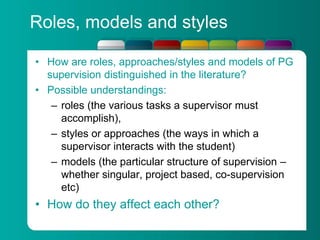
Roles, models and styles
• How are roles, approaches/styles and models of PG
supervision distinguished in the literature?
• Possible understandings:
– roles (the various tasks a supervisor must
accomplish),
– styles or approaches (the ways in which a
supervisor interacts with the student)
– models (the particular structure of supervision –
whether singular, project based, co-supervision
etc)
• How do they affect each other?
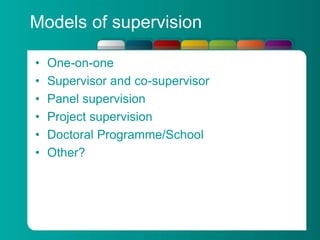
Models of supervision
• One-on-one
• Supervisor and co-supervisor
• Panel supervision
• Project supervision
• Doctoral Programme/School
• Other?
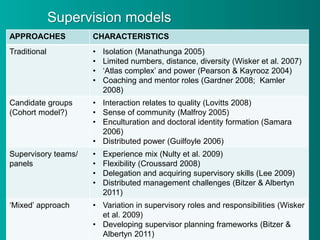
APPROACHES CHARACTERISTICS
Traditional • Isolation (Manathunga 2005)
• Limited numbers, distance, diversity (Wisker et al. 2007)
• ‘Atlas complex’ and power (Pearson & Kayrooz 2004)
• Coaching and mentor roles (Gardner 2008; Kamler
2008)
Candidate groups
(Cohort model?)
• Interaction relates to quality (Lovitts 2008)
• Sense of community (Malfroy 2005)
• Enculturation and doctoral identity formation (Samara
2006)
• Distributed power (Guilfoyle 2006)
Supervisory teams/
panels
• Experience mix (Nulty et al. 2009)
• Flexibility (Croussard 2008)
• Delegation and acquiring supervisory skills (Lee 2009)
• Distributed management challenges (Bitzer & Albertyn
2011)
‘Mixed’ approach • Variation in supervisory roles and responsibilities (Wisker
et al. 2009)
• Developing supervisor planning frameworks (Bitzer &
Albertyn 2011)
Supervision models
Institutional
processes
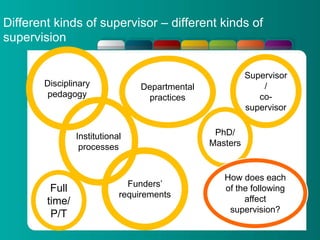
Different kinds of supervisor – different kinds of
supervision
Departmental
practices
Disciplinary
pedagogy
Funders’
requirements
Full
time/
P/T
Supervisor
/
co-
supervisor
PhD/
Masters
How does each
of the following
affect
supervision?
Two kinds of approach to supervision
(Wisker 2005)
Technical-
rationality
-emphasizes
technique
Negotiated order
-emphasizes
changes in
process
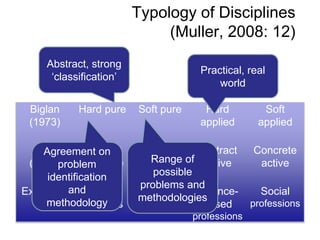
Typology of Disciplines
(Muller, 2008: 12)
Biglan
(1973)
Hard pure Soft pure Hard
applied
Soft
applied
Kolb
(1981)
Abstract
reflective
Concrete
Reflective
Abstract
active
Concrete
active
Examples Natural
sciences
Social
sciences
Science-
based
professions
Social
professions
Agreement on
problem
identification
and
methodology
Range of
possible
problems and
methodologies
Abstract, strong
‘classification’
Practical, real
world
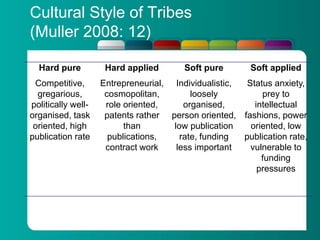
Cultural Style of Tribes
(Muller 2008: 12)
Hard pure Hard applied Soft pure Soft applied
Competitive,
gregarious,
politically well-
organised, task
oriented, high
publication rate
Entrepreneurial,
cosmopolitan,
role oriented,
patents rather
than
publications,
contract work
Individualistic,
loosely
organised,
person oriented,
low publication
rate, funding
less important
Status anxiety,
prey to
intellectual
fashions, power
oriented, low
publication rate,
vulnerable to
funding
pressures
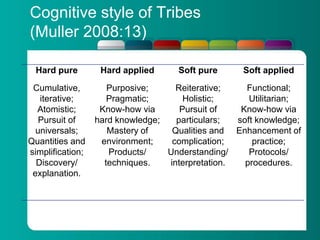
Cognitive style of Tribes
(Muller 2008:13)
Hard pure Hard applied Soft pure Soft applied
Cumulative,
iterative;
Atomistic;
Pursuit of
universals;
Quantities and
simplification;
Discovery/
explanation.
Purposive;
Pragmatic;
Know-how via
hard knowledge;
Mastery of
environment;
Products/
techniques.
Reiterative;
Holistic;
Pursuit of
particulars;
Qualities and
complication;
Understanding/
interpretation.
Functional;
Utilitarian;
Know-how via
soft knowledge;
Enhancement of
practice;
Protocols/
procedures.
Implications for supervision
(Muller 2008, Boughey 2010)
• Because the ‘hards’ enjoy more social
connectedness, teaching tends to be more
collaborative and what is taught tends not to be
contentious. As a result, ‘hards’ have more time
to devote to research.
• Research and supervision in ‘hard’ disciplines
tends to be highly integrated. This means that
less time is spent on supervision (Smelby 1996,
2000) -‘hards’ spend less than a quarter of the
time spent by ‘softs’ on supervision.
• Extent of ‘identity work’ a factor in supervision
process (Harrison 2010)
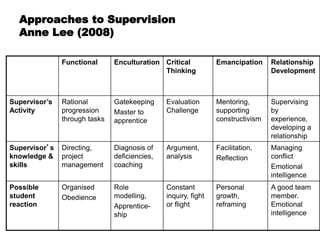
Approaches to Supervision
Anne Lee (2008)
Functional Enculturation Critical
Thinking
Emancipation Relationship
Development
Supervisor’s
Activity
Rational
progression
through tasks
Gatekeeping
Master to
apprentice
Evaluation
Challenge
Mentoring,
supporting
constructivism
Supervising
by
experience,
developing a
relationship
Supervisor’s
knowledge &
skills
Directing,
project
management
Diagnosis of
deficiencies,
coaching
Argument,
analysis
Facilitation,
Reflection
Managing
conflict
Emotional
intelligence
Possible
student
reaction
Organised
Obedience
Role
modelling,
Apprentice-
ship
Constant
inquiry, fight
or flight
Personal
growth,
reframing
A good team
member.
Emotional
intelligence
What does a supervisor do?
• If you had to represent a supervisor in a picture, what
would she look like?
– Think about the multiple roles of the supervisor
– Are these all included in your institution's policy on
supervision?
Selection and Appointment of
Supervisors
• Who chooses the supervisor?
• When and how are they officially appointed?
• What model of supervision is preferred in
your department / faculty / discipline?
• What support is provided to supervisors?

Phase-1-Day-1-Session-3-Models-and-Styles-of-Supervision (2).pptx

  • 1.
  • 2.
    Roles, models andstyles • How are roles, approaches/styles and models of PG supervision distinguished in the literature? • Possible understandings: – roles (the various tasks a supervisor must accomplish), – styles or approaches (the ways in which a supervisor interacts with the student) – models (the particular structure of supervision – whether singular, project based, co-supervision etc) • How do they affect each other?
  • 3.
    Models of supervision •One-on-one • Supervisor and co-supervisor • Panel supervision • Project supervision • Doctoral Programme/School • Other?
  • 4.
    APPROACHES CHARACTERISTICS Traditional •Isolation (Manathunga 2005) • Limited numbers, distance, diversity (Wisker et al. 2007) • ‘Atlas complex’ and power (Pearson & Kayrooz 2004) • Coaching and mentor roles (Gardner 2008; Kamler 2008) Candidate groups (Cohort model?) • Interaction relates to quality (Lovitts 2008) • Sense of community (Malfroy 2005) • Enculturation and doctoral identity formation (Samara 2006) • Distributed power (Guilfoyle 2006) Supervisory teams/ panels • Experience mix (Nulty et al. 2009) • Flexibility (Croussard 2008) • Delegation and acquiring supervisory skills (Lee 2009) • Distributed management challenges (Bitzer & Albertyn 2011) ‘Mixed’ approach • Variation in supervisory roles and responsibilities (Wisker et al. 2009) • Developing supervisor planning frameworks (Bitzer & Albertyn 2011) Supervision models
  • 5.
    Institutional processes Different kinds ofsupervisor – different kinds of supervision Departmental practices Disciplinary pedagogy Funders’ requirements Full time/ P/T Supervisor / co- supervisor PhD/ Masters How does each of the following affect supervision?
  • 6.
    Two kinds ofapproach to supervision (Wisker 2005) Technical- rationality -emphasizes technique Negotiated order -emphasizes changes in process
  • 7.
    Typology of Disciplines (Muller,2008: 12) Biglan (1973) Hard pure Soft pure Hard applied Soft applied Kolb (1981) Abstract reflective Concrete Reflective Abstract active Concrete active Examples Natural sciences Social sciences Science- based professions Social professions Agreement on problem identification and methodology Range of possible problems and methodologies Abstract, strong ‘classification’ Practical, real world
  • 8.
    Cultural Style ofTribes (Muller 2008: 12) Hard pure Hard applied Soft pure Soft applied Competitive, gregarious, politically well- organised, task oriented, high publication rate Entrepreneurial, cosmopolitan, role oriented, patents rather than publications, contract work Individualistic, loosely organised, person oriented, low publication rate, funding less important Status anxiety, prey to intellectual fashions, power oriented, low publication rate, vulnerable to funding pressures
  • 9.
    Cognitive style ofTribes (Muller 2008:13) Hard pure Hard applied Soft pure Soft applied Cumulative, iterative; Atomistic; Pursuit of universals; Quantities and simplification; Discovery/ explanation. Purposive; Pragmatic; Know-how via hard knowledge; Mastery of environment; Products/ techniques. Reiterative; Holistic; Pursuit of particulars; Qualities and complication; Understanding/ interpretation. Functional; Utilitarian; Know-how via soft knowledge; Enhancement of practice; Protocols/ procedures.
  • 10.
    Implications for supervision (Muller2008, Boughey 2010) • Because the ‘hards’ enjoy more social connectedness, teaching tends to be more collaborative and what is taught tends not to be contentious. As a result, ‘hards’ have more time to devote to research. • Research and supervision in ‘hard’ disciplines tends to be highly integrated. This means that less time is spent on supervision (Smelby 1996, 2000) -‘hards’ spend less than a quarter of the time spent by ‘softs’ on supervision. • Extent of ‘identity work’ a factor in supervision process (Harrison 2010)
  • 11.
    Approaches to Supervision AnneLee (2008) Functional Enculturation Critical Thinking Emancipation Relationship Development Supervisor’s Activity Rational progression through tasks Gatekeeping Master to apprentice Evaluation Challenge Mentoring, supporting constructivism Supervising by experience, developing a relationship Supervisor’s knowledge & skills Directing, project management Diagnosis of deficiencies, coaching Argument, analysis Facilitation, Reflection Managing conflict Emotional intelligence Possible student reaction Organised Obedience Role modelling, Apprentice- ship Constant inquiry, fight or flight Personal growth, reframing A good team member. Emotional intelligence
  • 12.
    What does asupervisor do? • If you had to represent a supervisor in a picture, what would she look like? – Think about the multiple roles of the supervisor – Are these all included in your institution's policy on supervision?
  • 13.
    Selection and Appointmentof Supervisors • Who chooses the supervisor? • When and how are they officially appointed? • What model of supervision is preferred in your department / faculty / discipline? • What support is provided to supervisors?

Editor's Notes

  • #2 This session encompasses pages 36 to 39 of old participant guide. Begin by going through this PPT (which is referred to at top of page 36) and then move onto the tasks as per pages 36 to 39 as time permits.
  • #14 Now move to pages 36 to 39