A Handbook for Doctoral Supervisors 3rd Edition Stan Taylor
A Handbook for Doctoral Supervisors 3rd Edition Stan Taylor
A Handbook for Doctoral Supervisors 3rd Edition Stan Taylor
A Handbook for Doctoral Supervisors 3rd Edition Stan Taylor
A Handbook for Doctoral Supervisors 3rd Edition Stan Taylor
1.
Visit ebookfinal.com todownload the full version and
explore more ebooks or textbooks
A Handbook for Doctoral Supervisors 3rd Edition
Stan Taylor
_____ Click the link below to download _____
https://ebookfinal.com/download/a-handbook-for-doctoral-
supervisors-3rd-edition-stan-taylor/
Explore and download more ebooks or textbook at ebookfinal.com
2.
Here are somerecommended products that we believe you will be
interested in. You can click the link to download.
Thesis and Dissertation Writing in a Second Language A
Handbook for Supervisors 1st Edition Brian Paltridge
https://ebookfinal.com/download/thesis-and-dissertation-writing-in-a-
second-language-a-handbook-for-supervisors-1st-edition-brian-
paltridge/
Logic 3rd Edition Stan Baronett
https://ebookfinal.com/download/logic-3rd-edition-stan-baronett/
How to get a PhD a handbook for students and their
supervisors 4th ed., rev. and updated Edition Pugh
https://ebookfinal.com/download/how-to-get-a-phd-a-handbook-for-
students-and-their-supervisors-4th-ed-rev-and-updated-edition-pugh/
Teach Yourself Electricity and Electronics 3rd Edition
Stan Gibilisco
https://ebookfinal.com/download/teach-yourself-electricity-and-
electronics-3rd-edition-stan-gibilisco/
3.
Veterinary Parasitology 3rded Edition Taylor
https://ebookfinal.com/download/veterinary-parasitology-3rd-ed-
edition-taylor/
A history of the Vietnamese 3rd printing. Edition Keith
Weller Taylor
https://ebookfinal.com/download/a-history-of-the-vietnamese-3rd-
printing-edition-keith-weller-taylor/
Ethical and legal issues for doctoral nursing students a
textbook for students and reference for nurse leaders 1st
Edition Peirce
https://ebookfinal.com/download/ethical-and-legal-issues-for-doctoral-
nursing-students-a-textbook-for-students-and-reference-for-nurse-
leaders-1st-edition-peirce/
Stan Lee s Master Class LQ 1st Edition Stan Lee
https://ebookfinal.com/download/stan-lee-s-master-class-lq-1st-
edition-stan-lee/
How to Handle Staff Misconduct A Practical Guide for
School Principals and Supervisors 2nd Edition C. Edward
Lawrence
https://ebookfinal.com/download/how-to-handle-staff-misconduct-a-
practical-guide-for-school-principals-and-supervisors-2nd-edition-c-
edward-lawrence/
5.
A Handbook forDoctoral Supervisors 3rd Edition Stan
Taylor Digital Instant Download
Author(s): Stan Taylor, Margaret Kiley
ISBN(s): 9781003432159, 1003432158
Edition: 3
File Details: PDF, 4.74 MB
Year: 2024
Language: english
7.
A Handbook forDoctoral Supervisors
Based on the latest research and covering key recent developments in supervisory
practice, the third edition of A Handbook for Doctoral Supervisors is designed to
support new and established supervisors in reviewing how they may make their
supervision practice more effective day to day. This new edition is fully updated
and extended to provide guidance on all aspects of the supervisory role, including:
� Recruitment and selection, including placing greater emphasis on candidate
diversity;
� Establishing and managing research projects, from initial conception through
to completion and examination;
� Relationships with candidates and co-supervisors, and the implementation of
an explicit respect agenda in relationships with candidates;
� Providing personal, professional, and career advice, including monitoring the
wellbeing and mental health of doctoral candidates;
� The implications for supervisors of the rapid adoption of online supervision
and examination.
With a self-interrogatory style which enables supervisors to reflect upon and,
where appropriate, consider how to enhance their practice, this key handbook is a
crucial read for those directly involved in doctoral supervision, those who manage
supervisors, as well as policy-makers, administrators, and scholars within the field
of doctoral education.
Stan Taylor is an Honorary Professor in the School of Education, Durham Uni
versity, UK. He is the author of the UK Council for Graduate Education's Fra
mework for Good Supervisory Practice and was the founding Chair of its Research
Supervisors Network.
Margaret Kiley holds an adjunct position in the Research School of Humanities
and Arts at the Australian National University, Canberra.
9.
A Handbook forDoctoral
Supervisors
Third Edition
Stan Taylor and Margaret Kiley
Contents
Acknowledgements ix
Introduction 1
PARTI
The context 5
1 The overall context 7
2 The institutional context 20
3 The disciplinary context 38
4 The programme context 51
PART II
Preparing the ground 65
5 Recruitment and selection 67
6 Working relationships: 1. Candidates 82
7 Working relationships: 2. Co-supervisors 100
PART III
Supporting the research project 115
8 Academic advice and support: Approaching research 117
9 Academic guidance and support: The research project 130
10 Encouraging writing and giving feedback 145
14.
viii Contents
11 Keepingthe research on track and monitoring progress 160
PART IV
Supporting the candidate 171
12 Pastoral support 173
13 Supporting professional knowledge and skills 186
14 Supporting preparation for careers 198
PART V
Supporting diversity 213
15 Supporting diversity: 1. Non-traditional candidates 215
16 Supporting diversity: 2. International candidates 230
17 Supporting diversity: 3. Part-time and off-campus candidates 246
PART VI
Completion and examination 263
18 Drafting and submission 265
19 Examination 279
PART VII
Enhancing practice 295
20 Evaluation, reflection, recognition, and dissemination 297
Conclusions 312
Index 316
15.
Acknowledgements
We gratefully acknowledgethe following for permission to reproduce copyright
material:
Australian Council for Graduate Research for an extract from AGCR Good
Practice Guidelines for Aboriginal and Torres Strait Research Education.
Elly Grossman and Nigel Crother for an extract from Grossman, E. and Crowther,
N. (2015) Co-supervision in postgraduate training: ensuring the right hand knows
what the left hand is doing. South African Journal of Science, 111(11–12): 104–111.
Erica McWilliam for an extract from McWilliam, E. (2004) On being accoun
table: risk-consciousness and the doctoral supervisor. Paper submitted for full
refereeing for the Australian Association for Research in Education Conference,
Melbourne 28 November–2 December 2004.
Eva Brodin and Anders Sonesson for an extract from the Lund University Doc
toral Supervision Syllabus.
Emerald Publishing Ltd. for an extract from Kuzhabekova, A. and Temer
bayeva, A. (2018) The role of conferences in doctoral student socialization. Stu
dies in Graduate and Postdoctoral Education, 9(2): 181–196.
Kay Guccione for an extract from Difficult Conversation Planner for Supervisors.
Margaret Kiley for permission to reproduce Kiley, M. (2015). Possible Issues to
Discuss with Co-supervisors.
Martin McAndrew of the Postgraduate Advisory Service and Joanna Kesika,
Student Counselling Service, Trinity College Dublin, Ireland for extracts from
their original presentation on ‘Staying Well’ at the Irish Universities Association
conference on Research Supervision: Growing Excellence held at University College,
Dublin, 19 May 2023.
Monash University, Australia, for an extract from the Supervision Framework.
Robin Humphrey and Bob Simpson for an extract from Humphrey, R. and
Simpson, B. (2013) Negotiating a ‘scary gap’: doctoral candidates, ‘writing up’
qualitative data and the contemporary supervisory relationship. Journal of Educa
tion and Training Studies, 1(1): 1–10.
Springer for extracts from: Salminen-Karlsson, M. and Wallgren, L. (2008) The
interaction of academic and industrial supervisors in graduate education. Higher
Education, 56: 77–93 and Warnock, D. and Appel, S. (2012) Learning the
16.
x Acknowledgements
unwritten rules:working class students in graduate school. Innovations in Higher
Education, 37: 307–321.
Taylor and Francis for extracts from:
Donelan, H. (2016) Social media for professional development and networking
opportunities in academia. Journal of Further and Higher Education, 40(5): 706–
729; Feather, D. and McDermott, K. (2014) The role of new doctoral supervisors in
higher education – a reflective view of literature and experience using two case stu
dies. Research in Post-Compulsory Education, 19(2): 165–176; Gardner, S. (2008)
‘What’s too much and what’s too little’: The process of becoming an independent
researcher in doctoral education. Journal of Higher Education, 79(3): 326–350;
Gurr, G. (2001) Negotiating the ‘rackety bridge’ – a dynamic model for aligning
supervisory style with research student development. Higher Education Research and
Development, 20(1): 81–92; Halse, C. (2011) Becoming a supervisor: the impact of
doctoral supervision on supervisors’ learning. Studies in Higher Education, 36(5):
557–570; Halse, C. and Malfoy, J. (2010) Retheorising doctoral advising as profes
sional work. Studies in Higher Education, 35(1): 79–92; Hughes, C. (2011) Plea
sure, change and values in doctoral pedagogy. Studies in Higher Education, 36(6):
621–635; Johnson, L., Lee, A., and Green, B. (2000) The PhD and the autonomous
self: gender, rationality and postgraduate pedagogy. Studies in Higher Education, 25
(2): 135–147; Kidman, J., Manathunga, C., and Cornforth. S. (2017) Intercultural
PhD supervision: exploring the hidden curriculum in a social science faculty doctoral
programme. Higher Education Research and Development; Lee, A. and McKenzie, J.
(2011) Evaluating doctoral supervision: tensions in eliciting students’ perspectives.
Innovations in Education and Teaching International, 48(1): 69–78; Lines, L.
(2016) Substantive editing as a form of plagiarism among postgraduate students in
Australia. Assessment and Evaluation in Higher Education. DOI: 10.1080/
02602938.2015.1013919; Maher, M., Feldon, D., Timmerman, B., and Chao, J.
(2014) Faculty perceptions of common challenges encountered by novice doctoral
writers. Higher Education Research and Development, 33(4): 699–711; Mason, S.
and Merga, M. (2018) Integrating publications in the social science doctoral thesis by
publication. Higher Education Research & Development. DOI: 10.1080/
07294360.2018.1498641; McAlpine, L. (2013) Doctoral supervision: not an indi
vidual but a collective institutional responsibility. Infancia y Aprendizaje Journal for
the Study of Education and Development, 36(3): 259–280; Ostrove, J., Stewart, A.,
and Curtin, N. (2011) Social class and belonging: implications for graduate students.
The Journal of Higher Education, 82(6): 748–774; Robertson, M. (2017) Team
modes and power: supervision of doctoral students. Higher Education Research and
Development. DOI: 10.1080/07294360.2016.1208157. Trudgett, M. (2014)
Supervision provided to Indigenous Australian doctoral students: a black and white
issue. Higher Education Research & Development, 33(5): 1035–1048; Wisker, G. and
Robinson, G. (2013) Doctoral ‘orphans’: nurturing and supporting the success of
postgraduates who have lost their supervisors. Higher Education Research and
Development, 32(2): 300–313.
Macquarie University, Australia, for an extract from Academic Promotions.
17.
Acknowledgements xi
Jannie Roedfor extracts from Roed. J. (2012) Labour of Love: Emotions and
Identities in Doctoral Supervision. EdD Thesis, University of Sussex.
Stellenbosch University, South Africa for an extract from Postgraduate Office,
Division for Research Development, Memorandum of Understanding.
The Institute of Professional Editors, Australia, for an extract from Guidelines
for Editing Research Theses.
The Publications Office of the European Union for an extract from The Eur
opean Qualifications Framework for Lifelong Learning.
The University of Adelaide, Australia, for an extract from the Research Student
Handbook: Supervisor Responsibilities.
The University of Birmingham, UK for an extract from the Supervision Record.
The University of Cumbria, UK. for an extract from Philpott, C. (2015) Rea
sons for doctoral non-completion: one non-completing doctoral student’s voice
on limitations in the academic literature. Practitioner Research in Higher Educa
tion, 9(1): 67–72.
The University of Edinburgh, UK, for an extract from the Code of Practice for
Supervisors and Research Students.
The University of Newcastle upon Tyne, UK, for an extract from the University
Handbook for Examiners of Research Degrees by Thesis.
The University of Otago, New Zealand, for extracts from the Induction Check
list for Supervisors and Peer Review of Teaching and Supervision.
The University of Queensland, Australia, for an extract from advertisement for
Aboriginal and Torres Strait Islander Scholarships.
The University of Western Australia, for an extract from the Graduate School:
Examiners’ Recommendation Form: Degree of Doctor of Philosophy.
The UK Council for Graduate Education for an extract from D. Halliday and G.
Clark (eds) Proceedings of the 2nd International Conference on Developments in
Doctoral Education and Training. Lichfield, UK Council for Graduate Education:
10–17.
Universities Australia, National Tertiary Education Union, Council of Aus
tralian Postgraduate Associations, and Australian Council of Graduate Research
for an extract from Principles for Respectful Supervisory Relationships.
University College Dublin, Ireland, for an extract from Policy on Inter-Institu
tional Co-Supervisory Agreements (including Cotutelle) for PhD Students.
Finally, we would like to thank Professor Alexander Easton, Director of the
Institute for Advanced Studies of the University of Durham, for providing facilities
in the magnificent setting of Cosin’s Hall for us to meet and finalise the drafting
of the book. We are also very grateful to the Manager of the Institute, Linda
Crowe, for looking after us so well.
19.
Introduction
In 2005, Routledgepublished the first edition of A Handbook for Doctoral
Supervisors written by Stan Taylor and the late Nigel Beasley, to whose memory
this edition is dedicated. The book was well received and was widely used as a
textbook and a source for professional development by supervisors across the
globe. Over time, it became out of date and Routledge commissioned a second
edition written by Stan Taylor, Margaret Kiley, and Robin Humphrey which was
published in 2018.
It is a measure of the pace of change in doctoral education that, six years later,
there is a need for a further edition. This reflects the fact that, in the relatively
short space of time since the second edition was published, there have been sig
nificant developments. These include variously; a much stronger focus on ensuring
equality of opportunity in access, particularly for indigenous populations and other
ethnic and racial minorities; a greater emphasis on ‘respect’ in supervisory-candi
date relationships; a move towards online supervision and online examination; an
increased realisation of the need to offer doctoral candidates appropriate personal
support during their studies, particularly in relation to their wellbeing and mental
health; and a heightened awareness of the importance of assisting them to prepare
them for careers outside as well as inside academia.
These developments pre-dated the Covid-19 outbreak of 2020–2022 but in
many cases their importance was dramatically amplified during the pandemic,
leaving a legacy that is still continuing. All of them have impacted the roles of
supervisors, particularly in terms of recruiting and selecting candidates, managing
working relationships, offering academic advice and support in the online envir
onment, and providing personal, professional, and career support. These changes
have attracted a considerable amount of attention from researchers in the field of
doctoral education, and this has been reflected in a rapid growth in published
research.
The aims of this new edition are to incorporate these changes in the roles of
supervisors into the content of the Handbook and to bring the latter up to date
with the latest research. This has involved a substantial re-writing of many of the
original chapters to incorporate new themes and new materials.
DOI: 10.4324/9781003432159-1
20.
2 Introduction
It hasalso involved a change of co-authors; Robin Humphrey has now retired,
and indicated, with regret, that he would not be involved in a third edition. This
version has then been co-authored by Stan Taylor and Margaret Kiley.
As with the first and second editions, the third is aimed at the potential or
established supervisor/advisor facing the changing world of doctoral super
vision and considering what makes for effective supervision in their day-to-day
practice.
We are aware that, while there is no hard and fast rule, the term ‘supervisor’
tends to be used in most of Europe, the UK, and Oceania. Elsewhere, parti
cularly in the United States and countries with systems based upon that model,
the more common term is ‘advisor’. We are also aware that this is not just a
matter of style but also of substance; ‘supervisor’ implies a wider range of
intervention with regard to the candidate and to the research project than
‘advisor’. But, while we have written this book for supervisors (and used the
term throughout) we believe that most, if not all, of it is also relevant to
advisors, that is, in covering the roles of the former we are also covering those
of the latter.
With regard to ‘supervision’, it may be noted that our use of this term is pri
marily confined to the supervision of the candidate’s research project. It does not
include any taught components, but we do think it is important that, particularly
in the case of more structured doctorates, supervisors are aware of the whole
doctoral programme in order that they can, where appropriate, advise candidates
how to build upon their previous studies.
With regard to ‘effective’, this could be taken as meaning simply getting the
candidate over the line to a doctorate. But we believe there is more to it than that
in terms of both ‘outcomes’ and ‘outputs’. With regard to the former, ‘effective
ness’ means a high-quality submission, completion on time or as near as possible,
and dissemination to the subject community; with regard to the latter, it means
that the candidate has successfully developed the creative, critical, and analytical
skills and knowledge of a researcher and laid the basis for their future career inside,
or increasingly outside, academia.
So, in our view, an effective supervisor is one who supports candidates to:
� where appropriate, initiate and plan a research project;
� acquire the research skills to undertake it and gain adequate access to
resources;
� complete it on time;
� produce a high-quality submission;
� be successful in examination;
� disseminate the results of their research;
� develop the creative, critical, and analytical skills and knowledge of a
researcher;
� lay the basis for their future career.
21.
Introduction 3
We believethat, in order to be effective as defined above, supervisors need to:
� have a knowledge and understanding of the context within which they are
supervising doctoral candidates, including recent changes accelerated by the
Covid-19 pandemic;
� be able to recruit, select and support candidates from diverse populations and
assist them to be successful and complete on time;
� establish positive and respectful working relationships with them and, where
appropriate, with co-supervisors;
� support candidates’ research projects;
� assist in their personal development, including their wellbeing and mental health;
� support their professional development, including networking, presentations,
publications and the acquisition of teaching skills;
� support their career development, including preparation for employment
inside and outside academia;
� in undertaking the above, to be aware of the benefits of and challenges facing
non-traditional domestic candidates, international candidates, and those
studying part-time or off-campus;
� assist candidates through the processes of completion of their thesis or dis
sertation or publications or artefacts and final examination, including exam
ination online; and
� be able to evaluate and enhance their practice and, where appropriate, dis
seminate good practice.
In accordance with this model, we have divided the book into seven parts.
Part I deals with the various contexts of supervision divided into the overall,
institutional, disciplinary, and programme contexts respectively.
Part II is concerned with preparing the ground in terms of recruiting and
selecting candidates, forming working relationships with them, and managing
relationships with co-supervisors.
Part III is devoted to supporting the research project, including initiating candidates
into research, assisting them to get their projects up and running and to overcome any
initial academic problems, encouraging them to write early and often and giving effective
feedback, and helping them to keep projects on track while monitoring their progress.
Part IV is concerned with supporting candidates in a range of ways including
personal, academic and career development
Part V is concerned with recognising and responding to domestic and interna
tional diversity among the candidate population and diversity in modes of study in
terms of candidates studying part-time and/or off-campus.
Part VI is devoted to the final stages of the doctorate including drafting and
submission and examination.
Part VII is concerned with how doctoral supervisors might go about evaluating
their practice, and disseminating it, as well as gaining recognition and reward for
good practice.
22.
4 Introduction
In additionto describing the content of the book, it is also appropriate to
comment upon the approach adopted in writing it. In order to illustrate effective
practice, we have included numerous examples drawn from a wide range of sour
ces. To enable readers to reflect, we have supplied prompts at key points in the
narrative to encourage readers to interrogate their own practice. Our hope is that,
through this process, readers will be able to personally engage with their practice
and, where appropriate, enhance it.
Finally, it may be noted that all of the links to online materials in the text were
accessed on 5 December 2023.
Chapter 1
The overallcontext
Introduction
Supervisors tend to be immersed in their busy academic and/or professional lives,
not to mention their personal ones, and seldom have the time to maintain an
overview of ongoing developments and research in doctoral education. As a con
sequence, many are experiencing new demands without necessarily understanding
the wider context within which they arise. The purpose of the present chapter is to
try to set that wider context. It is based on the work of Taylor (2012, 2023) and
begins with a brief summary of the historical origins and evolution of doctoral
education from its modern origins through to the 1980s and then looks at sub
sequent developments that have transformed the field and the context of
supervision.
The origins and evolution of doctoral education
Doctorates have their origins in the mediaeval universities when they were used
primarily as a means of licensing teachers in the professions of medicine, law, and
theology (Bernstein et al. 2014, Amaral and Carvalho 2020). This paradigm
remained dominant until, in the early 19th century, a number of eminent
Enlightenment thinkers in Prussia began to advocate a new kind of university, one
in which the core mission would be the creation of original knowledge and
understanding and in which research would be pre-eminent. These advocates
included Friedrich Schliermacher, Johann Fichte, and Wilhelm von Humboldt
(see Watson 2010).
It was von Humboldt who was able to implement this new model when, in
1809, he became Under-Secretary in the Ministry of the Interior and responsible
for education in Prussia. Although he was in office for a mere 16 months, he
initiated reforms designed, as Nybom (2003: 152) has put it, ‘to create an entirely
new type of academic institutional order and a new type of academic’.
With regard to the former, he took the lead in reorganising the University of
Berlin which in 1810 became the world’s first explicitly research-led university.
With regard to the latter, the new type of academic was to be engaged both in
DOI: 10.4324/9781003432159-3
that their tacticsin 1906 were, on the whole, successful; Mome,
though a catastrophe, was due to accident or carelessness that could
easily have been avoided by a competent commander.
That an outbreak should have occurred at Mapumulo subsequent to
the débâcle in Zululand, is remarkable chiefly as showing lack of
territorial organization. Although a certain amount had been
introduced at Nkandhla, between the arrival of Bambata and the
action at Mome, the army daily becoming more crafty and efficient, it
had reference only to such rebels as had actually massed at that
place. A supreme organizer was wanting, one who, whilst directing at
Nkandhla, could have so far enforced obedience as to control
situations such as those at Umsinga, and especially in Mapumulo and
Ndwedwe divisions. That there was this want was undoubtedly felt by
every insurgent. They knew too much of Tshaka's successes to do
otherwise than realize that they were weak, and see what such
weakness was due to. That is why Dinuzulu's personality and
presence was so much in demand. That is why, for instance, one
heard of such talk as that they would seize and carry him off to lead
them whether he willed it or not. To have a visible leader and to
submit to his direction, that was the height of their ambition. Only then
did they feel themselves to be a people, possessed to some extent of
their former solidarity. To sacrifice their lives for someone is
everything, to have to do so for an absent reality, nothing.
Another lesson is the necessity of pursuing the enemy the moment
he starts hostilities. Quick pursuit is what every Zulu holds as a
primary maxim of warfare. Such action inspires loyalists with
confidence, because affording them protection at the time they most
require it.
The policy of the rebels having been to avoid conflict whenever the
conditions were unfavourable, meant that the campaign resolved
itself into one where the troops had always to assume the offensive.
[305] The enemy deliberately invited being hunted in the forests in
which he took refuge. There was no other alternative but to 'hunt' him.
His perpetual and masterly evasiveness was resorted to just because
felt to be the most telling and safest tactics to adopt. He knew that,
man for man, he was infinitely better acquainted with forests,
28.
streams, dongas, caves,hills and valleys than the Europeans, most
of whom had spent the greater part of their lives in towns at a
distance and in sedentary occupations. But, whilst practising these
methods, the motive was invariably to draw the troops on after him in
the hope of small parties becoming detached when the opportunity
was smartly seized, and the severest blow possible struck. This being
the game, can it be wondered at that the rebels were severely
punished whenever they were come upon? For it must be
remembered that, up to the moment of Mome, nothing had been
further from their minds than to surrender. Ample opportunities for so
doing, notably when the troops first went to Cetshwayo's grave, were
afforded, but the negotiations fell through because they felt, and even
publicly stated that they had not had enough fighting. From their point
of view, it was in their interest to continue.
This watchful evasiveness, then, was the essence of the situation at
Nkandhla. Hence it sometimes happened that the troops drove one or
other of the bushes in the belief the enemy was there, whereas, as a
matter of fact, he was not there at all, but at Macala ten miles off or
elsewhere, having slipped away during the night.
In these circumstances, it was soon realized that, not 2,500, but
10,000 men were required to deal with Nkandhla alone, although the
rebels themselves did not exceed 2,000 in number. In no other way
was it possible to put a cordon round the forests, and, by confining
the enemy, speedily starve him into submission.
Connected with the same tactics was the waylaying of a force when
on the march. This generally took place at a carefully-selected
position, from which there was an immediate and safe line of retreat.
Instances of this occurred at Mpanza, Bobe, Macrae's store, Peyana,
Insuze and Ponjwana. At all, except Mpanza and others not here
named, the method was to divide the impi into two bodies, one to
attack the front, and the other the rear, of the advancing column. And
the principle was observed, although the ground rendered the
application thereof extremely difficult. On no occasion did attack take
place in the open, as often happened during the Zulu War.
The only standing camp attacked was that of Leuchars at
Mpukunyoni. This took place at dawn, there being no shelter for the
29.
troops except theirsaddles.
At Macrae's store, the attack came just after sunset and later—the
only instance of night attack. When the offensive is assumed by
Zulus, the proper time to do so is just before dawn, unless the force
be a strong one, when battle would be given in broad daylight.
The rebels moved about to get food and seize cattle chiefly at night,
sometimes going ten or more miles for the purpose. Those wounded
in action, too, were removed after dark.
A close watch was always kept on each column, especially by spies
posted on hills, where, if out of rifle range, they did not mind whether
they exposed themselves or not.
Occasionally it happened that those who had fought against the
troops, but had been obliged to surrender, took up arms against their
own people. Several of such men were utilized as spies, and proved
invaluable.
European troops.—Having regard to the number of troops in the field,
the importance of the campaign, and the wide area covered by the
operations, it would seem the officer in supreme command should
have been given the rank of Brigadier or Major-General. The O.C.
Troops was, of course, a full Colonel, but, on being appointed over
Natal and Zululand, it would, perhaps, have been more in accord with
the general duties he had to perform, to have conferred on him a rank
conspicuously higher than that of any one else in his command. The
rank, however, seeing the campaign was being conducted by
Colonial troops, could have been conferred only by the local
authorities.
The want of a trained staff was much felt by each column.
"It is," says Sir Duncan McKenzie,[306] "of great importance that an
intelligence department should be formed on the soundest of
bases.... It is not sufficient that an intelligence officer should simply be
able to speak the language of the country. He should have all the
available information at his instant disposal and also be able to guide
or conduct his O.C. anywhere.... Intelligence officers should not be
attached to any regiment in peace-time, but in the event of a force
30.
being required inany district, the intelligence officer from that district
should be placed at the disposal of the column commander." All the
columns were supplied with excellent intelligence. To the fine work
done by Lieut. Hedges and Sergts. Calverley and Titlestad at
Nkandhla must be attributed much of the success met with in that
district.
The two points on which attention was, perhaps, chiefly concentrated
were (a) methods of dealing with the enemy when concealed in
forests, and (b) advanced guards. That such matters assumed the
importance they did, was due to the enemy habitually leaving the
initiative to be taken by the troops. The troops never went out to drive
forests, but some catastrophe was possible. The greatest
circumspection had invariably to be exercised, not so much because
unable to afford the loss of men, as because the loss would have
been absurdly magnified by the enemy to obtain further recruits.
The principal authority as to dealing with the enemy in the Nkandhla
forests is, of course, Sir Duncan McKenzie. "A General Officer
Commanding," he says, "at a place like Nkandhla should have 10,000
men at his disposal. I, however, derived confidence from the fact that
not above 2,000 rebels were in the bush, consequently greater risks
were taken than would have happened had they been more
numerous. The chief aim as to the drives was this: I fitted my force to
the bush, not the bush to my force. It was impossible to do the latter,
so I did the former. As soon as the intelligence, which was good,
showed in what part of the forests the enemy was, it was at once
driven.
"The forests could never have been completely driven at one time,
i.e. in one day. Empandhleni and a number of other places had to be
garrisoned, whilst the different camps had to be protected during the
actual operations. Such calls naturally greatly reduced the force
available for driving.
"I do not see how the driving could have been carried out more
effectively than was done with the men at my disposal. My tactics, of
course, would have been considerably altered had there been, say,
10,000 troops. I would, in that event, have put the men in a line as
31.
skirmishers, with smallsupports at intervals of every 500 yards, and
larger ones at points that appeared more dangerous.
"So long as there was no reverse or tight corner, I felt the levies were
all right, hence their being sent in with the troops, as they were to
assist in the drive.
"I always made a point of driving downhill as much as possible, so
that when the enemy was come upon, he would be obliged to charge
uphill."
Barker, who was more frequently attacked when actually on the
march than any other column commander, says of advanced guards:
"I would never allow the guard to be more than 300 yards from the
main body as, if further, I would not have been able to gallop up in
time on its being suddenly attacked.
"I had only one squadron as advanced guard between Noodsberg
camp and Dalipa (wattle plantation). It was formed of two troops in
front in sections of four (in close touch with each other), with two
troops close up on either side in support. The head of the main
column was, at the same time, marching in the centre, not more than
200 yards away. This order was adopted as I expected to be
attacked. The guard, in this way, were able to at once deliver a
counter attack, instead of falling back on the main body. Had they
been weaker, they would have been obliged to fall back.
"It is, moreover, necessary to have the guard so arranged that the
main body can be pushed forward to support whichever side the
attack comes from. In Native warfare, one can never tell what flank
will be threatened.
"I fully realized that the whole essence of the position lay in the
advanced guard. Hence, before the action at Ponjwana, having seen
Natives collecting the previous day along the route to be traversed, I
warned the officer in command to be on the alert. When the attack
came, sudden though it was, his men were ready in a moment to
engage the enemy."
One of the surprises of the campaign, in the opinion of competent
judges, was the prominent part played by infantry, e.g. D.L.I., N.R.R.
32.
and N.R. Becausea less showy arm, infantry has been apt to be
underrated in connection with Native warfare. It is, however, not too
much to say that any such opinions as existed in Natal have had to
be considerably modified on account of the consistently fine work that
was done at Nkandhla, and in the actions of Bobe, Mome and
Izinsimba. Not only was it found that a well-trained corps could march
twenty or even thirty miles a day, but able to take a share in the
fighting as effective as that of troops conveyed on horseback to the
scene of action. As Native wars of the future will probably be fought
on difficult and out-of-the-way ground, similar to that chosen in 1906,
it would be well to bear this fact in mind.
In going through thick bush held by the enemy, as the N.P. had to do
at Mpanza, it would appear advisable for the advanced guard to
dismount and hand horses to Nos. 3, as, in the event of attack, men
would then be able to reply at once, as well as stand together to
resist the rush. Horses are startled by the shouting inevitable on such
occasions, with the result that a man's time is taken up in trying to
keep his seat, thereby becoming practically hors de combat at a very
critical moment.
The following miscellaneous extracts are taken from an unpublished
general report by Sir Duncan McKenzie:
Transport.—"The majority of the transport was ox-transport; for
military operations, mule-transport is absolutely necessary....
Expense should not be considered in such an important matter.[307]
... The necessity of good conductors was apparent." Closer
supervision should be exercised by O.C. units than was done to
ensure that only the regulation weight per man is put on the waggons.
"Pack transport is absolutely necessary in rough country, and the
saddles should be carried on the waggons, so that they can be used
when the country will not permit of waggons accompanying the
troops."
Remounts.—"The loss of horses from hard work, exposure and want
of suitable food is bound to be heavy.... Steps should be taken to
enable the remount officer to know exactly where he can put his
finger on suitable horses when required.... The establishment of a
proper remount depôt is strongly recommended."
33.
Boots, clothing, etc.—"Theseshould be issued on repayment at cost
price and the articles should be of really good quality. The wear and
tear on clothing, and more especially on boots, was very heavy.... A
man without boots is useless."
Searchlights.—"Their usefulness for defensive purposes is of the
greatest value.... They should be so arranged that with one engine
and dynamo, two or more lights could be placed at different positions
in the defences."
Maxim Transport.—"Having seen practical results with the C.M.R.,
who carried their Maxims on pack mules led by Cape boys, and the
Natal Militia regiment, who carried theirs on pack horses led by a
mounted man, I certainly recommend that we should follow the
C.M.R. in this respect."
Stretcher-bearers.—"These are indispensable when fighting takes
place in the bush or rough country. There was no organized supply
until too late." Natives had to be employed at exorbitant rates.
Native levies.—Their value was largely discounted by the fact that
parts of many tribes had joined the rebels. "Their services came in
useful in clearing up after an engagement, collecting and driving
cattle, etc., and also using up the enemy's supplies. They require to
be led by experienced officers who are known to them and who are
also well acquainted with Native habits and customs. For operations,
they need to be stiffened with a good proportion of European troops."
Colonel Leuchars, who had exceptional opportunities of observing
them, is of opinion that "as a fighting force, they were useless, though
those under Sibindi (a Chief quite above the average) were, as far as
I know, keen to help the Government. The use I expected to make of
them was in skirmishing down broken, bushy valleys, but my
experience goes to show that for this work they were useless as,
although I succeeded, after some trouble, in extending them, they
would always, a little further down the valley, collect and march along
in groups. As scouts and camp followers, they were useful. In a lager,
through not being armed with rifles, they are only an encumbrance.
Their only use would be to skirmish through rough country known to
34.
be occupied bythe enemy, and this, as pointed out above, they failed
to do."
The Rexer guns.—"This arm," says McKenzie, "gave most
satisfactory results. Handiness and portability in rough country are its
chief advantages. It does not afford a large target for the enemy, as is
the case with the Maxim. No cases of jamming occurred. The number
of spare parts to be carried is few. On more than one occasion, the
gun was caught up by the gunner and used from the shoulder when,
owing to scrub and long grass, the tripod could not be used. The
present equipment for carrying the gun is not satisfactory.... Every
squadron of mounted men and company of infantry should have three
of these guns."
Branding of loot stock.—"It is imperative that all captured stock
should be at once branded with a distinctive mark. A responsible
officer with each column should be detailed for this purpose."
Miscellaneous.—No epidemic or cases of serious illness occurred.
The organization of the medical department was so carefully planned
and carried out that only four died from disease out of over 9,000
men in the field.
"Generally speaking, veterinary surgeons had more animals to look
after per man than it was possible to deal with."
"The establishment of a field bakery and consequent supply of fresh
bread was an excellent innovation."
Sufficient transport was always available, although at times the
demands were very heavy.
The making of roads through all inaccessible parts of the Colony
would appear to be necessary. The want of these was felt along both
sides of the Tugela. A belt of country, some five miles wide on either
side, needs attention, though that is by no means the only region in
Natal that is difficult of access. Only narrow and inexpensive roads
are required. These, in time of peace, would be of assistance to the
inhabitants in facilitating conveyance of produce to available markets,
and generally developing the locations.
MISCELLANEOUS.
35.
The lesson tobe learned from the poll tax is, of course, that no
taxation should be imposed on Natives without previously consulting
them in some way or another. It is, however, unnecessary to obtain
the views of more than a few of the leading and most influential
advisers. These would speedily reveal the attitude likely to be taken
up by the majority towards any such proposal.
The advisability of securing uniformity when promulgating measures
closely affecting the Natives is so obvious as to call for no special
comment.
The likelihood of some of the Native police (Government) taking part
in the Rebellion was realized at the outset, consequently, at such
places as Krantzkop and Mapumulo, men connected with the
divisions were removed to another part of the Colony, their places
being taken by others. Native police from such stations as Insuze,
Kearsney, Glendale, Umhlali and Stanger rebelled. Sixteen were
recognized, by their finger-prints, among the rebel prisoners, whilst at
least four were killed. About eighty Durban Borough police are said to
have taken up arms.
On the other hand, out of the whole of the Nongqai, whose members
and ex-members numbered some thousands, only one man, who left
the force some twenty years previously, is known to have joined the
enemy. Full and careful inquiry was made in the matter by Chief
Commissioner Mansel. This highly creditable state of affairs may be
accounted for by the fact that, during the many years Mansel had
control of the force, he never allowed any one to serve as 'substitute'
for a regular member. An account of the Nongqai will be found in
Appendix XI.
The part taken by Christian Natives in the Insurrection was a large
and prominent one. The teaching of many Native preachers,
generally belonging to Ethiopian denominations, was of a distinctly
seditious character. Here, for instance, is a type of an address
frequently repeated in 1906 in a location within the vicinity of
Greytown: "The end of the age is at hand! On the black race did God
originally bestow the right of governing. The race, however, failed to
acquire the art. Now is the time drawing to a close. The right to
govern is reverting to its original possessors. Authority will be
36.
conferred on theblack race, and they will now be exalted to a position
above the whites. You shall enjoy complete ascendancy over
Europeans, for the power has at length been restored to you by the
Almighty. Even were actual conflicts to occur between you and the
whites, you will surely put them to flight, for God is standing by you."
The services were usually held in out-of-the-way places, and always
out of hearing of Europeans or their Native agents. It was found
exceedingly difficult to obtain sufficient evidence to prosecute, even
though sedition was known to be constantly preached. When
hostilities actually broke out, many of these men determined to
practise what they had preached; they accordingly broke away from
mission stations, notably in Mapumulo, Ndwedwe and Umsinga
divisions, and joined the rebels.
In July, 1907, it was found that of the Native prisoners then in Natal
gaols, 418 were Christians. Of this number, 204 were ordinary
criminals, whilst 214 had been convicted of rebellion.[308] Of the latter
figure, seven were preachers. The foregoing totals, which are below
the actual numbers, owing to the difficulty of ascertaining who were
converts, were obtained subsequent to the release of about 500
rebels, among whom other so-called Christians would probably have
been found.
In addition to the above, several preachers and many members of
different denominations were shot during the operations. Hunt and
Armstrong, it will be remembered, were murdered by a band of
mission Natives.
It is but fair to add that many of the Christian Natives who rebelled
were not attached to any recognized missionary body at the time they
did so.
A number of other matters, which might have been noticed here,
have already been sufficiently dealt with in preceding chapters. The
Native Affairs Commission drew attention to various reforms in
administration, many of which have already been introduced, such as
the appointment of a Council for Native Affairs and Commissioners,
[309] limitation of interest on loans, various problems connected with
labour, and compulsory service on public works.
37.
The fact thatnone of the Magistrates of such districts as Mahlabatini
(H.M. Stainbank, later J.Y. Gibson), Nongoma (G.W. Armstrong), and
Nkandhla (B. Colenbrander), in Zululand, and Umsinga (A.E.
Harrington) and Mapumulo (T. Maxwell), in Natal, were withdrawn,
but continued to discharge the duties of their office throughout the
Rebellion, tended to influence and reassure many European farmers,
storekeepers and others, preventing them from getting into a panic,
and, by flying off to other parts for protection, making matters
considerably worse than they were. With the troops often operating at
a distance, there is no doubt considerable danger was run of any of
these magistracies being attacked and the officials murdered. As very
little protection was immediately available, sometimes even with the
Native police disaffected, it would have been comparatively easy for
any band of determined rebels to have brought about one or more of
such results before assistance could have been rendered.
Much credit is due to Magistrates generally for the admirable manner
in which they retained a hold on the Natives of their districts
throughout the period of unrest. Occasionally, however, scares
among Europeans could not be prevented. Those at Greytown and
Nqutu have already been noticed; another occurred at
Pietermaritzburg.
It will already have been gathered that many loyalists, especially
those of tribes within the area of disturbance, stood in an extremely
invidious and dangerous position. Too little consideration is given to
the fact that, unless promptly supported by Government forces,
loyalists are liable to be murdered or their property looted. When an
outbreak occurs, it is almost as important to support the well-affected
as it is to operate against the insurgents themselves. The reason is
clear. If you do not back up those on your side when in danger, do not
be surprised if, in your absence, they are coerced into taking up arms
against you, and so add greatly to your difficulties.
FOOTNOTES:
[304] Except to the extent indicated on p. 63.
38.
[305] Perhaps theprincipal feature of the rebels' tactics was that
the troops should assume the offensive.
[306] General Report. Sept. 1906 (not published).
[307] In his report for 1906, Col. Bru-de-Wold observes: "The
recent operations have shown the absolute necessity for mobile
transport, as rapidity of movement is the secret of success where
Natives are concerned; ox-transport is far too slow to meet the
requirements."
[308] Those convicted of rebellion were about 5·3 per cent. of the
total number of rebel prisoners, less the 500 referred to in the text.
[309] The Union Government has abolished both the Council and
the Commissioners, so that Natal is now practically in the same
position in which she was before the Rebellion.
39.
XX.
NATIVE AFFAIRS COMMISSION.—VISITOF DINUZULU TO
PIETERMARITZBURG.—MURDERS OF LOYALISTS.—
ESCAPE OF BAMBATA'S WIFE AND CHILDREN FROM
USUTU.—REMOBILIZATION OF MILITIA TO ARREST
DINUZULU.
As far back as June, 1906, the Prime Minister had informed the
Legislative Assembly that certain bills, prepared by the Native Affairs
Department, and of the greatest importance in connection with Native
administration, would be laid on the table of the House. At the same
time, the Government was of opinion that the scope of these should
be extended. It had, accordingly, been deemed advisable to appoint a
Commission to inquire into the whole subject of Native administration
and legislation. In this proposal the Governor concurred; indeed, in
his capacity as Supreme Chief, he had already urged the taking of
some such step.
The appointment of the Commission, however, could not take effect
until September, primarily on account of hostilities in the eastern
districts of Natal, as well as of the dissolution of Parliament and
following general election.
The terms of reference were of the widest range, practically every
aspect of Native legislation and administration being set down for
inquiry. There was, however, one matter which did not fall within the
scope of the inquiry, viz. the actual causes of the Rebellion.
The seven Commissioners appointed included a representative of the
Imperial Government. No time was lost in getting to work.
The labours and area covered by this important body are succinctly
set forth in the following extracts from its own report:
"The design of the inquiry being both general and particular, the
powers conferred have been used in the manner intended and to the
40.
fullest extent bycollecting information from all sources, European,
official and unofficial—Native and others; all being invited who could
further the investigation, by advice or suggestion, or the results of
their observation or experience.... The Commission held its first
meeting on the 16th October, 1906, ... evidence was received from
time to time up to the 18th June, 1907. To facilitate this object, thirty-
four places were visited, at which statements by 301 Europeans were
received, together with those of 906 Natives and others, who
addressed the Commission personally or by delegation. So highly did
the Natives appreciate the opportunities afforded them of expressing
their views that at least 5,500, including Chiefs and headmen,
exempted and Christian Natives, attended, and, on the whole, spoke,
as they were invited to do, with remarkable freedom."[310]
The recommendations of the Commission will be referred to later.
Colonel Bru-de-Wold was unfortunately obliged to retire from the
position of Commandant of Militia, as well as from the public service,
at the beginning of 1907. He had served in several capacities, chiefly
as a soldier—always with benefit to the Colony and credit to himself
—for upwards of thirty years. In recognition of the splendid work done
by him before and during the Rebellion, the honour of D.S.O. was
conferred on him by the King. The Natal Militia, moreover, presented
him with a sword of honour, formally handed to him by the Governor.
Colonel Sir Duncan McKenzie, K.C.M.G., succeeded as
Commandant.
A general election took place towards the end of 1906, when Mr.
Smythe's Ministry, finding itself without a sufficient working majority,
resigned in November. The Right Hon. Sir Frederick R. Moor, P.C.,
K.C.M.G., was then called on to form a ministry. This he did, the
portfolio of Premier and Minister for Native Affairs being taken by
himself.
In connection with many of the courts-martial referred to in the
preceding chapter, a considerable amount of evidence was led more
or less implicating Dinuzulu in the Rebellion. Moreover, a Native who
had visited Usutu kraal on private business in January, 1907,
reported having seen being harboured there twenty-eight rebels he
knew by name and some hundred or more others. The men, it was
41.
averred, had beenformed into three companies and called the
Mbambangwe (leopard-catcher) regiment, because, for the most part,
they consisted of those who had almost annihilated a small portion of
Royston's Horse at Manzipambana.[311] In these circumstances, the
Government arrived at a decision in August to hold an inquiry into
Dinuzulu's conduct. Although action followed, it was soon suspended
in favour of the Chief himself paying the Governor a visit. The making
of such visit arose out of a conversation Sir Charles Saunders had
with Dinuzulu (then at Nongoma) over the telephone. The latter had
wished to 'unburden his heart.' After doing this as well as he could
through the telephone, he asked that what he had said might be
transmitted to the Government. This, the Commissioner replied, it
was obviously impossible to do, although he promised to forward a
summary, and suggested Dinuzulu's paying the Governor a visit and
setting forth at a tête-a-tête all he wished to say. As, by this time, the
Imperial Government wanted Sir Henry McCallum to assume the
Governorship of Ceylon at an early date, suggestions were made to
Dinuzulu that he should proceed to Pietermaritzburg for the purpose
of unburdening himself, and, at the same time, bidding His Excellency
good-bye. After some delay in arranging preliminaries, he proceeded
to the railhead at Somkele. At various stopping-places on the way to
Pietermaritzburg, he was visited by Natives, who not only accorded
him the highest royal salutes, but laid at his feet other tokens of
devotion and humble allegiance. This triumphal progress continued
until he had reached Pietermaritzburg. At this place, too, the Natives
treated him in a manner that could not have been outdone by the
most servile subjects of an eastern potentate.
On the 20th and 21st May, he was summoned to Government House,
where he, with his indunas, Mankulumana and Mgwaqo, and others,
had lengthy interviews with Sir Henry McCallum in the presence of
the Minister for Native Affairs and other officials. After saying all that
was on his mind, Dinuzulu was spoken to straightly in respect of his
misbehaviour and offences, real and imaginary, so far as these were
then known. He parried too searching inquiries with his usual
dexterity, not unmingled with suppressio veri, but there were certain
accusations which he was unable, even with the assistance of his
counsellors, Mankulumana and Mgwaqo, to quite brush aside. For
42.
instance, his havingreceived messengers from Chiefs in all parts of
the country in connection with the poll tax and not reporting them to
the local Magistrate, as required to do by standing instructions.
The Governor's object, however, was not to punish him for such
misdeeds as had come to light, or to probe too deeply into others that
rested merely on suspicion, but to show him that the Government
was in possession of information which clearly proved misbehaviour
on his part, and to afford friendly counsel as to his conduct in the
future. Little did the Governor or the Government know that the man
then being addressed and urged to make a clean breast of his
grievances, as he had himself requested to do, had already
committed several serious and unpardonable acts of high treason.
After another interview, this time with the Acting Prime Minister and
other Ministers, the Chief returned to his kraal.
By this time, the Native Affairs Commission was touring in Zululand,
holding meetings at most of the magistracies with Chiefs and
followers, under conditions the most pleasing to the Natives. Zulus
rejoiced at having that opportunity of laying their grievances before
the official delegates. Not so Dinuzulu. And yet the Governor's words
to him, through the interpreter, were that he would "have an
opportunity of laying his views before the Commission. I ask him to
do so, because I can assure him that any recommendations which
that Commission may send in will receive the earnest consideration
of the Government."[312]
When Dinuzulu got to Somkele by rail, the Commission happened to
be there too. This Dinuzulu knew, and yet although compelled for
some hours to be at the station, he was unable to leave his railway
carriage and walk a hundred yards to tender evidence, general in
character, which it was well within his power to give, and which, in the
interests of the people one would think he would rejoice to have
tendered.
By reason of the fact that interviews had taken place with Dinuzulu,
the Governor decided to arrange others with the most influential of
those Natal and Zululand Chiefs who had behaved loyally during the
Insurrection. Some of these men controlled tribes as large or larger
43.
than that ofDinuzulu. It was, indeed, for that particular reason that no
differentiation was shewn between him and them. The interviews,
held on the 3rd and 4th June, helped materially to allay much of the
nervousness then still prevalent among the people at large, and to
restore the former amicable relations between them and the
authorities.
This proved to be the last of many useful services Sir Henry
McCallum was called on to perform as Governor of Natal. With the
greatest regret did Natalians of every class take leave of this public
officer, for he was one who had very closely identified himself with
their interests, in times of peace and of war. The energy and ability
with which he had grappled with the numerous issues of the
Rebellion were at all times conspicuous and conspicuously
successful. Difficulties of the most serious nature arose, sometimes
with surprising force and suddenness, only to be met with coolness
and courage, and invariably surmounted. The Colony prided herself
in having him as her Governor. In his hands she felt safe. So satisfied
was she with him in command, as to accord him every privilege in
connection with internal affairs as it was possible to do. In parting with
him, after more than the normal term of years, she rejoiced to know
that his services and experience, which had been of such intrinsic
value to her in times of stress and of peril, would not be lost to the
great Empire of which she formed a part.
Until the new Governor's arrival at the beginning of September, Mr.
(now Sir William H.) Beaumont, one of the judges of the Supreme
Court, acted as Administrator.
Lieutenant-Colonel Sir Matthew Nathan, K.C.M.G., who had served
with distinction as Governor on the Gold Coast and Hong Kong,
arrived at a critical time to preside over the affairs of the Colony. He at
once addressed himself to the situation which, as will be seen, had
been rapidly developing during Mr. Beaumont's tenure of office.
During Dinuzulu's visit to Pietermaritzburg to see Sir Henry
McCallum, reference had been made to certain two murders in regard
to which the Chief was said to have rendered no assistance to the
Government. He explained, though not at that moment, that one of
the men had 'died' in his ward and the other (Mnqandi) outside it. The
44.
latter who, upto the time of his death, had been living at Usutu kraal,
had had his throat cut, but after walking a long way, died some eight
miles from the kraal. This incident occurred about the same time that
Stainbank was murdered. Dinuzulu declared he was unable to offer
any explanation as to how the crimes had come to be committed.
These murders, both of which took place during the first half of 1906,
are mentioned because it was owing to them and similar mysterious
occurrences in 1907, again associated with Dinuzulu, that the Colony
came once more to be placed under martial law, and a large portion
of the Militia mobilized for the purpose of restoring order.
Following on a charge of having committed adultery with one of
Dinuzulu's wives (a charge which was not substantiated), and on that
account, believed to have caused Dinuzulu to become ill, another
man, Gence alias Nsasa, formerly employed by the Chief as a doctor,
was murdered in Nkandhla district in April, 1907.
The latter incident, however, because of deceased's low rank, did not
excite nearly as much attention as the murder of a prominent and
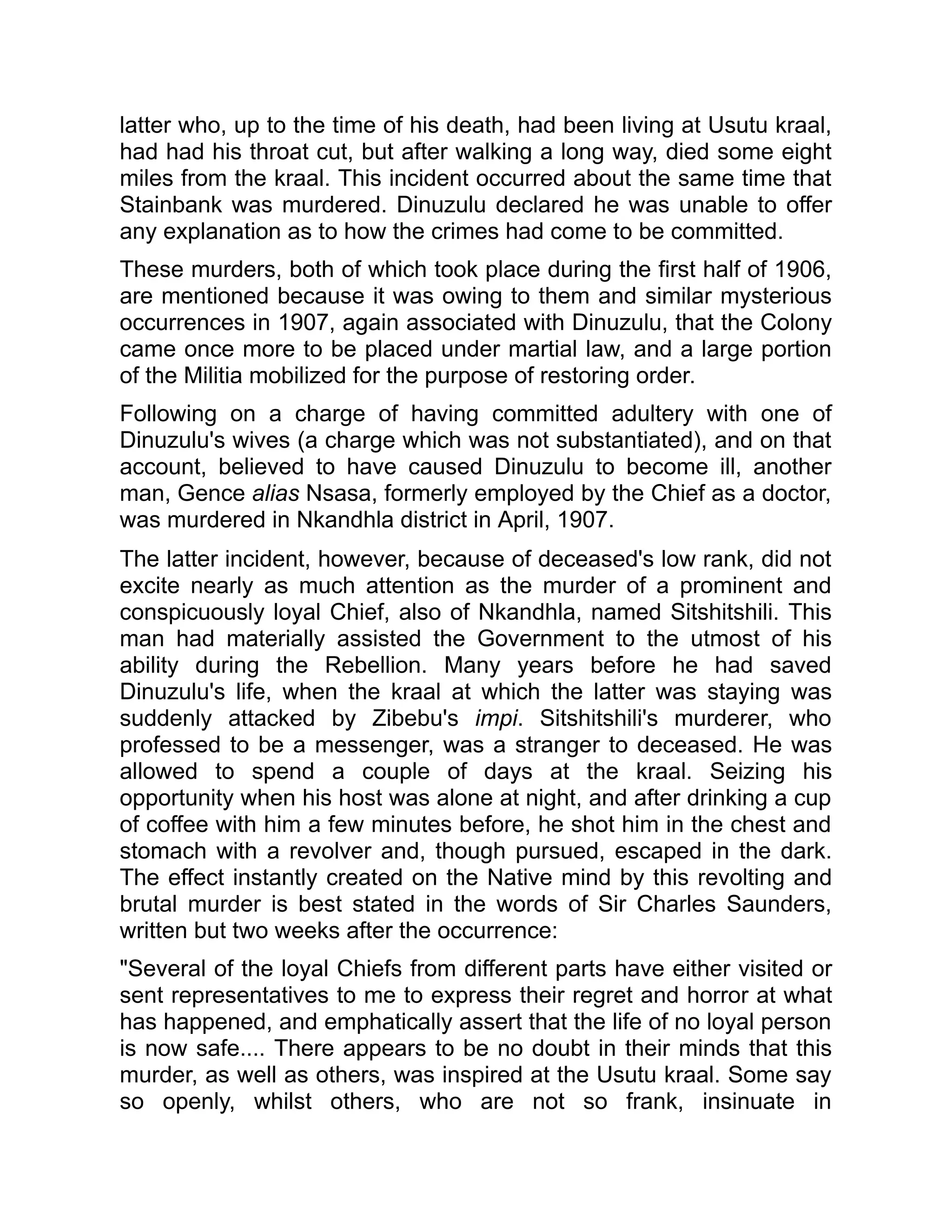
conspicuously loyal Chief, also of Nkandhla, named Sitshitshili. This
man had materially assisted the Government to the utmost of his
ability during the Rebellion. Many years before he had saved
Dinuzulu's life, when the kraal at which the latter was staying was
suddenly attacked by Zibebu's impi. Sitshitshili's murderer, who
professed to be a messenger, was a stranger to deceased. He was
allowed to spend a couple of days at the kraal. Seizing his
opportunity when his host was alone at night, and after drinking a cup
of coffee with him a few minutes before, he shot him in the chest and
stomach with a revolver and, though pursued, escaped in the dark.
The effect instantly created on the Native mind by this revolting and
brutal murder is best stated in the words of Sir Charles Saunders,
written but two weeks after the occurrence:
"Several of the loyal Chiefs from different parts have either visited or
sent representatives to me to express their regret and horror at what
has happened, and emphatically assert that the life of no loyal person
is now safe.... There appears to be no doubt in their minds that this
murder, as well as others, was inspired at the Usutu kraal. Some say
so openly, whilst others, who are not so frank, insinuate in
45.
unmistakable terms thatthey share the same view, and it is not
difficult to perceive that they hold Dinuzulu, either directly or indirectly,
responsible for the whole."
47.
Welcome to ourwebsite – the ideal destination for book lovers and
knowledge seekers. With a mission to inspire endlessly, we offer a
vast collection of books, ranging from classic literary works to
specialized publications, self-development books, and children's
literature. Each book is a new journey of discovery, expanding
knowledge and enriching the soul of the reade
Our website is not just a platform for buying books, but a bridge
connecting readers to the timeless values of culture and wisdom. With
an elegant, user-friendly interface and an intelligent search system,
we are committed to providing a quick and convenient shopping
experience. Additionally, our special promotions and home delivery
services ensure that you save time and fully enjoy the joy of reading.
Let us accompany you on the journey of exploring knowledge and
personal growth!
ebookfinal.com














![that their tactics in 1906 were, on the whole, successful; Mome,
though a catastrophe, was due to accident or carelessness that could
easily have been avoided by a competent commander.
That an outbreak should have occurred at Mapumulo subsequent to
the débâcle in Zululand, is remarkable chiefly as showing lack of
territorial organization. Although a certain amount had been
introduced at Nkandhla, between the arrival of Bambata and the
action at Mome, the army daily becoming more crafty and efficient, it
had reference only to such rebels as had actually massed at that
place. A supreme organizer was wanting, one who, whilst directing at
Nkandhla, could have so far enforced obedience as to control
situations such as those at Umsinga, and especially in Mapumulo and
Ndwedwe divisions. That there was this want was undoubtedly felt by
every insurgent. They knew too much of Tshaka's successes to do
otherwise than realize that they were weak, and see what such
weakness was due to. That is why Dinuzulu's personality and
presence was so much in demand. That is why, for instance, one
heard of such talk as that they would seize and carry him off to lead
them whether he willed it or not. To have a visible leader and to
submit to his direction, that was the height of their ambition. Only then
did they feel themselves to be a people, possessed to some extent of
their former solidarity. To sacrifice their lives for someone is
everything, to have to do so for an absent reality, nothing.
Another lesson is the necessity of pursuing the enemy the moment
he starts hostilities. Quick pursuit is what every Zulu holds as a
primary maxim of warfare. Such action inspires loyalists with
confidence, because affording them protection at the time they most
require it.
The policy of the rebels having been to avoid conflict whenever the
conditions were unfavourable, meant that the campaign resolved
itself into one where the troops had always to assume the offensive.
[305] The enemy deliberately invited being hunted in the forests in
which he took refuge. There was no other alternative but to 'hunt' him.
His perpetual and masterly evasiveness was resorted to just because
felt to be the most telling and safest tactics to adopt. He knew that,
man for man, he was infinitely better acquainted with forests,](https://image.slidesharecdn.com/76643-250317051804-f14dbb2e/75/A-Handbook-for-Doctoral-Supervisors-3rd-Edition-Stan-Taylor-27-2048.jpg)
![troops except their saddles.
At Macrae's store, the attack came just after sunset and later—the
only instance of night attack. When the offensive is assumed by
Zulus, the proper time to do so is just before dawn, unless the force
be a strong one, when battle would be given in broad daylight.
The rebels moved about to get food and seize cattle chiefly at night,
sometimes going ten or more miles for the purpose. Those wounded
in action, too, were removed after dark.
A close watch was always kept on each column, especially by spies
posted on hills, where, if out of rifle range, they did not mind whether
they exposed themselves or not.
Occasionally it happened that those who had fought against the
troops, but had been obliged to surrender, took up arms against their
own people. Several of such men were utilized as spies, and proved
invaluable.
European troops.—Having regard to the number of troops in the field,
the importance of the campaign, and the wide area covered by the
operations, it would seem the officer in supreme command should
have been given the rank of Brigadier or Major-General. The O.C.
Troops was, of course, a full Colonel, but, on being appointed over
Natal and Zululand, it would, perhaps, have been more in accord with
the general duties he had to perform, to have conferred on him a rank
conspicuously higher than that of any one else in his command. The
rank, however, seeing the campaign was being conducted by
Colonial troops, could have been conferred only by the local
authorities.
The want of a trained staff was much felt by each column.
"It is," says Sir Duncan McKenzie,[306] "of great importance that an
intelligence department should be formed on the soundest of
bases.... It is not sufficient that an intelligence officer should simply be
able to speak the language of the country. He should have all the
available information at his instant disposal and also be able to guide
or conduct his O.C. anywhere.... Intelligence officers should not be
attached to any regiment in peace-time, but in the event of a force](https://image.slidesharecdn.com/76643-250317051804-f14dbb2e/75/A-Handbook-for-Doctoral-Supervisors-3rd-Edition-Stan-Taylor-29-2048.jpg)
![and N.R. Because a less showy arm, infantry has been apt to be
underrated in connection with Native warfare. It is, however, not too
much to say that any such opinions as existed in Natal have had to
be considerably modified on account of the consistently fine work that
was done at Nkandhla, and in the actions of Bobe, Mome and
Izinsimba. Not only was it found that a well-trained corps could march
twenty or even thirty miles a day, but able to take a share in the
fighting as effective as that of troops conveyed on horseback to the
scene of action. As Native wars of the future will probably be fought
on difficult and out-of-the-way ground, similar to that chosen in 1906,
it would be well to bear this fact in mind.
In going through thick bush held by the enemy, as the N.P. had to do
at Mpanza, it would appear advisable for the advanced guard to
dismount and hand horses to Nos. 3, as, in the event of attack, men
would then be able to reply at once, as well as stand together to
resist the rush. Horses are startled by the shouting inevitable on such
occasions, with the result that a man's time is taken up in trying to
keep his seat, thereby becoming practically hors de combat at a very
critical moment.
The following miscellaneous extracts are taken from an unpublished
general report by Sir Duncan McKenzie:
Transport.—"The majority of the transport was ox-transport; for
military operations, mule-transport is absolutely necessary....
Expense should not be considered in such an important matter.[307]
... The necessity of good conductors was apparent." Closer
supervision should be exercised by O.C. units than was done to
ensure that only the regulation weight per man is put on the waggons.
"Pack transport is absolutely necessary in rough country, and the
saddles should be carried on the waggons, so that they can be used
when the country will not permit of waggons accompanying the
troops."
Remounts.—"The loss of horses from hard work, exposure and want
of suitable food is bound to be heavy.... Steps should be taken to
enable the remount officer to know exactly where he can put his
finger on suitable horses when required.... The establishment of a
proper remount depôt is strongly recommended."](https://image.slidesharecdn.com/76643-250317051804-f14dbb2e/75/A-Handbook-for-Doctoral-Supervisors-3rd-Edition-Stan-Taylor-32-2048.jpg)

![conferred on the black race, and they will now be exalted to a position
above the whites. You shall enjoy complete ascendancy over
Europeans, for the power has at length been restored to you by the
Almighty. Even were actual conflicts to occur between you and the
whites, you will surely put them to flight, for God is standing by you."
The services were usually held in out-of-the-way places, and always
out of hearing of Europeans or their Native agents. It was found
exceedingly difficult to obtain sufficient evidence to prosecute, even
though sedition was known to be constantly preached. When
hostilities actually broke out, many of these men determined to
practise what they had preached; they accordingly broke away from
mission stations, notably in Mapumulo, Ndwedwe and Umsinga
divisions, and joined the rebels.
In July, 1907, it was found that of the Native prisoners then in Natal
gaols, 418 were Christians. Of this number, 204 were ordinary
criminals, whilst 214 had been convicted of rebellion.[308] Of the latter
figure, seven were preachers. The foregoing totals, which are below
the actual numbers, owing to the difficulty of ascertaining who were
converts, were obtained subsequent to the release of about 500
rebels, among whom other so-called Christians would probably have
been found.
In addition to the above, several preachers and many members of
different denominations were shot during the operations. Hunt and
Armstrong, it will be remembered, were murdered by a band of
mission Natives.
It is but fair to add that many of the Christian Natives who rebelled
were not attached to any recognized missionary body at the time they
did so.
A number of other matters, which might have been noticed here,
have already been sufficiently dealt with in preceding chapters. The
Native Affairs Commission drew attention to various reforms in
administration, many of which have already been introduced, such as
the appointment of a Council for Native Affairs and Commissioners,
[309] limitation of interest on loans, various problems connected with
labour, and compulsory service on public works.](https://image.slidesharecdn.com/76643-250317051804-f14dbb2e/75/A-Handbook-for-Doctoral-Supervisors-3rd-Edition-Stan-Taylor-36-2048.jpg)
![The fact that none of the Magistrates of such districts as Mahlabatini
(H.M. Stainbank, later J.Y. Gibson), Nongoma (G.W. Armstrong), and
Nkandhla (B. Colenbrander), in Zululand, and Umsinga (A.E.
Harrington) and Mapumulo (T. Maxwell), in Natal, were withdrawn,
but continued to discharge the duties of their office throughout the
Rebellion, tended to influence and reassure many European farmers,
storekeepers and others, preventing them from getting into a panic,
and, by flying off to other parts for protection, making matters
considerably worse than they were. With the troops often operating at
a distance, there is no doubt considerable danger was run of any of
these magistracies being attacked and the officials murdered. As very
little protection was immediately available, sometimes even with the
Native police disaffected, it would have been comparatively easy for
any band of determined rebels to have brought about one or more of
such results before assistance could have been rendered.
Much credit is due to Magistrates generally for the admirable manner
in which they retained a hold on the Natives of their districts
throughout the period of unrest. Occasionally, however, scares
among Europeans could not be prevented. Those at Greytown and
Nqutu have already been noticed; another occurred at
Pietermaritzburg.
It will already have been gathered that many loyalists, especially
those of tribes within the area of disturbance, stood in an extremely
invidious and dangerous position. Too little consideration is given to
the fact that, unless promptly supported by Government forces,
loyalists are liable to be murdered or their property looted. When an
outbreak occurs, it is almost as important to support the well-affected
as it is to operate against the insurgents themselves. The reason is
clear. If you do not back up those on your side when in danger, do not
be surprised if, in your absence, they are coerced into taking up arms
against you, and so add greatly to your difficulties.
FOOTNOTES:
[304] Except to the extent indicated on p. 63.](https://image.slidesharecdn.com/76643-250317051804-f14dbb2e/75/A-Handbook-for-Doctoral-Supervisors-3rd-Edition-Stan-Taylor-37-2048.jpg)
![[305] Perhaps the principal feature of the rebels' tactics was that
the troops should assume the offensive.
[306] General Report. Sept. 1906 (not published).
[307] In his report for 1906, Col. Bru-de-Wold observes: "The
recent operations have shown the absolute necessity for mobile
transport, as rapidity of movement is the secret of success where
Natives are concerned; ox-transport is far too slow to meet the
requirements."
[308] Those convicted of rebellion were about 5·3 per cent. of the
total number of rebel prisoners, less the 500 referred to in the text.
[309] The Union Government has abolished both the Council and
the Commissioners, so that Natal is now practically in the same
position in which she was before the Rebellion.](https://image.slidesharecdn.com/76643-250317051804-f14dbb2e/75/A-Handbook-for-Doctoral-Supervisors-3rd-Edition-Stan-Taylor-38-2048.jpg)
![fullest extent by collecting information from all sources, European,
official and unofficial—Native and others; all being invited who could
further the investigation, by advice or suggestion, or the results of
their observation or experience.... The Commission held its first
meeting on the 16th October, 1906, ... evidence was received from
time to time up to the 18th June, 1907. To facilitate this object, thirty-
four places were visited, at which statements by 301 Europeans were
received, together with those of 906 Natives and others, who
addressed the Commission personally or by delegation. So highly did
the Natives appreciate the opportunities afforded them of expressing
their views that at least 5,500, including Chiefs and headmen,
exempted and Christian Natives, attended, and, on the whole, spoke,
as they were invited to do, with remarkable freedom."[310]
The recommendations of the Commission will be referred to later.
Colonel Bru-de-Wold was unfortunately obliged to retire from the
position of Commandant of Militia, as well as from the public service,
at the beginning of 1907. He had served in several capacities, chiefly
as a soldier—always with benefit to the Colony and credit to himself
—for upwards of thirty years. In recognition of the splendid work done
by him before and during the Rebellion, the honour of D.S.O. was
conferred on him by the King. The Natal Militia, moreover, presented
him with a sword of honour, formally handed to him by the Governor.
Colonel Sir Duncan McKenzie, K.C.M.G., succeeded as
Commandant.
A general election took place towards the end of 1906, when Mr.
Smythe's Ministry, finding itself without a sufficient working majority,
resigned in November. The Right Hon. Sir Frederick R. Moor, P.C.,
K.C.M.G., was then called on to form a ministry. This he did, the
portfolio of Premier and Minister for Native Affairs being taken by
himself.
In connection with many of the courts-martial referred to in the
preceding chapter, a considerable amount of evidence was led more
or less implicating Dinuzulu in the Rebellion. Moreover, a Native who
had visited Usutu kraal on private business in January, 1907,
reported having seen being harboured there twenty-eight rebels he
knew by name and some hundred or more others. The men, it was](https://image.slidesharecdn.com/76643-250317051804-f14dbb2e/75/A-Handbook-for-Doctoral-Supervisors-3rd-Edition-Stan-Taylor-40-2048.jpg)
![averred, had been formed into three companies and called the
Mbambangwe (leopard-catcher) regiment, because, for the most part,
they consisted of those who had almost annihilated a small portion of
Royston's Horse at Manzipambana.[311] In these circumstances, the
Government arrived at a decision in August to hold an inquiry into
Dinuzulu's conduct. Although action followed, it was soon suspended
in favour of the Chief himself paying the Governor a visit. The making
of such visit arose out of a conversation Sir Charles Saunders had
with Dinuzulu (then at Nongoma) over the telephone. The latter had
wished to 'unburden his heart.' After doing this as well as he could
through the telephone, he asked that what he had said might be
transmitted to the Government. This, the Commissioner replied, it
was obviously impossible to do, although he promised to forward a
summary, and suggested Dinuzulu's paying the Governor a visit and
setting forth at a tête-a-tête all he wished to say. As, by this time, the
Imperial Government wanted Sir Henry McCallum to assume the
Governorship of Ceylon at an early date, suggestions were made to
Dinuzulu that he should proceed to Pietermaritzburg for the purpose
of unburdening himself, and, at the same time, bidding His Excellency
good-bye. After some delay in arranging preliminaries, he proceeded
to the railhead at Somkele. At various stopping-places on the way to
Pietermaritzburg, he was visited by Natives, who not only accorded
him the highest royal salutes, but laid at his feet other tokens of
devotion and humble allegiance. This triumphal progress continued
until he had reached Pietermaritzburg. At this place, too, the Natives
treated him in a manner that could not have been outdone by the
most servile subjects of an eastern potentate.
On the 20th and 21st May, he was summoned to Government House,
where he, with his indunas, Mankulumana and Mgwaqo, and others,
had lengthy interviews with Sir Henry McCallum in the presence of
the Minister for Native Affairs and other officials. After saying all that
was on his mind, Dinuzulu was spoken to straightly in respect of his
misbehaviour and offences, real and imaginary, so far as these were
then known. He parried too searching inquiries with his usual
dexterity, not unmingled with suppressio veri, but there were certain
accusations which he was unable, even with the assistance of his
counsellors, Mankulumana and Mgwaqo, to quite brush aside. For](https://image.slidesharecdn.com/76643-250317051804-f14dbb2e/75/A-Handbook-for-Doctoral-Supervisors-3rd-Edition-Stan-Taylor-41-2048.jpg)
![instance, his having received messengers from Chiefs in all parts of
the country in connection with the poll tax and not reporting them to
the local Magistrate, as required to do by standing instructions.
The Governor's object, however, was not to punish him for such
misdeeds as had come to light, or to probe too deeply into others that
rested merely on suspicion, but to show him that the Government
was in possession of information which clearly proved misbehaviour
on his part, and to afford friendly counsel as to his conduct in the
future. Little did the Governor or the Government know that the man
then being addressed and urged to make a clean breast of his
grievances, as he had himself requested to do, had already
committed several serious and unpardonable acts of high treason.
After another interview, this time with the Acting Prime Minister and
other Ministers, the Chief returned to his kraal.
By this time, the Native Affairs Commission was touring in Zululand,
holding meetings at most of the magistracies with Chiefs and
followers, under conditions the most pleasing to the Natives. Zulus
rejoiced at having that opportunity of laying their grievances before
the official delegates. Not so Dinuzulu. And yet the Governor's words
to him, through the interpreter, were that he would "have an
opportunity of laying his views before the Commission. I ask him to
do so, because I can assure him that any recommendations which
that Commission may send in will receive the earnest consideration
of the Government."[312]
When Dinuzulu got to Somkele by rail, the Commission happened to
be there too. This Dinuzulu knew, and yet although compelled for
some hours to be at the station, he was unable to leave his railway
carriage and walk a hundred yards to tender evidence, general in
character, which it was well within his power to give, and which, in the
interests of the people one would think he would rejoice to have
tendered.
By reason of the fact that interviews had taken place with Dinuzulu,
the Governor decided to arrange others with the most influential of
those Natal and Zululand Chiefs who had behaved loyally during the
Insurrection. Some of these men controlled tribes as large or larger](https://image.slidesharecdn.com/76643-250317051804-f14dbb2e/75/A-Handbook-for-Doctoral-Supervisors-3rd-Edition-Stan-Taylor-42-2048.jpg)