PHARMACOVIGILANCE
PROGRAMME IN INDIA
By: Bibi Khuteja A J
Bpharm
KLE College of Pharmacy.
Hubli, Karnataka.
Instruction
BACKGROUNG CHECK:
1989 – ADR monitoring system for India was
proposed [12 regions]
1997 – India joined WHO-ADR monitoring
programme [3 centers-AIIMS,KEM.JLN]
2004-2008 – National pharmacovigilance
programme
2010 – Pharmacovigilance programme of
India[PvPI]
As per WHO:
Pharmacovigilance is a system relating to
the detection,assessment,understanding
and prevention of adverse effect and any
other drug related problems.
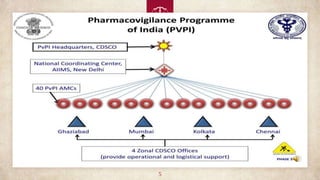
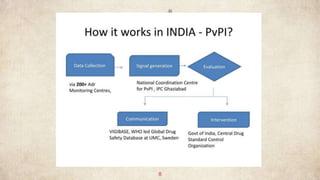
PvPI is a programme initiated with AIIMS New Delhi as National Coordination centre(NCC) for
monitoring ADR in the country 14th July 2010 shifted to India pharmacopoeia commission (IPC)
,Ghaziabad, Uttar Pradesh on 15th April 2011.
2
Vision: To improve patient safety and welfare in Indian population by monitoring the
drug safety and there by reducing the risk of associated with use of medicine
Mission: Safeguard the health of Indian population by ensuring that the benefits of use of
medicine outweigh the risk associated with its use.
Objectives:
◈To create a nation wide system for patient safety reporting.
◈To identify and analyze the new signal (ADR) from the reported cases.
◈To analyze the benefit-risk ratio of marketed medication.
◈To generate the evidence based information on safety of medicine.
◈To support regulatory agencies in the decision making process on use of medicine.
◈To emerge as a national center of excellence for pharmacovigilance activity.
3
“
IMPLEMENTATION OF PvPI
IPC assumes the need for establishing local
hospital based centers across the nation for better
patient safety.It was significant to monitor both
the known and previously unknown side effects of
medicines in order to determine any new
information available in relation to their safety
profile.For a coumtry like India with a population
over 1.2 billion and vast ethnic variability,
different disease,practice of different system of
medicine ,it was important to have a standardized
pharmacovigilance and drug safety monitoring
programme for the nation.
4
5
Short term goals
◈ To develop and implement pharmacovigilance system in
India
◈ To enroll,initially,allMCI approved medical colleges in the
programme covering north,south,east,and west of india
◈ To encourage healthcare professionals in reporting of ADR
of drugs ,vaccines, medical devices and biological products
◈ Collection of case reports and data
6
◈To expand the
pharmacovigilance
programme to all
hospitals(govt. & pvt.)and
centers of public health
programs located across
India.
◈To develop and implement
electronic reporting system
(e-reporting)
Long term goals
7
◈ To develop reporting culture
amongst healthcare
professionals.
◈ To make ADR reporting
mandatory for healthcare
professionals.
8
Causes of failure of implementation of PvPI
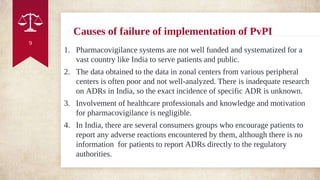
1. Pharmacovigilance systems are not well funded and systematized for a
vast country like India to serve patients and public.
2. The data obtained to the data in zonal centers from various peripheral
centers is often poor and not well-analyzed. There is inadequate research
on ADRs in India, so the exact incidence of specific ADR is unknown.
3. Involvement of healthcare professionals and knowledge and motivation
for pharmacovigilance is negligible.
4. In India, there are several consumers groups who encourage patients to
report any adverse reactions encountered by them, although there is no
information for patients to report ADRs directly to the regulatory
authorities.
9
Pharmacovigilance methods:
Spontaneous reporting: immediate ADR reporting by healthcare professional and consumers
to company, regulatory authorities or organization.
Targeted spontaneous reporting: To learn more about the ADR profile of specific medicines
in population.
Cohort event monitoring : A prospective, longitudinal, observational , cohort study of adverse
events with one or more monitored medicines. it is related to class of medicine that has
previously caused ADR. Observed during post-marketing surveilance.
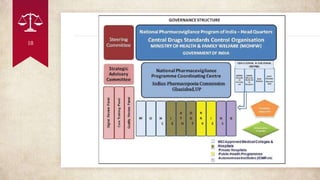
Organization committees under NCC
◈STEERING COMMITTEE
◈PvPI working group
◈Quality review panel
◈Signal review panel
◈Core training panel
10
11
12
Regional centers of PvPI
Let’s start with the first set of slides
1
Maps
14
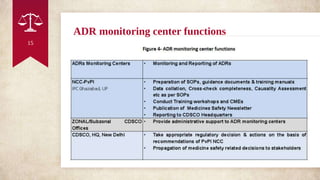
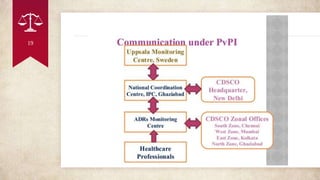
ADR monitoring center functions
15
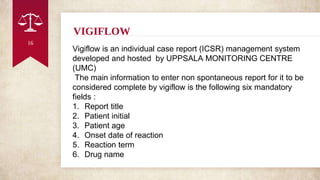
VIGIFLOW
16
Vigiflow is an individual case report (ICSR) management system
developed and hosted by UPPSALA MONITORING CENTRE
(UMC)
The main information to enter non spontaneous report for it to be
considered complete by vigiflow is the following six mandatory
fields :
1. Report title
2. Patient initial
3. Patient age
4. Onset date of reaction
5. Reaction term
6. Drug name
17
18
19
20
Current status of NCC-PvPI
ADR reporting status
•64.66% of ICSRs reported by clinicians
•14.75% by pharmacists
•18.83% by nurses and dentists
INDIAS CONTRIBUTION TO WHO-UMC 2013
◈ 117 Countries participating in the WHO
programme for international drug monitoring
◈ India stood at 7th position in contributing to
ICSRs safety database for the year 2013.
21
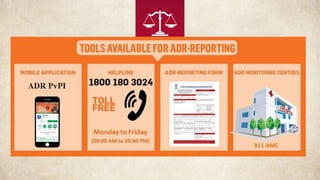
Mobile project
ADR-PvPI mobile project was
developed by NCC-PvPI
within 6 moths in the year
2017 with aims of immediate
reporting of ADR by any
healthcare providers or
consumers.
◈Till date more than 5500
users downloaded the app
◈262 reports recieved
◈By 2018 96.45% of ADRs
were reported using ADR-
PvPI app.
22
24
Thanks!
Referance
Google
oArticle by –innovations in pharmacy
25
http://z.umn.edu/INNOVATIONS
oPPT by chandan kumar [Mpharm-
NIPER]
oPPT by Jamshed Ahmad –Sr.technical
data associate at CDISCO

pharmacovigilance program in india.pptx

  • 1.
    PHARMACOVIGILANCE PROGRAMME IN INDIA By:Bibi Khuteja A J Bpharm KLE College of Pharmacy. Hubli, Karnataka.
  • 2.
    Instruction BACKGROUNG CHECK: 1989 –ADR monitoring system for India was proposed [12 regions] 1997 – India joined WHO-ADR monitoring programme [3 centers-AIIMS,KEM.JLN] 2004-2008 – National pharmacovigilance programme 2010 – Pharmacovigilance programme of India[PvPI] As per WHO: Pharmacovigilance is a system relating to the detection,assessment,understanding and prevention of adverse effect and any other drug related problems. PvPI is a programme initiated with AIIMS New Delhi as National Coordination centre(NCC) for monitoring ADR in the country 14th July 2010 shifted to India pharmacopoeia commission (IPC) ,Ghaziabad, Uttar Pradesh on 15th April 2011. 2
  • 3.
    Vision: To improvepatient safety and welfare in Indian population by monitoring the drug safety and there by reducing the risk of associated with use of medicine Mission: Safeguard the health of Indian population by ensuring that the benefits of use of medicine outweigh the risk associated with its use. Objectives: ◈To create a nation wide system for patient safety reporting. ◈To identify and analyze the new signal (ADR) from the reported cases. ◈To analyze the benefit-risk ratio of marketed medication. ◈To generate the evidence based information on safety of medicine. ◈To support regulatory agencies in the decision making process on use of medicine. ◈To emerge as a national center of excellence for pharmacovigilance activity. 3
  • 4.
    “ IMPLEMENTATION OF PvPI IPCassumes the need for establishing local hospital based centers across the nation for better patient safety.It was significant to monitor both the known and previously unknown side effects of medicines in order to determine any new information available in relation to their safety profile.For a coumtry like India with a population over 1.2 billion and vast ethnic variability, different disease,practice of different system of medicine ,it was important to have a standardized pharmacovigilance and drug safety monitoring programme for the nation. 4
  • 5.
  • 6.
    Short term goals ◈To develop and implement pharmacovigilance system in India ◈ To enroll,initially,allMCI approved medical colleges in the programme covering north,south,east,and west of india ◈ To encourage healthcare professionals in reporting of ADR of drugs ,vaccines, medical devices and biological products ◈ Collection of case reports and data 6
  • 7.
    ◈To expand the pharmacovigilance programmeto all hospitals(govt. & pvt.)and centers of public health programs located across India. ◈To develop and implement electronic reporting system (e-reporting) Long term goals 7 ◈ To develop reporting culture amongst healthcare professionals. ◈ To make ADR reporting mandatory for healthcare professionals.
  • 8.
  • 9.
    Causes of failureof implementation of PvPI 1. Pharmacovigilance systems are not well funded and systematized for a vast country like India to serve patients and public. 2. The data obtained to the data in zonal centers from various peripheral centers is often poor and not well-analyzed. There is inadequate research on ADRs in India, so the exact incidence of specific ADR is unknown. 3. Involvement of healthcare professionals and knowledge and motivation for pharmacovigilance is negligible. 4. In India, there are several consumers groups who encourage patients to report any adverse reactions encountered by them, although there is no information for patients to report ADRs directly to the regulatory authorities. 9
  • 10.
    Pharmacovigilance methods: Spontaneous reporting:immediate ADR reporting by healthcare professional and consumers to company, regulatory authorities or organization. Targeted spontaneous reporting: To learn more about the ADR profile of specific medicines in population. Cohort event monitoring : A prospective, longitudinal, observational , cohort study of adverse events with one or more monitored medicines. it is related to class of medicine that has previously caused ADR. Observed during post-marketing surveilance. Organization committees under NCC ◈STEERING COMMITTEE ◈PvPI working group ◈Quality review panel ◈Signal review panel ◈Core training panel 10
  • 11.
  • 12.
  • 13.
    Regional centers ofPvPI Let’s start with the first set of slides 1
  • 14.
  • 15.
  • 16.
    VIGIFLOW 16 Vigiflow is anindividual case report (ICSR) management system developed and hosted by UPPSALA MONITORING CENTRE (UMC) The main information to enter non spontaneous report for it to be considered complete by vigiflow is the following six mandatory fields : 1. Report title 2. Patient initial 3. Patient age 4. Onset date of reaction 5. Reaction term 6. Drug name
  • 17.
  • 18.
  • 19.
  • 20.
    20 Current status ofNCC-PvPI ADR reporting status •64.66% of ICSRs reported by clinicians •14.75% by pharmacists •18.83% by nurses and dentists
  • 21.
    INDIAS CONTRIBUTION TOWHO-UMC 2013 ◈ 117 Countries participating in the WHO programme for international drug monitoring ◈ India stood at 7th position in contributing to ICSRs safety database for the year 2013. 21
  • 22.
    Mobile project ADR-PvPI mobileproject was developed by NCC-PvPI within 6 moths in the year 2017 with aims of immediate reporting of ADR by any healthcare providers or consumers. ◈Till date more than 5500 users downloaded the app ◈262 reports recieved ◈By 2018 96.45% of ADRs were reported using ADR- PvPI app. 22
  • 24.
  • 25.
    Referance Google oArticle by –innovationsin pharmacy 25 http://z.umn.edu/INNOVATIONS oPPT by chandan kumar [Mpharm- NIPER] oPPT by Jamshed Ahmad –Sr.technical data associate at CDISCO