Module 1, Part 3: Process validation Slide 1 of 22 © WHO – EDM – 12/2001
Validation Part 3:
Process validation
Supplementary Training Modules on
Good Manufacturing Practices
Module 1, Part 3: Process validation Slide 2 of 22 © WHO – EDM – 12/2001
Validation
Objectives
To review:
 Validation, risk analysis, and critical steps of
processing
 Points to consider in process validation of:
 solid dose mixing
 tablet compression
 sterilization
 Finalization of validation
Module 1, Part 3: Process validation Slide 3 of 22 © WHO – EDM – 12/2001
Introduction
Validation
Module 1, Part 3: Process validation Slide 4 of 22 © WHO – EDM – 12/2001
Validation
Reliable, repeatable, under control
 At least first 3 consecutive batches - repeatable
 Must investigate failures
 The rationale should be documented if
experimental method is changed
 document deviations, decisions and reasoning
 Does not improve processes
 Should not validate bad processes
Module 1, Part 3: Process validation Slide 5 of 22 © WHO – EDM – 12/2001
Validation
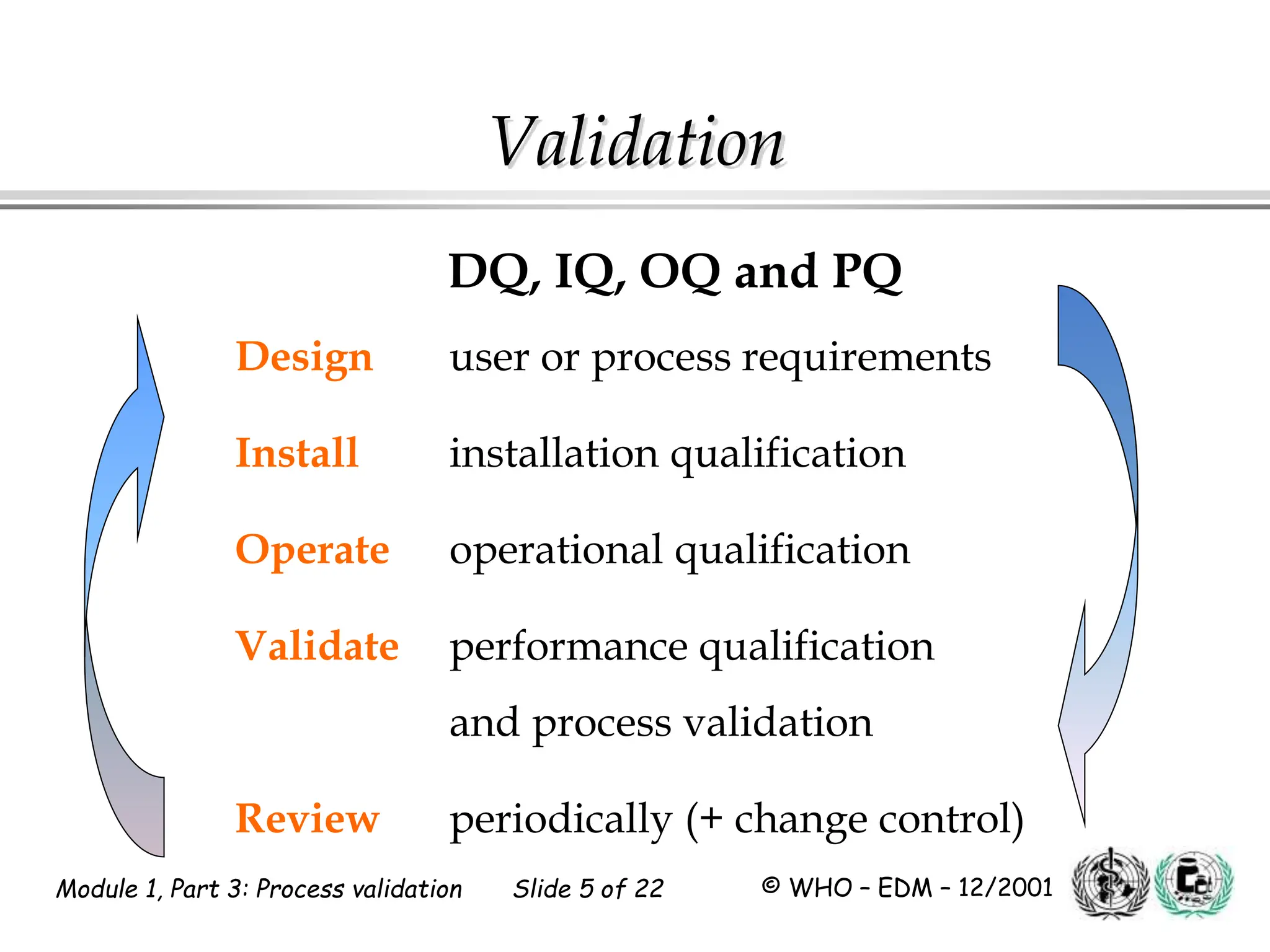
Design user or process requirements
Install installation qualification
Operate operational qualification
Validate performance qualification
and process validation
Review periodically (+ change control)
DQ, IQ, OQ and PQ
Module 1, Part 3: Process validation Slide 6 of 22 © WHO – EDM – 12/2001
Validation
Critical factors or parameters
 Need to be determined
 Need to be monitored during validation
 May affect the quality of the product
Module 1, Part 3: Process validation Slide 7 of 22 © WHO – EDM – 12/2001
Validation
Setting Limits
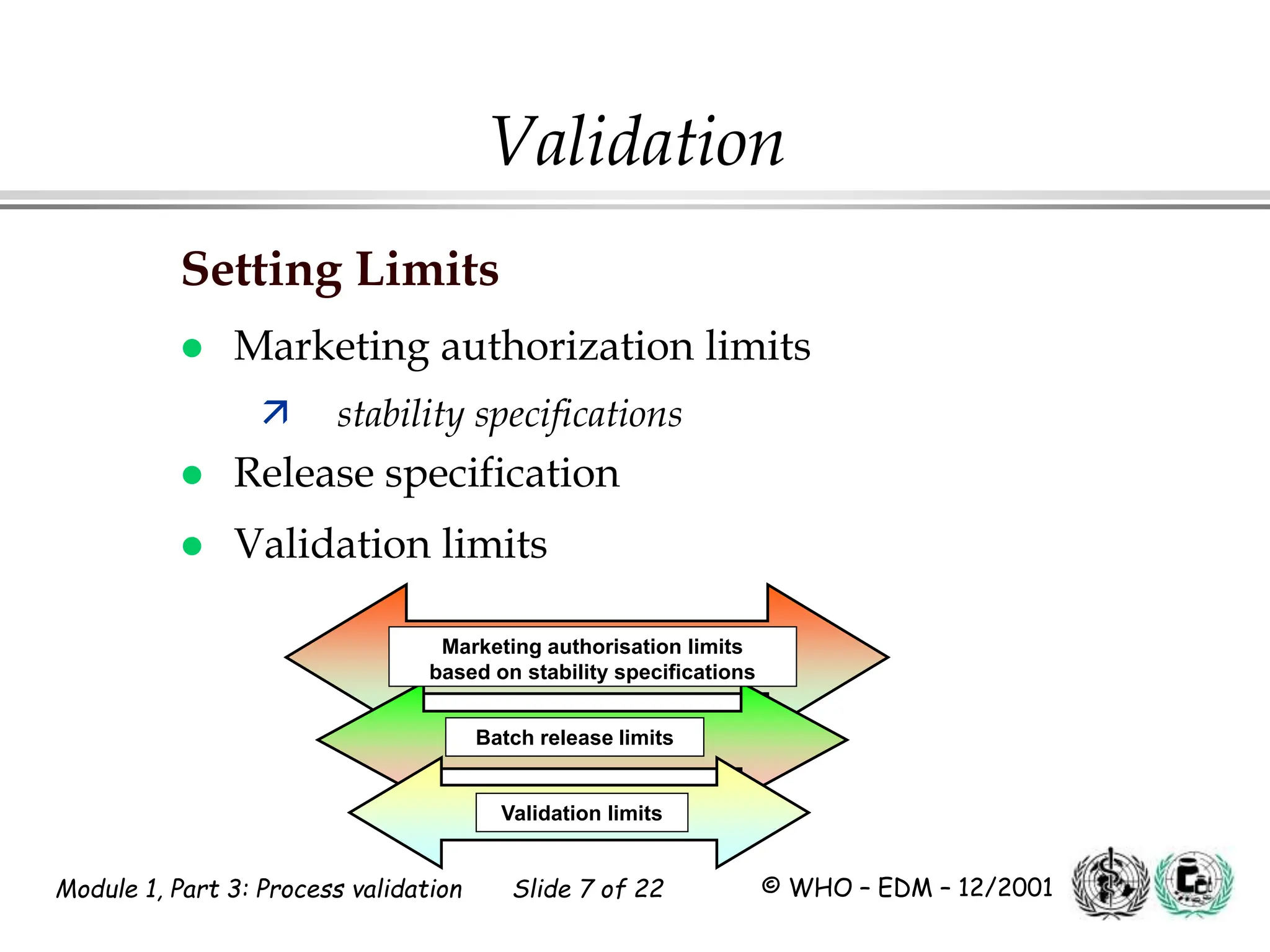
 Marketing authorization limits
 stability specifications
 Release specification
 Validation limits
Batch release limits
Marketing authorisation limits
based on stability specifications
Validation limits
Module 1, Part 3: Process validation Slide 8 of 22 © WHO – EDM – 12/2001
Determining critical control point
example of a tablet granulation process
 Particle size distribution of the active(s)
 Blending time for the powder
 Granulating time and speed,
 Amount of granulating fluid-binder concentration
 Drying time - final moisture content, granule
particle size distribution
 Granule active content and homogeneity,
blending time of external phase
Validation
Module 1, Part 3: Process validation Slide 9 of 22 © WHO – EDM – 12/2001
Validation
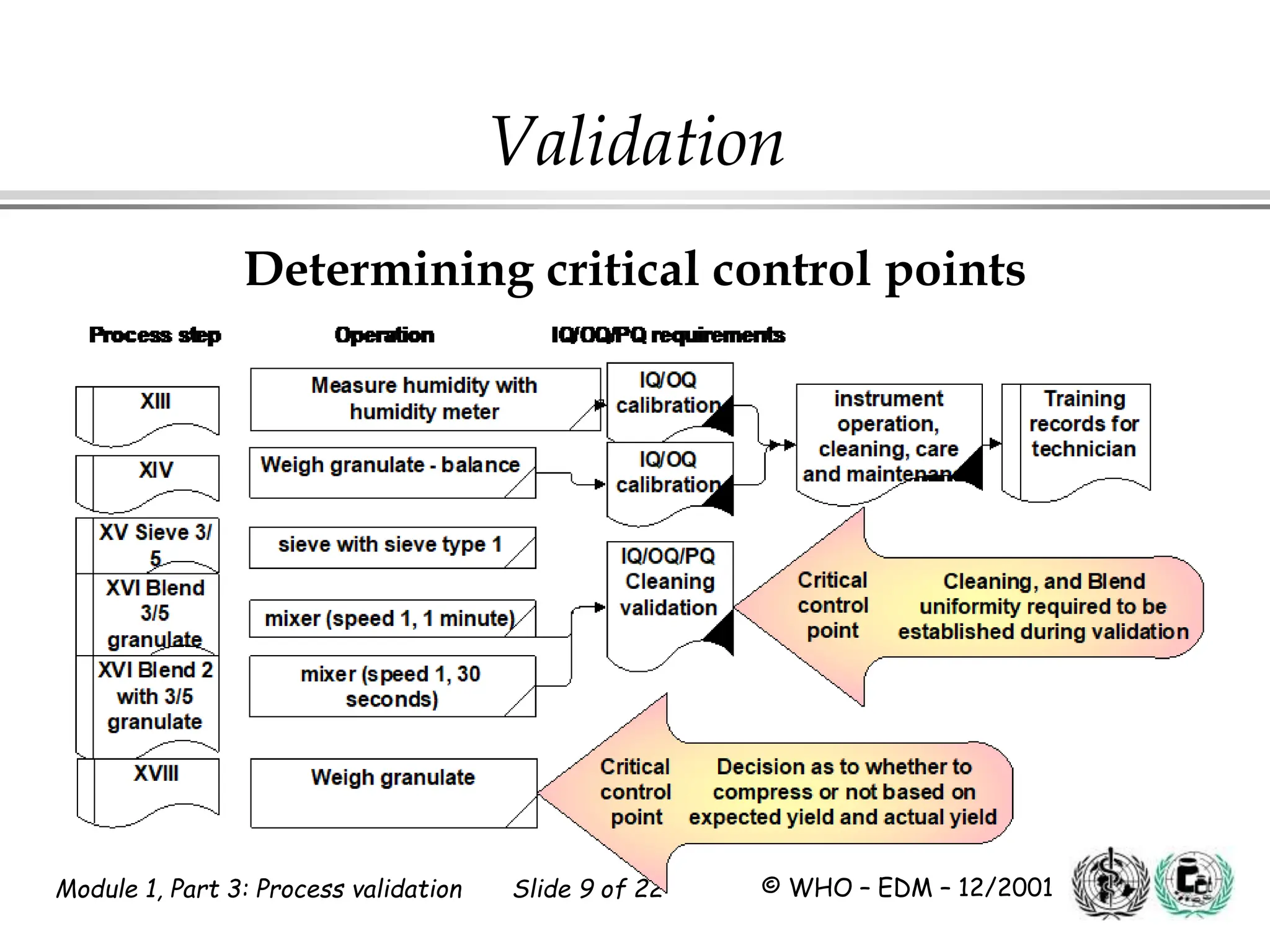
Determining critical control points
Module 1, Part 3: Process validation Slide 10 of 22 © WHO – EDM – 12/2001
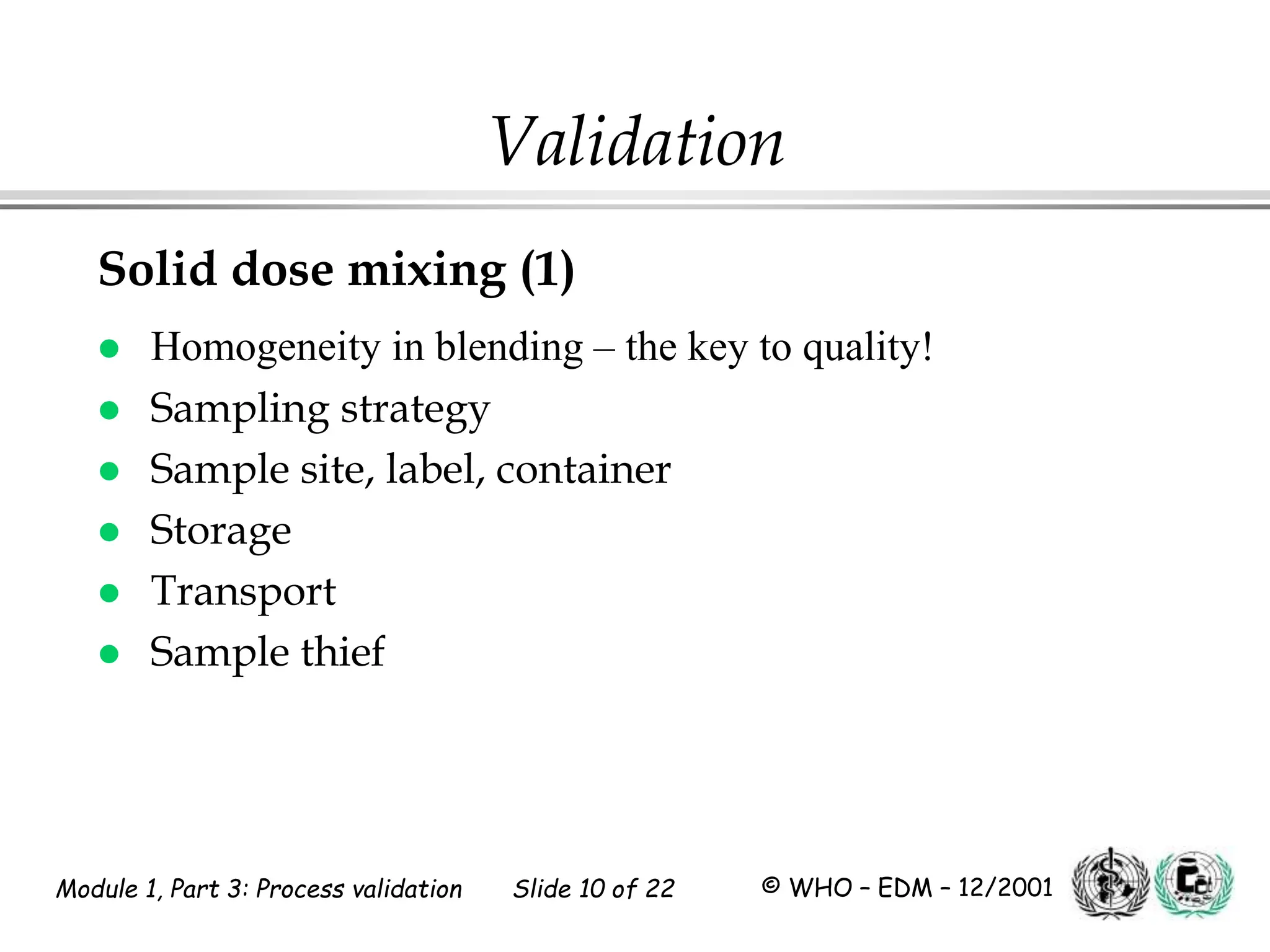
Solid dose mixing (1)
 Homogeneity in blending – the key to quality!
 Sampling strategy
 Sample site, label, container
 Storage
 Transport
 Sample thief
Validation
Module 1, Part 3: Process validation Slide 11 of 22 © WHO – EDM – 12/2001
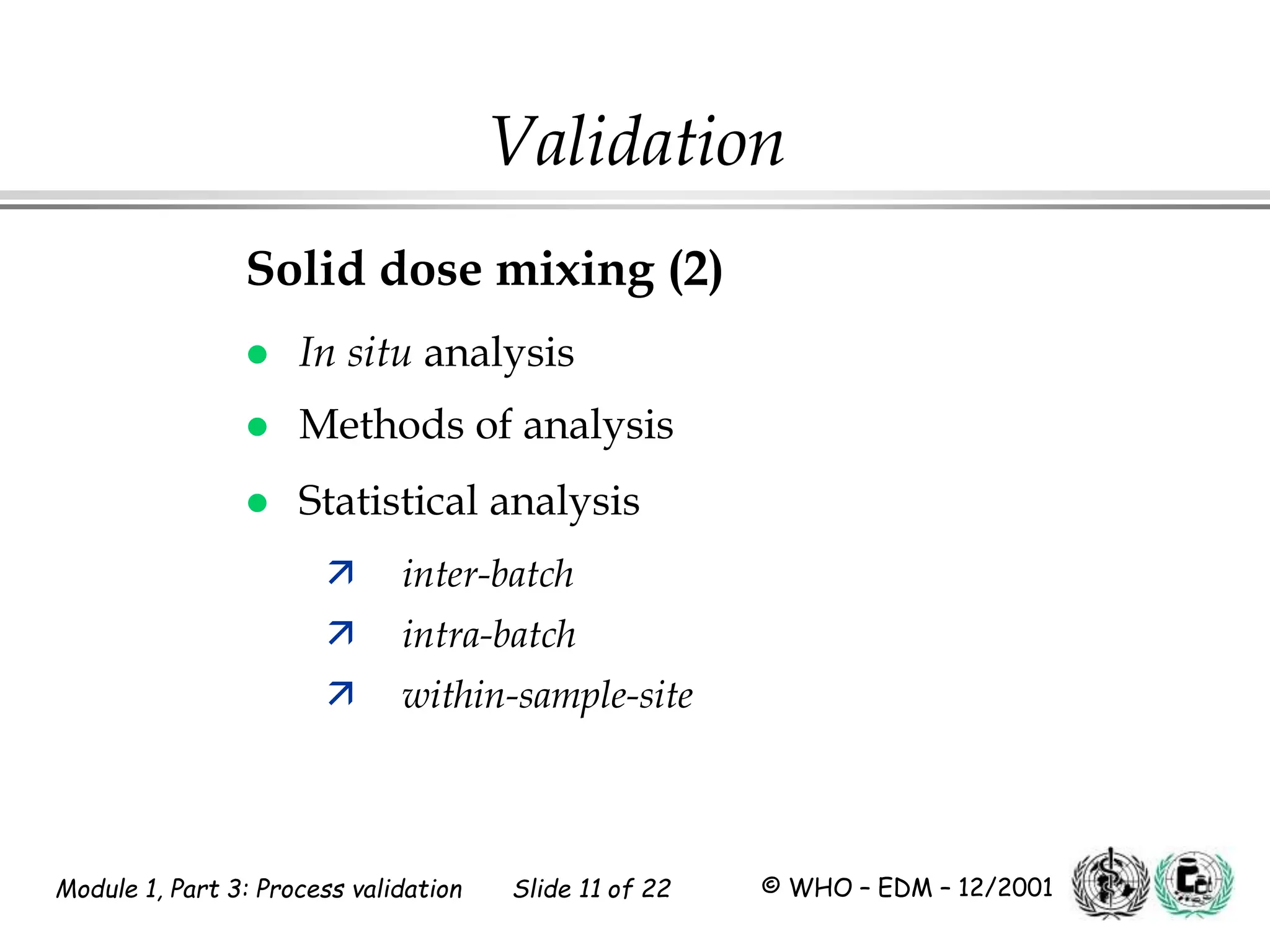
Solid dose mixing (2)
 In situ analysis
 Methods of analysis
 Statistical analysis
 inter-batch
 intra-batch
 within-sample-site
Validation
Module 1, Part 3: Process validation Slide 12 of 22 © WHO – EDM – 12/2001
Validation
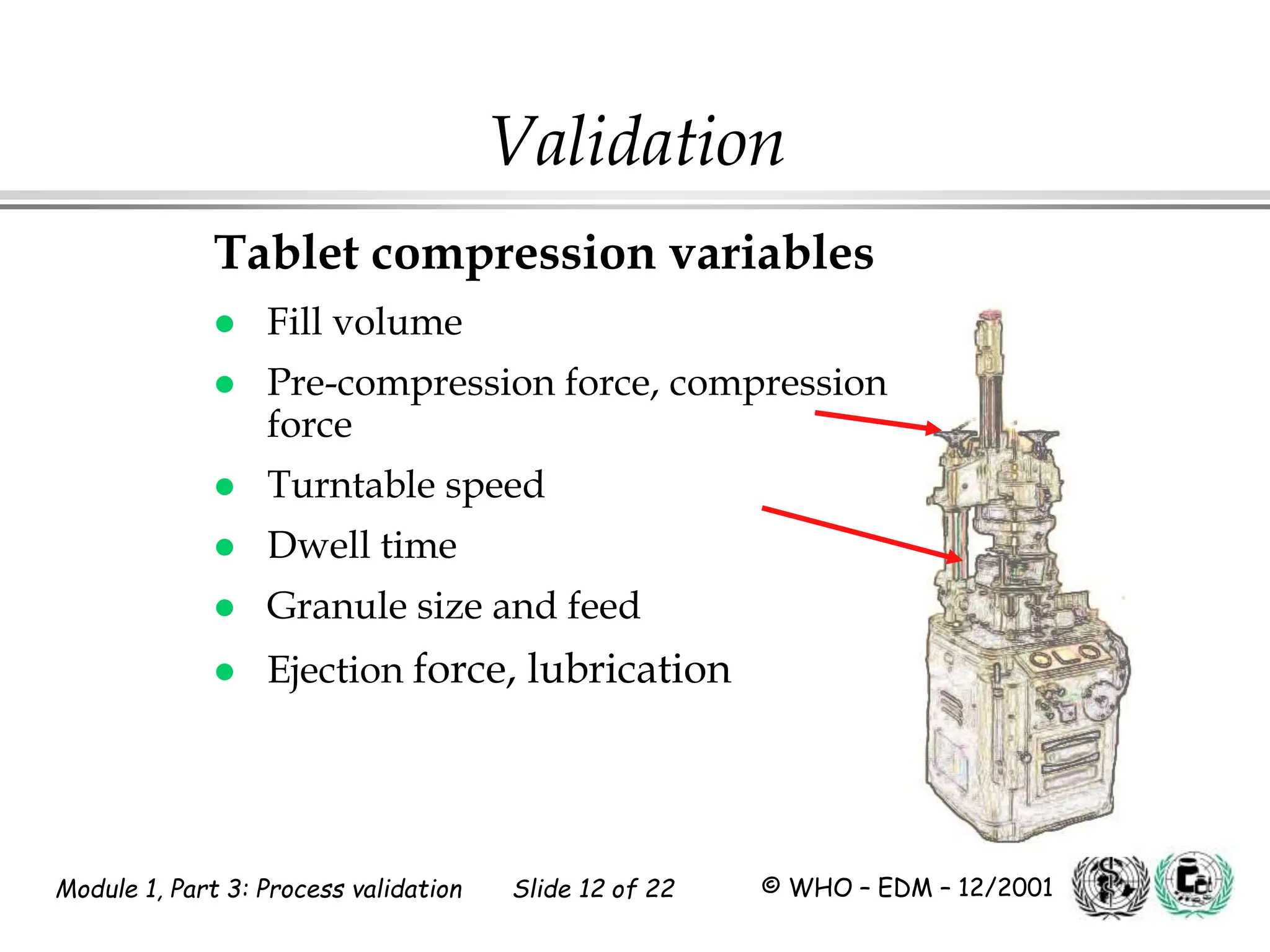
Tablet compression variables
 Fill volume
 Pre-compression force, compression
force
 Turntable speed
 Dwell time
 Granule size and feed
 Ejection force, lubrication
Module 1, Part 3: Process validation Slide 13 of 22 © WHO – EDM – 12/2001
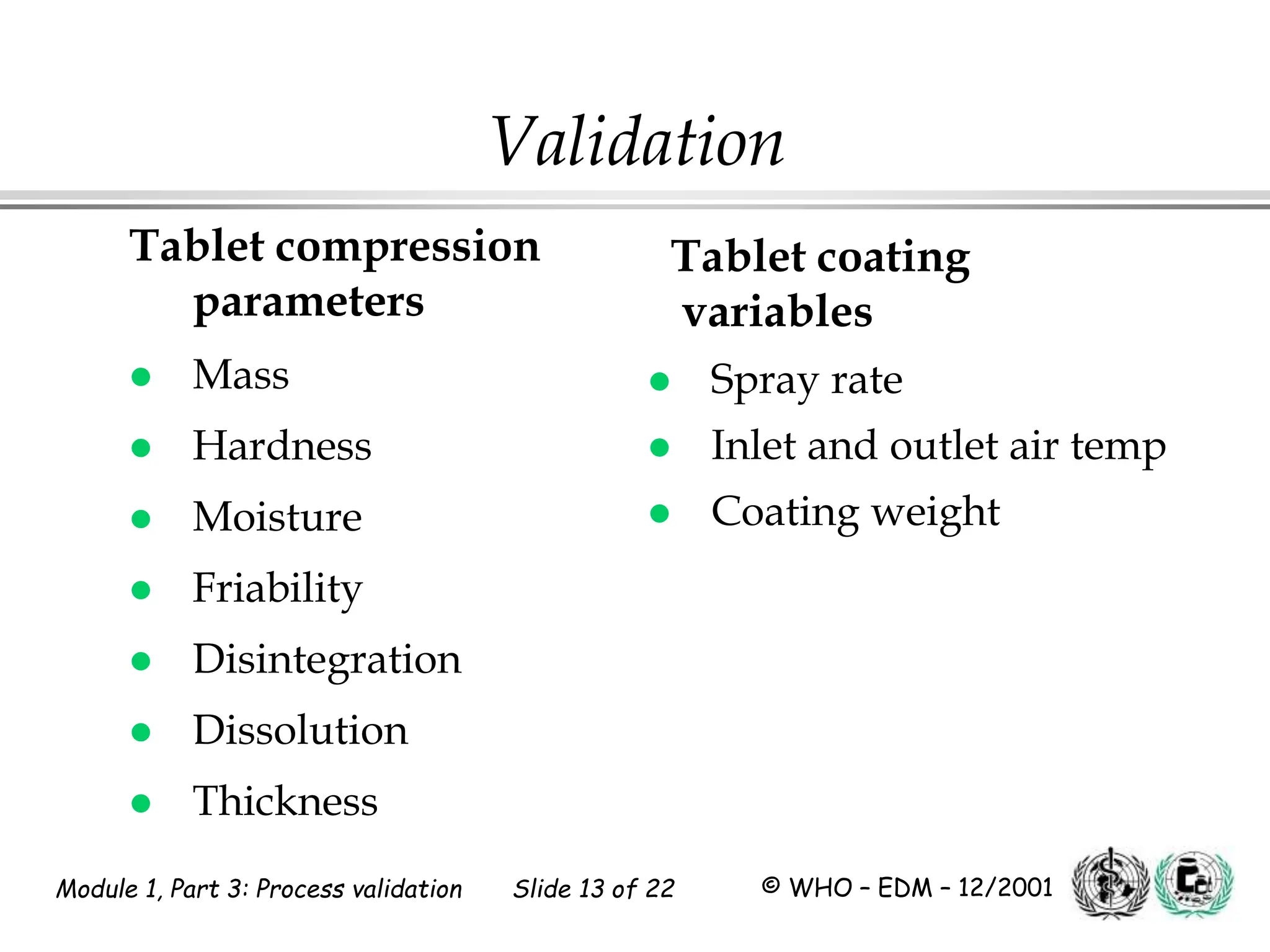
Validation
Tablet compression
parameters
 Mass
 Hardness
 Moisture
 Friability
 Disintegration
 Dissolution
 Thickness
Tablet coating
variables
 Spray rate
 Inlet and outlet air temp
 Coating weight
Module 1, Part 3: Process validation Slide 14 of 22 © WHO – EDM – 12/2001
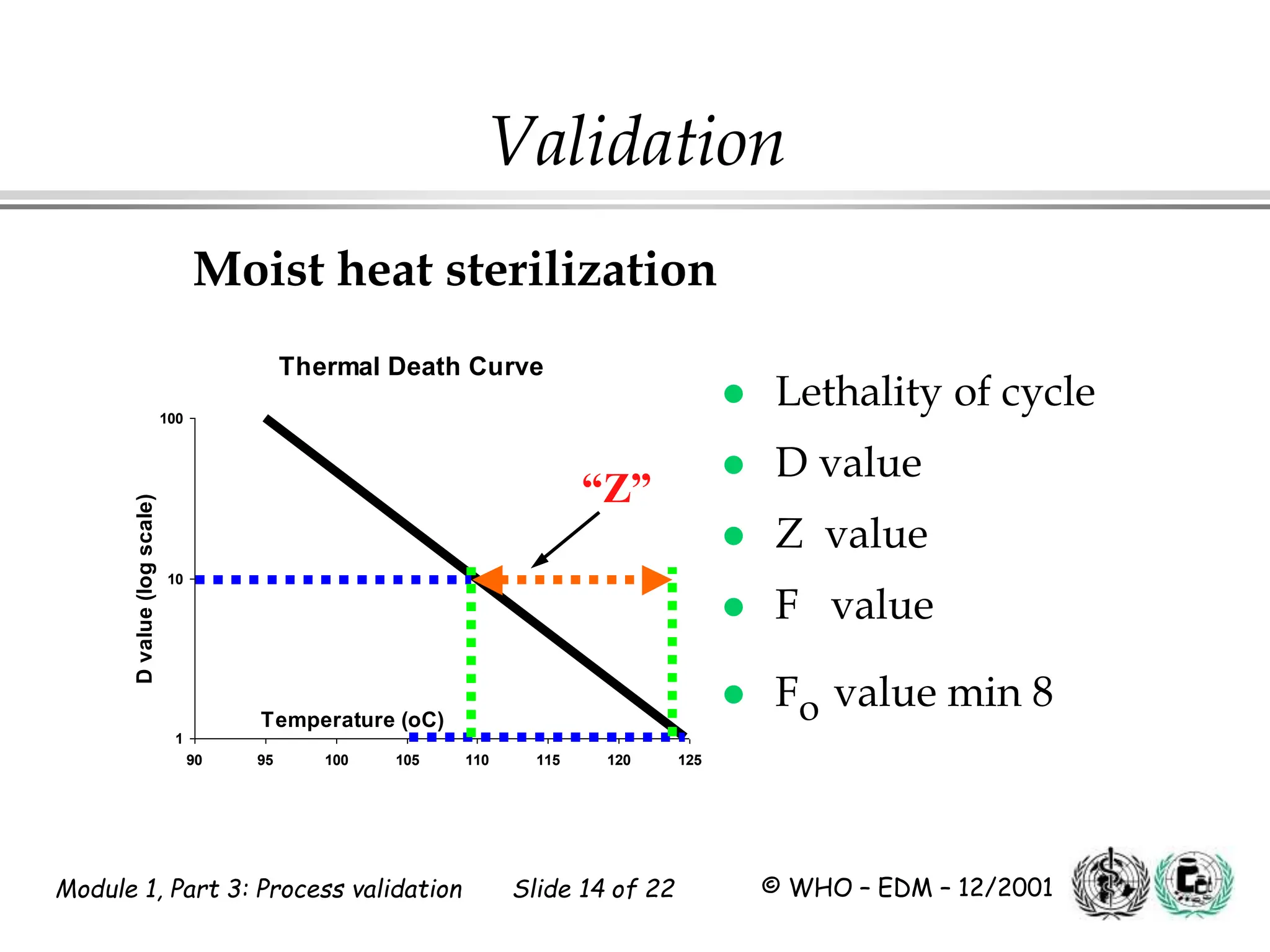
Validation
 Lethality of cycle
 D value
 Z value
 F value
 Fo value min 8
Thermal Death Curve
1
10
100
90 95 100 105 110 115 120 125
Temperature (oC)
D
value
(log
scale)
Moist heat sterilization
“Z”
Module 1, Part 3: Process validation Slide 15 of 22 © WHO – EDM – 12/2001
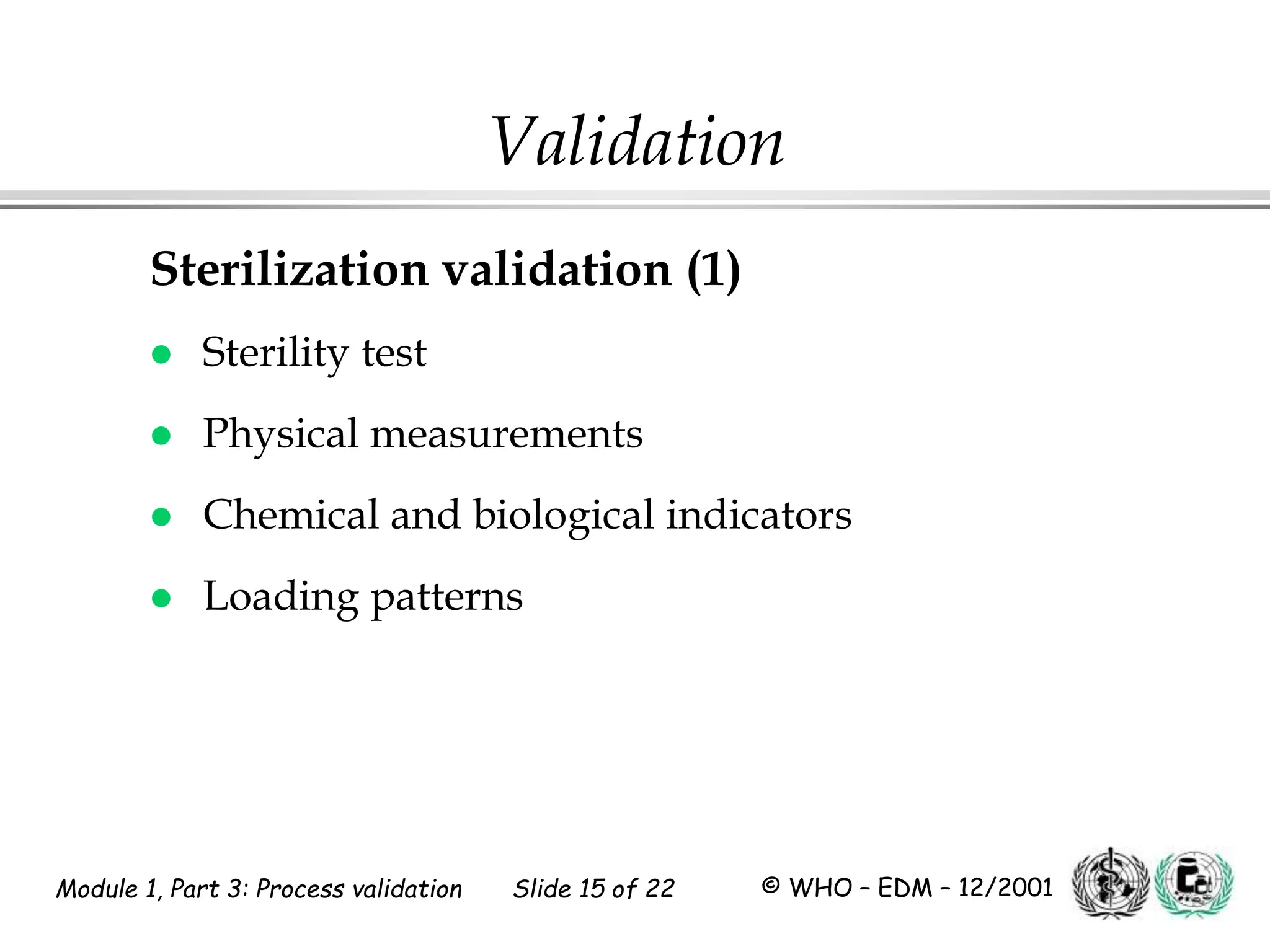
Validation
Sterilization validation (1)
 Sterility test
 Physical measurements
 Chemical and biological indicators
 Loading patterns
Module 1, Part 3: Process validation Slide 16 of 22 © WHO – EDM – 12/2001
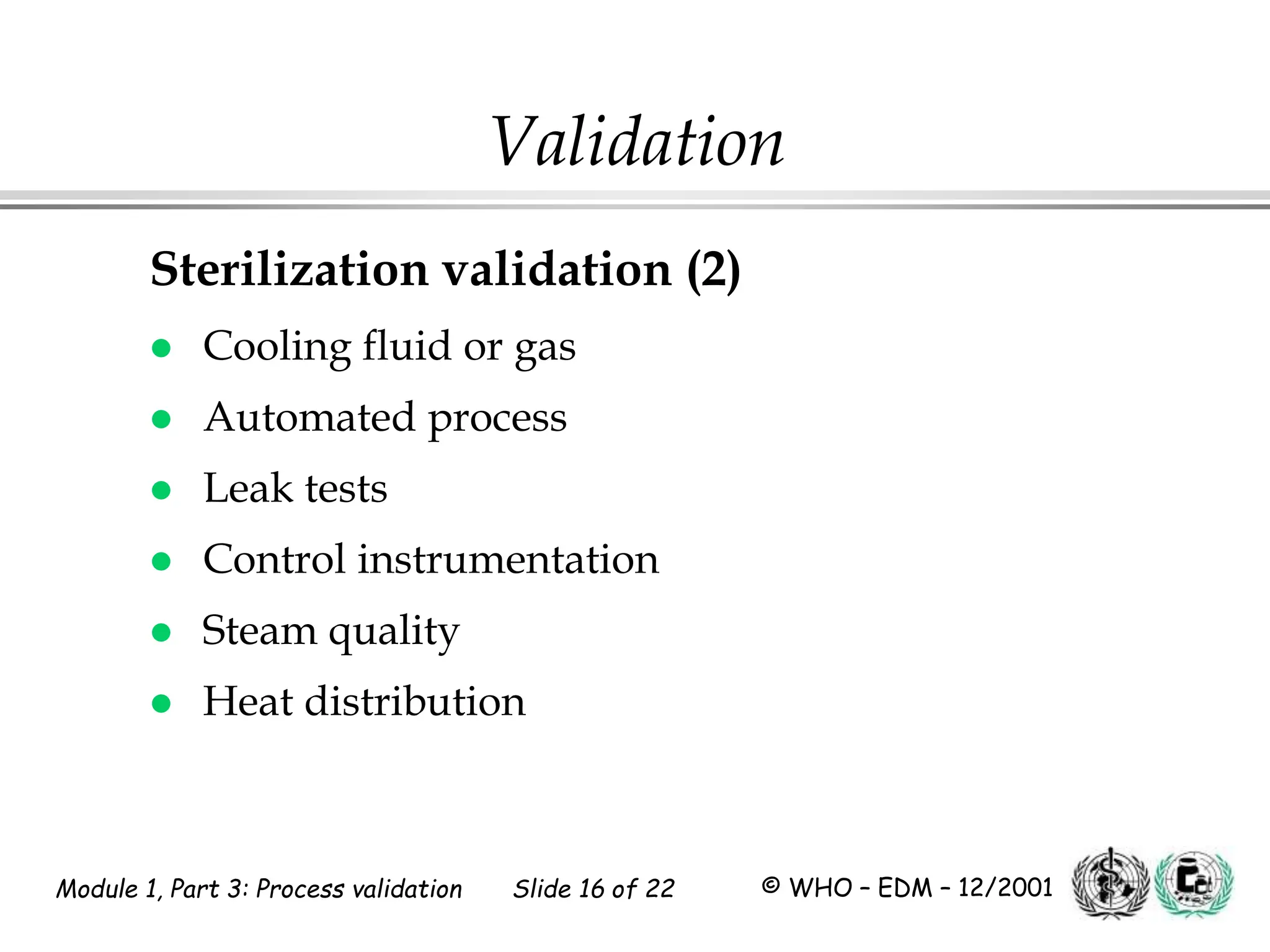
Validation
Sterilization validation (2)
 Cooling fluid or gas
 Automated process
 Leak tests
 Control instrumentation
 Steam quality
 Heat distribution
Module 1, Part 3: Process validation Slide 17 of 22 © WHO – EDM – 12/2001
Validation
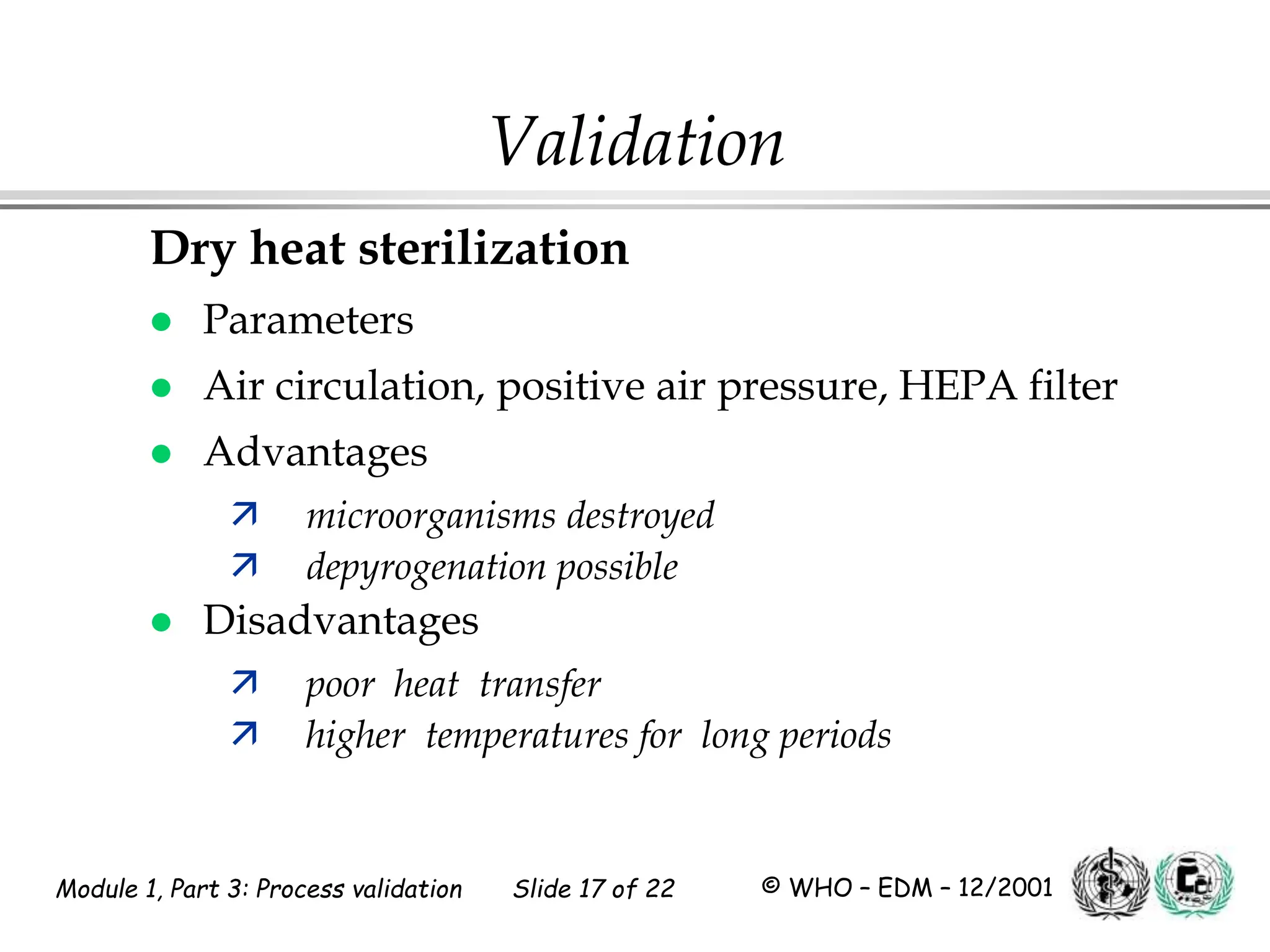
Dry heat sterilization
 Parameters
 Air circulation, positive air pressure, HEPA filter
 Advantages
 microorganisms destroyed
 depyrogenation possible
 Disadvantages
 poor heat transfer
 higher temperatures for long periods
Module 1, Part 3: Process validation Slide 18 of 22 © WHO – EDM – 12/2001
Validation
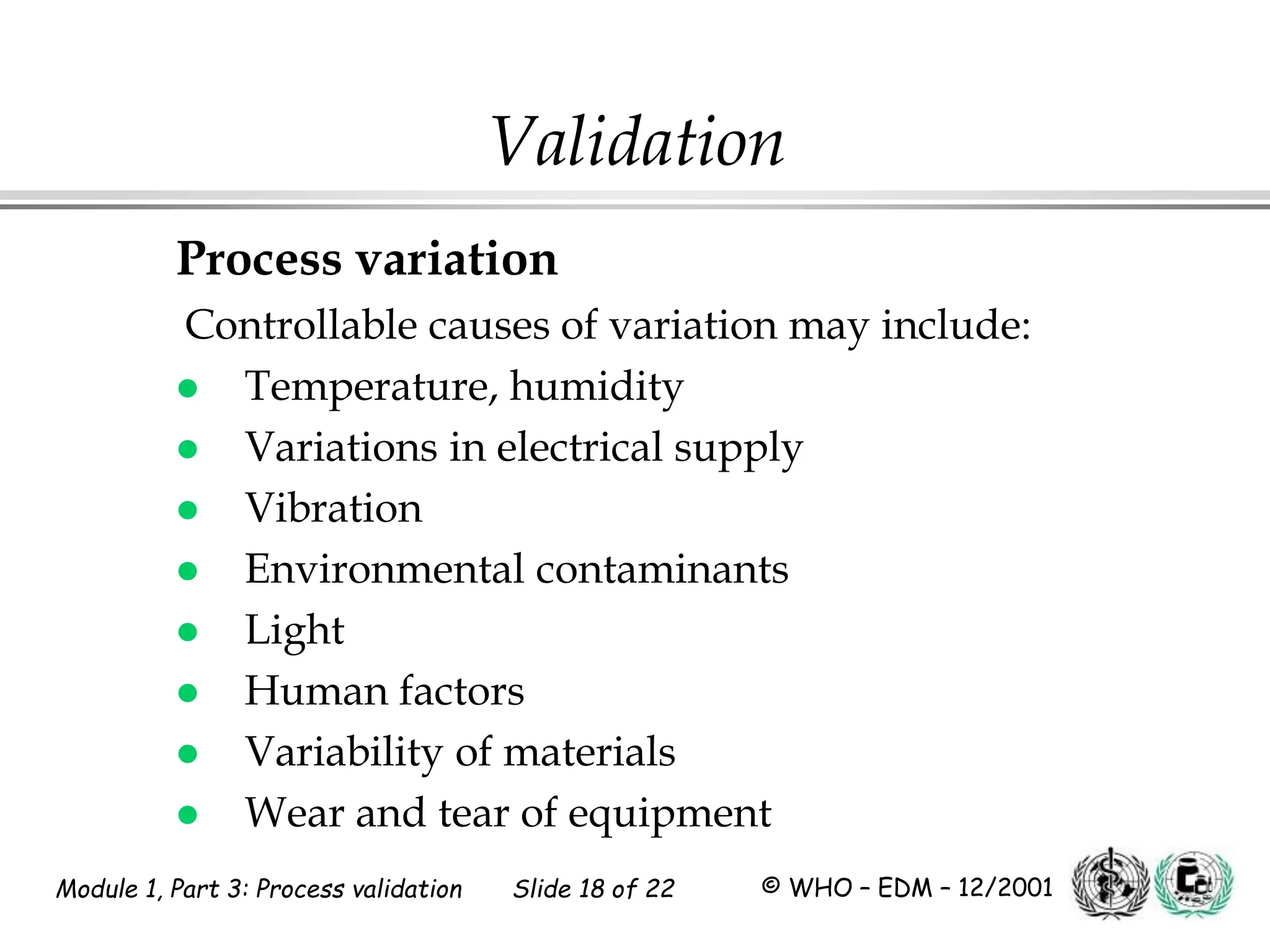
Process variation
Controllable causes of variation may include:
 Temperature, humidity
 Variations in electrical supply
 Vibration
 Environmental contaminants
 Light
 Human factors
 Variability of materials
 Wear and tear of equipment
Module 1, Part 3: Process validation Slide 19 of 22 © WHO – EDM – 12/2001
Validation
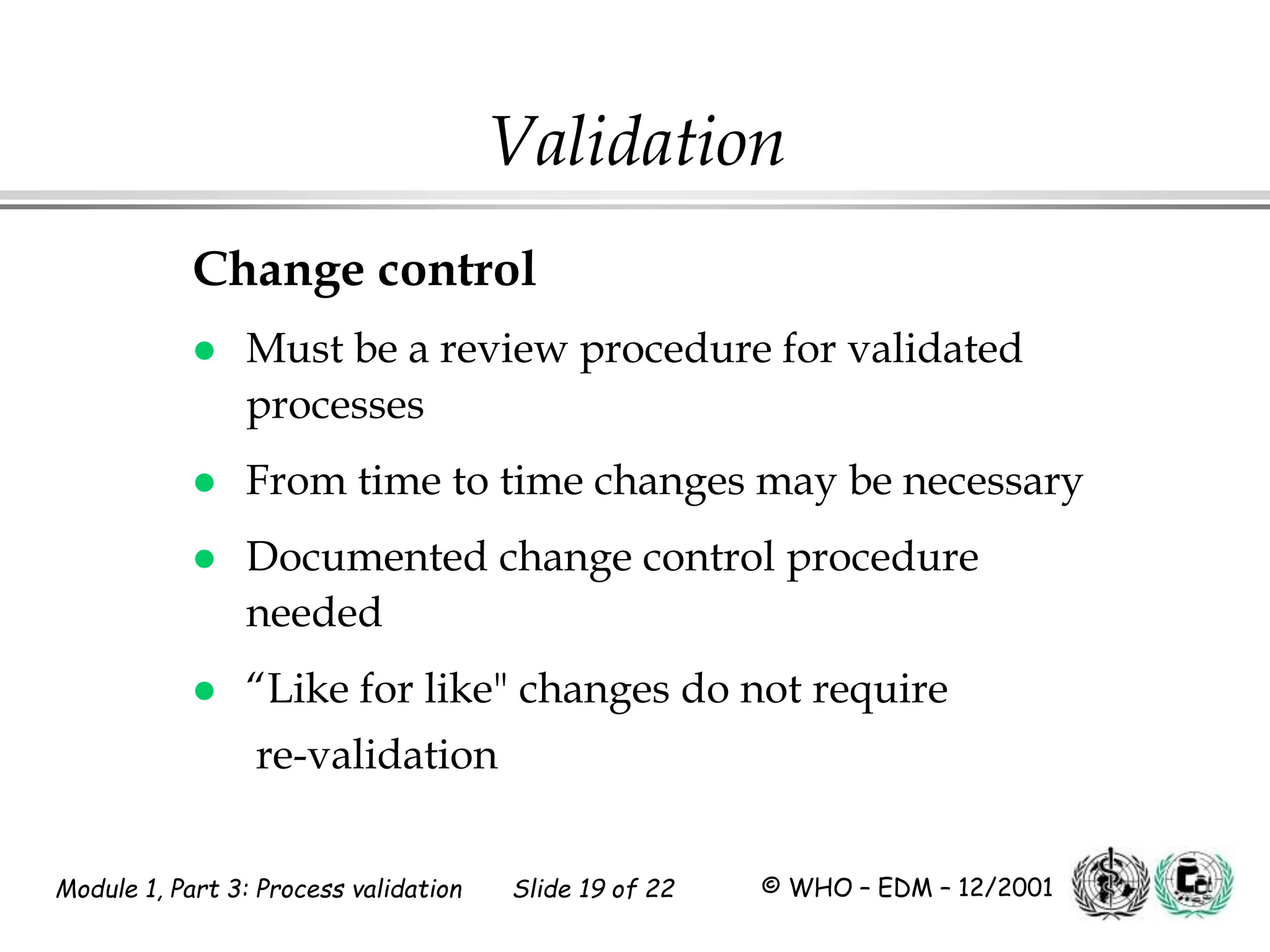
Change control
 Must be a review procedure for validated
processes
 From time to time changes may be necessary
 Documented change control procedure
needed
 “Like for like" changes do not require
re-validation
Module 1, Part 3: Process validation Slide 20 of 22 © WHO – EDM – 12/2001
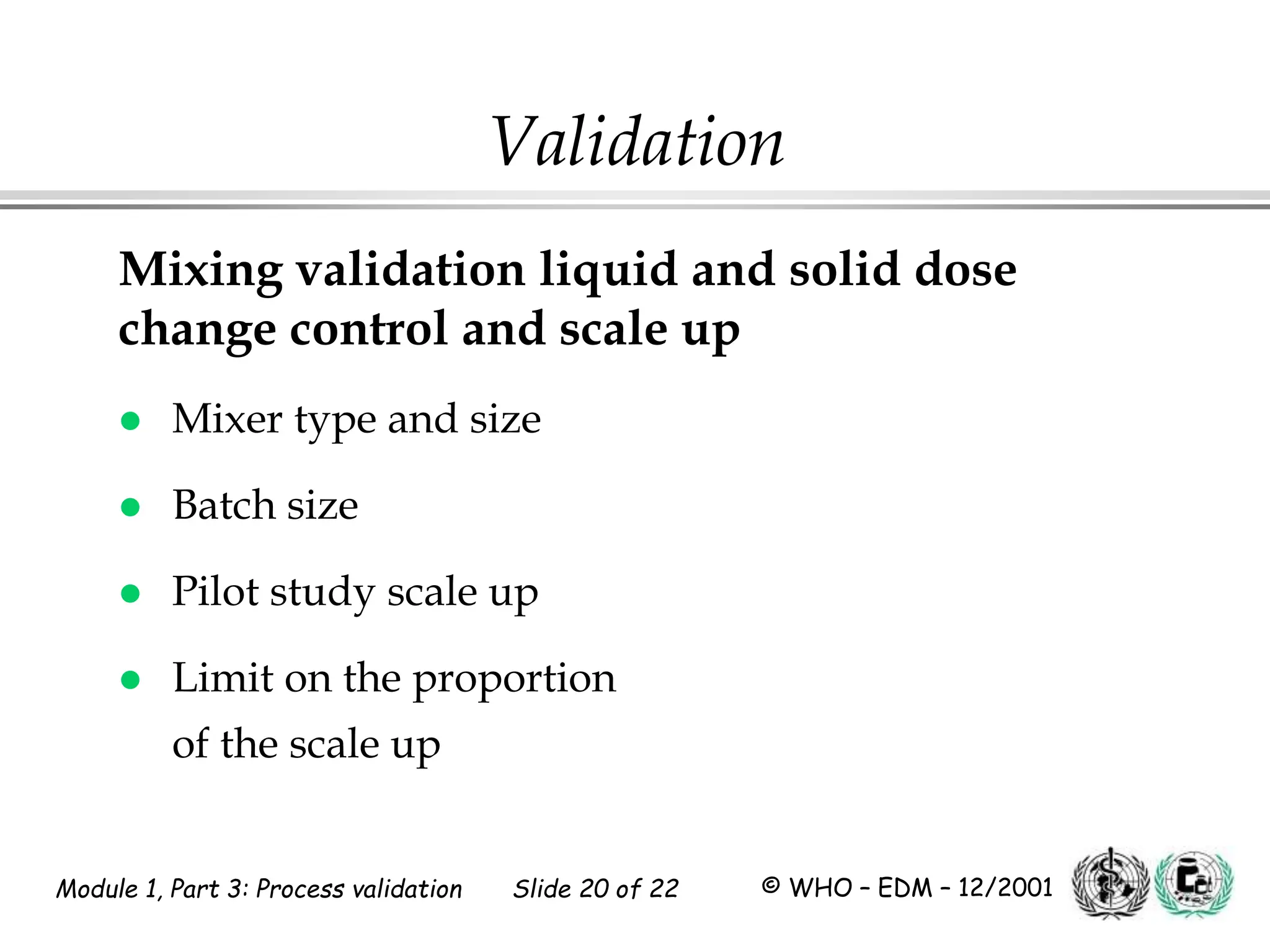
Mixing validation liquid and solid dose
change control and scale up
 Mixer type and size
 Batch size
 Pilot study scale up
 Limit on the proportion
of the scale up
Validation
Module 1, Part 3: Process validation Slide 21 of 22 © WHO – EDM – 12/2001
Validation
Finalization of validation process
 Final report required
 Summarize and reference protocols and results
 Conclusion required: “Is the process valid”
 Final report should be reviewed and approved
by
 the validation team
 “authorized person”
Module 1, Part 3: Process validation Slide 22 of 22 © WHO – EDM – 12/2001
Validation
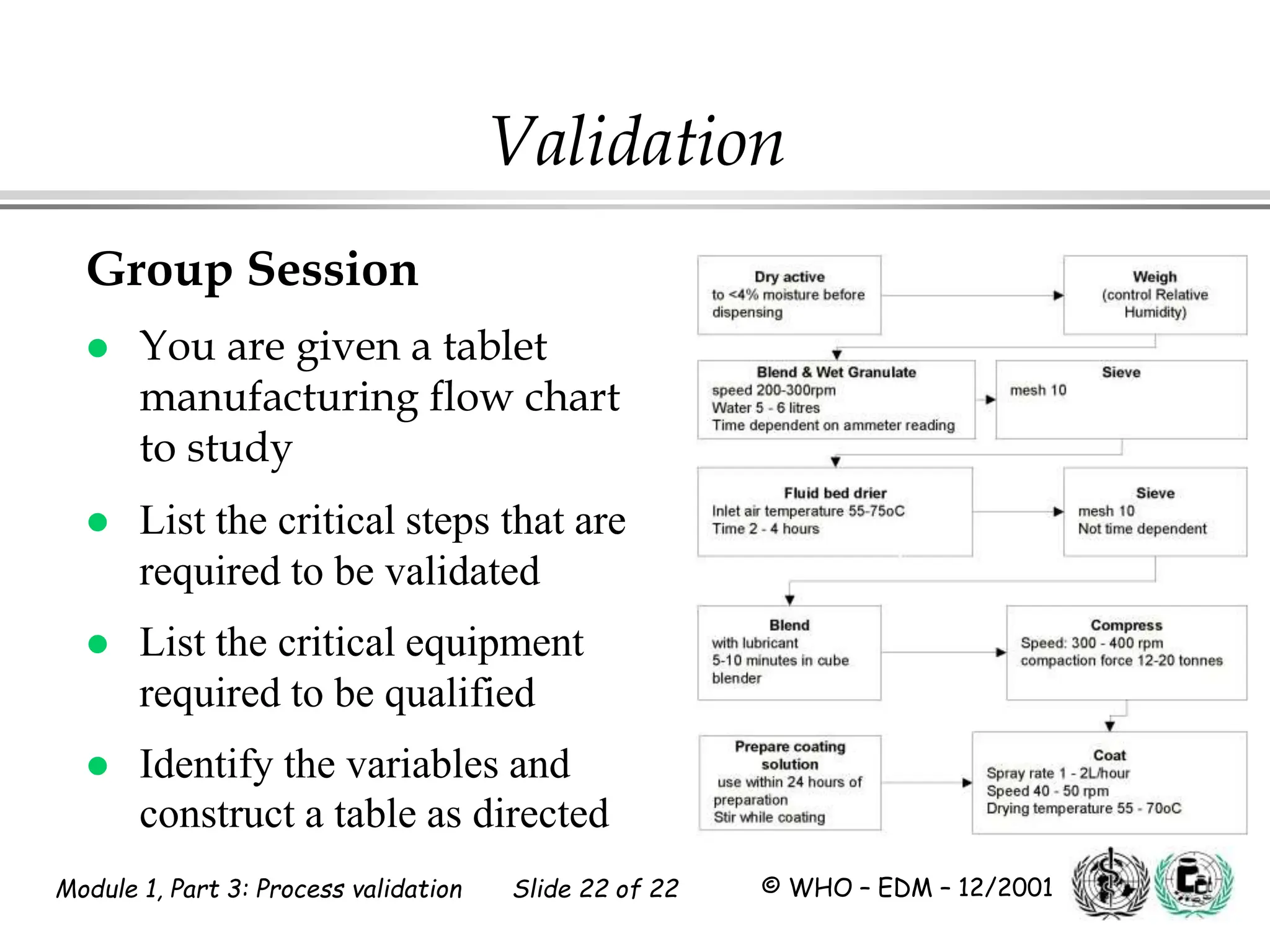
Group Session
 You are given a tablet
manufacturing flow chart
to study
 List the critical steps that are
required to be validated
 List the critical equipment
required to be qualified
 Identify the variables and
construct a table as directed

Pharmaceutical Validation & Calibration

  • 1.
    Module 1, Part3: Process validation Slide 1 of 22 © WHO – EDM – 12/2001 Validation Part 3: Process validation Supplementary Training Modules on Good Manufacturing Practices
  • 2.
    Module 1, Part3: Process validation Slide 2 of 22 © WHO – EDM – 12/2001 Validation Objectives To review:  Validation, risk analysis, and critical steps of processing  Points to consider in process validation of:  solid dose mixing  tablet compression  sterilization  Finalization of validation
  • 3.
    Module 1, Part3: Process validation Slide 3 of 22 © WHO – EDM – 12/2001 Introduction Validation
  • 4.
    Module 1, Part3: Process validation Slide 4 of 22 © WHO – EDM – 12/2001 Validation Reliable, repeatable, under control  At least first 3 consecutive batches - repeatable  Must investigate failures  The rationale should be documented if experimental method is changed  document deviations, decisions and reasoning  Does not improve processes  Should not validate bad processes
  • 5.
    Module 1, Part3: Process validation Slide 5 of 22 © WHO – EDM – 12/2001 Validation Design user or process requirements Install installation qualification Operate operational qualification Validate performance qualification and process validation Review periodically (+ change control) DQ, IQ, OQ and PQ
  • 6.
    Module 1, Part3: Process validation Slide 6 of 22 © WHO – EDM – 12/2001 Validation Critical factors or parameters  Need to be determined  Need to be monitored during validation  May affect the quality of the product
  • 7.
    Module 1, Part3: Process validation Slide 7 of 22 © WHO – EDM – 12/2001 Validation Setting Limits  Marketing authorization limits  stability specifications  Release specification  Validation limits Batch release limits Marketing authorisation limits based on stability specifications Validation limits
  • 8.
    Module 1, Part3: Process validation Slide 8 of 22 © WHO – EDM – 12/2001 Determining critical control point example of a tablet granulation process  Particle size distribution of the active(s)  Blending time for the powder  Granulating time and speed,  Amount of granulating fluid-binder concentration  Drying time - final moisture content, granule particle size distribution  Granule active content and homogeneity, blending time of external phase Validation
  • 9.
    Module 1, Part3: Process validation Slide 9 of 22 © WHO – EDM – 12/2001 Validation Determining critical control points
  • 10.
    Module 1, Part3: Process validation Slide 10 of 22 © WHO – EDM – 12/2001 Solid dose mixing (1)  Homogeneity in blending – the key to quality!  Sampling strategy  Sample site, label, container  Storage  Transport  Sample thief Validation
  • 11.
    Module 1, Part3: Process validation Slide 11 of 22 © WHO – EDM – 12/2001 Solid dose mixing (2)  In situ analysis  Methods of analysis  Statistical analysis  inter-batch  intra-batch  within-sample-site Validation
  • 12.
    Module 1, Part3: Process validation Slide 12 of 22 © WHO – EDM – 12/2001 Validation Tablet compression variables  Fill volume  Pre-compression force, compression force  Turntable speed  Dwell time  Granule size and feed  Ejection force, lubrication
  • 13.
    Module 1, Part3: Process validation Slide 13 of 22 © WHO – EDM – 12/2001 Validation Tablet compression parameters  Mass  Hardness  Moisture  Friability  Disintegration  Dissolution  Thickness Tablet coating variables  Spray rate  Inlet and outlet air temp  Coating weight
  • 14.
    Module 1, Part3: Process validation Slide 14 of 22 © WHO – EDM – 12/2001 Validation  Lethality of cycle  D value  Z value  F value  Fo value min 8 Thermal Death Curve 1 10 100 90 95 100 105 110 115 120 125 Temperature (oC) D value (log scale) Moist heat sterilization “Z”
  • 15.
    Module 1, Part3: Process validation Slide 15 of 22 © WHO – EDM – 12/2001 Validation Sterilization validation (1)  Sterility test  Physical measurements  Chemical and biological indicators  Loading patterns
  • 16.
    Module 1, Part3: Process validation Slide 16 of 22 © WHO – EDM – 12/2001 Validation Sterilization validation (2)  Cooling fluid or gas  Automated process  Leak tests  Control instrumentation  Steam quality  Heat distribution
  • 17.
    Module 1, Part3: Process validation Slide 17 of 22 © WHO – EDM – 12/2001 Validation Dry heat sterilization  Parameters  Air circulation, positive air pressure, HEPA filter  Advantages  microorganisms destroyed  depyrogenation possible  Disadvantages  poor heat transfer  higher temperatures for long periods
  • 18.
    Module 1, Part3: Process validation Slide 18 of 22 © WHO – EDM – 12/2001 Validation Process variation Controllable causes of variation may include:  Temperature, humidity  Variations in electrical supply  Vibration  Environmental contaminants  Light  Human factors  Variability of materials  Wear and tear of equipment
  • 19.
    Module 1, Part3: Process validation Slide 19 of 22 © WHO – EDM – 12/2001 Validation Change control  Must be a review procedure for validated processes  From time to time changes may be necessary  Documented change control procedure needed  “Like for like" changes do not require re-validation
  • 20.
    Module 1, Part3: Process validation Slide 20 of 22 © WHO – EDM – 12/2001 Mixing validation liquid and solid dose change control and scale up  Mixer type and size  Batch size  Pilot study scale up  Limit on the proportion of the scale up Validation
  • 21.
    Module 1, Part3: Process validation Slide 21 of 22 © WHO – EDM – 12/2001 Validation Finalization of validation process  Final report required  Summarize and reference protocols and results  Conclusion required: “Is the process valid”  Final report should be reviewed and approved by  the validation team  “authorized person”
  • 22.
    Module 1, Part3: Process validation Slide 22 of 22 © WHO – EDM – 12/2001 Validation Group Session  You are given a tablet manufacturing flow chart to study  List the critical steps that are required to be validated  List the critical equipment required to be qualified  Identify the variables and construct a table as directed