Module 1,, Part 4: QC-related validation Slide 1 of 28 © WHO – EDM – 1/2002
Validation Part 4:
QC-related validation
Supplementary Training Modules on
Good Manufacturing Practice
Module 1,, Part 4: QC-related validation Slide 2 of 28 © WHO – EDM – 1/2002
Validation
Introduction
 Why is analytical monitoring necessary?
 What is the purpose of analytical validation?
Module 1,, Part 4: QC-related validation Slide 3 of 28 © WHO – EDM – 1/2002
Validation
Objectives
To introduce the concepts of :
 Protocol development
 Instrument qualification
 Analytical procedure
 Extent of validation
 Method transfer
 Chemical and physical, biological, and
microbiological test validation
Module 1,, Part 4: QC-related validation Slide 4 of 28 © WHO – EDM – 1/2002
Validation of analytical procedures
requires:
 Qualified and calibrated instruments
 Documented methods
 Reliable reference standards
 Qualified analysts
 Sample integrity
Validation
Module 1,, Part 4: QC-related validation Slide 5 of 28 © WHO – EDM – 1/2002
Validation protocol for analytical method
 Statement of purpose and scope
 Responsibilities
 Documented test method
 List of materials and equipment
 Procedure for the experiments for each parameter
 Statistical analysis
 Acceptance criteria for each performance parameter
Validation
Module 1,, Part 4: QC-related validation Slide 6 of 28 © WHO – EDM – 1/2002
Qualification of the instrument
 Make, model and maker’s manual
 Modifications
 Installation and operational qualification
 Calibration programs
 Maintenance schedules
Validation
Module 1,, Part 4: QC-related validation Slide 7 of 28 © WHO – EDM – 1/2002
Characteristics of analytical
procedures (1)
 Accuracy
 Precision
 Repeatability
 Reproducibility
Validation
Module 1,, Part 4: QC-related validation Slide 8 of 28 © WHO – EDM – 1/2002
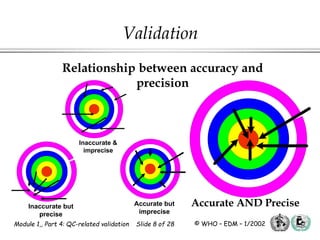
Inaccurate &
imprecise
Inaccurate but
precise
Accurate but
imprecise
Validation
Relationship between accuracy and
precision
Accurate AND Precise
Module 1,, Part 4: QC-related validation Slide 9 of 28 © WHO – EDM – 1/2002
Characteristics of analytical procedures (2)
 Ruggedness
 Robustness
 Variability caused by:
 Day-to-day variations
 Analyst-to-analyst
 Laboratory-to-laboratory
 Instrument-to-instrument
 Chromatographic column-to-column
 Reagent kit-to-kit
 Instability of analytical reagents
Validation
Module 1,, Part 4: QC-related validation Slide 10 of 28 © WHO – EDM – 1/2002
Characteristics of analytical procedures (3)
 Linearity and range
 Specificity
 Sensitivity
 Limit of detection
 Limit of quantitation
Validation
Module 1,, Part 4: QC-related validation Slide 11 of 28 © WHO – EDM – 1/2002
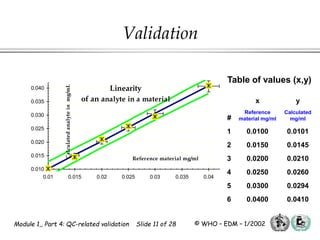
Linearity
of an analyte in a material
0.010
0.015
0.020
0.025
0.030
0.035
0.040
0.01 0.015 0.02 0.025 0.03 0.035 0.04
Reference material mg/ml
Calculated
analyte
in
mg/mL
Table of values (x,y)
x y
#
Reference
material mg/ml
Calculated
mg/ml
1 0.0100 0.0101
2 0.0150 0.0145
3 0.0200 0.0210
4 0.0250 0.0260
5 0.0300 0.0294
6 0.0400 0.0410
Validation
Module 1,, Part 4: QC-related validation Slide 12 of 28 © WHO – EDM – 1/2002
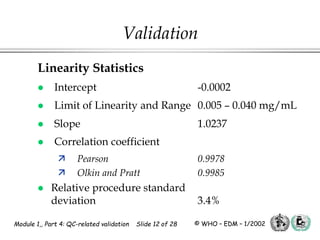
Linearity Statistics
 Intercept -0.0002
 Limit of Linearity and Range 0.005 – 0.040 mg/mL
 Slope 1.0237
 Correlation coefficient
 Pearson 0.9978
 Olkin and Pratt 0.9985
 Relative procedure standard
deviation 3.4%
Validation
Module 1,, Part 4: QC-related validation Slide 13 of 28 © WHO – EDM – 1/2002
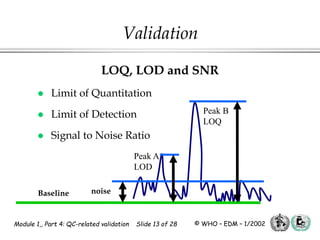
LOQ, LOD and SNR
 Limit of Quantitation
 Limit of Detection
 Signal to Noise Ratio
noise
Peak A
LOD
Peak B
LOQ
Baseline
Validation
Module 1,, Part 4: QC-related validation Slide 14 of 28 © WHO – EDM – 1/2002
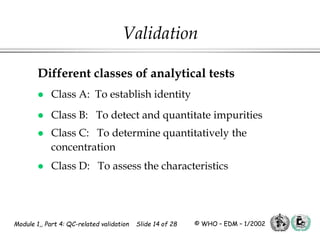
Different classes of analytical tests
 Class A: To establish identity
 Class B: To detect and quantitate impurities
 Class C: To determine quantitatively the
concentration
 Class D: To assess the characteristics
Validation
Module 1,, Part 4: QC-related validation Slide 15 of 28 © WHO – EDM – 1/2002
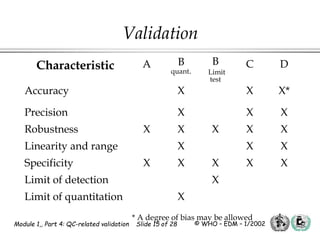
* A degree of bias may be allowed
Characteristic A B
quant.
B
Limit
test
C D
Accuracy X X X*
Precision X X X
Robustness X X X X X
Linearity and range X X X
Specificity X X X X X
Limit of detection X
Limit of quantitation X
Validation
Module 1,, Part 4: QC-related validation Slide 16 of 28 © WHO – EDM – 1/2002
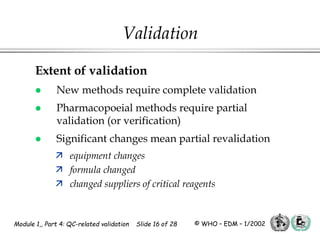
Extent of validation
 New methods require complete validation
 Pharmacopoeial methods require partial
validation (or verification)
 Significant changes mean partial revalidation
 equipment changes
 formula changed
 changed suppliers of critical reagents
Validation
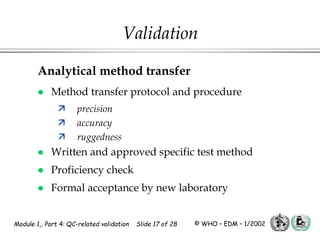
Module 1,, Part 4: QC-related validation Slide 17 of 28 © WHO – EDM – 1/2002
Analytical method transfer
 Method transfer protocol and procedure
 precision
 accuracy
 ruggedness
 Written and approved specific test method
 Proficiency check
 Formal acceptance by new laboratory
Validation
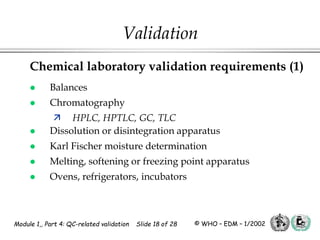
Module 1,, Part 4: QC-related validation Slide 18 of 28 © WHO – EDM – 1/2002
Chemical laboratory validation requirements (1)
 Balances
 Chromatography
 HPLC, HPTLC, GC, TLC
 Dissolution or disintegration apparatus
 Karl Fischer moisture determination
 Melting, softening or freezing point apparatus
 Ovens, refrigerators, incubators
Validation
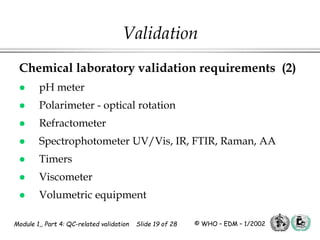
Module 1,, Part 4: QC-related validation Slide 19 of 28 © WHO – EDM – 1/2002
Chemical laboratory validation requirements (2)
 pH meter
 Polarimeter - optical rotation
 Refractometer
 Spectrophotometer UV/Vis, IR, FTIR, Raman, AA
 Timers
 Viscometer
 Volumetric equipment
Validation
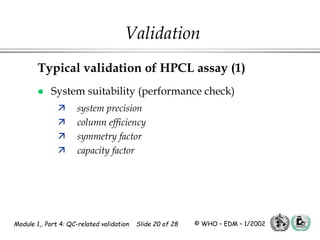
Module 1,, Part 4: QC-related validation Slide 20 of 28 © WHO – EDM – 1/2002
Validation
Typical validation of HPCL assay (1)
 System suitability (performance check)
 system precision
 column efficiency
 symmetry factor
 capacity factor
Module 1,, Part 4: QC-related validation Slide 21 of 28 © WHO – EDM – 1/2002
Validation
Typical validation of HPLC assay (2)
 Method validation
 specificity
 accuracy
 precision
 linearity
 robustness
Module 1,, Part 4: QC-related validation Slide 22 of 28 © WHO – EDM – 1/2002
Biological assays
 Can be difficult to "validate"
 "Validity" on a case by case basis
 Strictly adhere to the Biological Testing
monographs in pharmacopoeias
Validation
Module 1,, Part 4: QC-related validation Slide 23 of 28 © WHO – EDM – 1/2002
Microbiological testing requiring validation
 Microbial limit testing
 Microbial count
 Sterility testing
 Preservative effectiveness testing
 Environmental monitoring program
 Biological testing
Validation
Module 1,, Part 4: QC-related validation Slide 24 of 28 © WHO – EDM – 1/2002
Validation of microbial test procedures (1)
 Virtually impossible to completely validate test
procedures for every microorganism
 Neutralize /inactivate inhibitory substances, or
dilute
 Periodic media challenge
 Media QC
 Reliable methods
Validation
Module 1,, Part 4: QC-related validation Slide 25 of 28 © WHO – EDM – 1/2002
Validation of microbial test procedures (2)
 Incubation temperature and time
 Media may not grow all microorganisms
 Variations in media may affect recovery
 Inhibitory disinfectants or preservatives
 Sample
 procedures
 handling, storage, transport
Validation
Module 1,, Part 4: QC-related validation Slide 26 of 28 © WHO – EDM – 1/2002
Microbiological viable count method
validation (1)
 Methods
 pour plate / spread plate
 membrane filtration
 Most Probable Number
 Sample size
 Test dilution
 Inoculation size
Validation
Module 1,, Part 4: QC-related validation Slide 27 of 28 © WHO – EDM – 1/2002
Microbiological viable count method
validation (2)
 Membrane filtration conditions
 Incubation conditions
 Acceptance criteria
Validation
Module 1,, Part 4: QC-related validation Slide 28 of 28 © WHO – EDM – 1/2002
Sterility testing validation requirements
 Media growth promotion, sterility, pH
 Product validation
 Stasis testing
 Environmental monitoring
 Negative controls
 Challenge organisms
Validation

Analytical Validation Method for laboratory

  • 1.
    Module 1,, Part4: QC-related validation Slide 1 of 28 © WHO – EDM – 1/2002 Validation Part 4: QC-related validation Supplementary Training Modules on Good Manufacturing Practice
  • 2.
    Module 1,, Part4: QC-related validation Slide 2 of 28 © WHO – EDM – 1/2002 Validation Introduction  Why is analytical monitoring necessary?  What is the purpose of analytical validation?
  • 3.
    Module 1,, Part4: QC-related validation Slide 3 of 28 © WHO – EDM – 1/2002 Validation Objectives To introduce the concepts of :  Protocol development  Instrument qualification  Analytical procedure  Extent of validation  Method transfer  Chemical and physical, biological, and microbiological test validation
  • 4.
    Module 1,, Part4: QC-related validation Slide 4 of 28 © WHO – EDM – 1/2002 Validation of analytical procedures requires:  Qualified and calibrated instruments  Documented methods  Reliable reference standards  Qualified analysts  Sample integrity Validation
  • 5.
    Module 1,, Part4: QC-related validation Slide 5 of 28 © WHO – EDM – 1/2002 Validation protocol for analytical method  Statement of purpose and scope  Responsibilities  Documented test method  List of materials and equipment  Procedure for the experiments for each parameter  Statistical analysis  Acceptance criteria for each performance parameter Validation
  • 6.
    Module 1,, Part4: QC-related validation Slide 6 of 28 © WHO – EDM – 1/2002 Qualification of the instrument  Make, model and maker’s manual  Modifications  Installation and operational qualification  Calibration programs  Maintenance schedules Validation
  • 7.
    Module 1,, Part4: QC-related validation Slide 7 of 28 © WHO – EDM – 1/2002 Characteristics of analytical procedures (1)  Accuracy  Precision  Repeatability  Reproducibility Validation
  • 8.
    Module 1,, Part4: QC-related validation Slide 8 of 28 © WHO – EDM – 1/2002 Inaccurate & imprecise Inaccurate but precise Accurate but imprecise Validation Relationship between accuracy and precision Accurate AND Precise
  • 9.
    Module 1,, Part4: QC-related validation Slide 9 of 28 © WHO – EDM – 1/2002 Characteristics of analytical procedures (2)  Ruggedness  Robustness  Variability caused by:  Day-to-day variations  Analyst-to-analyst  Laboratory-to-laboratory  Instrument-to-instrument  Chromatographic column-to-column  Reagent kit-to-kit  Instability of analytical reagents Validation
  • 10.
    Module 1,, Part4: QC-related validation Slide 10 of 28 © WHO – EDM – 1/2002 Characteristics of analytical procedures (3)  Linearity and range  Specificity  Sensitivity  Limit of detection  Limit of quantitation Validation
  • 11.
    Module 1,, Part4: QC-related validation Slide 11 of 28 © WHO – EDM – 1/2002 Linearity of an analyte in a material 0.010 0.015 0.020 0.025 0.030 0.035 0.040 0.01 0.015 0.02 0.025 0.03 0.035 0.04 Reference material mg/ml Calculated analyte in mg/mL Table of values (x,y) x y # Reference material mg/ml Calculated mg/ml 1 0.0100 0.0101 2 0.0150 0.0145 3 0.0200 0.0210 4 0.0250 0.0260 5 0.0300 0.0294 6 0.0400 0.0410 Validation
  • 12.
    Module 1,, Part4: QC-related validation Slide 12 of 28 © WHO – EDM – 1/2002 Linearity Statistics  Intercept -0.0002  Limit of Linearity and Range 0.005 – 0.040 mg/mL  Slope 1.0237  Correlation coefficient  Pearson 0.9978  Olkin and Pratt 0.9985  Relative procedure standard deviation 3.4% Validation
  • 13.
    Module 1,, Part4: QC-related validation Slide 13 of 28 © WHO – EDM – 1/2002 LOQ, LOD and SNR  Limit of Quantitation  Limit of Detection  Signal to Noise Ratio noise Peak A LOD Peak B LOQ Baseline Validation
  • 14.
    Module 1,, Part4: QC-related validation Slide 14 of 28 © WHO – EDM – 1/2002 Different classes of analytical tests  Class A: To establish identity  Class B: To detect and quantitate impurities  Class C: To determine quantitatively the concentration  Class D: To assess the characteristics Validation
  • 15.
    Module 1,, Part4: QC-related validation Slide 15 of 28 © WHO – EDM – 1/2002 * A degree of bias may be allowed Characteristic A B quant. B Limit test C D Accuracy X X X* Precision X X X Robustness X X X X X Linearity and range X X X Specificity X X X X X Limit of detection X Limit of quantitation X Validation
  • 16.
    Module 1,, Part4: QC-related validation Slide 16 of 28 © WHO – EDM – 1/2002 Extent of validation  New methods require complete validation  Pharmacopoeial methods require partial validation (or verification)  Significant changes mean partial revalidation  equipment changes  formula changed  changed suppliers of critical reagents Validation
  • 17.
    Module 1,, Part4: QC-related validation Slide 17 of 28 © WHO – EDM – 1/2002 Analytical method transfer  Method transfer protocol and procedure  precision  accuracy  ruggedness  Written and approved specific test method  Proficiency check  Formal acceptance by new laboratory Validation
  • 18.
    Module 1,, Part4: QC-related validation Slide 18 of 28 © WHO – EDM – 1/2002 Chemical laboratory validation requirements (1)  Balances  Chromatography  HPLC, HPTLC, GC, TLC  Dissolution or disintegration apparatus  Karl Fischer moisture determination  Melting, softening or freezing point apparatus  Ovens, refrigerators, incubators Validation
  • 19.
    Module 1,, Part4: QC-related validation Slide 19 of 28 © WHO – EDM – 1/2002 Chemical laboratory validation requirements (2)  pH meter  Polarimeter - optical rotation  Refractometer  Spectrophotometer UV/Vis, IR, FTIR, Raman, AA  Timers  Viscometer  Volumetric equipment Validation
  • 20.
    Module 1,, Part4: QC-related validation Slide 20 of 28 © WHO – EDM – 1/2002 Validation Typical validation of HPCL assay (1)  System suitability (performance check)  system precision  column efficiency  symmetry factor  capacity factor
  • 21.
    Module 1,, Part4: QC-related validation Slide 21 of 28 © WHO – EDM – 1/2002 Validation Typical validation of HPLC assay (2)  Method validation  specificity  accuracy  precision  linearity  robustness
  • 22.
    Module 1,, Part4: QC-related validation Slide 22 of 28 © WHO – EDM – 1/2002 Biological assays  Can be difficult to "validate"  "Validity" on a case by case basis  Strictly adhere to the Biological Testing monographs in pharmacopoeias Validation
  • 23.
    Module 1,, Part4: QC-related validation Slide 23 of 28 © WHO – EDM – 1/2002 Microbiological testing requiring validation  Microbial limit testing  Microbial count  Sterility testing  Preservative effectiveness testing  Environmental monitoring program  Biological testing Validation
  • 24.
    Module 1,, Part4: QC-related validation Slide 24 of 28 © WHO – EDM – 1/2002 Validation of microbial test procedures (1)  Virtually impossible to completely validate test procedures for every microorganism  Neutralize /inactivate inhibitory substances, or dilute  Periodic media challenge  Media QC  Reliable methods Validation
  • 25.
    Module 1,, Part4: QC-related validation Slide 25 of 28 © WHO – EDM – 1/2002 Validation of microbial test procedures (2)  Incubation temperature and time  Media may not grow all microorganisms  Variations in media may affect recovery  Inhibitory disinfectants or preservatives  Sample  procedures  handling, storage, transport Validation
  • 26.
    Module 1,, Part4: QC-related validation Slide 26 of 28 © WHO – EDM – 1/2002 Microbiological viable count method validation (1)  Methods  pour plate / spread plate  membrane filtration  Most Probable Number  Sample size  Test dilution  Inoculation size Validation
  • 27.
    Module 1,, Part4: QC-related validation Slide 27 of 28 © WHO – EDM – 1/2002 Microbiological viable count method validation (2)  Membrane filtration conditions  Incubation conditions  Acceptance criteria Validation
  • 28.
    Module 1,, Part4: QC-related validation Slide 28 of 28 © WHO – EDM – 1/2002 Sterility testing validation requirements  Media growth promotion, sterility, pH  Product validation  Stasis testing  Environmental monitoring  Negative controls  Challenge organisms Validation