For updated information, please visit www.ibef.org May 2018
PHARMACEUTICALS
Table of Content
Executive Summary……………….….…….3
Advantage India…………………..….…......4
Market Overview …………….……….…….6
Porters Five Forces Analysis.….…..……..14
Recent trends and Strategies……...…..…15
Growth Drivers……………………..............20
Case Studies……………....…………….…33
Opportunities…….……….......………….…30
Useful Information……….......………….….36
For updated information, please visit www.ibef.orgPharmaceuticals3
EXECUTIVE SUMMARY
Source: 1 FICCI - Trends & Opportunities for Indian Pharma 2018, Pharmexcil, 2TechSci Research, Assocham and RNCOS
Notes: Information as per latest available data
 Indian pharmaceutical sector industry supplies over 50 per cent of global demand for various vaccines, 40 per
cent of generic demand in the US and 25 per cent of all medicine in UK1.
Leading pharma
producer
 The country’s pharmaceutical industry is expected to expand at a CAGR of 22.4 per cent over 2015–20 to
reach US$ 55 billion2. India is the second largest contributor of global biotech and pharmaceutical workforce.
Among fastest growing
industries
 India accounts for 20 per cent of global exports in generics. India’s pharmaceutical exports stood at US$
17.27 billion in 2017-18 and are expected to reach US$ 20 billion by 2020.
One of the highest
exports
 Indian healthcare sector, one of the fastest growing sectors, is expected to cross US$ 372 billion by 2022.
Rapidly growing
healthcare sector
 The domestic generics market is expected to reach US$ 27.9 billion by 2020. India’s generics market has
immense potential for growth. Indian pharmaceutical companies received record 300 generic drug approvals
in USA during 2017 where the generic market is expected to reach US$ 88 billion by 2021.
High potential generics
market
 By 2024-25, India’s biotech industry is estimated to increase to US$ 100 billion.
Robust growth in Biotech
industry
Pharmaceuticals
ADVANTAGE INDIA
For updated information, please visit www.ibef.orgPharmaceuticals5
ADVANTAGE INDIA
 Low cost of production and R&D boosts efficiency of
Indian pharma companies
 India’s cost of production is approximately 33 per cent
lower than that of the US.
 Due to lower cost of treatment, India is emerging as a
leading destination for medical tourism
 India’s ability to
manufacture high quality, low priced
medicines, presents a huge business
opportunity for the domestic industry.
 Economic prosperity to improve drug
affordability
 Increasing penetration of health
insurance
 With increasing penetration of
pharmacies, especially in rural India,
OTC drugs will be readily available
 Accounts for over 10 per cent of the
global pharmaceutical production
 Over 60,000 generic brands across 60
therapeutic categories. Manufactures
more than 500 different APIs
 Government unveiled ‘Pharma
Vision 2020’ aimed at making India
a global leader in end-to-end drug
manufacturing
 Reduced approval time for new
facilities to boost investments
 In this sector, 100 per cent FDI is
allowed under automatic route
ADVANTAGE
INDIA
Source: PwC, McKinsey, Pharmaceuticals Exports Promotion Council of India
Note: 2020 revenue forecasts are estimates of McKinsey, API - Active Pharmaceutical Ingredients, F – Forecast, OTC - Over-The-Counter
Pharmaceuticals
MARKET OVERVIEW
For updated information, please visit www.ibef.orgPharmaceuticals7
STRUCTURE OF PHARMA SECTOR IN INDIA
Pharmaceuticals
Source: Dun and Bradstreet, Aranca Research
Active Pharmaceutical
Ingredients/ Bulk drugs
Formulations
Branded Generics Branded Generics
 Cardiovascular
 Anti-Diabetes
 Gastro-Intestinal
 Neurological
 Anti-infectives
 Respiratory
 Pain
 Gynecology
For updated information, please visit www.ibef.orgPharmaceuticals8
EVOLUTION OF INDIAN PHARMACEUTICAL SECTOR
Source: Aranca Research
Notes: KAM - Key Account Management, CSO - Contract Sales Organisation
 Indian Patent Act passed in 1970
 Several domestic companies start
operations
 Development of production
infrastructure
 Export initiatives taken
 Increased patent filings by pharma players
 Likely adoption of newer sales models such
as channel management, KAM and CSO
 The National Pharmaceutical Pricing Policy,
2012 (NPPP-2012)
 In Union Budget, 2016, FDI increased to 74
per cent in existing pharmaceutical
companies
 The Government of India unveiled 'Pharma
Vision 2020' aimed at making India a global
leader in end-to-end drug manufacture.
Approval time for new facilities has been
reduced to boost investments.
 Liberalised market
 Indian companies increasingly launch
operations in foreign countries
 India a major destination for generic drug
manufacturing
 Approval of Patents (Amendment) Act 2005,
which led to adoption of product patents in
India
 2013: New Drug Pricing Control Order issued by Directorate of Food and Drugs this will reduce the
prices of drugs by 80 per cent
 2014: 100 per cent FDI allowed in medical device industry. The investment will be routed through
automatic route
 Leading Indian pharma companies are raising funds aggressively to fund acquisition in domestic
as well as international market to increase their product portfolios
 2015: India has 10,500 manufacturing units and over 3,000 pharma companies
 National Health Policy Draft 2015 to increase expenditure in health care sector
 Patent Act Amendment 2015, it includes amendments in Patent Act 2002
1990-2010 2010- 20152010
2016
onwards
1970-90
For updated information, please visit www.ibef.orgPharmaceuticals9
Important Segments in Indian Pharmaceutical Sector
Active Pharmaceutical Ingredients
(APIs)
 Domestic API consumption is expected to reach
US$ 18.8 billion by FY221.
 In April 2018, a high-level task force was
constituted to create a roadmap for increasing
domestic production of APIs. Currently India
imports over 60 per cent of its APIs from other
countries.
Contract Research and Manufacturing
Services (CRAMS)
 Fragmented market with more than 1,000 players
 CRAMS industry is estimated to reach US$ 18
billion in 2018 and expected to witness a strong
growth at a CAGR of 18-20 per cent between
2013-18.
Biosimilars
 The government plans to allocate US$ 70 million
for local players to develop Biosimilars.
 The domestic market is expected to reach US$ 40
billion by 2030
Formulations
 Largest exporter of formulations in terms of
volume, with 14 per cent market share and 12th in
terms of export value. Drug formulation* exports
from India reached US$ 12.91 billion during FY18.
 Domestic market size currently valued at US$
11.2 billion
 Double-digit growth expected over the next five
years
Pharmaceutical
industry
Notes: OTC - Over The Counter, * including biologicals
Source: 1 RNCOS, BMI, Datamonitor, Kemwell Biopharma, Chemical Pharmaceutical Generic Association, ICRA Report estimates, pharmanewsprwire.com, DGCI&S
For updated information, please visit www.ibef.orgPharmaceuticals10
INDIAN PHARMA SECTOR REVENUES TRENDING
NORTH
3.14 3.19 3.08
12.32
13.92
14.97
0.00
2.00
4.00
6.00
8.00
10.00
12.00
14.00
16.00
18.00
20.00
2015 2016 2017
Scheduled Formulations Non-Scheduled Formulations
Source: Department of Pharmaceuticals, PwC, McKinsey, AIOCD AWACS
Note: F - Forecast, CAGR - Compound Annual Growth Rate, CY – Calendar Year, E - Estimated
 Indian pharmaceutical market grew 5.5 per cent in CY2017 in terms
of moving annual turnover. With a turnover of Rs 1.16 trillion (US$
18.06 billion).
 By 2020, India is likely to be among the top three pharmaceutical
markets by incremental growth and 6th largest market globally in
absolute size.
 India’s cost of production is significantly lower than that of the US
and almost half of that of Europe. It gives a competitive edge to India
over others.
 Increase in the size of middle class households coupled with the
improvement in medical infrastructure and increase in the
penetration of health insurance in the country will also influence in
the growth of pharmaceuticals sector.
Visakhapatnam port traffic (million tonnes)Annual Turnover of Indian Pharmaceutical Market (US$ billion)
15.46
17.11
18.06
For updated information, please visit www.ibef.orgPharmaceuticals11
GENERIC DRUGS FORM THE LARGEST SEGMENT OF
INDIAN PHARMA MARKET
70%
21%
9%
Generic drugs
OTC medicines
Patented drugs
Source: Business Monitor International, FCCI Indian Pharma Summit 2014-15
 With 70 per cent of market share (in terms of revenues), generic
drugs form the largest segment of the Indian pharmaceutical sector
 India supplies 20 per cent of global generic medicines market
exports, in terms of volume, making the country the largest provider
of generic medicines globally and expected to expand even further in
coming years
 Over the Counter (OTC) medicines and patented drugs constitute 21
per cent and 9 per cent, respectively, of total market revenues of
US$ 20 billion
 Indian pharma drug manufacturer Aurobindo Pharma has received
the USFDA approval to manufacture oral suspension, which is used
for controlling serum phosphorus in patients with chronic kidney
disease on dialysis. This drug is a therapeutic equivalent generic
version of Genzyme's Renvela oral suspension.
 The share of generic drugs is expected to continue increasing;
domestic generic drug market is expected to reach US$ 27.9 billion
in 2020
 Due to their competence in generic drugs, growth in this market
offers a great opportunity for Indian firms
 Generic drug market is expected to grow in the next few years, with
many drugs going off-patent in the US and other countries
 Domestic generic drug market has reached US$ 26.1 billion in 2016
Visakhapatnam port traffic (million tonnes)Revenue share of Indian pharmaceutical sub-segments in 2015
Note: Figures are as per latest available data
0.8 0.9 1.1 1.3 1.5 2 2 2.70
6.9 8.1 10 11.3 12.6 15.1 18.1 21
0%
10%
20%
30%
40%
50%
60%
70%
80%
90%
100%
2008 2009 2010 2011 2012 2013 2014 2015
Patented drugs Generic drugs
Share of patented and generic drugs in prescribed drug market
(US$ billion)
For updated information, please visit www.ibef.orgPharmaceuticals12
PHARMA EXPORT TO CONTINUE WITNESSING
POSITIVE GROWTH
10.1
12.6
14.5
14.9
16.9 16.8
17.3
0.0
2.0
4.0
6.0
8.0
10.0
12.0
14.0
16.0
18.0
20.0
FY12 FY13 FY14 FY15 FY16 FY17 FY18
Source: Department of Commerce India, Department of Pharmaceuticals, India Business News, BMI
 India is the world’s largest provider of generic medicines; the
country’s generic drugs account for 20 per cent of global generic
drug exports (in terms of volumes). Indian drugs are exported to
more than 200 countries in the world, with the US as the key market.
 Indian pharma companies are capitalising on export opportunities in
regulated and semi-regulated markets.
 Pharmaceutical exports from India reached US$ 17.27 billion in
FY18.
Visakhapatnam port traffic (million tonnes)Pharmaceutical Exports from India(US$ billion)
For updated information, please visit www.ibef.orgPharmaceuticals13
PHARMA GIANTS RAISE THEIR R&D SPENDING
361 359
306
174
104 85 62
-
50
100
150
200
250
300
350
400
Sunpharma
Lupin
Dr.Reddy
Cipla
Aurbindo
Cadila
Wockhardt
Source: Company websites, CRISIL Research
 Investment (as % of sales) in research & development by Indian
pharma companies increased from 5.5 per cent in FY11 to 9 per cent
in FY17.
 In FY17, highest expenditure on research and development was done
by Sun Pharma, followed by Lupin.
 Sun Pharma’s R&D spending was 7.6 per cent of the total sales in
the FY17 , which grew at a CAGR of 38.3 per cent from FY11 to
FY17.
 Sun Pharma’s R&D plan includes developing more products through
expanded R&D team for global markets, focussing on more complex
products across multiple dosage forms and investments in speciality
pipeline
 Lupin’s R&D spending was 13.5 per cent of sales in FY17, with major
thrust on oral solids (45 per cent of R&D spend)
Visakhapatnam port traffic (million tonnes)R&D spending by top six pharma companies FY17 (US$ million)
5.5 5.7 6.0
6.8 7.2
8.1
9.0
-
2.0
4.0
6.0
8.0
10.0
FY11 FY12 FY13 FY14 FY15 FY16 FY17
Visakhapatnam port traffic (million tonnes)R&D investment by Indian Pharma companies (% of sales)
For updated information, please visit www.ibef.orgPharmaceuticals14
Porter’s Five Forces Framework Analysis
 Difficult-to-manufacture APIs such as
steroids, sex hormones and peptides
give bargaining power to suppliers.
However, generic APIs do not have
much of that power
Bargaining Power of Suppliers
 Threat to substitute products is low;
however, homeopathy and Ayurvedic
medicines can act as substitute
Threat of Substitutes
 Growth opportunities for pharma
companies are expected to grow in
next few years, with many drugs
going off-patent in the US and other
countries, thus increasing competition
 Indian pharma companies will face
competition from big companies,
backed by huge financial muscle
Competitive Rivalry
 Strict government regulations thwart
entry of new players
 Difficult to survive because of high
gestation period
Threat of New Entrants
 Generic drugs offer a cost-effective
alternative to drugs innovators and
significant savings to customers
 Biosimilars offer significant cost
saving for insurance companies in
India
Bargaining Power of Buyers
Positive Impact
Neutral Impact
Negative Impact
Source: Aranca Research
Pharmaceuticals
RECENT TRENDS
AND STRATEGIES
For updated information, please visit www.ibef.orgPharmaceuticals16
 Indian pharma companies spend 8-13 per cent of their total turnover on R&D
 Expenditure on R&D is likely to increase due to the introduction of product patents; companies need to
develop new drugs to boost sales
 India’s pharmaceutical export market is thriving due to strong presence in the generics space
 Pharmaceuticals exports from India stood at US$ 17.27 billion in FY18.
 Cipla, the largest supplier of anti-malarial drugs to Africa, set up a US$ 32 billion plant in Africa for the
production of anti-retroviral and anti-malarial drugs.
 Mankind Pharma is planning to enter the US market and might start product filings in 2018.
 Multinational companies are collaborating with Indian pharma firms to develop new drugs
 Cipla formed an exclusive partnership with Serum Institute of India to sell vaccines in South Africa
 Six leading pharmaceutical companies have formed an alliance ‘LAZOR’ to share their best practices, so as
to improve efficiency and reduce operating costs
NOTABLE TRENDS IN THE INDIAN
PHARMACEUTICALS SECTOR … (1/2)
Source: Aranca Research, Pharmexcil
Notes: R&D - Research and Development
Research and
development
Increasing exports
Expansion by Indian
players abroad
Joint Ventures
For updated information, please visit www.ibef.orgPharmaceuticals17
NOTABLE TRENDS IN THE INDIAN BIOTECH SECTOR
 US based DiabetOmics Inc., medical diagnostic company has raised US$ 4 million from Ventureast & US$1
million from KI Varaprasad Reddy for driving manufacturing & commercialisation activities in India.
Global companies
setting up base
 Ranbaxy, Cadila Healthcare, Lupin, Wockhardt & Dr Reddy’s are among the major Indian pharmaceutical
companies operating in the bio-pharma segment
Pharma companies
focusing on biotech
 Growth in the sector is anticipated to come from the country's strong position in biosimilars & molecular
diagnostics as well as personalised medicine (where export & domestic trends look promising). In 2016,
development of biosimilars has been speeding up via Glycosylation Control Technology.
Biosimilars and
molecular diagnostic
remain strongholds
 According to International Service for the Acquisition of Agri-Biotech Applications, India has the 4th largest
area covered under genetically modified crops
 In India, 11.57 million hectares of area is covered under genetically modified crops which is majorly
dominated by Bt cotton.
 The bio agriculture industry in India can reach US$ 34-37 billion size by 2025.
Growth in Genetically
Modified crops
Source: Ministry of External Affairs, Accenture, Aranca Research, Linkedin
For updated information, please visit www.ibef.orgPharmaceuticals18
STATES HOSTING KEY PHARMACEUTICAL
VENTURES
Source: Company websites
 Wockhardt's facility covers an area of
40,468 sq meters in Baddi, Himachal
Pradesh
 Baddi is also home to Cipla’s
formulations manufacturing facility
 Piramal’s USFDA-approved
manufacturing plant in Hyderabad
 GlaxoSmithKline has a major facility at
Rajahmundry, Andhra Pradesh
 Mandideep in Madhya Pradesh is the
manufacturing hub for Lupin’s
cephalosporin and ACE-Inhibitors
 Cipla has a formulations manufacturing
plant at Indore
 Dholka in Gujarat houses a major
manufacturing facility of Cadila,
which spans over 100 acres
 Lupin has an USFDA-approved
plant at Tarapur, Maharashtra. The
facility forms the core of Lupin's
fermentation capabilities
 Sun Pharma's API manufacturing
facility at Toansa, Malanpur,
Guwahati, Ankleshwar, Panoli,
Ahmednagar, Maduramthakam
For updated information, please visit www.ibef.orgPharmaceuticals19
STRATEGIES ADOPTED
 Sun Pharma is trying to achieve cost leadership by
• Vertical Integration: Complex API, which require special skills and technology, are developed and scaled
up for both API and dosage forms
Cost leadership
Source: Company websites, Ministry of External Affairs, RBI
 Players in the sector are trying to strengthen their position in the market and expand themselves by investing
heavily in R&D activities, such as:
• Dr Reddy’s acquired OctoPlus N.V, a Netherlands-based company, to get access to the Poly Lactic-Co-
Glycolic Acid (PLGA) technology for the formulation of complex injectables
• In January 2017, Piramal Enterprises acquired a portfolio of anti-spasticity and pain management drugs
from US based drug maker – Mallinckrodt, for US$ 203 million.
• In May 2017, Lupin has launched erectile dysfunction drug named as Cialis. The company has quoted the
market worth for US$ 58.01 million in India. This tablet is available in 20 mg and 10 mg strengths.
Differentiation
 Lupin is making inroads into new markets such as Latin America, Russia and other East European countries
 Sun Pharma decided to focus on specialty and chronic therapies such as neurology, oncology, dermatology
segments
 Companies like Dr Reddy’s, Cipla and Wockhardt are planning their expansions in US$ 100 billion China
market in 2018.
Focus on new markets
Notes: R&D – Research and Development
 In October 2016, Advanced Enzyme Technologies, a biotech based firm in Mumbai signed an agreement with
JC Biotech - Active Pharmaceutical Ingredient (API) maker in Hyderabad, to acquire 70 per cent stake in the
company.
 In December 2017, Torrent Pharmaceuticals completed acquisition of branded business of Unichem
Laboratories.
Mergers and
Acquisitions in Biotech
Pharmaceuticals
GROWTH DRIVERS
For updated information, please visit www.ibef.orgPharmaceuticals21
GROWTH DRIVERS OF INDIAN PHARMA SECTOR
Source: Pharmaceutical Export Promotion Council
Notes: BPL - Below Poverty Line, USFDA - United States Food and Drug Administration, NPPP-2012--The National Pharmaceutical Pricing Policy, 2012
 Cost advantage
 Skilled manpower
 India a major manufacturing hub
for generics
 India accounts for 22 per cent of
overall USFDA approved plants
 Increasing penetration of chemists
 Increasing fatal diseases
 Accessibility of drugs to greatly
improve
 Increasing penetration of health
insurance
 Growing number of stress-related
diseases due to change in lifestyle
 Better diagnostic facilities
 National Health Policy 2015, which focuses on increasing public expenditure on
healthcare segment
 Reduction in approval time for new facilities
 Plans to set up new pharmaceutical education and research institutes
 Exemptions to drugs manufactured through indigenous R&D from price control under
NPPP-2012
Growth Drivers
For updated information, please visit www.ibef.orgPharmaceuticals22
SUPPLY-SIDE DRIVERS OF INDIAN PHARMA SECTOR
 Following the introduction of product patents, several multinational companies are expected to launch
patented drugs in India
 Growth in the number of lifestyle diseases in India could boost the sale of drugs in this segment
 High Court allowing to export patent drugs, to foreign players in the Indian market.
Launch of patented
drugs
Source: BMI, India Biz, Nicholas Hall & Company
 Pharma companies have increased spending to tap rural markets and develop better medical infrastructure
 Hospitals’ market size is expected to increase by US$ 200 billion by 2024
 In October 2016, the government gave a nod to set up the country's first medical devices manufacturing park
in Chennai
Medical infrastructure
 About 120 drugs are expected to go off-patent over the next 10 years; with expected worldwide revenue
between US$ 80 to 250 billion
Patent Expiry
Notes: CAGR - Compound Annual Growth Rate
 India’s generic drugs account for 20 per cent of global exports in terms of volume, making it country the largest
provider of generic medicines globally. The generics drug market accounts for around 70 per cent of the India
pharmaceutical industry and it is expected to reach US$ 27.9 billion by 2020
Scope in generics
market
 India’s OTC drugs market is estimated to have grown at a CAGR of 16.3 per cent to US$ 6.6 billion over
2008–16 and is further expected to grow on the account of increased penetration of chemists, especially in
rural regions. Indian OTC market is expected to grow at a CAGR of 9 per cent from 2016-26 to cross Rs
44,115 crore (US$ 6.81 billion).
Over-The-Counter
(OTC) drugs
For updated information, please visit www.ibef.orgPharmaceuticals23
DEMAND DRIVERS OF INDIAN PHARMA SECTOR
Accessibility
 Over US$ 200 billion to be spent on medical
infrastructure in the next decade
 New business models expected to penetrate tier-2 and 3
cities
 Over 160,000 hospital beds expected to be added each
year in the next decade
 India’s generic drugs account for 20 per cent of global
exports in terms of volume, making the country the
largest provider of generic medicines globally
Acceptability
 Rising levels of education to increase acceptability of
pharmaceuticals
 Patients to show greater propensity to self-medicate,
boosting the OTC market
 Acceptance of biologics and preventive medicines to
rise
 A skilled workforce as well as high managerial and
technical competence
 Surge in medical tourism due to increased patient
inflow from other countries
Epidemiological factors
 Patient pool expected to increase over 20 per cent in
the next 10 years, mainly due to rise in population
 New diseases and lifestyle changes to boost demand
 Increasing prevalence of lifestyle diseases
Affordability
 Rising income could drive 73 million households to the
middle class over the next 10 years
 Over 650 million people expected to be covered by
health insurance by 2020
 Government-sponsored programmes set to provide
health benefits to over 380 million BPL people by the
end of 2017
 The government plans to provide free generic
medicines to half the population at an estimated cost of
US$ 5.4 billion
Demand
drivers
Source: ICRA Report on Indian Pharmaceutical Sector, Pharmaceutical Industry: Developments in India- Deloitte, Mckinsey Pharma Report 2020
Note: RSBY - Rashtriya Swasthya Bima Yojna
For updated information, please visit www.ibef.orgPharmaceuticals24
GROWING HEALTH INSURANCE
Source: IRDA, General Insurance Council, Aranca Research
 Increasing penetration of non-life insurance including health insurance will drive the expansion of healthcare services and pharmaceutical market
in India.
 Adoption of health insurance in the country has been increasing at a fast pace.
 Gross direct premium from health insurance reached Rs 378.97 billion (US$ 5.88 billion) in FY18 and contributed 25.2 per cent to the gross direct
premiums of non-life insurance companies in India.
 Another boost to the sector will be the National Health Protection Scheme under Ayushman Bharat, announced in Union Budget 2018-19.
9.28
11.05
12.03
13.14
14.95
19.89
23.38
0.00
5.00
10.00
15.00
20.00
25.00
FY12
FY13
FY14
FY15
FY16
FY17
FY18
CAGR 16.65%
Gross Direct Premiums of Non-Life Insurers (US$ billion)Visakhapatnam port traffic (million tonnes)Break-up of non-life insurance market in India (FY18)
25.20%
74.8%
Health Others
Total size:
US$ 23.38
billion
For updated information, please visit www.ibef.orgPharmaceuticals25
FAVOURABLE POLICY MEASURES SUPPORT
GROWTH (1/2)
 Steps taken to reduce approval time for new facilities
 NOC for export licence issued in two weeks compared to 12 weeks earlier
Reduction in approval
time for new facilities
 Government is planning to relax FDI norms in the pharmaceutical sector
 In March 2017, the government decided to create a digital platform to regulate and track the sale of quality
drugs, and it can be used by people living in the country as well as abroad
Support for technology
upgrades and FDIs
 Pharma Vision 2020 by the government’s Department of Pharmaceuticals aims to make India a major hub for
end-to-end drug discovery
Pharma Vision 2020
 As per NBDS, a proposal has been made to set up the National Biotechnology Regulatory Authority (NBRA) to
provide a single-window clearance mechanism for all bio-safety products to create efficiencies & streamline
the drug approval process
Single-window
clearance
 Government of India is planning to set up mega bulk drug parks in order to reduce industry’s dependency on
raw material imports.
Bulk Drug Parks
 Government of India is planning to set up an electronic platform to regulate online pharmacies under a new
policy
Online Pharmacies
 The Industry – Academia mission was launched in June 2017 to boost development of biopharmaceuticals in
India.
National Biopharma
Mission
For updated information, please visit www.ibef.orgPharmaceuticals26
FAVOURABLE POLICY MEASURES SUPPORT
GROWTH (2/2)
Source: Livemint, Union Budget
 The allocation to the Ministry of Health and Family Welfare has increased by 11.5 per cent to Rs 52,800 crore
(US$ 8.16 billion).
 The National Health Protection Scheme is largest government funded healthcare programme in the world,
which is expected to benefit 100 million poor families in the country by providing a cover of up to Rs 5 lakh
(US$ 7,723.2) per family per year for secondary and tertiary care hospitalisation.
 The government has allocated Rs 1,200 crore (US$ 185.36 million) towards the National Health Policy 2017
under which 150,000 health and wellness centres, will provide healthcare closer to homes of the people.
 The increased expenditure on healthcare is expected to benefit the pharmaceutical sector as well
Union Budget 2018-19
 BIRAC has been established to promote research & innovation capabilities in India’s biotech industry. The
council will provide funding to biotech companies for technology & product development.
 BIRAC under Small Business Innovation Research Initiative (SBIRI) scheme supports innovations in
biotechnology.
Biotechnology Industry
Research Assistance
Council
 Programme on application of biotechnology for women was done to provide employment, skill development,
awareness generation, health improvement & socio-economic upliftment of the women population
Biotechnology Based
Programme for Women
For updated information, please visit www.ibef.orgPharmaceuticals27
NATIONAL PHARMA POLICY TO BRING GREATER
TRANSPARENCY
 In 2017, the Department of Pharmaceuticals released a draft National Pharmaceutical Policy with the following objectives:
• Make all essential drugs accessible to masses through affordable prices
• Provide the Indian pharmaceutical sector with a long term stable policy environment
• Make India self sufficient in end to end domestic drug manufacturing
• Maintain world class quality for domestic consumption and exports
• Create a positive environment for research and development in the pharma sector.
 As per the new policy, the Department of Pharmaceuticals will have control over the National List of Essential Medicines (NLEM), which decides
the drugs for which the Government of India can control the prices.
For updated information, please visit www.ibef.orgPharmaceuticals28
GOVERNMENT EXPENDITURE IN THE PHARMA
SECTOR ON AN UPTREND
19.55
21.57
23.12 23.58
35.07 34.91
0.00
5.00
10.00
15.00
20.00
25.00
30.00
35.00
40.00
FY13 FY14 FY15 FY16 FY17 FY18
Source: Business Monitor International, Economic Survey 2017-18
Note: CAGR - Compound Annual Growth Rate
 Government expenditure on health increased from Rs 1.26 lakh crore
(US$ 19.55 billion) in FY12 to Rs 2.25 lakh crore (US$ 34.91 billion)
in FY18, implying a CAGR of 12.3 per cent.
 Medical technology park in Vishakhapatnam, Andhra Pradesh has
already been set up with an investment of US$ 183.31 million. States
like Himachal Pradesh, Gujarat, Telangana and Maharashtra are
showing interest for making investments in these parks.
 German technical services provider TUV Rheinland’s Indian
subsidiary has partnered with Andhra Pradesh MedTech Zone
(AMTZ) to create an infrastructure for Electro-Magnetic Interference
(EMI/EMC) at an investment of US$ 12.64 million over a course of
four to five years.
Visakhapatnam port traffic (million tonnes)Government Expenditure on Health in India (US$ billion)
For updated information, please visit www.ibef.orgPharmaceuticals29
INVESTMENTS, JVs INFUSING SUPERIOR
CAPABILITIES IN INDIAN FIRMS
Source: BMI, Business Standard
Date Announced Indian company Foreign company Value (US$ million) Type
December 2017 Unichem Laboratories Torrent Pharma NA Acquisition
March, 2017 Sun Pharma Thallion Pharmaceuticals 19.77 Acquisition
January, 2017 Zydus Cadila Zoetis NA Acquisition
February 2017 Piramal Mallinckrodt 170 Specialty products
July 2016 Continental Hospitals Ltd. HH Healthcare Berhad 192.84 73.4% Stake
February 2016 Cipla
InvaGen Pharmaceuticals Inc. and
Exelan Pharmaceuticals Inc.
550 100% Stake
November 2015 Famy Care Ltd
Mylan Inc – Mylan Laboratories
Limited
750 100% Stake
October 2015 Nitin Lifesciences Recipharm 109.8 75% stakes in equity
July 2015 Lupin Temmler Not disclosed Acquisition
May 2015 Cadila Healthcare Claris Lifesciences 556.8 To be acquired
July 2015 Lupin Gavis and Novel Laboratories 880 Acquisition
April 2014 Sun Pharma Ranbaxy 320 Acquisition
November, 2014 Curatio Healthcare Sequoia Capital 15.8 Acquisition
July, 2013 Cipla Cipla Medpro 512 Acquisition
January, 2013 GlaxoSmithkLine Consumer GlaxoSmithkLine Plc. 1,088 Acquisition
 Indian Drugs & Pharmaceuticals sector has received cumulative FDI worth US$ 15.59 billion between April 2000 – December 2017.
 In 2017, Indian pharmaceutical sector witnessed 46 merger & acquisition (M&A) deals worth US$ 1.47 billion.
 Over the last three years, pharmaceuticals segment has accounted for more than 70 per cent of M&A deals.
Note: JV - Joint Venture
Pharmaceuticals
OPPORTUNITIES
For updated information, please visit www.ibef.orgPharmaceuticals31
OPPORTUNITIES ABOUND IN CLINICAL TRIALS AND
HIGH-END DRUGS
 India is among the leaders
in the clinical trial market
 Due to a genetically diverse
population and availability of
skilled doctors, India has
the potential to attract huge
investments to its clinical
trial market
 From 2009 to 2015, 3043
clinical trial has been
carried out in India.
 As of June 2017, the
Clinical Trials Registry –
India had 8,950 trials
registered.
Clinical trials market
 Due to increasing
population and income
levels, demand for high-end
drugs is expected to rise
 Growing demand could
open up the market for
production of high-end
drugs in India
High-end drugs
 With 70 per cent of India’s
population residing in rural
areas, pharma companies
have immense opportunities
to tap this market
 Demand for generic
medicines in rural markets
has seen a sharp growth.
Various companies are
investing in the distribution
network in rural areas
Penetration in rural market
 The Contract Research and
Manufacturing Services
industry (CRAMS) –
estimated at US$ 9.3 billion
in 2014, is expected to
reach US$ 19 billion by
2018.
 The market has more than
1,000 players
CRAMS
Source: BMI
For updated information, please visit www.ibef.orgPharmaceuticals32
OPPORTUNITIES FOR INNOVATION IN
AGRICULTURE/HEALTHCARE
 Vaccines & recombinant therapeutics are the sectors driving the biotechnology industry’s growth in India
 Newer prominent therapies such as monoclonal antibodies products, stem cell therapies are expected to pick
up pace in the foreseeing future
 Indian vaccine market reached Rs 69 billion (US$ 1.07 billion) in 2017 growing at a CAGR of 18 per cent
between 2010-17.
Vaccines
 Protein & antibody production & fabrication of diagnostic protein chips are promising areas for investment
 Stem cell research, cell engineering & cell-based therapeutics are other areas, where India can cash its
expertise
Bioactive therapeutic
proteins
 Hybrid seeds, including GM seeds, represent new business opportunities in India based on yield improvement
 Growing at an annual growth rate of 10-15 per cent, the Indian hybrid seed industry is estimated at US$1.93
billion in FY16, wherein Bt cotton is leading the market accounting for 45 per cent share India hybrid seed
industry.
Agriculture sector
 Using the patent system as a mechanism to control drug pricing forestalls making the difficult decisions about
necessary investment in the healthcare system, but does not deal with the underlying issues.Intellectual Property
Source: imarc, Aranca search
Pharmaceuticals
CASE STUDIES
For updated information, please visit www.ibef.orgPharmaceuticals34
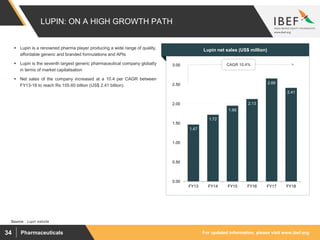
LUPIN: ON A HIGH GROWTH PATH
1.47
1.72
1.95
2.13
2.66
2.41
0.00
0.50
1.00
1.50
2.00
2.50
3.00
FY13 FY14 FY15 FY16 FY17 FY18
Source: : Lupin website
 Lupin is a renowned pharma player producing a wide range of quality,
affordable generic and branded formulations and APIs
 Lupin is the seventh largest generic pharmaceutical company globally
in terms of market capitalisation
 Net sales of the company increased at a 10.4 per CAGR between
FY13-18 to reach Rs 155.60 billion (US$ 2.41 billion).
Visakhapatnam port traffic (million tonnes)Lupin net sales (US$ million)
CAGR 10.4%
For updated information, please visit www.ibef.orgPharmaceuticals35
BIOCON: AN EARLY MOVER IN THE GLOBAL BIOTECH
MARKET
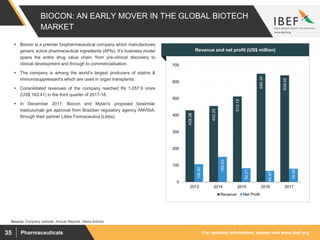
 Biocon is a premier biopharmaceutical company which manufactures
generic active pharmaceutical ingredients (APIs). It’s business model
spans the entire drug value chain, from pre-clinical discovery to
clinical development and through to commercialisation.
 The company is among the world’s largest producers of statins &
immunosuppressant's which are used in organ transplants.
 Consolidated revenues of the company reached Rs 1,057.9 crore
(US$ 163.41) in the third quarter of 2017-18.
 In December 2017, Biocon and Mylan's proposed biosimilar
trastuzumab got approval from Brazilian regulatory agency ANVISA,
through their partner Libbs Farmaceutica (Libbs).
429.38
455.20
512.19
648.34
639.05
106.80
150.63
82.01
66.87
79.58
0
100
200
300
400
500
600
700
2013 2014 2015 2016 2017
Revenue Net Profit
Revenue and net profit (US$ million)
Source: Company website, Annual Reports, News Articles
Pharmaceuticals
USEFUL
INFORMATION
For updated information, please visit www.ibef.orgPharmaceuticals37
INDUSTRY ORGANISATIONS
Address: Kalina, Santacruz (E),
Mumbai – 400 098
Phone: 91-22-2667 1072
Fax: 91 22 2667 0744
E-mail: ipacentre@ipapharma.org
www.ipapharma.org
The Indian Pharmaceutical Association
Address: 102-B, Poonam Chambers, Dr A.B. Road
Worli, Mumbai – 400 018
Phone: 91-22-2494 4624/2497 4308
Fax: 9122 24950723
E-mail: idma1@idmaindia.com
www.idma-assn.org
Indian Drug Manufacturers' Association
Address: Peninsula Chambers, Ground Floor,
Ganpatrao Kadam Marg, Lower Parel,
Mumbai – 400 013
Phone: 9122 24918123, 24912486, 66627007
Fax: 9122 24915168
E-mail: indiaoppi@vsnl.com
www.indiaoppi.com
Organisation of Pharmaceutical Producers of India
Address: C-25, Industrial Estate, Sanath Nagar
Hyderabad – 500018
Phone: 91 40 23703910/23706718
Fax: 91 40 23704804
E-mail: info@bdmai.org
www.bdmai.org
Bulk Drug Manufacturers Association
For updated information, please visit www.ibef.orgPharmaceuticals38
GLOSSARY
 CRAMS: Contract Research and Manufacturing Services
 API: Active Pharmaceutical Ingredients
 FDI: Foreign Direct Investment
 GOI: Government of India
 INR: Indian Rupee
 US$ : US Dollar
 BPL: Below Poverty Line
 RSBY: Rashtriya Swastha Bima Yojna
 ESIC: Employees State Insurance Corporation
 Wherever applicable, numbers have been rounded off to the nearest whole number
For updated information, please visit www.ibef.orgPharmaceuticals39
EXCHANGE RATES
Exchange Rates (Fiscal Year) Exchange Rates (Calendar Year)
Year INR INR Equivalent of one US$
2004–05 44.95
2005–06 44.28
2006–07 45.29
2007–08 40.24
2008–09 45.91
2009–10 47.42
2010–11 45.58
2011–12 47.95
2012–13 54.45
2013–14 60.50
2014-15 61.15
2015-16 65.46
2016-17 67.09
2017-18 64.45
Year INR Equivalent of one US$
2005 44.11
2006 45.33
2007 41.29
2008 43.42
2009 48.35
2010 45.74
2011 46.67
2012 53.49
2013 58.63
2014 61.03
2015 64.15
2016 67.21
2017 65.12
Source: Reserve bank of India, Average for the year
For updated information, please visit www.ibef.orgPharmaceuticals40
DISCLAIMER
India Brand Equity Foundation (IBEF) engaged Aranca to prepare this presentation and the same has been prepared by Aranca in consultation
with IBEF.
All rights reserved. All copyright in this presentation and related works is solely and exclusively owned by IBEF. The same may not be reproduced,
wholly or in part in any material form (including photocopying or storing it in any medium by electronic means and whether or not transiently or
incidentally to some other use of this presentation), modified or in any manner communicated to any third party except with the written approval
of IBEF.
This presentation is for information purposes only. While due care has been taken during the compilation of this presentation to ensure that the
information is accurate to the best of Aranca and IBEF’s knowledge and belief, the content is not to be construed in any manner whatsoever as a
substitute for professional advice.
Aranca and IBEF neither recommend nor endorse any specific products or services that may have been mentioned in this presentation and nor do
they assume any liability or responsibility for the outcome of decisions taken as a result of any reliance placed on this presentation.
Neither Aranca nor IBEF shall be liable for any direct or indirect damages that may arise due to any act or omission on the part of the user due to any
reliance placed or guidance taken from any portion of this presentation.

Pharmaceuticals Sector Report May 2018

  • 1.
    For updated information,please visit www.ibef.org May 2018 PHARMACEUTICALS
  • 2.
    Table of Content ExecutiveSummary……………….….…….3 Advantage India…………………..….…......4 Market Overview …………….……….…….6 Porters Five Forces Analysis.….…..……..14 Recent trends and Strategies……...…..…15 Growth Drivers……………………..............20 Case Studies……………....…………….…33 Opportunities…….……….......………….…30 Useful Information……….......………….….36
  • 3.
    For updated information,please visit www.ibef.orgPharmaceuticals3 EXECUTIVE SUMMARY Source: 1 FICCI - Trends & Opportunities for Indian Pharma 2018, Pharmexcil, 2TechSci Research, Assocham and RNCOS Notes: Information as per latest available data  Indian pharmaceutical sector industry supplies over 50 per cent of global demand for various vaccines, 40 per cent of generic demand in the US and 25 per cent of all medicine in UK1. Leading pharma producer  The country’s pharmaceutical industry is expected to expand at a CAGR of 22.4 per cent over 2015–20 to reach US$ 55 billion2. India is the second largest contributor of global biotech and pharmaceutical workforce. Among fastest growing industries  India accounts for 20 per cent of global exports in generics. India’s pharmaceutical exports stood at US$ 17.27 billion in 2017-18 and are expected to reach US$ 20 billion by 2020. One of the highest exports  Indian healthcare sector, one of the fastest growing sectors, is expected to cross US$ 372 billion by 2022. Rapidly growing healthcare sector  The domestic generics market is expected to reach US$ 27.9 billion by 2020. India’s generics market has immense potential for growth. Indian pharmaceutical companies received record 300 generic drug approvals in USA during 2017 where the generic market is expected to reach US$ 88 billion by 2021. High potential generics market  By 2024-25, India’s biotech industry is estimated to increase to US$ 100 billion. Robust growth in Biotech industry
  • 4.
  • 5.
    For updated information,please visit www.ibef.orgPharmaceuticals5 ADVANTAGE INDIA  Low cost of production and R&D boosts efficiency of Indian pharma companies  India’s cost of production is approximately 33 per cent lower than that of the US.  Due to lower cost of treatment, India is emerging as a leading destination for medical tourism  India’s ability to manufacture high quality, low priced medicines, presents a huge business opportunity for the domestic industry.  Economic prosperity to improve drug affordability  Increasing penetration of health insurance  With increasing penetration of pharmacies, especially in rural India, OTC drugs will be readily available  Accounts for over 10 per cent of the global pharmaceutical production  Over 60,000 generic brands across 60 therapeutic categories. Manufactures more than 500 different APIs  Government unveiled ‘Pharma Vision 2020’ aimed at making India a global leader in end-to-end drug manufacturing  Reduced approval time for new facilities to boost investments  In this sector, 100 per cent FDI is allowed under automatic route ADVANTAGE INDIA Source: PwC, McKinsey, Pharmaceuticals Exports Promotion Council of India Note: 2020 revenue forecasts are estimates of McKinsey, API - Active Pharmaceutical Ingredients, F – Forecast, OTC - Over-The-Counter
  • 6.
  • 7.
    For updated information,please visit www.ibef.orgPharmaceuticals7 STRUCTURE OF PHARMA SECTOR IN INDIA Pharmaceuticals Source: Dun and Bradstreet, Aranca Research Active Pharmaceutical Ingredients/ Bulk drugs Formulations Branded Generics Branded Generics  Cardiovascular  Anti-Diabetes  Gastro-Intestinal  Neurological  Anti-infectives  Respiratory  Pain  Gynecology
  • 8.
    For updated information,please visit www.ibef.orgPharmaceuticals8 EVOLUTION OF INDIAN PHARMACEUTICAL SECTOR Source: Aranca Research Notes: KAM - Key Account Management, CSO - Contract Sales Organisation  Indian Patent Act passed in 1970  Several domestic companies start operations  Development of production infrastructure  Export initiatives taken  Increased patent filings by pharma players  Likely adoption of newer sales models such as channel management, KAM and CSO  The National Pharmaceutical Pricing Policy, 2012 (NPPP-2012)  In Union Budget, 2016, FDI increased to 74 per cent in existing pharmaceutical companies  The Government of India unveiled 'Pharma Vision 2020' aimed at making India a global leader in end-to-end drug manufacture. Approval time for new facilities has been reduced to boost investments.  Liberalised market  Indian companies increasingly launch operations in foreign countries  India a major destination for generic drug manufacturing  Approval of Patents (Amendment) Act 2005, which led to adoption of product patents in India  2013: New Drug Pricing Control Order issued by Directorate of Food and Drugs this will reduce the prices of drugs by 80 per cent  2014: 100 per cent FDI allowed in medical device industry. The investment will be routed through automatic route  Leading Indian pharma companies are raising funds aggressively to fund acquisition in domestic as well as international market to increase their product portfolios  2015: India has 10,500 manufacturing units and over 3,000 pharma companies  National Health Policy Draft 2015 to increase expenditure in health care sector  Patent Act Amendment 2015, it includes amendments in Patent Act 2002 1990-2010 2010- 20152010 2016 onwards 1970-90
  • 9.
    For updated information,please visit www.ibef.orgPharmaceuticals9 Important Segments in Indian Pharmaceutical Sector Active Pharmaceutical Ingredients (APIs)  Domestic API consumption is expected to reach US$ 18.8 billion by FY221.  In April 2018, a high-level task force was constituted to create a roadmap for increasing domestic production of APIs. Currently India imports over 60 per cent of its APIs from other countries. Contract Research and Manufacturing Services (CRAMS)  Fragmented market with more than 1,000 players  CRAMS industry is estimated to reach US$ 18 billion in 2018 and expected to witness a strong growth at a CAGR of 18-20 per cent between 2013-18. Biosimilars  The government plans to allocate US$ 70 million for local players to develop Biosimilars.  The domestic market is expected to reach US$ 40 billion by 2030 Formulations  Largest exporter of formulations in terms of volume, with 14 per cent market share and 12th in terms of export value. Drug formulation* exports from India reached US$ 12.91 billion during FY18.  Domestic market size currently valued at US$ 11.2 billion  Double-digit growth expected over the next five years Pharmaceutical industry Notes: OTC - Over The Counter, * including biologicals Source: 1 RNCOS, BMI, Datamonitor, Kemwell Biopharma, Chemical Pharmaceutical Generic Association, ICRA Report estimates, pharmanewsprwire.com, DGCI&S
  • 10.
    For updated information,please visit www.ibef.orgPharmaceuticals10 INDIAN PHARMA SECTOR REVENUES TRENDING NORTH 3.14 3.19 3.08 12.32 13.92 14.97 0.00 2.00 4.00 6.00 8.00 10.00 12.00 14.00 16.00 18.00 20.00 2015 2016 2017 Scheduled Formulations Non-Scheduled Formulations Source: Department of Pharmaceuticals, PwC, McKinsey, AIOCD AWACS Note: F - Forecast, CAGR - Compound Annual Growth Rate, CY – Calendar Year, E - Estimated  Indian pharmaceutical market grew 5.5 per cent in CY2017 in terms of moving annual turnover. With a turnover of Rs 1.16 trillion (US$ 18.06 billion).  By 2020, India is likely to be among the top three pharmaceutical markets by incremental growth and 6th largest market globally in absolute size.  India’s cost of production is significantly lower than that of the US and almost half of that of Europe. It gives a competitive edge to India over others.  Increase in the size of middle class households coupled with the improvement in medical infrastructure and increase in the penetration of health insurance in the country will also influence in the growth of pharmaceuticals sector. Visakhapatnam port traffic (million tonnes)Annual Turnover of Indian Pharmaceutical Market (US$ billion) 15.46 17.11 18.06
  • 11.
    For updated information,please visit www.ibef.orgPharmaceuticals11 GENERIC DRUGS FORM THE LARGEST SEGMENT OF INDIAN PHARMA MARKET 70% 21% 9% Generic drugs OTC medicines Patented drugs Source: Business Monitor International, FCCI Indian Pharma Summit 2014-15  With 70 per cent of market share (in terms of revenues), generic drugs form the largest segment of the Indian pharmaceutical sector  India supplies 20 per cent of global generic medicines market exports, in terms of volume, making the country the largest provider of generic medicines globally and expected to expand even further in coming years  Over the Counter (OTC) medicines and patented drugs constitute 21 per cent and 9 per cent, respectively, of total market revenues of US$ 20 billion  Indian pharma drug manufacturer Aurobindo Pharma has received the USFDA approval to manufacture oral suspension, which is used for controlling serum phosphorus in patients with chronic kidney disease on dialysis. This drug is a therapeutic equivalent generic version of Genzyme's Renvela oral suspension.  The share of generic drugs is expected to continue increasing; domestic generic drug market is expected to reach US$ 27.9 billion in 2020  Due to their competence in generic drugs, growth in this market offers a great opportunity for Indian firms  Generic drug market is expected to grow in the next few years, with many drugs going off-patent in the US and other countries  Domestic generic drug market has reached US$ 26.1 billion in 2016 Visakhapatnam port traffic (million tonnes)Revenue share of Indian pharmaceutical sub-segments in 2015 Note: Figures are as per latest available data 0.8 0.9 1.1 1.3 1.5 2 2 2.70 6.9 8.1 10 11.3 12.6 15.1 18.1 21 0% 10% 20% 30% 40% 50% 60% 70% 80% 90% 100% 2008 2009 2010 2011 2012 2013 2014 2015 Patented drugs Generic drugs Share of patented and generic drugs in prescribed drug market (US$ billion)
  • 12.
    For updated information,please visit www.ibef.orgPharmaceuticals12 PHARMA EXPORT TO CONTINUE WITNESSING POSITIVE GROWTH 10.1 12.6 14.5 14.9 16.9 16.8 17.3 0.0 2.0 4.0 6.0 8.0 10.0 12.0 14.0 16.0 18.0 20.0 FY12 FY13 FY14 FY15 FY16 FY17 FY18 Source: Department of Commerce India, Department of Pharmaceuticals, India Business News, BMI  India is the world’s largest provider of generic medicines; the country’s generic drugs account for 20 per cent of global generic drug exports (in terms of volumes). Indian drugs are exported to more than 200 countries in the world, with the US as the key market.  Indian pharma companies are capitalising on export opportunities in regulated and semi-regulated markets.  Pharmaceutical exports from India reached US$ 17.27 billion in FY18. Visakhapatnam port traffic (million tonnes)Pharmaceutical Exports from India(US$ billion)
  • 13.
    For updated information,please visit www.ibef.orgPharmaceuticals13 PHARMA GIANTS RAISE THEIR R&D SPENDING 361 359 306 174 104 85 62 - 50 100 150 200 250 300 350 400 Sunpharma Lupin Dr.Reddy Cipla Aurbindo Cadila Wockhardt Source: Company websites, CRISIL Research  Investment (as % of sales) in research & development by Indian pharma companies increased from 5.5 per cent in FY11 to 9 per cent in FY17.  In FY17, highest expenditure on research and development was done by Sun Pharma, followed by Lupin.  Sun Pharma’s R&D spending was 7.6 per cent of the total sales in the FY17 , which grew at a CAGR of 38.3 per cent from FY11 to FY17.  Sun Pharma’s R&D plan includes developing more products through expanded R&D team for global markets, focussing on more complex products across multiple dosage forms and investments in speciality pipeline  Lupin’s R&D spending was 13.5 per cent of sales in FY17, with major thrust on oral solids (45 per cent of R&D spend) Visakhapatnam port traffic (million tonnes)R&D spending by top six pharma companies FY17 (US$ million) 5.5 5.7 6.0 6.8 7.2 8.1 9.0 - 2.0 4.0 6.0 8.0 10.0 FY11 FY12 FY13 FY14 FY15 FY16 FY17 Visakhapatnam port traffic (million tonnes)R&D investment by Indian Pharma companies (% of sales)
  • 14.
    For updated information,please visit www.ibef.orgPharmaceuticals14 Porter’s Five Forces Framework Analysis  Difficult-to-manufacture APIs such as steroids, sex hormones and peptides give bargaining power to suppliers. However, generic APIs do not have much of that power Bargaining Power of Suppliers  Threat to substitute products is low; however, homeopathy and Ayurvedic medicines can act as substitute Threat of Substitutes  Growth opportunities for pharma companies are expected to grow in next few years, with many drugs going off-patent in the US and other countries, thus increasing competition  Indian pharma companies will face competition from big companies, backed by huge financial muscle Competitive Rivalry  Strict government regulations thwart entry of new players  Difficult to survive because of high gestation period Threat of New Entrants  Generic drugs offer a cost-effective alternative to drugs innovators and significant savings to customers  Biosimilars offer significant cost saving for insurance companies in India Bargaining Power of Buyers Positive Impact Neutral Impact Negative Impact Source: Aranca Research
  • 15.
  • 16.
    For updated information,please visit www.ibef.orgPharmaceuticals16  Indian pharma companies spend 8-13 per cent of their total turnover on R&D  Expenditure on R&D is likely to increase due to the introduction of product patents; companies need to develop new drugs to boost sales  India’s pharmaceutical export market is thriving due to strong presence in the generics space  Pharmaceuticals exports from India stood at US$ 17.27 billion in FY18.  Cipla, the largest supplier of anti-malarial drugs to Africa, set up a US$ 32 billion plant in Africa for the production of anti-retroviral and anti-malarial drugs.  Mankind Pharma is planning to enter the US market and might start product filings in 2018.  Multinational companies are collaborating with Indian pharma firms to develop new drugs  Cipla formed an exclusive partnership with Serum Institute of India to sell vaccines in South Africa  Six leading pharmaceutical companies have formed an alliance ‘LAZOR’ to share their best practices, so as to improve efficiency and reduce operating costs NOTABLE TRENDS IN THE INDIAN PHARMACEUTICALS SECTOR … (1/2) Source: Aranca Research, Pharmexcil Notes: R&D - Research and Development Research and development Increasing exports Expansion by Indian players abroad Joint Ventures
  • 17.
    For updated information,please visit www.ibef.orgPharmaceuticals17 NOTABLE TRENDS IN THE INDIAN BIOTECH SECTOR  US based DiabetOmics Inc., medical diagnostic company has raised US$ 4 million from Ventureast & US$1 million from KI Varaprasad Reddy for driving manufacturing & commercialisation activities in India. Global companies setting up base  Ranbaxy, Cadila Healthcare, Lupin, Wockhardt & Dr Reddy’s are among the major Indian pharmaceutical companies operating in the bio-pharma segment Pharma companies focusing on biotech  Growth in the sector is anticipated to come from the country's strong position in biosimilars & molecular diagnostics as well as personalised medicine (where export & domestic trends look promising). In 2016, development of biosimilars has been speeding up via Glycosylation Control Technology. Biosimilars and molecular diagnostic remain strongholds  According to International Service for the Acquisition of Agri-Biotech Applications, India has the 4th largest area covered under genetically modified crops  In India, 11.57 million hectares of area is covered under genetically modified crops which is majorly dominated by Bt cotton.  The bio agriculture industry in India can reach US$ 34-37 billion size by 2025. Growth in Genetically Modified crops Source: Ministry of External Affairs, Accenture, Aranca Research, Linkedin
  • 18.
    For updated information,please visit www.ibef.orgPharmaceuticals18 STATES HOSTING KEY PHARMACEUTICAL VENTURES Source: Company websites  Wockhardt's facility covers an area of 40,468 sq meters in Baddi, Himachal Pradesh  Baddi is also home to Cipla’s formulations manufacturing facility  Piramal’s USFDA-approved manufacturing plant in Hyderabad  GlaxoSmithKline has a major facility at Rajahmundry, Andhra Pradesh  Mandideep in Madhya Pradesh is the manufacturing hub for Lupin’s cephalosporin and ACE-Inhibitors  Cipla has a formulations manufacturing plant at Indore  Dholka in Gujarat houses a major manufacturing facility of Cadila, which spans over 100 acres  Lupin has an USFDA-approved plant at Tarapur, Maharashtra. The facility forms the core of Lupin's fermentation capabilities  Sun Pharma's API manufacturing facility at Toansa, Malanpur, Guwahati, Ankleshwar, Panoli, Ahmednagar, Maduramthakam
  • 19.
    For updated information,please visit www.ibef.orgPharmaceuticals19 STRATEGIES ADOPTED  Sun Pharma is trying to achieve cost leadership by • Vertical Integration: Complex API, which require special skills and technology, are developed and scaled up for both API and dosage forms Cost leadership Source: Company websites, Ministry of External Affairs, RBI  Players in the sector are trying to strengthen their position in the market and expand themselves by investing heavily in R&D activities, such as: • Dr Reddy’s acquired OctoPlus N.V, a Netherlands-based company, to get access to the Poly Lactic-Co- Glycolic Acid (PLGA) technology for the formulation of complex injectables • In January 2017, Piramal Enterprises acquired a portfolio of anti-spasticity and pain management drugs from US based drug maker – Mallinckrodt, for US$ 203 million. • In May 2017, Lupin has launched erectile dysfunction drug named as Cialis. The company has quoted the market worth for US$ 58.01 million in India. This tablet is available in 20 mg and 10 mg strengths. Differentiation  Lupin is making inroads into new markets such as Latin America, Russia and other East European countries  Sun Pharma decided to focus on specialty and chronic therapies such as neurology, oncology, dermatology segments  Companies like Dr Reddy’s, Cipla and Wockhardt are planning their expansions in US$ 100 billion China market in 2018. Focus on new markets Notes: R&D – Research and Development  In October 2016, Advanced Enzyme Technologies, a biotech based firm in Mumbai signed an agreement with JC Biotech - Active Pharmaceutical Ingredient (API) maker in Hyderabad, to acquire 70 per cent stake in the company.  In December 2017, Torrent Pharmaceuticals completed acquisition of branded business of Unichem Laboratories. Mergers and Acquisitions in Biotech
  • 20.
  • 21.
    For updated information,please visit www.ibef.orgPharmaceuticals21 GROWTH DRIVERS OF INDIAN PHARMA SECTOR Source: Pharmaceutical Export Promotion Council Notes: BPL - Below Poverty Line, USFDA - United States Food and Drug Administration, NPPP-2012--The National Pharmaceutical Pricing Policy, 2012  Cost advantage  Skilled manpower  India a major manufacturing hub for generics  India accounts for 22 per cent of overall USFDA approved plants  Increasing penetration of chemists  Increasing fatal diseases  Accessibility of drugs to greatly improve  Increasing penetration of health insurance  Growing number of stress-related diseases due to change in lifestyle  Better diagnostic facilities  National Health Policy 2015, which focuses on increasing public expenditure on healthcare segment  Reduction in approval time for new facilities  Plans to set up new pharmaceutical education and research institutes  Exemptions to drugs manufactured through indigenous R&D from price control under NPPP-2012 Growth Drivers
  • 22.
    For updated information,please visit www.ibef.orgPharmaceuticals22 SUPPLY-SIDE DRIVERS OF INDIAN PHARMA SECTOR  Following the introduction of product patents, several multinational companies are expected to launch patented drugs in India  Growth in the number of lifestyle diseases in India could boost the sale of drugs in this segment  High Court allowing to export patent drugs, to foreign players in the Indian market. Launch of patented drugs Source: BMI, India Biz, Nicholas Hall & Company  Pharma companies have increased spending to tap rural markets and develop better medical infrastructure  Hospitals’ market size is expected to increase by US$ 200 billion by 2024  In October 2016, the government gave a nod to set up the country's first medical devices manufacturing park in Chennai Medical infrastructure  About 120 drugs are expected to go off-patent over the next 10 years; with expected worldwide revenue between US$ 80 to 250 billion Patent Expiry Notes: CAGR - Compound Annual Growth Rate  India’s generic drugs account for 20 per cent of global exports in terms of volume, making it country the largest provider of generic medicines globally. The generics drug market accounts for around 70 per cent of the India pharmaceutical industry and it is expected to reach US$ 27.9 billion by 2020 Scope in generics market  India’s OTC drugs market is estimated to have grown at a CAGR of 16.3 per cent to US$ 6.6 billion over 2008–16 and is further expected to grow on the account of increased penetration of chemists, especially in rural regions. Indian OTC market is expected to grow at a CAGR of 9 per cent from 2016-26 to cross Rs 44,115 crore (US$ 6.81 billion). Over-The-Counter (OTC) drugs
  • 23.
    For updated information,please visit www.ibef.orgPharmaceuticals23 DEMAND DRIVERS OF INDIAN PHARMA SECTOR Accessibility  Over US$ 200 billion to be spent on medical infrastructure in the next decade  New business models expected to penetrate tier-2 and 3 cities  Over 160,000 hospital beds expected to be added each year in the next decade  India’s generic drugs account for 20 per cent of global exports in terms of volume, making the country the largest provider of generic medicines globally Acceptability  Rising levels of education to increase acceptability of pharmaceuticals  Patients to show greater propensity to self-medicate, boosting the OTC market  Acceptance of biologics and preventive medicines to rise  A skilled workforce as well as high managerial and technical competence  Surge in medical tourism due to increased patient inflow from other countries Epidemiological factors  Patient pool expected to increase over 20 per cent in the next 10 years, mainly due to rise in population  New diseases and lifestyle changes to boost demand  Increasing prevalence of lifestyle diseases Affordability  Rising income could drive 73 million households to the middle class over the next 10 years  Over 650 million people expected to be covered by health insurance by 2020  Government-sponsored programmes set to provide health benefits to over 380 million BPL people by the end of 2017  The government plans to provide free generic medicines to half the population at an estimated cost of US$ 5.4 billion Demand drivers Source: ICRA Report on Indian Pharmaceutical Sector, Pharmaceutical Industry: Developments in India- Deloitte, Mckinsey Pharma Report 2020 Note: RSBY - Rashtriya Swasthya Bima Yojna
  • 24.
    For updated information,please visit www.ibef.orgPharmaceuticals24 GROWING HEALTH INSURANCE Source: IRDA, General Insurance Council, Aranca Research  Increasing penetration of non-life insurance including health insurance will drive the expansion of healthcare services and pharmaceutical market in India.  Adoption of health insurance in the country has been increasing at a fast pace.  Gross direct premium from health insurance reached Rs 378.97 billion (US$ 5.88 billion) in FY18 and contributed 25.2 per cent to the gross direct premiums of non-life insurance companies in India.  Another boost to the sector will be the National Health Protection Scheme under Ayushman Bharat, announced in Union Budget 2018-19. 9.28 11.05 12.03 13.14 14.95 19.89 23.38 0.00 5.00 10.00 15.00 20.00 25.00 FY12 FY13 FY14 FY15 FY16 FY17 FY18 CAGR 16.65% Gross Direct Premiums of Non-Life Insurers (US$ billion)Visakhapatnam port traffic (million tonnes)Break-up of non-life insurance market in India (FY18) 25.20% 74.8% Health Others Total size: US$ 23.38 billion
  • 25.
    For updated information,please visit www.ibef.orgPharmaceuticals25 FAVOURABLE POLICY MEASURES SUPPORT GROWTH (1/2)  Steps taken to reduce approval time for new facilities  NOC for export licence issued in two weeks compared to 12 weeks earlier Reduction in approval time for new facilities  Government is planning to relax FDI norms in the pharmaceutical sector  In March 2017, the government decided to create a digital platform to regulate and track the sale of quality drugs, and it can be used by people living in the country as well as abroad Support for technology upgrades and FDIs  Pharma Vision 2020 by the government’s Department of Pharmaceuticals aims to make India a major hub for end-to-end drug discovery Pharma Vision 2020  As per NBDS, a proposal has been made to set up the National Biotechnology Regulatory Authority (NBRA) to provide a single-window clearance mechanism for all bio-safety products to create efficiencies & streamline the drug approval process Single-window clearance  Government of India is planning to set up mega bulk drug parks in order to reduce industry’s dependency on raw material imports. Bulk Drug Parks  Government of India is planning to set up an electronic platform to regulate online pharmacies under a new policy Online Pharmacies  The Industry – Academia mission was launched in June 2017 to boost development of biopharmaceuticals in India. National Biopharma Mission
  • 26.
    For updated information,please visit www.ibef.orgPharmaceuticals26 FAVOURABLE POLICY MEASURES SUPPORT GROWTH (2/2) Source: Livemint, Union Budget  The allocation to the Ministry of Health and Family Welfare has increased by 11.5 per cent to Rs 52,800 crore (US$ 8.16 billion).  The National Health Protection Scheme is largest government funded healthcare programme in the world, which is expected to benefit 100 million poor families in the country by providing a cover of up to Rs 5 lakh (US$ 7,723.2) per family per year for secondary and tertiary care hospitalisation.  The government has allocated Rs 1,200 crore (US$ 185.36 million) towards the National Health Policy 2017 under which 150,000 health and wellness centres, will provide healthcare closer to homes of the people.  The increased expenditure on healthcare is expected to benefit the pharmaceutical sector as well Union Budget 2018-19  BIRAC has been established to promote research & innovation capabilities in India’s biotech industry. The council will provide funding to biotech companies for technology & product development.  BIRAC under Small Business Innovation Research Initiative (SBIRI) scheme supports innovations in biotechnology. Biotechnology Industry Research Assistance Council  Programme on application of biotechnology for women was done to provide employment, skill development, awareness generation, health improvement & socio-economic upliftment of the women population Biotechnology Based Programme for Women
  • 27.
    For updated information,please visit www.ibef.orgPharmaceuticals27 NATIONAL PHARMA POLICY TO BRING GREATER TRANSPARENCY  In 2017, the Department of Pharmaceuticals released a draft National Pharmaceutical Policy with the following objectives: • Make all essential drugs accessible to masses through affordable prices • Provide the Indian pharmaceutical sector with a long term stable policy environment • Make India self sufficient in end to end domestic drug manufacturing • Maintain world class quality for domestic consumption and exports • Create a positive environment for research and development in the pharma sector.  As per the new policy, the Department of Pharmaceuticals will have control over the National List of Essential Medicines (NLEM), which decides the drugs for which the Government of India can control the prices.
  • 28.
    For updated information,please visit www.ibef.orgPharmaceuticals28 GOVERNMENT EXPENDITURE IN THE PHARMA SECTOR ON AN UPTREND 19.55 21.57 23.12 23.58 35.07 34.91 0.00 5.00 10.00 15.00 20.00 25.00 30.00 35.00 40.00 FY13 FY14 FY15 FY16 FY17 FY18 Source: Business Monitor International, Economic Survey 2017-18 Note: CAGR - Compound Annual Growth Rate  Government expenditure on health increased from Rs 1.26 lakh crore (US$ 19.55 billion) in FY12 to Rs 2.25 lakh crore (US$ 34.91 billion) in FY18, implying a CAGR of 12.3 per cent.  Medical technology park in Vishakhapatnam, Andhra Pradesh has already been set up with an investment of US$ 183.31 million. States like Himachal Pradesh, Gujarat, Telangana and Maharashtra are showing interest for making investments in these parks.  German technical services provider TUV Rheinland’s Indian subsidiary has partnered with Andhra Pradesh MedTech Zone (AMTZ) to create an infrastructure for Electro-Magnetic Interference (EMI/EMC) at an investment of US$ 12.64 million over a course of four to five years. Visakhapatnam port traffic (million tonnes)Government Expenditure on Health in India (US$ billion)
  • 29.
    For updated information,please visit www.ibef.orgPharmaceuticals29 INVESTMENTS, JVs INFUSING SUPERIOR CAPABILITIES IN INDIAN FIRMS Source: BMI, Business Standard Date Announced Indian company Foreign company Value (US$ million) Type December 2017 Unichem Laboratories Torrent Pharma NA Acquisition March, 2017 Sun Pharma Thallion Pharmaceuticals 19.77 Acquisition January, 2017 Zydus Cadila Zoetis NA Acquisition February 2017 Piramal Mallinckrodt 170 Specialty products July 2016 Continental Hospitals Ltd. HH Healthcare Berhad 192.84 73.4% Stake February 2016 Cipla InvaGen Pharmaceuticals Inc. and Exelan Pharmaceuticals Inc. 550 100% Stake November 2015 Famy Care Ltd Mylan Inc – Mylan Laboratories Limited 750 100% Stake October 2015 Nitin Lifesciences Recipharm 109.8 75% stakes in equity July 2015 Lupin Temmler Not disclosed Acquisition May 2015 Cadila Healthcare Claris Lifesciences 556.8 To be acquired July 2015 Lupin Gavis and Novel Laboratories 880 Acquisition April 2014 Sun Pharma Ranbaxy 320 Acquisition November, 2014 Curatio Healthcare Sequoia Capital 15.8 Acquisition July, 2013 Cipla Cipla Medpro 512 Acquisition January, 2013 GlaxoSmithkLine Consumer GlaxoSmithkLine Plc. 1,088 Acquisition  Indian Drugs & Pharmaceuticals sector has received cumulative FDI worth US$ 15.59 billion between April 2000 – December 2017.  In 2017, Indian pharmaceutical sector witnessed 46 merger & acquisition (M&A) deals worth US$ 1.47 billion.  Over the last three years, pharmaceuticals segment has accounted for more than 70 per cent of M&A deals. Note: JV - Joint Venture
  • 30.
  • 31.
    For updated information,please visit www.ibef.orgPharmaceuticals31 OPPORTUNITIES ABOUND IN CLINICAL TRIALS AND HIGH-END DRUGS  India is among the leaders in the clinical trial market  Due to a genetically diverse population and availability of skilled doctors, India has the potential to attract huge investments to its clinical trial market  From 2009 to 2015, 3043 clinical trial has been carried out in India.  As of June 2017, the Clinical Trials Registry – India had 8,950 trials registered. Clinical trials market  Due to increasing population and income levels, demand for high-end drugs is expected to rise  Growing demand could open up the market for production of high-end drugs in India High-end drugs  With 70 per cent of India’s population residing in rural areas, pharma companies have immense opportunities to tap this market  Demand for generic medicines in rural markets has seen a sharp growth. Various companies are investing in the distribution network in rural areas Penetration in rural market  The Contract Research and Manufacturing Services industry (CRAMS) – estimated at US$ 9.3 billion in 2014, is expected to reach US$ 19 billion by 2018.  The market has more than 1,000 players CRAMS Source: BMI
  • 32.
    For updated information,please visit www.ibef.orgPharmaceuticals32 OPPORTUNITIES FOR INNOVATION IN AGRICULTURE/HEALTHCARE  Vaccines & recombinant therapeutics are the sectors driving the biotechnology industry’s growth in India  Newer prominent therapies such as monoclonal antibodies products, stem cell therapies are expected to pick up pace in the foreseeing future  Indian vaccine market reached Rs 69 billion (US$ 1.07 billion) in 2017 growing at a CAGR of 18 per cent between 2010-17. Vaccines  Protein & antibody production & fabrication of diagnostic protein chips are promising areas for investment  Stem cell research, cell engineering & cell-based therapeutics are other areas, where India can cash its expertise Bioactive therapeutic proteins  Hybrid seeds, including GM seeds, represent new business opportunities in India based on yield improvement  Growing at an annual growth rate of 10-15 per cent, the Indian hybrid seed industry is estimated at US$1.93 billion in FY16, wherein Bt cotton is leading the market accounting for 45 per cent share India hybrid seed industry. Agriculture sector  Using the patent system as a mechanism to control drug pricing forestalls making the difficult decisions about necessary investment in the healthcare system, but does not deal with the underlying issues.Intellectual Property Source: imarc, Aranca search
  • 33.
  • 34.
    For updated information,please visit www.ibef.orgPharmaceuticals34 LUPIN: ON A HIGH GROWTH PATH 1.47 1.72 1.95 2.13 2.66 2.41 0.00 0.50 1.00 1.50 2.00 2.50 3.00 FY13 FY14 FY15 FY16 FY17 FY18 Source: : Lupin website  Lupin is a renowned pharma player producing a wide range of quality, affordable generic and branded formulations and APIs  Lupin is the seventh largest generic pharmaceutical company globally in terms of market capitalisation  Net sales of the company increased at a 10.4 per CAGR between FY13-18 to reach Rs 155.60 billion (US$ 2.41 billion). Visakhapatnam port traffic (million tonnes)Lupin net sales (US$ million) CAGR 10.4%
  • 35.
    For updated information,please visit www.ibef.orgPharmaceuticals35 BIOCON: AN EARLY MOVER IN THE GLOBAL BIOTECH MARKET  Biocon is a premier biopharmaceutical company which manufactures generic active pharmaceutical ingredients (APIs). It’s business model spans the entire drug value chain, from pre-clinical discovery to clinical development and through to commercialisation.  The company is among the world’s largest producers of statins & immunosuppressant's which are used in organ transplants.  Consolidated revenues of the company reached Rs 1,057.9 crore (US$ 163.41) in the third quarter of 2017-18.  In December 2017, Biocon and Mylan's proposed biosimilar trastuzumab got approval from Brazilian regulatory agency ANVISA, through their partner Libbs Farmaceutica (Libbs). 429.38 455.20 512.19 648.34 639.05 106.80 150.63 82.01 66.87 79.58 0 100 200 300 400 500 600 700 2013 2014 2015 2016 2017 Revenue Net Profit Revenue and net profit (US$ million) Source: Company website, Annual Reports, News Articles
  • 36.
  • 37.
    For updated information,please visit www.ibef.orgPharmaceuticals37 INDUSTRY ORGANISATIONS Address: Kalina, Santacruz (E), Mumbai – 400 098 Phone: 91-22-2667 1072 Fax: 91 22 2667 0744 E-mail: ipacentre@ipapharma.org www.ipapharma.org The Indian Pharmaceutical Association Address: 102-B, Poonam Chambers, Dr A.B. Road Worli, Mumbai – 400 018 Phone: 91-22-2494 4624/2497 4308 Fax: 9122 24950723 E-mail: idma1@idmaindia.com www.idma-assn.org Indian Drug Manufacturers' Association Address: Peninsula Chambers, Ground Floor, Ganpatrao Kadam Marg, Lower Parel, Mumbai – 400 013 Phone: 9122 24918123, 24912486, 66627007 Fax: 9122 24915168 E-mail: indiaoppi@vsnl.com www.indiaoppi.com Organisation of Pharmaceutical Producers of India Address: C-25, Industrial Estate, Sanath Nagar Hyderabad – 500018 Phone: 91 40 23703910/23706718 Fax: 91 40 23704804 E-mail: info@bdmai.org www.bdmai.org Bulk Drug Manufacturers Association
  • 38.
    For updated information,please visit www.ibef.orgPharmaceuticals38 GLOSSARY  CRAMS: Contract Research and Manufacturing Services  API: Active Pharmaceutical Ingredients  FDI: Foreign Direct Investment  GOI: Government of India  INR: Indian Rupee  US$ : US Dollar  BPL: Below Poverty Line  RSBY: Rashtriya Swastha Bima Yojna  ESIC: Employees State Insurance Corporation  Wherever applicable, numbers have been rounded off to the nearest whole number
  • 39.
    For updated information,please visit www.ibef.orgPharmaceuticals39 EXCHANGE RATES Exchange Rates (Fiscal Year) Exchange Rates (Calendar Year) Year INR INR Equivalent of one US$ 2004–05 44.95 2005–06 44.28 2006–07 45.29 2007–08 40.24 2008–09 45.91 2009–10 47.42 2010–11 45.58 2011–12 47.95 2012–13 54.45 2013–14 60.50 2014-15 61.15 2015-16 65.46 2016-17 67.09 2017-18 64.45 Year INR Equivalent of one US$ 2005 44.11 2006 45.33 2007 41.29 2008 43.42 2009 48.35 2010 45.74 2011 46.67 2012 53.49 2013 58.63 2014 61.03 2015 64.15 2016 67.21 2017 65.12 Source: Reserve bank of India, Average for the year
  • 40.
    For updated information,please visit www.ibef.orgPharmaceuticals40 DISCLAIMER India Brand Equity Foundation (IBEF) engaged Aranca to prepare this presentation and the same has been prepared by Aranca in consultation with IBEF. All rights reserved. All copyright in this presentation and related works is solely and exclusively owned by IBEF. The same may not be reproduced, wholly or in part in any material form (including photocopying or storing it in any medium by electronic means and whether or not transiently or incidentally to some other use of this presentation), modified or in any manner communicated to any third party except with the written approval of IBEF. This presentation is for information purposes only. While due care has been taken during the compilation of this presentation to ensure that the information is accurate to the best of Aranca and IBEF’s knowledge and belief, the content is not to be construed in any manner whatsoever as a substitute for professional advice. Aranca and IBEF neither recommend nor endorse any specific products or services that may have been mentioned in this presentation and nor do they assume any liability or responsibility for the outcome of decisions taken as a result of any reliance placed on this presentation. Neither Aranca nor IBEF shall be liable for any direct or indirect damages that may arise due to any act or omission on the part of the user due to any reliance placed or guidance taken from any portion of this presentation.