Packaging of
Pharmaceuticals
Athar Ansari
SESIOP, Navalnagar (Dhule)
Introduction
When manufacturing of drug is completed is it essential to consider the
various elements of the packaging of pharmaceutical product to ensure
the safety of medicine when it arrival there destination.
Objective of packaging
 To protect the content from environment also protect the goods
from loss
 To store the material properly so as to preserve the quality of the
material
 To identify the product at all stages
Material Used For Packaging Of Pharmaceutical
Products
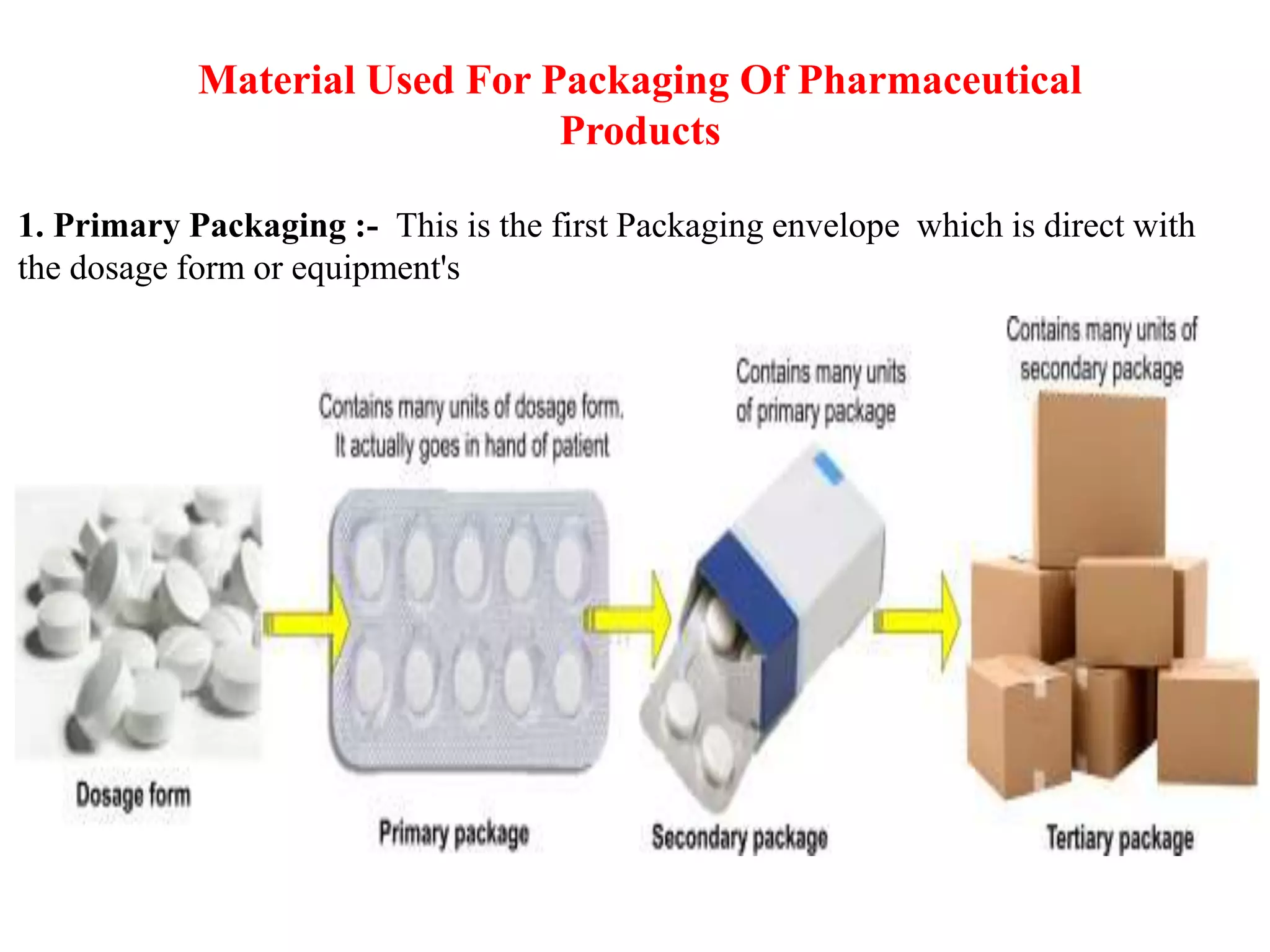
1. Primary Packaging :- This is the first Packaging envelope which is direct with
the dosage form or equipment's
2. Secondary Packaging
After primary packaging pharmaceutical product are then under go
secondary packaging , its includes Cartoons ,boxes etc.
3.Tertiary Packaging
This is done to provide bulk handling and shipping of
pharmaceutical from one place to another place . e,g containers ,
cartoon , barrels etc
Types Of Packaging Material
Material Example of use
Glass Ampoule , Vial
Plastic Ampoule , vial , infusion fluid container ,dropper
bottele
Cardboard Box to contain primary pack
Paper Labels , patients information leaflet ,
Containers
Containers are the device used to contain or hold the material .
Requirements of good container
1. The material used for construction of the container must with stand
normal during handling
2. The shape of the container must be such that the dose can be easily
removed
3. Container should be attractive in appearance .
4. The container must be insert and must not interact with stored
product
5. The container must not effect the physical and chemical stability of
the product .
6. It should be labeled easily
Types Of Container For Liquid Dosage Form
Single Dose Container :-
This is used to hold product
only one time use E.g glass
ampoules
Multi dose container
They are used to hold the product
two or more than 2 times E.g
multiples doses vial / plastic
tablet bottles
Well closed container
They protect the product from
contamination and as well as the protect
the loss of content during use
Airtight container
They also known as hermetic
container this container are
impermeable to solid , liquid and
gasses
Light Resistance Container
They protect the content from
the effect of radiation or light
at a wave length between 290
nm and 150 nm
Types Of Container For Solid Dosage Form
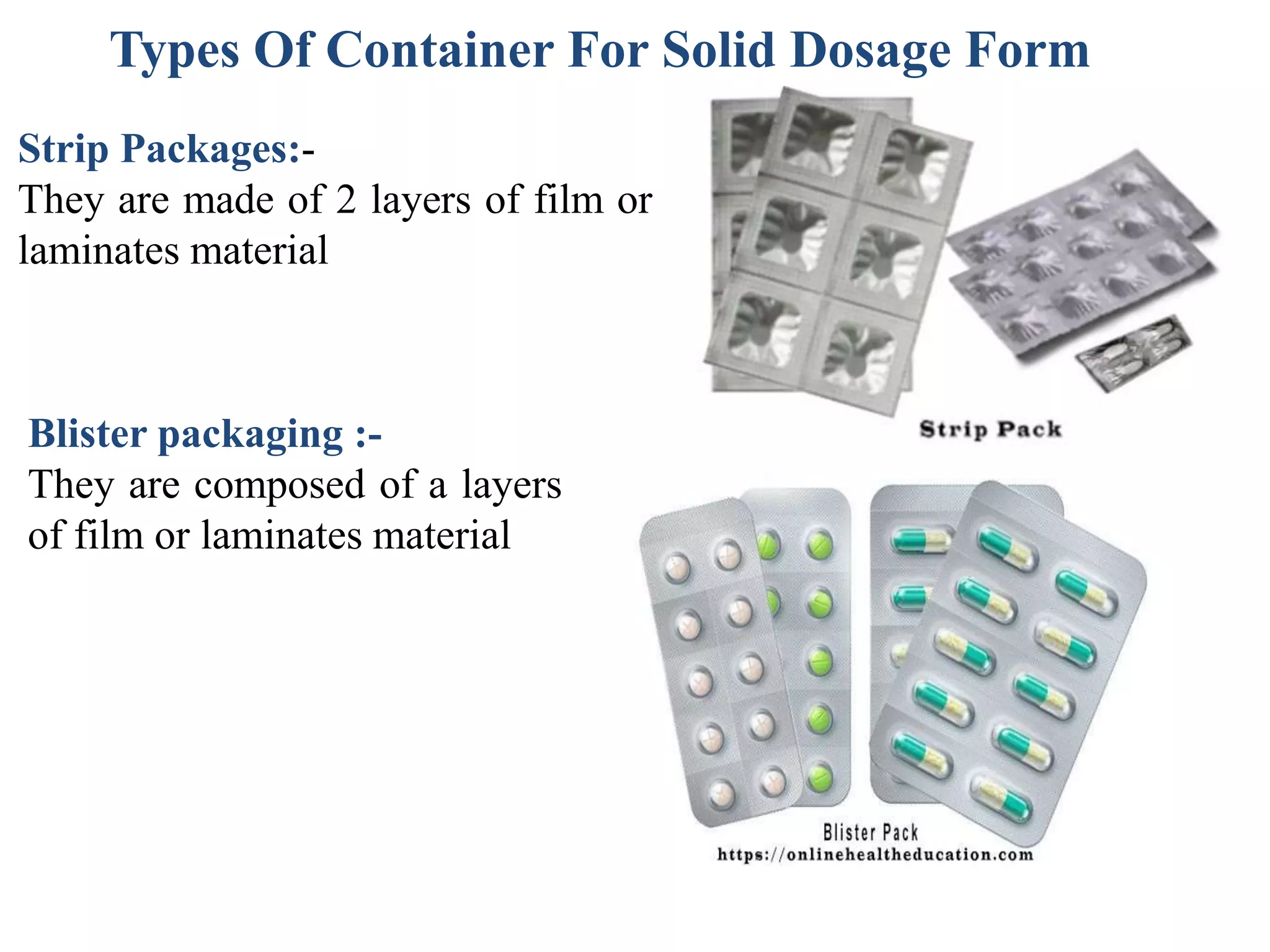
Strip Packages:-
They are made of 2 layers of film or
laminates material
Blister packaging :-
They are composed of a layers
of film or laminates material
Child Resistance Container :-
They are designed to protect the child
from hazards product
Different types of container for semi solid and pressurized
products
Materials Used For Preparing Of Containers
Material used
Glass Plastic Metal
Glass:-
 Glasses prepared by different methods such as blowing drawing ,
pressing , and casting
 glass is composed of sand , soda ash , lime stone and cullet .
 Cullet or broken glass act as fusion agent for whole mixture
Type Of Glass
Type I :- (borosilicate glass)
It is highly resistance to alkali and earth cation are replaced by boron
they are less brittle is it clean and sterilize
Type II (treated soda lime glass )
This type of glass surface alkyl is neutralized sulfur oxides vapors
they are used for making container for buffer at a solution having pH
below 7
Type III (soda lime glass )
It release 10 times more alkali than type I and type II glasses its offer
moderated hydrolytic resistance is used for dry powder and
oleaginous solutions.
Type Vi (general purpose soda lime glasses )
It is not used for parenteral. It is used as a container for tablet ,oral
solution ,suspension ointment and liquid for external use.
Different Type Of Glasses Are Used To
Prepare Containers
1. Lime soda glass :- It is most common glass . it is made of 75 %
SIO2 (silicon dioxide) , 15 % NA2o (Sodium Oxide) , 10% Cao
(Calcium Oxide) , Along With Traces Of K2o , Mgo & Al2o3 .
2. Borosilicate glass :- it is made of 80 % Sio2 , 12% B2O3 (Boric
oxide) , 6% Al2O3 . Along with mixture 2% Na2O3 ,Cao , and
other oxides.
3. Silicone treated glass :-
the glass are treated with silicon to make containers for storage of
alkali sensitive products
4. Sulphured glass :-
They are also called treated soda lime glass . Because soda lime glass
is exposed to moist SO2 at 500 0C in damp atmosphere . It is used to
prepare container for blood , plasma , Infusion fluids
5. Neutral Glass :-
It is made of 72-75 % of sio2 , 7-10% of B2O3 , 4-6% of Al2O3 , 6-
8% of Na2O , 2-4% of BaO, 0.5-2% K2O .They can hold solution
pH up to 8
6. Amber Coloure glass :- they are used for storage of light sensitive
products . As per USP specification , the glass must provide protection
against 2900-4500 A of Light
Plastics
 Types Of Plastics
1. Thermoplastics :- They get softened with application of pressure
and heat but regain their original shape on cooling .
Different Type Of Thermoplastic And Their
Uses
Thermoplastics Uses
Polyethylene For preparing Bottles , tubing's and heat sealable
packaging films , disposable syringes etc
Polypropylene Used to prepare disposable syringes , tubing's ,
squeeze bottles and packaging films
Teflon Gaskets , coating
PVC Used for manufacturing of eye ointments tubes
PMMA
Polymethyl
Methoacrylate
Bottles and tubes
Polystyrene Bottles , tubes , jar , syringes'
2. Thermosetting :-
They are permanently shaped to rigid structure when pressure and
heat is applied , example :- Phenol Formaldehyde , they can not
withstand on sever abrasion .
Metal Container
 Aluminum:-
1. its available in large of alloys
2. Is cheap and light in weight
3. Adequate mechanical strength
4. Maintenance and cleaning is easy
5. Thermal conductivity of aluminum is 60 of pure copper
6. Tensile strength is 10,000 Ib /sq.in
7. Resistance to corrosion
8. Used in widely variety of chemical equipment's
9. Used for manufacturing's of tanks
Lead :-
1. Its is used in less percentage
2. Because lead produce large amount of toxicity.
3. Generally used for Non food products .
4. it is cheap
5. The addition of silver and copper its become corrosion
resistance.
Tin :-
Its is used for food as well as for pharmaceutical products . But they
most expensive
Closure
They are also known as stopper or bungs . These are the devices
used to open and close the containers and protect the material from
external environments as well as spillage from bottles .
Different material such as cork , glass , plastic , metals & Rubbers
are used for making closures.
Rubbers Closure :-
1. It is good ageing effect ,
2. do not allow permeation of air or moisture and economical .
3. But disadvantage is that it undergoes leaching process
Different additives are used for
manufacturing of rubber closure
1. Vulcanizing agents :- its used to provide strength and elasticity .it
is soluble in many solvents
2. Accelerators:- They improves strength and resistance to oxidation
ex. Thiazole
3. Activators:- used to increase activity of accelerators Ex. Stearic
acid
4. Fillers:- they give bulkiness Ex. Activated carbon black.
5. Softened:- used to facilitate the incorporation of filter ,make the
compound easier and cheaper to manipulate and influence the
hardness of finished products Ex. Pine oil
6. Antioxidants :- it prevents the oxidative degradation of raw
material Ex . Phenols
7. Lubricants:- Ex :- Talc
Types of
closers
Thread screw cap
It is a seal which provide
physical and chemical
protection to content . The
screw cap is commonly
mad of metal or plastic
Lug Cap :-
Used to engage a lug on the
cap side wall and draw the cap
down to the sealing surface of
the containers .
Crown Cap
This type of cap is used in beverage bottles
Roll on closure
The aluminum roll –on cap
can be sealed and open easily
and resealed effectively the
pilfer proof closer has a wider
skirt length
Introduction To Aerosol Packaging
Pharmaceutical aerosols are define is defined as pressurized package
consist of therapeutics active drugs dissolve or suspended in compressed
or liquefied gas , the product is discharged in form of spray or foam or
solid stream
Containers
Aerosol containers are made of glass metals & plastics .
Selection Of Containers
Its depends on following different factors
1. Production method
2. Compatibility with formulation
3. ability to sustain the pressure necessary for the product the design
and aesthetics appeal
4. The cost
1. Glass containers
1. They are prefer due to non corrosive nature and compatibility
with the most of the formulation when compare to metal
containers
2. This containers must be designed in a such way that provide the
maximum pressure safety and impact resistance .
3. Mostly coated glass containers are considered safe
4. Sometimes plastic coating containers are commonly applied to
the outer surface of glass containers
5. disadvantages of this due to its fragile nature and also can not
withstand in high pressure more than 15 psig
Tin –Plated Steel Containers
1. They are light in weight
2. Relatively inexpensive
3. Special protective coatings (such as oleoresin , phenolic etc) are
applied to the tin sheets prior to fabrication to protect from
corrosion and interaction.
4. They are used in topical aerosol
Aluminum containers
1. They are used in most metered dose inhaler and many topical
aerosol
2. They are extremely light in weight and less reactive
3. They are coated with epoxy , vinyl or phenolic resins to reduce
interaction with formulation
4. A great safety against leakage , incompatibility and corrosion .
Stainless Steel Containers
1. They are strong's and can withstand very high pressure.
2. They are anon reactive .
3. The main limitation of theses containers is their high cost can not
molded easily .
Plastics Containers
1. They are made of polypropylene or acetal resin .
2. They can withstand high pressure .
3. They are non fragile , light weight and cheap .
4. They are less used because content of formulation may be absorbed
into the surface of containers .
Packaging of aerosol
Cold Fill Process :-
1. In cold fill process some ingredients will, liquefy when cooled , in
the cold fill process both the product concentrate and the
propellant must be cooled to temperature between 30 to 60 0C
where they will remain liquefied
2. Cold filling apparatus consist of insulated box fitted with copper
coils .
3. The cooling systems may be a mixture of a dry ice and acetone
4. The cold aerosol container is filled with the filled product
concentrate and evaporation of propellant
5. After filling is done , the vale assembly is placed into the container
and crimped
6. aqueous solution cannot be filled by this process because the
water will turn to ice in the low temperature
Pressure Fill Process
1. Pressure filling is carried out essentially at room temp .
2. The product concentrated is inserted in the containers .
3. the valve assembly is then placed and crimped .
4. The liquefied gas , under pressure is introduced through the valve
into the container .
5. After the filling operation is done , the container is removed and
move filling head of high pressure propellant which is similarly
filled .
6. The pressure filling process is preferred for most pharmaceutical
aerosol due to less danger of moisture contamination of the product
and also less propellant is lost in the process.

Pharmaceutical Packaging.pptx

  • 1.
  • 2.
    Introduction When manufacturing ofdrug is completed is it essential to consider the various elements of the packaging of pharmaceutical product to ensure the safety of medicine when it arrival there destination.
  • 3.
    Objective of packaging To protect the content from environment also protect the goods from loss  To store the material properly so as to preserve the quality of the material  To identify the product at all stages
  • 4.
    Material Used ForPackaging Of Pharmaceutical Products 1. Primary Packaging :- This is the first Packaging envelope which is direct with the dosage form or equipment's
  • 5.
    2. Secondary Packaging Afterprimary packaging pharmaceutical product are then under go secondary packaging , its includes Cartoons ,boxes etc. 3.Tertiary Packaging This is done to provide bulk handling and shipping of pharmaceutical from one place to another place . e,g containers , cartoon , barrels etc
  • 6.
    Types Of PackagingMaterial Material Example of use Glass Ampoule , Vial Plastic Ampoule , vial , infusion fluid container ,dropper bottele Cardboard Box to contain primary pack Paper Labels , patients information leaflet ,
  • 7.
    Containers Containers are thedevice used to contain or hold the material . Requirements of good container 1. The material used for construction of the container must with stand normal during handling 2. The shape of the container must be such that the dose can be easily removed 3. Container should be attractive in appearance . 4. The container must be insert and must not interact with stored product 5. The container must not effect the physical and chemical stability of the product . 6. It should be labeled easily
  • 8.
    Types Of ContainerFor Liquid Dosage Form Single Dose Container :- This is used to hold product only one time use E.g glass ampoules Multi dose container They are used to hold the product two or more than 2 times E.g multiples doses vial / plastic tablet bottles
  • 9.
    Well closed container Theyprotect the product from contamination and as well as the protect the loss of content during use Airtight container They also known as hermetic container this container are impermeable to solid , liquid and gasses Light Resistance Container They protect the content from the effect of radiation or light at a wave length between 290 nm and 150 nm
  • 10.
    Types Of ContainerFor Solid Dosage Form Strip Packages:- They are made of 2 layers of film or laminates material Blister packaging :- They are composed of a layers of film or laminates material
  • 11.
    Child Resistance Container:- They are designed to protect the child from hazards product
  • 12.
    Different types ofcontainer for semi solid and pressurized products
  • 13.
    Materials Used ForPreparing Of Containers Material used Glass Plastic Metal
  • 14.
    Glass:-  Glasses preparedby different methods such as blowing drawing , pressing , and casting  glass is composed of sand , soda ash , lime stone and cullet .  Cullet or broken glass act as fusion agent for whole mixture
  • 15.
    Type Of Glass TypeI :- (borosilicate glass) It is highly resistance to alkali and earth cation are replaced by boron they are less brittle is it clean and sterilize Type II (treated soda lime glass ) This type of glass surface alkyl is neutralized sulfur oxides vapors they are used for making container for buffer at a solution having pH below 7 Type III (soda lime glass ) It release 10 times more alkali than type I and type II glasses its offer moderated hydrolytic resistance is used for dry powder and oleaginous solutions. Type Vi (general purpose soda lime glasses ) It is not used for parenteral. It is used as a container for tablet ,oral solution ,suspension ointment and liquid for external use.
  • 16.
    Different Type OfGlasses Are Used To Prepare Containers 1. Lime soda glass :- It is most common glass . it is made of 75 % SIO2 (silicon dioxide) , 15 % NA2o (Sodium Oxide) , 10% Cao (Calcium Oxide) , Along With Traces Of K2o , Mgo & Al2o3 . 2. Borosilicate glass :- it is made of 80 % Sio2 , 12% B2O3 (Boric oxide) , 6% Al2O3 . Along with mixture 2% Na2O3 ,Cao , and other oxides. 3. Silicone treated glass :- the glass are treated with silicon to make containers for storage of alkali sensitive products 4. Sulphured glass :- They are also called treated soda lime glass . Because soda lime glass is exposed to moist SO2 at 500 0C in damp atmosphere . It is used to prepare container for blood , plasma , Infusion fluids
  • 17.
    5. Neutral Glass:- It is made of 72-75 % of sio2 , 7-10% of B2O3 , 4-6% of Al2O3 , 6- 8% of Na2O , 2-4% of BaO, 0.5-2% K2O .They can hold solution pH up to 8 6. Amber Coloure glass :- they are used for storage of light sensitive products . As per USP specification , the glass must provide protection against 2900-4500 A of Light
  • 18.
    Plastics  Types OfPlastics 1. Thermoplastics :- They get softened with application of pressure and heat but regain their original shape on cooling .
  • 19.
    Different Type OfThermoplastic And Their Uses Thermoplastics Uses Polyethylene For preparing Bottles , tubing's and heat sealable packaging films , disposable syringes etc Polypropylene Used to prepare disposable syringes , tubing's , squeeze bottles and packaging films Teflon Gaskets , coating PVC Used for manufacturing of eye ointments tubes PMMA Polymethyl Methoacrylate Bottles and tubes Polystyrene Bottles , tubes , jar , syringes'
  • 20.
    2. Thermosetting :- Theyare permanently shaped to rigid structure when pressure and heat is applied , example :- Phenol Formaldehyde , they can not withstand on sever abrasion .
  • 21.
    Metal Container  Aluminum:- 1.its available in large of alloys 2. Is cheap and light in weight 3. Adequate mechanical strength 4. Maintenance and cleaning is easy 5. Thermal conductivity of aluminum is 60 of pure copper 6. Tensile strength is 10,000 Ib /sq.in 7. Resistance to corrosion 8. Used in widely variety of chemical equipment's 9. Used for manufacturing's of tanks
  • 22.
    Lead :- 1. Itsis used in less percentage 2. Because lead produce large amount of toxicity. 3. Generally used for Non food products . 4. it is cheap 5. The addition of silver and copper its become corrosion resistance. Tin :- Its is used for food as well as for pharmaceutical products . But they most expensive
  • 23.
    Closure They are alsoknown as stopper or bungs . These are the devices used to open and close the containers and protect the material from external environments as well as spillage from bottles . Different material such as cork , glass , plastic , metals & Rubbers are used for making closures.
  • 24.
    Rubbers Closure :- 1.It is good ageing effect , 2. do not allow permeation of air or moisture and economical . 3. But disadvantage is that it undergoes leaching process
  • 25.
    Different additives areused for manufacturing of rubber closure 1. Vulcanizing agents :- its used to provide strength and elasticity .it is soluble in many solvents 2. Accelerators:- They improves strength and resistance to oxidation ex. Thiazole 3. Activators:- used to increase activity of accelerators Ex. Stearic acid 4. Fillers:- they give bulkiness Ex. Activated carbon black. 5. Softened:- used to facilitate the incorporation of filter ,make the compound easier and cheaper to manipulate and influence the hardness of finished products Ex. Pine oil 6. Antioxidants :- it prevents the oxidative degradation of raw material Ex . Phenols 7. Lubricants:- Ex :- Talc
  • 26.
    Types of closers Thread screwcap It is a seal which provide physical and chemical protection to content . The screw cap is commonly mad of metal or plastic
  • 27.
    Lug Cap :- Usedto engage a lug on the cap side wall and draw the cap down to the sealing surface of the containers .
  • 28.
    Crown Cap This typeof cap is used in beverage bottles
  • 29.
    Roll on closure Thealuminum roll –on cap can be sealed and open easily and resealed effectively the pilfer proof closer has a wider skirt length
  • 30.
    Introduction To AerosolPackaging Pharmaceutical aerosols are define is defined as pressurized package consist of therapeutics active drugs dissolve or suspended in compressed or liquefied gas , the product is discharged in form of spray or foam or solid stream
  • 31.
    Containers Aerosol containers aremade of glass metals & plastics . Selection Of Containers Its depends on following different factors 1. Production method 2. Compatibility with formulation 3. ability to sustain the pressure necessary for the product the design and aesthetics appeal 4. The cost
  • 32.
    1. Glass containers 1.They are prefer due to non corrosive nature and compatibility with the most of the formulation when compare to metal containers 2. This containers must be designed in a such way that provide the maximum pressure safety and impact resistance . 3. Mostly coated glass containers are considered safe 4. Sometimes plastic coating containers are commonly applied to the outer surface of glass containers 5. disadvantages of this due to its fragile nature and also can not withstand in high pressure more than 15 psig
  • 33.
    Tin –Plated SteelContainers 1. They are light in weight 2. Relatively inexpensive 3. Special protective coatings (such as oleoresin , phenolic etc) are applied to the tin sheets prior to fabrication to protect from corrosion and interaction. 4. They are used in topical aerosol
  • 34.
    Aluminum containers 1. Theyare used in most metered dose inhaler and many topical aerosol 2. They are extremely light in weight and less reactive 3. They are coated with epoxy , vinyl or phenolic resins to reduce interaction with formulation 4. A great safety against leakage , incompatibility and corrosion .
  • 35.
    Stainless Steel Containers 1.They are strong's and can withstand very high pressure. 2. They are anon reactive . 3. The main limitation of theses containers is their high cost can not molded easily .
  • 36.
    Plastics Containers 1. Theyare made of polypropylene or acetal resin . 2. They can withstand high pressure . 3. They are non fragile , light weight and cheap . 4. They are less used because content of formulation may be absorbed into the surface of containers .
  • 37.
    Packaging of aerosol ColdFill Process :- 1. In cold fill process some ingredients will, liquefy when cooled , in the cold fill process both the product concentrate and the propellant must be cooled to temperature between 30 to 60 0C where they will remain liquefied 2. Cold filling apparatus consist of insulated box fitted with copper coils . 3. The cooling systems may be a mixture of a dry ice and acetone 4. The cold aerosol container is filled with the filled product concentrate and evaporation of propellant 5. After filling is done , the vale assembly is placed into the container and crimped 6. aqueous solution cannot be filled by this process because the water will turn to ice in the low temperature
  • 38.
    Pressure Fill Process 1.Pressure filling is carried out essentially at room temp . 2. The product concentrated is inserted in the containers . 3. the valve assembly is then placed and crimped . 4. The liquefied gas , under pressure is introduced through the valve into the container . 5. After the filling operation is done , the container is removed and move filling head of high pressure propellant which is similarly filled . 6. The pressure filling process is preferred for most pharmaceutical aerosol due to less danger of moisture contamination of the product and also less propellant is lost in the process.

Editor's Notes

  • #25 Leaching phase :-  the release of organic and inorganic contaminants or radionuclides from a solid phase into a water phase