PostgreSQL FTS
PGBR 2013
by Emanuel Calvo
Saturday, August 17, 13
Palomino - Service Offerings
• Monthly Support:
o Being renamed to Palomino DBA as a service.
o Eliminating 10 hour monthly clients.
o Discounts are based on spend per month (0-80, 81-160, 161+
o We will be penalizing excessive paging financially.
o Quarterly onsite day from Palomino executive, DBA and PM for clients
using 80 hours or more per month.
o Clients using 80-160 hours get 2 New Relic licenses. 160 hours plus
get 4.
• Adding annual support contracts:
o Consultation as needed.
o Emergency pages allowed.
o Small bucket of DBA hours (8, 16 or 24)
For more information, please go to: Spreadsheet
“Advanced Technology Partner” for Amazon Web Services
Saturday, August 17, 13
About me:
• Operational DBA at PalominoDB.
• MySQL, Maria and PostgreSQL databases (and others)
• Community member
• Check out my LinkedIn Profile at: http://es.linkedin.com/in/ecbcbcb/
Saturday, August 17, 13
Credits
• Thanks to:
o Andrew Atanasoff
o Vlad Fedorkov
o All the PalominoDB people that help out !
Saturday, August 17, 13
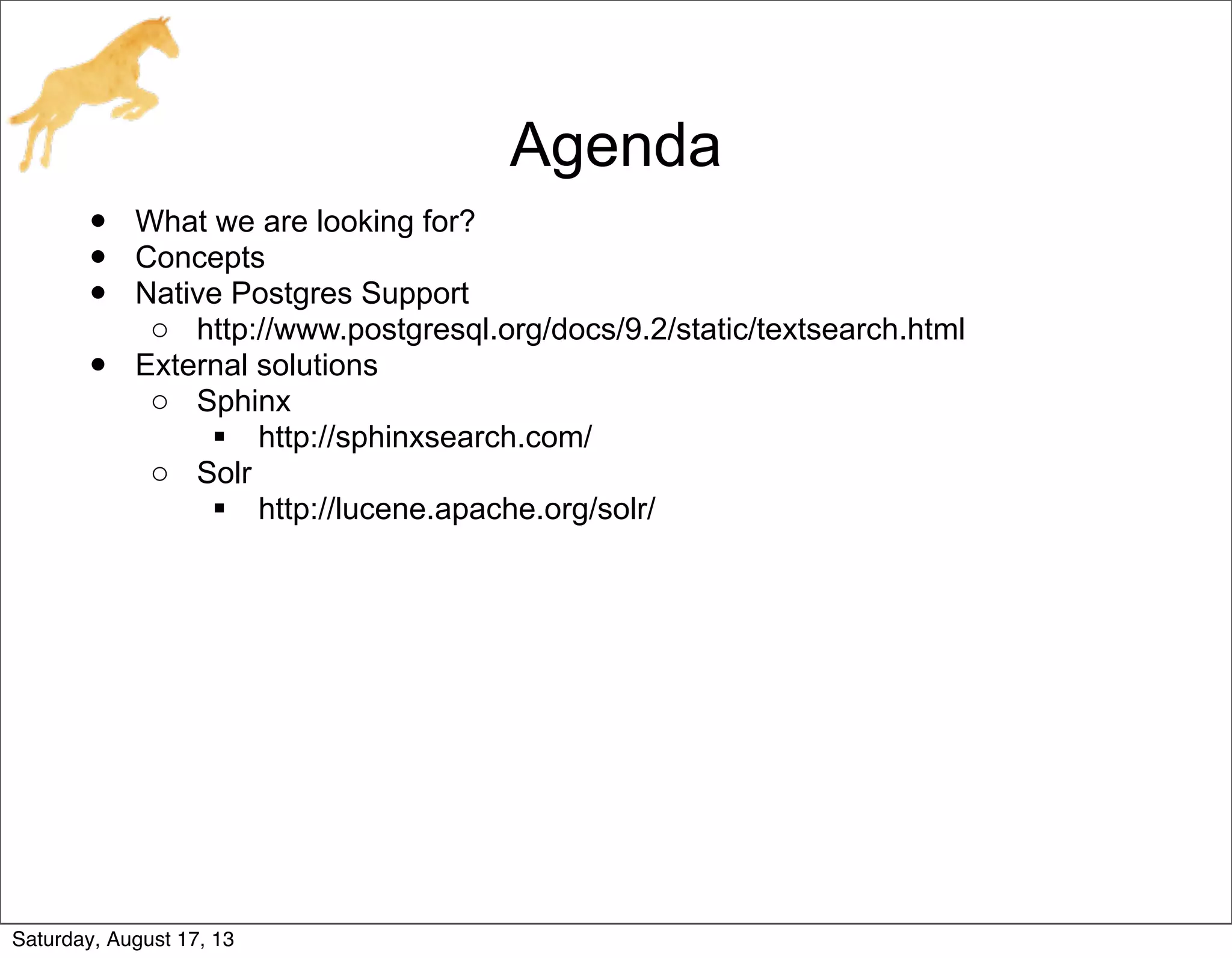
Agenda
• What we are looking for?
• Concepts
• Native Postgres Support
o http://www.postgresql.org/docs/9.2/static/textsearch.html
• External solutions
o Sphinx
 http://sphinxsearch.com/
o Solr
 http://lucene.apache.org/solr/
Saturday, August 17, 13
What are we looking for?
• Finish the talk knowing what FTS is for.
• Have an idea which are our tools.
• Which of those tools are the best fit.
Saturday, August 17, 13
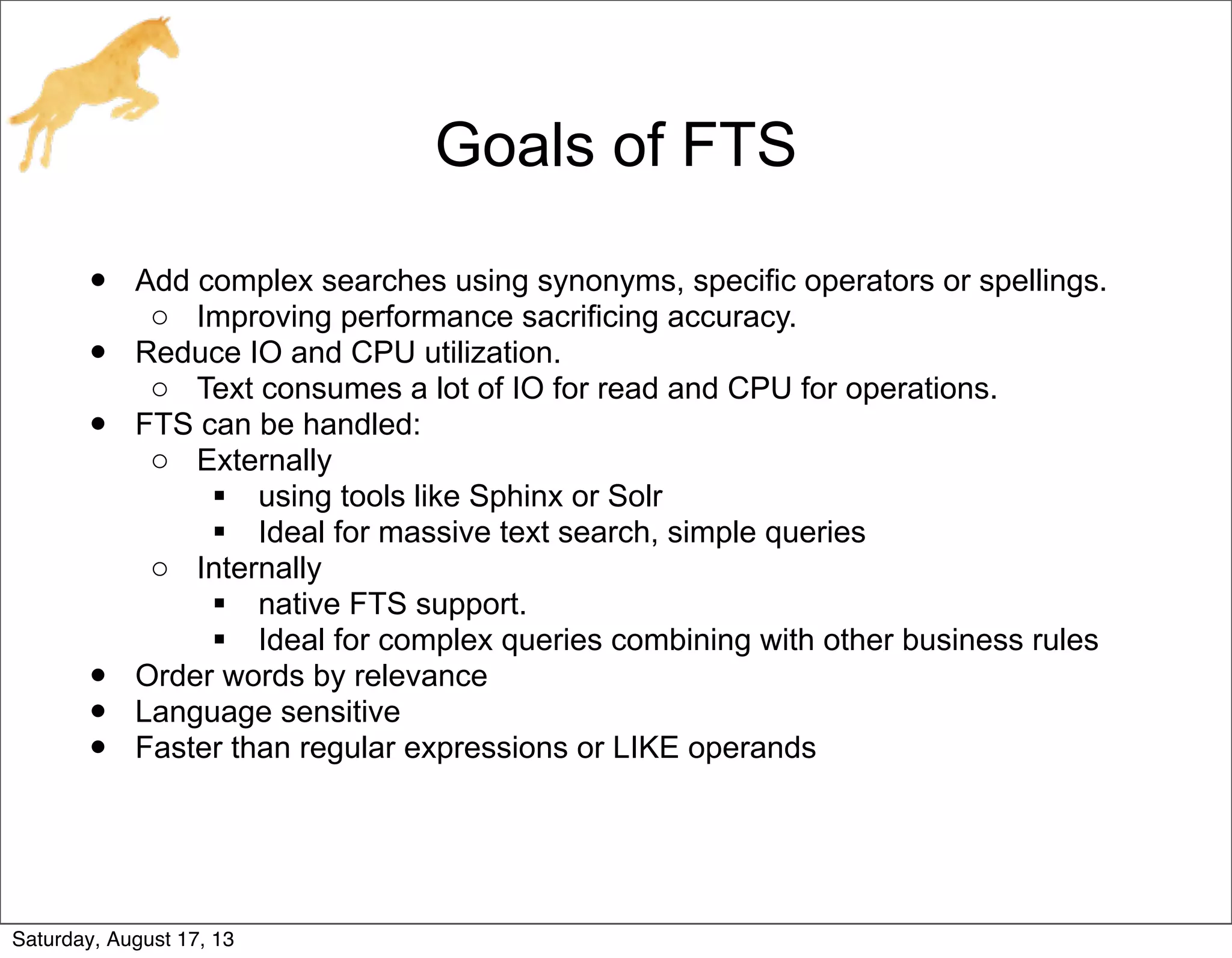
Goals of FTS
• Add complex searches using synonyms, specific operators or spellings.
o Improving performance sacrificing accuracy.
• Reduce IO and CPU utilization.
o Text consumes a lot of IO for read and CPU for operations.
• FTS can be handled:
o Externally
 using tools like Sphinx or Solr
 Ideal for massive text search, simple queries
o Internally
 native FTS support.
 Ideal for complex queries combining with other business rules
• Order words by relevance
• Language sensitive
• Faster than regular expressions or LIKE operands
Saturday, August 17, 13
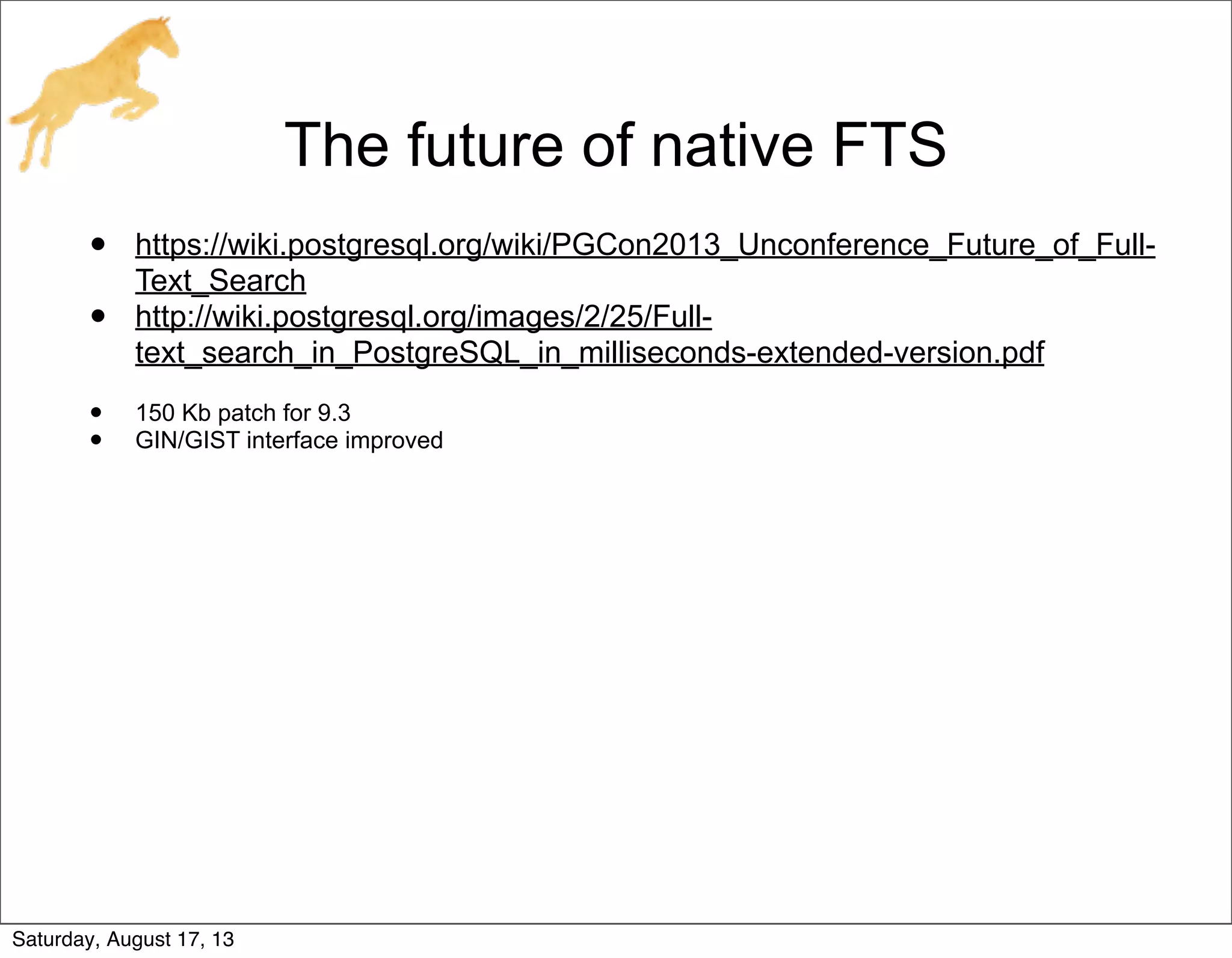
The future of native FTS
• https://wiki.postgresql.org/wiki/PGCon2013_Unconference_Future_of_Full-
Text_Search
• http://wiki.postgresql.org/images/2/25/Full-
text_search_in_PostgreSQL_in_milliseconds-extended-version.pdf
• 150 Kb patch for 9.3
• GIN/GIST interface improved
Saturday, August 17, 13
WHY FTS??
You may be asking this now.
Saturday, August 17, 13
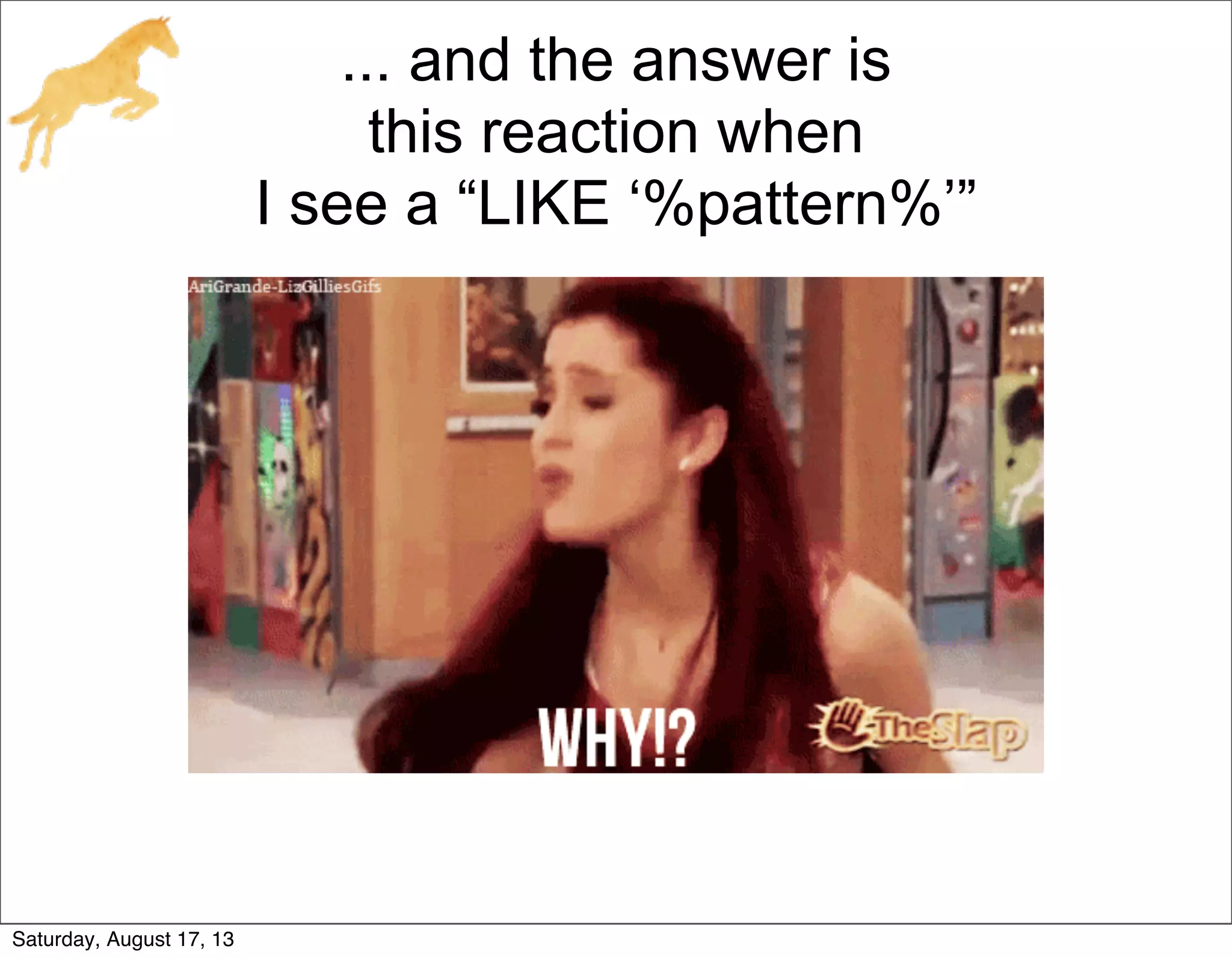
... and the answer is
this reaction when
I see a “LIKE ‘%pattern%’”
Saturday, August 17, 13
Concepts
• Parsers
o 23 token types (url, email, file, etc)
• Token
• Stop word
• Lexeme
o array of lexemes + position + weight = tsvector
• Dictionaries
o Simple Dictionary
 The simple dictionary template operates by converting the input
token to lower case and checking it against a file of stop words.
o Synonym Dictionary
o Thesaurus Dictionary
o Ispell Dictionary
o Snowball Dictionary
Saturday, August 17, 13
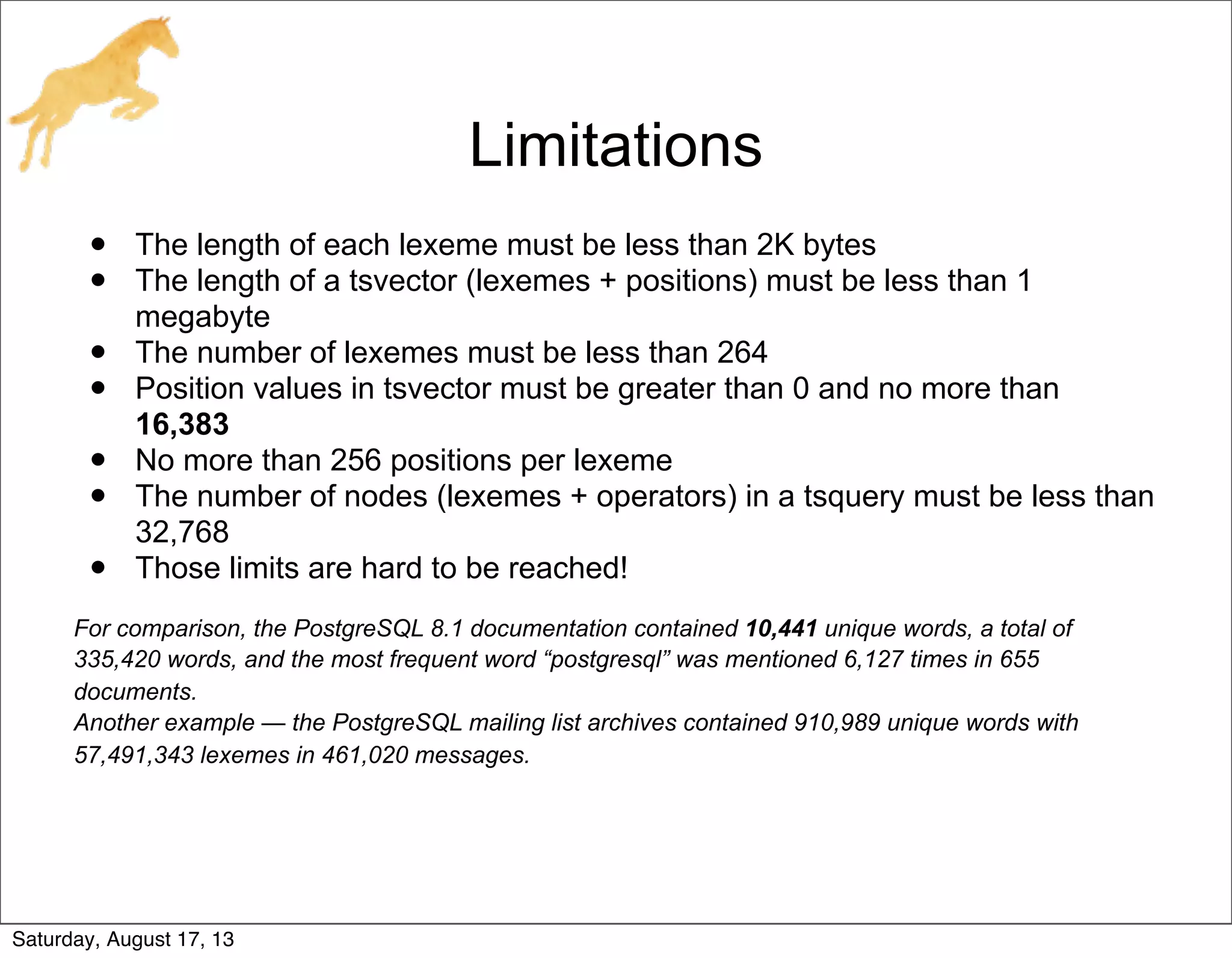
Limitations
• The length of each lexeme must be less than 2K bytes
• The length of a tsvector (lexemes + positions) must be less than 1
megabyte
• The number of lexemes must be less than 264
• Position values in tsvector must be greater than 0 and no more than
16,383
• No more than 256 positions per lexeme
• The number of nodes (lexemes + operators) in a tsquery must be less than
32,768
• Those limits are hard to be reached!
For comparison, the PostgreSQL 8.1 documentation contained 10,441 unique words, a total of
335,420 words, and the most frequent word “postgresql” was mentioned 6,127 times in 655
documents.
Another example — the PostgreSQL mailing list archives contained 910,989 unique words with
57,491,343 lexemes in 461,020 messages.
Saturday, August 17, 13
Elements
dF[+] [PATTERN] list text search configurations
dFd[+] [PATTERN] list text search dictionaries
dFp[+] [PATTERN] list text search parsers
dFt[+] [PATTERN] list text search templates
full_text_search=# dFd+ *
List of text search dictionaries
Schema | Name | Template | Init options | Description
------------+-----------------+---------------------+---------------------------------------------------+-----------------------------------------------------------
pg_catalog | danish_stem | pg_catalog.snowball | language = 'danish', stopwords = 'danish' | snowball stemmer for danish language
pg_catalog | dutch_stem | pg_catalog.snowball | language = 'dutch', stopwords = 'dutch' | snowball stemmer for dutch language
pg_catalog | english_stem | pg_catalog.snowball | language = 'english', stopwords = 'english' | snowball stemmer for english language
pg_catalog | finnish_stem | pg_catalog.snowball | language = 'finnish', stopwords = 'finnish' | snowball stemmer for finnish language
pg_catalog | french_stem | pg_catalog.snowball | language = 'french', stopwords = 'french' | snowball stemmer for french language
pg_catalog | german_stem | pg_catalog.snowball | language = 'german', stopwords = 'german' | snowball stemmer for german
language
pg_catalog | hungarian_stem | pg_catalog.snowball | language = 'hungarian', stopwords = 'hungarian' | snowball stemmer for hungarian language
pg_catalog | italian_stem | pg_catalog.snowball | language = 'italian', stopwords = 'italian' | snowball stemmer for italian language
pg_catalog | norwegian_stem | pg_catalog.snowball | language = 'norwegian', stopwords = 'norwegian' | snowball stemmer for norwegian language
pg_catalog | portuguese_stem | pg_catalog.snowball | language = 'portuguese', stopwords = 'portuguese' | snowball stemmer for portuguese language
pg_catalog | romanian_stem | pg_catalog.snowball | language = 'romanian' | snowball stemmer for romanian language
pg_catalog | russian_stem | pg_catalog.snowball | language = 'russian', stopwords = 'russian' | snowball stemmer for russian language
pg_catalog | simple | pg_catalog.simple | | simple dictionary: just lower case and check for
stopword
pg_catalog | spanish_stem | pg_catalog.snowball | language = 'spanish', stopwords = 'spanish' | snowball stemmer for spanish
language
pg_catalog | swedish_stem | pg_catalog.snowball | language = 'swedish', stopwords = 'swedish' | snowball stemmer for swedish
language
pg_catalog | turkish_stem | pg_catalog.snowball | language = 'turkish', stopwords = 'turkish' | snowball stemmer for turkish language
(16 rows)
Saturday, August 17, 13
Elements
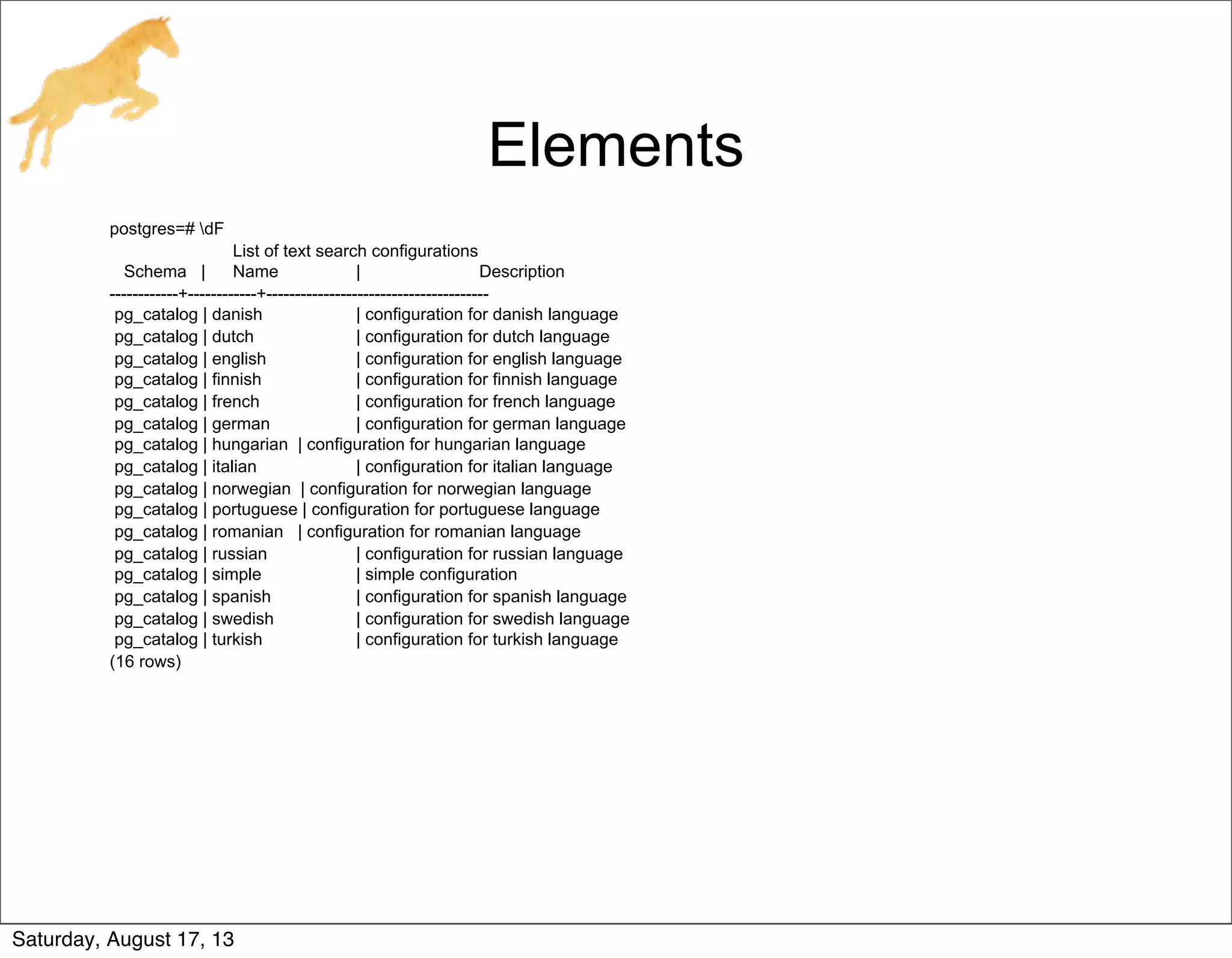
postgres=# dF
List of text search configurations
Schema | Name | Description
------------+------------+---------------------------------------
pg_catalog | danish | configuration for danish language
pg_catalog | dutch | configuration for dutch language
pg_catalog | english | configuration for english language
pg_catalog | finnish | configuration for finnish language
pg_catalog | french | configuration for french language
pg_catalog | german | configuration for german language
pg_catalog | hungarian | configuration for hungarian language
pg_catalog | italian | configuration for italian language
pg_catalog | norwegian | configuration for norwegian language
pg_catalog | portuguese | configuration for portuguese language
pg_catalog | romanian | configuration for romanian language
pg_catalog | russian | configuration for russian language
pg_catalog | simple | simple configuration
pg_catalog | spanish | configuration for spanish language
pg_catalog | swedish | configuration for swedish language
pg_catalog | turkish | configuration for turkish language
(16 rows)
Saturday, August 17, 13
Elements
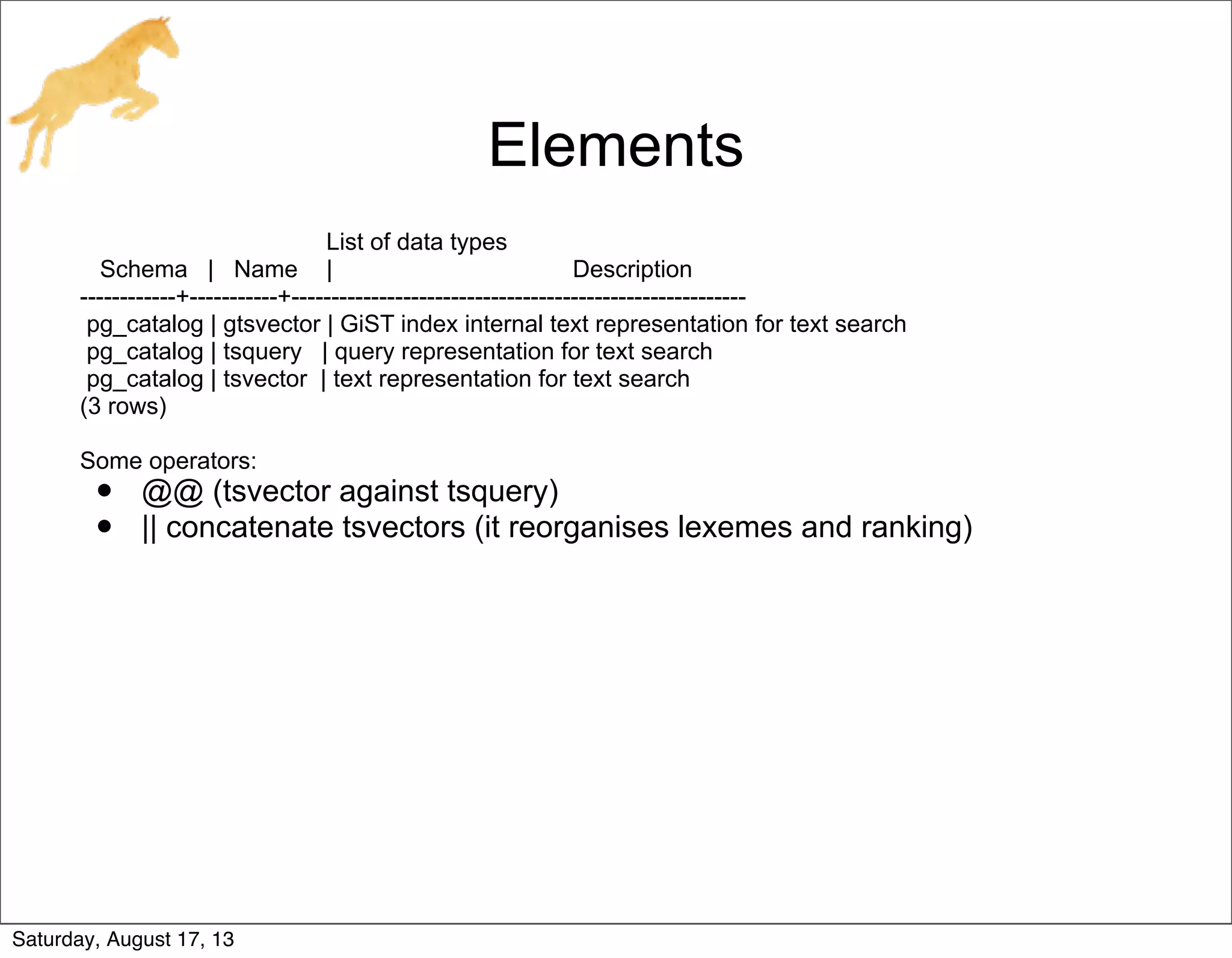
List of data types
Schema | Name | Description
------------+-----------+---------------------------------------------------------
pg_catalog | gtsvector | GiST index internal text representation for text search
pg_catalog | tsquery | query representation for text search
pg_catalog | tsvector | text representation for text search
(3 rows)
Some operators:
• @@ (tsvector against tsquery)
• || concatenate tsvectors (it reorganises lexemes and ranking)
Saturday, August 17, 13
Small Example
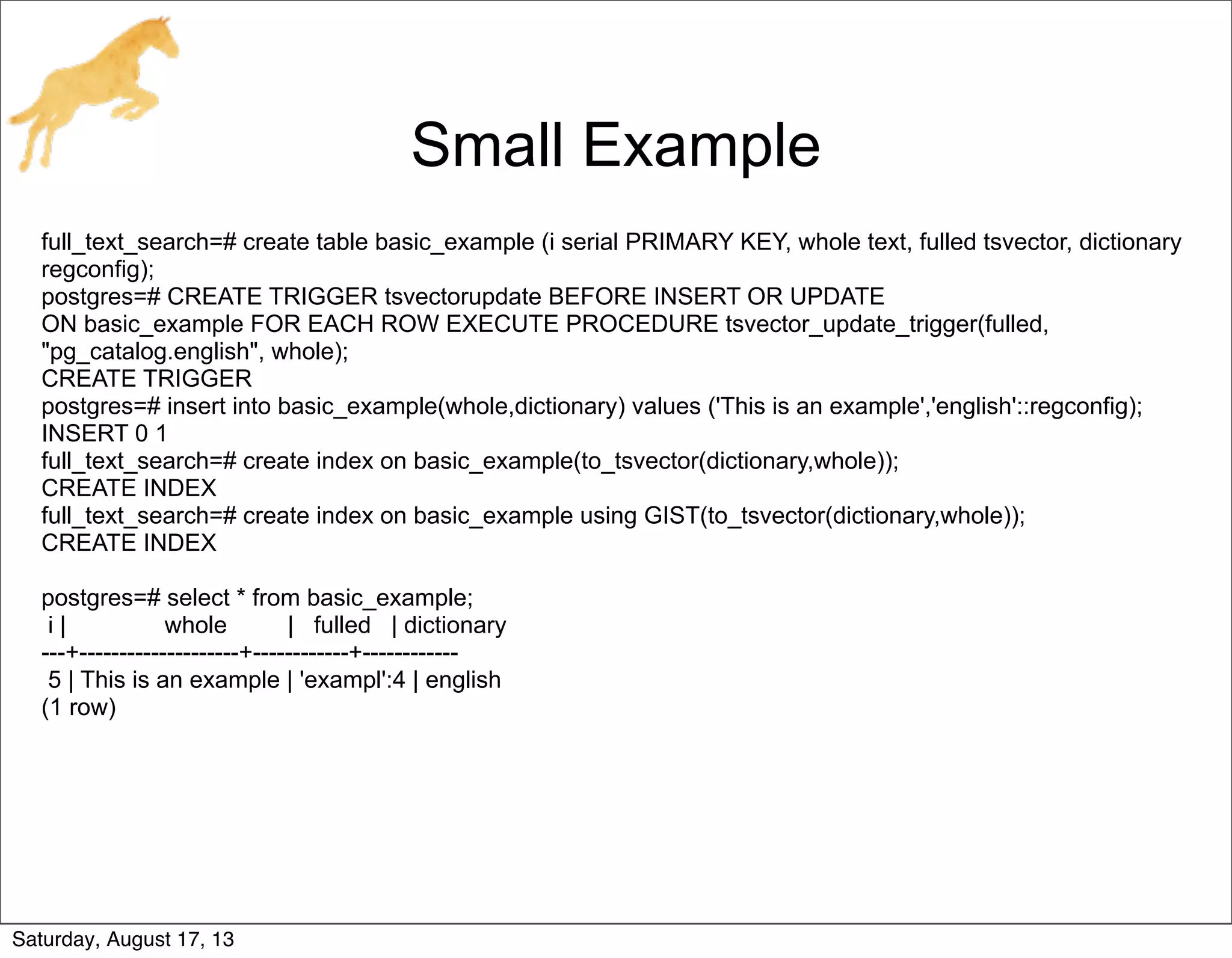
full_text_search=# create table basic_example (i serial PRIMARY KEY, whole text, fulled tsvector, dictionary
regconfig);
postgres=# CREATE TRIGGER tsvectorupdate BEFORE INSERT OR UPDATE
ON basic_example FOR EACH ROW EXECUTE PROCEDURE tsvector_update_trigger(fulled,
"pg_catalog.english", whole);
CREATE TRIGGER
postgres=# insert into basic_example(whole,dictionary) values ('This is an example','english'::regconfig);
INSERT 0 1
full_text_search=# create index on basic_example(to_tsvector(dictionary,whole));
CREATE INDEX
full_text_search=# create index on basic_example using GIST(to_tsvector(dictionary,whole));
CREATE INDEX
postgres=# select * from basic_example;
i | whole | fulled | dictionary
---+--------------------+------------+------------
5 | This is an example | 'exampl':4 | english
(1 row)
Saturday, August 17, 13
Pre processing
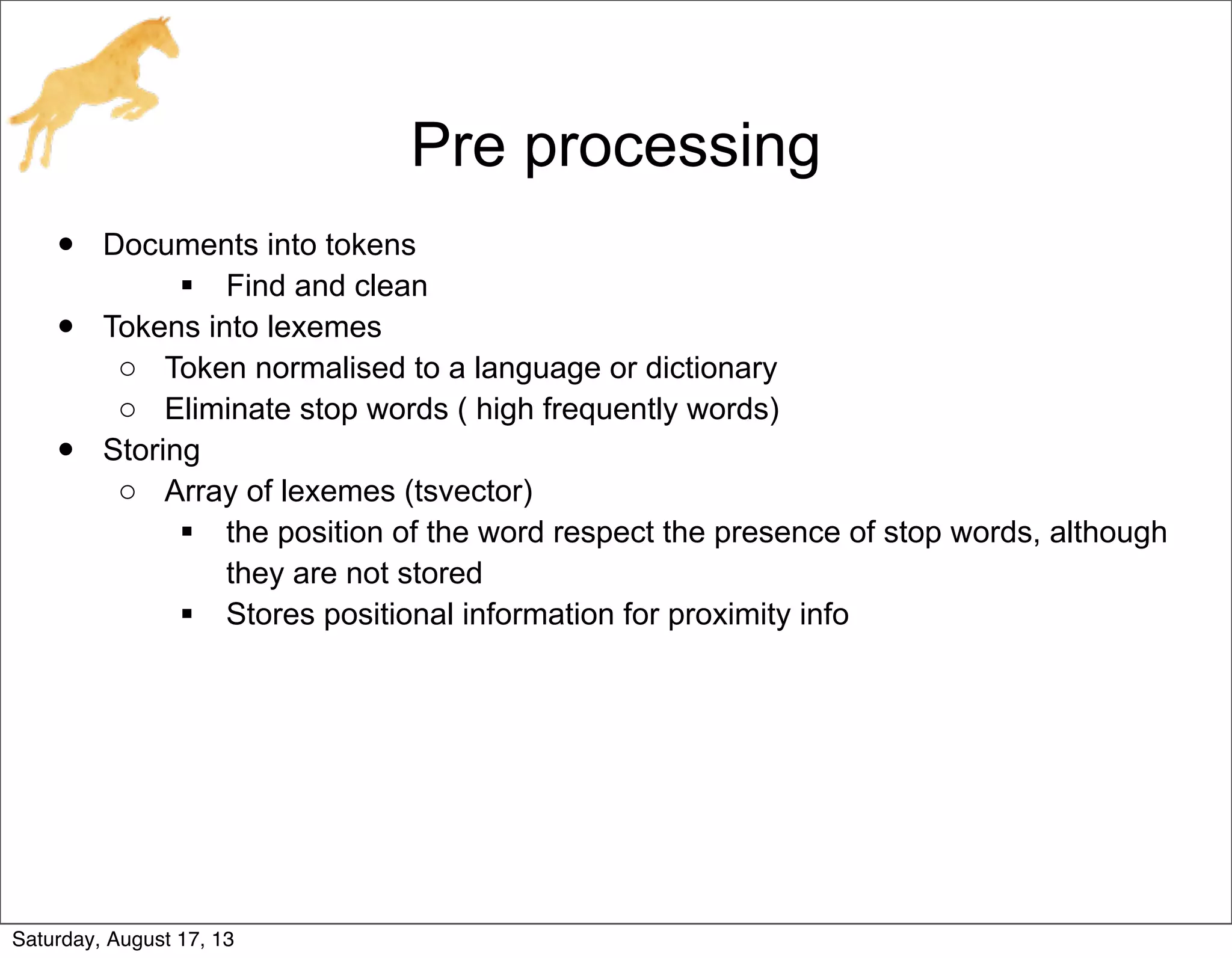
• Documents into tokens
 Find and clean
• Tokens into lexemes
o Token normalised to a language or dictionary
o Eliminate stop words ( high frequently words)
• Storing
o Array of lexemes (tsvector)
 the position of the word respect the presence of stop words, although
they are not stored
 Stores positional information for proximity info
Saturday, August 17, 13
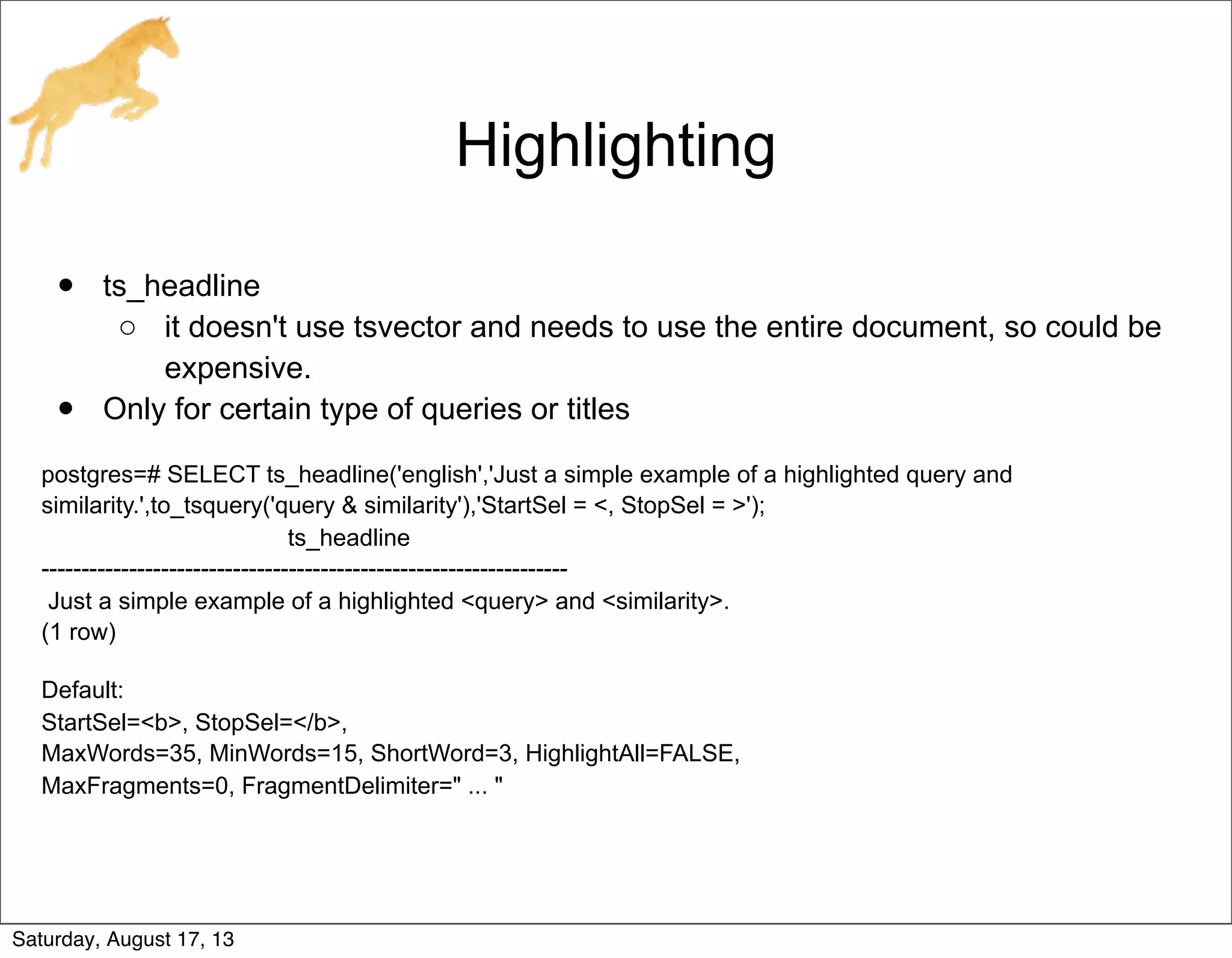
Highlighting
• ts_headline
o it doesn't use tsvector and needs to use the entire document, so could be
expensive.
• Only for certain type of queries or titles
postgres=# SELECT ts_headline('english','Just a simple example of a highlighted query and
similarity.',to_tsquery('query & similarity'),'StartSel = <, StopSel = >');
ts_headline
------------------------------------------------------------------
Just a simple example of a highlighted <query> and <similarity>.
(1 row)
Default:
StartSel=<b>, StopSel=</b>,
MaxWords=35, MinWords=15, ShortWord=3, HighlightAll=FALSE,
MaxFragments=0, FragmentDelimiter=" ... "
Saturday, August 17, 13
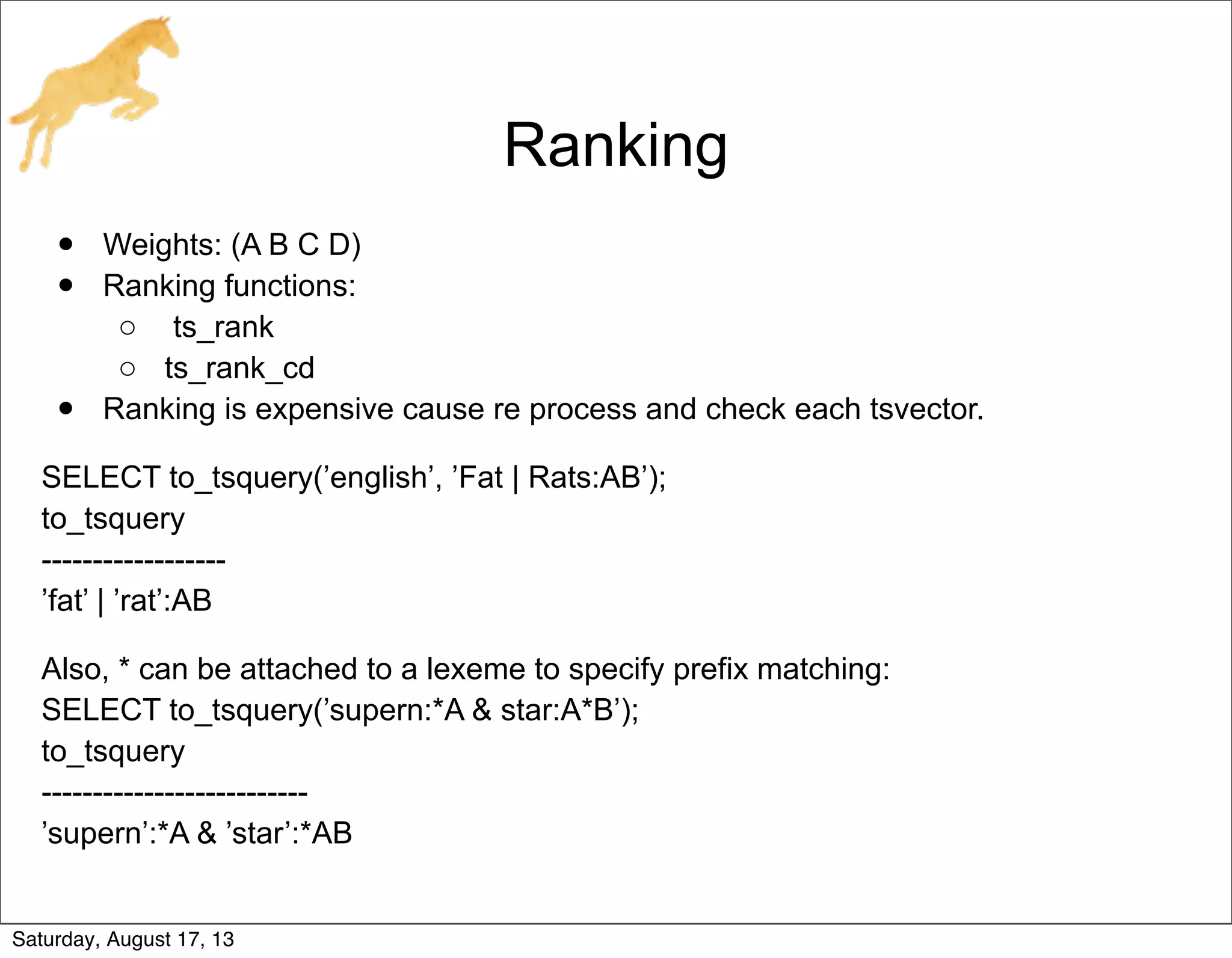
Ranking
• Weights: (A B C D)
• Ranking functions:
o ts_rank
o ts_rank_cd
• Ranking is expensive cause re process and check each tsvector.
SELECT to_tsquery(’english’, ’Fat | Rats:AB’);
to_tsquery
------------------
’fat’ | ’rat’:AB
Also, * can be attached to a lexeme to specify prefix matching:
SELECT to_tsquery(’supern:*A & star:A*B’);
to_tsquery
--------------------------
’supern’:*A & ’star’:*AB
Saturday, August 17, 13
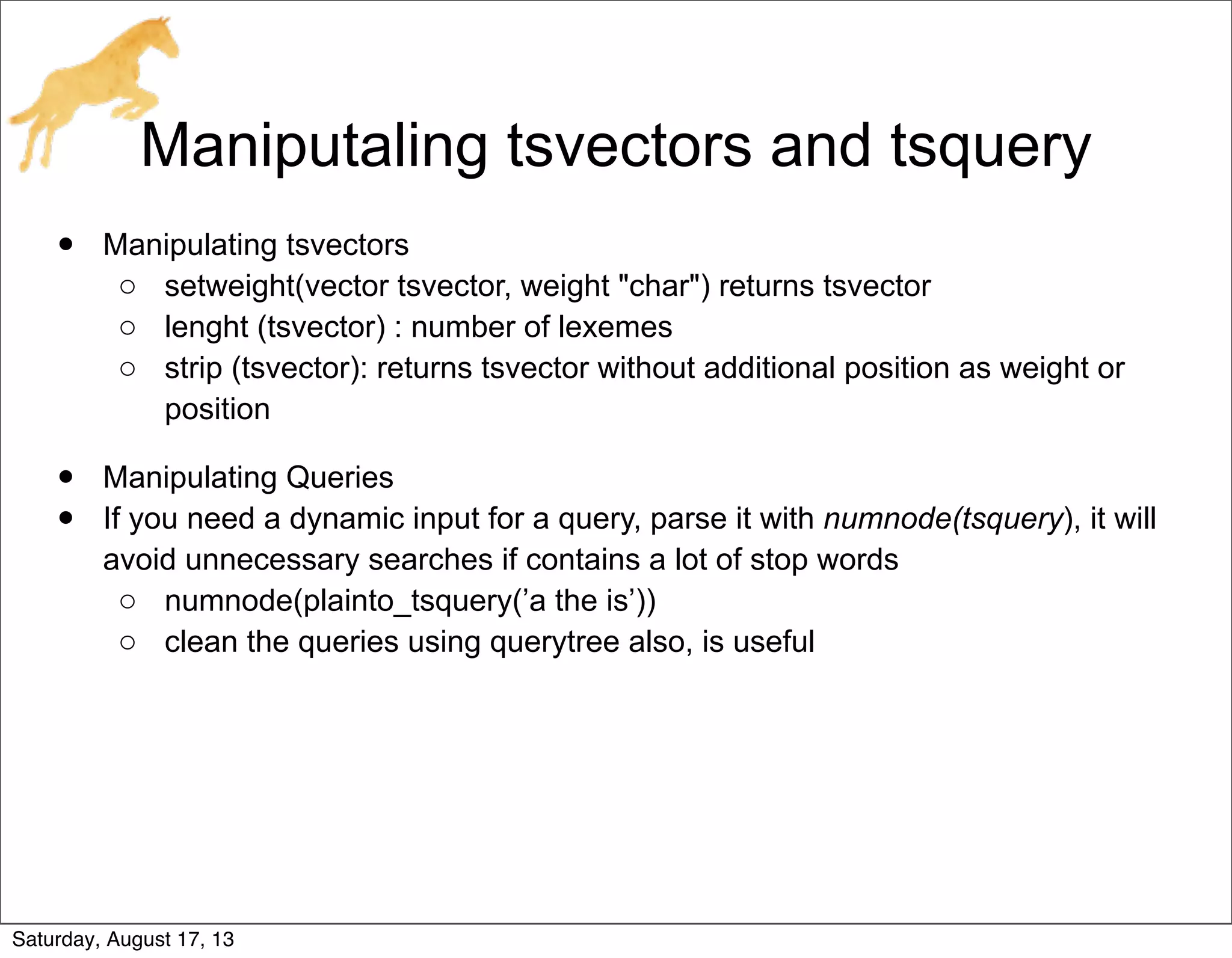
Maniputaling tsvectors and tsquery
• Manipulating tsvectors
o setweight(vector tsvector, weight "char") returns tsvector
o lenght (tsvector) : number of lexemes
o strip (tsvector): returns tsvector without additional position as weight or
position
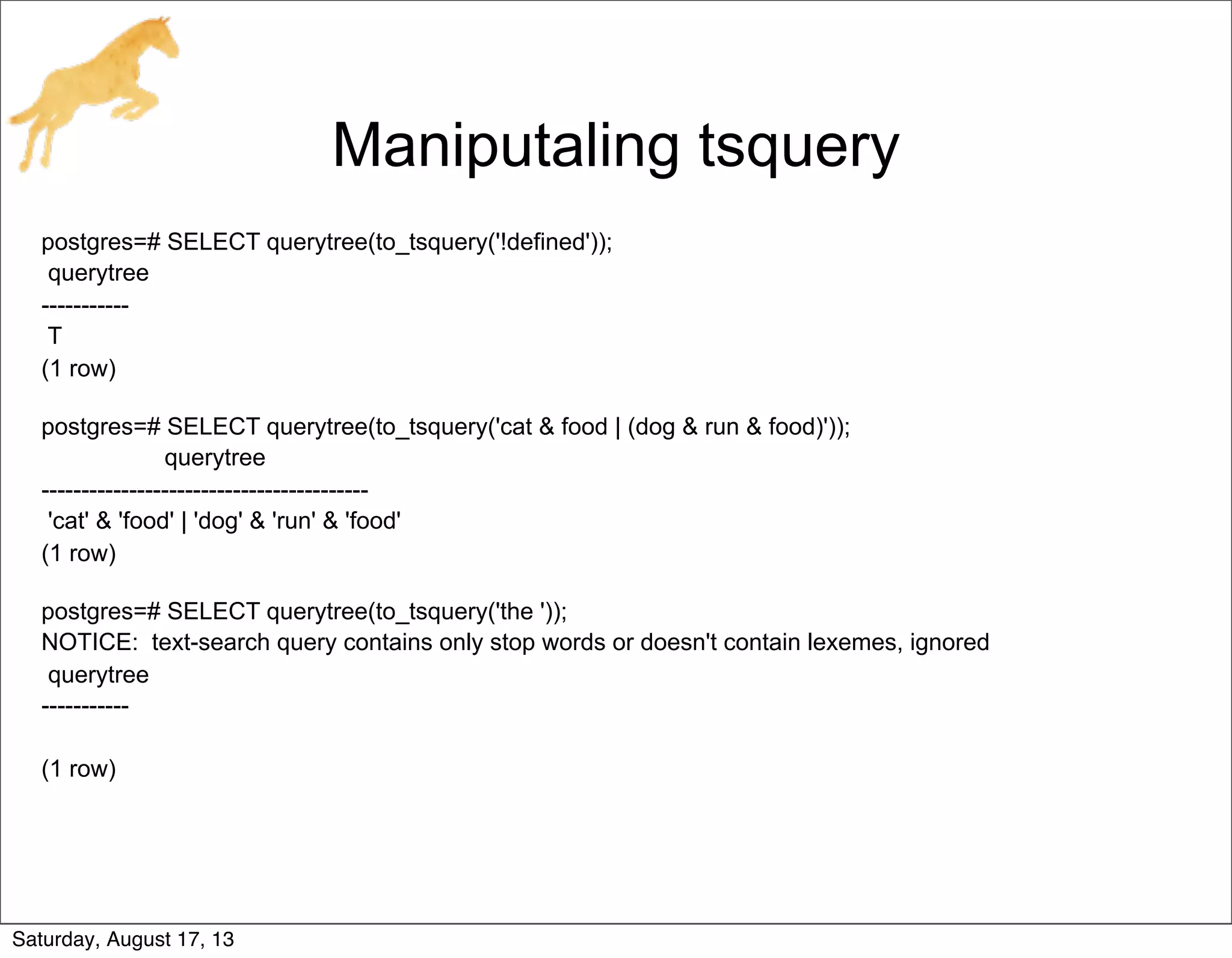
• Manipulating Queries
• If you need a dynamic input for a query, parse it with numnode(tsquery), it will
avoid unnecessary searches if contains a lot of stop words
o numnode(plainto_tsquery(’a the is’))
o clean the queries using querytree also, is useful
Saturday, August 17, 13
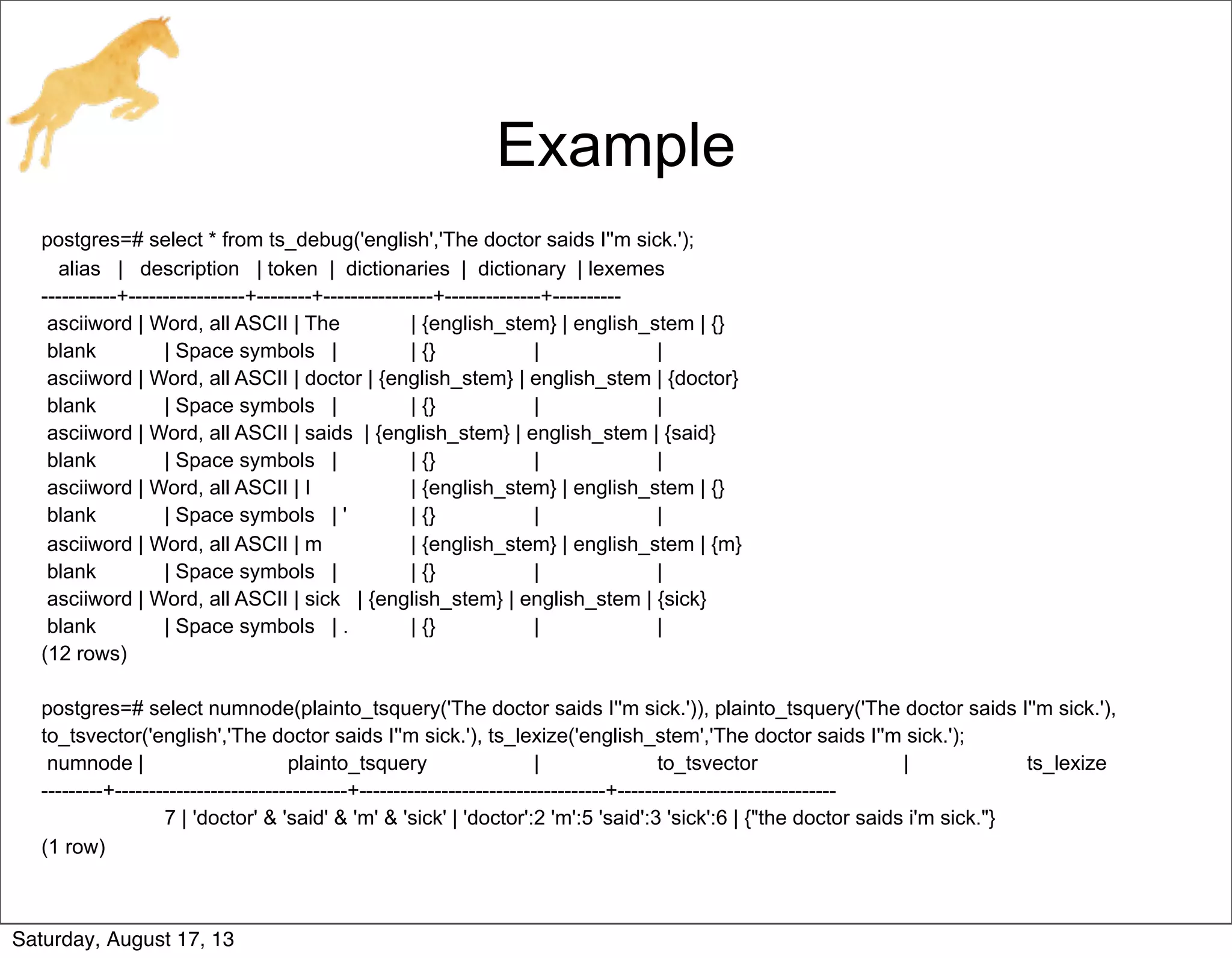
Example
postgres=# select * from ts_debug('english','The doctor saids I''m sick.');
alias | description | token | dictionaries | dictionary | lexemes
-----------+-----------------+--------+----------------+--------------+----------
asciiword | Word, all ASCII | The | {english_stem} | english_stem | {}
blank | Space symbols | | {} | |
asciiword | Word, all ASCII | doctor | {english_stem} | english_stem | {doctor}
blank | Space symbols | | {} | |
asciiword | Word, all ASCII | saids | {english_stem} | english_stem | {said}
blank | Space symbols | | {} | |
asciiword | Word, all ASCII | I | {english_stem} | english_stem | {}
blank | Space symbols | ' | {} | |
asciiword | Word, all ASCII | m | {english_stem} | english_stem | {m}
blank | Space symbols | | {} | |
asciiword | Word, all ASCII | sick | {english_stem} | english_stem | {sick}
blank | Space symbols | . | {} | |
(12 rows)
postgres=# select numnode(plainto_tsquery('The doctor saids I''m sick.')), plainto_tsquery('The doctor saids I''m sick.'),
to_tsvector('english','The doctor saids I''m sick.'), ts_lexize('english_stem','The doctor saids I''m sick.');
numnode | plainto_tsquery | to_tsvector | ts_lexize
---------+----------------------------------+------------------------------------+--------------------------------
7 | 'doctor' & 'said' & 'm' & 'sick' | 'doctor':2 'm':5 'said':3 'sick':6 | {"the doctor saids i'm sick."}
(1 row)
Saturday, August 17, 13
Maniputaling tsquery
postgres=# SELECT querytree(to_tsquery('!defined'));
querytree
-----------
T
(1 row)
postgres=# SELECT querytree(to_tsquery('cat & food | (dog & run & food)'));
querytree
-----------------------------------------
'cat' & 'food' | 'dog' & 'run' & 'food'
(1 row)
postgres=# SELECT querytree(to_tsquery('the '));
NOTICE: text-search query contains only stop words or doesn't contain lexemes, ignored
querytree
-----------
(1 row)
Saturday, August 17, 13
Automating updates on tsvector
• Postgresql provide standard functions for this:
o tsvector_update_trigger(tsvector_column_name, config_name,
text_column_name [, ... ])
o tsvector_update_trigger_column(tsvector_column_name,
config_column_name, text_column_name [, ...
CREATE TABLE messages (
title text,
body text,
tsv tsvector
);
CREATE TRIGGER tsvectorupdate BEFORE INSERT OR UPDATE
ON messages FOR EACH ROW EXECUTE PROCEDURE
tsvector_update_trigger(tsv, ’pg_catalog.english’, title, body);
Saturday, August 17, 13
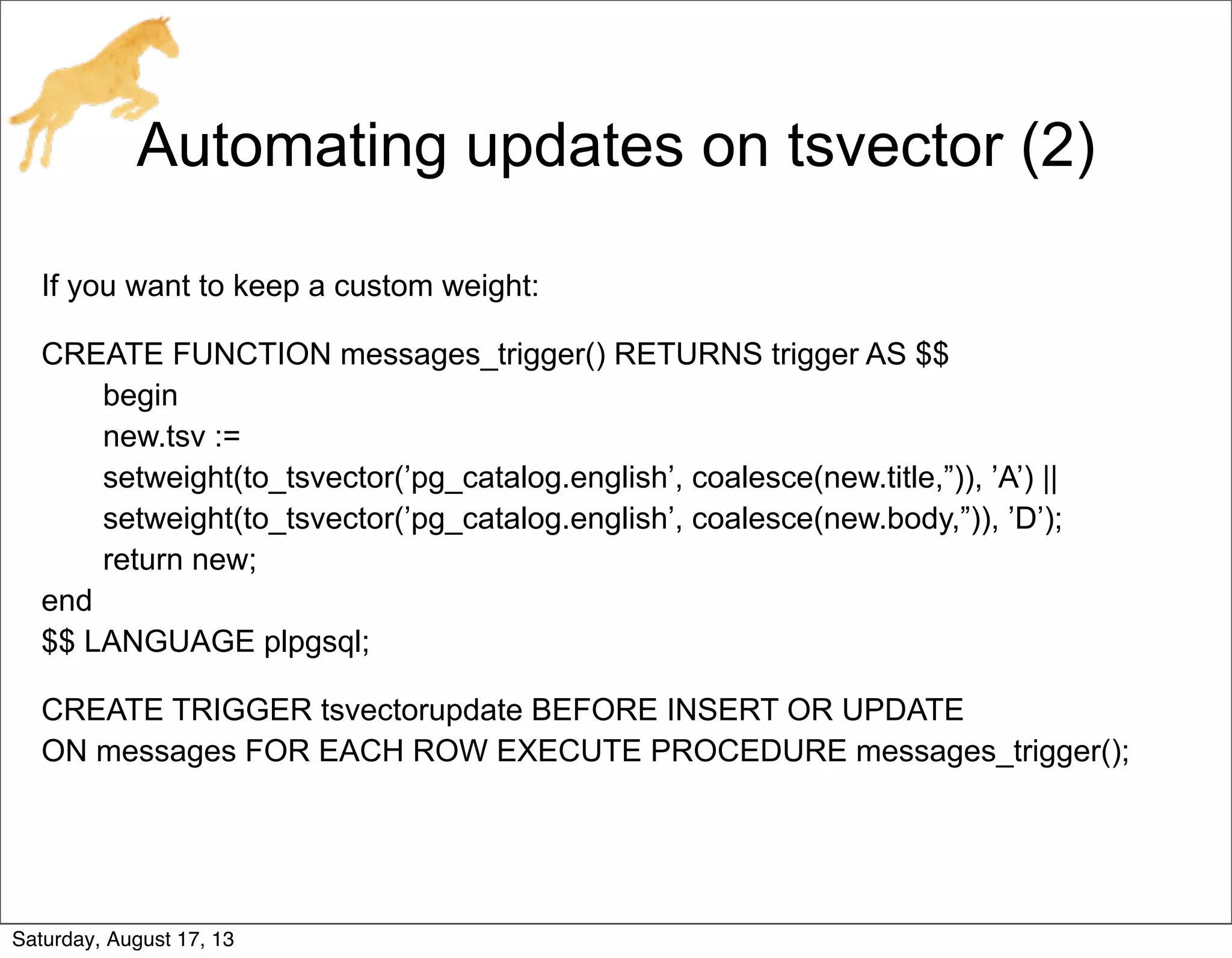
Automating updates on tsvector (2)
If you want to keep a custom weight:
CREATE FUNCTION messages_trigger() RETURNS trigger AS $$
begin
new.tsv :=
setweight(to_tsvector(’pg_catalog.english’, coalesce(new.title,”)), ’A’) ||
setweight(to_tsvector(’pg_catalog.english’, coalesce(new.body,”)), ’D’);
return new;
end
$$ LANGUAGE plpgsql;
CREATE TRIGGER tsvectorupdate BEFORE INSERT OR UPDATE
ON messages FOR EACH ROW EXECUTE PROCEDURE messages_trigger();
Saturday, August 17, 13
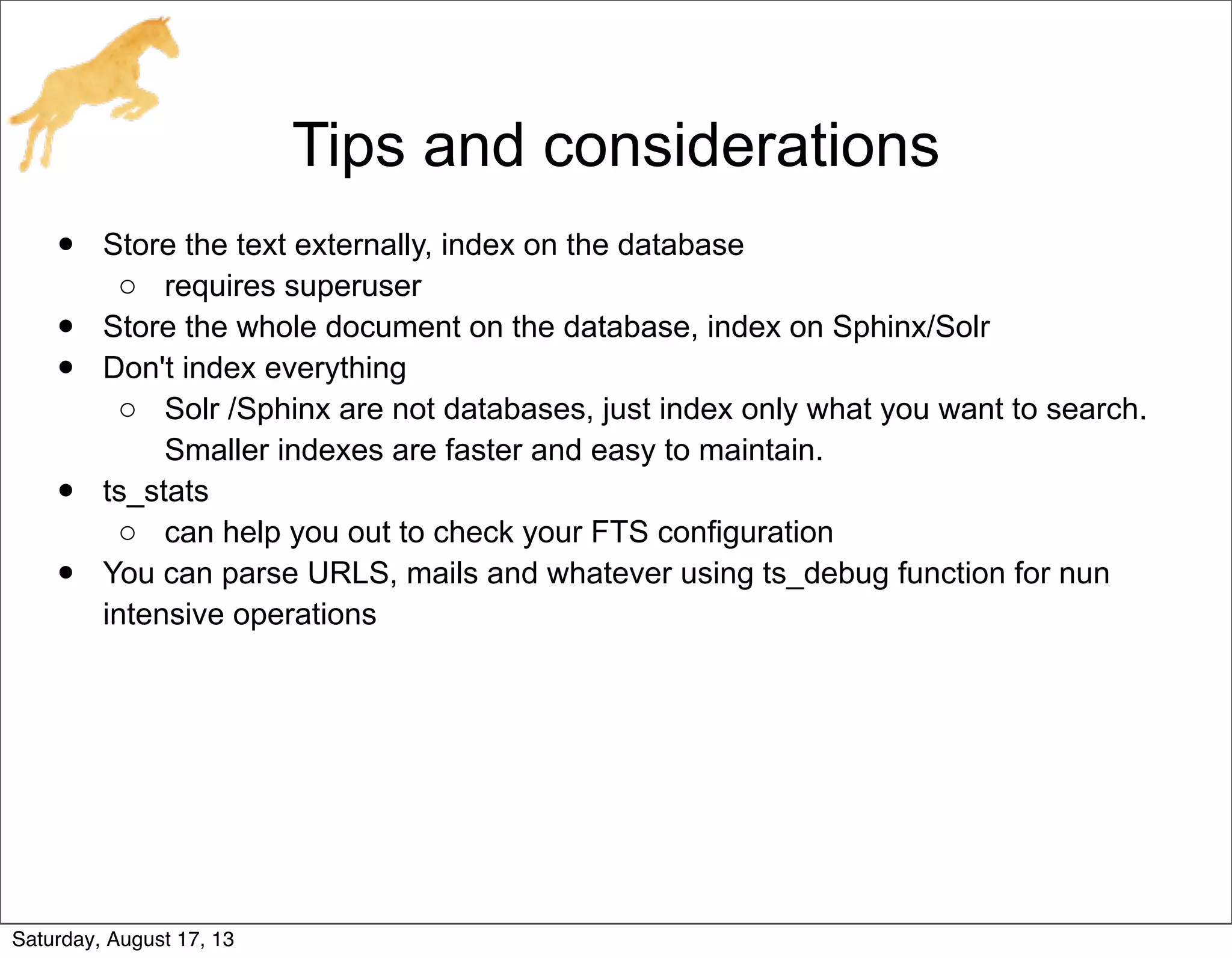
Tips and considerations
• Store the text externally, index on the database
o requires superuser
• Store the whole document on the database, index on Sphinx/Solr
• Don't index everything
o Solr /Sphinx are not databases, just index only what you want to search.
Smaller indexes are faster and easy to maintain.
• ts_stats
o can help you out to check your FTS configuration
• You can parse URLS, mails and whatever using ts_debug function for nun
intensive operations
Saturday, August 17, 13
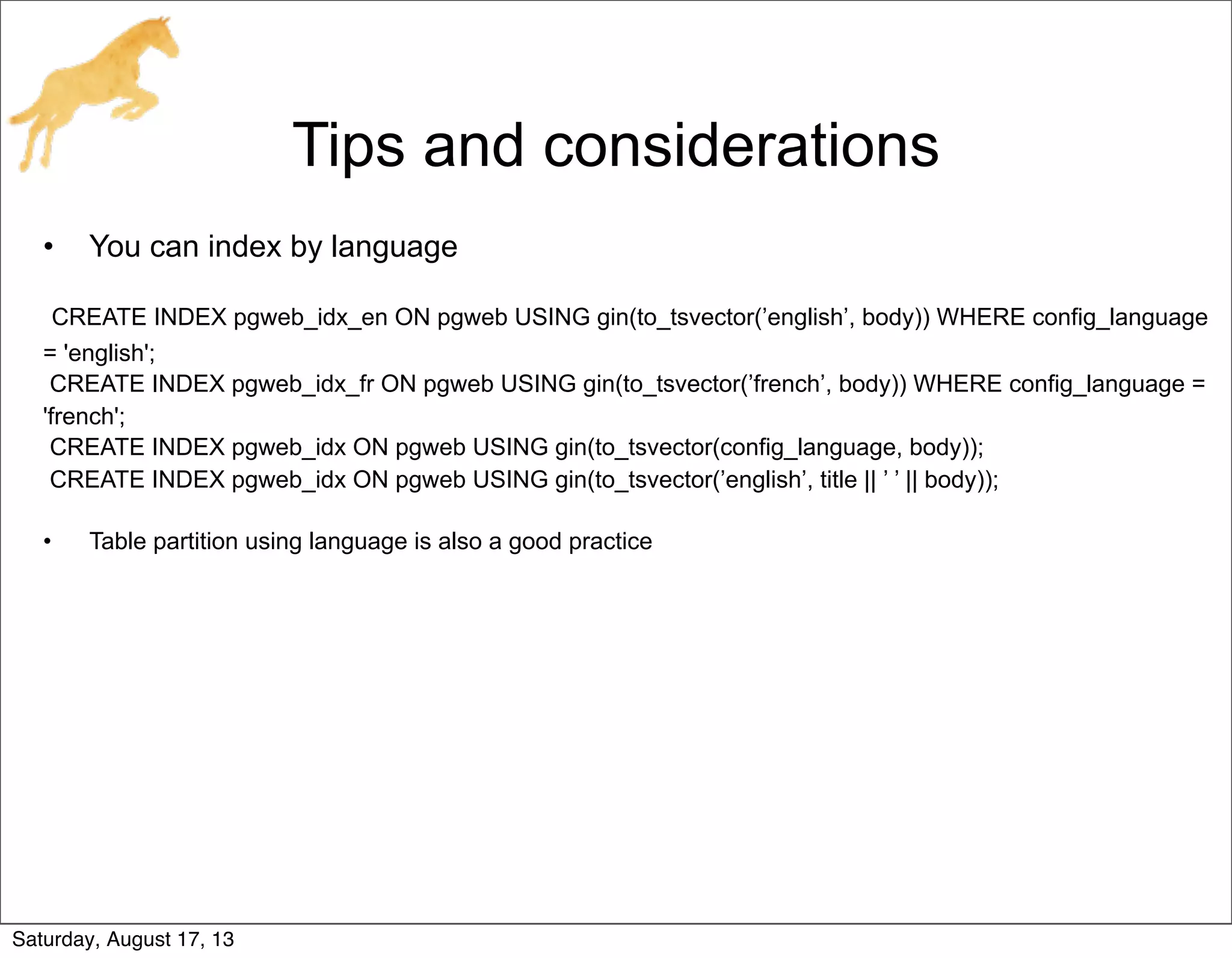
Tips and considerations
• You can index by language
CREATE INDEX pgweb_idx_en ON pgweb USING gin(to_tsvector(’english’, body)) WHERE config_language
= 'english';
CREATE INDEX pgweb_idx_fr ON pgweb USING gin(to_tsvector(’french’, body)) WHERE config_language =
'french';
CREATE INDEX pgweb_idx ON pgweb USING gin(to_tsvector(config_language, body));
CREATE INDEX pgweb_idx ON pgweb USING gin(to_tsvector(’english’, title || ’ ’ || body));
• Table partition using language is also a good practice
Saturday, August 17, 13
Features on 9.2
• Move tsvector most-common-element statistics to new pg_stats columns
(Alexander Korotkov)
• Consult most_common_elems and most_common_elem_freqs for the data
formerly available in most_common_vals and most_common_freqs for a tsvector
column.
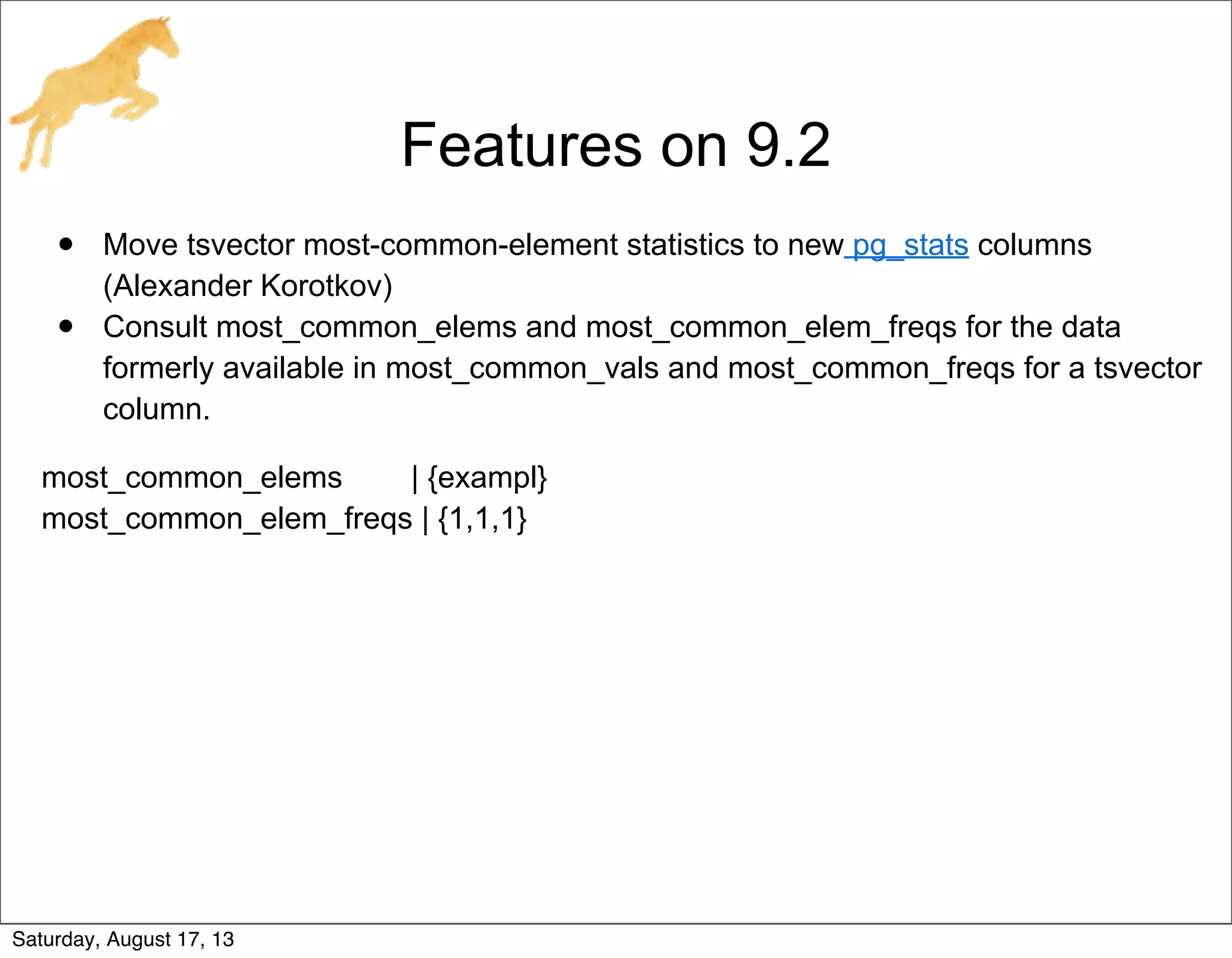
most_common_elems | {exampl}
most_common_elem_freqs | {1,1,1}
Saturday, August 17, 13
Links
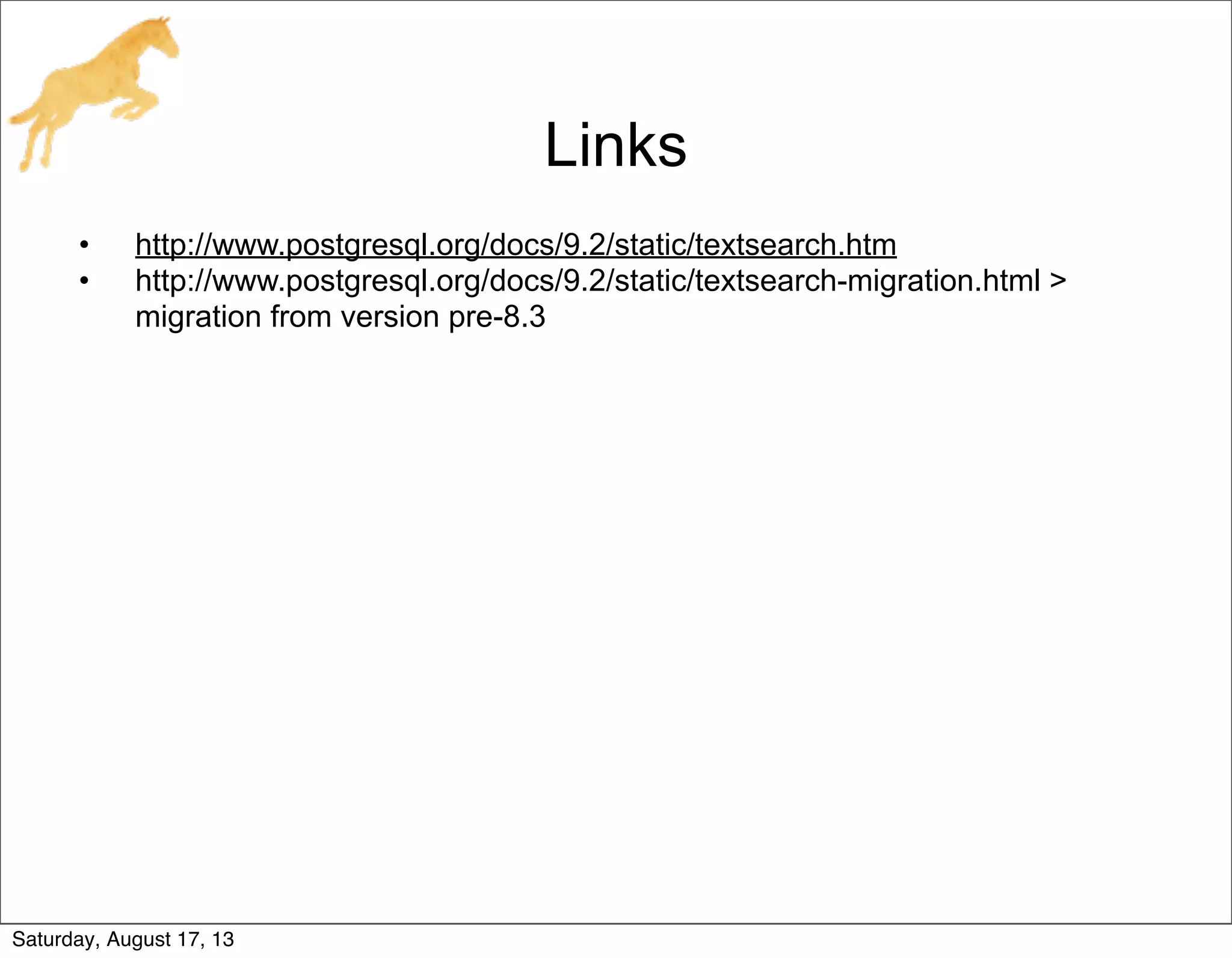
• http://www.postgresql.org/docs/9.2/static/textsearch.htm
• http://www.postgresql.org/docs/9.2/static/textsearch-migration.html >
migration from version pre-8.3
Saturday, August 17, 13
Sphinx
Saturday, August 17, 13
Sphinx
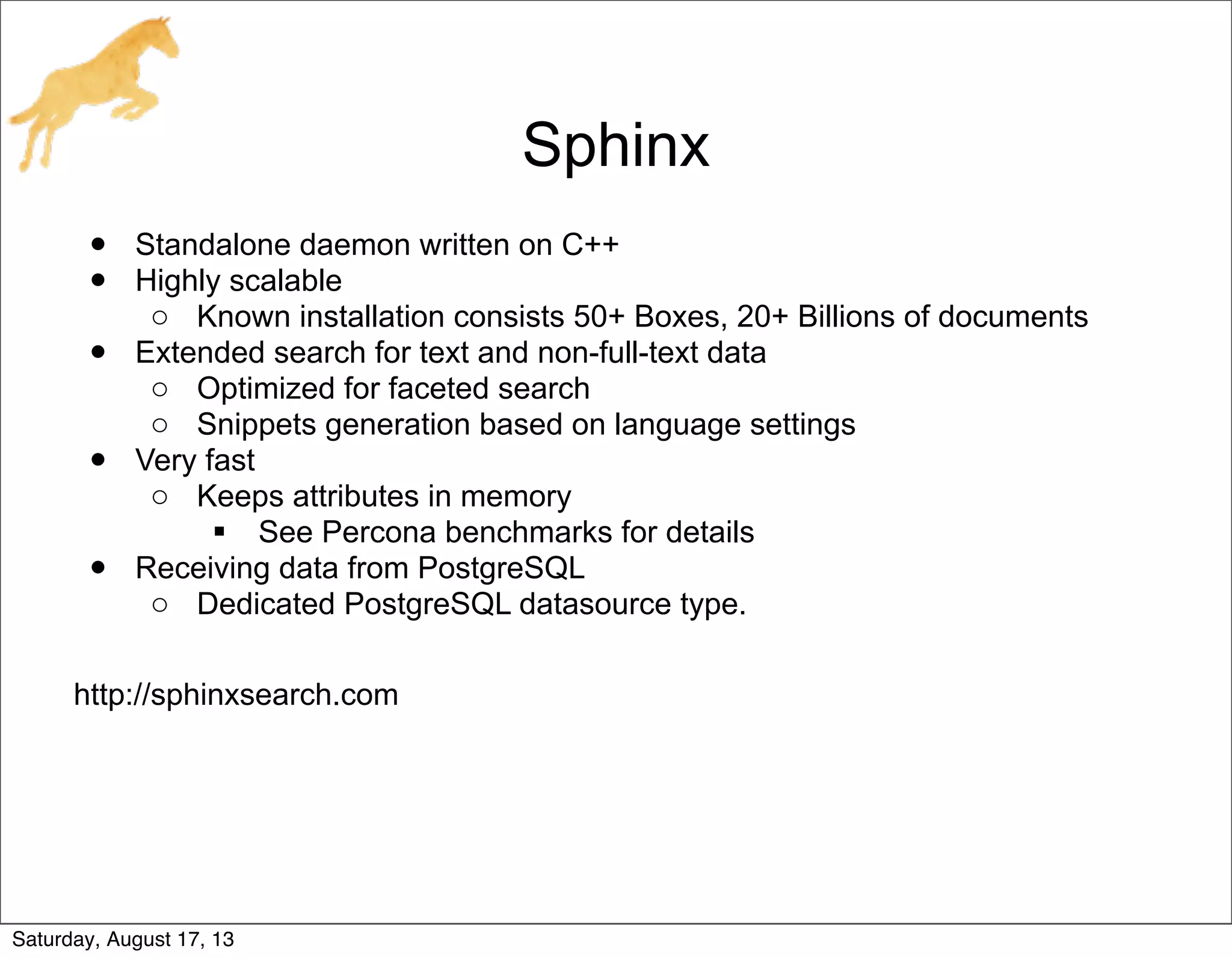
• Standalone daemon written on C++
• Highly scalable
o Known installation consists 50+ Boxes, 20+ Billions of documents
• Extended search for text and non-full-text data
o Optimized for faceted search
o Snippets generation based on language settings
• Very fast
o Keeps attributes in memory
 See Percona benchmarks for details
• Receiving data from PostgreSQL
o Dedicated PostgreSQL datasource type.
http://sphinxsearch.com
Saturday, August 17, 13
Key features- Sphinx
• Scalability & failover
• Extended FT language
• Faceted search support
• GEO-search support
• Integration and pluggable architecture
• Dedicated PostgreSQL source, UDF support
• Morphology & stemming
• Both batch & real-time indexing is available
• Parallel snippets generation
Saturday, August 17, 13
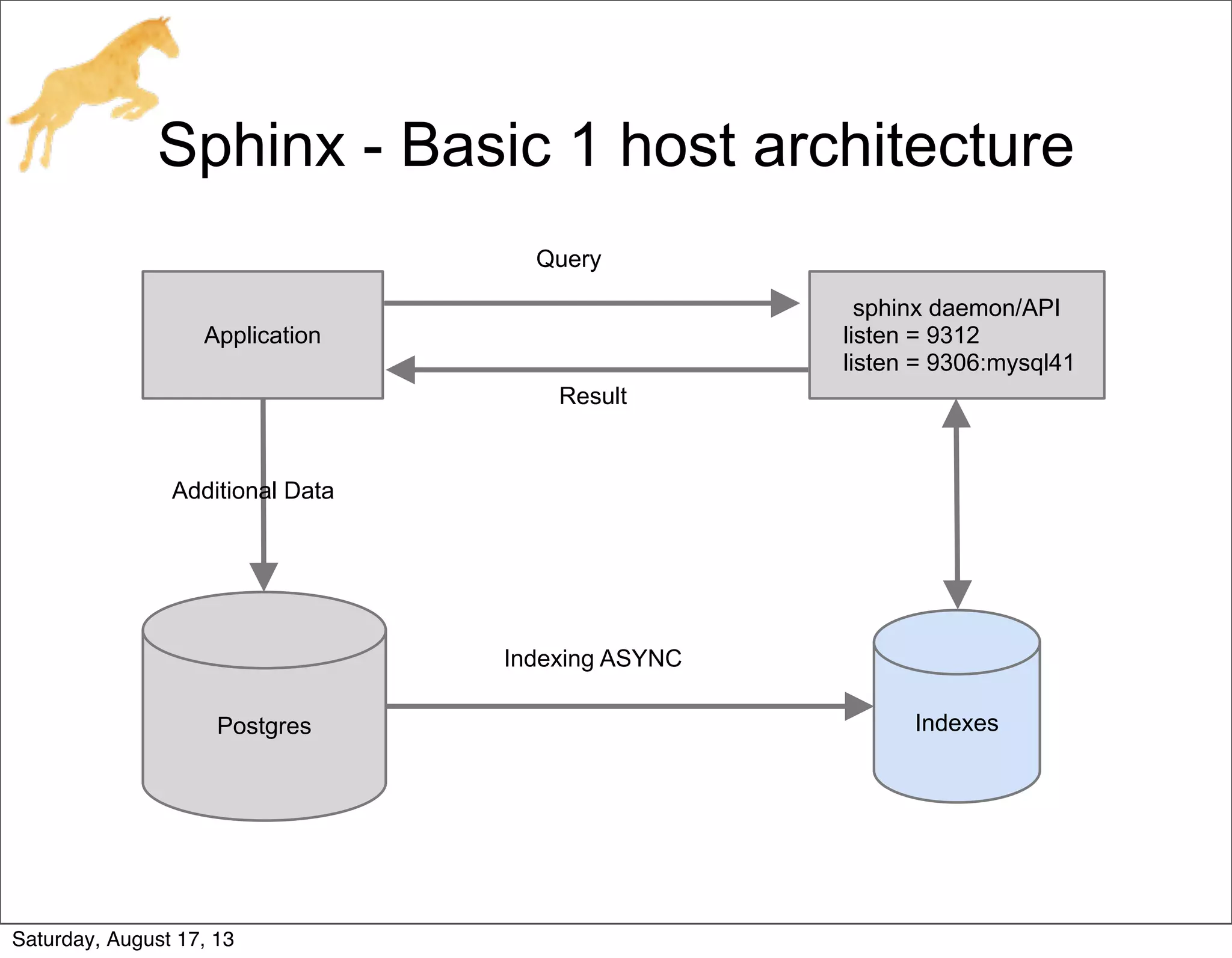
Sphinx - Basic 1 host architecture
Postgres
Application
sphinx daemon/API
listen = 9312
listen = 9306:mysql41
Indexes
Query
Result
Additional Data
Indexing ASYNC
Saturday, August 17, 13
What's new on Sphinx
• 1. added AOT (new morphology library, lemmatizer) support
o Russian only for now; English coming soon; small 10-20% indexing
impact; it's all about search quality (much much better "stemming")
• 2. added JSON support
o limited support (limited subset of JSON) for now; JSON sits in a
column; you're able to do thing like WHERE jsoncol.key=123 or
ORDER BY or GROUP BY
• 3. added subselect syntax that reorders result sets, SELECT * FROM
(SELECT ... ORDER BY cond1 LIMIT X) ORDER BY cond2 LIMIT Y
• 4. added bigram indexing, and quicker phrase searching with bigrams
(bigram_index, bigram_freq_words directives)
o improves the worst cases for social mining
• 5. added HA support, ha_strategy, agent_mirror directives
• 6. added a few new geofunctions (POLY2D, GEOPOLY2D, CONTAINS)
• 7. added GROUP_CONCAT()
• 8. added OPTIMIZE INDEX rtindex, rt_merge_iops, rt_merge_maxiosize
directives
• 9. added TRUNCATE RTINDEX statement
Saturday, August 17, 13
Sphinx - Postgres compilation
[root@ip-10-55-83-238 ~]# yum install gcc-c++.noarch
[root@ip-10-55-83-238 sphinx-2.0.6-release]# ./configure --prefix=/opt/sphinx --
without-mysql --with-pgsql-includes=$PGSQL_INCLUDE --with-pgsql-libs=
$PGSQL_LIBS --with-pgsql
[root@ip-10-55-83-238 sphinx]# /opt/pg/bin/psql -Upostgres -hmaster test <
etc/example-pg.sql
* Package is compiled with mysql libraries dependencies
Saturday, August 17, 13
Data source flow (from DBs)
- Connection to the database is established
- Pre-query, is executed to perform any necessary initial setup, such as setting
per-connection encoding with MySQL;
- main query is executed and the rows it returns are indexed;
- Post-query is executed to perform any necessary cleanup;
- connection to the database is closed;
- indexer does the sorting phase (to be pedantic, index-type specific post-
processing);
- connection to the database is established again;
- post-index query, is executed to perform any necessary final cleanup;
- connection to the database is closed again.
Saturday, August 17, 13
Sphinx - Daemon
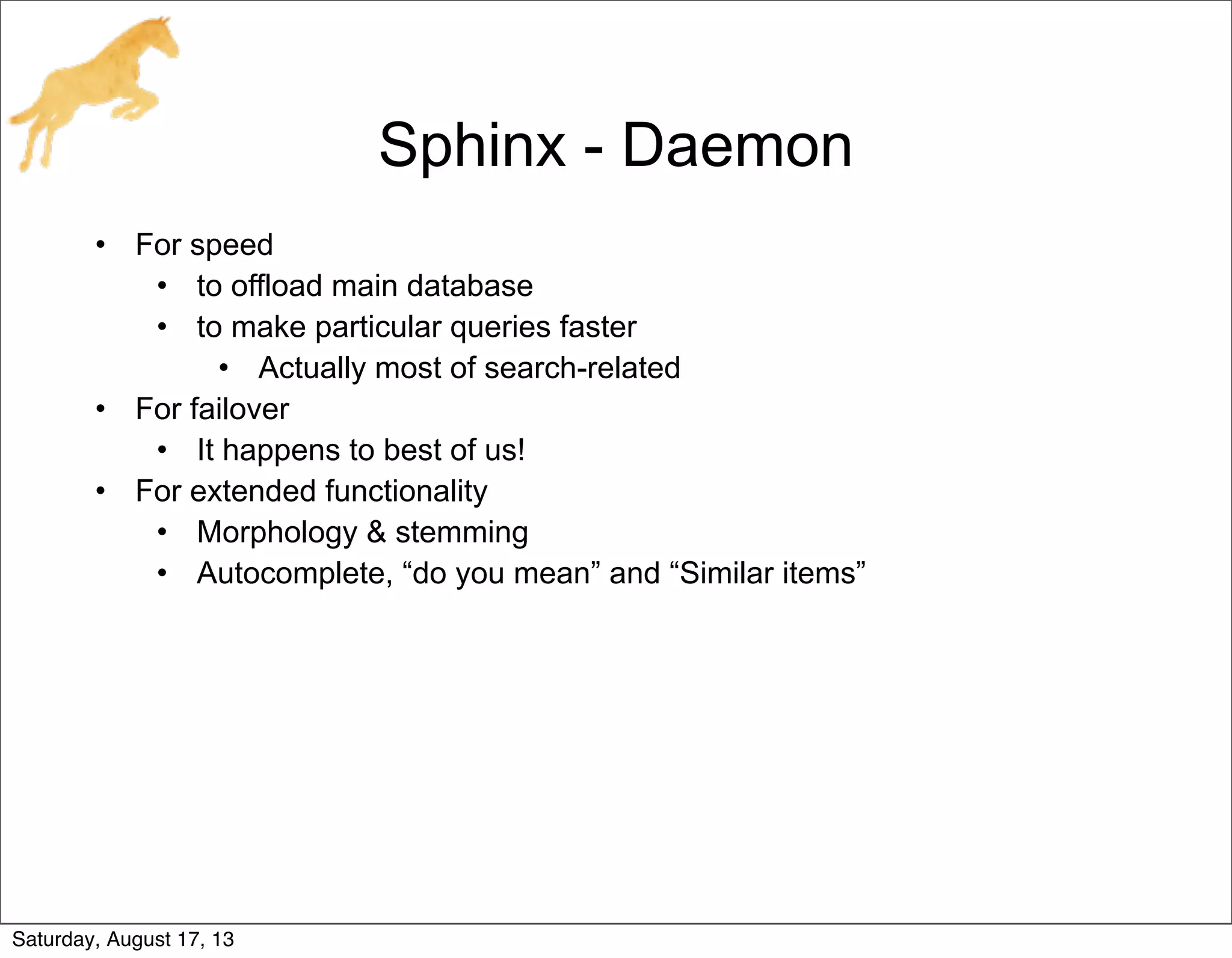
• For speed
• to offload main database
• to make particular queries faster
• Actually most of search-related
• For failover
• It happens to best of us!
• For extended functionality
• Morphology & stemming
• Autocomplete, “do you mean” and “Similar items”
Saturday, August 17, 13
SOLR/Lucene
Saturday, August 17, 13
Solr Features
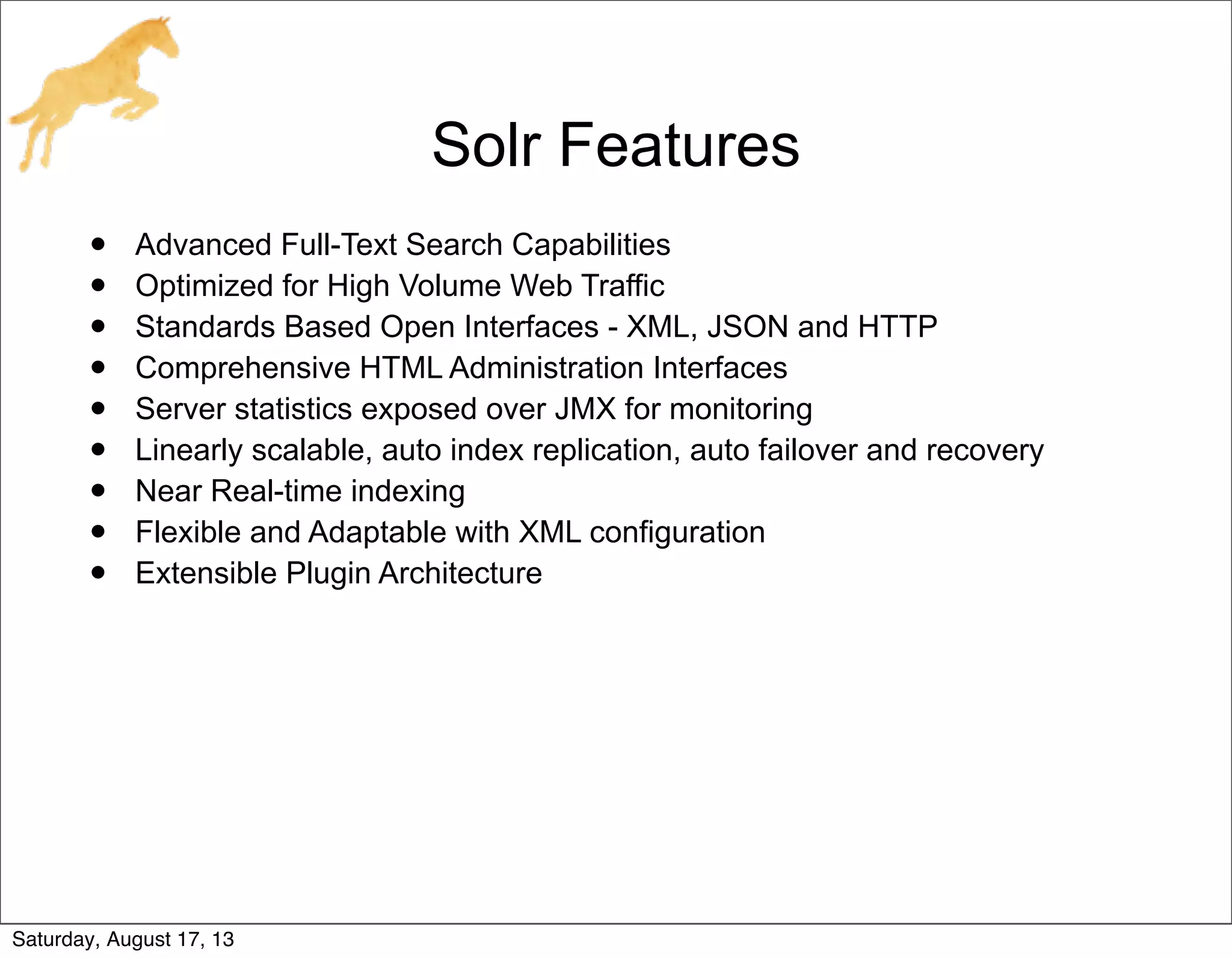
• Advanced Full-Text Search Capabilities
• Optimized for High Volume Web Traffic
• Standards Based Open Interfaces - XML, JSON and HTTP
• Comprehensive HTML Administration Interfaces
• Server statistics exposed over JMX for monitoring
• Linearly scalable, auto index replication, auto failover and recovery
• Near Real-time indexing
• Flexible and Adaptable with XML configuration
• Extensible Plugin Architecture
Saturday, August 17, 13
Solr
• http://lucene.apache.org/solr/features.html
• Solr uses Lucene Library
Saturday, August 17, 13
Thanks!
Contact us!
We are hiring!
emanuel@palominodb.com
Saturday, August 17, 13

Pgbr 2013 fts

  • 1.
    PostgreSQL FTS PGBR 2013 byEmanuel Calvo Saturday, August 17, 13
  • 2.
    Palomino - ServiceOfferings • Monthly Support: o Being renamed to Palomino DBA as a service. o Eliminating 10 hour monthly clients. o Discounts are based on spend per month (0-80, 81-160, 161+ o We will be penalizing excessive paging financially. o Quarterly onsite day from Palomino executive, DBA and PM for clients using 80 hours or more per month. o Clients using 80-160 hours get 2 New Relic licenses. 160 hours plus get 4. • Adding annual support contracts: o Consultation as needed. o Emergency pages allowed. o Small bucket of DBA hours (8, 16 or 24) For more information, please go to: Spreadsheet “Advanced Technology Partner” for Amazon Web Services Saturday, August 17, 13
  • 3.
    About me: • OperationalDBA at PalominoDB. • MySQL, Maria and PostgreSQL databases (and others) • Community member • Check out my LinkedIn Profile at: http://es.linkedin.com/in/ecbcbcb/ Saturday, August 17, 13
  • 4.
    Credits • Thanks to: oAndrew Atanasoff o Vlad Fedorkov o All the PalominoDB people that help out ! Saturday, August 17, 13
  • 5.
    Agenda • What weare looking for? • Concepts • Native Postgres Support o http://www.postgresql.org/docs/9.2/static/textsearch.html • External solutions o Sphinx  http://sphinxsearch.com/ o Solr  http://lucene.apache.org/solr/ Saturday, August 17, 13
  • 6.
    What are welooking for? • Finish the talk knowing what FTS is for. • Have an idea which are our tools. • Which of those tools are the best fit. Saturday, August 17, 13
  • 7.
    Goals of FTS •Add complex searches using synonyms, specific operators or spellings. o Improving performance sacrificing accuracy. • Reduce IO and CPU utilization. o Text consumes a lot of IO for read and CPU for operations. • FTS can be handled: o Externally  using tools like Sphinx or Solr  Ideal for massive text search, simple queries o Internally  native FTS support.  Ideal for complex queries combining with other business rules • Order words by relevance • Language sensitive • Faster than regular expressions or LIKE operands Saturday, August 17, 13
  • 8.
    The future ofnative FTS • https://wiki.postgresql.org/wiki/PGCon2013_Unconference_Future_of_Full- Text_Search • http://wiki.postgresql.org/images/2/25/Full- text_search_in_PostgreSQL_in_milliseconds-extended-version.pdf • 150 Kb patch for 9.3 • GIN/GIST interface improved Saturday, August 17, 13
  • 9.
    WHY FTS?? You maybe asking this now. Saturday, August 17, 13
  • 10.
    ... and theanswer is this reaction when I see a “LIKE ‘%pattern%’” Saturday, August 17, 13
  • 11.
    Concepts • Parsers o 23token types (url, email, file, etc) • Token • Stop word • Lexeme o array of lexemes + position + weight = tsvector • Dictionaries o Simple Dictionary  The simple dictionary template operates by converting the input token to lower case and checking it against a file of stop words. o Synonym Dictionary o Thesaurus Dictionary o Ispell Dictionary o Snowball Dictionary Saturday, August 17, 13
  • 12.
    Limitations • The lengthof each lexeme must be less than 2K bytes • The length of a tsvector (lexemes + positions) must be less than 1 megabyte • The number of lexemes must be less than 264 • Position values in tsvector must be greater than 0 and no more than 16,383 • No more than 256 positions per lexeme • The number of nodes (lexemes + operators) in a tsquery must be less than 32,768 • Those limits are hard to be reached! For comparison, the PostgreSQL 8.1 documentation contained 10,441 unique words, a total of 335,420 words, and the most frequent word “postgresql” was mentioned 6,127 times in 655 documents. Another example — the PostgreSQL mailing list archives contained 910,989 unique words with 57,491,343 lexemes in 461,020 messages. Saturday, August 17, 13
  • 13.
    Elements dF[+] [PATTERN] listtext search configurations dFd[+] [PATTERN] list text search dictionaries dFp[+] [PATTERN] list text search parsers dFt[+] [PATTERN] list text search templates full_text_search=# dFd+ * List of text search dictionaries Schema | Name | Template | Init options | Description ------------+-----------------+---------------------+---------------------------------------------------+----------------------------------------------------------- pg_catalog | danish_stem | pg_catalog.snowball | language = 'danish', stopwords = 'danish' | snowball stemmer for danish language pg_catalog | dutch_stem | pg_catalog.snowball | language = 'dutch', stopwords = 'dutch' | snowball stemmer for dutch language pg_catalog | english_stem | pg_catalog.snowball | language = 'english', stopwords = 'english' | snowball stemmer for english language pg_catalog | finnish_stem | pg_catalog.snowball | language = 'finnish', stopwords = 'finnish' | snowball stemmer for finnish language pg_catalog | french_stem | pg_catalog.snowball | language = 'french', stopwords = 'french' | snowball stemmer for french language pg_catalog | german_stem | pg_catalog.snowball | language = 'german', stopwords = 'german' | snowball stemmer for german language pg_catalog | hungarian_stem | pg_catalog.snowball | language = 'hungarian', stopwords = 'hungarian' | snowball stemmer for hungarian language pg_catalog | italian_stem | pg_catalog.snowball | language = 'italian', stopwords = 'italian' | snowball stemmer for italian language pg_catalog | norwegian_stem | pg_catalog.snowball | language = 'norwegian', stopwords = 'norwegian' | snowball stemmer for norwegian language pg_catalog | portuguese_stem | pg_catalog.snowball | language = 'portuguese', stopwords = 'portuguese' | snowball stemmer for portuguese language pg_catalog | romanian_stem | pg_catalog.snowball | language = 'romanian' | snowball stemmer for romanian language pg_catalog | russian_stem | pg_catalog.snowball | language = 'russian', stopwords = 'russian' | snowball stemmer for russian language pg_catalog | simple | pg_catalog.simple | | simple dictionary: just lower case and check for stopword pg_catalog | spanish_stem | pg_catalog.snowball | language = 'spanish', stopwords = 'spanish' | snowball stemmer for spanish language pg_catalog | swedish_stem | pg_catalog.snowball | language = 'swedish', stopwords = 'swedish' | snowball stemmer for swedish language pg_catalog | turkish_stem | pg_catalog.snowball | language = 'turkish', stopwords = 'turkish' | snowball stemmer for turkish language (16 rows) Saturday, August 17, 13
  • 14.
    Elements postgres=# dF List oftext search configurations Schema | Name | Description ------------+------------+--------------------------------------- pg_catalog | danish | configuration for danish language pg_catalog | dutch | configuration for dutch language pg_catalog | english | configuration for english language pg_catalog | finnish | configuration for finnish language pg_catalog | french | configuration for french language pg_catalog | german | configuration for german language pg_catalog | hungarian | configuration for hungarian language pg_catalog | italian | configuration for italian language pg_catalog | norwegian | configuration for norwegian language pg_catalog | portuguese | configuration for portuguese language pg_catalog | romanian | configuration for romanian language pg_catalog | russian | configuration for russian language pg_catalog | simple | simple configuration pg_catalog | spanish | configuration for spanish language pg_catalog | swedish | configuration for swedish language pg_catalog | turkish | configuration for turkish language (16 rows) Saturday, August 17, 13
  • 15.
    Elements List of datatypes Schema | Name | Description ------------+-----------+--------------------------------------------------------- pg_catalog | gtsvector | GiST index internal text representation for text search pg_catalog | tsquery | query representation for text search pg_catalog | tsvector | text representation for text search (3 rows) Some operators: • @@ (tsvector against tsquery) • || concatenate tsvectors (it reorganises lexemes and ranking) Saturday, August 17, 13
  • 16.
    Small Example full_text_search=# createtable basic_example (i serial PRIMARY KEY, whole text, fulled tsvector, dictionary regconfig); postgres=# CREATE TRIGGER tsvectorupdate BEFORE INSERT OR UPDATE ON basic_example FOR EACH ROW EXECUTE PROCEDURE tsvector_update_trigger(fulled, "pg_catalog.english", whole); CREATE TRIGGER postgres=# insert into basic_example(whole,dictionary) values ('This is an example','english'::regconfig); INSERT 0 1 full_text_search=# create index on basic_example(to_tsvector(dictionary,whole)); CREATE INDEX full_text_search=# create index on basic_example using GIST(to_tsvector(dictionary,whole)); CREATE INDEX postgres=# select * from basic_example; i | whole | fulled | dictionary ---+--------------------+------------+------------ 5 | This is an example | 'exampl':4 | english (1 row) Saturday, August 17, 13
  • 17.
    Pre processing • Documentsinto tokens  Find and clean • Tokens into lexemes o Token normalised to a language or dictionary o Eliminate stop words ( high frequently words) • Storing o Array of lexemes (tsvector)  the position of the word respect the presence of stop words, although they are not stored  Stores positional information for proximity info Saturday, August 17, 13
  • 18.
    Highlighting • ts_headline o itdoesn't use tsvector and needs to use the entire document, so could be expensive. • Only for certain type of queries or titles postgres=# SELECT ts_headline('english','Just a simple example of a highlighted query and similarity.',to_tsquery('query & similarity'),'StartSel = <, StopSel = >'); ts_headline ------------------------------------------------------------------ Just a simple example of a highlighted <query> and <similarity>. (1 row) Default: StartSel=<b>, StopSel=</b>, MaxWords=35, MinWords=15, ShortWord=3, HighlightAll=FALSE, MaxFragments=0, FragmentDelimiter=" ... " Saturday, August 17, 13
  • 19.
    Ranking • Weights: (AB C D) • Ranking functions: o ts_rank o ts_rank_cd • Ranking is expensive cause re process and check each tsvector. SELECT to_tsquery(’english’, ’Fat | Rats:AB’); to_tsquery ------------------ ’fat’ | ’rat’:AB Also, * can be attached to a lexeme to specify prefix matching: SELECT to_tsquery(’supern:*A & star:A*B’); to_tsquery -------------------------- ’supern’:*A & ’star’:*AB Saturday, August 17, 13
  • 20.
    Maniputaling tsvectors andtsquery • Manipulating tsvectors o setweight(vector tsvector, weight "char") returns tsvector o lenght (tsvector) : number of lexemes o strip (tsvector): returns tsvector without additional position as weight or position • Manipulating Queries • If you need a dynamic input for a query, parse it with numnode(tsquery), it will avoid unnecessary searches if contains a lot of stop words o numnode(plainto_tsquery(’a the is’)) o clean the queries using querytree also, is useful Saturday, August 17, 13
  • 21.
    Example postgres=# select *from ts_debug('english','The doctor saids I''m sick.'); alias | description | token | dictionaries | dictionary | lexemes -----------+-----------------+--------+----------------+--------------+---------- asciiword | Word, all ASCII | The | {english_stem} | english_stem | {} blank | Space symbols | | {} | | asciiword | Word, all ASCII | doctor | {english_stem} | english_stem | {doctor} blank | Space symbols | | {} | | asciiword | Word, all ASCII | saids | {english_stem} | english_stem | {said} blank | Space symbols | | {} | | asciiword | Word, all ASCII | I | {english_stem} | english_stem | {} blank | Space symbols | ' | {} | | asciiword | Word, all ASCII | m | {english_stem} | english_stem | {m} blank | Space symbols | | {} | | asciiword | Word, all ASCII | sick | {english_stem} | english_stem | {sick} blank | Space symbols | . | {} | | (12 rows) postgres=# select numnode(plainto_tsquery('The doctor saids I''m sick.')), plainto_tsquery('The doctor saids I''m sick.'), to_tsvector('english','The doctor saids I''m sick.'), ts_lexize('english_stem','The doctor saids I''m sick.'); numnode | plainto_tsquery | to_tsvector | ts_lexize ---------+----------------------------------+------------------------------------+-------------------------------- 7 | 'doctor' & 'said' & 'm' & 'sick' | 'doctor':2 'm':5 'said':3 'sick':6 | {"the doctor saids i'm sick."} (1 row) Saturday, August 17, 13
  • 22.
    Maniputaling tsquery postgres=# SELECTquerytree(to_tsquery('!defined')); querytree ----------- T (1 row) postgres=# SELECT querytree(to_tsquery('cat & food | (dog & run & food)')); querytree ----------------------------------------- 'cat' & 'food' | 'dog' & 'run' & 'food' (1 row) postgres=# SELECT querytree(to_tsquery('the ')); NOTICE: text-search query contains only stop words or doesn't contain lexemes, ignored querytree ----------- (1 row) Saturday, August 17, 13
  • 23.
    Automating updates ontsvector • Postgresql provide standard functions for this: o tsvector_update_trigger(tsvector_column_name, config_name, text_column_name [, ... ]) o tsvector_update_trigger_column(tsvector_column_name, config_column_name, text_column_name [, ... CREATE TABLE messages ( title text, body text, tsv tsvector ); CREATE TRIGGER tsvectorupdate BEFORE INSERT OR UPDATE ON messages FOR EACH ROW EXECUTE PROCEDURE tsvector_update_trigger(tsv, ’pg_catalog.english’, title, body); Saturday, August 17, 13
  • 24.
    Automating updates ontsvector (2) If you want to keep a custom weight: CREATE FUNCTION messages_trigger() RETURNS trigger AS $$ begin new.tsv := setweight(to_tsvector(’pg_catalog.english’, coalesce(new.title,”)), ’A’) || setweight(to_tsvector(’pg_catalog.english’, coalesce(new.body,”)), ’D’); return new; end $$ LANGUAGE plpgsql; CREATE TRIGGER tsvectorupdate BEFORE INSERT OR UPDATE ON messages FOR EACH ROW EXECUTE PROCEDURE messages_trigger(); Saturday, August 17, 13
  • 25.
    Tips and considerations •Store the text externally, index on the database o requires superuser • Store the whole document on the database, index on Sphinx/Solr • Don't index everything o Solr /Sphinx are not databases, just index only what you want to search. Smaller indexes are faster and easy to maintain. • ts_stats o can help you out to check your FTS configuration • You can parse URLS, mails and whatever using ts_debug function for nun intensive operations Saturday, August 17, 13
  • 26.
    Tips and considerations •You can index by language CREATE INDEX pgweb_idx_en ON pgweb USING gin(to_tsvector(’english’, body)) WHERE config_language = 'english'; CREATE INDEX pgweb_idx_fr ON pgweb USING gin(to_tsvector(’french’, body)) WHERE config_language = 'french'; CREATE INDEX pgweb_idx ON pgweb USING gin(to_tsvector(config_language, body)); CREATE INDEX pgweb_idx ON pgweb USING gin(to_tsvector(’english’, title || ’ ’ || body)); • Table partition using language is also a good practice Saturday, August 17, 13
  • 27.
    Features on 9.2 •Move tsvector most-common-element statistics to new pg_stats columns (Alexander Korotkov) • Consult most_common_elems and most_common_elem_freqs for the data formerly available in most_common_vals and most_common_freqs for a tsvector column. most_common_elems | {exampl} most_common_elem_freqs | {1,1,1} Saturday, August 17, 13
  • 28.
  • 29.
  • 30.
    Sphinx • Standalone daemonwritten on C++ • Highly scalable o Known installation consists 50+ Boxes, 20+ Billions of documents • Extended search for text and non-full-text data o Optimized for faceted search o Snippets generation based on language settings • Very fast o Keeps attributes in memory  See Percona benchmarks for details • Receiving data from PostgreSQL o Dedicated PostgreSQL datasource type. http://sphinxsearch.com Saturday, August 17, 13
  • 31.
    Key features- Sphinx •Scalability & failover • Extended FT language • Faceted search support • GEO-search support • Integration and pluggable architecture • Dedicated PostgreSQL source, UDF support • Morphology & stemming • Both batch & real-time indexing is available • Parallel snippets generation Saturday, August 17, 13
  • 32.
    Sphinx - Basic1 host architecture Postgres Application sphinx daemon/API listen = 9312 listen = 9306:mysql41 Indexes Query Result Additional Data Indexing ASYNC Saturday, August 17, 13
  • 33.
    What's new onSphinx • 1. added AOT (new morphology library, lemmatizer) support o Russian only for now; English coming soon; small 10-20% indexing impact; it's all about search quality (much much better "stemming") • 2. added JSON support o limited support (limited subset of JSON) for now; JSON sits in a column; you're able to do thing like WHERE jsoncol.key=123 or ORDER BY or GROUP BY • 3. added subselect syntax that reorders result sets, SELECT * FROM (SELECT ... ORDER BY cond1 LIMIT X) ORDER BY cond2 LIMIT Y • 4. added bigram indexing, and quicker phrase searching with bigrams (bigram_index, bigram_freq_words directives) o improves the worst cases for social mining • 5. added HA support, ha_strategy, agent_mirror directives • 6. added a few new geofunctions (POLY2D, GEOPOLY2D, CONTAINS) • 7. added GROUP_CONCAT() • 8. added OPTIMIZE INDEX rtindex, rt_merge_iops, rt_merge_maxiosize directives • 9. added TRUNCATE RTINDEX statement Saturday, August 17, 13
  • 34.
    Sphinx - Postgrescompilation [root@ip-10-55-83-238 ~]# yum install gcc-c++.noarch [root@ip-10-55-83-238 sphinx-2.0.6-release]# ./configure --prefix=/opt/sphinx -- without-mysql --with-pgsql-includes=$PGSQL_INCLUDE --with-pgsql-libs= $PGSQL_LIBS --with-pgsql [root@ip-10-55-83-238 sphinx]# /opt/pg/bin/psql -Upostgres -hmaster test < etc/example-pg.sql * Package is compiled with mysql libraries dependencies Saturday, August 17, 13
  • 35.
    Data source flow(from DBs) - Connection to the database is established - Pre-query, is executed to perform any necessary initial setup, such as setting per-connection encoding with MySQL; - main query is executed and the rows it returns are indexed; - Post-query is executed to perform any necessary cleanup; - connection to the database is closed; - indexer does the sorting phase (to be pedantic, index-type specific post- processing); - connection to the database is established again; - post-index query, is executed to perform any necessary final cleanup; - connection to the database is closed again. Saturday, August 17, 13
  • 36.
    Sphinx - Daemon •For speed • to offload main database • to make particular queries faster • Actually most of search-related • For failover • It happens to best of us! • For extended functionality • Morphology & stemming • Autocomplete, “do you mean” and “Similar items” Saturday, August 17, 13
  • 37.
  • 38.
    Solr Features • AdvancedFull-Text Search Capabilities • Optimized for High Volume Web Traffic • Standards Based Open Interfaces - XML, JSON and HTTP • Comprehensive HTML Administration Interfaces • Server statistics exposed over JMX for monitoring • Linearly scalable, auto index replication, auto failover and recovery • Near Real-time indexing • Flexible and Adaptable with XML configuration • Extensible Plugin Architecture Saturday, August 17, 13
  • 39.
    Solr • http://lucene.apache.org/solr/features.html • Solruses Lucene Library Saturday, August 17, 13
  • 40.
    Thanks! Contact us! We arehiring! emanuel@palominodb.com Saturday, August 17, 13