Patient Information
Resource
#PFICawareness #itchingforacure
Progressive Familial Intrahepatic
Cholestasis Advocacy and
Resource Network, Inc.
ADVOCACY&RESOURCENETWORK,INC.
Progressive Familial
Intrahepatic Cholestasis
(PFIC) is a general term
that represents a group
of rare genetic disorders
that cause a progressive
liver disease and can
lead to cirrhosis and
end-stage liver disease.
So what happens next?
PFIC
Diagnosis
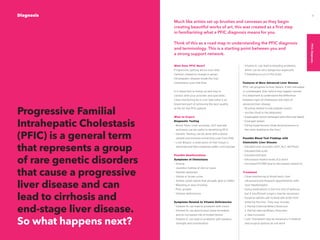
Much like artists set up brushes and canvases as they begin
creating beautiful works of art, this was created as a first step
in familiarizing what a PFIC diagnosis means for you.
Think of this as a road map in understanding the PFIC diagnosis
and terminology. This is a starting point between you and
a strong support network.
Diagnosis 1
What Does PFIC Mean?
Progressive: getting worse over time
Familial: related to change in genes
Intrahepatic: disease inside the liver
Cholestasis: poor bile flow
It is important to follow up and stay in
contact with your provider and specialist.
Close monitoring by a Liver Specialist is an
important part of achieving the best quality
of life for the PFIC patient.
What to Expect
Diagnostic Testing
–	Blood Tests: Liver enzymes, GGT and bile
	 acid tests can be useful in identifying PFIC
–	Genetic Testing: can be done with a blood 	
	 sample and involves extracting code from DNA
–	Liver Biopsy: a small piece of liver tissue is 	
	 extracted and then examined under a microscope
Possible Manifestations
Symptoms of Cholestasis
–	Itching
–	Jaundice (yellow of skin or eyes)
–	Swollen abdomen
–	Yellow or brown urine
–	Acholic stools (stools that are pale, grey or white)
–	Bleeding or easy bruising
–	Poor growth
–	Vitamin deficiencies
Symptoms Related to Vitamin Deficiencies:
– Vitamin A: can lead to problems with vision
– Vitamin D: can lead to poor bone formation
	 and an increased risk of broken bones
– Vitamin E: can lead to problems with balance,
	 strength and coordination
– Vitamin K: can lead to bleeding problems,
	 which can be very dangerous especially	
	 if bleeding occurs in the brain
Features of More Advanced Liver Disease
PFIC can progress to liver failure. If left untreated
or unmanaged, liver failure may happen sooner.
It is important to understand the difference
between signs of cholestasis and signs of
advanced liver disease.
–	Bruising related to low platelet counts
–	Ascites (fluid in the abdomen)
–	Esophageal varices (enlarged veins that may bleed)
–	Enlarged spleen
–	Portal hypertension (high blood pressure in
	 the veins leading to the liver)
Possible Blood Test Findings with
Cholestatic Liver Disease
–	Elevated liver enzymes (AST, ALT, Alk Phos)	
–	Elevated bile acids
–	Elevated bilirubin
–	Decreased vitamin levels A,D and E
–	Increased PT/INR (due to decreased vitamin K)
Treatment
–	Close monitoring of blood tests, liver
	 ultrasound and frequent appointments with
	 your hepatologists
–	Using medications is the first line of defense, 	
	 but if insufficient surgery may be necessary
–	Surgical options aim to keep bile acids from
	 entering the liver. They may include:
	 »	 Partial External Biliary Diversion
	 »	 Partial Internal Biliary Diversion
	 »	 Ileal Exclusion
–	Liver Transplant may be necessary if medical
	 and surgical options do not work
PFIC
Subtypes
3
Common Name
PFIC 1
PFIC 2
PFIC 3
Mutated Gene
ATP8B1
ABCB11
ABCB4
Pruritus (itch)
Intense
Intense
Mild to moderate
Other Potential Manifestations
• Extrahepatic Symptoms
• Diarrhea
• May have pancreatitis
• May have cough, wheezing
• May have hearing loss
• Potential for developing
	 heptocellular carcinoma
	 and cholangiocarcinoma
	 (liver cancer)
• Gallstones
• Reduced bone density
• Potential for developing hepato-
	 cellular carcinoma and cholan-
	 giocarcinoma (liver cancer)
• Gallstones
Protein Deficiency
FIC1
BSEP
MDR3
GGT Cholestasis
Normal GGT
Cholestasis
Normal GGT
Cholestasis
Elevated GGT
Cholestasis
PFIC
Subtypes
Understanding PFIC
Potential Clinical Outcomes, Treatment
and Complications of Treatment
• Moderate rate of progression
• Can lead to cirrhosis and end stage
	 liver disease typically in the second
	 or third decade of life
• Post-transplant hepatic steatosis
	 (fatty change) and diarrhea
• Extrahepatic symptoms can worsen and
	 new ones can develop after liver transplant
• BRIC presentations have been recorded*
• Moderate to rapid progression
• Success of surgical biliary diversion may
	 depend on the specific genetic defects
• Liver transplant in PFIC 2 patients may lead 	
	 to antibody induced BSEP deficiency in some
• Potential for retransplant
• BRIC presentations have been recorded*
• Highly variable rate of progression
• Medical management: those retaining MDR3 	
	 expression respond better to ursodiol
• Biliary diversion may not be as effective
	 as in other forms of disease
• Liver transplant is curative
• BRIC presentations have been recorded*
2
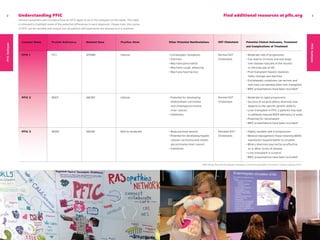
General symptoms and considerations for PFIC apply to all of the subtypes on this table. This table
is intended to highlight some of the potential differences in each diagnosis. Please note, the course
of PFIC can be variable and unique, not all patients will experience the disease as it is outlined.
*(BRIC) Benign Recurrent Intrahepatic Cholestasis is a transient presentation of a known or unknown subtype of PFIC.
Find additional resources at pfic.org
New genes have been identified.
Some of these new genes do not appear on this version of the table, namely LSR and PLECTIN.
I’ve been diagnosed with PFIC, but they can’t tell me what type? Genetic studies are underway
to try to identify genetic factors contributing to PFIC when mutations are not found in any of the below
listed genes. Identifications of these genes is very complicated and require state-of-the-art genetic
investigations. Doctors and scientists are working on finding more answers for these patients.
Common Name
PFIC 4
PFIC 5
PFIC
Associated with
MYO5B defects
PFIC
Subtypes
PFIC
Subtypes
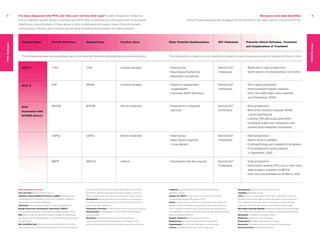
The following subtypes are exceedingly rare in the reported literature (although being recognized more). This information is based on only a handful of patients in each group and should be viewed with that in mind.
5
4
PFIC Definition of Terms
ALT and AST: Markers of liver injury.
Antibody Induced BSEP Deficiency (AIBD): cholestasis that
can develop after transplant in some PFIC 2 patients related to
the development of BSEP antibodies.
Autosome: Any chromosome that is not a sex chromosome.
Benign Recurrent Intrahepatic Cholestasis (BRIC):
Is a transient presentation of a known or unknown subtype of PFIC.
Bile: Bile is a yellow fluid that contains a number of compounds
including bile acids, phospholipids, cholesterol and waste products
from the body.
Bile Acid/Bile Salt: Bile acids are chemicals made by the liver
from cholesterol. In a healthy individual bile acids are transported
Familial: Originally described in families and related to
changes in genes.
Gamma GT (GGT): A type of liver enzyme which may help
to distinguish between the types of PFIC.
Genes: Genes are short parts of a chromosome that contain the
genetic code for heritable characteristics. Some characteristics
such as height are influenced by many genes, and some just by
one single gene. Humans have two copies for most genes including
those associated with PFIC.
Hepatic Steatosis: Fatty change in the liver.
Hepatocytes: Liver cells, responsible for making bile.
Hepatologist: A doctor who specializes in liver disease.
Icterus: Yellowing of the skin, mouth, tongue, etc.
from the liver to the intestines where they help to absorb fats,
fat soluble vitamins and other fat-soluble nutrients. They are
then circulated back to the liver such that they can be reused.
Cholestasis: Means poor bile flow and build-up of substances
in the liver that would normally be carried out of the liver into
bile and then the intestines.
Cholestatic Pruritus: Is the sensation of itch due to liver disease.
Chromosome: Chromosomes are large molecules that mainly
consist of DNA.
Dominant: Dominant disorders are a single defective
copy of a gene that can lead to disease. The impact of that
defective copy is dominant over the other copy which is healthy.
Intrahepatic: Involves disease inside the liver.
Jaundice: Yellowing of skin.
Liver: The Liver is the largest solid organ in the body. It plays an
essential role in many different body functions, such as removing
toxic substances from the blood, or producing proteins and bio-
chemicals (bile) that are necessary for digestion and growth.
Microvillus Inclusion Disease: A disease caused by structural changes
in the small bowel usually, but not always, causing severe diarrhea.
Mutations: A change in the genetic code.
Offspring: A person’s child or children.
Progressive: Tending to get worse over time.
Recessive: Two abnormal copies of a gene to have disease.
Scleral Incterus: Yellowing of the eyes.
Mutated Gene
TJP2
NR1H4
MYO5B
USP53
ABCC12
Pruritus (itch)
Unclear/variable
Unclear/variable
Mild to moderate
Mild to moderate
Intense
Other Potential Manifestations
• Hearing loss
• Neurological Symptoms
• Respiratory Symptoms
• Vitamin K independent
	 coagulopathy
• Can mimic BSEP deficiency
• Potential for congenital 	
	 diarrhea
• Hearing loss
• Heart failure reported
	 in one patient
• Intrahepatic bile duct paucity
Protein Deficiency
TJP2
FXR
MYO5B
USP53
MRP9
GGT Cholestasis
Normal GGT
Cholestasis
Normal GGT
Cholestasis
Normal GGT
Cholestasis
Normal GGT
Cholestasis
Normal GGT
Cholestasis
Potential clinical Outcomes, Treatment
and Complications of Treatment
• Moderate to rapid progression
• Some reports of hepatocellular carcinoma
• Very rapid progression
• Post-transplant hepatic steatosis
• Very rare (Only eight cases reported
	 as of December, 2020).
• Slow progression
• MicroVillus Inclusion Disease (MVID)
	 can be experienced
• Lifelong TPN with associated MVID
• Combined bowel liver transplants may
	 prevent post transplant cholestasis
• Slow progression
• Age of onset is variable
• Continued follow-up is needed for all patients
• First published in seven patients,
	 in September, 2020
• Slow progression
• Uncertainty whether PFIC occurs with (one) 	
	 heterozygous mutation in ABCC12
• Only one case published as of March, 2021
#PFICawareness
#itchingforacure
pfic.org

PFIC Patient Resource Information

  • 1.
    Patient Information Resource #PFICawareness #itchingforacure ProgressiveFamilial Intrahepatic Cholestasis Advocacy and Resource Network, Inc. ADVOCACY&RESOURCENETWORK,INC.
  • 2.
    Progressive Familial Intrahepatic Cholestasis (PFIC)is a general term that represents a group of rare genetic disorders that cause a progressive liver disease and can lead to cirrhosis and end-stage liver disease. So what happens next? PFIC Diagnosis Much like artists set up brushes and canvases as they begin creating beautiful works of art, this was created as a first step in familiarizing what a PFIC diagnosis means for you. Think of this as a road map in understanding the PFIC diagnosis and terminology. This is a starting point between you and a strong support network. Diagnosis 1 What Does PFIC Mean? Progressive: getting worse over time Familial: related to change in genes Intrahepatic: disease inside the liver Cholestasis: poor bile flow It is important to follow up and stay in contact with your provider and specialist. Close monitoring by a Liver Specialist is an important part of achieving the best quality of life for the PFIC patient. What to Expect Diagnostic Testing – Blood Tests: Liver enzymes, GGT and bile acid tests can be useful in identifying PFIC – Genetic Testing: can be done with a blood sample and involves extracting code from DNA – Liver Biopsy: a small piece of liver tissue is extracted and then examined under a microscope Possible Manifestations Symptoms of Cholestasis – Itching – Jaundice (yellow of skin or eyes) – Swollen abdomen – Yellow or brown urine – Acholic stools (stools that are pale, grey or white) – Bleeding or easy bruising – Poor growth – Vitamin deficiencies Symptoms Related to Vitamin Deficiencies: – Vitamin A: can lead to problems with vision – Vitamin D: can lead to poor bone formation and an increased risk of broken bones – Vitamin E: can lead to problems with balance, strength and coordination – Vitamin K: can lead to bleeding problems, which can be very dangerous especially if bleeding occurs in the brain Features of More Advanced Liver Disease PFIC can progress to liver failure. If left untreated or unmanaged, liver failure may happen sooner. It is important to understand the difference between signs of cholestasis and signs of advanced liver disease. – Bruising related to low platelet counts – Ascites (fluid in the abdomen) – Esophageal varices (enlarged veins that may bleed) – Enlarged spleen – Portal hypertension (high blood pressure in the veins leading to the liver) Possible Blood Test Findings with Cholestatic Liver Disease – Elevated liver enzymes (AST, ALT, Alk Phos) – Elevated bile acids – Elevated bilirubin – Decreased vitamin levels A,D and E – Increased PT/INR (due to decreased vitamin K) Treatment – Close monitoring of blood tests, liver ultrasound and frequent appointments with your hepatologists – Using medications is the first line of defense, but if insufficient surgery may be necessary – Surgical options aim to keep bile acids from entering the liver. They may include: » Partial External Biliary Diversion » Partial Internal Biliary Diversion » Ileal Exclusion – Liver Transplant may be necessary if medical and surgical options do not work
  • 3.
    PFIC Subtypes 3 Common Name PFIC 1 PFIC2 PFIC 3 Mutated Gene ATP8B1 ABCB11 ABCB4 Pruritus (itch) Intense Intense Mild to moderate Other Potential Manifestations • Extrahepatic Symptoms • Diarrhea • May have pancreatitis • May have cough, wheezing • May have hearing loss • Potential for developing heptocellular carcinoma and cholangiocarcinoma (liver cancer) • Gallstones • Reduced bone density • Potential for developing hepato- cellular carcinoma and cholan- giocarcinoma (liver cancer) • Gallstones Protein Deficiency FIC1 BSEP MDR3 GGT Cholestasis Normal GGT Cholestasis Normal GGT Cholestasis Elevated GGT Cholestasis PFIC Subtypes Understanding PFIC Potential Clinical Outcomes, Treatment and Complications of Treatment • Moderate rate of progression • Can lead to cirrhosis and end stage liver disease typically in the second or third decade of life • Post-transplant hepatic steatosis (fatty change) and diarrhea • Extrahepatic symptoms can worsen and new ones can develop after liver transplant • BRIC presentations have been recorded* • Moderate to rapid progression • Success of surgical biliary diversion may depend on the specific genetic defects • Liver transplant in PFIC 2 patients may lead to antibody induced BSEP deficiency in some • Potential for retransplant • BRIC presentations have been recorded* • Highly variable rate of progression • Medical management: those retaining MDR3 expression respond better to ursodiol • Biliary diversion may not be as effective as in other forms of disease • Liver transplant is curative • BRIC presentations have been recorded* 2 General symptoms and considerations for PFIC apply to all of the subtypes on this table. This table is intended to highlight some of the potential differences in each diagnosis. Please note, the course of PFIC can be variable and unique, not all patients will experience the disease as it is outlined. *(BRIC) Benign Recurrent Intrahepatic Cholestasis is a transient presentation of a known or unknown subtype of PFIC. Find additional resources at pfic.org
  • 4.
    New genes havebeen identified. Some of these new genes do not appear on this version of the table, namely LSR and PLECTIN. I’ve been diagnosed with PFIC, but they can’t tell me what type? Genetic studies are underway to try to identify genetic factors contributing to PFIC when mutations are not found in any of the below listed genes. Identifications of these genes is very complicated and require state-of-the-art genetic investigations. Doctors and scientists are working on finding more answers for these patients. Common Name PFIC 4 PFIC 5 PFIC Associated with MYO5B defects PFIC Subtypes PFIC Subtypes The following subtypes are exceedingly rare in the reported literature (although being recognized more). This information is based on only a handful of patients in each group and should be viewed with that in mind. 5 4 PFIC Definition of Terms ALT and AST: Markers of liver injury. Antibody Induced BSEP Deficiency (AIBD): cholestasis that can develop after transplant in some PFIC 2 patients related to the development of BSEP antibodies. Autosome: Any chromosome that is not a sex chromosome. Benign Recurrent Intrahepatic Cholestasis (BRIC): Is a transient presentation of a known or unknown subtype of PFIC. Bile: Bile is a yellow fluid that contains a number of compounds including bile acids, phospholipids, cholesterol and waste products from the body. Bile Acid/Bile Salt: Bile acids are chemicals made by the liver from cholesterol. In a healthy individual bile acids are transported Familial: Originally described in families and related to changes in genes. Gamma GT (GGT): A type of liver enzyme which may help to distinguish between the types of PFIC. Genes: Genes are short parts of a chromosome that contain the genetic code for heritable characteristics. Some characteristics such as height are influenced by many genes, and some just by one single gene. Humans have two copies for most genes including those associated with PFIC. Hepatic Steatosis: Fatty change in the liver. Hepatocytes: Liver cells, responsible for making bile. Hepatologist: A doctor who specializes in liver disease. Icterus: Yellowing of the skin, mouth, tongue, etc. from the liver to the intestines where they help to absorb fats, fat soluble vitamins and other fat-soluble nutrients. They are then circulated back to the liver such that they can be reused. Cholestasis: Means poor bile flow and build-up of substances in the liver that would normally be carried out of the liver into bile and then the intestines. Cholestatic Pruritus: Is the sensation of itch due to liver disease. Chromosome: Chromosomes are large molecules that mainly consist of DNA. Dominant: Dominant disorders are a single defective copy of a gene that can lead to disease. The impact of that defective copy is dominant over the other copy which is healthy. Intrahepatic: Involves disease inside the liver. Jaundice: Yellowing of skin. Liver: The Liver is the largest solid organ in the body. It plays an essential role in many different body functions, such as removing toxic substances from the blood, or producing proteins and bio- chemicals (bile) that are necessary for digestion and growth. Microvillus Inclusion Disease: A disease caused by structural changes in the small bowel usually, but not always, causing severe diarrhea. Mutations: A change in the genetic code. Offspring: A person’s child or children. Progressive: Tending to get worse over time. Recessive: Two abnormal copies of a gene to have disease. Scleral Incterus: Yellowing of the eyes. Mutated Gene TJP2 NR1H4 MYO5B USP53 ABCC12 Pruritus (itch) Unclear/variable Unclear/variable Mild to moderate Mild to moderate Intense Other Potential Manifestations • Hearing loss • Neurological Symptoms • Respiratory Symptoms • Vitamin K independent coagulopathy • Can mimic BSEP deficiency • Potential for congenital diarrhea • Hearing loss • Heart failure reported in one patient • Intrahepatic bile duct paucity Protein Deficiency TJP2 FXR MYO5B USP53 MRP9 GGT Cholestasis Normal GGT Cholestasis Normal GGT Cholestasis Normal GGT Cholestasis Normal GGT Cholestasis Normal GGT Cholestasis Potential clinical Outcomes, Treatment and Complications of Treatment • Moderate to rapid progression • Some reports of hepatocellular carcinoma • Very rapid progression • Post-transplant hepatic steatosis • Very rare (Only eight cases reported as of December, 2020). • Slow progression • MicroVillus Inclusion Disease (MVID) can be experienced • Lifelong TPN with associated MVID • Combined bowel liver transplants may prevent post transplant cholestasis • Slow progression • Age of onset is variable • Continued follow-up is needed for all patients • First published in seven patients, in September, 2020 • Slow progression • Uncertainty whether PFIC occurs with (one) heterozygous mutation in ABCC12 • Only one case published as of March, 2021
  • 5.