Page 1 © 500 Words Ltd, 2014
PESTLE Analysis for Construction Projects
BUILD™ is a framework to ensure you act in the best interests of your clients. The key purpose of
analysing the context for the project is to get all relevant information to help you agree an
appropriate strategy for protecting those interests.
Overview
This analysis should relate to the whole life-cycle of the project. For further information see the
business balls website. This checklist is used in the Briefing stage of BUILD™.
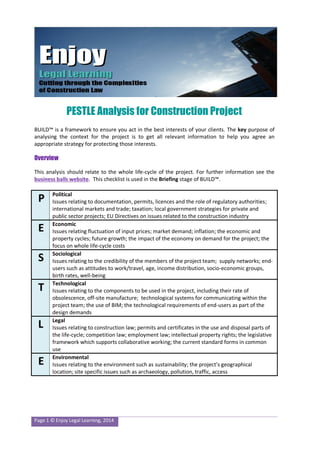
P Political
Issues relating to documentation, permits, licences and the role of regulatory authorities;
international markets and trade; taxation; local government strategies for private and
public sector projects; EU Directives on issues related to the construction industry
E Economic
Issues relating fluctuation of input prices; market demand; inflation; the economic and
property cycles; future growth; the impact of the economy on demand for the project; the
focus on whole life-cycle costs
S Sociological
Issues relating to the credibility of the members of the project team; supply networks; end-
users such as attitudes to work/travel, age, income distribution, socio-economic groups,
birth rates, well-being
T Technological
Issues relating to the components to be used in the project, including their rate of
obsolescence, off-site manufacture; technological systems for communicating within the
project team; the use of BIM; the technological requirements of end-users as part of the
design demands
L Legal
Issues relating to construction law; permits and certificates in the use and disposal parts of
the life-cycle; competition law; employment law; intellectual property rights; the legislative
framework which supports collaborative working; the current standard forms in common
use
E Environmental
Issues relating to the environment such as sustainability; the project’s geographical
location; site specific issues such as archaeology, pollution, traffic, access
Page 2 © 500 Words Ltd, 2014
Objectives
The objectives of this stage in the process, with which this analysis is intended to assist, are:
 to act in your client’s best interests;
 to obtain the right information at the right time;
 to clarify your client’s perspective(s) and criteria for success;
 to ensure consistent information across the project team;
 to focus on what’s critical for your client.
Author
Sarah Fox of 500 Words Ltd developed this checklist. She is a speaker and trainer who helps you
write simpler contracts and understand complex ones. She is also author of the 500-Word
Contract™. To find out how Sarah can help you, send her an email sarah@500words.co.uk or her
mobile: 07767 342747.
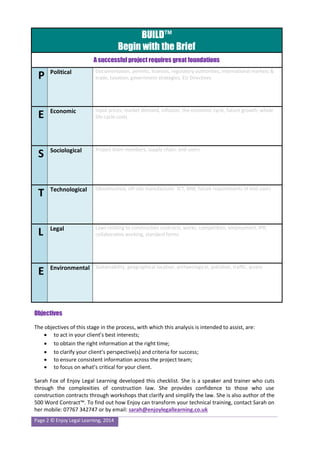
BUILD™
Begin with the Brief
A successful project requires great foundations
P Political Documentation, permits, licences, regulatory authorities, international markets &
trade, taxation, government strategies, EU Directives
E Economic Input prices, market demand, inflation, the economic cycle, future growth; whole
life-cycle costs
S Sociological Project team members, supply chain; end-users
T Technological Obsolescence, off-site manufacture; ICT, BIM, future requirements of end-users
L Legal Laws relating to construction contracts, works, competition, employment, IPR,
collaborative working, standard forms
E Environmental Sustainability, geographical location, archaeological, pollution, traffic, access

PESTLE Context Checklist for Construction Project

  • 1.
    Page 1 ©500 Words Ltd, 2014 PESTLE Analysis for Construction Projects BUILD™ is a framework to ensure you act in the best interests of your clients. The key purpose of analysing the context for the project is to get all relevant information to help you agree an appropriate strategy for protecting those interests. Overview This analysis should relate to the whole life-cycle of the project. For further information see the business balls website. This checklist is used in the Briefing stage of BUILD™. P Political Issues relating to documentation, permits, licences and the role of regulatory authorities; international markets and trade; taxation; local government strategies for private and public sector projects; EU Directives on issues related to the construction industry E Economic Issues relating fluctuation of input prices; market demand; inflation; the economic and property cycles; future growth; the impact of the economy on demand for the project; the focus on whole life-cycle costs S Sociological Issues relating to the credibility of the members of the project team; supply networks; end- users such as attitudes to work/travel, age, income distribution, socio-economic groups, birth rates, well-being T Technological Issues relating to the components to be used in the project, including their rate of obsolescence, off-site manufacture; technological systems for communicating within the project team; the use of BIM; the technological requirements of end-users as part of the design demands L Legal Issues relating to construction law; permits and certificates in the use and disposal parts of the life-cycle; competition law; employment law; intellectual property rights; the legislative framework which supports collaborative working; the current standard forms in common use E Environmental Issues relating to the environment such as sustainability; the project’s geographical location; site specific issues such as archaeology, pollution, traffic, access
  • 2.
    Page 2 ©500 Words Ltd, 2014 Objectives The objectives of this stage in the process, with which this analysis is intended to assist, are:  to act in your client’s best interests;  to obtain the right information at the right time;  to clarify your client’s perspective(s) and criteria for success;  to ensure consistent information across the project team;  to focus on what’s critical for your client. Author Sarah Fox of 500 Words Ltd developed this checklist. She is a speaker and trainer who helps you write simpler contracts and understand complex ones. She is also author of the 500-Word Contract™. To find out how Sarah can help you, send her an email sarah@500words.co.uk or her mobile: 07767 342747. BUILD™ Begin with the Brief A successful project requires great foundations P Political Documentation, permits, licences, regulatory authorities, international markets & trade, taxation, government strategies, EU Directives E Economic Input prices, market demand, inflation, the economic cycle, future growth; whole life-cycle costs S Sociological Project team members, supply chain; end-users T Technological Obsolescence, off-site manufacture; ICT, BIM, future requirements of end-users L Legal Laws relating to construction contracts, works, competition, employment, IPR, collaborative working, standard forms E Environmental Sustainability, geographical location, archaeological, pollution, traffic, access