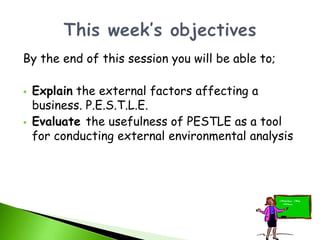
By the end of this session you will be able to;
 Explain the external factors affecting a
business. P.E.S.T.L.E.
 Evaluate the usefulness of PESTLE as a tool
for conducting external environmental analysis
Business does not operate in a vacuum.
It has to act and react to what happens outside
the factory and office walls.
These factors that happen outside the business
are known as external factors or influences.
These will affect
 the main internal functions of the business,
 the objectives of the business and
 The firm’s strategies
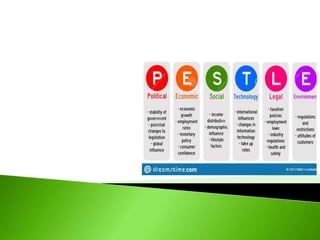
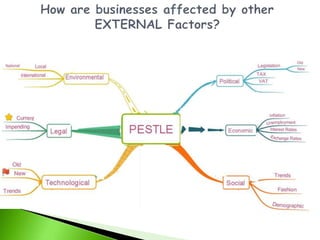
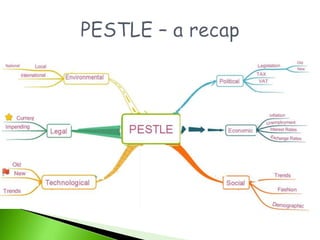
 Political – how changes in government policy
might affect the business e.g. a decision to
subsidise building new houses in an area could be
good for a local brick works.
 Can you think of some government polices that
could impact your selected business?
5 minutes on political risk
 Economic – how the economy affects a business in terms
of taxation, government spending, general
demand,inflation, interest rates, exchange rates and
European and global economic factors.
 Can you think of some specific economic considerations that could
impact your selected business?
 Social – how consumers, households and communities
behave and their beliefs. For instance, changes in attitude
towards health, or a greater number of pensioners in a
population.
Can you think of some specific socio-cultural
considerations that could impact your selected
business?
 Technological – how the rapid pace of change in
production processes and product innovation
affect a business.
 Legal – the way in which legislation in society
affects the business. E.g. changes in employment
laws on wages.
US court signs off on BP’s $20bn oil
spill settlement
Thames Water is fined a record £20MILLION after
1.4billion litres of polluted sewage Fish and birds died
over two-year period due to 'out of control' sewage
The largest fine in the firm's history was delivered at
Aylesbury Crown Court
The more factors you consider for
analysis, the better the results you can
achieve from your strategy.
By the end of this session you will be able to;
 Explain the external factors affecting a
business. P.E.S.T.L.E.
 Evaluate the usefulness of PESTLE as a tool
for conducting external environmental analysis
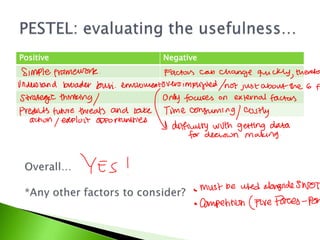
Positive Negative
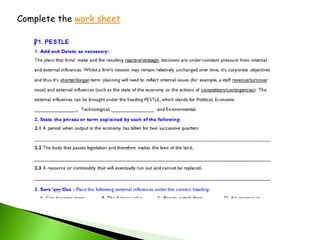
Complete the work sheet
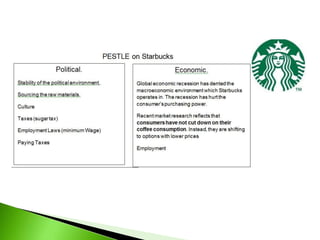
PESTLE ANALYSIS
STARBUCKS
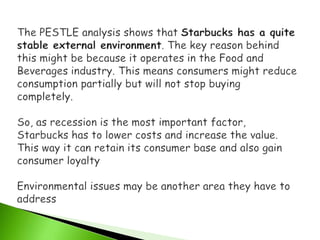
What should Starbucks strategy be?
Set Priorities
Short Term vs Long Term
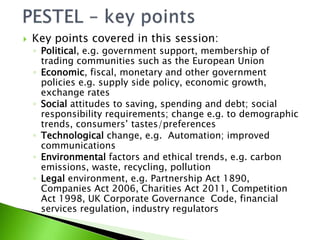
 Key points covered in this session:
◦ Political, e.g. government support, membership of
trading communities such as the European Union
◦ Economic, fiscal, monetary and other government
policies e.g. supply side policy, economic growth,
exchange rates
◦ Social attitudes to saving, spending and debt; social
responsibility requirements; change e.g. to demographic
trends, consumers’ tastes/preferences
◦ Technological change, e.g. Automation; improved
communications
◦ Environmental factors and ethical trends, e.g. carbon
emissions, waste, recycling, pollution
◦ Legal environment, e.g. Partnership Act 1890,
Companies Act 2006, Charities Act 2011, Competition
Act 1998, UK Corporate Governance Code, financial
services regulation, industry regulators
Are you able to;
 Explain the external factors affecting a
business. P.E.S.T.L.E.
 Evaluate the usefulness of PESTLE as a tool
for conducting external environmental analysis

PESTEL analysis - define, explain, give examples, evaluate - PPT

  • 2.
    By the endof this session you will be able to;  Explain the external factors affecting a business. P.E.S.T.L.E.  Evaluate the usefulness of PESTLE as a tool for conducting external environmental analysis
  • 3.
    Business does notoperate in a vacuum. It has to act and react to what happens outside the factory and office walls. These factors that happen outside the business are known as external factors or influences. These will affect  the main internal functions of the business,  the objectives of the business and  The firm’s strategies
  • 5.
     Political –how changes in government policy might affect the business e.g. a decision to subsidise building new houses in an area could be good for a local brick works.  Can you think of some government polices that could impact your selected business?
  • 6.
    5 minutes onpolitical risk
  • 7.
     Economic –how the economy affects a business in terms of taxation, government spending, general demand,inflation, interest rates, exchange rates and European and global economic factors.  Can you think of some specific economic considerations that could impact your selected business?
  • 8.
     Social –how consumers, households and communities behave and their beliefs. For instance, changes in attitude towards health, or a greater number of pensioners in a population. Can you think of some specific socio-cultural considerations that could impact your selected business?
  • 9.
     Technological –how the rapid pace of change in production processes and product innovation affect a business.
  • 10.
     Legal –the way in which legislation in society affects the business. E.g. changes in employment laws on wages.
  • 11.
    US court signsoff on BP’s $20bn oil spill settlement Thames Water is fined a record £20MILLION after 1.4billion litres of polluted sewage Fish and birds died over two-year period due to 'out of control' sewage The largest fine in the firm's history was delivered at Aylesbury Crown Court
  • 12.
    The more factorsyou consider for analysis, the better the results you can achieve from your strategy.
  • 13.
    By the endof this session you will be able to;  Explain the external factors affecting a business. P.E.S.T.L.E.  Evaluate the usefulness of PESTLE as a tool for conducting external environmental analysis
  • 15.
  • 16.
  • 17.
  • 20.
    What should Starbucksstrategy be? Set Priorities Short Term vs Long Term
  • 22.
     Key pointscovered in this session: ◦ Political, e.g. government support, membership of trading communities such as the European Union ◦ Economic, fiscal, monetary and other government policies e.g. supply side policy, economic growth, exchange rates ◦ Social attitudes to saving, spending and debt; social responsibility requirements; change e.g. to demographic trends, consumers’ tastes/preferences ◦ Technological change, e.g. Automation; improved communications ◦ Environmental factors and ethical trends, e.g. carbon emissions, waste, recycling, pollution ◦ Legal environment, e.g. Partnership Act 1890, Companies Act 2006, Charities Act 2011, Competition Act 1998, UK Corporate Governance Code, financial services regulation, industry regulators
  • 23.
    Are you ableto;  Explain the external factors affecting a business. P.E.S.T.L.E.  Evaluate the usefulness of PESTLE as a tool for conducting external environmental analysis

Editor's Notes

  • #19 Go through the PESTLE on the hand out Get the students to add to /delete the ideas, then what should be the strategy?