Topic 1.1.1: Healthy, active lifestyles and how they could benefit you Benefits of taking part in physical activity
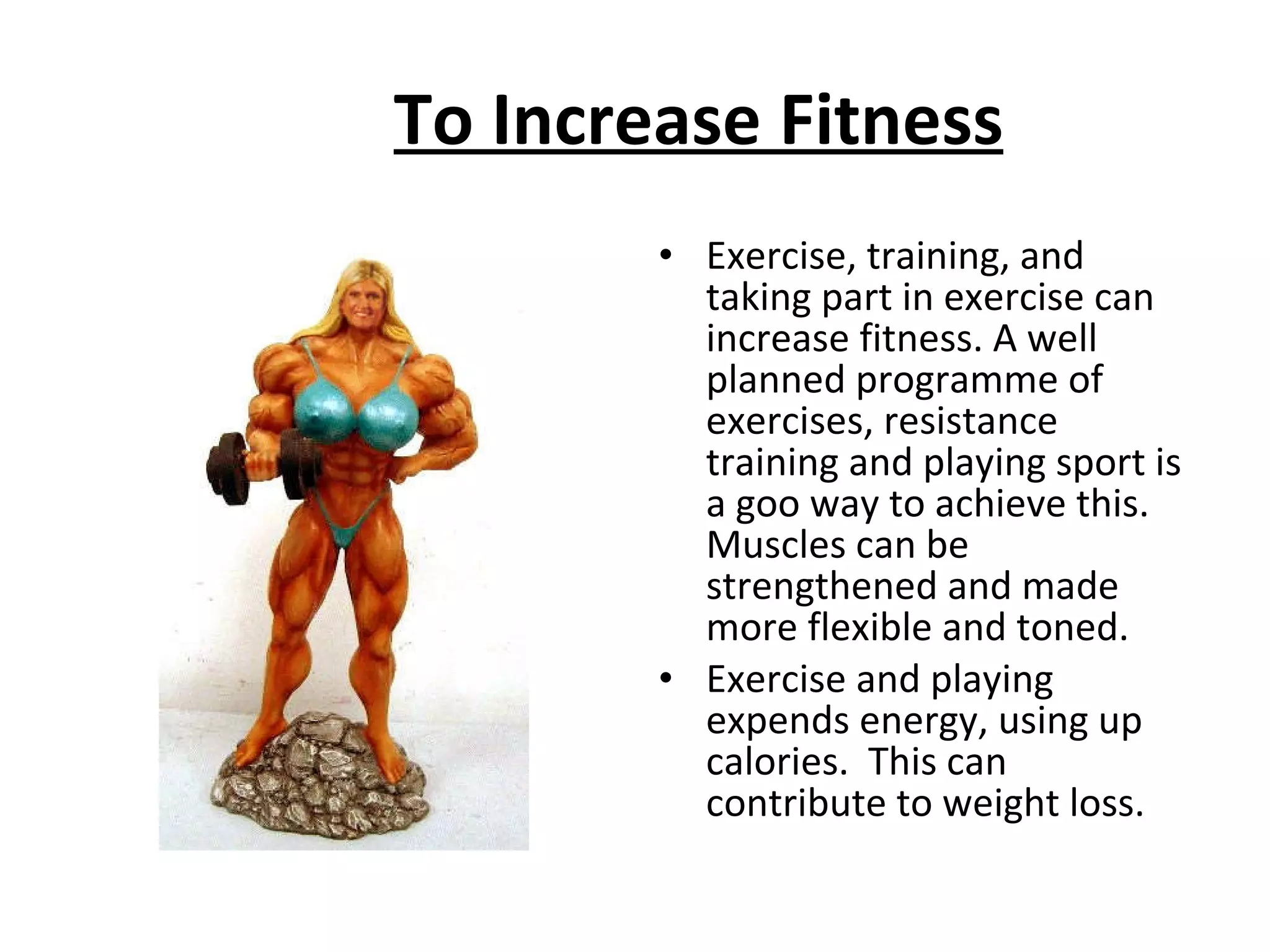
To Increase Fitness Exercise, training, and taking part in exercise can increase fitness. A well planned programme of exercises, resistance training and playing sport is a goo way to achieve this.  Muscles can be strengthened and made more flexible and toned.  Exercise and playing expends energy, using up calories.  This can contribute to weight loss.
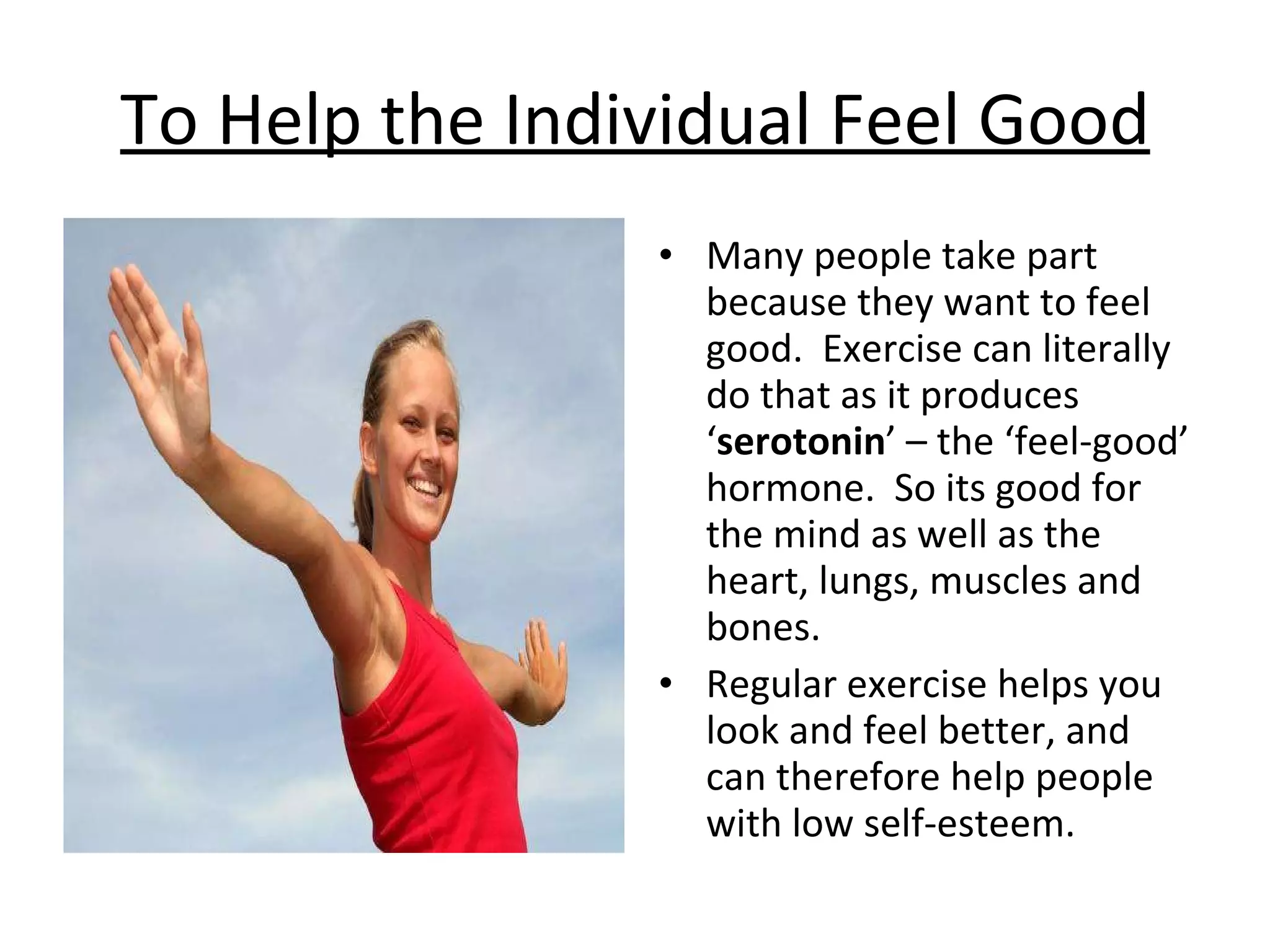
To Help the Individual Feel Good Many people take part because they want to feel good.  Exercise can literally do that as it produces ‘ serotonin ’ – the ‘feel-good’ hormone.  So its good for the mind as well as the heart, lungs, muscles and bones.  Regular exercise helps you look and feel better, and can therefore help people with low self-esteem.
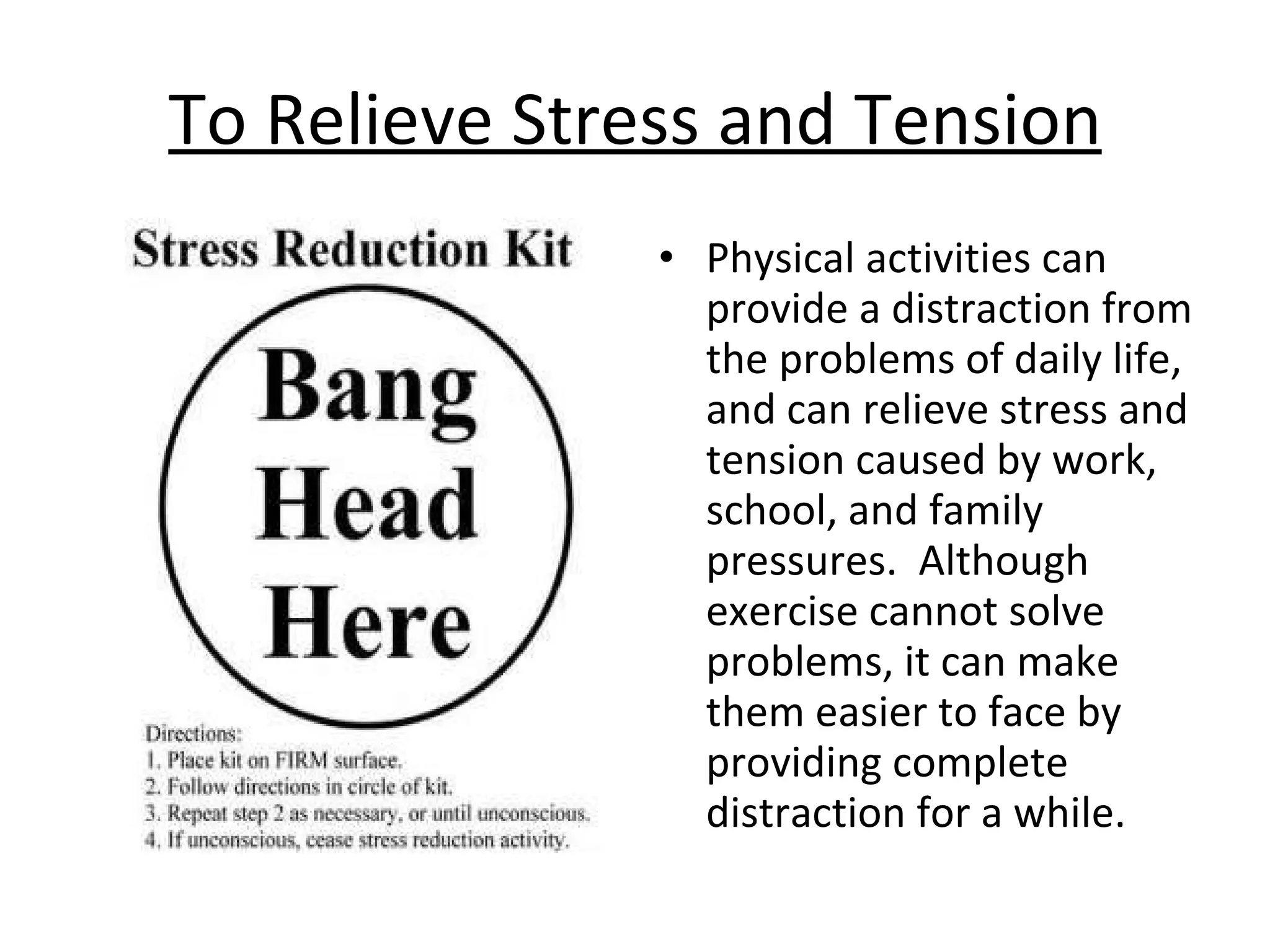
To Relieve Stress and Tension Physical activities can provide a distraction from the problems of daily life, and can relieve stress and tension caused by work, school, and family pressures.  Although exercise cannot solve problems, it can make them easier to face by providing complete distraction for a while.
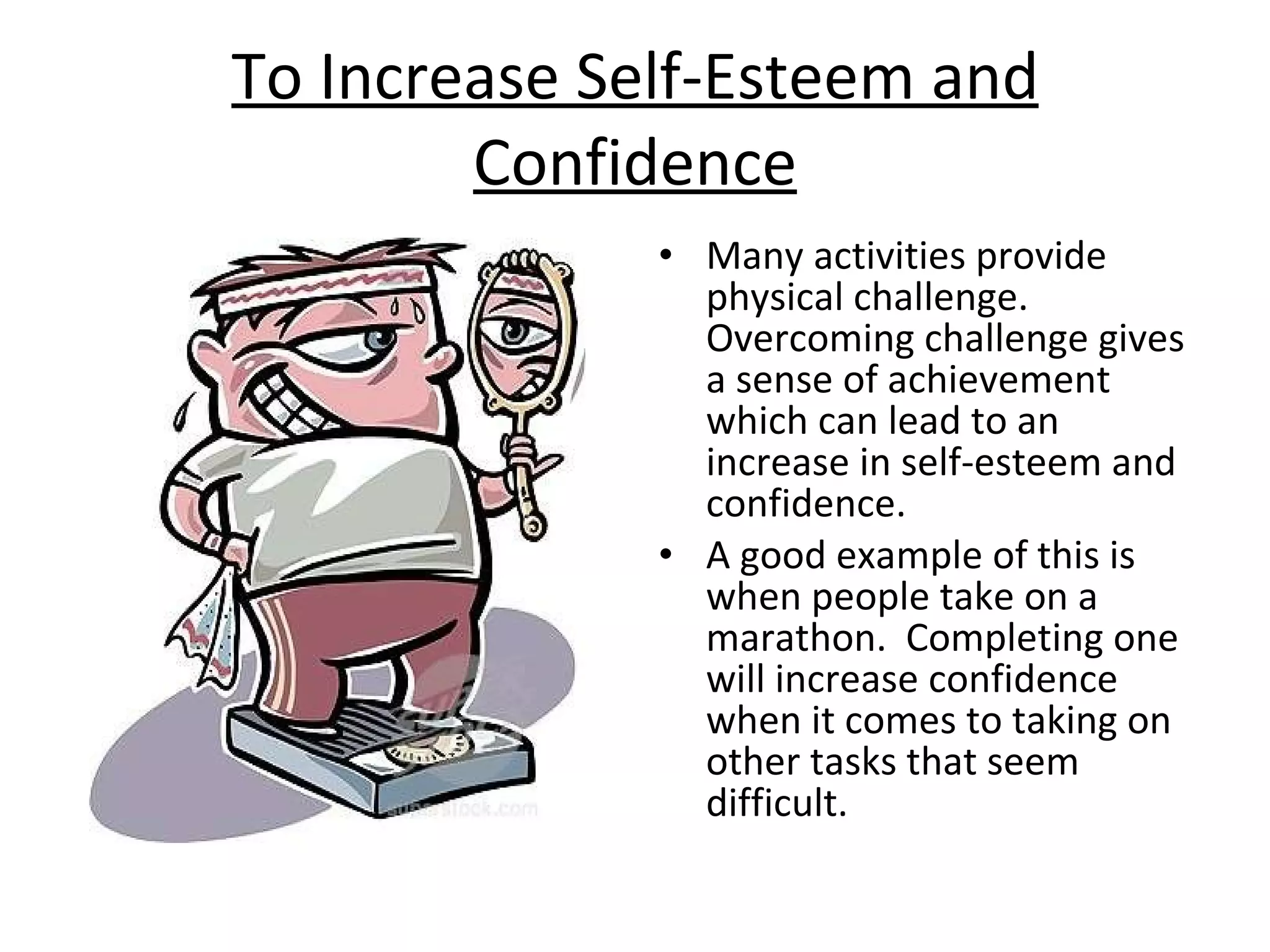
To Increase Self-Esteem and Confidence Many activities provide physical challenge.  Overcoming challenge gives a sense of achievement which can lead to an increase in self-esteem and confidence.  A good example of this is when people take on a marathon.  Completing one will increase confidence when it comes to taking on other tasks that seem difficult.
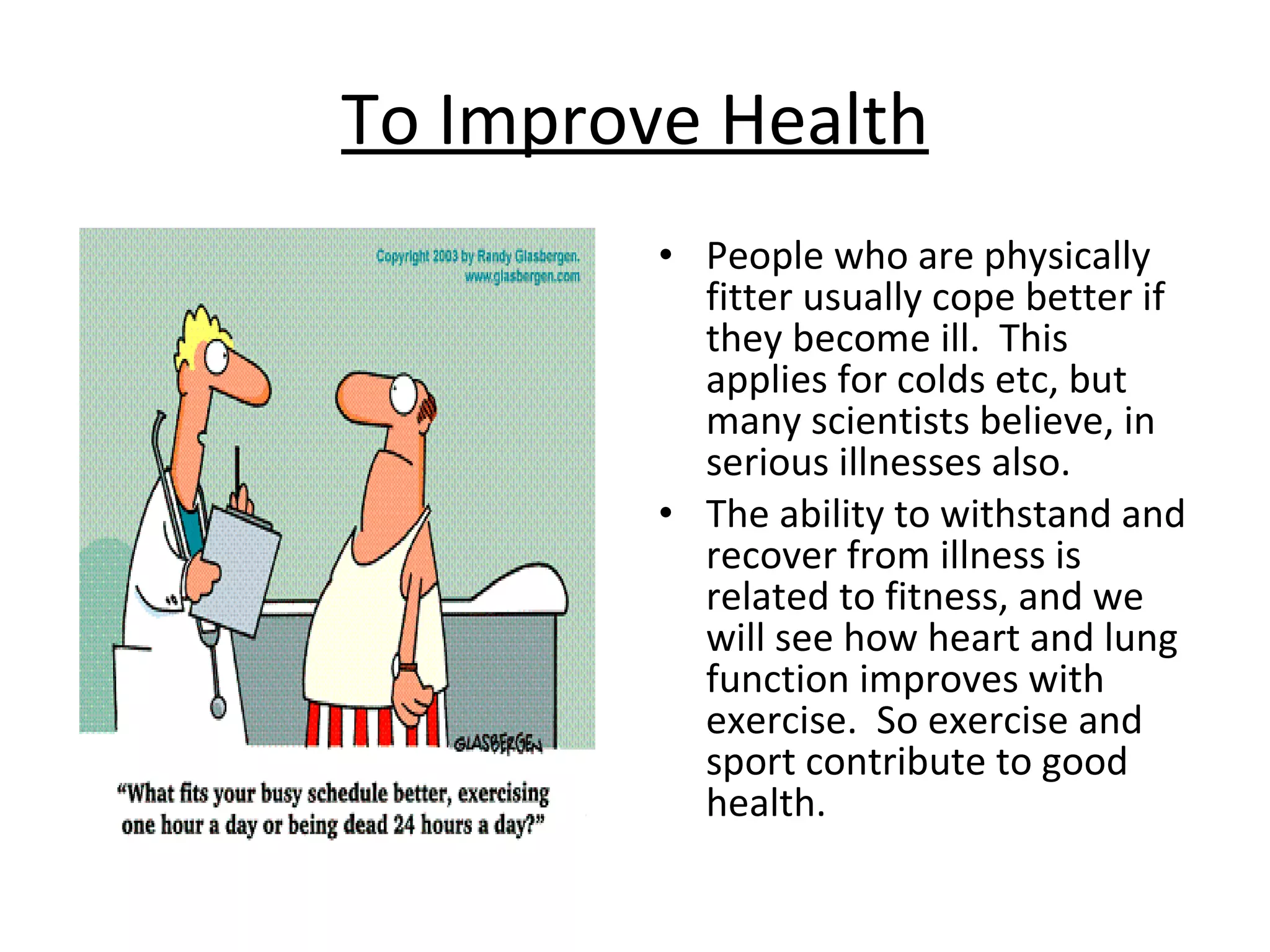
To Improve Health People who are physically fitter usually cope better if they become ill.  This applies for colds etc, but many scientists believe, in serious illnesses also.  The ability to withstand and recover from illness is related to fitness, and we will see how heart and lung function improves with exercise.  So exercise and sport contribute to good health.
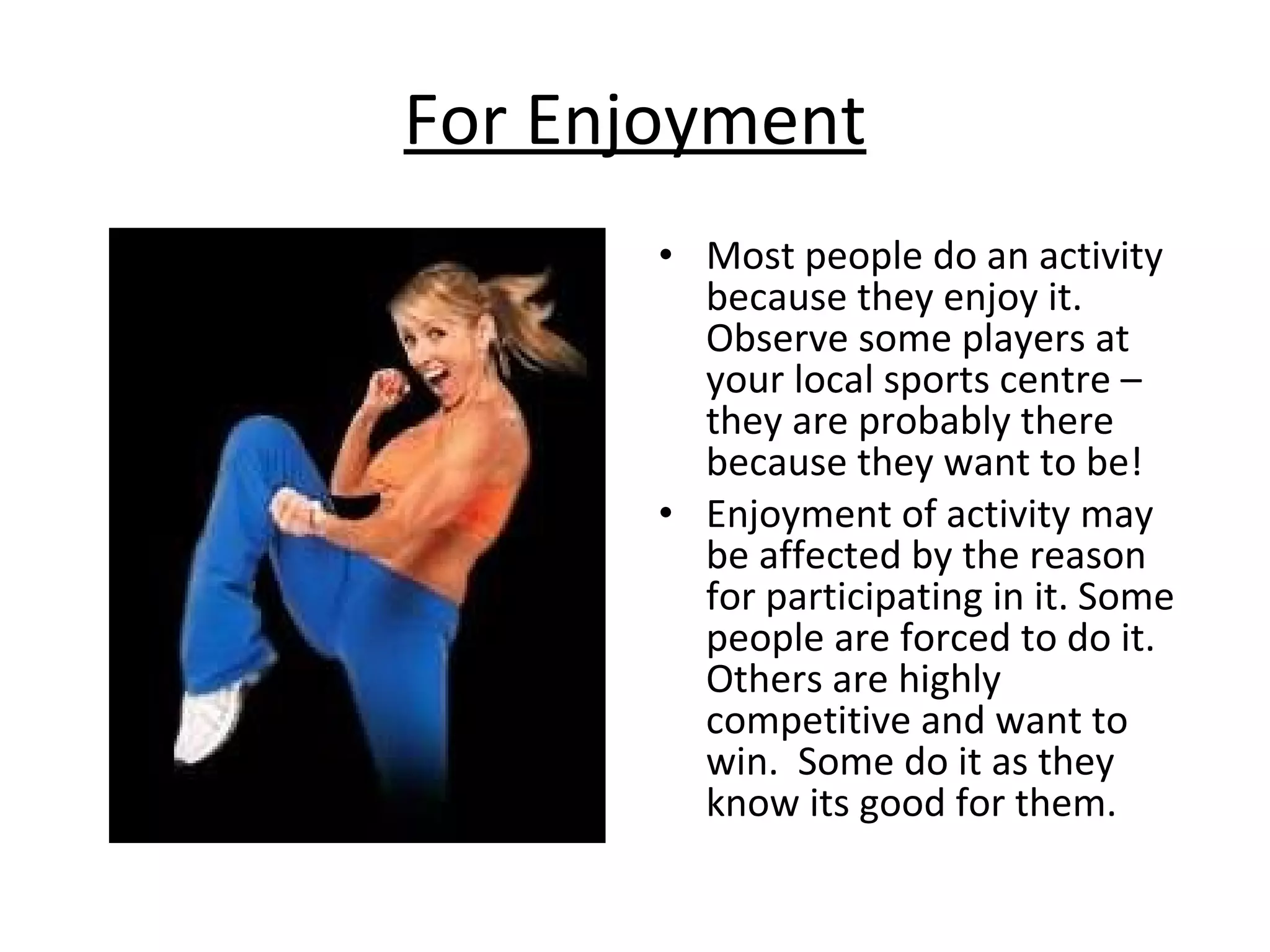
For Enjoyment Most people do an activity because they enjoy it.  Observe some players at your local sports centre – they are probably there because they want to be! Enjoyment of activity may be affected by the reason for participating in it. Some people are forced to do it.  Others are highly competitive and want to win.  Some do it as they know its good for them.
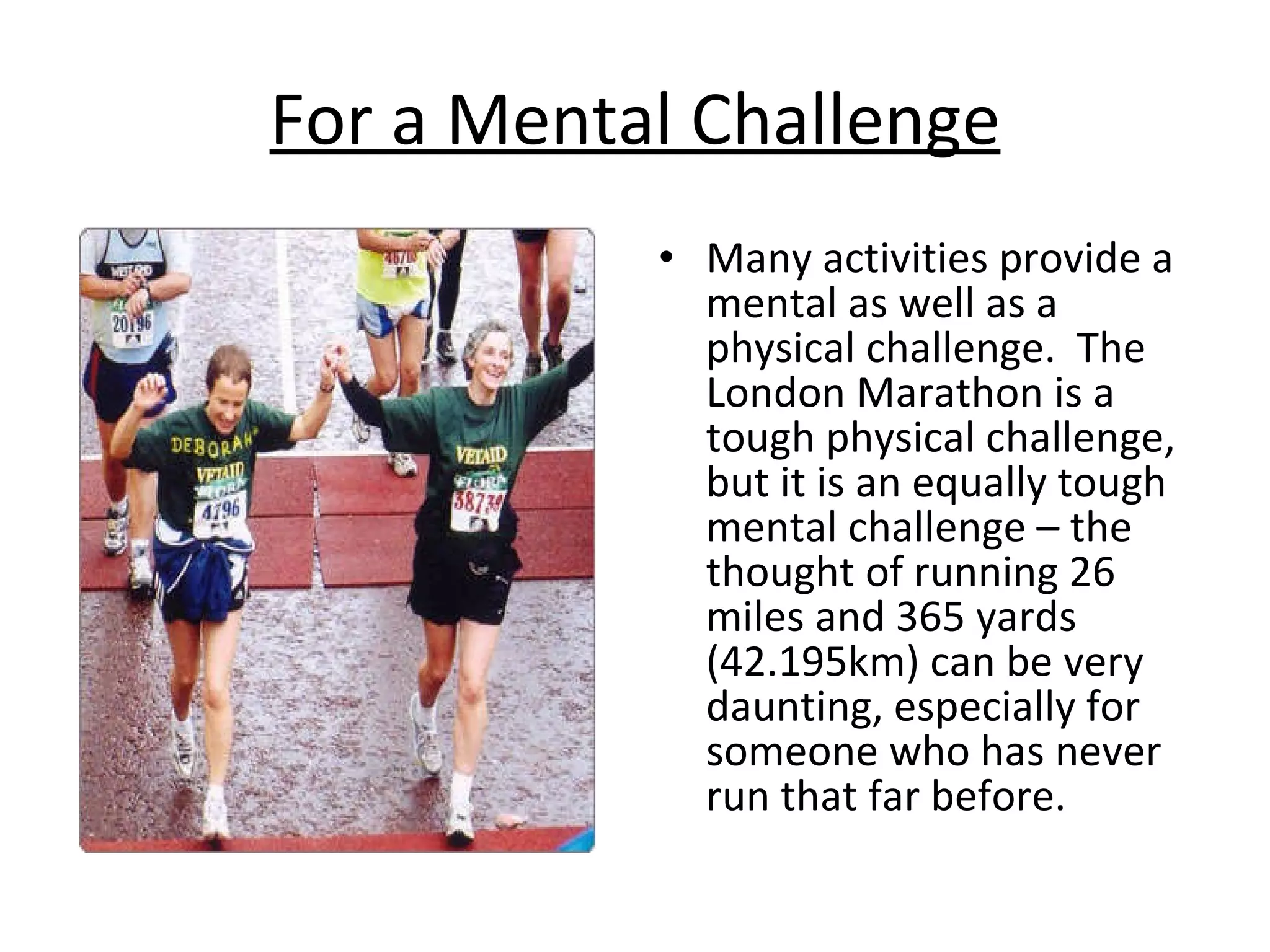
For a Mental Challenge Many activities provide a mental as well as a physical challenge.  The London Marathon is a tough physical challenge, but it is an equally tough mental challenge – the thought of running 26 miles and 365 yards (42.195km) can be very daunting, especially for someone who has never run that far before.
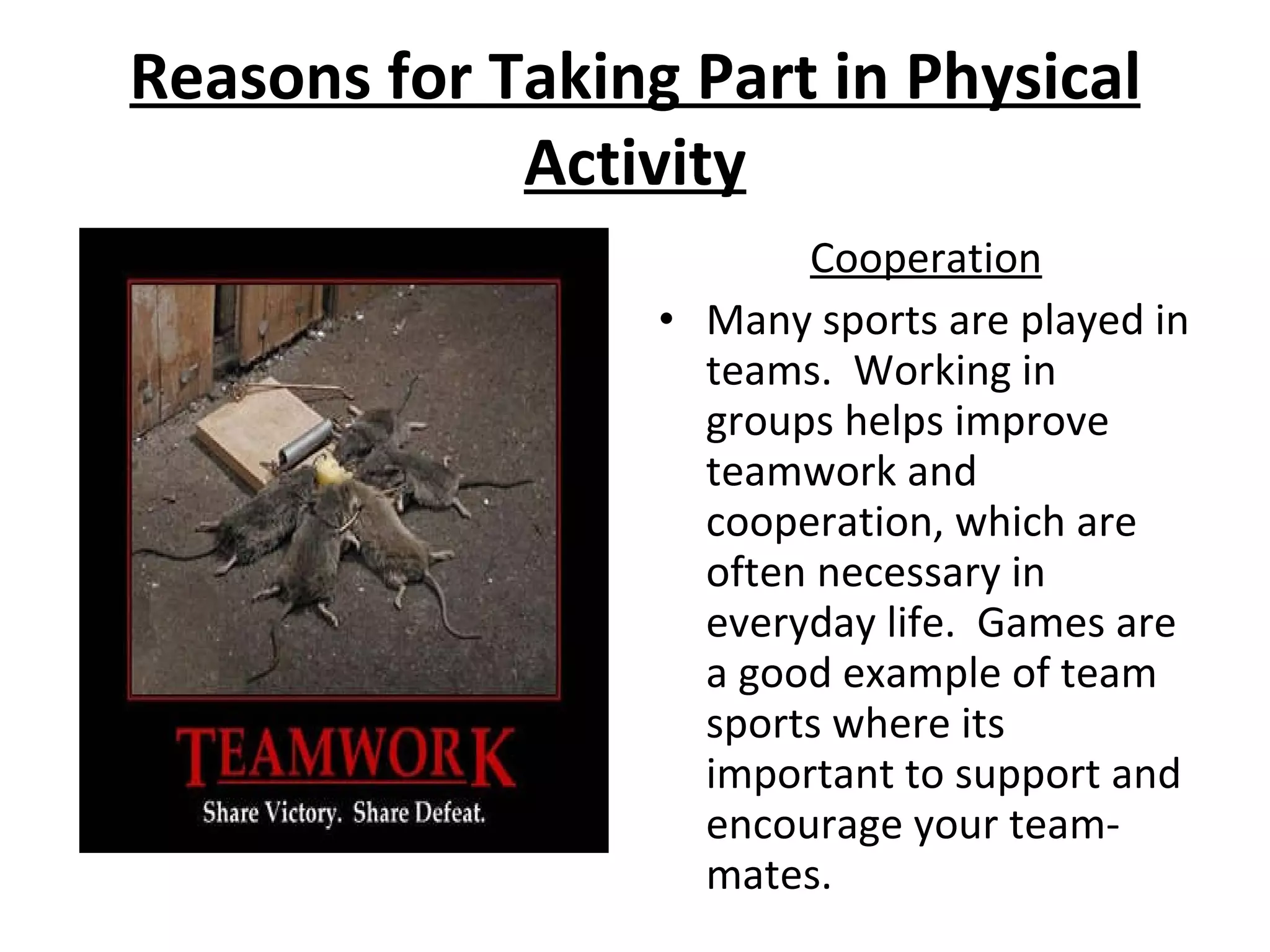
Reasons for Taking Part in Physical Activity Cooperation Many sports are played in teams.  Working in groups helps improve teamwork and cooperation, which are often necessary in everyday life.  Games are a good example of team sports where its important to support and encourage your team-mates.
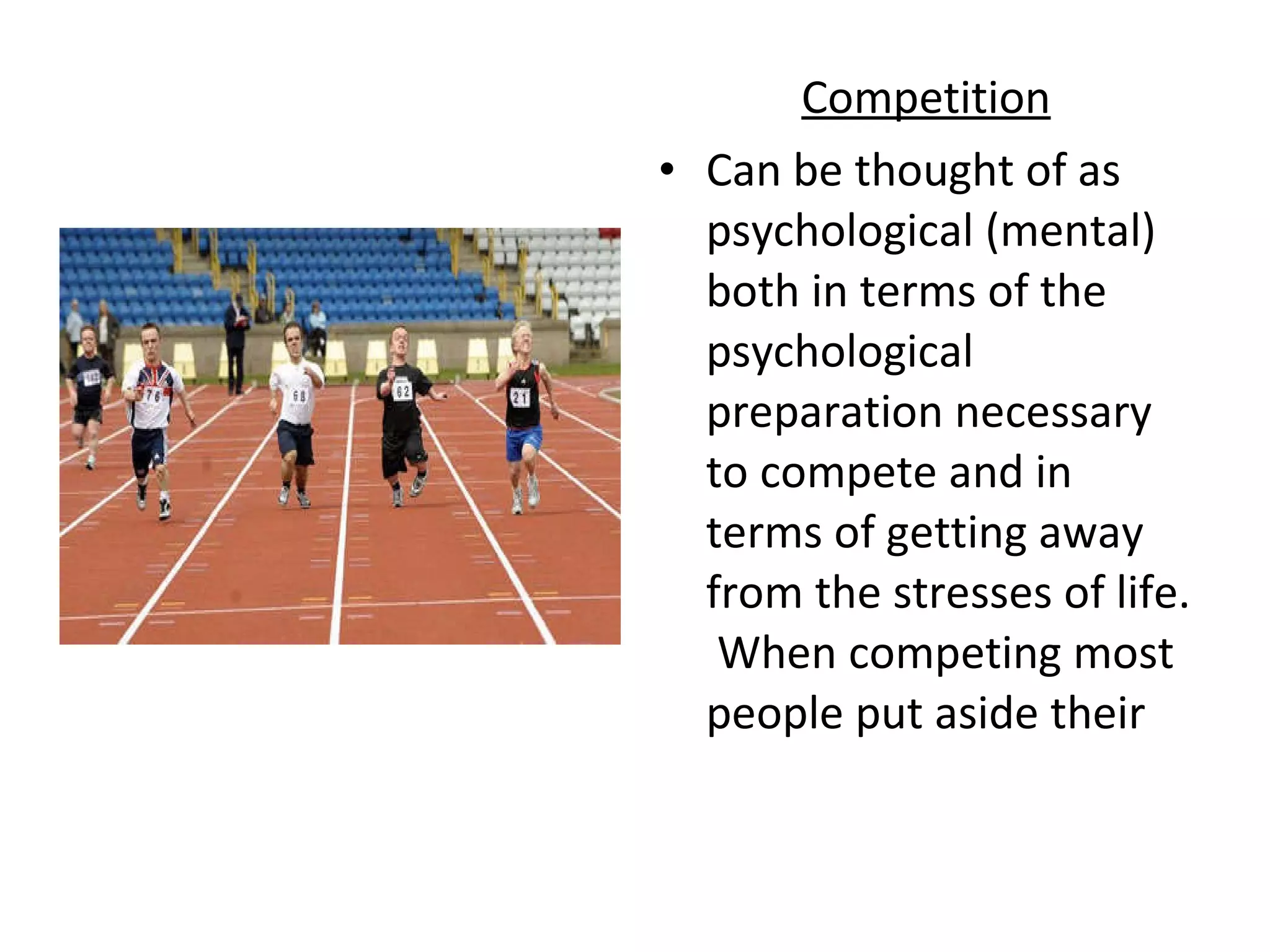
Competition Can be thought of as psychological (mental) both in terms of the psychological preparation necessary to compete and in terms of getting away from the stresses of life.  When competing most people put aside their
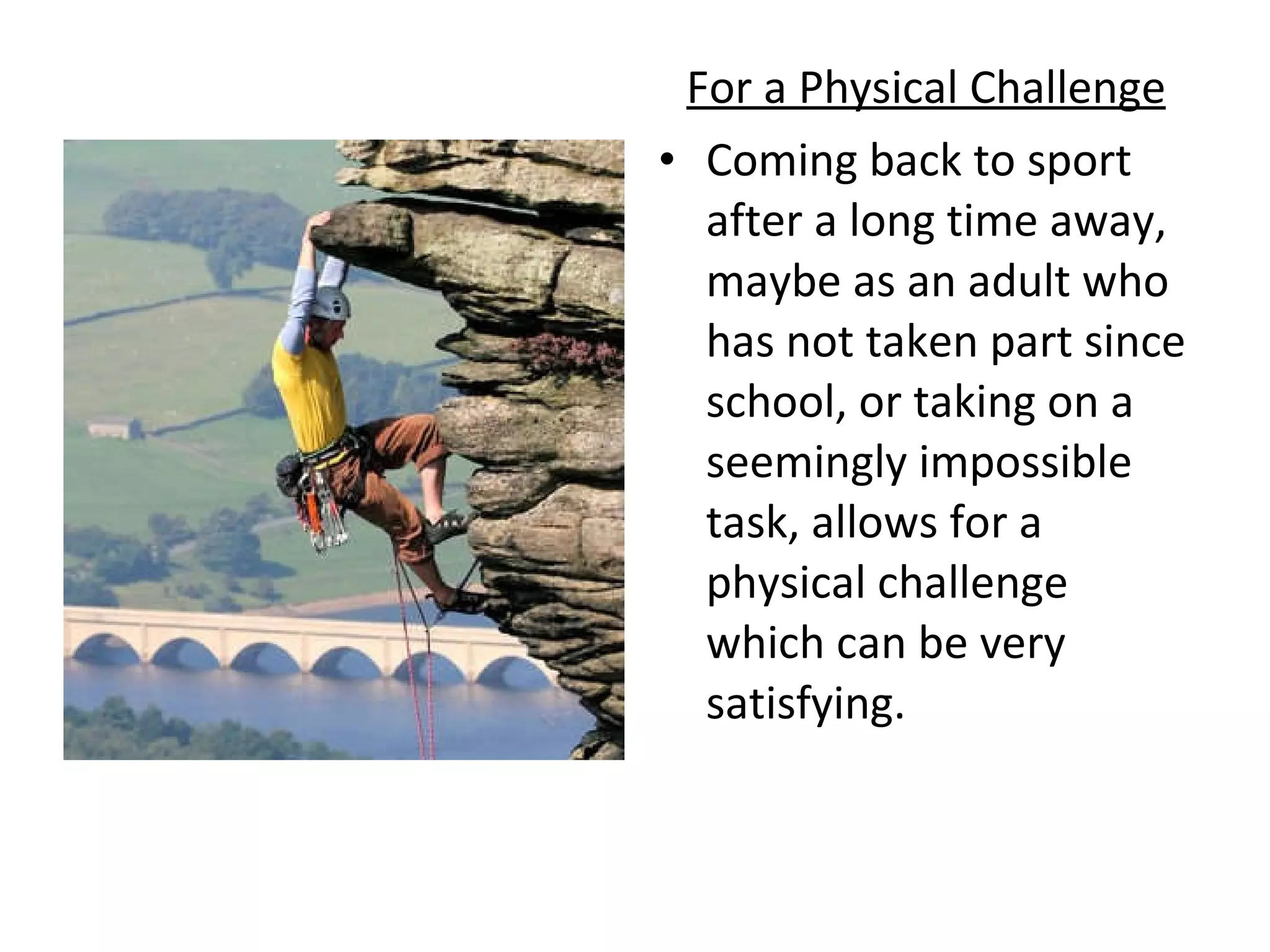
For a Physical Challenge Coming back to sport after a long time away, maybe as an adult who has not taken part since school, or taking on a seemingly impossible task, allows for a physical challenge which can be very satisfying.
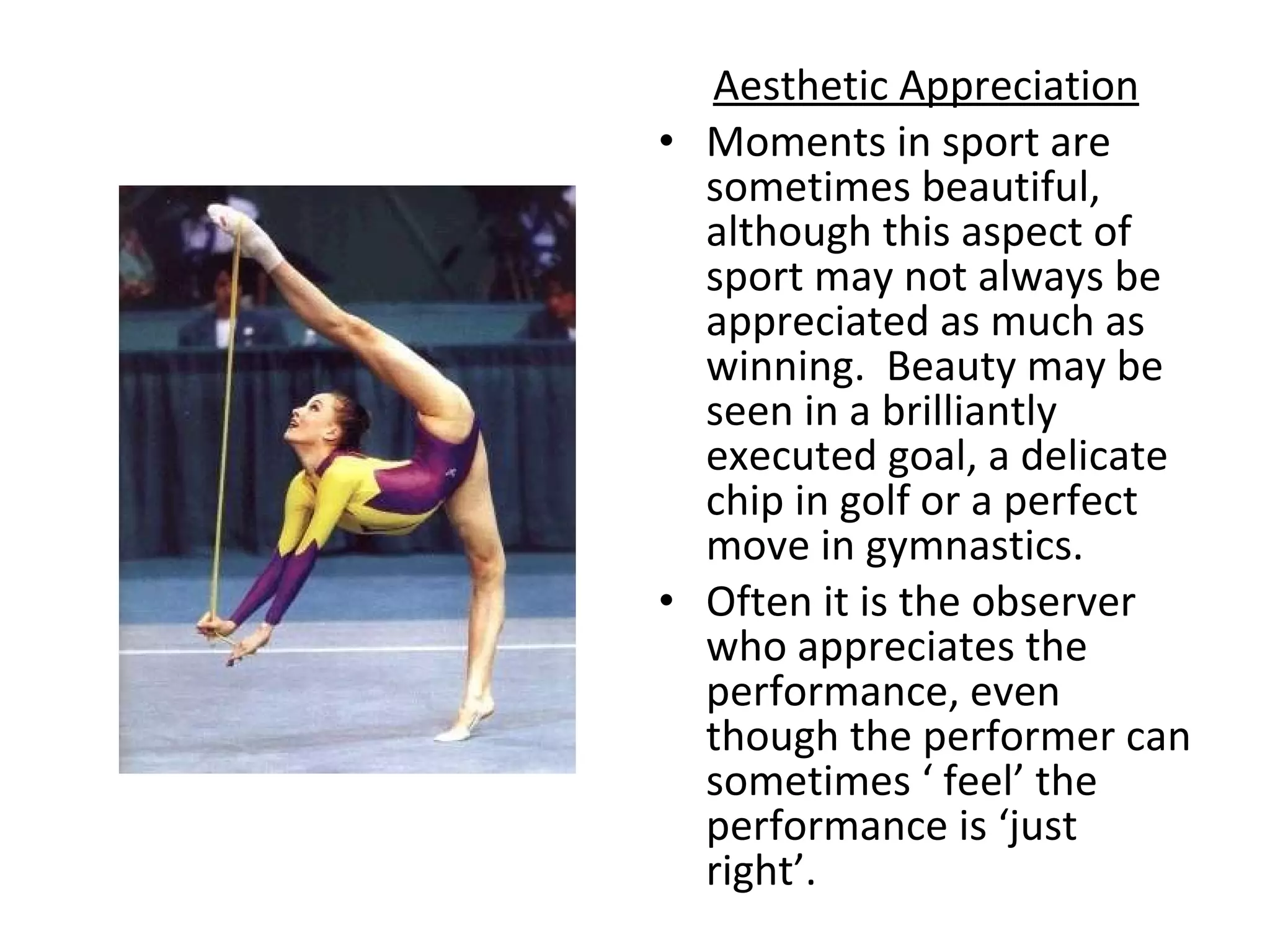
Aesthetic Appreciation Moments in sport are sometimes beautiful, although this aspect of sport may not always be appreciated as much as winning.  Beauty may be seen in a brilliantly executed goal, a delicate chip in golf or a perfect move in gymnastics.  Often it is the observer who appreciates the performance, even though the performer can sometimes ‘ feel’ the performance is ‘just right’.
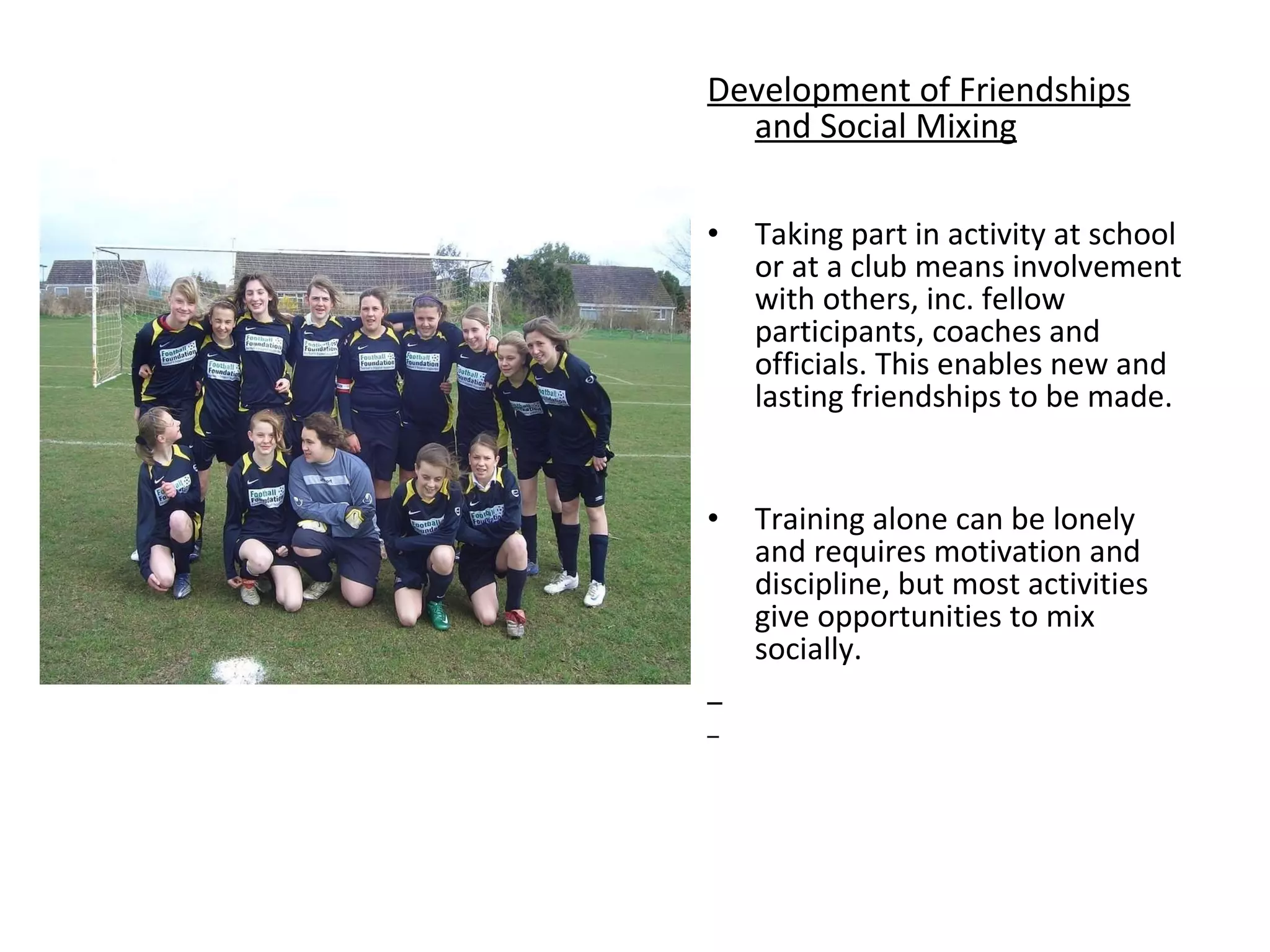
Development of Friendships and Social Mixing Taking part in activity at school or at a club means involvement with others, inc. fellow participants, coaches and officials. This enables new and lasting friendships to be made. Training alone can be lonely and requires motivation and discipline, but most activities give opportunities to mix socially.

PEShare.co.uk Shared Resource

  • 1.
    Topic 1.1.1: Healthy,active lifestyles and how they could benefit you Benefits of taking part in physical activity
  • 2.
    To Increase FitnessExercise, training, and taking part in exercise can increase fitness. A well planned programme of exercises, resistance training and playing sport is a goo way to achieve this. Muscles can be strengthened and made more flexible and toned. Exercise and playing expends energy, using up calories. This can contribute to weight loss.
  • 3.
    To Help theIndividual Feel Good Many people take part because they want to feel good. Exercise can literally do that as it produces ‘ serotonin ’ – the ‘feel-good’ hormone. So its good for the mind as well as the heart, lungs, muscles and bones. Regular exercise helps you look and feel better, and can therefore help people with low self-esteem.
  • 4.
    To Relieve Stressand Tension Physical activities can provide a distraction from the problems of daily life, and can relieve stress and tension caused by work, school, and family pressures. Although exercise cannot solve problems, it can make them easier to face by providing complete distraction for a while.
  • 5.
    To Increase Self-Esteemand Confidence Many activities provide physical challenge. Overcoming challenge gives a sense of achievement which can lead to an increase in self-esteem and confidence. A good example of this is when people take on a marathon. Completing one will increase confidence when it comes to taking on other tasks that seem difficult.
  • 6.
    To Improve HealthPeople who are physically fitter usually cope better if they become ill. This applies for colds etc, but many scientists believe, in serious illnesses also. The ability to withstand and recover from illness is related to fitness, and we will see how heart and lung function improves with exercise. So exercise and sport contribute to good health.
  • 7.
    For Enjoyment Mostpeople do an activity because they enjoy it. Observe some players at your local sports centre – they are probably there because they want to be! Enjoyment of activity may be affected by the reason for participating in it. Some people are forced to do it. Others are highly competitive and want to win. Some do it as they know its good for them.
  • 8.
    For a MentalChallenge Many activities provide a mental as well as a physical challenge. The London Marathon is a tough physical challenge, but it is an equally tough mental challenge – the thought of running 26 miles and 365 yards (42.195km) can be very daunting, especially for someone who has never run that far before.
  • 9.
    Reasons for TakingPart in Physical Activity Cooperation Many sports are played in teams. Working in groups helps improve teamwork and cooperation, which are often necessary in everyday life. Games are a good example of team sports where its important to support and encourage your team-mates.
  • 10.
    Competition Can bethought of as psychological (mental) both in terms of the psychological preparation necessary to compete and in terms of getting away from the stresses of life. When competing most people put aside their
  • 11.
    For a PhysicalChallenge Coming back to sport after a long time away, maybe as an adult who has not taken part since school, or taking on a seemingly impossible task, allows for a physical challenge which can be very satisfying.
  • 12.
    Aesthetic Appreciation Momentsin sport are sometimes beautiful, although this aspect of sport may not always be appreciated as much as winning. Beauty may be seen in a brilliantly executed goal, a delicate chip in golf or a perfect move in gymnastics. Often it is the observer who appreciates the performance, even though the performer can sometimes ‘ feel’ the performance is ‘just right’.
  • 13.
    Development of Friendshipsand Social Mixing Taking part in activity at school or at a club means involvement with others, inc. fellow participants, coaches and officials. This enables new and lasting friendships to be made. Training alone can be lonely and requires motivation and discipline, but most activities give opportunities to mix socially.