Smart Analytics
Dr. James C. (“Jim”) Spohrer
IBM Innovation Champion
Director, IBM Global University Programs
CTS CSL, Phoenix, USA, Nov. 6, 2013
International Society of Service
Innovation Professionals (ISSIP)
Today’s Talk
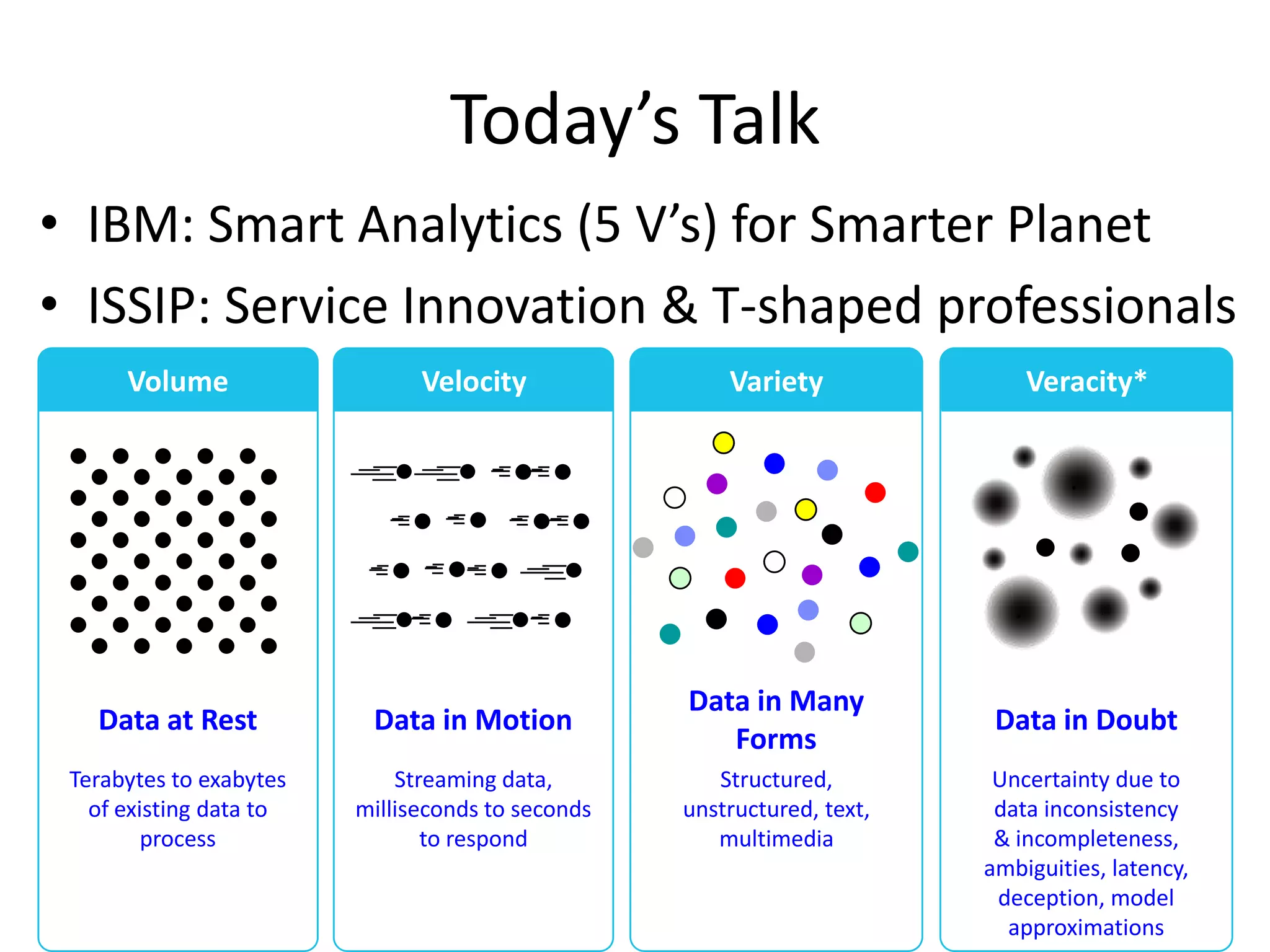
• IBM: Smart Analytics (5 V’s) for Smarter Planet
• ISSIP: Service Innovation & T-shaped professionals
Volume

Velocity

Variety

Veracity*

Data at Rest

Data in Motion

Data in Many
Forms

Data in Doubt

Terabytes to exabytes
of existing data to
process

Streaming data,
milliseconds to seconds
to respond

Structured,
unstructured, text,
multimedia

Uncertainty due to
data inconsistency
& incompleteness,
ambiguities, latency,
deception, model
approximations
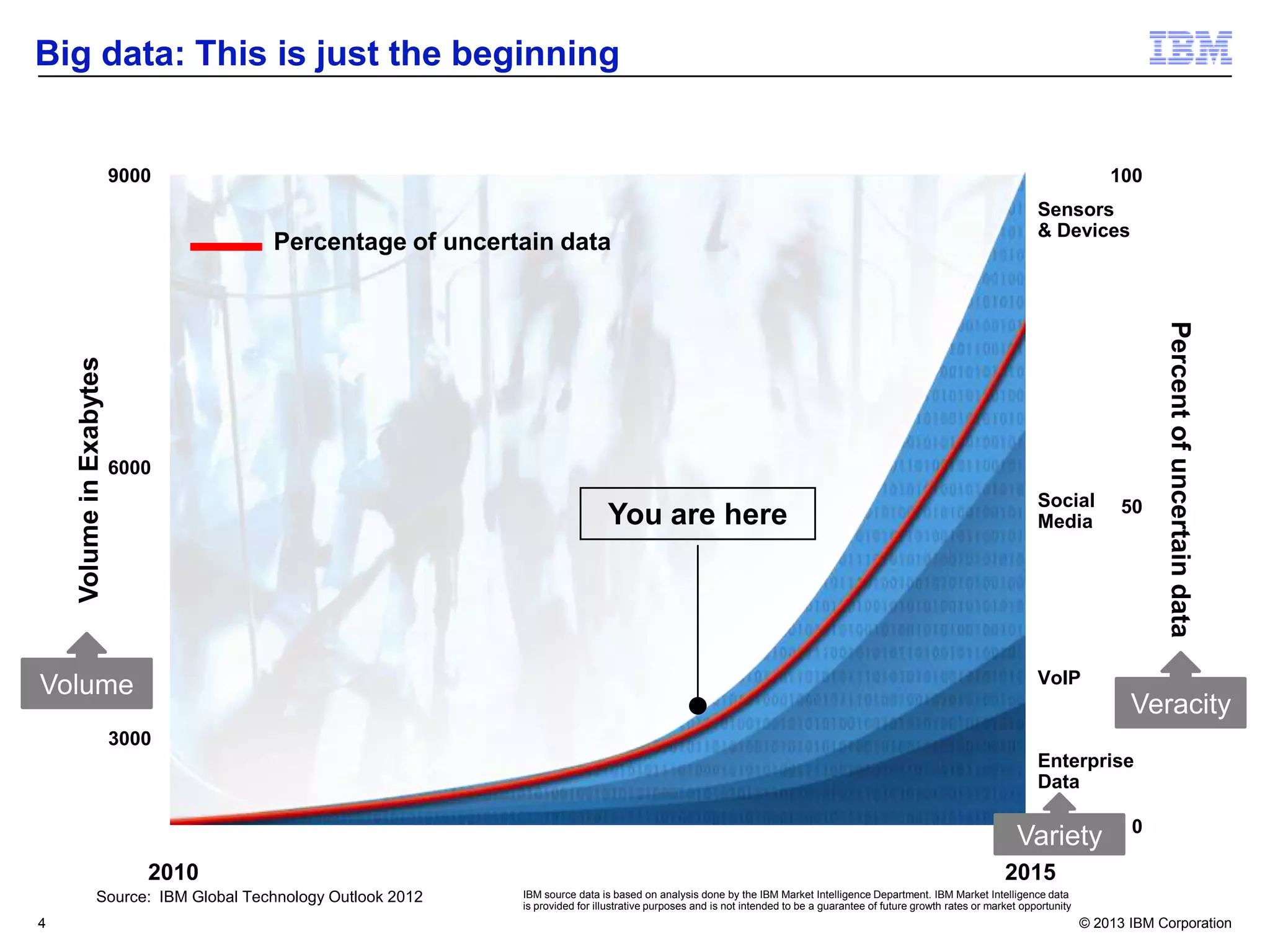
Big data: This is just the beginning

9000

100

6000

You are here

Social
Media

50

Percent of uncertain data

Volume in Exabytes

Percentage of uncertain data

Sensors
& Devices

VoIP

Volume

Veracity

3000
Enterprise
Data

Variety
2010
Source: IBM Global Technology Outlook 2012
4

0

2015
IBM source data is based on analysis done by the IBM Market Intelligence Department. IBM Market Intelligence data
is provided for illustrative purposes and is not intended to be a guarantee of future growth rates or market opportunity

© 2013 IBM Corporation
5th V = Value of leveraging big data
Nearly two out of three respondents reports realizing a competitive
advantage from information and analytics
Competitive advantage enabler


A majority of respondents
reported analytics and information
(including big data) creates a
competitive advantage within their
market or industry

Realizing a competitive advantage
50%

2012

increase

 Represents a 70% increase
since 2010 among global
respondents

5

52%

 Organizations already active in
big data activities were 15%
more likely to report a
competitive advantage


28%

In the Education industry, the
percentage of respondents
reporting a competitive advantage
rose from 28% in 2010 to 50% in
2012, a 79% increase in two
years after a peak in 2011 at 52%.

63%

79%
58%

2011

70%
increase

37%

2010
Education industry
respondents

Global respondents

Respondents were asked “To what extent does the use of information (including big data)
Respondents were a competitive advantage for your organization in your industry or
and analytics createasked “To what extent does the use of information (including big data)
and analytics create a competitive shown are for those who rated in extent a [4 ] or
market.” Respondent percentages advantage for your organizationthe your industryor [5
market.” Respondent percentages shown are for those each year.
Significant extent]. The same question has been asked who rated the extent a [4 ] or [5
Significant extent].
2010 and 2011 datasets © Massachusetts Institute of Technology

Source: Analytics: The real-world use of big data, a collaborative research study by the IBM
Institute for Business Value and the Saïd Business School at the University of Oxford. © IBM 2012
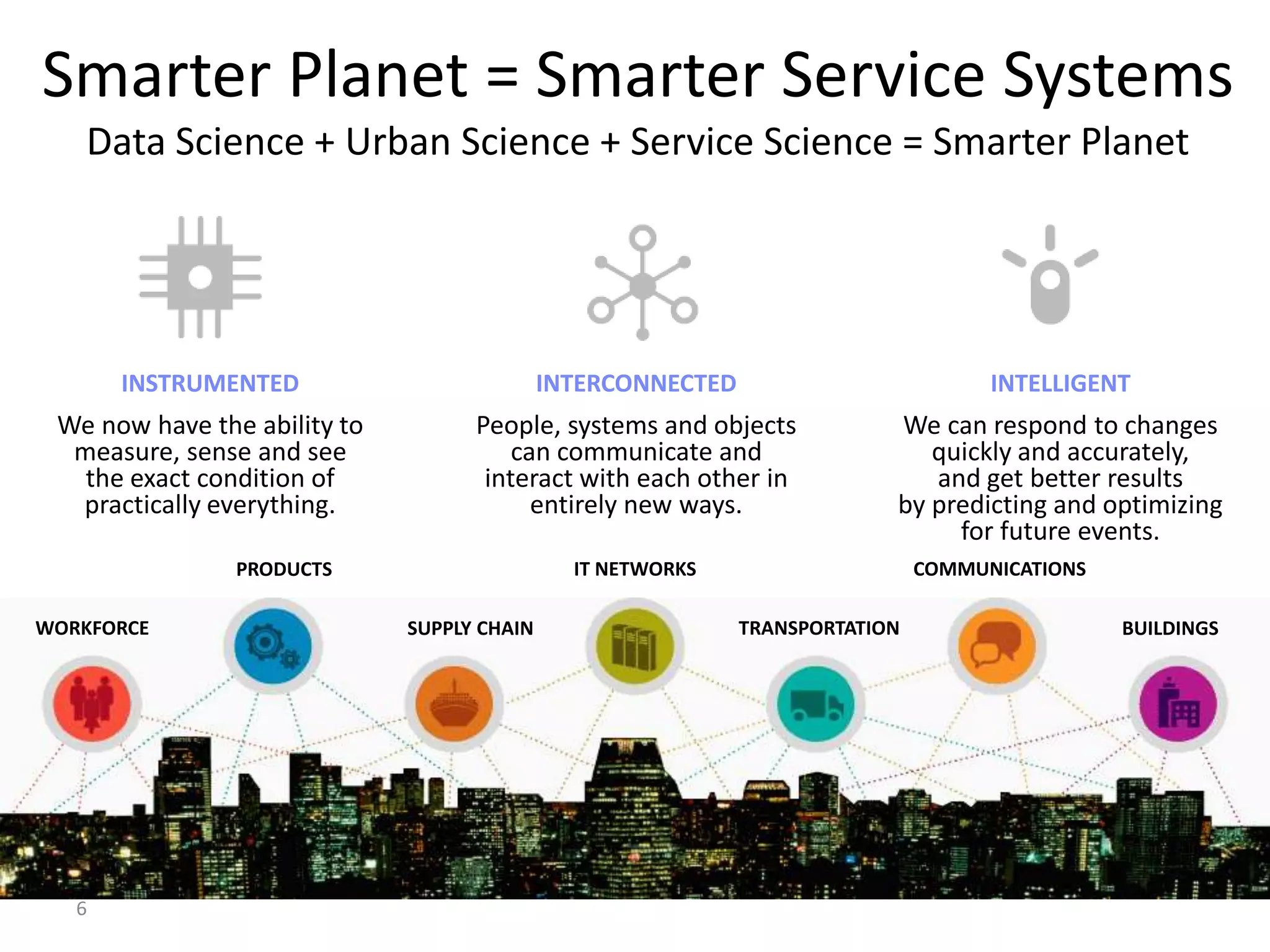
Smarter Planet = Smarter Service Systems
Data Science + Urban Science + Service Science = Smarter Planet

INSTRUMENTED

INTERCONNECTED

INTELLIGENT

We now have the ability to
measure, sense and see
the exact condition of
practically everything.

People, systems and objects
can communicate and
interact with each other in
entirely new ways.

We can respond to changes
quickly and accurately,
and get better results
by predicting and optimizing
for future events.

IT NETWORKS

PRODUCTS
WORKFORCE

6

SUPPLY CHAIN

COMMUNICATIONS
TRANSPORTATION

BUILDINGS
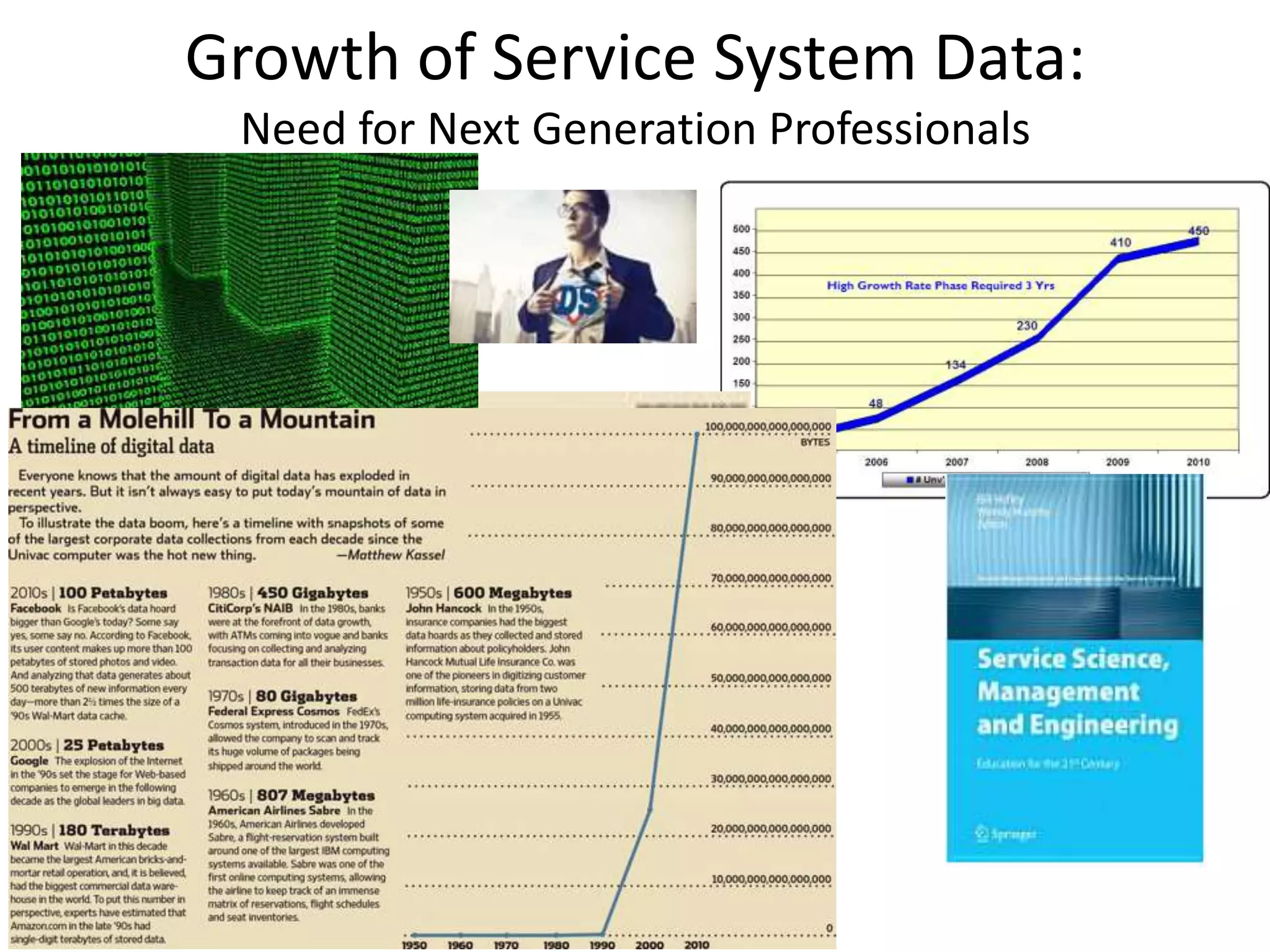
Growth of Service System Data:
Need for Next Generation Professionals

7
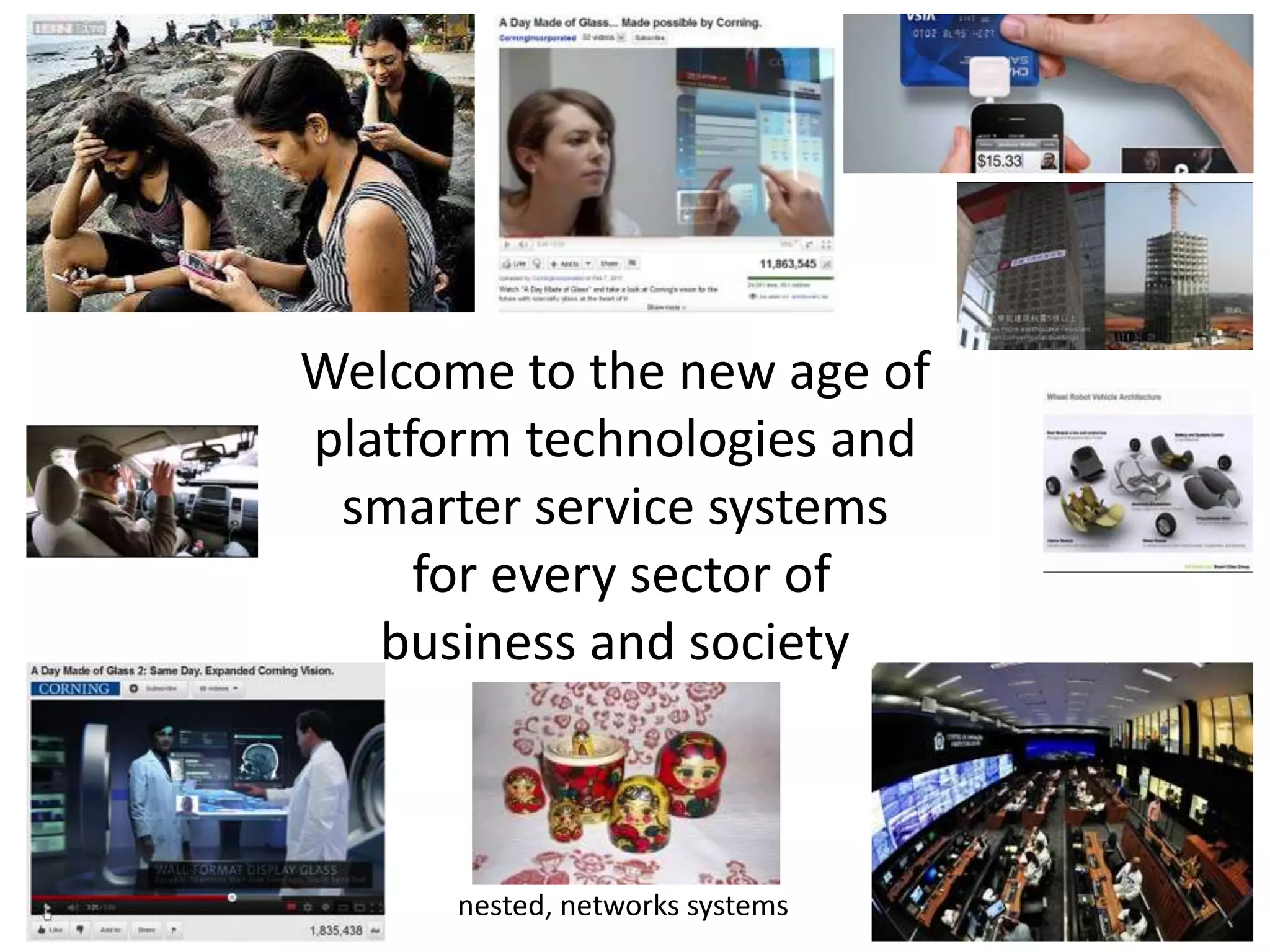
Welcome to the new age of
platform technologies and
smarter service systems
for every sector of
business and society

nested, networks systems
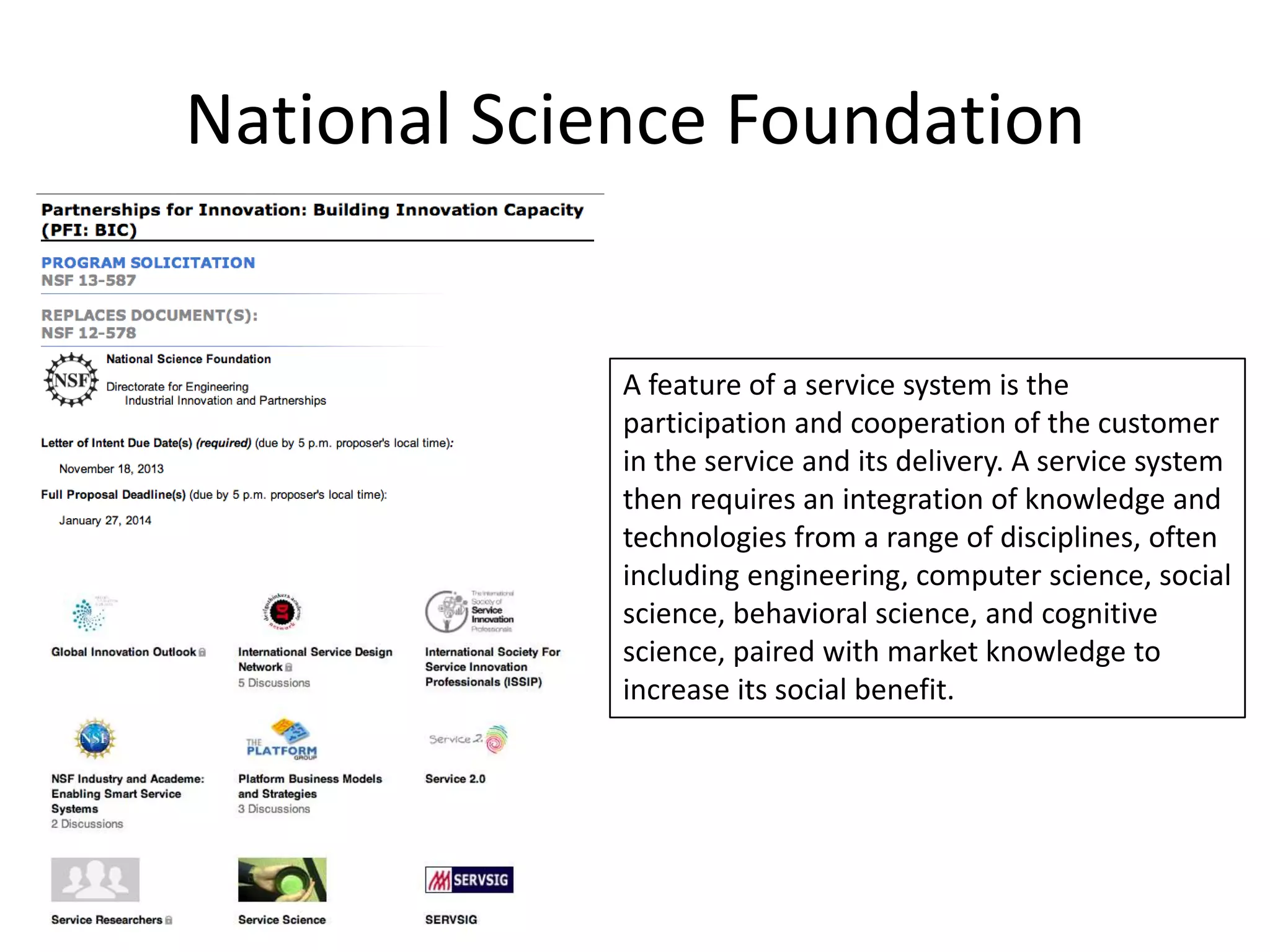
National Science Foundation

A feature of a service system is the
participation and cooperation of the customer
in the service and its delivery. A service system
then requires an integration of knowledge and
technologies from a range of disciplines, often
including engineering, computer science, social
science, behavioral science, and cognitive
science, paired with market knowledge to
increase its social benefit.
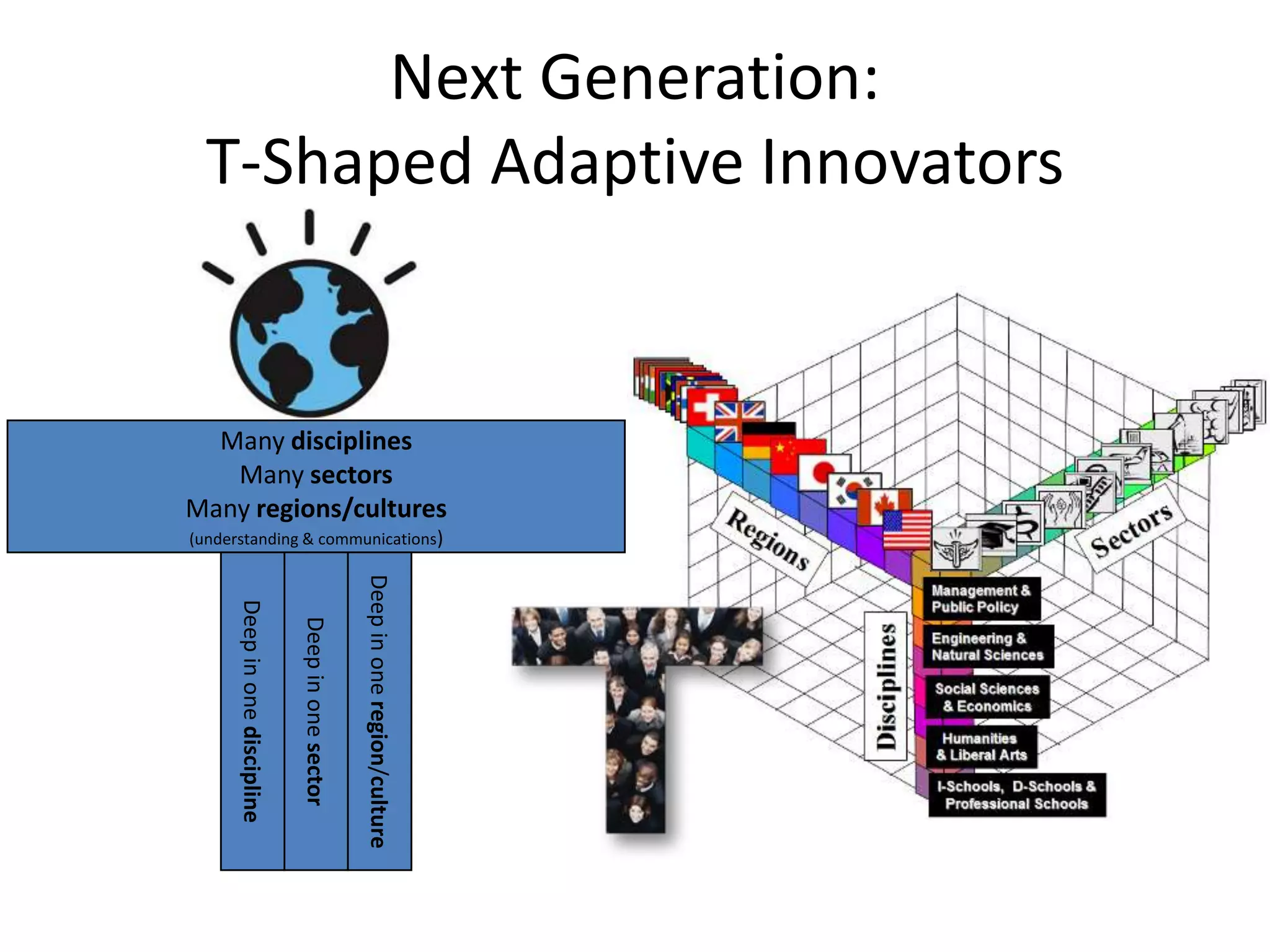
Next Generation:
T-Shaped Adaptive Innovators

Many disciplines
Many sectors
Many regions/cultures
(understanding & communications)

Deep in one region/culture

Deep in one sector

Deep in one discipline
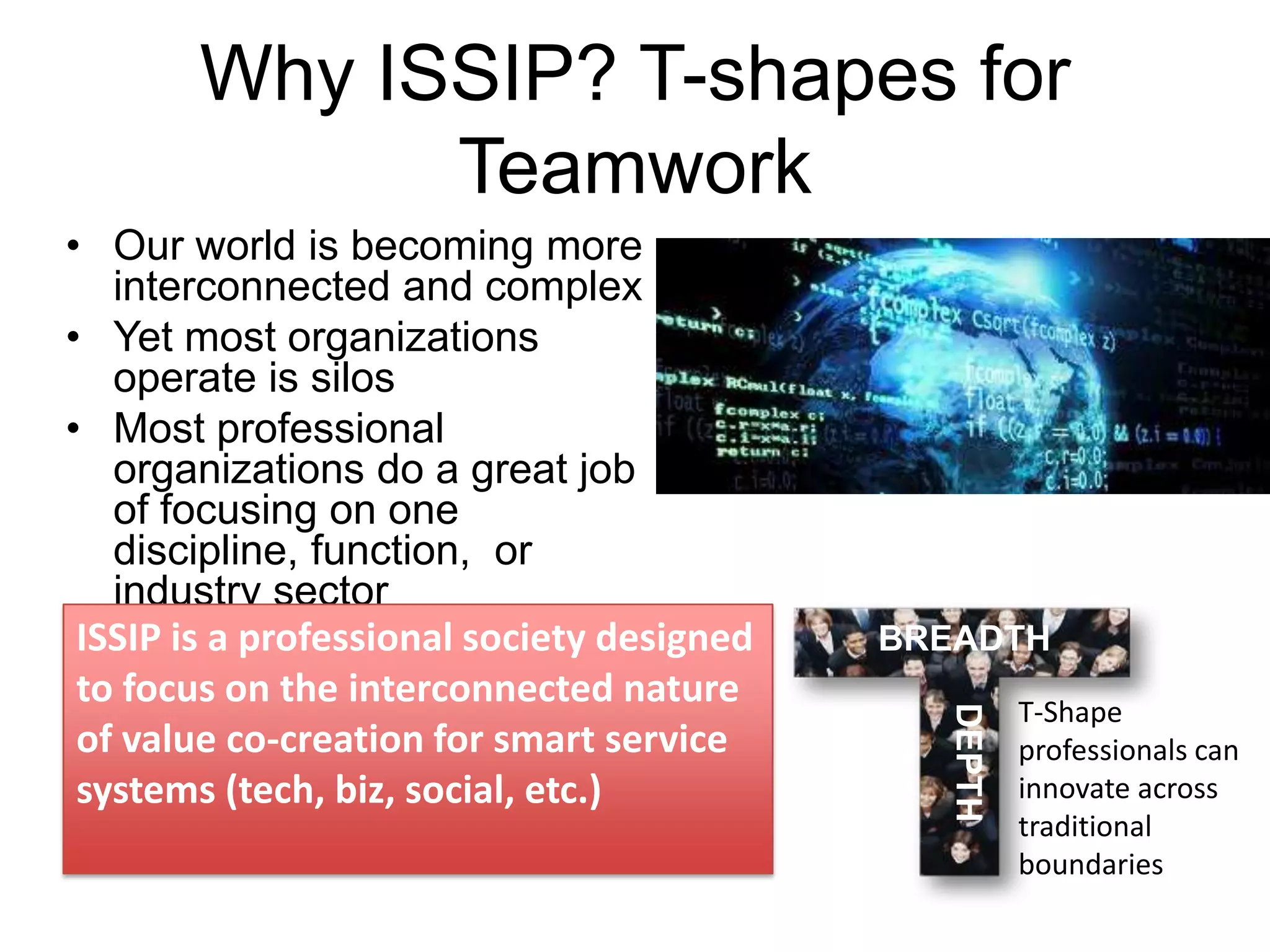
Why ISSIP? T-shapes for
Teamwork

BREADTH
DEPTH

• Our world is becoming more
interconnected and complex
• Yet most organizations
operate is silos
• Most professional
organizations do a great job
of focusing on one
discipline, function, or
industry sector
ISSIP is a professional society designed
to focus on the interconnected nature
of value co-creation for smart service
systems (tech, biz, social, etc.)

T-Shape
professionals can
innovate across
traditional
boundaries
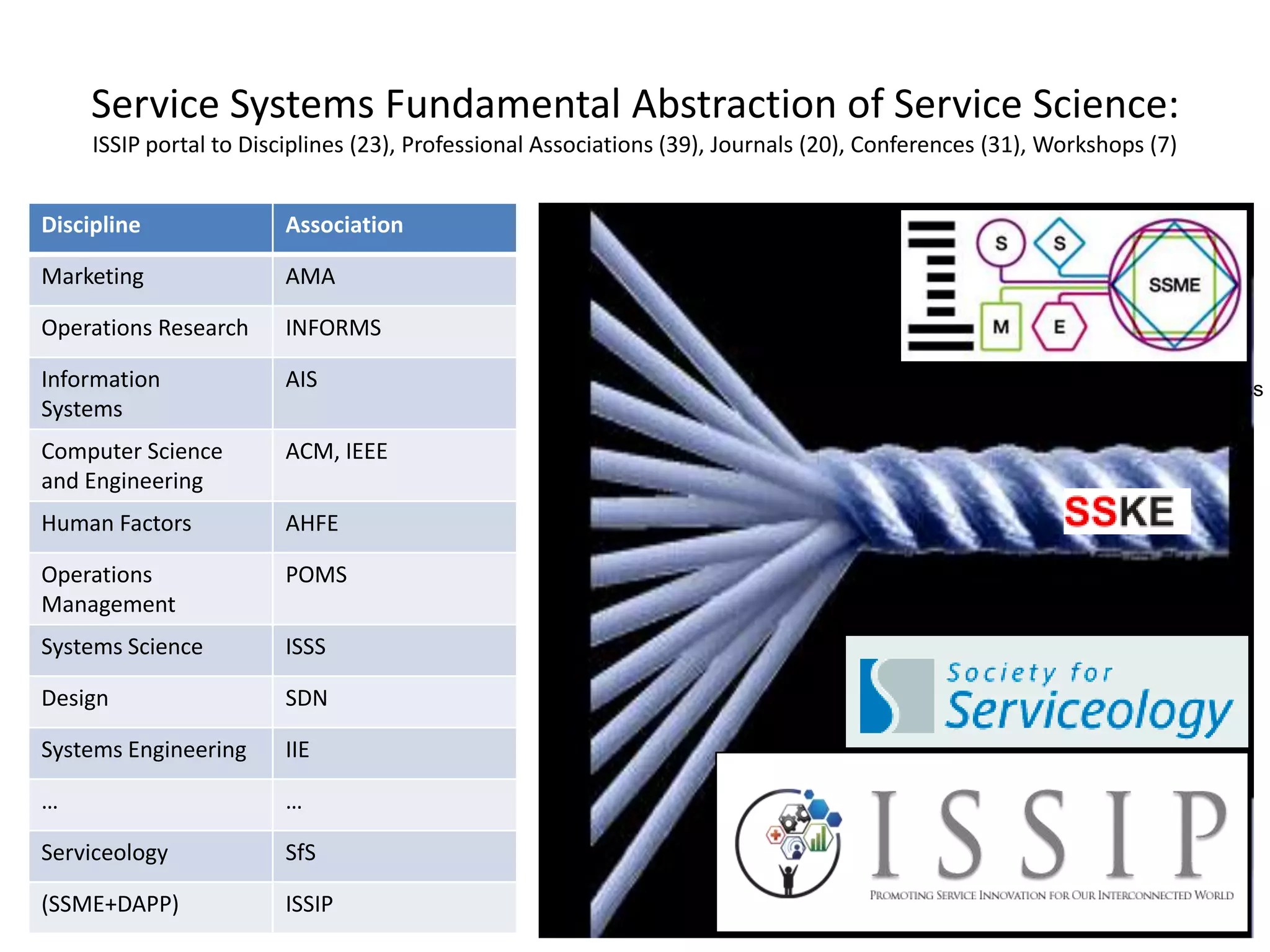
Service Systems Fundamental Abstraction of Service Science:
ISSIP portal to Disciplines (23), Professional Associations (39), Journals (20), Conferences (31), Workshops (7)
Discipline

Association

Marketing

AMA

Operations Research

INFORMS

Information
Systems

AIS

Computer Science
and Engineering

ACM, IEEE

Human Factors

AHFE

Operations
Management

POMS

Systems Science

ISSS

Design

SDN

Systems Engineering

IIE

…

…

Serviceology

SfS

(SSME+DAPP)

ISSIP

IBM SSME Centennial Icon of Progress
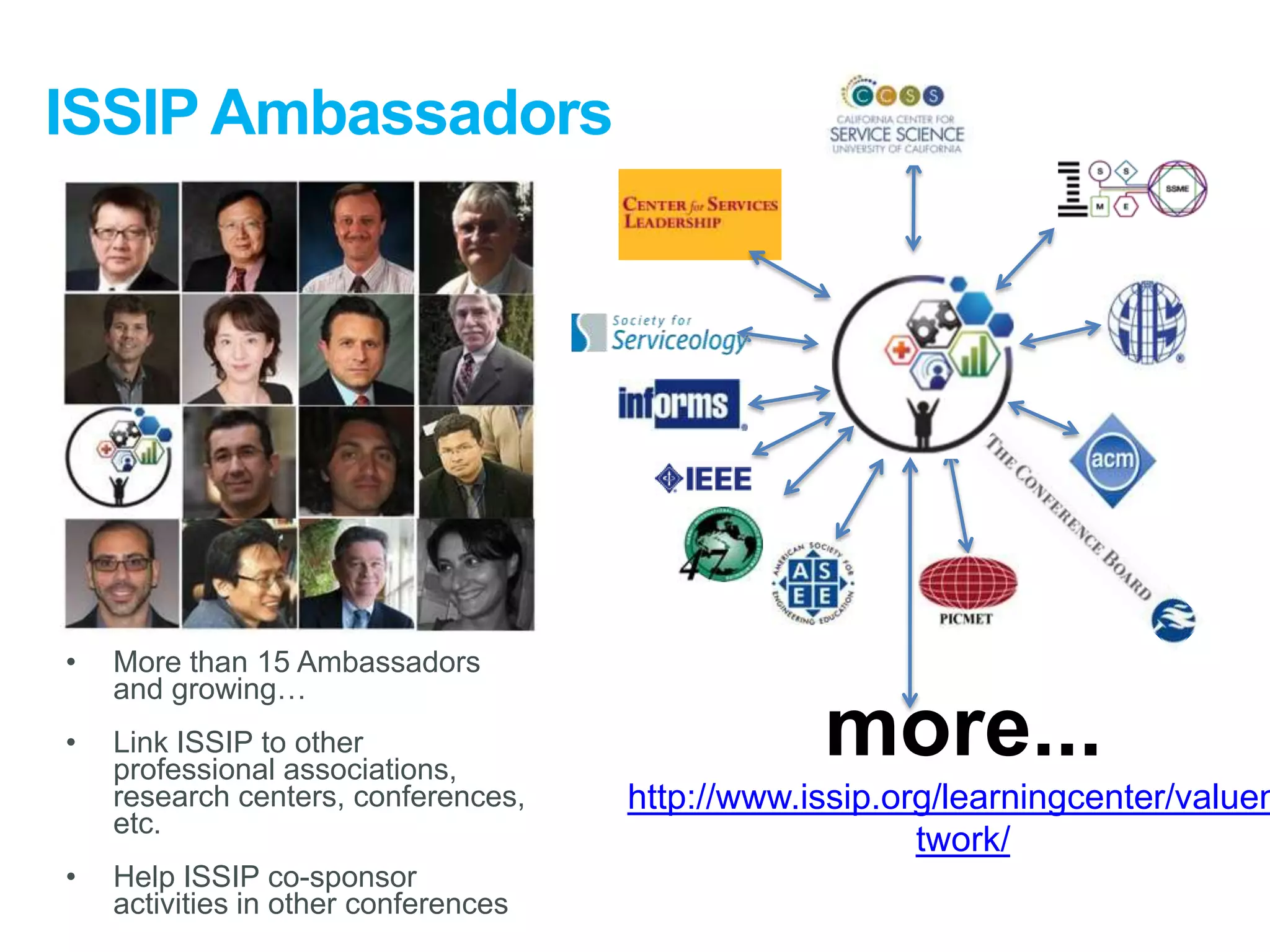
ISSIP Ambassadors

•

More than 15 Ambassadors
and growing…

•

Link ISSIP to other
professional associations,
research centers, conferences,
etc.

•

Help ISSIP co-sponsor
activities in other conferences

more...

http://www.issip.org/learningcenter/valuen
twork/
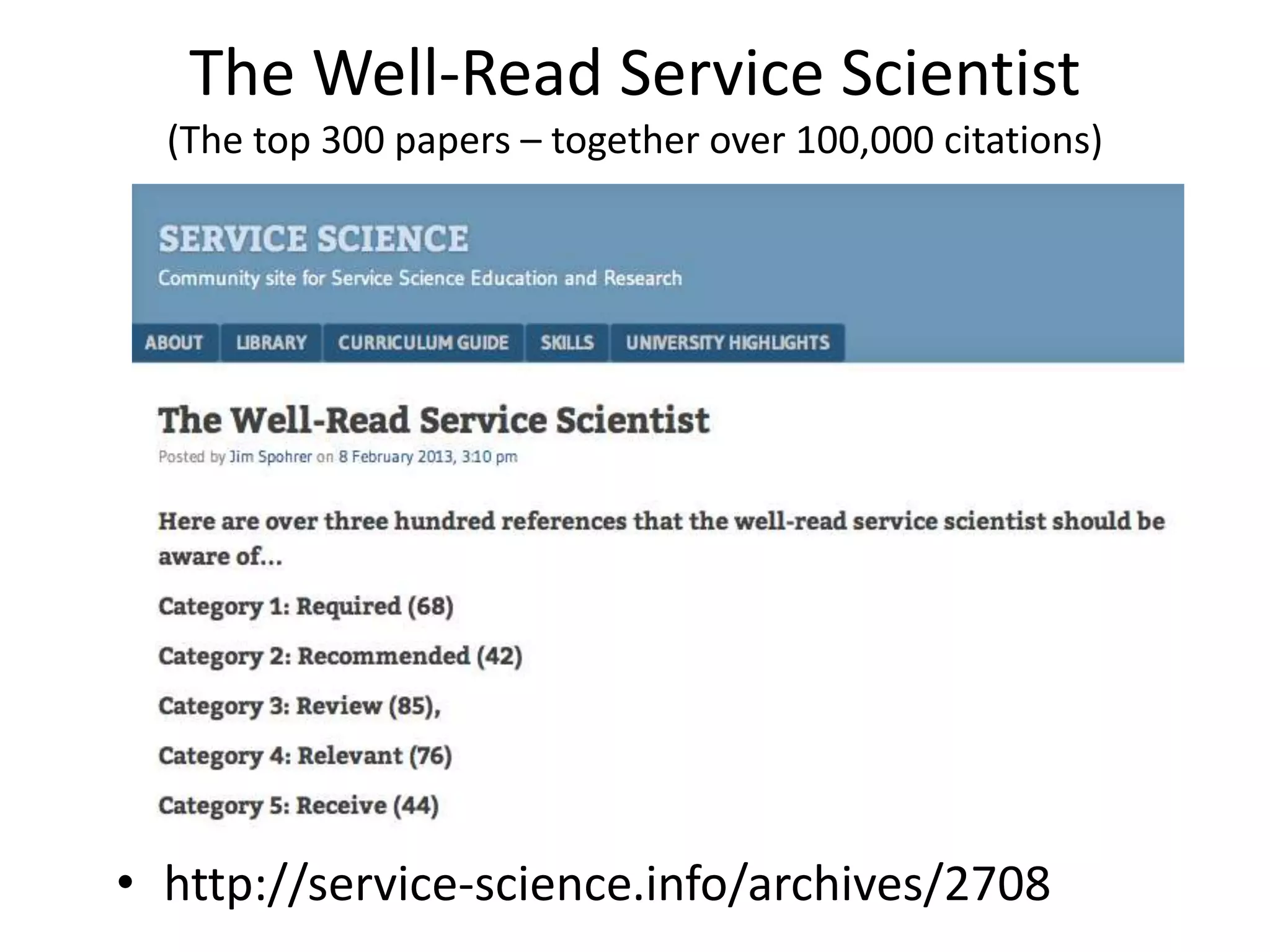
The Well-Read Service Scientist
(The top 300 papers – together over 100,000 citations)

• http://service-science.info/archives/2708
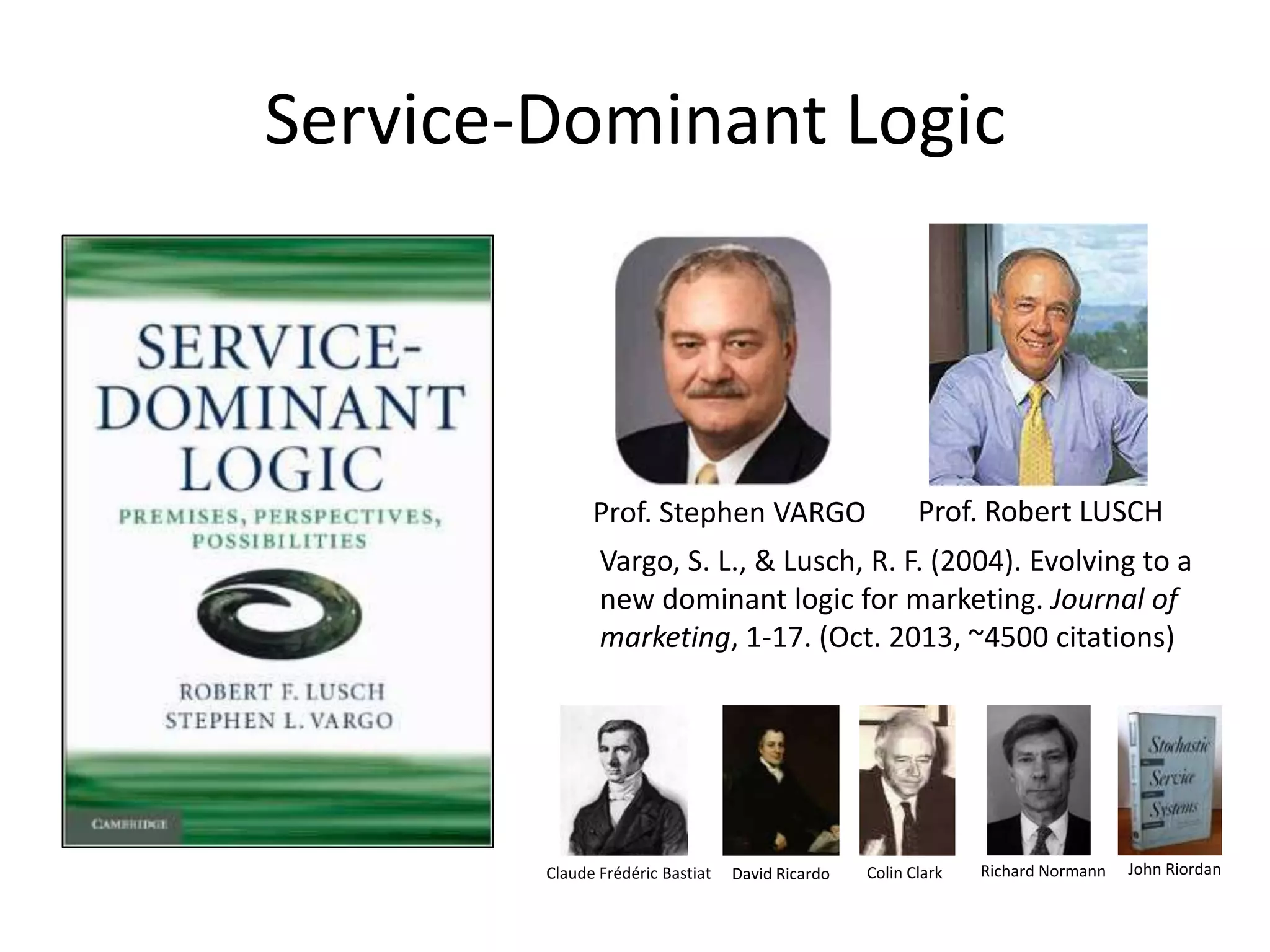
Service-Dominant Logic

Prof. Stephen VARGO

Prof. Robert LUSCH

Vargo, S. L., & Lusch, R. F. (2004). Evolving to a
new dominant logic for marketing. Journal of
marketing, 1-17. (Oct. 2013, ~4500 citations)

Claude Frédéric Bastiat

David Ricardo

Colin Clark

Richard Normann

John Riordan
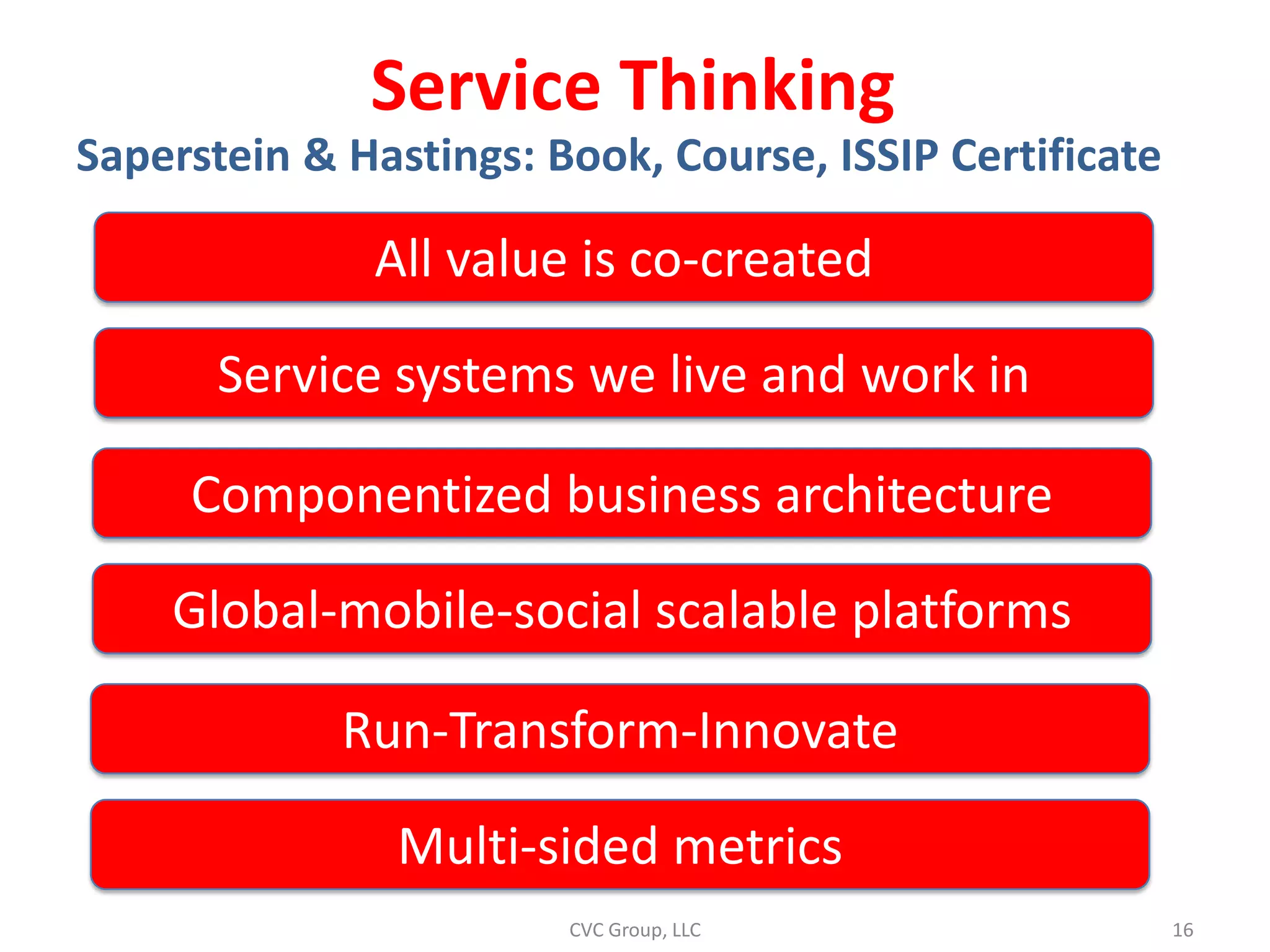
Service Thinking
Saperstein & Hastings: Book, Course, ISSIP Certificate

All value is co-created
Service systems we live and work in
Componentized business architecture

Global-mobile-social scalable platforms
Run-Transform-Innovate
Multi-sided metrics
CVC Group, LLC

16
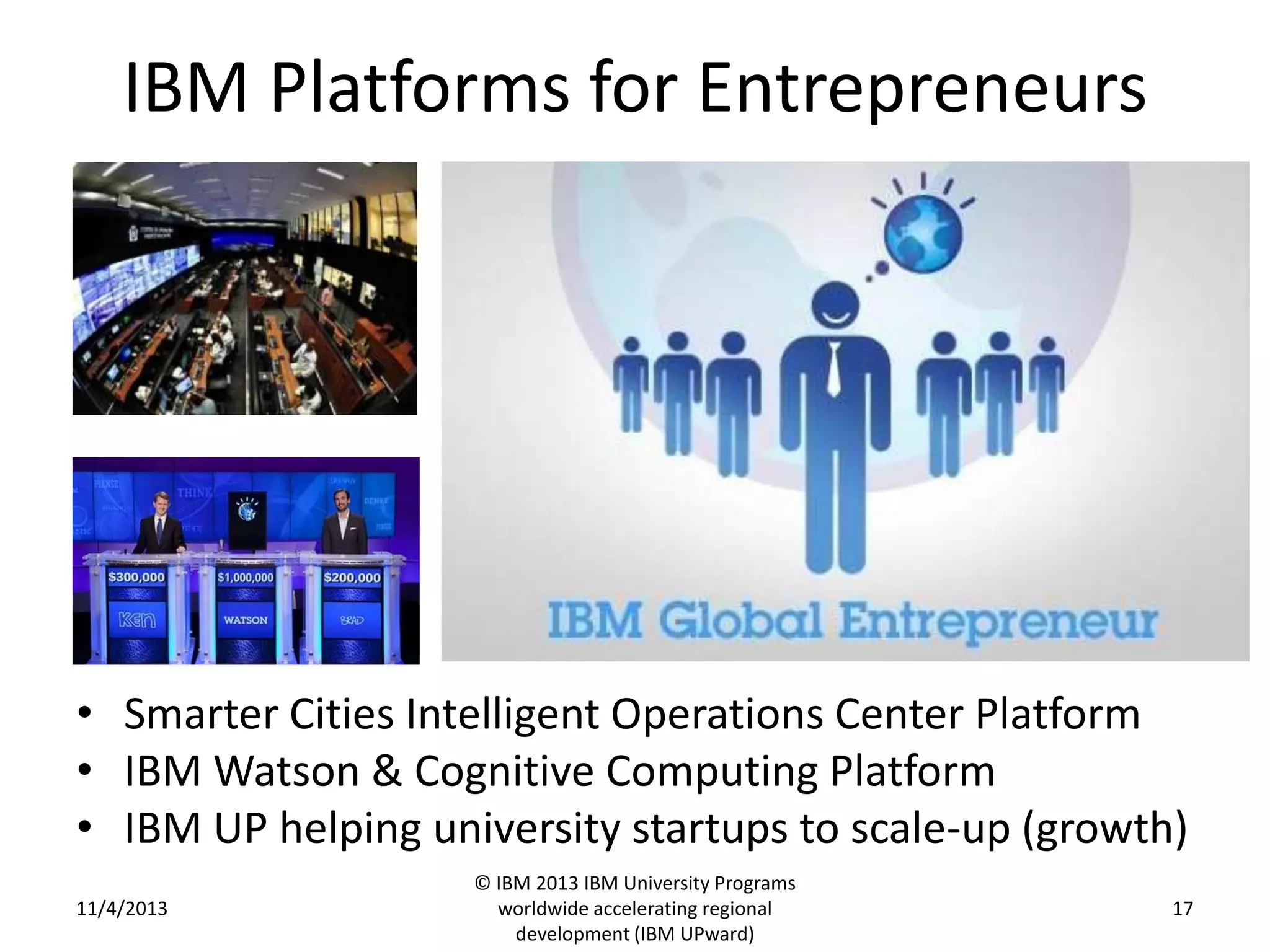
IBM Platforms for Entrepreneurs

• Smarter Cities Intelligent Operations Center Platform
• IBM Watson & Cognitive Computing Platform
• IBM UP helping university startups to scale-up (growth)
11/4/2013

© IBM 2013 IBM University Programs
worldwide accelerating regional
development (IBM UPward)

17
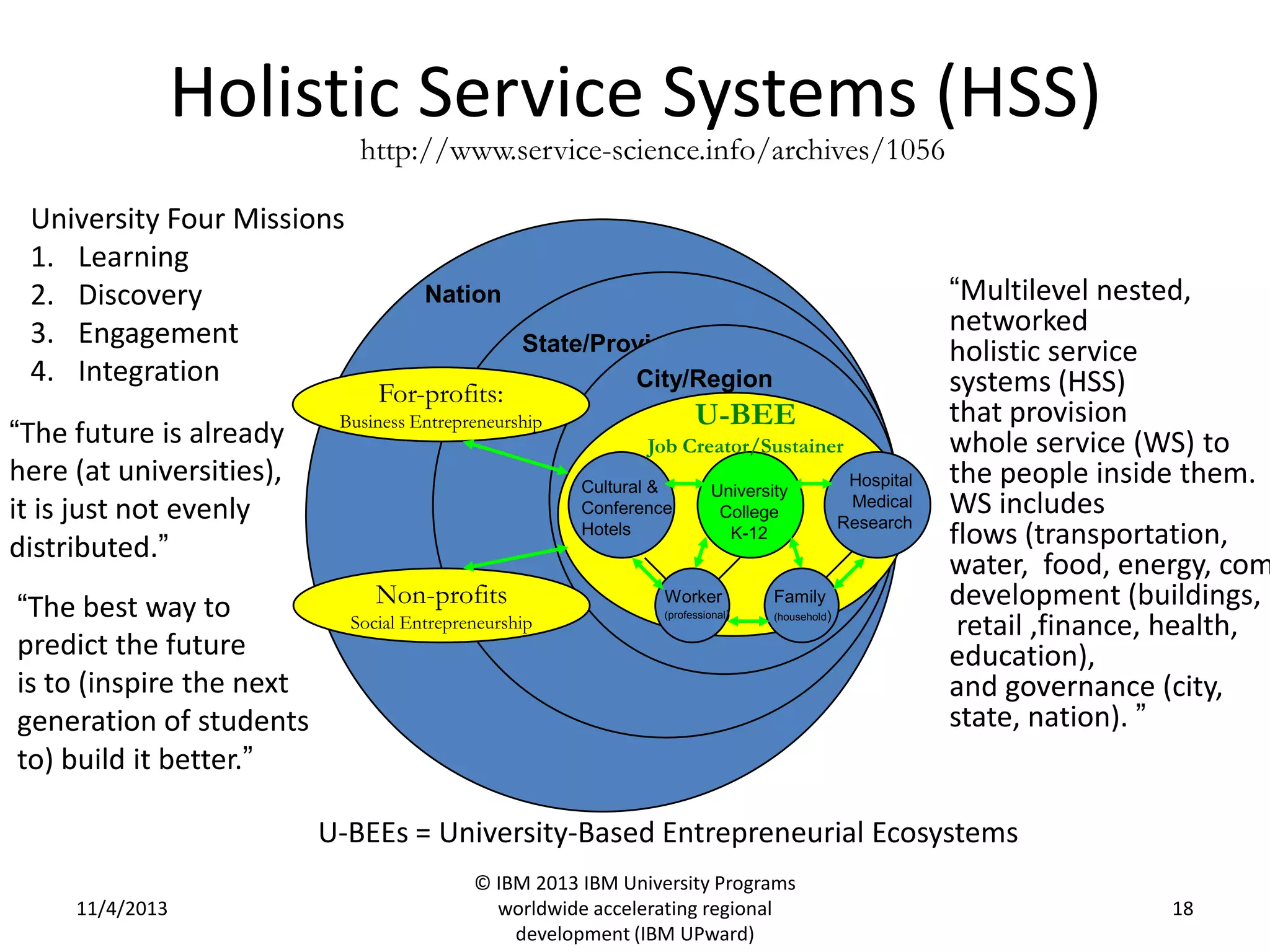
Holistic Service Systems (HSS)
http://www.service-science.info/archives/1056

University Four Missions
1. Learning
2. Discovery
3. Engagement
4. Integration
“The future is already
here (at universities),
it is just not evenly
distributed.”
“The best way to
predict the future
is to (inspire the next
generation of students
to) build it better.”

Nation

For-profits:

State/Province
City/Region

U-BEE

Business Entrepreneurship

Job Creator/Sustainer
Cultural &
Conference
Hotels

Non-profits
Social Entrepreneurship

University
College
K-12

Worker

Family

(professional )

(household)

Hospital
Medical
Research

“Multilevel nested,
networked
holistic service
systems (HSS)
that provision
whole service (WS) to
the people inside them.
WS includes
flows (transportation,
water, food, energy, com
development (buildings,
retail ,finance, health,
education),
and governance (city,
state, nation). ”

U-BEEs = University-Based Entrepreneurial Ecosystems
11/4/2013

© IBM 2013 IBM University Programs
worldwide accelerating regional
development (IBM UPward)

18
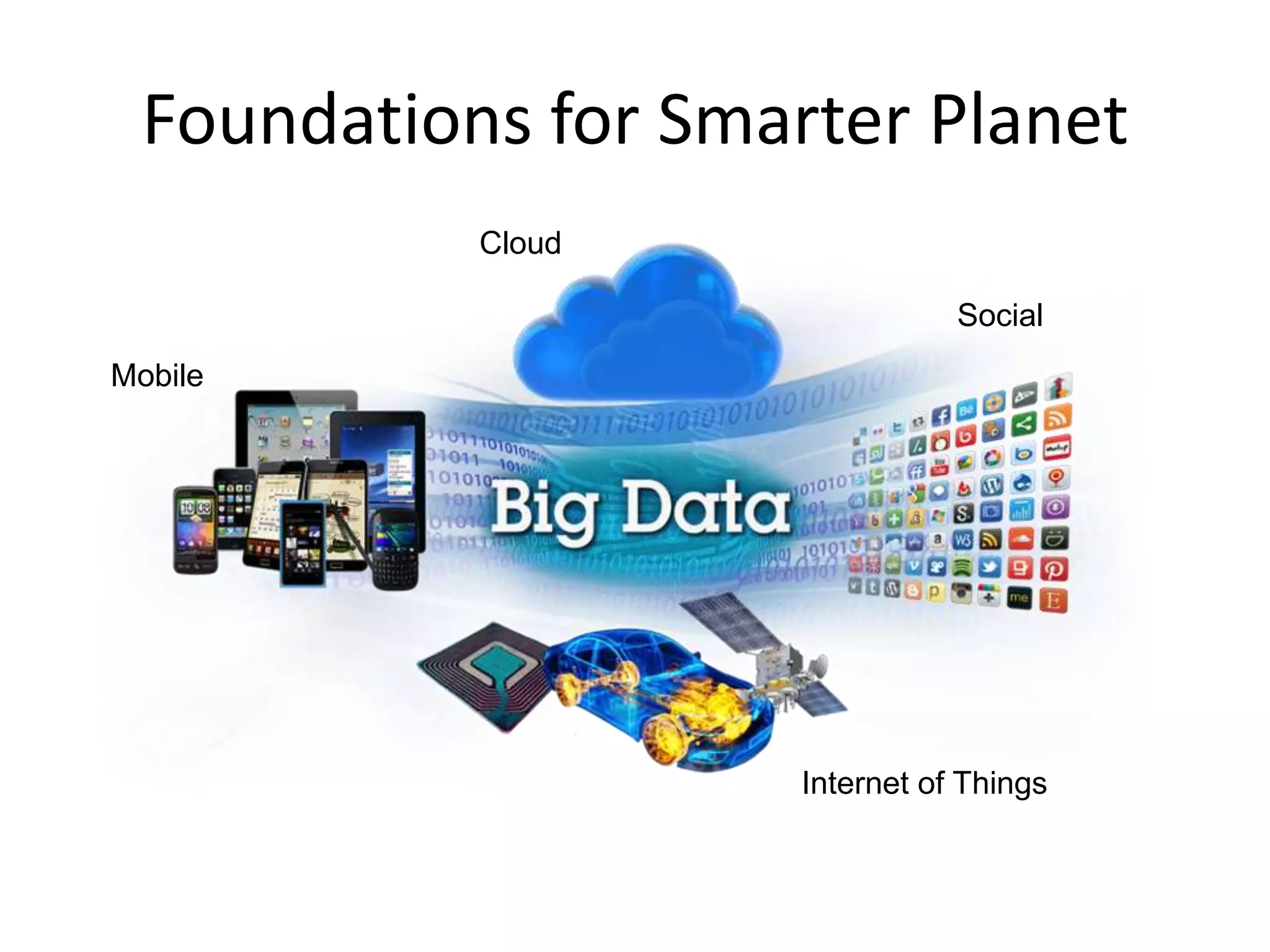
Foundations for Smarter Planet
Cloud
Social

Mobile

Internet of Things
11/4/2013

© IBM 2013 IBM University Programs
worldwide accelerating regional
development (IBM UPward)

20
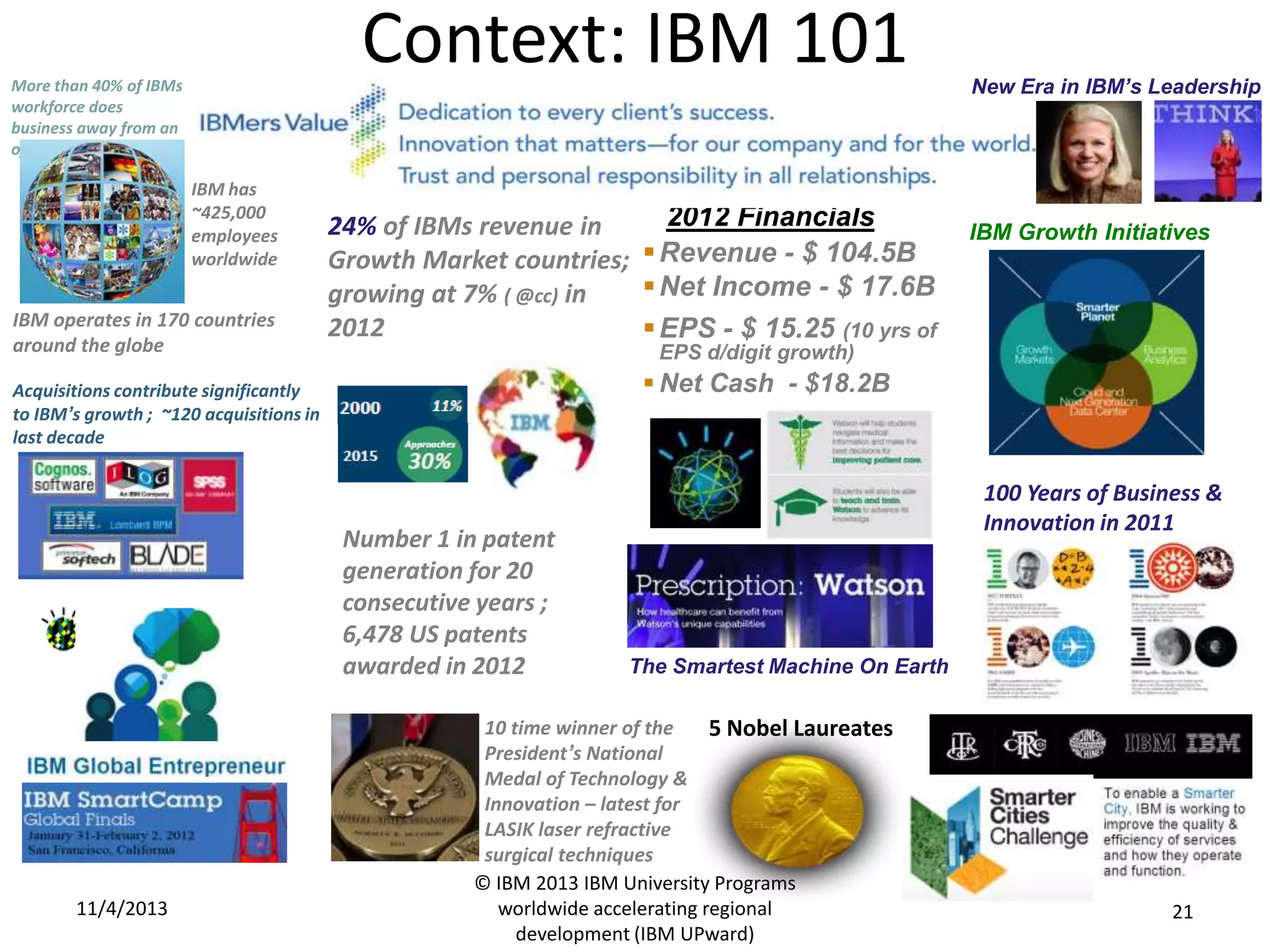
Context: IBM 101

More than 40% of IBMs
workforce does
business away from an
office

IBM has
~425,000
employees
worldwide

IBM operates in 170 countries
around the globe

2012 Financials
24% of IBMs revenue in
Growth Market countries;  Revenue - $ 104.5B
 Net Income - $ 17.6B
growing at 7% ( @cc) in
2012
 EPS - $ 15.25 (10 yrs of

IBM Growth Initiatives

EPS d/digit growth)

 Net Cash - $18.2B

Acquisitions contribute significantly
to IBM’s growth ; ~120 acquisitions in
last decade

Number 1 in patent
generation for 20
consecutive years ;
6,478 US patents
awarded in 2012

11/4/2013

New Era in IBM’s Leadership

100 Years of Business &
Innovation in 2011

The Smartest Machine On Earth

10 time winner of the
5 Nobel Laureates
President’s National
Medal of Technology &
Innovation – latest for
LASIK laser refractive
surgical techniques
© IBM 2013 IBM University Programs
worldwide accelerating regional
development (IBM UPward)

21
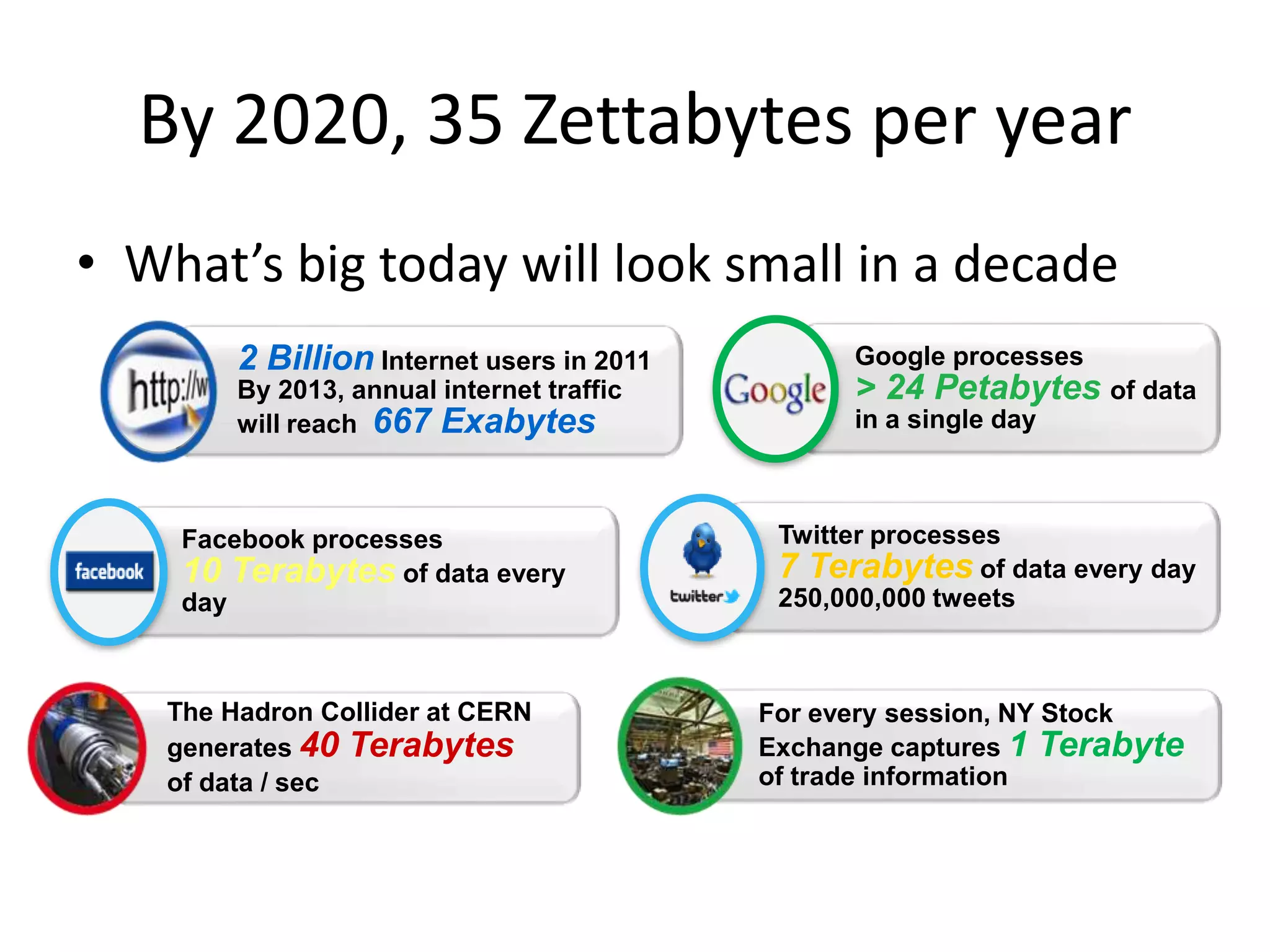
By 2020, 35 Zettabytes per year
• What’s big today will look small in a decade
2 Billion Internet users in 2011

Google processes

By 2013, annual internet traffic
will reach 667 Exabytes

in a single day

Facebook processes
10 Terabytes of data every
day

The Hadron Collider at CERN
generates 40 Terabytes
of data / sec

> 24 Petabytes of data

Twitter processes
7 Terabytes of data every day
250,000,000 tweets

For every session, NY Stock
Exchange captures 1 Terabyte
of trade information
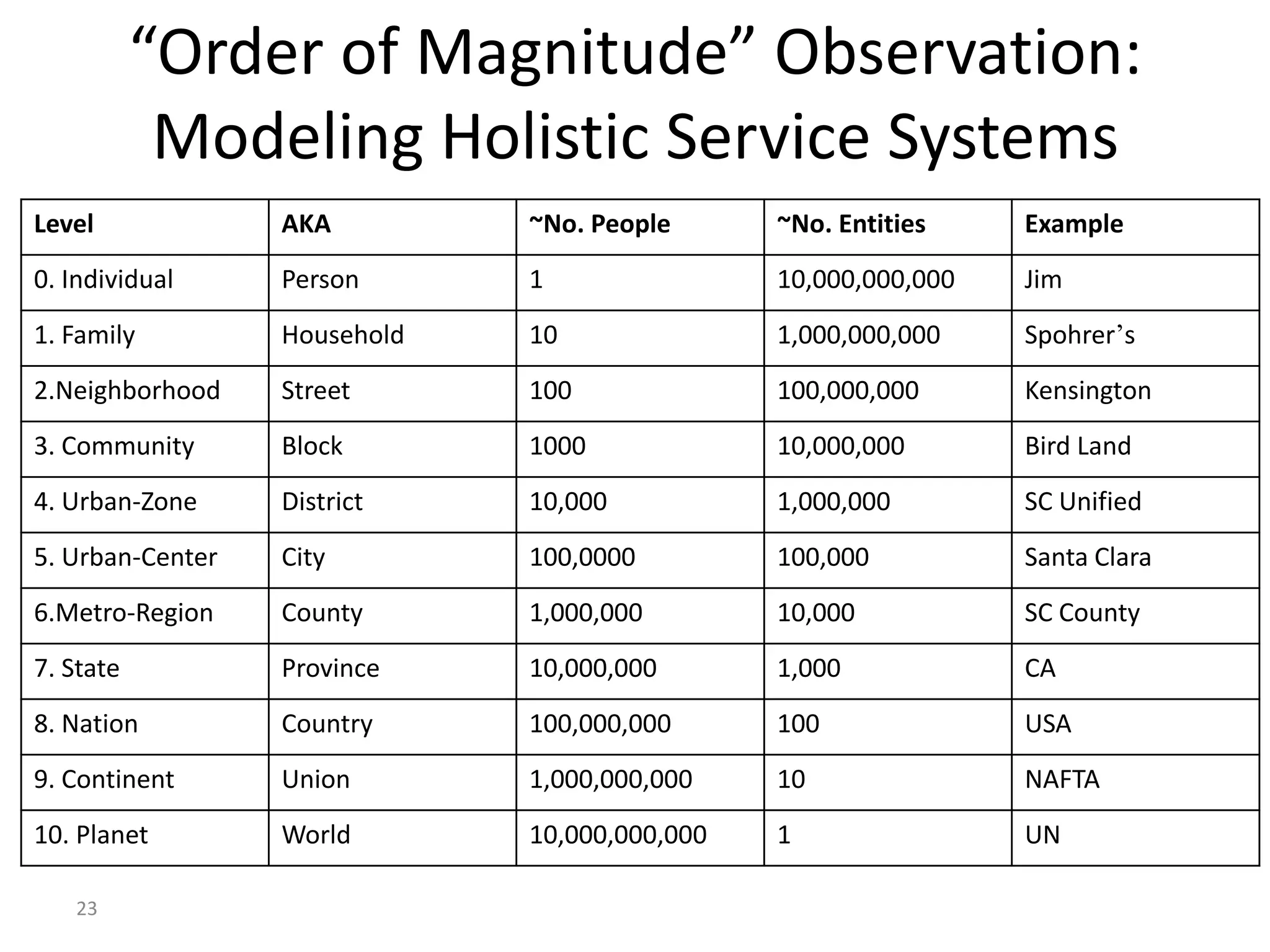
“Order of Magnitude” Observation:
Modeling Holistic Service Systems
Level

AKA

~No. People

~No. Entities

Example

0. Individual

Person

1

10,000,000,000

Jim

1. Family

Household

10

1,000,000,000

Spohrer’s

2.Neighborhood

Street

100

100,000,000

Kensington

3. Community

Block

1000

10,000,000

Bird Land

4. Urban-Zone

District

10,000

1,000,000

SC Unified

5. Urban-Center

City

100,0000

100,000

Santa Clara

6.Metro-Region

County

1,000,000

10,000

SC County

7. State

Province

10,000,000

1,000

CA

8. Nation

Country

100,000,000

100

USA

9. Continent

Union

1,000,000,000

10

NAFTA

10. Planet

World

10,000,000,000

1

UN

23

Cts csl phoenix 20131104 v1

  • 1.
    Smart Analytics Dr. JamesC. (“Jim”) Spohrer IBM Innovation Champion Director, IBM Global University Programs CTS CSL, Phoenix, USA, Nov. 6, 2013
  • 2.
    International Society ofService Innovation Professionals (ISSIP)
  • 3.
    Today’s Talk • IBM:Smart Analytics (5 V’s) for Smarter Planet • ISSIP: Service Innovation & T-shaped professionals Volume Velocity Variety Veracity* Data at Rest Data in Motion Data in Many Forms Data in Doubt Terabytes to exabytes of existing data to process Streaming data, milliseconds to seconds to respond Structured, unstructured, text, multimedia Uncertainty due to data inconsistency & incompleteness, ambiguities, latency, deception, model approximations
  • 4.
    Big data: Thisis just the beginning 9000 100 6000 You are here Social Media 50 Percent of uncertain data Volume in Exabytes Percentage of uncertain data Sensors & Devices VoIP Volume Veracity 3000 Enterprise Data Variety 2010 Source: IBM Global Technology Outlook 2012 4 0 2015 IBM source data is based on analysis done by the IBM Market Intelligence Department. IBM Market Intelligence data is provided for illustrative purposes and is not intended to be a guarantee of future growth rates or market opportunity © 2013 IBM Corporation
  • 5.
    5th V =Value of leveraging big data Nearly two out of three respondents reports realizing a competitive advantage from information and analytics Competitive advantage enabler  A majority of respondents reported analytics and information (including big data) creates a competitive advantage within their market or industry Realizing a competitive advantage 50% 2012 increase  Represents a 70% increase since 2010 among global respondents 5 52%  Organizations already active in big data activities were 15% more likely to report a competitive advantage  28% In the Education industry, the percentage of respondents reporting a competitive advantage rose from 28% in 2010 to 50% in 2012, a 79% increase in two years after a peak in 2011 at 52%. 63% 79% 58% 2011 70% increase 37% 2010 Education industry respondents Global respondents Respondents were asked “To what extent does the use of information (including big data) Respondents were a competitive advantage for your organization in your industry or and analytics createasked “To what extent does the use of information (including big data) and analytics create a competitive shown are for those who rated in extent a [4 ] or market.” Respondent percentages advantage for your organizationthe your industryor [5 market.” Respondent percentages shown are for those each year. Significant extent]. The same question has been asked who rated the extent a [4 ] or [5 Significant extent]. 2010 and 2011 datasets © Massachusetts Institute of Technology Source: Analytics: The real-world use of big data, a collaborative research study by the IBM Institute for Business Value and the Saïd Business School at the University of Oxford. © IBM 2012
  • 6.
    Smarter Planet =Smarter Service Systems Data Science + Urban Science + Service Science = Smarter Planet INSTRUMENTED INTERCONNECTED INTELLIGENT We now have the ability to measure, sense and see the exact condition of practically everything. People, systems and objects can communicate and interact with each other in entirely new ways. We can respond to changes quickly and accurately, and get better results by predicting and optimizing for future events. IT NETWORKS PRODUCTS WORKFORCE 6 SUPPLY CHAIN COMMUNICATIONS TRANSPORTATION BUILDINGS
  • 7.
    Growth of ServiceSystem Data: Need for Next Generation Professionals 7
  • 8.
    Welcome to thenew age of platform technologies and smarter service systems for every sector of business and society nested, networks systems
  • 9.
    National Science Foundation Afeature of a service system is the participation and cooperation of the customer in the service and its delivery. A service system then requires an integration of knowledge and technologies from a range of disciplines, often including engineering, computer science, social science, behavioral science, and cognitive science, paired with market knowledge to increase its social benefit.
  • 10.
    Next Generation: T-Shaped AdaptiveInnovators Many disciplines Many sectors Many regions/cultures (understanding & communications) Deep in one region/culture Deep in one sector Deep in one discipline
  • 11.
    Why ISSIP? T-shapesfor Teamwork BREADTH DEPTH • Our world is becoming more interconnected and complex • Yet most organizations operate is silos • Most professional organizations do a great job of focusing on one discipline, function, or industry sector ISSIP is a professional society designed to focus on the interconnected nature of value co-creation for smart service systems (tech, biz, social, etc.) T-Shape professionals can innovate across traditional boundaries
  • 12.
    Service Systems FundamentalAbstraction of Service Science: ISSIP portal to Disciplines (23), Professional Associations (39), Journals (20), Conferences (31), Workshops (7) Discipline Association Marketing AMA Operations Research INFORMS Information Systems AIS Computer Science and Engineering ACM, IEEE Human Factors AHFE Operations Management POMS Systems Science ISSS Design SDN Systems Engineering IIE … … Serviceology SfS (SSME+DAPP) ISSIP IBM SSME Centennial Icon of Progress
  • 13.
    ISSIP Ambassadors • More than15 Ambassadors and growing… • Link ISSIP to other professional associations, research centers, conferences, etc. • Help ISSIP co-sponsor activities in other conferences more... http://www.issip.org/learningcenter/valuen twork/
  • 14.
    The Well-Read ServiceScientist (The top 300 papers – together over 100,000 citations) • http://service-science.info/archives/2708
  • 15.
    Service-Dominant Logic Prof. StephenVARGO Prof. Robert LUSCH Vargo, S. L., & Lusch, R. F. (2004). Evolving to a new dominant logic for marketing. Journal of marketing, 1-17. (Oct. 2013, ~4500 citations) Claude Frédéric Bastiat David Ricardo Colin Clark Richard Normann John Riordan
  • 16.
    Service Thinking Saperstein &Hastings: Book, Course, ISSIP Certificate All value is co-created Service systems we live and work in Componentized business architecture Global-mobile-social scalable platforms Run-Transform-Innovate Multi-sided metrics CVC Group, LLC 16
  • 17.
    IBM Platforms forEntrepreneurs • Smarter Cities Intelligent Operations Center Platform • IBM Watson & Cognitive Computing Platform • IBM UP helping university startups to scale-up (growth) 11/4/2013 © IBM 2013 IBM University Programs worldwide accelerating regional development (IBM UPward) 17
  • 18.
    Holistic Service Systems(HSS) http://www.service-science.info/archives/1056 University Four Missions 1. Learning 2. Discovery 3. Engagement 4. Integration “The future is already here (at universities), it is just not evenly distributed.” “The best way to predict the future is to (inspire the next generation of students to) build it better.” Nation For-profits: State/Province City/Region U-BEE Business Entrepreneurship Job Creator/Sustainer Cultural & Conference Hotels Non-profits Social Entrepreneurship University College K-12 Worker Family (professional ) (household) Hospital Medical Research “Multilevel nested, networked holistic service systems (HSS) that provision whole service (WS) to the people inside them. WS includes flows (transportation, water, food, energy, com development (buildings, retail ,finance, health, education), and governance (city, state, nation). ” U-BEEs = University-Based Entrepreneurial Ecosystems 11/4/2013 © IBM 2013 IBM University Programs worldwide accelerating regional development (IBM UPward) 18
  • 19.
    Foundations for SmarterPlanet Cloud Social Mobile Internet of Things
  • 20.
    11/4/2013 © IBM 2013IBM University Programs worldwide accelerating regional development (IBM UPward) 20
  • 21.
    Context: IBM 101 Morethan 40% of IBMs workforce does business away from an office IBM has ~425,000 employees worldwide IBM operates in 170 countries around the globe 2012 Financials 24% of IBMs revenue in Growth Market countries;  Revenue - $ 104.5B  Net Income - $ 17.6B growing at 7% ( @cc) in 2012  EPS - $ 15.25 (10 yrs of IBM Growth Initiatives EPS d/digit growth)  Net Cash - $18.2B Acquisitions contribute significantly to IBM’s growth ; ~120 acquisitions in last decade Number 1 in patent generation for 20 consecutive years ; 6,478 US patents awarded in 2012 11/4/2013 New Era in IBM’s Leadership 100 Years of Business & Innovation in 2011 The Smartest Machine On Earth 10 time winner of the 5 Nobel Laureates President’s National Medal of Technology & Innovation – latest for LASIK laser refractive surgical techniques © IBM 2013 IBM University Programs worldwide accelerating regional development (IBM UPward) 21
  • 22.
    By 2020, 35Zettabytes per year • What’s big today will look small in a decade 2 Billion Internet users in 2011 Google processes By 2013, annual internet traffic will reach 667 Exabytes in a single day Facebook processes 10 Terabytes of data every day The Hadron Collider at CERN generates 40 Terabytes of data / sec > 24 Petabytes of data Twitter processes 7 Terabytes of data every day 250,000,000 tweets For every session, NY Stock Exchange captures 1 Terabyte of trade information
  • 23.
    “Order of Magnitude”Observation: Modeling Holistic Service Systems Level AKA ~No. People ~No. Entities Example 0. Individual Person 1 10,000,000,000 Jim 1. Family Household 10 1,000,000,000 Spohrer’s 2.Neighborhood Street 100 100,000,000 Kensington 3. Community Block 1000 10,000,000 Bird Land 4. Urban-Zone District 10,000 1,000,000 SC Unified 5. Urban-Center City 100,0000 100,000 Santa Clara 6.Metro-Region County 1,000,000 10,000 SC County 7. State Province 10,000,000 1,000 CA 8. Nation Country 100,000,000 100 USA 9. Continent Union 1,000,000,000 10 NAFTA 10. Planet World 10,000,000,000 1 UN 23

Editor's Notes

  • #8 Big Data in business has grown over 60 years from ~10MB to 100PB or a billion times :MB -> GB -> TB –> PB All that Big Data from 1950 can easily be handled by one person’s smart phoneService science is now taught in over 500 universities that we know of and probably at least 2x more that we don’t know about…The number of service science conferences and service science related journals has also expanded
  • #9 Individuals with smartphonesDrivers in driveless carsHome owners in smart rooms in their smart housesOccupants of smart buildings, sometimes 30 story smart buildings built in just 15 daysPatients, doctors, and nurses in smart hospitals and operating roomsTechnicians monitoring multiples aspects of from a smarter city intelligent operations centersSmall retail businesses taking credit card purchses on their smart phones
  • #13 There is a conference nearly every week, and approx. ten publication every day…Service Science Knowledge Environmenthttp://sske.cloud.upb.ro/sskemw/index.php/Main_Page
  • #16 Bastiat: Economic HarmoniesRicardo: Principles of Political Economy and TaxationClark: Conditions of Economic ProgressRiordan: Stochastic Service Systems
  • #19 Multilevel nested, networked holistic service systems (HSS) that provision whole service (WS) to the people inside them. WS includes flows (transportation, water, food, energy, communications), development (buildings, retail, finance, health, education), and governance (city, state, nation). What are the largest and smallest service system entities that have the problem of interconnected systems?Holistic Service Systems like nations, states, cities, and universities – are all system of systems dealing with flows, development, and governance.=============\Nations (~100)States/Provinces (~1000)Cities/Regions (~10,000)Educational Institutions (~100,000)Healthcare Institutions (~100,000)Other Enterprises (~10,000,000)Largest 2000>50% GDP WWFamilies/Households (~1B)Persons (~10B)Balance/ImproveQuality of Life, generation after generationGDP/CapitaQuality of ServiceCustomer ExperienceQuality of JobsEmployee ExperienceQuality of Investment-OpportunitiesOwner ExperienceEntrepreneurial ExperienceSustainabilityGDP/Energy-Unit% Fossil% RenewableGDP/Mass-Unit% New Inputs% Recycled Inputs
  • #23 35 Zettabytes - IDC