FACILITY SECURITY PLAN
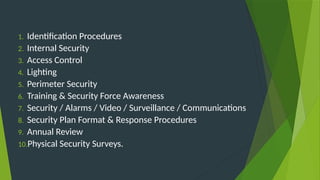
1. Identification Procedures
2. Internal Security
3. Access Control
4. Lighting
5. Perimeter Security
6. Training & Security Force Awareness
7. Security / Alarms / Video / Surveillance / Communications
8. Security Plan Format & Response Procedures
9. Annual Review
10.Physical Security Surveys.
Identification Procedures
A. Employees
i. Employee / Union photo ID
ii. Present upon request
iii. Color coded
iv. Background checks
v. Renewal on annual basis
vi. Laminated, issued by Serial Number
vii. Log
B. Vendors / Contractors / Vessel Pilots
i. Valid photo ID
ii. Verification Process
iii. Access Lists
C. Truck Drivers / Passengers
iv. Valid photo ID
v. Verification Process
D. Visitors (other categories)
vi. Valid photo ID (DL, Passport)
vii. Verification Process
viii.Schedule in Advance
E. Government Employees
ix. Valid government ID
x. Should be given access to complete official visits / inspections
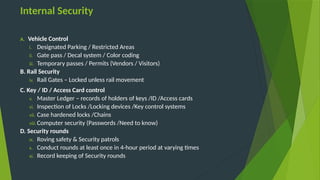
Internal Security
A. Vehicle Control
i. Designated Parking / Restricted Areas
ii. Gate pass / Decal system / Color coding
iii. Temporary passes / Permits (Vendors / Visitors)
B. Rail Security
iv. Rail Gates – Locked unless rail movement
C. Key / ID / Access Card control
v. Master Ledger – records of holders of keys /ID /Access cards
vi. Inspection of Locks /Locking devices /Key control systems
vii. Case hardened locks /Chains
viii.Computer security (Passwords /Need to know)
D. Security rounds
ix. Roving safety & Security patrols
x. Conduct rounds at least once in 4-hour period at varying times
xi. Record keeping of Security rounds
Access Control
A. Armed Guard / Local Police Department Response
B. Gates (Locked / Secured / Guarded)
C. Deliveries (Schedule in Advance / Subject to search)
Lighting
A. Illuminated at least to level of twilight
B. Use of updated lighting technology (high pressure sodium,
mercury vapor, metal halide)
C. Directed downward, away from guard’s offices /navigable
waterways. Produce high contrast with few shadows.
Perimeter Security
A. Restricted Areas
i. Control & channel access
B. Barriers
i. Perimeter areas cleared of vegetation & debris
ii. Supporting safeguards for natural barriers
C. Fencing
i. 8 feet high, 9-gauge galvanized steel, 2-inch-wide chain link
w /2 feet barbed wire outrigger consisting of 3 strands of 9-
gauge galvanized barb wire at 45-degree outward angle
ii. Bottom of fence within 2 inches of ground
iii. Fence lines clear of all obstructions
Training & Security Awareness
A. Training & Qualification program for Security force
personnel
B. Training Program – Job specific
i. LE & Security guidelines
ii. Company Policies, Security Plan & Response Procedures
iii. Prevention, Detection, Investigation of Criminal Activities
iv. Reporting threats /actual criminal and terrorist activity
v. Communications & Surveillance systems operations
vi. Notification procedures when higher security levels imposed
Security plan format and Response procedures
A. Facility plan
i. Inclusion of all discussed
ii. Designate by name facility security officer
B. Response procedures
i. Unauthorized personnel discovered on facility
ii. Unauthorized /illegally parked /abandoned vehicles in or near
the facility
iii. Unauthorized vessels moored along waterfront property
iv. Bomb Threat
v. Suspicious person /Activity response
vi. Loss of power /Lighting
vii. Mail handling
viii.Unknown /Suspicious package discovery response
Annual review of plan
Annual conduction of Physical Security surveys
Security Levels
Level I - The degree of security precautions to take when the
threat of an unlawful act against a vessel or terminal is though
possible, not likely.
Level II - The degree of security precautions to taken when the
threat of an unlawful act against a vessel or terminal is possible
and intelligence indicates that terrorists are likely to be active
within a specific area, or against a type of vessel or terminal.
Level III - The degree of security precautions to take when the
threat of an unlawful act against a vessel or terminal is probable
or imminent and intelligence indicates that terrorists have chosen
specific targets.
Physical Security Surveys
1. Documentation
i. Track previous security surveys
ii. Identify Security breakdowns
iii. Identify if Current Security systems adequately address threat /risk
iv. Identify short - term, Long - term Security upgrade recommendations
v. How will report assist in Unit’s mission
2. Examination of Security plan
i. Identification Procedures
ii. Access control
iii. Internal /Perimeter Security
iv. Lighting
v. Security /Alarms /Video /Surveillance /Communications
vi. Security Force /Training
vii. Security Awareness
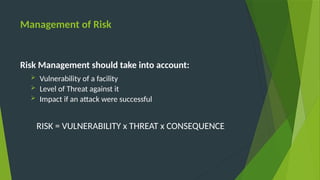
Management of Risk
Risk Management should take into account:
 Vulnerability of a facility
 Level of Threat against it
 Impact if an attack were successful
RISK = VULNERABILITY x THREAT x CONSEQUENCE
Certified Protection Professional Training Course
Personnel Security
Personnel Security:
Purpose and Functions:
 Personnel Security’s primary purpose is to ensure that on
organization hires those candidates best suited to assist the
organization in achieving its desired goals. After the individual
is hired, this employee now serves to augment the security
program by protecting the organization’s assets.
 Vulnerability to losses caused by employees is measure in part
by the character of the employees, their awareness of asset
protection requirements and their motivation to cooperate.
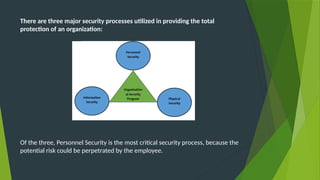
There are three major security processes utilized in providing the total
protection of an organization:
Of the three, Personnel Security is the most critical security process, because the
potential risk could be perpetrated by the employee.
The key function of the personnel security
process are:
 Screening
 Application Screening
 Resumes
 Background Investigations
 Work history
 References
 Financial
 Investigations of current employees suspected in violation of
organization’s rules and regulations.
 Security awareness and educational programs.
 Protection of employees from discriminatory practices.
A comprehensive Personnel Security program
should include the following elements:
1. Adequate job specification which are documented in the form of a job
description.
 Job specifications provide information to determine the worth of the job.
 It identifies the knowledge and skills required.
2. Appropriate application screening procedures and standards
 A well-constructed application form serves as a pre-screening tool
3. Background investigative standards
4. Criteria for employee conduct and performance standards.
 Performance standards describe the results that should exist upon
completion of a specific assignment or activity.
5. Investigative process for questionable workplace conduct.
6. Disciplinary or corrective action procedures (i.e., Progressive discipline)
7. Procedures for employee discharge
Note: A comprehensive personnel security program must be non-discriminative
and in accordance with federal and state employment laws.
Job Analysis and Job Description:
 Prior to an organization engaging in the recruitment for employment, the
organization must define the job specifications. The key tools in this process
are the job analysis and the job description.
Job Analysis - the procedure by which jobs are researched
to determine the activities and responsibilities. These
include:
1. The relationship the job has with other jobs within the organization.
2. The personal qualification necessary to perform the job.
3. The conditions under which the work or tasks are performed.
Job Description - one of the important outputs of the job analysis is the job
description. Based on the job analysis, a written job description can be prepared
for the position within the organization.
Key Elements within the job description:
1. General purpose of the job.
2. Duties and responsibilities.
3. Knowledge, skill and abilities.
4. Education or training.
The job description can be used for:
1. Recruiting and screening
2. Test design (in relation to the job)
3. Hiring and placement
4. Orientation
5. Developing procedures
6. Training and development
Applicant Screening:
Applicant screening verifies accuracy and completeness of applicant’s
statements and develops additional relevant information.
 The key to an effective personnel security program is to endeavor
to screen out the candidates who might pose a risk to the organization.
 Deliberate misstatements or material omissions in any segment
of the process should be considered major disqualifying features.
 All relevant aspects of the candidate’s background are weighed
using the whole man rule which gives consideration for the totality of
the person.
 Governing standards should be the needs of the organization and
fairness to the applicant.
Rejection should be on the basis of the standards
which have been clearly defined:
1. The standards must be strictly adhered to;
2. The standards should be updated on a regular basis to ensure legal compliance.
Under federal law, there are certain criteria relating to the type of questions that candidates for
employment may be asked. The following are federal laws that prohibit employment
discrimination.
3. Civil Rights Act of 1964 - prohibits employment discrimination based on race, color, religion,
sex or national origin.
4. Age discrimination employment Act of 1967 - protects individuals who are 40 years of age
or older. (Applies to organizations with 20 or more employees.
5. Americans Disability Act of 1990 - prohibits employment discrimination against qualified
individuals with disabilities.
6. Equal Pay Act of 1963 - protects men and women from performing essentially equal work in
the same establishment from sexual based wage discrimination.
The Equal Employment Opportunity Commission (EEOC) enforces all the aforementioned laws.
It also provides oversight and coordination of all Equal Employment Opportunity regulations,
practices and policies.
Focal issues in a Screening Process: (Things to look for)
1. Signs of instability in job /career
2. Candidate under or overqualified for position
3. Declining salary history
4. No referencing of former supervisors
5. Gaps in residences or unexplained moves
6. Inadequate or no personal references.
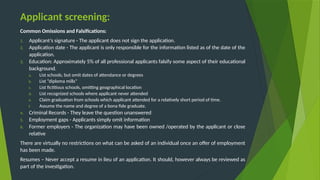
Applicant screening:
Common Omissions and Falsifications:
1. Applicant’s signature - The applicant does not sign the application.
2. Application date - The applicant is only responsible for the information listed as of the date of the
application.
3. Education: Approximately 5% of all professional applicants falsify some aspect of their educational
background.
a. List schools, but omit dates of attendance or degrees
b. List “diploma mills”
c. List fictitious schools, omitting geographical location
d. List recognized schools where applicant never attended
e. Claim graduation from schools which applicant attended for a relatively short period of time.
f. Assume the name and degree of a bona fide graduate.
4. Criminal Records - They leave the question unanswered
5. Employment gaps - Applicants simply omit information
6. Former employers - The organization may have been owned /operated by the applicant or close
relative
There are virtually no restrictions on what can be asked of an individual once an offer of employment
has been made.
Resumes – Never accept a resume in lieu of an application. It should, however always be reviewed as
part of the investigation.
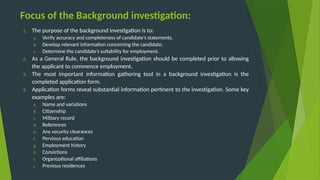
Focus of the Background investigation:
1. The purpose of the background investigation is to:
a. Verify accuracy and completeness of candidate’s statements.
b. Develop relevant information concerning the candidate.
c. Determine the candidate’s suitability for employment.
2. As a General Rule, the background investigation should be completed prior to allowing
the applicant to commence employment.
3. The most important information gathering tool in a background investigation is the
completed application form.
4. Application forms reveal substantial information pertinent to the investigation. Some key
examples are:
a. Name and variations
b. Citizenship
c. Military record
d. References
e. Any security clearances
f. Pervious education
g. Employment history
h. Convictions
i. Organizational affiliations
j. Previous residences
5. Investigative Coverage should include all or part of the following depending upon
job requirements and funds available:
a. Check any available local security indices and police files to ascertain
derogatory information. (Note: Such information must be publicly available
and lawfully obtained.)
b. Criminal history - if a candidate indicated a conviction record, the details
should be verified.
c. At least five consecutive immediately preceding year of employment and or
non-employment should be verified.
d. Any gaps in employment more than 30 days should be explained and be fully
explored.
e. Claimed residence for the period covered in employment and education
inquiries should be verified.
f. Criminal court records should be checked.
g. Listed and developed personal references are interviewed.
h. All education required for position should be verified.
i. Interviews of former employees and work associates.
6. Personal contact rather than telephone or mail queries is by far the most desirable
method of investigation.
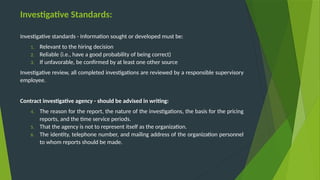
Investigative Standards:
Investigative standards - Information sought or developed must be:
1. Relevant to the hiring decision
2. Reliable (i.e., have a good probability of being correct)
3. If unfavorable, be confirmed by at least one other source
Investigative review, all completed investigations are reviewed by a responsible supervisory
employee.
Contract investigative agency - should be advised in writing:
4. The reason for the report, the nature of the investigations, the basis for the pricing
reports, and the time service periods.
5. That the agency is not to represent itself as the organization.
6. The identity, telephone number, and mailing address of the organization personnel
to whom reports should be made.
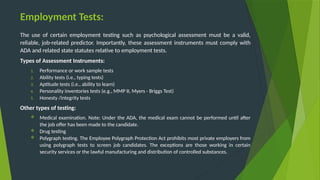
Employment Tests:
The use of certain employment testing such as psychological assessment must be a valid,
reliable, job-related predictor. Importantly, these assessment instruments must comply with
ADA and related state statutes relative to employment tests.
Types of Assessment Instruments:
1. Performance or work sample tests
2. Ability tests (i.e., typing tests)
3. Aptitude tests (i.e., ability to learn)
4. Personality inventories tests (e.g., MMP II, Myers - Briggs Test)
5. Honesty /integrity tests
Other types of testing:
 Medical examination. Note: Under the ADA, the medical exam cannot be performed until after
the job offer has been made to the candidate.
 Drug testing
 Polygraph testing. The Employee Polygraph Protection Act prohibits most private employers from
using polygraph tests to screen job candidates. The exceptions are those working in certain
security services or the lawful manufacturing and distribution of controlled substances.
Orientation and Financial & Lifestyle inquiry
Financial and lifestyle inquiry:
These investigations should be conducted during the initial background
investigation and every 18 months thereafter. All employees must be advised of the
organizations’ policy on this type of inquiry.
Any anomalies found should be investigated fully, including interviewing the
subject of the inquiry.
Orientation for New Employees:
The orientation program should be designed to familiarize the new employee
with the organization’s culture, goals, objectives, procedures and rules. This
process also identifies requirement for employees to protect assets and to play a
role in loss prevention.
Security Awareness:
Security awareness is a state of mind. The purposes of security awareness are:
1. To understand the relationship between security and a successful operation
2. To know one’s personal obligation under the security program
3. To comply with legal and regulatory requirements
4. To comply with any contractual obligations
Exit Interviews:
An exit interview is a valuable tool for the following reasons:
5. Gives the employee an opportunity to list grievances and or issues
6. Management often learns of problems not previously known
7. Helps to reduce loss when a checklist is used to have organizations’ property returned
8. Is used to remind departing employee of legal obligation to protect trade secrets or
confidential records, non-compete agreements, and non-disclosure agreements.
Work Place Violence:
A protection method is to have a “Threat Management” approach which involves:
1. Pre-employment screening
2. Access control and other physical security measures
3. A fully disseminated written policy statement and reporting procedures
4. An Incident Management Team (IMT)
5. Established guidelines for threat and incident management
THANK YOU

FACILITY-SECURITY-PLAN-training pptx.pptx

  • 1.
  • 2.
    1. Identification Procedures 2.Internal Security 3. Access Control 4. Lighting 5. Perimeter Security 6. Training & Security Force Awareness 7. Security / Alarms / Video / Surveillance / Communications 8. Security Plan Format & Response Procedures 9. Annual Review 10.Physical Security Surveys.
  • 3.
    Identification Procedures A. Employees i.Employee / Union photo ID ii. Present upon request iii. Color coded iv. Background checks v. Renewal on annual basis vi. Laminated, issued by Serial Number vii. Log
  • 4.
    B. Vendors /Contractors / Vessel Pilots i. Valid photo ID ii. Verification Process iii. Access Lists C. Truck Drivers / Passengers iv. Valid photo ID v. Verification Process D. Visitors (other categories) vi. Valid photo ID (DL, Passport) vii. Verification Process viii.Schedule in Advance E. Government Employees ix. Valid government ID x. Should be given access to complete official visits / inspections
  • 5.
    Internal Security A. VehicleControl i. Designated Parking / Restricted Areas ii. Gate pass / Decal system / Color coding iii. Temporary passes / Permits (Vendors / Visitors) B. Rail Security iv. Rail Gates – Locked unless rail movement C. Key / ID / Access Card control v. Master Ledger – records of holders of keys /ID /Access cards vi. Inspection of Locks /Locking devices /Key control systems vii. Case hardened locks /Chains viii.Computer security (Passwords /Need to know) D. Security rounds ix. Roving safety & Security patrols x. Conduct rounds at least once in 4-hour period at varying times xi. Record keeping of Security rounds
  • 6.
    Access Control A. ArmedGuard / Local Police Department Response B. Gates (Locked / Secured / Guarded) C. Deliveries (Schedule in Advance / Subject to search)
  • 7.
    Lighting A. Illuminated atleast to level of twilight B. Use of updated lighting technology (high pressure sodium, mercury vapor, metal halide) C. Directed downward, away from guard’s offices /navigable waterways. Produce high contrast with few shadows.
  • 8.
    Perimeter Security A. RestrictedAreas i. Control & channel access B. Barriers i. Perimeter areas cleared of vegetation & debris ii. Supporting safeguards for natural barriers C. Fencing i. 8 feet high, 9-gauge galvanized steel, 2-inch-wide chain link w /2 feet barbed wire outrigger consisting of 3 strands of 9- gauge galvanized barb wire at 45-degree outward angle ii. Bottom of fence within 2 inches of ground iii. Fence lines clear of all obstructions
  • 9.
    Training & SecurityAwareness A. Training & Qualification program for Security force personnel B. Training Program – Job specific i. LE & Security guidelines ii. Company Policies, Security Plan & Response Procedures iii. Prevention, Detection, Investigation of Criminal Activities iv. Reporting threats /actual criminal and terrorist activity v. Communications & Surveillance systems operations vi. Notification procedures when higher security levels imposed
  • 10.
    Security plan formatand Response procedures A. Facility plan i. Inclusion of all discussed ii. Designate by name facility security officer B. Response procedures i. Unauthorized personnel discovered on facility ii. Unauthorized /illegally parked /abandoned vehicles in or near the facility iii. Unauthorized vessels moored along waterfront property iv. Bomb Threat v. Suspicious person /Activity response vi. Loss of power /Lighting vii. Mail handling viii.Unknown /Suspicious package discovery response
  • 11.
  • 12.
    Annual conduction ofPhysical Security surveys
  • 13.
    Security Levels Level I- The degree of security precautions to take when the threat of an unlawful act against a vessel or terminal is though possible, not likely. Level II - The degree of security precautions to taken when the threat of an unlawful act against a vessel or terminal is possible and intelligence indicates that terrorists are likely to be active within a specific area, or against a type of vessel or terminal. Level III - The degree of security precautions to take when the threat of an unlawful act against a vessel or terminal is probable or imminent and intelligence indicates that terrorists have chosen specific targets.
  • 14.
    Physical Security Surveys 1.Documentation i. Track previous security surveys ii. Identify Security breakdowns iii. Identify if Current Security systems adequately address threat /risk iv. Identify short - term, Long - term Security upgrade recommendations v. How will report assist in Unit’s mission 2. Examination of Security plan i. Identification Procedures ii. Access control iii. Internal /Perimeter Security iv. Lighting v. Security /Alarms /Video /Surveillance /Communications vi. Security Force /Training vii. Security Awareness
  • 15.
    Management of Risk RiskManagement should take into account:  Vulnerability of a facility  Level of Threat against it  Impact if an attack were successful RISK = VULNERABILITY x THREAT x CONSEQUENCE
  • 16.
    Certified Protection ProfessionalTraining Course Personnel Security Personnel Security: Purpose and Functions:  Personnel Security’s primary purpose is to ensure that on organization hires those candidates best suited to assist the organization in achieving its desired goals. After the individual is hired, this employee now serves to augment the security program by protecting the organization’s assets.  Vulnerability to losses caused by employees is measure in part by the character of the employees, their awareness of asset protection requirements and their motivation to cooperate.
  • 17.
    There are threemajor security processes utilized in providing the total protection of an organization: Of the three, Personnel Security is the most critical security process, because the potential risk could be perpetrated by the employee.
  • 18.
    The key functionof the personnel security process are:  Screening  Application Screening  Resumes  Background Investigations  Work history  References  Financial  Investigations of current employees suspected in violation of organization’s rules and regulations.  Security awareness and educational programs.  Protection of employees from discriminatory practices.
  • 19.
    A comprehensive PersonnelSecurity program should include the following elements: 1. Adequate job specification which are documented in the form of a job description.  Job specifications provide information to determine the worth of the job.  It identifies the knowledge and skills required. 2. Appropriate application screening procedures and standards  A well-constructed application form serves as a pre-screening tool 3. Background investigative standards 4. Criteria for employee conduct and performance standards.  Performance standards describe the results that should exist upon completion of a specific assignment or activity. 5. Investigative process for questionable workplace conduct. 6. Disciplinary or corrective action procedures (i.e., Progressive discipline) 7. Procedures for employee discharge Note: A comprehensive personnel security program must be non-discriminative and in accordance with federal and state employment laws.
  • 20.
    Job Analysis andJob Description:  Prior to an organization engaging in the recruitment for employment, the organization must define the job specifications. The key tools in this process are the job analysis and the job description.
  • 21.
    Job Analysis -the procedure by which jobs are researched to determine the activities and responsibilities. These include: 1. The relationship the job has with other jobs within the organization. 2. The personal qualification necessary to perform the job. 3. The conditions under which the work or tasks are performed. Job Description - one of the important outputs of the job analysis is the job description. Based on the job analysis, a written job description can be prepared for the position within the organization.
  • 22.
    Key Elements withinthe job description: 1. General purpose of the job. 2. Duties and responsibilities. 3. Knowledge, skill and abilities. 4. Education or training.
  • 23.
    The job descriptioncan be used for: 1. Recruiting and screening 2. Test design (in relation to the job) 3. Hiring and placement 4. Orientation 5. Developing procedures 6. Training and development
  • 24.
    Applicant Screening: Applicant screeningverifies accuracy and completeness of applicant’s statements and develops additional relevant information.  The key to an effective personnel security program is to endeavor to screen out the candidates who might pose a risk to the organization.  Deliberate misstatements or material omissions in any segment of the process should be considered major disqualifying features.  All relevant aspects of the candidate’s background are weighed using the whole man rule which gives consideration for the totality of the person.  Governing standards should be the needs of the organization and fairness to the applicant.
  • 25.
    Rejection should beon the basis of the standards which have been clearly defined: 1. The standards must be strictly adhered to; 2. The standards should be updated on a regular basis to ensure legal compliance. Under federal law, there are certain criteria relating to the type of questions that candidates for employment may be asked. The following are federal laws that prohibit employment discrimination. 3. Civil Rights Act of 1964 - prohibits employment discrimination based on race, color, religion, sex or national origin. 4. Age discrimination employment Act of 1967 - protects individuals who are 40 years of age or older. (Applies to organizations with 20 or more employees. 5. Americans Disability Act of 1990 - prohibits employment discrimination against qualified individuals with disabilities. 6. Equal Pay Act of 1963 - protects men and women from performing essentially equal work in the same establishment from sexual based wage discrimination. The Equal Employment Opportunity Commission (EEOC) enforces all the aforementioned laws. It also provides oversight and coordination of all Equal Employment Opportunity regulations, practices and policies.
  • 26.
    Focal issues ina Screening Process: (Things to look for) 1. Signs of instability in job /career 2. Candidate under or overqualified for position 3. Declining salary history 4. No referencing of former supervisors 5. Gaps in residences or unexplained moves 6. Inadequate or no personal references.
  • 27.
    Applicant screening: Common Omissionsand Falsifications: 1. Applicant’s signature - The applicant does not sign the application. 2. Application date - The applicant is only responsible for the information listed as of the date of the application. 3. Education: Approximately 5% of all professional applicants falsify some aspect of their educational background. a. List schools, but omit dates of attendance or degrees b. List “diploma mills” c. List fictitious schools, omitting geographical location d. List recognized schools where applicant never attended e. Claim graduation from schools which applicant attended for a relatively short period of time. f. Assume the name and degree of a bona fide graduate. 4. Criminal Records - They leave the question unanswered 5. Employment gaps - Applicants simply omit information 6. Former employers - The organization may have been owned /operated by the applicant or close relative There are virtually no restrictions on what can be asked of an individual once an offer of employment has been made. Resumes – Never accept a resume in lieu of an application. It should, however always be reviewed as part of the investigation.
  • 28.
    Focus of theBackground investigation: 1. The purpose of the background investigation is to: a. Verify accuracy and completeness of candidate’s statements. b. Develop relevant information concerning the candidate. c. Determine the candidate’s suitability for employment. 2. As a General Rule, the background investigation should be completed prior to allowing the applicant to commence employment. 3. The most important information gathering tool in a background investigation is the completed application form. 4. Application forms reveal substantial information pertinent to the investigation. Some key examples are: a. Name and variations b. Citizenship c. Military record d. References e. Any security clearances f. Pervious education g. Employment history h. Convictions i. Organizational affiliations j. Previous residences
  • 29.
    5. Investigative Coverageshould include all or part of the following depending upon job requirements and funds available: a. Check any available local security indices and police files to ascertain derogatory information. (Note: Such information must be publicly available and lawfully obtained.) b. Criminal history - if a candidate indicated a conviction record, the details should be verified. c. At least five consecutive immediately preceding year of employment and or non-employment should be verified. d. Any gaps in employment more than 30 days should be explained and be fully explored. e. Claimed residence for the period covered in employment and education inquiries should be verified. f. Criminal court records should be checked. g. Listed and developed personal references are interviewed. h. All education required for position should be verified. i. Interviews of former employees and work associates. 6. Personal contact rather than telephone or mail queries is by far the most desirable method of investigation.
  • 30.
    Investigative Standards: Investigative standards- Information sought or developed must be: 1. Relevant to the hiring decision 2. Reliable (i.e., have a good probability of being correct) 3. If unfavorable, be confirmed by at least one other source Investigative review, all completed investigations are reviewed by a responsible supervisory employee. Contract investigative agency - should be advised in writing: 4. The reason for the report, the nature of the investigations, the basis for the pricing reports, and the time service periods. 5. That the agency is not to represent itself as the organization. 6. The identity, telephone number, and mailing address of the organization personnel to whom reports should be made.
  • 31.
    Employment Tests: The useof certain employment testing such as psychological assessment must be a valid, reliable, job-related predictor. Importantly, these assessment instruments must comply with ADA and related state statutes relative to employment tests. Types of Assessment Instruments: 1. Performance or work sample tests 2. Ability tests (i.e., typing tests) 3. Aptitude tests (i.e., ability to learn) 4. Personality inventories tests (e.g., MMP II, Myers - Briggs Test) 5. Honesty /integrity tests Other types of testing:  Medical examination. Note: Under the ADA, the medical exam cannot be performed until after the job offer has been made to the candidate.  Drug testing  Polygraph testing. The Employee Polygraph Protection Act prohibits most private employers from using polygraph tests to screen job candidates. The exceptions are those working in certain security services or the lawful manufacturing and distribution of controlled substances.
  • 32.
    Orientation and Financial& Lifestyle inquiry Financial and lifestyle inquiry: These investigations should be conducted during the initial background investigation and every 18 months thereafter. All employees must be advised of the organizations’ policy on this type of inquiry. Any anomalies found should be investigated fully, including interviewing the subject of the inquiry. Orientation for New Employees: The orientation program should be designed to familiarize the new employee with the organization’s culture, goals, objectives, procedures and rules. This process also identifies requirement for employees to protect assets and to play a role in loss prevention.
  • 33.
    Security Awareness: Security awarenessis a state of mind. The purposes of security awareness are: 1. To understand the relationship between security and a successful operation 2. To know one’s personal obligation under the security program 3. To comply with legal and regulatory requirements 4. To comply with any contractual obligations Exit Interviews: An exit interview is a valuable tool for the following reasons: 5. Gives the employee an opportunity to list grievances and or issues 6. Management often learns of problems not previously known 7. Helps to reduce loss when a checklist is used to have organizations’ property returned 8. Is used to remind departing employee of legal obligation to protect trade secrets or confidential records, non-compete agreements, and non-disclosure agreements.
  • 34.
    Work Place Violence: Aprotection method is to have a “Threat Management” approach which involves: 1. Pre-employment screening 2. Access control and other physical security measures 3. A fully disseminated written policy statement and reporting procedures 4. An Incident Management Team (IMT) 5. Established guidelines for threat and incident management

  • 35.