PERSONALITY DISORDERS
– Dr. Ranjan Bhattacharya
– Associate Professor and HOD
– Dept of Psychiatry
– Msd MCH
– Dr. Aratrika Sen
– Senior Resident
– Dept of Psychiatry
– Msd MCH
PERSONALITY
Definition:
“Personality is the dynamic organization within the individual of those
psychophysical systems that determine his or her unique adjustment
with his or her environment" (Allport, 1961)
“The characteristics or blend of characteristics that make a person
unique" (Weinberg & Gould, 1999)
The totality of emotional and behavioral characteristics that are
particular to a specific person and that remain somewhat stable and
predictable over time.
PERSONALITY DISORDERS
 Are diagnosed when personality traits become inflexible and maladaptive and
significantly interferes with how a person functions in society or cause the
person emotional distress.
 Common and chronic disorder.
 Prevalence: 10-20% in general population.
 Approximately one half of all psychiatric patients have personality disorders.
 Personality Disorder is predisposing factor for other psychiatric disorders (eg:
substance abuse, suicide, affective disorders, impulse control disorders.)
 They are far more likely to refuse psychiatric help. They do not routinely feel
anxious or pain from their mal-adaptive behavior.
ETIOLOGY
GENETIC FACTORS
BIOLOGICAL
FACTORS
PSYCHOANALYTICAL
FACTORS
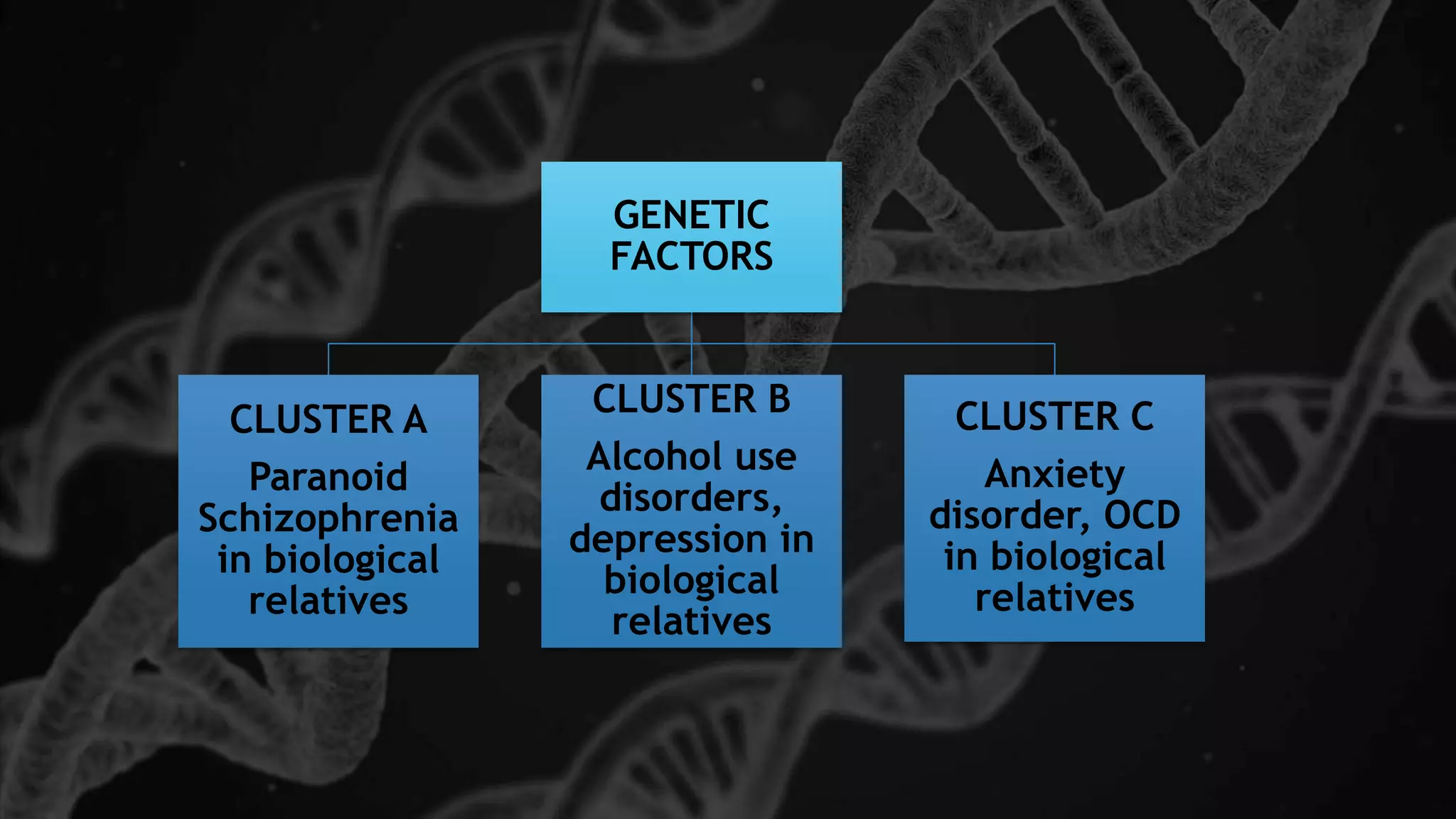
GENETIC
FACTORS
CLUSTER A
Paranoid
Schizophrenia
in biological
relatives
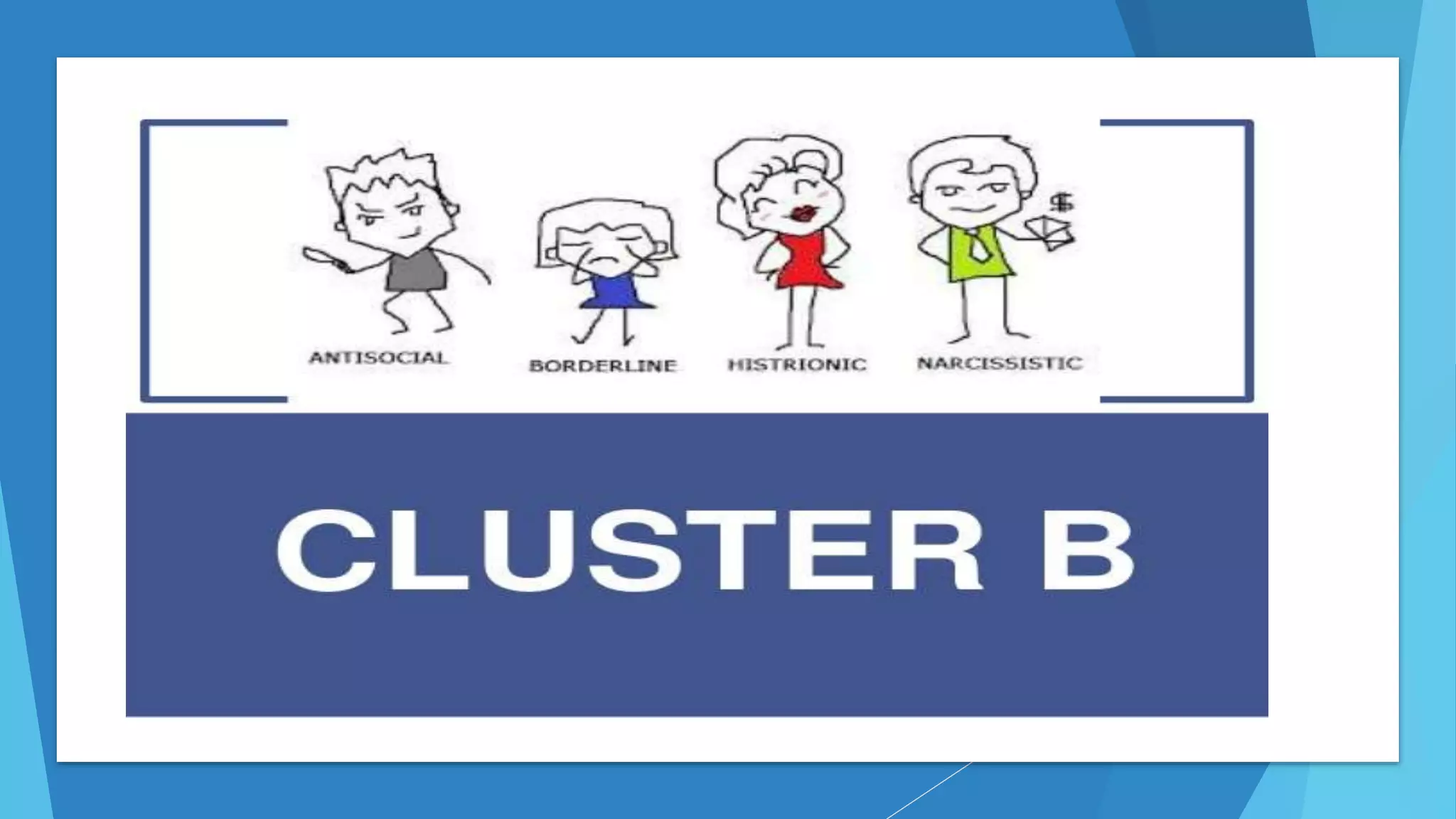
CLUSTER B
Alcohol use
disorders,
depression in
biological
relatives
CLUSTER C
Anxiety
disorder, OCD
in biological
relatives
BIOLOGICAL
FACTORS
HORMONES
High levels of
testosterone, estrone in
impulsive traits.
DST results are
abnormal in BPD.
PLATELET MAO
Low platelet MAO
noted in some patients
of Schizotypal
personality disorder.
NEUROTRANSMITT
ERS
Low Serotonin level in
Impulsive and
Aggressive patients.
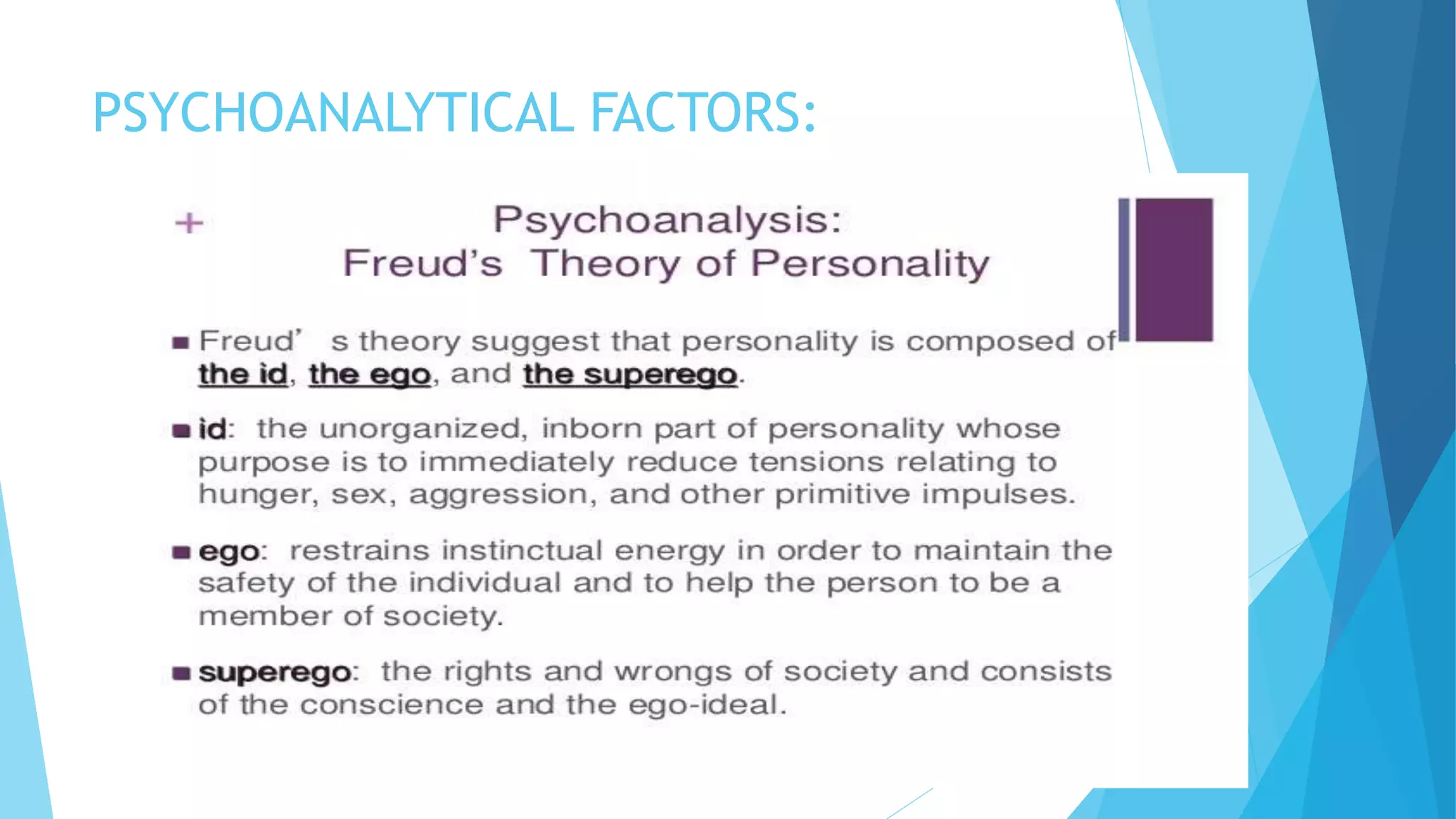
PSYCHOANALYTICAL FACTORS:
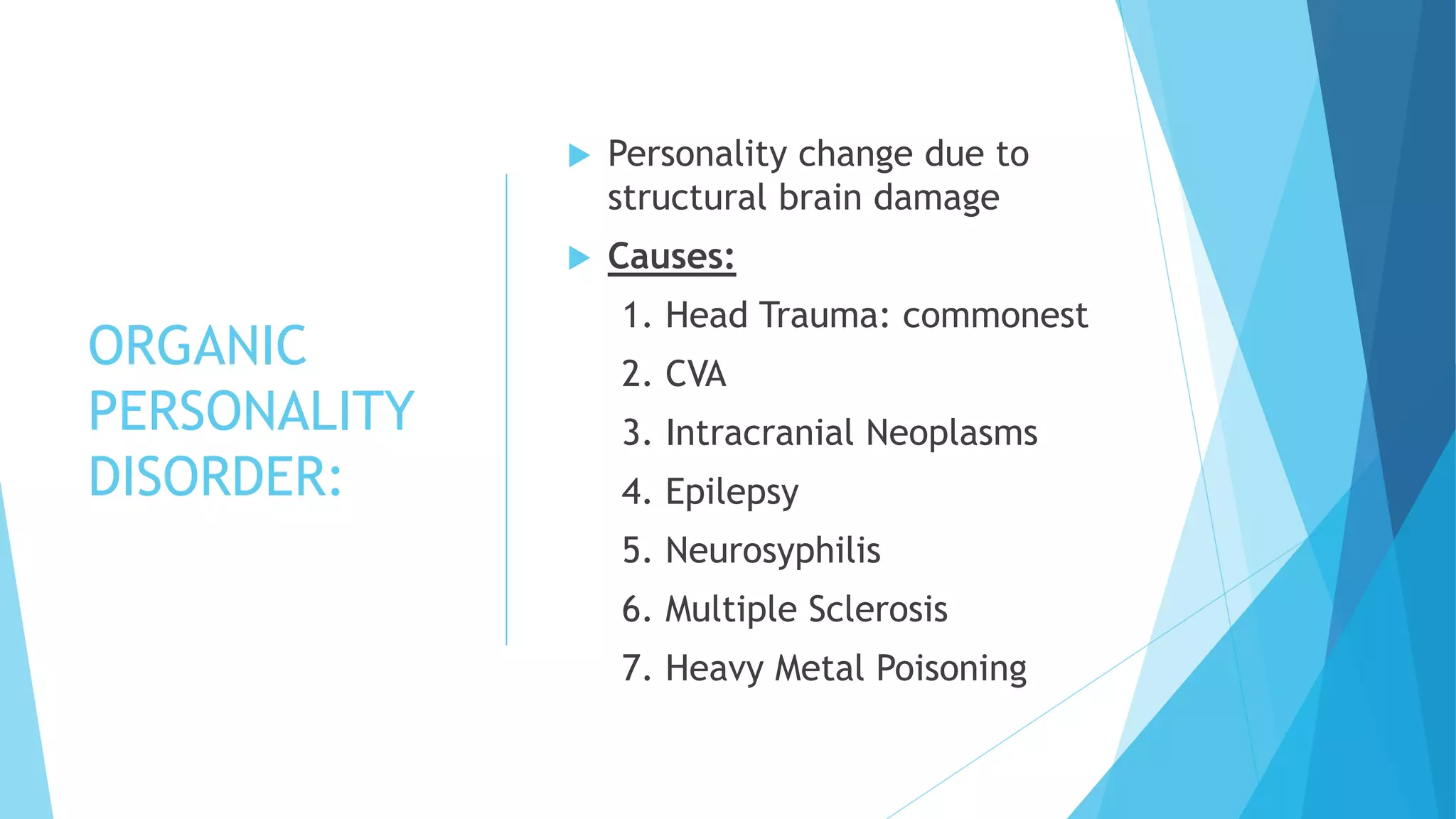
ORGANIC
PERSONALITY
DISORDER:
 Personality change due to
structural brain damage
 Causes:
1. Head Trauma: commonest
2. CVA
3. Intracranial Neoplasms
4. Epilepsy
5. Neurosyphilis
6. Multiple Sclerosis
7. Heavy Metal Poisoning
PHINEAS GAGE
 Phineas P. Gage (1823–1860) was an
American railroad construction foreman
remembered for his improbable survival of
an accident in which a large iron rod was
driven completely through his head,
destroying much of his brain's left frontal
lobe, and for that injury's reported effects on
his personality and behavior over the
remaining 12 years of his life - effects
sufficiently profound (for a time at least)
that friends saw him as "no longer Gage’.
 It was perhaps the first case to suggest the
brain's role in determining personality, and
that damage to specific parts of the brain
might induce specific mental changes.
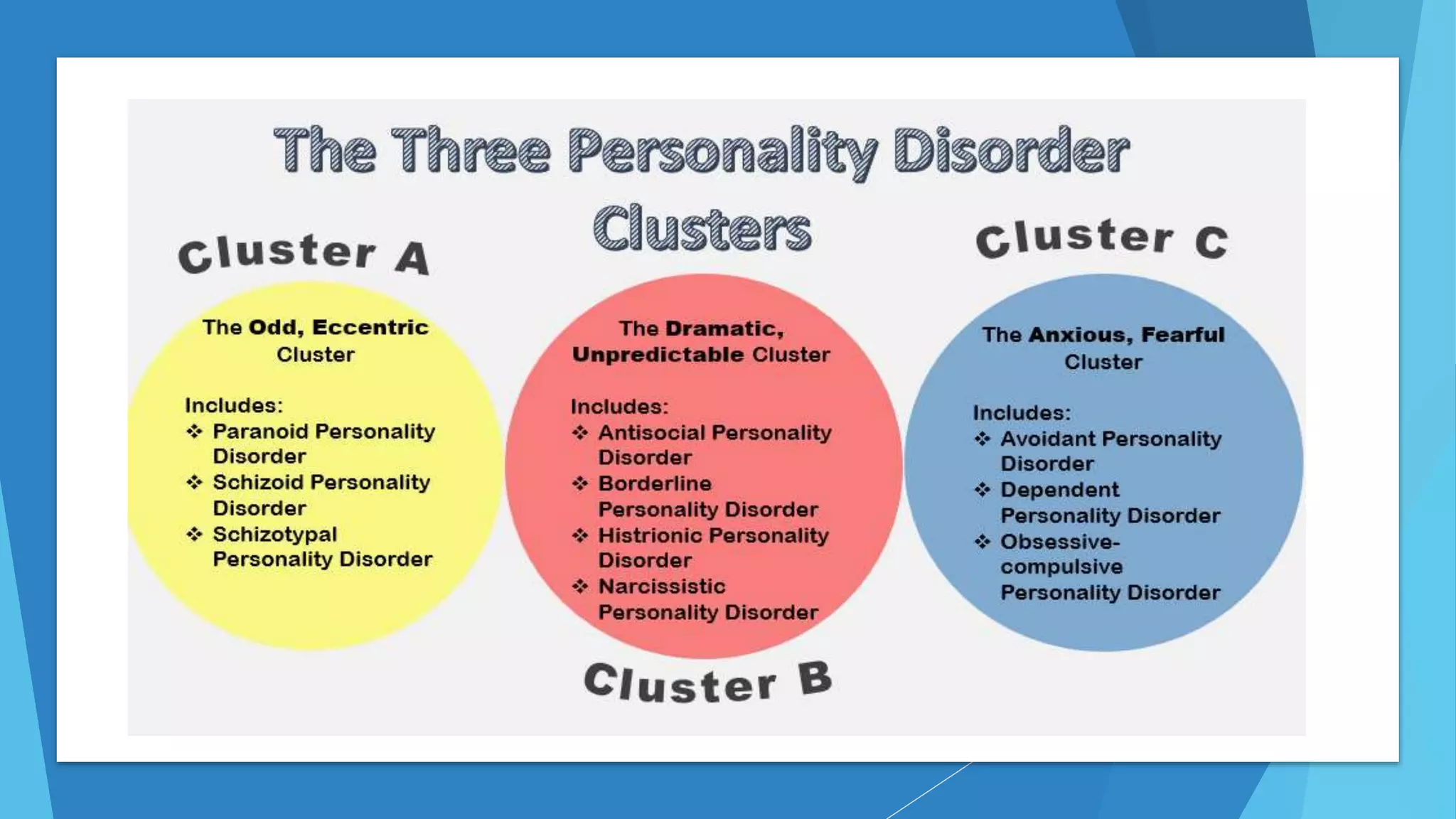
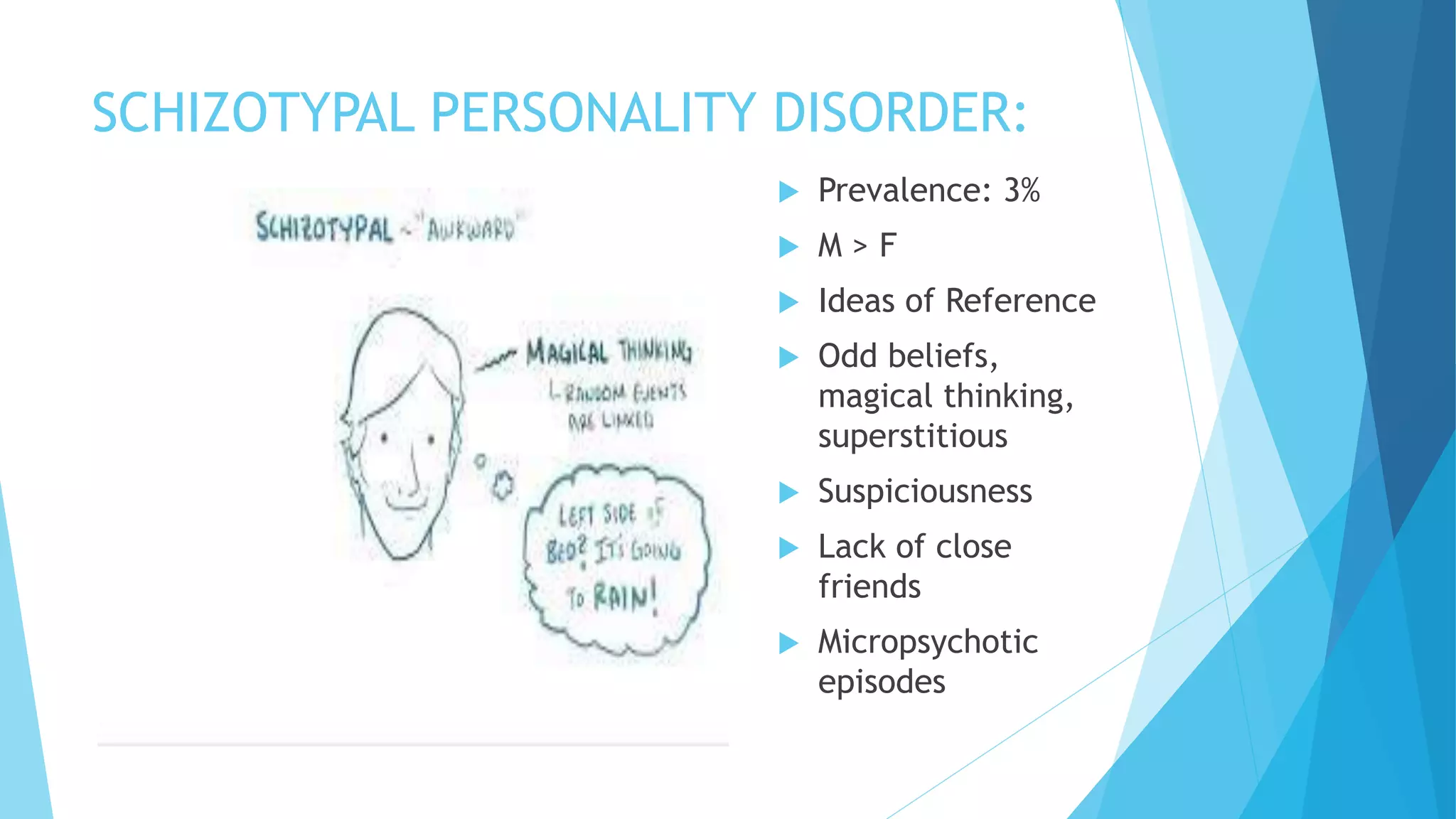
SCHIZOTYPAL PERSONALITY DISORDER:
 Prevalence: 3%
 M > F
 Ideas of Reference
 Odd beliefs,
magical thinking,
superstitious
 Suspiciousness
 Lack of close
friends
 Micropsychotic
episodes
SCHIZOID PERSONALITY DISORDER:
 Prevalence: 5%
 M > F
 More in solitary jobs.
 Onset: Early Childhood
 Do not enjoy close relation,
prefer solitary
 Indifference to praise/ criticism
 Lack of pleasure in any
activities.
 Do not enjoy sexual/ conjugal
life.
 Cannot express anger directly.
 Interest in mathematics,
astronomy
 Fantasy thinking.
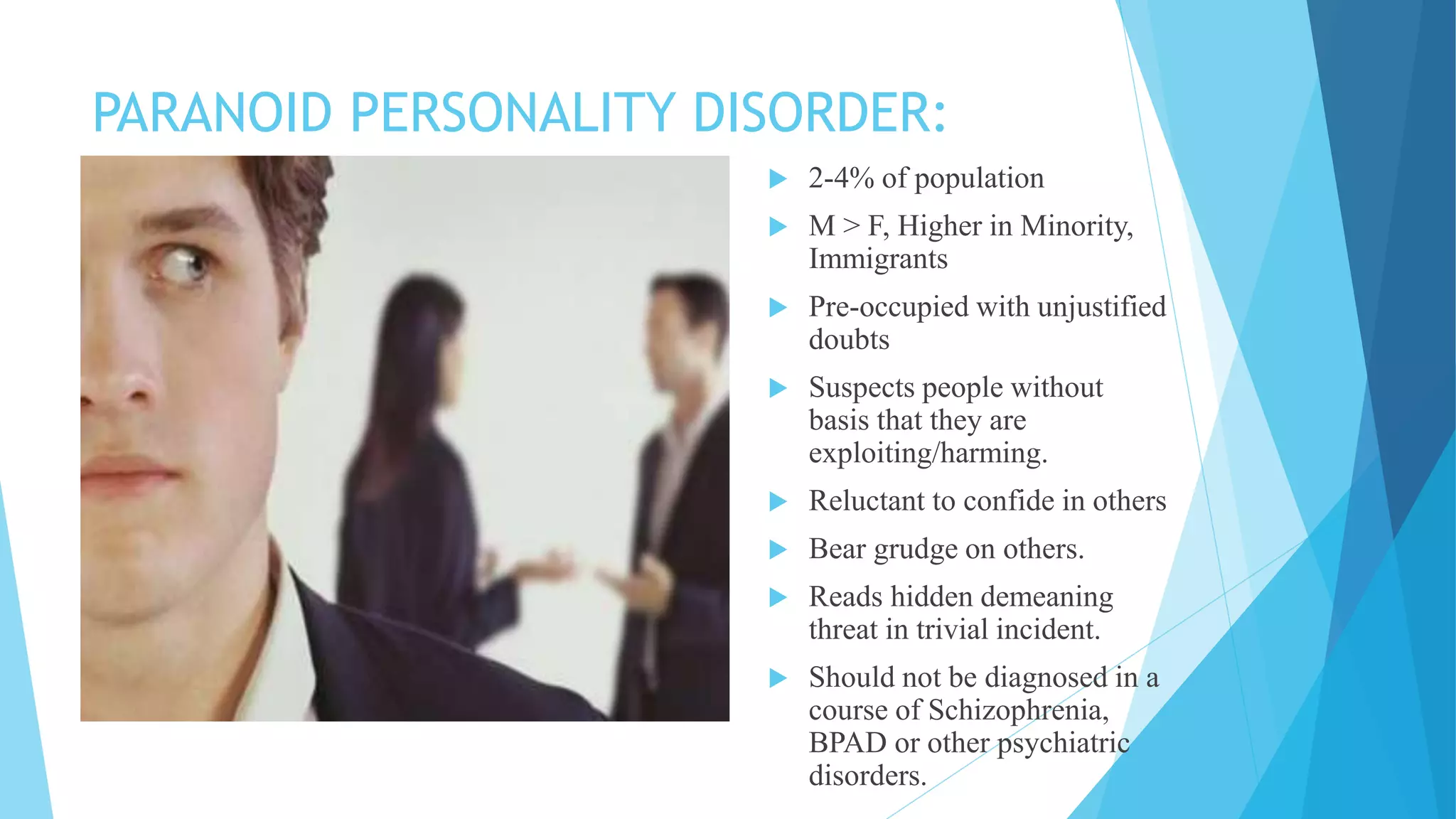
PARANOID PERSONALITY DISORDER:
 2-4% of population
 M > F, Higher in Minority,
Immigrants
 Pre-occupied with unjustified
doubts
 Suspects people without
basis that they are
exploiting/harming.
 Reluctant to confide in others
 Bear grudge on others.
 Reads hidden demeaning
threat in trivial incident.
 Should not be diagnosed in a
course of Schizophrenia,
BPAD or other psychiatric
disorders.
ANTISOCIAL PERSONALITY DISORDER:
 Onset < 15yrs
 M > F
 Failure to stick to societal norms
 Unlawful behavior
 Lying, Deceitfulness
 Impulsivity, disregard for safety
for self / others.
 Aggressiveness, Assaultive
behaviour
 Lack of remorse
 H/O conduct disorder in
childhood
TED BUNDYJOHN WAYNE GACY LUIS GARAVITO
BORDERLINE PERSONALITY DISORDER:
 Pervasive instability of IPR, self-image and mood
 Fear of abandonment
 Unstable IPR, attending between extreme idealization and
devaluation.
 Identity disturbance
 Impulsivity that is self-damaging (excessive spending, substance
abuse, unprotected sex, reckless driving)
 Deliberate self-harm
 Chronic feeling of emptiness
 Affective instability
 Micro psychotic episode.
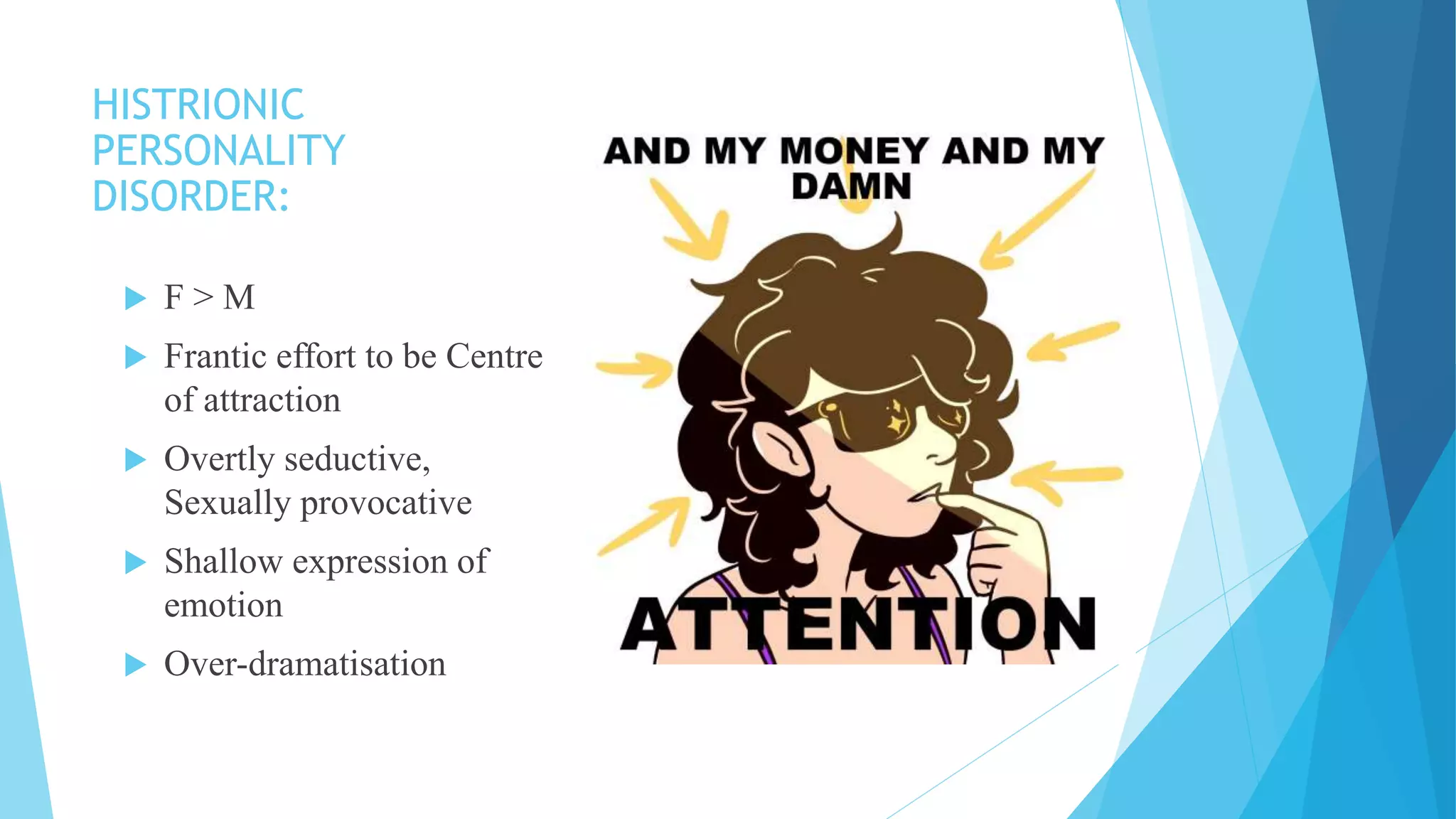
HISTRIONIC
PERSONALITY
DISORDER:
 F > M
 Frantic effort to be Centre
of attraction
 Overtly seductive,
Sexually provocative
 Shallow expression of
emotion
 Over-dramatisation
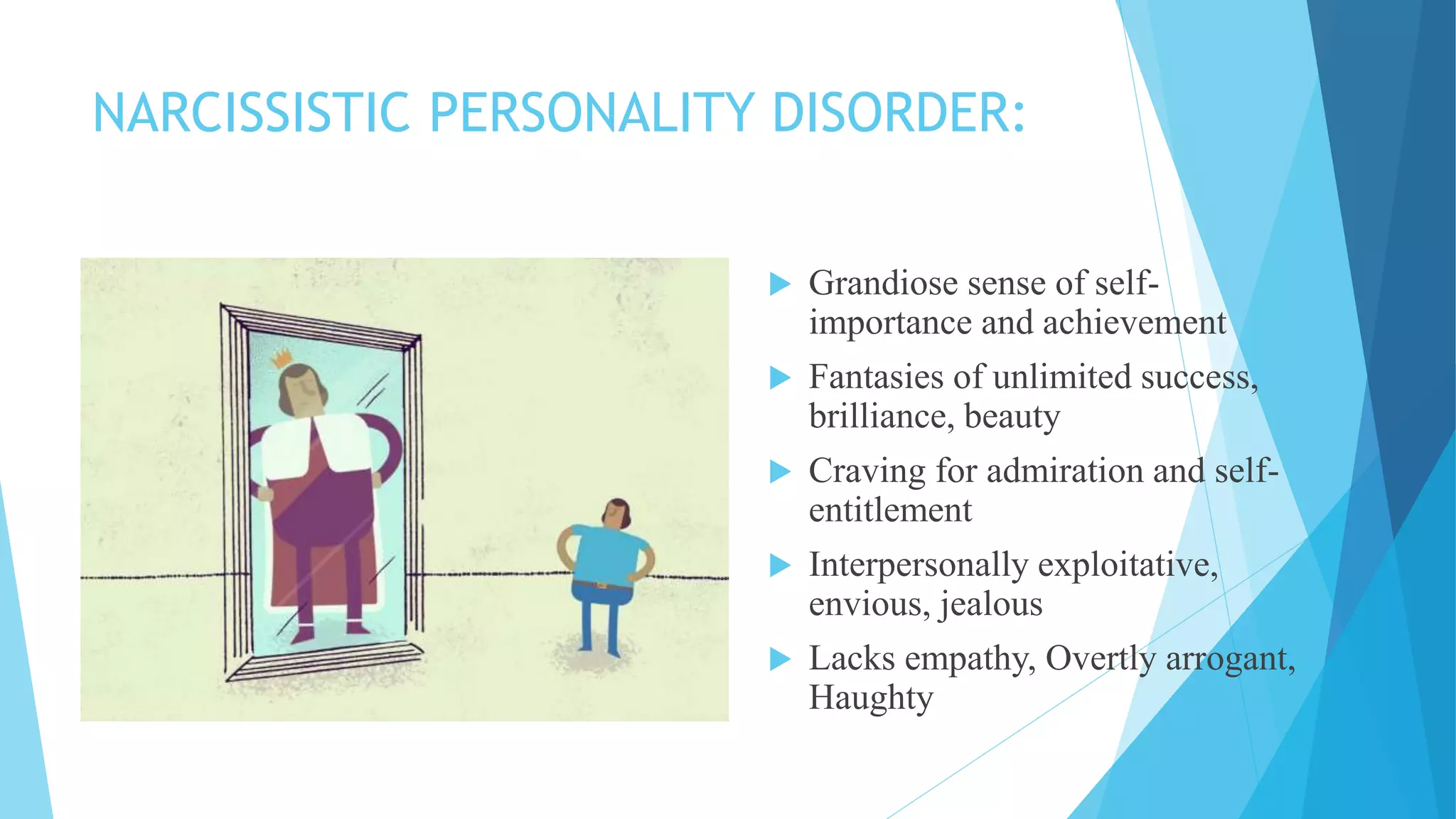
NARCISSISTIC PERSONALITY DISORDER:
 Grandiose sense of self-
importance and achievement
 Fantasies of unlimited success,
brilliance, beauty
 Craving for admiration and self-
entitlement
 Interpersonally exploitative,
envious, jealous
 Lacks empathy, Overtly arrogant,
Haughty
AVOIDANT
PERSONALITY
DISORDER:
 1-10% of general population
 Extreme sensitivity to rejection
 Although shy, but not asocial
 Show a great desire for
companionship
 Inferiority complex, lack of
self-confidence
 Afraid to speak in public
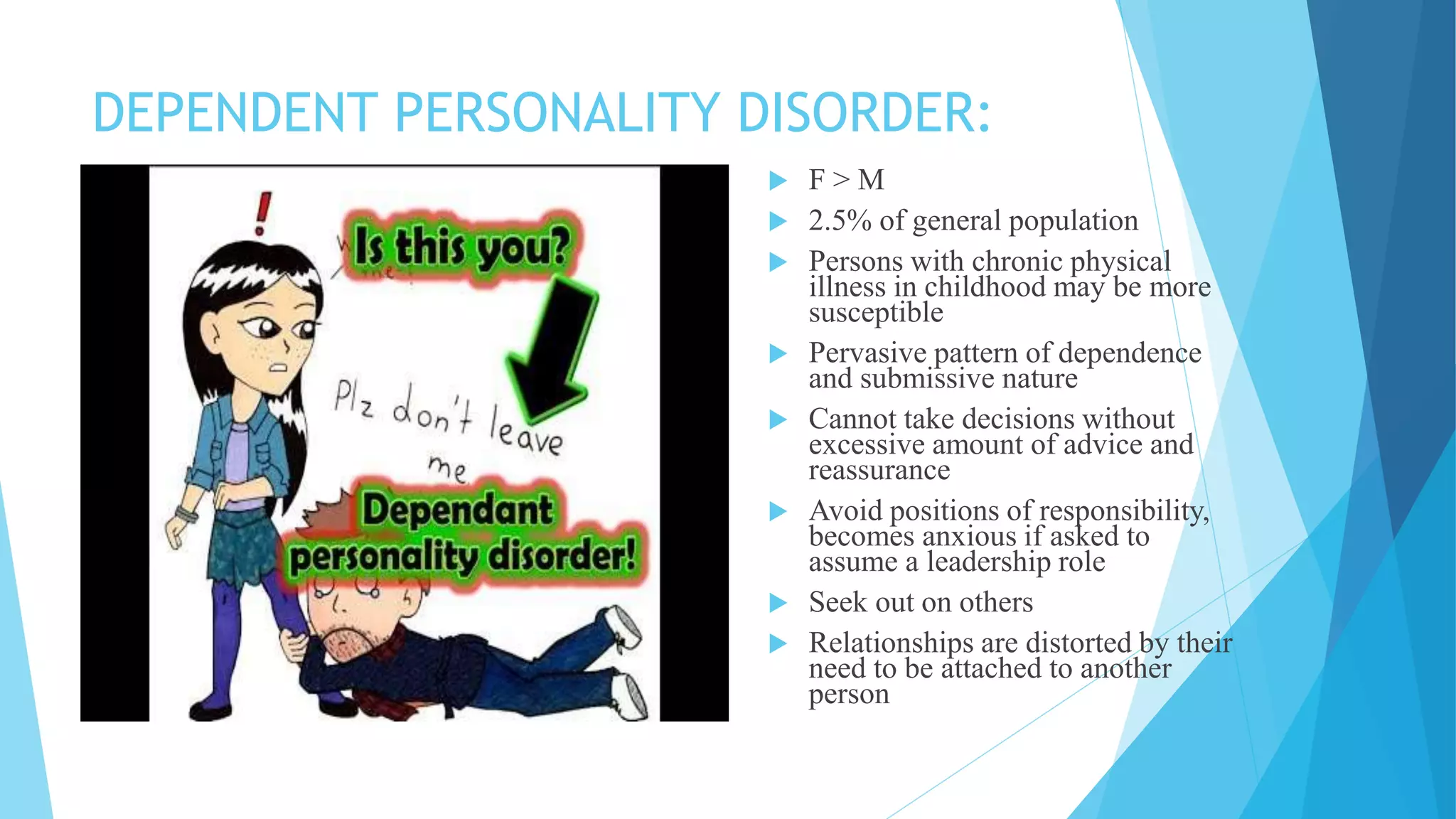
DEPENDENT PERSONALITY DISORDER:
 F > M
 2.5% of general population
 Persons with chronic physical
illness in childhood may be more
susceptible
 Pervasive pattern of dependence
and submissive nature
 Cannot take decisions without
excessive amount of advice and
reassurance
 Avoid positions of responsibility,
becomes anxious if asked to
assume a leadership role
 Seek out on others
 Relationships are distorted by their
need to be attached to another
person
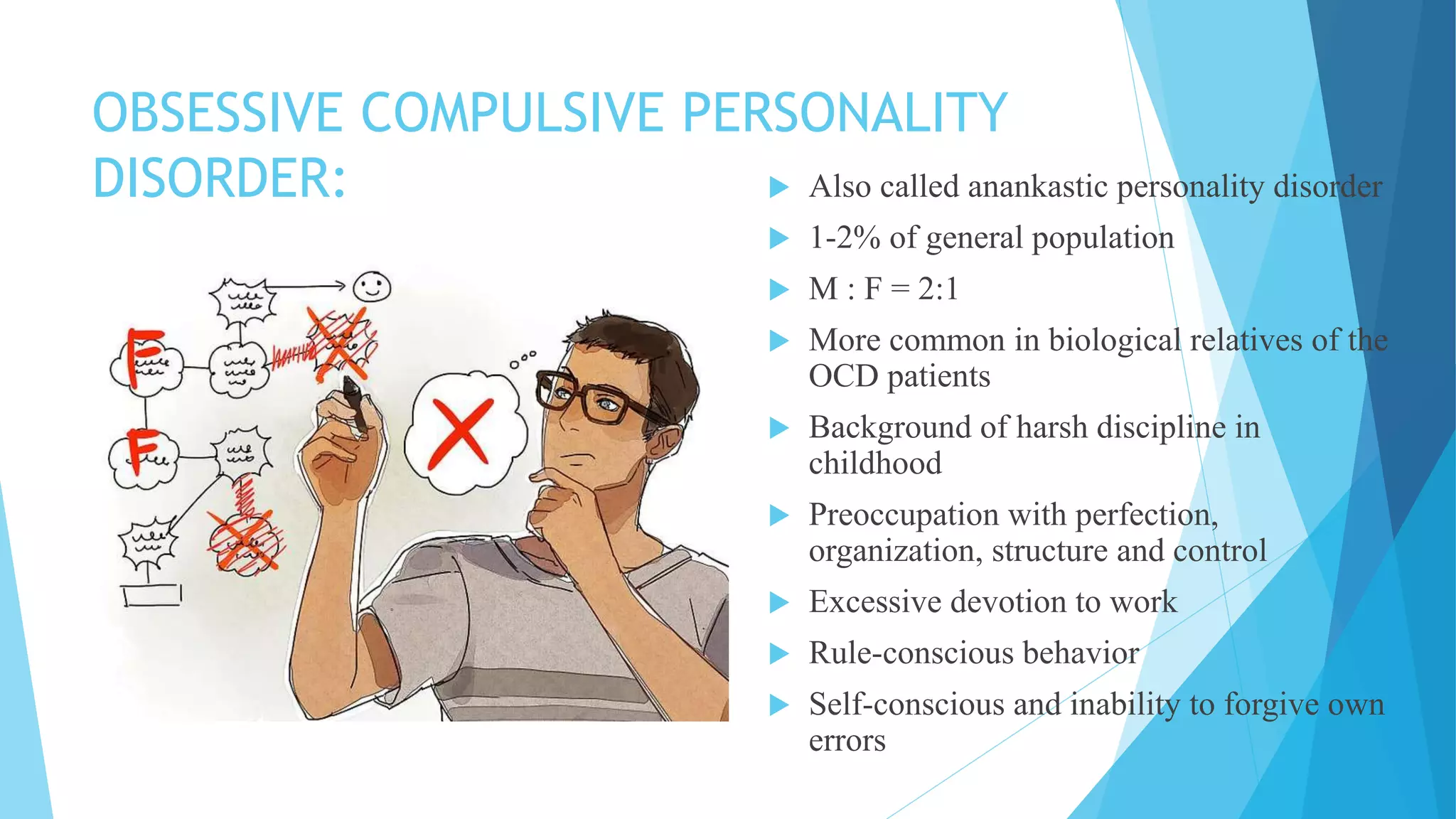
OBSESSIVE COMPULSIVE PERSONALITY
DISORDER:  Also called anankastic personality disorder
 1-2% of general population
 M : F = 2:1
 More common in biological relatives of the
OCD patients
 Background of harsh discipline in
childhood
 Preoccupation with perfection,
organization, structure and control
 Excessive devotion to work
 Rule-conscious behavior
 Self-conscious and inability to forgive own
errors
TREATMENT
PHARMACOTHERAPY PSYCHOTHERAPY
PHARMACOTHERAPY:
1. ANTI- DEPRESSANT
 SSRI: Mostly in depressive symptoms
associated with BPD, ASPD, Avoidant,
Dependent & OCPD.
OCPD: High dose of SSRI [Fluoxetine,
Fluvoxamine, Sertraline, Escitalopram]
 TCA: Clomipramine, adjunctive therapy in
OCPD
Imipramine: In Nocturnal enuresis,
common in BPD
 NDRI: Bupropion, in smoking cessation in
BPD, ASPD, decreases performance anxiety in
cluster C
 MAOI: Decreases aggression in Schizotypal,
ASPD
PHARMACOTHERAPY:
2. ANTIPSYCHOTICS:
 Second generation antipsychotics
used to treat the psychotic
episodes in Cluster A & B
 Aripiprazole: to decrease the
aggression in BPD
 Pimozide: Decrease delusional
component of Cluster A
 Clozapine: decrease suicidality,
DSH in BPD
 As an add-on therapy in Cluster
C
PHARMACOTHERAPY:
3. MOOD STABILISER
 LiCO3, Na Valproate,
Divalproex Na, Lamotrigine,
Carbamazepine
 Decrease the impulsivity,
affective instability in Cluster B
 LiCO3: Anti-suicidal, decrease
DSH in BPD
 Valproate: used in chronic
dysphoria of BPD
PHARMACOTHERAPY:
4. BENZODIAZEPINES:
 In anxiety, insomnia, Predominantly in Cluster
C, also used in Cluster A & B
 To be used for short duration.
 To be used judiciously in BPD, may develop
dependence to BZDs
5. OTHERS:
 CLONIDINE: decrease aggression
 NALTREXONE: decrease agitation
 PROPRANOLOL: decrease anxiety symptoms
 METHYL PHENIDATE / ATOMOXETINE:
Used in associated ADHD symptoms in BPD
PSYCHOTHERAPY:
 Treatment of choice for any PD
 Building rapport, therapeutic
alliance is pre-requisite for
favorable outcome.
PSYCHOTHERAPY:
1. INDIVIDUAL
PSYCHOTHERAPY:
 Mostly in Cluster A
 In patients who face difficulty
in interacting with others
 Also helpful in Cluster C
 Supportive
2. GROUP THERAPY:
 Mostly in Cluster B & C
 In Cluster A, it is to be
preceded by Individual
Psychotherapy
PSYCHOTHERAPY:
3. CBT:
Treatment of choice in Cluster B & C
4. INSIGHT ORIENTED
PSYCHOTHERAPY:
Cluster C
5. MENTALIZATION BASED
THERAPY:
In BPD
6. DIALECTICAL BEHAVIOR
THERAPY:
In BPD
TELEVISION
AND
PERSONALITY
DIOSRDERS
PHEOBE [FRIENDS]
SCHIZOTYPAL
HEAD BUTLER
[REMAINS OF THE
DAY]
SCHIZOID
JERRY
[CONSPIRACY
THEORY]
PARANOID
Dr. HANNIBAL LECTER
[HANNIBAL] ASPD
RON [ANCHORMAN]
NARCISSISTIC
SUSANNA [GIRL,
INTERRUPTED] BPD
SCARLETT [GONE WITH
THE WIND]
HISTRIONIC
SHELDON COOPER [BIG BANG THEORY]
OCPD
ROSS [FRIENDS] DEPENDENT
Personality disorders

Personality disorders

  • 1.
    PERSONALITY DISORDERS – Dr.Ranjan Bhattacharya – Associate Professor and HOD – Dept of Psychiatry – Msd MCH – Dr. Aratrika Sen – Senior Resident – Dept of Psychiatry – Msd MCH
  • 2.
    PERSONALITY Definition: “Personality is thedynamic organization within the individual of those psychophysical systems that determine his or her unique adjustment with his or her environment" (Allport, 1961) “The characteristics or blend of characteristics that make a person unique" (Weinberg & Gould, 1999) The totality of emotional and behavioral characteristics that are particular to a specific person and that remain somewhat stable and predictable over time.
  • 3.
    PERSONALITY DISORDERS  Arediagnosed when personality traits become inflexible and maladaptive and significantly interferes with how a person functions in society or cause the person emotional distress.  Common and chronic disorder.  Prevalence: 10-20% in general population.  Approximately one half of all psychiatric patients have personality disorders.  Personality Disorder is predisposing factor for other psychiatric disorders (eg: substance abuse, suicide, affective disorders, impulse control disorders.)  They are far more likely to refuse psychiatric help. They do not routinely feel anxious or pain from their mal-adaptive behavior.
  • 4.
  • 5.
    GENETIC FACTORS CLUSTER A Paranoid Schizophrenia in biological relatives CLUSTERB Alcohol use disorders, depression in biological relatives CLUSTER C Anxiety disorder, OCD in biological relatives
  • 6.
    BIOLOGICAL FACTORS HORMONES High levels of testosterone,estrone in impulsive traits. DST results are abnormal in BPD. PLATELET MAO Low platelet MAO noted in some patients of Schizotypal personality disorder. NEUROTRANSMITT ERS Low Serotonin level in Impulsive and Aggressive patients.
  • 7.
  • 10.
    ORGANIC PERSONALITY DISORDER:  Personality changedue to structural brain damage  Causes: 1. Head Trauma: commonest 2. CVA 3. Intracranial Neoplasms 4. Epilepsy 5. Neurosyphilis 6. Multiple Sclerosis 7. Heavy Metal Poisoning
  • 11.
    PHINEAS GAGE  PhineasP. Gage (1823–1860) was an American railroad construction foreman remembered for his improbable survival of an accident in which a large iron rod was driven completely through his head, destroying much of his brain's left frontal lobe, and for that injury's reported effects on his personality and behavior over the remaining 12 years of his life - effects sufficiently profound (for a time at least) that friends saw him as "no longer Gage’.  It was perhaps the first case to suggest the brain's role in determining personality, and that damage to specific parts of the brain might induce specific mental changes.
  • 15.
    SCHIZOTYPAL PERSONALITY DISORDER: Prevalence: 3%  M > F  Ideas of Reference  Odd beliefs, magical thinking, superstitious  Suspiciousness  Lack of close friends  Micropsychotic episodes
  • 16.
    SCHIZOID PERSONALITY DISORDER: Prevalence: 5%  M > F  More in solitary jobs.  Onset: Early Childhood  Do not enjoy close relation, prefer solitary  Indifference to praise/ criticism  Lack of pleasure in any activities.  Do not enjoy sexual/ conjugal life.  Cannot express anger directly.  Interest in mathematics, astronomy  Fantasy thinking.
  • 17.
    PARANOID PERSONALITY DISORDER: 2-4% of population  M > F, Higher in Minority, Immigrants  Pre-occupied with unjustified doubts  Suspects people without basis that they are exploiting/harming.  Reluctant to confide in others  Bear grudge on others.  Reads hidden demeaning threat in trivial incident.  Should not be diagnosed in a course of Schizophrenia, BPAD or other psychiatric disorders.
  • 19.
    ANTISOCIAL PERSONALITY DISORDER: Onset < 15yrs  M > F  Failure to stick to societal norms  Unlawful behavior  Lying, Deceitfulness  Impulsivity, disregard for safety for self / others.  Aggressiveness, Assaultive behaviour  Lack of remorse  H/O conduct disorder in childhood
  • 20.
    TED BUNDYJOHN WAYNEGACY LUIS GARAVITO
  • 21.
    BORDERLINE PERSONALITY DISORDER: Pervasive instability of IPR, self-image and mood  Fear of abandonment  Unstable IPR, attending between extreme idealization and devaluation.  Identity disturbance  Impulsivity that is self-damaging (excessive spending, substance abuse, unprotected sex, reckless driving)  Deliberate self-harm  Chronic feeling of emptiness  Affective instability  Micro psychotic episode.
  • 23.
    HISTRIONIC PERSONALITY DISORDER:  F >M  Frantic effort to be Centre of attraction  Overtly seductive, Sexually provocative  Shallow expression of emotion  Over-dramatisation
  • 24.
    NARCISSISTIC PERSONALITY DISORDER: Grandiose sense of self- importance and achievement  Fantasies of unlimited success, brilliance, beauty  Craving for admiration and self- entitlement  Interpersonally exploitative, envious, jealous  Lacks empathy, Overtly arrogant, Haughty
  • 27.
    AVOIDANT PERSONALITY DISORDER:  1-10% ofgeneral population  Extreme sensitivity to rejection  Although shy, but not asocial  Show a great desire for companionship  Inferiority complex, lack of self-confidence  Afraid to speak in public
  • 28.
    DEPENDENT PERSONALITY DISORDER: F > M  2.5% of general population  Persons with chronic physical illness in childhood may be more susceptible  Pervasive pattern of dependence and submissive nature  Cannot take decisions without excessive amount of advice and reassurance  Avoid positions of responsibility, becomes anxious if asked to assume a leadership role  Seek out on others  Relationships are distorted by their need to be attached to another person
  • 29.
    OBSESSIVE COMPULSIVE PERSONALITY DISORDER: Also called anankastic personality disorder  1-2% of general population  M : F = 2:1  More common in biological relatives of the OCD patients  Background of harsh discipline in childhood  Preoccupation with perfection, organization, structure and control  Excessive devotion to work  Rule-conscious behavior  Self-conscious and inability to forgive own errors
  • 31.
  • 32.
    PHARMACOTHERAPY: 1. ANTI- DEPRESSANT SSRI: Mostly in depressive symptoms associated with BPD, ASPD, Avoidant, Dependent & OCPD. OCPD: High dose of SSRI [Fluoxetine, Fluvoxamine, Sertraline, Escitalopram]  TCA: Clomipramine, adjunctive therapy in OCPD Imipramine: In Nocturnal enuresis, common in BPD  NDRI: Bupropion, in smoking cessation in BPD, ASPD, decreases performance anxiety in cluster C  MAOI: Decreases aggression in Schizotypal, ASPD
  • 33.
    PHARMACOTHERAPY: 2. ANTIPSYCHOTICS:  Secondgeneration antipsychotics used to treat the psychotic episodes in Cluster A & B  Aripiprazole: to decrease the aggression in BPD  Pimozide: Decrease delusional component of Cluster A  Clozapine: decrease suicidality, DSH in BPD  As an add-on therapy in Cluster C
  • 34.
    PHARMACOTHERAPY: 3. MOOD STABILISER LiCO3, Na Valproate, Divalproex Na, Lamotrigine, Carbamazepine  Decrease the impulsivity, affective instability in Cluster B  LiCO3: Anti-suicidal, decrease DSH in BPD  Valproate: used in chronic dysphoria of BPD
  • 35.
    PHARMACOTHERAPY: 4. BENZODIAZEPINES:  Inanxiety, insomnia, Predominantly in Cluster C, also used in Cluster A & B  To be used for short duration.  To be used judiciously in BPD, may develop dependence to BZDs 5. OTHERS:  CLONIDINE: decrease aggression  NALTREXONE: decrease agitation  PROPRANOLOL: decrease anxiety symptoms  METHYL PHENIDATE / ATOMOXETINE: Used in associated ADHD symptoms in BPD
  • 36.
    PSYCHOTHERAPY:  Treatment ofchoice for any PD  Building rapport, therapeutic alliance is pre-requisite for favorable outcome.
  • 37.
    PSYCHOTHERAPY: 1. INDIVIDUAL PSYCHOTHERAPY:  Mostlyin Cluster A  In patients who face difficulty in interacting with others  Also helpful in Cluster C  Supportive 2. GROUP THERAPY:  Mostly in Cluster B & C  In Cluster A, it is to be preceded by Individual Psychotherapy
  • 38.
    PSYCHOTHERAPY: 3. CBT: Treatment ofchoice in Cluster B & C 4. INSIGHT ORIENTED PSYCHOTHERAPY: Cluster C 5. MENTALIZATION BASED THERAPY: In BPD 6. DIALECTICAL BEHAVIOR THERAPY: In BPD
  • 39.
  • 40.
    PHEOBE [FRIENDS] SCHIZOTYPAL HEAD BUTLER [REMAINSOF THE DAY] SCHIZOID JERRY [CONSPIRACY THEORY] PARANOID
  • 41.
    Dr. HANNIBAL LECTER [HANNIBAL]ASPD RON [ANCHORMAN] NARCISSISTIC SUSANNA [GIRL, INTERRUPTED] BPD SCARLETT [GONE WITH THE WIND] HISTRIONIC
  • 42.
    SHELDON COOPER [BIGBANG THEORY] OCPD ROSS [FRIENDS] DEPENDENT