Application Essays: How to
write a personal statement
AGENDA
Introductions
Overview
 Options and Goals
 The website
Getting started
Prompt 2
Writing exercise
Transfer prompt 1
Writing exercise
The Common Application
Individual or Small group work:
Brainstorming
Introductions to
Workshop Faculty
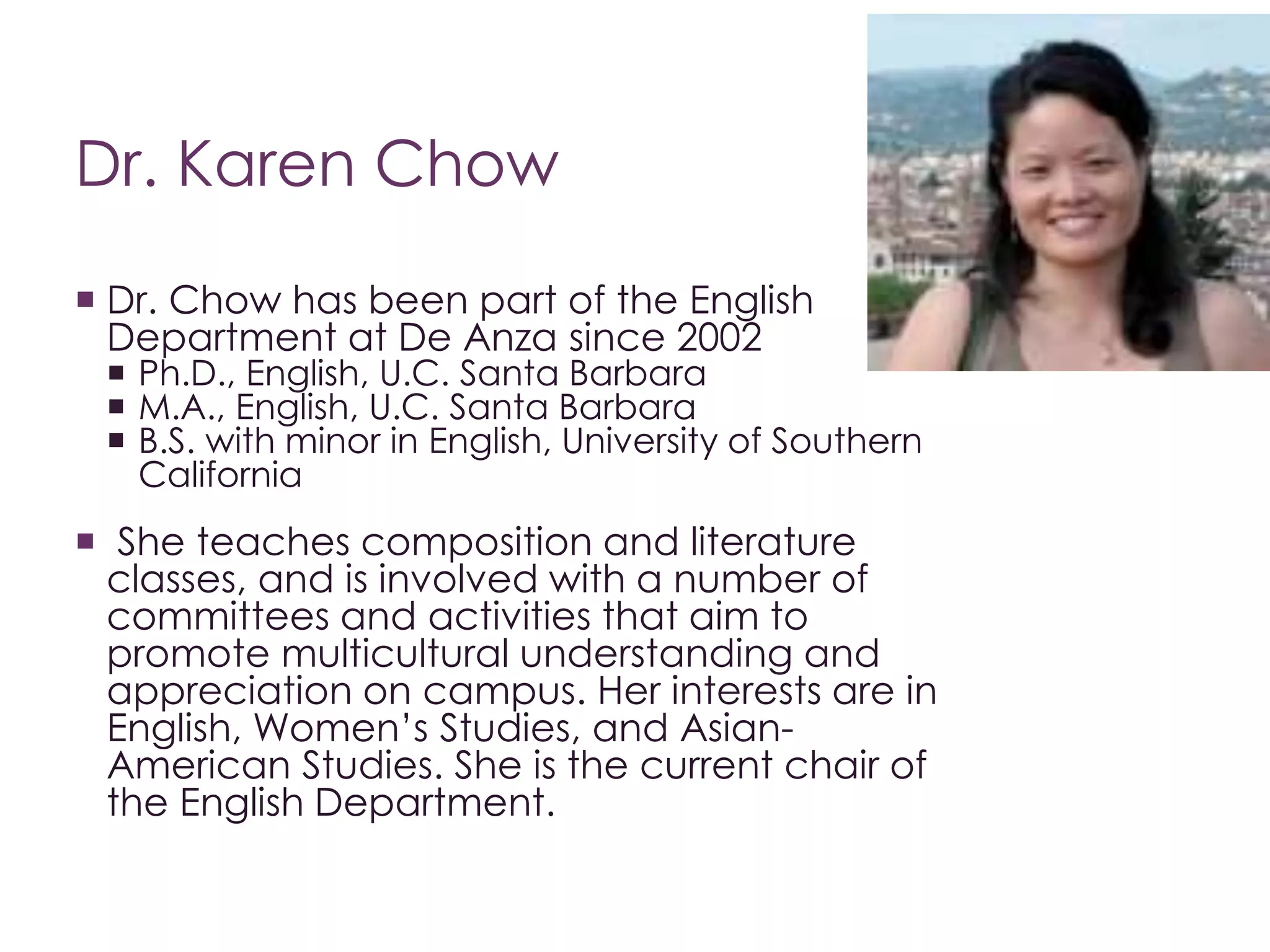
Dr. Karen Chow
 Dr. Chow has been part of the English
Department at De Anza since 2002
 Ph.D., English, U.C. Santa Barbara
 M.A., English, U.C. Santa Barbara
 B.S. with minor in English, University of Southern
California
 She teaches composition and literature
classes, and is involved with a number of
committees and activities that aim to
promote multicultural understanding and
appreciation on campus. Her interests are in
English, Women’s Studies, and Asian-
American Studies. She is the current chair of
the English Department.
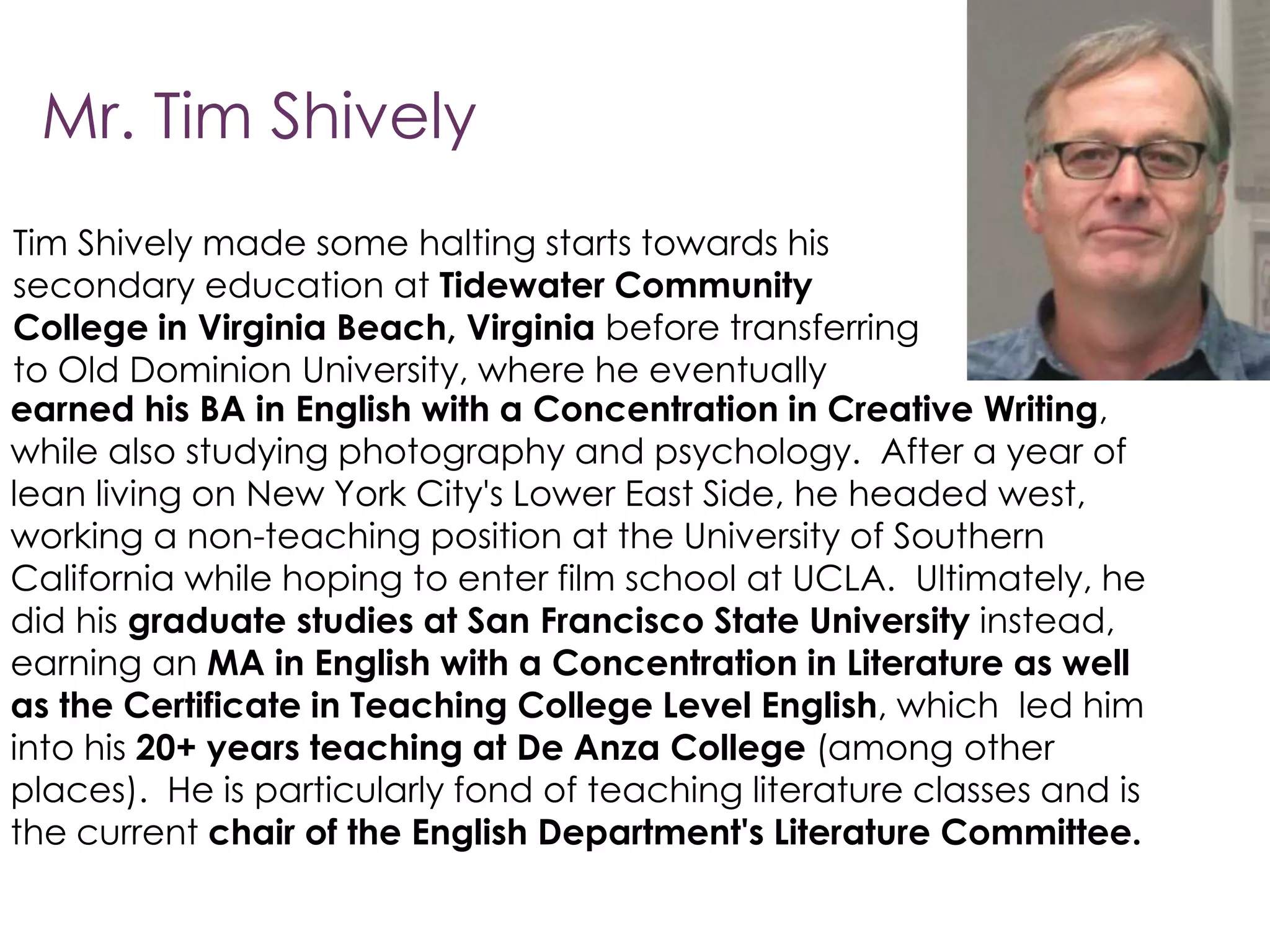
Mr. Tim Shively
Tim Shively made some halting starts towards his
secondary education at Tidewater Community
College in Virginia Beach, Virginia before transferring
to Old Dominion University, where he eventually
earned his BA in English with a Concentration in Creative Writing,
while also studying photography and psychology. After a year of
lean living on New York City's Lower East Side, he headed west,
working a non-teaching position at the University of Southern
California while hoping to enter film school at UCLA. Ultimately, he
did his graduate studies at San Francisco State University instead,
earning an MA in English with a Concentration in Literature as well
as the Certificate in Teaching College Level English, which led him
into his 20+ years teaching at De Anza College (among other
places). He is particularly fond of teaching literature classes and is
the current chair of the English Department's Literature Committee.
Getting Started
Before you write,
consider both your
options and your goals.
How UCs use your statements
To discover and evaluate distinctions
among applicants whose academic
records are often very similar.
To gain insight into your level of
academic, personal, and
extracurricular achievement.
To provide information that may not be
evident in other parts of the application
The Purpose of the Statement
Your personal statement should add to the
application information you have already
provided. Consider what you can say that
adds the following information:
Clarity – a richer perspective of your life,
experiences, and/or accomplishments
Depth – details into your application
(academics or extra-curricular’s)
Context – sharing details on your home,
school, or community
The Goal: Start Early
According to the
University of
California Website,
your application for
fall 2016 is due
November 1-30, 2015
The UC Personal Statement
 There are two prompts
 You must address both within the
1,000 word limit. You may
allocate the word count as you
wish, but the shorter answer
should be no fewer than 250
words.
 View this portion of the
application as a personal
interview
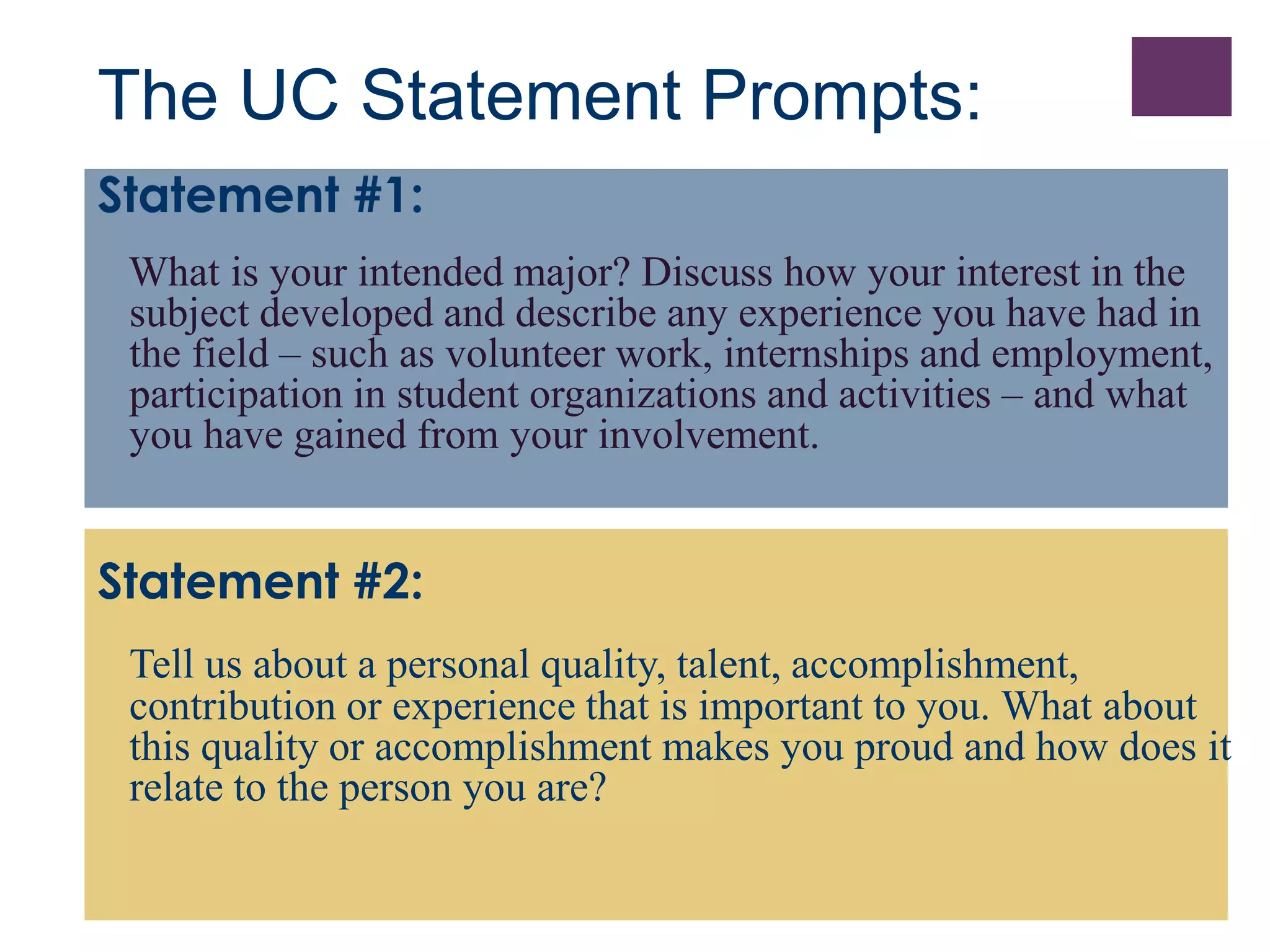
The UC Statement Prompts:
Statement #1:
What is your intended major? Discuss how your interest in the
subject developed and describe any experience you have had in
the field – such as volunteer work, internships and employment,
participation in student organizations and activities – and what
you have gained from your involvement.
Statement #2:
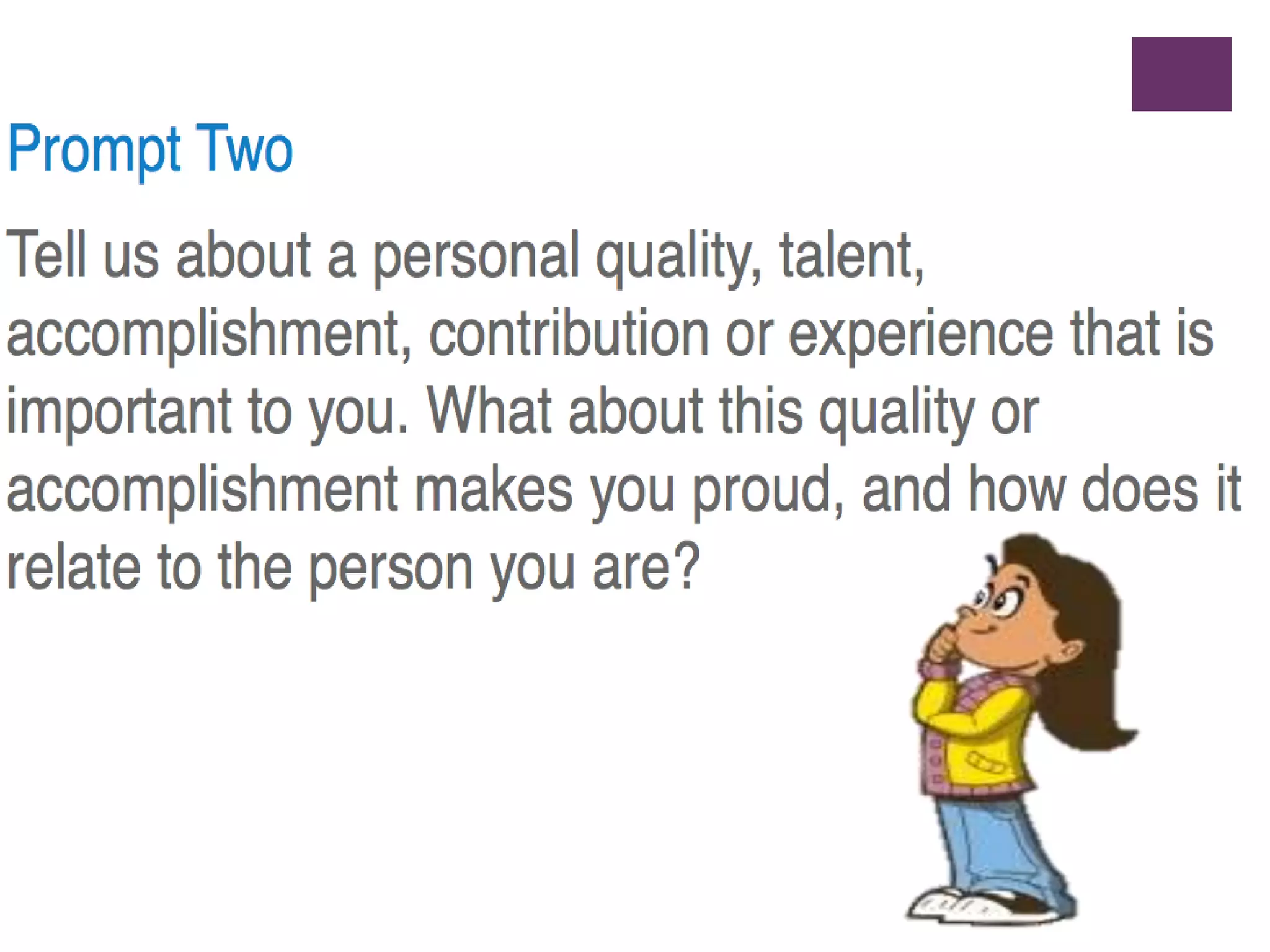
Tell us about a personal quality, talent, accomplishment,
contribution or experience that is important to you. What about
this quality or accomplishment makes you proud and how does it
relate to the person you are?
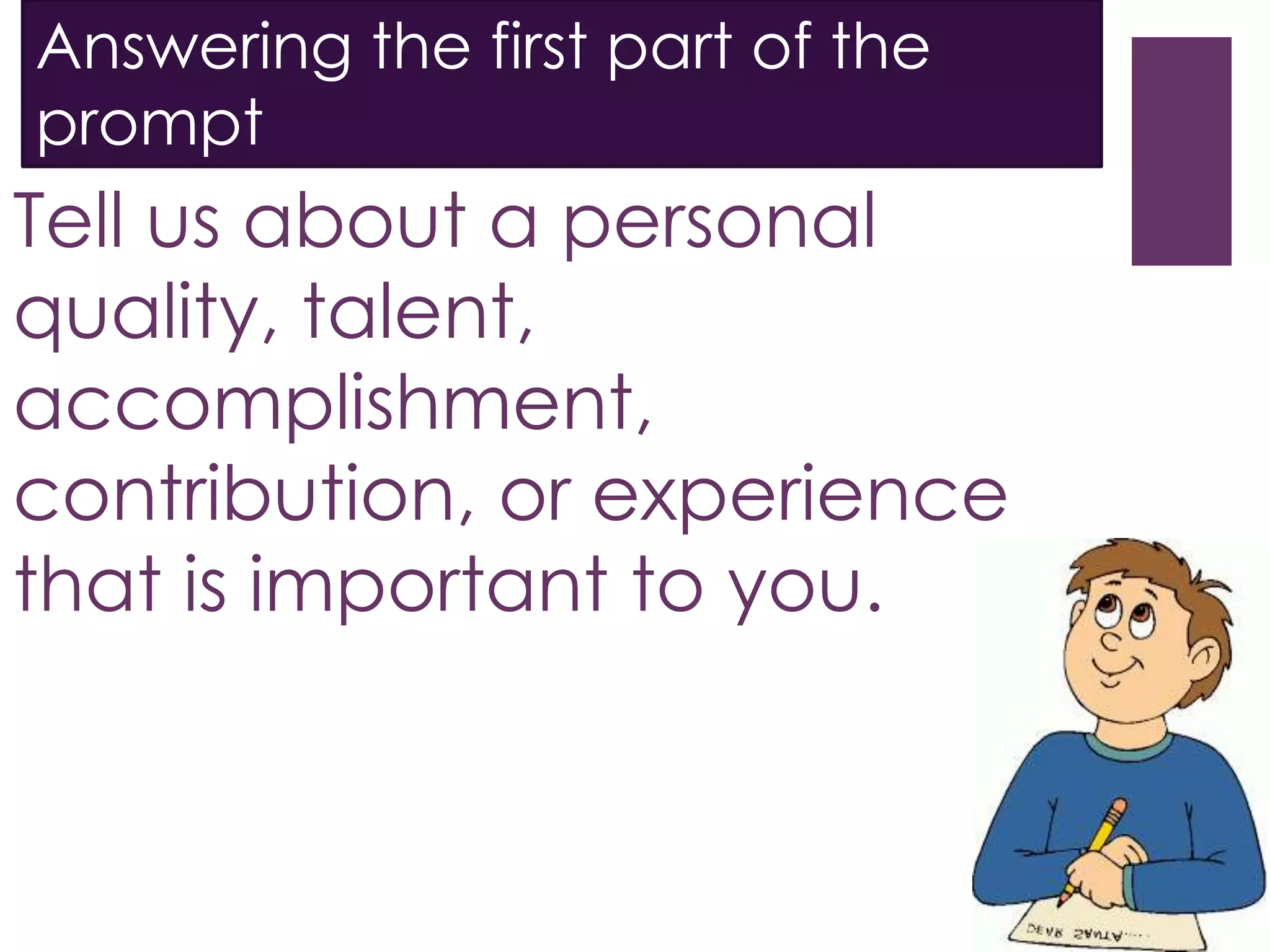
Tell us about a personal
quality, talent,
accomplishment,
contribution, or experience
that is important to you.
Answering the first part of the
prompt
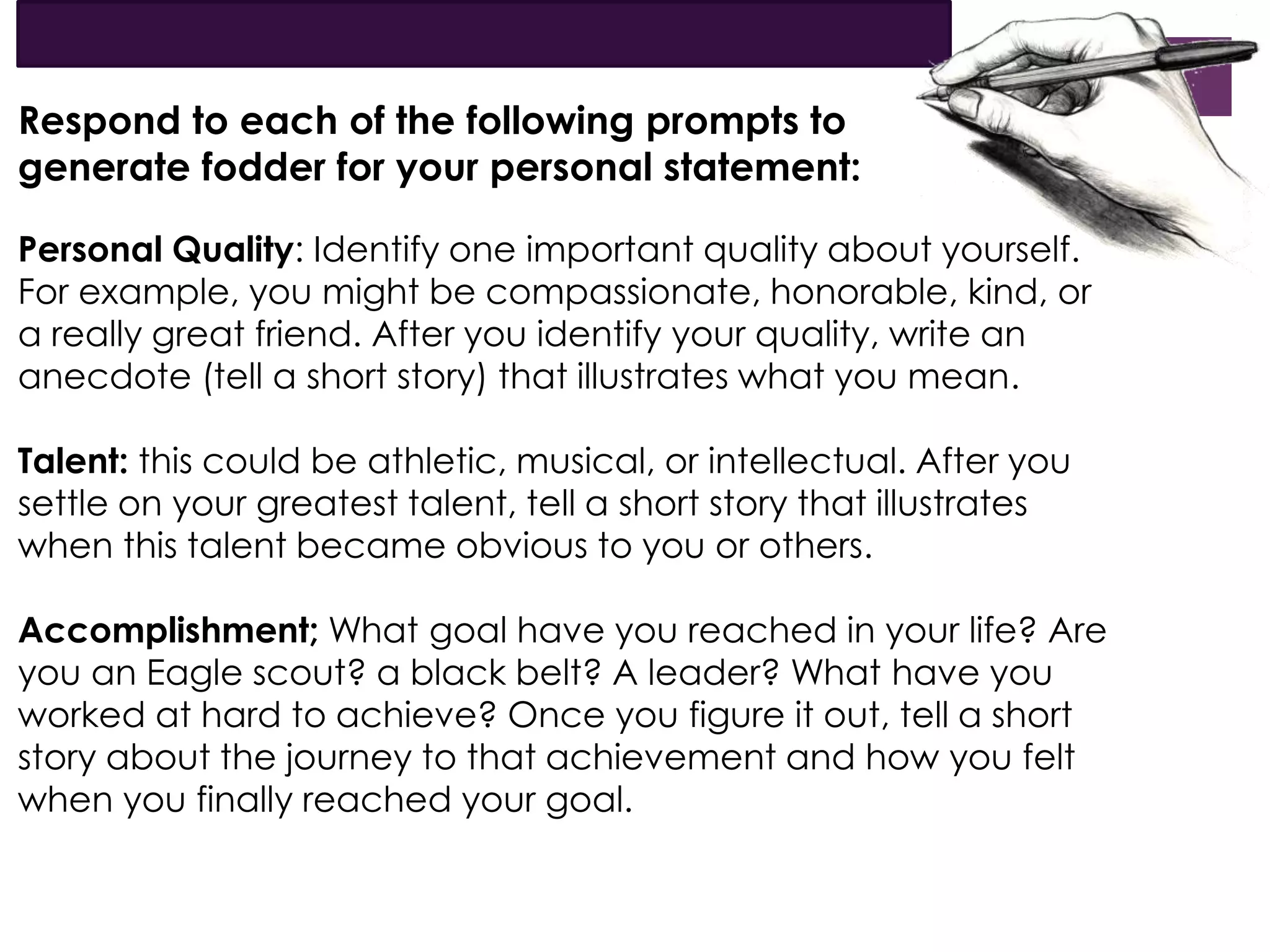
Respond to each of the following prompts to
generate fodder for your personal statement:
Personal Quality: Identify one important quality about yourself.
For example, you might be compassionate, honorable, kind, or
a really great friend. After you identify your quality, write an
anecdote (tell a short story) that illustrates what you mean.
Talent: this could be athletic, musical, or intellectual. After you
settle on your greatest talent, tell a short story that illustrates
when this talent became obvious to you or others.
Accomplishment; What goal have you reached in your life? Are
you an Eagle scout? a black belt? A leader? What have you
worked at hard to achieve? Once you figure it out, tell a short
story about the journey to that achievement and how you felt
when you finally reached your goal.
Contribution: What have you done for others? This could be a
family, school, or community contribution. Are you in student
government? Did you family have an emergency or situation
where your help was very important? Have you done
volunteer work for the community? Once you have identified
your contribution, write an anecdote about what you did and
how you felt about it.
Important Experience: Have you had an important
experience in your life? Think about moments of great
realization; they often follow important experiences. This could
be a relationship experience, an illness or injury, and
encounter with a stranger, or a moment on an athletic field.
Any time you said to yourself ” wow, I won’t do that again” or
“Hey, I totally get this now” is a potential experience to
investigate.
Once you figure out which
aspect of the question to write
about, spend a few minutes
making notes. Don’t forget to
include your epiphany.
 Which of your anecdotes or examples
makes the most compelling story?
 Which one taught you the most?
 Which one made you feel strong,
confident, or humble?
Answering the
second half of the
question
“what makes you proud”
about what you choose to
write about?
 Pride is not usually an attractive quality. It suggests that you are, at best,
self-satisfied and worthy of admiration. At worst, it makes you appear
narcissistic and smug. It implies you are the one winner in a sea of losers.
 Humility can serve the purpose of showcasing your admirable qualities or
experiences just as well. It is really how you frame your qualities or
experiences that will cast you in a likable light. Instead of asserting that
your accomplishment or talent “made you proud,” focus on including your
insights, thoughts, and opinions about what you valued or learned
through your experience.
 Take a few minutes to note your insights, thoughts, and opinions.
“how does [your event]
relate to the person you
are?”
 Think about how this quality, event, accomplishment, talent,
contribution, or experience reflects who you are or who you
have become because of it. Consider these questions:
1. What have I learned?
2. What do I value from this experience and why?
3. How have I changed?
4. What skills have I improved upon?
5. What do I think and feel now?
6. How has it helped me see or shape my future.
Finishing
your
essay
 Use the anecdote from the first exercise to begin
your personal statement. This is your hook; it also
gives the reader some insight to who you are.
 Use the second part of the prompt, your
reflection, to show the reader how you think, act,
and learn from the events in your life.
 Finally, connect the story and the reflection to
who you are today. How have events like this
one shaped you into a person who is dedicated,
passionate, and focused.
Answer these questions to
generate fodder for your essay:
1. What is your intended major?
2. How did your interest in the subject develop?
3. Describe any experience you have in the field:
jobs, internships, volunteer work, clubs and
other student organizations, and course work
(practical experience, working with your
instructor, or research projects).
4. What have you gained from your involvement.
How has it inspired or motivated you to pursue
your goals in this field?
5. What do you want to do in the future? Do you
plan to go to graduate school?
This essay will likely be shorter than essay #2. 300-400
words will suffice for this one about your intended
field of study. Remember, it must be at least 250
words.
 Consider this essay your love story:
Tell the tale of how you first met, the
initial attractions, and the passion
that inspires you. Use anecdotes and
examples to share a moment or
quality between you and your one
love; convince your reader that you
are committed to a life together.
Use the answers to the questions on
the previous slide to add emotion to
this statement.
http://blog.commonapp.org/2015/03/31/2015-2016-essay-
prompts/
The Common Application
 The Common App includes essays
that are universally agreed upon by
the member colleges. The
Common Application for the 2016-
17 academic year will likely go
“live” on Aug. 1, 2015. Students
who use the Common Application
will be able to create a
personalized account by going to
the
website: www.commonapp.org
The Common Application
Transfer Prompt
“Please provide a
statement that
addresses your reasons
for transferring and the
objectives you hope to
achieve.” (250-650
words)
Address the two main
questions:
1. What are your reasons for
transferring?
2. What objectives (goals) do
you hope to achieve?
Before you begin writing:
3. Highlight the positive experiences you have had at De Anza; use those as
a springboard to explain why you want more of those at your next school.
Stay positive. List three positive features of De Anza concerning your
major. Then list three more that your new school will have (this must
necessarily be general because multiple schools will receive this essay).
4. Now, write a short anecdote (based on an experience, incident, or
moment) that will show the reader one of the defining qualities you
noted in step one. Then explain how that quality has driven you down the
path to your major and your new University or College. If you did this
exercise for UC Essay 2, you may already have fodder for this essay.
1. List the core or defining qualities that make you
think you will be effective in your major.
2. Jot down your memories of specific moments in
your life that sparked your interest in your field.
Sample Outline for the
Common Application Essay
1. Introduction: An anecdote from #4 on the previous slide—a quality that drives you
to your major.
2. Background: Provide examples of positive earlier experiences with your subject.
3. Content: Share positive academic/intellectual experiences from De Anza, using
specific examples.
4. Transition into the main reason you are ready to move on and into the new school.
5. Objectives: Discuss how you will find success in your intended major in your new
school. What do you want to learn? What do you see yourself doing with your
degree?
6. Conclusion: End with a sentence or two that projects your goals into the future.
What do you believe a degree in your major will allow you to do: consider yourself,
your family, your community, and the world.
Avoid These
Common Mistakes
Avoid Common Mistakes
Don’t be campus specific! One application serves multiple
schools.
Don’t use inappropriate humor.
Don’t decide to turn your essay into a poem or dialogue.
Don’t use quotations –Your thoughts are important; you
only have 1000 words. Don’t waste them on someone
else’s.
Don’t include multiple topics – each question should be
answered with one topic. You cannot go into depth when
you talk about multiple topics.
Avoid Common Mistakes Cont.
Avoid Generalities – stick to facts and specifics to
describe yourself.
Avoid Repetition – do not talk about the same topic in
each response. Provide information not included in other
sections of the application.
Skip Hard-luck stories without a purpose - you do not
need to overcome a challenge to gain admission to
college, so do not make one up.
Don’t Stretch the truth – just be honest. Most lies reveal
themselves.
If you would like to stay for small group/
individual help with your essays, we invite you
to do so.
Brainstorming:
We will return in the fall to offer help with revision
and editing!

Personalstatementpresentation 2015 1

  • 1.
    Application Essays: Howto write a personal statement
  • 2.
    AGENDA Introductions Overview  Options andGoals  The website Getting started Prompt 2 Writing exercise Transfer prompt 1 Writing exercise The Common Application Individual or Small group work: Brainstorming
  • 3.
  • 4.
    Dr. Karen Chow Dr. Chow has been part of the English Department at De Anza since 2002  Ph.D., English, U.C. Santa Barbara  M.A., English, U.C. Santa Barbara  B.S. with minor in English, University of Southern California  She teaches composition and literature classes, and is involved with a number of committees and activities that aim to promote multicultural understanding and appreciation on campus. Her interests are in English, Women’s Studies, and Asian- American Studies. She is the current chair of the English Department.
  • 5.
    Mr. Tim Shively TimShively made some halting starts towards his secondary education at Tidewater Community College in Virginia Beach, Virginia before transferring to Old Dominion University, where he eventually earned his BA in English with a Concentration in Creative Writing, while also studying photography and psychology. After a year of lean living on New York City's Lower East Side, he headed west, working a non-teaching position at the University of Southern California while hoping to enter film school at UCLA. Ultimately, he did his graduate studies at San Francisco State University instead, earning an MA in English with a Concentration in Literature as well as the Certificate in Teaching College Level English, which led him into his 20+ years teaching at De Anza College (among other places). He is particularly fond of teaching literature classes and is the current chair of the English Department's Literature Committee.
  • 6.
  • 7.
    Before you write, considerboth your options and your goals.
  • 8.
    How UCs useyour statements To discover and evaluate distinctions among applicants whose academic records are often very similar. To gain insight into your level of academic, personal, and extracurricular achievement. To provide information that may not be evident in other parts of the application
  • 9.
    The Purpose ofthe Statement Your personal statement should add to the application information you have already provided. Consider what you can say that adds the following information: Clarity – a richer perspective of your life, experiences, and/or accomplishments Depth – details into your application (academics or extra-curricular’s) Context – sharing details on your home, school, or community
  • 10.
    The Goal: StartEarly According to the University of California Website, your application for fall 2016 is due November 1-30, 2015
  • 11.
    The UC PersonalStatement  There are two prompts  You must address both within the 1,000 word limit. You may allocate the word count as you wish, but the shorter answer should be no fewer than 250 words.  View this portion of the application as a personal interview
  • 12.
    The UC StatementPrompts: Statement #1: What is your intended major? Discuss how your interest in the subject developed and describe any experience you have had in the field – such as volunteer work, internships and employment, participation in student organizations and activities – and what you have gained from your involvement. Statement #2: Tell us about a personal quality, talent, accomplishment, contribution or experience that is important to you. What about this quality or accomplishment makes you proud and how does it relate to the person you are?
  • 14.
    Tell us abouta personal quality, talent, accomplishment, contribution, or experience that is important to you. Answering the first part of the prompt
  • 15.
    Respond to eachof the following prompts to generate fodder for your personal statement: Personal Quality: Identify one important quality about yourself. For example, you might be compassionate, honorable, kind, or a really great friend. After you identify your quality, write an anecdote (tell a short story) that illustrates what you mean. Talent: this could be athletic, musical, or intellectual. After you settle on your greatest talent, tell a short story that illustrates when this talent became obvious to you or others. Accomplishment; What goal have you reached in your life? Are you an Eagle scout? a black belt? A leader? What have you worked at hard to achieve? Once you figure it out, tell a short story about the journey to that achievement and how you felt when you finally reached your goal.
  • 16.
    Contribution: What haveyou done for others? This could be a family, school, or community contribution. Are you in student government? Did you family have an emergency or situation where your help was very important? Have you done volunteer work for the community? Once you have identified your contribution, write an anecdote about what you did and how you felt about it. Important Experience: Have you had an important experience in your life? Think about moments of great realization; they often follow important experiences. This could be a relationship experience, an illness or injury, and encounter with a stranger, or a moment on an athletic field. Any time you said to yourself ” wow, I won’t do that again” or “Hey, I totally get this now” is a potential experience to investigate.
  • 17.
    Once you figureout which aspect of the question to write about, spend a few minutes making notes. Don’t forget to include your epiphany.  Which of your anecdotes or examples makes the most compelling story?  Which one taught you the most?  Which one made you feel strong, confident, or humble?
  • 18.
  • 19.
    “what makes youproud” about what you choose to write about?  Pride is not usually an attractive quality. It suggests that you are, at best, self-satisfied and worthy of admiration. At worst, it makes you appear narcissistic and smug. It implies you are the one winner in a sea of losers.  Humility can serve the purpose of showcasing your admirable qualities or experiences just as well. It is really how you frame your qualities or experiences that will cast you in a likable light. Instead of asserting that your accomplishment or talent “made you proud,” focus on including your insights, thoughts, and opinions about what you valued or learned through your experience.  Take a few minutes to note your insights, thoughts, and opinions.
  • 20.
    “how does [yourevent] relate to the person you are?”  Think about how this quality, event, accomplishment, talent, contribution, or experience reflects who you are or who you have become because of it. Consider these questions: 1. What have I learned? 2. What do I value from this experience and why? 3. How have I changed? 4. What skills have I improved upon? 5. What do I think and feel now? 6. How has it helped me see or shape my future.
  • 21.
    Finishing your essay  Use theanecdote from the first exercise to begin your personal statement. This is your hook; it also gives the reader some insight to who you are.  Use the second part of the prompt, your reflection, to show the reader how you think, act, and learn from the events in your life.  Finally, connect the story and the reflection to who you are today. How have events like this one shaped you into a person who is dedicated, passionate, and focused.
  • 23.
    Answer these questionsto generate fodder for your essay: 1. What is your intended major? 2. How did your interest in the subject develop? 3. Describe any experience you have in the field: jobs, internships, volunteer work, clubs and other student organizations, and course work (practical experience, working with your instructor, or research projects). 4. What have you gained from your involvement. How has it inspired or motivated you to pursue your goals in this field? 5. What do you want to do in the future? Do you plan to go to graduate school?
  • 24.
    This essay willlikely be shorter than essay #2. 300-400 words will suffice for this one about your intended field of study. Remember, it must be at least 250 words.  Consider this essay your love story: Tell the tale of how you first met, the initial attractions, and the passion that inspires you. Use anecdotes and examples to share a moment or quality between you and your one love; convince your reader that you are committed to a life together. Use the answers to the questions on the previous slide to add emotion to this statement.
  • 25.
  • 26.
    The Common Application The Common App includes essays that are universally agreed upon by the member colleges. The Common Application for the 2016- 17 academic year will likely go “live” on Aug. 1, 2015. Students who use the Common Application will be able to create a personalized account by going to the website: www.commonapp.org
  • 27.
    The Common Application TransferPrompt “Please provide a statement that addresses your reasons for transferring and the objectives you hope to achieve.” (250-650 words)
  • 28.
    Address the twomain questions: 1. What are your reasons for transferring? 2. What objectives (goals) do you hope to achieve?
  • 29.
    Before you beginwriting: 3. Highlight the positive experiences you have had at De Anza; use those as a springboard to explain why you want more of those at your next school. Stay positive. List three positive features of De Anza concerning your major. Then list three more that your new school will have (this must necessarily be general because multiple schools will receive this essay). 4. Now, write a short anecdote (based on an experience, incident, or moment) that will show the reader one of the defining qualities you noted in step one. Then explain how that quality has driven you down the path to your major and your new University or College. If you did this exercise for UC Essay 2, you may already have fodder for this essay. 1. List the core or defining qualities that make you think you will be effective in your major. 2. Jot down your memories of specific moments in your life that sparked your interest in your field.
  • 30.
    Sample Outline forthe Common Application Essay 1. Introduction: An anecdote from #4 on the previous slide—a quality that drives you to your major. 2. Background: Provide examples of positive earlier experiences with your subject. 3. Content: Share positive academic/intellectual experiences from De Anza, using specific examples. 4. Transition into the main reason you are ready to move on and into the new school. 5. Objectives: Discuss how you will find success in your intended major in your new school. What do you want to learn? What do you see yourself doing with your degree? 6. Conclusion: End with a sentence or two that projects your goals into the future. What do you believe a degree in your major will allow you to do: consider yourself, your family, your community, and the world.
  • 31.
  • 32.
    Avoid Common Mistakes Don’tbe campus specific! One application serves multiple schools. Don’t use inappropriate humor. Don’t decide to turn your essay into a poem or dialogue. Don’t use quotations –Your thoughts are important; you only have 1000 words. Don’t waste them on someone else’s. Don’t include multiple topics – each question should be answered with one topic. You cannot go into depth when you talk about multiple topics.
  • 33.
    Avoid Common MistakesCont. Avoid Generalities – stick to facts and specifics to describe yourself. Avoid Repetition – do not talk about the same topic in each response. Provide information not included in other sections of the application. Skip Hard-luck stories without a purpose - you do not need to overcome a challenge to gain admission to college, so do not make one up. Don’t Stretch the truth – just be honest. Most lies reveal themselves.
  • 34.
    If you wouldlike to stay for small group/ individual help with your essays, we invite you to do so. Brainstorming: We will return in the fall to offer help with revision and editing!