1
PERSONAL PROTECTIVE EQUIPMENT
TRAINING
Opening & Background
TRAINING RULE
 Phone on silent mode (if there is an urgent call
take it outside)
 If you need a break or explanation don’t
hesitate to stop us
 Try to stay, always focus on your safety and the
safety of your buddy.
3
Objectives
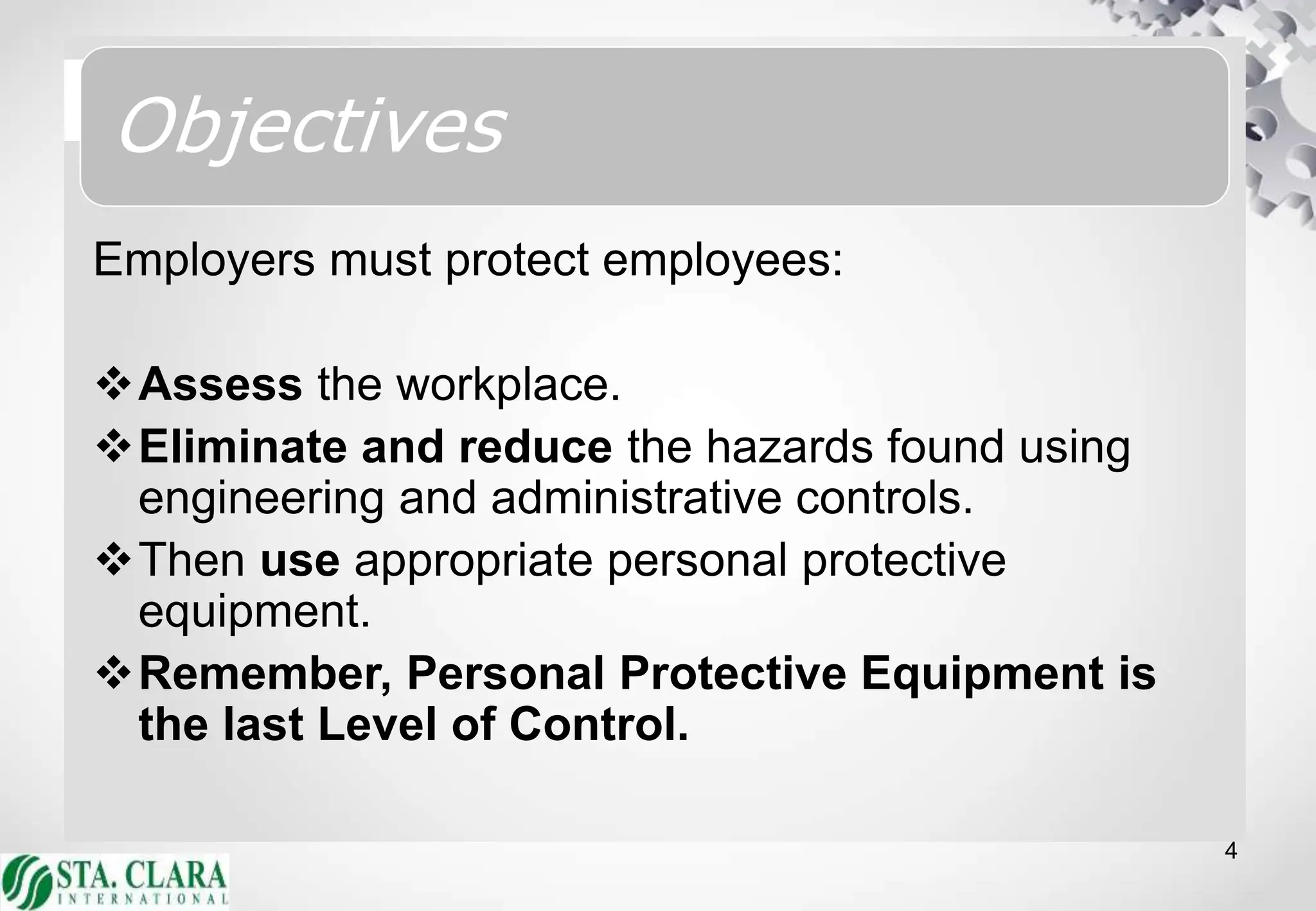
Describe the hierarchy of controls as it relates to
personal protective equipment.
Identify the types of personal protective equipment.
Explain the personal protective equipment training
requirements.
Explain the employer responsibilities.
Explain the employee responsibilities regarding
personal protective equipment.
4
Objectives
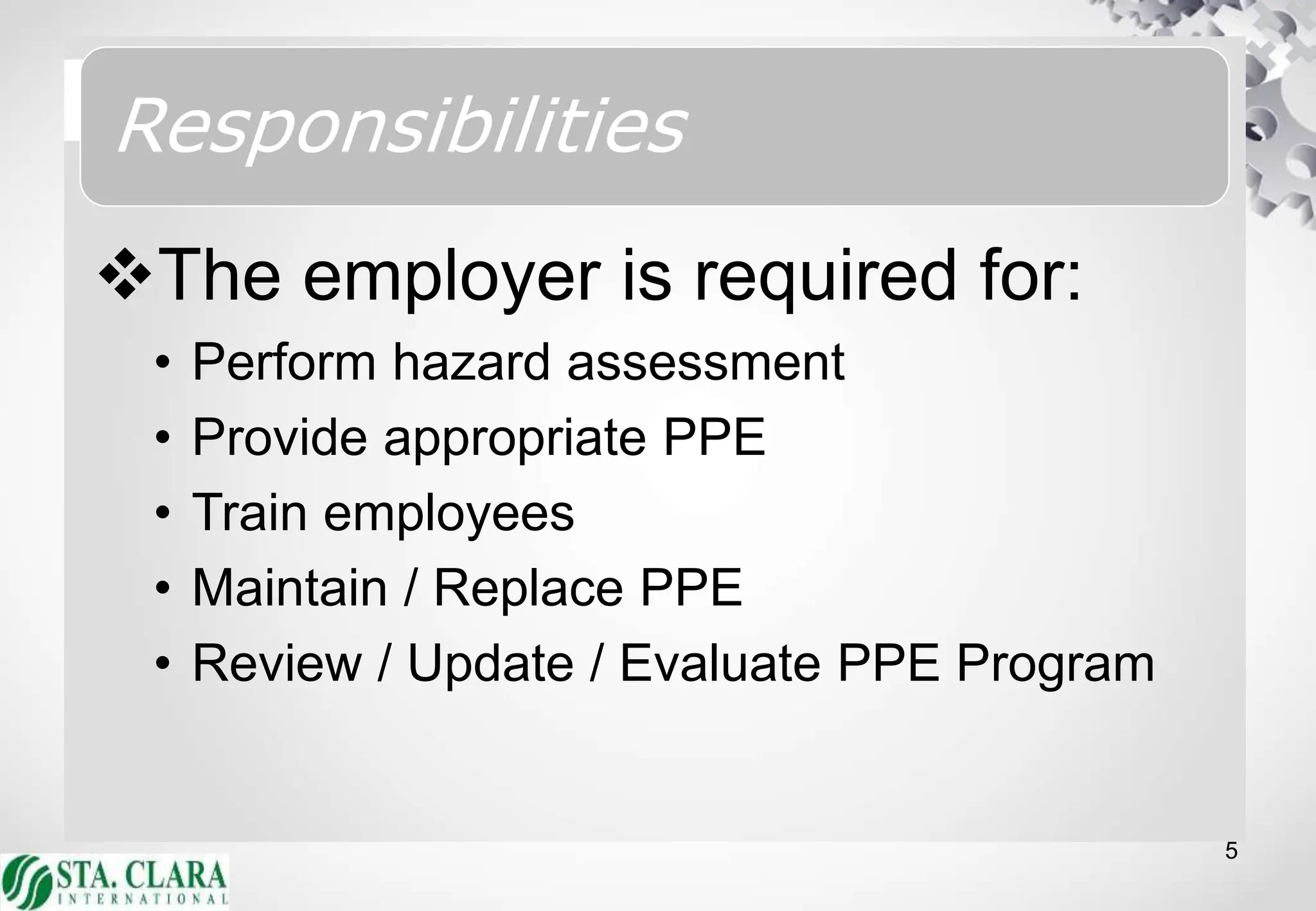
Employers must protect employees:
Assess the workplace.
Eliminate and reduce the hazards found using
engineering and administrative controls.
Then use appropriate personal protective
equipment.
Remember, Personal Protective Equipment is
the last Level of Control.
5
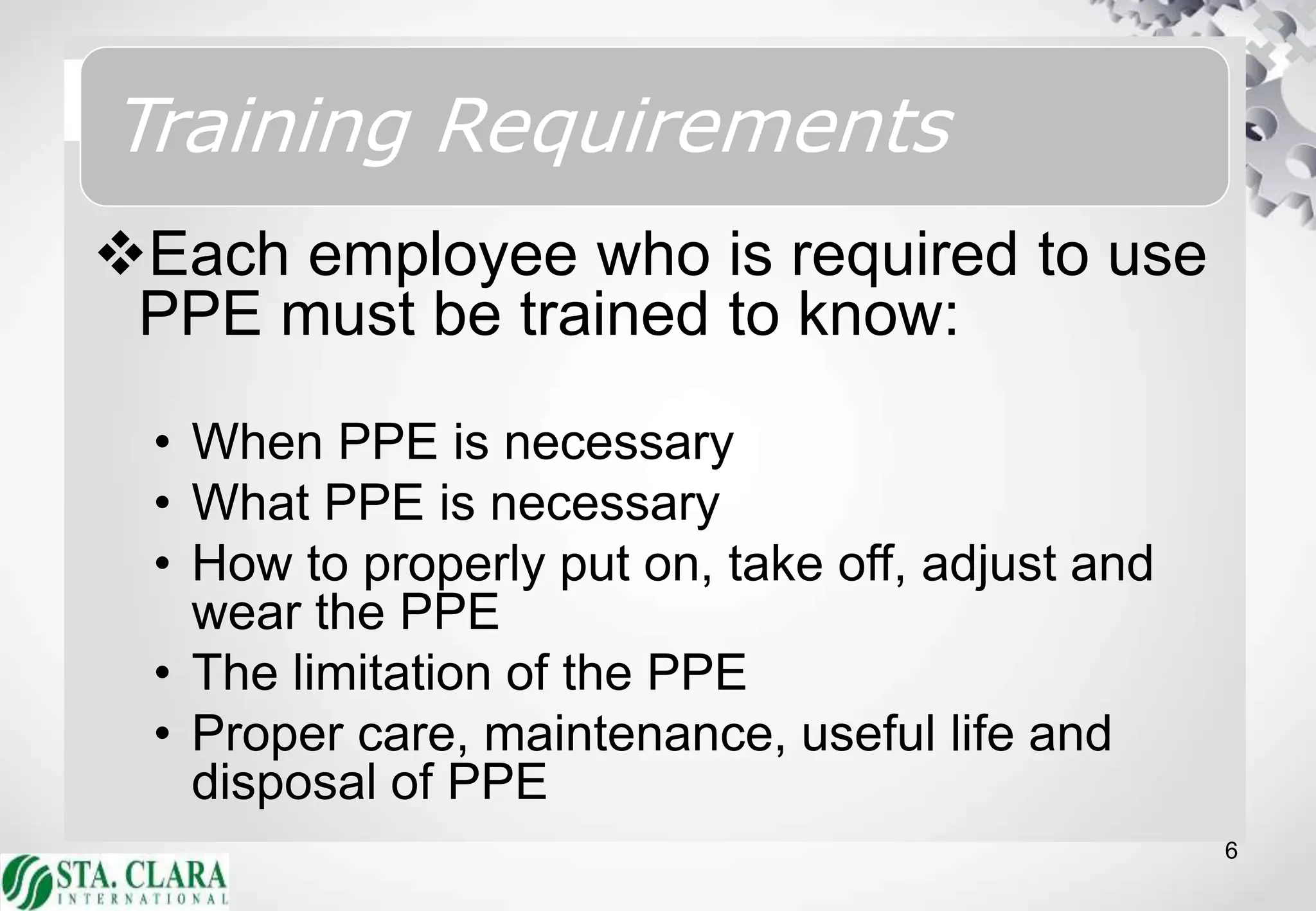
Responsibilities
The employer is required for:
• Perform hazard assessment
• Provide appropriate PPE
• Train employees
• Maintain / Replace PPE
• Review / Update / Evaluate PPE Program
6
Training Requirements
Each employee who is required to use
PPE must be trained to know:
• When PPE is necessary
• What PPE is necessary
• How to properly put on, take off, adjust and
wear the PPE
• The limitation of the PPE
• Proper care, maintenance, useful life and
disposal of PPE
7
HIERARCHY of CONTROLS
Physically
removed the
hazards
Replace the
hazards
Isolate the people from
the hazards
Change the way people
work
Protect the worker with
Personal Protective
Equipment
Least Effective
Highest Effective
8
Hierarchy of Control
Elimination:
Highest level of protection
Eliminate the hazard from the workplace
HAZARD
9
Hierarchy of Control
Substitution:
Use safer item / substance
Use same chemical but in a different form; as
particle size of a substance decreases, hazard
level increases.
HAZARD
10
Hierarchy of Control
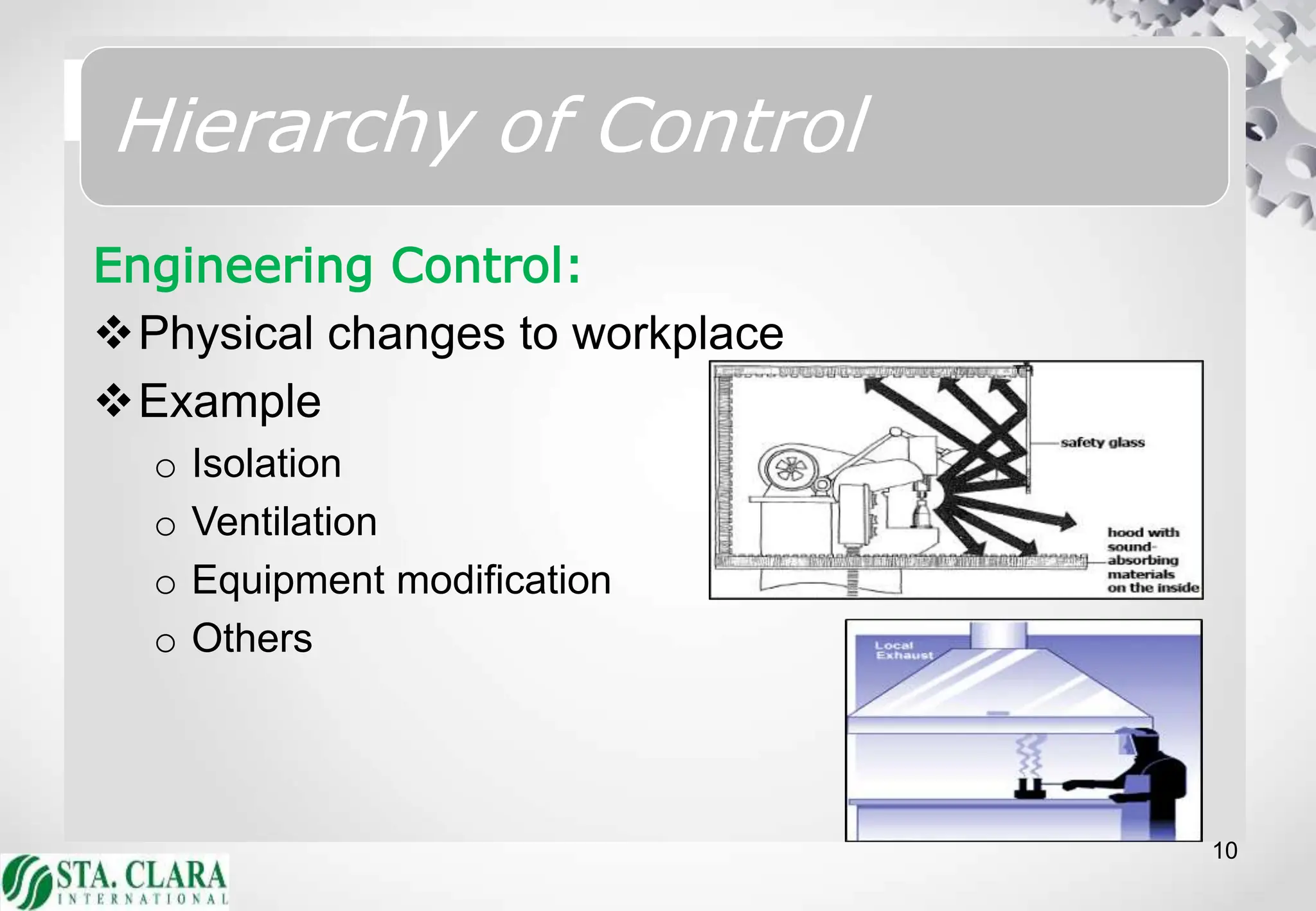
Engineering Control:
Physical changes to workplace
Example
o Isolation
o Ventilation
o Equipment modification
o Others
11
Hierarchy of Control
Administrative Control:
 Requires worker or employer to do something
 Example
o Written proper operating procedures, work permits and safe work
practices
o Inspection and maintenance
o Housekeeping
o Monitoring the use of highly hazardous materials
o Supervision
o Trainings
o Alarms, signals and warnings
o Regulated areas
o Limit exposure by time or distance
o Posting of safety signages
12
Hierarchy of Control
Personal Protective Equipment (PPE) Control:
Requires worker or employer to wear
Examples:
13
What is PPE?
Personal Protective Equipment
PPE is a precautionary step to protect yourself and
the people around you.
PPE is specialized clothing or equipment worn for
protection against dangerous or infectious
materials.
PPE prevents contact with an infectious agent by
creating a barrier between the potentially infectious
material and the public health practitioner.
14
Types of PPE
Head Protection:

15
Types of PPE
Head Protection:
Frequent causes of head injuries
- Falling objects from above
striking on the head;
- Bump head against fixed objects,
such as exposed pipes or
beams; or
- Accidental head contact with
electrical hazards.
16
Types of PPE
Wearing a helmet or hard hat is one
of the easiest ways to protect an
employees head from injury. Hard
hats can protect employees from
impact and penetration hazards as
well as from electrical shock and
burn hazards.
Employers must ensure that their employees wear
head protection if any of the following apply.
17
Types of PPE
Classes of hard hats:
- CLASS G (General)
• Protection against
impact, penetration.
• Low-voltage electrical
protection (proof –
tested to 2,200 volts)
18
Types of PPE
Classes of hard hats:
- CLASS E (Electrical)
• Designed for electrical /
utility work.
• Protect against falling
objects, impact.
• Electrical protection
against high-voltage
(proof-tested to 20,000
volts)
19
Types of PPE
Classes of hard hats:
- CLASS C (Conductive)
• Designed for comfort;
offers limited protection.
• Protects head that may
bump against fixed
objects.
• Does not protect against
falling objects or electrical
hazards.
20
Types of PPE
ANSI Z89.1, 1997
- Type I:
• Provides protection from objects fall
directly on top of the helmet, but not from
objects that strikes the side, front or back
of the head.
- Type II:
• Provides protection from strikes to the
top of the head and also provides
protection from blows to the sides, front,
and back of the head. More suitable for
workers who are not always in a standing
position.
21
Types of PPE
Eye and Face Protection:
22
Types of PPE
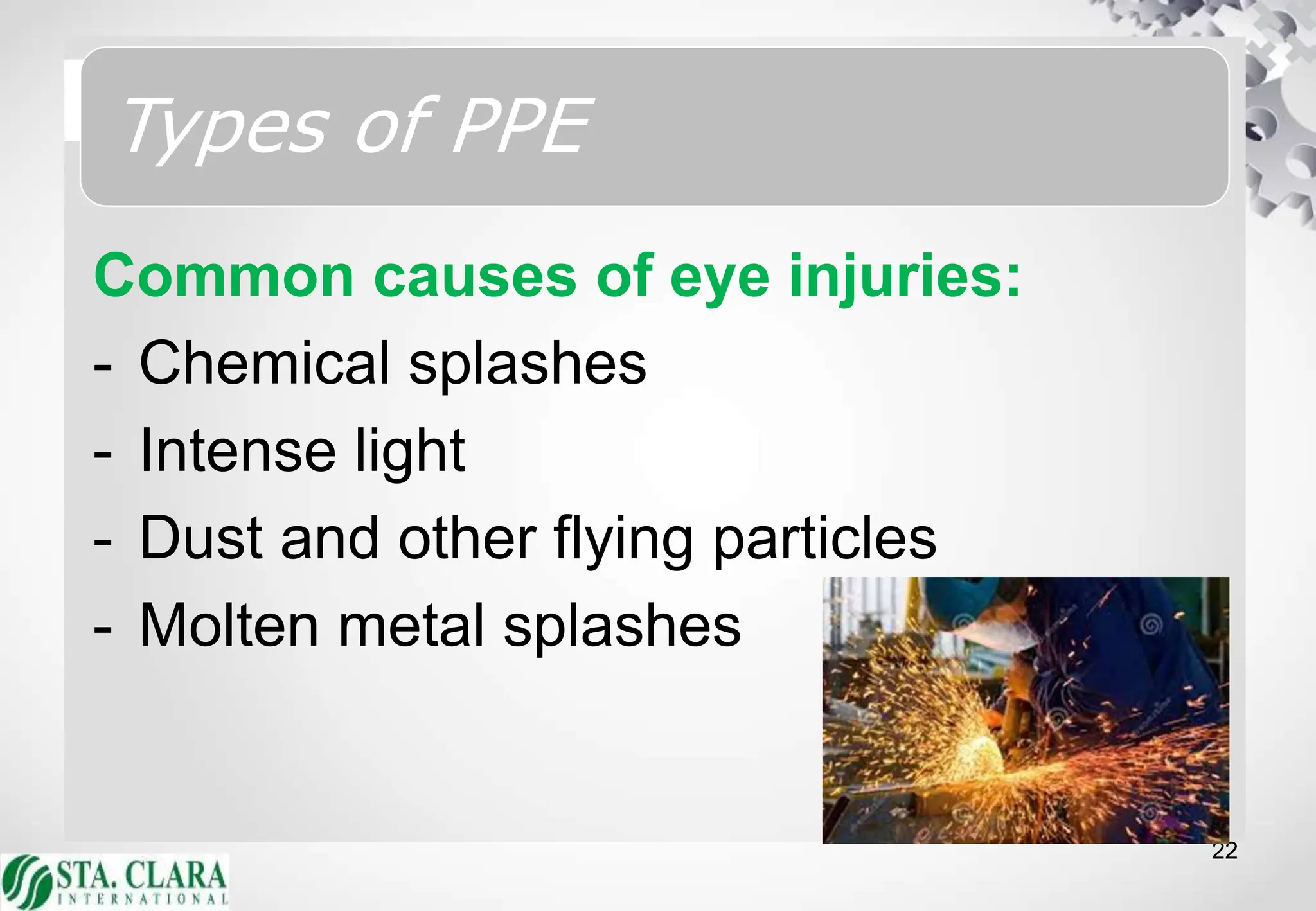
Common causes of eye injuries:
- Chemical splashes
- Intense light
- Dust and other flying particles
- Molten metal splashes
23
Types of PPE
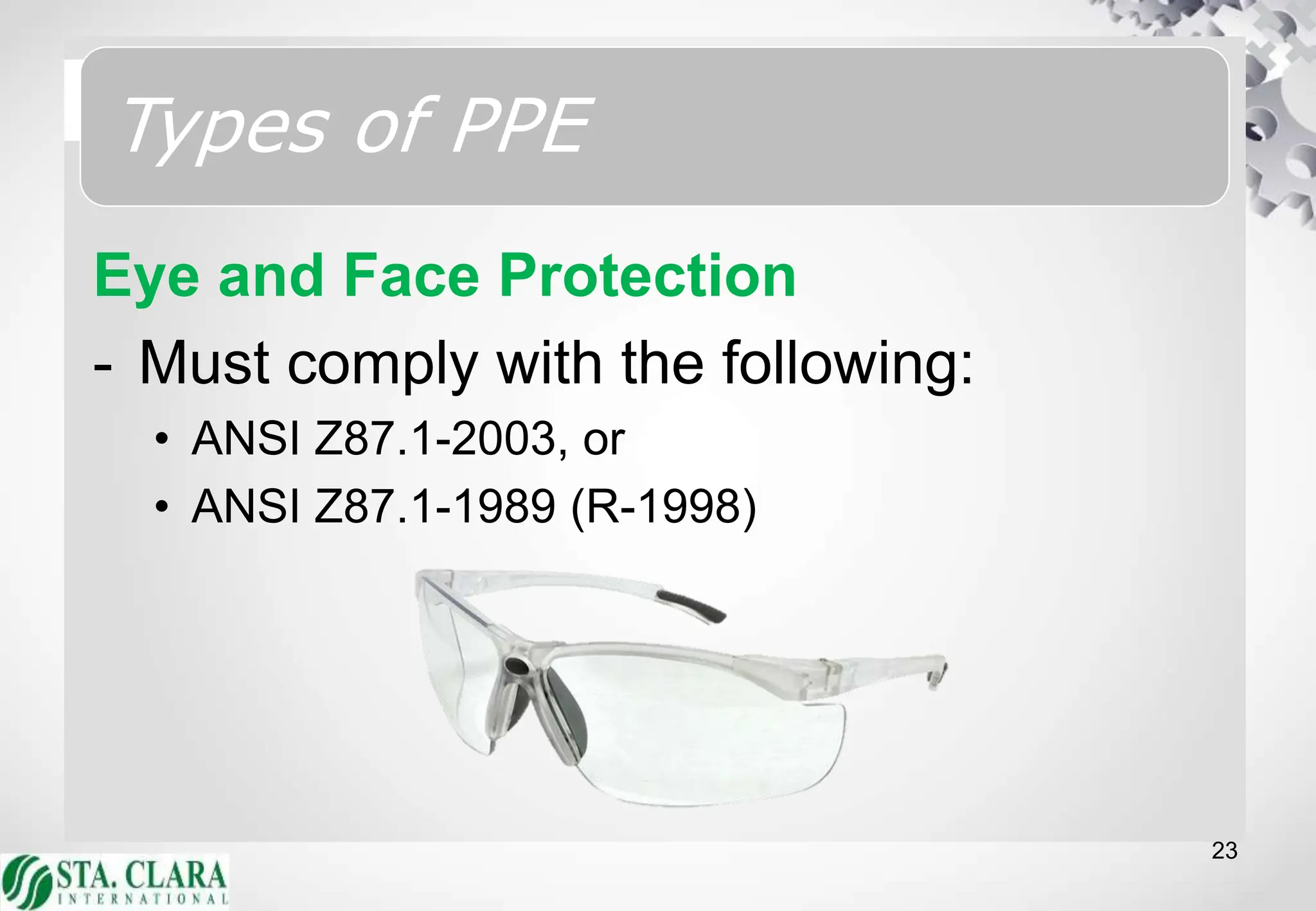
Eye and Face Protection
- Must comply with the following:
• ANSI Z87.1-2003, or
• ANSI Z87.1-1989 (R-1998)
24
Types of PPE
Safety Glasses
- Used to protect against
moderate impacts from particles
25
Types of PPE
Selecting Eye and Face Protection
- Elements to consider:
• Ability to protect against workplace hazards
• Should fit properly
• Should provide unrestricted vision and
movement
• Durable and cleanable
• Allow unrestricted functioning of other PPE
26
Types of PPE
Prescription Glasses
- Employee who use
prescription glasses while
performing operations with
potential eye hazards must
use eye protection that:
• Incorporates the prescription in its design, or
• Can be used over your prescription glasses
without interfering with the proper positioning of
the prescription glasses or goggles.
27
Types of PPE
Goggles
- Protect eyes, and the facial
area immediately surrounding
the eyes from impact, dust
splashes.
- Some can be used over
corrective lenses or
prescription glasses, if they fit
them.
28
Types of PPE
Types of Goggles
Direct-ventilated Indirect-ventilated Non-ventilated
• Does not allow the
passage of air into the
goggle
• Prevents splash entry
• May fog and require
frequent lens cleaning
• Prevents fogging
by allowing air
circulation
• Protects against
liquid or chemical
splash entry
• Resist direct passage
of large particles into
the goggle
• Prevents fogging by
allowing air circulation
29
Types of PPE
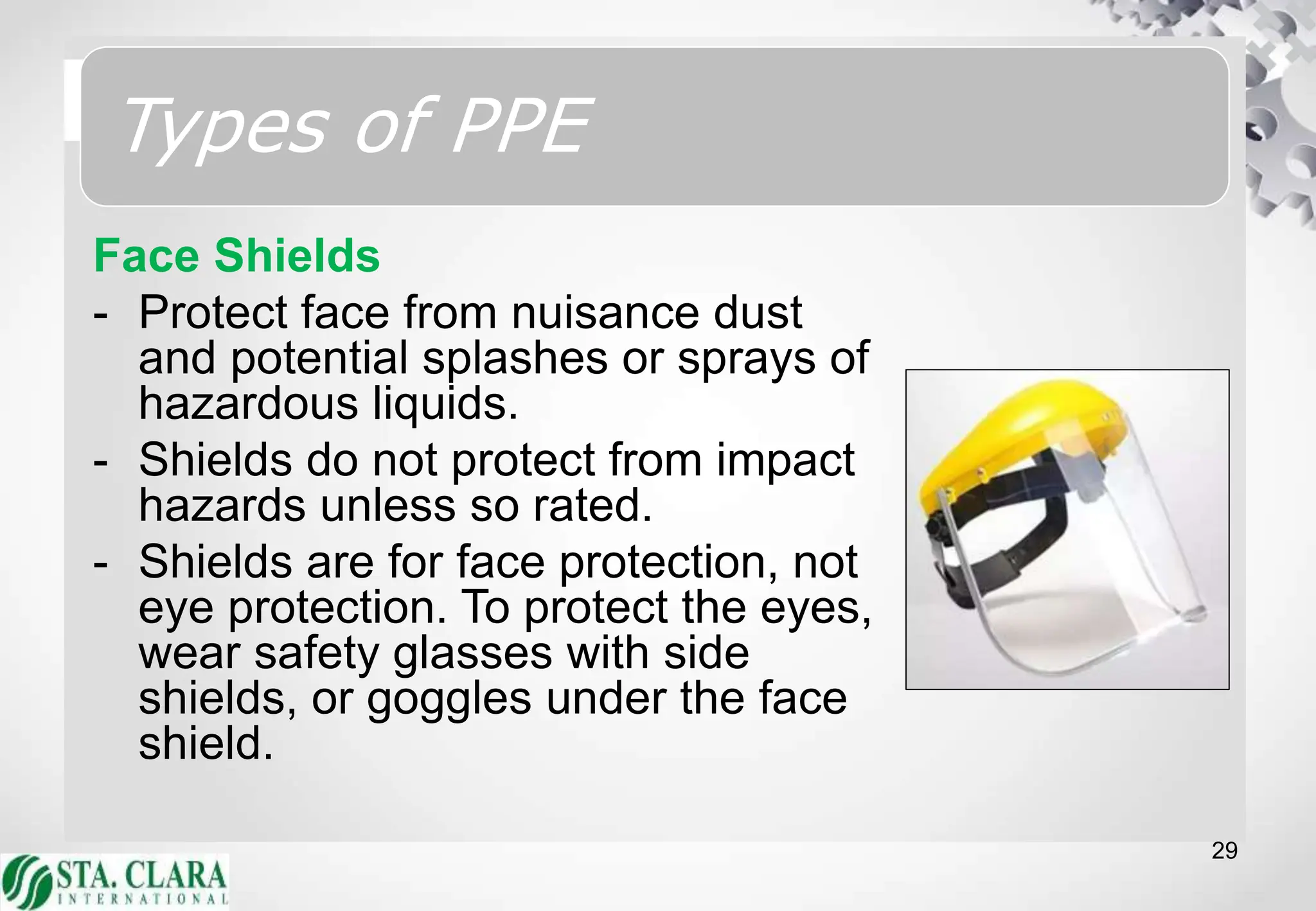
Face Shields
- Protect face from nuisance dust
and potential splashes or sprays of
hazardous liquids.
- Shields do not protect from impact
hazards unless so rated.
- Shields are for face protection, not
eye protection. To protect the eyes,
wear safety glasses with side
shields, or goggles under the face
shield.
30
Types of PPE
Welding Shield / Welding Mask
- Protect eye from burns caused
by:
• Infrared light
• Intense radiant light
- Protect eyes and face from
flying sparks, metal spatters,
and slag
31
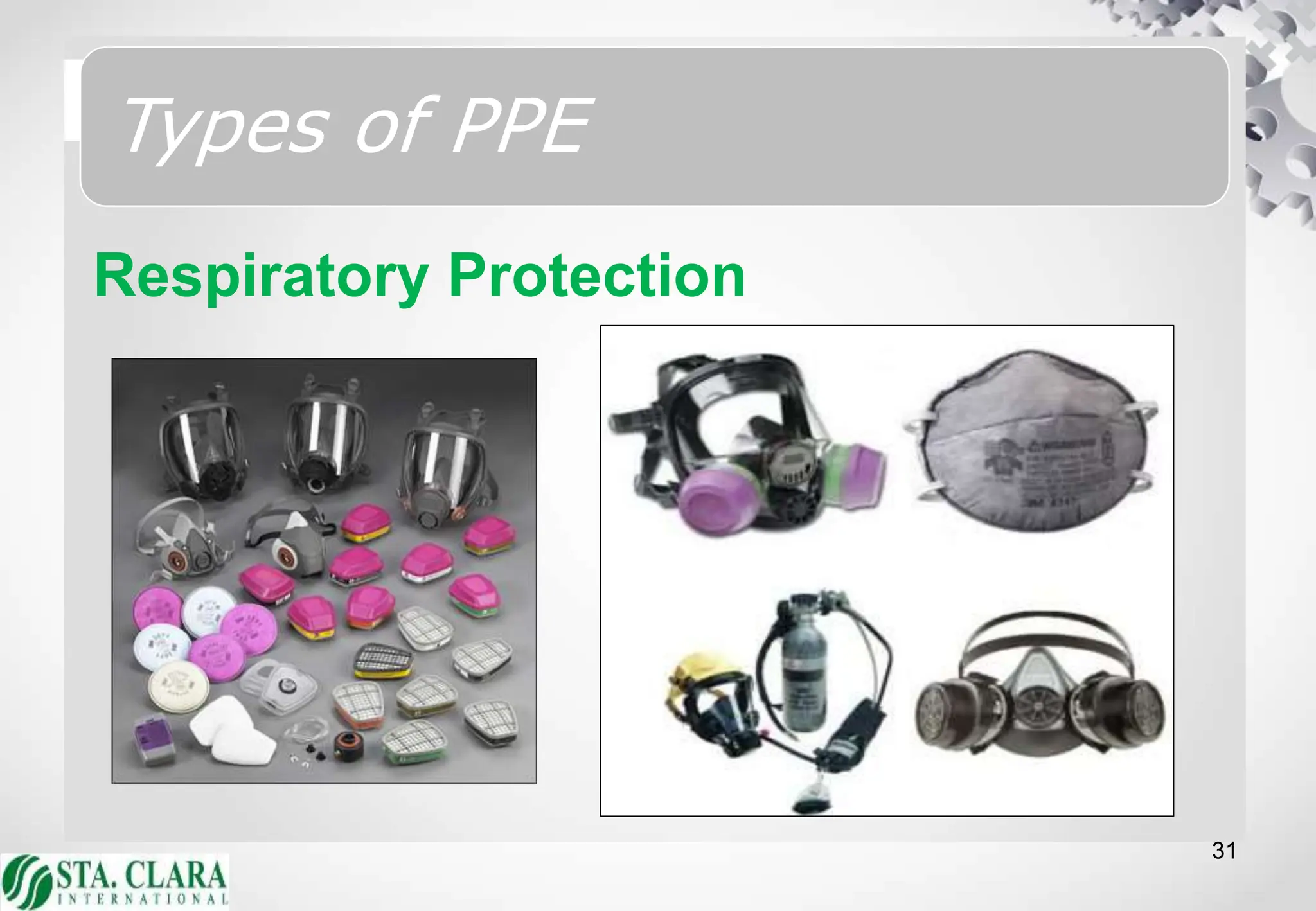
Types of PPE
Respiratory Protection
32
Types of PPE
- Eliminate toxic material or substitute a
less toxic material
- Enclose or confine operation
- General or local exhaust ventilation
• Only when engineering controls are not
feasible, respirators will be used
33
Types of PPE
Types of Respirators
- Air-Purifying (APR) –
remove contaminants
from air
• Particulate respirators
• Chemical cartridge/gas mask
respirator
• Powered Air-Purifying
Respirator (PAPR)
34
Types of PPE
Types of Respirators
- Atmosphere – Supplying
– provide clean and
breathable air
• Self-Contained Breathing
Apparatus (SCBA)
• Supplied-Air Respirator
(SAR)
35
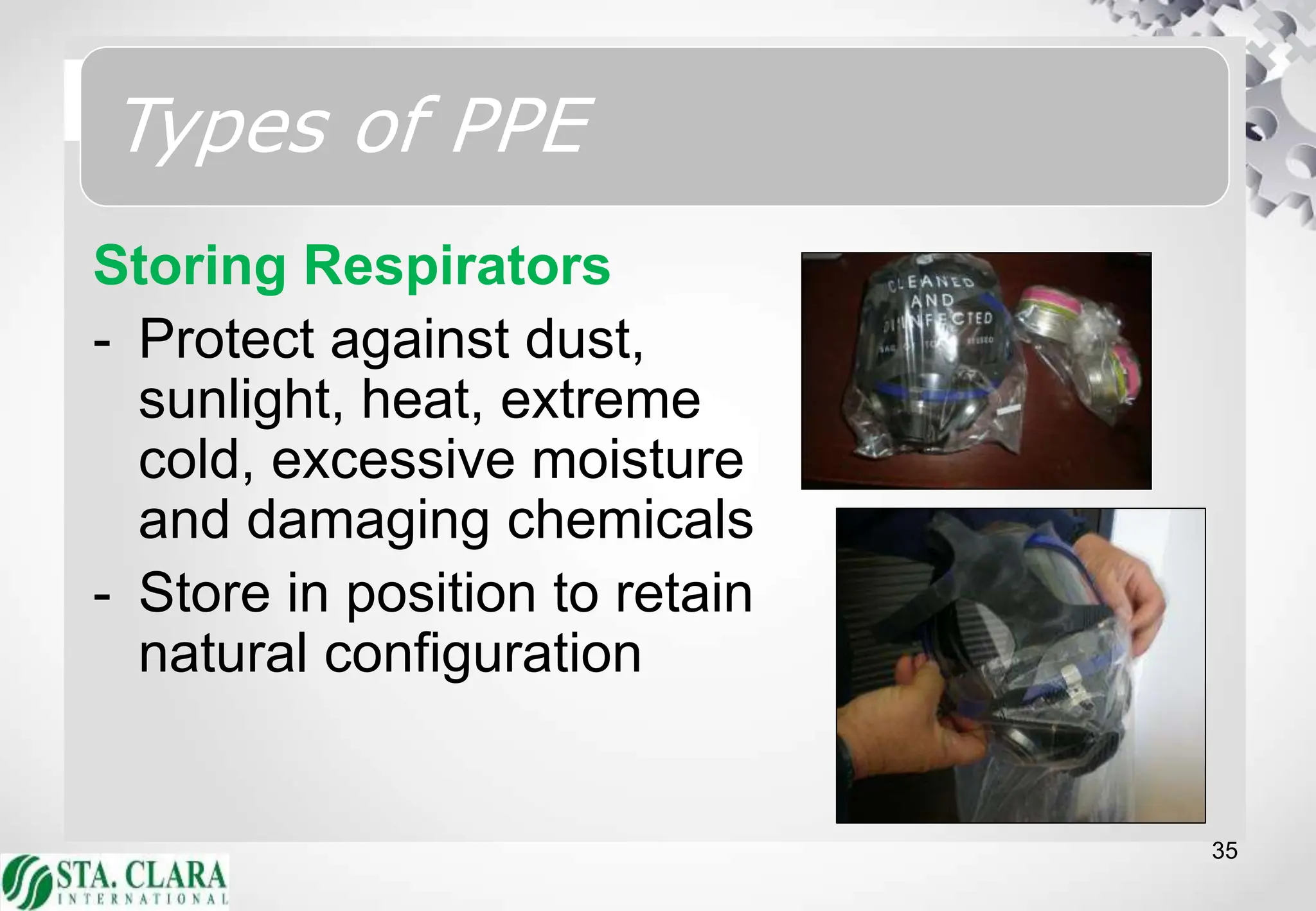
Types of PPE
Storing Respirators
- Protect against dust,
sunlight, heat, extreme
cold, excessive moisture
and damaging chemicals
- Store in position to retain
natural configuration
36
Types of PPE
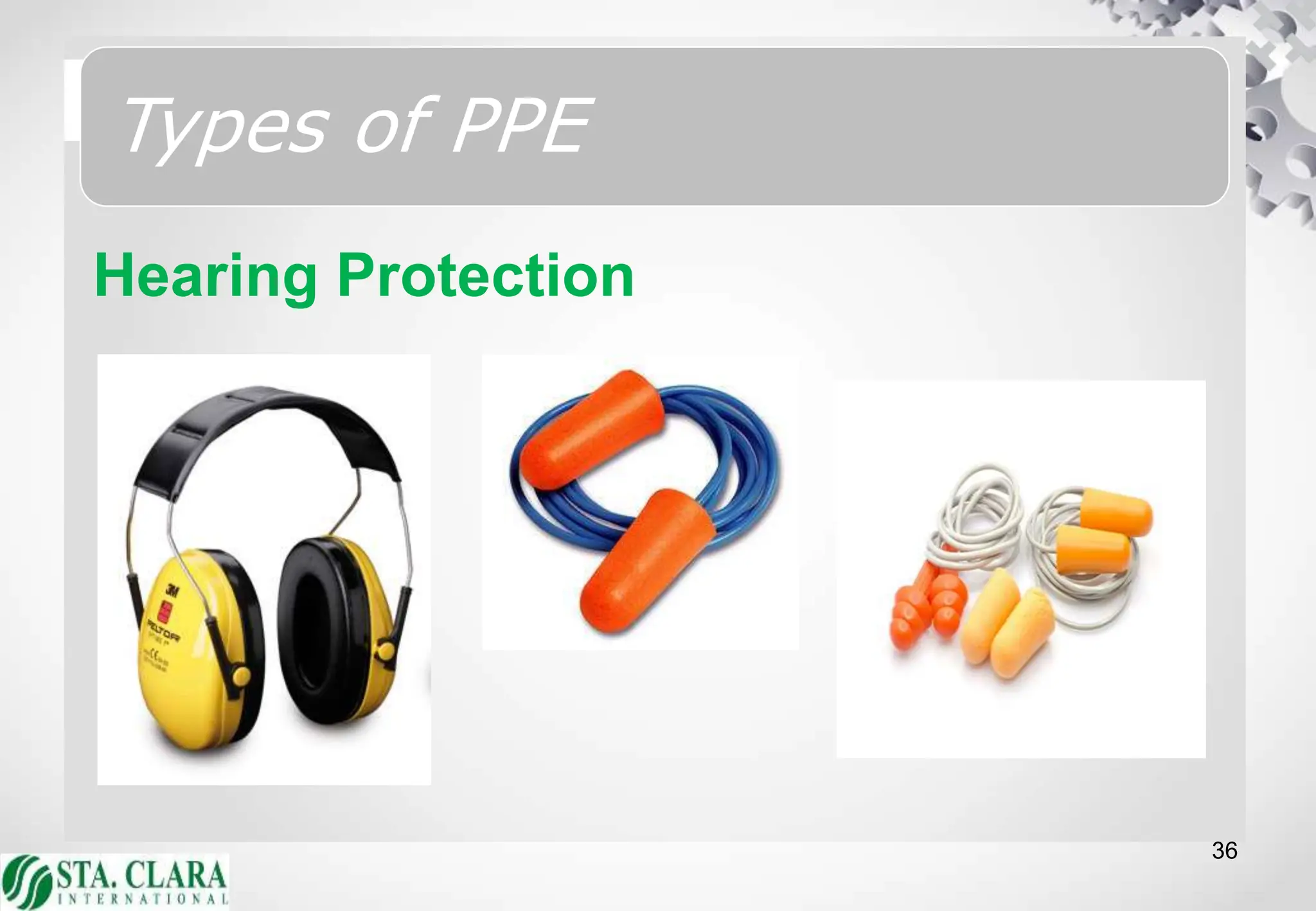
Hearing Protection
37
Types of PPE
Hearing Protection
• Exposure to noise levels
over 85 dB can be cause
hearing loss
• Hearing protection
required at 90 dB
• Implement effective
Hearing Conservation
Program
38
Types of PPE
Hearing Protection
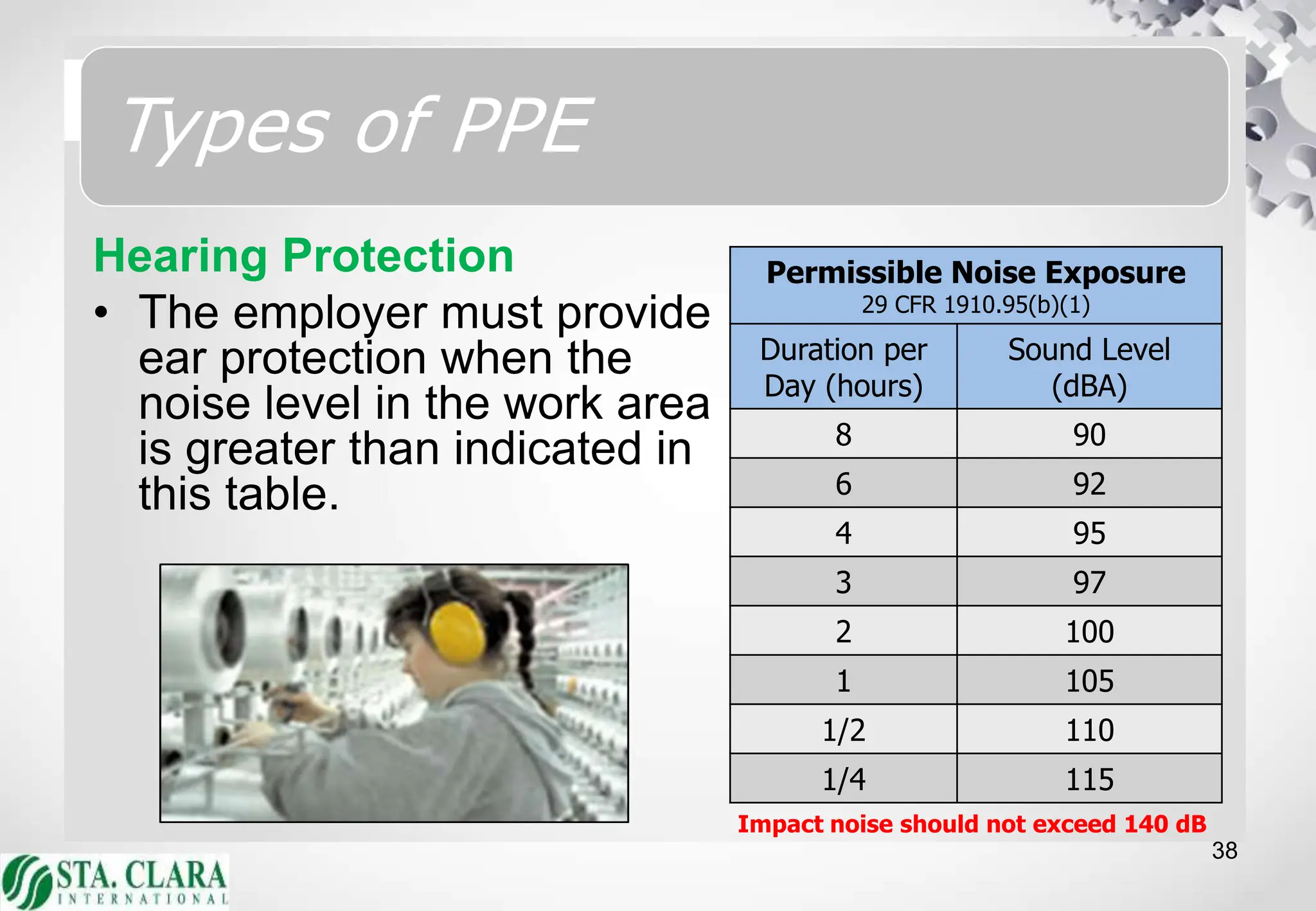
• The employer must provide
ear protection when the
noise level in the work area
is greater than indicated in
this table.
Impact noise should not exceed 140 dB
Permissible Noise Exposure
29 CFR 1910.95(b)(1)
Duration per
Day (hours)
Sound Level
(dBA)
8 90
6 92
4 95
3 97
2 100
1 105
1/2 110
1/4 115
39
Types of PPE
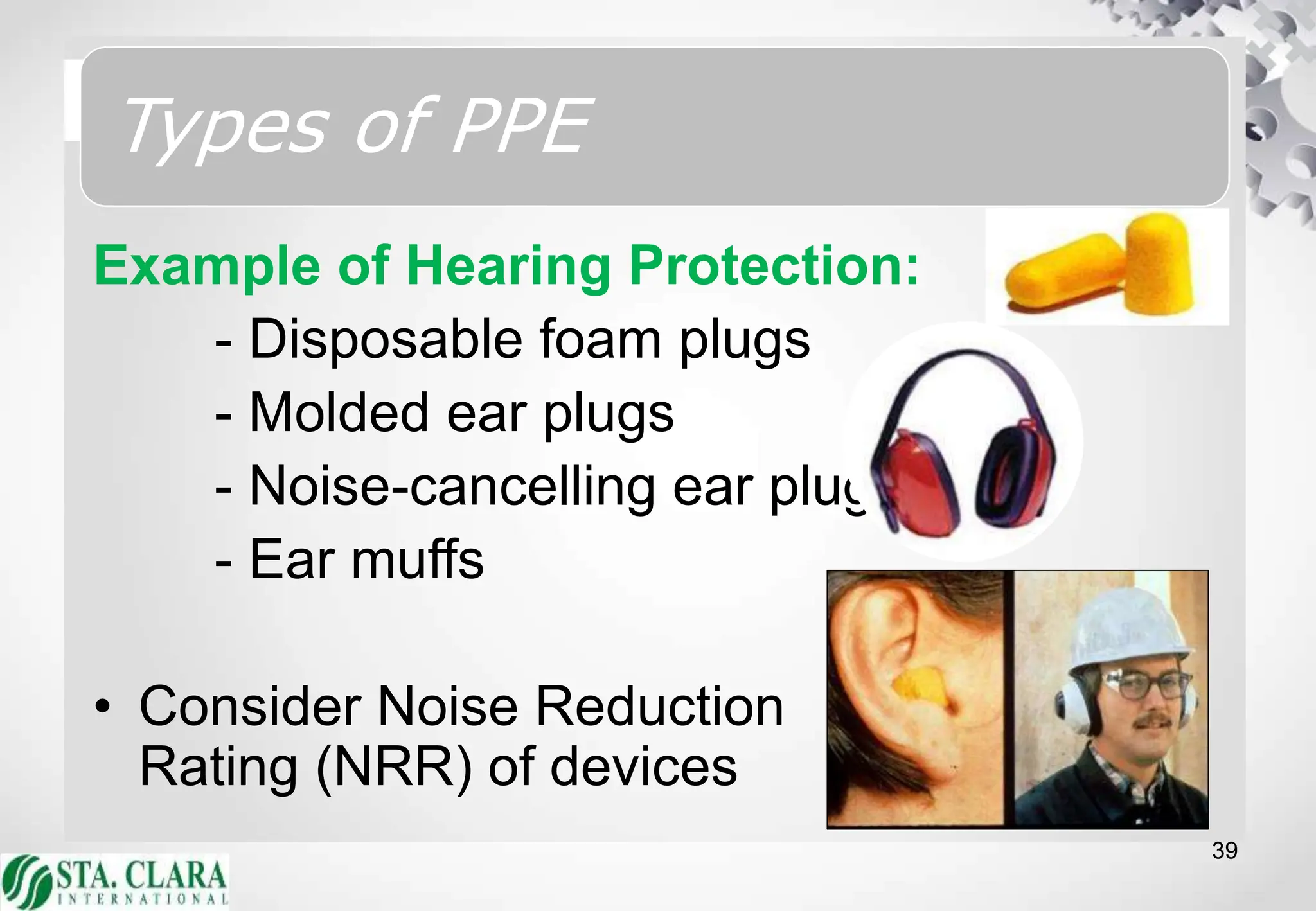
Example of Hearing Protection:
- Disposable foam plugs
- Molded ear plugs
- Noise-cancelling ear plugs
- Ear muffs
• Consider Noise Reduction
Rating (NRR) of devices
40
Types of PPE
Hand Protection:
• Potential hazards for hands
- Skin absorption of hazardous
substances
- Lacerations or severe cuts
- Punctures
- Chemical burns
- Thermal burns
- Extreme temperatures
41
Types of PPE
Hand Protection (Types of Gloves):
Anti-vibration
Working gloves
Leather Palm / Welding gloves
Cut-resistant
Electrical gloves
Chemical-resistant
42
Types of PPE
Foot Protection:
• Protective footwear must comply with any of the
following agreement standards:
- ANSI Z41.1 – 1991 – “American
National Standard for Personal
Protection –
Protective Footwear”
- ASTM F-2412 – 2005 – “Standard Test
Methods for foot protection”
- ASTM F-2413 – 2005 – “Standard
Specification for
Performance
Requirements for Protective Footwear”
43
Types of PPE
Foot Protection:
• Condition requiring foot
protection:
- Impacts
- Compressions
- Cuts/Punctures
- Chemicals
- Temperatures
44
Types of PPE
45
Types of PPE
Foot Protection:
• Cause of foot injuries:
- Falling or rolling of heavy objects
- Crushing or penetrating materials
- Sharp objects that can penetrate
the sole
- Exposure to molten metal
- Working on, or around, hot, wet, or
slippery surfaces
- working when electrical hazards are
present
46
Types of PPE
Foot Protection:
• Protection from hazards
- Shoes with metal toe-cap
protects against
knocks, falling objects
- Rubber shoes protect
against chemical materials, as
directed by
the SDS
47
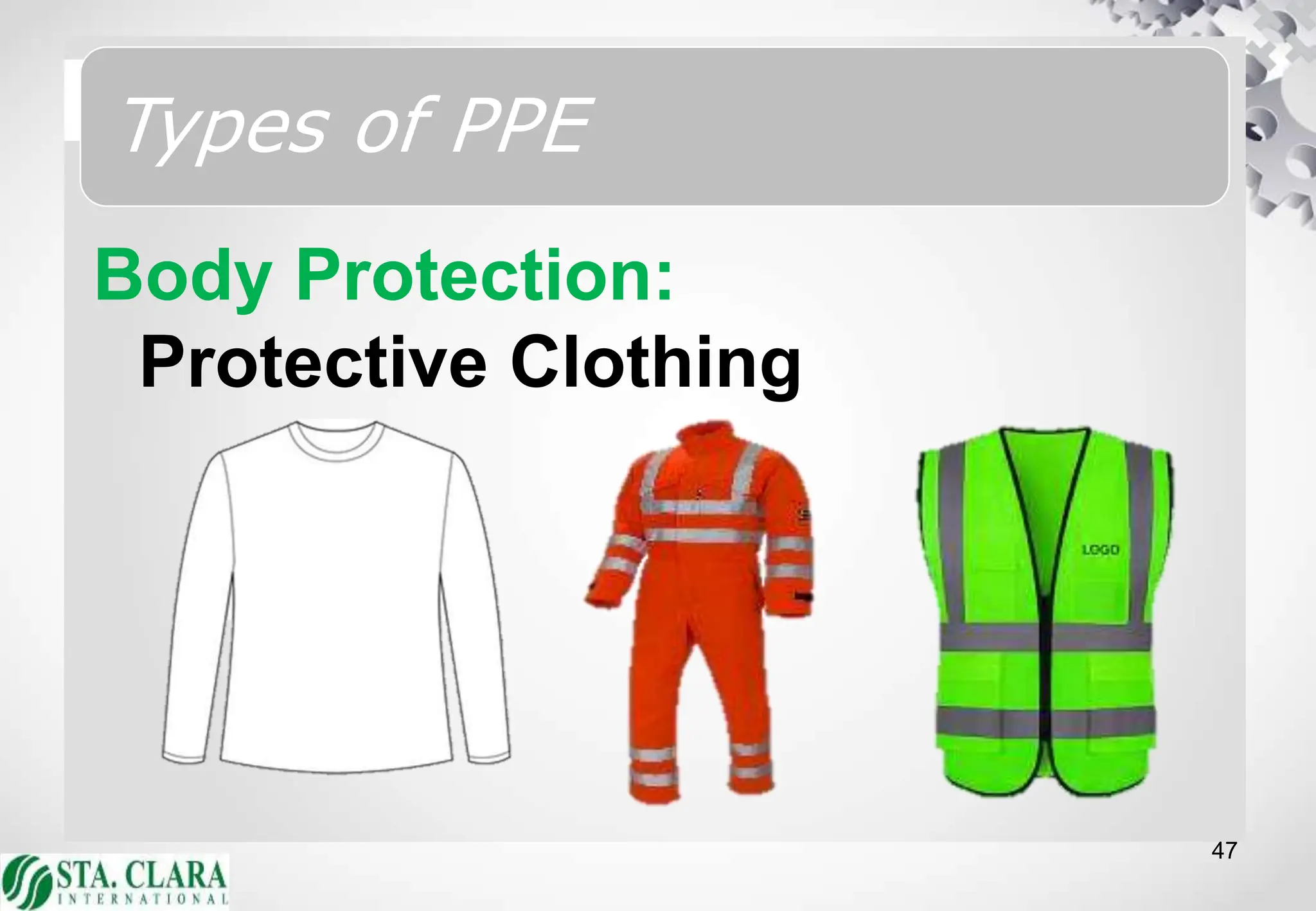
Types of PPE
Body Protection:
Protective Clothing
48
Types of PPE
Provide protective clothing for those
parts of the body exposed to possible
injuries.
Types of body protection
• Laboratory coats
• Coveralls
• Vests
• Jackets
• Aprons
• Surgical gowns
• Full-body suits
Question & Answer?
NO JOB IS SO URGENT THAT WE
CANNOT TAKE THE TIME TO DO IT
SAFELY.
ALWAYS REMEMBER!
51
BE SAFE ALWAYS

Personal Protective Equipment (PPE) Training - PREPARED BY JAY.pptx

  • 1.
  • 2.
    Opening & Background TRAININGRULE  Phone on silent mode (if there is an urgent call take it outside)  If you need a break or explanation don’t hesitate to stop us  Try to stay, always focus on your safety and the safety of your buddy.
  • 3.
    3 Objectives Describe the hierarchyof controls as it relates to personal protective equipment. Identify the types of personal protective equipment. Explain the personal protective equipment training requirements. Explain the employer responsibilities. Explain the employee responsibilities regarding personal protective equipment.
  • 4.
    4 Objectives Employers must protectemployees: Assess the workplace. Eliminate and reduce the hazards found using engineering and administrative controls. Then use appropriate personal protective equipment. Remember, Personal Protective Equipment is the last Level of Control.
  • 5.
    5 Responsibilities The employer isrequired for: • Perform hazard assessment • Provide appropriate PPE • Train employees • Maintain / Replace PPE • Review / Update / Evaluate PPE Program
  • 6.
    6 Training Requirements Each employeewho is required to use PPE must be trained to know: • When PPE is necessary • What PPE is necessary • How to properly put on, take off, adjust and wear the PPE • The limitation of the PPE • Proper care, maintenance, useful life and disposal of PPE
  • 7.
    7 HIERARCHY of CONTROLS Physically removedthe hazards Replace the hazards Isolate the people from the hazards Change the way people work Protect the worker with Personal Protective Equipment Least Effective Highest Effective
  • 8.
    8 Hierarchy of Control Elimination: Highestlevel of protection Eliminate the hazard from the workplace HAZARD
  • 9.
    9 Hierarchy of Control Substitution: Usesafer item / substance Use same chemical but in a different form; as particle size of a substance decreases, hazard level increases. HAZARD
  • 10.
    10 Hierarchy of Control EngineeringControl: Physical changes to workplace Example o Isolation o Ventilation o Equipment modification o Others
  • 11.
    11 Hierarchy of Control AdministrativeControl:  Requires worker or employer to do something  Example o Written proper operating procedures, work permits and safe work practices o Inspection and maintenance o Housekeeping o Monitoring the use of highly hazardous materials o Supervision o Trainings o Alarms, signals and warnings o Regulated areas o Limit exposure by time or distance o Posting of safety signages
  • 12.
    12 Hierarchy of Control PersonalProtective Equipment (PPE) Control: Requires worker or employer to wear Examples:
  • 13.
    13 What is PPE? PersonalProtective Equipment PPE is a precautionary step to protect yourself and the people around you. PPE is specialized clothing or equipment worn for protection against dangerous or infectious materials. PPE prevents contact with an infectious agent by creating a barrier between the potentially infectious material and the public health practitioner.
  • 14.
    14 Types of PPE HeadProtection: 
  • 15.
    15 Types of PPE HeadProtection: Frequent causes of head injuries - Falling objects from above striking on the head; - Bump head against fixed objects, such as exposed pipes or beams; or - Accidental head contact with electrical hazards.
  • 16.
    16 Types of PPE Wearinga helmet or hard hat is one of the easiest ways to protect an employees head from injury. Hard hats can protect employees from impact and penetration hazards as well as from electrical shock and burn hazards. Employers must ensure that their employees wear head protection if any of the following apply.
  • 17.
    17 Types of PPE Classesof hard hats: - CLASS G (General) • Protection against impact, penetration. • Low-voltage electrical protection (proof – tested to 2,200 volts)
  • 18.
    18 Types of PPE Classesof hard hats: - CLASS E (Electrical) • Designed for electrical / utility work. • Protect against falling objects, impact. • Electrical protection against high-voltage (proof-tested to 20,000 volts)
  • 19.
    19 Types of PPE Classesof hard hats: - CLASS C (Conductive) • Designed for comfort; offers limited protection. • Protects head that may bump against fixed objects. • Does not protect against falling objects or electrical hazards.
  • 20.
    20 Types of PPE ANSIZ89.1, 1997 - Type I: • Provides protection from objects fall directly on top of the helmet, but not from objects that strikes the side, front or back of the head. - Type II: • Provides protection from strikes to the top of the head and also provides protection from blows to the sides, front, and back of the head. More suitable for workers who are not always in a standing position.
  • 21.
    21 Types of PPE Eyeand Face Protection:
  • 22.
    22 Types of PPE Commoncauses of eye injuries: - Chemical splashes - Intense light - Dust and other flying particles - Molten metal splashes
  • 23.
    23 Types of PPE Eyeand Face Protection - Must comply with the following: • ANSI Z87.1-2003, or • ANSI Z87.1-1989 (R-1998)
  • 24.
    24 Types of PPE SafetyGlasses - Used to protect against moderate impacts from particles
  • 25.
    25 Types of PPE SelectingEye and Face Protection - Elements to consider: • Ability to protect against workplace hazards • Should fit properly • Should provide unrestricted vision and movement • Durable and cleanable • Allow unrestricted functioning of other PPE
  • 26.
    26 Types of PPE PrescriptionGlasses - Employee who use prescription glasses while performing operations with potential eye hazards must use eye protection that: • Incorporates the prescription in its design, or • Can be used over your prescription glasses without interfering with the proper positioning of the prescription glasses or goggles.
  • 27.
    27 Types of PPE Goggles -Protect eyes, and the facial area immediately surrounding the eyes from impact, dust splashes. - Some can be used over corrective lenses or prescription glasses, if they fit them.
  • 28.
    28 Types of PPE Typesof Goggles Direct-ventilated Indirect-ventilated Non-ventilated • Does not allow the passage of air into the goggle • Prevents splash entry • May fog and require frequent lens cleaning • Prevents fogging by allowing air circulation • Protects against liquid or chemical splash entry • Resist direct passage of large particles into the goggle • Prevents fogging by allowing air circulation
  • 29.
    29 Types of PPE FaceShields - Protect face from nuisance dust and potential splashes or sprays of hazardous liquids. - Shields do not protect from impact hazards unless so rated. - Shields are for face protection, not eye protection. To protect the eyes, wear safety glasses with side shields, or goggles under the face shield.
  • 30.
    30 Types of PPE WeldingShield / Welding Mask - Protect eye from burns caused by: • Infrared light • Intense radiant light - Protect eyes and face from flying sparks, metal spatters, and slag
  • 31.
  • 32.
    32 Types of PPE -Eliminate toxic material or substitute a less toxic material - Enclose or confine operation - General or local exhaust ventilation • Only when engineering controls are not feasible, respirators will be used
  • 33.
    33 Types of PPE Typesof Respirators - Air-Purifying (APR) – remove contaminants from air • Particulate respirators • Chemical cartridge/gas mask respirator • Powered Air-Purifying Respirator (PAPR)
  • 34.
    34 Types of PPE Typesof Respirators - Atmosphere – Supplying – provide clean and breathable air • Self-Contained Breathing Apparatus (SCBA) • Supplied-Air Respirator (SAR)
  • 35.
    35 Types of PPE StoringRespirators - Protect against dust, sunlight, heat, extreme cold, excessive moisture and damaging chemicals - Store in position to retain natural configuration
  • 36.
  • 37.
    37 Types of PPE HearingProtection • Exposure to noise levels over 85 dB can be cause hearing loss • Hearing protection required at 90 dB • Implement effective Hearing Conservation Program
  • 38.
    38 Types of PPE HearingProtection • The employer must provide ear protection when the noise level in the work area is greater than indicated in this table. Impact noise should not exceed 140 dB Permissible Noise Exposure 29 CFR 1910.95(b)(1) Duration per Day (hours) Sound Level (dBA) 8 90 6 92 4 95 3 97 2 100 1 105 1/2 110 1/4 115
  • 39.
    39 Types of PPE Exampleof Hearing Protection: - Disposable foam plugs - Molded ear plugs - Noise-cancelling ear plugs - Ear muffs • Consider Noise Reduction Rating (NRR) of devices
  • 40.
    40 Types of PPE HandProtection: • Potential hazards for hands - Skin absorption of hazardous substances - Lacerations or severe cuts - Punctures - Chemical burns - Thermal burns - Extreme temperatures
  • 41.
    41 Types of PPE HandProtection (Types of Gloves): Anti-vibration Working gloves Leather Palm / Welding gloves Cut-resistant Electrical gloves Chemical-resistant
  • 42.
    42 Types of PPE FootProtection: • Protective footwear must comply with any of the following agreement standards: - ANSI Z41.1 – 1991 – “American National Standard for Personal Protection – Protective Footwear” - ASTM F-2412 – 2005 – “Standard Test Methods for foot protection” - ASTM F-2413 – 2005 – “Standard Specification for Performance Requirements for Protective Footwear”
  • 43.
    43 Types of PPE FootProtection: • Condition requiring foot protection: - Impacts - Compressions - Cuts/Punctures - Chemicals - Temperatures
  • 44.
  • 45.
    45 Types of PPE FootProtection: • Cause of foot injuries: - Falling or rolling of heavy objects - Crushing or penetrating materials - Sharp objects that can penetrate the sole - Exposure to molten metal - Working on, or around, hot, wet, or slippery surfaces - working when electrical hazards are present
  • 46.
    46 Types of PPE FootProtection: • Protection from hazards - Shoes with metal toe-cap protects against knocks, falling objects - Rubber shoes protect against chemical materials, as directed by the SDS
  • 47.
    47 Types of PPE BodyProtection: Protective Clothing
  • 48.
    48 Types of PPE Provideprotective clothing for those parts of the body exposed to possible injuries. Types of body protection • Laboratory coats • Coveralls • Vests • Jackets • Aprons • Surgical gowns • Full-body suits
  • 49.
  • 50.
    NO JOB ISSO URGENT THAT WE CANNOT TAKE THE TIME TO DO IT SAFELY. ALWAYS REMEMBER!
  • 51.