Routes of Chemical Entry-Personnel Protective Equipment- Health and Safety Policy-Material Safety Data Sheet MSDS
Immediately dangerous to life or health (IDLH)- acute and chronic Effects- Routes of Chemical Entry-Personnel Protective Equipment- Health and Safety Policy-Material Safety Data Sheet MSDS
Routes of Chemical Entry-Personnel Protective Equipment- Health and Safety Policy-Material Safety Data Sheet MSDS
1.
1
Hierarchy of Controls
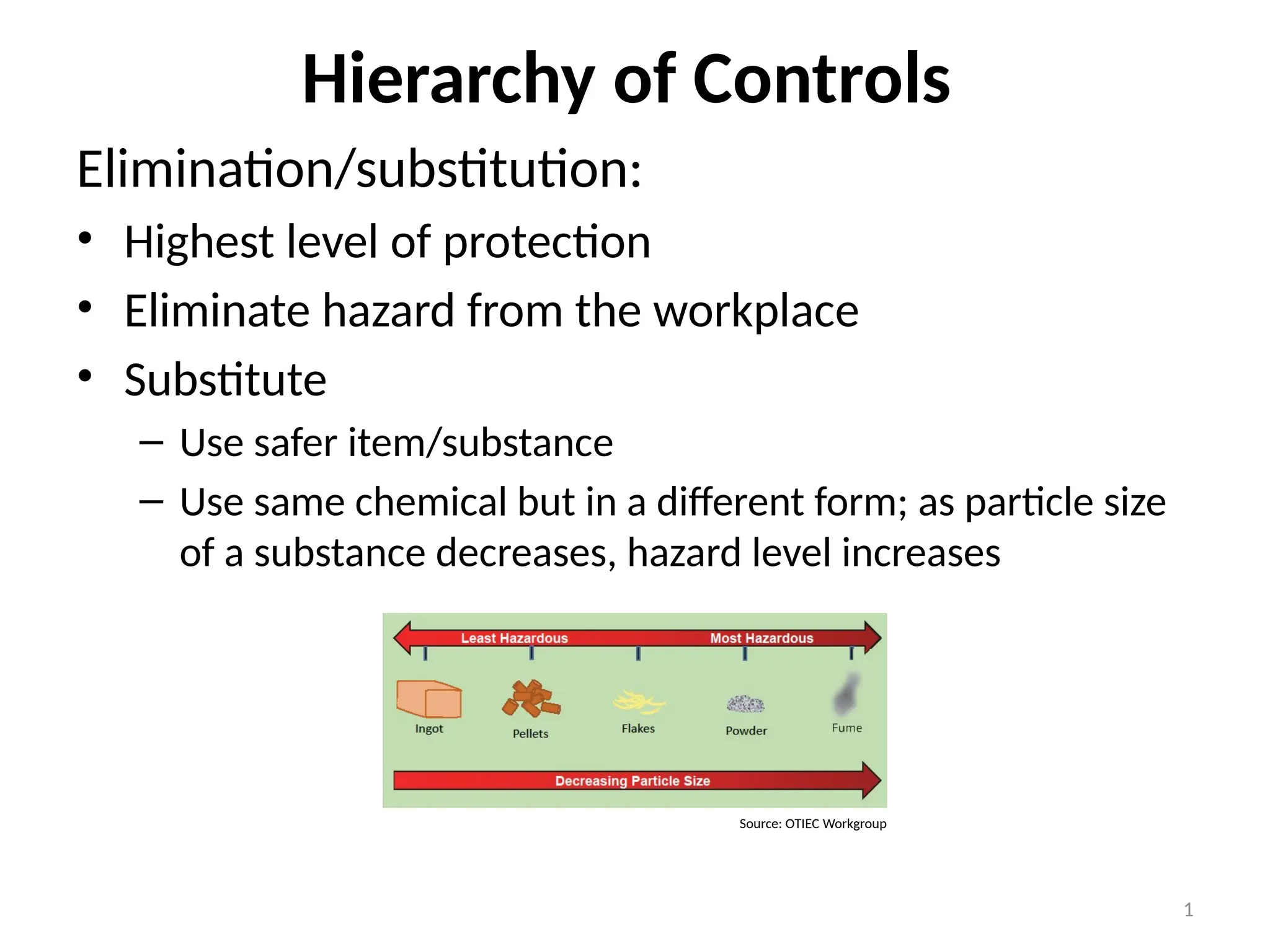
Elimination/substitution:
•Highest level of protection
• Eliminate hazard from the workplace
• Substitute
– Use safer item/substance
– Use same chemical but in a different form; as particle size
of a substance decreases, hazard level increases
Source: OTIEC Workgroup
2.
2
Hierarchy of Controls
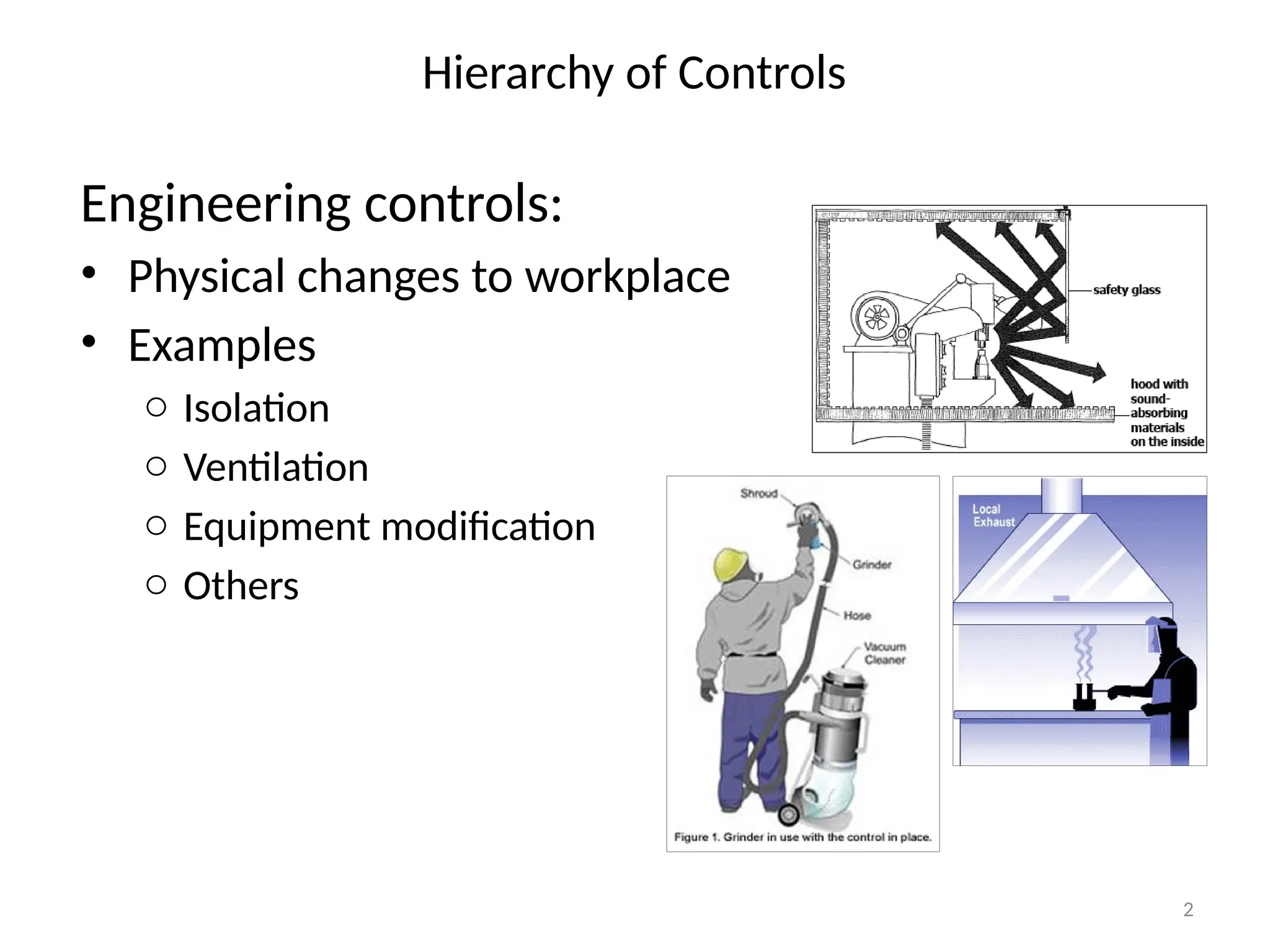
Engineeringcontrols:
• Physical changes to workplace
• Examples
o Isolation
o Ventilation
o Equipment modification
o Others
3.
3
Hierarchy of Controls
Administrativecontrols/work practice control:
• Requires worker or employer to do something
• Examples
o Written proper operating procedures, work permits and safe work
practices
o Inspection and maintenance
o Housekeeping
o Monitoring the use of highly hazardous materials
o Supervision
o Training
o Alarms, signs and warnings
o Regulated areas
o Limit exposure by time or distance
4.
4
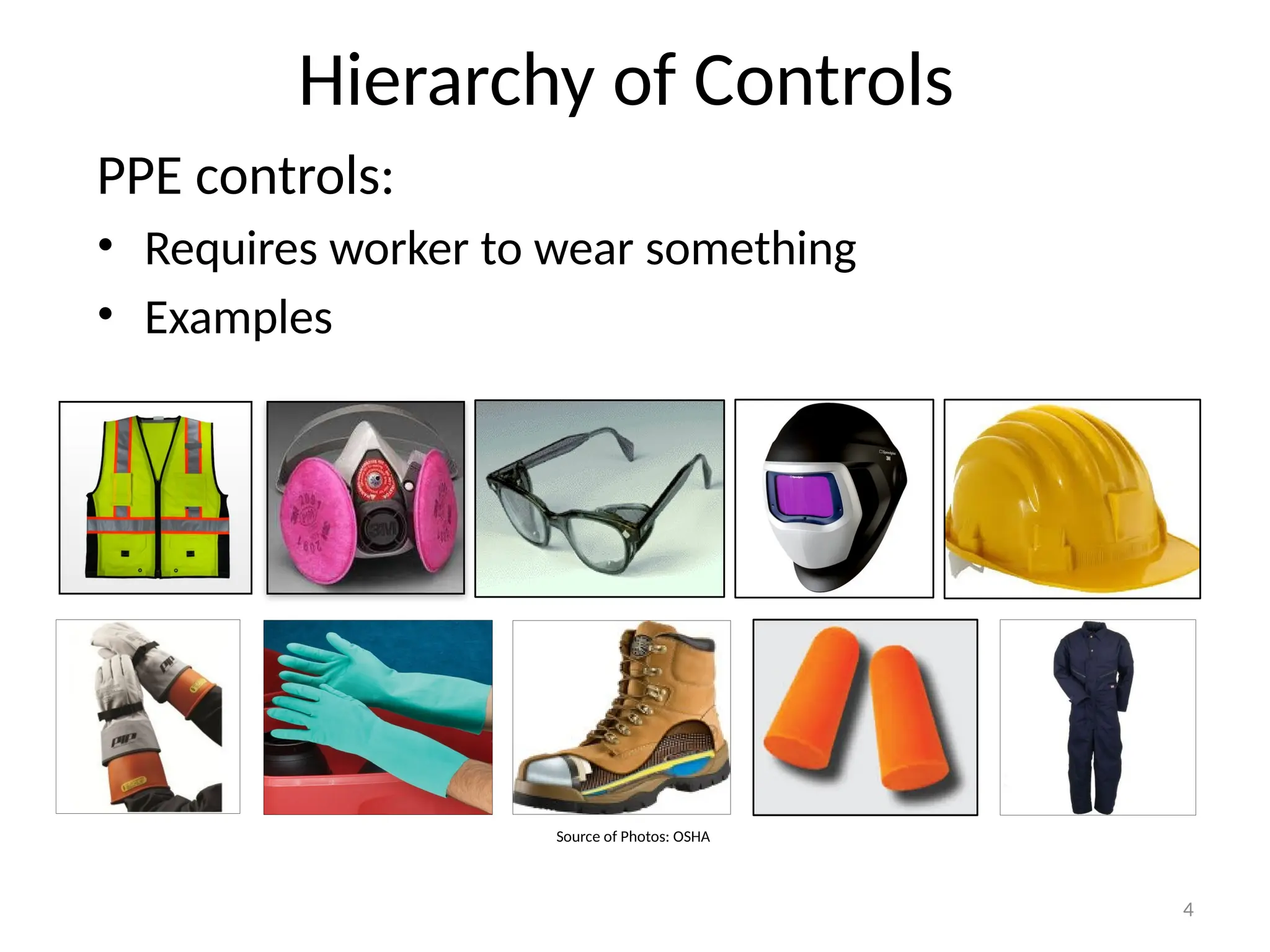
Source of Photos:OSHA
Hierarchy of Controls
PPE controls:
• Requires worker to wear something
• Examples
5.
5
Types of PPE
Headprotection:
• Frequent causes of head injuries
– Falling objects from above striking on the head;
– Bump head against fixed objects, such as exposed
pipes or beams; or
– Accidental head contact with electrical hazards.
Source: OSHA
7
Source of graphics:OSHA
Types of PPE
• Classes of hard hats:
– CLASS G (General)
• Protect against impact, penetration
• Low-voltage electrical protection (proof-tested to 2,200
volts)
8.
8
Source: OSHA
Types ofPPE
– CLASS E (Electrical)
• Designed for electrical/utility work
• Protect against falling objects, impact
• Electrical protection against high-voltage
(proof-tested to 20,000 volts)
9.
9
Source: OSHA
Types ofPPE
– CLASS C (Conductive)
• Designed for comfort; offers limited protection
• Protects heads that may bump against fixed objects
• Does not protect against falling objects or electrical
hazards
10.
10
Types of PPE
•ANSI Z89.1, 1997
– Type I: provides protection from
objects fall directly on top of the
helmet, but not from objects that
strike the side, front, or back of the
head.
– Type II: provides protection from strikes
to the top of the head and also provides
protection from blows to the sides,
front, and back of the head. More
suitable for workers who are not
always in a standing position
Source of photos: OSHA
12
Source: OSHA
Types ofPPE
• Common causes of eye injuries
– Chemical splashes
– Blood or OPIM splashes or sprays
– Intense light
– Dust and other flying particles
– Molten metal splashes
13.
13
Types of PPE
•Eye and face protection – must comply with
– ANSI Z87.1-2003, or
– ANSI Z87.1-1989 (R-1998)
Source: OSHA
14.
14
Types of PPE
•Selecting eye and face protection – elements
to consider:
– Ability to protect against workplace hazards
– Should fit properly
– Should provide unrestricted vision and movement
– Durable and cleanable
– Allow unrestricted functioning of other PPE
15.
15
Types of PPE
•Safety glasses
– Used to protect against moderate impacts from
particles
Source of graphics: OSHA
16.
16
Source: OSHA
Types ofPPE
• Prescription glasses
– Employees who use
prescription glasses while
performing operations with
potential eye hazards must use
eye protection that:
• Incorporates the prescription in its design, or
• Can be used over your prescription glasses without
interfering with the proper positioning of the prescription
glasses or goggles
17.
17
Types of PPE
•Goggles
– Protect eyes, and the
facial area immediately surrounding
the eyes from
impact, dust, splashes.
– Some can be used over corrective
lenses, if they fit them.
Source: OSHA
18.
18
Types of PPE
–Goggle types
Direct-ventilated
Source: OSHA.gov
Indirect-ventilated Non-ventilated
• Does not allow the
passage of air into
the goggle
• Prevents splash
entry
• May fog and require
frequent lens
cleaning
• Prevents fogging
by allowing air
circulation
• Protects against
liquid or
chemical splash
entry
• Resist direct passage
of large particles into
the goggle
• Prevents fogging by
allowing air
circulation
19.
19
Types of PPE
•Face shields
– Protect face from nuisance
dusts and potential splashes
or sprays of hazardous liquids
– Shields do not protect from
impact hazards unless so rated
– Shields are for face protection, not eye
protection. To protect the eyes, wear safety
glasses with side shields, or goggles under the
face shield.
Source: OSHA
20.
20
Source of photos:OSHA
Types of PPE
• Welding shields
– Protect eyes from burns caused
by:
• Infrared light
• Intense radiant light
– Protect eyes and face from flying
sparks, metal spatter, and slag
chips
21.
21
Types of PPE
•Laser safety goggles
– Provide protection from hazards:
• physical contact such as flying particles
• ultraviolet light, laser, and welding
Source: OSHA
23
Types of PPE
•Elimination/substitution or Engineering controls
– Eliminate toxic material or substitute a less toxic material
– Enclose or confine operation
– General or local exhaust
ventilation
• Only when engineering
controls are not feasible,
will respirators be used
Source: OSHA
24.
24
Source of photos:OSHA
Types of PPE
• Types of respirators
– Air-Purifying (APR) –
remove contaminants from
air
• Particulate respirators
• Chemical cartridge/
gas mask respirator
• Powered Air-Purifying
Respirator (PAPR)
25.
25
Source of photos:OSHA
Types of PPE
– Atmosphere-Supplying – provide clean,
breathable air
• Self-Contained Breathing Apparatus (SCBA)
• Supplied-Air Respirator (SAR)
26.
26
Types of PPE
•Medical evaluation
– Before fit tests are conducted and employee is
authorized the use of a respirator, a medical evaluation
must be provide to determine the ability of the
employee to use a respirator.
– Identify a physician or other license health care
professional (PLHCP) to perform medical evaluations
using a medical questionnaire or an initial medical
evaluation with which the same information is obtained.
27.
27
Types of PPE
•Inspecting and cleaning respirators
– Inspect all respirators for wear and tear before and
after each use
– Wash in a detergent solution; then, disinfect by
immersing in a sanitizing solution
Source of photos: Carmen Vazquez
28.
28
Types of PPE
•Storing respirators
– Protect against dust, sunlight, heat, extreme cold,
excessive moisture, and damaging chemicals
– Store in position to retain natural configuration
Source of photos: Carmen Vazquez
30
Types of PPE
•Exposure to noise levels
over 85 dB can cause
hearing loss
• Hearing protection required
at 90 dB
• Implement effective Hearing
Conservation Program
Source: OSHA
31.
31
Impact noise shouldnot exceed 140 dB
Source: NIOSH
Permissible Noise Exposure
29 CFR 1910.95(b)(1)
Duration per
Day (hours)
Sound Level
(dBA)
8 90
6 92
4 95
3 97
2 100
1 105
1/2 110
1/4 115
Types of PPE
• The employer must provide
ear protection when the
noise level in the work area
is greater than indicated in
this table.
32.
32
Types of PPE
•Examples of hearing protection:
– Disposable foam plugs
– Molded ear plugs
– Noise-cancelling ear plugs
– Ear muffs
• Consider Noise Reduction
Rating (NRR) of devices
NIOSH/John Rekus/elcosh.org
Source of photos: OSHA
34
Hand protection:
• Potentialhazards for hands
– Skin absorption of hazardous
substances
– Lacerations or severe cuts
– Punctures
– Chemical burns
– Thermal burns
– Extreme temperatures
Types of PPE
Source of photos: OSHA
35.
35
Source of photos:OSHA
Anti-vibration
Heat-resistant
Leather Palm
Cut-resistant
Permeation-resistant
Chemical-resistant
Types of PPE
• Types of gloves
36.
36
Types of PPE
Footand leg protection:
• Causes of foot injuries:
– Falling or rolling of heavy objects
– Crushing or penetrating materials
– Sharp objects that can penetrate
the sole
– Exposure to molten metal
– Working on, or around, hot, wet, or slippery
surfaces
– Working when electrical
hazards are present.
Source: OSHA
38
Types of PPE
•Examples of foot and leg protection
– Impact-resistant toe and/or instep
• Steel
• Composite
– Heat-resistant soles
– Metal shanks
– Specialty footwear may be needed
• Metatarsal guards
• Liquid- or chemical-resistant
• Conductive or nonconductive
Source of photos: OSHA
39.
39
Types of PPE
•Protective footwear must comply with any of
the following consensus standards:
– ANSI Z41.1 – 1991 - "American
National Standard for Personal
Protection -- Protective Footwear,"
– ASTM F-2412 – 2005 – “ Standard
Test Methods for Foot Protection”
– ASTM F-2413 – 2005 –
“Standard Specification for Performance
Requirements for Protective Footwear”
Source: OSHA
40.
40
Types of PPE
•Protection from hazards
– Shoes with metal toe-cap protects
against knocks, falling objects
– Rubber shoes protect against
chemical materials, as directed
by the SDS
Source of photos: OSHA
42
Types of PPE
•Provide protective clothing for
those parts of the body exposed to
possible injuries
• Types of body protection
– Laboratory coats
– Coveralls
– Vests
– Jackets
– Aprons
– Surgical gowns
– Full-body suits
Source of photos: OSHA
43.
43
Types of PPE
•Selection of body protection –
variety of materials effective against
particular hazard
– Paper-like fiber – dust and splashes
– Treated wool and cotton – fire-
resistant; dust, abrasions,
rough/irritating surfaces
– Duck – cuts, bruises
– Leather – dry heat, flames
– Rubber, rubberized fabrics,
neoprene, and plastics – certain
chemicals and physical hazards
Source of photos: OSHA
51
What are theyused for?
• A Material Safety Data Sheet (MSDS) is designed to
provide both workers and emergency personnel with
the proper procedures for handling or working with a
particular substance.
• MSDS's include information such as physical data
(melting point, boiling point, flash point etc.), toxicity,
health effects, first aid, reactivity, storage, disposal,
protective equipment, and spill/leak procedures. These
are of particular use if a spill or other accident occurs.
• MSDS's vary in length depending on their format,
content, and font size.
52.
Format
• While theformat can
vary, there is an
Occupational Safety &
Health ministration
(OSHA) recommended
format that is
commonly used.
This format
includes 8
sections
52
53.
53
Sections 1 and2
• Section one contains the manufacturer's name
and address, as well as a phone number for
information, an emergency telephone number,
the date of preparation, and the signature of
the person who prepared it.
• Section 2 provides information of hazardous
ingredients.
54.
54
Section 3
Section 3provides the physical and chemical
characteristics.
Boiling Point
Vapor Pressure
Vapor Density
Specific Gravity
Melting Point
Evaporation Rate
Solubility in Water
Appearance and Odor
55.
55
Section 4
Section 4provides information on fire and
explosion hazards.
Flash Point
Flammable Limits
Extinguishing Media
Special Fire Fighting Procedures
Unusual Fire and Explosion Hazards
56.
56
Section 5
Section 5provides the reactivity data for the
substance.
Stability
Conditions to Avoid
Incompatibility
Hazardous Decompositions or Byproducts
Hazardous Polymerization
57.
57
Section 6
Section 6provides health hazard data.
Routes of entry
Carcinogenicity
Signs and Symptoms of Exposure
Medical Conditions Generally Aggravated by
Exposure
Emergency and First Aid Procedures
58.
58
Section 7
Section 7contains information on precautions
for safe handling and use of the substance.
Steps to Be Taken in Case Material is
Released or Spilled
Waste Disposal Method
Precautions to Be Taken in Handling and
Storage
Other Precautions
59.
59
Section 8
Section 8contains information on control
measures.
Respiratory Protection
Ventilation
Protective Gloves
Eye Protection
Other Protective Clothing or Equipment
Work/Hygienic Practices
61
What are theyused for?
A Material Safety Data Sheet (MSDS) is designed to
provide both workers and emergency personnel with
the proper procedures for handling or working with a
particular substance. MSDS's include information such
as physical data (melting point, boiling point, flash
point etc.), toxicity, health effects, first aid, reactivity,
storage, disposal, protective equipment, and spill/leak
procedures. These are of particular use if a spill or
other accident occurs.
MSDS's vary in length depending on their format,
content, and font size.
62.
Format
While the formatcan
vary, there is an
Occupational Safety &
Health Administration
(OSHA) recommended
format that is
commonly used.
This format
includes 8
sections
62
63.
63
Sections 1 and2
Section one contains the manufacturer's
name and address, as well as a phone number
for information, an emergency telephone
number, the date of preparation, and the
signature of the person who prepared it.
Section 2 provides information of hazardous
ingredients.
64.
64
Section 3
Section 3provides the physical and chemical
characteristics.
Boiling Point
Vapor Pressure
Vapor Density
Specific Gravity
Melting Point
Evaporation Rate
Solubility in Water
Appearance and Odor
65.
65
Section 4
Section 4provides information on fire and
explosion hazards.
Flash Point
Flammable Limits
Extinguishing Media
Special Fire Fighting Procedures
Unusual Fire and Explosion Hazards
66.
66
Section 5
Section 5provides the reactivity data for the
substance.
Stability
Conditions to Avoid
Incompatibility
Hazardous Decompositions or Byproducts
Hazardous Polymerization
67.
67
Section 6
Section 6provides health hazard data.
Routes of entry
Carcinogenicity
Signs and Symptoms of Exposure
Medical Conditions Generally Aggravated by
Exposure
Emergency and First Aid Procedures
68.
68
Section 7
Section 7contains information on precautions
for safe handling and use of the substance.
Steps to Be Taken in Case Material is
Released or Spilled
Waste Disposal Method
Precautions to Be Taken in Handling and
Storage
Other Precautions
69.
69
Section 8
Section 8contains information on control
measures.
Respiratory Protection
Ventilation
Protective Gloves
Eye Protection
Other Protective Clothing or Equipment
Work/Hygienic Practices
Editor's Notes
#1 Elimination / substitution:
Provides the highest level of protection against hazards.
The hazard is eliminated from the workplace or a safer item/substance is substituted for the more hazardous item/substance.
Another type of substitution includes using the same chemical but to use it in a different form.
For example, a dry, dusty powder may be a significant inhalation hazard but if this material can be purchased and used as pellets or crystals, there may be less dust in the air and therefore less exposure.
#2 Engineering controls
Requires a physical change to the workplace
Based on the following principles: (OSHA 2001)
If feasible, design the facility, equipment, or process to remove the hazard.
If removal is not feasible, enclose the hazard to prevent exposure in normal operations.
Where complete enclosure is not feasible, establish barriers or local ventilation to reduce exposure to the hazard in normal operations.
Examples
Isolation – hazard is enclosed prohibiting exposure to worker
Ventilation – air exchanges to reduce atmospheric hazards
Equipment modifications – reduce the hazard through design of the equipment or attachments (Examples: reduced vibration, dust collection system, noise reduction, etc.)
#3 Administrative Controls
Includes work practices
Requires the worker or employer to do something
Examples
Proper procedures – workplace rules and other operation-specific rules
Inspection and maintenance – regularly inspect tools and equipment; keep them well maintained; remove from service any damaged or broken items
Housekeeping
Supervision
Regulated areas – designate areas for lunch and break times; no eating, drinking, smoking, chewing tobacco or gum, and applying cosmetics in workplace
Limit exposure by time and distance – shorten amount of time a worker is exposed to task involving the hazard; distance hazard from workers
#4 OSHA requires employees to protect their employees from workplace hazards through the use of engineering or work practice controls.
When these controls are not feasible or do not provide sufficient protection, the use of personal protective equipment (PPE) is required.
#5 “Wearing a safety helmet or hard hat is one of the easiest ways to protect an employee's head from injury. Hard hats can protect employees from impact and penetration hazards as well as from electrical shock and burn hazards.
Employers must ensure that their employees wear head protection if any of the following apply:
Objects might fall from above and strike them on the head;
They might bump their heads against fixed objects, such as exposed pipes or beams; or
There is a possibility of accidental head contact with electrical hazards.”
(OSHA Publication 3151-12R, 2003)
#6 “Protecting employees from potential head injuries is a key element of any safety program. A head injury can impair an employee for life or it can be fatal.”
(OSHA Publication 3151-12R, 2003)
Your head is a very delicate part of your body. In and around your head are:
Your eyes, with which you see;
Your ears, with which you hear;
Your nose, with which you smell;
Your mouth, with which you eat and speak; and
Your brain, with which you think.
Injuries to the head are very serious. For this reason, head protection and safety are very important.
#7 https://www.osha.gov/Publications/osha3151.html
“There are many types of hard hats available in the marketplace today. In addition to selecting protective headgear that meets ANSI standard requirements, employers should ensure that employees wear hard hats that provide appropriate protection against potential workplace hazards. It is important for employers to understand all potential hazards when making this selection, including electrical hazards. This can be done through a comprehensive hazard analysis and an awareness of the different types of protective headgear available.”
(OSHA Publication 3151-12R, 2003)
Class G hard hats are intended for general service use, such as building construction, shipbuilding, lumbering, and manufacturing. Class G hard hats provide good impact protection, but limited voltage protection (proof-tested at 2,200 volts).
#8 Class E hard hats are designed for electrical/utility work. They protect against falling objects and provide protection against conductors with higher voltage levels (proof-tested at 20,000 volts).
#9 For impact and penetration only. Usually made of aluminum, so it should not be used near areas with electrical hazards.
Class C hard hats provide limited protection, mostly from bumps against fixed objects. Class C hard hats do not provide any protection against electrical hazards.
#12 https://www.osha.gov/Publications/osha3151.html
“Employees can be exposed to a large number of hazards that pose danger to their eyes and face. OSHA requires employers to ensure that employees have appropriate eye or face protection if they are exposed to eye or face hazards from flying particles, molten metal, liquid chemicals, acids or caustic liquids, chemical gases or vapors, potentially infected material or potentially harmful light radiation.”
(OSHA Publication 3151-12R, 2003)
Examples:
Acids and other caustic liquid chemicals that might splash
Blood and other potentially infectious materials that might splash, spray
Intense light such as that created by welding and lasers
Dust and other flying particles, such as sawdust or metal shavings
Molten metal that might splash
1910.133 (b) Criteria for protective eye and face protection
Eye and face protection equipment required by this Part shall meet the requirements specified in American National Standards Institute, and devices must comply with any of the following : Z87.1-2003, ANSI Z87.1-1998 (R-1998), ANSI Z87.1-1989
Practice for Occupational and Educational Eye and Face Protection. Incorporated by reference in 1910.6
#13 www.osha.gov/SLTC/etools/eyeandface/employer/requirements.html
Eye and face protection must comply with the American National Standards Institute, ANSI Z87.1-2003
Eye and face personal protective equipment (PPE) shall be distinctly marked to facilitate identification of the manufacturer. [29 CFR 1910.133(a)(4)]
The following minimum requirements must be met by all protective devices. Protectors shall:
Provide adequate protection against the particular hazards for which they are designed.
Be of safe design and construction for the work to be performed.
Be reasonably comfortable when worn under the designated conditions.
Fit snugly and not unduly interfere with the movements of the wearer.
Be durable.
Be capable of being disinfected.
Be easily cleanable.
Be distinctly marked to facilitate identification only of the manufacturer.
www.osha.gov/SLTC/etools/eyeandface/index.html
#14 1910.133
Eye and face protection equipment required by this Part shall meet the requirements specified in American National Standards Institute, Z87.1-2003, Z87.1-1989 (Rr-1998) incorporated by reference in 19110.06, Practice for Occupational and Educational Eye and Face Protection.
https://www.osha.gov/Publications/osha3151.html
“Selecting the most suitable eye and face protection for employees should take into consideration the following elements:
Ability to protect against specific workplace hazards.
Should fit properly and be reasonably comfortable to wear.
Should provide unrestricted vision and movement.
Should be durable and cleanable.
Should allow unrestricted functioning of any other required PPE.”
(OSHA Publication 3151-12R, 2003)
#16 https://www.osha.gov/SLTC/etools/eyeandface/employer/requirements.html
“Employers must ensure that employees who wear prescription (Rx) lenses or contacts use personal protective equipment (PPE) that incorporates the prescription or use eye protection that can be worn over prescription lenses without interfering with the proper positioning of the prescription glasses or goggles.”
#18 Safety goggles are used as primary protection to shield the eyes from heat hazards. Goggles form a protective seal around the eyes, preventing objects or liquids from entering under or around the goggles. This is especially important when working with or around molten metals that may splash.
When employees are exposed to high temperatures, additional protection beyond that offered by primary protectors may be required. Use safety goggles in combination with a heat-reflective face shield for severe temperatures exposure. Consider specific lens, frame, and ventilation options when selecting safety goggles.
Ventilated goggles allow air circulation while providing protection against airborne particles, dust, liquids, or light.
#19 https://www.osha.gov/SLTC/etools/eyeandface/ppe/impact.html#faceshields
“Face shields are intended to protect the entire face or portions of it from impact hazards such as flying fragments, objects, large chips, and particles. When worn alone, face shields do not protect employees from impact hazards. Use face shields in combination with safety spectacles or goggles, even in the absence of dust or potential splashes, for additional protection beyond that offered by spectacles or goggles alone.”
(OSHA Eye and Face Protection eTool, 2002)
#20 https://www.osha.gov/Publications/osha3151.html
“Constructed of vulcanized fiber or fiberglass and fitted with a filtered lens, welding shields protect eyes from burns caused by infrared or intense radiant light; they also protect both the eyes and face from flying sparks, metal spatter, and slag chips produced during welding, brazing, soldering and cutting operations. OSHA requires filter lenses to have a shade number appropriate to protect against the specific hazards of the work being performed in order to protect against harmful light radiation.”
(OSHA Publication 3151-12R, 2003)
#24 Source: https://www.osha.gov/Publications/osha3079.pdf
“There are two major classes of respirators:
Air-purifying, which remove contaminants from the air; and
Atmosphere-supplying, which provide clean, breathable air from an uncontaminated source. As a general rule, atmosphere-supplying respirators are used for more hazardous exposures.”
Source: https://www.osha.gov/dts/shib/respiratory_protection_bulletin_2011.html
“Respirators work by either filtering particles from the air, chemically cleaning (purifying) the air, or supplying clean air from an outside source.
Particulate Respirators: Particulate respirators are the simplest, least expensive, and least protective of the respirator types available. These respirators only protect against particles (e.g., dust). They do not protect against chemicals, gases, or vapors, and are intended only for low hazard levels. The commonly known "N-95" filtering facepiece respirator or "dust mask" is one type of particulate respirator, often used in hospitals to protect against infectious agents. Particulate respirators are "air-purifying respirators" because they clean particles out of the air as you breathe.
Particulate respirators:
Filter out dusts, fumes and mists.
Are usually disposable dust masks or respirators with disposable filters.
Must be replaced when they become discolored, damaged, or clogged.
Examples: filtering facepiece or elastomeric respirator.
Chemical Cartridge/Gas Mask Respirator: Gas masks are also known as "air-purifying respirators" because they filter or clean chemical gases out of the air as you breathe. This respirator includes a facepiece or mask, and a cartridge or canister. Straps secure the facepiece to the head. The cartridge may also have a filter to remove particles.
Gas masks are effective only if used with the correct cartridge or filter (these terms are often used interchangeably) for a particular biological or chemical substance. Selecting the proper filter can be a complicated process. There are cartridges available that protect against more than one hazard, but there is no "all-in-one" cartridge that protects against all substances. It is important to know what hazards you will face in order to be certain you are choosing the right filters/cartridges.
Chemical Cartridge/Gas Mask respirator:
Uses replaceable chemical cartridges or canisters to remove the contaminant.
Are color-coded to help you select the right one.
May require more than one cartridge to protect against multiple hazards.
Powered Air-Purifying Respirator (PAPR): Powered air-purifying respirators use a fan to draw air through the filter to the user. They are easier to breathe through; however, they need a fully charged battery to work properly. They use the same type of filters/cartridges as other air-purifying respirators. It is important to know what the hazard is, and how much of it is in the air, in order to select the proper filters/cartridges.”
#25 Source: https://www.osha.gov/Publications/osha3079.pdf
“There are two major classes of respirators:
Air-purifying, which remove contaminants from the air; and
Atmosphere-supplying, which provide clean, breathable air from an uncontaminated source. As a general rule, atmosphere-supplying respirators are used for more hazardous exposures.”
Source: https://www.osha.gov/dts/shib/respiratory_protection_bulletin_2011.html
“Self-Contained Breathing Apparatus (SCBA) is the respirator commonly used by firefighters. These use their own air tank to supply clean air, so you don't need to worry about filters. They also protect against higher concentrations of dangerous chemicals. However, they are very heavy (30 pounds or more), and require very special training on how to use and to maintain them. Also, the air tanks typically last an hour or less depending upon their rating and your breathing rate (how hard you are breathing).
Self-Contained Breathing Apparatus:
Provide clean air from a portable air tank when the air around you is simply too dangerous to breathe.
All of these respirators (except for the "dust masks" or filtering face pieces) are available in either half-mask or full-face pieces.”
Source: https://www.osha.gov/dte/library/respirators/presentation/index.html
Supplied Air Respirator (SAR)
“An atmosphere-supplying respirator for which the source of breathing air is not designed to be carried by the user. Also called airline respirator.”
#27 Source: Respiratory Protection (2002), OSHA #3079, https://www.osha.gov/Publications/OSHA3079/osha3079.html
“It is important to inspect all respirators for wear and tear before and after each use, giving special attention to rubber or plastic parts that can deteriorate or lose pliability. The facepiece, headband, valves, connecting tube, fittings, and cartridges, canisters or filters must be in good condition. A respirator inspection must include checking the tightness of the connections.
Users must inspect SCBAs at least monthly and ensure that air and oxygen cylinders are fully charged according to the manufacturer's instructions. The inspection should include a check of regulator and warning devices to ensure their proper function. Employers must keep records of inspection dates and findings.
Users should replace chemical cartridges and gas mask canisters as necessary to provide complete protection, following the manufacturer's recommendations. In addition, they should replace mechanical filters as necessary to avoid high resistance to breathing.
Only an experienced person is permitted to make repairs, using parts specifically designed for the respirator. This person must consult the manufacturer's instructions for any repair and no attempt should be made to repair or replace components or make adjustments or repairs beyond the manufacturer's recommendations.
The employer must ensure that respirators are cleaned and disinfected as often as necessary to keep them sanitary. In addition, the employer must ensure that emergency-use respirators are cleaned and disinfected immediately after each use.
Respirators should be washed in a detergent solution and then disinfected by immersing them in a sanitizing solution. Cleaner-sanitizers that effectively clean the respirator and contain a bactericidal agent are available commercially. The bactericidal agent frequently used is a quaternary ammonium compound. Strong cleaning and sanitizing agents and many solvents can damage rubber or plastic respirator parts. Use these materials with caution or after consultation with the respirator manufacturer.”
#28 Source: Respiratory Protection (2002), OSHA #3079, https://www.osha.gov/Publications/OSHA3079/osha3079.html
“Users must store respirators in a way that protects them against dust, sunlight, heat, extreme cold, excessive moisture, and damaging chemicals. When packed or stored, each respirator should be positioned to retain its natural configuration. Facepieces and exhalation valves should rest in a normal position to prevent the rubber or plastic from deforming.”
#31 29 CFR 1910.95(b)(2)
“If the variations in noise level involve maxima at intervals of 1 second or less, it is to be considered continuous.
Footnote(1) When the daily noise exposure is composed of two or more periods of noise exposure of different levels, their combined effect should be considered, rather than the individual effect of each. If the sum of the following fractions: C(1)/T(1) + C(2)/T(2) C(n)/T(n) exceeds unity, then, the mixed exposure should be considered to exceed the limit value. Cn indicates the total time of exposure at a specified noise level, and Tn indicates the total time of exposure permitted at that level. Exposure to impulsive or impact noise should not exceed 140 dB peak sound pressure level.”
#32 https://www.osha.gov/dts/osta/otm/noise/index.html
“Hearing protection devices (HPDs) are considered the last option to control exposures to noise. HPDs are generally used during the necessary time it takes to implement engineering or administrative controls, or when such controls are not feasible.”
(OSHA Noise and Hearing Conservation eTool, 2005)
This slide shows some examples of hearing protection devices.
https://www.osha.gov/dts/osta/otm/new_noise/appendixe.pdf
The Noise Reduction Rating of hearing protectors is required labeling on the hearing protector package; manufacturers must identify the noise reduction capability of the product through “laboratory-derived numerical estimate of the attenuation achieved by the protector” (OSHA n.d.).
#34 The employer select and require employees the proper use of hand protection when exposed to hazards.
#35 https://www.osha.gov/Publications/osha3151.html
“There are many types of gloves available today to protect against a wide variety of hazards. The nature of the hazard and the operation involved will affect the selection of gloves. The variety of potential occupational hand injuries makes selecting the right pair of gloves challenging. It is essential that employees use gloves specifically designed for the hazards and tasks found in their workplace because gloves designed for one function may not protect against a different function even though they may appear to be an appropriate protective device.
The following are examples of some factors that may influence the selection of protective gloves for a workplace.
Type of chemicals handled.
Nature of contact (total immersion, splash, etc.).
Duration of contact.
Area requiring protection (hand only, forearm, arm).
Grip requirements (dry, wet, oily).
Thermal protection.
Size and comfort.
Abrasion/resistance requirements.
Gloves made from a wide variety of materials are designed for many types of workplace hazards. In general, gloves fall into four groups:
Gloves made of leather, canvas or metal mesh;
Fabric and coated fabric gloves;
Chemical- and liquid-resistant gloves;
Insulating rubber gloves”
(OSHA Publication 3151-12R, 2003)
#36 Employees who face possible foot or leg injuries from falling or rolling objects or from crushing or penetrating materials should wear protective footwear. Also, employees whose work involves exposure to hot substances or corrosive or poisonous materials must have protective gear to cover exposed body parts, including legs and feet….
Examples of situations in which an employee should wear foot and/or leg protection include:
When heavy objects such as barrels or tools might roll onto or fall on the employee's feet;
Working with sharp objects such as nails or spikes that could pierce the soles or uppers of ordinary shoes;
Exposure to molten metal that might splash on feet or legs;
Working on or around hot, wet, or slippery surfaces; and
Working when electrical hazards are present.”
(OSHA Publication 3151-12R, 2003)
#37 IMPACTS – loading or handling materials such as packages, equipment or heavy objects that could fall
COMPRESSIONS – activities involving vehicles (manual material handling carts)
CUTS/PUNCTURES – sharp objects such as nails, wire, tacks, staples, screws, scrap metal
CHEMICALS – verify with your supervisor and/or the SDS (Safety Data Sheet) for adequate protection
TEMPERATURES – extreme hot or cold work surfaces and/or materials
#38 https://www.osha.gov/Publications/osha3151.html
“Safety shoes have impact-resistant toes and heat-resistant soles that protect the feet against hot work surfaces common in roofing, paving and hot metal industries. The metal insoles of some safety shoes protect against puncture wounds. Safety shoes may also be designed to be electrically conductive to prevent the buildup of static electricity in areas with the potential for explosive atmospheres or nonconductive to protect workers from workplace electrical hazards.”
“Metatarsal guards protect the instep area from impact and compression. Made of aluminum, steel, fiber or plastic, these guards may be strapped to the outside of shoes.”
“Electrically conductive shoes provide protection against the buildup of static electricity…. Employees exposed to electrical hazards must never wear conductive shoes.”
“Electrical hazard, safety-toe shoes are nonconductive and will prevent the wearers' feet from completing an electrical circuit to the ground. These shoes can protect against open circuits of up to 600 volts in dry conditions and should be used in conjunction with other insulating equipment and additional precautions to reduce the risk of a worker becoming a path for hazardous electrical energy. The insulating protection of electrical hazard, safety-toe shoes may be compromised if the shoes become wet, the soles are worn through, metal particles become embedded in the sole or heel, or workers touch conductive, grounded items. Note: Nonconductive footwear must not be used in explosive or hazardous locations.”
(OSHA Publication 3151-12R, 2003)
#39 Criteria for protective footwear.1910.136(b)(1)
Protective footwear must comply with any of the following consensus standards:1910.136(b)(1)(i)
ASTM F-2412-2005, "Standard Test Methods for Foot Protection," and ASTM F-2413-2005, "Standard Specification for Performance Requirements for Protective Footwear," which are incorporated by reference in § 1910.6;1910.136(b)(1)(ii)
ANSI Z41-1999, "American National Standard for Personal Protection -- Protective Footwear," which is incorporated by reference in § 1910.6; or1910.136(b)(1)(iii)
ANSI Z41-1991, "American National Standard for Personal Protection -- Protective Footwear," which is incorporated by reference in § 1910.6.1910.136(b)(2)
Protective footwear that the employer demonstrates is at least as effective as protective footwear that is constructed in accordance with one of the above consensus standards will be deemed to be in compliance with the requirements of this section. [59 FR 16360, April 6, 1994; 59 FR 33910, July 1, 1994; 61 FR 9227, March 7, 1996; 61 FR 19547, May 2, 1996; 61 FR 21228, May 9, 1996; 74 FR 46356, Sept. 9, 2009; 79 FR 20629, July 10, 2014]
#42 Source: Personal Protective Equipment (2003), OSHA #3151-12R, https://www.osha.gov/Publications/osha3151.html#bodyprotection
“Employees who face possible bodily injury of any kind that cannot be eliminated through engineering, work practice or administrative controls, must wear appropriate body protection while performing their jobs. In addition to cuts and radiation, the following are examples of workplace hazards that could cause bodily injury:
Temperature extremes;
Hot splashes from molten metals and other hot liquids;
Potential impacts from tools, machinery and materials;
Hazardous chemicals.
There are many varieties of protective clothing available for specific hazards. Employers are required to ensure that their employees wear personal protective equipment only for the parts of the body exposed to possible injury. Examples of body protection include laboratory coats, coveralls, vests, jackets, aprons, surgical gowns and full body suits.”
#43 Source: Personal Protective Equipment (2003), OSHA #3151-12R, https://www.osha.gov/Publications/osha3151.html#bodyprotection
“Protective clothing comes in a variety of materials, each effective against particular hazards, such as:
Paper-like fiber used for disposable suits provide protection against dust and splashes.
Treated wool and cotton adapts well to changing temperatures, is comfortable, and fire-resistant and protects against dust, abrasions and rough and irritating surfaces.
Duck is a closely woven cotton fabric that protects against cuts and bruises when handling heavy, sharp or rough materials.
Leather is often used to protect against dry heat and flames.
Rubber, rubberized fabrics, neoprene and plastics protect against certain chemicals and physical hazards. When chemical or physical hazards are present, check with the clothing manufacturer to ensure that the material selected will provide protection against the specific hazard.”