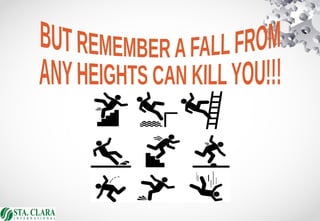
WORKING AT HEIGHTS
TRAINING
Opening & Background
TRAINING RULE
 Phone on silent mode (if there is an urgent call
take it outside)
 If you need a break or explanation don’t hesitate
to stop us
 Try to stay always focus on your safety and the
safety of your buddy.
 dbfd
TRAINING GOALS
I – Identify hazards of working at heights
II – Learn about fall prevention and
personal fall arrest system
III – Know the dangers associated with
suspension trauma
IV – Learn the work at height requirements
followed on the project
WORKING AT HEIGHTS
TRAINING
We therefore, request that you
make yourself familiar with this
guide and apply the principles and
rules when you have to conduct a
working at heights activities.
WORKING AT HEIGHT
Working at height has always been a hazardous
business.
Work at height is a work in any place, including
a place at above or below ground level, where a
person could be injured if they fell from that
place.
Access and egress to a place of work can also
be work at height.
WORKING AT HEIGHT
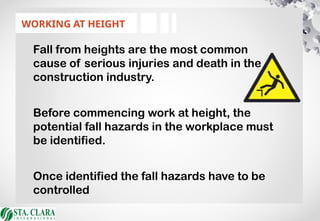
Fall from heights are the most common
cause of serious injuries and death in the
construction industry.
Before commencing work at height, the
potential fall hazards in the workplace must
be identified.
Once identified the fall hazards have to be
controlled
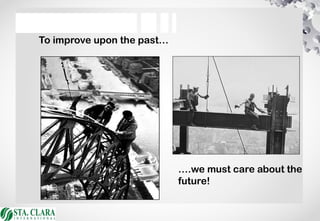
To improve upon the past…
….we must care about the
future!
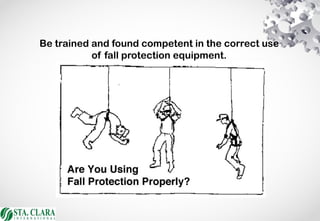
Be trained and found competent in the correct use
of fall protection equipment.
Several hazards may arise in working at heights,
they are but not limited to:
 Fall from different levels
 Dropped object
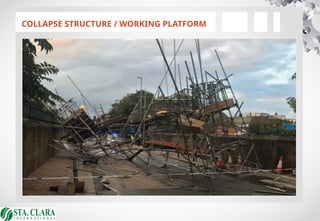
 Collapse structure / working platform
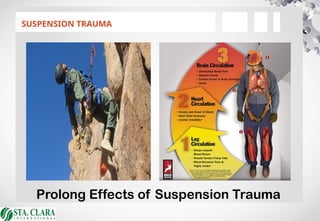
 Suspension trauma
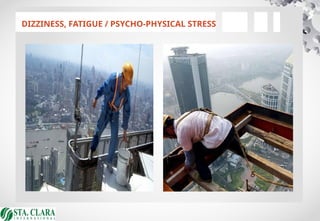
 Dizziness, fatigue / psycho-physical stress
TYPICAL HAZARDS
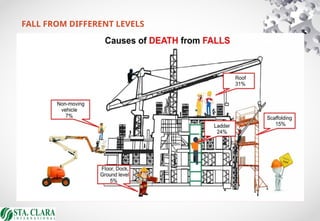
FALL FROM DIFFERENT LEVELS
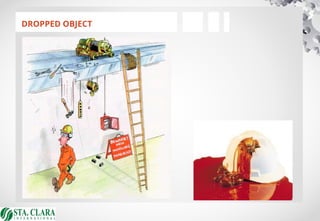
DROPPED OBJECT
COLLAPSE STRUCTURE / WORKING PLATFORM
SUSPENSION TRAUMA
Prolong Effects of Suspension Trauma
DIZZINESS, FATIGUE / PSYCHO-PHYSICAL STRESS
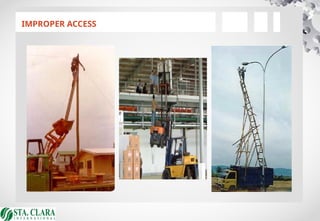
IMPROPER ACCESS
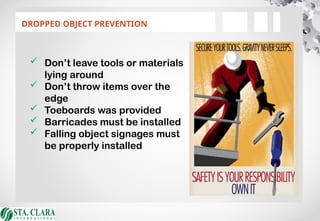
DROPPED OBJECT PREVENTION
 Don’t leave tools or materials
lying around
 Don’t throw items over the
edge
 Toeboards was provided
 Barricades must be installed
 Falling object signages must
be properly installed
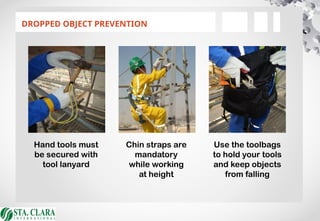
DROPPED OBJECT PREVENTION
Hand tools must
be secured with
tool lanyard
Chin straps are
mandatory
while working
at height
Use the toolbags
to hold your tools
and keep objects
from falling
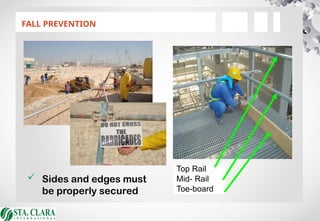
FALL PREVENTION
 Sides and edges must
be properly secured
Top Rail
Mid- Rail
Toe-board
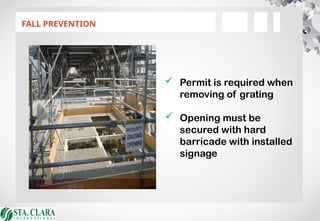
FALL PREVENTION
 Permit is required when
removing of grating
 Opening must be
secured with hard
barricade with installed
signage
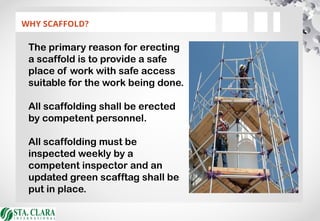
WHY SCAFFOLD?
The primary reason for erecting
a scaffold is to provide a safe
place of work with safe access
suitable for the work being done.
All scaffolding shall be erected
by competent personnel.
All scaffolding must be
inspected weekly by a
competent inspector and an
updated green scafftag shall be
put in place.
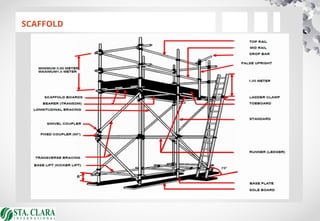
SCAFFOLD
SAFE WORKING AT HEIGHT
 Only trained and medically fit personnel to perform work at
height
 Perform the task at ground level if possible
 Used fall restraint systems rather than fall arrest systems
 Risk assessment , PTW and Total Safety Task Instruction
 Set up barricades and warning signs
 Ensure effective supervision at all times
 Ensure housekeeping (i.e risk of drop objects)
PERSONAL FALL PROTECTION
What is fall protection?
 Fall Arrest System
 Fall Restrain System
FALL RESTRAINT vs FALL ARREST SYSTEM
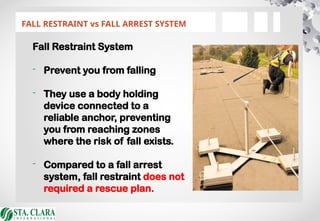
Fall Restraint System
- Prevent you from falling
- They use a body holding
device connected to a
reliable anchor, preventing
you from reaching zones
where the risk of fall exists.
- Compared to a fall arrest
system, fall restraint does not
required a rescue plan.
FALL RESTRAINT vs FALL ARREST SYSTEM
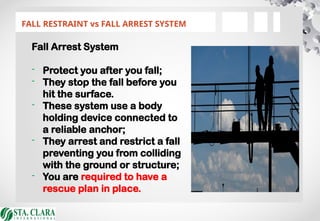
Fall Arrest System
- Protect you after you fall;
- They stop the fall before you
hit the surface.
- These system use a body
holding device connected to
a reliable anchor;
- They arrest and restrict a fall
preventing you from colliding
with the ground or structure;
- You are required to have a
rescue plan in place.
PERSONAL FALL PROTECTION
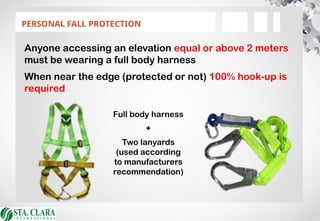
Anyone accessing an elevation equal or above 2 meters
must be wearing a full body harness
When near the edge (protected or not) 100% hook-up is
required
Full body harness
+
Two lanyards
(used according
to manufacturers
recommendation)
LANYARDS
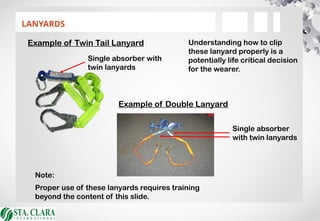
Example of Twin Tail Lanyard
Single absorber with
twin lanyards
Example of Double Lanyard
Single absorber
with twin lanyards
Understanding how to clip
these lanyard properly is a
potentially life critical decision
for the wearer.
Note:
Proper use of these lanyards requires training
beyond the content of this slide.
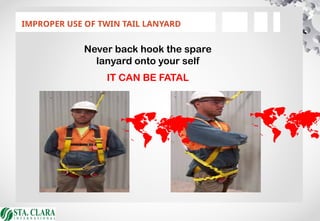
IMPROPER USE OF TWIN TAIL LANYARD
Never back hook the spare
lanyard onto your self
IT CAN BE FATAL
 
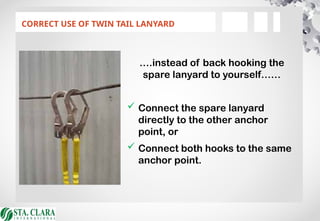
CORRECT USE OF TWIN TAIL LANYARD
….instead of back hooking the
spare lanyard to yourself……
 Connect the spare lanyard
directly to the other anchor
point, or
 Connect both hooks to the same
anchor point.
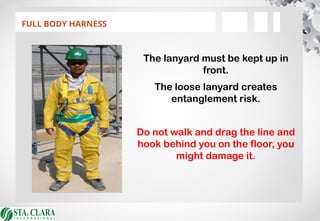
FULL BODY HARNESS
The lanyard must be kept up in
front.
The loose lanyard creates
entanglement risk.
Do not walk and drag the line and
hook behind you on the floor, you
might damage it.
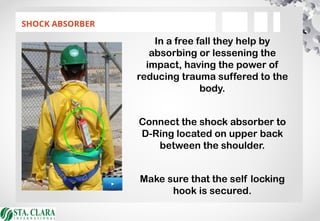
SHOCK ABSORBER
In a free fall they help by
absorbing or lessening the
impact, having the power of
reducing trauma suffered to the
body.
Connect the shock absorber to
D-Ring located on upper back
between the shoulder.
Make sure that the self locking
hook is secured.
ANCHORAGE SELECTION
Select an anchor point with strong enough to withstand
the impact / forces involved in arresting a fall
Where there is the potential for a fall, the anchor point
must comply with the three following factors:
1. Minimum breaking force of about 15kN (approx.
1500kg)
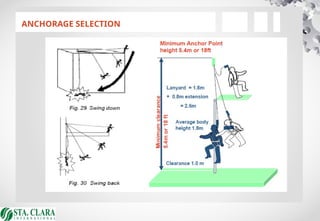
2. As high as possible, above the harness rear ‘D’ ring.
3. Anchor points are to be as centrally located as
possible, no more than 15 degrees vertically from your
position.
ANCHORAGE SELECTION
ANCHORAGE SELECTION
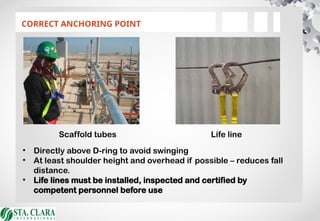
CORRECT ANCHORING POINT
• Directly above D-ring to avoid swinging
• At least shoulder height and overhead if possible – reduces fall
distance.
• Life lines must be installed, inspected and certified by
competent personnel before use
Scaffold tubes Life line
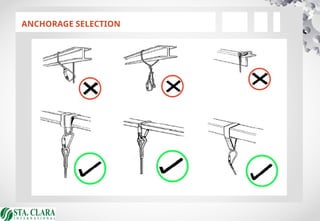
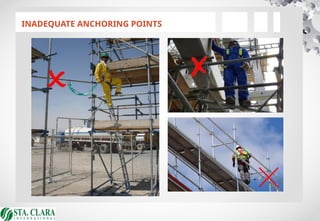
INADEQUATE ANCHORING POINTS
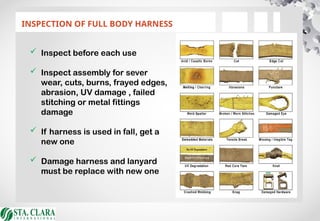
INSPECTION OF FULL BODY HARNESS
 Inspect before each use
 Inspect assembly for sever
wear, cuts, burns, frayed edges,
abrasion, UV damage , failed
stitching or metal fittings
damage
 If harness is used in fall, get a
new one
 Damage harness and lanyard
must be replace with new one
SUSPENSION TRAUMA
 Suspension Trauma is a potential hazard for all
people working at heights in a harness
 It can result in unconsciousness, followed by death
in less than 30 minutes (could been even within 10-
15)
 Avoid suspension trauma by alternatively raising
one leg and then the other to assist with improving
the blood circulation from the lower limbs.
 The JOB HAZARD ANALYSIS MUST include a
rescue plan IF a person falls.
 Ensure rescue equipment is immediately available
and that rescue methods are practiced regularly
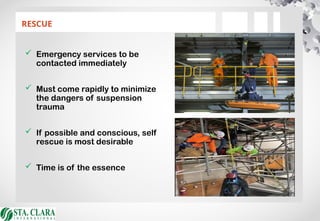
RESCUE
 Emergency services to be
contacted immediately
 Must come rapidly to minimize
the dangers of suspension
trauma
 If possible and conscious, self
rescue is most desirable
 Time is of the essence
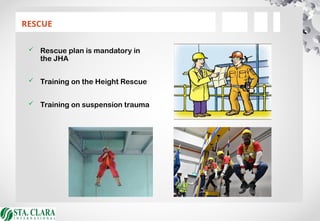
RESCUE
 Rescue plan is mandatory in
the JHA
 Training on the Height Rescue
 Training on suspension trauma
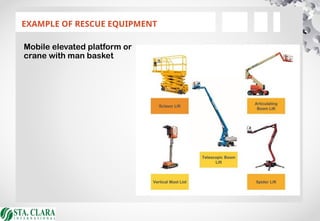
EXAMPLE OF RESCUE EQUIPMENT
Mobile elevated platform or
crane with man basket
Any Question?
NO JOB IS SO URGENT THAT WE
CANNOT TAKE THE TIME TO DO
IT SAFELY.
Working at Heights Training -PREPARED BY JAY.pptx

Working at Heights Training -PREPARED BY JAY.pptx

  • 1.
  • 2.
    Opening & Background TRAININGRULE  Phone on silent mode (if there is an urgent call take it outside)  If you need a break or explanation don’t hesitate to stop us  Try to stay always focus on your safety and the safety of your buddy.
  • 3.
     dbfd TRAINING GOALS I– Identify hazards of working at heights II – Learn about fall prevention and personal fall arrest system III – Know the dangers associated with suspension trauma IV – Learn the work at height requirements followed on the project
  • 4.
    WORKING AT HEIGHTS TRAINING Wetherefore, request that you make yourself familiar with this guide and apply the principles and rules when you have to conduct a working at heights activities.
  • 5.
    WORKING AT HEIGHT Workingat height has always been a hazardous business. Work at height is a work in any place, including a place at above or below ground level, where a person could be injured if they fell from that place. Access and egress to a place of work can also be work at height.
  • 6.
    WORKING AT HEIGHT Fallfrom heights are the most common cause of serious injuries and death in the construction industry. Before commencing work at height, the potential fall hazards in the workplace must be identified. Once identified the fall hazards have to be controlled
  • 7.
    To improve uponthe past… ….we must care about the future!
  • 9.
    Be trained andfound competent in the correct use of fall protection equipment.
  • 10.
    Several hazards mayarise in working at heights, they are but not limited to:  Fall from different levels  Dropped object  Collapse structure / working platform  Suspension trauma  Dizziness, fatigue / psycho-physical stress TYPICAL HAZARDS
  • 11.
  • 12.
  • 13.
    COLLAPSE STRUCTURE /WORKING PLATFORM
  • 14.
  • 15.
    DIZZINESS, FATIGUE /PSYCHO-PHYSICAL STRESS
  • 16.
  • 17.
    DROPPED OBJECT PREVENTION Don’t leave tools or materials lying around  Don’t throw items over the edge  Toeboards was provided  Barricades must be installed  Falling object signages must be properly installed
  • 18.
    DROPPED OBJECT PREVENTION Handtools must be secured with tool lanyard Chin straps are mandatory while working at height Use the toolbags to hold your tools and keep objects from falling
  • 19.
    FALL PREVENTION  Sidesand edges must be properly secured Top Rail Mid- Rail Toe-board
  • 20.
    FALL PREVENTION  Permitis required when removing of grating  Opening must be secured with hard barricade with installed signage
  • 21.
    WHY SCAFFOLD? The primaryreason for erecting a scaffold is to provide a safe place of work with safe access suitable for the work being done. All scaffolding shall be erected by competent personnel. All scaffolding must be inspected weekly by a competent inspector and an updated green scafftag shall be put in place.
  • 22.
  • 23.
    SAFE WORKING ATHEIGHT  Only trained and medically fit personnel to perform work at height  Perform the task at ground level if possible  Used fall restraint systems rather than fall arrest systems  Risk assessment , PTW and Total Safety Task Instruction  Set up barricades and warning signs  Ensure effective supervision at all times  Ensure housekeeping (i.e risk of drop objects)
  • 24.
    PERSONAL FALL PROTECTION Whatis fall protection?  Fall Arrest System  Fall Restrain System
  • 25.
    FALL RESTRAINT vsFALL ARREST SYSTEM Fall Restraint System - Prevent you from falling - They use a body holding device connected to a reliable anchor, preventing you from reaching zones where the risk of fall exists. - Compared to a fall arrest system, fall restraint does not required a rescue plan.
  • 26.
    FALL RESTRAINT vsFALL ARREST SYSTEM Fall Arrest System - Protect you after you fall; - They stop the fall before you hit the surface. - These system use a body holding device connected to a reliable anchor; - They arrest and restrict a fall preventing you from colliding with the ground or structure; - You are required to have a rescue plan in place.
  • 27.
    PERSONAL FALL PROTECTION Anyoneaccessing an elevation equal or above 2 meters must be wearing a full body harness When near the edge (protected or not) 100% hook-up is required Full body harness + Two lanyards (used according to manufacturers recommendation)
  • 28.
    LANYARDS Example of TwinTail Lanyard Single absorber with twin lanyards Example of Double Lanyard Single absorber with twin lanyards Understanding how to clip these lanyard properly is a potentially life critical decision for the wearer. Note: Proper use of these lanyards requires training beyond the content of this slide.
  • 29.
    IMPROPER USE OFTWIN TAIL LANYARD Never back hook the spare lanyard onto your self IT CAN BE FATAL  
  • 30.
    CORRECT USE OFTWIN TAIL LANYARD ….instead of back hooking the spare lanyard to yourself……  Connect the spare lanyard directly to the other anchor point, or  Connect both hooks to the same anchor point.
  • 31.
    FULL BODY HARNESS Thelanyard must be kept up in front. The loose lanyard creates entanglement risk. Do not walk and drag the line and hook behind you on the floor, you might damage it.
  • 32.
    SHOCK ABSORBER In afree fall they help by absorbing or lessening the impact, having the power of reducing trauma suffered to the body. Connect the shock absorber to D-Ring located on upper back between the shoulder. Make sure that the self locking hook is secured.
  • 33.
    ANCHORAGE SELECTION Select ananchor point with strong enough to withstand the impact / forces involved in arresting a fall Where there is the potential for a fall, the anchor point must comply with the three following factors: 1. Minimum breaking force of about 15kN (approx. 1500kg) 2. As high as possible, above the harness rear ‘D’ ring. 3. Anchor points are to be as centrally located as possible, no more than 15 degrees vertically from your position.
  • 34.
  • 35.
  • 36.
    CORRECT ANCHORING POINT •Directly above D-ring to avoid swinging • At least shoulder height and overhead if possible – reduces fall distance. • Life lines must be installed, inspected and certified by competent personnel before use Scaffold tubes Life line
  • 37.
  • 38.
    INSPECTION OF FULLBODY HARNESS  Inspect before each use  Inspect assembly for sever wear, cuts, burns, frayed edges, abrasion, UV damage , failed stitching or metal fittings damage  If harness is used in fall, get a new one  Damage harness and lanyard must be replace with new one
  • 39.
    SUSPENSION TRAUMA  SuspensionTrauma is a potential hazard for all people working at heights in a harness  It can result in unconsciousness, followed by death in less than 30 minutes (could been even within 10- 15)  Avoid suspension trauma by alternatively raising one leg and then the other to assist with improving the blood circulation from the lower limbs.  The JOB HAZARD ANALYSIS MUST include a rescue plan IF a person falls.  Ensure rescue equipment is immediately available and that rescue methods are practiced regularly
  • 40.
    RESCUE  Emergency servicesto be contacted immediately  Must come rapidly to minimize the dangers of suspension trauma  If possible and conscious, self rescue is most desirable  Time is of the essence
  • 41.
    RESCUE  Rescue planis mandatory in the JHA  Training on the Height Rescue  Training on suspension trauma
  • 42.
    EXAMPLE OF RESCUEEQUIPMENT Mobile elevated platform or crane with man basket
  • 43.
  • 44.
    NO JOB ISSO URGENT THAT WE CANNOT TAKE THE TIME TO DO IT SAFELY.