Personal Health Records Connecting the Healthcare Experience
Roadmap What is a Personal Health Record (PHR) Definition, Components, & Goals Terminology Market Market Size & Benchmarks Providence Future Directions
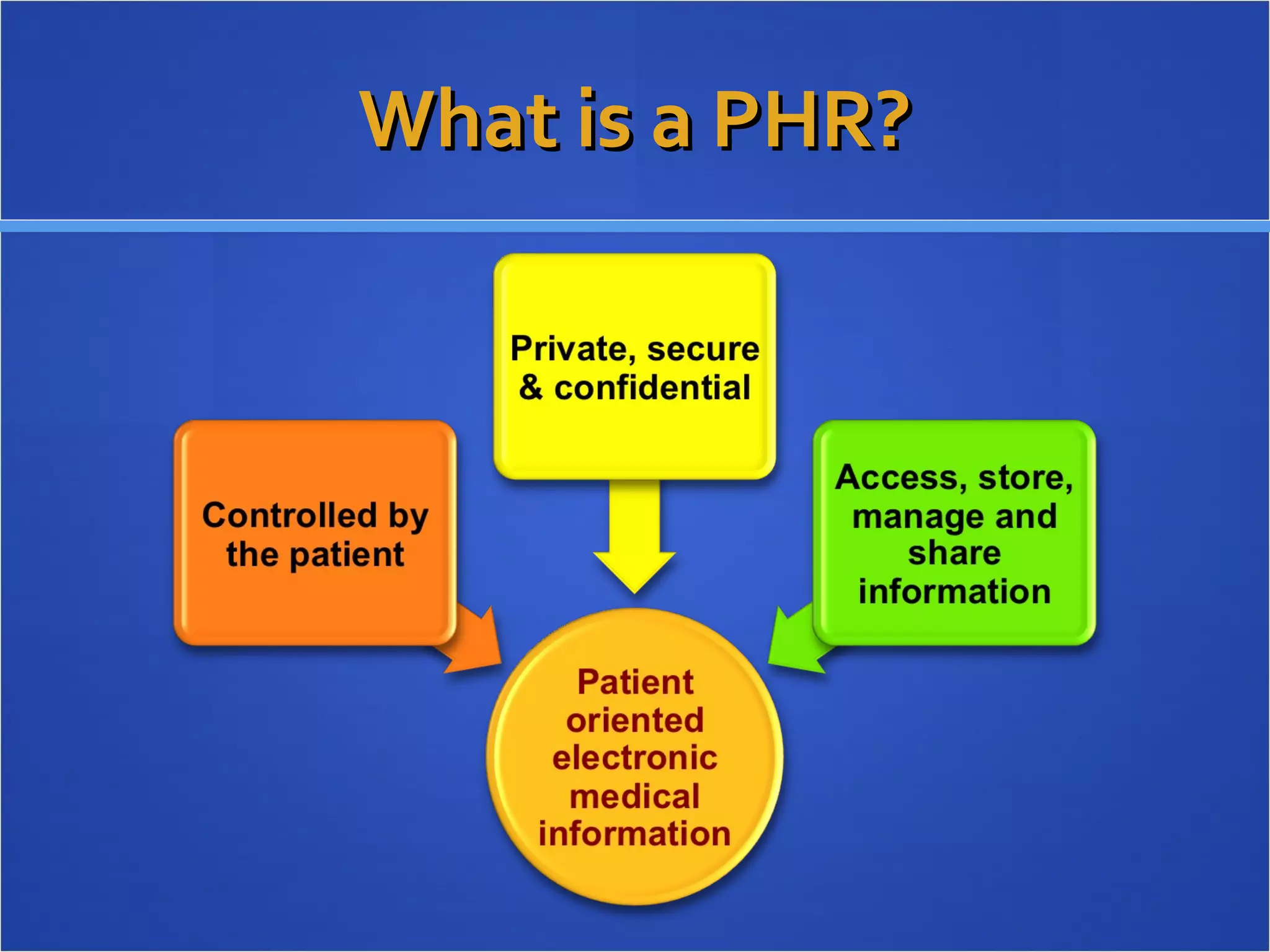
What is a PHR?
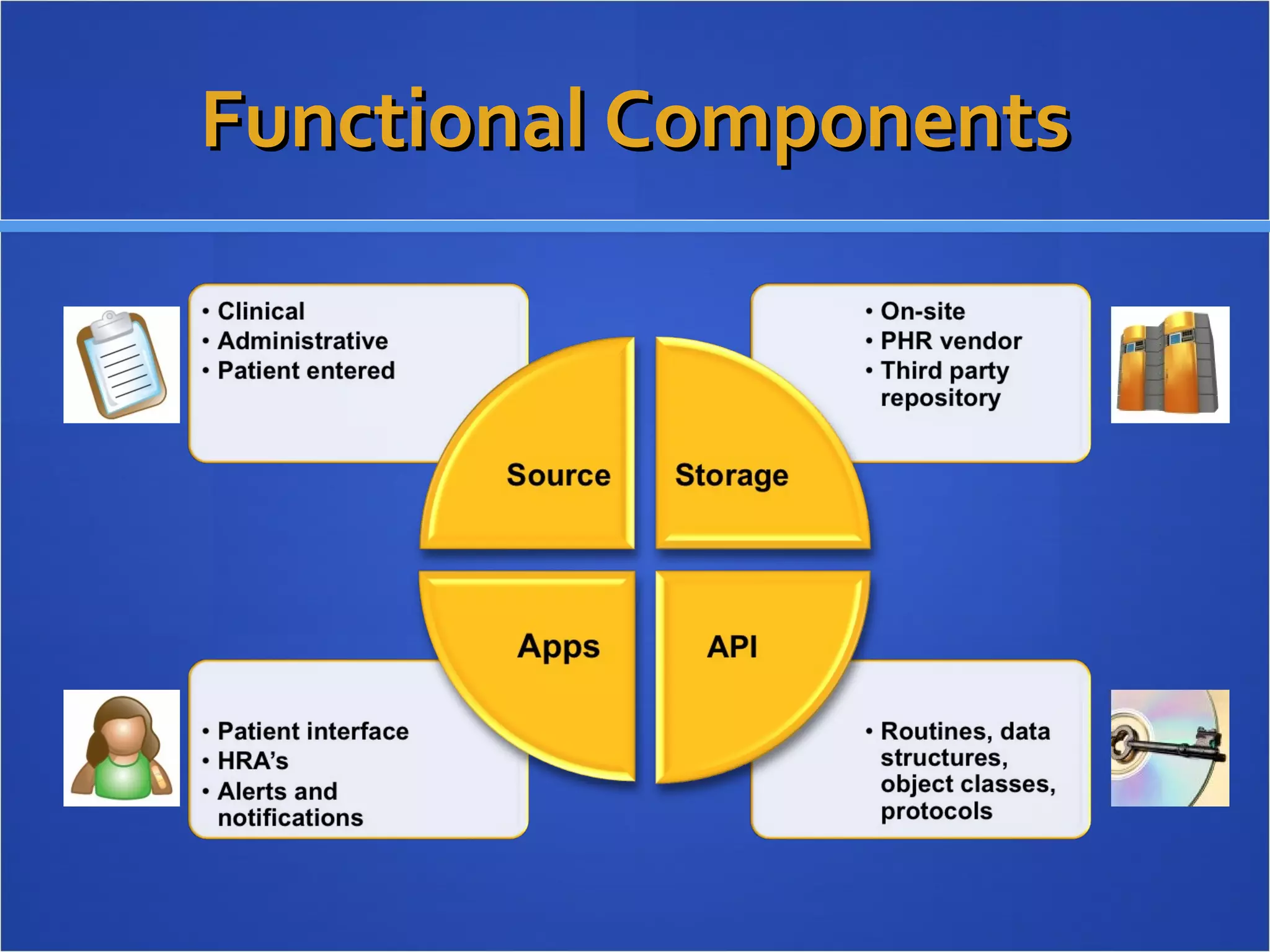
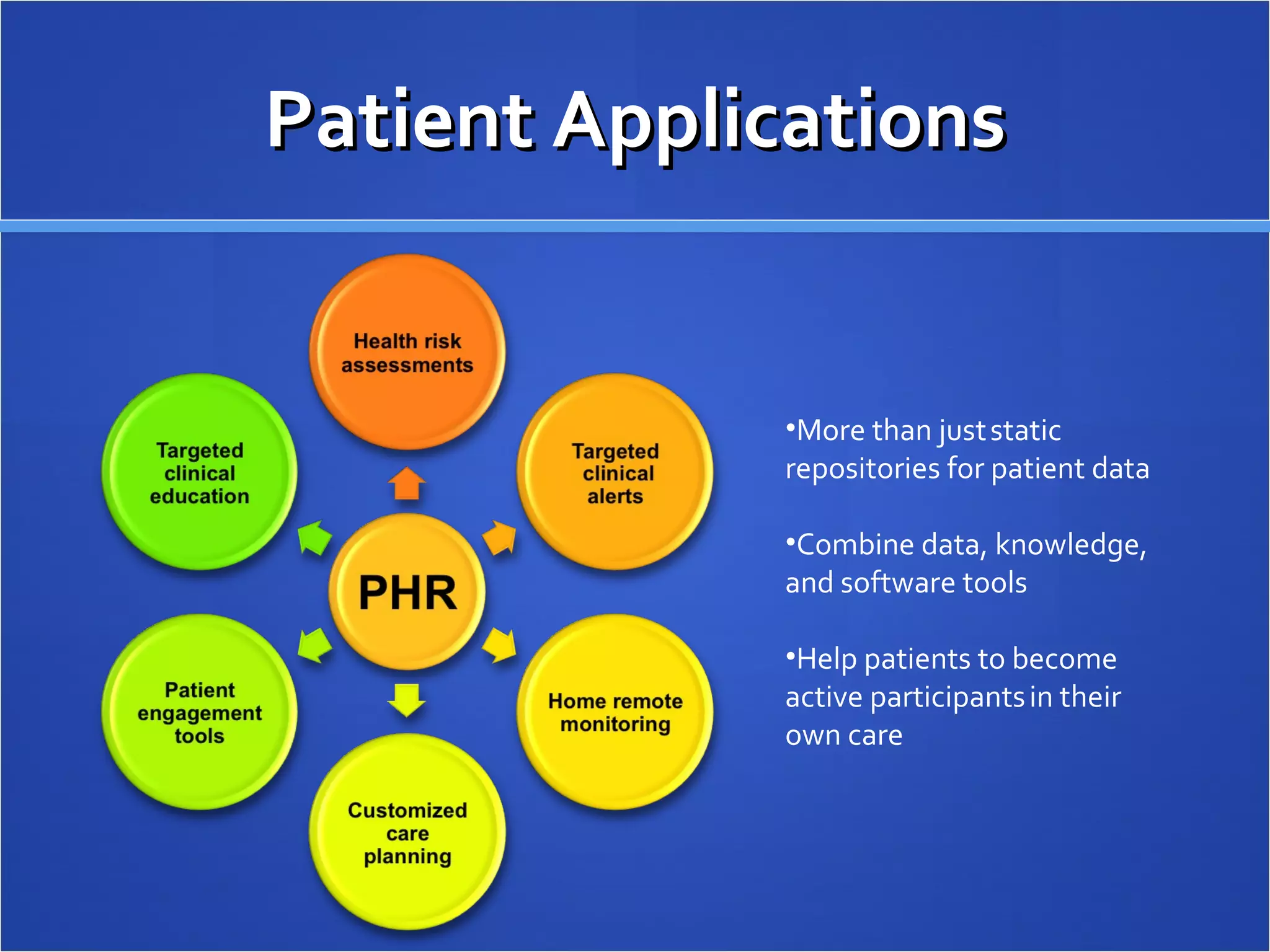
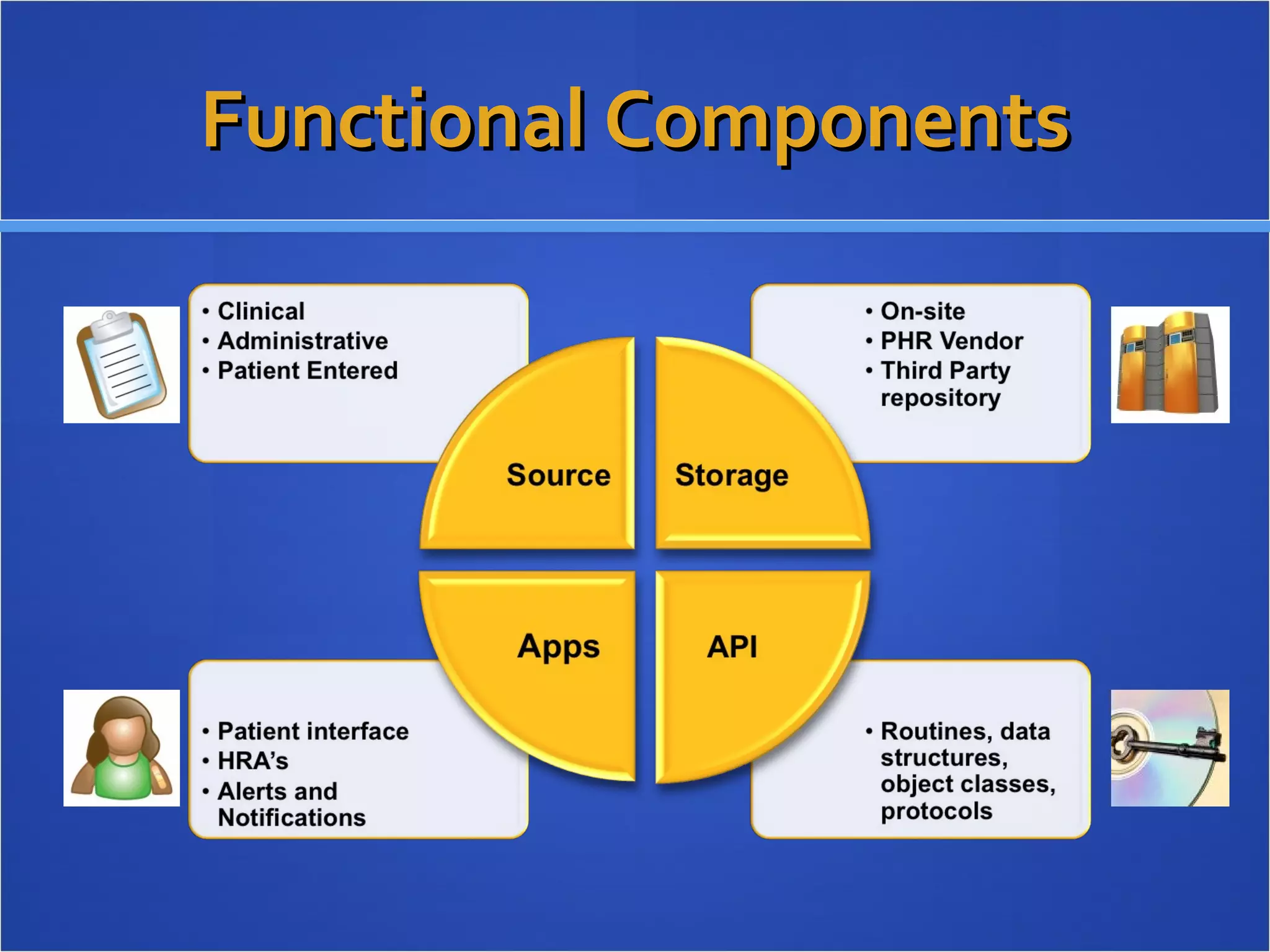
Functional Components
Patient Applications More than just   static repositories for patient data Combine data, knowledge,   and software tools Help patients to become active participants   in their own care
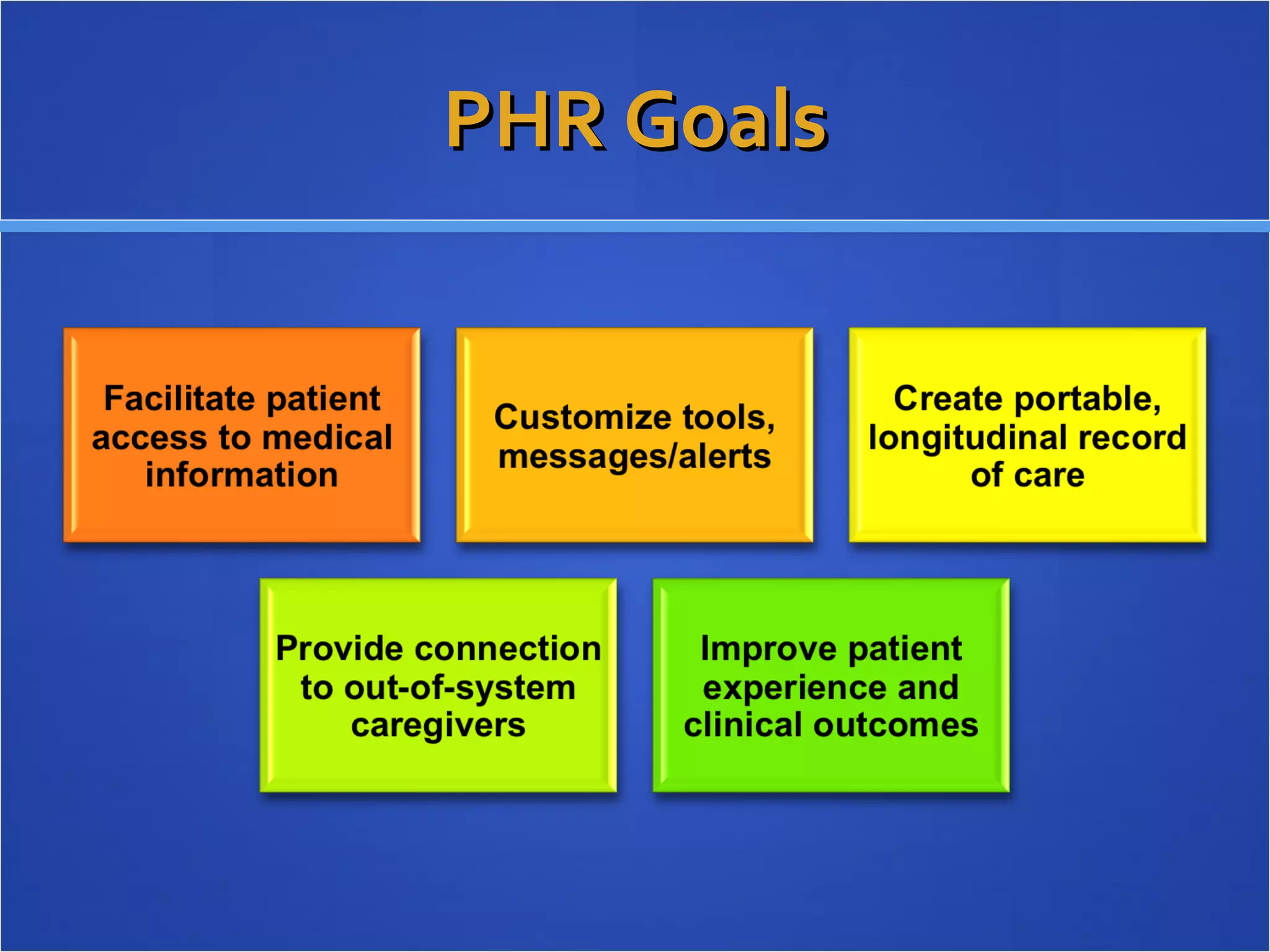
PHR Goals
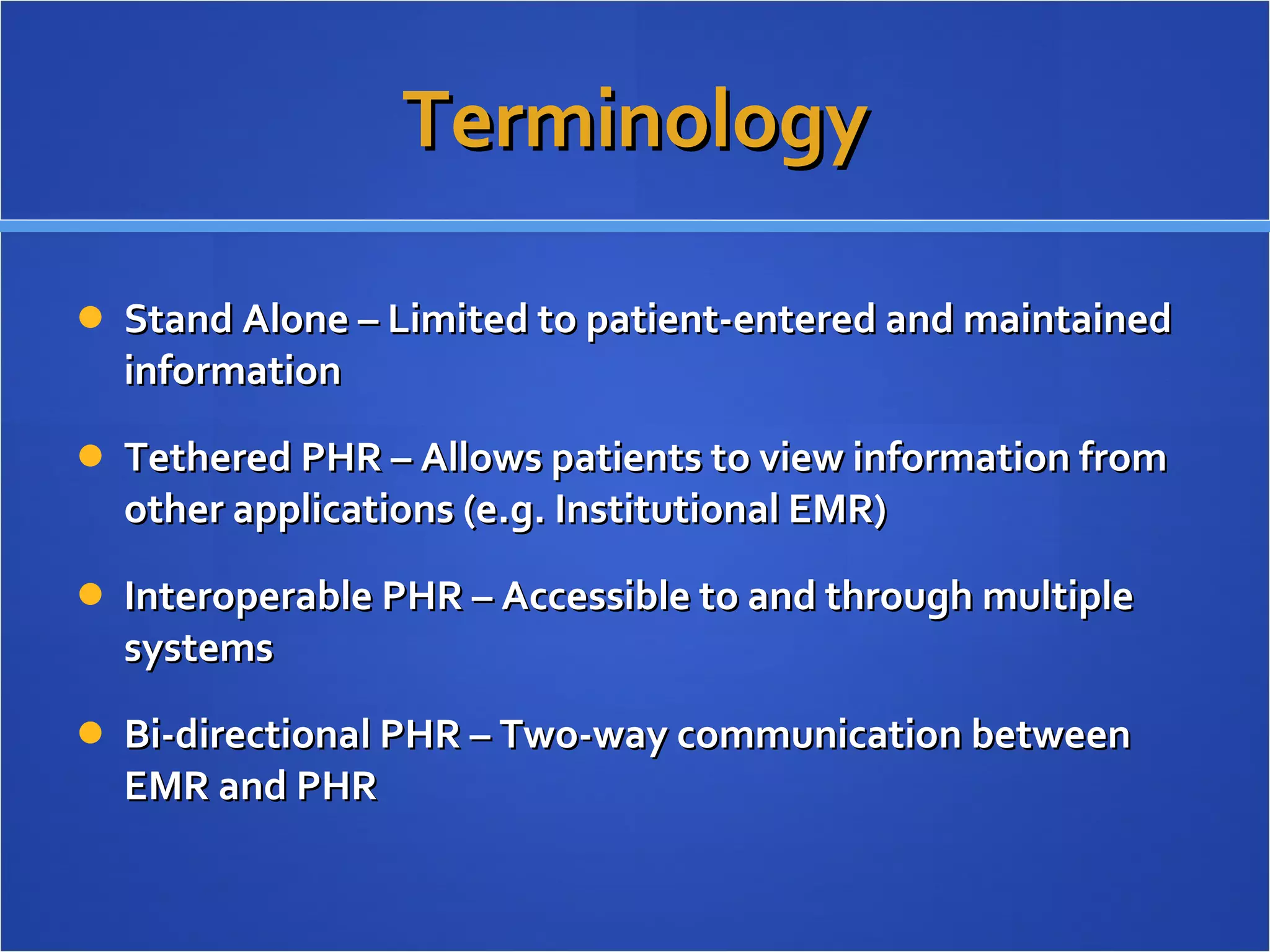
Terminology Stand Alone – Limited to patient-entered and maintained information Tethered PHR – Allows patients to view information from other applications (e.g. Institutional EMR) Interoperable PHR – Accessible to and through multiple systems Bi-directional PHR – Two-way communication between EMR and PHR
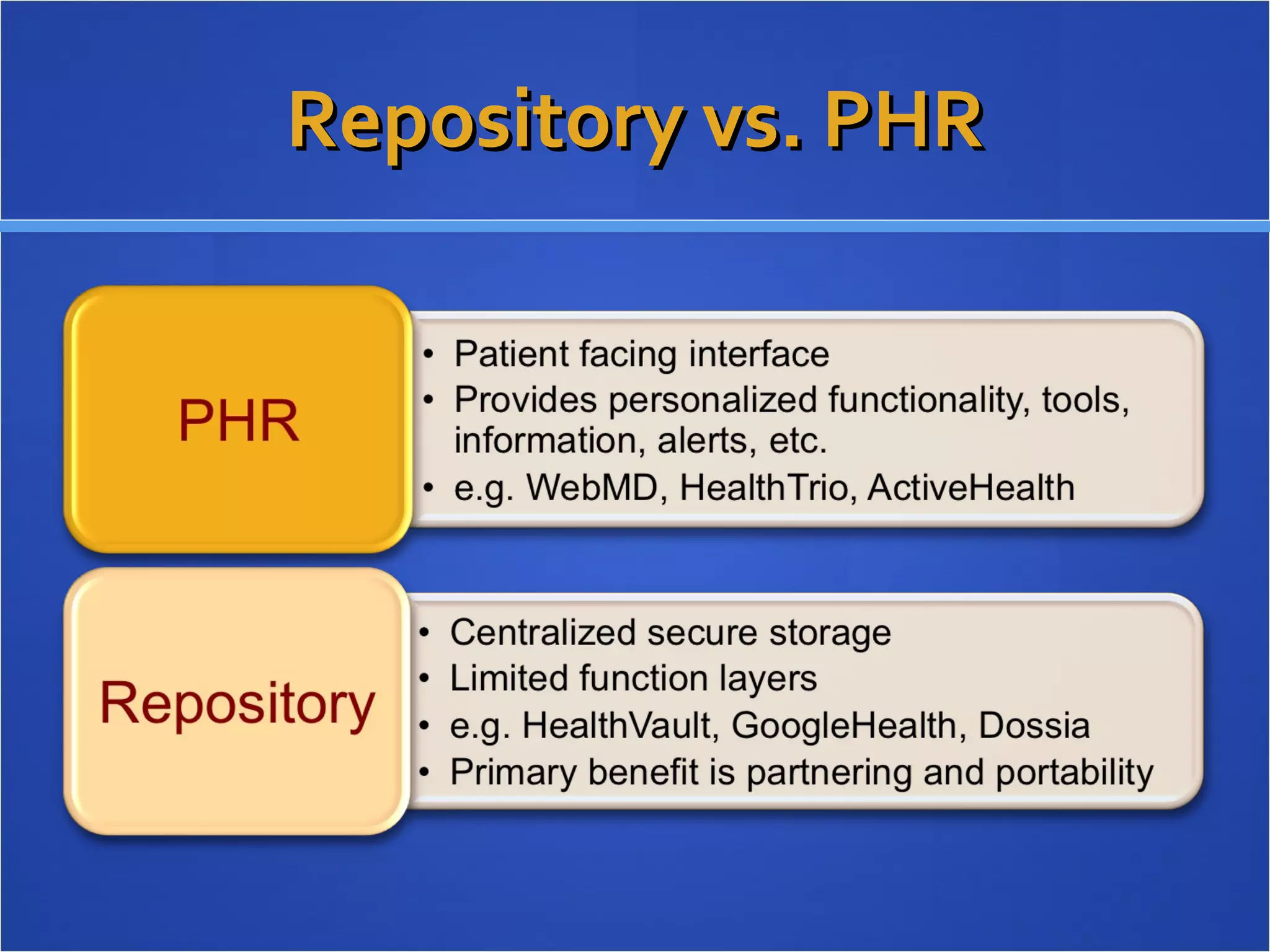
Repository vs. PHR
Adoption Potential 75% of consumers want access online Medical records Test results Appointment scheduling 1 in 4 willing to pay extra 60% would use a PHR if available
Cross-Industry Comparison Online banking 27% growth rate in 2005 72 million households (76%) by 2011 85% of “Gen Y” will bank online Similarities and Differences Technical - security, privacy, sharing Information complexity and need for interpretation
Current Utilization 25% of Americans have PHR access Currently 2-3% actual overall utilization Barriers to adoption: Difficulty finding, using or understanding PHR’s Lack of “Value” content – beyond data storage
Current Utilization Higher adoption rates in specific systems Lower adoption in repository-only systems Function layers drive utilization Ease of access and use are key drivers
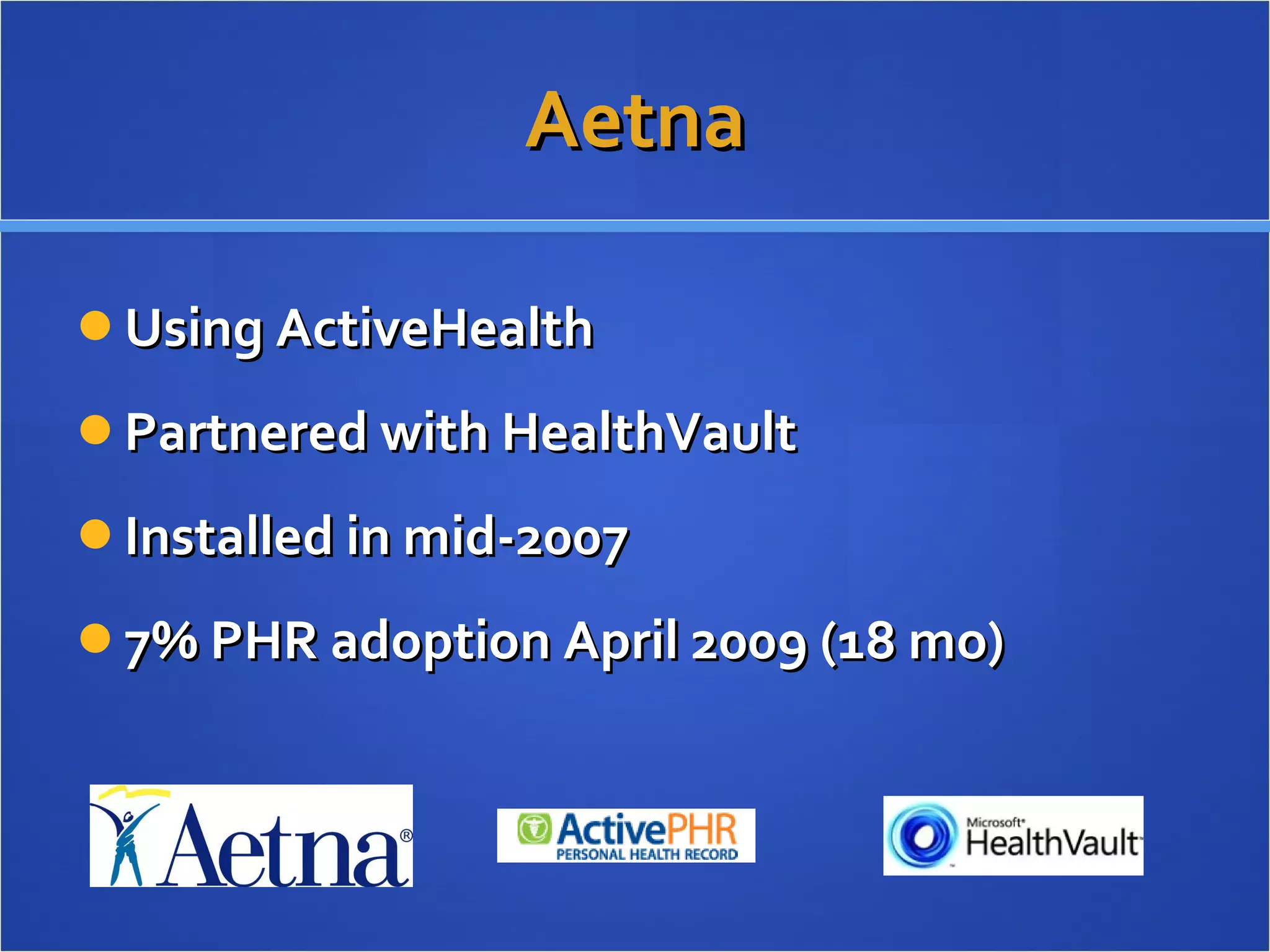
Aetna Using ActiveHealth Partnered with HealthVault Installed in mid-2007 7% PHR adoption April 2009 (18 mo)
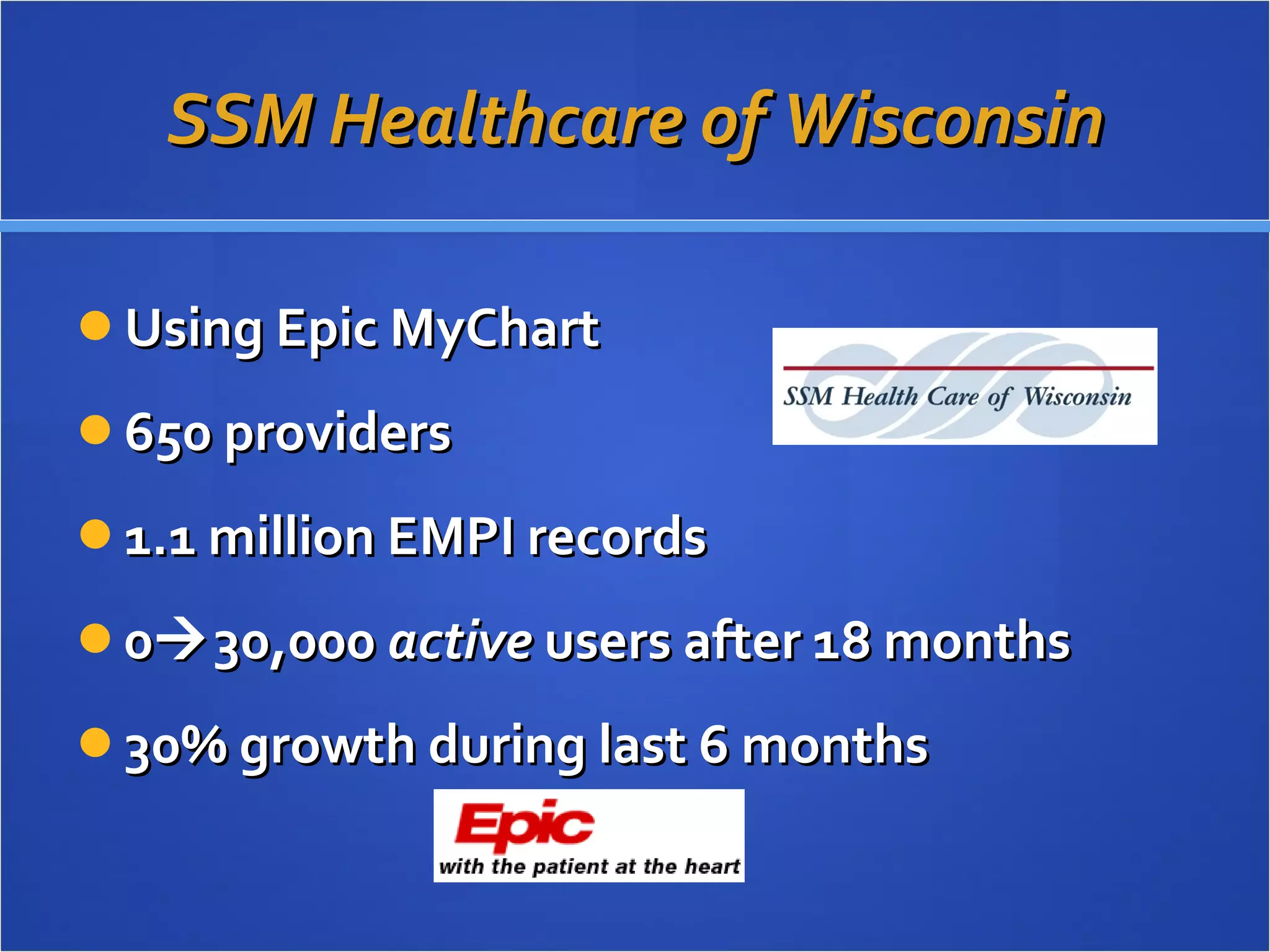
SSM Healthcare of Wisconsin Using Epic MyChart 650 providers 1.1 million EMPI records 0  30,000  active  users after 18 months 30% growth during last 6 months
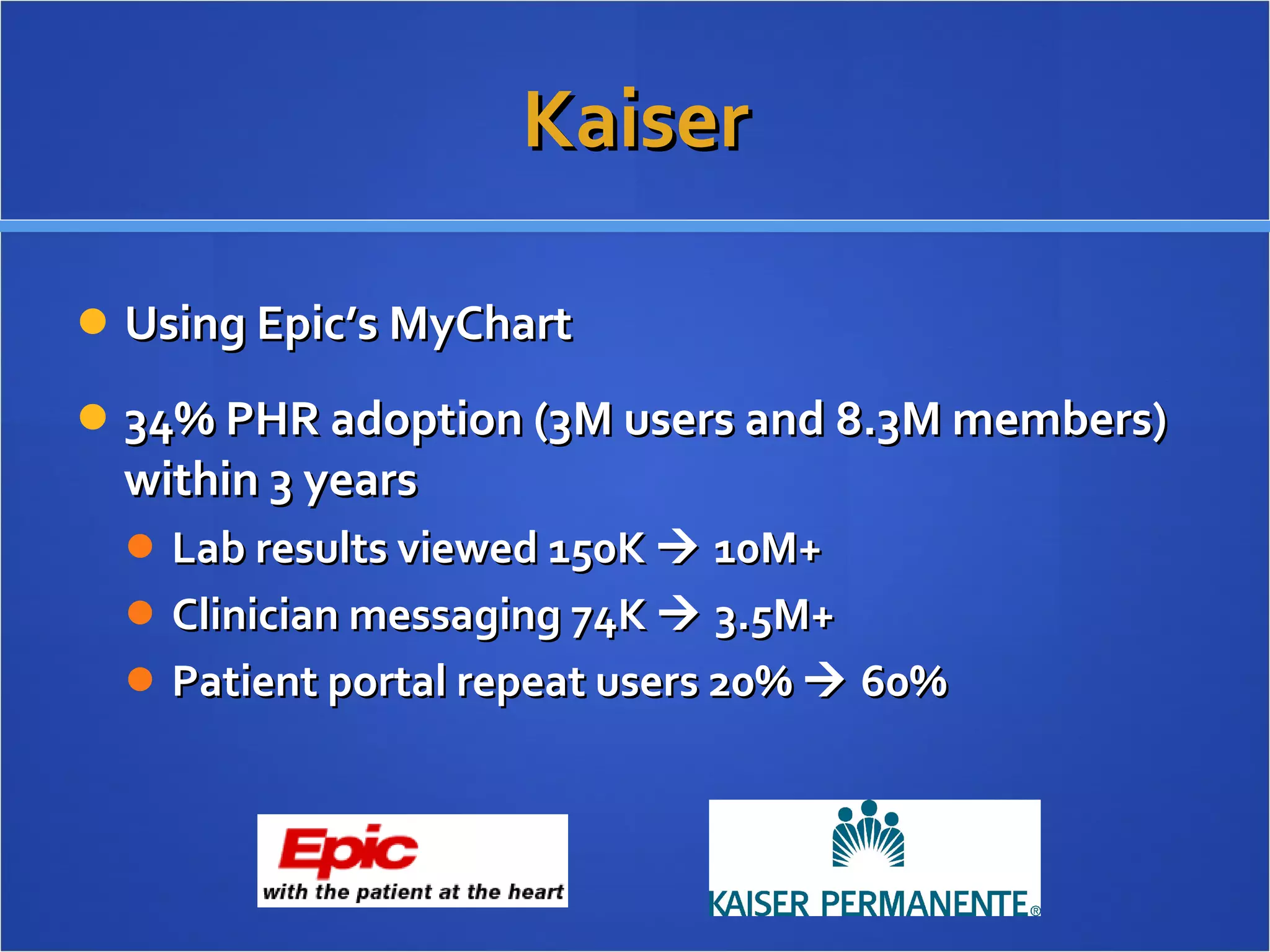
Kaiser Using Epic’s MyChart 34% PHR adoption (3M users and 8.3M members) within 3 years Lab results viewed 150K    10M+ Clinician messaging 74K    3.5M+ Patient portal repeat users 20%    60%
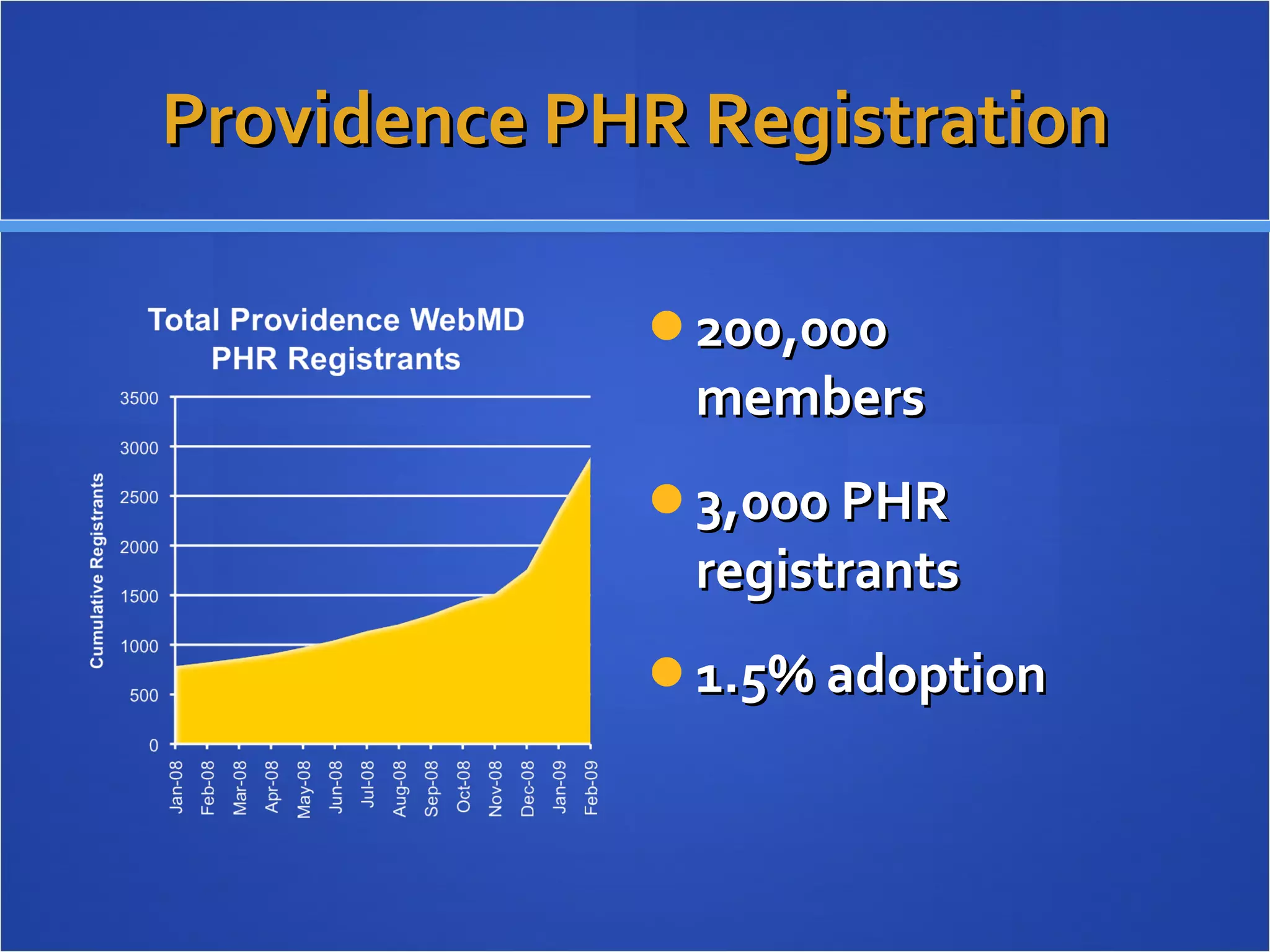
Providence PHR Registration 200,000 members 3,000 PHR registrants 1.5% adoption
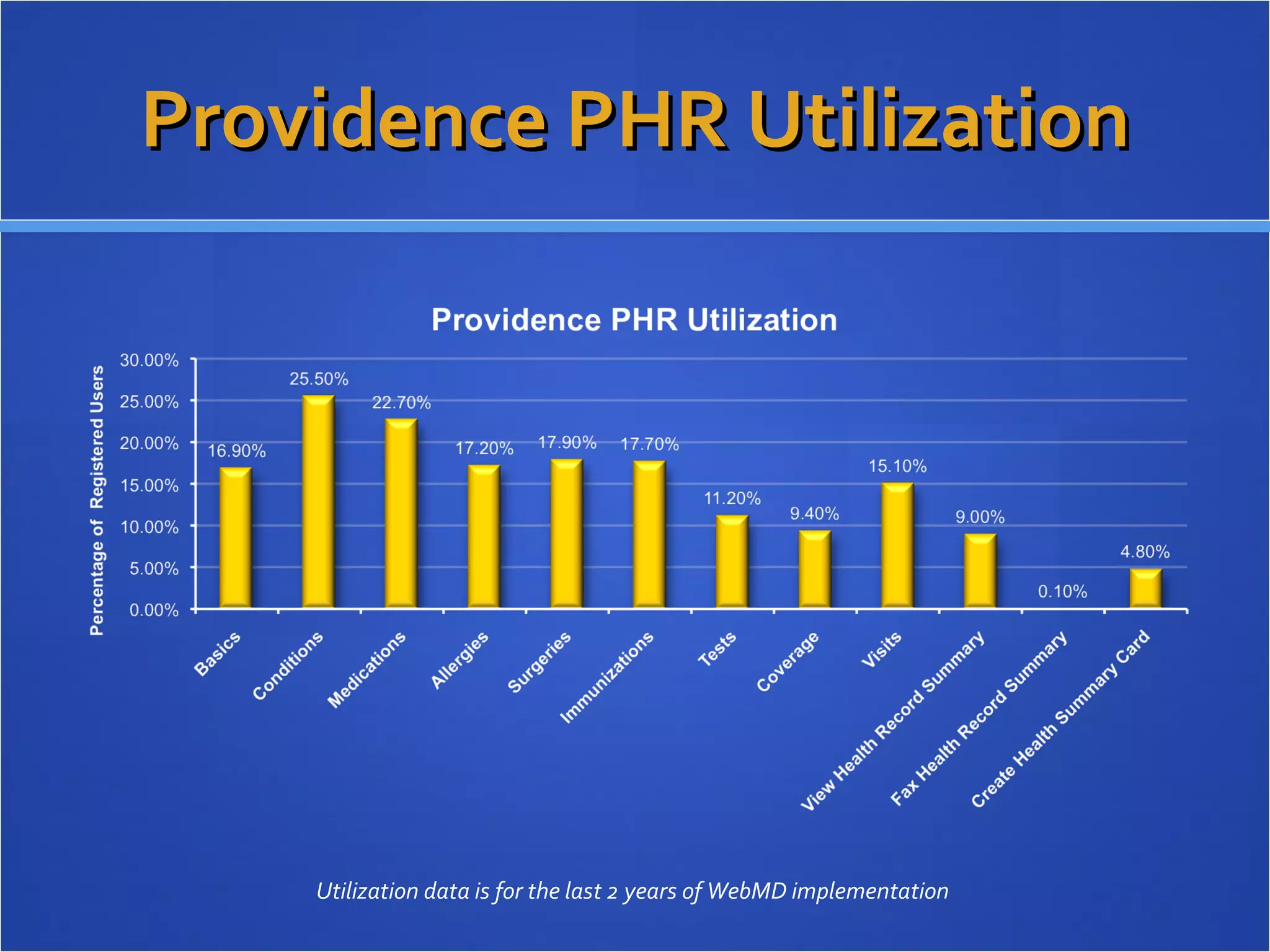
Providence PHR Utilization Utilization data is for the last 2 years of WebMD implementation
Functional Components
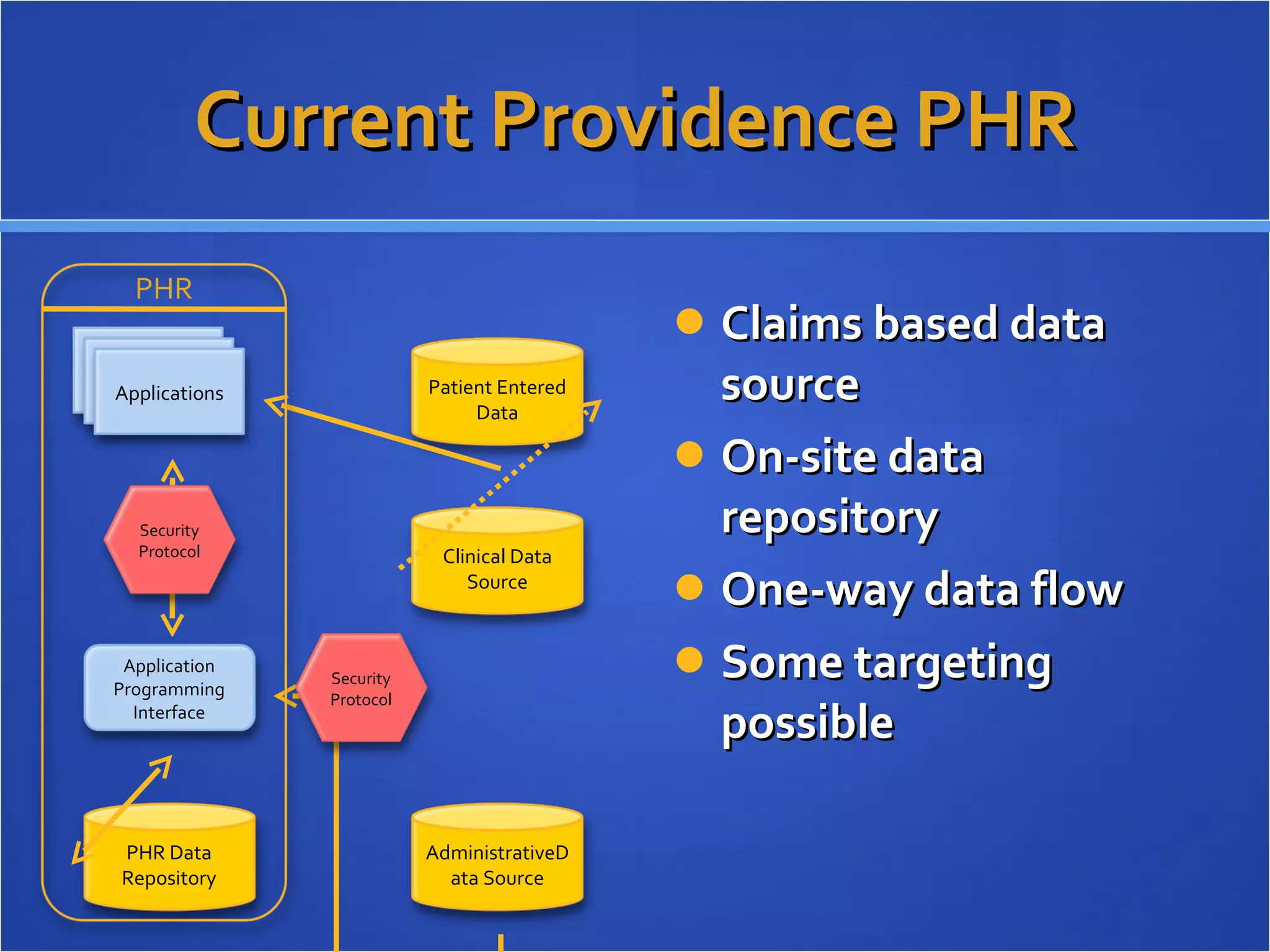
Current Providence PHR Claims based data source On-site data repository One-way data flow Some targeting possible PHR Applications Application Programming Interface PHR Data Repository AdministrativeData Source Clinical Data Source Patient Entered Data Security Protocol Security Protocol
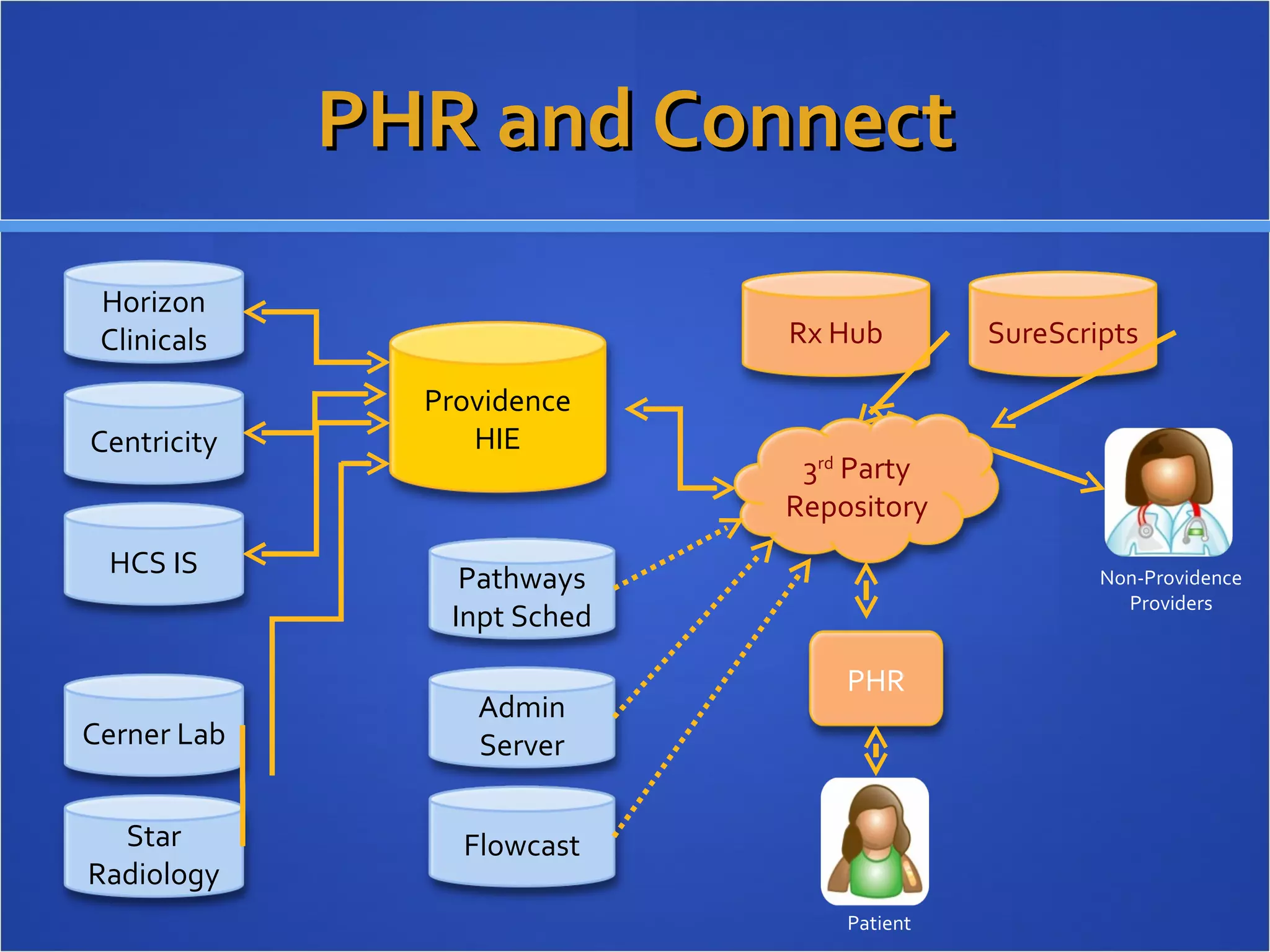
PHR and Connect Rx Hub SureScripts Non-Providence Providers PHR Patient Providence HIE Cerner Lab Star Radiology HCS IS Centricity Horizon Clinicals 3 rd  Party Repository Admin Server Flowcast Pathways Inpt Sched
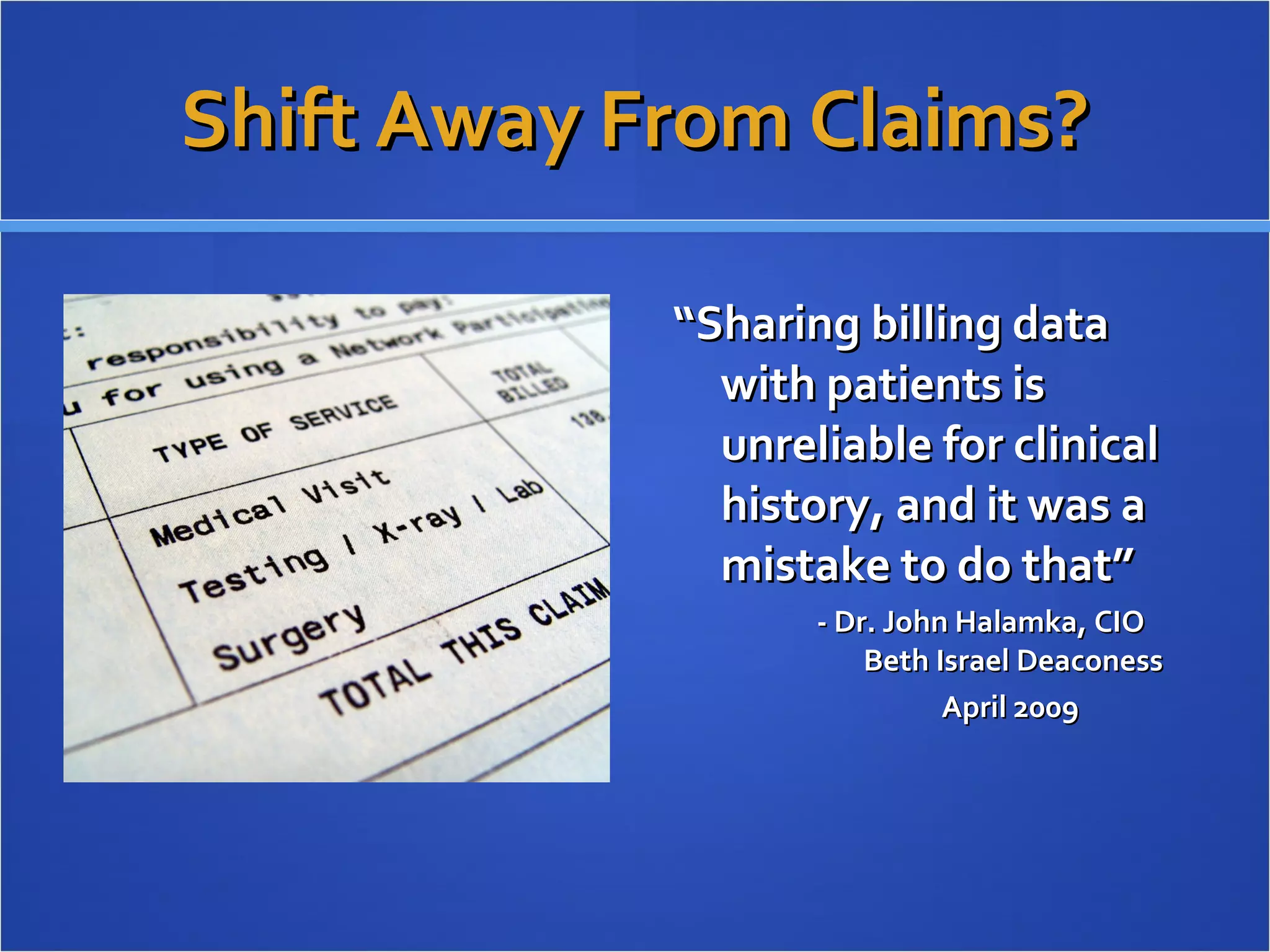
Shift Away From Claims? “ Sharing billing data with patients is unreliable for clinical history, and it was a mistake to do that” - Dr. John Halamka, CIO Beth Israel Deaconess April 2009
Shift Away From Claims? Google now working with National Library of Medicine to codify free text clinical terms
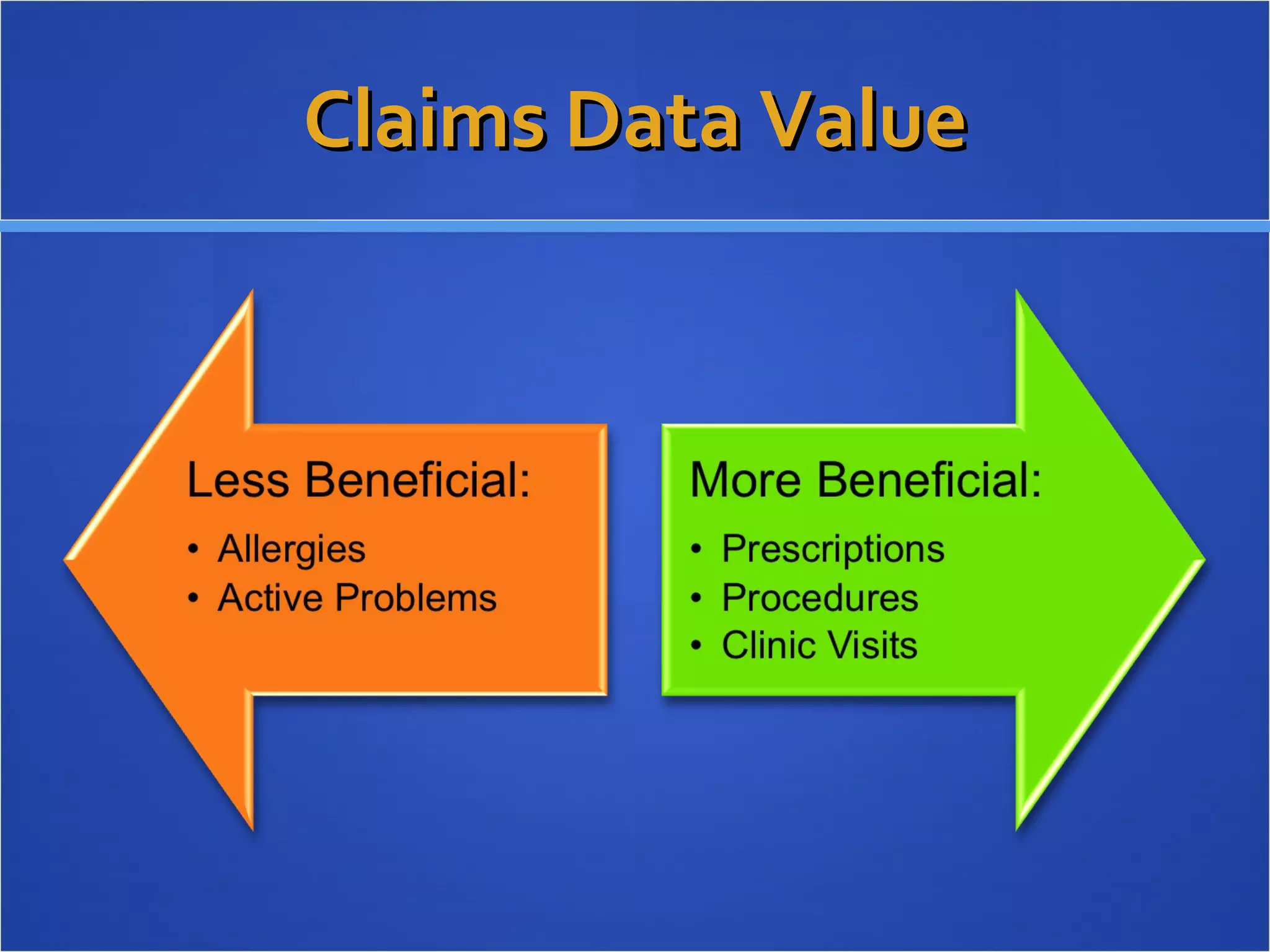
Claims Data Value
Summary PHR’s are a fundamental means of providing value driven healthcare We are currently falling behind benchmarks in PHR application and adoption rates Developing a bidirectional, integrated PHR puts Providence at the front of Healthcare IT
Questions?

Personal Health Records - An Overview

  • 1.
    Personal Health RecordsConnecting the Healthcare Experience
  • 2.
    Roadmap What isa Personal Health Record (PHR) Definition, Components, & Goals Terminology Market Market Size & Benchmarks Providence Future Directions
  • 3.
  • 4.
  • 5.
    Patient Applications Morethan just static repositories for patient data Combine data, knowledge, and software tools Help patients to become active participants in their own care
  • 6.
  • 7.
    Terminology Stand Alone– Limited to patient-entered and maintained information Tethered PHR – Allows patients to view information from other applications (e.g. Institutional EMR) Interoperable PHR – Accessible to and through multiple systems Bi-directional PHR – Two-way communication between EMR and PHR
  • 8.
  • 9.
    Adoption Potential 75%of consumers want access online Medical records Test results Appointment scheduling 1 in 4 willing to pay extra 60% would use a PHR if available
  • 10.
    Cross-Industry Comparison Onlinebanking 27% growth rate in 2005 72 million households (76%) by 2011 85% of “Gen Y” will bank online Similarities and Differences Technical - security, privacy, sharing Information complexity and need for interpretation
  • 11.
    Current Utilization 25%of Americans have PHR access Currently 2-3% actual overall utilization Barriers to adoption: Difficulty finding, using or understanding PHR’s Lack of “Value” content – beyond data storage
  • 12.
    Current Utilization Higheradoption rates in specific systems Lower adoption in repository-only systems Function layers drive utilization Ease of access and use are key drivers
  • 13.
    Aetna Using ActiveHealthPartnered with HealthVault Installed in mid-2007 7% PHR adoption April 2009 (18 mo)
  • 14.
    SSM Healthcare ofWisconsin Using Epic MyChart 650 providers 1.1 million EMPI records 0  30,000 active users after 18 months 30% growth during last 6 months
  • 15.
    Kaiser Using Epic’sMyChart 34% PHR adoption (3M users and 8.3M members) within 3 years Lab results viewed 150K  10M+ Clinician messaging 74K  3.5M+ Patient portal repeat users 20%  60%
  • 16.
    Providence PHR Registration200,000 members 3,000 PHR registrants 1.5% adoption
  • 17.
    Providence PHR UtilizationUtilization data is for the last 2 years of WebMD implementation
  • 18.
  • 19.
    Current Providence PHRClaims based data source On-site data repository One-way data flow Some targeting possible PHR Applications Application Programming Interface PHR Data Repository AdministrativeData Source Clinical Data Source Patient Entered Data Security Protocol Security Protocol
  • 20.
    PHR and ConnectRx Hub SureScripts Non-Providence Providers PHR Patient Providence HIE Cerner Lab Star Radiology HCS IS Centricity Horizon Clinicals 3 rd Party Repository Admin Server Flowcast Pathways Inpt Sched
  • 21.
    Shift Away FromClaims? “ Sharing billing data with patients is unreliable for clinical history, and it was a mistake to do that” - Dr. John Halamka, CIO Beth Israel Deaconess April 2009
  • 22.
    Shift Away FromClaims? Google now working with National Library of Medicine to codify free text clinical terms
  • 23.
  • 24.
    Summary PHR’s area fundamental means of providing value driven healthcare We are currently falling behind benchmarks in PHR application and adoption rates Developing a bidirectional, integrated PHR puts Providence at the front of Healthcare IT
  • 25.