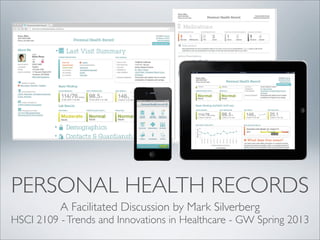
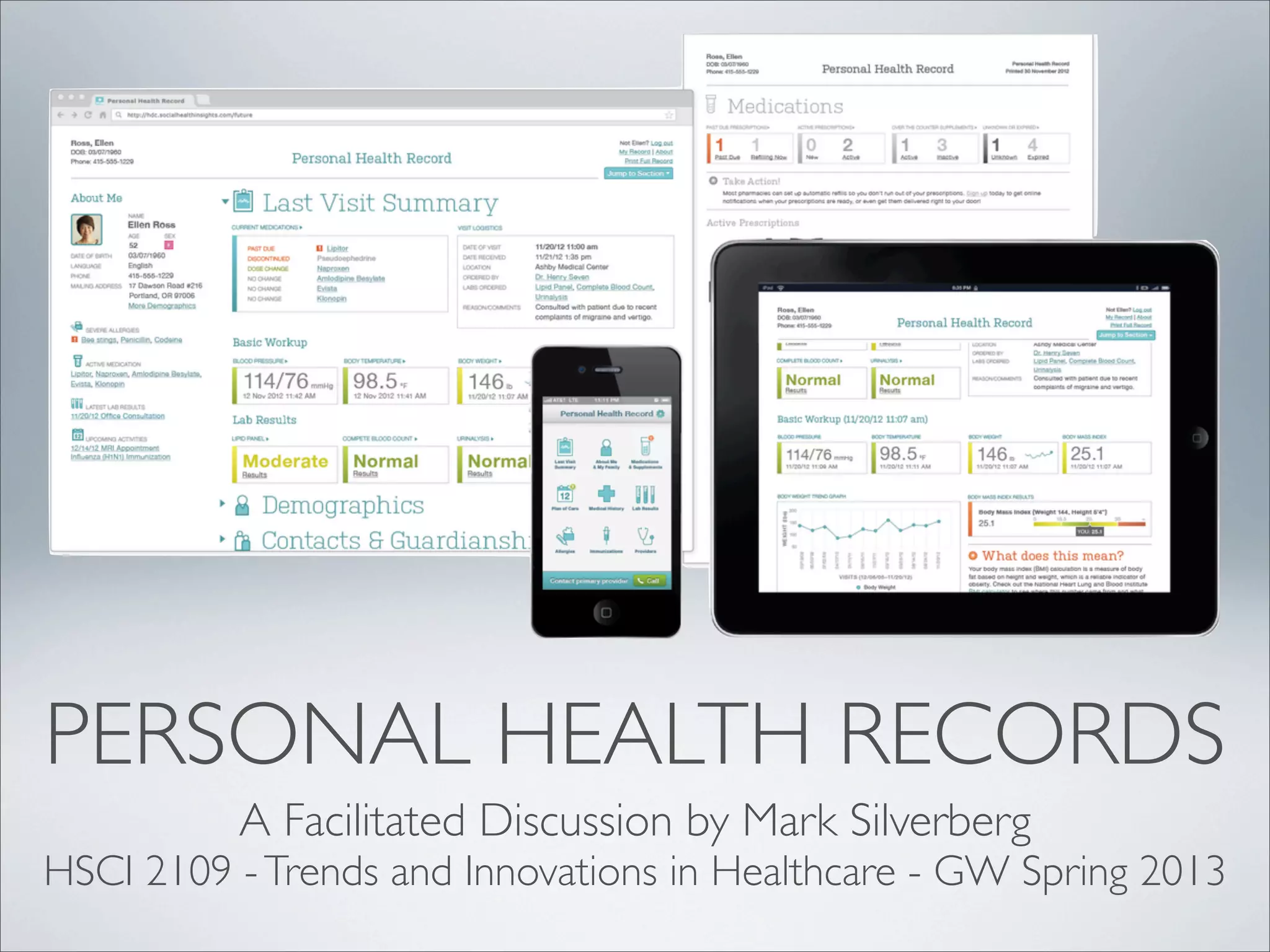
PERSONAL HEALTH RECORDS
          A Facilitated Discussion by Mark Silverberg
HSCI 2109 - Trends and Innovations in Healthcare - GW Spring 2013
TOPIC INTRODUCTION
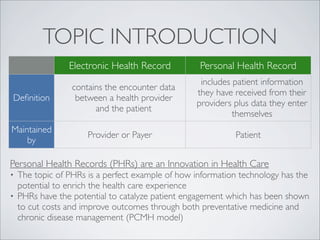
               Electronic Health Record          Personal Health Record
                                                 includes patient information
                contains the encounter data
                                                they have received from their
Definition        between a health provider
                                                providers plus data they enter
                      and the patient
                                                          themselves
Maintained
                    Provider or Payer                     Patient
    by

Personal Health Records (PHRs) are an Innovation in Health Care
• The topic of PHRs is a perfect example of how information technology has the
  potential to enrich the health care experience
• PHRs have the potential to catalyze patient engagement which has been shown
  to cut costs and improve outcomes through both preventative medicine and
  chronic disease management (PCMH model)
KEY STAKEHOLDERS
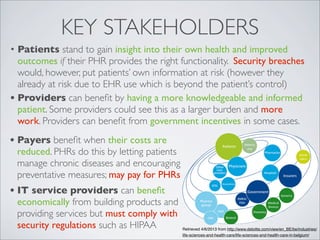
• Patients stand to gain insight into their own health and improved
  outcomes if their PHR provides the right functionality. Security breaches
  would, however, put patients’ own information at risk (however they
  already at risk due to EHR use which is beyond the patient’s control)
• Providers can benefit by having a more knowledgeable and informed
  patient. Some providers could see this as a larger burden and more
  work. Providers can benefit from government incentives in some cases.
• Payers benefit when their costs are
  reduced. PHRs do this by letting patients
  manage chronic diseases and encouraging
  preventative measures; may pay for PHRs
• IT service providers can benefit
  economically from building products and
  providing services but must comply with
  security regulations such as HIPAA          Retrieved 4/6/2013 from http://www.deloitte.com/view/en_BE/be/industries/
                                              life-sciences-and-health-care/life-sciences-and-health-care-in-belgium/
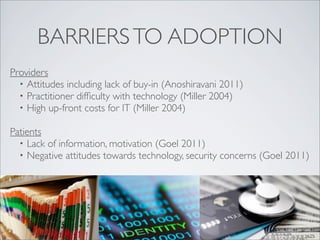
BARRIERS TO ADOPTION
Providers
  • Attitudes including lack of buy-in (Anoshiravani 2011)
  • Practitioner difficulty with technology (Miller 2004)
  • High up-front costs for IT (Miller 2004)

Patients
  • Lack of information, motivation (Goel 2011)
  • Negative attitudes towards technology, security concerns (Goel 2011)
FACILITATORS OF PROGRESS
Technology
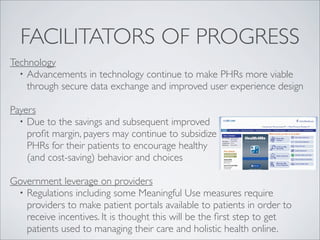
  • Advancements in technology continue to make PHRs more viable
    through secure data exchange and improved user experience design

Payers
  • Due to the savings and subsequent improved
    profit margin, payers may continue to subsidize
    PHRs for their patients to encourage healthy
    (and cost-saving) behavior and choices

Government leverage on providers
 • Regulations including some Meaningful Use measures require
   providers to make patient portals available to patients in order to
   receive incentives. It is thought this will be the first step to get
   patients used to managing their care and holistic health online.
SUSTAINABILITY & ECONOMICS
•   A PHR is controlled by a patient but it can be hosted by any trusted party
•   Some receive a PHR through their employer, payer, provider, or health
    club.
•   There are free and paid options in the marketplace for patients to
    choose from. Popular examples include Microsoft HealthVault and
    NoMoreClipboard.
•   Implementation costs for PHRs vary greatly. There are some open-
    source software packages which can be used to significantly reduce
    costs.
    •   Providers are economically incentivized by the
        government (Center for Medicare and Medicaid
        Services) to implement EHRs and PHRs.
COST AND BENEFITS
          FOR INDIVIDUALS AND SOCIETY
•   With correctly implemented and supported PHRs,
    improved health outcomes and reduced costs can be
    achieved; a few examples include:
      • reminding and urging patients to receive preventative medicine such as
        flu shots and colonoscopies (Lau 2012)
      • allow patients to ask medical professionals non-urgent questions
        without calling or coming into the office (Detmer 2008)
      • facilitate chronic disease management using online, mobile, and device-
        connected tools (Urowitz 2012)
      •   connect patients to cost-saving telemedicine providers

•   A 2008 article from the Journal of the American Health Information
    Management Association (JAHIMA) noted that “widespread use of PHRs
    could save the US healthcare industry between $13 and $21 billion a year.”
IMPORTANT CONSIDERATIONS
There has been a lot of credible research performed on the topic of PHRs.
Future researchers and system implementors should take advantage of the
existing wealth of knowledge including these suggestions:
•   Good user interfaces not only make for a more enjoyable experience but also
    increase data quality (Kim 2004)
•   Most popular features were usually found to be medication overview and lab
    results sections followed by the treatment appointments feature (Ros 2012)
•   Patients are most likely to engage with the PHR technology if the practitioner
    who explains it to them ‘buys into’ the pitch (Lee 2006)
•   Organizational change management cannot be underestimated (Bonander
    2010); it may be as or more important than the technology itself (Day 2012)
RECOMMENDATIONS
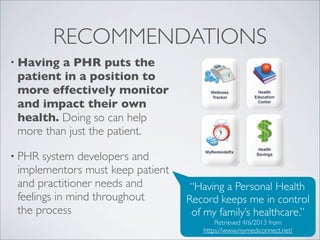
• Having a PHR puts the
 patient in a position to
 more effectively monitor
 and impact their own
 health. Doing so can help
 more than just the patient.

• PHR  system developers and
 implementors must keep patient
 and practitioner needs and        “Having a Personal Health
 feelings in mind throughout      Record keeps me in control
 the process                       of my family’s healthcare.”
                                         Retrieved 4/6/2013 from
                                     https://www.mymediconnect.net/

Innovations and Trends in Health Care: The Advent and Use of Personal Health Records (PHRs)

  • 1.
    PERSONAL HEALTH RECORDS A Facilitated Discussion by Mark Silverberg HSCI 2109 - Trends and Innovations in Healthcare - GW Spring 2013
  • 2.
    TOPIC INTRODUCTION Electronic Health Record Personal Health Record includes patient information contains the encounter data they have received from their Definition between a health provider providers plus data they enter and the patient themselves Maintained Provider or Payer Patient by Personal Health Records (PHRs) are an Innovation in Health Care • The topic of PHRs is a perfect example of how information technology has the potential to enrich the health care experience • PHRs have the potential to catalyze patient engagement which has been shown to cut costs and improve outcomes through both preventative medicine and chronic disease management (PCMH model)
  • 3.
    KEY STAKEHOLDERS • Patientsstand to gain insight into their own health and improved outcomes if their PHR provides the right functionality. Security breaches would, however, put patients’ own information at risk (however they already at risk due to EHR use which is beyond the patient’s control) • Providers can benefit by having a more knowledgeable and informed patient. Some providers could see this as a larger burden and more work. Providers can benefit from government incentives in some cases. • Payers benefit when their costs are reduced. PHRs do this by letting patients manage chronic diseases and encouraging preventative measures; may pay for PHRs • IT service providers can benefit economically from building products and providing services but must comply with security regulations such as HIPAA Retrieved 4/6/2013 from http://www.deloitte.com/view/en_BE/be/industries/ life-sciences-and-health-care/life-sciences-and-health-care-in-belgium/
  • 4.
    BARRIERS TO ADOPTION Providers • Attitudes including lack of buy-in (Anoshiravani 2011) • Practitioner difficulty with technology (Miller 2004) • High up-front costs for IT (Miller 2004) Patients • Lack of information, motivation (Goel 2011) • Negative attitudes towards technology, security concerns (Goel 2011)
  • 5.
    FACILITATORS OF PROGRESS Technology • Advancements in technology continue to make PHRs more viable through secure data exchange and improved user experience design Payers • Due to the savings and subsequent improved profit margin, payers may continue to subsidize PHRs for their patients to encourage healthy (and cost-saving) behavior and choices Government leverage on providers • Regulations including some Meaningful Use measures require providers to make patient portals available to patients in order to receive incentives. It is thought this will be the first step to get patients used to managing their care and holistic health online.
  • 6.
    SUSTAINABILITY & ECONOMICS • A PHR is controlled by a patient but it can be hosted by any trusted party • Some receive a PHR through their employer, payer, provider, or health club. • There are free and paid options in the marketplace for patients to choose from. Popular examples include Microsoft HealthVault and NoMoreClipboard. • Implementation costs for PHRs vary greatly. There are some open- source software packages which can be used to significantly reduce costs. • Providers are economically incentivized by the government (Center for Medicare and Medicaid Services) to implement EHRs and PHRs.
  • 7.
    COST AND BENEFITS FOR INDIVIDUALS AND SOCIETY • With correctly implemented and supported PHRs, improved health outcomes and reduced costs can be achieved; a few examples include: • reminding and urging patients to receive preventative medicine such as flu shots and colonoscopies (Lau 2012) • allow patients to ask medical professionals non-urgent questions without calling or coming into the office (Detmer 2008) • facilitate chronic disease management using online, mobile, and device- connected tools (Urowitz 2012) • connect patients to cost-saving telemedicine providers • A 2008 article from the Journal of the American Health Information Management Association (JAHIMA) noted that “widespread use of PHRs could save the US healthcare industry between $13 and $21 billion a year.”
  • 8.
    IMPORTANT CONSIDERATIONS There hasbeen a lot of credible research performed on the topic of PHRs. Future researchers and system implementors should take advantage of the existing wealth of knowledge including these suggestions: • Good user interfaces not only make for a more enjoyable experience but also increase data quality (Kim 2004) • Most popular features were usually found to be medication overview and lab results sections followed by the treatment appointments feature (Ros 2012) • Patients are most likely to engage with the PHR technology if the practitioner who explains it to them ‘buys into’ the pitch (Lee 2006) • Organizational change management cannot be underestimated (Bonander 2010); it may be as or more important than the technology itself (Day 2012)
  • 9.
    RECOMMENDATIONS • Having aPHR puts the patient in a position to more effectively monitor and impact their own health. Doing so can help more than just the patient. • PHR system developers and implementors must keep patient and practitioner needs and “Having a Personal Health feelings in mind throughout Record keeps me in control the process of my family’s healthcare.” Retrieved 4/6/2013 from https://www.mymediconnect.net/