William G. Perry, Jr.  Theory of Intellectual and  Ethical Development By: Suzy Herman & Amy Veenstra
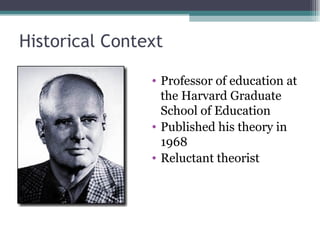
Historical Context  Professor of education at the Harvard Graduate School of Education Published his theory in 1968 Reluctant theorist
Comparison to Other Theories Used Piaget and Kohlberg developmental ideas Sanford and Heath’s influence in higher education Little had been done in intellectual development before Perry Trying to make meaning of the teaching/learning process
Theory It is a cognitive theory, which means that it explains the development of simple to complex thinking Uses 9 Positions, not Stages No assumption of duration Central tendencies Point of view consistency Static vs. Transitions
Four Main Positions Dualism- Viewing the world dichotomously Black and white thinking Multiplicity- Honoring diverse views when the right answers are not yet known Relativism- Recognizing that evidence is needed to support opinions Commitment to Relativism- Making choices in a contextual world
Small Group Discussion Discuss a viewpoint that has changed for you since you began college? How did you go through the four categories? What experiences accelerated your development?
Deflections for Cognitive Growth Temporizing- a “time out” period when the movement is postponed Escape- avoiding responsibility Retreat- temporary return to dualism when stressed
Research Used open ended interviews with mostly Harvard undergraduates to create the scheme Then a manual was developed with a rating system Perry’s research was used to create numerous assessment scales by other researchers
Application Informal assessment  Developmental Instruction Model- operationalizes Perry’s model Structure Framework and direction that students get Diversity Alternatives and perspectives exposed Experiential Learning Learning activities Personalism Risk-taking within a safe environment
Application Classroom Plus-One Staging: stretching the student to think beyond current position Student Affairs Practitioners design development opportunities
Criticism Inclusiveness: study conducted with mostly white males at prestigious institution Comparing students of the 1950s and 1960s to students of today The inclusion of two constructs, both intellectual and ethical Labels students and can be viewed as judgmental
Questions and Comments

Perry1

  • 1.
    William G. Perry,Jr. Theory of Intellectual and Ethical Development By: Suzy Herman & Amy Veenstra
  • 2.
    Historical Context Professor of education at the Harvard Graduate School of Education Published his theory in 1968 Reluctant theorist
  • 3.
    Comparison to OtherTheories Used Piaget and Kohlberg developmental ideas Sanford and Heath’s influence in higher education Little had been done in intellectual development before Perry Trying to make meaning of the teaching/learning process
  • 4.
    Theory It isa cognitive theory, which means that it explains the development of simple to complex thinking Uses 9 Positions, not Stages No assumption of duration Central tendencies Point of view consistency Static vs. Transitions
  • 5.
    Four Main PositionsDualism- Viewing the world dichotomously Black and white thinking Multiplicity- Honoring diverse views when the right answers are not yet known Relativism- Recognizing that evidence is needed to support opinions Commitment to Relativism- Making choices in a contextual world
  • 6.
    Small Group DiscussionDiscuss a viewpoint that has changed for you since you began college? How did you go through the four categories? What experiences accelerated your development?
  • 7.
    Deflections for CognitiveGrowth Temporizing- a “time out” period when the movement is postponed Escape- avoiding responsibility Retreat- temporary return to dualism when stressed
  • 8.
    Research Used openended interviews with mostly Harvard undergraduates to create the scheme Then a manual was developed with a rating system Perry’s research was used to create numerous assessment scales by other researchers
  • 9.
    Application Informal assessment Developmental Instruction Model- operationalizes Perry’s model Structure Framework and direction that students get Diversity Alternatives and perspectives exposed Experiential Learning Learning activities Personalism Risk-taking within a safe environment
  • 10.
    Application Classroom Plus-OneStaging: stretching the student to think beyond current position Student Affairs Practitioners design development opportunities
  • 11.
    Criticism Inclusiveness: studyconducted with mostly white males at prestigious institution Comparing students of the 1950s and 1960s to students of today The inclusion of two constructs, both intellectual and ethical Labels students and can be viewed as judgmental
  • 12.

Editor's Notes

  • #3 Was not trying to create anything systematic, only descriptive
  • #4 Amy “unfolding views of the world”
  • #5 Amy. No length requirement. Central tendency, although individuals can range in structures at any point in time. Possibly the development happens during the transitions, not at the static “stages”
  • #6 Talk about 9 positions
  • #8 Amy. Career focus – if I temporize I’m just taking a time out and not deciding or thinking about it. If I try to escape, I might look to others to make my decision for me (parents, career counselors, etc.). If I retreat, I could return to dualism, black or white. Only two options, or thinking simplistically instead of thinking critically about how my skills might fit a career.
  • #9 Used interviews with harvard students, and used questions such as “What has stood out to you during the year?” After, Knefelkamp and Widick created a more production oriented instrument with the Measure of Intellectual Development (MID) and Erwin created the Scale of Intellectual Development
  • #10 Amy. The DI model goes hand in hand with dualism, multiplicity, relativism, and commitment. Just operationalzing these elements.
  • #11 Amy. Teaching opportunities
  • #12 Not applicable to all types of modern students, however evidence by Knefelkamp suggests that it can fall into all types of students Including two constructs can be complicated and difficult to define, Developed in one area, but not the other