PERISCOPE
Group # 3 :
• OBAID ULLAH
• ANEEQ AHMED
• M.JUNAID TABASSUM
PRESENATION
APLLIED PHYSICS
PERISCOPE
What is a periscope
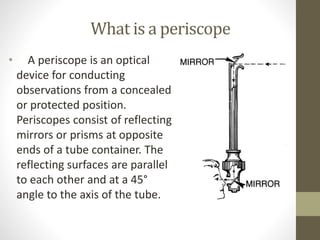
• A periscope is an optical
device for conducting
observations from a concealed
or protected position.
Periscopes consist of reflecting
mirrors or prisms at opposite
ends of a tube container. The
reflecting surfaces are parallel
to each other and at a 45°
angle to the axis of the tube.
History
• Johannes Gutenberg, marketed a kind of
periscope in the 1430s to see over the heads of
the crowd at the vigintennial religious festival at
Aachen.
• In 1854 Hippolyte Marié-Davy invented the first
naval periscope, consisting of a vertical tube with
two small mirrors fixed at each end at 45°
• . Simon Lake used periscopes in his submarines
in 1902.
In world war I & II
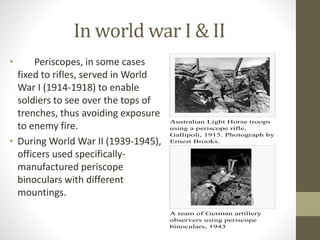
• Periscopes, in some cases
fixed to rifles, served in World
War I (1914-1918) to enable
soldiers to see over the tops of
trenches, thus avoiding exposure
to enemy fire.
• During World War II (1939-1945),
officers used specifically-
manufactured periscope
binoculars with different
mountings.
Australian Light Horse troops
using a periscope rifle,
Gallipoli, 1915. Photograph by
Ernest Brooks.
A team of German artillery
observers using periscope
binoculars, 1943
Introduction
• A periscope is an instrument used for
observation over, around or through an
object, obstacle or condition that prevents
direct line-of-sight observation from an
observer's current position.
Types of Periscope
• 1: Simple Periscope
• 2: Complex Periscope
Simple periscope
• In its simplest form, it consists
of an outer case with mirrors
at each end.
• Set parallel to each other at a
45-degree angle.
• This form of periscope, with
the addition of two simple
lenses, served for observation
purposes in the trenches
during World war I.
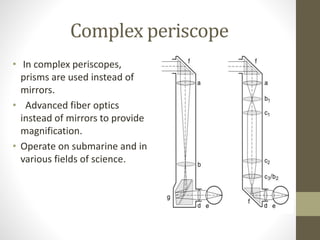
Complex periscope
• In complex periscopes,
prisms are used instead of
mirrors.
• Advanced fiber optics
instead of mirrors to provide
magnification.
• Operate on submarine and in
various fields of science.
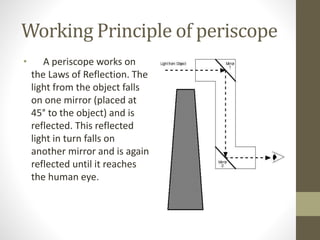
Working Principle of periscope
• A periscope works on
the Laws of Reflection. The
light from the object falls
on one mirror (placed at
45° to the object) and is
reflected. This reflected
light in turn falls on
another mirror and is again
reflected until it reaches
the human eye.
Construction of a periscope
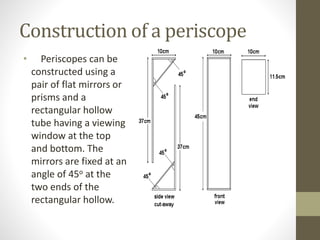
• Periscopes can be
constructed using a
pair of flat mirrors or
prisms and a
rectangular hollow
tube having a viewing
window at the top
and bottom. The
mirrors are fixed at an
angle of 45o at the
two ends of the
rectangular hollow.
Uses of periscope
• Periscopes are found in a variety of
applications but they are almost synonymous
with their use in submarines.
• In a similar 'threat detection' application,
periscopes are often used on battlefields to look
out of trenches safely without exposing the
observer's body.
USE IN SUBMARINE
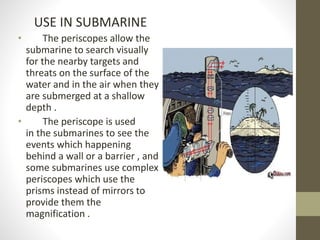
• The periscopes allow the
submarine to search visually
for the nearby targets and
threats on the surface of the
water and in the air when they
are submerged at a shallow
depth .
• The periscope is used
in the submarines to see the
events which happening
behind a wall or a barrier , and
some submarines use complex
periscopes which use the
prisms instead of mirrors to
provide them the
magnification .
USE IN TANK
• Tanks use periscopes extensively:
they allow military personnel to
check out their situation without
leaving the safety of the tank.
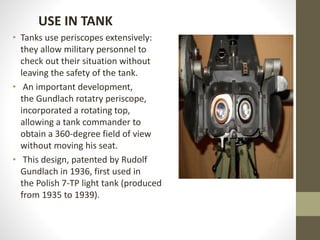
• An important development,
the Gundlach rotatry periscope,
incorporated a rotating top,
allowing a tank commander to
obtain a 360-degree field of view
without moving his seat.
• This design, patented by Rudolf
Gundlach in 1936, first used in
the Polish 7-TP light tank (produced
from 1935 to 1939).
USE IN MEDICINE
• One of the most widely used applications for periscopes is
in medicine. They're a less obtrusive method for looking
into the human body to detect illness and disease than
surgery is and are used in endoscopes.
USE IN LABOROTRAY
• The periscope is used to monitor the dangerous chemical
reactions in the laboratory , and they are used in
observing the nuclear reactors .
USE IN FUEL TANKS
• The periscopes are used to observe the dangerous places ,
they are used in the fuel tanks to see around and above
the vehicles .

Periscope ,its types & uses.

  • 2.
    PERISCOPE Group # 3: • OBAID ULLAH • ANEEQ AHMED • M.JUNAID TABASSUM PRESENATION APLLIED PHYSICS
  • 3.
  • 4.
    What is aperiscope • A periscope is an optical device for conducting observations from a concealed or protected position. Periscopes consist of reflecting mirrors or prisms at opposite ends of a tube container. The reflecting surfaces are parallel to each other and at a 45° angle to the axis of the tube.
  • 5.
    History • Johannes Gutenberg,marketed a kind of periscope in the 1430s to see over the heads of the crowd at the vigintennial religious festival at Aachen. • In 1854 Hippolyte Marié-Davy invented the first naval periscope, consisting of a vertical tube with two small mirrors fixed at each end at 45° • . Simon Lake used periscopes in his submarines in 1902.
  • 6.
    In world warI & II • Periscopes, in some cases fixed to rifles, served in World War I (1914-1918) to enable soldiers to see over the tops of trenches, thus avoiding exposure to enemy fire. • During World War II (1939-1945), officers used specifically- manufactured periscope binoculars with different mountings. Australian Light Horse troops using a periscope rifle, Gallipoli, 1915. Photograph by Ernest Brooks. A team of German artillery observers using periscope binoculars, 1943
  • 7.
    Introduction • A periscopeis an instrument used for observation over, around or through an object, obstacle or condition that prevents direct line-of-sight observation from an observer's current position. Types of Periscope • 1: Simple Periscope • 2: Complex Periscope
  • 8.
    Simple periscope • Inits simplest form, it consists of an outer case with mirrors at each end. • Set parallel to each other at a 45-degree angle. • This form of periscope, with the addition of two simple lenses, served for observation purposes in the trenches during World war I.
  • 9.
    Complex periscope • Incomplex periscopes, prisms are used instead of mirrors. • Advanced fiber optics instead of mirrors to provide magnification. • Operate on submarine and in various fields of science.
  • 10.
    Working Principle ofperiscope • A periscope works on the Laws of Reflection. The light from the object falls on one mirror (placed at 45° to the object) and is reflected. This reflected light in turn falls on another mirror and is again reflected until it reaches the human eye.
  • 11.
    Construction of aperiscope • Periscopes can be constructed using a pair of flat mirrors or prisms and a rectangular hollow tube having a viewing window at the top and bottom. The mirrors are fixed at an angle of 45o at the two ends of the rectangular hollow.
  • 12.
    Uses of periscope •Periscopes are found in a variety of applications but they are almost synonymous with their use in submarines. • In a similar 'threat detection' application, periscopes are often used on battlefields to look out of trenches safely without exposing the observer's body.
  • 13.
    USE IN SUBMARINE •The periscopes allow the submarine to search visually for the nearby targets and threats on the surface of the water and in the air when they are submerged at a shallow depth . • The periscope is used in the submarines to see the events which happening behind a wall or a barrier , and some submarines use complex periscopes which use the prisms instead of mirrors to provide them the magnification .
  • 14.
    USE IN TANK •Tanks use periscopes extensively: they allow military personnel to check out their situation without leaving the safety of the tank. • An important development, the Gundlach rotatry periscope, incorporated a rotating top, allowing a tank commander to obtain a 360-degree field of view without moving his seat. • This design, patented by Rudolf Gundlach in 1936, first used in the Polish 7-TP light tank (produced from 1935 to 1939).
  • 15.
    USE IN MEDICINE •One of the most widely used applications for periscopes is in medicine. They're a less obtrusive method for looking into the human body to detect illness and disease than surgery is and are used in endoscopes. USE IN LABOROTRAY • The periscope is used to monitor the dangerous chemical reactions in the laboratory , and they are used in observing the nuclear reactors .
  • 16.
    USE IN FUELTANKS • The periscopes are used to observe the dangerous places , they are used in the fuel tanks to see around and above the vehicles .