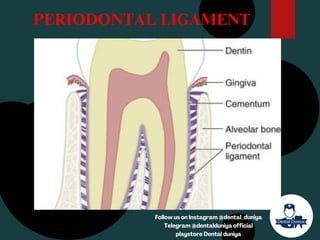
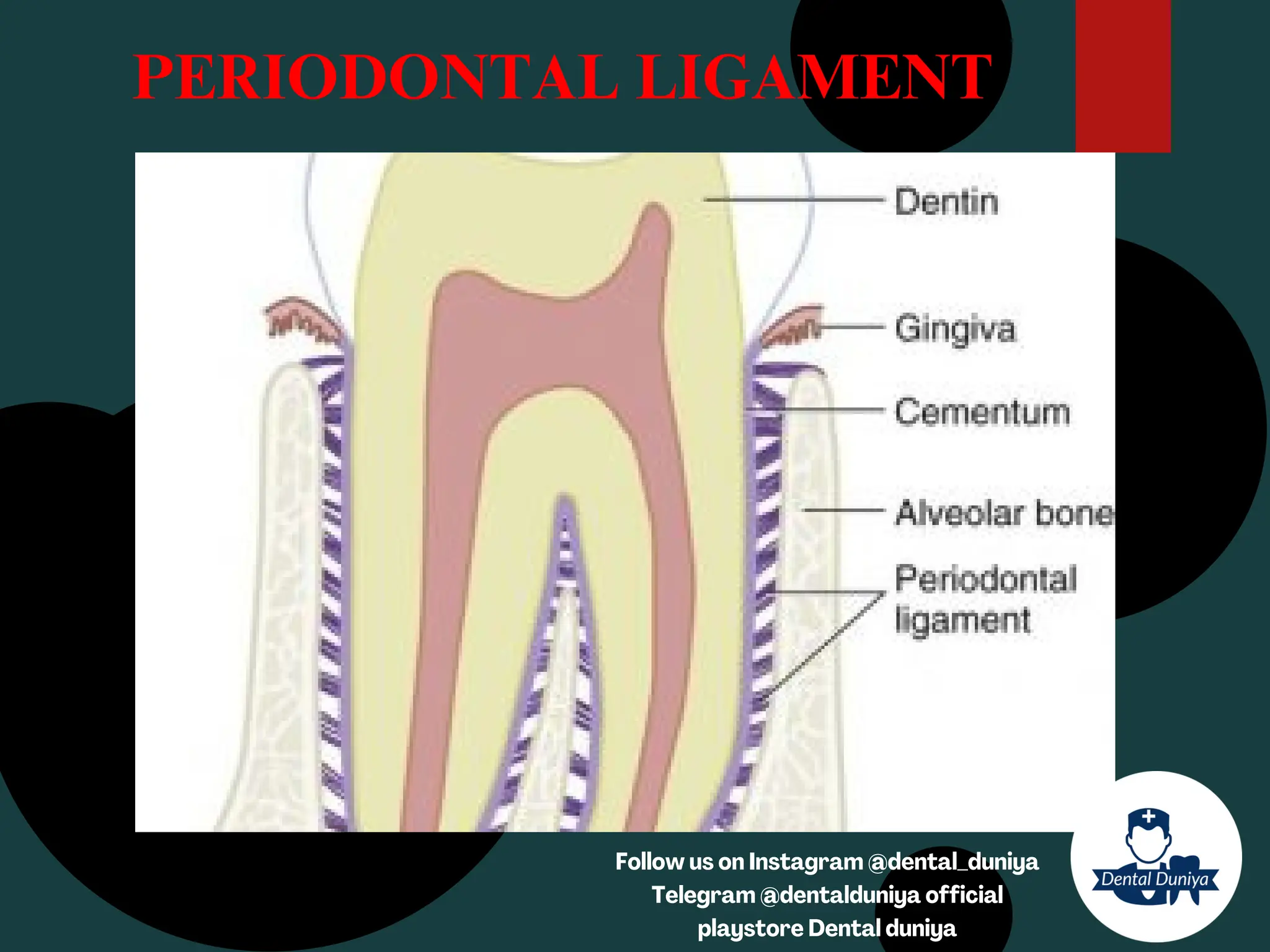
PERIODONTAL LIGAMENT
Follow us on Instagram @dental_duniya
Telegram @dentalduniya official
playstore Dental duniya
Contents
INTRODUCTION
DEFINITION
COMPONENTS
PERIODONTAL FIBRES
CELLULAR ELEMENTS
FUNCTIONS OF PERIODONTAL LIGAMENT
TRANSMISSION OF OCCLUSAL FORCES TO BONE
BLOOD SUPPLY AND LYMPHATICS
Follow us on Instagram @dental_duniya
Telegram @dentalduniya official
playstore Dental duniya
Introduction
Periodontium
It is a dynamic structure composed
of the tissues supporting and investing
the teeth.
Peri – around
Odontos - tooth
Four principal components
Gingiva.
1.
Periodontal ligament.
2.
Cementum.
3.
Alveolar bone.
4.
Follow us on Instagram @dental_duniya
Telegram @dentalduniya official
playstore Dental duniya
Periodontal ligament
It is composed of complex vascular and highly cellular connective
tissue that surrounds the tooth root and connects it to the inner wall
of the alveolar bone.
Shape : Hourglass.
Other names:
Periodontal membrane
Pericemental membrane
Alveolo-dental ligament
Desmodent
Gomphosis
Follow us on Instagram @dental_duniya
Telegram @dentalduniya official
playstore Dental duniya
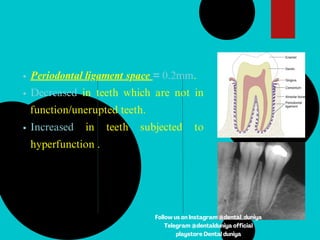
Periodontal ligament space = 0.2mm.
Decreased in teeth which are not in
function/unerupted teeth.
Increased in teeth subjected to
hyperfunction .
Follow us on Instagram @dental_duniya
Telegram @dentalduniya official
playstore Dental duniya
Components
Periodontal fibres
Cellular components
Ground substance
Follow us on Instagram @dental_duniya
Telegram @dentalduniya official
playstore Dental duniya
Periodontal fibers
Principal fibers collagenous.
1.
Non- collagenous fibres/elastic fibers.
2.
Indifferent fiber plexus.
3.
Follow us on Instagram @dental_duniya
Telegram @dentalduniya official
playstore Dental duniya
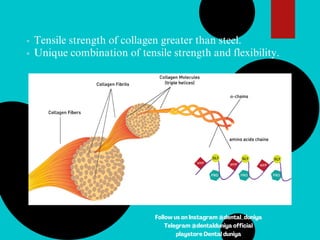
Collagen
Collagen molecule –
Tropocollagen -3 alpha chains.
Three helical alpha chains- coiled
around each other triple helix
rigid structure like rope.
Follow us on Instagram @dental_duniya
Telegram @dentalduniya official
playstore Dental duniya
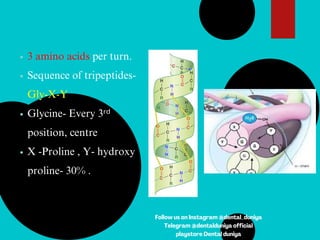
3 amino acids per turn.
Sequence of tripeptides-
Gly-X-Y
Glycine- Every 3ʳᵈ
position, centre
X -Proline , Y- hydroxy
proline- 30% .
Follow us on Instagram @dental_duniya
Telegram @dentalduniya official
playstore Dental duniya
Most abundant amino acids present in
collagen:
Glycine
Proline
Hydroxylysine and
Hydroxyproline
Follow us on Instagram @dental_duniya
Telegram @dentalduniya official
playstore Dental duniya
Tensile strength of collagen greater than steel.
Unique combination of tensile strength and flexibility.
Follow us on Instagram @dental_duniya
Telegram @dentalduniya official
playstore Dental duniya
Types of collagen in PDL
Type I - Most abundant- 80%. Compose principal fibers
Type III- Compose reticular fibers
Type IV- Found in basal lamina/ basement membrane.
Type XII- help in the alignment and organization of
periodontal fibers during the tooth development
Type VI- Immunolocalized in pdl & gingiva
Follow us on Instagram @dental_duniya
Telegram @dentalduniya official
playstore Dental duniya
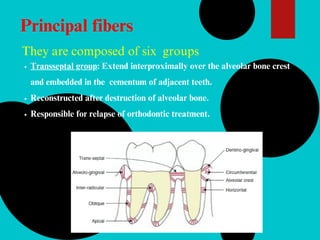
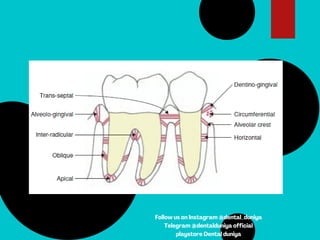
Principal fibers
They are composed of six groups
Transseptal group: Extend interproximally over the alveolar bone crest
and embedded in the cementum of adjacent teeth.
Reconstructed after destruction of alveolar bone.
Responsible for relapse of orthodontic treatment.
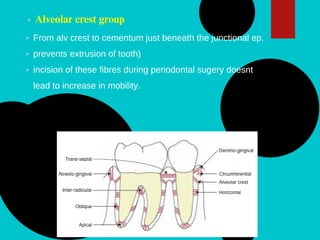
Alveolar crest group
From alv crest to cementum just beneath the junctional ep.
prevents extrusion of tooth)
incision of these fibres during periodontal sugery doesnt
lead to increase in mobility.
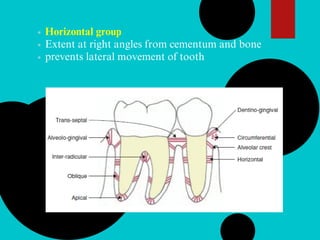
Horizontal group
Extent at right angles from cementum and bone
prevents lateral movement of tooth
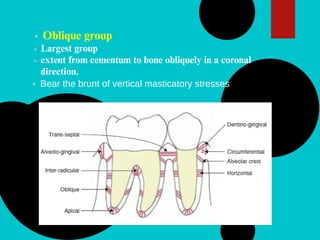
Oblique group
Largest group
extent from cementum to bone obliquely in a coronal
direction.
Bear the brunt of vertical masticatory stresses
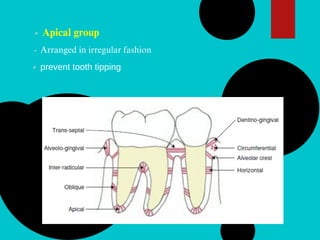
Apical group
Arranged in irregular fashion
prevent tooth tipping
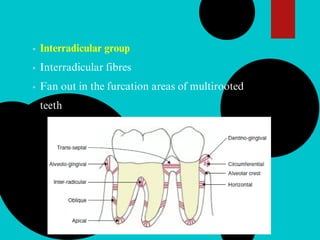
Interradicular group
Interradicular fibres
Fan out in the furcation areas of multirooted
teeth
Follow us on Instagram @dental_duniya
Telegram @dentalduniya official
playstore Dental duniya
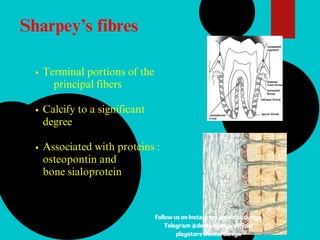
Sharpey’s fibres
Terminal portions of the
principal fibers
Calcify to a significant
degree
Associated with proteins :
osteopontin and
bone sialoprotein
Follow us on Instagram @dental_duniya
Telegram @dentalduniya official
playstore Dental duniya
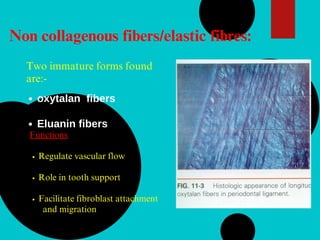
Non collagenous fibers/elastic fibres:
Two immature forms found
are:-
oxytalan fibers
Eluanin fibers
Functions
Regulate vascular flow
Role in tooth support
Facilitate fibroblast attachment
and migration
Indifferent fiber plexus
Small collagen fibers along with large principal
fibers
Randomly oriented forming plexus.
Follow us on Instagram @dental_duniya
Telegram @dentalduniya official
playstore Dental duniya
Cellular elements
Connective tissue cells
Epithelial cells
Immune system cells
Cells associated with neuro- vascular
elements
Follow us on Instagram @dental_duniya
Telegram @dentalduniya official
playstore Dental duniya
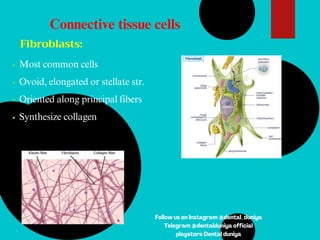
Fibroblasts:
Most common cells
Ovoid, elongated or stellate str.
Oriented along principal fibers
Synthesize collagen
Connective tissue cells
Follow us on Instagram @dental_duniya
Telegram @dentalduniya official
playstore Dental duniya
Possess capacity to phagocytose
old collagen & degrade them – enzyme hydrolysis
Regulates collagen turnover
Follow us on Instagram @dental_duniya
Telegram @dentalduniya official
playstore Dental duniya
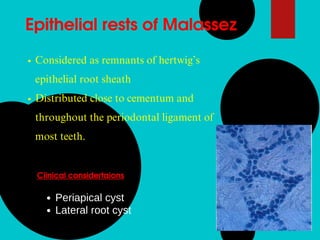
Epithelial rests of Malassez
Considered as remnants of hertwig’s
epithelial root sheath
Distributed close to cementum and
throughout the periodontal ligament of
most teeth.
Clinical considertaions
Periapical cyst
Lateral root cyst
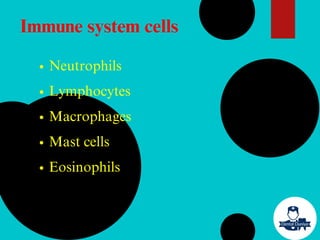
Neutrophils
Lymphocytes
Macrophages
Mast cells
Eosinophils
Immune system cells
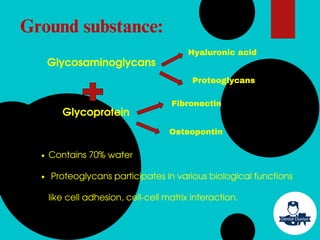
Ground substance:
Contains 70% water
Proteoglycans participates in various biological functions
like cell adhesion, cell-cell matrix interaction.
Glycosaminoglycans
Glycoprotein
Hyaluronic acid
Proteoglycans
Fibronectin
Osteopontin
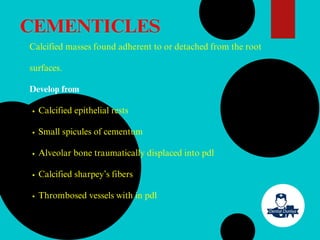
CEMENTICLES
Calcified masses found adherent to or detached from the root
surfaces.
Develop from
Calcified epithelial rests
Small spicules of cementum
Alveolar bone traumatically displaced into pdl
Calcified sharpey’s fibers
Thrombosed vessels with in pdl
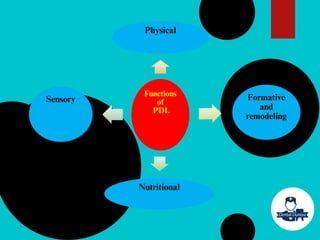
Functions
of
PDL
Physical
Formative
and
remodeling
Nutritional
Sensory
Physical Function
Protection- provide sof tissue casing for nerves
and vessels.
1.
Transmission of occlusal forces to the bone.
2.
Shock absorption: resistance to the impact of
occlusal forces.
3.
Attachment of the teeth to the bone.
4.
Maintenance of the gingival tissues in the
5.
Theories of shock absorption:
Tensional theory
Viscoelastic theory
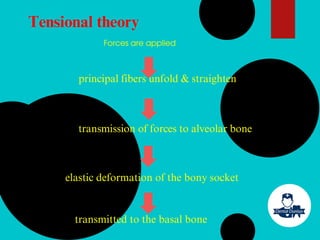
Tensional theory
Forces are applied
principal fibers unfold & straighten
transmission of forces to alveolar bone
elastic deformation of the bony socket
transmitted to the basal bone
Viscoelastic theory
Extracellular fluid passes from pdl to marrow spaces of
bone
depletion of tissue
fluid
Fibers slacken & tighten
Blood vessels
stenosis
Forces are
applied
Arterial back pressure causes ballooning of vessels
& passage of blood into tissues, replenishing tissue
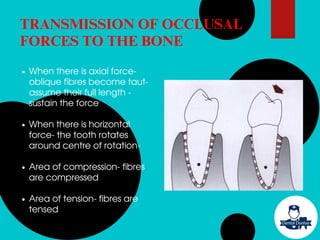
TRANSMISSION OF OCCLUSAL
FORCES TO THE BONE
When there is axial force-
oblique fibres become taut-
assume their full length -
sustain the force
When there is horizontal
force- the tooth rotates
around centre of rotation-
Area of compression- fibres
are compressed
Area of tension- fibres are
tensed
Helps in formation & resorption of
cementum and bone during physiologic tooth
movement.
Constantly undergoes remodeling.
Formative and Remodeling
Function
Supplies nutrients to cementum ,bone & gingiva
Abundantly supplied with sensory nerve fibers capable
of transmitting tactile ,pressure and pain sensation by
trigeminal pathway.
Nutritional and sensory function
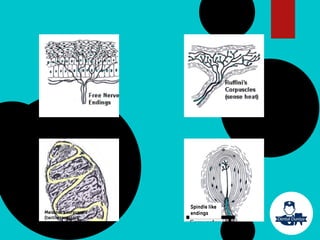
Free nerve endings-pain sensation
Ruffini like mechano receptors-apical region
Meissner’s corpuscles(mechano receptors)-mid
root region
Spindle like(pressure,vibration nerve endings)-
apical region
4 TYPES OF NEURAL
TERMINATIONS :
Spindle like
endings
Meissner’s corpuscels
(tactile receptors
BLOOD SUPPLY
Inferior and superior alveolar
arteries
Branches from
Apical vessels
1.
Penetrating vessels from the
alveolar bone
2.
Anastomosing vessels from the
gingiva.
3.
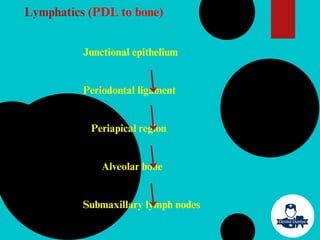
Junctional epithelium
Periodontal ligament
Periapical region
Alveolar bone
Submaxillary lymph nodes
Lymphatics (PDL to bone)
Follow @dental_duniya for new updates of
medical and dental jobs
,check stories for recent job opportunities,
check out our website for question papers ,e
books ,dentalassistance for dental students
share our instgram page with friends and
colleagues

periodontal ligament.pdf

  • 1.
    PERIODONTAL LIGAMENT Follow uson Instagram @dental_duniya Telegram @dentalduniya official playstore Dental duniya
  • 2.
    Contents INTRODUCTION DEFINITION COMPONENTS PERIODONTAL FIBRES CELLULAR ELEMENTS FUNCTIONSOF PERIODONTAL LIGAMENT TRANSMISSION OF OCCLUSAL FORCES TO BONE BLOOD SUPPLY AND LYMPHATICS Follow us on Instagram @dental_duniya Telegram @dentalduniya official playstore Dental duniya
  • 3.
    Introduction Periodontium It is adynamic structure composed of the tissues supporting and investing the teeth. Peri – around Odontos - tooth Four principal components Gingiva. 1. Periodontal ligament. 2. Cementum. 3. Alveolar bone. 4. Follow us on Instagram @dental_duniya Telegram @dentalduniya official playstore Dental duniya
  • 4.
    Periodontal ligament It iscomposed of complex vascular and highly cellular connective tissue that surrounds the tooth root and connects it to the inner wall of the alveolar bone. Shape : Hourglass. Other names: Periodontal membrane Pericemental membrane Alveolo-dental ligament Desmodent Gomphosis Follow us on Instagram @dental_duniya Telegram @dentalduniya official playstore Dental duniya
  • 5.
    Periodontal ligament space= 0.2mm. Decreased in teeth which are not in function/unerupted teeth. Increased in teeth subjected to hyperfunction . Follow us on Instagram @dental_duniya Telegram @dentalduniya official playstore Dental duniya
  • 6.
    Components Periodontal fibres Cellular components Groundsubstance Follow us on Instagram @dental_duniya Telegram @dentalduniya official playstore Dental duniya
  • 7.
    Periodontal fibers Principal fiberscollagenous. 1. Non- collagenous fibres/elastic fibers. 2. Indifferent fiber plexus. 3. Follow us on Instagram @dental_duniya Telegram @dentalduniya official playstore Dental duniya
  • 8.
    Collagen Collagen molecule – Tropocollagen-3 alpha chains. Three helical alpha chains- coiled around each other triple helix rigid structure like rope. Follow us on Instagram @dental_duniya Telegram @dentalduniya official playstore Dental duniya
  • 9.
    3 amino acidsper turn. Sequence of tripeptides- Gly-X-Y Glycine- Every 3ʳᵈ position, centre X -Proline , Y- hydroxy proline- 30% . Follow us on Instagram @dental_duniya Telegram @dentalduniya official playstore Dental duniya
  • 10.
    Most abundant aminoacids present in collagen: Glycine Proline Hydroxylysine and Hydroxyproline Follow us on Instagram @dental_duniya Telegram @dentalduniya official playstore Dental duniya
  • 11.
    Tensile strength ofcollagen greater than steel. Unique combination of tensile strength and flexibility. Follow us on Instagram @dental_duniya Telegram @dentalduniya official playstore Dental duniya
  • 12.
    Types of collagenin PDL Type I - Most abundant- 80%. Compose principal fibers Type III- Compose reticular fibers Type IV- Found in basal lamina/ basement membrane. Type XII- help in the alignment and organization of periodontal fibers during the tooth development Type VI- Immunolocalized in pdl & gingiva Follow us on Instagram @dental_duniya Telegram @dentalduniya official playstore Dental duniya
  • 13.
    Principal fibers They arecomposed of six groups Transseptal group: Extend interproximally over the alveolar bone crest and embedded in the cementum of adjacent teeth. Reconstructed after destruction of alveolar bone. Responsible for relapse of orthodontic treatment.
  • 14.
    Alveolar crest group Fromalv crest to cementum just beneath the junctional ep. prevents extrusion of tooth) incision of these fibres during periodontal sugery doesnt lead to increase in mobility.
  • 15.
    Horizontal group Extent atright angles from cementum and bone prevents lateral movement of tooth
  • 16.
    Oblique group Largest group extentfrom cementum to bone obliquely in a coronal direction. Bear the brunt of vertical masticatory stresses
  • 17.
    Apical group Arranged inirregular fashion prevent tooth tipping
  • 18.
    Interradicular group Interradicular fibres Fanout in the furcation areas of multirooted teeth
  • 19.
    Follow us onInstagram @dental_duniya Telegram @dentalduniya official playstore Dental duniya
  • 20.
    Sharpey’s fibres Terminal portionsof the principal fibers Calcify to a significant degree Associated with proteins : osteopontin and bone sialoprotein Follow us on Instagram @dental_duniya Telegram @dentalduniya official playstore Dental duniya
  • 21.
    Non collagenous fibers/elasticfibres: Two immature forms found are:- oxytalan fibers Eluanin fibers Functions Regulate vascular flow Role in tooth support Facilitate fibroblast attachment and migration
  • 22.
    Indifferent fiber plexus Smallcollagen fibers along with large principal fibers Randomly oriented forming plexus. Follow us on Instagram @dental_duniya Telegram @dentalduniya official playstore Dental duniya
  • 23.
    Cellular elements Connective tissuecells Epithelial cells Immune system cells Cells associated with neuro- vascular elements Follow us on Instagram @dental_duniya Telegram @dentalduniya official playstore Dental duniya
  • 24.
    Fibroblasts: Most common cells Ovoid,elongated or stellate str. Oriented along principal fibers Synthesize collagen Connective tissue cells Follow us on Instagram @dental_duniya Telegram @dentalduniya official playstore Dental duniya
  • 25.
    Possess capacity tophagocytose old collagen & degrade them – enzyme hydrolysis Regulates collagen turnover Follow us on Instagram @dental_duniya Telegram @dentalduniya official playstore Dental duniya
  • 26.
    Epithelial rests ofMalassez Considered as remnants of hertwig’s epithelial root sheath Distributed close to cementum and throughout the periodontal ligament of most teeth. Clinical considertaions Periapical cyst Lateral root cyst
  • 27.
  • 28.
    Ground substance: Contains 70%water Proteoglycans participates in various biological functions like cell adhesion, cell-cell matrix interaction. Glycosaminoglycans Glycoprotein Hyaluronic acid Proteoglycans Fibronectin Osteopontin
  • 29.
    CEMENTICLES Calcified masses foundadherent to or detached from the root surfaces. Develop from Calcified epithelial rests Small spicules of cementum Alveolar bone traumatically displaced into pdl Calcified sharpey’s fibers Thrombosed vessels with in pdl
  • 30.
  • 31.
    Physical Function Protection- providesof tissue casing for nerves and vessels. 1. Transmission of occlusal forces to the bone. 2. Shock absorption: resistance to the impact of occlusal forces. 3. Attachment of the teeth to the bone. 4. Maintenance of the gingival tissues in the 5.
  • 32.
    Theories of shockabsorption: Tensional theory Viscoelastic theory
  • 33.
    Tensional theory Forces areapplied principal fibers unfold & straighten transmission of forces to alveolar bone elastic deformation of the bony socket transmitted to the basal bone
  • 34.
    Viscoelastic theory Extracellular fluidpasses from pdl to marrow spaces of bone depletion of tissue fluid Fibers slacken & tighten Blood vessels stenosis Forces are applied Arterial back pressure causes ballooning of vessels & passage of blood into tissues, replenishing tissue
  • 35.
    TRANSMISSION OF OCCLUSAL FORCESTO THE BONE When there is axial force- oblique fibres become taut- assume their full length - sustain the force When there is horizontal force- the tooth rotates around centre of rotation- Area of compression- fibres are compressed Area of tension- fibres are tensed
  • 36.
    Helps in formation& resorption of cementum and bone during physiologic tooth movement. Constantly undergoes remodeling. Formative and Remodeling Function
  • 37.
    Supplies nutrients tocementum ,bone & gingiva Abundantly supplied with sensory nerve fibers capable of transmitting tactile ,pressure and pain sensation by trigeminal pathway. Nutritional and sensory function
  • 38.
    Free nerve endings-painsensation Ruffini like mechano receptors-apical region Meissner’s corpuscles(mechano receptors)-mid root region Spindle like(pressure,vibration nerve endings)- apical region 4 TYPES OF NEURAL TERMINATIONS :
  • 39.
  • 40.
    BLOOD SUPPLY Inferior andsuperior alveolar arteries Branches from Apical vessels 1. Penetrating vessels from the alveolar bone 2. Anastomosing vessels from the gingiva. 3.
  • 41.
    Junctional epithelium Periodontal ligament Periapicalregion Alveolar bone Submaxillary lymph nodes Lymphatics (PDL to bone)
  • 42.
    Follow @dental_duniya fornew updates of medical and dental jobs ,check stories for recent job opportunities, check out our website for question papers ,e books ,dentalassistance for dental students share our instgram page with friends and colleagues