Dr. Chandler Marrs
Hormones and
Mood
Women’s Mental Health
• Women have a 2-fold greater lifetime risk for MDD than
men
• Anxiety disorders
• Somatic disorders
• Associated with female-specific reproductive events
• Puberty
• Pregnancy/postpartum
• Menopause
2
Why & How
• What exactly is depression?
• Can’t measure it, if you can’t define it-specifically
• Are women more/less likely to experience certain clusters of symptoms?
• If associated with reproductive events which hormones are
involved with which symptoms?
• Need to know how specific hormones interact with specific
neurotransmitters in the CNS
• How those neurotransmitters affect psychological behavior
• Not good enough to say women are more susceptible to depression
because of hormone changes
3
What is MDD?
•Five or more for >2 weeks
• Depressed mood
• Diminished interest or pleasure in life (anhedonia)
• Weight change (+/-)
• Sleeping change (+/-)
• Psychomotor retardation or agitation
• Excessive feelings of worthlessness or guilt
• Poor concentration
• Recurrent thoughts of death
4
MDD, three syndromes in one
• Melancholic depression
• Sadness, loss of pleasure, hypersomnia, psychomotor retardation, lack
of motivation, cognitive disturbances
• Anxious depression
• Psychomotor agitation, insomnia, phobic anxiety and/or OCD symptoms
(obsessive fretting), plus anhedonia
• Somatic depression
• Physiological disturbances such as GI issues, chronic, unexplained illness,
chronic pain, plus anhedonia
5
Reproduction and Mental Health
• Puberty
• Onset of menstruation
• Increased incidence of MDD, OCD, bipolar
• Cyclical disorders PMS, PMDD, cyclic psychosis
• Pregnancy/Postpartum
• Increased incidence of MDD, OCD and other anxiety disorders, bipolar,
psychotic disorders
• Identified as postpartum depression and psychosis
• Menopause
• Increased incidence of MDD, decreased incidence and severity of
psychotic and bipolar disorders
6
Reproductive Cycle Hormone
Changes
• Puberty
• Increase in DHEA/S
• Increase & cyclical variation in PROG, estrogens (E1, E2, E3)
• Changes in androgen concentrations
• Pregnancy
• HUGE increase in PROG, E1, E2, E3
• Increase in DHEA/DHEAS, testosterone & other androgens
• Postpartum
• HUGE decrease in PROG, E1, E2, E3
• HUGE increase in DHEAS
• Menopause
• Large and continued decrease in DHEA/S
• Decline of testosterone, estrogens and progesterone
7
DHEAS across the Lifespan
8
When we speak of
DHEAS linked to mood
in the elderly, it is a
completely different
proposition then
DHEAS in puberty,
pregnancy or
postpartum
Reproductive Hormone Patterns:
Culprits for Mood Changes
• DHEA/S
• Precursor for androgens & estrogens synthesized in the adrenals
• Non-pregnant: ~50% androgens, estrogens produced in adrenals
• Pregnant: precursor for estriol, major pregnancy hormone
• Postpartum: suspected of decreasing, but no real data
• Until my study
• Menopausal: 75-90% of androgens, estrogens produced by adrenals
• Progesterone & Estrogens
• Cyclic variations
• HUGE Increase pregnancy, decrease immediately following delivery
• Decrease across lifespan
9
Hormones & the Brain
• The brain is major target for & source of steroid hormones
• Intranuclear receptors located in the
• Hippocampus, amygdala, cerebellum, basal forebrain, locus
ceruleus, raphe nucleus, hypothalamus, pituitary, glial cells
• Membrane receptors located all over
• Co-localized on
• GABA (inhibition)
• DA (reward and motivation)
• 5HT (alertness and mood)
• NE (vigilance, attention and mood)
• Glutamate (excitation)
• Opioids (pain and pleasure)
• And thus, are suspected of regulating mood & behavior in
some fairly significant ways 10
GABA
• Progesterone & metabolites are potent
GABAA agonist
• GABA is the primary inhibitory
neurotransmitter
• Drugs that increase GABA include
• Benzodiazepines, barbiturates, alcohol
• GABA agonists used acutely are
• Sedative/hypnotic/anesthetic
• Too much-respiratory depression & death
• Chronic use
• Anxiogenic b/c of changes to the GABAA
receptor
• Withdrawal symptoms include CNS
instability, irritability, anxiety 11
The Estrogens
• Estradiol (E2): excitatory
• Mediates hippocampal dendritic growth
& retraction across menstrual cycle
• Elicits DA hypersensitivity (chronic
high E2)
• Less endogenous DA needed to get
reward, reinforcement
• Increases NE, 5HT, endorphin
concentrations
• Elevates mood & decreases pain
• Enhances NMDA activation
• Presumed mechanism of learn
• Reduces cell death caused by stroke
• Estrone & estriol
• No research 12
McEwen et al.
E2 mediated dendritic growth,
rodent estrous cycle
Androgens
•DHEA/DHEAS: excitatory
• GABAA antagonist
• DHEA acute & higher doses
• DHEAS chronic, lower doses
• Enhance NMDA, prolongs LTP
• Increase NE, DA
•Testosterone: inhibitory
• Blocks Ca2+ channels
• Increase K+ channel opening
13
How/When to study
hormones & mood…
• Pregnancy and Postpartum
• Huge changes in maternal hormones
• Huge increase in mood disorders
• 80% experience postpartum mood lability
• 15% develop “postpartum depression”
• 8-50% develop “postpartum anxiety disorder”
• 3-5% OCD during pregnancy
• .1-.2% postpartum psychosis
• 20X greater risk of psychosis & suicide
• 4% risk of infanticide
• Across a relatively short period of time
• Temporally related to onset of psychiatric disturbances
• 60-70% of cases develop within 3 weeks postpartum
14
Pregnancy
Hormone
changes
15
Harris et al., 1994
Pregnancy-Postpartum Changes in
Progesterone, Estradiol & Cortisol
Postpartum Mental Illness
•Definition, Diagnosis & Onset
• DSM-IV
• Time course specifier, mood disorders
• <30 days of childbirth
• Popular nomenclature
• Baby blues
• <2 weeks postpartum
• Postpartum depression
• <1 year postpartum
• Postpartum Psychosis
• Accepted as rapid
16
Etiology
• Psychosocial Factors
• Life stressors
• Previous History
• Ovarian Hormone Theory
• Change from pre- to postpartum
results in PPD
• Lots of studies-inconsistent results
• Methodological problems
• Increased vulnerability hypothesis
• “abnormal response to otherwise
normal hormone levels.” Bloch et
al., 2003
17
Harris et al., 1994
Pregnancy-Postpartum Changes in
Progesterone, Estradiol & Cortisol
Design
• Hypotheses
• Anxiety type symptoms
• Pre-morbid psychiatric symptoms (late pregnancy) – early warning
• Hormone mediated
• Assessed 9 psychiatric symptoms
• Anxiety, hostility, phobia, paranoia, psychoticism, somatization, obsessive-compulsive
behavior, interpersonal sensitivity, depression & a global severity index of distress
• Measured salivary progesterone, DHEAS, testosterone, estrone,
estradiol & estriol
• Test times
• T1: 37 weeks of pregnancy (n=32)
• T2: <10 days postpartum (n=28)
• T3: 4 months postpartum (n=9)
• T4: 8 months postpartum (n=9)
• T5: 12 months post (n=9)
• Healthy, primigravids
• Mean age: 29 yrs; education: 15.7 yrs; eFSIQ: 112; eVIQ: 114
18
Pregnancy to
Postpartum
T1-T2 Results
First Major Finding:
Individual Variance in Hormone Change
• PROG & Estriol decreased in all participants by 93% & 98%
respectively
• Confirms current literature
• DHEAS increased 34% postpartum (21 of 27) participants
• Challenges current literature
• Testosterone decreased 49% (increased in 5)
• Challenges current literature
• Estradiol decreased 65% (increased in 3)
• Might challenge-could be artifactual
• Estrone decreased 91% (increased in 1)
• Might challenge-could be artifactual
20
Second Major Finding:
Increased Prevalence & Severity
• Published rates
• 10-15% PPD
• 1-2 p/1000 psychosis
• This study found
• 50% >4 psychiatric
symptoms
• ~18% displayed mild-
moderate psychotic
symptoms absent
paranoia
• Thought insertion &
broadcasting
• Auditory hallucinations
21
>60 (1 SD above normative mean & 84th percentile)
Third Major Finding:
Diversity of Symptoms
•Perinatal psychiatric disturbances
• Depression is part of syndrome, but not the only
factor
• Anxiety, phobia, psychoticism, OCD &
somatization showed highest T-scores
• Somatization scores-autonomic dysregulation
•Symptoms in late pregnancy
•Spike w/in 10 days of delivery
22
Fourth Major Finding:
Symptoms may be Hormonally Mediated
•Progesterone NOT correlated with
psychiatric symptoms
• But may still mediate severity
•E2 only sporadically associated w/
symptoms
•Unique pattern of adrenal androgens
associated w/ all psychiatric symptoms
• Low late pregnancy testosterone
• High puerperal DHEAS
• Correlated with all negative symptoms 23
24
Pregnancy Testosterone pg/mL
PostpartumSCL-90-RT-scores
SCL-90-R score >60 = 84th percentile,
symptomatic
Lower Pregnancy Testosterone,
More Pregnancy/Postpartum
Symptoms
Postpartum DHEAS pg/mL
PostpartumSCL-90-RT-scores
Higher Postpartum DHEAS,
More Postpartum Symptoms
Testosterone
A Possible Early Biomarker
25
14/14 women with low late pregnancy testosterone (<60 pg/mL)
developed postpartum psychiatric disturbances (p=.002).
Lower late pregnancy testosterone significantly correlated with
postpartum
ANX, HOS, PSY, SOM, OC, IS, DEP, GSI & DHEAS concentrations
Asymptomatic Symptomatic
PregnancyTestosterone
DHEAS
• Postpartum DHEAS
associated with
• ANX, PHOB, PAR, PSY, SOM, GSI
• 4/4 women with postpartum
DHEAS > 2500 pg/mL
psychiatric distress
(p=.028).
• 4/4 women with both low
late pregnancy testosterone
and high DHEAS psychiatric
distress (p=.012).
• DHEAS is a GABAA antagonist
similar to picrotoxin
26
10.008.006.004.002.000.00
Total Number of Postpartum SCL Symptoms > 60
5000.00
4000.00
3000.00
2000.00
1000.00
0.00
PostpartumDHEAS(pg/mL)
Why Testosterone & DHEAS might
be Important
• With high DHEAS should have high testosterone
• Along with high DHEA, but we didn’t measure DHEA
• Testosterone is inhibitory at the cell level
• Blocks Ca2+ channels
• Neurally linked to AVP stress related inhibition of cortisol
• Low testosterone = CNS excitability & increased cortisol
• Low testosterone + high DHEAS may compound CNS excitability
• May mark some sort of steroidogenic dysfunction
• Need to measure other hormones along the pathway
27
Postpartum: The Perfect Storm
• Radical change in internal chemistry with potentially
• Excessive reductions in GABA activity mediated by
• Simultaneous withdrawal of PROG & increase in DHEAS
• CNS hyper-excitability, instability
• Compounded by psychosocial changes associated with the
birth
• Relationship changes
• Sleep deprivation
• Career changes
28
Longitudinal Trends
across the Postpartum
Year
Phase Two: T3, T4, T5
Hypothesis
• As hormone values “normalize” symptoms of
distress will abate
• Chronic supra-physiological DHEAS concentrations will
negatively impact mental health & other hormones
30
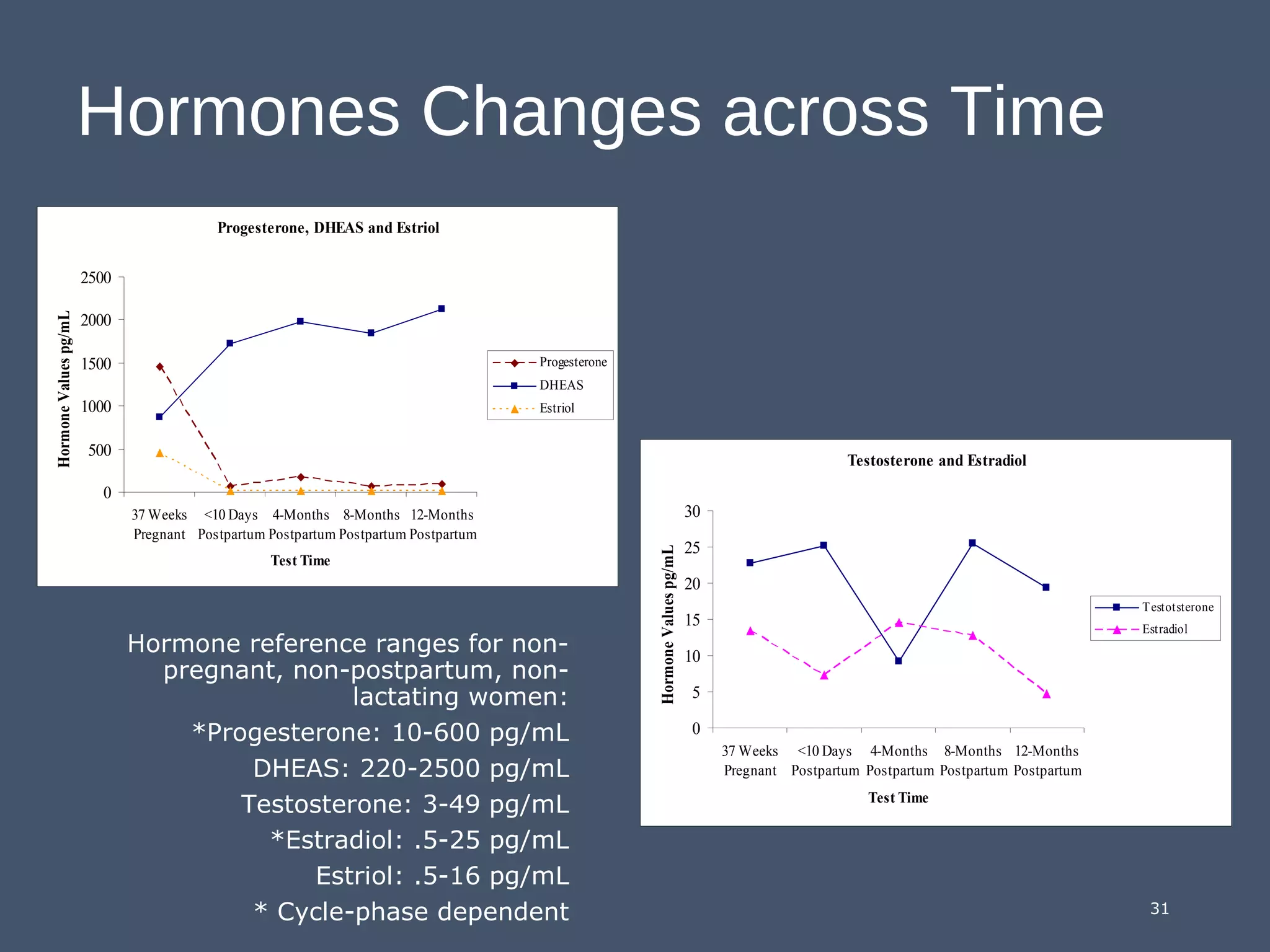
Hormones Changes across Time
Hormone reference ranges for non-
pregnant, non-postpartum, non-
lactating women:
*Progesterone: 10-600 pg/mL
DHEAS: 220-2500 pg/mL
Testosterone: 3-49 pg/mL
*Estradiol: .5-25 pg/mL
Estriol: .5-16 pg/mL
* Cycle-phase dependent 31
Progesterone, DHEAS and Estriol
0
500
1000
1500
2000
2500
37 Weeks
Pregnant
<10 Days
Postpartum
4-Months
Postpartum
8-Months
Postpartum
12-Months
Postpartum
Test Time
HormoneValuespg/mL
Progesterone
DHEAS
Estriol
Testosterone and Estradiol
0
5
10
15
20
25
30
37 Weeks
Pregnant
<10 Days
Postpartum
4-Months
Postpartum
8-Months
Postpartum
12-Months
Postpartum
Test Time
HormoneValuespg/mL
Testotsterone
Estradiol
Symptoms across Time
32
Anxiety and Depressive Symptoms
0
20
40
60
80
100
37 Weeks
Pregnant
<10 Days
Postpartum
4-Months
Postpartum
8-Months
Postpartum
12-Months
Postpartum
Test Time
PercentageofSymptomatic
Women
ANX
PHOB
OC
DEP
Psychotic Symptoms
0
20
40
60
80
100
37 Weeks
Pregnant
<10 Days
Postpartum
4-Months
Postpartum
8-Months
Postpartum
12-Months
Postpartum
Test Time
PercentageofSymptomatic
Women PSY
PAR
Symptomatic: SCL-90-R T-score >60 or 84th
percentile.
Severity of Symptoms
0
20
40
60
80
100
37 Weeks
Pregnant
<10 Days
Postpartum
4-Months
Postpartum
8-Months
Postpartum
12-Months
Postpartum
Test Time
PercentageofSymptomatic
Women
GSI
33
Symptomatic: SCL-90-R T-score >60 or 84th
percentile.
Hormone-Symptom
Associations
•Elevated DHEAS significantly associated with
• Symptoms @ T2, T3 & T4
• Other hormones
• Progesterone
• Testosterone
• Estriol
• Other hormones associated with symptoms
• Progesterone
• Testosterone
• Estriol
34
Longitudinal Trends
• DHEAS
• Continues to increase across postpartum year
• Associated with multiple symptoms & hormones (progesterone,
testosterone & estriol)
• Testosterone
• Positively associated with symptoms
• NOT correlated with estradiol
• Puerperal psychiatric symptoms
• Not limited to depression
• Spike following parturition
• Abate by 4 months (in all but most serious cases)
• Linked to elevated DHEAS & perhaps other hormones
• Chronically elevated DHEAS associated with irregularities in other hormone
values
35
Future Research
• Replicate w/ larger sample
• More prenatal & postpartum test times
• Include entire aromatase pathway
• Measure enzymes in symptomatic women
• Genetic testing in symptomatic women/sisters/mothers
• Develop
• Pregnancy & postpartum reference ranges for salivary hormones
• Biomarker test (salivary assessment kit for late-pregnancy low testosterone)
• Perinatal psychological assessment tool (underway)
• Treatment options
• Education programs
• Counseling programs
• Pharmacological options
36
Future Research
Hormones & Mood
• Define the symptoms
• MDD probably a cluster of disorders
• Some symptoms more common at different reproductive points
• Understand breadth & scope of presumed hormone changes
• HUGE inter-individual differences in hormones (can’t do between subjects research)
• HUGE lack of research on potential the cyclical & reproductive related changes of most
steroid hormones
• Most focused on PROG & E2
• Know next to nothing about cyclic changes in other estrogens, androgens, gluccocorticoids and
mineralocorticoid
• Understand the presumed neural mechanisms action
• Not sufficient to investigate the most obvious hormones if the presumed neuroactive
mechanisms are not capable of eliciting the observed symptoms
37

Perinatal hormones, mood, and cognition - 2007

  • 1.
  • 2.
    Women’s Mental Health •Women have a 2-fold greater lifetime risk for MDD than men • Anxiety disorders • Somatic disorders • Associated with female-specific reproductive events • Puberty • Pregnancy/postpartum • Menopause 2
  • 3.
    Why & How •What exactly is depression? • Can’t measure it, if you can’t define it-specifically • Are women more/less likely to experience certain clusters of symptoms? • If associated with reproductive events which hormones are involved with which symptoms? • Need to know how specific hormones interact with specific neurotransmitters in the CNS • How those neurotransmitters affect psychological behavior • Not good enough to say women are more susceptible to depression because of hormone changes 3
  • 4.
    What is MDD? •Fiveor more for >2 weeks • Depressed mood • Diminished interest or pleasure in life (anhedonia) • Weight change (+/-) • Sleeping change (+/-) • Psychomotor retardation or agitation • Excessive feelings of worthlessness or guilt • Poor concentration • Recurrent thoughts of death 4
  • 5.
    MDD, three syndromesin one • Melancholic depression • Sadness, loss of pleasure, hypersomnia, psychomotor retardation, lack of motivation, cognitive disturbances • Anxious depression • Psychomotor agitation, insomnia, phobic anxiety and/or OCD symptoms (obsessive fretting), plus anhedonia • Somatic depression • Physiological disturbances such as GI issues, chronic, unexplained illness, chronic pain, plus anhedonia 5
  • 6.
    Reproduction and MentalHealth • Puberty • Onset of menstruation • Increased incidence of MDD, OCD, bipolar • Cyclical disorders PMS, PMDD, cyclic psychosis • Pregnancy/Postpartum • Increased incidence of MDD, OCD and other anxiety disorders, bipolar, psychotic disorders • Identified as postpartum depression and psychosis • Menopause • Increased incidence of MDD, decreased incidence and severity of psychotic and bipolar disorders 6
  • 7.
    Reproductive Cycle Hormone Changes •Puberty • Increase in DHEA/S • Increase & cyclical variation in PROG, estrogens (E1, E2, E3) • Changes in androgen concentrations • Pregnancy • HUGE increase in PROG, E1, E2, E3 • Increase in DHEA/DHEAS, testosterone & other androgens • Postpartum • HUGE decrease in PROG, E1, E2, E3 • HUGE increase in DHEAS • Menopause • Large and continued decrease in DHEA/S • Decline of testosterone, estrogens and progesterone 7
  • 8.
    DHEAS across theLifespan 8 When we speak of DHEAS linked to mood in the elderly, it is a completely different proposition then DHEAS in puberty, pregnancy or postpartum
  • 9.
    Reproductive Hormone Patterns: Culpritsfor Mood Changes • DHEA/S • Precursor for androgens & estrogens synthesized in the adrenals • Non-pregnant: ~50% androgens, estrogens produced in adrenals • Pregnant: precursor for estriol, major pregnancy hormone • Postpartum: suspected of decreasing, but no real data • Until my study • Menopausal: 75-90% of androgens, estrogens produced by adrenals • Progesterone & Estrogens • Cyclic variations • HUGE Increase pregnancy, decrease immediately following delivery • Decrease across lifespan 9
  • 10.
    Hormones & theBrain • The brain is major target for & source of steroid hormones • Intranuclear receptors located in the • Hippocampus, amygdala, cerebellum, basal forebrain, locus ceruleus, raphe nucleus, hypothalamus, pituitary, glial cells • Membrane receptors located all over • Co-localized on • GABA (inhibition) • DA (reward and motivation) • 5HT (alertness and mood) • NE (vigilance, attention and mood) • Glutamate (excitation) • Opioids (pain and pleasure) • And thus, are suspected of regulating mood & behavior in some fairly significant ways 10
  • 11.
    GABA • Progesterone &metabolites are potent GABAA agonist • GABA is the primary inhibitory neurotransmitter • Drugs that increase GABA include • Benzodiazepines, barbiturates, alcohol • GABA agonists used acutely are • Sedative/hypnotic/anesthetic • Too much-respiratory depression & death • Chronic use • Anxiogenic b/c of changes to the GABAA receptor • Withdrawal symptoms include CNS instability, irritability, anxiety 11
  • 12.
    The Estrogens • Estradiol(E2): excitatory • Mediates hippocampal dendritic growth & retraction across menstrual cycle • Elicits DA hypersensitivity (chronic high E2) • Less endogenous DA needed to get reward, reinforcement • Increases NE, 5HT, endorphin concentrations • Elevates mood & decreases pain • Enhances NMDA activation • Presumed mechanism of learn • Reduces cell death caused by stroke • Estrone & estriol • No research 12 McEwen et al. E2 mediated dendritic growth, rodent estrous cycle
  • 13.
    Androgens •DHEA/DHEAS: excitatory • GABAAantagonist • DHEA acute & higher doses • DHEAS chronic, lower doses • Enhance NMDA, prolongs LTP • Increase NE, DA •Testosterone: inhibitory • Blocks Ca2+ channels • Increase K+ channel opening 13
  • 14.
    How/When to study hormones& mood… • Pregnancy and Postpartum • Huge changes in maternal hormones • Huge increase in mood disorders • 80% experience postpartum mood lability • 15% develop “postpartum depression” • 8-50% develop “postpartum anxiety disorder” • 3-5% OCD during pregnancy • .1-.2% postpartum psychosis • 20X greater risk of psychosis & suicide • 4% risk of infanticide • Across a relatively short period of time • Temporally related to onset of psychiatric disturbances • 60-70% of cases develop within 3 weeks postpartum 14
  • 15.
    Pregnancy Hormone changes 15 Harris et al.,1994 Pregnancy-Postpartum Changes in Progesterone, Estradiol & Cortisol
  • 16.
    Postpartum Mental Illness •Definition,Diagnosis & Onset • DSM-IV • Time course specifier, mood disorders • <30 days of childbirth • Popular nomenclature • Baby blues • <2 weeks postpartum • Postpartum depression • <1 year postpartum • Postpartum Psychosis • Accepted as rapid 16
  • 17.
    Etiology • Psychosocial Factors •Life stressors • Previous History • Ovarian Hormone Theory • Change from pre- to postpartum results in PPD • Lots of studies-inconsistent results • Methodological problems • Increased vulnerability hypothesis • “abnormal response to otherwise normal hormone levels.” Bloch et al., 2003 17 Harris et al., 1994 Pregnancy-Postpartum Changes in Progesterone, Estradiol & Cortisol
  • 18.
    Design • Hypotheses • Anxietytype symptoms • Pre-morbid psychiatric symptoms (late pregnancy) – early warning • Hormone mediated • Assessed 9 psychiatric symptoms • Anxiety, hostility, phobia, paranoia, psychoticism, somatization, obsessive-compulsive behavior, interpersonal sensitivity, depression & a global severity index of distress • Measured salivary progesterone, DHEAS, testosterone, estrone, estradiol & estriol • Test times • T1: 37 weeks of pregnancy (n=32) • T2: <10 days postpartum (n=28) • T3: 4 months postpartum (n=9) • T4: 8 months postpartum (n=9) • T5: 12 months post (n=9) • Healthy, primigravids • Mean age: 29 yrs; education: 15.7 yrs; eFSIQ: 112; eVIQ: 114 18
  • 19.
  • 20.
    First Major Finding: IndividualVariance in Hormone Change • PROG & Estriol decreased in all participants by 93% & 98% respectively • Confirms current literature • DHEAS increased 34% postpartum (21 of 27) participants • Challenges current literature • Testosterone decreased 49% (increased in 5) • Challenges current literature • Estradiol decreased 65% (increased in 3) • Might challenge-could be artifactual • Estrone decreased 91% (increased in 1) • Might challenge-could be artifactual 20
  • 21.
    Second Major Finding: IncreasedPrevalence & Severity • Published rates • 10-15% PPD • 1-2 p/1000 psychosis • This study found • 50% >4 psychiatric symptoms • ~18% displayed mild- moderate psychotic symptoms absent paranoia • Thought insertion & broadcasting • Auditory hallucinations 21 >60 (1 SD above normative mean & 84th percentile)
  • 22.
    Third Major Finding: Diversityof Symptoms •Perinatal psychiatric disturbances • Depression is part of syndrome, but not the only factor • Anxiety, phobia, psychoticism, OCD & somatization showed highest T-scores • Somatization scores-autonomic dysregulation •Symptoms in late pregnancy •Spike w/in 10 days of delivery 22
  • 23.
    Fourth Major Finding: Symptomsmay be Hormonally Mediated •Progesterone NOT correlated with psychiatric symptoms • But may still mediate severity •E2 only sporadically associated w/ symptoms •Unique pattern of adrenal androgens associated w/ all psychiatric symptoms • Low late pregnancy testosterone • High puerperal DHEAS • Correlated with all negative symptoms 23
  • 24.
    24 Pregnancy Testosterone pg/mL PostpartumSCL-90-RT-scores SCL-90-Rscore >60 = 84th percentile, symptomatic Lower Pregnancy Testosterone, More Pregnancy/Postpartum Symptoms Postpartum DHEAS pg/mL PostpartumSCL-90-RT-scores Higher Postpartum DHEAS, More Postpartum Symptoms
  • 25.
    Testosterone A Possible EarlyBiomarker 25 14/14 women with low late pregnancy testosterone (<60 pg/mL) developed postpartum psychiatric disturbances (p=.002). Lower late pregnancy testosterone significantly correlated with postpartum ANX, HOS, PSY, SOM, OC, IS, DEP, GSI & DHEAS concentrations Asymptomatic Symptomatic PregnancyTestosterone
  • 26.
    DHEAS • Postpartum DHEAS associatedwith • ANX, PHOB, PAR, PSY, SOM, GSI • 4/4 women with postpartum DHEAS > 2500 pg/mL psychiatric distress (p=.028). • 4/4 women with both low late pregnancy testosterone and high DHEAS psychiatric distress (p=.012). • DHEAS is a GABAA antagonist similar to picrotoxin 26 10.008.006.004.002.000.00 Total Number of Postpartum SCL Symptoms > 60 5000.00 4000.00 3000.00 2000.00 1000.00 0.00 PostpartumDHEAS(pg/mL)
  • 27.
    Why Testosterone &DHEAS might be Important • With high DHEAS should have high testosterone • Along with high DHEA, but we didn’t measure DHEA • Testosterone is inhibitory at the cell level • Blocks Ca2+ channels • Neurally linked to AVP stress related inhibition of cortisol • Low testosterone = CNS excitability & increased cortisol • Low testosterone + high DHEAS may compound CNS excitability • May mark some sort of steroidogenic dysfunction • Need to measure other hormones along the pathway 27
  • 28.
    Postpartum: The PerfectStorm • Radical change in internal chemistry with potentially • Excessive reductions in GABA activity mediated by • Simultaneous withdrawal of PROG & increase in DHEAS • CNS hyper-excitability, instability • Compounded by psychosocial changes associated with the birth • Relationship changes • Sleep deprivation • Career changes 28
  • 29.
    Longitudinal Trends across thePostpartum Year Phase Two: T3, T4, T5
  • 30.
    Hypothesis • As hormonevalues “normalize” symptoms of distress will abate • Chronic supra-physiological DHEAS concentrations will negatively impact mental health & other hormones 30
  • 31.
    Hormones Changes acrossTime Hormone reference ranges for non- pregnant, non-postpartum, non- lactating women: *Progesterone: 10-600 pg/mL DHEAS: 220-2500 pg/mL Testosterone: 3-49 pg/mL *Estradiol: .5-25 pg/mL Estriol: .5-16 pg/mL * Cycle-phase dependent 31 Progesterone, DHEAS and Estriol 0 500 1000 1500 2000 2500 37 Weeks Pregnant <10 Days Postpartum 4-Months Postpartum 8-Months Postpartum 12-Months Postpartum Test Time HormoneValuespg/mL Progesterone DHEAS Estriol Testosterone and Estradiol 0 5 10 15 20 25 30 37 Weeks Pregnant <10 Days Postpartum 4-Months Postpartum 8-Months Postpartum 12-Months Postpartum Test Time HormoneValuespg/mL Testotsterone Estradiol
  • 32.
    Symptoms across Time 32 Anxietyand Depressive Symptoms 0 20 40 60 80 100 37 Weeks Pregnant <10 Days Postpartum 4-Months Postpartum 8-Months Postpartum 12-Months Postpartum Test Time PercentageofSymptomatic Women ANX PHOB OC DEP Psychotic Symptoms 0 20 40 60 80 100 37 Weeks Pregnant <10 Days Postpartum 4-Months Postpartum 8-Months Postpartum 12-Months Postpartum Test Time PercentageofSymptomatic Women PSY PAR Symptomatic: SCL-90-R T-score >60 or 84th percentile.
  • 33.
    Severity of Symptoms Severityof Symptoms 0 20 40 60 80 100 37 Weeks Pregnant <10 Days Postpartum 4-Months Postpartum 8-Months Postpartum 12-Months Postpartum Test Time PercentageofSymptomatic Women GSI 33 Symptomatic: SCL-90-R T-score >60 or 84th percentile.
  • 34.
    Hormone-Symptom Associations •Elevated DHEAS significantlyassociated with • Symptoms @ T2, T3 & T4 • Other hormones • Progesterone • Testosterone • Estriol • Other hormones associated with symptoms • Progesterone • Testosterone • Estriol 34
  • 35.
    Longitudinal Trends • DHEAS •Continues to increase across postpartum year • Associated with multiple symptoms & hormones (progesterone, testosterone & estriol) • Testosterone • Positively associated with symptoms • NOT correlated with estradiol • Puerperal psychiatric symptoms • Not limited to depression • Spike following parturition • Abate by 4 months (in all but most serious cases) • Linked to elevated DHEAS & perhaps other hormones • Chronically elevated DHEAS associated with irregularities in other hormone values 35
  • 36.
    Future Research • Replicatew/ larger sample • More prenatal & postpartum test times • Include entire aromatase pathway • Measure enzymes in symptomatic women • Genetic testing in symptomatic women/sisters/mothers • Develop • Pregnancy & postpartum reference ranges for salivary hormones • Biomarker test (salivary assessment kit for late-pregnancy low testosterone) • Perinatal psychological assessment tool (underway) • Treatment options • Education programs • Counseling programs • Pharmacological options 36
  • 37.
    Future Research Hormones &Mood • Define the symptoms • MDD probably a cluster of disorders • Some symptoms more common at different reproductive points • Understand breadth & scope of presumed hormone changes • HUGE inter-individual differences in hormones (can’t do between subjects research) • HUGE lack of research on potential the cyclical & reproductive related changes of most steroid hormones • Most focused on PROG & E2 • Know next to nothing about cyclic changes in other estrogens, androgens, gluccocorticoids and mineralocorticoid • Understand the presumed neural mechanisms action • Not sufficient to investigate the most obvious hormones if the presumed neuroactive mechanisms are not capable of eliciting the observed symptoms 37