AMELIORATE OF
CLINICAL PERFUSION DATA
MOHD. SASEEDHARAN BIN ABDULLAH
SENIOR PERFUSIONIST
1. Introduction
2. Definition of Clinical Perfusion Data
3. Development in Our Setting
4. Components of CPD
5. Conclusion
6. Short Demonstration
OUTLINE
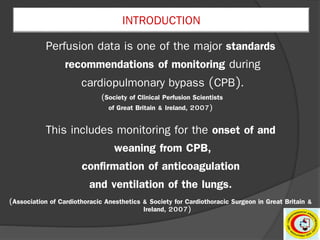
WHAT IS A PERFUSIONIST ?
PERFUSIONISTS
 Operate the heart lung machine,
 Monitoring and controlling oxygen
levels, blood pressure, body
temperature and blood flow.
 They also administer anesthetics and
other drugs during surgery.
(Prof. Michael Smith
Quinnipiac University School of Health Sciences)
Perfusion data is one of the major standards
recommendations of monitoring during
cardiopulmonary bypass (CPB).
(Society of Clinical Perfusion Scientists
of Great Britain & Ireland, 2007)
This includes monitoring for the onset of and
weaning from CPB,
confirmation of anticoagulation
and ventilation of the lungs.
(Association of Cardiothoracic Anesthetics & Society for Cardiothoracic Surgeon in Great Britain &
Ireland, 2007)
INTRODUCTION
Perfusion data can defined as:
The perfusion record (written or electronic) for
each (CPB) procedure
which shall be included as part of patient’s
permanent medical record.
(American Society of ExtraCorporeal Technology, 2013)
…..is a legal presentation of the procedure,
whether manually recorded or computerized
which should be maintained & stored
in patient's notes, according to institution policy
for retaining medical records.
(Society of Clinical Perfusion Scientists
of Great Britain & Ireland, 2007)
WHAT IS CLINICAL PERFUSION DATA (CPD)?
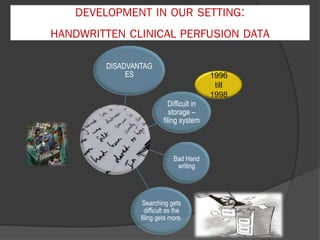
DEVELOPMENT IN OUR SETTING:
HANDWRITTEN CLINICAL PERFUSION DATA
DISADVANTAG
ES
Difficult in
storage –
filing system
Bad Hand
writing
Searching gets
difficult as the
filing gets more.
1996
till
1998
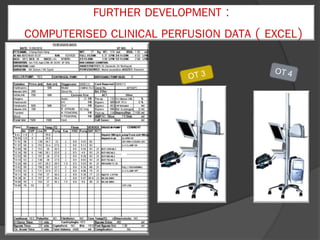
FURTHER DEVELOPMENT :
COMPUTERISED CLINICAL PERFUSION DATA ( EXCEL)
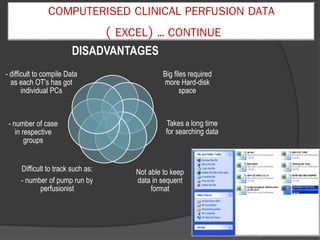
COMPUTERISED CLINICAL PERFUSION DATA
( EXCEL) … CONTINUE
DISADVANTAGES
Big files required
more Hard-disk
space
Takes a long time
for searching data
Not able to keep
data in sequent
format
Difficult to track such as:
- number of pump run by
perfusionist
- number of case
in respective
groups
- difficult to compile Data
as each OT’s has got
individual PCs
OUR DEVELOPMENT: COMPUTERISED
CLINICAL PERFUSION DATA (DATABASE)
Database records are
divided into fields,
which makes searching
the databases easier.
What goes into each
field varies depending
on the type of literature
we’re documenting.
ADVANTAGES
- Easier to key in data
- Searching made
simpler and faster
- Well organized data
no matter how long the
files are.
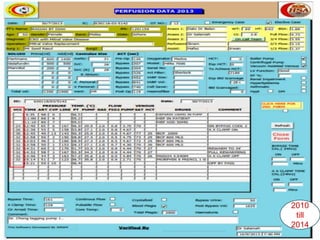
2010
till
2014
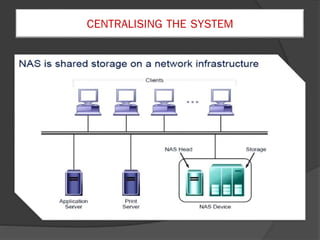
CENTRALISING THE SYSTEM
CENTRALISE NETWORK STORAGE
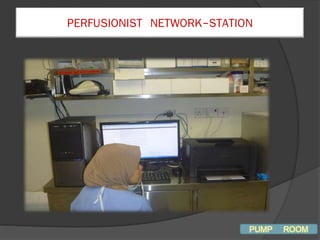
PERFUSIONIST NETWORK-STATION
PUMP ROOM
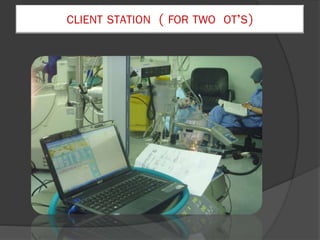
CLIENT STATION ( FOR TWO OT’S)
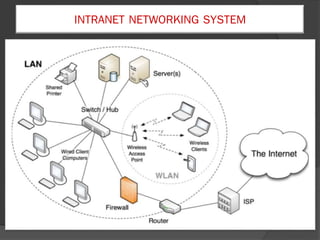
INTRANET NETWORKING SYSTEM
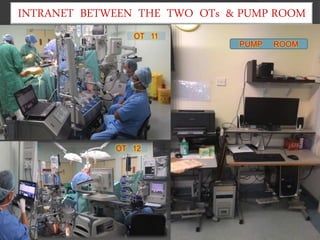
PUMP ROOM
INTRANET BETWEEN THE TWO OTs & PUMP ROOM
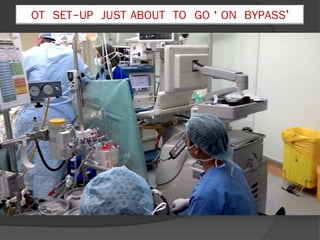
OT SET-UP JUST ABOUT TO GO ‘ ON BYPASS’
COMPONENT OF CPD
1. Patient information
(demographics & pre-operative risk factors).
2. Information describing :-
(procedure, personnel & equipment ).
3. Patient physiology parameters
(documented at a frequency determined by institutional protocol).
4. Blood gas & anticoagulation monitoring results.
5. Signature of the perfusionist (include relief).
(American Society of ExtraCorporeal Technology, 2013)
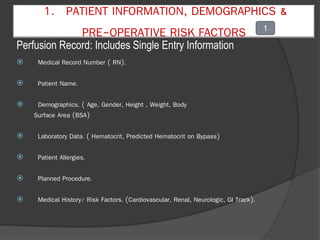
1. PATIENT INFORMATION, DEMOGRAPHICS &
PRE-OPERATIVE RISK FACTORS
Perfusion Record: Includes Single Entry Information
 Medical Record Number ( RN).
 Patient Name.
 Demographics. ( Age, Gender, Height , Weight, Body
Surface Area (BSA)
 Laboratory Data. ( Hematocrit, Predicted Hematocrit on Bypass)
 Patient Allergies.
 Planned Procedure.
 Medical History/ Risk Factors. (Cardiovascular, Renal, Neurologic, GI Track).
1
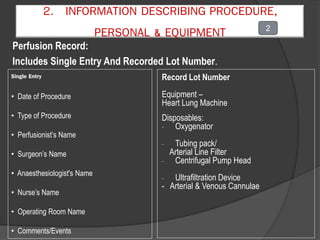
2. INFORMATION DESCRIBING PROCEDURE,
PERSONAL & EQUIPMENT
Perfusion Record:
Includes Single Entry And Recorded Lot Number.
Record Lot Number
Equipment –
Heart Lung Machine
Disposables:
- Oxygenator
- Tubing pack/
Arterial Line Filter
- Centrifugal Pump Head
- Ultrafiltration Device
- Arterial & Venous Cannulae
Single Entry
• Date of Procedure
• Type of Procedure
• Perfusionist’s Name
• Surgeon’s Name
• Anaesthesiologist's Name
• Nurse’s Name
• Operating Room Name
• Comments/Events
2
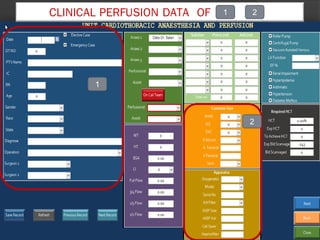
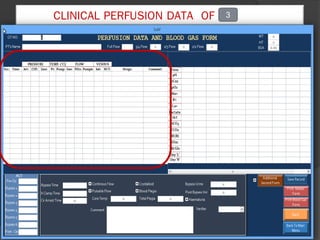
CLINICAL PERFUSION DATA OF 1 2
2
1
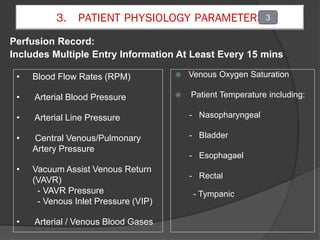
3. PATIENT PHYSIOLOGY PARAMETERS
Perfusion Record:
Includes Multiple Entry Information At Least Every 15 mins
 Venous Oxygen Saturation
 Patient Temperature including:
- Nasopharyngeal
- Bladder
- Esophagael
- Rectal
- Tympanic
• Blood Flow Rates (RPM)
• Arterial Blood Pressure
• Arterial Line Pressure
• Central Venous/Pulmonary
Artery Pressure
• Vacuum Assist Venous Return
(VAVR)
- VAVR Pressure
- Venous Inlet Pressure (VIP)
• Arterial / Venous Blood Gases
3
CLINICAL PERFUSION DATA OF 3
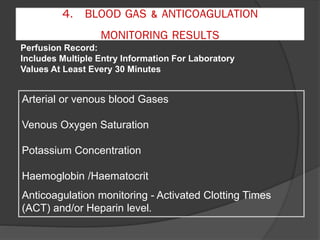
4. BLOOD GAS & ANTICOAGULATION
MONITORING RESULTS
Perfusion Record:
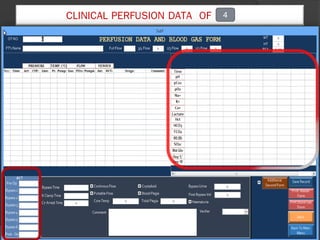
Includes Multiple Entry Information For Laboratory
Values At Least Every 30 Minutes
Arterial or venous blood Gases
Venous Oxygen Saturation
Potassium Concentration
Haemoglobin /Haematocrit
Anticoagulation monitoring - Activated Clotting Times
(ACT) and/or Heparin level.
CLINICAL PERFUSION DATA OF 4
4. BLOOD GAS & ANTICOAGULATION
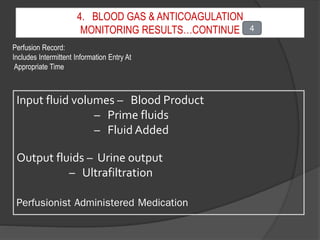
MONITORING RESULTS…CONTINUE
Perfusion Record:
Includes Intermittent Information Entry At
Appropriate Time
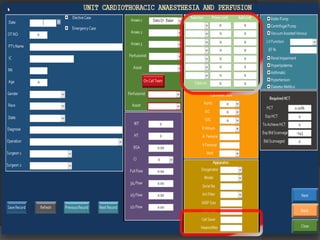
Input fluid volumes – Blood Product
– Prime fluids
– Fluid Added
Output fluids – Urine output
– Ultrafiltration
Perfusionist Administered Medication
4
5. SIGNATURE OF THE PERFUSIONIST
 Signature of the perfusionist
(and all relief perfusionists) performing
the procedure.
 Include the signature of physician(s) providing
supervision for the CPB procedure.
5
21/9/2013 29
It is the responsibility of the clinical perfusionist to assist the
Surgeon/physician in any way possible in patient care
& particularly within the defined areas of expertise
of the clinical perfusionist ….
(The American Academy of Cardiovascular Perfusion, 2008)
CONCLUSION
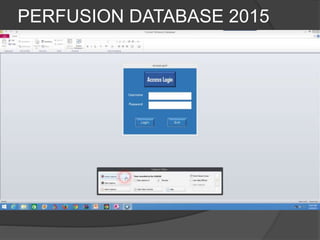
PERFUSION DATABASE 2015
REFERENCES:
Banbury, M.,White J., Blackstone, E., & Cosgrovo, D. (2003)Vacuum-assisted venous return reduces blood usage. Journal
ofThoracic Cardiovascular Surgery.Vol. 126 (3), pp:680-687.
Jegger, D.,Tevaearai, H.T., Mueller, X.M., Horisberger, J., & von Segesser, LK. (2003).
Limitations using the vacuum-assist venous drainage technique during cardiopulmonary
bypass procedures. The Journal Of Extra-corporealTechnology. Vol. 35 (3), pp: 207 – 211.
Munster, K., Anderson, U., Mikkelsen, J., & Petterson,G.(1999).Vacuum AssistedVenous Drainage
(VAVD). University of Copenhagen and Hamlet Private Hospital.
Vol. 14 (6), pp: 419 – 423.
Shigang Wang & Akif Undar (2009). Vacuum-assisted venous drainage and gaseous microemboli in
pulmonary bypass. The Journal Of Extra-corporealTechnology. Vol. 40 (4), pp: 249 – 256.
Sintya,T. et al. (2011). Vacuum-assisted venous drainage in cardiopulmonary bypass and need of blood transfusion:
experience of service. Brazilian Journal of Cardiovascular Surgery.Vol. 26 (1).
Willcox,T. (2013).Vacuum Assist:Angel or Demon CON. The Journal Of Extra-corporeal
Technology. Vol. 45 (2), pp: 128 – 141.
Willcox,T. (2002).Vacuum-assisted venous drainage: to air or not to air, that is the question.
Has the bubble burst? The Journal Of Extra-corporealTechnology. Vol. 34, pp: 24–28.
Y Hayashi et al. (2001). Clinical application of vacuum-assisted cardiopulmonary bypass with a pressure
relief valve. European Journal of Cardio-Thoracic Surgery.Vol. 20 (3), pp: 621 - 627. .
21/9/2013 31
 GET SOME CHAT SLIDES READY in
case the video doesn’t work

Perfusion database

  • 1.
    AMELIORATE OF CLINICAL PERFUSIONDATA MOHD. SASEEDHARAN BIN ABDULLAH SENIOR PERFUSIONIST
  • 2.
    1. Introduction 2. Definitionof Clinical Perfusion Data 3. Development in Our Setting 4. Components of CPD 5. Conclusion 6. Short Demonstration OUTLINE
  • 3.
    WHAT IS APERFUSIONIST ? PERFUSIONISTS  Operate the heart lung machine,  Monitoring and controlling oxygen levels, blood pressure, body temperature and blood flow.  They also administer anesthetics and other drugs during surgery. (Prof. Michael Smith Quinnipiac University School of Health Sciences)
  • 4.
    Perfusion data isone of the major standards recommendations of monitoring during cardiopulmonary bypass (CPB). (Society of Clinical Perfusion Scientists of Great Britain & Ireland, 2007) This includes monitoring for the onset of and weaning from CPB, confirmation of anticoagulation and ventilation of the lungs. (Association of Cardiothoracic Anesthetics & Society for Cardiothoracic Surgeon in Great Britain & Ireland, 2007) INTRODUCTION
  • 5.
    Perfusion data candefined as: The perfusion record (written or electronic) for each (CPB) procedure which shall be included as part of patient’s permanent medical record. (American Society of ExtraCorporeal Technology, 2013) …..is a legal presentation of the procedure, whether manually recorded or computerized which should be maintained & stored in patient's notes, according to institution policy for retaining medical records. (Society of Clinical Perfusion Scientists of Great Britain & Ireland, 2007) WHAT IS CLINICAL PERFUSION DATA (CPD)?
  • 6.
    DEVELOPMENT IN OURSETTING: HANDWRITTEN CLINICAL PERFUSION DATA DISADVANTAG ES Difficult in storage – filing system Bad Hand writing Searching gets difficult as the filing gets more. 1996 till 1998
  • 7.
    FURTHER DEVELOPMENT : COMPUTERISEDCLINICAL PERFUSION DATA ( EXCEL)
  • 8.
    COMPUTERISED CLINICAL PERFUSIONDATA ( EXCEL) … CONTINUE DISADVANTAGES Big files required more Hard-disk space Takes a long time for searching data Not able to keep data in sequent format Difficult to track such as: - number of pump run by perfusionist - number of case in respective groups - difficult to compile Data as each OT’s has got individual PCs
  • 9.
    OUR DEVELOPMENT: COMPUTERISED CLINICALPERFUSION DATA (DATABASE) Database records are divided into fields, which makes searching the databases easier. What goes into each field varies depending on the type of literature we’re documenting. ADVANTAGES - Easier to key in data - Searching made simpler and faster - Well organized data no matter how long the files are.
  • 10.
  • 11.
  • 12.
  • 13.
  • 14.
    CLIENT STATION (FOR TWO OT’S)
  • 15.
  • 16.
    PUMP ROOM INTRANET BETWEENTHE TWO OTs & PUMP ROOM
  • 17.
    OT SET-UP JUSTABOUT TO GO ‘ ON BYPASS’
  • 18.
    COMPONENT OF CPD 1.Patient information (demographics & pre-operative risk factors). 2. Information describing :- (procedure, personnel & equipment ). 3. Patient physiology parameters (documented at a frequency determined by institutional protocol). 4. Blood gas & anticoagulation monitoring results. 5. Signature of the perfusionist (include relief). (American Society of ExtraCorporeal Technology, 2013)
  • 19.
    1. PATIENT INFORMATION,DEMOGRAPHICS & PRE-OPERATIVE RISK FACTORS Perfusion Record: Includes Single Entry Information  Medical Record Number ( RN).  Patient Name.  Demographics. ( Age, Gender, Height , Weight, Body Surface Area (BSA)  Laboratory Data. ( Hematocrit, Predicted Hematocrit on Bypass)  Patient Allergies.  Planned Procedure.  Medical History/ Risk Factors. (Cardiovascular, Renal, Neurologic, GI Track). 1
  • 20.
    2. INFORMATION DESCRIBINGPROCEDURE, PERSONAL & EQUIPMENT Perfusion Record: Includes Single Entry And Recorded Lot Number. Record Lot Number Equipment – Heart Lung Machine Disposables: - Oxygenator - Tubing pack/ Arterial Line Filter - Centrifugal Pump Head - Ultrafiltration Device - Arterial & Venous Cannulae Single Entry • Date of Procedure • Type of Procedure • Perfusionist’s Name • Surgeon’s Name • Anaesthesiologist's Name • Nurse’s Name • Operating Room Name • Comments/Events 2
  • 21.
  • 22.
    3. PATIENT PHYSIOLOGYPARAMETERS Perfusion Record: Includes Multiple Entry Information At Least Every 15 mins  Venous Oxygen Saturation  Patient Temperature including: - Nasopharyngeal - Bladder - Esophagael - Rectal - Tympanic • Blood Flow Rates (RPM) • Arterial Blood Pressure • Arterial Line Pressure • Central Venous/Pulmonary Artery Pressure • Vacuum Assist Venous Return (VAVR) - VAVR Pressure - Venous Inlet Pressure (VIP) • Arterial / Venous Blood Gases 3
  • 23.
  • 24.
    4. BLOOD GAS& ANTICOAGULATION MONITORING RESULTS Perfusion Record: Includes Multiple Entry Information For Laboratory Values At Least Every 30 Minutes Arterial or venous blood Gases Venous Oxygen Saturation Potassium Concentration Haemoglobin /Haematocrit Anticoagulation monitoring - Activated Clotting Times (ACT) and/or Heparin level.
  • 25.
  • 26.
    4. BLOOD GAS& ANTICOAGULATION MONITORING RESULTS…CONTINUE Perfusion Record: Includes Intermittent Information Entry At Appropriate Time Input fluid volumes – Blood Product – Prime fluids – Fluid Added Output fluids – Urine output – Ultrafiltration Perfusionist Administered Medication 4
  • 28.
    5. SIGNATURE OFTHE PERFUSIONIST  Signature of the perfusionist (and all relief perfusionists) performing the procedure.  Include the signature of physician(s) providing supervision for the CPB procedure. 5
  • 29.
    21/9/2013 29 It isthe responsibility of the clinical perfusionist to assist the Surgeon/physician in any way possible in patient care & particularly within the defined areas of expertise of the clinical perfusionist …. (The American Academy of Cardiovascular Perfusion, 2008) CONCLUSION
  • 30.
  • 31.
    REFERENCES: Banbury, M.,White J.,Blackstone, E., & Cosgrovo, D. (2003)Vacuum-assisted venous return reduces blood usage. Journal ofThoracic Cardiovascular Surgery.Vol. 126 (3), pp:680-687. Jegger, D.,Tevaearai, H.T., Mueller, X.M., Horisberger, J., & von Segesser, LK. (2003). Limitations using the vacuum-assist venous drainage technique during cardiopulmonary bypass procedures. The Journal Of Extra-corporealTechnology. Vol. 35 (3), pp: 207 – 211. Munster, K., Anderson, U., Mikkelsen, J., & Petterson,G.(1999).Vacuum AssistedVenous Drainage (VAVD). University of Copenhagen and Hamlet Private Hospital. Vol. 14 (6), pp: 419 – 423. Shigang Wang & Akif Undar (2009). Vacuum-assisted venous drainage and gaseous microemboli in pulmonary bypass. The Journal Of Extra-corporealTechnology. Vol. 40 (4), pp: 249 – 256. Sintya,T. et al. (2011). Vacuum-assisted venous drainage in cardiopulmonary bypass and need of blood transfusion: experience of service. Brazilian Journal of Cardiovascular Surgery.Vol. 26 (1). Willcox,T. (2013).Vacuum Assist:Angel or Demon CON. The Journal Of Extra-corporeal Technology. Vol. 45 (2), pp: 128 – 141. Willcox,T. (2002).Vacuum-assisted venous drainage: to air or not to air, that is the question. Has the bubble burst? The Journal Of Extra-corporealTechnology. Vol. 34, pp: 24–28. Y Hayashi et al. (2001). Clinical application of vacuum-assisted cardiopulmonary bypass with a pressure relief valve. European Journal of Cardio-Thoracic Surgery.Vol. 20 (3), pp: 621 - 627. . 21/9/2013 31
  • 33.
     GET SOMECHAT SLIDES READY in case the video doesn’t work