Peter Anderson, KPMG
Peter Purcell, Deloitte & Touche
Adapted from Consulting Interview Preparation Guide
Marquis, Stanford GSB Class of 2006
Case Interview Preparation Guide
2
Prior to the Interview
3
Building Relationships at your Target Firms
 Attend as many events as possible for the firms that
interest you

Including school / company-wide, affinity groups, and regional /
office-specific events

At these events, talk to as many people as possible to make an
impression
 Have a set of good questions to ask firm representatives
to show your level of interest in the company

Don’t ask about topics that can easily be found on the company’s
website
 Get the contact information for each person with whom
you speak and follow up with an e-mail after an event
4
Building Relationships at your Target Firms
 Always make a positive impression when interacting
with company representatives

This includes when attending official company presentations and
dinners, during informal exchanges, and even at school
sponsored functions

Be on the lookout for deliberate attempts to see how you act when
you’re not “on the clock”

Assume that all interactions with a firm’s employees could affect
your standing, so be on your best behavior AT ALL TIMES!
5
Resume Preparation
 Without a prior banking or consulting background, you
will likely have to tailor your resume to appeal to the
consulting firms
 Instead of focusing on the “must have” skills for your
previous industry, emphasize the following:

Analytical abilities

Experience in teams

Communications skills

Leadership / management experiences

History of achieving results
 Use an “Additional Information” section to highlight
qualities / interests to differentiate yourself
6
Answering the “Why Firm X?” Question
 Show a specific desire to work at Firm X, rather than
simply a general desire to work in consulting
 Learn the “ins and outs” of the company

Locations

Business areas of specialty

Reputation

Career progression and direction

Company culture
 Research the firm’s competitors to find points of
differentiation
 Give reasons that the firm is a good fit for you and that
you are a good fit for the firm
7
Describing your Work Experiences
 Resume “walk through”

Develop a coherent story for each step along your educational
and career path – it should not seem like a random walk

Some firms analyze the walk through as if it were a case – be
structure when describing the sections of your resume
 Work experience stories

Allow firms to learn about your experiences in a variety of work
situations

Have four or five unique stories ready to share
− Led an initiative to a successful conclusion
− Had an impact on a team where you were not in charge
− Worked in a group where there was internal conflict
− Found success in a challenging environment
− Initiated change within an organization
8
Generating a List of Questions
 It is crucial for the candidate to develop good questions
to ask the interviewer at the end of the interview
 Tips for creating strong questions:

Ask questions beyond standard travel and work-life balance
issues (interviewers hear these questions all the time)

Show that you have done some prior research about the firm

Ask questions that pertain to your own background

If given interviewer biographies, ask questions about their
backgrounds and how they were able to leverage them at the firm
9
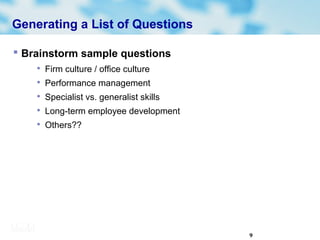
Generating a List of Questions
 Brainstorm sample questions

Firm culture / office culture

Performance management

Specialist vs. generalist skills

Long-term employee development

Others??
10
Approaching the Case
Interview
11
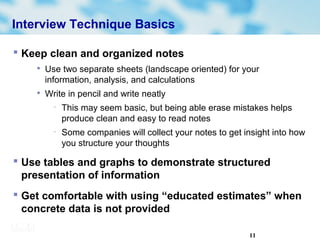
Interview Technique Basics
 Keep clean and organized notes

Use two separate sheets (landscape oriented) for your
information, analysis, and calculations

Write in pencil and write neatly
− This may seem basic, but being able erase mistakes helps
produce clean and easy to read notes
− Some companies will collect your notes to get insight into how
you structure your thoughts
 Use tables and graphs to demonstrate structured
presentation of information
 Get comfortable with using “educated estimates” when
concrete data is not provided
12
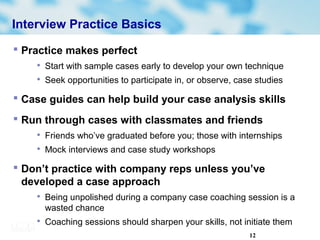
Interview Practice Basics
 Practice makes perfect

Start with sample cases early to develop your own technique

Seek opportunities to participate in, or observe, case studies
 Case guides can help build your case analysis skills
 Run through cases with classmates and friends

Friends who’ve graduated before you; those with internships

Mock interviews and case study workshops
 Don’t practice with company reps unless you’ve
developed a case approach

Being unpolished during a company case coaching session is a
wasted chance

Coaching sessions should sharpen your skills, not initiate them
13
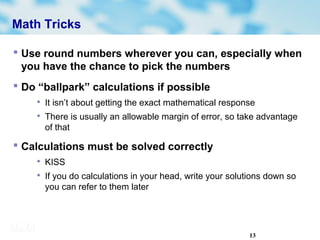
Math Tricks
 Use round numbers wherever you can, especially when
you have the chance to pick the numbers
 Do “ballpark” calculations if possible

It isn’t about getting the exact mathematical response

There is usually an allowable margin of error, so take advantage
of that
 Calculations must be solved correctly

KISS

If you do calculations in your head, write your solutions down so
you can refer to them later
14
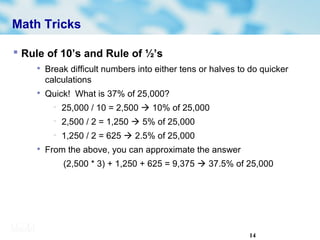
Math Tricks
 Rule of 10’s and Rule of ½’s

Break difficult numbers into either tens or halves to do quicker
calculations

Quick! What is 37% of 25,000?
− 25,000 / 10 = 2,500  10% of 25,000
− 2,500 / 2 = 1,250  5% of 25,000
− 1,250 / 2 = 625  2.5% of 25,000

From the above, you can approximate the answer
(2,500 * 3) + 1,250 + 625 = 9,375  37.5% of 25,000
15
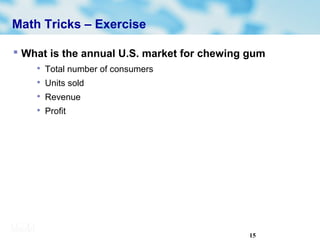
Math Tricks – Exercise
 What is the annual U.S. market for chewing gum

Total number of consumers

Units sold

Revenue

Profit
16
Math Tricks – Example
 What is the annual U.S. market for chewing gum (total
number of consumers)

Estimate the total U.S. population (~300 million)

Segment the population based on some metric (hint: age is
usually a good metric)

Estimate the number of people in each population segment

Make a guess at the percentage of each segment that chews gum
[(100 m) * 80%] + [(150 m) * 60%] + [(50 m) * 20%] =
80 + 90 + 10 = 180 million
17
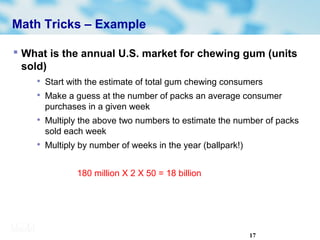
Math Tricks – Example
 What is the annual U.S. market for chewing gum (units
sold)

Start with the estimate of total gum chewing consumers

Make a guess at the number of packs an average consumer
purchases in a given week

Multiply the above two numbers to estimate the number of packs
sold each week

Multiply by number of weeks in the year (ballpark!)
180 million X 2 X 50 = 18 billion
18
Math Tricks - Example
 What is the annual U.S. market for chewing gum
(revenue)

Start with the annual number of pack sold

Make a guess at the average price of gum per pack (ballpark)
18 billion X $1 = $18 billion
19
Math Tricks - Example
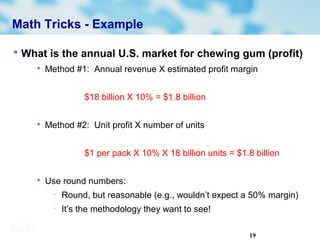
 What is the annual U.S. market for chewing gum (profit)

Method #1: Annual revenue X estimated profit margin
$18 billion X 10% = $1.8 billion

Method #2: Unit profit X number of units
$1 per pack X 10% X 18 billion units = $1.8 billion

Use round numbers:
− Round, but reasonable (e.g., wouldn’t expect a 50% margin)
− It’s the methodology they want to see!
20
Learning to “Think Business”
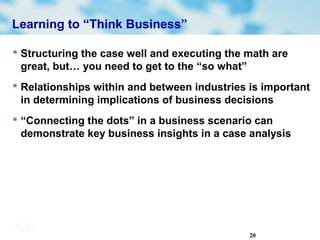
 Structuring the case well and executing the math are
great, but… you need to get to the “so what”
 Relationships within and between industries is important
in determining implications of business decisions
 “Connecting the dots” in a business scenario can
demonstrate key business insights in a case analysis
21
Learning to “Think Business”
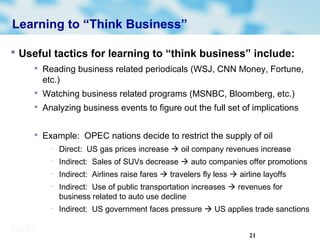
 Useful tactics for learning to “think business” include:

Reading business related periodicals (WSJ, CNN Money, Fortune,
etc.)

Watching business related programs (MSNBC, Bloomberg, etc.)

Analyzing business events to figure out the full set of implications

Example: OPEC nations decide to restrict the supply of oil
− Direct: US gas prices increase  oil company revenues increase
− Indirect: Sales of SUVs decrease  auto companies offer promotions
− Indirect: Airlines raise fares  travelers fly less  airline layoffs
− Indirect: Use of public transportation increases  revenues for
business related to auto use decline
− Indirect: US government faces pressure  US applies trade sanctions
22
Key Business Concepts
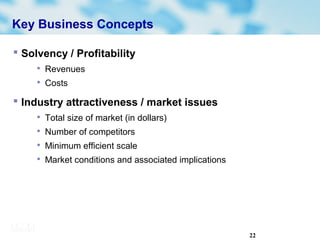
 Solvency / Profitability

Revenues

Costs
 Industry attractiveness / market issues

Total size of market (in dollars)

Number of competitors

Minimum efficient scale

Market conditions and associated implications
23
Key Business Concepts
 Mergers and acquisitions

Financials of the deal (will it be profitable?)

Product, service, or support synergies

Market reaction

Culture issues
 Marketing

Pricing

Placement (distribution channels)

Product

Promotion
24
Key Business Concepts
 Product introduction

Potential market for product or service
− Do consumers want it?
− Does market have to be developed?

Profitability of the product
− Cost to introduce
− Expected revenues and margin

Competitor reaction
− Can they copy it?
− Do they already have competing products

Does the new product fit your current company and product line
− Does it fit with the brand?
− Are there implications on existing products?
25
Key Business Concepts
 Other concepts that show deeper business insights

Labor issues
− Unionization
− Defined benefit programs

Long-term contracts

Revenue stream analysis

Costs
− Fixed vs. variable
− Direct vs. indirect

Supply / demand issues, and their affect on pricing

Operational issues

Culture and morale issues
26
Case Execution
27
Case Execution Tips
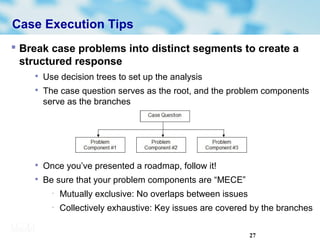
 Break case problems into distinct segments to create a
structured response

Use decision trees to set up the analysis

The case question serves as the root, and the problem components
serve as the branches

Once you’ve presented a roadmap, follow it!

Be sure that your problem components are “MECE”
− Mutually exclusive: No overlaps between issues
− Collectively exhaustive: Key issues are covered by the branches
28
Case Execution Tips
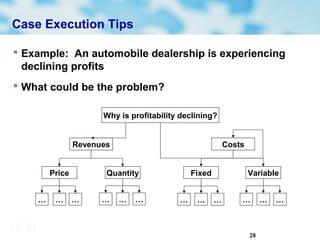
 Example: An automobile dealership is experiencing
declining profits
 What could be the problem?
Why is profitability declining?
Revenues Costs
Price Quantity Fixed Variable
… … … … … … … … … … … …
29
Case Execution Tips
 Don’t be afraid to ask clarifying questions if you don’t
understand something
 Assumptions are powerful; be clear when you use them
 Be quick, but correct, when doing calculations (use
round numbers and ballpark estimates)
 Be confident in your analysis
 Be ready to change direction if guided to do so
30
The First Four Steps
 Summarize the question
 Verify the objectives
 Ask clarifying questions
 Lay out your structure – it’s OK to ask for a few minutes
to collect your thoughts!
31
Types of Cases
 Entering a new market

Step 1: Investigate the market
− Would entering the market make good business sense?
− Assess market attractiveness

Step 2: If you decide to enter the market, determine the best way
to become a player
− Start from scratch
− Acquire an existing player
− Form a JV or strategic alliance with a complementary player
32
Types of Cases
 Developing a new product

Step 1: Analyze the product

Step 2: Analyze the market and develop a strategy

Step 3: Analyze potential customers and segments

Step 4: Develop project financial model
33
Types of Cases
 Pricing strategies

Step 1: Investigate the product

Step 2: Determine pricing strategy
− Pricing methodology:
○ Cost-based pricing: Analyzing product cost, estimating
margin, and generating sales price
○ Price-based costing: Analyzing market for price point,
costing out production to meet price point with desired
margin
− Supply / demand forces and price elasticity
34
Types of Cases
 Growth strategies

Step 1: Clarify objectives
− Nature of growth (organic, acquisitive
− Scope of growth (division vs. enterprise)

Step 2: Analyze and select growth strategy
− Increasing sales
− Expanding distribution channels
− Expanding product line
− Invest in major marketing programs
− Diversify products / services
− Acquire another firm
35
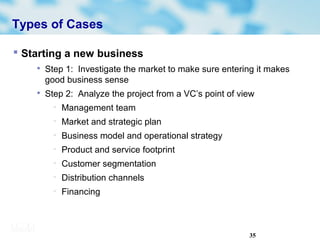
Types of Cases
 Starting a new business

Step 1: Investigate the market to make sure entering it makes
good business sense

Step 2: Analyze the project from a VC’s point of view
− Management team
− Market and strategic plan
− Business model and operational strategy
− Product and service footprint
− Customer segmentation
− Distribution channels
− Financing
36
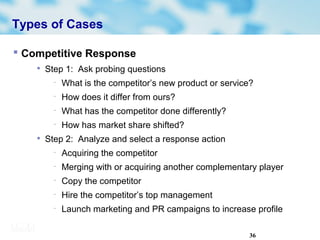
Types of Cases
 Competitive Response

Step 1: Ask probing questions
− What is the competitor’s new product or service?
− How does it differ from ours?
− What has the competitor done differently?
− How has market share shifted?

Step 2: Analyze and select a response action
− Acquiring the competitor
− Merging with or acquiring another complementary player
− Copy the competitor
− Hire the competitor’s top management
− Launch marketing and PR campaigns to increase profile
37
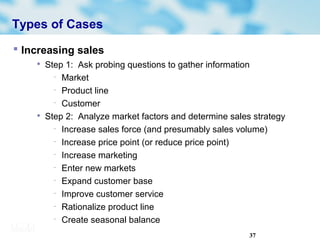
Types of Cases
 Increasing sales

Step 1: Ask probing questions to gather information
− Market
− Product line
− Customer

Step 2: Analyze market factors and determine sales strategy
− Increase sales force (and presumably sales volume)
− Increase price point (or reduce price point)
− Increase marketing
− Enter new markets
− Expand customer base
− Improve customer service
− Rationalize product line
− Create seasonal balance
38
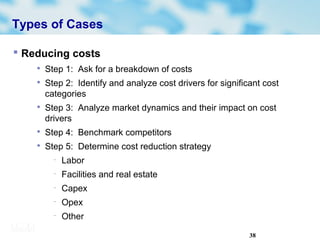
Types of Cases
 Reducing costs

Step 1: Ask for a breakdown of costs

Step 2: Identify and analyze cost drivers for significant cost
categories

Step 3: Analyze market dynamics and their impact on cost
drivers

Step 4: Benchmark competitors

Step 5: Determine cost reduction strategy
− Labor
− Facilities and real estate
− Capex
− Opex
− Other
39
Types of Cases
 Turnarounds

Step 1: Evaluate the magnitude of the problem
− Test the business model
− Analyze liquidity and understand debt covenants
− Review costing and pricing and develop top down cost model
− Review business model and market strategy

Step 2: Choose appropriate actions (and be creative!)
− Control cash and cut all non-essential spending
− Clean up the balance sheet
− Retain key staff and cut non-essential payroll
− Communicate / negotiate with key constituencies
− Suppliers
− Banks
− Tax authorities
− Customers
40
Case Examples
41
Case Example Introduction
 The following case samples are provided to facilitate
first-level analysis
 For each case, practice setting up the high-level tree
that could be used to attack the problem:

Place the key question for the case at the root of the tree

Break the problem into a set of solvable components and assign
those components to the tree branches

Define the high level steps you would take to solve each
component
42
Case Example
 Your client owns a professional football team that has
just won the Super Bowl. Despite the Super Bowl
victory, the team finished the season with a financial
loss for the 5th
season in a row.

What could be the cause of the team’s profitability problems?

How would you go about developing recommendations to reverse
this past season’s financial performance?
43
Case Example
 You are the owner of a small, but relatively successful
towing company with a hand full of locations
throughout the Southeastern U.S. Two recent MBA
graduates have approached you about purchasing the
company.

How would you go about determining whether you should accept
the offer to sell your company?
44
Case Example
 Your client is an industry-leading security software
company that is considering acquiring a data
management software company.

How would you go about determining if your client should go
through with the acquisition?
45
Case Example
 Your client is a national chain of fitness centers with
locations in 35 major cities. The company is thinking of
creating a sub-brand of gyms for the small-town
market.

How would you go about determining whether your client should
launch the sub-brand?

What issues come into play when making this decision?
46
Case Example
 A publishing company that has traditionally created
news and entertainment magazines is thinking of
introducing a new sports-focused magazine.

How would you go about determining whether they should do it?
47
Case Example
 You have taken over as the Executive Director of a non-
profit that has had trouble raising enough money to
fund its programs.

What could the problems be?

How would you go about determining what might be done to
resolve the issues?
48
Case Example
 You have just accepted a job as the Superintendant of a
city school district where more than 90% of the
students have scored below proficient in English and
Math for the past 15 years.

How will you solve this long-standing academic performance
problem?

What resources might you need to implement your plan?
49
Case Example
 Your client is a beverage company that was excited to
see its sponsored cyclist win the Tour de France. That
is, until authorities announced that the cyclist had
tested positive for performance enhancing drugs.

What sort of damage control should the company do in light of
this event?

What could be the effects on the company’s brand as a result of
this discovery?
50
Case Example
 Your client is an enterprise software company that has
spent over $100 million developing a new product that
isn’t selling well.

What could the problem be?

How would you go about identifying what could be done to resolve
the situation?
51
Case Example
 A friend of yours is considering becoming a franchisee
of a national fast-food chain

What issues should she be thinking about in making her decision?

How would you go about determining whether she should open
the franchise?
52
Final Words of Advice
53
General Advice
 Relax, and don't let yourself get too stressed out before
or during the interview – succumbing to nerves is the
quickest way to sabotage yourself.
 Be confident during the interview, but be humble!
 Be sure to have a strong list of questions to ask the
interviewers

This is your chance to gain insights from their experiences

It shows that you care enough about getting a position to ask
insightful questions
54
General Advice
 If you make a mistake, learn from it and move on.

Don’t let it fester in your mind

It will serve as a distraction later on.
 Make sure the interviewer understands your thinking.

Gives the interviewer a chance to give you correct information if
you've got something mixed up

Gives the interviewer a chance to ask follow-up questions to gain
more insight about you as a candidate
 Take time to think about what you're going to say before
you say it.

There is nothing wrong with taking 5 or 10 seconds to think
through something

Fight the urge to say the first thing that comes to mind
55
Advice on Cases
 Focus on structure from start of interview until the end

Initial case breakdown

Set up and execution of calculations

Final case wrap-up
 Having a structured approach in a case interview is just
as important as getting the "right" answers
 Think “big picture” whenever you can

Don’t dig too deep into the details until you have to

The big picture should be the foundation of your approach; it is
especially important when developing your initial case roadmap
and issue tree
56
Advice on Cases
 Make sure you bring out the "So what?" insights and
not just surface level ideas.

Simply reciting facts won't distinguish you from the pack

Drawing out insights about the case situation, and the larger
business context is key
 Be as efficient as possible when doing the math on
your cases.

Writing out equations can use up a lot of time that would be better
spent doing case analysis and gathering data

Find shortcuts to get through your calculations quicker, such as
canceling zeros or recognizing patterns in numbers

Use the Rule of 10’s and Rule of ½’s
57
Advice on Cases
 Make your notes as neat and clear as possible.

It will help so you don't confuse yourself during interviews

Some firms collect your case notes to gain insights on how you
structured your analysis
 Don’t become restricted by the explicit details of the
case – be creative!

There are many ways to solve a problem

Creativity can make a strong and lasting impression on the
interviewers
58
Advice on Cases
 Use assumptions to your advantage, but check first

If you need a piece of information during the case, ask for it

The worst that can happen is that the interviewer won't have the
information and you will have to make an assumption about it

The alternative to not asking is making an invalid or incorrect
assumption and going down the wrong path

In most cases, the interviewer will have additional data that can
help you sharpen your case analysis
59
Advice on the Fit / Experience Discussion
 The interview is not all about the case, the interviewer’s
cultural fit assessment is highly important!
 Focus on your role – the interviewer wants to hear
about what you did
 Have several stories prepared (I’d recommend at least
four) that cover a wide range of anecdotes about your
leadership experience (try not to repeat stories across
interviews on a single day)
 Be concise and make sure you bring out only the most
important points

Case Interview Preparation Guide V5

  • 1.
    Peter Anderson, KPMG PeterPurcell, Deloitte & Touche Adapted from Consulting Interview Preparation Guide Marquis, Stanford GSB Class of 2006 Case Interview Preparation Guide
  • 2.
    2 Prior to theInterview
  • 3.
    3 Building Relationships atyour Target Firms  Attend as many events as possible for the firms that interest you  Including school / company-wide, affinity groups, and regional / office-specific events  At these events, talk to as many people as possible to make an impression  Have a set of good questions to ask firm representatives to show your level of interest in the company  Don’t ask about topics that can easily be found on the company’s website  Get the contact information for each person with whom you speak and follow up with an e-mail after an event
  • 4.
    4 Building Relationships atyour Target Firms  Always make a positive impression when interacting with company representatives  This includes when attending official company presentations and dinners, during informal exchanges, and even at school sponsored functions  Be on the lookout for deliberate attempts to see how you act when you’re not “on the clock”  Assume that all interactions with a firm’s employees could affect your standing, so be on your best behavior AT ALL TIMES!
  • 5.
    5 Resume Preparation  Withouta prior banking or consulting background, you will likely have to tailor your resume to appeal to the consulting firms  Instead of focusing on the “must have” skills for your previous industry, emphasize the following:  Analytical abilities  Experience in teams  Communications skills  Leadership / management experiences  History of achieving results  Use an “Additional Information” section to highlight qualities / interests to differentiate yourself
  • 6.
    6 Answering the “WhyFirm X?” Question  Show a specific desire to work at Firm X, rather than simply a general desire to work in consulting  Learn the “ins and outs” of the company  Locations  Business areas of specialty  Reputation  Career progression and direction  Company culture  Research the firm’s competitors to find points of differentiation  Give reasons that the firm is a good fit for you and that you are a good fit for the firm
  • 7.
    7 Describing your WorkExperiences  Resume “walk through”  Develop a coherent story for each step along your educational and career path – it should not seem like a random walk  Some firms analyze the walk through as if it were a case – be structure when describing the sections of your resume  Work experience stories  Allow firms to learn about your experiences in a variety of work situations  Have four or five unique stories ready to share − Led an initiative to a successful conclusion − Had an impact on a team where you were not in charge − Worked in a group where there was internal conflict − Found success in a challenging environment − Initiated change within an organization
  • 8.
    8 Generating a Listof Questions  It is crucial for the candidate to develop good questions to ask the interviewer at the end of the interview  Tips for creating strong questions:  Ask questions beyond standard travel and work-life balance issues (interviewers hear these questions all the time)  Show that you have done some prior research about the firm  Ask questions that pertain to your own background  If given interviewer biographies, ask questions about their backgrounds and how they were able to leverage them at the firm
  • 9.
    9 Generating a Listof Questions  Brainstorm sample questions  Firm culture / office culture  Performance management  Specialist vs. generalist skills  Long-term employee development  Others??
  • 10.
  • 11.
    11 Interview Technique Basics Keep clean and organized notes  Use two separate sheets (landscape oriented) for your information, analysis, and calculations  Write in pencil and write neatly − This may seem basic, but being able erase mistakes helps produce clean and easy to read notes − Some companies will collect your notes to get insight into how you structure your thoughts  Use tables and graphs to demonstrate structured presentation of information  Get comfortable with using “educated estimates” when concrete data is not provided
  • 12.
    12 Interview Practice Basics Practice makes perfect  Start with sample cases early to develop your own technique  Seek opportunities to participate in, or observe, case studies  Case guides can help build your case analysis skills  Run through cases with classmates and friends  Friends who’ve graduated before you; those with internships  Mock interviews and case study workshops  Don’t practice with company reps unless you’ve developed a case approach  Being unpolished during a company case coaching session is a wasted chance  Coaching sessions should sharpen your skills, not initiate them
  • 13.
    13 Math Tricks  Useround numbers wherever you can, especially when you have the chance to pick the numbers  Do “ballpark” calculations if possible  It isn’t about getting the exact mathematical response  There is usually an allowable margin of error, so take advantage of that  Calculations must be solved correctly  KISS  If you do calculations in your head, write your solutions down so you can refer to them later
  • 14.
    14 Math Tricks  Ruleof 10’s and Rule of ½’s  Break difficult numbers into either tens or halves to do quicker calculations  Quick! What is 37% of 25,000? − 25,000 / 10 = 2,500  10% of 25,000 − 2,500 / 2 = 1,250  5% of 25,000 − 1,250 / 2 = 625  2.5% of 25,000  From the above, you can approximate the answer (2,500 * 3) + 1,250 + 625 = 9,375  37.5% of 25,000
  • 15.
    15 Math Tricks –Exercise  What is the annual U.S. market for chewing gum  Total number of consumers  Units sold  Revenue  Profit
  • 16.
    16 Math Tricks –Example  What is the annual U.S. market for chewing gum (total number of consumers)  Estimate the total U.S. population (~300 million)  Segment the population based on some metric (hint: age is usually a good metric)  Estimate the number of people in each population segment  Make a guess at the percentage of each segment that chews gum [(100 m) * 80%] + [(150 m) * 60%] + [(50 m) * 20%] = 80 + 90 + 10 = 180 million
  • 17.
    17 Math Tricks –Example  What is the annual U.S. market for chewing gum (units sold)  Start with the estimate of total gum chewing consumers  Make a guess at the number of packs an average consumer purchases in a given week  Multiply the above two numbers to estimate the number of packs sold each week  Multiply by number of weeks in the year (ballpark!) 180 million X 2 X 50 = 18 billion
  • 18.
    18 Math Tricks -Example  What is the annual U.S. market for chewing gum (revenue)  Start with the annual number of pack sold  Make a guess at the average price of gum per pack (ballpark) 18 billion X $1 = $18 billion
  • 19.
    19 Math Tricks -Example  What is the annual U.S. market for chewing gum (profit)  Method #1: Annual revenue X estimated profit margin $18 billion X 10% = $1.8 billion  Method #2: Unit profit X number of units $1 per pack X 10% X 18 billion units = $1.8 billion  Use round numbers: − Round, but reasonable (e.g., wouldn’t expect a 50% margin) − It’s the methodology they want to see!
  • 20.
    20 Learning to “ThinkBusiness”  Structuring the case well and executing the math are great, but… you need to get to the “so what”  Relationships within and between industries is important in determining implications of business decisions  “Connecting the dots” in a business scenario can demonstrate key business insights in a case analysis
  • 21.
    21 Learning to “ThinkBusiness”  Useful tactics for learning to “think business” include:  Reading business related periodicals (WSJ, CNN Money, Fortune, etc.)  Watching business related programs (MSNBC, Bloomberg, etc.)  Analyzing business events to figure out the full set of implications  Example: OPEC nations decide to restrict the supply of oil − Direct: US gas prices increase  oil company revenues increase − Indirect: Sales of SUVs decrease  auto companies offer promotions − Indirect: Airlines raise fares  travelers fly less  airline layoffs − Indirect: Use of public transportation increases  revenues for business related to auto use decline − Indirect: US government faces pressure  US applies trade sanctions
  • 22.
    22 Key Business Concepts Solvency / Profitability  Revenues  Costs  Industry attractiveness / market issues  Total size of market (in dollars)  Number of competitors  Minimum efficient scale  Market conditions and associated implications
  • 23.
    23 Key Business Concepts Mergers and acquisitions  Financials of the deal (will it be profitable?)  Product, service, or support synergies  Market reaction  Culture issues  Marketing  Pricing  Placement (distribution channels)  Product  Promotion
  • 24.
    24 Key Business Concepts Product introduction  Potential market for product or service − Do consumers want it? − Does market have to be developed?  Profitability of the product − Cost to introduce − Expected revenues and margin  Competitor reaction − Can they copy it? − Do they already have competing products  Does the new product fit your current company and product line − Does it fit with the brand? − Are there implications on existing products?
  • 25.
    25 Key Business Concepts Other concepts that show deeper business insights  Labor issues − Unionization − Defined benefit programs  Long-term contracts  Revenue stream analysis  Costs − Fixed vs. variable − Direct vs. indirect  Supply / demand issues, and their affect on pricing  Operational issues  Culture and morale issues
  • 26.
  • 27.
    27 Case Execution Tips Break case problems into distinct segments to create a structured response  Use decision trees to set up the analysis  The case question serves as the root, and the problem components serve as the branches  Once you’ve presented a roadmap, follow it!  Be sure that your problem components are “MECE” − Mutually exclusive: No overlaps between issues − Collectively exhaustive: Key issues are covered by the branches
  • 28.
    28 Case Execution Tips Example: An automobile dealership is experiencing declining profits  What could be the problem? Why is profitability declining? Revenues Costs Price Quantity Fixed Variable … … … … … … … … … … … …
  • 29.
    29 Case Execution Tips Don’t be afraid to ask clarifying questions if you don’t understand something  Assumptions are powerful; be clear when you use them  Be quick, but correct, when doing calculations (use round numbers and ballpark estimates)  Be confident in your analysis  Be ready to change direction if guided to do so
  • 30.
    30 The First FourSteps  Summarize the question  Verify the objectives  Ask clarifying questions  Lay out your structure – it’s OK to ask for a few minutes to collect your thoughts!
  • 31.
    31 Types of Cases Entering a new market  Step 1: Investigate the market − Would entering the market make good business sense? − Assess market attractiveness  Step 2: If you decide to enter the market, determine the best way to become a player − Start from scratch − Acquire an existing player − Form a JV or strategic alliance with a complementary player
  • 32.
    32 Types of Cases Developing a new product  Step 1: Analyze the product  Step 2: Analyze the market and develop a strategy  Step 3: Analyze potential customers and segments  Step 4: Develop project financial model
  • 33.
    33 Types of Cases Pricing strategies  Step 1: Investigate the product  Step 2: Determine pricing strategy − Pricing methodology: ○ Cost-based pricing: Analyzing product cost, estimating margin, and generating sales price ○ Price-based costing: Analyzing market for price point, costing out production to meet price point with desired margin − Supply / demand forces and price elasticity
  • 34.
    34 Types of Cases Growth strategies  Step 1: Clarify objectives − Nature of growth (organic, acquisitive − Scope of growth (division vs. enterprise)  Step 2: Analyze and select growth strategy − Increasing sales − Expanding distribution channels − Expanding product line − Invest in major marketing programs − Diversify products / services − Acquire another firm
  • 35.
    35 Types of Cases Starting a new business  Step 1: Investigate the market to make sure entering it makes good business sense  Step 2: Analyze the project from a VC’s point of view − Management team − Market and strategic plan − Business model and operational strategy − Product and service footprint − Customer segmentation − Distribution channels − Financing
  • 36.
    36 Types of Cases Competitive Response  Step 1: Ask probing questions − What is the competitor’s new product or service? − How does it differ from ours? − What has the competitor done differently? − How has market share shifted?  Step 2: Analyze and select a response action − Acquiring the competitor − Merging with or acquiring another complementary player − Copy the competitor − Hire the competitor’s top management − Launch marketing and PR campaigns to increase profile
  • 37.
    37 Types of Cases Increasing sales  Step 1: Ask probing questions to gather information − Market − Product line − Customer  Step 2: Analyze market factors and determine sales strategy − Increase sales force (and presumably sales volume) − Increase price point (or reduce price point) − Increase marketing − Enter new markets − Expand customer base − Improve customer service − Rationalize product line − Create seasonal balance
  • 38.
    38 Types of Cases Reducing costs  Step 1: Ask for a breakdown of costs  Step 2: Identify and analyze cost drivers for significant cost categories  Step 3: Analyze market dynamics and their impact on cost drivers  Step 4: Benchmark competitors  Step 5: Determine cost reduction strategy − Labor − Facilities and real estate − Capex − Opex − Other
  • 39.
    39 Types of Cases Turnarounds  Step 1: Evaluate the magnitude of the problem − Test the business model − Analyze liquidity and understand debt covenants − Review costing and pricing and develop top down cost model − Review business model and market strategy  Step 2: Choose appropriate actions (and be creative!) − Control cash and cut all non-essential spending − Clean up the balance sheet − Retain key staff and cut non-essential payroll − Communicate / negotiate with key constituencies − Suppliers − Banks − Tax authorities − Customers
  • 40.
  • 41.
    41 Case Example Introduction The following case samples are provided to facilitate first-level analysis  For each case, practice setting up the high-level tree that could be used to attack the problem:  Place the key question for the case at the root of the tree  Break the problem into a set of solvable components and assign those components to the tree branches  Define the high level steps you would take to solve each component
  • 42.
    42 Case Example  Yourclient owns a professional football team that has just won the Super Bowl. Despite the Super Bowl victory, the team finished the season with a financial loss for the 5th season in a row.  What could be the cause of the team’s profitability problems?  How would you go about developing recommendations to reverse this past season’s financial performance?
  • 43.
    43 Case Example  Youare the owner of a small, but relatively successful towing company with a hand full of locations throughout the Southeastern U.S. Two recent MBA graduates have approached you about purchasing the company.  How would you go about determining whether you should accept the offer to sell your company?
  • 44.
    44 Case Example  Yourclient is an industry-leading security software company that is considering acquiring a data management software company.  How would you go about determining if your client should go through with the acquisition?
  • 45.
    45 Case Example  Yourclient is a national chain of fitness centers with locations in 35 major cities. The company is thinking of creating a sub-brand of gyms for the small-town market.  How would you go about determining whether your client should launch the sub-brand?  What issues come into play when making this decision?
  • 46.
    46 Case Example  Apublishing company that has traditionally created news and entertainment magazines is thinking of introducing a new sports-focused magazine.  How would you go about determining whether they should do it?
  • 47.
    47 Case Example  Youhave taken over as the Executive Director of a non- profit that has had trouble raising enough money to fund its programs.  What could the problems be?  How would you go about determining what might be done to resolve the issues?
  • 48.
    48 Case Example  Youhave just accepted a job as the Superintendant of a city school district where more than 90% of the students have scored below proficient in English and Math for the past 15 years.  How will you solve this long-standing academic performance problem?  What resources might you need to implement your plan?
  • 49.
    49 Case Example  Yourclient is a beverage company that was excited to see its sponsored cyclist win the Tour de France. That is, until authorities announced that the cyclist had tested positive for performance enhancing drugs.  What sort of damage control should the company do in light of this event?  What could be the effects on the company’s brand as a result of this discovery?
  • 50.
    50 Case Example  Yourclient is an enterprise software company that has spent over $100 million developing a new product that isn’t selling well.  What could the problem be?  How would you go about identifying what could be done to resolve the situation?
  • 51.
    51 Case Example  Afriend of yours is considering becoming a franchisee of a national fast-food chain  What issues should she be thinking about in making her decision?  How would you go about determining whether she should open the franchise?
  • 52.
  • 53.
    53 General Advice  Relax,and don't let yourself get too stressed out before or during the interview – succumbing to nerves is the quickest way to sabotage yourself.  Be confident during the interview, but be humble!  Be sure to have a strong list of questions to ask the interviewers  This is your chance to gain insights from their experiences  It shows that you care enough about getting a position to ask insightful questions
  • 54.
    54 General Advice  Ifyou make a mistake, learn from it and move on.  Don’t let it fester in your mind  It will serve as a distraction later on.  Make sure the interviewer understands your thinking.  Gives the interviewer a chance to give you correct information if you've got something mixed up  Gives the interviewer a chance to ask follow-up questions to gain more insight about you as a candidate  Take time to think about what you're going to say before you say it.  There is nothing wrong with taking 5 or 10 seconds to think through something  Fight the urge to say the first thing that comes to mind
  • 55.
    55 Advice on Cases Focus on structure from start of interview until the end  Initial case breakdown  Set up and execution of calculations  Final case wrap-up  Having a structured approach in a case interview is just as important as getting the "right" answers  Think “big picture” whenever you can  Don’t dig too deep into the details until you have to  The big picture should be the foundation of your approach; it is especially important when developing your initial case roadmap and issue tree
  • 56.
    56 Advice on Cases Make sure you bring out the "So what?" insights and not just surface level ideas.  Simply reciting facts won't distinguish you from the pack  Drawing out insights about the case situation, and the larger business context is key  Be as efficient as possible when doing the math on your cases.  Writing out equations can use up a lot of time that would be better spent doing case analysis and gathering data  Find shortcuts to get through your calculations quicker, such as canceling zeros or recognizing patterns in numbers  Use the Rule of 10’s and Rule of ½’s
  • 57.
    57 Advice on Cases Make your notes as neat and clear as possible.  It will help so you don't confuse yourself during interviews  Some firms collect your case notes to gain insights on how you structured your analysis  Don’t become restricted by the explicit details of the case – be creative!  There are many ways to solve a problem  Creativity can make a strong and lasting impression on the interviewers
  • 58.
    58 Advice on Cases Use assumptions to your advantage, but check first  If you need a piece of information during the case, ask for it  The worst that can happen is that the interviewer won't have the information and you will have to make an assumption about it  The alternative to not asking is making an invalid or incorrect assumption and going down the wrong path  In most cases, the interviewer will have additional data that can help you sharpen your case analysis
  • 59.
    59 Advice on theFit / Experience Discussion  The interview is not all about the case, the interviewer’s cultural fit assessment is highly important!  Focus on your role – the interviewer wants to hear about what you did  Have several stories prepared (I’d recommend at least four) that cover a wide range of anecdotes about your leadership experience (try not to repeat stories across interviews on a single day)  Be concise and make sure you bring out only the most important points