10 Secrets of Effective
Salary Negotiation
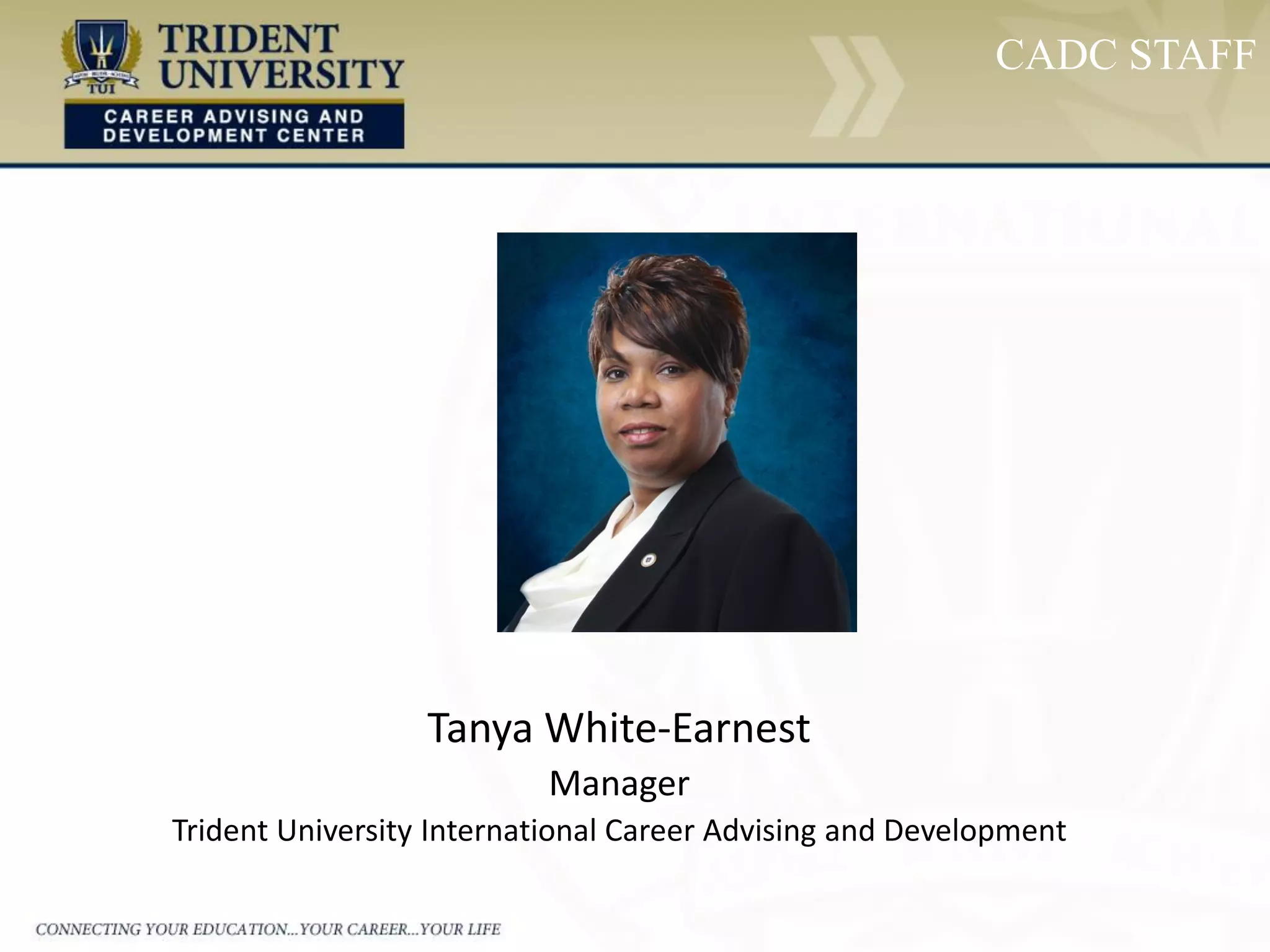
CADC STAFF
Tanya White-Earnest
Manager
Trident University International Career Advising and Development
Marketing
Staff
Daniel Sloan
Marketing Specialist
Trident University International
• Turn off email, phones, instant messaging
• Get involved in the webinar
• Use the Q&A panel to submit your questions
• Let family/colleagues know you are on a webinar to avoid
distractions
• Participant phones are muted
GET THE MOST OUT OF YOUR WEBINAR TODAY
CONTACT INFO
trident4careers@trident.edu
714-816-0366 X1943
Tanya.WhiteEarnest@trident.edu - CADC
Manager
Daniel.Sloan@trident.edu
6
AGENDA
▪ When not to negotiate
▪ How to prepare for negotiation
▪ How to recognize buying signals
▪ What to negotiate
▪ What not to do when you negotiate
▪ 10 tips to help you negotiate more effectively
▪ It’s all about value
10 Secrets of Effective Salary Negotiation
SEPTEMBER 09, 2015
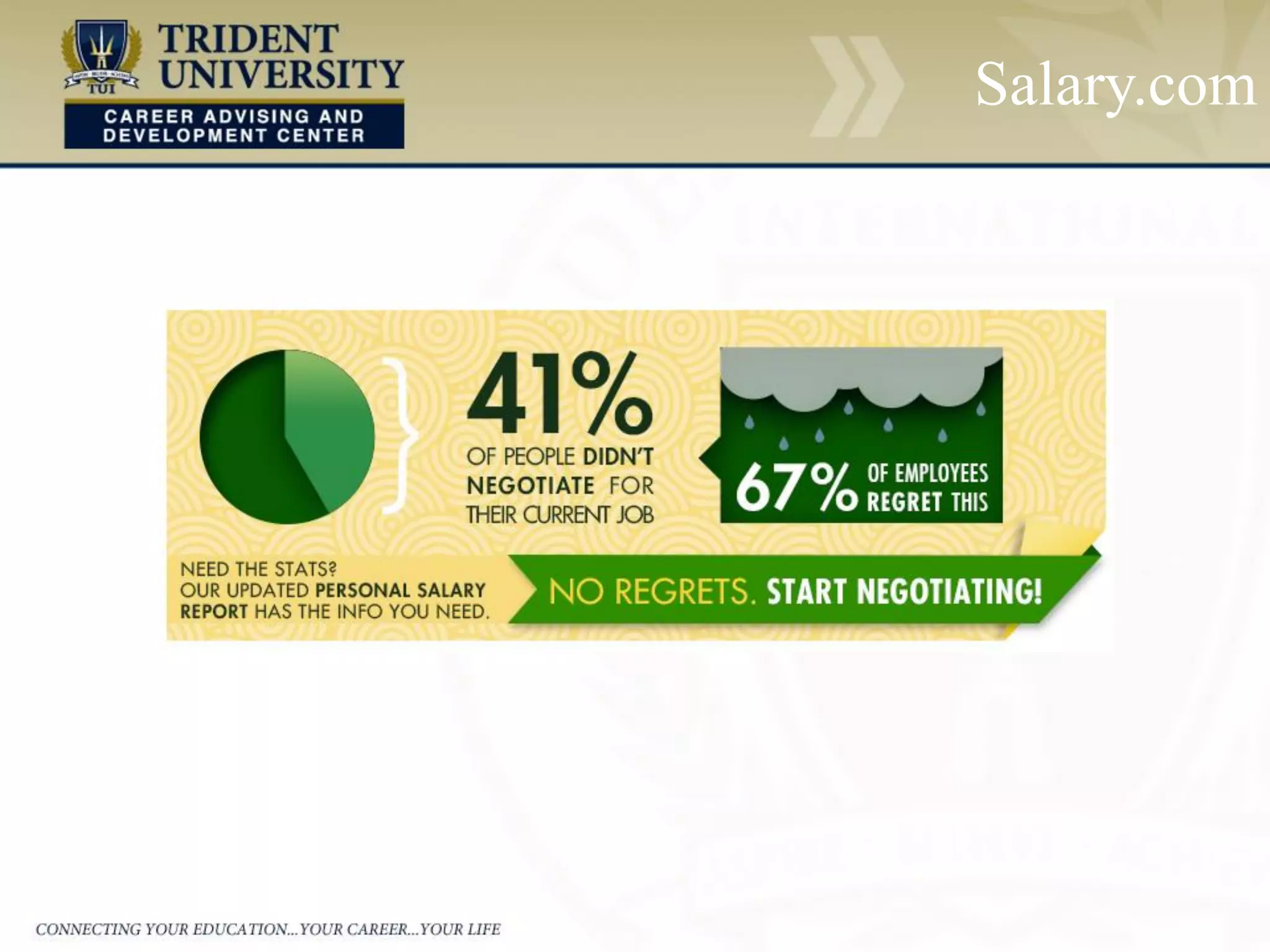
Salary.com
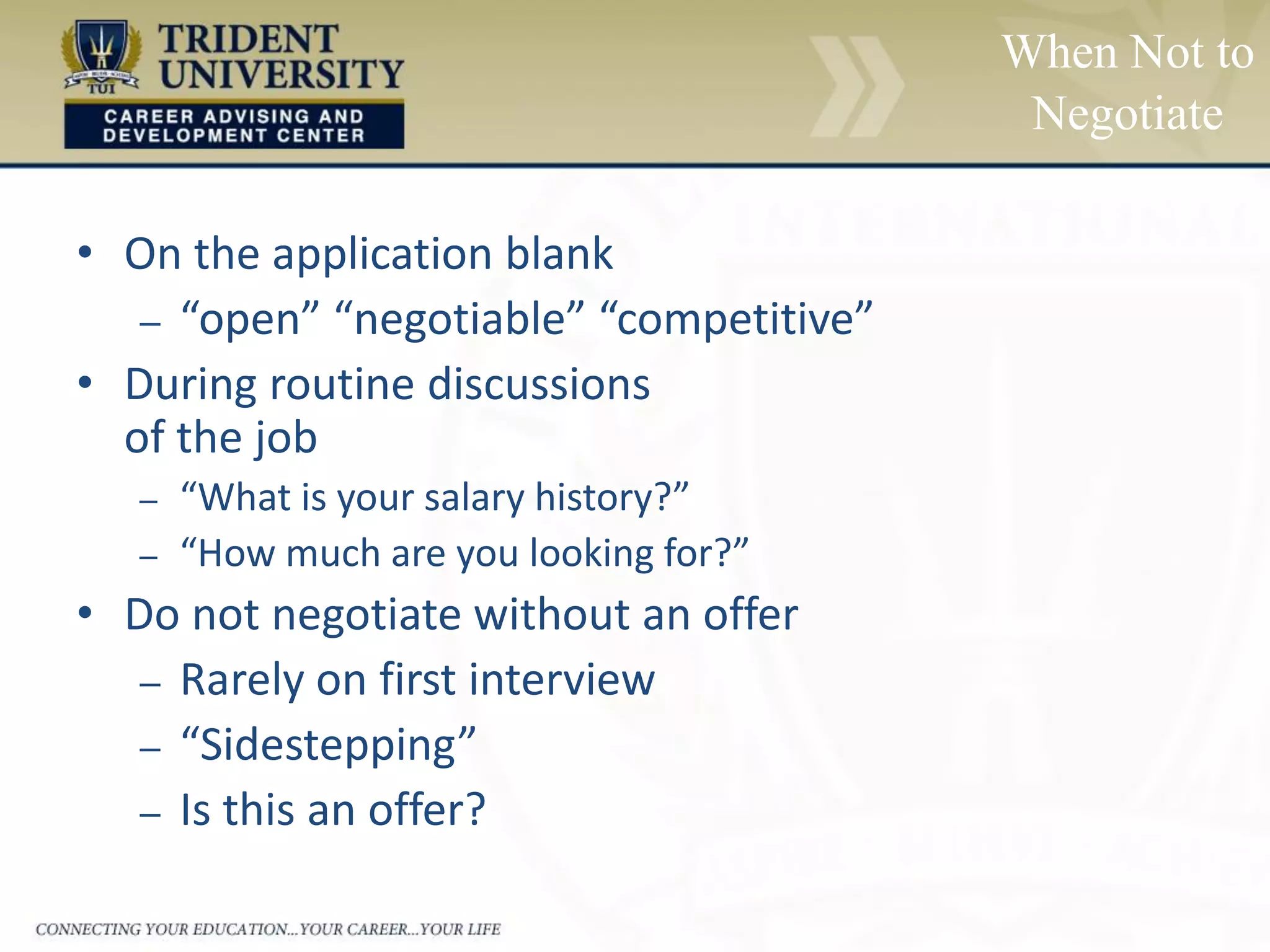
When Not to
Negotiate
• On the application blank
– “open” “negotiable” “competitive”
• During routine discussions
of the job
– “What is your salary history?”
– “How much are you looking for?”
• Do not negotiate without an offer
– Rarely on first interview
– “Sidestepping”
– Is this an offer?
9
WHEN TO
NEGOTIATE
SALARY
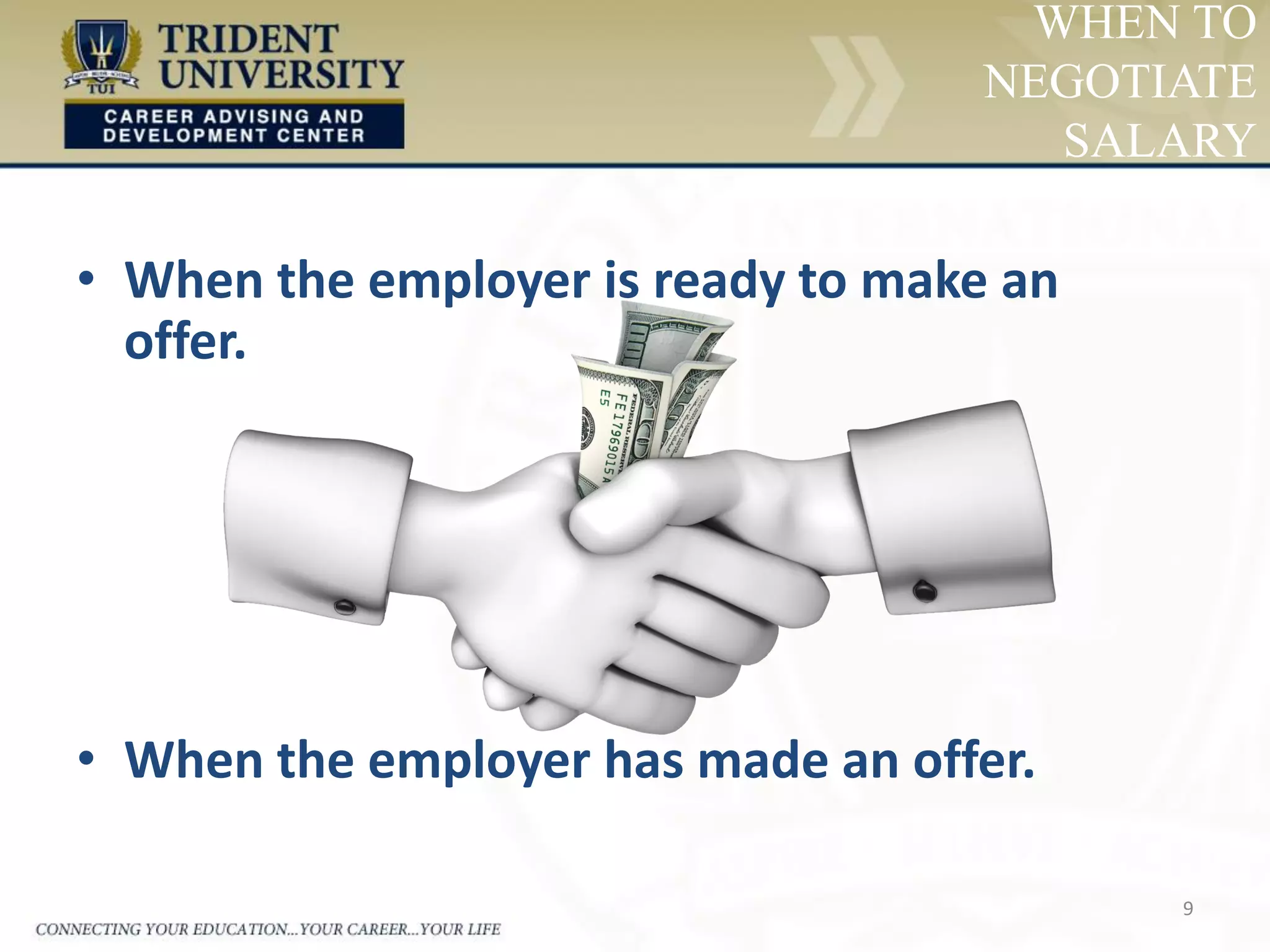
• When the employer is ready to make an
offer.
• When the employer has made an offer.
Buying
Signals
He/She says:
• “How do you think you would like working
here?”
• “People with your background always fit in
well with us.”
• “You could make a real contribution here.”
• “Well, you certainly seem to have what it
takes.”
• Get comfortable talking about money
• Know your value and the value of the position
you are seeking to the industry, in the area, at
that company
• Be prepared to share your evidence of your
value
• Realize that compensation is about much
more than money
• Set realistic expectations and understand you
may not get everything you want
Tips for
Negotiating
• Always be prepared to talk about salary
• Silence is golden
• Verify the scope of the job before negotiating
• Know your fit for the job
• Sell VALUE and CONTRIBUTION
Tips for
Negotiating
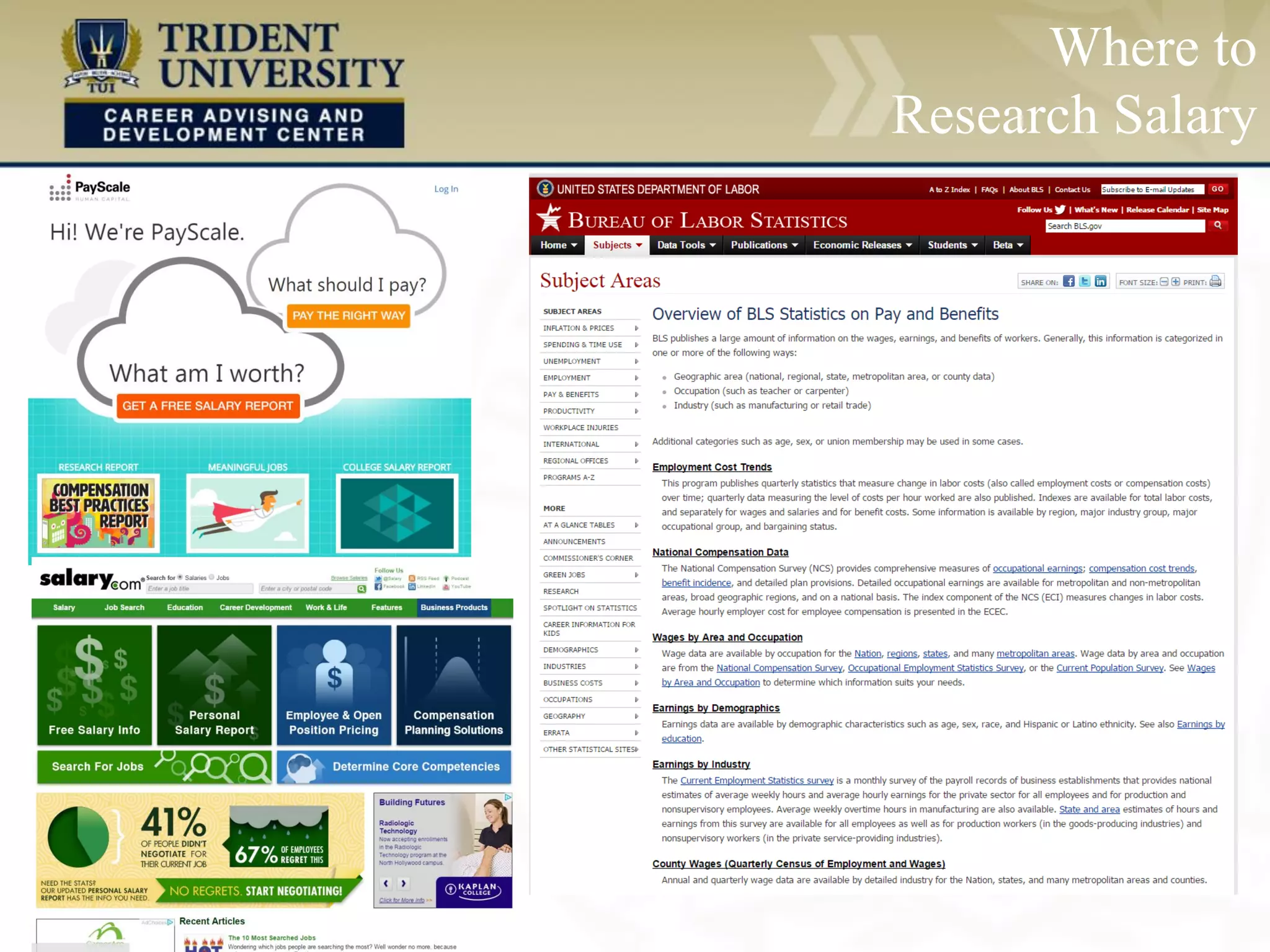
Salaries in Your Field & Industry
• Read the trade journals for your
industry.
• Review salary information on
Payscale.com, Salary.com, or other sites
• Talk to an employee in the field.
•Use your network to find out what
others make at the same level.
Be Prepared
to Negotiate
It’s Not Just
Money
• Base Salary (FINISH IT FIRST!)
• Bonus (gross/net taxes, signing
advantage/disadvantage)
• Medical coverage (COBRA coverage)
• Retirement, 401(k) regulated
• Vacation
• Relocation (taxes)
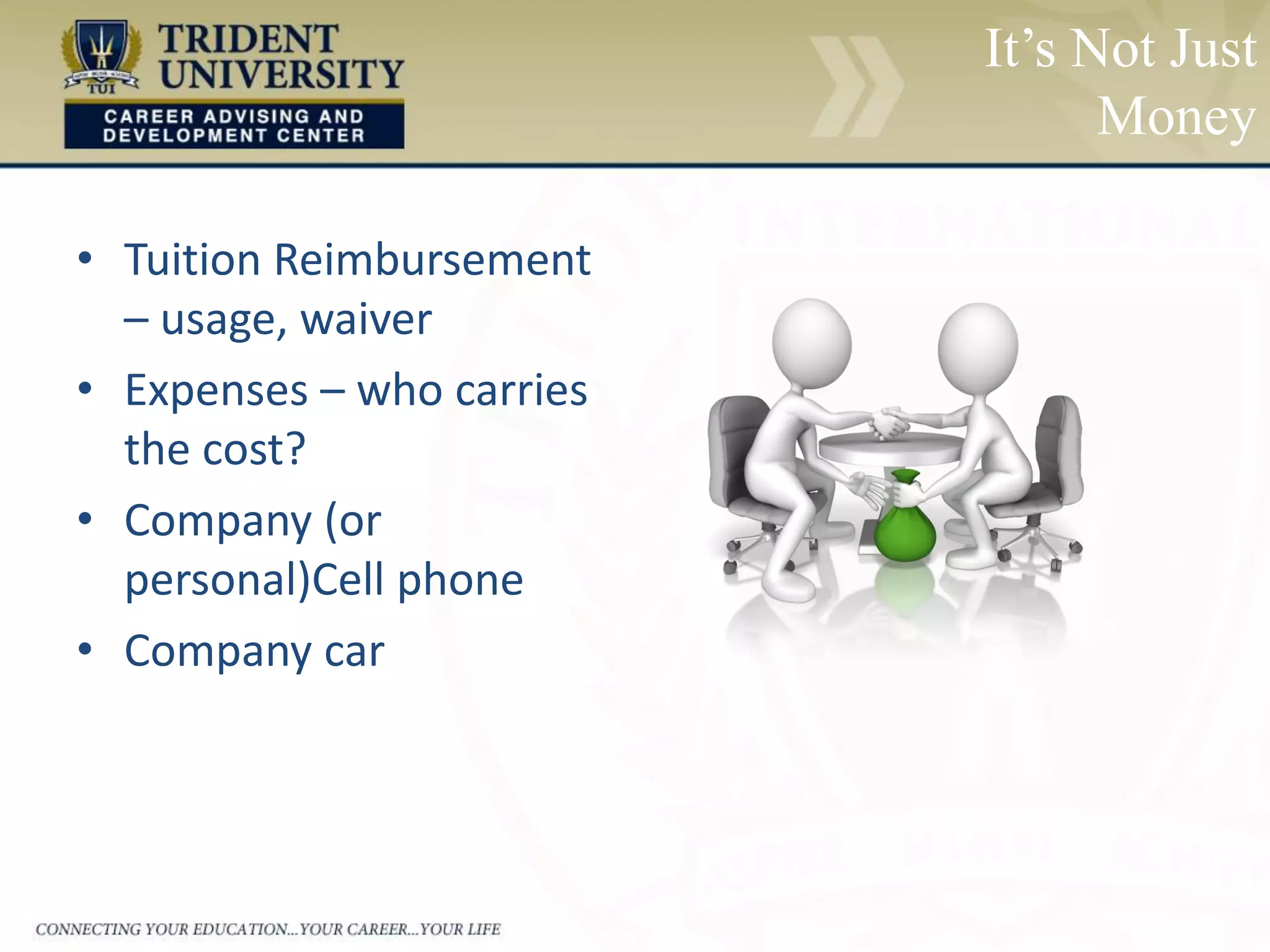
• Tuition Reimbursement
– usage, waiver
• Expenses – who carries
the cost?
• Company (or
personal)Cell phone
• Company car
It’s Not Just
Money
Where to
Research Salary
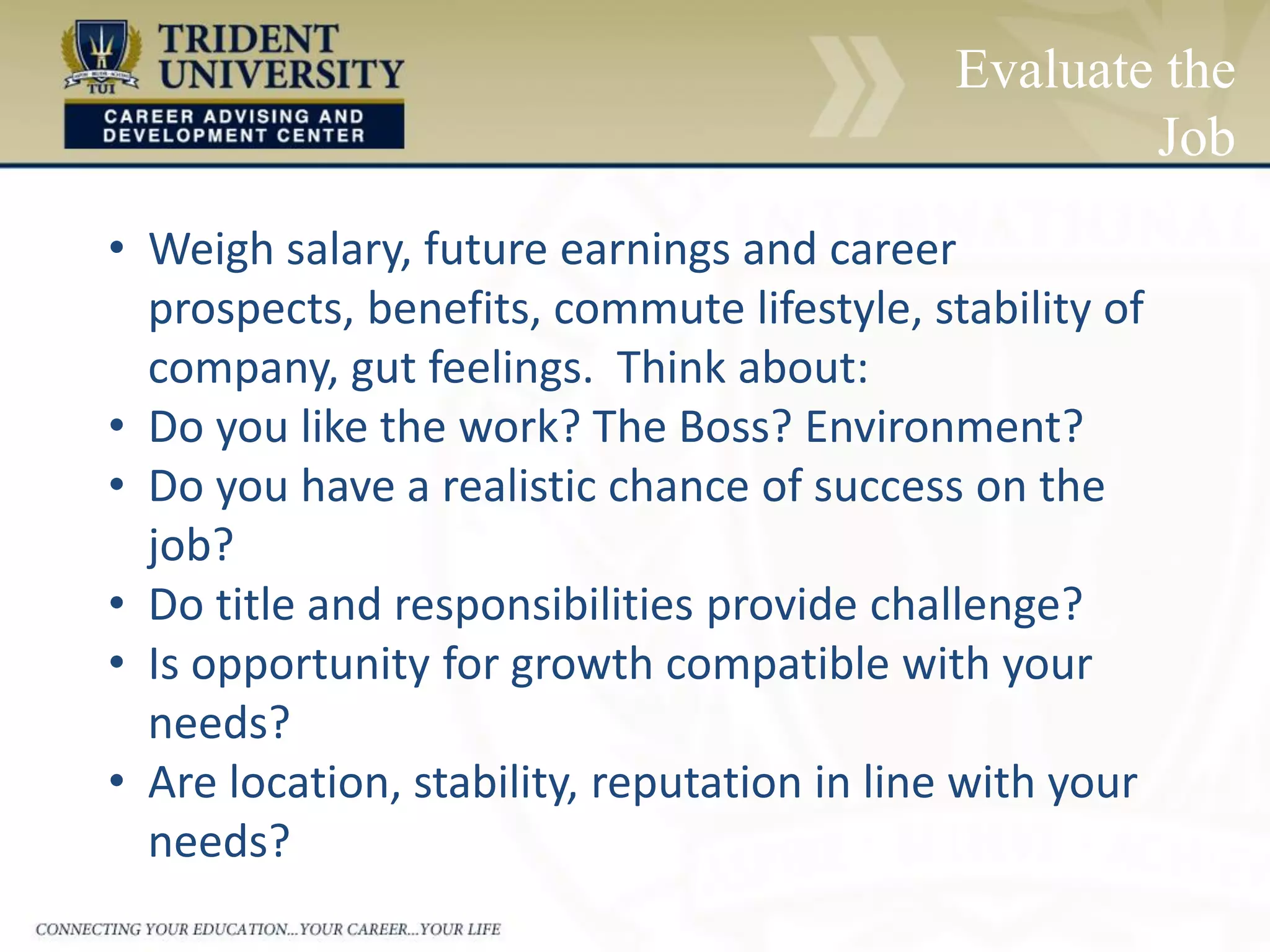
Evaluate the
Offer
• If it sounds fair and equitable (You still want to
negotiate)
• ALWAYS say how excited you are
about the opportunity and how much
you want to work there.
• If it meets your needs, your career interests,
etc. money may not be so important.
• Think it over, don’t decide on the spot.
• Get a Written Offer/Contract.
• KEEP LOOKING UNTIL YOU DO!
• STOP LOOKING IF YOU ACCEPT
Evaluate the
Job
• Weigh salary, future earnings and career
prospects, benefits, commute lifestyle, stability of
company, gut feelings. Think about:
• Do you like the work? The Boss? Environment?
• Do you have a realistic chance of success on the
job?
• Do title and responsibilities provide challenge?
• Is opportunity for growth compatible with your
needs?
• Are location, stability, reputation in line with your
needs?
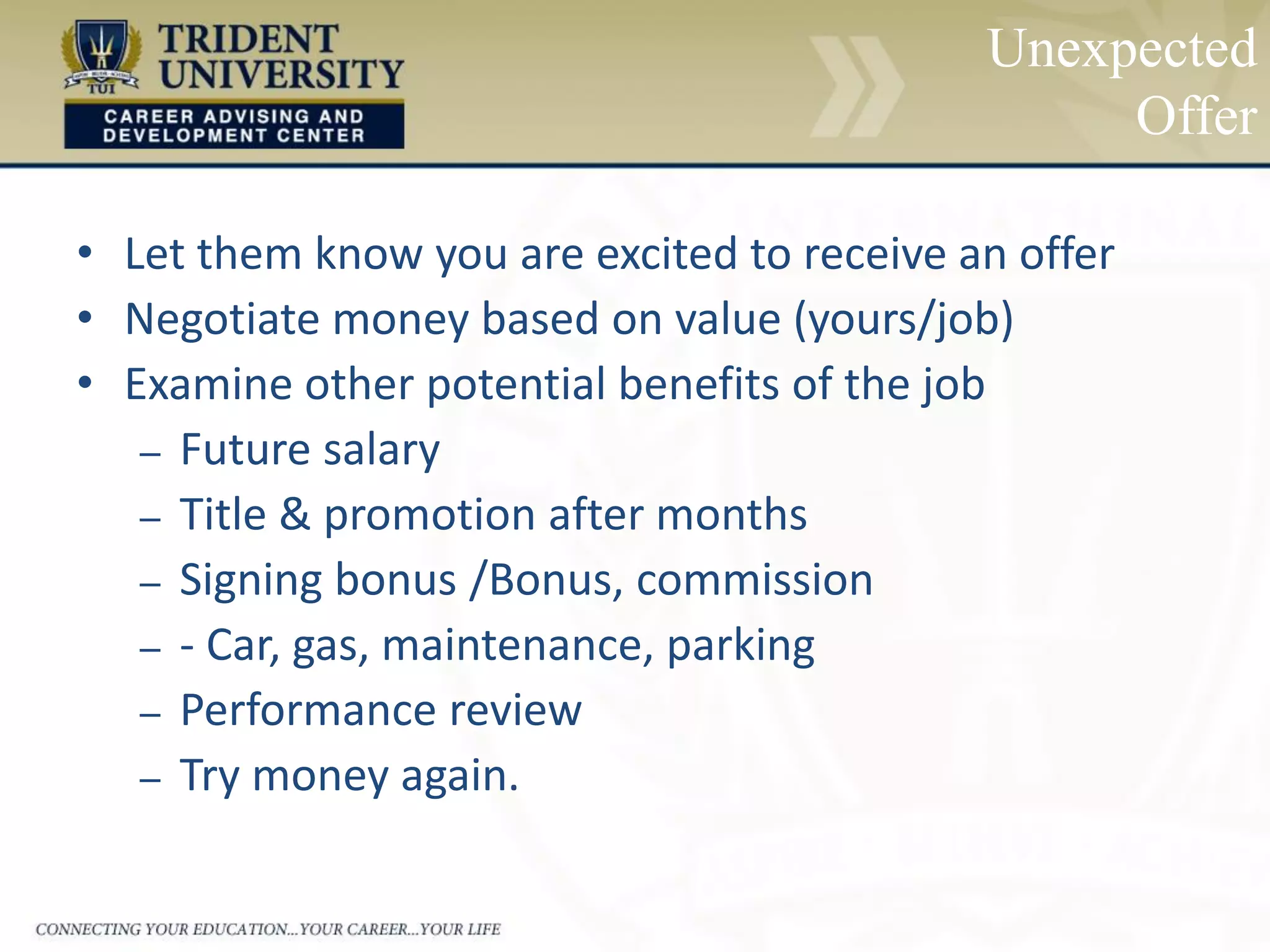
Unexpected
Offer
• Let them know you are excited to receive an offer
• Negotiate money based on value (yours/job)
• Examine other potential benefits of the job
– Future salary
– Title & promotion after months
– Signing bonus /Bonus, commission
– - Car, gas, maintenance, parking
– Performance review
– Try money again.
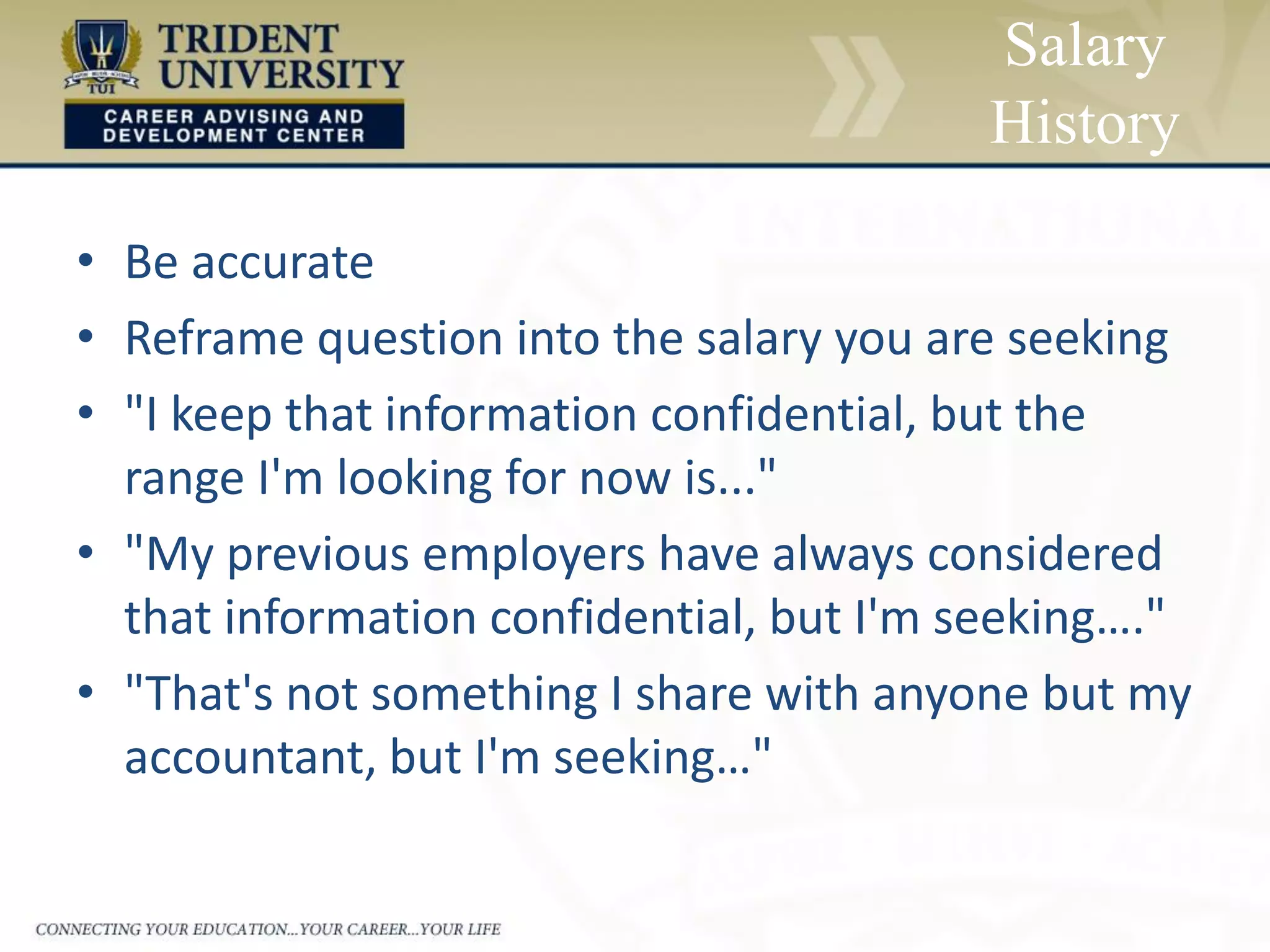
• Be accurate
• Reframe question into the salary you are seeking
• "I keep that information confidential, but the
range I'm looking for now is..."
• "My previous employers have always considered
that information confidential, but I'm seeking…."
• "That's not something I share with anyone but my
accountant, but I'm seeking…"
Salary
History
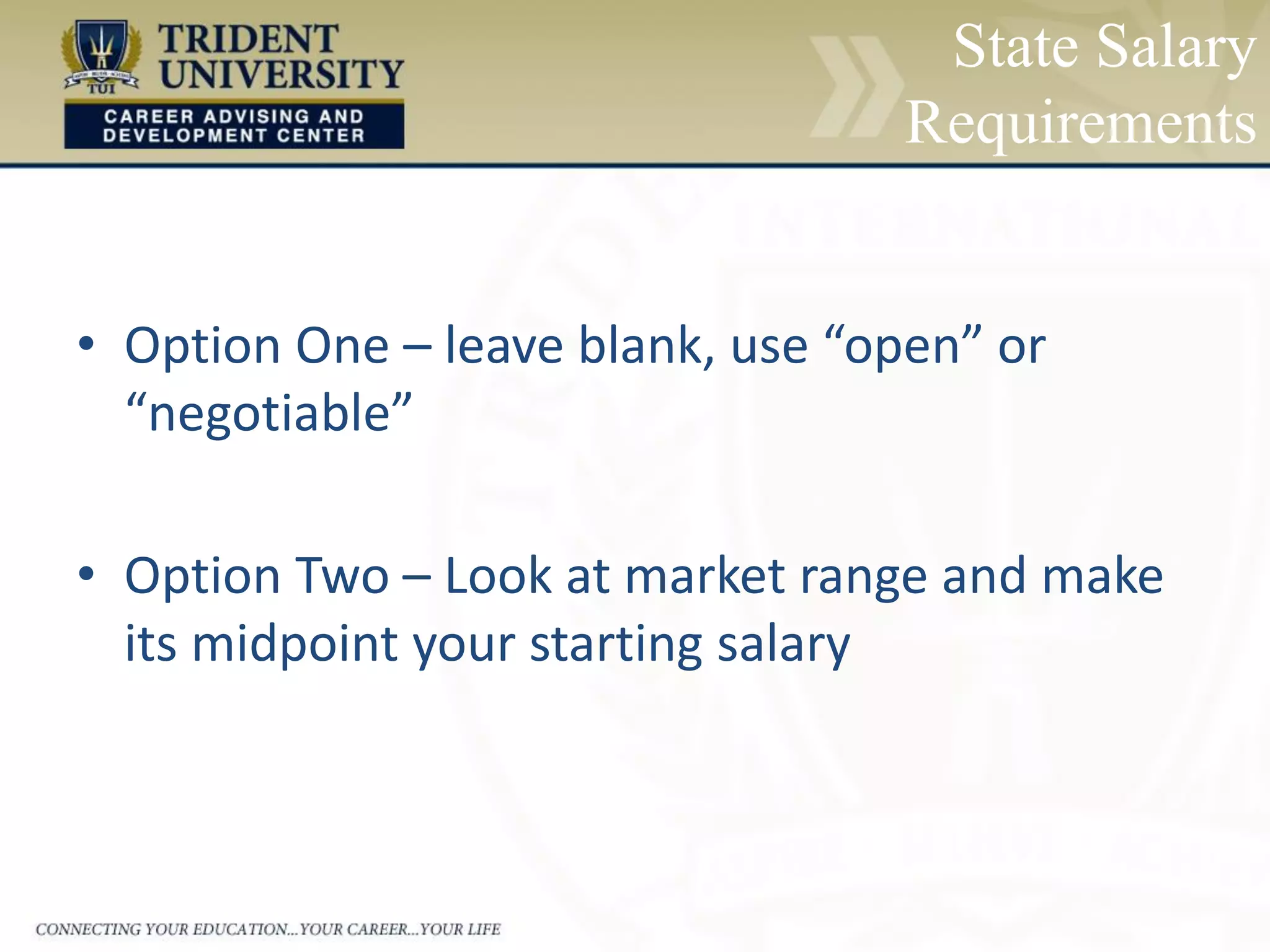
State Salary
Requirements
• Option One – leave blank, use “open” or
“negotiable”
• Option Two – Look at market range and make
its midpoint your starting salary
Early in the
Process
• Option One – Ask about the job itself
• Option Two – Talk about the value you bring
Before the
Offer
• Option One – Discuss scope of responsibility,
size of territory, . . .
• Option Two – Good company reputation for
fair compensation
• Option Three – If we agree this is a good fit,
we’re sure to agree on salary
• Option Four – May I ask the range (turn tables
politely)
Money Questions
Become Direct
• Option One – Can’t
compare apples to
oranges
• Option Two – Prefer to
fit in employer’s
established range –
what is it?
What will it take
to hire you?
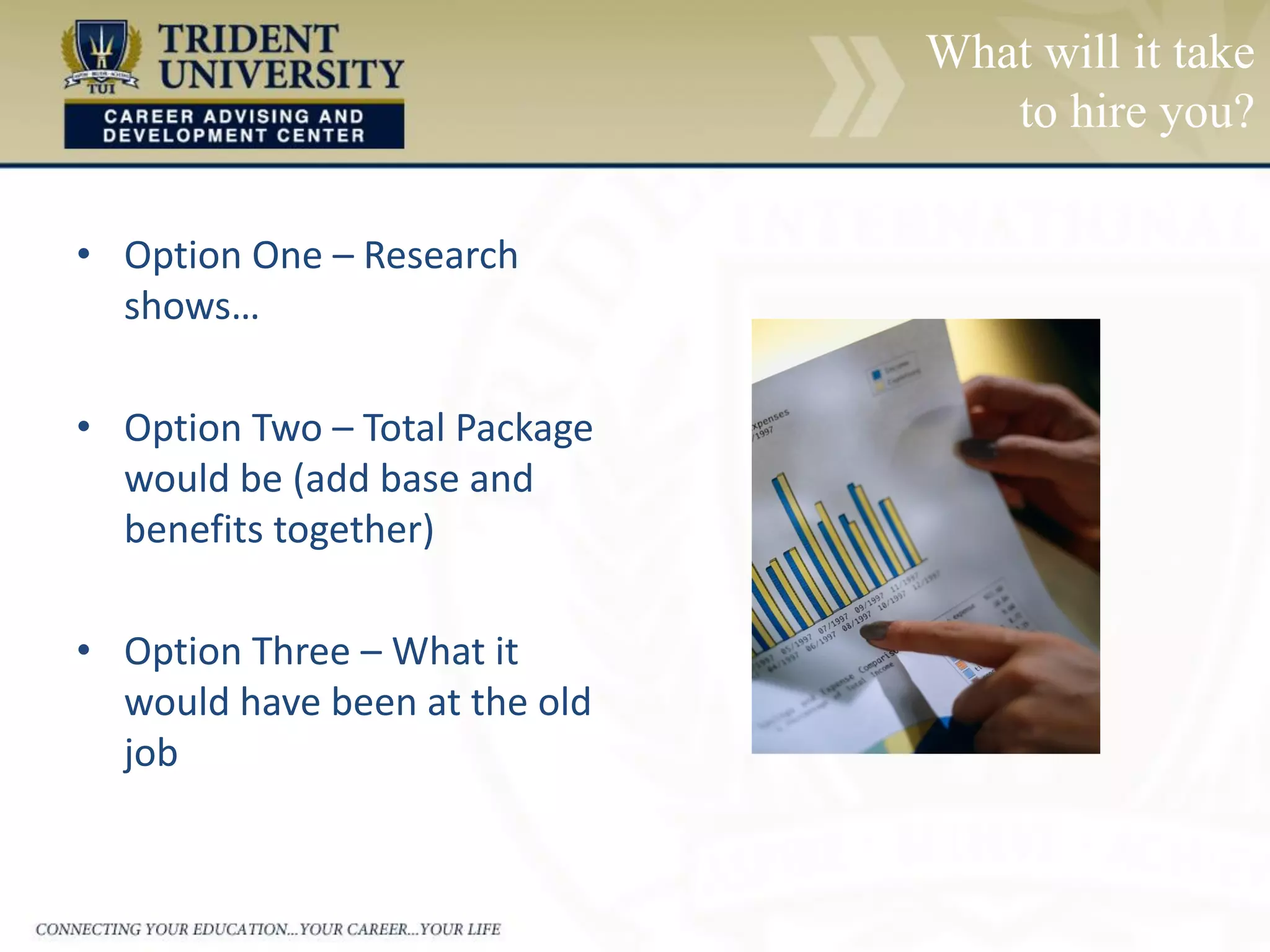
• Option One – Research
shows…
• Option Two – Total Package
would be (add base and
benefits together)
• Option Three – What it
would have been at the old
job
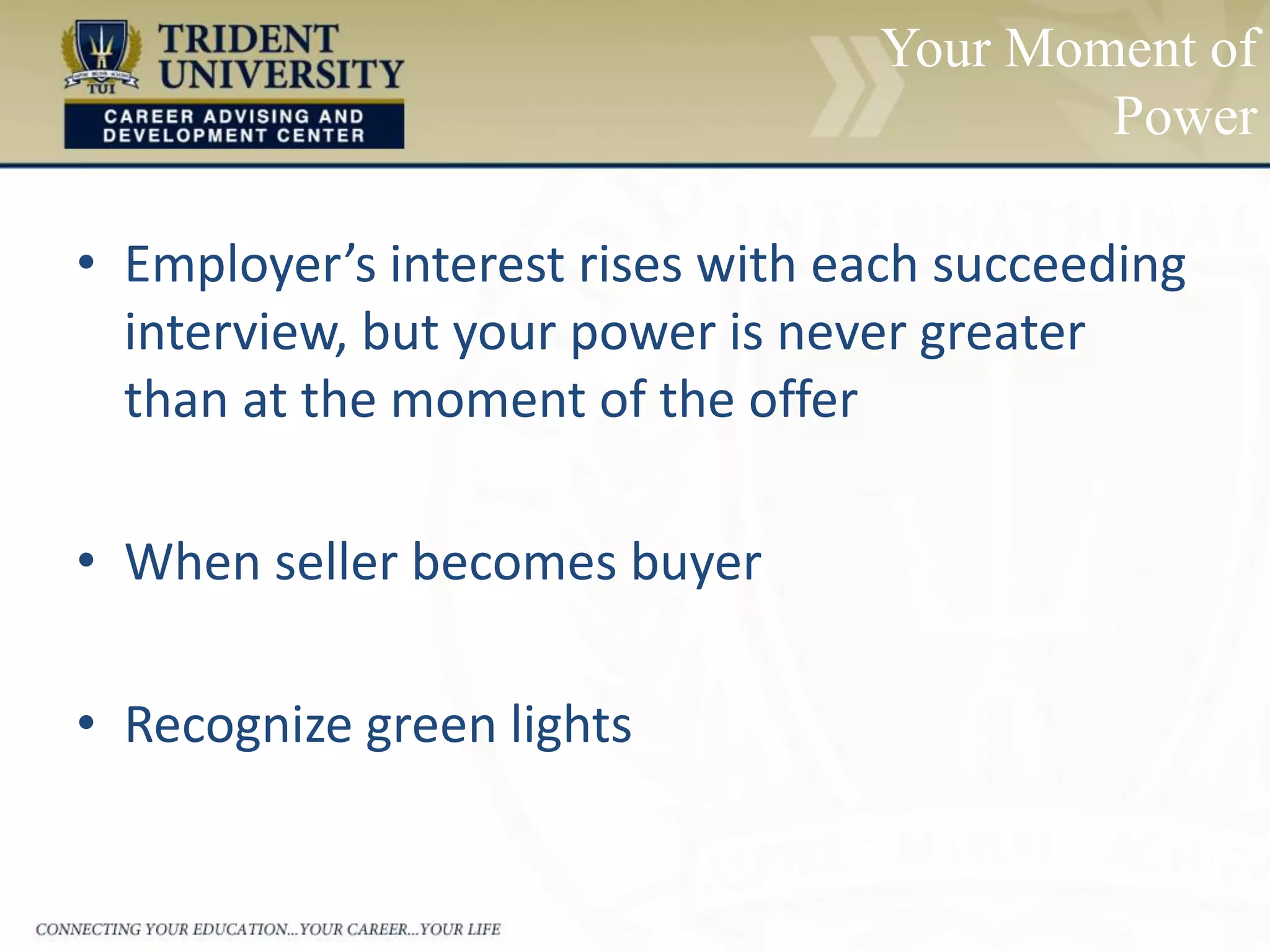
Your Moment of
Power
• Employer’s interest rises with each succeeding
interview, but your power is never greater
than at the moment of the offer
• When seller becomes buyer
• Recognize green lights
27
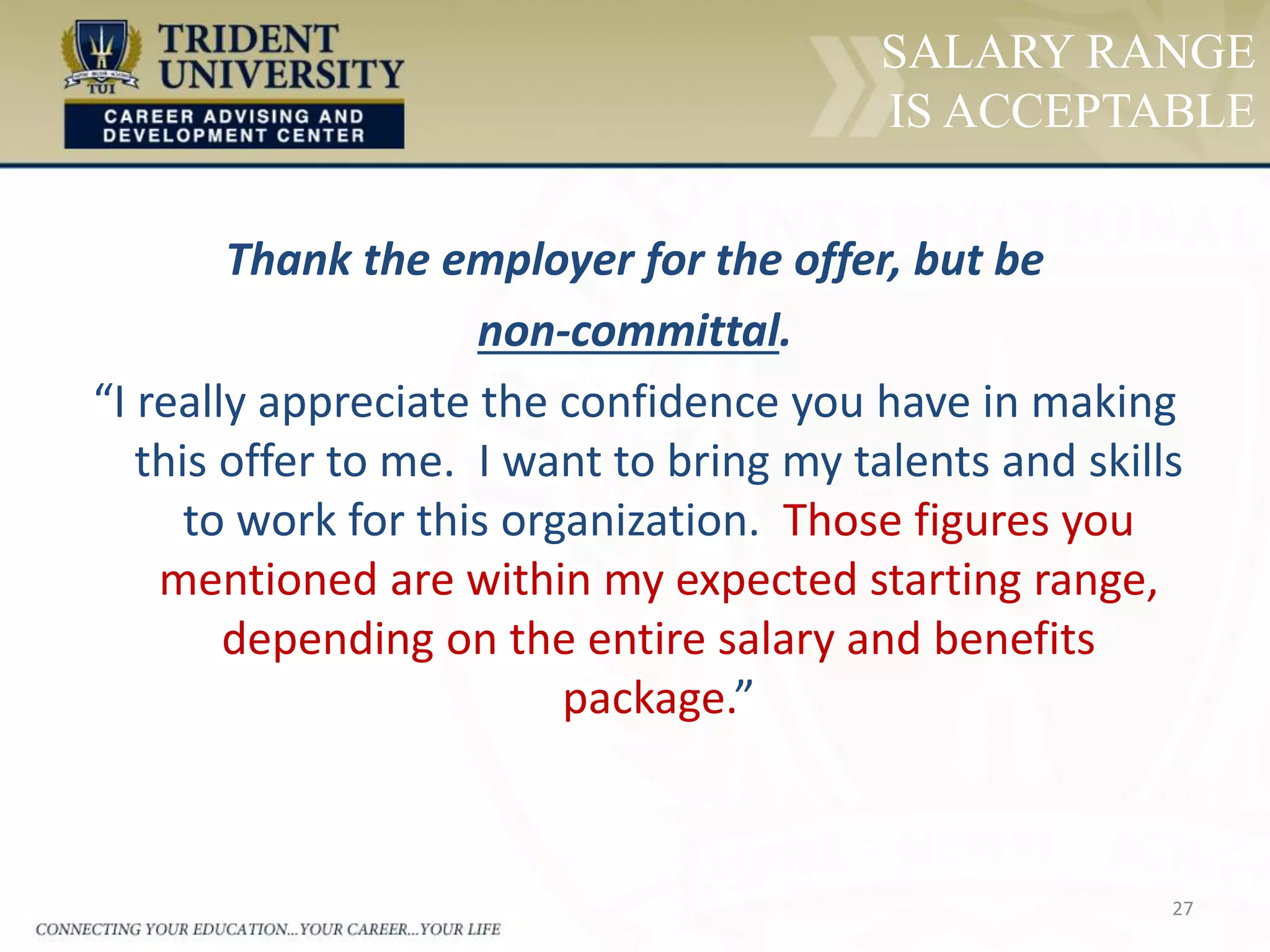
SALARY RANGE
IS ACCEPTABLE
Thank the employer for the offer, but be
non-committal.
“I really appreciate the confidence you have in making
this offer to me. I want to bring my talents and skills
to work for this organization. Those figures you
mentioned are within my expected starting range,
depending on the entire salary and benefits
package.”
28
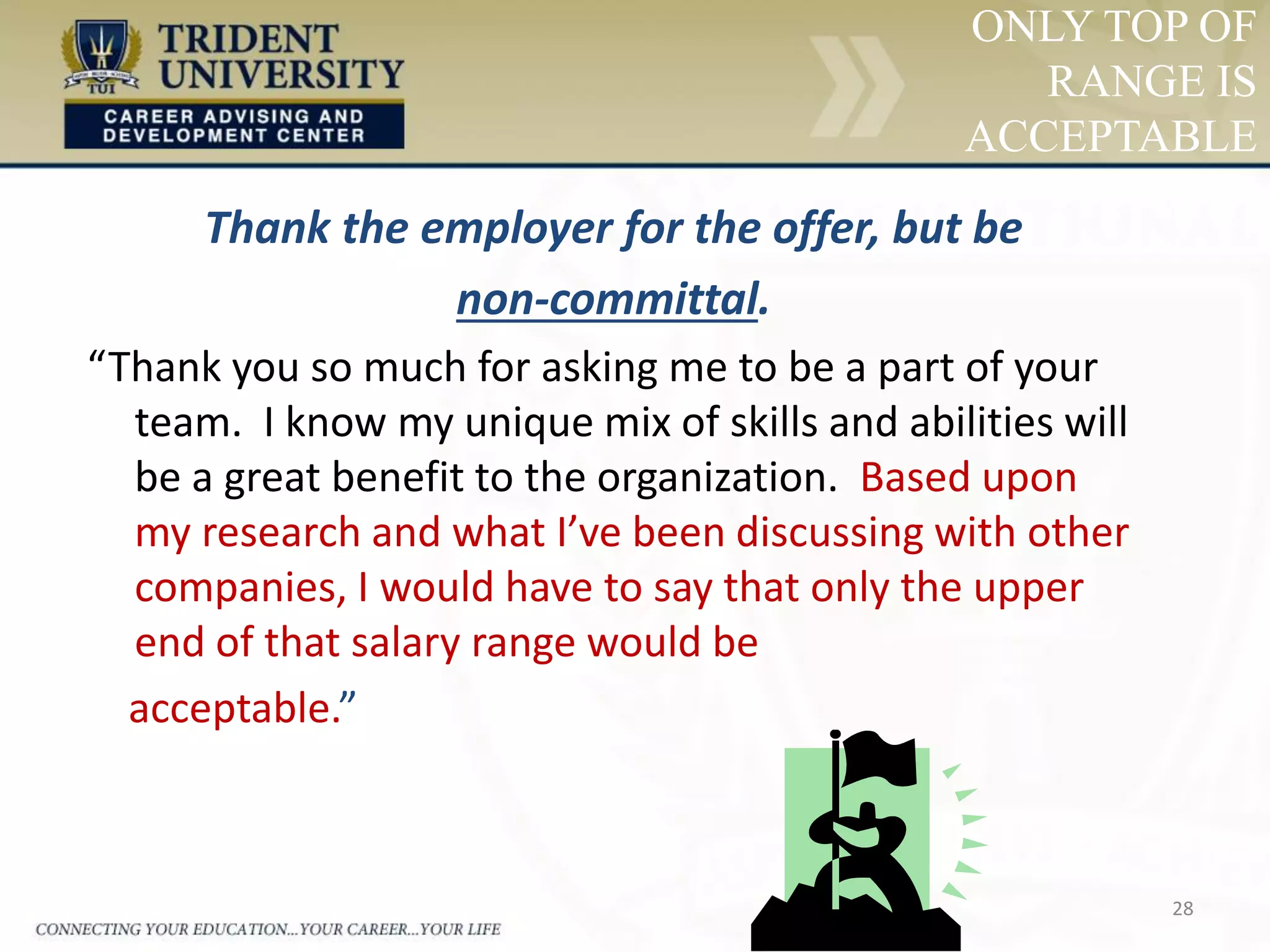
ONLY TOP OF
RANGE IS
ACCEPTABLE
Thank the employer for the offer, but be
non-committal.
“Thank you so much for asking me to be a part of your
team. I know my unique mix of skills and abilities will
be a great benefit to the organization. Based upon

my research and what I’ve been discussing with other
companies, I would have to say that only the upper
end of that salary range would be
acceptable.”
29
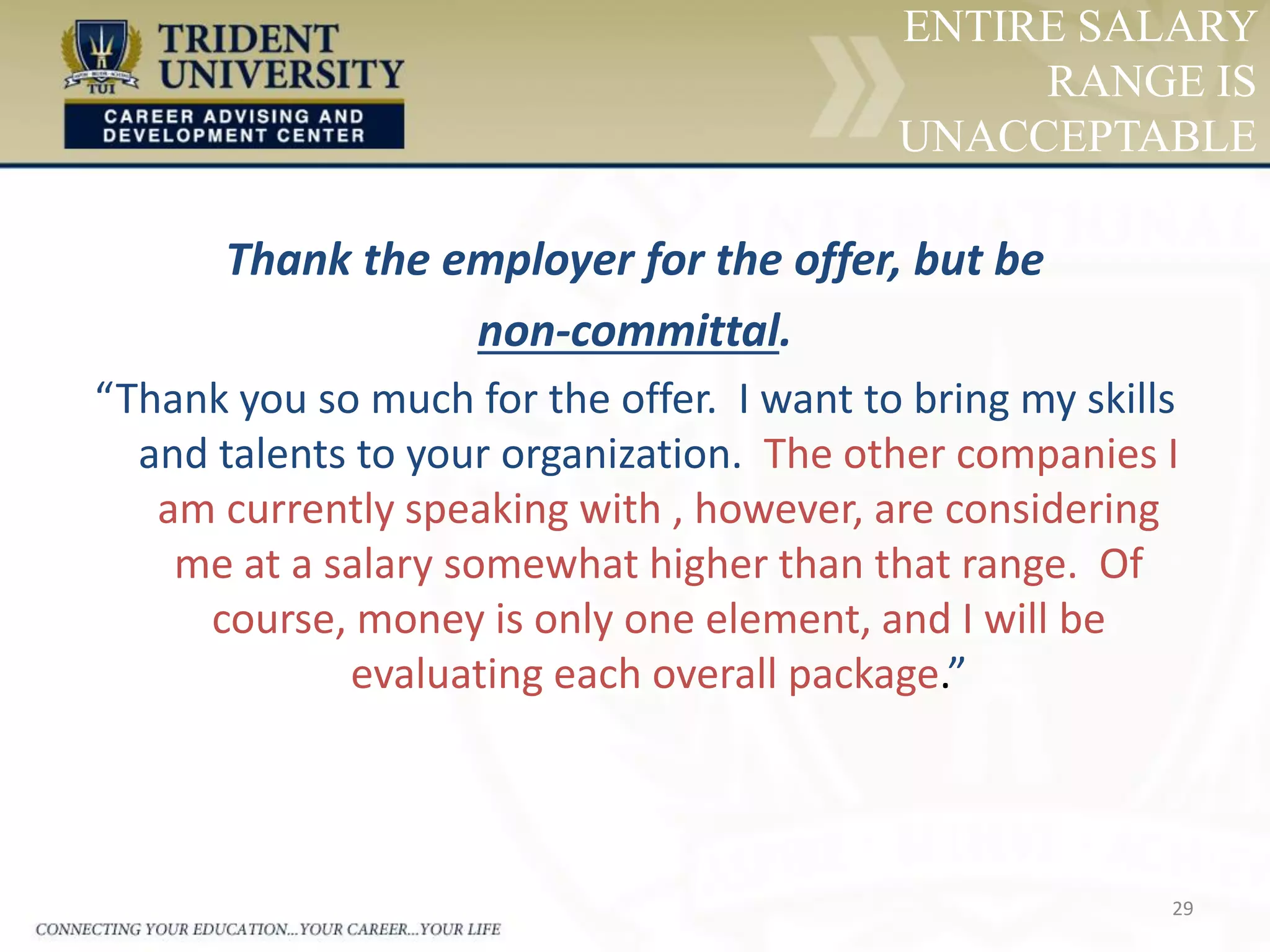
ENTIRE SALARY
RANGE IS
UNACCEPTABLE
Thank the employer for the offer, but be
non-committal.
“Thank you so much for the offer. I want to bring my skills
and talents to your organization. The other companies I
am currently speaking with , however, are considering
me at a salary somewhat higher than that range. Of
course, money is only one element, and I will be
evaluating each overall package.”
30
NO SALARY RANGE
IS OFFERED
When interviewer doesn’t give you a specific salary
offer and keeps pushing you for your salary
expectations.
“From my research, $XX,XXX is around the base level
for salary for this type of position. Considering my
enthusiasm and my general success in the things I set
out to do, I believe I’m worth mid-range, say
$XX,XXX. What can you do in that area?”
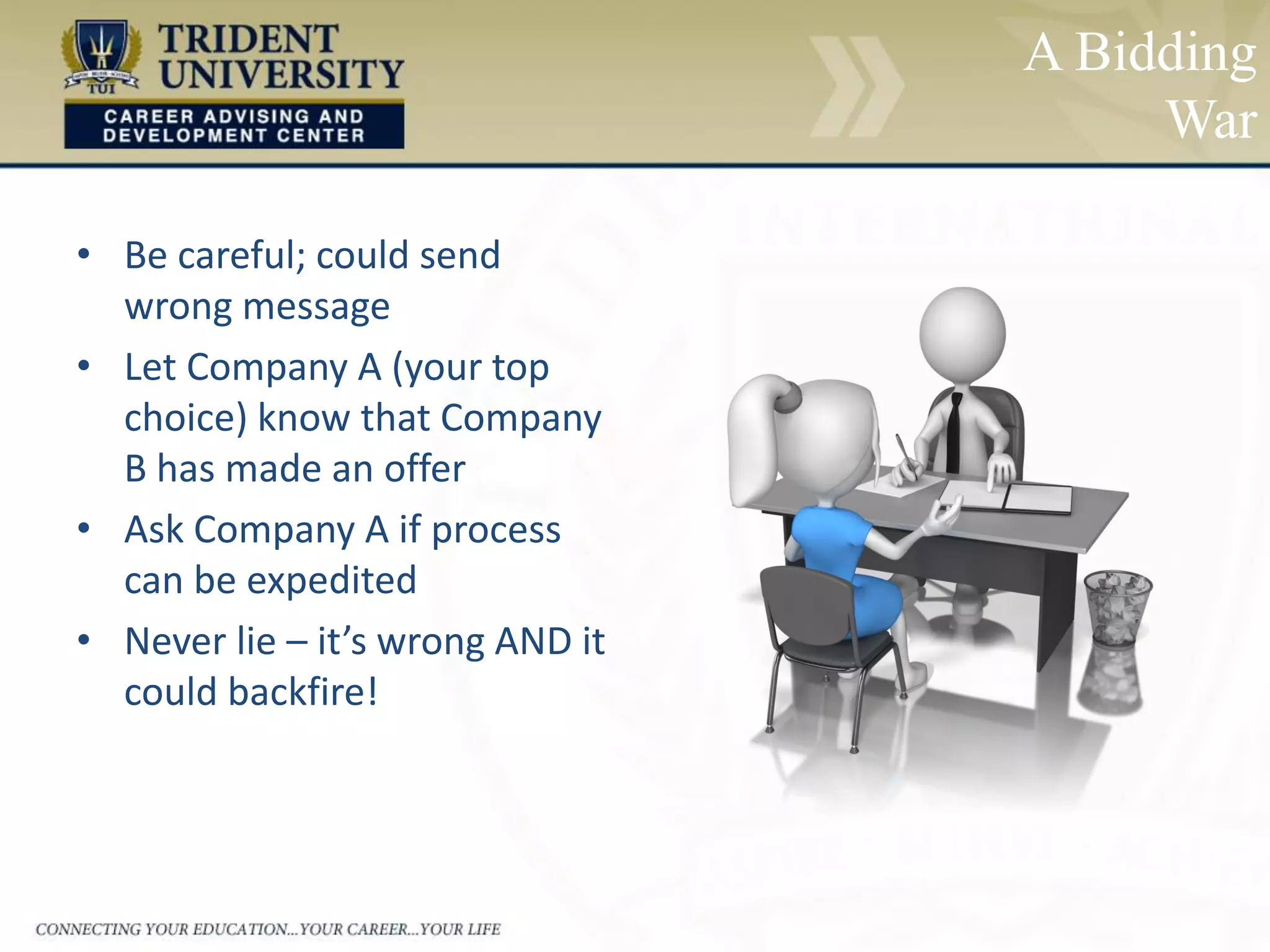
A Bidding
War
• Be careful; could send
wrong message
• Let Company A (your top
choice) know that Company
B has made an offer
• Ask Company A if process
can be expedited
• Never lie – it’s wrong AND it
could backfire!
Homework
• Identify a job you would be interested in
having in an actual company.
– E.g., monster, Indeed, Simply Hired, etc.
• Find out the market rate for that job.
– E.g., http://www.bls.gov/bls/wages.htm
– Write out at least five good arguments for why
you would be worth a higher salary than they
might offer.
10 Secrets to
Effective
Negotiation
1. It’s not all about you
2. It’s not all about money
3. Negotiate after an offer is made
4. Do your research before the interview – be prepared
5. Understand the value of the position to the company
6. Ask for time; NEVER accept on the spot.
7. Negotiate on the same level
8. Know that the opportunity may be greater than the
money
9. Silence is golden
10. Be prepared to walk away
QUESTIONS / COMMENTS?
NEXT WEBINAR
Join us in 2 weeks for:
Ph.D vs Ed.D: Which Degree
is Right for You?
Featuring Dr. Wenling Li and Dr. Heidi Gilligan
• Ph.D Educational Leadership program
• Ed.D Educational Leadership
• Career Paths
THANK YOU!
We appreciate you joining us today for:
“10 Secrets to Effective Salary Negotiation”
We hope you enjoyed and learned something new from the session
Watch for the email containing the link to the recording and the
Slideshare for today’s webinar
Please be sure to leave your comments and suggestions as you log
out
See you next time!
trident4careers@trident.edu
714-816-0366 X1943
Tanya.WhiteEarnest@trident.edu - CADC
Manager
Daniel.Sloan@trident.edu
CONTACT
INFORMATION
▪ Career Planning
▪ Job Search
▪ Self-Assessment
▪ Career Transition/Advancement Assistance
▪ Resume Review/Critique and Preparation
▪ Mentoring and Networking Opportunities
Experience the Trident
University Advantage
Tanya White-Earnest | www.trident4careers.com | trident4careers@trident.edu
714.816.0366 x1943

CADC -- 10 Secrets of Effective Salary Negotiation

  • 1.
    10 Secrets ofEffective Salary Negotiation
  • 2.
    CADC STAFF Tanya White-Earnest Manager TridentUniversity International Career Advising and Development
  • 3.
  • 4.
    • Turn offemail, phones, instant messaging • Get involved in the webinar • Use the Q&A panel to submit your questions • Let family/colleagues know you are on a webinar to avoid distractions • Participant phones are muted GET THE MOST OUT OF YOUR WEBINAR TODAY
  • 5.
  • 6.
    6 AGENDA ▪ When notto negotiate ▪ How to prepare for negotiation ▪ How to recognize buying signals ▪ What to negotiate ▪ What not to do when you negotiate ▪ 10 tips to help you negotiate more effectively ▪ It’s all about value 10 Secrets of Effective Salary Negotiation SEPTEMBER 09, 2015
  • 7.
  • 8.
    When Not to Negotiate •On the application blank – “open” “negotiable” “competitive” • During routine discussions of the job – “What is your salary history?” – “How much are you looking for?” • Do not negotiate without an offer – Rarely on first interview – “Sidestepping” – Is this an offer?
  • 9.
    9 WHEN TO NEGOTIATE SALARY • Whenthe employer is ready to make an offer. • When the employer has made an offer.
  • 10.
    Buying Signals He/She says: • “Howdo you think you would like working here?” • “People with your background always fit in well with us.” • “You could make a real contribution here.” • “Well, you certainly seem to have what it takes.”
  • 11.
    • Get comfortabletalking about money • Know your value and the value of the position you are seeking to the industry, in the area, at that company • Be prepared to share your evidence of your value • Realize that compensation is about much more than money • Set realistic expectations and understand you may not get everything you want Tips for Negotiating
  • 12.
    • Always beprepared to talk about salary • Silence is golden • Verify the scope of the job before negotiating • Know your fit for the job • Sell VALUE and CONTRIBUTION Tips for Negotiating
  • 13.
    Salaries in YourField & Industry • Read the trade journals for your industry. • Review salary information on Payscale.com, Salary.com, or other sites • Talk to an employee in the field. •Use your network to find out what others make at the same level. Be Prepared to Negotiate
  • 14.
    It’s Not Just Money •Base Salary (FINISH IT FIRST!) • Bonus (gross/net taxes, signing advantage/disadvantage) • Medical coverage (COBRA coverage) • Retirement, 401(k) regulated • Vacation • Relocation (taxes)
  • 15.
    • Tuition Reimbursement –usage, waiver • Expenses – who carries the cost? • Company (or personal)Cell phone • Company car It’s Not Just Money
  • 16.
  • 17.
    Evaluate the Offer • Ifit sounds fair and equitable (You still want to negotiate) • ALWAYS say how excited you are about the opportunity and how much you want to work there. • If it meets your needs, your career interests, etc. money may not be so important. • Think it over, don’t decide on the spot. • Get a Written Offer/Contract. • KEEP LOOKING UNTIL YOU DO! • STOP LOOKING IF YOU ACCEPT
  • 18.
    Evaluate the Job • Weighsalary, future earnings and career prospects, benefits, commute lifestyle, stability of company, gut feelings. Think about: • Do you like the work? The Boss? Environment? • Do you have a realistic chance of success on the job? • Do title and responsibilities provide challenge? • Is opportunity for growth compatible with your needs? • Are location, stability, reputation in line with your needs?
  • 19.
    Unexpected Offer • Let themknow you are excited to receive an offer • Negotiate money based on value (yours/job) • Examine other potential benefits of the job – Future salary – Title & promotion after months – Signing bonus /Bonus, commission – - Car, gas, maintenance, parking – Performance review – Try money again.

  • 20.
    • Be accurate •Reframe question into the salary you are seeking • "I keep that information confidential, but the range I'm looking for now is..." • "My previous employers have always considered that information confidential, but I'm seeking…." • "That's not something I share with anyone but my accountant, but I'm seeking…" Salary History
  • 21.
    State Salary Requirements • OptionOne – leave blank, use “open” or “negotiable” • Option Two – Look at market range and make its midpoint your starting salary
  • 22.
    Early in the Process •Option One – Ask about the job itself • Option Two – Talk about the value you bring
  • 23.
    Before the Offer • OptionOne – Discuss scope of responsibility, size of territory, . . . • Option Two – Good company reputation for fair compensation • Option Three – If we agree this is a good fit, we’re sure to agree on salary • Option Four – May I ask the range (turn tables politely)
  • 24.
    Money Questions Become Direct •Option One – Can’t compare apples to oranges • Option Two – Prefer to fit in employer’s established range – what is it?
  • 25.
    What will ittake to hire you? • Option One – Research shows… • Option Two – Total Package would be (add base and benefits together) • Option Three – What it would have been at the old job
  • 26.
    Your Moment of Power •Employer’s interest rises with each succeeding interview, but your power is never greater than at the moment of the offer • When seller becomes buyer • Recognize green lights
  • 27.
    27 SALARY RANGE IS ACCEPTABLE Thankthe employer for the offer, but be non-committal. “I really appreciate the confidence you have in making this offer to me. I want to bring my talents and skills to work for this organization. Those figures you mentioned are within my expected starting range, depending on the entire salary and benefits package.”
  • 28.
    28 ONLY TOP OF RANGEIS ACCEPTABLE Thank the employer for the offer, but be non-committal. “Thank you so much for asking me to be a part of your team. I know my unique mix of skills and abilities will be a great benefit to the organization. Based upon my research and what I’ve been discussing with other companies, I would have to say that only the upper end of that salary range would be acceptable.”
  • 29.
    29 ENTIRE SALARY RANGE IS UNACCEPTABLE Thankthe employer for the offer, but be non-committal. “Thank you so much for the offer. I want to bring my skills and talents to your organization. The other companies I am currently speaking with , however, are considering me at a salary somewhat higher than that range. Of course, money is only one element, and I will be evaluating each overall package.”
  • 30.
    30 NO SALARY RANGE ISOFFERED When interviewer doesn’t give you a specific salary offer and keeps pushing you for your salary expectations. “From my research, $XX,XXX is around the base level for salary for this type of position. Considering my enthusiasm and my general success in the things I set out to do, I believe I’m worth mid-range, say $XX,XXX. What can you do in that area?”
  • 31.
    A Bidding War • Becareful; could send wrong message • Let Company A (your top choice) know that Company B has made an offer • Ask Company A if process can be expedited • Never lie – it’s wrong AND it could backfire!
  • 32.
    Homework • Identify ajob you would be interested in having in an actual company. – E.g., monster, Indeed, Simply Hired, etc. • Find out the market rate for that job. – E.g., http://www.bls.gov/bls/wages.htm – Write out at least five good arguments for why you would be worth a higher salary than they might offer.
  • 33.
    10 Secrets to Effective Negotiation 1.It’s not all about you 2. It’s not all about money 3. Negotiate after an offer is made 4. Do your research before the interview – be prepared 5. Understand the value of the position to the company 6. Ask for time; NEVER accept on the spot. 7. Negotiate on the same level 8. Know that the opportunity may be greater than the money 9. Silence is golden 10. Be prepared to walk away
  • 34.
  • 35.
    NEXT WEBINAR Join usin 2 weeks for: Ph.D vs Ed.D: Which Degree is Right for You? Featuring Dr. Wenling Li and Dr. Heidi Gilligan • Ph.D Educational Leadership program • Ed.D Educational Leadership • Career Paths
  • 36.
    THANK YOU! We appreciateyou joining us today for: “10 Secrets to Effective Salary Negotiation” We hope you enjoyed and learned something new from the session Watch for the email containing the link to the recording and the Slideshare for today’s webinar Please be sure to leave your comments and suggestions as you log out See you next time!
  • 37.
    trident4careers@trident.edu 714-816-0366 X1943 Tanya.WhiteEarnest@trident.edu -CADC Manager Daniel.Sloan@trident.edu CONTACT INFORMATION
  • 38.
    ▪ Career Planning ▪Job Search ▪ Self-Assessment ▪ Career Transition/Advancement Assistance ▪ Resume Review/Critique and Preparation ▪ Mentoring and Networking Opportunities Experience the Trident University Advantage Tanya White-Earnest | www.trident4careers.com | trident4careers@trident.edu 714.816.0366 x1943