BS Economics
psy-2119
Lecture No. 4 : PERCEPTION
SAIMA ZAFAR
Lecturer psychology
Date: Dec,2020
LEARNING OBJECTIVES
After reading this chapter, student will able to tell about :
PERCEPTION :
• Nature of perception
• Factor of perception:
Subjective, objective and social
• kinds of perception :
I. Spatial perception ( perception of depth and distance)
II. Temporal perception
III. Auditory perception
BACTERIOLOGY & VIROLOGY 2
Definition of perception
3
BACTERIOLOGY & VIROLOGY
Perception can be defined as:
“Our recognition and interpretation of
sensory information. Perception also includes how
we respond to the information. Perception allows
us to take the sensory information in and make it
into something meaningful.”
Nature of perception
4
BACTERIOLOGY & VIROLOGY
• Perception refers to the interpretation of sensory data.
• In other words, sensation involves detecting the presence of a
stimulus whereas perception involves understanding what the
stimulus means.
• For example, when we see something, the visual stimulus is the light
energy reflected from the external world and the eye becomes the
sensor. This visual image of the external thing becomes perception
when it is interpreted in the visual cortex of the brain. Thus, visual
perception refers to interpreting the image of the external world
projected on the retina of the eye and constructing a model of the
three dimensional world.”
Nature of perception (2)
5
BACTERIOLOGY & VIROLOGY
• Perception is determined by both physiological and psychological
characteristics of the human being whereas sensation is conceived
with only the physiological features.
• Perception is a subjective process, therefore, different people may
perceive the same environment differently based on what particular
aspects of the situation they choose to selectively absorb, how they
organize this information and the manner in which they interpret it to
obtain a grasp of the situation.
Factors of perception
6
BACTERIOLOGY & VIROLOGY
• Subjective perception can mean more than one thing.
The more popular meaning is your personal opinions and beliefs. Like if
something is ugly or beautiful, if chocolate ice-cream tastes better than vanilla
and things like that.
• They are personal because they are not factual beliefs, in the sense that there is
no objective way of "knowing" if chocolate is in fact better than vanilla. It can be
better to me, but maybe to you vanilla tastes better.
• In philosophy, however, subjective perception has a slightly different meaning.
It means every sensation that you feel. It's not exactly the opinion you have of
the sensation (e.g. "chocolate tastes better than vanilla"), but the sensation itself
(e.g. the taste itself).
• Color is only one example of what constitutes subjective perception. All other
senses and everything that happens inside one’s own mind constitute an
individual’s subjective perception.
Factors of perception(2)
7
BACTERIOLOGY & VIROLOGY
• Social Perception measures comprehension of social communication, including facial
affect recognition and naming, affect recognition from prosody and facial expressions,
and affect recognition from prosody and interaction between people.
Three tasks comprise Social Perception:
• Affect Naming
• Prosody-Face Matching
• Prosody-Pair Matching.
• Objectivity, pertaining to perception, is defined to be the formal structure that envelops
the perceiver, the act of perceiving, that which is perceived, and their interrelationships.
the objective perception of reality is that the boundaries that you see are actually
creations of your mind. They are figments of your imagination. You have created this
image and idea in your mind, and then said, “That’s me. I end here, and the other person
starts there. I end here, and the chair starts there. You start over there, and you end over
there.”
Kinds of perception
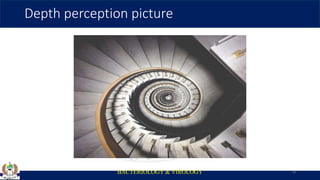
• Depth perception is the visual ability to perceive the world in three
dimensions, coupled with the ability to gauge how far away an object
is. Depth perception, size, and distance are ascertained through both
monocular (one eye) and binocular (two eyes) cues.
• Depth perception relies on the convergence of both eyes upon a
single object, the relative differences between the shape and size of
the images on each retina, the relative size of objects in relation to
each other, and other cues such as texture and constancy.
BACTERIOLOGY & VIROLOGY 8
Depth perception picture
BACTERIOLOGY & VIROLOGY 9
Kinds of perception(2)
10
BACTERIOLOGY & VIROLOGY
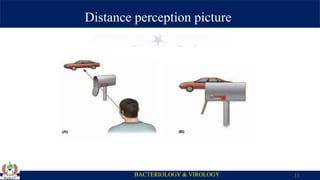
• Distance perception refers to a process in which an observer perceives an
interval between two points in space.
• The interval does not have to be linear, but perception of a straight-line
distance has been most extensively studied.
• The distance can be defined between the observer and an external object
(egocentric distance) or between two external objects (exocentric distance),
and perception of these two types of distance tends to show different
characteristics .
Distance perception picture
11
BACTERIOLOGY & VIROLOGY
Kinds of perception (3)
Bacteriology and virology 12
Temporal perception :
• The study of time perception is a field within psychology, cognitive
linguistics and neuroscience that refers to the subjective experience, or sense,
of time, which is measured by someone's own perception of the duration of the
indefinite and unfolding of events.
• The perceived time interval between two successive events is referred to
as perceived duration.
• Though directly experiencing or understanding another person's perception of
time is not possible, such a perception can be objectively studied
and inferred through a number of scientific experiments.
• Some temporal illusions help to expose the underlying neural mechanisms of
time perception
TEMPORAL
PERCEPTION
PICTURE:
BACTERIOLOGY & VIROLOGY 13
Kinds of perception (4)
• Hearing, or auditory perception, is the ability to perceive sounds by
detecting vibrations, changes in the pressure of the surrounding medium
through time, through an organ such as the ear. The academic field
concerned with hearing is auditory science.
• Sound may be heard through solid, liquid, or gaseous matter. It is one of
the traditional five senses; partial or total inability to hear is called hearing
loss.
• In humans and other vertebrates, hearing is performed primarily by the
auditory system: mechanical waves, known as vibrations, are detected by
the ear and transduced into nerve impulses that are perceived by the brain
(primarily in the temporal lobe).
• Like touch, audition requires sensitivity to the movement of molecules in
the world outside the organism. Both hearing and touch are types of
mechano-sensation.
BACTERIOLOGY & VIROLOGY 14
Auditory perception picture:
Bacteriology and virology 15

perception (b).pptx

  • 1.
    BS Economics psy-2119 Lecture No.4 : PERCEPTION SAIMA ZAFAR Lecturer psychology Date: Dec,2020
  • 2.
    LEARNING OBJECTIVES After readingthis chapter, student will able to tell about : PERCEPTION : • Nature of perception • Factor of perception: Subjective, objective and social • kinds of perception : I. Spatial perception ( perception of depth and distance) II. Temporal perception III. Auditory perception BACTERIOLOGY & VIROLOGY 2
  • 3.
    Definition of perception 3 BACTERIOLOGY& VIROLOGY Perception can be defined as: “Our recognition and interpretation of sensory information. Perception also includes how we respond to the information. Perception allows us to take the sensory information in and make it into something meaningful.”
  • 4.
    Nature of perception 4 BACTERIOLOGY& VIROLOGY • Perception refers to the interpretation of sensory data. • In other words, sensation involves detecting the presence of a stimulus whereas perception involves understanding what the stimulus means. • For example, when we see something, the visual stimulus is the light energy reflected from the external world and the eye becomes the sensor. This visual image of the external thing becomes perception when it is interpreted in the visual cortex of the brain. Thus, visual perception refers to interpreting the image of the external world projected on the retina of the eye and constructing a model of the three dimensional world.”
  • 5.
    Nature of perception(2) 5 BACTERIOLOGY & VIROLOGY • Perception is determined by both physiological and psychological characteristics of the human being whereas sensation is conceived with only the physiological features. • Perception is a subjective process, therefore, different people may perceive the same environment differently based on what particular aspects of the situation they choose to selectively absorb, how they organize this information and the manner in which they interpret it to obtain a grasp of the situation.
  • 6.
    Factors of perception 6 BACTERIOLOGY& VIROLOGY • Subjective perception can mean more than one thing. The more popular meaning is your personal opinions and beliefs. Like if something is ugly or beautiful, if chocolate ice-cream tastes better than vanilla and things like that. • They are personal because they are not factual beliefs, in the sense that there is no objective way of "knowing" if chocolate is in fact better than vanilla. It can be better to me, but maybe to you vanilla tastes better. • In philosophy, however, subjective perception has a slightly different meaning. It means every sensation that you feel. It's not exactly the opinion you have of the sensation (e.g. "chocolate tastes better than vanilla"), but the sensation itself (e.g. the taste itself). • Color is only one example of what constitutes subjective perception. All other senses and everything that happens inside one’s own mind constitute an individual’s subjective perception.
  • 7.
    Factors of perception(2) 7 BACTERIOLOGY& VIROLOGY • Social Perception measures comprehension of social communication, including facial affect recognition and naming, affect recognition from prosody and facial expressions, and affect recognition from prosody and interaction between people. Three tasks comprise Social Perception: • Affect Naming • Prosody-Face Matching • Prosody-Pair Matching. • Objectivity, pertaining to perception, is defined to be the formal structure that envelops the perceiver, the act of perceiving, that which is perceived, and their interrelationships. the objective perception of reality is that the boundaries that you see are actually creations of your mind. They are figments of your imagination. You have created this image and idea in your mind, and then said, “That’s me. I end here, and the other person starts there. I end here, and the chair starts there. You start over there, and you end over there.”
  • 8.
    Kinds of perception •Depth perception is the visual ability to perceive the world in three dimensions, coupled with the ability to gauge how far away an object is. Depth perception, size, and distance are ascertained through both monocular (one eye) and binocular (two eyes) cues. • Depth perception relies on the convergence of both eyes upon a single object, the relative differences between the shape and size of the images on each retina, the relative size of objects in relation to each other, and other cues such as texture and constancy. BACTERIOLOGY & VIROLOGY 8
  • 9.
  • 10.
    Kinds of perception(2) 10 BACTERIOLOGY& VIROLOGY • Distance perception refers to a process in which an observer perceives an interval between two points in space. • The interval does not have to be linear, but perception of a straight-line distance has been most extensively studied. • The distance can be defined between the observer and an external object (egocentric distance) or between two external objects (exocentric distance), and perception of these two types of distance tends to show different characteristics .
  • 11.
  • 12.
    Kinds of perception(3) Bacteriology and virology 12 Temporal perception : • The study of time perception is a field within psychology, cognitive linguistics and neuroscience that refers to the subjective experience, or sense, of time, which is measured by someone's own perception of the duration of the indefinite and unfolding of events. • The perceived time interval between two successive events is referred to as perceived duration. • Though directly experiencing or understanding another person's perception of time is not possible, such a perception can be objectively studied and inferred through a number of scientific experiments. • Some temporal illusions help to expose the underlying neural mechanisms of time perception
  • 13.
  • 14.
    Kinds of perception(4) • Hearing, or auditory perception, is the ability to perceive sounds by detecting vibrations, changes in the pressure of the surrounding medium through time, through an organ such as the ear. The academic field concerned with hearing is auditory science. • Sound may be heard through solid, liquid, or gaseous matter. It is one of the traditional five senses; partial or total inability to hear is called hearing loss. • In humans and other vertebrates, hearing is performed primarily by the auditory system: mechanical waves, known as vibrations, are detected by the ear and transduced into nerve impulses that are perceived by the brain (primarily in the temporal lobe). • Like touch, audition requires sensitivity to the movement of molecules in the world outside the organism. Both hearing and touch are types of mechano-sensation. BACTERIOLOGY & VIROLOGY 14
  • 15.