New Media, New Approach:
Public Relations for the 21st
Century
Globecomm/Cachendo

June 30, 2009
Rock Creek Strategic Marketing
Contents

•     Traditional vs. New Media
           o Similarities and Differences

•     Executing Traditional Media and Blog Campaigns
           o 10 Steps to Developing a Successful Media/Blog Relations
             Campaign
           o 6 Tips for Talking to Bloggers/Reporters

•     Social Media Specifics
           o 3 Universal Truths About Social Media
           o Social Media Options
           o So Many Options…How to Decide?
           o Tips for Using Social Media Outlets to Your Advantage

07/15/09                                                                2
Traditional vs. New Media


07/15/09                    3
Traditional vs. New Media:
    Similarities and Differences
Similarities: Traditional and new media are
governed by the same principles:
•    Have a game plan for proactive and reactive media activities.
      o Know what your objectives are. Traditional and new
        media tactics are simply tools in your marketing toolkit to
        help you reach your larger objectives.
      o Don’t develop your crisis PR plan when the crisis hits.
      o Show up consistently. Media relations is like having a
        bird feeder—maintain it or the birds will stop coming.
•    Know who you need to know—that is, who’s covering your
     space and what interests them.
07/15/09                                                          4
Traditional vs. New Media:
Similarities and Differences
Similarities, cont.
           o Build relationships before you need them.
           o Tell a newsworthy story.
           o Be authentic, transparent, honest, and believable.


07/15/09                                                          5
Traditional vs. New Media:
Similarities and Differences
Differences
• Training and background
           o Journalists at traditional publications are usually trained
             in reporting; new media/social media authors may not
             have any formal training.

• Separation of editorial/advertising
           o Journalists must abide “separation of church and state”;
             new media and social media authors may choose to
             keep advertising and editorial separate. They may also
             accept payment to write about businesses/products.

07/15/09                                                                   6
Traditional Media and
Blog Campaigns:
10 Steps to Developing a Successful
Media/Blog Relations Campaign


07/15/09                              7
Step 1: Determine the Message

• What are you really trying to publicize?
• All of your communications should relate back
  to your set of core messages.
• Remember, your messages must be:
           o Believable—Poorly written corporate gobbledygook can
             make you look incredibly unbelievable.
           o Credible—Be authentic, honest, and transparent.


07/15/09                                                            8
Step 2: Differentiate


• Your announcements must pass the “so
  what?” test.
• Prove value. How is your offering different
  and better vs. competitors’? Tell the story
  through real examples.
• Avoid hype at all costs. Lofty language and
  claims of “best of breed” are likely to turn off
  traditional and new media journalists alike.

07/15/09                                             9
Step 3: Define Your Audience

• Your audience may not be the same for every
  announcement. You may want to focus on a
  specific region, job title, or technology.
• Coverage is more likely to result from a few
  highly targeted pitches than a high-volume
  shotgun approach.


07/15/09                                         10
Step 4: Get the Timing Right


• Take advantage of naturally newsworthy
  events like conferences or trade shows.
• Prepare happy customers to talk to the press
  on your behalf.
• Take logical steps—launching a wide-scale
  Facebook campaign the day after you post
  your company profile is unlikely to earn
  meaningful results.

07/15/09                                      11
Step 5: Identify Traditional & New
Media Outlets
• Don’t assume—survey and research.
• Realize that your audience may not read
  what you think they read.
• They’re more likely to read industry-focused
  publications than general ones.


07/15/09                                         12
Step 6: Choose the Most Appropriate
Media
• Consider your message, audience, and credibility
  within each of the media outlets.
• Target your campaigns to the media that will give
  you the most mileage.
• Not every announcement needs to be sent to
  every contact.
• Avoid brand/news exhaustion—e.g. your Twitter
  feed shouldn’t be a constant stream of company
  press releases.

07/15/09                                           13
Step 7: Reuse and Repost Content

Some ideas:
• Post releases on PR Web and your company blog
  that feeds news items onto your home page.
• Add a blurb for the announcement in your
  company e-newsletter.
• Link to the announcement in a company direct
  email or on your company’s Facebook page.
• Republish print magazine coverage as a PDF on
  your website.
07/15/09                                         14
Step 8: Optimize Your Content
for SEM
• Seed your announcements with keywords
  and phrases that are likely to be used when
  searching for your products and services.
• Take advantage of inline links and tags.
• Maximize opportunities to receive external
  links.


07/15/09                                        15
Step 9: Build Credibility with Outside
Endorsements and Accolades
• Journalists and bloggers are more likely to
  cover companies they’ve heard of.
• One way for a lesser-known company to get
  a foot in the door is through third-party
  quotes, testimonials, and case studies.
• Awards are also an excellent way to gain
  attention.


07/15/09                                        16
Step 10: Develop Genuine
Relationships Before you Pitch
• Read the publications and blogs that cover
  your industry.
• Build profiles of journalists/bloggers. This will
  help you avoid sending tips that are clearly
  outside the writer’s lane.
• It’s pointless to sell a story to someone who’ll
  never write about it—and it could be
  embarrassing for you and your brand.

07/15/09                                          17
Step 10: Develop Genuine
Relationships (cont.)
• Try to become a regular source. Send tips
  that the writer may not know about.
• Writers like to know they’re being read. Get to
  know and interact with bloggers by
  commenting using your real name and email
  address.
• Pitch trend stories. Even if your company is
  not the main topic, it can still be valuable to
  be mentioned in the story.
07/15/09                                            18
6 Tips for Talking to
Journalists/Bloggers
• DO frame answers to tough questions
  positively.
• DON’T wing it. Prepare.
• DO speak in terms everyone can understand.
  Avoid jargon.
• DON’T speculate.
• DO communicate your key messages.
• DON’T ask to approve the story.
07/15/09                                   19
Social Media Specifics


07/15/09                 20
3 Universal Truths About Social Media
• Every social networking site has different rules,
  and you must know the rules and play by them.
• You must build relationships based on trust and
  authenticity. Remember, your company is playing
  on their playground.
• Two things that will help lead you to success:
           o Being personal, e.g., answering questions and private
             messages.
           o Showing up, i.e., making sure that if someone initiates
             interaction, you’re there to respond.
07/15/09                                                               21
Social Media Options

•   Company blog          •   Reddit
•   Forums & message      •   Digg
    boards
                          •   StumbleUpon
•   Industry listservs
                          •   Wikipedia
•   SlideShare
                          •   Yahoo! Answers
•   LinkedIn profiles &
    groups                •   Squidoo

•   YouTube               •   Ning

•   Facebook              •   Flickr

•   Twitter               •   And many more!
So Many Options—How to Decide?

• Understand the intent and limitations of the
  each option.
• Choose a few to get started with, then
  expand.
• Don’t spread yourself too thin—better to
  have fewer social media profiles that are
  well-developed than many poorly-developed
  profiles.
• No profile is better than a bad profile.
Tips for Using Social Media Outlets to
Your Advantage: Facebook
• Facebook is only worthwhile if you intend to:
           o Stay active.
           o Use it for two-way conversations with followers.

• Create a Facebook company page.
           o Creating a profile page takes 5 minutes.
           o Creating a meaningful profile page and using it
             effectively is a much bigger investment!
           o Variety of applications available to promote your blog,
             link to your SlideShare offerings, communicate and
             more.
07/15/09                                                               24
Tips for Using Social Media Outlets to
Your Advantage: Facebook
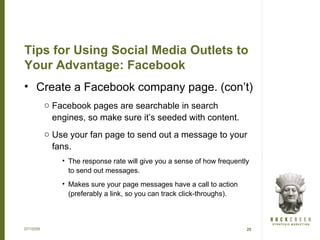
• Create a Facebook company page. (con’t)
           o Facebook pages are searchable in search
             engines, so make sure it’s seeded with content.
           o Use your fan page to send out a message to your
             fans.
               • The response rate will give you a sense of how frequently
                 to send out messages.
               • Makes sure your page messages have a call to action
                 (preferably a link, so you can track click-throughs).


07/15/09                                                                 25
Tips for Using Social Media Outlets to
Your Advantage: Facebook
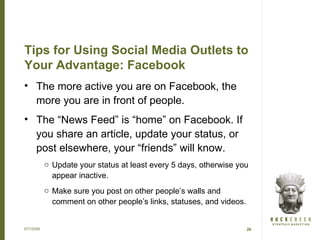
• The more active you are on Facebook, the
  more you are in front of people.
• The “News Feed” is “home” on Facebook. If
  you share an article, update your status, or
  post elsewhere, your “friends” will know.
           o Update your status at least every 5 days, otherwise you
             appear inactive.
           o Make sure you post on other people’s walls and
             comment on other people’s links, statuses, and videos.


07/15/09                                                              26
Tips for Using Social Media Outlets to
Your Advantage: Facebook
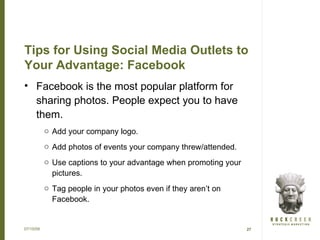
• Facebook is the most popular platform for
  sharing photos. People expect you to have
  them.
           o Add your company logo.
           o Add photos of events your company threw/attended.
           o Use captions to your advantage when promoting your
             pictures.
           o Tag people in your photos even if they aren’t on
             Facebook.


07/15/09                                                          27
Tips for Using Social Media Outlets to
Your Advantage: Twitter
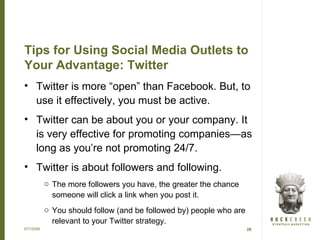
• Twitter is more “open” than Facebook. But, to
  use it effectively, you must be active.
• Twitter can be about you or your company. It
  is very effective for promoting companies—as
  long as you’re not promoting 24/7.
• Twitter is about followers and following.
           o The more followers you have, the greater the chance
             someone will click a link when you post it.
           o You should follow (and be followed by) people who are
             relevant to your Twitter strategy.
07/15/09                                                             28
Tips for Using Social Media Outlets to
Your Advantage: Twitter
• Choose a Twitter username that is short and
  relevant.
• Use a short URL to conserve space when
  sharing links (tinyurl.com, bit.ly, etc.).
• Make sure you thank people for following you.
• Make sure to reply to people.


07/15/09                                        29
Tips for Using Social Media Outlets to
Your Advantage: Twitter
• Tweet often: Aim for daily goals, e.g., 20
  times/day.
• Share information that others may find
  interesting, like articles, links to industry
  news, etc. Don’t tweet about company
  information all the time.
• Optimize your Facebook/Twitter by adding a
  Twitter app on Facebook. This allows your
  tweets to double as Facebook activity.
07/15/09                                          30
Questions & Answers


07/15/09              31
Thank you for your participation!


Kristen M. Newton
Director of Strategy
301/657-0800 x116

Amy Hooker
Director of New Media
301/657-0800 x138

07/15/09                            32

New Media New Approach

  • 1.
    New Media, NewApproach: Public Relations for the 21st Century Globecomm/Cachendo June 30, 2009 Rock Creek Strategic Marketing
  • 2.
    Contents • Traditional vs. New Media o Similarities and Differences • Executing Traditional Media and Blog Campaigns o 10 Steps to Developing a Successful Media/Blog Relations Campaign o 6 Tips for Talking to Bloggers/Reporters • Social Media Specifics o 3 Universal Truths About Social Media o Social Media Options o So Many Options…How to Decide? o Tips for Using Social Media Outlets to Your Advantage 07/15/09 2
  • 3.
    Traditional vs. NewMedia 07/15/09 3
  • 4.
    Traditional vs. NewMedia: Similarities and Differences Similarities: Traditional and new media are governed by the same principles: • Have a game plan for proactive and reactive media activities. o Know what your objectives are. Traditional and new media tactics are simply tools in your marketing toolkit to help you reach your larger objectives. o Don’t develop your crisis PR plan when the crisis hits. o Show up consistently. Media relations is like having a bird feeder—maintain it or the birds will stop coming. • Know who you need to know—that is, who’s covering your space and what interests them. 07/15/09 4
  • 5.
    Traditional vs. NewMedia: Similarities and Differences Similarities, cont. o Build relationships before you need them. o Tell a newsworthy story. o Be authentic, transparent, honest, and believable. 07/15/09 5
  • 6.
    Traditional vs. NewMedia: Similarities and Differences Differences • Training and background o Journalists at traditional publications are usually trained in reporting; new media/social media authors may not have any formal training. • Separation of editorial/advertising o Journalists must abide “separation of church and state”; new media and social media authors may choose to keep advertising and editorial separate. They may also accept payment to write about businesses/products. 07/15/09 6
  • 7.
    Traditional Media and BlogCampaigns: 10 Steps to Developing a Successful Media/Blog Relations Campaign 07/15/09 7
  • 8.
    Step 1: Determinethe Message • What are you really trying to publicize? • All of your communications should relate back to your set of core messages. • Remember, your messages must be: o Believable—Poorly written corporate gobbledygook can make you look incredibly unbelievable. o Credible—Be authentic, honest, and transparent. 07/15/09 8
  • 9.
    Step 2: Differentiate •Your announcements must pass the “so what?” test. • Prove value. How is your offering different and better vs. competitors’? Tell the story through real examples. • Avoid hype at all costs. Lofty language and claims of “best of breed” are likely to turn off traditional and new media journalists alike. 07/15/09 9
  • 10.
    Step 3: DefineYour Audience • Your audience may not be the same for every announcement. You may want to focus on a specific region, job title, or technology. • Coverage is more likely to result from a few highly targeted pitches than a high-volume shotgun approach. 07/15/09 10
  • 11.
    Step 4: Getthe Timing Right • Take advantage of naturally newsworthy events like conferences or trade shows. • Prepare happy customers to talk to the press on your behalf. • Take logical steps—launching a wide-scale Facebook campaign the day after you post your company profile is unlikely to earn meaningful results. 07/15/09 11
  • 12.
    Step 5: IdentifyTraditional & New Media Outlets • Don’t assume—survey and research. • Realize that your audience may not read what you think they read. • They’re more likely to read industry-focused publications than general ones. 07/15/09 12
  • 13.
    Step 6: Choosethe Most Appropriate Media • Consider your message, audience, and credibility within each of the media outlets. • Target your campaigns to the media that will give you the most mileage. • Not every announcement needs to be sent to every contact. • Avoid brand/news exhaustion—e.g. your Twitter feed shouldn’t be a constant stream of company press releases. 07/15/09 13
  • 14.
    Step 7: Reuseand Repost Content Some ideas: • Post releases on PR Web and your company blog that feeds news items onto your home page. • Add a blurb for the announcement in your company e-newsletter. • Link to the announcement in a company direct email or on your company’s Facebook page. • Republish print magazine coverage as a PDF on your website. 07/15/09 14
  • 15.
    Step 8: OptimizeYour Content for SEM • Seed your announcements with keywords and phrases that are likely to be used when searching for your products and services. • Take advantage of inline links and tags. • Maximize opportunities to receive external links. 07/15/09 15
  • 16.
    Step 9: BuildCredibility with Outside Endorsements and Accolades • Journalists and bloggers are more likely to cover companies they’ve heard of. • One way for a lesser-known company to get a foot in the door is through third-party quotes, testimonials, and case studies. • Awards are also an excellent way to gain attention. 07/15/09 16
  • 17.
    Step 10: DevelopGenuine Relationships Before you Pitch • Read the publications and blogs that cover your industry. • Build profiles of journalists/bloggers. This will help you avoid sending tips that are clearly outside the writer’s lane. • It’s pointless to sell a story to someone who’ll never write about it—and it could be embarrassing for you and your brand. 07/15/09 17
  • 18.
    Step 10: DevelopGenuine Relationships (cont.) • Try to become a regular source. Send tips that the writer may not know about. • Writers like to know they’re being read. Get to know and interact with bloggers by commenting using your real name and email address. • Pitch trend stories. Even if your company is not the main topic, it can still be valuable to be mentioned in the story. 07/15/09 18
  • 19.
    6 Tips forTalking to Journalists/Bloggers • DO frame answers to tough questions positively. • DON’T wing it. Prepare. • DO speak in terms everyone can understand. Avoid jargon. • DON’T speculate. • DO communicate your key messages. • DON’T ask to approve the story. 07/15/09 19
  • 20.
  • 21.
    3 Universal TruthsAbout Social Media • Every social networking site has different rules, and you must know the rules and play by them. • You must build relationships based on trust and authenticity. Remember, your company is playing on their playground. • Two things that will help lead you to success: o Being personal, e.g., answering questions and private messages. o Showing up, i.e., making sure that if someone initiates interaction, you’re there to respond. 07/15/09 21
  • 22.
    Social Media Options • Company blog • Reddit • Forums & message • Digg boards • StumbleUpon • Industry listservs • Wikipedia • SlideShare • Yahoo! Answers • LinkedIn profiles & groups • Squidoo • YouTube • Ning • Facebook • Flickr • Twitter • And many more!
  • 23.
    So Many Options—Howto Decide? • Understand the intent and limitations of the each option. • Choose a few to get started with, then expand. • Don’t spread yourself too thin—better to have fewer social media profiles that are well-developed than many poorly-developed profiles. • No profile is better than a bad profile.
  • 24.
    Tips for UsingSocial Media Outlets to Your Advantage: Facebook • Facebook is only worthwhile if you intend to: o Stay active. o Use it for two-way conversations with followers. • Create a Facebook company page. o Creating a profile page takes 5 minutes. o Creating a meaningful profile page and using it effectively is a much bigger investment! o Variety of applications available to promote your blog, link to your SlideShare offerings, communicate and more. 07/15/09 24
  • 25.
    Tips for UsingSocial Media Outlets to Your Advantage: Facebook • Create a Facebook company page. (con’t) o Facebook pages are searchable in search engines, so make sure it’s seeded with content. o Use your fan page to send out a message to your fans. • The response rate will give you a sense of how frequently to send out messages. • Makes sure your page messages have a call to action (preferably a link, so you can track click-throughs). 07/15/09 25
  • 26.
    Tips for UsingSocial Media Outlets to Your Advantage: Facebook • The more active you are on Facebook, the more you are in front of people. • The “News Feed” is “home” on Facebook. If you share an article, update your status, or post elsewhere, your “friends” will know. o Update your status at least every 5 days, otherwise you appear inactive. o Make sure you post on other people’s walls and comment on other people’s links, statuses, and videos. 07/15/09 26
  • 27.
    Tips for UsingSocial Media Outlets to Your Advantage: Facebook • Facebook is the most popular platform for sharing photos. People expect you to have them. o Add your company logo. o Add photos of events your company threw/attended. o Use captions to your advantage when promoting your pictures. o Tag people in your photos even if they aren’t on Facebook. 07/15/09 27
  • 28.
    Tips for UsingSocial Media Outlets to Your Advantage: Twitter • Twitter is more “open” than Facebook. But, to use it effectively, you must be active. • Twitter can be about you or your company. It is very effective for promoting companies—as long as you’re not promoting 24/7. • Twitter is about followers and following. o The more followers you have, the greater the chance someone will click a link when you post it. o You should follow (and be followed by) people who are relevant to your Twitter strategy. 07/15/09 28
  • 29.
    Tips for UsingSocial Media Outlets to Your Advantage: Twitter • Choose a Twitter username that is short and relevant. • Use a short URL to conserve space when sharing links (tinyurl.com, bit.ly, etc.). • Make sure you thank people for following you. • Make sure to reply to people. 07/15/09 29
  • 30.
    Tips for UsingSocial Media Outlets to Your Advantage: Twitter • Tweet often: Aim for daily goals, e.g., 20 times/day. • Share information that others may find interesting, like articles, links to industry news, etc. Don’t tweet about company information all the time. • Optimize your Facebook/Twitter by adding a Twitter app on Facebook. This allows your tweets to double as Facebook activity. 07/15/09 30
  • 31.
  • 32.
    Thank you foryour participation! Kristen M. Newton Director of Strategy 301/657-0800 x116 Amy Hooker Director of New Media 301/657-0800 x138 07/15/09 32