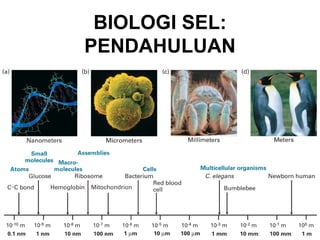
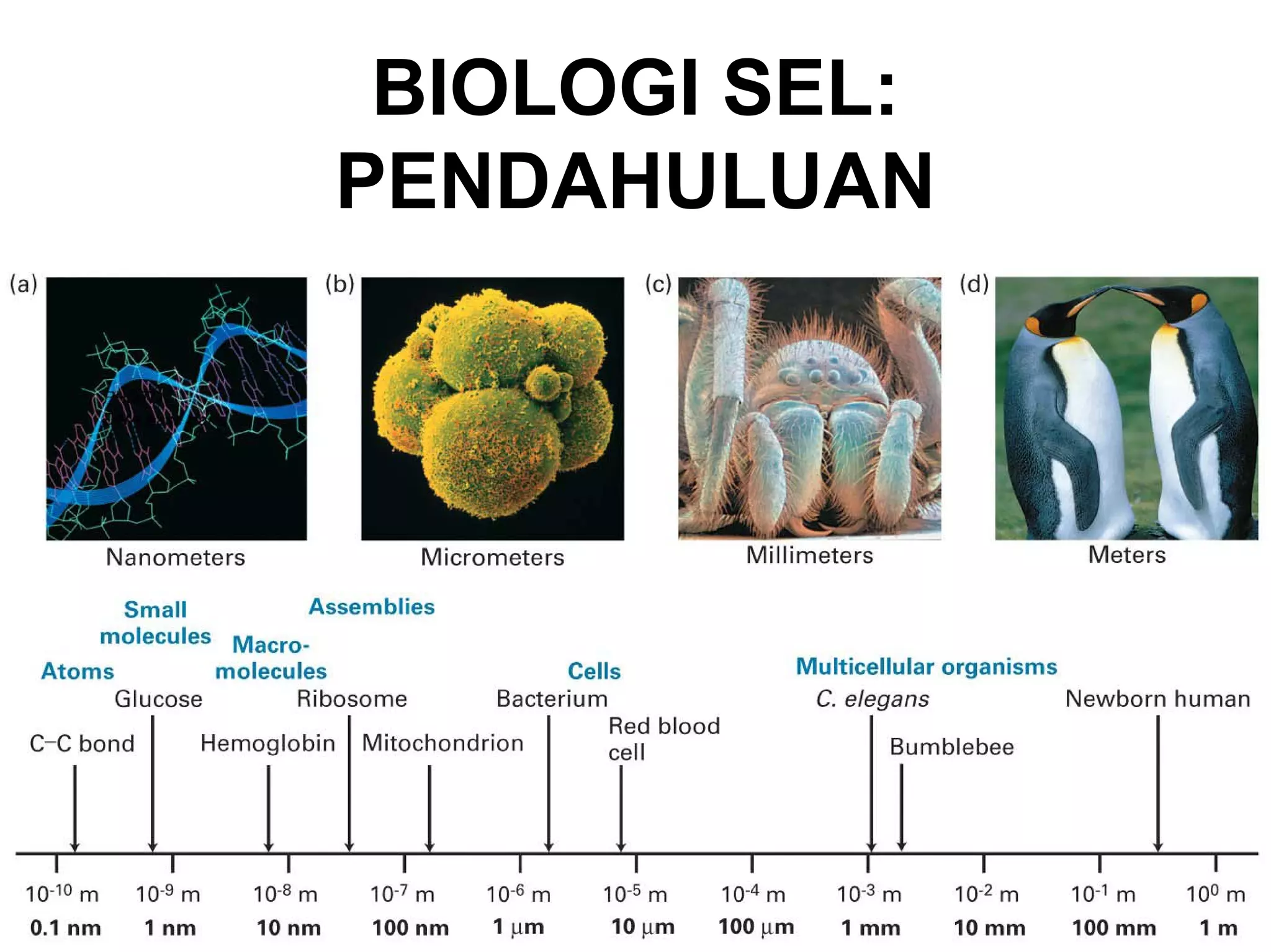
BIOLOGI SEL:
PENDAHULUAN


   BISEL07-SITH/ITB-MIT/IR   1
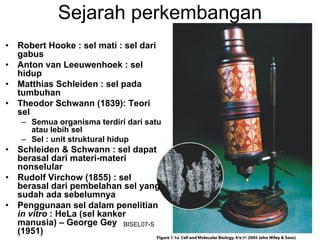
Sejarah perkembangan
•   Robert Hooke : sel mati : sel dari
    gabus
•   Anton van Leeuwenhoek : sel
    hidup
•   Matthias Schleiden : sel pada
    tumbuhan
•   Theodor Schwann (1839): Teori
    sel
     – Semua organisma terdiri dari satu
       atau lebih sel
     – Sel : unit struktural hidup
•   Schleiden & Schwann : sel dapat
    berasal dari materi-materi
    nonselular
•   Rudolf Virchow (1855) : sel
    berasal dari pembelahan sel yang
    sudah ada sebelumnya
•   Penggunaan sel dalam penelitian
    in vitro : HeLa (sel kanker
    manusia) – George Gey BISEL07-SITH/ITB-MIT/IR   2
    (1951)
BISEL07-SITH/ITB-MIT/IR   3
Karakteristik sel
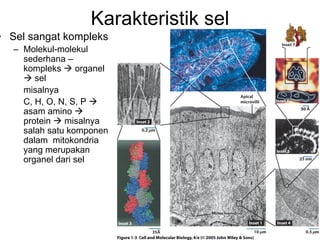
• Sel sangat kompleks
   – Molekul-molekul
     sederhana –
     kompleks     organel
        sel
     misalnya
     C, H, O, N, S, P
     asam amino
     protein   misalnya
     salah satu komponen
     dalam mitokondria
     yang merupakan
     organel dari sel


                            BISEL07-SITH/ITB-MIT/IR   4
Karakteristik sel
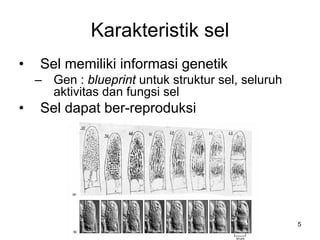
•   Sel memiliki informasi genetik
    – Gen : blueprint untuk struktur sel, seluruh
      aktivitas dan fungsi sel
•   Sel dapat ber-reproduksi


                    BISEL07-SITH/ITB-MIT/IR         5
Karakteristik sel
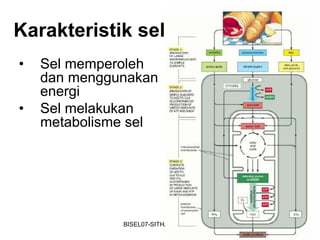
•   Sel memperoleh
    dan menggunakan
    energi
•   Sel melakukan
    metabolisme sel


              BISEL07-SITH/ITB-MIT/IR   6
Karakteristik sel
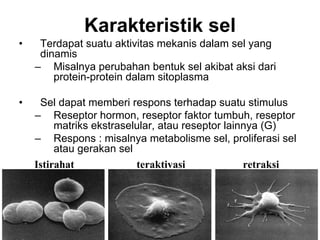
•    Terdapat suatu aktivitas mekanis dalam sel yang
     dinamis
    – Misalnya perubahan bentuk sel akibat aksi dari
        protein-protein dalam sitoplasma

•    Sel dapat memberi respons terhadap suatu stimulus
    – Reseptor hormon, reseptor faktor tumbuh, reseptor
         matriks ekstraselular, atau reseptor lainnya (G)
    – Respons : misalnya metabolisme sel, proliferasi sel
         atau gerakan sel
    Istirahat             teraktivasi             retraksi


                      BISEL07-SITH/ITB-MIT/IR                7
Karakteristik sel
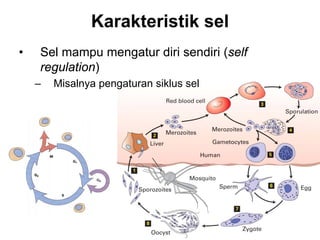
•   Sel mampu mengatur diri sendiri (self
    regulation)
    –   Misalnya pengaturan siklus sel


                      BISEL07-SITH/ITB-MIT/IR   8
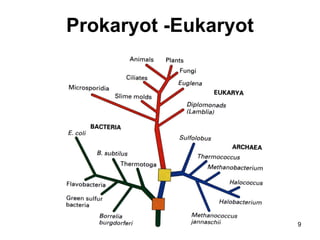
Prokaryot -Eukaryot


     BISEL07-SITH/ITB-MIT/IR   9
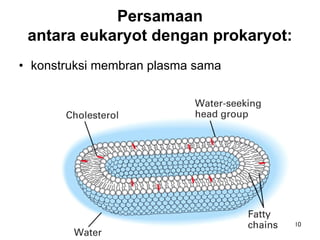
Persamaan
 antara eukaryot dengan prokaryot:
• konstruksi membran plasma sama


                BISEL07-SITH/ITB-MIT/IR   10
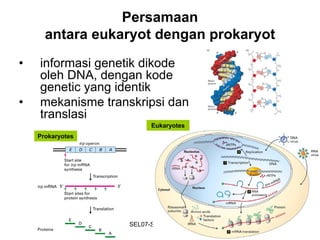
Persamaan
      antara eukaryot dengan prokaryot
•   informasi genetik dikode
    oleh DNA, dengan kode
    genetic yang identik
•   mekanisme transkripsi dan
    translasi
                          Eukaryotes
    Prokaryotes


                  BISEL07-SITH/ITB-MIT/IR   11
Persamaan antara eukaryot
             dengan prokaryot:
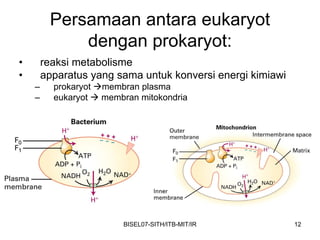
•       reaksi metabolisme
•       apparatus yang sama untuk konversi energi kimiawi
    –     prokaryot   membran plasma
    –     eukaryot    membran mitokondria


                          BISEL07-SITH/ITB-MIT/IR           12
Persamaan antara eukaryot
         dengan prokaryot:
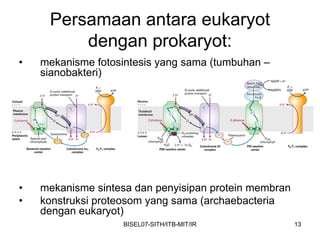
•   mekanisme fotosintesis yang sama (tumbuhan –
    sianobakteri)


•   mekanisme sintesa dan penyisipan protein membran
•   konstruksi proteosom yang sama (archaebacteria
    dengan eukaryot)
                   BISEL07-SITH/ITB-MIT/IR             13
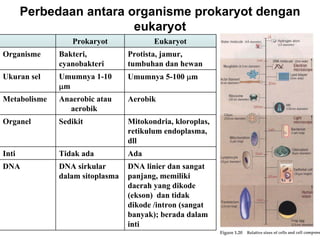
Perbedaan antara organisme prokaryot dengan
                         eukaryot
                 Prokaryot               Eukaryot
Organisme     Bakteri,            Protista, jamur,
              cyanobakteri        tumbuhan dan hewan
Ukuran sel    Umumnya 1-10        Umumnya 5-100 μm
              μm
Metabolisme   Anaerobic atau      Aerobik
                aerobik
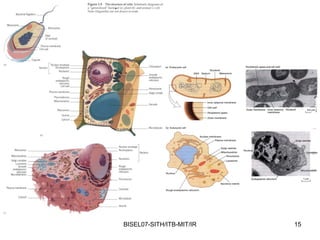
Organel       Sedikit             Mitokondria, kloroplas,
                                  retikulum endoplasma,
                                  dll
Inti          Tidak ada           Ada
DNA           DNA sirkular        DNA linier dan sangat
              dalam sitoplasma    panjang, memiliki
                                  daerah yang dikode
                                  (ekson) dan tidak
                                  dikode /intron (sangat
                                  banyak); berada dalam
                                 BISEL07-SITH/ITB-MIT/IR
                                  inti                      14
BISEL07-SITH/ITB-MIT/IR   15
Perbedaan antara organisme prokaryot
             dengan eukaryot
                              Prokaryot                               Eukaryot
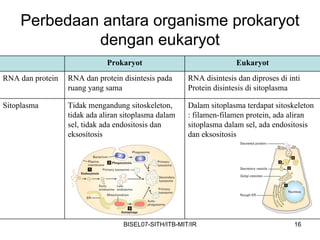
RNA dan protein   RNA dan protein disintesis pada      RNA disintesis dan diproses di inti
                  ruang yang sama                      Protein disintesis di sitoplasma

Sitoplasma        Tidak mengandung sitoskeleton,       Dalam sitoplasma terdapat sitoskeleton
                  tidak ada aliran sitoplasma dalam    : filamen-filamen protein, ada aliran
                  sel, tidak ada endositosis dan       sitoplasma dalam sel, ada endositosis
                  eksositosis                          dan eksositosis


                                   BISEL07-SITH/ITB-MIT/IR                              16
Perbedaan antara organisme prokaryot dengan
                             eukaryot
                           Prokaryot                                Eukaryot

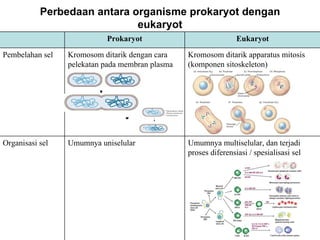
Pembelahan sel   Kromosom ditarik dengan cara       Kromosom ditarik apparatus mitosis
                 pelekatan pada membran plasma      (komponen sitoskeleton)


Organisasi sel   Umumnya uniselular                 Umumnya multiselular, dan terjadi
                                                    proses diferensiasi / spesialisasi sel


                                BISEL07-SITH/ITB-MIT/IR                                17
Virus
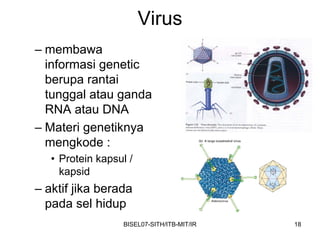
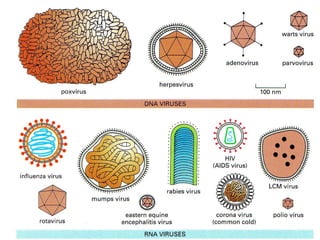
– membawa
  informasi genetic
  berupa rantai
  tunggal atau ganda
  RNA atau DNA
– Materi genetiknya
  mengkode :
   • Protein kapsul /
     kapsid
– aktif jika berada
  pada sel hidup
                  BISEL07-SITH/ITB-MIT/IR   18
BISEL07-SITH/ITB-MIT/IR   19
Bioenergetika


   BISEL07-SITH/ITB-MIT/IR   20
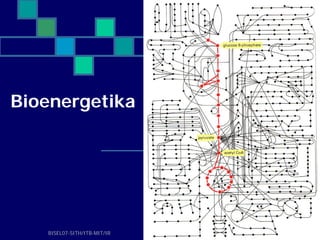
The Chemistry of Life: A network
     of metabolic pathways
• Cell metabolism can
  be compared to an
  elaborate road map
  of the thousands of
  chemical reactions
  that occur in the cell

              It is an intricate
              network of metabolic
              pathways
                   BISEL07-SITH/ITB-MIT/IR   21
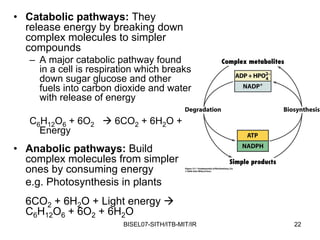
• Catabolic pathways: They
  release energy by breaking down
  complex molecules to simpler
  compounds
   – A major catabolic pathway found
     in a cell is respiration which breaks
     down sugar glucose and other
     fuels into carbon dioxide and water
     with release of energy

   C6H12O6 + 6O2       6CO2 + 6H2O +
     Energy
• Anabolic pathways: Build
  complex molecules from simpler
  ones by consuming energy
  e.g. Photosynthesis in plants
  6CO2 + 6H2O + Light energy
  C6H12O6 + 6O2 + 6H2O
                         BISEL07-SITH/ITB-MIT/IR   22
• Organisms Transform Energy:
   – Energy: The capacity to do work
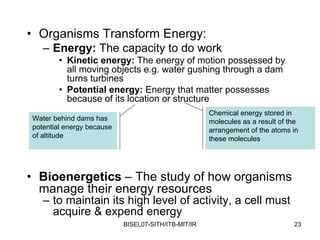
        • Kinetic energy: The energy of motion possessed by
          all moving objects e.g. water gushing through a dam
          turns turbines
        • Potential energy: Energy that matter possesses
          because of its location or structure
                                                     Chemical energy stored in
Water behind dams has                                molecules as a result of the
potential energy because                             arrangement of the atoms in
of altitude                                          these molecules


• Bioenergetics – The study of how organisms
  manage their energy resources
   – to maintain its high level of activity, a cell must
     acquire & expend energy
                           BISEL07-SITH/ITB-MIT/IR                             23
Conversion of Energy from
    one form to the other:
• Thermodynamics -
  study of the changes
  in energy that
  accompany events
  in the Universe
• Two laws of
  Thermodynamics

               BISEL07-SITH/ITB-MIT/IR   24
The First Law of
                     Thermodynamics
 •   energy can be neither created nor destroyed (Law of Conservation
     of Energy); total energy in Universe remains constant (regardless of
     transduction process)
      – Energy can, however, be transduced - burning fuel, polysaccharide
        breakdown, photosynthesis
           • Several organism communities are independent of photosynthesis –
             communities residing in hydrothermal vents on ocean floor; depends on
             energy obtained by bacterial chemosynthesis
           • Some animals (fireflies, luminous fish) convert chemical energy back into
             light
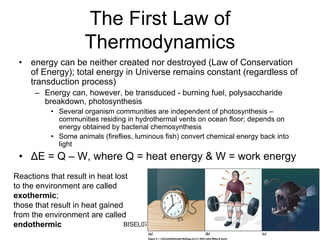
 • ΔE = Q – W, where Q = heat energy & W = work energy
Reactions that result in heat lost
to the environment are called
exothermic;
those that result in heat gained
from the environment are called
endothermic                      BISEL07-SITH/ITB-MIT/IR                                 25
Couple of terms
•   System: Is used to denote the matter under
    study and refer to the rest of the universe-
    everything outside the systems the
    surroundings
    1. Closed system: e.g. a liquid in a thermos bottle is
       isolated from its surroundings
    2. Open system: Energy (&often matter) can be
       transferred between the system and its
       surroundings e.g. organisms
•   Entropy: A measure of disorder or
    randomness
•   Free energy: Is the portion of a system’s
    energy that can perform work when
    temperature is uniform through out the system
                      BISEL07-SITH/ITB-MIT/IR                26
The Second Law of
          Thermodynamics
• Every energy transfer or transformation
  increases the entropy of the universe
  (no machine is 100% efficient which
  would be necessary)
     • Some energy is inevitably lost as machine
       works (same is true of living organism)

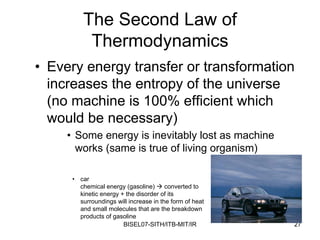
      • car
        chemical energy (gasoline)      converted to
        kinetic energy + the disorder of its
        surroundings will increase in the form of heat
        and small molecules that are the breakdown
        products of gasoline
                        BISEL07-SITH/ITB-MIT/IR          27
• Together the 1st & 2nd laws of thermodynamics show
  that the energy of the universe is constant, but that
  entropy continues to increase toward a maximum

• Gibbs combined concepts inherent in 1st & 2nd Laws to
  get equation: ΔH = ΔG + TΔS
   where:
   1. ΔG is the change in free energy (the change during a process in
      energy available to do work)

   2. ΔH - change in enthalpy (total energy content of system; equivalent
      to ΔE for our purposes)

   3. T - absolute temperature (°K; °K = °C + 273)

   4. ΔS - change in entropy of system


                          BISEL07-SITH/ITB-MIT/IR                       28
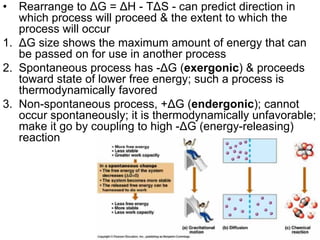
•  Rearrange to ΔG = ΔH - TΔS - can predict direction in
   which process will proceed & the extent to which the
   process will occur
1. ΔG size shows the maximum amount of energy that can
   be passed on for use in another process
2. Spontaneous process has -ΔG (exergonic) & proceeds
   toward state of lower free energy; such a process is
   thermodynamically favored
3. Non-spontaneous process, +ΔG (endergonic); cannot
   occur spontaneously; it is thermodynamically unfavorable;
   make it go by coupling to high -ΔG (energy-releasing)
   reaction


                       BISEL07-SITH/ITB-MIT/IR         29
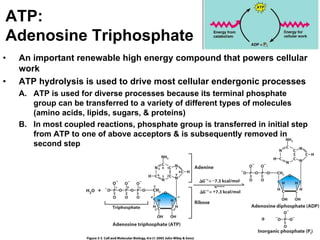
ATP:
Adenosine Triphosphate
•   An important renewable high energy compound that powers cellular
    work
•   ATP hydrolysis is used to drive most cellular endergonic processes
    A. ATP is used for diverse processes because its terminal phosphate
       group can be transferred to a variety of different types of molecules
       (amino acids, lipids, sugars, & proteins)
    B. In most coupled reactions, phosphate group is transferred in initial step
       from ATP to one of above acceptors & is subsequently removed in
       second step


                               BISEL07-SITH/ITB-MIT/IR                      30
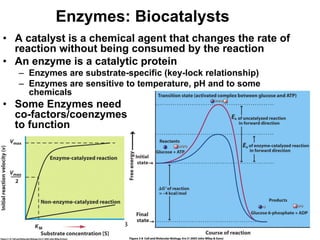
Enzymes: Biocatalysts
• A catalyst is a chemical agent that changes the rate of
  reaction without being consumed by the reaction
• An enzyme is a catalytic protein
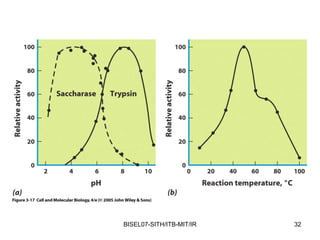
   – Enzymes are substrate-specific (key-lock relationship)
   – Enzymes are sensitive to temperature, pH and to some
     chemicals
• Some Enzymes need
  co-factors/coenzymes
  to function


                           BISEL07-SITH/ITB-MIT/IR            31
BISEL07-SITH/ITB-MIT/IR   32
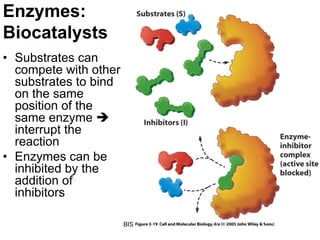
Enzymes:
Biocatalysts
• Substrates can
  compete with other
  substrates to bind
  on the same
  position of the
  same enzyme
  interrupt the
  reaction
• Enzymes can be
  inhibited by the
  addition of
  inhibitors

                       BISEL07-SITH/ITB-MIT/IR   33
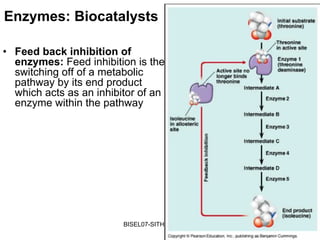
Enzymes: Biocatalysts

• Feed back inhibition of
  enzymes: Feed inhibition is the
  switching off of a metabolic
  pathway by its end product
  which acts as an inhibitor of an
  enzyme within the pathway


                         BISEL07-SITH/ITB-MIT/IR   34
•   ATP formed 2 ways in cell:
          – oxidative phosphorylation     inner
            membrane of mitochondria
          – substrate-level phosphorylation
     •   Oxidative phosphorylation -
         dehydrogenases move 2 electrons &
         proton to NAD+ to make NADH
          1. High energy NADH donates electrons to
             other molecules at electron transport (ET)
             chain
          2. Because NADH transfers electrons so
             readily, it is said to have high electron
             transfer potential
          3. As electron travels down ET system, it loses
             energy used to make ATP & is added to O2
             to make H2O

     •   Substrate-level phosphorylation -
         phosphate group moved from a
         substrate to ADP   ATP
          1. ATP formation is not that endergonic,
             formation of other molecules is more
             endergonic
          2. Such molecules can donate their
             phosphates to ADP to make ATP
BISEL07-SITH/ITB-MIT/IR                              35

Pendahuluan biologi-sel

  • 1.
    BIOLOGI SEL: PENDAHULUAN BISEL07-SITH/ITB-MIT/IR 1
  • 2.
    Sejarah perkembangan • Robert Hooke : sel mati : sel dari gabus • Anton van Leeuwenhoek : sel hidup • Matthias Schleiden : sel pada tumbuhan • Theodor Schwann (1839): Teori sel – Semua organisma terdiri dari satu atau lebih sel – Sel : unit struktural hidup • Schleiden & Schwann : sel dapat berasal dari materi-materi nonselular • Rudolf Virchow (1855) : sel berasal dari pembelahan sel yang sudah ada sebelumnya • Penggunaan sel dalam penelitian in vitro : HeLa (sel kanker manusia) – George Gey BISEL07-SITH/ITB-MIT/IR 2 (1951)
  • 3.
  • 4.
    Karakteristik sel • Selsangat kompleks – Molekul-molekul sederhana – kompleks organel sel misalnya C, H, O, N, S, P asam amino protein misalnya salah satu komponen dalam mitokondria yang merupakan organel dari sel BISEL07-SITH/ITB-MIT/IR 4
  • 5.
    Karakteristik sel • Sel memiliki informasi genetik – Gen : blueprint untuk struktur sel, seluruh aktivitas dan fungsi sel • Sel dapat ber-reproduksi BISEL07-SITH/ITB-MIT/IR 5
  • 6.
    Karakteristik sel • Sel memperoleh dan menggunakan energi • Sel melakukan metabolisme sel BISEL07-SITH/ITB-MIT/IR 6
  • 7.
    Karakteristik sel • Terdapat suatu aktivitas mekanis dalam sel yang dinamis – Misalnya perubahan bentuk sel akibat aksi dari protein-protein dalam sitoplasma • Sel dapat memberi respons terhadap suatu stimulus – Reseptor hormon, reseptor faktor tumbuh, reseptor matriks ekstraselular, atau reseptor lainnya (G) – Respons : misalnya metabolisme sel, proliferasi sel atau gerakan sel Istirahat teraktivasi retraksi BISEL07-SITH/ITB-MIT/IR 7
  • 8.
    Karakteristik sel • Sel mampu mengatur diri sendiri (self regulation) – Misalnya pengaturan siklus sel BISEL07-SITH/ITB-MIT/IR 8
  • 9.
    Prokaryot -Eukaryot BISEL07-SITH/ITB-MIT/IR 9
  • 10.
    Persamaan antara eukaryotdengan prokaryot: • konstruksi membran plasma sama BISEL07-SITH/ITB-MIT/IR 10
  • 11.
    Persamaan antara eukaryot dengan prokaryot • informasi genetik dikode oleh DNA, dengan kode genetic yang identik • mekanisme transkripsi dan translasi Eukaryotes Prokaryotes BISEL07-SITH/ITB-MIT/IR 11
  • 12.
    Persamaan antara eukaryot dengan prokaryot: • reaksi metabolisme • apparatus yang sama untuk konversi energi kimiawi – prokaryot membran plasma – eukaryot membran mitokondria BISEL07-SITH/ITB-MIT/IR 12
  • 13.
    Persamaan antara eukaryot dengan prokaryot: • mekanisme fotosintesis yang sama (tumbuhan – sianobakteri) • mekanisme sintesa dan penyisipan protein membran • konstruksi proteosom yang sama (archaebacteria dengan eukaryot) BISEL07-SITH/ITB-MIT/IR 13
  • 14.
    Perbedaan antara organismeprokaryot dengan eukaryot Prokaryot Eukaryot Organisme Bakteri, Protista, jamur, cyanobakteri tumbuhan dan hewan Ukuran sel Umumnya 1-10 Umumnya 5-100 μm μm Metabolisme Anaerobic atau Aerobik aerobik Organel Sedikit Mitokondria, kloroplas, retikulum endoplasma, dll Inti Tidak ada Ada DNA DNA sirkular DNA linier dan sangat dalam sitoplasma panjang, memiliki daerah yang dikode (ekson) dan tidak dikode /intron (sangat banyak); berada dalam BISEL07-SITH/ITB-MIT/IR inti 14
  • 15.
  • 16.
    Perbedaan antara organismeprokaryot dengan eukaryot Prokaryot Eukaryot RNA dan protein RNA dan protein disintesis pada RNA disintesis dan diproses di inti ruang yang sama Protein disintesis di sitoplasma Sitoplasma Tidak mengandung sitoskeleton, Dalam sitoplasma terdapat sitoskeleton tidak ada aliran sitoplasma dalam : filamen-filamen protein, ada aliran sel, tidak ada endositosis dan sitoplasma dalam sel, ada endositosis eksositosis dan eksositosis BISEL07-SITH/ITB-MIT/IR 16
  • 17.
    Perbedaan antara organismeprokaryot dengan eukaryot Prokaryot Eukaryot Pembelahan sel Kromosom ditarik dengan cara Kromosom ditarik apparatus mitosis pelekatan pada membran plasma (komponen sitoskeleton) Organisasi sel Umumnya uniselular Umumnya multiselular, dan terjadi proses diferensiasi / spesialisasi sel BISEL07-SITH/ITB-MIT/IR 17
  • 18.
    Virus – membawa informasi genetic berupa rantai tunggal atau ganda RNA atau DNA – Materi genetiknya mengkode : • Protein kapsul / kapsid – aktif jika berada pada sel hidup BISEL07-SITH/ITB-MIT/IR 18
  • 19.
  • 20.
    Bioenergetika BISEL07-SITH/ITB-MIT/IR 20
  • 21.
    The Chemistry ofLife: A network of metabolic pathways • Cell metabolism can be compared to an elaborate road map of the thousands of chemical reactions that occur in the cell It is an intricate network of metabolic pathways BISEL07-SITH/ITB-MIT/IR 21
  • 22.
    • Catabolic pathways:They release energy by breaking down complex molecules to simpler compounds – A major catabolic pathway found in a cell is respiration which breaks down sugar glucose and other fuels into carbon dioxide and water with release of energy C6H12O6 + 6O2 6CO2 + 6H2O + Energy • Anabolic pathways: Build complex molecules from simpler ones by consuming energy e.g. Photosynthesis in plants 6CO2 + 6H2O + Light energy C6H12O6 + 6O2 + 6H2O BISEL07-SITH/ITB-MIT/IR 22
  • 23.
    • Organisms TransformEnergy: – Energy: The capacity to do work • Kinetic energy: The energy of motion possessed by all moving objects e.g. water gushing through a dam turns turbines • Potential energy: Energy that matter possesses because of its location or structure Chemical energy stored in Water behind dams has molecules as a result of the potential energy because arrangement of the atoms in of altitude these molecules • Bioenergetics – The study of how organisms manage their energy resources – to maintain its high level of activity, a cell must acquire & expend energy BISEL07-SITH/ITB-MIT/IR 23
  • 24.
    Conversion of Energyfrom one form to the other: • Thermodynamics - study of the changes in energy that accompany events in the Universe • Two laws of Thermodynamics BISEL07-SITH/ITB-MIT/IR 24
  • 25.
    The First Lawof Thermodynamics • energy can be neither created nor destroyed (Law of Conservation of Energy); total energy in Universe remains constant (regardless of transduction process) – Energy can, however, be transduced - burning fuel, polysaccharide breakdown, photosynthesis • Several organism communities are independent of photosynthesis – communities residing in hydrothermal vents on ocean floor; depends on energy obtained by bacterial chemosynthesis • Some animals (fireflies, luminous fish) convert chemical energy back into light • ΔE = Q – W, where Q = heat energy & W = work energy Reactions that result in heat lost to the environment are called exothermic; those that result in heat gained from the environment are called endothermic BISEL07-SITH/ITB-MIT/IR 25
  • 26.
    Couple of terms • System: Is used to denote the matter under study and refer to the rest of the universe- everything outside the systems the surroundings 1. Closed system: e.g. a liquid in a thermos bottle is isolated from its surroundings 2. Open system: Energy (&often matter) can be transferred between the system and its surroundings e.g. organisms • Entropy: A measure of disorder or randomness • Free energy: Is the portion of a system’s energy that can perform work when temperature is uniform through out the system BISEL07-SITH/ITB-MIT/IR 26
  • 27.
    The Second Lawof Thermodynamics • Every energy transfer or transformation increases the entropy of the universe (no machine is 100% efficient which would be necessary) • Some energy is inevitably lost as machine works (same is true of living organism) • car chemical energy (gasoline) converted to kinetic energy + the disorder of its surroundings will increase in the form of heat and small molecules that are the breakdown products of gasoline BISEL07-SITH/ITB-MIT/IR 27
  • 28.
    • Together the1st & 2nd laws of thermodynamics show that the energy of the universe is constant, but that entropy continues to increase toward a maximum • Gibbs combined concepts inherent in 1st & 2nd Laws to get equation: ΔH = ΔG + TΔS where: 1. ΔG is the change in free energy (the change during a process in energy available to do work) 2. ΔH - change in enthalpy (total energy content of system; equivalent to ΔE for our purposes) 3. T - absolute temperature (°K; °K = °C + 273) 4. ΔS - change in entropy of system BISEL07-SITH/ITB-MIT/IR 28
  • 29.
    • Rearrangeto ΔG = ΔH - TΔS - can predict direction in which process will proceed & the extent to which the process will occur 1. ΔG size shows the maximum amount of energy that can be passed on for use in another process 2. Spontaneous process has -ΔG (exergonic) & proceeds toward state of lower free energy; such a process is thermodynamically favored 3. Non-spontaneous process, +ΔG (endergonic); cannot occur spontaneously; it is thermodynamically unfavorable; make it go by coupling to high -ΔG (energy-releasing) reaction BISEL07-SITH/ITB-MIT/IR 29
  • 30.
    ATP: Adenosine Triphosphate • An important renewable high energy compound that powers cellular work • ATP hydrolysis is used to drive most cellular endergonic processes A. ATP is used for diverse processes because its terminal phosphate group can be transferred to a variety of different types of molecules (amino acids, lipids, sugars, & proteins) B. In most coupled reactions, phosphate group is transferred in initial step from ATP to one of above acceptors & is subsequently removed in second step BISEL07-SITH/ITB-MIT/IR 30
  • 31.
    Enzymes: Biocatalysts • Acatalyst is a chemical agent that changes the rate of reaction without being consumed by the reaction • An enzyme is a catalytic protein – Enzymes are substrate-specific (key-lock relationship) – Enzymes are sensitive to temperature, pH and to some chemicals • Some Enzymes need co-factors/coenzymes to function BISEL07-SITH/ITB-MIT/IR 31
  • 32.
  • 33.
    Enzymes: Biocatalysts • Substrates can compete with other substrates to bind on the same position of the same enzyme interrupt the reaction • Enzymes can be inhibited by the addition of inhibitors BISEL07-SITH/ITB-MIT/IR 33
  • 34.
    Enzymes: Biocatalysts • Feedback inhibition of enzymes: Feed inhibition is the switching off of a metabolic pathway by its end product which acts as an inhibitor of an enzyme within the pathway BISEL07-SITH/ITB-MIT/IR 34
  • 35.
    ATP formed 2 ways in cell: – oxidative phosphorylation inner membrane of mitochondria – substrate-level phosphorylation • Oxidative phosphorylation - dehydrogenases move 2 electrons & proton to NAD+ to make NADH 1. High energy NADH donates electrons to other molecules at electron transport (ET) chain 2. Because NADH transfers electrons so readily, it is said to have high electron transfer potential 3. As electron travels down ET system, it loses energy used to make ATP & is added to O2 to make H2O • Substrate-level phosphorylation - phosphate group moved from a substrate to ADP ATP 1. ATP formation is not that endergonic, formation of other molecules is more endergonic 2. Such molecules can donate their phosphates to ADP to make ATP BISEL07-SITH/ITB-MIT/IR 35