PELVIC TRAUMA
Ihsan Oesman
Orthopaedic Department
Cipto Mangunkusumo Hospital
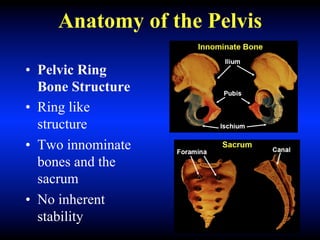
Anatomy of the Pelvis
• Pelvic Ring
Bone Structure
• Ring like
structure
• Two innominate
bones and the
sacrum
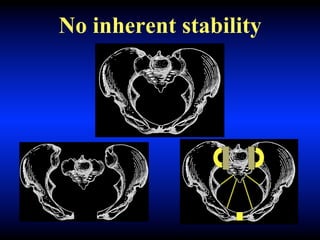
• No inherent
stability
No inherent stability
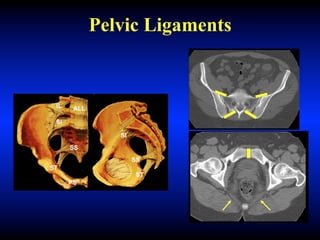
Pelvic Ligaments
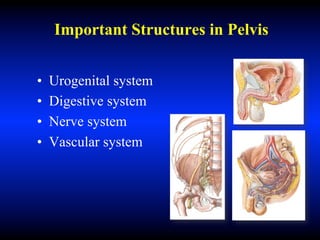
Important Structures in Pelvis
• Urogenital system
• Digestive system
• Nerve system
• Vascular system
Pelvic Trauma
• High association with other injuries
• Major external forces required
• Proximity to major vessels
• Highly vascularized cancellous bone
Pelvic Trauma
• Greatest mortality rate of skeletal injury
• Retroperitoneal bleeding
• Overall pelvic fracture mortality : 16%
• Closed pelvic fracture & instability
mortality : 27%
• Open pelvic fracture & instability
mortality : 55%
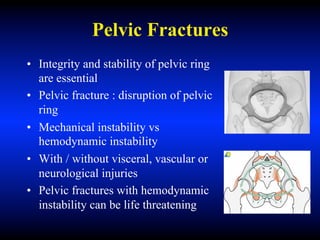
Pelvic Fractures
• Integrity and stability of pelvic ring
are essential
• Pelvic fracture : disruption of pelvic
ring
• Mechanical instability vs
hemodynamic instability
• With / without visceral, vascular or
neurological injuries
• Pelvic fractures with hemodynamic
instability can be life threatening
Mechanism of injuries
• Motor vehicle accidents
• Falls
• Crushing injuries
• Working forces :
– Lateral compression
– AP compression
– Vertical shears
– Combined
Minor Pelvic Fractures
• Pelvic ring is still stable
• No damage to the major intrapelvic
structures
Major Pelvic Fractures
• Displacement of part of the pelvis
• Diastasis of the pelvis, disruption of
sacro-iliac joints, severe bleeding and
upward displacement of the pelvis
Complication of pelvic
fracture
• Rupture of the bladder
• Rupture of the urethra
• Sciatic nerve lesion
• Lumbosacral plexus damage
• Major vessel damage
• Massive retroperitoneal haemorrhage
• Paralytic ileus
• Intestinal and rectal damage
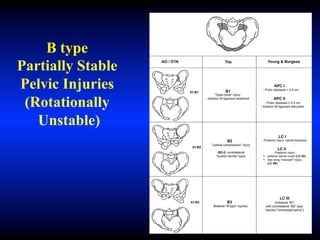
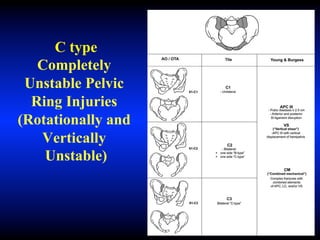
Pelvic Fracture Classification
• Many classifications
• AO/OTA, Tile, Young & Burgess
• Based on the concept of stability, force
direction and pathoanatomy
• Guide to treatment and allow centres to
compare results of similar cases
A type
Stable Pelvic
Ring Injuries
B type
Partially Stable
Pelvic Injuries
(Rotationally
Unstable)
C type
Completely
Unstable Pelvic
Ring Injuries
(Rotationally and
Vertically
Unstable)
Management of pelvic
injuries
• Assessment
• Resuscitation
• Provisional stabilisation
Assessment
• General assessment : ATLS (Primary &
Secondary Survey)
• Clinical assessment : important,
determine pelvic stability
• Radiographic assessment
Assessment
• General assessment : ATLS (Primary
& Secondary Survey)
• Clinical assessment
• Radiographic assessment
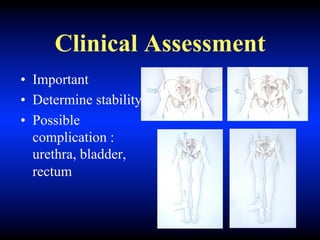
Clinical Assessment
• Important
• Determine stability
• Possible
complication :
urethra, bladder,
rectum
Assessment
• General assessment : ATLS (Primary
& Secondary Survey)
• Clinical assessment
• Radiographic assessment
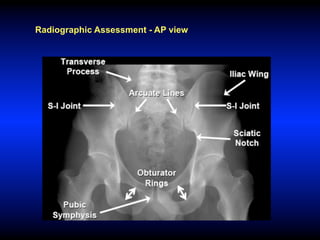
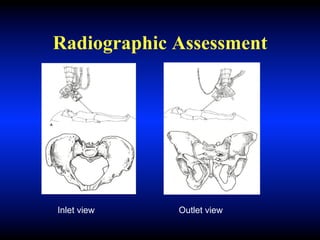
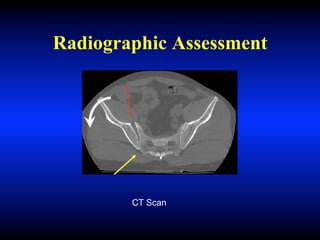
Radiographic Assessment
• Plain X-ray :
– AP : in acute/resuscitation phase
– Inlet view : posterior displacement
– Outlet view : superior/inferior migration
• CT scan
Radiographic Assessment - AP view
Radiographic Assessment
Inlet view Outlet view
Radiographic Assessment
CT Scan
Resuscitation
• Hemorrhage in pelvic trauma : life
threatening
• Site of bleeding : FAST, DPL, CT scan
• Rapid and aggressive resuscitation
• Massive fluid replacement
Source of bleeding
• Vein and fracture surface (85-90%)
• Arterial (10-15%)
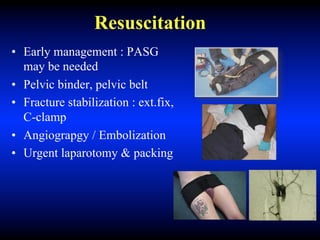
Resuscitation
• Early management : PASG
may be needed
• Pelvic binder, pelvic belt
• Fracture stabilization : ext.fix,
C-clamp
• Angiograpgy / Embolization
• Urgent laparotomy & packing
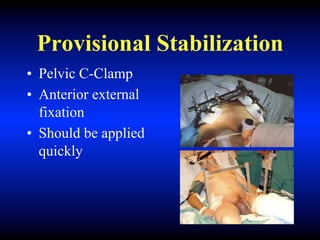
Provisional Stabilization
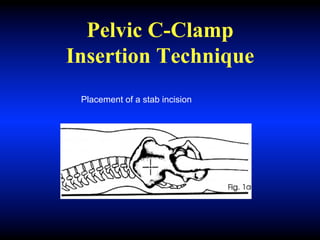
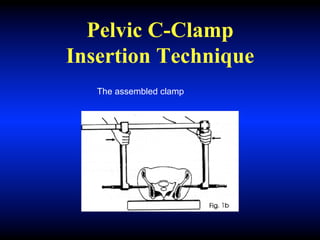
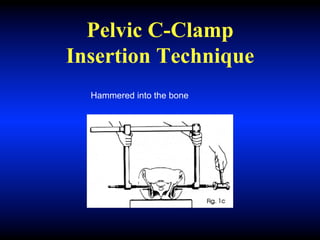
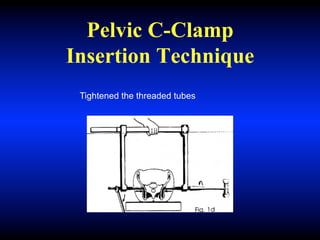
• Pelvic C-Clamp
• Anterior external
fixation
• Should be applied
quickly
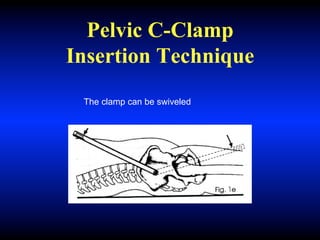
Pelvic C-Clamp
Indication & Contra indication
• Direct posterior compression & stabilization
• Decreasing pelvic volume, enhance self-tamponade
and support for pelvic packing
• Unobstructed access to the abdomen
• Indication : posteriorly unstable pelvic injury &
hemodynamically unstable px
• Contraindication : hemodynamically stable px and
posterior iliac wing fractures
Pelvic C-Clamp
Insertion Technique
Placement of a stab incision
Pelvic C-Clamp
Insertion Technique
The assembled clamp
Pelvic C-Clamp
Insertion Technique
Hammered into the bone
Pelvic C-Clamp
Insertion Technique
Tightened the threaded tubes
Pelvic C-Clamp
Insertion Technique
The clamp can be swiveled
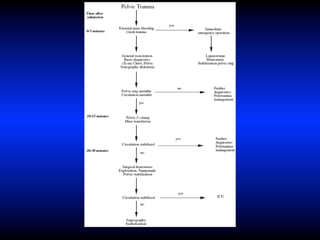
Emergency Treatment
Algorithms
• Many different algorithms
• Depend on the facilities and capabilities
• Goal : to simplify the decision making
• Internal fixation of major pelvic
fractures in haemodynamic
unstable patient is contra
indicated
Summary
• Disruption of the pelvic ring integrity
may cause mechanical instability of the
pelvis
• Gross mechanical instability may be
associated with hemodynamic
instability
• Be aware of associated injuries
• Aggressive resuscitation and early
stabilization are mandatory in
haemodynamically unstable patient
Terima Kasih

Pelvis Fracture.pdf