Shita Dewi
The Health Policymaking
Process And The Role Of
Research Evidence In
Health Policy Decisions
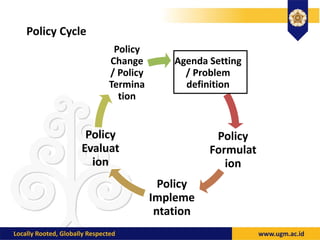
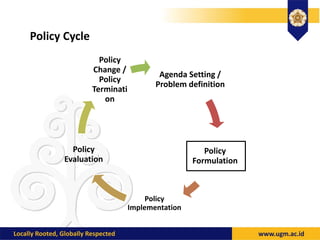
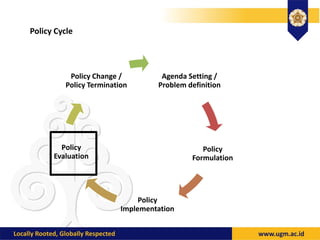
Policy Cycle
Agenda Setting
/ Problem
definition
Policy
Formulat
ion
Policy
Impleme
ntation
Policy
Evaluat
ion
Policy
Change
/ Policy
Termina
tion
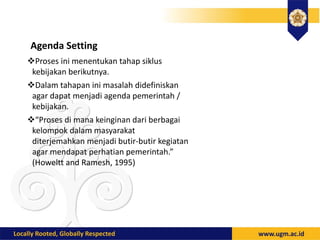
Agenda Setting
Proses ini menentukan tahap siklus
kebijakan berikutnya.
Dalam tahapan ini masalah didefiniskan
agar dapat menjadi agenda pemerintah /
kebijakan.
“Proses di mana keinginan dari berbagai
kelompok dalam masyarakat
diterjemahkan menjadi butir-butir kegiatan
agar mendapat perhatian pemerintah.”
(Howeltt and Ramesh, 1995)
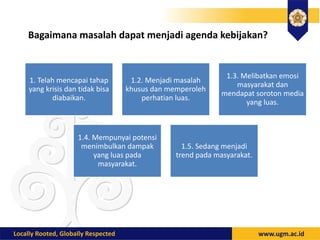
Bagaimana masalah dapat menjadi agenda kebijakan?
1. Telah mencapai tahap
yang krisis dan tidak bisa
diabaikan.
1.2. Menjadi masalah
khusus dan memperoleh
perhatian luas.
1.3. Melibatkan emosi
masyarakat dan
mendapat soroton media
yang luas.
1.4. Mempunyai potensi
menimbulkan dampak
yang luas pada
masyarakat.
1.5. Sedang menjadi
trend pada masyarakat.
Policy Cycle
Agenda Setting /
Problem definition
Policy
Formulation
Policy
Implementation
Policy
Evaluation
Policy
Change /
Policy
Terminati
on
Policy Formulation
 Apa rencana untuk mengatasi masalah?
 Apa tujuan prioritasnya?
 Apa pilihan yang tersedia untuk mencapai tujuan tersebut?
 Apa kekurangan dan kelibahan dari setiap alternative?
(Cochran and Malone, 1999)
Tahapan ini mencakup identifikasi dalam penyusunan
alternative kebijakan untuk mengatasi masalah.
Identifikasi alternative membutuhkan berbagai pendekatan
untuk menguji kelayakan.
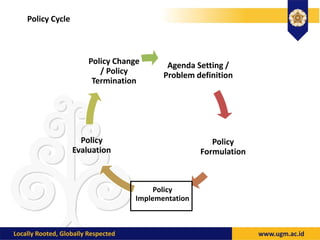
Agenda Setting /
Problem definition
Policy
Formulation
Policy
Implementation
Policy
Evaluation
Policy Change
/ Policy
Termination
Policy Cycle
Policy Implementation
“menerjemahkan kebijakan ke dalam tindakan” (Barret, 2004)
Dalam proses kebijakan ini, perumuskan kebijakan yang
baik dapat menjadi buruk dalam implementasi.
Banyak faktor yang akan mempengaruhi kesuksesan
dan kegagalan dalam implementasi kebijakan.
• Politik
• Birokrasi
• Sosial
• Ekonomi
• Teknologi
• Proses sebelumnya
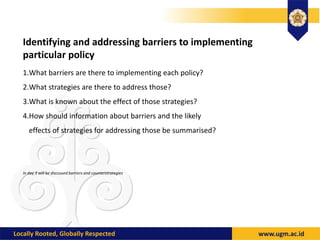
Identifying and addressing barriers to implementing
particular policy
1.What barriers are there to implementing each policy?
2.What strategies are there to address those?
3.What is known about the effect of those strategies?
4.How should information about barriers and the likely
effects of strategies for addressing those be summarised?
In day 3 will be discussed barriers and counterstrategies
Policy Cycle
Agenda Setting /
Problem definition
Policy
Formulation
Policy
Implementation
Policy
Evaluation
Policy Change /
Policy Termination
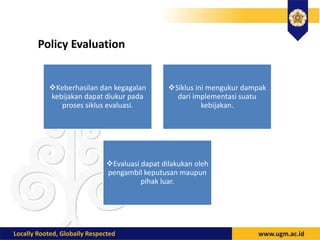
Policy Evaluation
Keberhasilan dan kegagalan
kebijakan dapat diukur pada
proses siklus evaluasi.
Siklus ini mengukur dampak
dari implementasi suatu
kebijakan.
Evaluasi dapat dilakukan oleh
pengambil keputusan maupun
pihak luar.
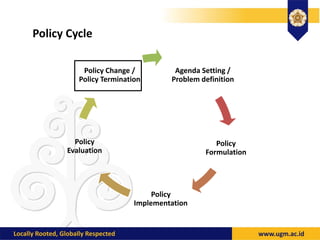
Policy Cycle
Agenda Setting /
Problem definition
Policy
Formulation
Policy
Implementation
Policy
Evaluation
Policy Change /
Policy Termination
The Role of Research Evidence
In Health Policy Decisions
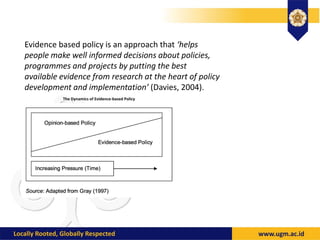
Evidence based policy is an approach that ‘helps
people make well informed decisions about policies,
programmes and projects by putting the best
available evidence from research at the heart of policy
development and implementation’ (Davies, 2004).
The Dynamics of Evidence-based Policy
Why we need evidence in policy making?
1. Understand the policy environment and how it’s changing.
2. Appraise the likely effects of policy changes so we can choose between
different policy options and subsequently assess their impacts.
3. Demonstrate the links between strategic direction, intended outcomes
and policy objectives, to show that there are clear lines of argument
and evidence between what we are aiming for and what we are doing
now.
4. Determine what we need to do to meet our strategic goals or
intermediate objectives.
5. Influence others so that they help us achieve our policy goals and take
them through to
6. delivery.
7. Communicate the quality (breadth and depth) of our evidence base to
meet the open government agenda.
(Shaxson, 2005)
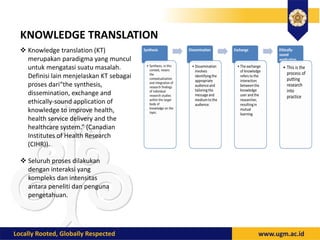
KNOWLEDGE TRANSLATION
 Knowledge translation (KT)
merupakan paradigma yang muncul
untuk mengatasi suatu masalah.
Definisi lain menjelaskan KT sebagai
proses dari“the synthesis,
dissemination, exchange and
ethically-sound application of
knowledge to improve health,
health service delivery and the
healthcare system.” (Canadian
Institutes of Health Research
(CIHR)).
 Seluruh proses dilakukan
dengan interaksi yang
kompleks dan intensitas
antara peneliti dan penguna
pengetahuan.
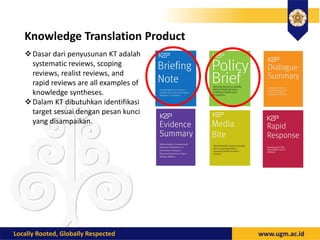
Knowledge Translation Product
Dasar dari penyusunan KT adalah
systematic reviews, scoping
reviews, realist reviews, and
rapid reviews are all examples of
knowledge syntheses.
Dalam KT dibutuhkan identifikasi
target sesuai dengan pesan kunci
yang disampaikan.
Policy Brief / Briefing Note: Introduction
 A policy brief / briefing note is a concise document
that explains a particular problem and options for
dealing with it. This document is intended for policy
makers to understand the problem and be interested
in adopting one or all options.
 Decision makers and stakeholders often appreciate
the summary of policies they receive.
 Policy brief can be evidence brief for policy.
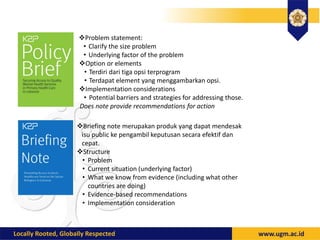
Problem statement:
• Clarify the size problem
• Underlying factor of the problem
Option or elements
• Terdiri dari tiga opsi terprogram
• Terdapat element yang menggambarkan opsi.
Implementation considerations
• Potential barriers and strategies for addressing those.
Does note provide recommendations for action
Briefing note merupakan produk yang dapat mendesak
isu public ke pengambil keputusan secara efektif dan
cepat.
Structure
• Problem
• Current situation (underlying factor)
• What we know from evidence (including what other
countries are doing)
• Evidence-based recommendations
• Implementation consideration
Tipe Policy Brief
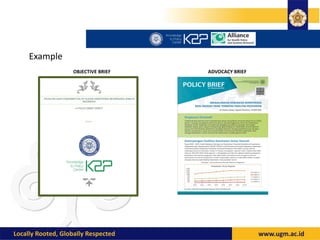
Example
1
2
OBJECTIVE BRIEF ADVOCACY BRIEF
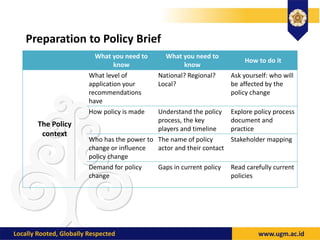
Siapa penulis policy brief? Siapa pembaca policy brief?
• Lembaga penelitian
• Think tanks
• NGO (non-government organization)
• Kelompok advokasi / jaringan / koalisi
• Institusi pemerintah
• Multilateral organization /
international organization
• Pengambil kebijakan
• Street bureaucracy / Praktisi
• Non akademis
• Pelaksana
Preparation to Policy Brief
What you need to
know
What you need to
know
How to do it
The Policy
context
What level of
application your
recommendations
have
National? Regional?
Local?
Ask yourself: who will
be affected by the
policy change
How policy is made Understand the policy
process, the key
players and timeline
Explore policy process
document and
practice
Who has the power to
change or influence
policy change
The name of policy
actor and their contact
Stakeholder mapping
Demand for policy
change
Gaps in current policy Read carefully current
policies
Kerangka Policy Brief
4 halaman
Biasanya mencakup:
• Ringkasan Eksekutif
• Pendahuluan
• Hasil/Diskusi dan Kesimpulan
• Rekomendasi
Pendahuluan
MASALAH/ISU YANG AKAN DIBAHAS
Disiapkan:
 Data [data sekunder, hasil survey, hasil
observasi, hasil indepth interview, hasil
FGD, analisis isi surat kabar
lokal/nasional, foto]
Nyatakan seberapa besar masalahnya
Apa masalah utamanya:
• Kebijakannya: isinya kurang jelas?
Bertentangan dengan aturan lain?
• Pelaksanaannya: ada yg tidak
menjalankan perannya? Tidak sesuai
dengan konteksnya?
Target: 3-4 paragraph (0.5 halaman)
Hasil & Diskusi
APA YANG MENYEBABKAN TERJADINYA
MASALAH/ISU TERSEBUT?
Disiapkan:
 Data [data sekunder, hasil survey, hasil
observasi, hasil indepth interview, hasil
FGD, analisis isi surat kabar lokal/nasional,
foto]
 Dukungan argumen dari buku/jurnal
 Kebijakan existing dari pemerintah
/pemda untuk mengetahui apa yang sudah
dilakukan pemerintah untuk mengatasi
masalah yang kita bahas
Nyatakan:
 Analisis situasi atas masalah/isu.
 Mengkaji keterkaitan antara kebijakan
dengan situasi yang terjadi
Target: 1.5 halaman
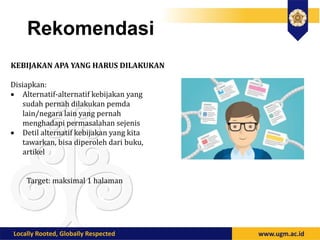
Rekomendasi
KEBIJAKAN APA YANG HARUS DILAKUKAN
Disiapkan:
 Alternatif-alternatif kebijakan yang
sudah pernah dilakukan pemda
lain/negara lain yang pernah
menghadapi permasalahan sejenis
 Detil alternatif kebijakan yang kita
tawarkan, bisa diperoleh dari buku,
artikel
Target: maksimal 1 halaman
Judul
Menggambarkan isu/masalah yang
menjadi concern penulis
Ringkasan
Eksekutif
What, where, why, who, when,
how
Target: 1 paragraf
The Concept of a Problem in Policy
Perumusan Masalah Kebijakan adalah tahap
terpenting dalam siklus kebijakan: masalah
yang tepat = setengah masalah selesai
Error tipe 3: “policy analysts fail more often
because they formulate the wrong problem
than because they choose the wrong solution”
(Dunn 1988, 720)
Karakter masalah
 Wicked: complex, open-ended, and intractable (Head
2008)
 Messy: so uncertain, complex, interrupted, and
highly disputed (Roe 2013)
 Kompleks: multi-dimensi, multi-sebab, multi-akibat
 Moving object = temporality
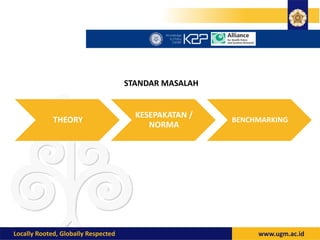
THEORY
KESEPAKATAN /
NORMA
BENCHMARKING
STANDAR MASALAH
Problem Statement
• Identifikasi masalah publik selalu
melibatkan political framing yang
menyentuh sistem dan aktor politik di
mana kebijakan akan dibuat = Policy
Window.
• Framing of problem is evidence-
informed, contextualized, and engaging
with a focus on health outcomes.
Framing Problem Statement
1.Focusing events (eg. Ibu hamil yang melakukan
persalinan di desa dengan metode tradisional
mengalami risiko kematian tinggi dan
kompleksitas.)
2.A change in an indicator (eg. Drop in SDGs, or
development plan target)
3.Konsekuensi jika diabaikan
4.Dampak untuk Kesehatan dan ekonomi
Latihan Problem Statement:
Problem Statement 2
Indonesia is included to the top 5 countries for Sugar Sweetened Beverages (SSBs)
consumption (20,23 liter/person/year) in South East Asia. The high consumption of SSBs
contributes to the high mortality and morbidity of diabetes mellitus, obesity and also the
higher healthcare cost. The high consumption of SSBs also caused by easy access and
affordability, less regulation, industry interference, and the marketing strategy.
Problem Statement 1
Indonesia memiliki jumlah konsumsi SSBs yang tinggi pada setiap tahun. Tingginya konsumsi
tersebut membuat Indonesia menjadi daya tarik bagi investor industry SSBs. Disisi lain,
konsumsi dan industry juga berkontribusi kepada pendapatan negara yang meningkat pada
setiap tahun. Akan tetapi, pemerintah belum mempertimbangkan dampak Kesehatan dari
perilaku konsumsi masyarakat.
How to write problem in policy brief?
1.Problem statement
2.Consequences of inaction
3.How does the problem relate to a risk factor, disease
or condition?
4.How does the problem relate to a program, service or
drug currently being used?
Terimakasih
pkmkdivisiph@gmail.com

Pelatihan PB 11 Agustus-1.pdf

  • 1.
    Shita Dewi The HealthPolicymaking Process And The Role Of Research Evidence In Health Policy Decisions
  • 2.
    Policy Cycle Agenda Setting /Problem definition Policy Formulat ion Policy Impleme ntation Policy Evaluat ion Policy Change / Policy Termina tion
  • 3.
    Agenda Setting Proses inimenentukan tahap siklus kebijakan berikutnya. Dalam tahapan ini masalah didefiniskan agar dapat menjadi agenda pemerintah / kebijakan. “Proses di mana keinginan dari berbagai kelompok dalam masyarakat diterjemahkan menjadi butir-butir kegiatan agar mendapat perhatian pemerintah.” (Howeltt and Ramesh, 1995)
  • 4.
    Bagaimana masalah dapatmenjadi agenda kebijakan? 1. Telah mencapai tahap yang krisis dan tidak bisa diabaikan. 1.2. Menjadi masalah khusus dan memperoleh perhatian luas. 1.3. Melibatkan emosi masyarakat dan mendapat soroton media yang luas. 1.4. Mempunyai potensi menimbulkan dampak yang luas pada masyarakat. 1.5. Sedang menjadi trend pada masyarakat.
  • 5.
    Policy Cycle Agenda Setting/ Problem definition Policy Formulation Policy Implementation Policy Evaluation Policy Change / Policy Terminati on
  • 6.
    Policy Formulation  Aparencana untuk mengatasi masalah?  Apa tujuan prioritasnya?  Apa pilihan yang tersedia untuk mencapai tujuan tersebut?  Apa kekurangan dan kelibahan dari setiap alternative? (Cochran and Malone, 1999) Tahapan ini mencakup identifikasi dalam penyusunan alternative kebijakan untuk mengatasi masalah. Identifikasi alternative membutuhkan berbagai pendekatan untuk menguji kelayakan.
  • 7.
    Agenda Setting / Problemdefinition Policy Formulation Policy Implementation Policy Evaluation Policy Change / Policy Termination Policy Cycle
  • 8.
    Policy Implementation “menerjemahkan kebijakanke dalam tindakan” (Barret, 2004) Dalam proses kebijakan ini, perumuskan kebijakan yang baik dapat menjadi buruk dalam implementasi. Banyak faktor yang akan mempengaruhi kesuksesan dan kegagalan dalam implementasi kebijakan. • Politik • Birokrasi • Sosial • Ekonomi • Teknologi • Proses sebelumnya
  • 9.
    Identifying and addressingbarriers to implementing particular policy 1.What barriers are there to implementing each policy? 2.What strategies are there to address those? 3.What is known about the effect of those strategies? 4.How should information about barriers and the likely effects of strategies for addressing those be summarised? In day 3 will be discussed barriers and counterstrategies
  • 10.
    Policy Cycle Agenda Setting/ Problem definition Policy Formulation Policy Implementation Policy Evaluation Policy Change / Policy Termination
  • 11.
    Policy Evaluation Keberhasilan dankegagalan kebijakan dapat diukur pada proses siklus evaluasi. Siklus ini mengukur dampak dari implementasi suatu kebijakan. Evaluasi dapat dilakukan oleh pengambil keputusan maupun pihak luar.
  • 12.
    Policy Cycle Agenda Setting/ Problem definition Policy Formulation Policy Implementation Policy Evaluation Policy Change / Policy Termination
  • 13.
    The Role ofResearch Evidence In Health Policy Decisions
  • 14.
    Evidence based policyis an approach that ‘helps people make well informed decisions about policies, programmes and projects by putting the best available evidence from research at the heart of policy development and implementation’ (Davies, 2004). The Dynamics of Evidence-based Policy
  • 15.
    Why we needevidence in policy making? 1. Understand the policy environment and how it’s changing. 2. Appraise the likely effects of policy changes so we can choose between different policy options and subsequently assess their impacts. 3. Demonstrate the links between strategic direction, intended outcomes and policy objectives, to show that there are clear lines of argument and evidence between what we are aiming for and what we are doing now. 4. Determine what we need to do to meet our strategic goals or intermediate objectives. 5. Influence others so that they help us achieve our policy goals and take them through to 6. delivery. 7. Communicate the quality (breadth and depth) of our evidence base to meet the open government agenda. (Shaxson, 2005)
  • 16.
    KNOWLEDGE TRANSLATION  Knowledgetranslation (KT) merupakan paradigma yang muncul untuk mengatasi suatu masalah. Definisi lain menjelaskan KT sebagai proses dari“the synthesis, dissemination, exchange and ethically-sound application of knowledge to improve health, health service delivery and the healthcare system.” (Canadian Institutes of Health Research (CIHR)).  Seluruh proses dilakukan dengan interaksi yang kompleks dan intensitas antara peneliti dan penguna pengetahuan.
  • 17.
    Knowledge Translation Product Dasardari penyusunan KT adalah systematic reviews, scoping reviews, realist reviews, and rapid reviews are all examples of knowledge syntheses. Dalam KT dibutuhkan identifikasi target sesuai dengan pesan kunci yang disampaikan.
  • 18.
    Policy Brief /Briefing Note: Introduction  A policy brief / briefing note is a concise document that explains a particular problem and options for dealing with it. This document is intended for policy makers to understand the problem and be interested in adopting one or all options.  Decision makers and stakeholders often appreciate the summary of policies they receive.  Policy brief can be evidence brief for policy.
  • 19.
    Problem statement: • Clarifythe size problem • Underlying factor of the problem Option or elements • Terdiri dari tiga opsi terprogram • Terdapat element yang menggambarkan opsi. Implementation considerations • Potential barriers and strategies for addressing those. Does note provide recommendations for action Briefing note merupakan produk yang dapat mendesak isu public ke pengambil keputusan secara efektif dan cepat. Structure • Problem • Current situation (underlying factor) • What we know from evidence (including what other countries are doing) • Evidence-based recommendations • Implementation consideration
  • 20.
  • 21.
  • 22.
    Siapa penulis policybrief? Siapa pembaca policy brief? • Lembaga penelitian • Think tanks • NGO (non-government organization) • Kelompok advokasi / jaringan / koalisi • Institusi pemerintah • Multilateral organization / international organization • Pengambil kebijakan • Street bureaucracy / Praktisi • Non akademis • Pelaksana
  • 23.
    Preparation to PolicyBrief What you need to know What you need to know How to do it The Policy context What level of application your recommendations have National? Regional? Local? Ask yourself: who will be affected by the policy change How policy is made Understand the policy process, the key players and timeline Explore policy process document and practice Who has the power to change or influence policy change The name of policy actor and their contact Stakeholder mapping Demand for policy change Gaps in current policy Read carefully current policies
  • 24.
    Kerangka Policy Brief 4halaman Biasanya mencakup: • Ringkasan Eksekutif • Pendahuluan • Hasil/Diskusi dan Kesimpulan • Rekomendasi
  • 25.
    Pendahuluan MASALAH/ISU YANG AKANDIBAHAS Disiapkan:  Data [data sekunder, hasil survey, hasil observasi, hasil indepth interview, hasil FGD, analisis isi surat kabar lokal/nasional, foto] Nyatakan seberapa besar masalahnya Apa masalah utamanya: • Kebijakannya: isinya kurang jelas? Bertentangan dengan aturan lain? • Pelaksanaannya: ada yg tidak menjalankan perannya? Tidak sesuai dengan konteksnya? Target: 3-4 paragraph (0.5 halaman)
  • 26.
    Hasil & Diskusi APAYANG MENYEBABKAN TERJADINYA MASALAH/ISU TERSEBUT? Disiapkan:  Data [data sekunder, hasil survey, hasil observasi, hasil indepth interview, hasil FGD, analisis isi surat kabar lokal/nasional, foto]  Dukungan argumen dari buku/jurnal  Kebijakan existing dari pemerintah /pemda untuk mengetahui apa yang sudah dilakukan pemerintah untuk mengatasi masalah yang kita bahas Nyatakan:  Analisis situasi atas masalah/isu.  Mengkaji keterkaitan antara kebijakan dengan situasi yang terjadi Target: 1.5 halaman
  • 27.
    Rekomendasi KEBIJAKAN APA YANGHARUS DILAKUKAN Disiapkan:  Alternatif-alternatif kebijakan yang sudah pernah dilakukan pemda lain/negara lain yang pernah menghadapi permasalahan sejenis  Detil alternatif kebijakan yang kita tawarkan, bisa diperoleh dari buku, artikel Target: maksimal 1 halaman
  • 28.
    Judul Menggambarkan isu/masalah yang menjadiconcern penulis Ringkasan Eksekutif What, where, why, who, when, how Target: 1 paragraf
  • 29.
    The Concept ofa Problem in Policy Perumusan Masalah Kebijakan adalah tahap terpenting dalam siklus kebijakan: masalah yang tepat = setengah masalah selesai Error tipe 3: “policy analysts fail more often because they formulate the wrong problem than because they choose the wrong solution” (Dunn 1988, 720)
  • 30.
    Karakter masalah  Wicked:complex, open-ended, and intractable (Head 2008)  Messy: so uncertain, complex, interrupted, and highly disputed (Roe 2013)  Kompleks: multi-dimensi, multi-sebab, multi-akibat  Moving object = temporality
  • 31.
  • 32.
    Problem Statement • Identifikasimasalah publik selalu melibatkan political framing yang menyentuh sistem dan aktor politik di mana kebijakan akan dibuat = Policy Window. • Framing of problem is evidence- informed, contextualized, and engaging with a focus on health outcomes.
  • 33.
    Framing Problem Statement 1.Focusingevents (eg. Ibu hamil yang melakukan persalinan di desa dengan metode tradisional mengalami risiko kematian tinggi dan kompleksitas.) 2.A change in an indicator (eg. Drop in SDGs, or development plan target) 3.Konsekuensi jika diabaikan 4.Dampak untuk Kesehatan dan ekonomi
  • 34.
    Latihan Problem Statement: ProblemStatement 2 Indonesia is included to the top 5 countries for Sugar Sweetened Beverages (SSBs) consumption (20,23 liter/person/year) in South East Asia. The high consumption of SSBs contributes to the high mortality and morbidity of diabetes mellitus, obesity and also the higher healthcare cost. The high consumption of SSBs also caused by easy access and affordability, less regulation, industry interference, and the marketing strategy. Problem Statement 1 Indonesia memiliki jumlah konsumsi SSBs yang tinggi pada setiap tahun. Tingginya konsumsi tersebut membuat Indonesia menjadi daya tarik bagi investor industry SSBs. Disisi lain, konsumsi dan industry juga berkontribusi kepada pendapatan negara yang meningkat pada setiap tahun. Akan tetapi, pemerintah belum mempertimbangkan dampak Kesehatan dari perilaku konsumsi masyarakat.
  • 35.
    How to writeproblem in policy brief? 1.Problem statement 2.Consequences of inaction 3.How does the problem relate to a risk factor, disease or condition? 4.How does the problem relate to a program, service or drug currently being used?
  • 36.