PEDIGREE ANALYSIS
AND
PATTERNS OF
INHERITANCE
Mrs. Jennifer Lawrence Tellis
Institute of Science, Nirma University
PEDIGREE
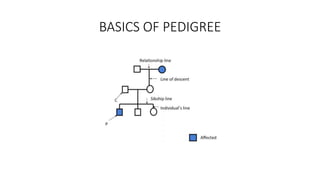
BASICS OF PEDIGREE
PATTERNS OF INHERITANCE
Mendelian
Autosomal
dominant
Autosomal
recessive
X-linked
Y-linked
Non-Mendelian
Mitochondrial
inheritance
Genomic
imprinting
Unstable repeat
expansions
Uniparental disomy
Mosaicism
Multigenic
inheritance
AUTOSOMAL DOMINANT INHERITANCE
FEATURES:
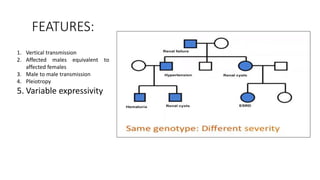
1. Vertical transmission
2. Affected males equivalent
to affected females
3. Male to male transmission
1. Vertical transmission
2. Affected males equivalent to
affected females
3. Male to male transmission
4. Pleiotropy
FEATURES:
FEATURES:
1. Vertical transmission
2. Affected males equivalent to
affected females
3. Male to male transmission
4. Pleiotropy
5. Variable expressivity
FEATURES:
1. Vertical transmission
2. Affected males equivalent to
affected females
3. Male to male transmission
4. Pleiotropy
5. Variable expressivity
6. Decreased penetrance
FEATURES:
1. Vertical transmission
2. Affected males equivalent to
affected females
3. Male to male transmission
4. Pleiotropy
5. Variable expressivity
6. Decreased penetrance
7. Recurrence risk
AUTOSOMAL RECESSIVE INHERITANCE
FEATURES:
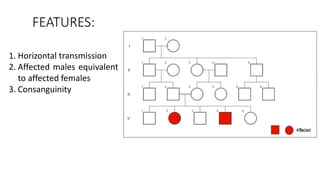
1. Horizontal transmission
2. Affected males equivalent
to affected females
3. Consanguinity
FEATURES:
1. Horizontal transmission
2. Affected males equivalent to affected
females
3. Consanguinity
4. Recurrence risk
X- LINKED INHERITANCE
• Dominant / recessive will depend on the phenotype in heterozygous
females
• Considered a spectrum of disorders instead of dominant or recessive
FEATURES:
1. Dominant or Recessive?
FEATURES:
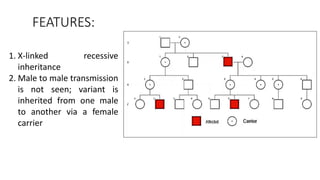
1. X-linked recessive
inheritance
2. Male to male transmission
is not seen; variant is
inherited from one male
to another via a female
carrier
FEATURES:
1. X-linked recessive inheritance
2. Male to male transmission is not seen;
variant is inherited from one male to
another via a female carrier
3. Affected females in
special cases: Turner
syndrome, X-autosome
translocation, etc.
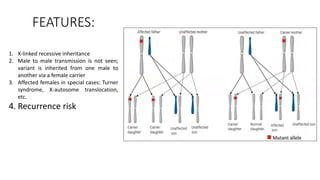
FEATURES:
1. X-linked recessive inheritance
2. Male to male transmission is not seen;
variant is inherited from one male to
another via a female carrier
3. Affected females in special cases: Turner
syndrome, X-autosome translocation,
etc.
4. Recurrence risk
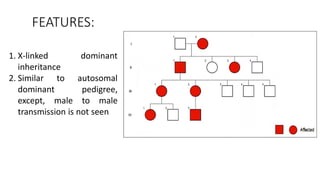
FEATURES:
1. X-linked dominant
inheritance
2. Similar to autosomal
dominant pedigree,
except, male to male
transmission is not seen
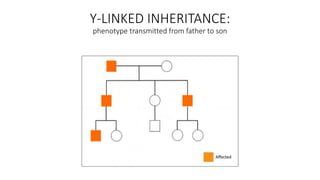
Y-LINKED INHERITANCE:
phenotype transmitted from father to son
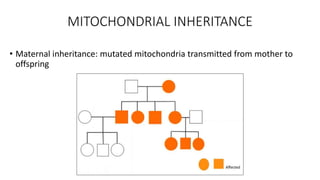
MITOCHONDRIAL INHERITANCE
• Maternal inheritance: mutated mitochondria transmitted from mother to
offspring
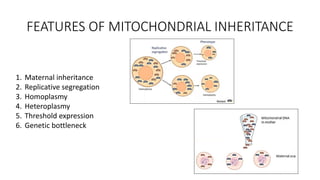
FEATURES OF MITOCHONDRIAL INHERITANCE
1. Maternal inheritance
2. Replicative segregation
3. Homoplasmy
4. Heteroplasmy
5. Threshold expression
6. Genetic bottleneck
UNSTABLE REPEAT EXPANSIONS
• Unstable expansion of repeating units of three or more nucleotides in
tandem
• Features:
1. Anticipation
• Examples:
1. Fragile X syndrome: CGG
2. Huntington disease: CAG
GENOMIC IMPRINTING
• Phenotypic expression of alleles depends on the parent of origin
• Epigenetic phenomenon
• Examples: Angelman syndrome, Prader- Willi syndrome
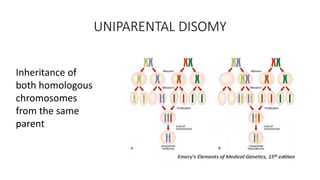
UNIPARENTAL DISOMY
Inheritance of
both homologous
chromosomes
from the same
parent
MOSAICISM
• Presence of more than one cell type
• Error in mitosis after conception
• Somatic cells/ germline cells
• Variable severity of clinical features
MULTIGENIC INHERITANCE
• This is a result of combined
effect of more than one gene
• Complex traits are a result of
environmental factors and
multiple genes

PEDIGREE ANALYSIS.pptx