Game Sense Approach 
• What is it? 
• Game Sense Model 
• Why use Game Sense? 
“When are we going to play a game?”
What is it? 
“When are we going to play a game?” is the most 
common question my students ask me when we 
begin our Physical Education lessons. 
Game Sense is a relatively new method of teaching in PE 
classes that focuses more on the game rather than technique. 
This allows students/players to make better more tactful and 
strategic decisions during the game, whilst enabling them to 
develop skills in a more realistic and fun environment. 
There are 4 Types of Game Sense Categories: 
• Invasion Games: Soccer, Touch Football, Netball etc. 
• Target Games: Archery, Golf, Lawn Bowls/Bowling etc. 
• Court/Net Games: Tennis & Volleyball etc. 
• Striking & Fielding Games: Cricket & Baseball etc. 
Towns. J., (2002) About Game Sense, University of Wollongong
What is it Cont. 
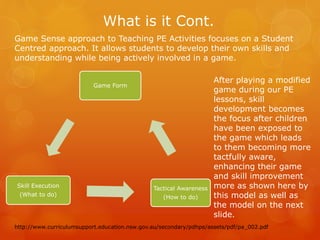
Game Sense approach to Teaching PE Activities focuses on a Student 
Centred approach. It allows students to develop their own skills and 
understanding while being actively involved in a game. 
Game Form 
Tactical Awareness 
(How to do) 
Skill Execution 
(What to do) 
After playing a modified 
game during our PE 
lessons, skill 
development becomes 
the focus after children 
have been exposed to 
the game which leads 
to them becoming more 
tactfully aware, 
enhancing their game 
and skill improvement 
more as shown here by 
this model as well as 
the model on the next 
slide. 
http://www.curriculumsupport.education.nsw.gov.au/secondary/pdhpe/assets/pdf/pa_002.pdf
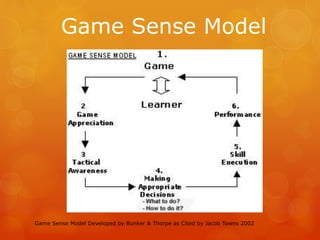
Game Sense Model 
Game Sense Model Developed by Bunker & Thorpe as Cited by Jacob Towns 2002
Why use a Game Sense 
Approach? 
The reason I choose to use the Game Sense approach in my 
class room is that it has many strengths and many connections 
to the NSW Board of Studies PDHPE K-6 Syllabus (NSW Board of Studies, 
2006). 
• Communication: COS3.1 Communicates confidently in a variety of 
situations (p 21). The Game sense approach puts players in a situation 
where they must become tactical and strategic – this encourages them 
to communicate with their peers to better enhance their skills. 
• Decision Making: DMS3.2 Makes informed decisions and accepts 
responsibility for consequences (p 22). The cycle of the game sense 
approach allow students to get a feel for the game, develop their skills 
and put their skills to use – based on this they must make informed 
decisions about what they have learned and how they are going to 
execute that skill and accept the responsibility for the outcome. 
• Moving: MOS3.4 Refines and applies movement skills creatively to a 
variety of challenging situations (p 24). This teaching approach puts 
students in a challenging position where they must move and interact 
with other students to gain a positive outcome which also enables them 
to better develop their movement skills in relation to the game.
Continued… 
• Games and Sports: GSS3.8 Applies movement skills in games and 
sports that require communication, cooperation, decision making 
and observation of rules (p 28). The Game Sense approach 
enables students to communicate and cooperate with one another 
to achieve a common goal. They must also make decisions to 
achieve this goal based on previous knowledge and also 
knowledge of the rules. 
I believe that the Game Sense approach, to put in laymen's terms, 
throws students into the deep end. While they must make decisions 
and communicate and become actively involved in the game, as 
shown in the model this form of teaching also allows for reflection. It 
enables students to ask questions based on an action or decision they 
have made such as “why did I do that? Did that work well for me? 
How can I make an improvement?” etc. Being able to reflect enables 
students to better enhance their skills and enjoyment of an activity or 
game.
References 
• NSW Department of Education and Communities. (n.d.). 
Game Sense approach to Practical Lessons. Retrieved 
from 
http://www.curriculumsupport.education.nsw.gov.au/se 
condary/pdhpe/assets/pdf/pa_002.pdf 
• Towns, J. (2002). About Game Sense. University of 
Wollongong 
• New South Wales Government, Board of Studies. (2006). 
Syllabus: Personal Development, Health and Physical 
Education K-6. Sydney, Australia: Board of Studies NSW.

PDHPE weebly powerpoint

  • 1.
    Game Sense Approach • What is it? • Game Sense Model • Why use Game Sense? “When are we going to play a game?”
  • 2.
    What is it? “When are we going to play a game?” is the most common question my students ask me when we begin our Physical Education lessons. Game Sense is a relatively new method of teaching in PE classes that focuses more on the game rather than technique. This allows students/players to make better more tactful and strategic decisions during the game, whilst enabling them to develop skills in a more realistic and fun environment. There are 4 Types of Game Sense Categories: • Invasion Games: Soccer, Touch Football, Netball etc. • Target Games: Archery, Golf, Lawn Bowls/Bowling etc. • Court/Net Games: Tennis & Volleyball etc. • Striking & Fielding Games: Cricket & Baseball etc. Towns. J., (2002) About Game Sense, University of Wollongong
  • 3.
    What is itCont. Game Sense approach to Teaching PE Activities focuses on a Student Centred approach. It allows students to develop their own skills and understanding while being actively involved in a game. Game Form Tactical Awareness (How to do) Skill Execution (What to do) After playing a modified game during our PE lessons, skill development becomes the focus after children have been exposed to the game which leads to them becoming more tactfully aware, enhancing their game and skill improvement more as shown here by this model as well as the model on the next slide. http://www.curriculumsupport.education.nsw.gov.au/secondary/pdhpe/assets/pdf/pa_002.pdf
  • 4.
    Game Sense Model Game Sense Model Developed by Bunker & Thorpe as Cited by Jacob Towns 2002
  • 5.
    Why use aGame Sense Approach? The reason I choose to use the Game Sense approach in my class room is that it has many strengths and many connections to the NSW Board of Studies PDHPE K-6 Syllabus (NSW Board of Studies, 2006). • Communication: COS3.1 Communicates confidently in a variety of situations (p 21). The Game sense approach puts players in a situation where they must become tactical and strategic – this encourages them to communicate with their peers to better enhance their skills. • Decision Making: DMS3.2 Makes informed decisions and accepts responsibility for consequences (p 22). The cycle of the game sense approach allow students to get a feel for the game, develop their skills and put their skills to use – based on this they must make informed decisions about what they have learned and how they are going to execute that skill and accept the responsibility for the outcome. • Moving: MOS3.4 Refines and applies movement skills creatively to a variety of challenging situations (p 24). This teaching approach puts students in a challenging position where they must move and interact with other students to gain a positive outcome which also enables them to better develop their movement skills in relation to the game.
  • 6.
    Continued… • Gamesand Sports: GSS3.8 Applies movement skills in games and sports that require communication, cooperation, decision making and observation of rules (p 28). The Game Sense approach enables students to communicate and cooperate with one another to achieve a common goal. They must also make decisions to achieve this goal based on previous knowledge and also knowledge of the rules. I believe that the Game Sense approach, to put in laymen's terms, throws students into the deep end. While they must make decisions and communicate and become actively involved in the game, as shown in the model this form of teaching also allows for reflection. It enables students to ask questions based on an action or decision they have made such as “why did I do that? Did that work well for me? How can I make an improvement?” etc. Being able to reflect enables students to better enhance their skills and enjoyment of an activity or game.
  • 7.
    References • NSWDepartment of Education and Communities. (n.d.). Game Sense approach to Practical Lessons. Retrieved from http://www.curriculumsupport.education.nsw.gov.au/se condary/pdhpe/assets/pdf/pa_002.pdf • Towns, J. (2002). About Game Sense. University of Wollongong • New South Wales Government, Board of Studies. (2006). Syllabus: Personal Development, Health and Physical Education K-6. Sydney, Australia: Board of Studies NSW.